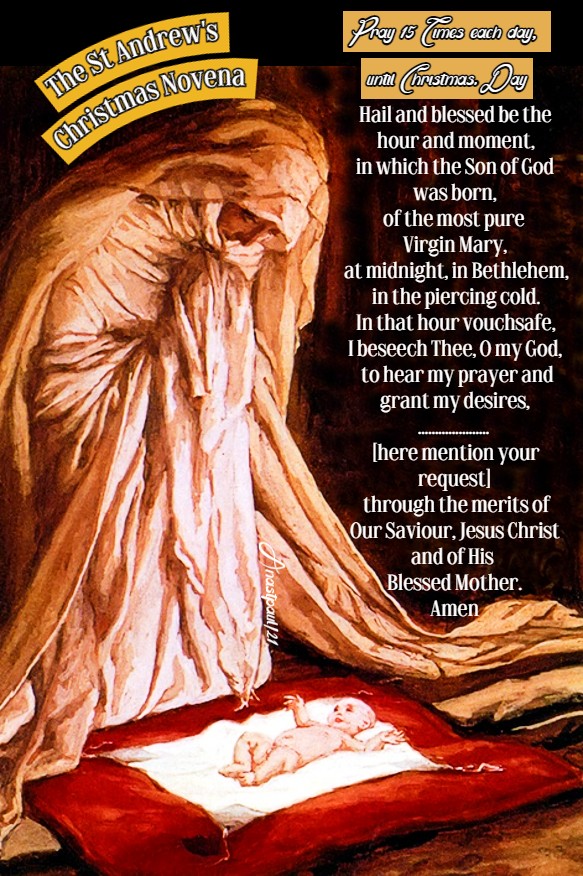
The St Andrew’s Christmas Novena The Christmas Anticipation Prayer
The Novena is not actually addressed to Saint Andrew but to God Himself, asking Him to grant our request in honour of the birth of His Son at Christmas. You can say the prayer all 15 times, all at once; or divide up the recitation as necessary (perhaps five times at each meal). We say ours after the Family Rosary each day, with each member saying it a number of times to total 15.
Prayed as a family, the Saint Andrew Christmas Novena is a very good way to help focus the attention of your family and children on the Advent season. nd the reason for the festivities to come.
Pray 15 Times each day, until Christmas Day
Hail and blessed be the hour and moment, in which the Son of God was born, of the most pure Virgin Mary, at midnight, in Bethlehem, in the piercing cold. In that hour vouchsafe, I beseech Thee, O my God, to hear my prayer and grant my desires, ………………… [here mention your request] through the merits of Our Saviour, Jesus Christ and of His Blessed Mother. Amen
PREPARATORY PRAYER: In thy conception, O Virgin Mary, thou wast immaculate; pray for us to the Father, Whose Son Jesus, conceived in thy womb by the Holy Ghost, thou didst bring forth.
Indulgence. 200 days, every time (Pope Pius VI, 21 November
MEDITATION: According to the definition of Pope Pius IX, the Immaculate Conception of the Blessed Virgin Mary is that privilege by which she was preserved, in view of the merits of our Saviour Jesus Christ, from Original Sin in the first moment of her conception.
By solemnly proclaiming the Dogma of Mary’s Immaculate Conception, the Church confirmed anew, the fundamental principles of Christianity which, in our times, are so frequently attacked, derided, or forgotten. God reserved the solemn proclamation of this Dogma which seemingly, has no practical bearing on the Christian life, for our age, to recall to our mind the Doctrines resulting from it.
PRACTICE: The most important of these Doctrines, is that of Original Sin, which today is rejected by many as a debasement of human nature and is forgotten by others, as having no practical influence on our moral state. By the promulgation of the Doctrine of the Immaculate Conception of the Blessed Virgin Mary, the Church solemnly declares and defines, as an article of faith, that the Blessed Virgin Mary is conceived without the stain of Original Sin, by a special privilege and grace of God. If, then, Mary’s sinlessness is an exception, the general rule remains in force and all other human beings enter this world in the state of Original Sin. Thus, by the proclamation of the Dogma of the Immaculate Conception, the Church combats human pride and sensuality, the foremost vices of the age.
PRAYER OF THE CHURCH: O God, Who through the Immaculate Conception of the Virgin didst prepare a worthy dwelling-place for Thy Divine Son; grant that, as in view of Thy Son, Thou didst preserve her from all taint, so Thou wouldst vouchsafe unto us that cleansed from all sin by her intercession, we too may arrive at Thine eternal glory. Through the same Christ our Lord. Amen.
PRAYER Mary, unsullied lily of heavenly purity, I rejoice with thee because, at thy conception’s earliest dawn, thou wast full of grace and endowed with the perfect use of reason. I thank and adore the ever-blessed Trinity, Who gave thee such high gifts. I am overwhelmed with shame in thy presence, to see myself so poor in grace. O thou who wast filled with heavenly grace, impart some portion of it to my soul and make to me share the treasures of thy Immaculate Conception.
Thought for the Day – 30 November – Meditations with Antonio Cardinal Bacci (1881-1971)
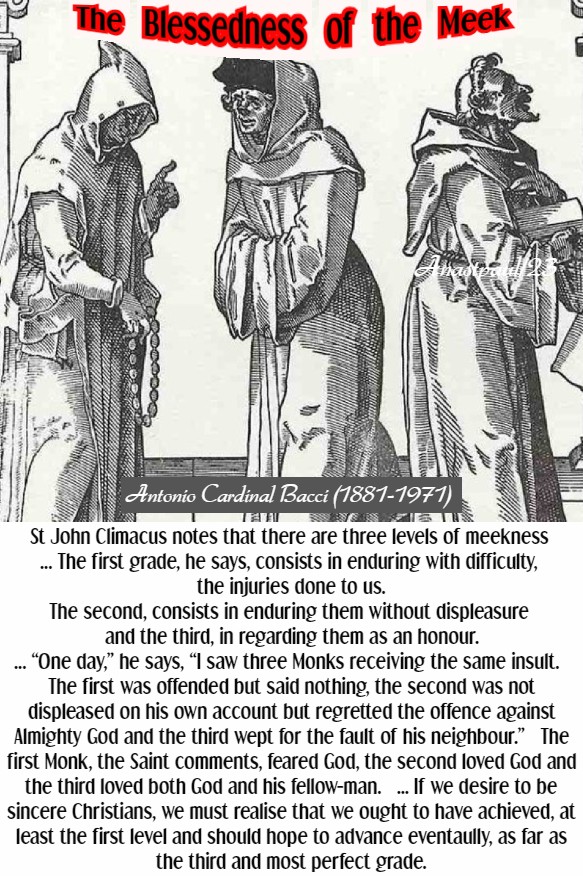
The Blessedness of the Meek
“St John Climacus notes that there are three levels of meekness (Dcala Paradist pp 296-298). The first grade, he says, consists in enduring with difficulty, the injuries done to us. The second, consists in enduring them without displeasure and the third, in regarding them as an honour.
Those who reach the first level are to be congratulated, those who reach the second are to be applauded but, those in the third and highest category, are really blessed by God.
“One day,” he says, “I saw three Monks receiving the same insult. The first was offended but said nothing, the second was not displeased on his own account but regretted the offence against Almighty God and the third wept for the fault of his neighbour.” The first Monk, the Saint comments, feared God, the second loved God and the third loved both God and his fellow-man.
At What stage of perfection in this virtue can we claim to have arrived? If we desire to be sincere Christians, we must realise that we ought to have achieved, at least the first level and should hope to advance eventaully, as far as the third and most perfect grade.”
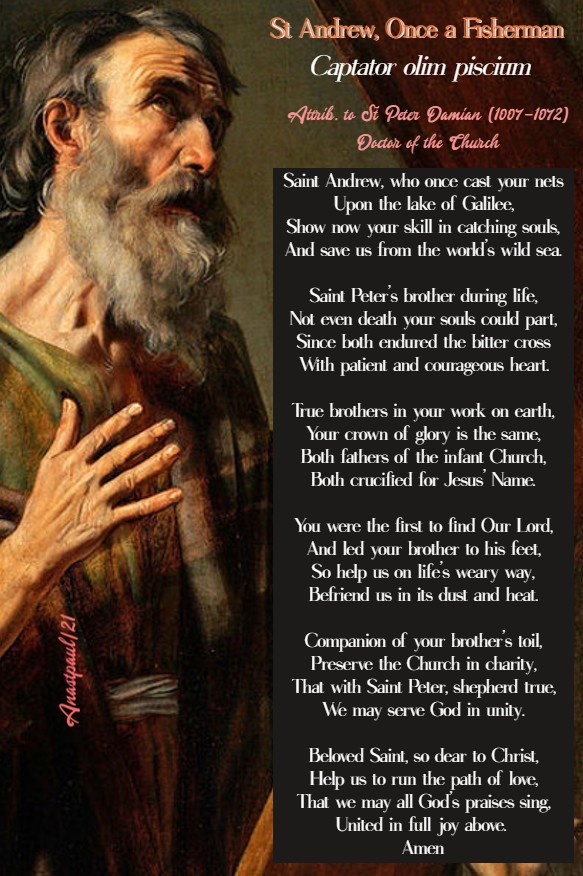
Quote of the Day – 30 November – The Feast of St Andrew, Apostle of Christ, Martyr on the Cross for Christ
It is claimed, that the words below were spoken by St Andrew, according to an ancient account (which dates to the beginning of the 6th Century), entitled –
The Passion of Andrew
“Hail, O Cross, inaugurated by the Body of Christ and adorned with His limbs as though they were precious pearls. Before the Lord mounted you, you inspired an earthly fear. Now, instead, endowed with heavenly love, you are accepted as a gift.
Believers know of the great joy that you possess and of the multitude of gifts you have prepared. I come to you, therefore, confident and joyful, so that you too may receive me, exultant as a disciple of the One Who was hung upon you….
O blessed Cross, clothed in the majesty and beauty of the Lord’s limbs!…
Take me, carry me far from men and restore me to my Teacher, so that, through you, the One who redeemed me by you, may receive me.
One Minute Reflection – 30 November – The Feast of St Andrew, Apostle of Christ – Readings: Romans 10: 9-18; Matthew 4: 18-22
“At once they left their nets and followed him.” – Matthew 4:20
REFLECTION – “After Andrew had remained with Jesus (Jn 1:39) and had learned what he did learn, he did not keep his treasure concealed for himself but hastened to run quickly to his brother, Simon Peter, to share with him, the good things that he had received. Consider what he told his brother: “We have found the Messiah (which interpreted is Christ)” (Jn 1:41). Do you perceive, in these words, the fruit of what he had learned in such a short time? It shows, at once, the authority of the Teacher who taught His disciples and their own enthusiasm and will to learn from Him, since the very beginning.
Indeed Andrew’s eagerness, his zeal in wanting to spread immediately such a good news, supposes a soul who was longing to see the accomplishment of the many prophecies concerning Christ. It is a mark of brotherly kindness, of loving kinship, of genuine goodwill, to hasten to stretch out a helping hand to one another in spiritual matters. … ”We have found the Messiah” he says – not any messiah but “the Messiah,” the one Christ they were awaiting.” – St John Chrysostom (347-407) Father and Doctor of the Church (Homely on the Gospel of Saint John, 19:1).
PRAYER – Lord, in Your kindness hear our petitions. You called Andrew the Apostle, to preach the Gospel and guide Your Church in faith. May he always be our friend in Your Presence, to help us with his prayers. We ask this through our Lord Jesus Christ, Your Son, who lives and reigns with You and the Holy Spirit, one God, forever and ever. Amen. (Collect)
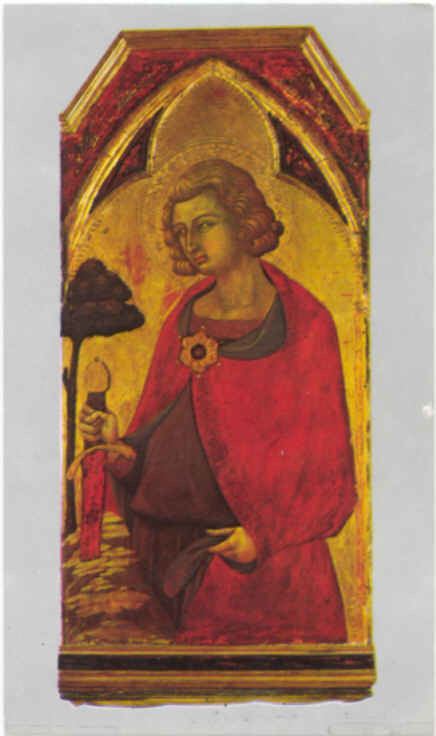
Saint of the Day – 30 November – Saint Galganus Guidotti (1148-1181) Hermit of The Sword in the Stone fame. Born in Chiusdino, Siena) in 1148 and died in 1181 at Monte Siepe, Tuscany, Italy of natural causes. Also known as – Galgano. Our Saintwas Canonised only 3 years after his death in 1185, by Pope Lucius III.
The Roman Martyrology reads today: “Near Mount Siepi in Tuscany, Saint Galganus Guidotti, a Hermit, who, having converted to God after a dissipated youth, spent the rest of his life in voluntary mortification of the body.”
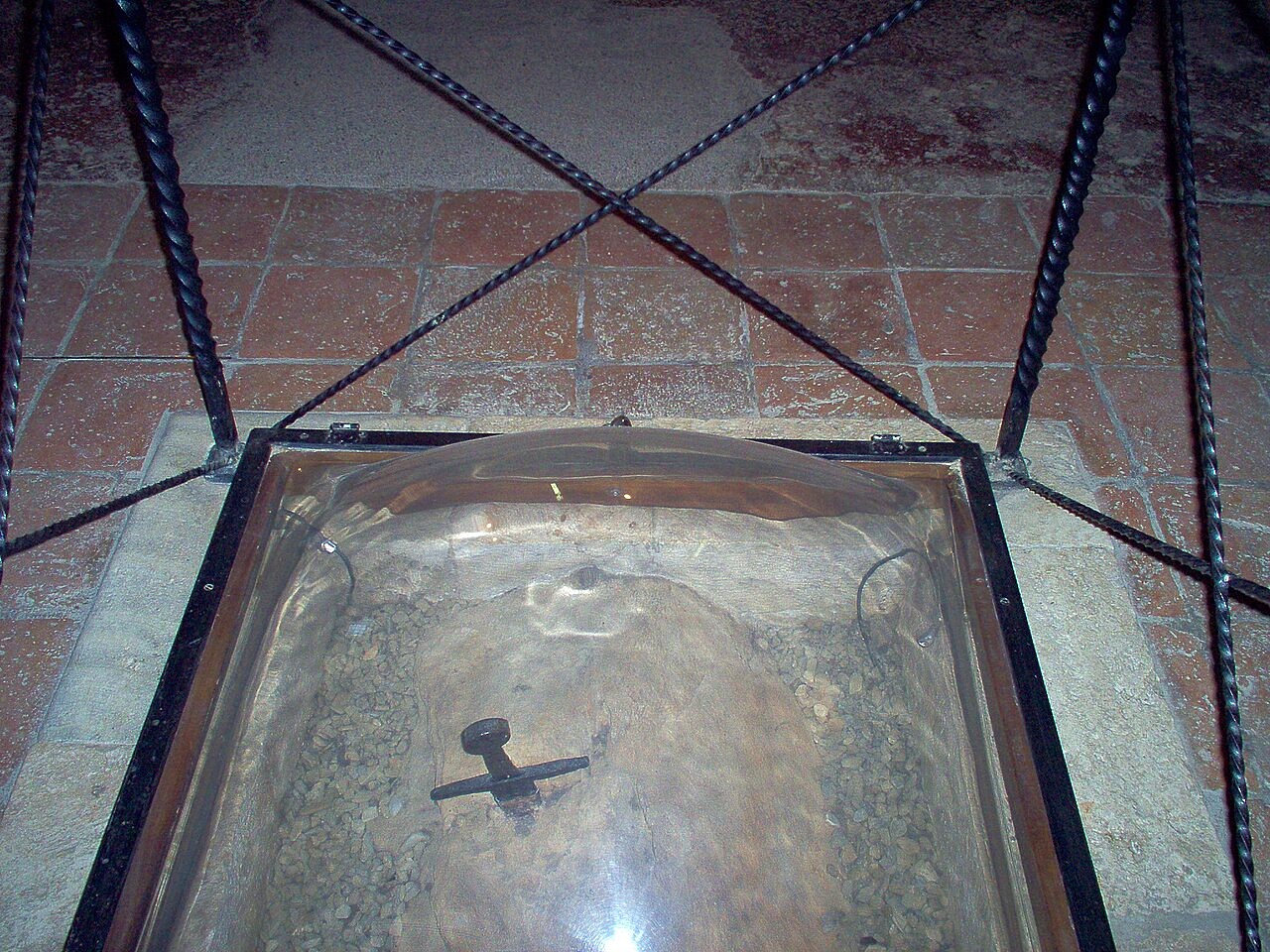
About 30 km (20 miles) southwest of Siena, in beautiful Tuscany, Italy, stands the ruins of a Cistercian Abbey. In a nearby Chapel is one of the strangest Relics ever – the sword of Saint Galganus, seemingly thrust into the bedrock to the hilt. How did it end up there?
Galganus Guidotti was born in 1148, the son of a minor noble and one of those dissipated young knights constantly seeking worldly pleasures. One day when he least expected it, Archangel Michael appeared before him and showed him the way to salvation and kindly provided him with directions. The next day, Galganus announced that he was going to become a Hermit and took up residence in a cave. His friends and relatives ridiculed him and Dionisia, his mother, bade him to wear his expensive nobleman’s clothes and at least, pay a last visit to his fiancée. On his way there, his horse reared, throwing Galganus. Spitting road dust, he suddenly felt as if he was being lifted to his feet by an invisible force and a seraphic voice and a will he was unable to resist, led him to Monte Siepi, a rugged hill close to his home town of Chiusdino.
The voice bade him stand still and look at the top of the hill. Galganus saw a round Church with Jesus and Mary surrounded by the Apostles. The voice told him to climb the hill and while doing so, the vision faded away. When he reached the top the voice spoke again, inviting him to renounce his loose, easy living. Galganus replied that it was easier said than done, about as easy as splitting a rock with a sword. To prove his point, he drew his blade and thrust at the rocky ground. With miraculous ease, the sword penetrated the living bedrock to the hilt! Galganus immediately prostrated himself in awe and took up permanent residence on that hill as a humble Hermit.
There he led a life of poverty, visited by the occasional peasant looking for a blessing. He befriended wild animals and once, when the Devil sent an assassin in the guise of a Monk, the wild wolves living with Galganus attacked the killer, sending him speedily running with them after him – it is said and “his bones were gnawed.”
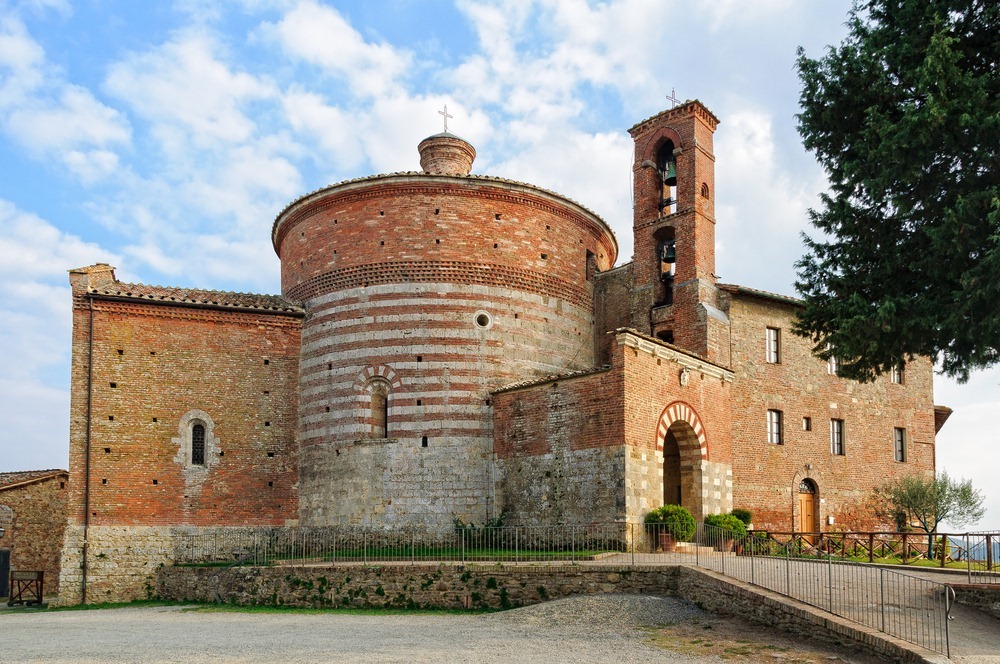
Galganus Guidotti died in 1181, at the age of 33 years and was Canonised four years later. His funeral was a major event, attended by Bishops and three Cistercian Abbots, including one who had been lost while on his way to Rome. The next year, the Bishop of Volterra gave Monte Siepi to the Cistercian Monks, aware that they would build a Shrine to Galganus’ memory. They began building in 1185, erecting a round Chapel that became known as the Cappella di Monte Siepi, on the hill above the main Abbey, with the sword forming the centrepiece.
The Sword “Excalibur”
The Cappella offers a breathtaking view of the Abbey, the neighbouring buildings and the beautiful surrounding countryside. Galganus’ body was for some reason lost after the funeral, although his head, which is said to have grown golden curls for many years following his death, was placed in one side Chapel and the chewed bones of the arms of the assassin in another.
The beautiful Capella
Saint Galganus’ head is now preserved as a Relic in the Museo dell’Opera del Duomo in Siena, while the skeletal arms are still in place. The crowds of pilgrims were so numerous that the Cistercians were authorised to build another Monastery named after the Saint a short distance away. It was to be one of the most beautiful Gothic buildings in Italy and one of the Cistercians’ two largest Italian foundations. The Monastery soon became both powerful and respected. Monks from San Galganus were appointed to high offices throughout Tuscany.
In the 14th Century, a Gothic side Chapel was added to the original Romanesque Cappella and in the 18th Century, a rectory was added. The side Chapel has the remains of some frescoes by Ambrogio Lorenzetti, including a faint picture of Galganus offering the sword in the stone to Saint Michael. The Abbey was sacked by the (in)famous English mercenary Captain Sir John Hawkwood and his White Company and by 1397 the Abbot was its only inhabitant. The Abbey deteriorated over the Centuries, becoming the impressive ruins seen today.
It is often argued that the legend of Saint Galganus formed the inspiration for the medieval legends about King Arthur and the Sword in the Stone, with which he proved his birthright. A story like that of Saint Galganus could travel all over Europe and, it is interesting to note that the first story about Arthur pulling a sword from a stone, (or more exactly an anvil on top of the stone), appears in the decades following Saint Galganus’ Canonisation in one of the poems by the Burgundian poet Robert de Boron. So, in the ever-changing legends of Arthur, it is it not unlikely that him pulling the sword out of the stone. was inspired by the act of a reformed Italian knight who became a Saint!
St Abraham of Persia St Anders of Slagelse Bl Andrew of Antioch Bl Arnold of Gemblours
St Castulus of Rome (c288) Martyr, married to Saint Irene of Rome (the woman who assisted St Sebastian after he had been wounded by the Imperial archers) and father of 2 children, Military Officer and he was the Chamberlain (or officer, valet) of Emperor Diocletian. His Feast day was moved to 26 March in 1969. His Life and Death: https://anastpaul.com/2021/03/26/saint-of-the-day-26-march-saint-castulus-of-rome-died-c-288-martyr/ St Constantius of Rome St Crider of Cornwall
Bl Joscius Roseus St Justina of Constantinople St Mahanes the Persian St Maura of Constantinople St Merola of Antioch St Mirocles of Milan St Sapor St Simeon of Persia St Trojan St Tudwal of Tréguier Bl William de Paulo Zosimus the Wonder Worker
Martyrs of Saxony – 6 Saints: Missionaries who worked with Saint Willehad of Bremen. Martyrs. – Attroban, Benjamin, Emmingen, Folkard, Gerwald and Grisold. They were martyred on 30 November 782 at River Weser, Lawer Saxony, Germany.















 AnaStpaul
You must be logged in to post a comment.