
Saint of the Day – 30 November – Saint Galganus Guidotti (1148-1181) Hermit of The Sword in the Stone fame. Born in Chiusdino, Siena) in 1148 and died in 1181 at Monte Siepe, Tuscany, Italy of natural causes. Also known as – Galgano. Our Saint was Canonised only 3 years after his death in 1185, by Pope Lucius III.

The Roman Martyrology reads today: “Near Mount Siepi in Tuscany, Saint Galganus Guidotti, a Hermit, who, having converted to God after a dissipated youth, spent the rest of his life in voluntary mortification of the body.”

About 30 km (20 miles) southwest of Siena, in beautiful Tuscany, Italy, stands the ruins of a Cistercian Abbey. In a nearby Chapel is one of the strangest Relics ever – the sword of Saint Galganus, seemingly thrust into the bedrock to the hilt. How did it end up there?
Galganus Guidotti was born in 1148, the son of a minor noble and one of those dissipated young knights constantly seeking worldly pleasures. One day when he least expected it, Archangel Michael appeared before him and showed him the way to salvation and kindly provided him with directions. The next day, Galganus announced that he was going to become a Hermit and took up residence in a cave. His friends and relatives ridiculed him and Dionisia, his mother, bade him to wear his expensive nobleman’s clothes and at least, pay a last visit to his fiancée. On his way there, his horse reared, throwing Galganus. Spitting road dust, he suddenly felt as if he was being lifted to his feet by an invisible force and a seraphic voice and a will he was unable to resist, led him to Monte Siepi, a rugged hill close to his home town of Chiusdino.
The voice bade him stand still and look at the top of the hill. Galganus saw a round Church with Jesus and Mary surrounded by the Apostles. The voice told him to climb the hill and while doing so, the vision faded away. When he reached the top the voice spoke again, inviting him to renounce his loose, easy living. Galganus replied that it was easier said than done, about as easy as splitting a rock with a sword. To prove his point, he drew his blade and thrust at the rocky ground. With miraculous ease, the sword penetrated the living bedrock to the hilt! Galganus immediately prostrated himself in awe and took up permanent residence on that hill as a humble Hermit.
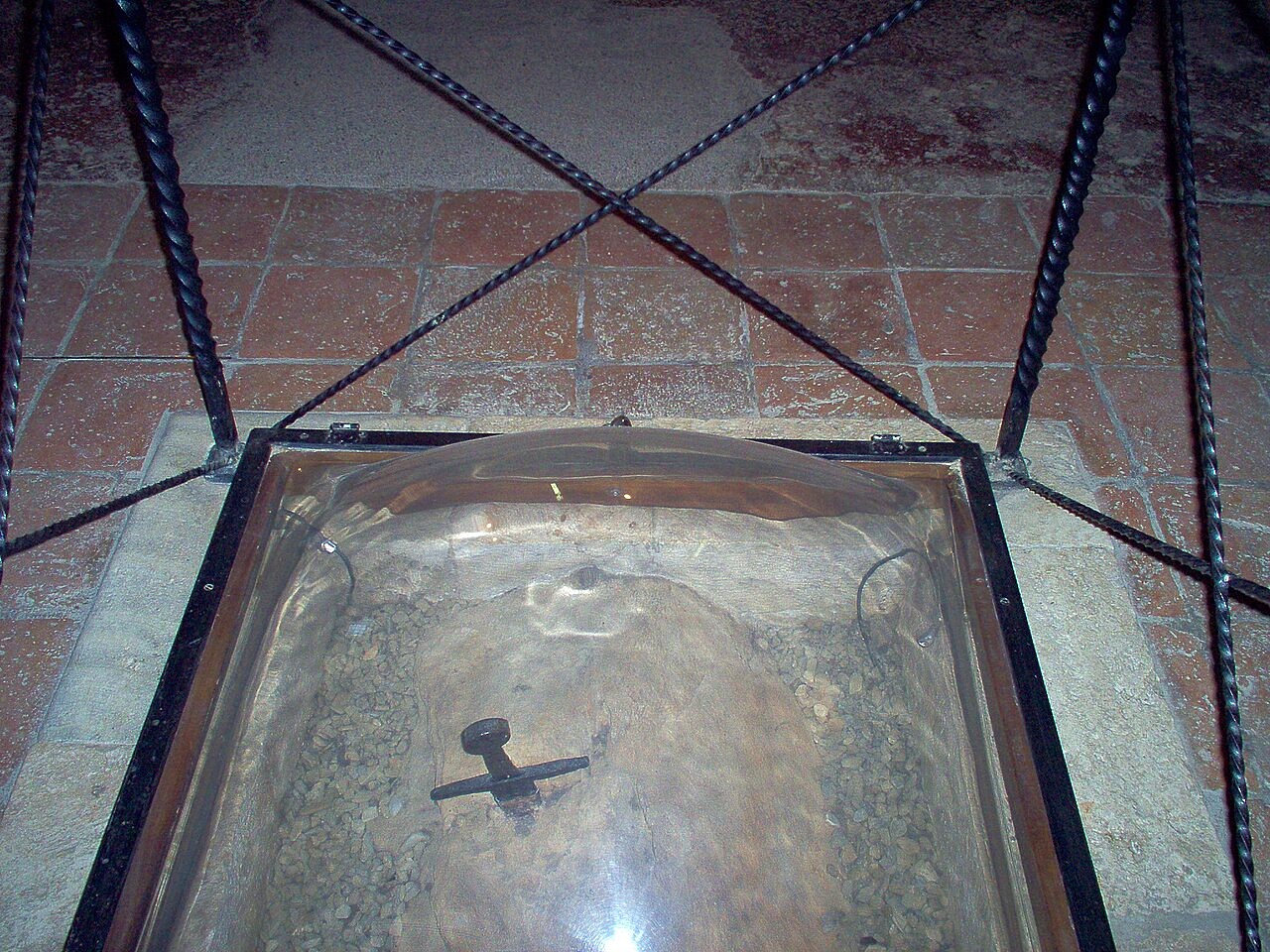
There he led a life of poverty, visited by the occasional peasant looking for a blessing. He befriended wild animals and once, when the Devil sent an assassin in the guise of a Monk, the wild wolves living with Galganus attacked the killer, sending him speedily running with them after him – it is said and “his bones were gnawed.”
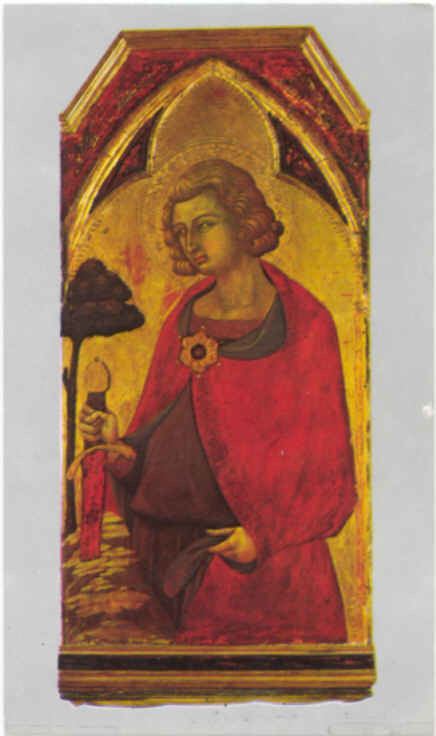
Galganus Guidotti died in 1181, at the age of 33 years and was Canonised four years later. His funeral was a major event, attended by Bishops and three Cistercian Abbots, including one who had been lost while on his way to Rome. The next year, the Bishop of Volterra gave Monte Siepi to the Cistercian Monks, aware that they would build a Shrine to Galganus’ memory. They began building in 1185, erecting a round Chapel that became known as the Cappella di Monte Siepi, on the hill above the main Abbey, with the sword forming the centrepiece.

The Cappella offers a breathtaking view of the Abbey, the neighbouring buildings and the beautiful surrounding countryside. Galganus’ body was for some reason lost after the funeral, although his head, which is said to have grown golden curls for many years following his death, was placed in one side Chapel and the chewed bones of the arms of the assassin in another.
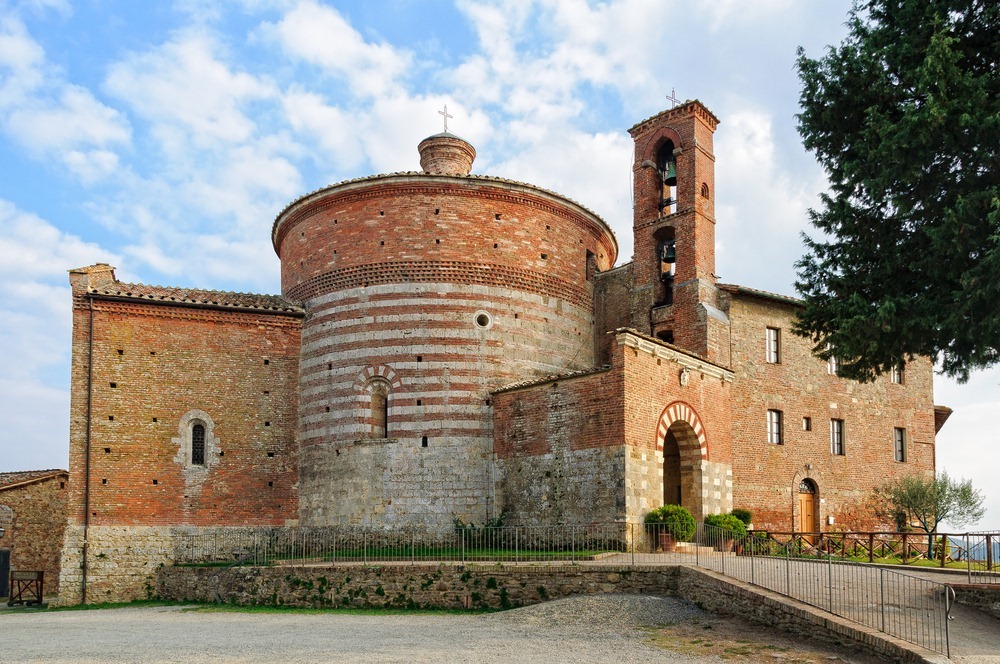
Saint Galganus’ head is now preserved as a Relic in the Museo dell’Opera del Duomo in Siena, while the skeletal arms are still in place. The crowds of pilgrims were so numerous that the Cistercians were authorised to build another Monastery named after the Saint a short distance away. It was to be one of the most beautiful Gothic buildings in Italy and one of the Cistercians’ two largest Italian foundations. The Monastery soon became both powerful and respected. Monks from San Galganus were appointed to high offices throughout Tuscany.
In the 14th Century, a Gothic side Chapel was added to the original Romanesque Cappella and in the 18th Century, a rectory was added. The side Chapel has the remains of some frescoes by Ambrogio Lorenzetti, including a faint picture of Galganus offering the sword in the stone to Saint Michael. The Abbey was sacked by the (in)famous English mercenary Captain Sir John Hawkwood and his White Company and by 1397 the Abbot was its only inhabitant. The Abbey deteriorated over the Centuries, becoming the impressive ruins seen today.

It is often argued that the legend of Saint Galganus formed the inspiration for the medieval legends about King Arthur and the Sword in the Stone, with which he proved his birthright. A story like that of Saint Galganus could travel all over Europe and, it is interesting to note that the first story about Arthur pulling a sword from a stone, (or more exactly an anvil on top of the stone), appears in the decades following Saint Galganus’ Canonisation in one of the poems by the Burgundian poet Robert de Boron. So, in the ever-changing legends of Arthur, it is it not unlikely that him pulling the sword out of the stone. was inspired by the act of a reformed Italian knight who became a Saint!


 AnaStpaul
One thought on “Saint of the Day – 30 November – Saint Galganus Guidotti (1148-1181) Hermit of The Sword in the Stone fame”