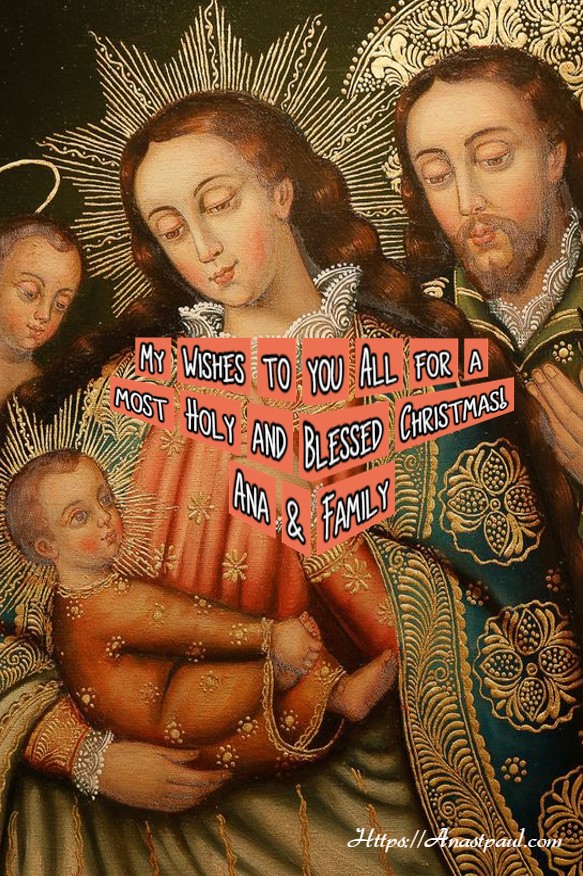
My Wish for you All – a most Holy and Blessed Christmas!
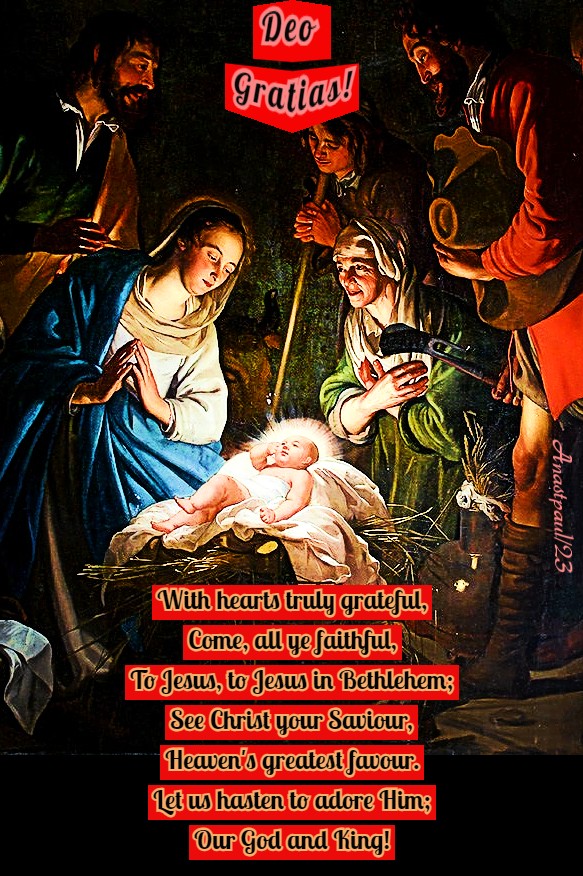
With hearts truly grateful, Come, all ye faithful, To Jesus, to Jesus in Bethlehem; See Christ your Saviour, Heaven’s greatest favour. Let us hasten to adore Him; Our God and King!
May the Holy Family of Bethlehem fill your hearts with joy, peace and love! And my Love and Prayers for you and yours.
My sincere thanksgiving for those most generous and loving Benefactors, who, in their generosity, have constantly contributed to the upkeep of this site. For those who, in the midst of their manifold duties during this very busy time, have still found time to send Christmas donations and prayers. May the Divine Infant, His Immaculate Mother and Holy St Joseph, Bless you all. Ana
Thought for the Day – 25 December – Meditations with Antonio Cardinal Bacci (1881-1971)
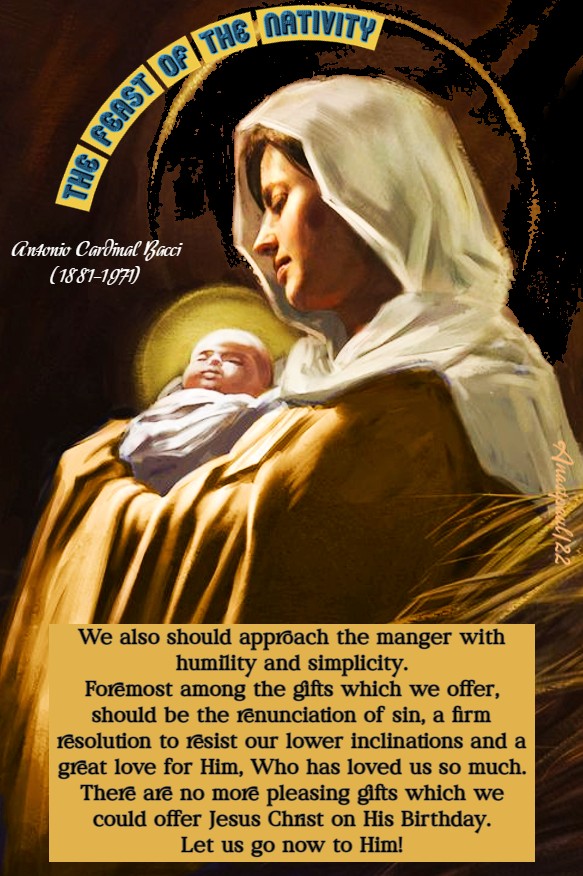
The Feast of the Nativity
“The first people to pay homage to Jesus Christ, are not men of exalted rank but humble shepherds. They come to offer their poor gifts but, above all else, they offer Him their simple and innocent hearts.
We also should approach the manger with humility and simplicity. Foremost among the gifts which we offer, should be the renunciation of sin, a firm resolution to resist our lower inclinations and a great love for Him, Who has loved us so much. There are no more pleasing gifts which we could offer Jesus Christ on His Birthday. Let us go now to Him!”
Quote/s of the Day – 25 December – The Nativity of Our Lord, Christmas Day!
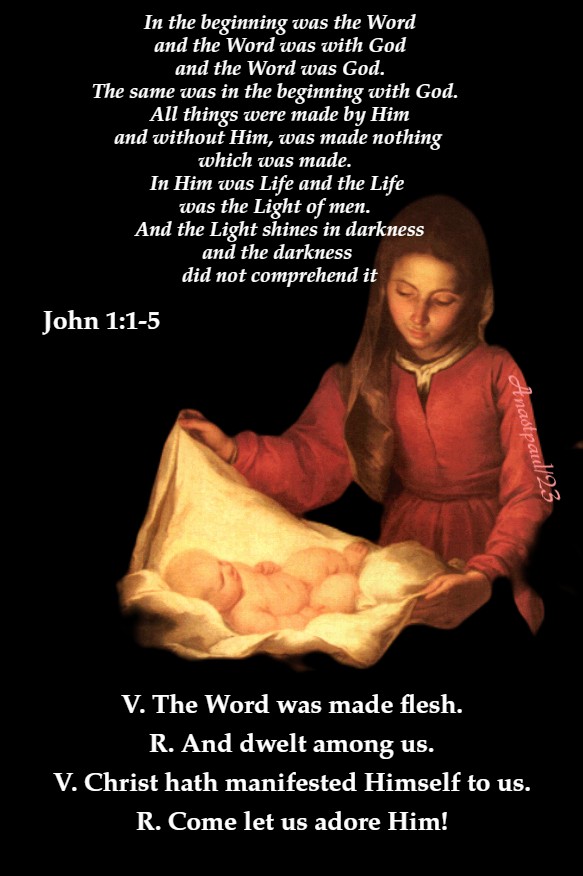
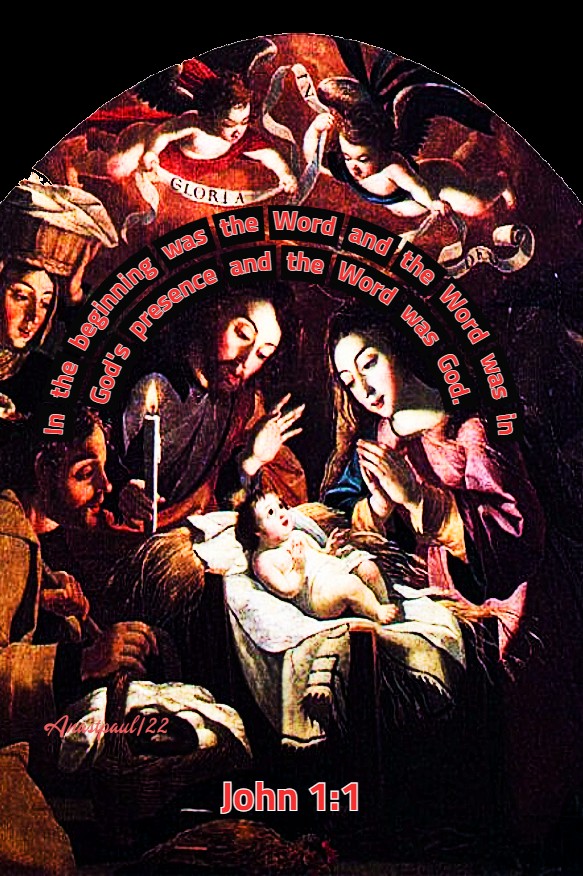
“In the beginning was the Word and the Word was with God and the Word was God. The same was in the beginning with God. All things were made by Him and without Him, was made nothing which was made. In Him was Life and the Life was the Light of men. And the Light shines in darkness and the darkness did not comprehend it.”
John 1:1-5
V. The Word was made flesh. R. And dwelt among us. V. Christ hath manifested Himself to us. R. Come let us adore Him!
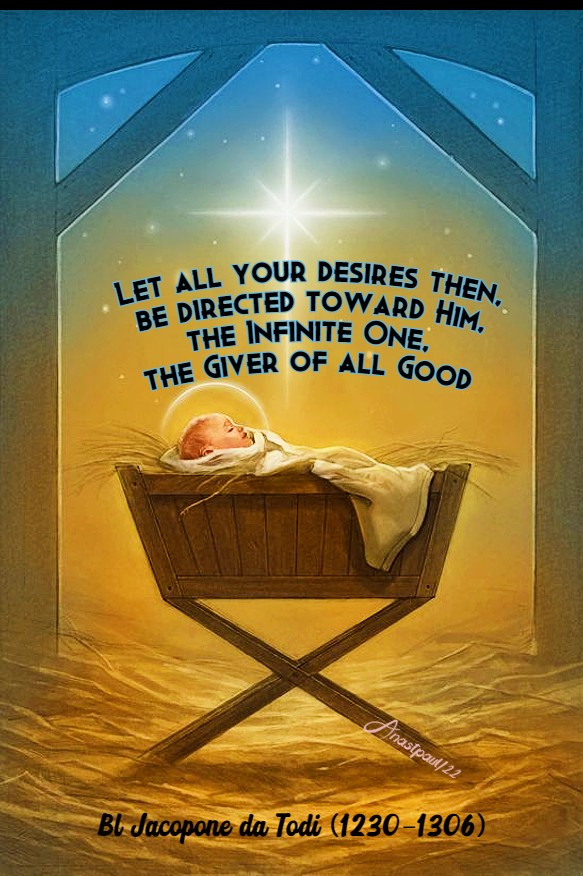
“Let all your desires then, be directed toward Him, the Infinite One, the Giver of all Good.”
Bl Jacopone da Todi (1230-1306)
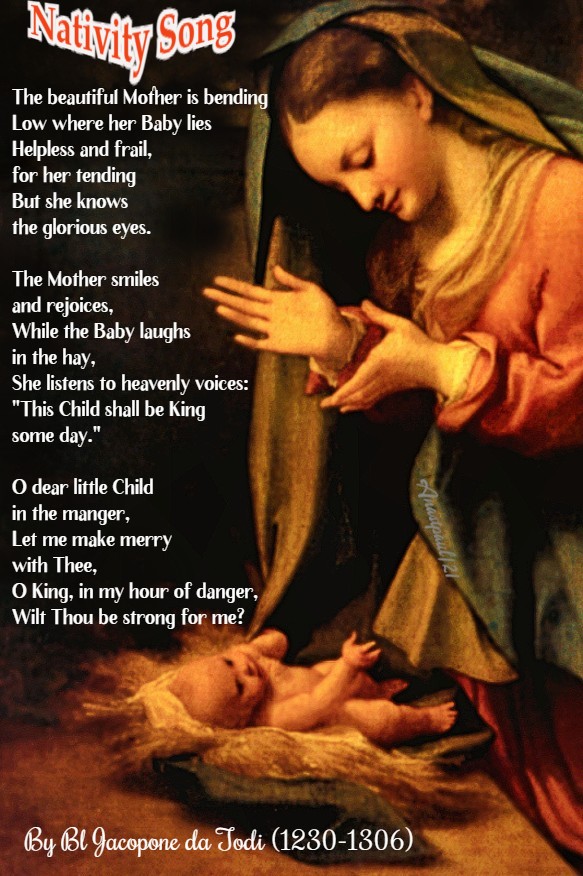
Nativity Song By Blessed Jacopone da Todi OFM (1230-1306) (Today is the Feast Day of Blessed Jacopone)
The beautiful Mother is bending Low where her Baby lies Helpless and frail, for her tending But she knows the glorious eyes.
The Mother smiles and rejoices, While the Baby laughs in the hay, She listens to heavenly voices: “This Child shall be King some day.”
O dear little Child in the manger, Let me make merry with Thee, O King, in my hour of danger, Wilt Thou be strong for me?
One Minute Reflection – 25 December – “The Month of the Divine Infancy and the Immaculate Conception of the Blessed Virgin Mary” – The Nativity of Our Lord, Christmas Day! – Titus 2:11-15; Luke 2:1-14 – Scripture search here: https://www.drbo.org/
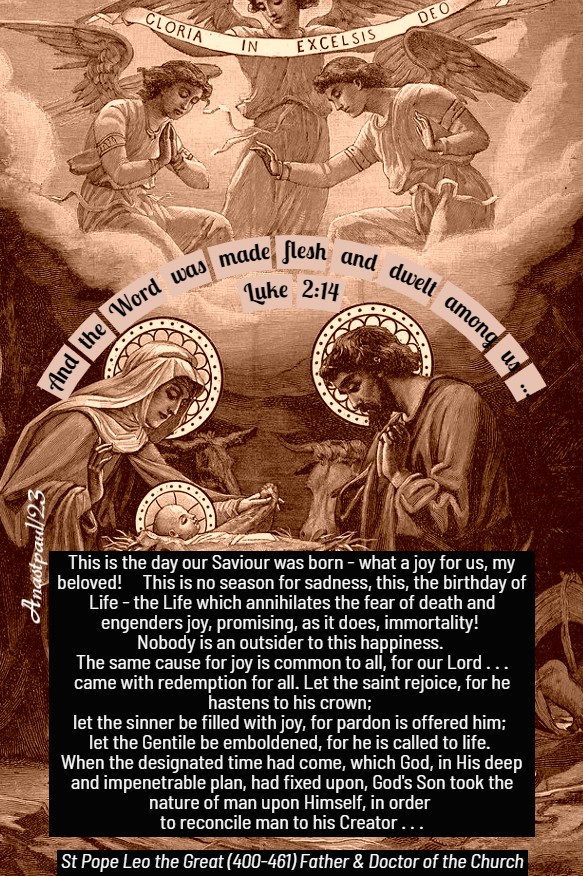
“And the Word was made flesh and dwelt among us (and we saw His glory, the glory, as it were, of the Only-Begotten of the Father), full of grace and truth.”- Luke 2:14
REFLECTION – “This is the day our Saviour was born – what a joy for us, my beloved! This is no season for sadness, this, the birthday of Life – the Life which annihilates the fear of death and engenders joy, promising, as it does, immortality! Nobody is an outsider to this happiness. The same cause for joy is common to all, for our Lord . . . came with redemption for all. Let the saint rejoice, for he hastens to his crown; let the sinner be filled with joy, for pardon is offered him; let the Gentile be emboldened, for he is called to life. When the designated time had come, which God, in His deep and impenetrable plan, had fixed upon, God’s Son took the nature of man upon Himself, in order to reconcile man to his Creator . . .
The Word, Who is God, the Son of God “Who was in the beginning with God; through Whom all things came to be and without Whom, nothing came to be” has become Man to deliver man from eternal death. He humbled Himself to assume our mortal condition, yet without diminishing His greatness. Remaining what He was and assuming what He was not, He united our condition of a slave, to His condition of equality with God the Father . . . Greatness was clothed with humility, strength with weakness, eternity with mortality – True God and True Man, in the unity of a single Lord, “the One Mediator between God and the human race” (1Tim 2,5). . .
My beloved, let us offer thanksgiving to God the Father, through His Son, in the Holy Ghost. In the great mercy with which He loved us, He had pity on us and “in giving life to Christ, gave life to us too, when we were dead through sin,” so that, in Him, we might be a new creation, a new work of His Hands (Eph 2:4-5; 2 Cor 5:17) . . . O Christian, be aware of your nobility!” – St Leo the Great (400-461) Pope , Father and Doctor of the Church (1st sermon for the Nativity of the Lord)
PRAYER – O God, Who have brightened this most holy night with the splendour of the true Light, grant, we beseech Thee that we may know in Heaven the joy of that light which we have known mystically on earth. Through the same Jesus Christ, Thy Son our Lord, Who lives and reigns with Thee, in the unity of the Holy Ghost, God, world without end. Amen (Collect).
Our Morning Offering – 25 December – The Nativity of Our Lord, Christmas Day!
Adeste Fidelis O Come, All Ye Faithful! By John Francis Wade (c1711-1786) Composer, Hymnist, Professor of Music at the Douay Seminary
O come, all ye faithful, joyful and triumphant, O come ye, O come ye to Bethlehem! Come and behold Him, born the King of Angels! Refrain: O come, let us adore Him, O come, let us adore Him, O come, let us adore Him, Christ, the Lord!
God of God, Light of Light, Lo, He abhors not the virgin’s womb; Very God, begotten, not created. [Refrain]
Sing, Choirs of Angels; sing in exultation; sing, all ye citizens of heav’n above! Glory to God, all glory in the highest! [Refrain]
Yea, Lord, we greet Thee, born this happy morning; Jesus, to Thee be all glory giv’n! Word of the Father, now in flesh appearing! [Refrain]
John Francis Wade (1711 or 1712-1786) is now generally recognised as both Author and Composer of the hymn “Adeste fideles,” originally written in Latin in four stanzas. The earliest manuscript signed by Wade is dated about 1743. By the early 19th Century, however, four additional stanzas had been added by other writers. A Roman Catholic, Wade apparently moved to France because of discrimination against Roman Catholics in 18th Century England—especially so. after the Jacobite Rebellion of 1745. He taught music at an English college in Douay and hand copied and sold Chant music for use in the Chapels of wealthy families. Wade’s copied manuscripts were published as Cantus Diversi pro Dominicis et Festis per annum (1751)
The Translator is Father Frederick Oakeley (1802-1880), ex Anglican minister, in 1845, he became a Catholic and a Priest and Canon of the Diocese of Westminister. His publications are numerous, and some of them have considerable value.
Saint of the Day – 25 December – Saintt Fulk of Toulouse (c1155-1231) Bishop, a fierce and untiring Defender of the Faith against heresies, Musician, Composer and Lyricist, Poet, Born in c1155 at Genoa, Italy and died in 1231 in Toulouse of natural causes. Also known as – Folquet, Folquet de Marseille, Folquet de Marselha, Foulques de Toulouse, Coots of Toulouse, the Minstrel Bishop.
St Fulk depicted in an ancient Manuscript
Fulk was born into a Genoese merchant family but, in about 1180, he left his life as a merchant to become a singing and playing Minstrel Poet. He was widely respected and successful throughout Provence and Aragon. His works, which include love lyrics (often dedicated to his patron’s wife), crusading songs and religious poems and hymns, demonstrate a classical education and careful metrical forms.
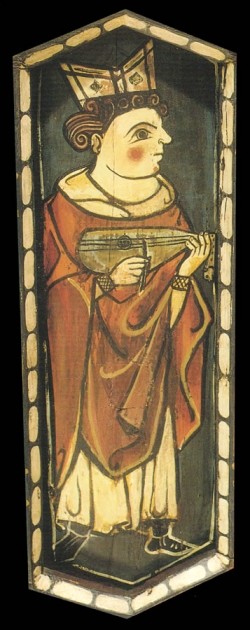
Painting from Teruel Cathedral of musician Clergy, probably our St Fulk of Toulouse.
In 1195, Fulk’s life and career abruptly changed, when he experienced a profound religious conversion and decided to renounce his former life. He joined the strict Cistercian Order, entering the Monastery of Thoronet (Var, France) and appears to have placed his wife and two sons in monastic institutions as well. He soon rose in prominence and was elected Abbot of Thoronet which allowed him to help found the sister house of Géménos to house women, quite possibly including his wife.
In 1205 Fulk was elected Bishop of Toulouse and immediately he took a very active role in combatting heresy. Throughout his Episcopal career, he sought to create and encourage outlets for religious enthusiasm which were Catholic, in an effort to woo believers away from preachers of heresy (primarily Cathar and Waldensian). In 1206 he created what would become the Convent of Prouille, to offer women a religious community which would rival (and, where necessary, replace) those of the Cathars. He participated in the initial preaching mission of Saint Dominic which was led by Dominic’s superior, Bishop Alphonsus Didacus of Osma. He continued to support this new form of preaching after Bishop Alphonsus Didacus’ death by assisting St Dominic and his followers, eventually allotting to the nascent Dominicans, property and a portion of the tithes of Toulouse, to ensure their continued success. In July 1215 Fulk issued a Diocesan letter instituting St Dominic’s Order of Preachers. In November 1215 he and Dominic, with Guy of Montfort, were in Rome at the Fourth Lateran Council.
The Convent of Prouille, now a Museum
Bishop Fulk had tumultuous relations with his Diocese, primarily on account of his support of the Albigensian Crusade which was popularly perceived as a war of aggression against the region. Hated by many Toulousains and by Count Raymond VI of Toulouse. he left Toulouse on 2 April 1211, after the crusaders laid siege to the City. Our Saint requested a release from his See but the Pope refused. Fulk spent much of the following decade outside his Diocese, assisting the crusading army and the Church’s attempts to bring order to the region. He was at the Council of Sens in 1223.
In 1229, after the Peace of Paris finally ended the crusade, Fulk returned to Toulouse and began to construct the institutions that were designed to combat heresy in the region. He helped to create the University of Toulouse and administered the newly created Episcopal Inquisition.
Fulk died in 1231 and was buried, beside the tomb of William VII of Montpellier, at the Abbey of Grandselves, near Toulouse, where his sons, Ildefonsus and Petrus had been Abbots.
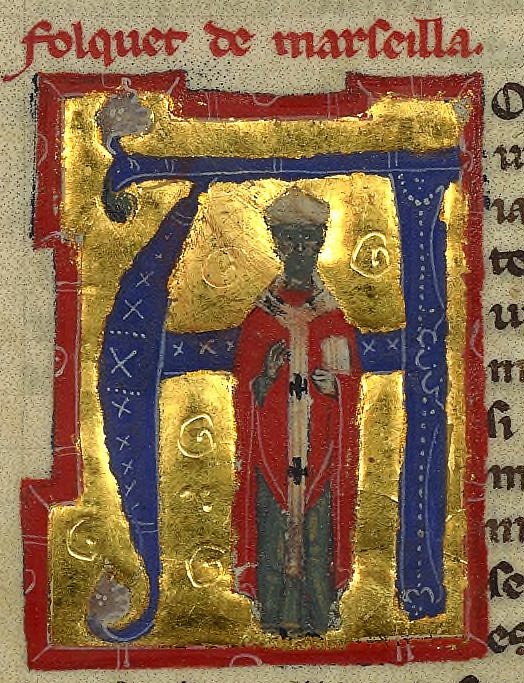
St Fulk of Toulouse in a 13th Century Manuscript, depicted in his Episcopal robes.
The Nativity of Our Lord, Christmas Day! Celebration of the Anniversary of the Birth of Our Lord. In the earliest days of the Church there was no such Feast, the Saviour’s Birth was commemorated with the Epiphany by the Greek and other Eastern Churches. First mention of the Feast, then kept on 20 May, was made by Clement of Alexandria c 200. The Latin Church began in c 300 to observe it on 25 December, though there is no certainty that Our Lord was born on that day. Today, Priests have the privilege of saying three Masses, at midnight, daybreak and morning. This was originally reserved to the Holy Father alone – beginning about the 4th century he celebrated a midnight Mass in the Lateran Basilica (in which according to tradition, the manger of Bethlehem is preserved), a second in the Church of Saint Anastasia, whose Feast comes on 25 December and a third at the Vatican Basilica. Many peculiar customs of the day are the outcome of the pagan celebrations of the January calendar. The Christmas tree, of which the first known mention was made in 1605 at Strasbourg, was introduced into France and England in 1840. The Feast is a Holy Day of Obligation, preceded by the preparatory season of Advent and by a special Vigil – should it fall on a Friday it abrogates the law of abstinence. Of course, Christmas attracts an Octave, when this wonderful Mystery and Miracle is celebrated for eight days. https://anastpaul.com/2019/12/25/the-solemnity-of-the-nativity-of-our-lord-jesus-christ-25-december-2/ AND: https://anastpaul.com/2018/12/25/the-solemnity-of-the-nativity-of-our-lord-jesus-christ-25-december/ AND: https://anastpaul.wordpress.com/2017/12/25/25-december-the-solemnity-of-the-birth-of-our-lord-jesus-christ-2/
St Adalsindis of Hamay St Alburga of Wilton St Anastasia of Sirmium





 AnaStpaul
You must be logged in to post a comment.