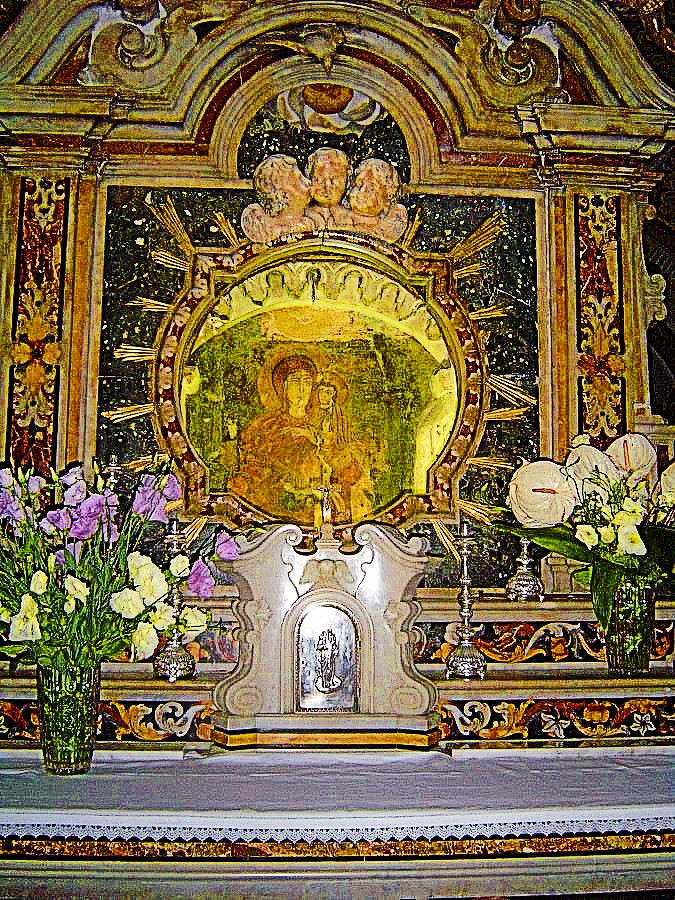
Saint of the Day – 26 December – Blessed Giovanni Orsini (1333-1411) Cardinal Archbishop of Turin for forty-seven year! Reformer both socially and within the Church, Apostle of the poor and needy, carer of Monasteries Convents and the Religious who inhabited them. No images of this holy man have been found. The Shrine pictured below, is described in the last paragraph and resides at the Cathedral in Turin.
Giovanni Orsini was born in 1333 into the noble family of the Lords of Rivalta, near Turin. Son of Guglielmo, he had numerous brothers, including Pietro, who was also religious. Giovanni led an exemplary life from boyhood, he undertook ecclesiastical studies, graduating in Canon law.
He was then invested with the commandery of the Abbey of Rivalta which, thanks to the affiliation of 1266 to the Cistercians of Staffarla, had returned to its past splendour. Many members of his family, over the centuries, held this position. Noble both in birth and in soul, he acquired profound virtues, was dedicated to good works, helped the poor and dedicated a lot of time to preaching and Confessions.
He was the ideal successor to the chair of St Maximus and in 1364 he was elected Bishop of Turin. He was a zealous shepherd, who combined the firmness necessary to carry out his delicate task, in very complex times for the Church, with innate goodness. In the vast territory of the Diocese there were many problematic situations to deal with.
In 1367 the pious prelate visited Val Susa and found that in many Parishes there were hardships due to the wars and the continuous raids of the soldiers. Predecessors had attempted to remedy this but without great results. On 5 September 1368 he sent the convening letters for the calling of a Synod which was celebrated in the main Church of San Salvatore. Unfortunately, the documents have not reached us, even though we know that they were published in 1403. He then undertook the pastoral visit, starting from the valleys of Luserna and Angrogna, where the danger of the spread of heresies was greatest. The Waldensians, in particular, coming from France, had settled in the border valleys at the beginning of the previous Century. Giovanni made the visit with an Inquisitor and several collaborators. They mainly addressed the leaders of the communities, called ‘barba, because, by their conversion it would be easier to convince their followers.
In extreme cases, according to the laws of the time, the obstinate could be punished with capital punishment. The memory of the assassination of the Blessed Pietro da Ruffia in Susa which occurred precisely at the hands of the Waldensians on 2 February 1365, was still alive, while Bricherasio was the scene of the Martyrdom of the Blessed Antonio Pavoni which took place on a Sunday in 1374. The Pope had written a letter of encouragement, directing Antonio to Count Amedeo and Bishop Giovanni. The murderers were later captured and tried.
All the Clergy were required to collaborate with the Inquisitor and the Bishop, basically by preaching the truths of the faith in the Churches. Emblematic is the case of a man from Chieri, Giacomo Bech, who on 21 August 1388, in the Episcopal Palace of Turin, was listened to by Bishop Giovanni, in the presence of the Inquisitor. He had lived near Florence and in Perugia and had come into contact with a community of “apostolics”, partly originating from the Turin area.
The help that Orsini gave to the Poor Clares of Carignano was important, as can be seen in a patent dated 3 June 1372, where he confirmed the Nuns’ acquired rights. Their Monastery was not in good condition and was located in an unsafe place due to the wars. The Nuns took shelter in private homes then, when it was possible, decided to restore the ancient site, against the wishes of the inhabitants. The Nuns turned to Count Amedeo of Savoy and Bishop Giovanni. For jurisdictional reasons, the Abbot of Chiusa St Michele also rebelled against the new construction. The Poor Clares appealed to Pope Gregory XI who was in Avignon. Since no-one appeared on behalf of the Abbot, the Bishop’s actions were justified. The same Abbot was the protagonist of other controversies and even made accusations against the Pope. Giovanni was appointed to mediate but it led to the excommunication of that sad Abbot.
Bishop Giovann’s great concern was to counteract a certain laxity of customs among the Clergy and he promulgated some rules so that ecclesiastics respected the Sacred Canons. Thanks to his commitment, he brought many faithful who had drifted away, back to the Faith.
The Pope’s stay in Avignon caused divisions in some communities. These were the sad times of the Western Schism (which would only be resolved in 1415). Cardinal Egidio Albornoz, who had the difficult task of restoring the state of the Church in Italy, had Giovanni’s moral and economic support during his visits to Piedmont. The Turin Prelate collaborated in the return to Rome, albeit temporary, of the Blessed Pope Urban V. In 1370 Pope Gregory XI was elected and he returned to Italy but only in 1377 in a more complex context than ever.
Clement VII was appointed antipope and settled in Avignon. The Church was split in two. Giovanni, like the other Prelates of Savoy and France, supported Clement. They had great esteem for the “blessed” James of Savoy and William of Acaja, who appointed Giovanni as his Executor.
During his very long Episcopate Giovanni made important concessions. In 1380, he authorised the inhabitants of Fossano to rebuild the Collegiate Church of St Maria and St Giovenale, while he forgave many debts to the Poor Clares of Carignano, the Abbot of Rivalta and the Vicar of Lanzo. In 1395 he approved the election of Aimone da Romagnano as Provost of the Canons of Moncenisio.
After a long and fruitful Episcopate, forty-seven years, Giovanni died in June 1411. He was buried in his Cathedral. The fame of his sanctity spread and graces occurred at his Tomb, as was recorded in the chapter documents. In a document dated 21 February 1438 it was complained that the people were taking the ex-votos away from the Tomb. Unfortunately, his remains were lost in the reconstruction works of the Cathedral carried out at the end of the 15th Century and perhaps for this reason his cult decreased and was never confirmed, even though all Ecclesiastical and secular historians, unanimously praised his merits. In some Chapels of Rivalta he was depicted with a Cardinal’s hat and with a halo.
In a Chapel in the Cathedral of Turin there is today, a Plaque in a 15th Century Shrine and sarcophagus, with an epigraph engraved in 1892 which indicates the presence of the ashes of a man whose virtues are known only to God. Some scholars would place the Tomb of the Bishop of Rivalta there, while, due to the complex historical events of the Church of those decades, the appointment as Cardinal in 1388 and as Apostolic Legate to the Court of King Charles VI, is not certain.





 AnaStpaul
You must be logged in to post a comment.