Thought for the Day – 13 January – The Spiritual Combat (1589) – Dom Lorenzo Scupoli OSM (c1530-1610)
“None shall be crowned who has not fought well.” 2 Tim 2: 5
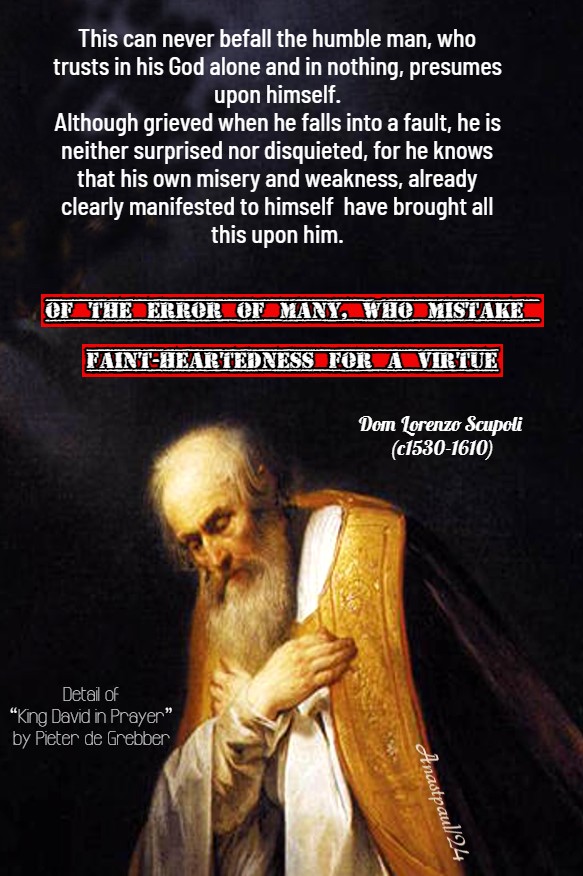
V: Of the Error of Many, Who Mistake Faint-heartedness for a Virtue
“Many also deceive themselves in this way, they mistake the fear and uneasiness which follow after sin, for virtuous emotions and know not, that these painful feelings spring from wounded pride and a presumption which rests upon confidence in themselves and their own strength. They have accounted themselves to be something and relied unduly upon their own powers. Their fall proves to them, the vanity of this self-dependence and they are immediately troubled and astonished, as at some strange thing and are disheartened at seeing the prop, to which they trusted, suddenly give way!
This can never befall the humble man, who trusts in his God alone and in nothing, presumes upon himself. Although grieved when he falls into a fault, he is neither surprised nor disquieted, for he knows that his own misery and weakness, already clearly manifested to himself, by the Light of Truth, have brought all this upon him.”
Quote/s of the Day – 13 January – “The Month of the Most Holy Name of Jesus and of the Holy Family” – Octave Day of Epiphany – Isaias 60:1-6, John 1:29-34 –
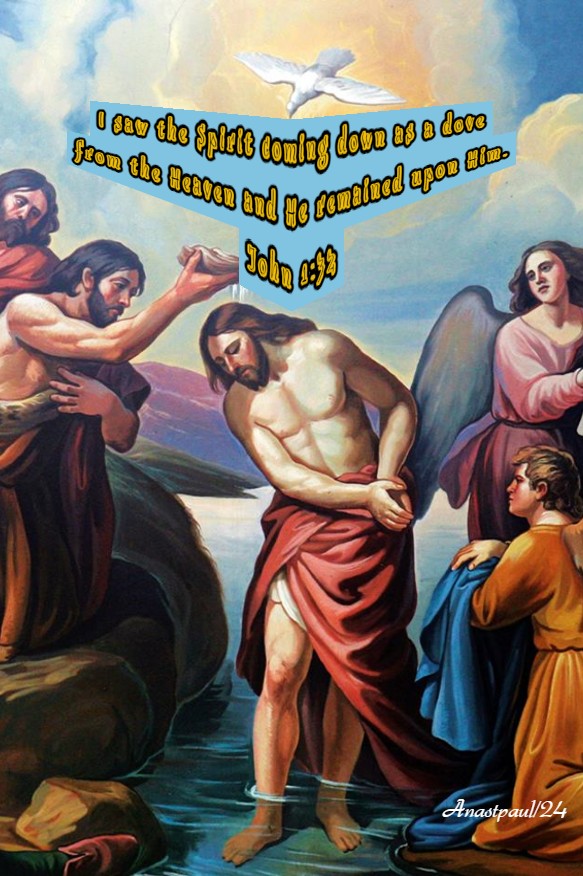
“I saw the Spirit coming down as a dove from the Heaven and He remained upon Him.”
John 1:32
“Jesus rises from the waters – the world rises with Him. The heavens, like Paradise with its flaming sword, closed by Adam for himself and his descendants, are rent open. The Spirit comes to Him as to an equal, bearing witness to His Godhead. A Voice bears witness to Him from Heaven, His place of origin. The Spirit descends in bodily form like the Dove which, so long ago, announced the ending of the flood and so, gives honour to the Body, Who is One with God.”
St Gregory Nazianzen (330-390) Father and Doctor of the Church
“Christ was born of the Holy Spirit and, since it was fitting, that He should fulfill all justice, He entered into the waters of baptism to sanctify them. When He left the Jordan, He was filled with the Holy Spirit, Who had descended upon Him, in the form of a dove. As the Evangelist tells us: Jesus, full of the Holy Spirit, returned from the Jordan.”
One Minute Reflection – 13 January – Octave Day of Epiphany – Isaias 60:1-6, John 1:29-34 – Scripture search here: https://www.drbo.org/
“And I knew Him not but He who sent me to Baptise with water said to me: He upon whom thou shalt see the Spirit descending and remaining upon Him, He it IS, Who Baptises with the Holy Spirit. And I saw and I gave testimony that this is the Son of God.” – John 1:33-34
REFLECTION – “Jesus Christ was the Son of God, yet He preached not the Gospel before His Baptism. If the Master Himself followed the right time in due order, ought we, His servants, to venture out of order? From that time Jesus began to preach (Matthew 4:17) , when the Holy Ghost had descended upon Him in a bodily shape, like a Dove, (Luke 3:22) not that Jesus might see Him first, for He knew Him even before He came in a bodily shape but, that John, who was Baptising Him, might behold Him. For I, says he, knew Him not but He that sent me to Baptise with water, He said to me, upon Whomsoever you shall see the Spirit descending and abiding on Him, that is He (John 1:33).
If you too have unfeigned piety, the Holy Ghost comes down on you also and a Father’s Voice sounds over you from on high — not, ‘This is My Son’ alone because ‘In the beginning was the Word, and the Word was with God and the Word was God.’ To Him belongs the ‘IS’ since He is always the Son of God – but to you, has now been made, since you have not the sonship by nature but receive it by adoption. He eternally ‘IS’ but you receive the grace progressively.
Make ready then the vessel of your soul that you may become a son of God and an heir of God and joint-heir with Christ (Romans 8:17); if, indeed, you are preparing yourself that you may receive; if you are drawing near in faith that you may be made faithful; if of set purpose, you are putting off the old man!” – St Cyril of Jerusalem (315-387) Bishop of Jerusalem, Father and Doctor of the Church (Catechetical Lecture 3: 14-15).
PRAYER – O God, Whose Only-begotten Son appeared in the substance of our flesh, grant, we pray Thee that we, who acknowledge His outward likeness to us, may deserve to be inwardly refashioned in His Image. Through the same Jesus Christ, Thy Son our Lord, Who lives and reigns with Thee, in the unity of the Holy Ghost, God, world without end. Amen (Collect).
Our Morning Offering – 13 January – “The Month of the Most Holy Name of Jesus and of the Holy Family” – The Eighth Day, The Octave of the Epiphany
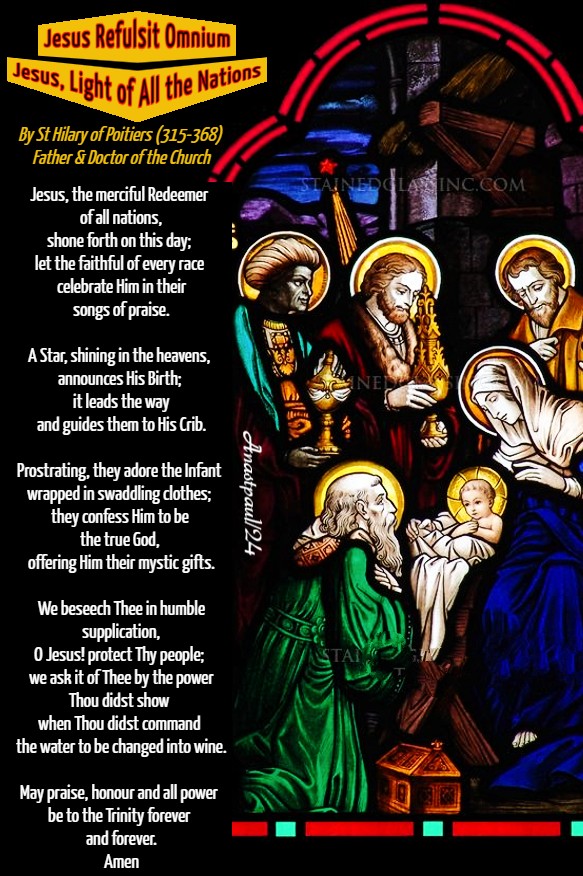
Jesus Refulsit Omnium Jesus, Light of All the Nations By St Hilary (315-368) Father & Doctor of the Church Doctor of the Divinity of Christ
Jesus, the merciful Redeemer of all nations, shone forth on this day; let the faithful of every race celebrate Him in their songs of praise.
A Star, shining in the heavens, announces His Birth; it leads the way and guides them to His Crib.
Prostrating, they adore the Infant wrapped in swaddling clothes; they confess Him to be the true God, offering Him their mystic gifts.
Thirty years of His life had passed and He, the infinitely pure God, seeks the laver of baptism.
John, the favoured Baptist trembles as he bends the head of Jesus beneath the waters–that Jesus whose Blood was to purify the whole earth from its sins.
The Divine Voice of the Father is heard from Heaven, bearing testimony to His Son and the Holy Ghost, too, is present, the Giver of holy grace.
We beseech Thee in humble supplication, O Jesus! protect Thy people; we ask it of Thee by the power Thou didst show when Thou didst command the water to be changed into wine.
May praise, honour and all power be to the Trinity forever and forever. Amen
(Verses 4-6 omitted on the image). I could not find the name of the Translator of this version of this Hymn, often referred to as “the oldest” Christmas Hymn.
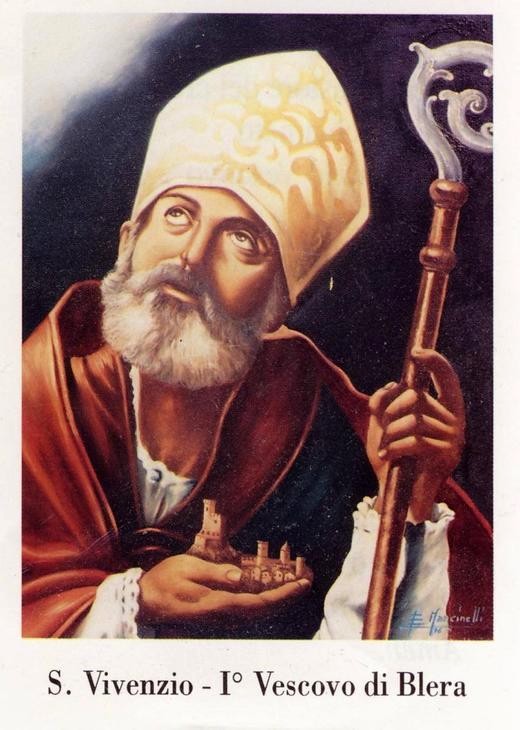
Saint of the Day – 13 January – Saint Viventius Benedicente of Blera (Died 484) Bishop of Blera, in the Province of Viterbo, Italy, during which time he also became a Hermit. Patronage – of Blera, the City and the Diocese. Also known as – Vivenzio. Additional Memorials – Easter Monday, 2nd Sunday in May, 11 December in Blera.
According to an oral tradition, Viventius was an illustrious and beloved Bishop of Blera from 457 to 484. There is indeed a very strong oral tradition about this Saint, rich in poetic and evocative details but, unfortunately, no document of historical value which can help us to reconstruct the phases of his earthly life.
According to tradition, the Bishop, in addition to his devout and holy life, he administered the Diocese with firmness but also with the gentleness of a father, dedicated his free time from pastoral commitments, to assisting the sick and especially the dying. One day two unbelieving and vicious nobles, irritated by the admonitions of the Bishop, who invited them to convert, decided to play an atrocious prank on him, to discredit him in the eyes of the faithful. Having bribed the servants, they had his tunic replaced with a female one during the night. Then they woke him, begging him to rush to a house in the town to assist a dying man. In order not to waste time, Viventius did not even light the lamp but putting on his female dress in the darkness, which was only distinguishable from his own by a few gatherings, without noticing anything. Arriving at the house of the dying man, he found the two nobles there who publicly reprimanded him for that unusual garment, saying to those present: D“o you see how brazen this Bishop is who we venerate as a saint? Not only does he associate intimately with women but he is not even ashamed of dressing in their clothes!”
When, the next day, the population found out about it, they accused him of having caused a scandal with his unacceptable behavior, some even tried to stone him. Barely saved from the angry crowd, Viventius gathered the Priests protesting his innocence and telling them that he would leave Blera forever. He retreated to a cave about seven miles away, on the slopes of the Norchia valley, in a place called “the seven caves” to atone, not for his non-existent error but, for those of his slanderous persecutors. Despite his distance he continued to direct the Diocese through his Priests who came to visit him.
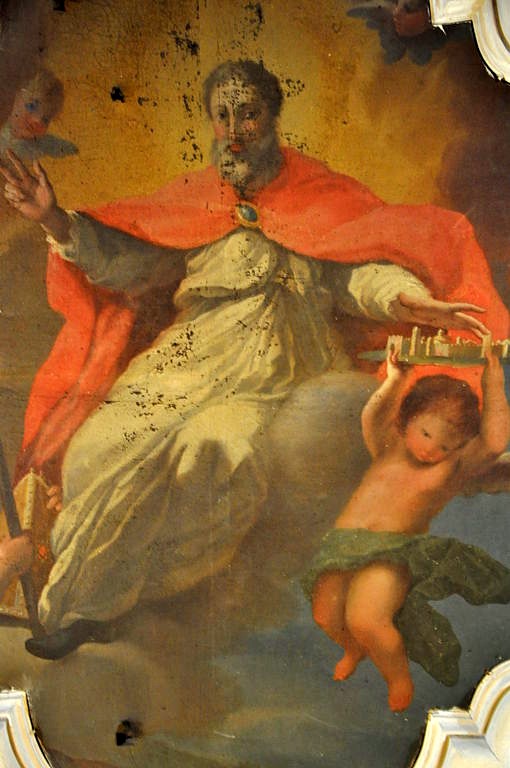
Painting of St Viventius in the Church in Blera
When, thanks to a vision, he knew that he would soon die, he sent for one of his spiritual daughters who had become blind in old age, ordering her to go to Blera to ask the faithful to come and fetch him with a cart on which he would return to the Town. That it was Providence that wanted it was understood from a miraculous event – some indomitable bulls, yoked to the wagon, suddenly became tame. The woman, who wanted to escape that embassy, objected that her blindness prevented her from doing so. “Go, daughter, and you will see, ” replied Viventius and at those words her sight returned.
Faced with the miracle, the inhabitants of Blera hastened to carry out the Bishop’s orders, realising, with amazement that the docile bulls were heading, without any apparent guide, to the Hermit’s cave. Viventius boarded the cart which, instead of following the shortest route, crossed the borders of the Diocese while the bells of the villages across which the wagon travelled, rang in celebration, even though no bell-ringer was present. Iit was theproof of his innocence. Arriving in Blera, he blessed the population, who had repented for having believed those impostors and finally died – it was 13 December which has become his liturgical feast.
St Viventius celebration and procession in Blera
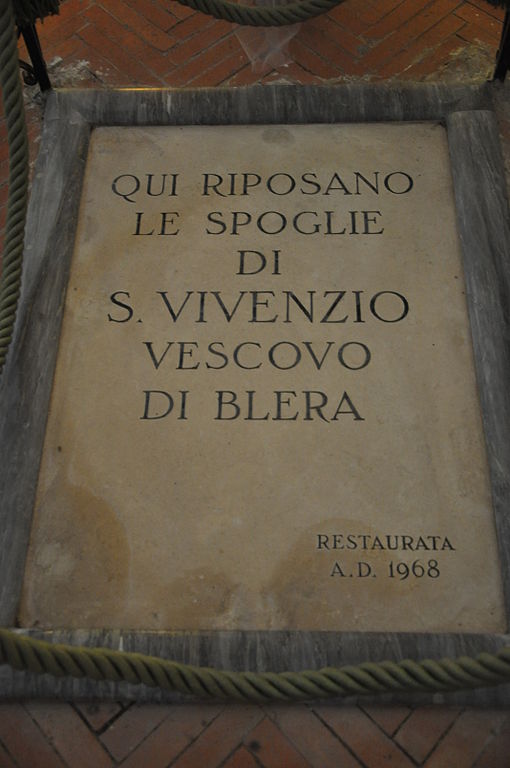
His body was buried in the Collegiate Church of Blera which is dedicated to the Assumption of the Blessed Mother and our St Viventius. The Crypt therein, with cross vaults embellished with stuccos and capitals, houses the Tomb of the Saint. The marble portal of the Church is surmounted by the bust of Viventius. We also find an image of the Saint inside the Church – he is depicted on a large canvas together with San Sensia and the Madonna Assunta. A Chapel in the right nave of the Collegiate Church is also dedicated to St Viventius.
St Viventius’ Tomb
In fact, the Saint is much loved, the veneration of the Patron Saint is still strongly felt and rooted in the souls of the Bleranians. According to some, Saint Viventius (the name derives from the Latin Vicentius and means ‘who is filled with vitality’) was the Confessor of Vergy in France, who is also celebrated today.
The Martyrology of Usuardo mentions him on 13 January and from there he passed into the Roman Martyrology on the same date. In Blera, our Saint is celebrated on 11 December. But such a loved Patron has 2 further celebrations, which consist of pilgrimages to his hermitage (prior to becoming the Bishop), one on Easter Monday and the other on the second Sunday of May. The Bleranrians, therefore, celebrate their Saint three times a year – on the occasion of the two pilgrimages and on 11 December.
St Agrecius of Trier St Andrew of Trier St Berno of Cluny St Designatus of Maastricht St Elian of Brittany St Enogatus of Aleth St Erbin of Cornwall St Glaphyra St Gumesindus of Córdoba St Hermylus St Hildemar of Arrouaise Bl Ida of Argensolles Bl Ivetta of Huy Widow, Mother, Recluse, Mystic












 AnaStpaul
You must be logged in to post a comment.