One Minute Reflection – 17 January – “The Month of the Most Holy Name of Jesus and of the Holy Family” – St Anthony Abbot (251-356) – Ecclesiasticus 45:1-6; Luke 12:35-40 – Scripture search here: https://www.drbo.org/
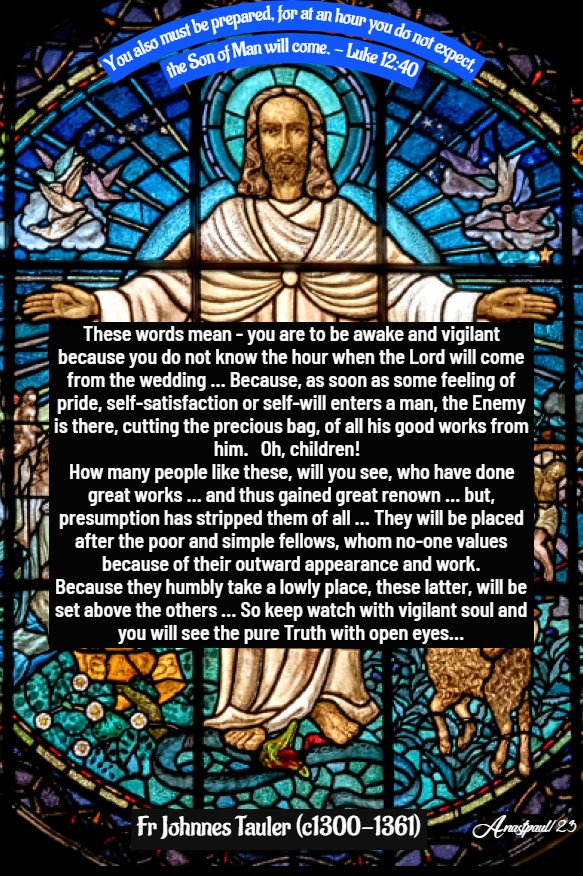
“You also must be prepared, for at an hour you do not expect, the Son of Man will come.” – Luke 12:40
REFLECTION – “These words mean – you are to be awake and vigilant because you do not know the hour when the Lord will come from the wedding … Because, as soon as some feeling of pride, self-satisfaction or self-will enters a man, the Enemy is there, cutting the precious bag, of all his good works from him. Oh, children! How many people like these, will you see, who have done great works … and thus gained great renown … but, presumption has stripped them of all … They will be placed after the poor and simple fellows, whom no-one values because of their outward appearance and work. Because they humbly take a lowly place, these latter, will be set above the others … So keep watch with vigilant soul and you will see the pure Truth with open eyes …
“Let your loins be girt about and your lamps alight.” Here there are three points to notice. First – the loins are to be girded like someone firmly bound with a rope, so as to be led, against his will … Second – you are to carry lighted lamps in your hands which is to say, works of love. Your hands should never stop doing the true, ardent work of charity … Third – you should wait for the Lord when He returns from the wedding … “The Lord will set them over all His goods; He will gird Himself and will serve them.” This wedding from which the Lord comes, takes place in the most interior part of the soul, in its depths, where the noble image is found. O what intimate contact the soul has with God and God with it, in this depth and what a marvellous work God does there! What rejoicing and joy He finds there! It surpasses all feeling and thought and yet, man knows nothing and feels nothing of it.” – Fr Johannes Tauler OP (c1300-1361) Dominican Priest and Friar, renowned Preacher and Theologian (Sermon 77 for the Feast of a Confessor).
PRAYER – May the intercession of the Blessed Abbot Anthony, commend us, we beseech Thee, O Lord, so that what we do not deserve by any merits of our own, we may obtain by his patronage. Through tJesus Christ, Thy Son our Lord, Who lives and reigns with Thee, in the unity of the Holy Ghost, God, world without end. Amen (Collect).
Our Morning Offering – 17 January – “The Month of the Most Holy Name of Jesus and of the Holy Family”
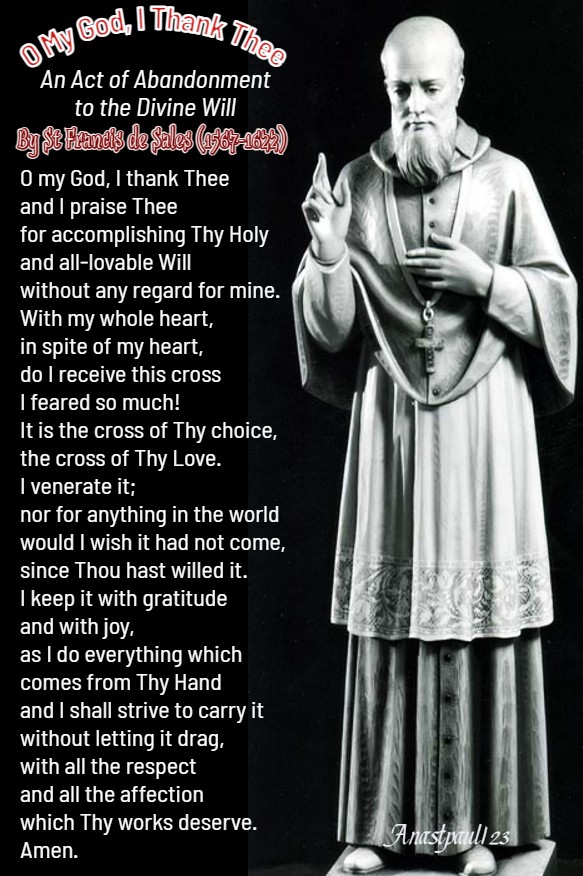
O My God, I Thank Thee An Act of Abandonment to the Divine Will By St Francis de Sales (1567-1622) Doctor Caritas
O my God, I thank Thee and I praise Thee for accomplishing Thy Holy and all-lovable Will without any regard for mine. With my whole heart, in spite of my heart, do I receive this cross I feared so much! It is the cross of Thy choice, the cross of Thy Love. I venerate it; nor for anything in the world would I wish it had not come, since Thou hast willed it. I keep it with gratitude and with joy, as I do everything which comes from Thy Hand and I shall strive to carry it without letting it drag, with all the respect and all the affection which Thy works deserve. Amen.
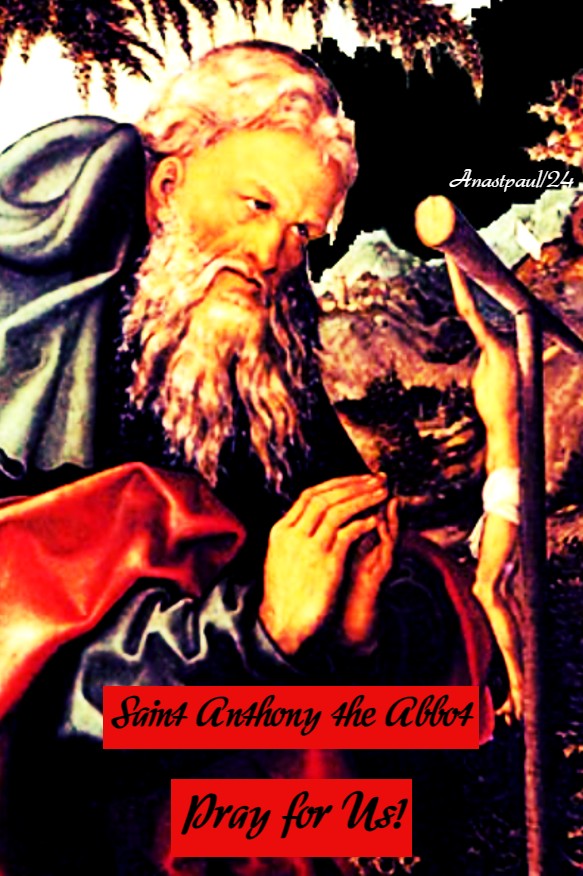
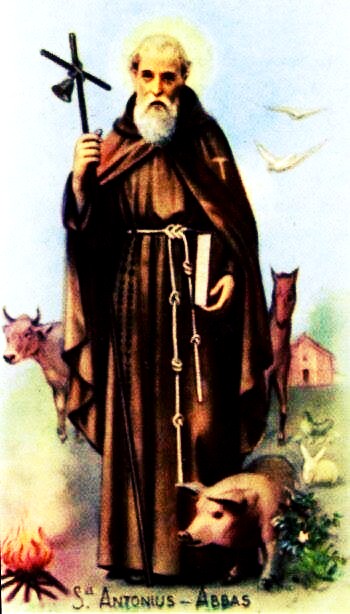
Saint of the Day – 17 January – St Anthony Abbot (251-356) Hermit, Founder of Monasteries, Abbot and Spiritual Guide, Mystic and Miracle-Worker, beloved of all animals. Born in 251 at Heracleus, Egyptand died on 17 January 356 at Mount Colzim of natural causes. Also known as – Anthony of Egypt, Anthony of the Desert, Anthony the Anchorite, Anthony the Hermit, Antonio Abate, Father of All Monks, Father of Western Monasticism. His Patronages are numerous – against eczema, skin diseases and rashes, pestilence, Saint Anthony’s Fire, of firefighters, of wild animals, amputees, anchorites, basket weavers and makers, bell ringers, brushmakers, domestic animals, butchers, cemetery and funeral workers and gravediggers, epileptics, farmers, hermits, monks, pigs, livestock, Hospitallers, of 29 Cities in Europe.
The Roman Martyrology says: “In Thebais, St Anthony, Abbot and Spiritual Guide of many Monks. He was most celebrated for his life and miracles, of which St Athanasius has written a detailed account. His holy body was found by divine revelation, during the reign of the Emperor Justinian and brought to Alexandria, where it was buring in the Church of St John the Baptist.”
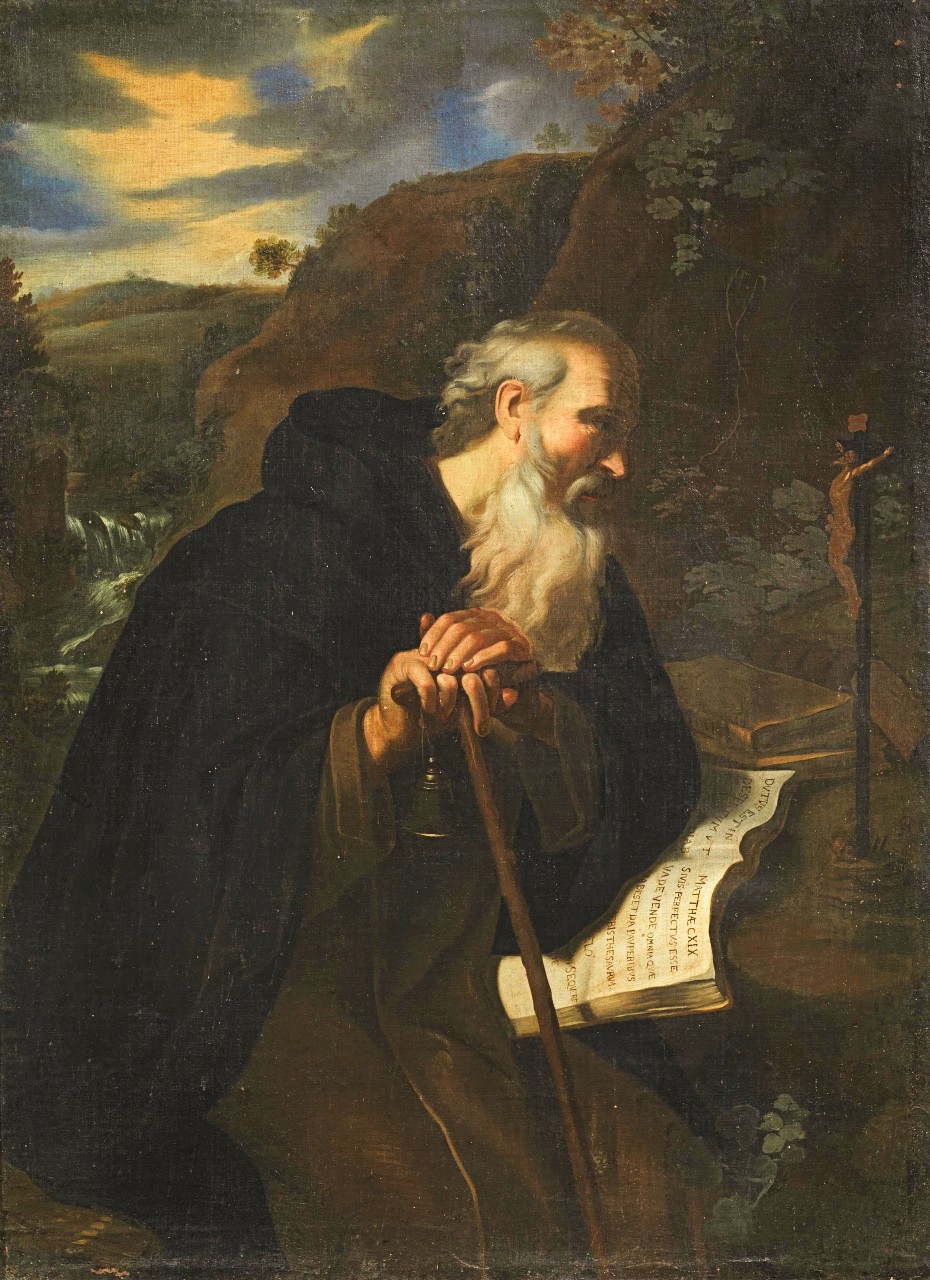
St Anthony unknown artist Italian School
St Anthony’s Vocation Anthony was born in 251 to a wealthy family of farmers in the village of Coma, now Qumans, in Egypt. Around the age of 18-20, he was left an orphan with a rich estate to manage and with a younger sister to educate. Attracted by the evangelical teaching “If you wish to be perfect, go, sell what you have, give to the poor and you will have treasure in heaven, then come, follow me” and by the example of some Anchorites who lived nearby in prayer, poverty and chastity, Anthony’s heart was drawn to choose this path. He, therefore, sold his goods, entrusted his sister to a community of virgins and dedicated himself to an ascetic life in front of his house and then outside the town.
Seeking a penitential and isolated life, he prayed to God for enlightenment. Not far away he saw a Hermit, like himself, who sat and worked, weaving a rope, then stopped, stood up and prayed; immediately after, he went back to working and praying again. This Anchorite was an Angel of God showing Anthony the path of work and prayer which, two Centuries later, would form the basis of the Benedictine Rule “Ora et labora” and Western Monasticism. Part of Anthony’s work was used to obtain food and part was distributed to the poor. St Athanasius asserts that he prayed continually and was so attentive to reading the Scriptures that he trained them verbatim in his memory oand he no longer needed scrolls.
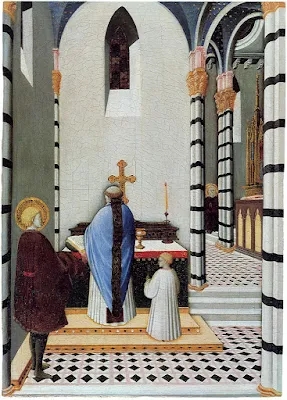
From the Sienese Altarpiece (1425-50) depiciting the Life of St Anthony – this image shows him as a little boy on the right and as a young adult on the left, after hearing the Gospel of the rich young man
St Anthony’s Temptations While still very young, after a few years of his solitary life, very difficult trials began for him. Impure thoughts tormented him, doubts assailed him about the advisability of such a solitary life. The instinct of the flesh and the attachment to material goods which he had tried to suppress, returned in overbearing and uncontrollable force. He, therefore, asked for help from other Hermits, who told him not to be afraid but to move forward with confidence because God was with him. They also advised him to get rid of all ties and material possessions and retreat to a more solitary place. Thus, barely covered by a rough cloth, Anthony took refuge in an ancient tomb dug into the rock of a hill, aurrounding the village of Coma. A friend brought him some bread every now and then; for the rest, he had to make do with wild berries and herbs growing around him. In this place, the first temptations were replaced by terrifying visions and noises. Furthermore, he went through a period of terrible spiritual darkness. All this Anthonye overcame by patiently persevering in faith, carrying out the will of God, day by day, as his teachers had taught him. When Christ finally revealed Himself to him as the Hermit, he asked: “Where were Thou? Why did Thou not appear from the beginning, to put an end to my sufferings?”. He heard Him reply: “Anthony, I was here with thee and witnessed thy fight”…
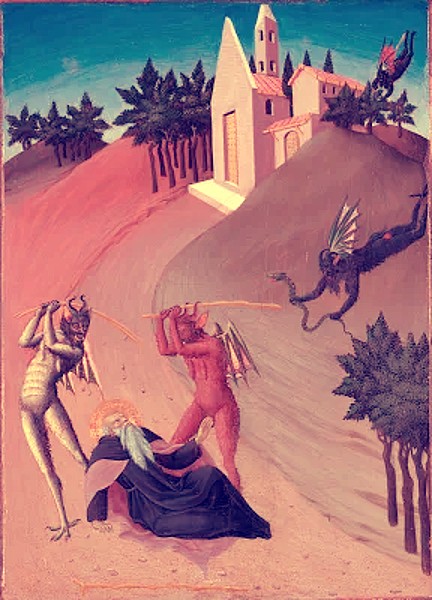
St Anthony’s Temptations
On the Mountains of Pispir Discovered by his fellow citizens, who, like all Christians of those times, flocked to the Hermits to receive spiritual advice, prayer and consolation but, at the same time, disturbed their solitude and meditation, forced Anthony to move further away. In the Pispir mountains there was an abandoned fortress, infested with snakes but with a spring source and in 285 Anthony moved there and remained there for 20 years. Twice a year, bread was dropped to him from above. In this new solitude he followed the example of Jesus, Who, guided by the Spirit, retreated into the desert “to be tempted by the devil,”
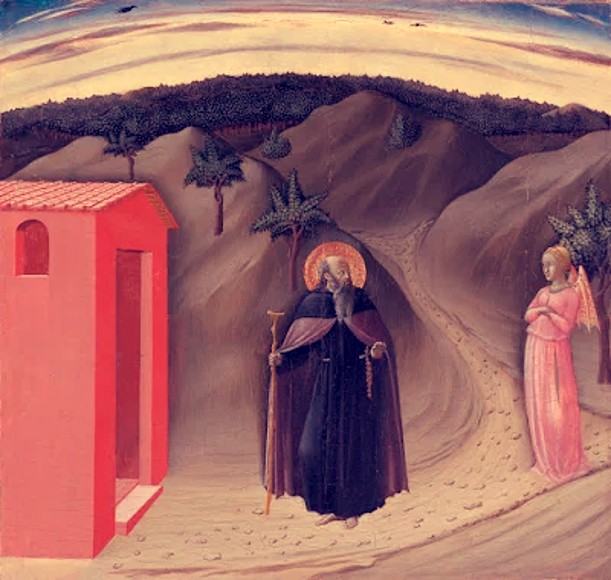
St Athanasius tells of the many times when St Anthony struggled against devils, not only by resisting temptations but also suffering bodily harm which they were permitted to inflict upon him. On one such occasion, “a multitude of demons … so cut him with stripes that he lay on the ground speechless from the excessive pain.” He was discovered unconscious by the local villagers, who thought him dead and brought him to their Church, here depicted in the background. (Life of Anthony 8 and 9)
The First Communities of disciples Then came the time when many people who wanted to dedicate themselves to the solitary eremitcal life arrived at the fort. Anthony went out and began to console the afflicted, obtaining cures from the Lord, freeing the possessed and instructing the new disciples. Two groups of Monks were formed who gave rise to two Monasteries, one east of the Nile and the other on the left bank of the river. Each Monk had his own solitary cave but obeyed a brother more experienced in spiritual life. Anthony gave everyone his advice on the path towards perfection of the spirit and union with God, thus operating as their Abbot from his cave.
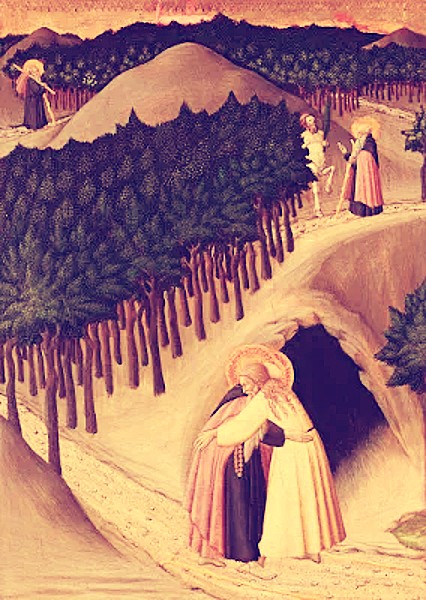
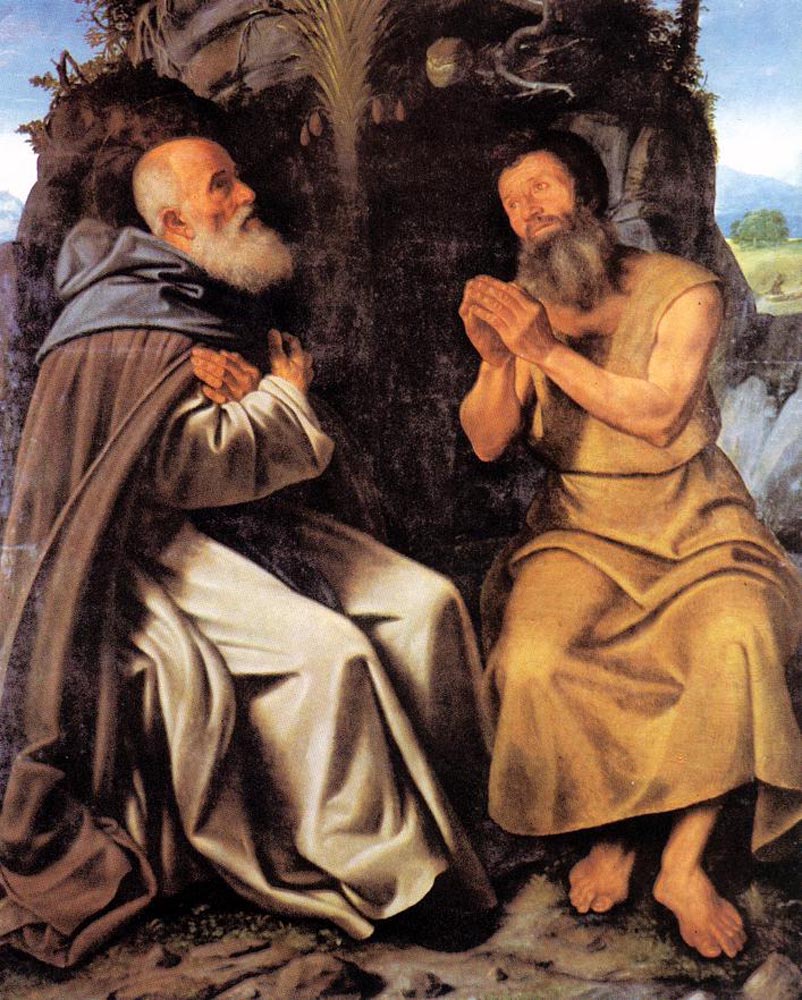
In the Thebaid Once again, to escape the many curious people who went to the fortress, Anthony decided to retreat to a more isolated place. He, therefore ,went to the Thebaid desert, in Upper Egypt, where he began to cultivate a small garden to support himself and those disciples and visitors, who followed him. He lived in the Thebaid region until the end of his very long life. He was able to bury the body of the Hermit Saint Paul the Hermit, with the help of a lion — for this reason he is considered the Patron Saint of wild animals, of cemeteries, gravediggers and funeral workers. In his last years he welcomed two Monks who looked after him in his extreme old age. He died at the age of 106, on 17 January 356 and was buried in a secret place.
St Anthony meets St Paul the Hermit
The Spiritual Inheritance His presence had also attracted many people to the Thebaid eager for a more spiritual life. Many chose to follow his style, thus Monasteries arose among those mountains. The desert was populated by Monks, the first of that multitude of consecrated men, who in the East and the West, continued the path he had begun, expanding it and adapting it to the needs of the times. His disciples handed down his wisdom to the Church, collected in 120 sayings and 20 letters. In Letter 8, Saint Anthony wrote: “Ask with a sincere heart for that great Spirit of fire which I myself have received and it will be given to you.”
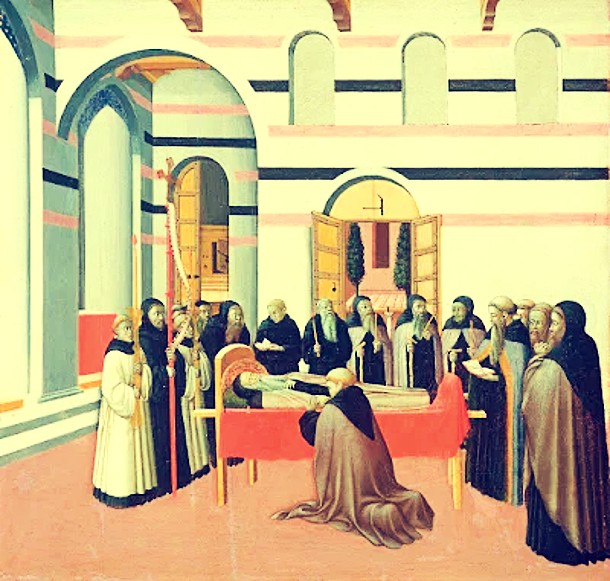
The Last Rites and Death of St Anthony
Protection against Shingles (Herpes Zoster) In 561 his tomb was discovered and the Relics began a long journey through time and space, from Alexandria to Constantinople, until arriving in France, in the 11th Century, in Motte-Saint-Didier, where a Church was built in his honour. Crowds of sick people flocked to venerate his Relics in this Church, especially those suffering from skin eruptions, caused by the poisoning of a fungus present in rye, used to make bread (or so it was thought). The disease, now scientifically known as herpes zoster, was known since ancient times as ‘ignis sacer’ (sacred fire) due to the burning sensation it caused. Also for this reason, our Saint is invoked against skin diseases in general. To house all the sick people who arrived, a hospital was built and a brotherhood of religious people was founded, the ancient hospital order of the ‘Antoniani.’ Hence the Patronage of Hospitallers. The village took the name of Saint-Antoine de Viennois.
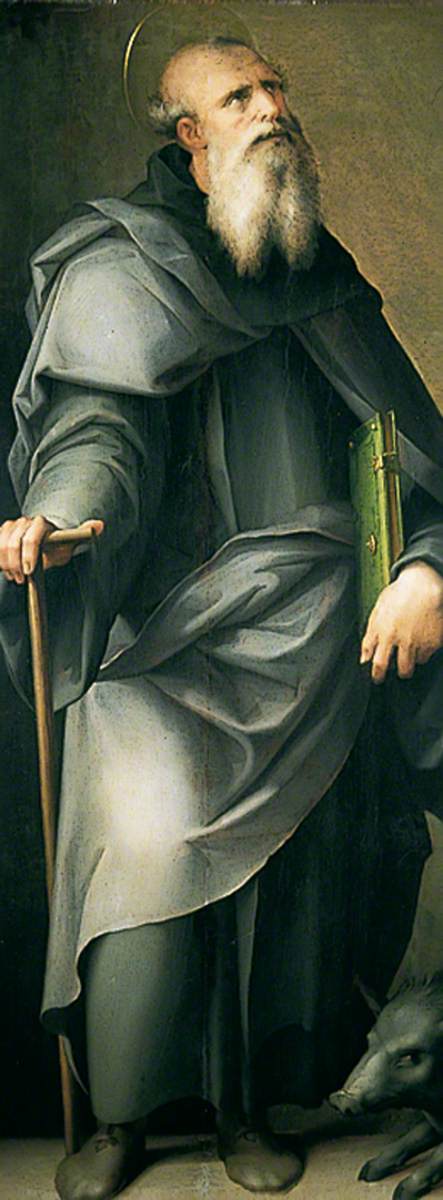
The Tau Staff is visible in St Anthony’s hand
The Pig, the Fire, the “Tau” The Pope granted the Antonians the privilege of raising pigs for their own use and at the expense of the community, so the piglets could move freely between courtyards and streets; no-one touched them, if they wore an identification bell. Their fat was used to treat ergotism, which was called “sickness. Antonio” and then “fire of St Anthony.” For this reason, in popular religiosity, the pig began to be associated with the great Egyptian Hermit, later considered the Patron Saint of pigs and by extension, of all domestic and stable animals. In his iconography, in addition to the pig with the bell, there also appears the T-shaped Hermits’ staff, the “tau” the last letter of the Hebrew alphabet and, therefore, an allusion to the last things and destiny. A popular legend which connects his iconographic attributes, narrates that Saint Anthony went to hell to contend with the devil for the souls of the dead. While his little pig, sneaking in, created havoc among the demons, he lit his tau-shaped stick with infernal fire and took it out together with the recovered little pig — he gave fire to humanity, lighting a pile of wood.
Popular devotion On the day of his liturgical memory, the stables are blessed and the domestic animals are brought to be blessed. In some countries of Celtic origin, Saint Anthony took on the functions of the divinity of rebirth and light, Lug, the guarantor of new life, to whom wild boars and pigs were consecrated. Therefore, in various works of art, there is a boar at his feet. Patron of all those involved in processing pigs, alive or slaughtered, he is also the Patron of those who work with fire, such as firefighters because he cured that metaphorical fire which was Herpes Zoster. Even today, on 17 January, especially in agricultural villages and farmhouses, it is customary to light the so-called “St Anthony’s bonfire which had a purifying and fertilising function, like all the fires which marked the transition from winter to the imminent spring. The ashes, then collected in the home braziers of the past, were used to heat the house and, using a special bell made with wooden slats, to dry damp clothes. Venerated throughout the Centuries, his name is among the most widespread in Catholicism. Saint Anthony of Padua himself, precisely to indicate his desire for greater perfection, chose to change the name received at his Baptism to that of our Saint today.
The Life of St Anthony by St Athanasius: https://www.youtube.com/watch? v=XiKDl_lOb74&list=PL5_ax08Z6UX9h2VWw84sk4zcAQUliDUo7
St Achillas of Sketis St Amoes of Sketis St Anthony of Rome Bl Euphemia Domitilla
BlessedGamelbert of Michaelsbuch (c720-c802) Priest, Monk, Hermit. “Such was his kindness of heart, that he used to buy the little birds caught by the peasants, in order to set them free. He never allowed his servants to work in the fields or woods, if bad weather threatened. He valued, above everything, peace and concord and kept the peace among his parishioners, as far as he possibly could.” – from “The Little Bollandists” by Monsignor Paul Guérin, 1882 Biography: https://anastpaul.com/2022/01/17/saint-of-the-day-17-january-blessed-gamelbert-of-michaelsbuch-c-720-c-802/
Martyrs of Langres – Triplet Brothers with their Grandmother: At Langres, in the time of Marcus Aurelius, the Saints Eleusippus, Meleusippus, Speusippus, born at one birth, who were crowned with Martyrdom, together with their grandmother, Leonilla,
Thought for the Day – 16 January – The Spiritual Combat (1589) – Dom Lorenzo Scupoli OSM (c1530-1610)
“None shall be crowned who has not fought well.” 2 Tim 2: 5
The Third Weapon of the Spiritual Combat
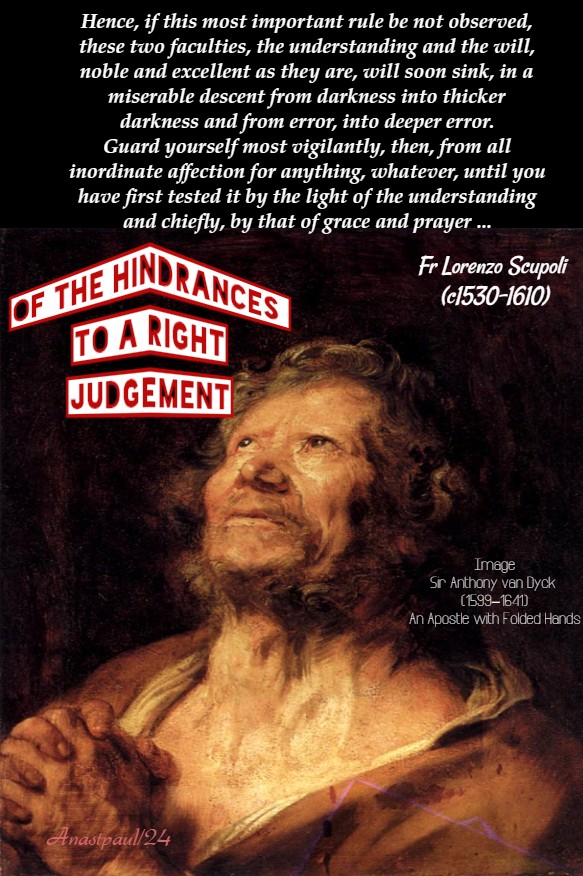
VIII: … Of the Hindrances to a Right Judgement and of the Method to be Adopted, in order to Understand them Properly
“The cause of our not rightly judging all these things and many others, is, that we conceive a love or hatred of them at first sight. Our understanding (reason or intellect) is thus darkened, so that it cannot judge of them correctly. Lest you fall into this delusion, take all possible care to keep your will pure and free from inordinate affection for anything whatsoever! When any object, then, is presented to you, view it with your understanding and consider it maturely, before you are moved by hatred to reject it, if it be a thing contrary to your inclinations, or by love to desire it, if it be pleasing to them. For thus the understanding, being unclouded by passion, will be free and clear and able to perceive the truth and to judge the evil which lurks behind delusive pleasure and the good which is veiled under the appearance of evil.
But if the will be first inclined to love or hate anything, the understanding will be unable to exercise a right judgement upon it. For the affection which has thus intruded itself so obscures the understanding, that it views the object as other than it is and, by thus representing it to the will, influences that faculty, in contradiction to every law and rule of reason, to love or hate it inordinately. The understanding is gradually darkened more and more and, in this deepening obscurity, the object appears more and more hateful or lovely to the will.
Hence, if this most important rule be not observed, these two faculties, the understanding and the will, noble and excellent as they are, will soon sink, in a miserable descent from darkness into thicker darkness and from error, into deeper error.
Guard yourself most vigilantly, then, from all inordinate affection for anything, whatever, until you have first tested it by the light of the understanding and chiefly, by that of grace and prayer and by the judgement of your spiritual father. And this is to be observed most carefully with regard to such outward works as are good and holy because, the danger is greatest here, of delusion and indiscretion. Hence you may here receive serious injury from some circumstance of time, or place, or degree, or regarding obedience — as has been proved by many, who have incurred great danger in the performance of commendable and holy exercises.”
Quote/s of the Day – 16 January – “The Month of the Most Holy Name of Jesus and of the Holy Family” – 1 Peter 5:1-4, 10-11; Matthew 16:13-19 – Scripture search here: https://www.drbo.org/
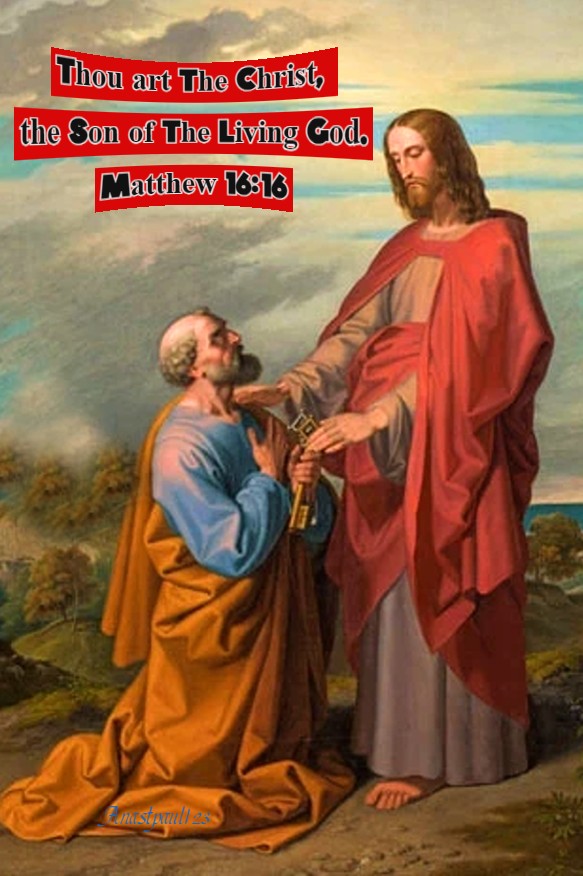
“Thou art the Christ, the Son of the living God.”
Matthew 16:16
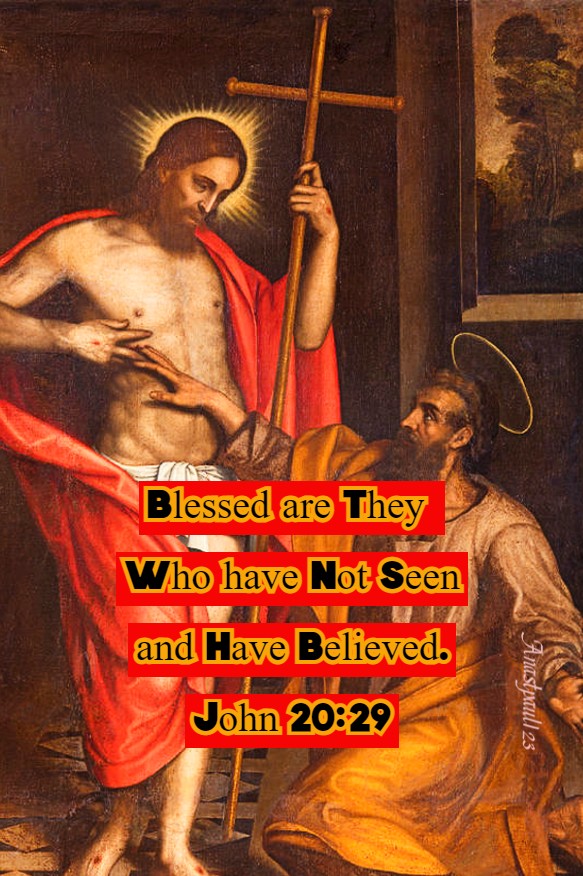
Blessed are they who have not seen and have believed.”
John 20:29
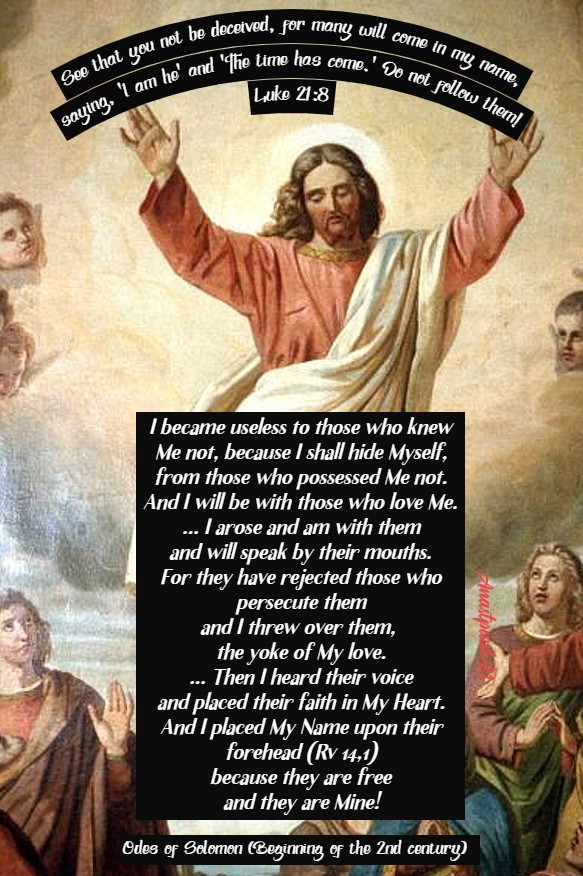
“See that you not be deceived, for many will come in my name, saying, ‘I am he’ and ‘The time has come.’ Do not follow them!” Luke 21:8
“[Christ speaks:] I became useless to those who knew Me not, because I shall hide Myself, from those who possessed Me not. And I will be with those who love Me. … I arose and am with them and will speak by their mouths. For they have rejected those who persecute them and I threw over them, the yoke of My love. … Then I heard their voice and placed their faith in My Heart. And I placed My Name upon their forehead (Rv 14,1) because they are free and they are Mine!”
Odes of Solomon (Hebrew Christian text from the beginning of the 2nd century) N° 42)
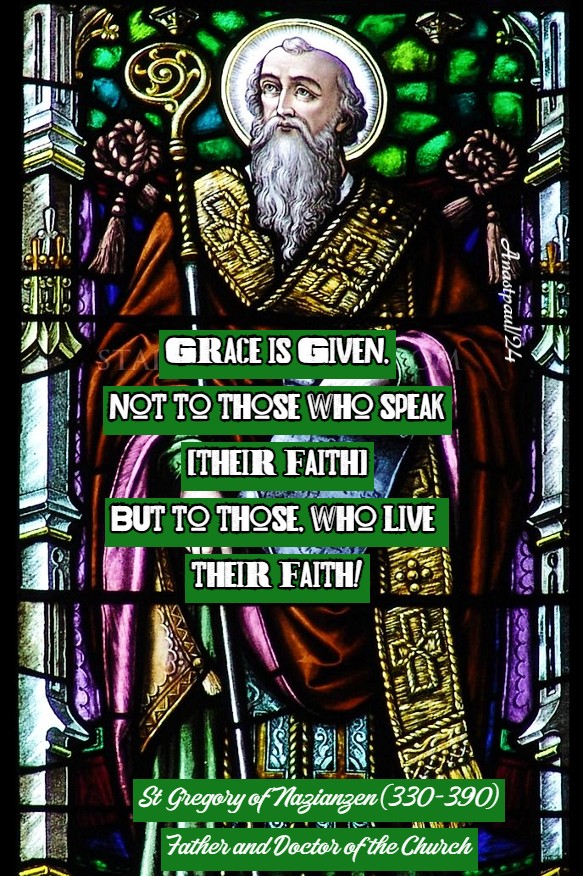
“Grace is given, not to those who speak [their faith] but to those, who live their faith!”
St Gregory of Nazianzen (330-390) Father and Doctor of the Church
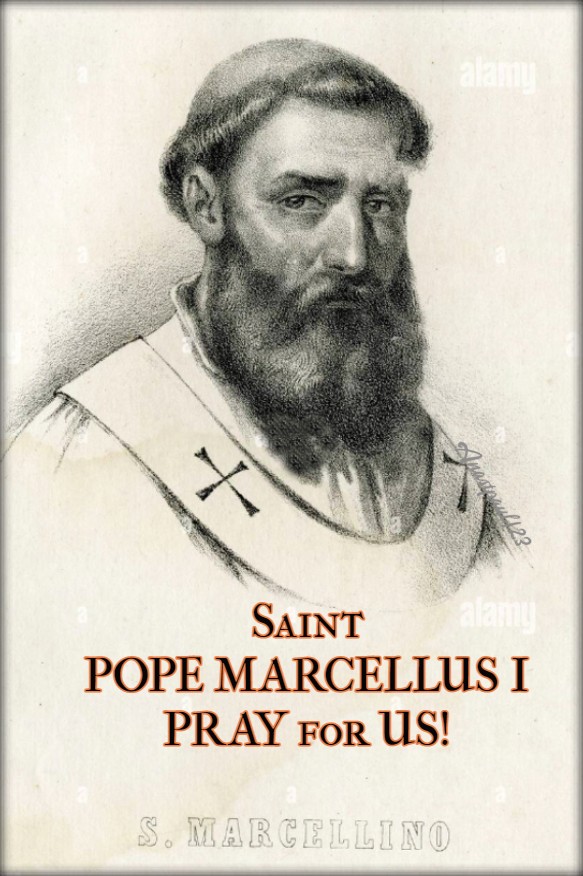
One Minute Reflection – 16 January – “The Month of the Most Holy Name of Jesus and of the Holy Family” – Saint Pope Marcellus I (Died 309) – 1 Peter 5:1-4, 10-11; Matthew 16:13-19 – Scripture search here: https://www.drbo.org/
“Upon this rock I will build My Church” – Matthew 16:18
REFLECTION – “Brothers, when it comes to fulfilling my duties as Bishop, I discover that I am weak and slack, weighed down by the weakness of my own condition, while at the same time, I want to act generously and courageously. However, I draw my strength from the untiring intercession of the almighty and eternal Priest, Who, like us but equal to the Father, lowered His divinity to the level of man and raised humankind to the level of God. The decisions He made, give me a just and holy joy. For, when He delegated many shepherds to care for His flock, He did not abandon watching over His beloved sheep. Thanks to that fundamental and eternal assistance, I in turn, have received the protection and support of the Apostle Peter, who also does not abandon his function. This solid foundation, on which the whole of the Church is built, never grows tired of carrying the whole weight, of the building which rests on it.
The firmness of faith, for which the first of the Apostles was praised, never fails. Just as everything which Peter professed in Christ remains, so that which Christ established in Peter, remains… The order willed by God’s Truth remains. Saint Peter perseveres in the solidity which he received; he has not abandoned the governance of the Church which was placed in his hands. That, my brothers, is what that profession of faith, inspired by God the Father, obtained in the heart of the Apostle. He received the solidity of a rock which no assault can shake. In the entire Church, Peter says everyday: “Thou art the Messiah, the Son of the living God.” – St Leo the Great (400-461) Pope, Father and Doctor of the Church (Sermon on the anniversary of his Consecration as Bishop).
PRAYER – O Lord, we beseech Thee, graciously hear the prayers of Thy people, that we may be helped by the merits of blessed Marcellus, Thy Pope and Martyr, whose sufferings we celebrate. Through the same Jesus Christ, Thy Son our Lord, Who lives and reigns with Thee, in the unity of the Holy Ghost, God, world without end. Amen (Collect).
Our Morning Offering – 16 January – “The Month of the Most Holy Name of Jesus and of the Holy Family”
My Most Sweet Lord Morning Offering Of St Alphonsus Liguori (1696-1787) Most Zealous Doctor
My most sweet Lord, I offer and consecrate to Thee. this morning all that I am and have – my senses, my thoughts, my affections, my desires, my pleasures, my inclinations, my liberty. In a word, I place my whole body and soul in Thy Hands. Amen.
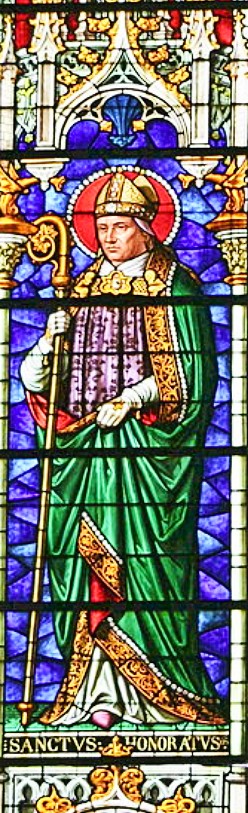
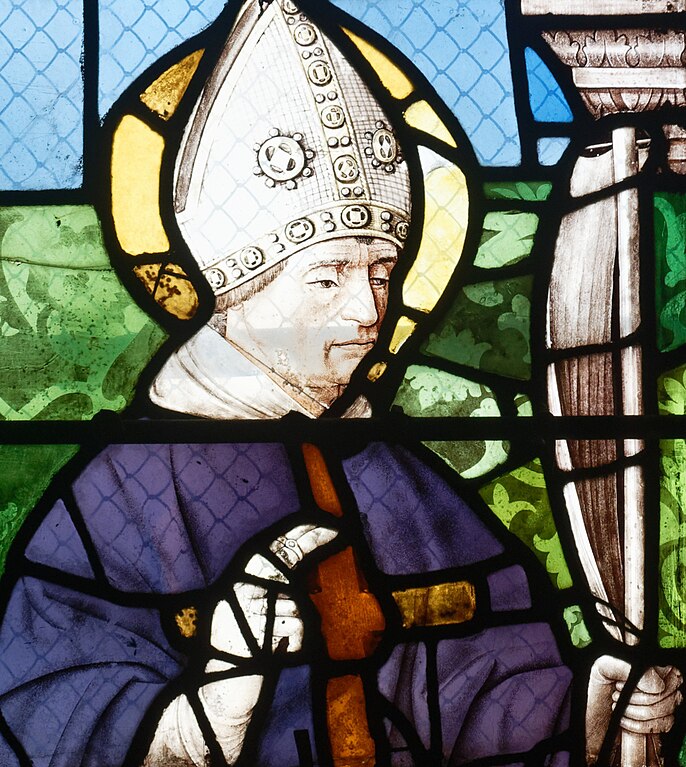
Saint of the Day – 16 January – Saint Honoratus of Arles (c350-c429) Bishop and Confessor, Monk and Abbot, Miracle-worker, Founder of the renowned Monaster at Lérins. on the Iles-de-Lérins, the Lérins Islands, outside present-day Cannes. Born in c350 in northern Gaul (modern France) and died in January 429 of natural causes, Patronages – against and for rain, against drought. Also known as – Honorat, Honore, Honoratus of Lérins.
The Roman Martyrology reads today: “At Arles, St Honoratus, Bishop and Confessor, whose life was renowned for learning and miracles.”
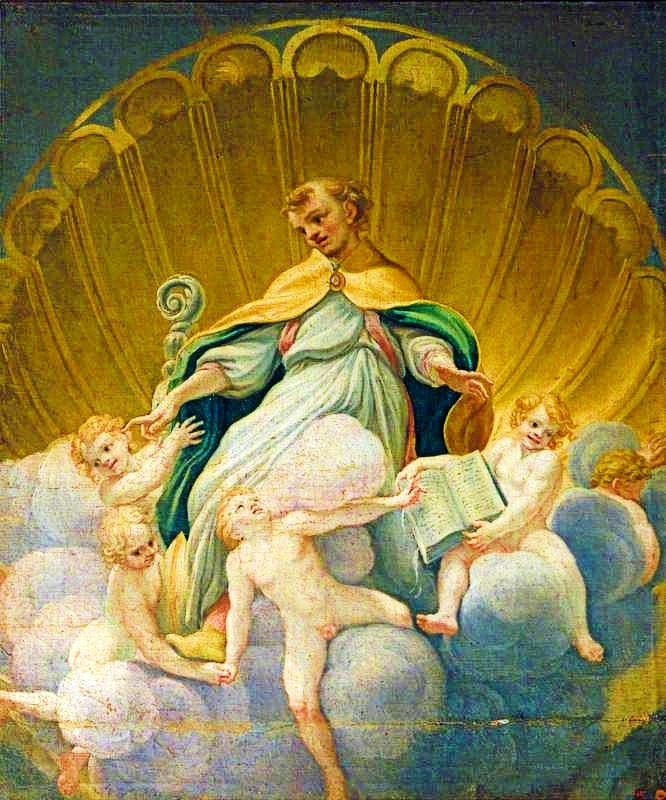
This Statue of St Honoratus resides in Barcelona – Basílica de la Mercè
Honoratus and his brother, also a Saint, Venantius were of a noble pagan family of Roman heritage, their father being a Roman Consul to Gaul in the north of modern France. Honoratus was born around the year 350 probably in Lorraine or possibly in Trier in present-day Germany.
After receiving an outstanding education in the liberal arts both Honoratus and his brother became Christians and in 368, under the instruction and guidance of St Caprasius (died around 430), a holy Hermit of Lérins, the two brothers embarked, from Marseilles, on a pilgrimage to the Holy Land and the Desert Monks in Egypt and Syria, speciafically aimed at studying monasticism.
The sudden death of Venantius and illness of Honoratus in Greece, prevented further travels. St Caprasius and our Saint, returned home through Italy stopping at Rome. On their return to Gaul, Honoratus went on into Provence. There in around 405, encouraged by St Leontius the Bishop of Fréjus (Died c488), he was Ordained a Priest and took up his abode on the wild Lérins Island today named after him — the Île Saint-Honorat, with the intention of living there in solitude.
Numerous disciples soon gathered around Honoratus, including St Lupus of Troyes, St Eucherius of Lyon and St Hilary of Arles (who was our Saints’ nephew[?]). Thus was founded the Monastery of Lérins which has enjoyed so great a celebrity status and which was, during the 5th and 6th Centuries, a nursery for illustrious Bishops and remarkable Ecclesiastical writers. His Rule of Life was chiefly borrowed from that of St Pachomius. It is believed too that the glorious St Patrick trained there for his missionary work in Ireland. The famous Monastery of Lerinum (Lérins) which stands there to this day, the oldest existing Monastery in Europe, is today inhabited by Cistercians. Many visitors also found their way to Lérins, among them Saint John Cassian . He called the foundation at Lérins “en ingens fratrum coenobium — a great community of brothers.”
Honoratus’ reputation for sanctity was such that in 426, after the assassination of Patroclus, Archbishop of Arles, he was summoned from his solitude to succeed to the government of the Diocese which the Arian and Manichaean beliefs had greatly disturbed. He appears to have succeeded in re-establishing order and orthodoxy, while still continuing to direct, from afar, the Monks of Lérins.
He died in the arms of Hilary, his disciple and nephew, who was to succeed him in the See of Arles. Almost immediately after his death in around 430, Hilary wrote the “Sermo de Vita Sancti Honorati” probably in 430.
In 1391, Honoratus’ Relics were transferred to Lérins and his Tomb now stands empty under the High Altar in the Church named after him in Arles. His Relics have, since 1788, been in the Church of Notre-Dame in Grasse in the south of France, north-west of Cannes. There he was later honoured as “St Transitus” (Latin transitus = the moved) – possibly moved for safety during the Revolution.
Honoratus’ various writings have not been preserved, nor has the Rule which he gave to the solitaries of Lérins. St John Cassian, dedicated several of his “Conferences” to our Saint Honoratus.
St Henry of Coquet St Honoratus of Arles (c350-c429) Bishop and Confessor St Honoratus of Fondi Abbot Bl James of Luino St James of Tarentaise Bl Joan of Bagno di Romagna Bl Konrad II of Mondsee St Leobazio St Liberata of Pavia St Melas of Rhinocolura St Otto of Morocco St Peter of Morocco St Priscilla of Rome St Sigeberht of East Anglia
Thought for the Day – 15 January – The Spiritual Combat (1589) – Dom Lorenzo Scupoli OSM (c1530-1610)
“None shall be crowned who has not fought well.” 2 Tim 2: 5
The Third Weapon of the Spiritual Combat
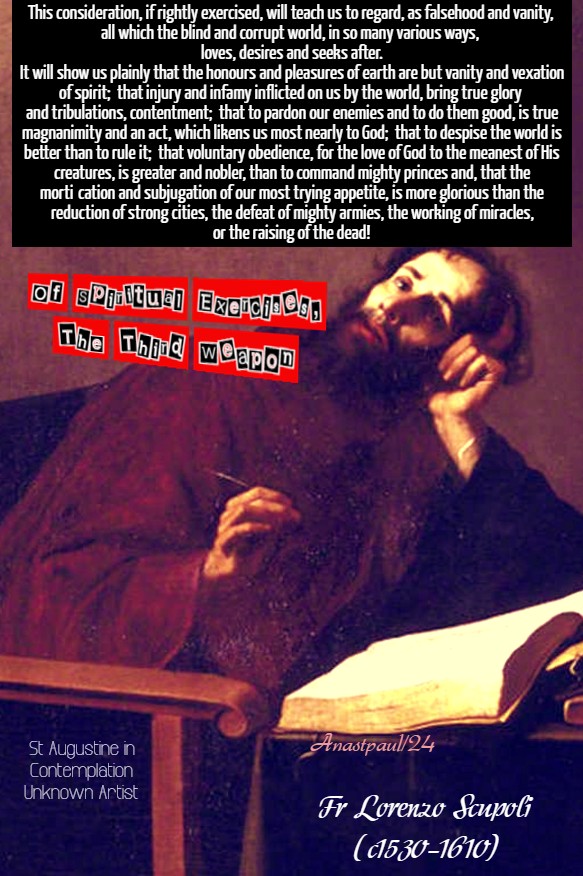
VII: … Of Spiritual Exercises (and the first of the Exercise of the Understanding (Reason) — which must be kept guarded against ignorance and curiosity).
“If in this warfare, we are provided with no weapons except self-distrust and trust in God, needful as both these are, we shall not only fail to gain the victory over ourselves but, shall fall into many evils. To these, therefore, we must add the use of Spiritual Exercises, the Third Weapon named above. And these relate chiefly to the Understanding (Reason) and the Will.
As regards the Understanding, we must guard against two things which are apt to obscure it. One is ignorance which darkens it and impedes it in acquiring the knowledge of truth, the proper object of the understanding. Therefore, it must be made clear and bright, by exercise that so it may be able to see and discern plainly, all that is needful to purify the soul from disorderly passions and to adorn it with saintly virtues.
This light may be obtained in two ways: The first and most important is prayer, imploring the Holy Ghost to pour it into our hearts. This He will not fail to do, if we, in truth seek God alone and the fullment of His holy will and, if in all things, we submit our judgement to that of our spiritual father. The other is, to exercise ourselves continually in a true and deep consideration of all things, to discover whether they be good or evil, according to the teaching of the Holy Ghost and not, according to their outward appearance, as they impress the senses or are judged of by the world.
This consideration, if rightly exercised, will teach us to regard, as falsehood and vanity, all which the blind and corrupt world, in so many various ways, loves, desires and seeks after. It will show us plainly that the honours and pleasures of earth are but vanity and vexation of spirit; that injury and infamy inflicted on us by the world, bring true glory and tribulations, contentment; that to pardon our enemies and to do them good, is true magnanimity and an act, which likens us most nearly to God; that to despise the world is better than to rule it; that voluntary obedience, for the love of God to the meanest of His creatures, is greater and nobler, than to command mighty princes and, that the mortication and subjugation of our most trying appetite, is more glorious than the reduction of strong cities, the defeat of mighty armies, the working of miracles, or the raising of the dead!”
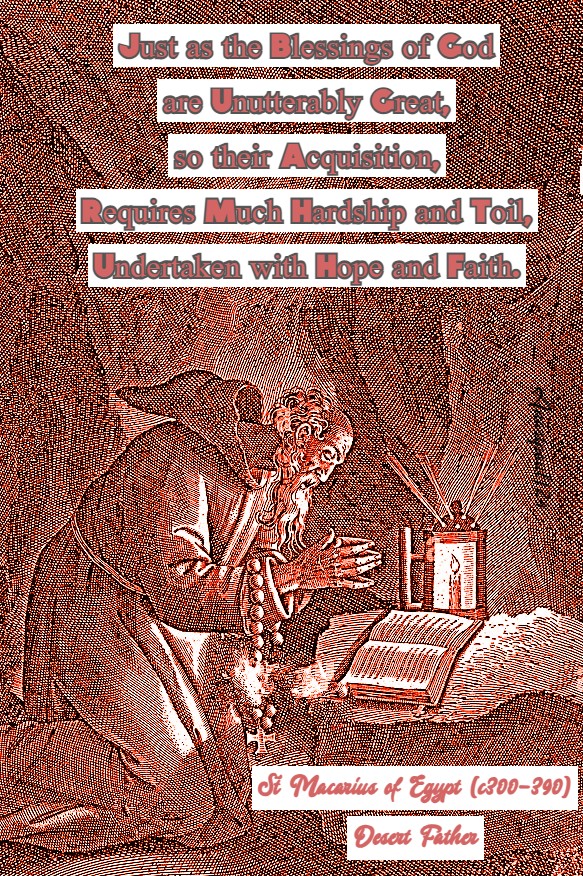
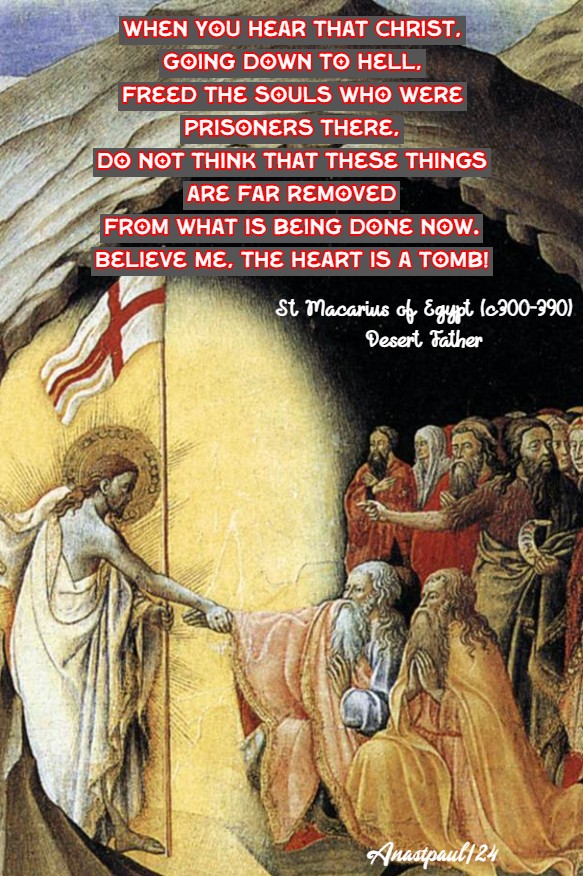
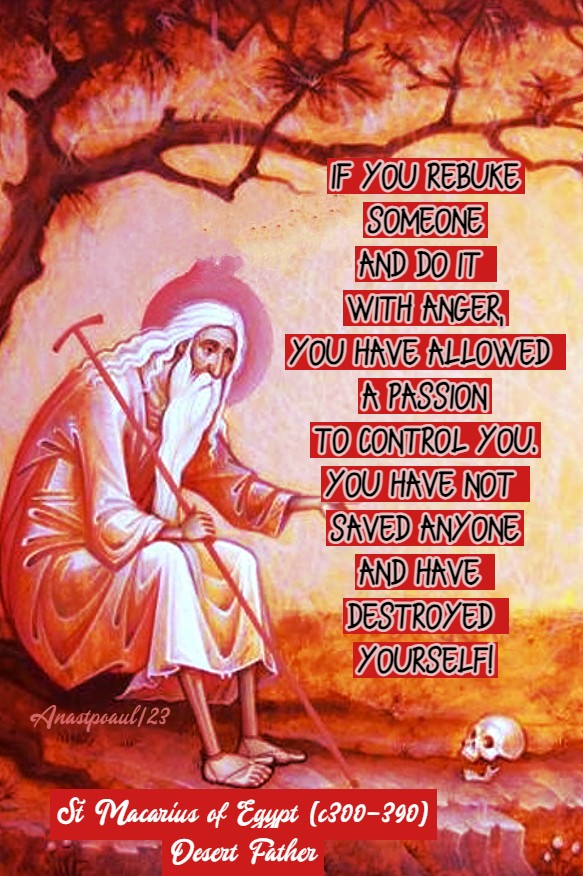
Quote/s of the Day – 15 January – The Feast of St Macarius of Egypt (c300-390) Priest, Abbot, Hermit, Desert Father of the Church, Spiritual student of Saint Anthony Abbot, Ascetic, Miracle-worker , known as “The Glowing Lantern.”
“Just as the blessings of God are unutterably great, so their acquisition, requires much hardship and toil, undertaken with hope and faith.”
“When you hear that Christ, going down to hell, freed the souls who were prisoners there, do not think that these things are far removed from what is being done now. Believe me, the heart is a tomb!”
“If you rebuke someone and do it with anger, you have allowed a passion to control you. You have not saved anyone and have destroyed yourself!”
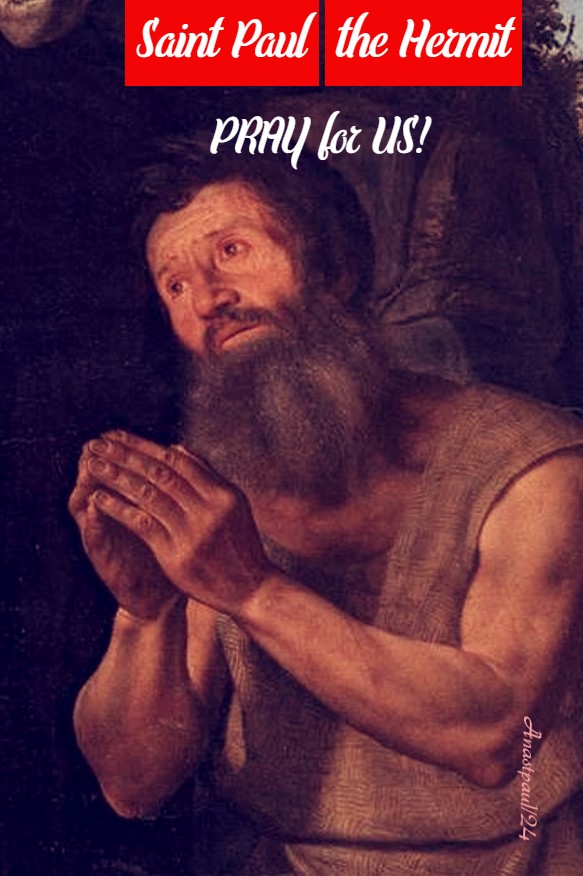
One Minute Reflection – 15 January – St Paul the Hermit (c227-c342) The First Hermit – in the Thebaid region of Egypt, is regarded as the first Christian hermit, who lived alone in the desert from his sixteenth to the one hundred and thirteenth year of his life. – Philippians 3:7-12; Matthew 11:25-30 – Scripture search here: https://www.drbo.org/
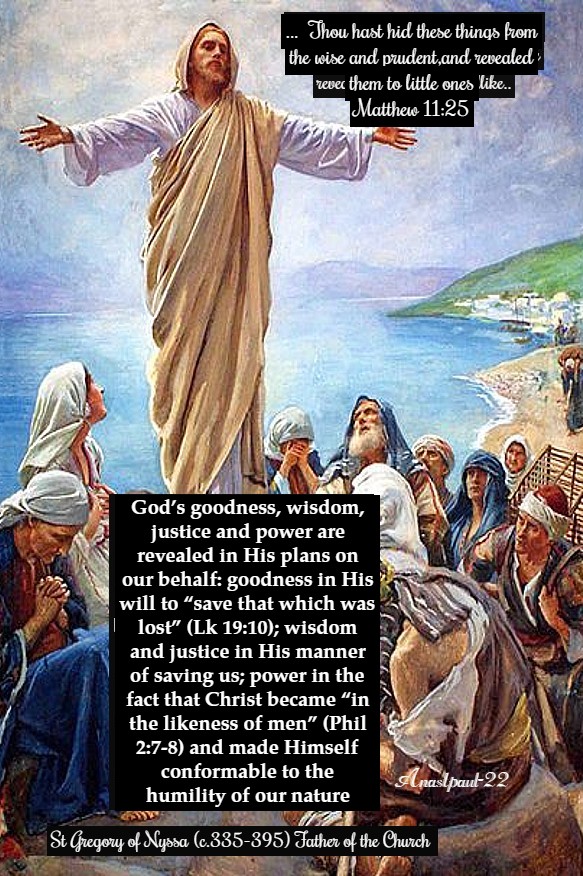
“…Thou hast hid these things from the wise and prudent,and revealed them to little ones.”– Matthew 11:25
REFLECTION – “The fact ,that the All-Powerful God has been able to humble Himself even to the humility of the human condition, constitutes a greater proof than the impact and supernatural character of miracles. Indeed, when divine power effects something of great sublimity, this is, after a fashion, in conformity with and appropriate to, God’s nature … On the other hand, that God descended even to our lowliness is, in a certain way, the expression of an overwhelming power which is not in the least restrained, by what is contrary to its nature …
Neither the expanse of the heavens, the brightness of the stars, the governing of the universe, nor the harmony of created things, reveal the splendid power of God, as much as His indulgence, which leads Him to lower Himself to the weakness of our nature … God’s goodness, wisdom, justice and power are revealed in His plans on our behalf:goodness in His will to “save that which was lost” (Lk 19:10);wisdom and justice in His manner of saving us;power in the fact that Christ became “in the likeness of men” (Phil 2:7-8) and made Himself conformable to the humility of our nature.” – St Gregory of Nyssa (c.335-395) Bishop, Father of the Church (Catechetical Discourse 23-26 ; SC 453).
PRAYER – O God, Who each year give us the joyful feast of blessed Paul, Thy Confessor, mercifully grant that we may imitate the deeds of him, whose anniversary we celebrate. Through Jesus Christ, Thy Son our Lord, Who lives and reigns with Thee, in the unity of the Holy Ghost, God, world without end. Amen (Collect).
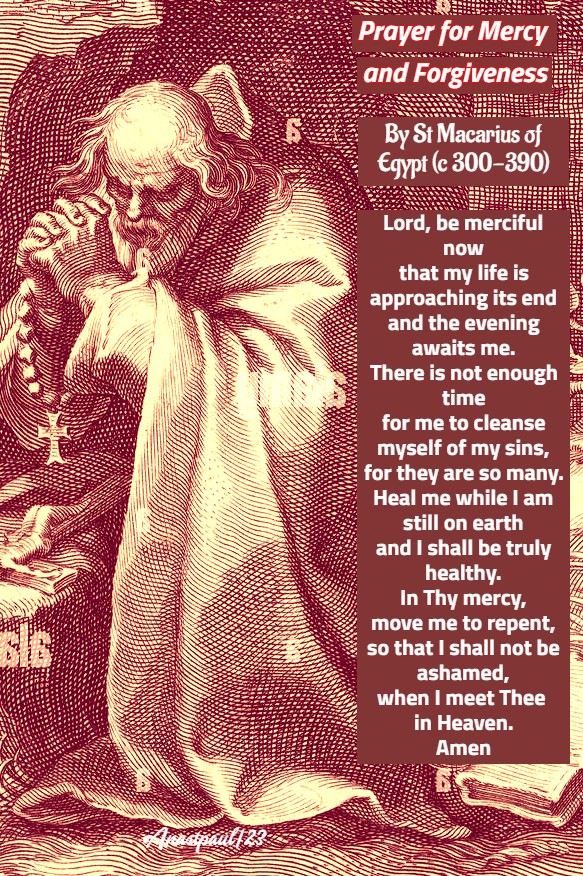
Our Morning Offering – 15 January – “The Month of the Most Holy Name of Jesus and of the Holy Family” – The Feast of St Macarius of Egypt (c300-390) Priest, Abbot, Hermit, Desert Father of the Church, Spiritual student of Saint Anthony Abbot, Ascetic, Miracle-worker , known as “The Glowing Lantern.”
Prayer for Mercyand Forgiveness By St Macarius of Egypt (c300-390)
Lord, be merciful now that my life is approaching its end and the evening awaits me. There is not enough time for me to cleanse myself of my sins, for they are so many. Heal me while I am still on earth and I shall be truly healthy. In Thy mercy, move me to repent, so that I shall not be ashamed, when I meet Thee in Heaven. Amen
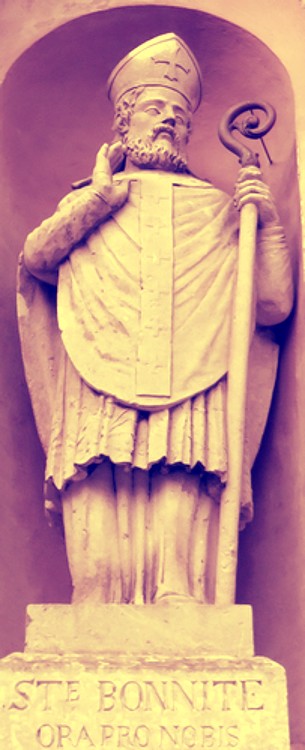
Saint of the Day – 15 January – Saint Bonitus of Clermont (c623-706) Bishop, Confessor, Chancellor of the Kingdom, Governor of Provence, Diplomatic peacemaker, Protector of Slaves and active advocate for its abolition, a man of deep devotion and Asceticism, Promoter of monasticism, builder of Churches and Monasteries., Miracle-worker. Heir to a rich heritage, he used his resources not only to beautify Churches and Monasteries but also, to relieve the miseries of the poor. Bonitus is a much loved and endearing Saint in France and, in some ways, a very modern figure. Born in c623 in Auvergne, France and died in 706 in Lyon, France of natural causes. Patronages – against leg ailments (gout), of Clermont and Lyons, France, of Bonito, Italy. Also known as – Bonet, Bonito, Bonnet, Bont, Bunìto, Bunìtë, Bonnite.
The Roman Martyrology reads: “At Clermont, in Auvergne, St Bonitus, Bishop and Confessor.”
Bonitus was born in Auvergne around 623–630 (but the place is unknown, probably Clermont). He came from a large aristocratic family from Auvergne, who held important positions in France (like many Bishops at that time). He made, perhaps in Clermont, very careful studies in law, grammar and literature, in order to prepare himself for a political career. He was thus noticed by King Sigebert II who entrusted him with high functions at Court. After the death of his father, he became the Chancellor of King Sigebert III, then, in around 677, he was sent to Marseille as the Governor of Provence.
He exercised this function with great gentleness (while the time was particularly marked by violence). He strongly opposed the sale of slaves and bought back those he could reach, to free them. Despite his responsibilities, he practiced severe asceticism and demonstrated great piety. This is how the cult of Saint Sidoine Apollinaire (former Bishop of Clermont) would have developed early in Provence, and this thanks to the action of Bonitus (he indeed had great admiration for this Bishop who courageously defended the Province of Auvergne against the Visigoths).
Bonitus’elder brother, St Avitus, was then the Bishop of Clermont. Feeling his death approaching, he persuaded his entourage and the faithful of Clermont, to elect Bonitus in his place. This was done around 689 or 690, with the consent of the clergy and the approval of the King (according to the tradition of the time).
His Episcopate in Clermont extended over approximately ten years, illustrated by his piety and charity. He gave new impetus to the famous Episcopal school (founded at the beginning of the 6th Century) responsible for training young clerics. He also took care of the training of his clergy and organised missions in regions which were still poorly Christianised — these missions seemed a novelty for the time.
He favoured the monastic expansion then underway, either by encouraging the restoration of ruined Monasteries (for example the Abbey of Menat by a young Monk Ménélée), or by establishing new Monasteries (perhaps Royat, Chamalières, Beaumont…) , or by favouring founders (for example Calmin who built Mozac). In his undertakings, Bonitus benefited from the friendly assistance of the pious Count Genèsius who then Governed Auvergne.
Inhabited by profound piety, Bonitus was also concerned with liturgical celebrations — instituting a solemn fast and then a famous and miraculous procession of prayer which he ordered in Clermont, to pray for the cessation of the long drought which was desolating Auvergne and, an abundant rain poured down and alloweda beneficial and a succesful and long-awaited harvests!.
However, after ten years of Episcopate, he was assailed by scruples. Bonitus resigned his Seat and retired, as a penance, as a simple Monk at the Benedictine Abbey of Manglieu. In fact, he thought that his designation as Bishop had not been valid and that it was hardly reconcilable with Canonical rules because he had been chosen by his brother. Feeling remorseful, when he was the Bishop, he sought advice from several Monks, including the renowned Monk Tillo, of the Abbey of Solignac, near Limoges, who suggested he resign. What motivated his decision. (We can also assume that his appointment had perhaps caused resentment among high-ranking Priests, including the one who would be his successor, Nordebert…).
After having practiced monastic life for some time in Manglieu, he decided to undertake, despite his great age, a pilgrimage to Rome via Lyon, where he stayed for a time in the Monastery of Isle-Barbe. In reality,, he was sought out in Manglieu, in order to settle various disciplinary or doctrinal disputes which had arisen in the Lyon region and in the north of Italy. This is how, among other things, he resolved a conflict between the Bishop of Lyon and the Duke of Burgundy and, as a wise advisor, he succeeded in appeasing the revolt between the King of Lombard and his subjects. We can sense here the experience of the politician he once was.
Then, arriving in Rome, he made his devotions at the Tombs of the Apostles Peter and Paul and then he started his journey his way back home. During this period, he returned with captives, whose freedom he had purchased in Rome and, according to reports, he performed miracles with the oil brought from the Tomb of Saint Peter.
Finally, he returned to Lyon where he lived for four years in a Monastery and took care to re-establish good relations with his successor in Clermont. In 706, therefore, very old, he died in Lyon of an attack of gout. His body, believed to be miraculous, was then placed in the Saint-Pierre Monastery of this City.
The Bishop of Clermont requested the transfer of his remains to Auvergne. It was not without many difficulties — Clermont and Lyon fought over the Relics! Finally, after six years of negotiations, he sent the Abbot of Manglieu (the same one who had welcomed Bonitus into his Monastery) to Lyon to settle this long dispute. And the Relics were brought back triumphantly to Clermont. The translation would have taken place around 712(?) and the remains deposited in the Saint-Maurice Church, a very old Church which was restored for the occasion. It was located below the Poterne, near the current Rue Sidoine Apollinaire and this cCurch then became a place of pilgrimage, it also took the name of Saint Bonitus (later, it woulf be destroyed under the Revolution).
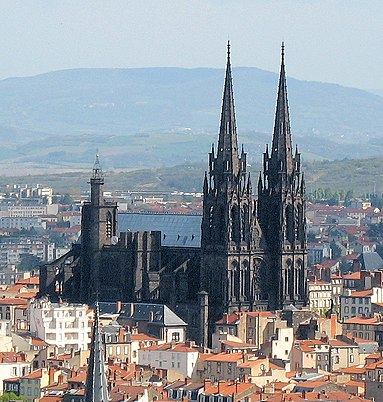
In 1095, the Relics were transferred to the recently built cathedral and placed in a chapel in the apse which will bear his name. In the 13th century, in the new Gothic cathedral, the chapel dedicated to Saint Bonnet was decorated with a set of stained glass windows which tell the story of his life in a slightly legendary way! A beautiful reliquary of gilded silver was made to enclose his relics. But it was destroyed during the Revolution and its relics disappeared.
Bonifus’ fame was significant and numerous Relics of the Saint were scattered in various places (as was often the custom, especially during the Middle Ages). This is why a certain number of places and Churches bear his name in France, particularly in the Diocese of Lyon, Marseille, Autun and, especially in Auvergne in the vast territory of the former Diocese of Clermont. Today, in the area of Puy-de -Dôme (therefore, the current Diocese of Clermont), he is the Patron of 17 Churches.
In order to establish his biography, historians were able to rely on a reliable source, being the “Vita Sancti Boniti = The Life of Saint Bonitus” written shortly after his death by a Monk from Manglieu. He wrote down what he had learned, often from direct witnesses (including the Abbot of Manglieu). Subsequently, much later legends were written which took pleasure in embellishing his life but, they at least testify to the popularity of the Saint and the fervour of his cult (he was invoked particularly for leg ailments). He was the 28th Bishop and he closes (to this day!) the list of holy Bishops of Clermont. Currently his Feast is celebrated in the Diocese on 16 January (supposed day of his death) but the 1914 Roman Martyrology which is used for the Traditional Calendar, shows his day and festival as 15 January.
The above graceful and factual rendition of our Saint Bonitus’ life, is from the Diocese of Clermont.
St Maurus OSB (c512-584) Benedictine Monk, Abbot and Deacon, Miracle-worker. Maurus was the first disciple of Saint Benedict of Nursia (512–584). He is mentioned in Saint Gregory the Great’s biography of the latter as the first oblate, offered to the Monastery by his noble Roman parents as a young boy, to be brought up in the monastic life. The formula and blessing of St Maurus were universally adopted and approved for use in the Blessing of the Sick. His Life and Miracles: https://anastpaul.com/2021/01/15/saint-of-the-day-15-january-saint-maurus-osb-c-512-584/
St Blaithmaic of Iona St Bonitus of Clermont (c623-706) Bishop, Confessor St Britta St Ceolwulf of Northumbria St Emebert of Cambrai St Ephysius of Sardinia St Eugyppius Bl Geoffrey of Peronne Bl Giacomo Villa St Gwrnerth St Habakkuk the Prophet St Isidore of Scété St Isidore the Egyptian St Ita of Killeedy St John Calabytes St Liewellyn St Lleudadd of Bardsey St Malard of Chartres St Maximus of Nola St Michaeas + Bl Peter of Castelnau St Placidus
Thought for the Day – 14 January – The Spiritual Combat (1589) – Dom Lorenzo Scupoli OSM (c1530-1610)
“None shall be crowned who has not fought well.” 2 Tim 2: 5
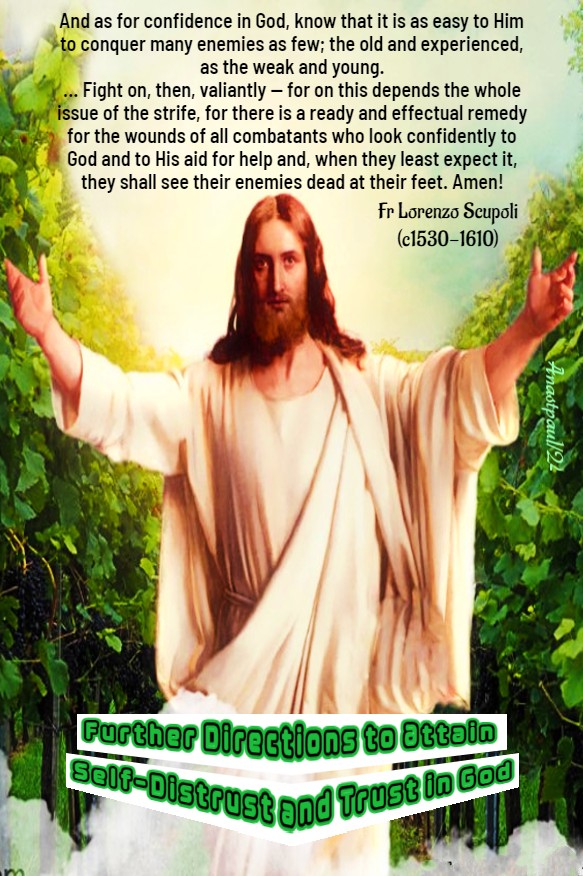
VI: … Further Directions on How to Attain Self-Distrust and Trust in God
“Since our whole power to subdue our enemies arises, principally from self-distrust and trust in God, I will give you some further directions to enable you, by the Divine Assistance, to acquire it.
Know then, for a certain truth that neither all gifts, natural or acquired, nor all graces given gratis, nor the knowledge of all Scripture, nor long habitual exercise in the service of God, will enable us to do His will, unless, in every good and acceptable work to be performed, in every temptation to be overcome, in every peril to be avoided, in every Cross to be borne in conformity to His will, our heart be sustained and supported by an especial aid from Him and His Hand be outstretched to help us. We must, then, bear this in mind all our life long, everyday, every hour, every moment — that we may never indulge, so much as a thought of self-confidence!
And as for confidence in God, know that it is as easy to Him to conquer many enemies as few; the old and experienced, as the weak and young.
Therefore, we will suppose a soul to be heavy-laden with sins, to have every possible fault and every imaginable defect and to have tried, by every possible means and every kind of Spiritual Exercise, to forsake sin and to practice holiness. We will suppose this soul to have done all this and yet, to have failed in making the smallest advance in holiness, nay, on the contrary, to have been borne the more strongly towards evil. For all this the soul must not lose trust in God, nor give up its spiritual conflict and lay down its arms but still fight on resolutely, knowing that none is vanquished in this spiritual combat but he who ceases to struggle and loses confidence in God, whose succour never fails His soldiers, although He sometimes permits them to be wounded.
Fight on, then, valiantly — for on this depends the whole issue of the strife, for there is a ready and effectual remedy for the wounds of all combatants who look confidently to God and to His aid for help and, when they least expect it, they shall see their enemies dead at their feet. Amen!”
Quote/s of the Day – 14 January – St Hilary (315-368) Confessor, Bishop, Father and Doctor of the Church
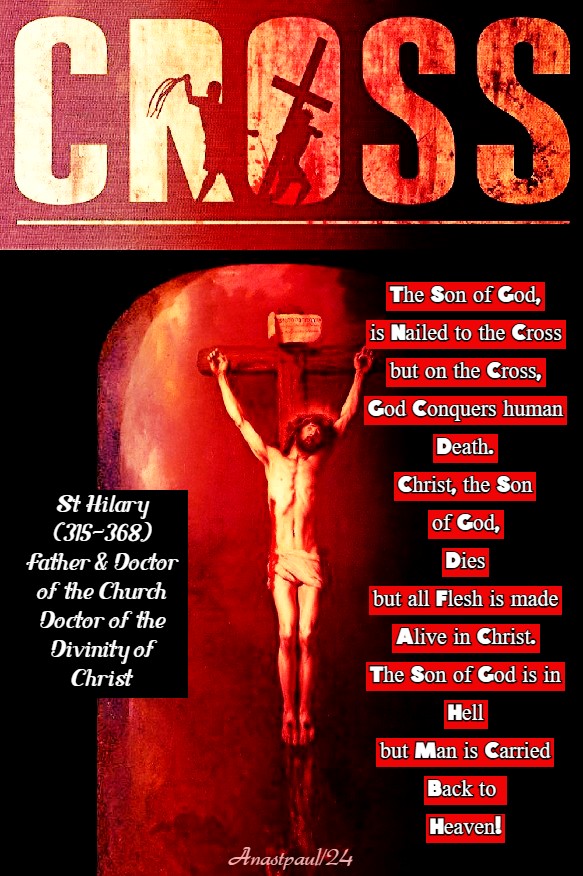
“The Son of God, is nailed to the Cross but on the Cross, God conquers human death. Christ, the Son of God, dies but all flesh is made alive in Christ. The Son of God is in hell but man is carried back to Heaven!”
(On the Trinity Book II)I
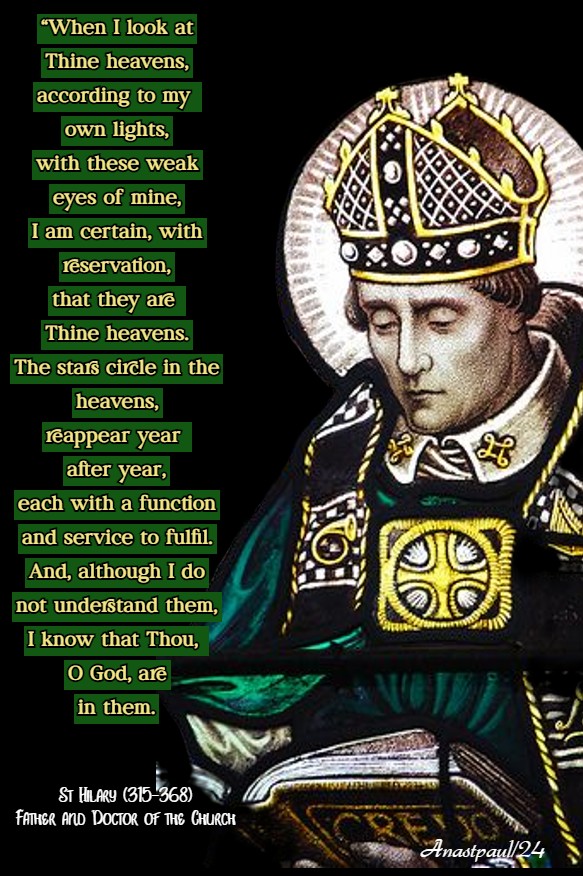
“When I look at Thine heavens, according to my own lights, with these weak eyes of mine, I am certain, with reservation, that they are Thine heavens. The stars circle in the heavens, reappear year after year, each with a function and service to fulfil. And, although I do not understand them, I know that Thou, O God, are in them.”
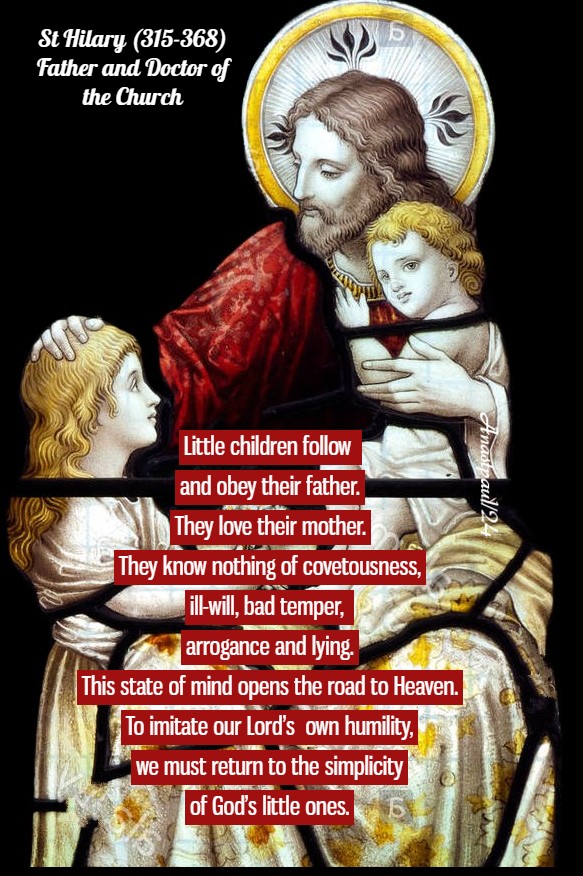
“Little children follow and obey their father. They love their mother. They know nothing of covetousness, ill-will, bad temper, arrogance and lying. This state of mind opens the road to Heaven. To imitate our Lord’s own humility, we must return to the simplicity of God’s little ones.”
One Minute Reflection – 14 January – “The Month of the Most Holy Name of Jesus and of the Holy Family”– Second Sunday after the Epiphany and the Feast day of St Hilary (315-368) Confessor, Bishop, Father and Doctor of the Church – Romans 12:6-16; John 2:1-11 – Scripture search here: https://www.drbo.org/
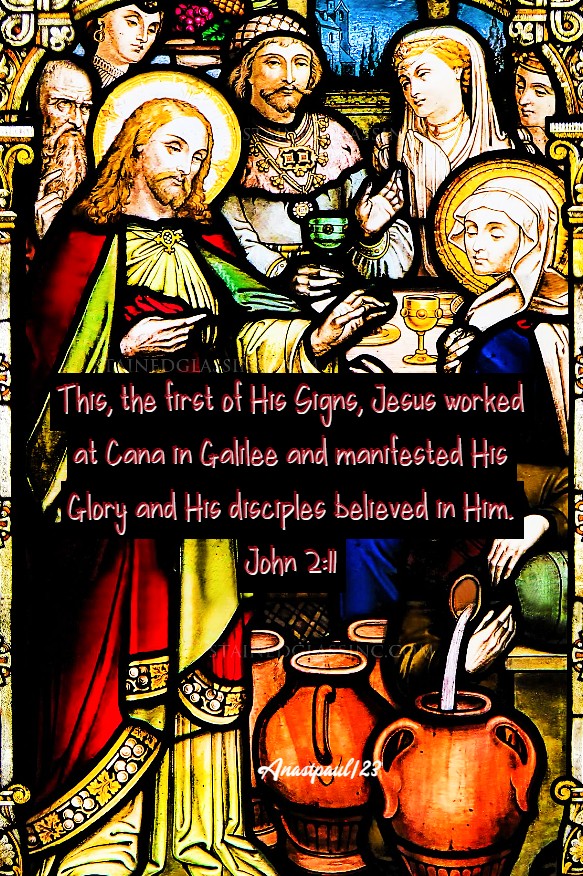
“This, the first of His Signs, Jesus worked at Cana in Galilee and manifested His Glory and His disciples believed in Him…” – John 2:11
REFLECTION – “Why did our Lord change water into wine as His first Sign? It was to show how God, Who transforms nature into something else, also works His transformation in the womb of the Virgin. In the same way, as the crown of His miraculous deeds, Jesus opened a tomb to make known His freedom, with regard to the death, which is hungry to swallow up everything.
To both authenticate and confirm, the twofold reversal of nature, brought by His Birth and His Resurrection, Jesus changed water into wine, without in any way altering the stone water-jars. This was the symbol of His own Body, miraculously conceived and wonderfully created in a virgin, without the working of a man… Contrary to their normal use, the jars… brought new wine into the world, without ever repeating the same miracle again. In the same way the Virgin conceived and brought Emmanuel into the world, (Is 7,14) without afterwards conceiving again. The miracle of the stone water-jars was that what was small, became great, sparseness was changed into superabundance, plain water into sweet wine… In Mary, on the other hand, the greatness and glory of the Godhead changed its appearance to take on the aspect of weakness and humiliation.
Those jars were used for the Jewish purifications; into them our Lord poured His teaching: He demonstrated that He came according to the Law and the prophets but with the purpose of changing them all, through His teaching, as the water became wine… «The Law was given through Moses; grace and truth came through Jesus Christ» (Jn 1,17). The bridegroom who lived in Cana, invited the Bridegroom from Heaven and the Lord, Who was ready for that wedding, answered His invitation. Those seated at table invited Him, Who sets worlds in His Kingdom and He sent them a wedding gift, able to delight them… They had no wine, even of an ordinary sort, He poured a little from His own abundance for them. In return for their invitation, He Himself, invited them to His own wedding!” – St Ephrem (306-373) Deacon in Syria, Father and Doctor of the Church (Commentary on the Diatessaron, 5, 6f).
PRAYER – O God, Who gave to Thy people blessed Hilary, as a minister of salvation, grant we beseech Thee that we, who cherished him on earth as a teacher of life, may be found worthy to have him as an intercessor in Heaven. Through Jesus Christ, Thy Son our Lord, Who lives and reigns with Thee, in the unity of the Holy Ghost, God, world without end. Amen (Collect).
Our Morning Offering – 14 January – “The Month of the Most Holy Name of Jesus and of the Holy Family” – Second Sunday after the Epiphany and the Feast day of St Hilary (315-368) Confessor, Bishop, Father and Doctor of the Church
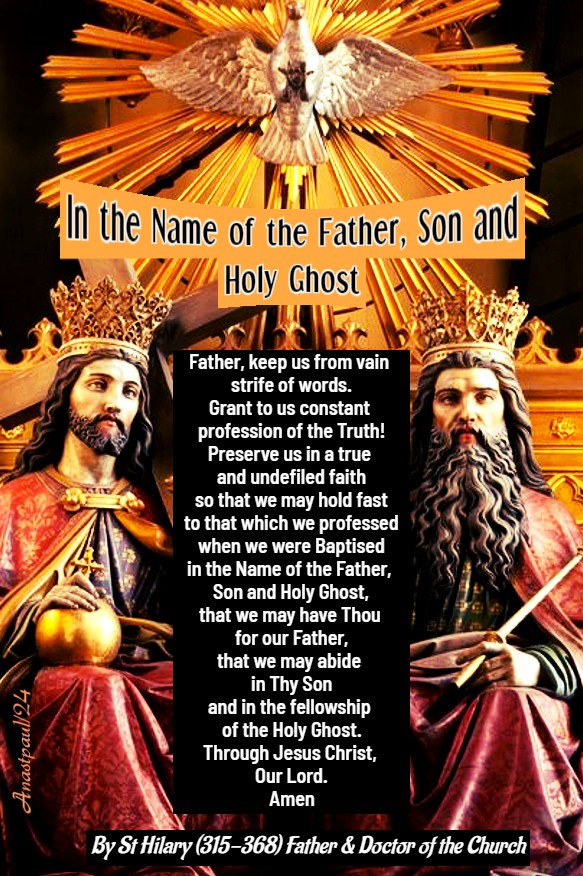
In the Name of the Father, Son and Holy Ghost By St Hilary (315-368) Father & Doctor of the Church
Father, keep us from vain strife of words. Grant to us constant profession of the Truth! Preserve us in a true and undefiled faith so that we may hold fast to that which we professed when we were Baptised in the Name of the Father, Son and Holy Ghost, that we may have Thou for our Father, that we may abide in Thy Son and in the fellowship of the Holy Ghost. Through Jesus Christ, Our Lord. Amen
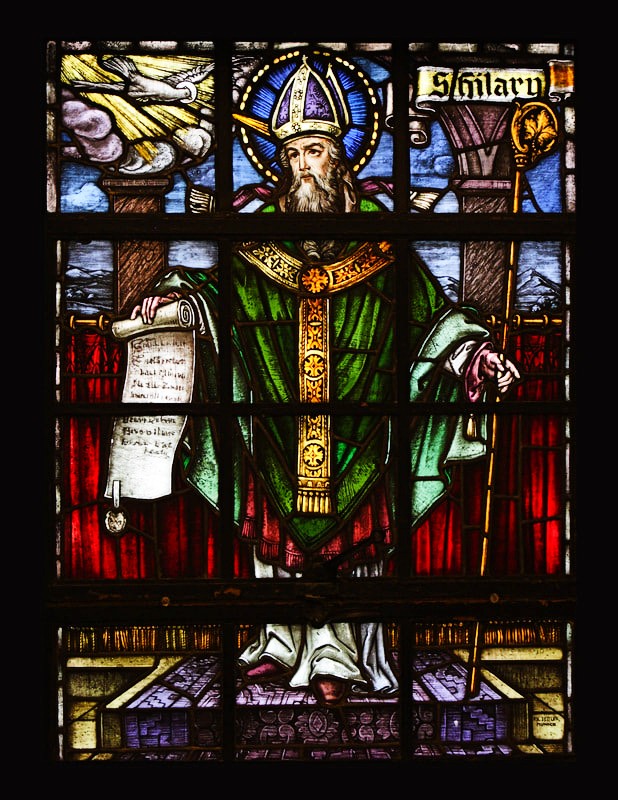
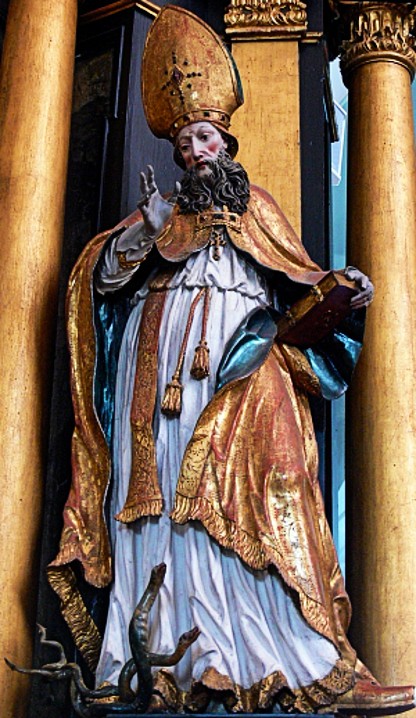
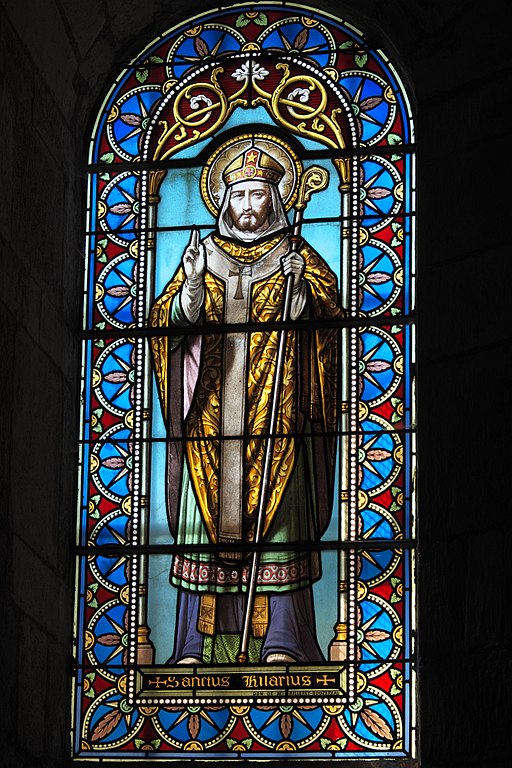
Saint of the Day – 14 January – St Hilary (315-368) Confessor, Bishop, Father and Doctor of the Church, Writer, Philosopher, Theologian, Preacher, Defender of the Faith, Doctor of the Divinity of Christ, Miracle-worker. The “Hammer of the Arians” and “Athanasius of the West.” Patronages – against rheumatism, against snakes and snakebites, children with learning impediments, children learning to walk, lawyers, mothers, of the sick, of La Rochelle and Poitiers in France,4 Cities in Italy. Also known as – Ilario di Poitiers, Malleus Arianorum.
The Roman Martyrology reads yesterday, 13 January the day of his death: “At Poitiers, in France, the birthday of St Hilary, Bishop and Confessor of the Catholic Faith which he courageously defended and for which he was banished for four years to Phrygia, where, among other miracles, he raised a man from the dead. Pope Pius IX declared him a Doctor of the Church. His festival is celebrated on the 14th day of this Month.”
This staunch defender of the Divinity of Christ was a gentle and courteous man, devoted to writing some of the greatest theology and was like his Master in being labeled a “disturber of the peace.” In a very troubled period in the Church, his holiness was lived in both scholarship and controversy.
Raised a pagan, he was converted to Christianity when he met his God of nature in the study of Sacred Scriptures. His wife was still living when he was chosen, against his will, to be the Bishop of Poitiers in France. He was soon involved in the immense fight against what became the scourge of the 4th Century, -Arianism which denied the Divinity of Christ.
The heresy spread rapidly. St Jerome said “The world groaned and marvelled to find that it was Arian.” When Emperor Constantius ordered all the Bishops of the West to sign a condemnation of Athanasius, the great Defender of the Faith in the East, Hilary refused and was banished from France to far off Phrygia. Eventually he was called the “Athanasius of the West.”
While in Phrygia, however, he continued to govern his Diocese, as well as writing two of the most important of his contributions to theology. While there, he was invited by some semi-Arians (hoping for reconciliation) to a Council the Emperor called to counteract the Council of Nicea. But Hilary predictably defended theTruth of the Church and when he sought public debate with the heretical bishop who had exiled him, the Arians, dreading the meeting and its outcome, pleaded with the Emperor to send this troublemaker back home to the small Town of Poitiers, where his enemies hoped he would fade into obscurity. Hilary was welcomed by his people but he continued the fight against the heretics without ceasing.
While Hilary closely followed the great St Athanasius, in exegesis and Christology respectively, his work shows many traces of vigorous independent thought. St Jerome and others consider our St Hilary as the first Catholic Hymnist. Hilary is the pre-eminent Latin writer of the 4th Century (before Sts Ambrose and Augustine) and his works continue to be highly influential. Remember this Hymn we prayed yesterday for the Octave of the Epiphany and the Baptism of the Lord:
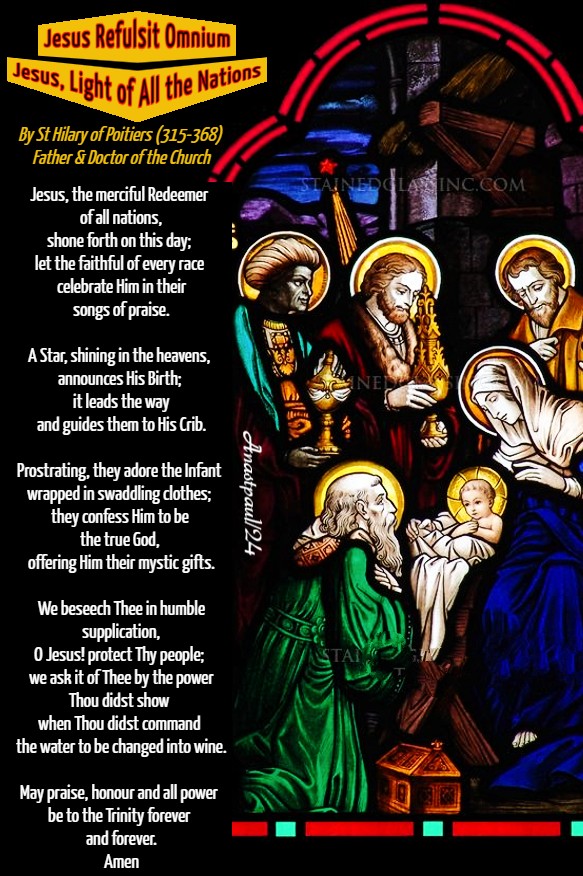
Jesus Refulsit Omnium Jesus, Light of All the Nations By St Hilary (315-368) Father & Doctor of the Church Doctor of the Divinity of Christ
Jesus, the merciful Redeemer of all nations, shone forth on this day; let the faithful of every race celebrate Him in their songs of praise.
A Star, shining in the heavens, announces His Birth; it leads the way and guides them to His Crib.
Prostrating, they adore the Infant wrapped in swaddling clothes; they confess Him to be the true God, offering Him their mystic gifts.
Thirty years of His life had passed and He, the infinitely pure God, seeks the laver of baptism.
John, the favoured Baptist trembles as he bends the head of Jesus beneath the waters–that Jesus whose Blood was to purify the whole earth from its sins.
The Divine Voice of the Father is heard from Heaven, bearing testimony to His Son and the Holy Ghost, too, is present, the Giver of holy grace.
We beseech Thee in humble supplication, O Jesus! protect Thy people; we ask it of Thee by the power Thou didst show when Thou didst command the water to be changed into wine.
May praise, honour and all power be to the Trinity forever and forever. Amen
(Verses 4-6 omitted on the image). I could not find the name of the Translator of this version of this Hymn, often referred to as “the oldest” Christmas Hymn.
Thought for the Day – 13 January – The Spiritual Combat (1589) – Dom Lorenzo Scupoli OSM (c1530-1610)
“None shall be crowned who has not fought well.” 2 Tim 2: 5
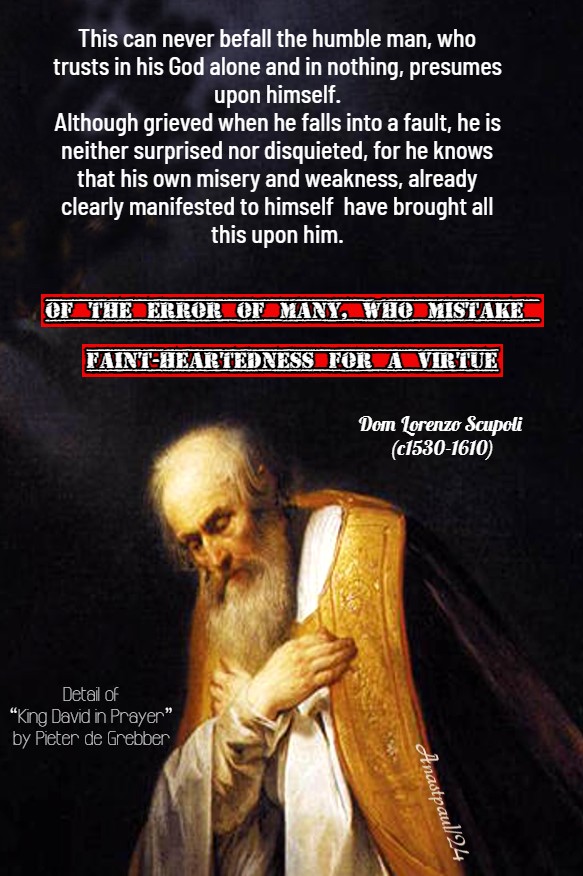
V: Of the Error of Many, Who Mistake Faint-heartedness for a Virtue
“Many also deceive themselves in this way, they mistake the fear and uneasiness which follow after sin, for virtuous emotions and know not, that these painful feelings spring from wounded pride and a presumption which rests upon confidence in themselves and their own strength. They have accounted themselves to be something and relied unduly upon their own powers. Their fall proves to them, the vanity of this self-dependence and they are immediately troubled and astonished, as at some strange thing and are disheartened at seeing the prop, to which they trusted, suddenly give way!
This can never befall the humble man, who trusts in his God alone and in nothing, presumes upon himself. Although grieved when he falls into a fault, he is neither surprised nor disquieted, for he knows that his own misery and weakness, already clearly manifested to himself, by the Light of Truth, have brought all this upon him.”
Quote/s of the Day – 13 January – “The Month of the Most Holy Name of Jesus and of the Holy Family” – Octave Day of Epiphany – Isaias 60:1-6, John 1:29-34 –
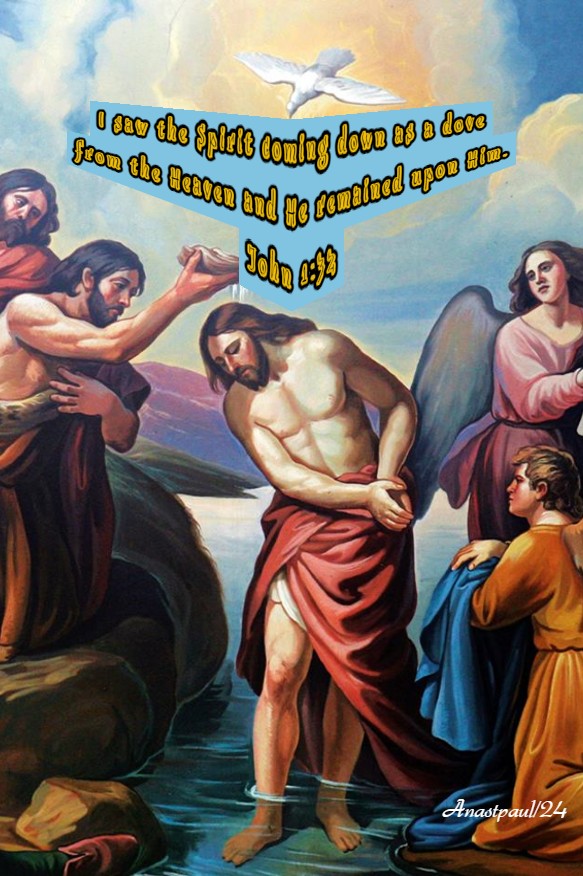
“I saw the Spirit coming down as a dove from the Heaven and He remained upon Him.”
John 1:32
“Jesus rises from the waters – the world rises with Him. The heavens, like Paradise with its flaming sword, closed by Adam for himself and his descendants, are rent open. The Spirit comes to Him as to an equal, bearing witness to His Godhead. A Voice bears witness to Him from Heaven, His place of origin. The Spirit descends in bodily form like the Dove which, so long ago, announced the ending of the flood and so, gives honour to the Body, Who is One with God.”
St Gregory Nazianzen (330-390) Father and Doctor of the Church
“Christ was born of the Holy Spirit and, since it was fitting, that He should fulfill all justice, He entered into the waters of baptism to sanctify them. When He left the Jordan, He was filled with the Holy Spirit, Who had descended upon Him, in the form of a dove. As the Evangelist tells us: Jesus, full of the Holy Spirit, returned from the Jordan.”
One Minute Reflection – 13 January – Octave Day of Epiphany – Isaias 60:1-6, John 1:29-34 – Scripture search here: https://www.drbo.org/
“And I knew Him not but He who sent me to Baptise with water said to me: He upon whom thou shalt see the Spirit descending and remaining upon Him, He it IS, Who Baptises with the Holy Spirit. And I saw and I gave testimony that this is the Son of God.” – John 1:33-34
REFLECTION – “Jesus Christ was the Son of God, yet He preached not the Gospel before His Baptism. If the Master Himself followed the right time in due order, ought we, His servants, to venture out of order? From that time Jesus began to preach (Matthew 4:17) , when the Holy Ghost had descended upon Him in a bodily shape, like a Dove, (Luke 3:22) not that Jesus might see Him first, for He knew Him even before He came in a bodily shape but, that John, who was Baptising Him, might behold Him. For I, says he, knew Him not but He that sent me to Baptise with water, He said to me, upon Whomsoever you shall see the Spirit descending and abiding on Him, that is He (John 1:33).
If you too have unfeigned piety, the Holy Ghost comes down on you also and a Father’s Voice sounds over you from on high — not, ‘This is My Son’ alone because ‘In the beginning was the Word, and the Word was with God and the Word was God.’ To Him belongs the ‘IS’ since He is always the Son of God – but to you, has now been made, since you have not the sonship by nature but receive it by adoption. He eternally ‘IS’ but you receive the grace progressively.
Make ready then the vessel of your soul that you may become a son of God and an heir of God and joint-heir with Christ (Romans 8:17); if, indeed, you are preparing yourself that you may receive; if you are drawing near in faith that you may be made faithful; if of set purpose, you are putting off the old man!” – St Cyril of Jerusalem (315-387) Bishop of Jerusalem, Father and Doctor of the Church (Catechetical Lecture 3: 14-15).
PRAYER – O God, Whose Only-begotten Son appeared in the substance of our flesh, grant, we pray Thee that we, who acknowledge His outward likeness to us, may deserve to be inwardly refashioned in His Image. Through the same Jesus Christ, Thy Son our Lord, Who lives and reigns with Thee, in the unity of the Holy Ghost, God, world without end. Amen (Collect).
Our Morning Offering – 13 January – “The Month of the Most Holy Name of Jesus and of the Holy Family” – The Eighth Day, The Octave of the Epiphany
Jesus Refulsit Omnium Jesus, Light of All the Nations By St Hilary (315-368) Father & Doctor of the Church Doctor of the Divinity of Christ
Jesus, the merciful Redeemer of all nations, shone forth on this day; let the faithful of every race celebrate Him in their songs of praise.
A Star, shining in the heavens, announces His Birth; it leads the way and guides them to His Crib.
Prostrating, they adore the Infant wrapped in swaddling clothes; they confess Him to be the true God, offering Him their mystic gifts.
Thirty years of His life had passed and He, the infinitely pure God, seeks the laver of baptism.
John, the favoured Baptist trembles as he bends the head of Jesus beneath the waters–that Jesus whose Blood was to purify the whole earth from its sins.
The Divine Voice of the Father is heard from Heaven, bearing testimony to His Son and the Holy Ghost, too, is present, the Giver of holy grace.
We beseech Thee in humble supplication, O Jesus! protect Thy people; we ask it of Thee by the power Thou didst show when Thou didst command the water to be changed into wine.
May praise, honour and all power be to the Trinity forever and forever. Amen
(Verses 4-6 omitted on the image). I could not find the name of the Translator of this version of this Hymn, often referred to as “the oldest” Christmas Hymn.
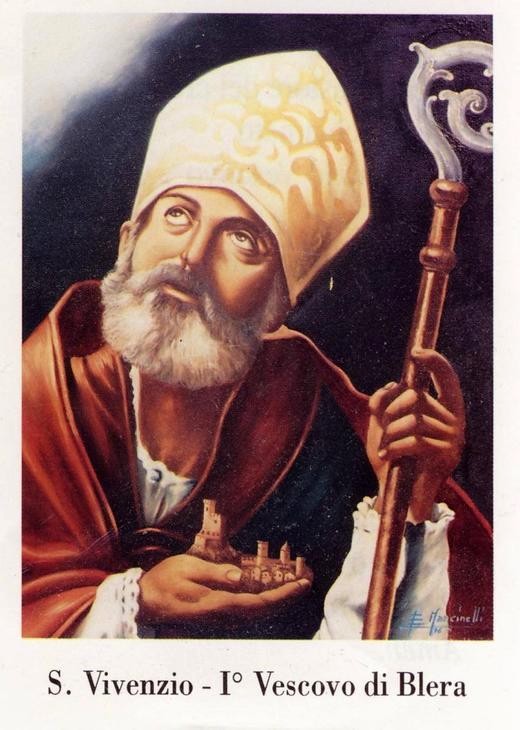
Saint of the Day – 13 January – Saint Viventius Benedicente of Blera (Died 484) Bishop of Blera, in the Province of Viterbo, Italy, during which time he also became a Hermit. Patronage – of Blera, the City and the Diocese. Also known as – Vivenzio. Additional Memorials – Easter Monday, 2nd Sunday in May, 11 December in Blera.
According to an oral tradition, Viventius was an illustrious and beloved Bishop of Blera from 457 to 484. There is indeed a very strong oral tradition about this Saint, rich in poetic and evocative details but, unfortunately, no document of historical value which can help us to reconstruct the phases of his earthly life.
According to tradition, the Bishop, in addition to his devout and holy life, he administered the Diocese with firmness but also with the gentleness of a father, dedicated his free time from pastoral commitments, to assisting the sick and especially the dying. One day two unbelieving and vicious nobles, irritated by the admonitions of the Bishop, who invited them to convert, decided to play an atrocious prank on him, to discredit him in the eyes of the faithful. Having bribed the servants, they had his tunic replaced with a female one during the night. Then they woke him, begging him to rush to a house in the town to assist a dying man. In order not to waste time, Viventius did not even light the lamp but putting on his female dress in the darkness, which was only distinguishable from his own by a few gatherings, without noticing anything. Arriving at the house of the dying man, he found the two nobles there who publicly reprimanded him for that unusual garment, saying to those present: D“o you see how brazen this Bishop is who we venerate as a saint? Not only does he associate intimately with women but he is not even ashamed of dressing in their clothes!”
When, the next day, the population found out about it, they accused him of having caused a scandal with his unacceptable behavior, some even tried to stone him. Barely saved from the angry crowd, Viventius gathered the Priests protesting his innocence and telling them that he would leave Blera forever. He retreated to a cave about seven miles away, on the slopes of the Norchia valley, in a place called “the seven caves” to atone, not for his non-existent error but, for those of his slanderous persecutors. Despite his distance he continued to direct the Diocese through his Priests who came to visit him.
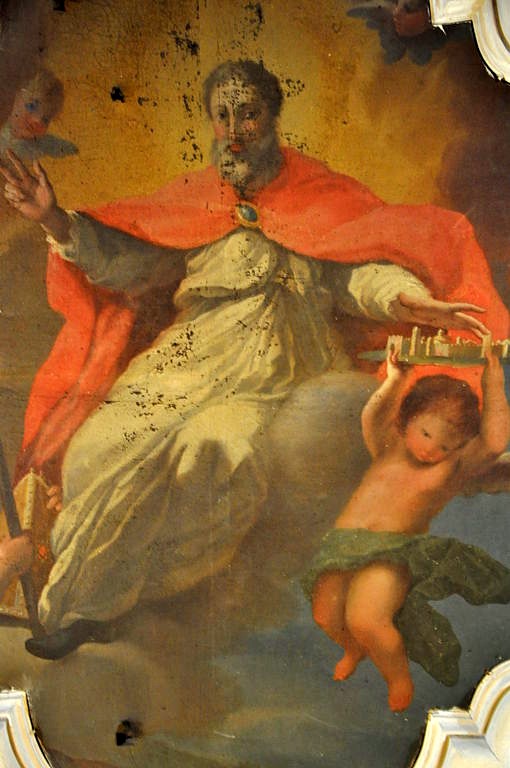
Painting of St Viventius in the Church in Blera
When, thanks to a vision, he knew that he would soon die, he sent for one of his spiritual daughters who had become blind in old age, ordering her to go to Blera to ask the faithful to come and fetch him with a cart on which he would return to the Town. That it was Providence that wanted it was understood from a miraculous event – some indomitable bulls, yoked to the wagon, suddenly became tame. The woman, who wanted to escape that embassy, objected that her blindness prevented her from doing so. “Go, daughter, and you will see, ” replied Viventius and at those words her sight returned.
Faced with the miracle, the inhabitants of Blera hastened to carry out the Bishop’s orders, realising, with amazement that the docile bulls were heading, without any apparent guide, to the Hermit’s cave. Viventius boarded the cart which, instead of following the shortest route, crossed the borders of the Diocese while the bells of the villages across which the wagon travelled, rang in celebration, even though no bell-ringer was present. Iit was theproof of his innocence. Arriving in Blera, he blessed the population, who had repented for having believed those impostors and finally died – it was 13 December which has become his liturgical feast.
St Viventius celebration and procession in Blera
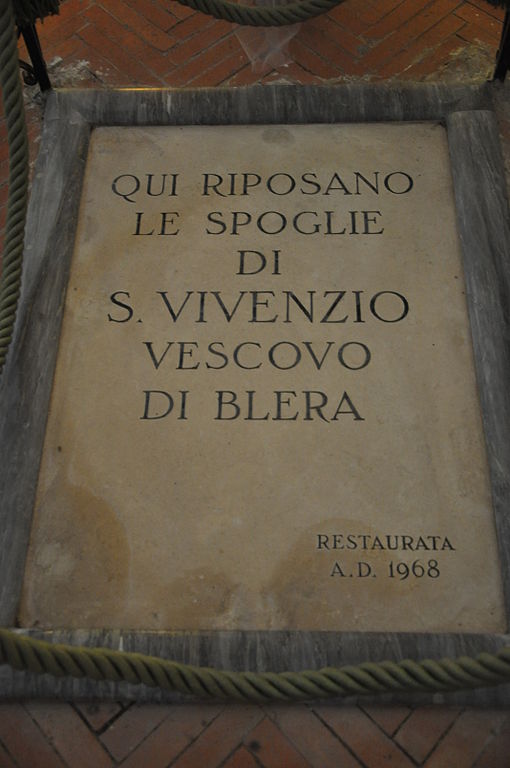
His body was buried in the Collegiate Church of Blera which is dedicated to the Assumption of the Blessed Mother and our St Viventius. The Crypt therein, with cross vaults embellished with stuccos and capitals, houses the Tomb of the Saint. The marble portal of the Church is surmounted by the bust of Viventius. We also find an image of the Saint inside the Church – he is depicted on a large canvas together with San Sensia and the Madonna Assunta. A Chapel in the right nave of the Collegiate Church is also dedicated to St Viventius.
St Viventius’ Tomb
In fact, the Saint is much loved, the veneration of the Patron Saint is still strongly felt and rooted in the souls of the Bleranians. According to some, Saint Viventius (the name derives from the Latin Vicentius and means ‘who is filled with vitality’) was the Confessor of Vergy in France, who is also celebrated today.
The Martyrology of Usuardo mentions him on 13 January and from there he passed into the Roman Martyrology on the same date. In Blera, our Saint is celebrated on 11 December. But such a loved Patron has 2 further celebrations, which consist of pilgrimages to his hermitage (prior to becoming the Bishop), one on Easter Monday and the other on the second Sunday of May. The Bleranrians, therefore, celebrate their Saint three times a year – on the occasion of the two pilgrimages and on 11 December.
St Agrecius of Trier St Andrew of Trier St Berno of Cluny St Designatus of Maastricht St Elian of Brittany St Enogatus of Aleth St Erbin of Cornwall St Glaphyra St Gumesindus of Córdoba St Hermylus St Hildemar of Arrouaise Bl Ida of Argensolles Bl Ivetta of Huy Widow, Mother, Recluse, Mystic
Thought for the Day – 12 January – The Spiritual Combat (1589) – Dom Lorenzo Scupoli OSM (c1530-1610)
“None shall be crowned who has not fought well.” 2 Tim 2: 5
IV. How a man may know whether he is active in Self-Distrust and Trust in God
“The presumptuous servant, often supposes that he has acquired Self-Distrust and Trust in God, when the case is far otherwise! And this will be made clear to you by the effect produced on your mind by a fall. If you are so saddened and disquieted thereby, (a fall) as to be tempted to despair of making progress or doing good, it is a sure sign that your trust is in self and not in God. For he who has any large measure of self-distrust and trust in God, feels neither surprise, nor despondency, nor bitterness, when he falls; for he knows this has arisen from his own weakness and want of trust in God.
On the contrary, being, rendered, thereby, more distrustful of self, more humbly confident in God, detesting above all things, his fault and the unruly passions which have occasioned it and mourning, with a quiet, deep and patient sorrow, over his offence against God, he pursues his enterprise and follows after his enemies, even to the death, with a spirit more resolute and undaunted than before.
I would that these things were well considered by certain persons, so-called spiritual, who cannot and will not be at rest, when they have fallen into any fault. They rush to their spiritual father, rather to get rid of the anxiety and uneasiness which springs from wounded self-love, than for that purpose which should be their chief end, in seeking him, to purify themselves from the stain of sin and to fortify themselves against its power, by means of the most Holy Sacrament of Penance!”
Quote/s of the Day – 12 January – “The Month of the Most Holy Name of Jesus and of the Holy Family” – Seventh Day Within the Octave of The Epiphany – Isaias 60:1-6; Matthew 2:1-12
“We have seen His Star in the east and are come to adore Him.”
Matthew 2:2
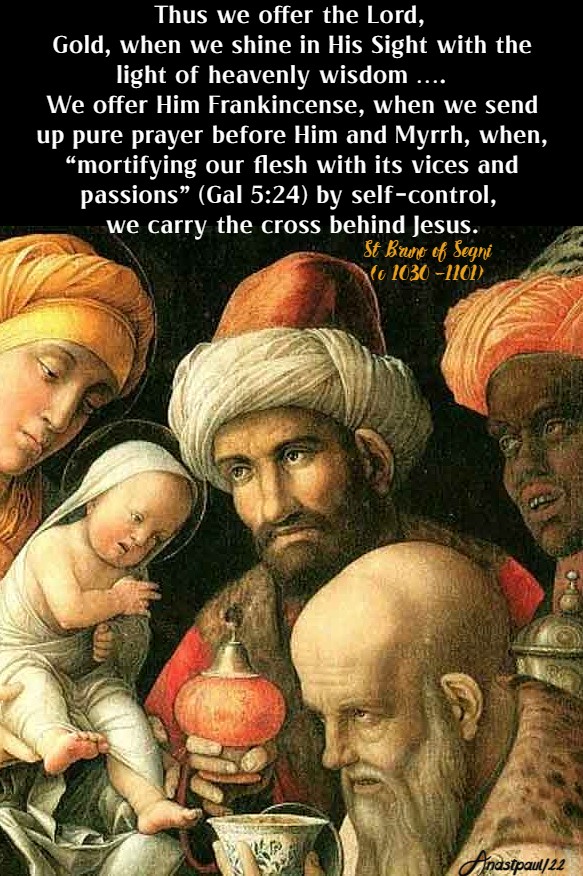
“Thus we offer the Lord, Gold, when we shine in His Sight with the Light of heavenly wisdom …. We offer Him Frankincense, when we send up pure prayer before Him and Myrrh, when, “mortifying our flesh with its vices and passions” (Gal 5:24) by self-control, we carry the cross behind Jesus.”
St Bruno of Segni O.Cart. (c 1030 -1101)
Bishop (1st Sermon on the Epiphany PL 165, 863).
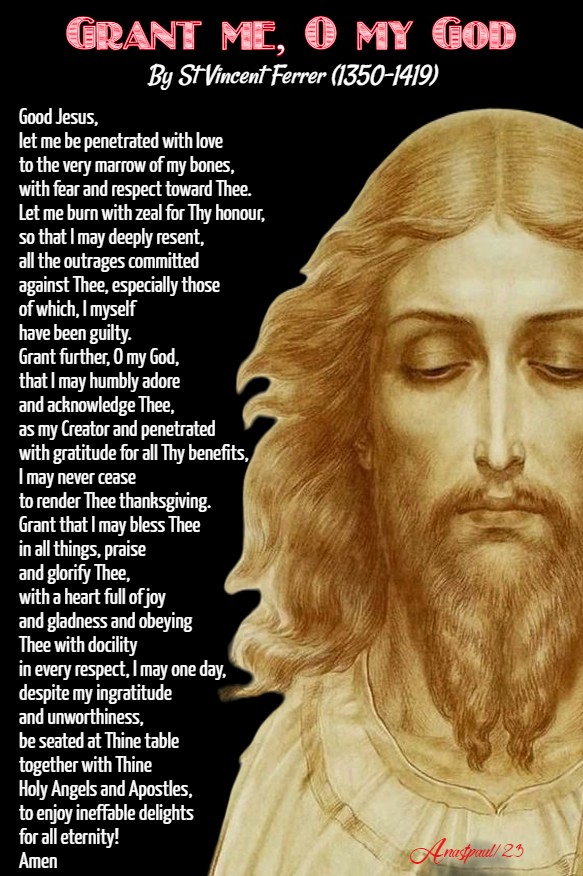
Grant me, O my God By St Vincent Ferrer OP (1350-1419)
Good Jesus, let me be penetrated with love to the very marrow of my bones, with fear and respect toward Thee. Let me burn with zeal for Thy honour, so that I may deeply resent, all the outrages committed against Thee, especially those of which, I myself have been guilty. Grant further, O my God, that I may humbly adore and acknowledge Thee, as my Creator and penetrated with gratitude for all Thy benefits, I may never cease to render Thee thanksgiving. Grant that I may bless Thee in all things, praise and glorify Thee, with a heart full of joy and gladness and obeying Thee with docility in every respect, I may one day, despite my ingratitude and unworthiness, be seated at Thine table together with Thine Holy Angels and Apostles, to enjoy ineffable delights for all eternity! Amen
“He who most loves will be most loved.”
(Letters to Persons in Religion III, 43)
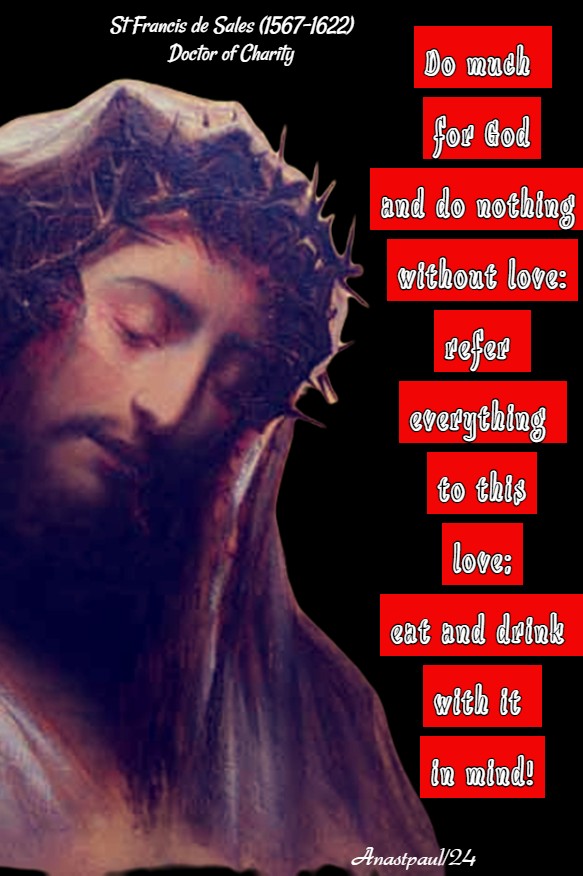
“Do much for God and do nothing without love: refer everything to this love; eat and drink with it in mind!”
(Letter to Madame de Chantal)
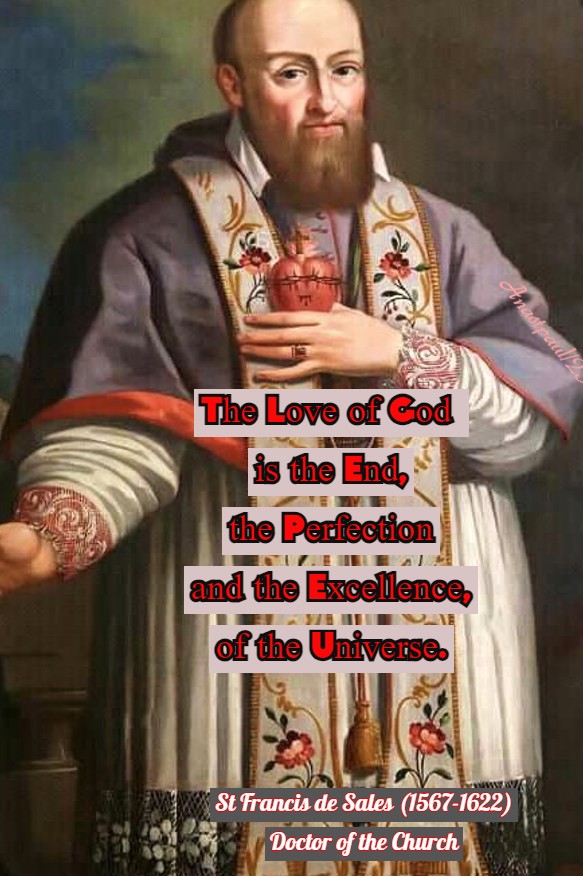
“The love of God, is the end, the perfection and the excellence of the universe.”
One Minute Reflection – 12 January – “The Month of the Most Holy Name of Jesus and of the Holy Family”– Seventh Day Within the Octave of The Epiphany – Isaias 60:1-6; Matthew 2:1-12 – Scripture search here: https://www.drbo.org/
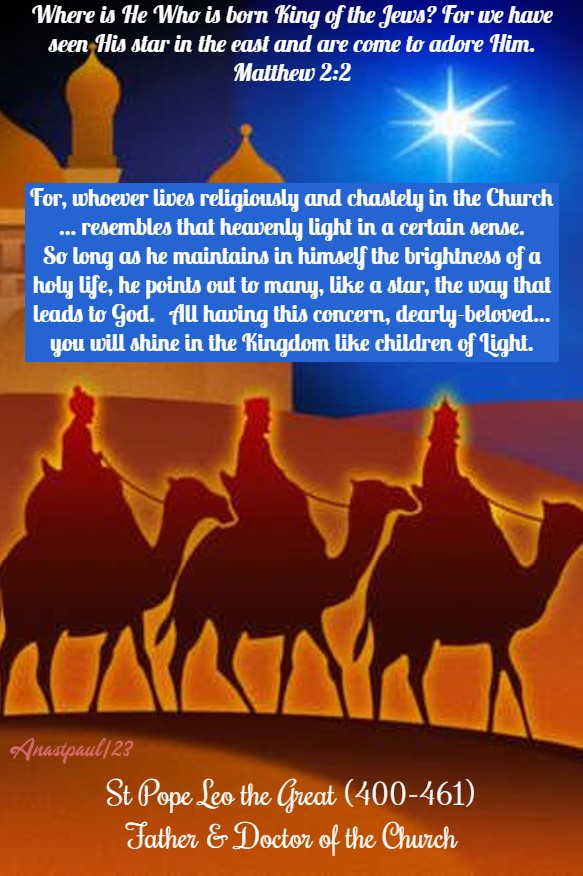
“Where is He Who is born King of the Jews? For we have seen His Star in the east and are come to adore Him.” – Matthew 2:2
REFLECTION – “All these things we know to have taken place ever since the Three Wise Men, aroused in their far-off land, were led by a Star to recognise and worship the King of Heaven and earth. The responsiveness of that Star exhorts us to imitate it’s obedience and, as much as we can, to make ourselves servants of that grace which invites us all to Christ. For, whoever lives religiously and chastely in the Church and “sets his mind on the things which are above, not on the things that are upon the earth” (Col 3:2) resembles that heavenly light in a certain sense. So long as he maintains in himself the brightness of a holy life, he points out to many, like a Star, the way that leads to God. All having this concern, dearly-beloved… you will shine in the Kingdom like children of Light.”… St Pope Leo the Great (400-461) Father & Doctor of the Church.
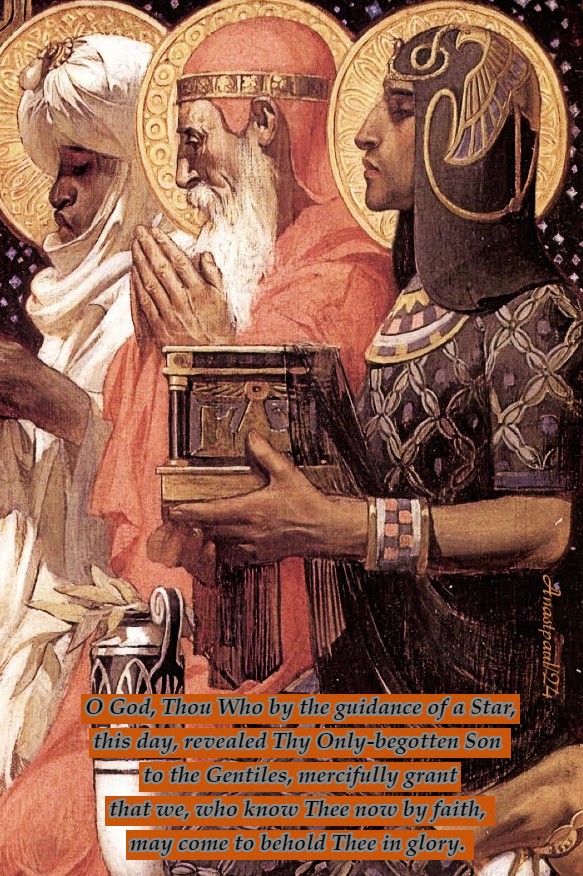
PRAYER – O God, Thou Who by the guidance of a star this day revealed Thy Only-begotten Son to the Gentiles, mercifully grant that we, who know Thee now by faith, may come to behold Thee in glory. Through the same Jesus Christ, Thy Son our Lord, Who lives and reigns with Thee, in the unity of the Holy Ghost, God, world without end. Amen (Collect).





















 AnaStpaul
You must be logged in to post a comment.