Thought for the Day – 2 February – The Spiritual Combat (1589) – Dom Lorenzo Scupoli OSM (c1530-1610)
“None shall be crowned who has not fought well.” 2 Tim 2: 5
The Third Weapon of the Spiritual Combat
XIII: … Of the Way to Resist the Impulses of Sense and of the Acts to be Performed by the Will in order to Acquire Habits of Virtue (Part Two)
“Suppose you are assailed by feelings of impatience. Look carefully into yourself and you will find that these feelings are constantly directed against the superior will, in order to win its consent.
Now then, begin the first exercise and by repeated acts of the will, do all in your power to stifle each feeling, as it arises that your will may not consent to it. And never desist from this, until, wearied unto death, your enemy yields himself vanquished. But see here the malice of the devil! When he perceives that we resist the first movements of any passion, not only does he desist from exciting them but when excited, he endeavours, for the time, to allay them, lest, by the exercise of resistance to the passion, we should acquire the habit of the opposite virtue. He would fain also betray us into the snares of pride and vainglory, by subtly insinuating to us that, like valiant soldiers, we have quickly trampled down our enemies.
Proceed, therefore, to the second conflict, recalling and exciting within yourself those thoughts which tempted you to impatience, until they sensibly affect you. Then set yourself to repress every such feeling with a stronger will and more earnest endeavour than before. And because, however strenuously we have resisted our enemies, from a sense of duty and a desire to please God, we are still in danger, unless we hold them in perfect detestation, of being one day overcome, attack them again even a third time and repel them, not with repugnance only but with indignation, until they have become hateful and abominable in your sight.”
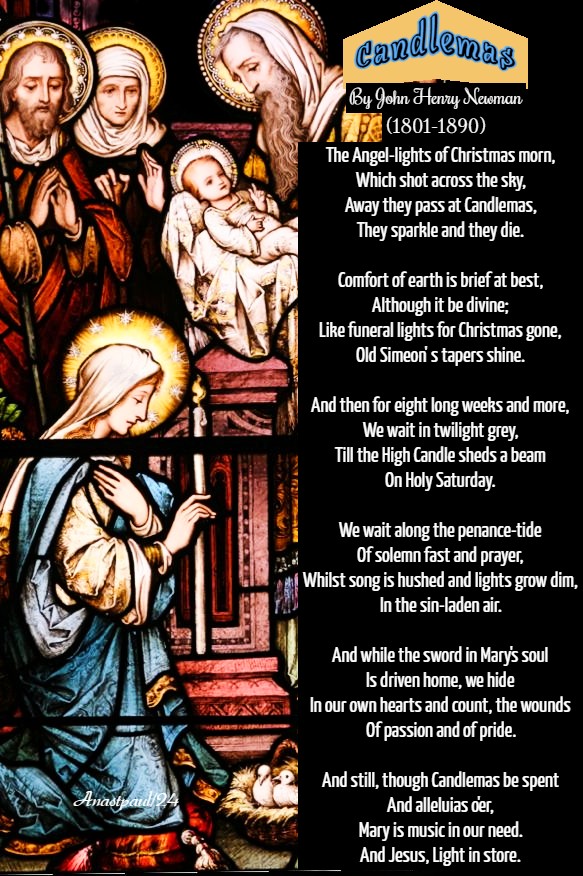
Quote/s of the Day – 2 February – The Feast of the Purification of the Blessed Virgin, Candlemas – Malachias 3:1-4, Luke 2:22-32 – Scripture search here: https://www.drbo.org/
“The day will come when this Child will no longer be offered in the Temple, nor in Simeon’s arms but outside the City in the arms of the Cross. The day will come when He will not be redeemed by the blood of a sacrifice but redeem others , with His own Blood. …” That will be the evening sacrifice; this is the morning sacrifice; this one is the happiest but that one is the most complete; for this one was offered at the time of birth and that one will be offered in the fullness of time,..”
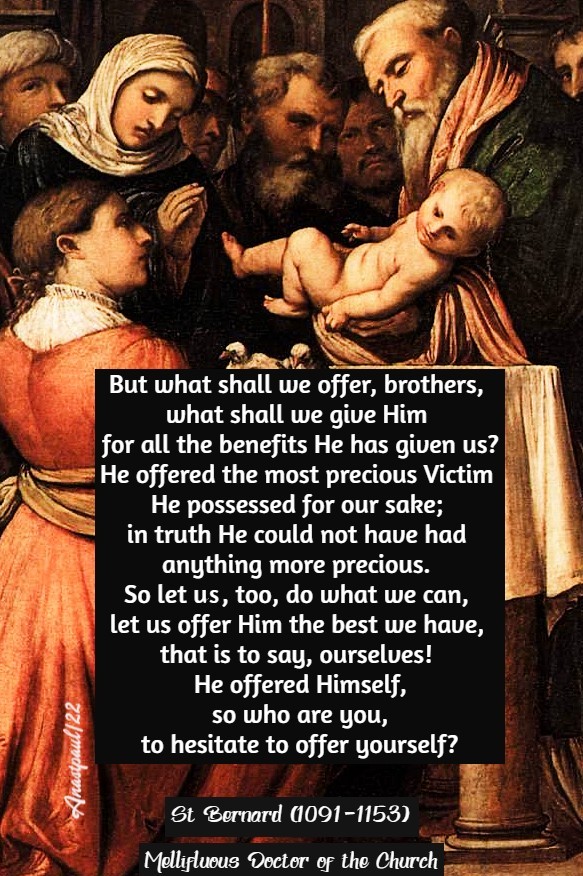
“But what shall we offer, brothers, what shall we give Him for all the benefits He has given us? He offered the most precious Victim He possessed for our sake; in truth, He could not have had anything more precious. So let us, too, do what we can, let us offer Him the best we have, that is to say, ourselves! He offered Himself, so who are you, to hesitate to offer yourself?”
St Bernard (1091-1153) Mellifluous Doctor of the Church
“Let us try and live like Simeon, with our minds and hearts turned towards Jesus. Let us think chiefly of Him, love Him, above everything else and work only for Him. Then our death will be as beautiful as his. In fact, we shall be even more fortunate, for we can go further than receiving Jesus into our arms. We shall be able to receive Him into out hearts. He will be at hand to give us the supernatural strength which we shall need on our great journey into eternity.”
One Minute Reflection – 2 February – The Feast of the Purification of the Blessed Virgin, Candlemas – Malachias 3:1-4; Luke 2:22-32 – Scripture search here: https://www.drbo.org/
“My eyes have seen Thy salvation …” – Luke 2:30
REFLECTION – “Come then, my brethren, give an eye to that candle burning in Simeon’s hands. Light your candles too by borrowing from that Light; for these candles I speak of are the lamps which the Lord orders us to have in our hands (Mt 25:1; Lk 12:35). Come to Him and be enlightened (Ps 33:6), so as to be not merely carrying lamps but to be very lamps yourselves, shining inside and out, for yourselves and for your neighbours.
Be a lamp then in heart, in hand, in lips. The lamp in your heart will shine for you; the lamp in your hand or on your lips, will shine out for your neighbours. The lamp in the heart is loving faith; the lamp in the hand is the example of good works; the lamp on the lips is edifying speech. But not just before men, must we shine by works and word but before Angels too, by prayer and before God Himself by pure Intention. Our lamp before the Angels is the purity of our devotion, when, in the sight of Angels, we chant the Psalms with care, or pray with burning ardour; our lamp before God is the honesty of our intention to please Him only, Whose approval we have won…
There are so many lamps then, my brethren, to lighten your way, if only you will come to the Source of all Light and be enlightened. Come, I say, to Jesus, Who shines out to us from Simeon’s arms. He will give Light to your faith, lustre to your works, meaning to your words for men, ardour to your prayer, purity to your intentions … And when this life’s lamp is extinguished, there will arise a life’s Light which can never be extinguished, a shimmering noonday Light, arising, as it were, at the evening of your life!” – Blessed Guerric of Igny O.Cist. (c1080-1157) Cistercian Abbot (1st Sermon for the Feast of the Purification of the Virgin Mary).
PRAYER – Almighty, eternal God, we humbly beseech Thy Majesty that, as Thy Only-begotten Son was this day presented in the temple in the nature of our flesh, so may Thou grant us to be presented to Thee with purified minds. Through Jesus Christ, Thy Son our Lord, Who lives and reigns with Thee, in the unity of the Holy Ghost, God, world without end. Amen (Collect). Through Jesus Christ, Thy Son our Lord, Who lives and reigns with Thee, in the unity of the Holy Ghost, God, world without end. Amen (Collect).
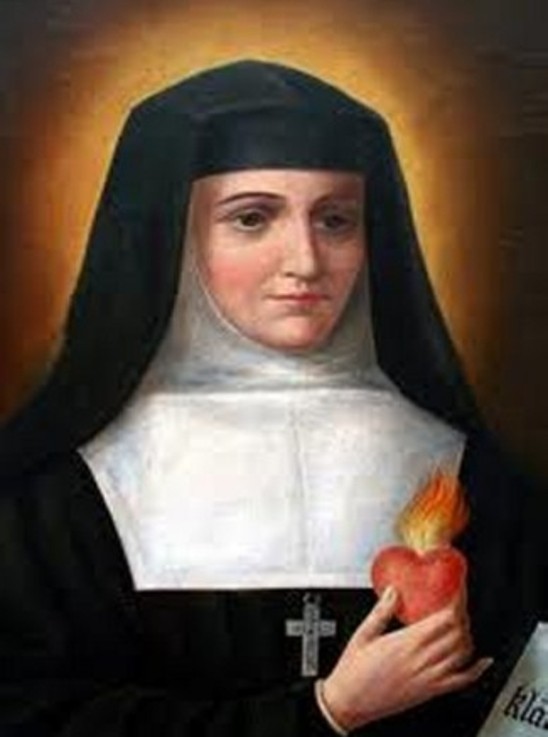
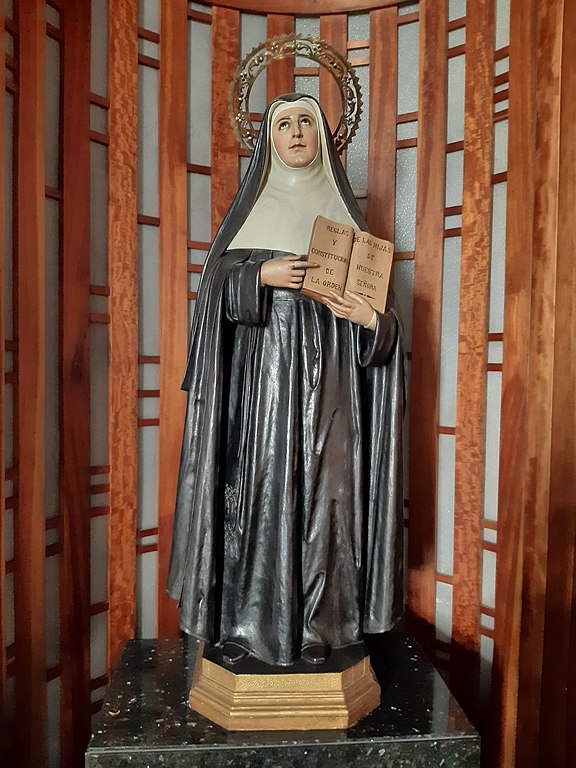
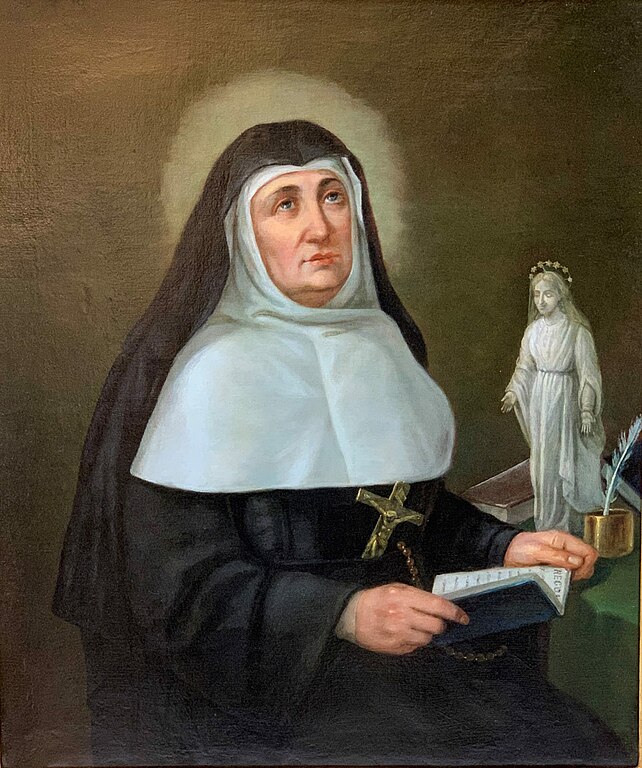
Saint of the Day – 2 February – St Jeanne de Lestonnac ODN (1556-1640) Widow, Mother, Founder of the The Sisters of the Company of Mary, Our Lady ODN (Latin: Ordinis Dominae Nostrae). Born on 27 December 1556 at Bordeaux, France and died on 2 February 1640 of natural causes. Patronages – of widows, abuse victims. Also known as – Jane de Lestonnac, Joan de Lestonnac, Joanne. Additional Memorial – 15 May on some Calendars.
Jeanne was born in Bordeaux in 1556 to Richard de Lestonnac, a member of the Parlement of Bordeaux and Jeanne Eyquem, the sister of the noted philosopher, Michel Eyquem de Montaigne. She grew up in a time where the conflict between the Protestants and the defenders of the Catholic Faith was at its height. This was evident in her own family. While her mother became an enthusiastic Calvinist and tried to persuade her to convert, her father and her uncle Montaigne, adhered to the Catholic Faith and were her support in withstanding her own mother’s influence. Jeanner remained a devoted Catholic.
At the age of 17 she married Gaston de Montferrant, with whom she had seven children, three of whom died in infancy. She was married for 24 years when her husband died. This marked the beginning of a very painful period in her life, with the further loss, within seven months, of her father, uncle and eldest son.
Copy of a Portrait of an 18-year old woman, attributed to Pieter Pourbus, 1574, in the Montreal Museum of Fine Arts, possibly St Jeanne de Lestonnac (1556-1640).
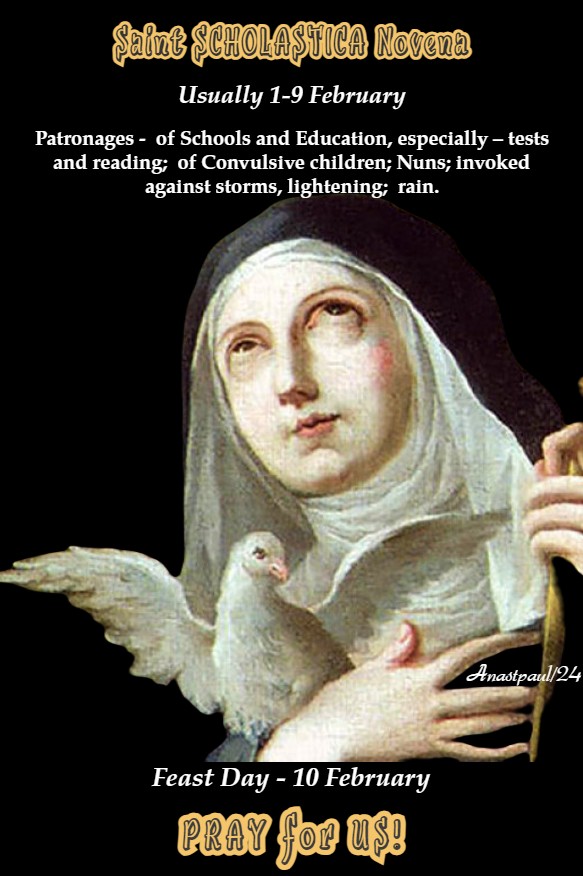
Following her husband’s death, Jeanne, at the age of 46 and with her children now grown, turned to a contemplative life and entered the Cistercian Monastery in Toulouse, where she was given the religious name of “Jeanne of Saint Bernard.” She found great peace and satisfaction in the monastic life but, after six months, she became very ill and had to leave the Monastery. She then went to live on her estate La Mothe Lusié to recover her health and where she adopted the lifestyle of a secular Sister, performing many acts of charity, including food and alms distribution and Jeanne regularly met with young women of her social class, to pray and discuss religious questions. She sought for models of Catholic women to be her guides and cultivated an interest in the lives of St Scholastica, St Clare of Assisi, St Catherine of Siena and St Teresa of Avila.
A few years later, in 1605, an epidemic of the Plague erupted in Bordeaux. At risk to her own life, Jeanne returned to her native City to help care for the sick and suffering in the slums and poorest regions of Bordeaux.
Jeanne’s brother, a Jesuit attached to the college in Bordeaux, arranged a meeting between his sister and two Jesuit Priests – Jean de Bordes and François de Raymond. The Jesuits asked her to serve as founder of a new teaching order for young women. They encouraged her to establish for girls, in terms of formal education, what they were doing for boys. The three decided upon a cloistered community to follow the Benedictine Rule, modified to allow Sisters to teach. The group gained the approval of Pope Paul V in 1607. The community took the name of the Compagnie de Notre-Dame.
An old priory was purchased near the Château Trompette but moved in September 1610, to a larger old Monastery on Rue du Hâ. They were well-received and financially supported by the City’s elite. The first five members of the new Order took their religious vows on 10 December 1610. The community established its first school for girls in Bordeaux. Foundations proceeded in Beziers, Périgueux and Toulouse through Jeanne’s personal connections, as well as her connections with the Jesuits and Bordelaise political elite. By the time she died in 1640, 30 Houses existed in France that is roughly one new foundation per year for 30 years.
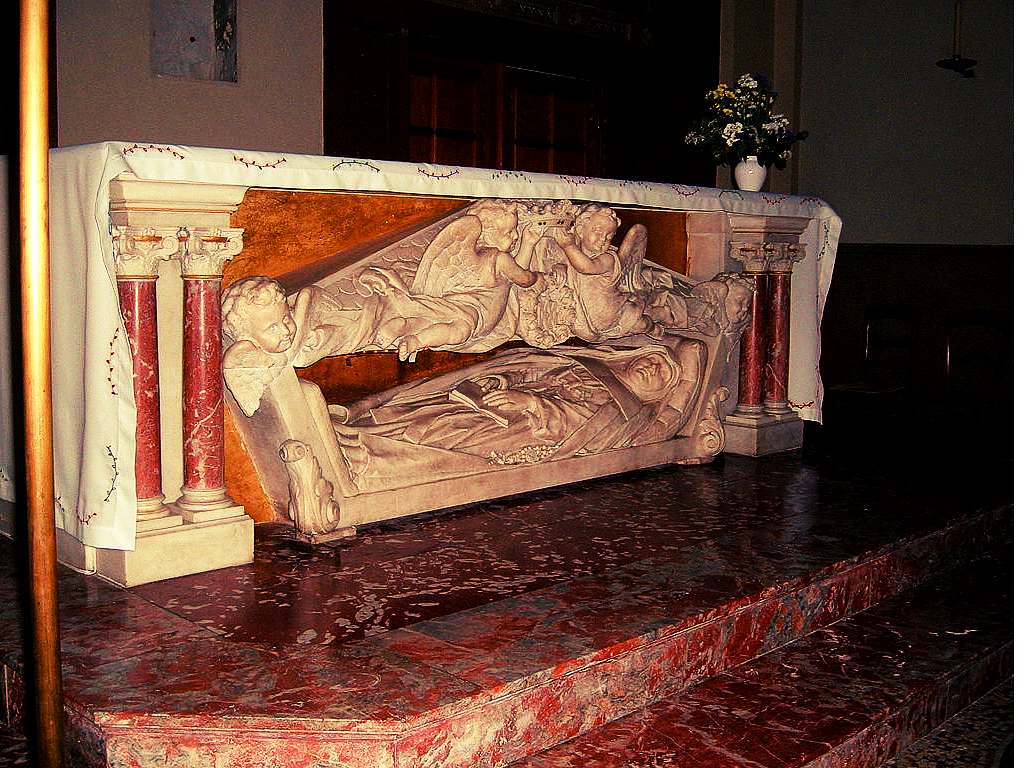
Two of her daughters and at least one granddaughter had now joined the Order. Revised Rules and Constitutions for the congregation were drawn up in 1638. Joeanne was now over 80 and her health was beginning to fail. She spent her last years in seclusion as she prepared for death. But in her last years she was highly honoured by her Order. She died peacefully on 2 February 1640 in Bordeaux, aged 84, just after the sisters had renewed their vows on the Feast of the Purification of Our Lady. Her body is said to have been as healthy and emitted a sweet smell for several days afterwards. She was buried in the Cemetery of the Convent in Rue du Ha.
St Jeanne was Beatified on 23 December 1900 by Pope Leo XIII and was CanoniSed on 15 May 1949 by Pope Pius XII. As of 2016, her religious order has over 1,450 Sisters found in 27 Countries throughout Europe, Africa, North America and South America.
Our Lady of the Candles – Nuestra Señora de la Purificación y la Candelaria, is a Marian title and image venerated by Filipino Catholics. The image, which is enshrined on the balcony of Jaro Cathedral, is known as the Patroness of Jaro District of Iloilo City and the whole of the Western Visayas. The Feast Day of Our Lady of the Candles is on Candlemas (2 February) and is celebrated in Iloilo City with a Solemn Pontifical Mass presided by the Archbishop of Jaro.
St Adalbald of Ostrevant St Adeloga of Kitzingen St Agathodoros of Tyana St Apronian the Executioner Bl Bernard of Corbara St Bruno of Ebsdorf St Candidus the Martyr St Columbanus of Ghent St Cornelius the Centurion St Felician the Martyr St Feock St Firmus of Rome St Flosculus of Orléans St Fortunatus the Martyr St Hilarus the Martyr St Jeanne de Lestonnac (1556-1640) Widow, Mother, Founder
St Lawrence of Canterbury (Died 2 February 619) The Second Archbishop of Canterbury, the successor of St Augustine of Canterbury from 604 until his death in 619, but he was Consecrated as Archbishop by his predecessor, St Augustine, during Augustine’s lifetime, to ensure continuity in the office, Benedictine Monk, Missionary. He was a member of the Gregorian mission sent from Italy to England to Christianise the Anglo-Saxons. About St Lawrence: https://anastpaul.com/2022/02/02/saint-of-the-day-2-february-saint-lawrence-of-canterbury-died-619/












 AnaStpaul
You must be logged in to post a comment.