Posted in LOVE of NEIGHBOUR, OUR Cross, QUOTES on DIVINE PROVIDENCE, QUOTES on LOVE of GOD, QUOTES on PERSEVERANCE, QUOTES on the CROSS of CHRIST, QUOTES on UNITY/with GOD, QUOTES on Will (Sensual or Inferior), The MOST PRECIOUS BLOOD, THE SPIRITUAL COMBAT - Fr Lorenzo Scupoli

Thought for the Day – 11 February – Of the Way to Resist Sudden Impulses of the Passions

Thought for the Day – 11 February – The Spiritual Combat (1589) – Dom Lorenzo Scupoli OSM (c1530-1610)

None shall be crowned who has not fought well.” 2 Tim 2: 5

XVIII: … Of the Way to Resist
Sudden Impulses of the Passions
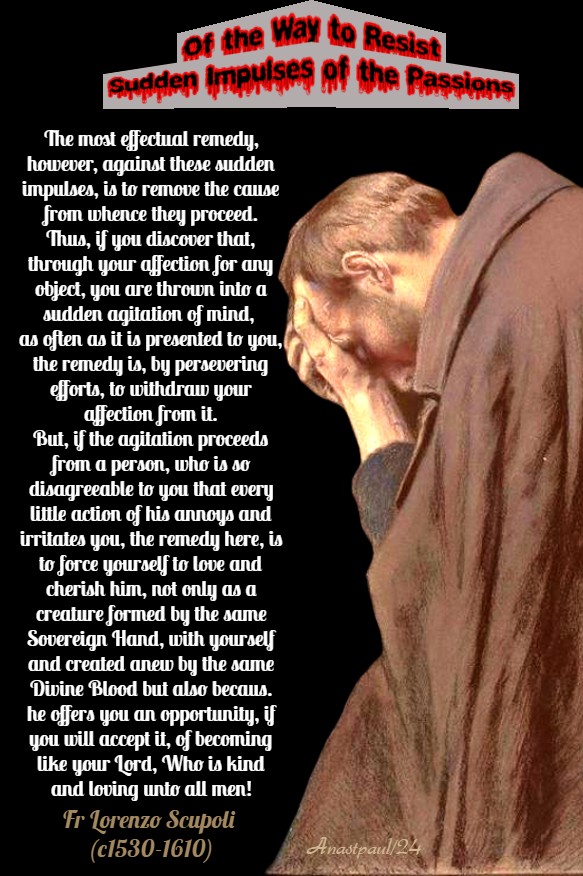
“Until we have become habituated to ward off sudden strikes, whether of insult or other adverse circumstances, it is well, in order to acquire such a habit, to anticipate them and desire to suffer them, over and over again and so, to await them with a mind prepared.

The way to anticipate them is, to consider the passion to which you are most inclined and also, the places wherein and the persons with whom, you are wont to converse; whence you may readily conjecture what is likely to befall you.
And should you meet with any other untoward circumstance which you have not foreseen, although you will find your soul strengthened by having been prepared to meet the other evils which you did foresee, yet may you also avail yourself of the following additional help.

At the very first touch of the insult or ‘trial,’ whatever it be, rouse yourself at once and lift up your heart to God, reflecting on His ineffable goodness and love, which sends you this affliction that, by enduring it for the love of Him, you may thereby be more purified and brought nearer and united unto Him.
And, knowing, how greatly He is pleased that you should suffer it, turn next to yourself and with a sharp rebuke, say, “O, why will you refuse to bear this cross which is sent to you, not by man but by your Father Who is in Heaven!
Then turn to the cross and embrace it with all possible patience and joy, saying, “O cross, formed by Divine Providence before I was born; O cross, endeared to me by the dear love of my Crucified Lord, nail me now to youself that so I may give myself to Him, Who died on you for my redemption!

And if, at first the passion should prevail against you and you should be wounded and unable to raise your heart to God, strive even then, to do, as at the beginning and fight as if still unwounded.

The most effectual remedy, however, against these sudden impulses, is to remove the cause from whence they proceed.
Thus, if you discover that, through your affection for any object, you
are thrown into a sudden agitation of mind, as often as it is presented to you, the remedy is, by persevering efforts, to withdraw your affection from it.

But, if the agitation proceeds from a person, who is so disagreeable to you that every little action of his annoys and irritates you, the remedy here, is to force yourself to love and cherish him, not only as a creature formed by the same Sovereign Hand, with yourself and created anew by the same Divine Blood but also becaus. he offers you an opportunity, if you will accept it, of becoming like your Lord, Who is kind and loving unto all men!

Dom Lorenzo Scupoli

Posted in DECEMBER - The DIVINE INFANCY and The IMMACULATE CONCEPTION, DOCTORS of the Church, DOGMA, FATHERS of the Church, MARIAN QUOTES, QUOTES on GRACE, The GOOD SHEPHERD, The IMMACULATE CONCEPTION

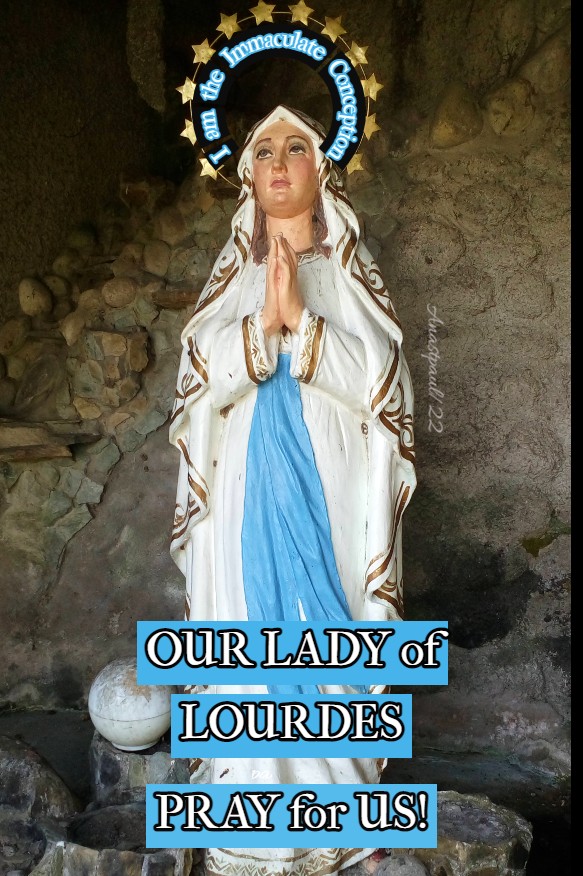
Quote/s of the Day – 11 February – Apparition of the Immaculate Conception

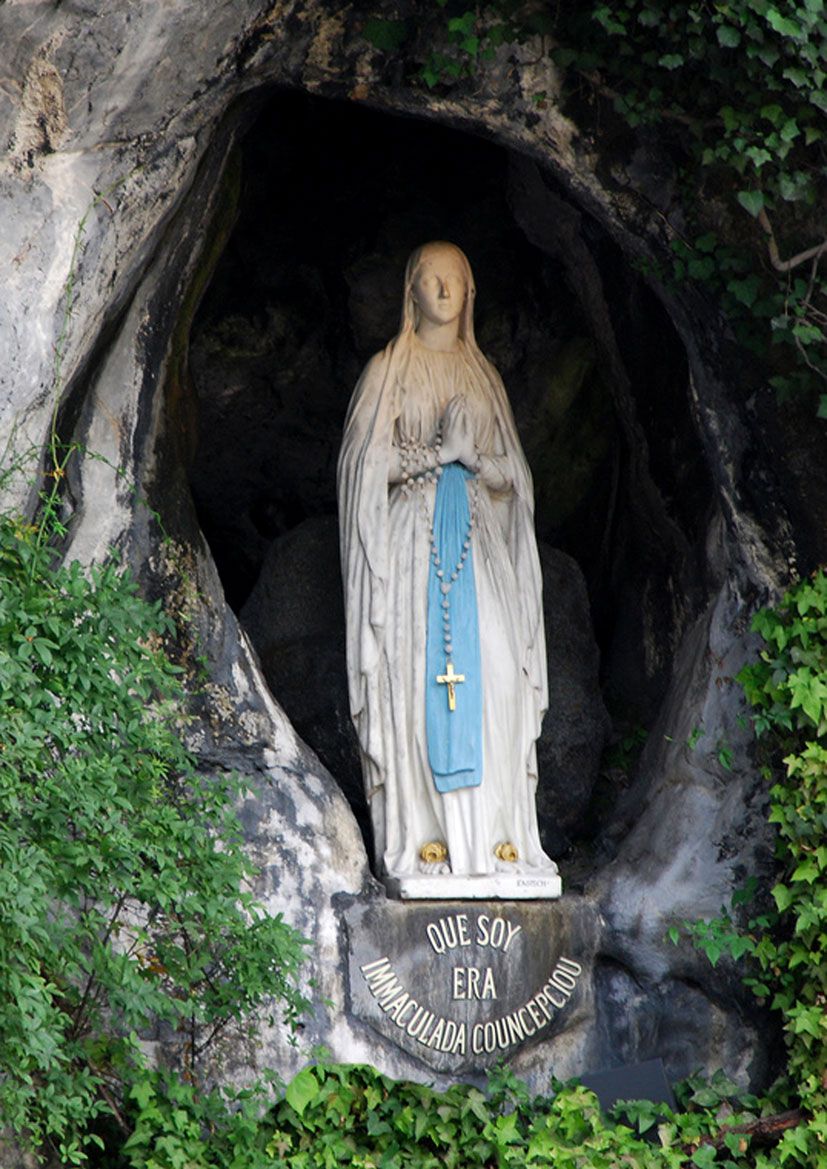
Quote/s of the Day – 11 February – Apparition of the Immaculate Conception, the Blessed Virgin Mary at Lourdes

I am the Immaculate Conception.

Our Lady to St Bernadette
at Lourdes on 25 March 1858

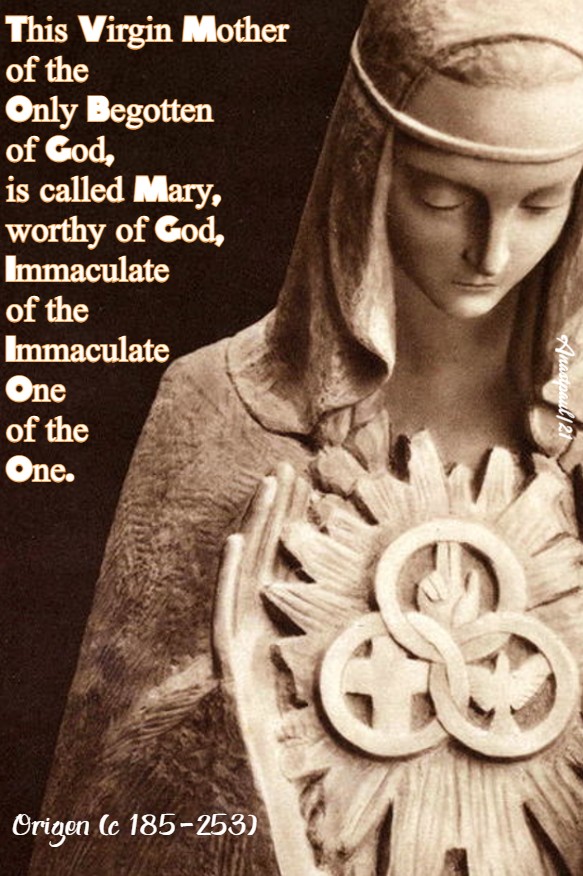
This Virgin Mother
of the Only Begotten of God,
is called Mary,
worthy of God,
Immaculate of the Immaculate,
One of the One.

Origen (c 185-253)

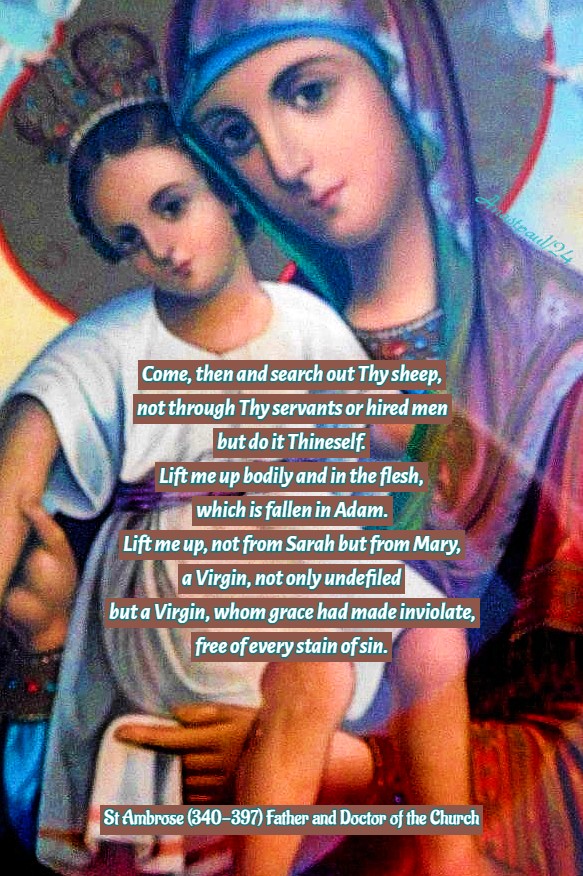
Come, then and search out Thy sheep,
not through Thy servants or hired men
but do it Thineself.
Lift me up bodily and in the flesh,
which is fallen in Adam.
Lift me up, not from Sarah but from Mary,
a Virgin, not only undefiled
but a Virgin, whom grace had made inviolate,
free of every stain of sin.

St Ambrose (340-397)
Father and Doctor of the Church

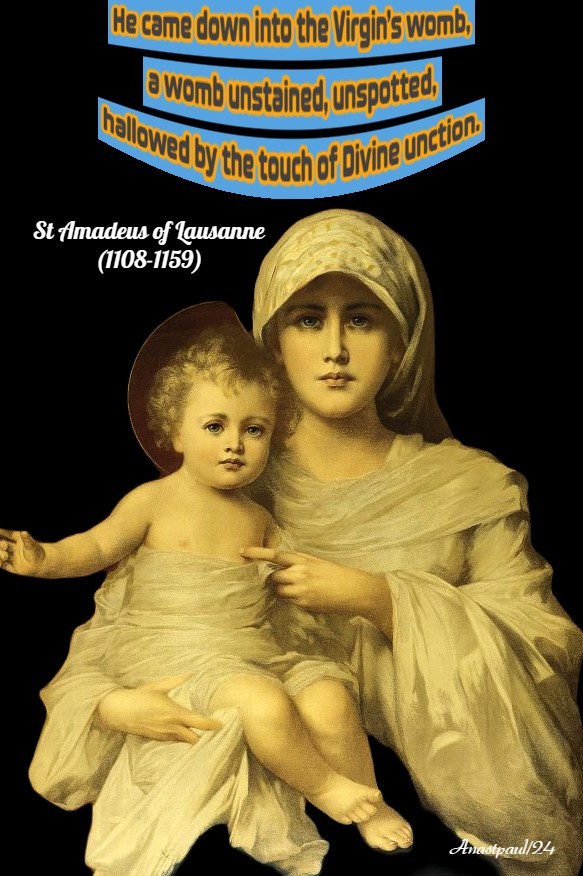
He came down into the Virgin’s womb,
a womb unstained, unspotted,
hallowed by the touch of Divine unction.

St Amadeus of Lausanne (1108-1159)

Posted in CHRIST the WORD and WISDOM, DOCTORS of the Church, FATHERS of the Church, GOD ALONE!, I BELIEVE!, ONE Minute REFLECTION, QUOTES on FAITH, The WORD

One Minute Reflection – 11 February – How then does he call Him the Son of David?

One Minute Reflection – 11 February – “The Month of the Most Holy and Blessed Trinity” – Quinquagesima Sunday and the Feast of Our Lady of Lourdes – 1 Cor.13:1-13; Luke 18:31-43 – Scripture search here: https://www.drbo.org/

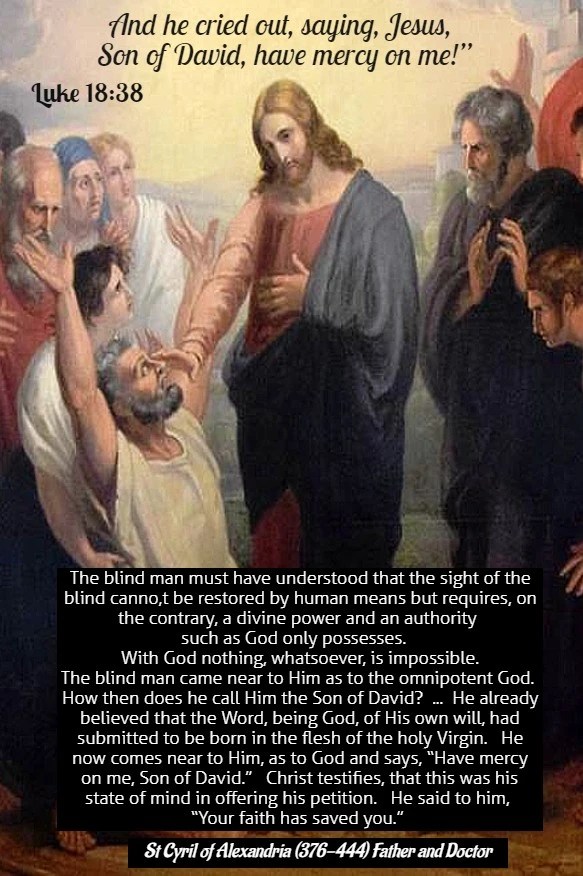
And he cried out, saying, Jesus, Son of David, have mercy on me!” – Luke 18:38

REFLECTION – The blind man must have understood, that the sight of the blind cannot be restored by human means but requires, on the contrary, a divine power and an authority such as God only possesses. With God nothing, whatsoever, is impossible. The blind man came near to Him as to the omnipotent God. How then does he call Him the Son of David? What can one answer to this? The following is perhaps the explanation. Since He was born and raised in Judaism, of course, the predictions contained in the law and the holy prophets concerning Christ, had not escaped his knowledge. He heard them chant that passage in the book of the Psalms, “The Lord has sworn in truth to David and will not annul it, saying: ‘of the fruit of your loins I will set a king upon your throne.’” The blind man also knew, that the blessed Prophet Isaiah said, “There will spring up a shoot from the root of Jesse and from his root a flower will grow up.” Isaiah also said, “Behold, a virgin will conceive and bring forth a son,and they will call his name Emmanuel, which, being interpreted is, God with us.” He already believed that the Word, being God, of His own will, had submitted to be born in the flesh of the holy Virgin. He now comes near to Him, as to God and says, “Have mercy on me, Son of David.” Christ testifies, that this was his state of mind in offering his petition. He said to him, “Your faith has saved you.” – St Cyril of Alexandria (376-444) Archbishop of Alexandria, Father and Doctor of the Incarnation (Commentary on Luke, Homily 126)

PRAYER – O God, Who by the Immaculate Conception of the Virgin, prepared a worthy dwelling for Thy Son, we humbly beseech Thee that, recalling the apparition of the same Virgin, we may obtain health for both soul and body. Through the same Jesus Christ, Thy Son our Lord, Who lives and reigns with Thee, in the unity of the Holy Ghost, God, world without end. Amen (Collect).

Posted in FEASTS and SOLEMNITIES, MARIAN DEVOTIONS, MARIAN HYMNS, MARIAN PRAYERS, MARIAN TITLES, Our MORNING Offering, QUEENSHIP of MARY

Our Morning Offering – 11 February – Hail! all Hail! Great Queen of Heaven, Notre Dame de Lourdes

Our Morning Offering – 11 February – Apparition of the Immaculate Virgin Mary at Lourdes

Hail! all Hail! Great Queen of Heaven,
Notre Dame de Lourdes

Unknown Author
First Published in 1905

Hail! all Hail! great Queen of Heaven,
Hail sweet Notre Dame de Lourdes,
‘Neath whose care our weary exile,
Is from countless ills secured.

Refrain:
Then let men and angels praise thee,
Fount of grace to all assured,
While in gladsome strains we are singing,
Hail! sweet Notre Dame de Lourdes
Hail! sweet Notre Dame de Lourdes.

Blessed thou above all others,
Mary Mistress of the spheres,
Star of hope, serenely beaming
Through this darksome vale of tears.
Refrain

Happy angels joy to own thee,
O’er their choirs exalted high,
Throned in blissful light and beauty,
Empress of the starry sky.
Refrain

As the fount is still unsealing
Its pure treasures softly fair,
May each drop be fraught with healing,
Dearest Mother, at thy prayer.
Refrain

Posted in SAINT of the DAY

Saint of the Day – 11 February – St Severinus of Agaunum (Died c507) Abbot

Saint of the Day – 11 February – St Severinus of Agaunum (Died c507) Abbot, Miracle-worker, gifted with Prophecy and healing the sick. Born in Burgundy, France and died in c507 at Chateau-Landon in Gatinais, of natural causes whilst travelling towards his Monastery. Patronage – of Agaunum, Switzerland.

The Roman Martyrology reads: “At Chateau-Landon, St Severin, Abbot of the Monastery of Aqaunum, by whose prayers the Christian King Clovis, was deliovered from a long sickness.

Severinus, of a noble family in Burgundy, was educated in the Catholic faith at a time when the Arian heresy reigned supreme in that region. He forsook the world in his youth and dedicated himself to God in the Monastery of Saint-Maurice-en-Valais at Agaunum, which consisted only of scattered cells until, some time later, the Catholic King, Sigismund, built there the great Abbey of Saint-Maurice.

Severinus became the holy Abbot of Saint-Maurice, with its distinct Convents for men and women, all of whom, bore voluntarily, the yoke of penance and celibacy, without solemn vows. The Abbot had governed his community for many years in the exercise of penance and charity, when, in 504, Clovis, the first Christian King of France, who was lying ill of a fever, sent his Chamberlain to conduct the Saint to Court. After his Physicians had, for two years endeavoured, without success, to cure him, Clovis was told that the sick from all parts recovered their health by the prayers of our Saint Severinus. The Abbot, therefore, took leave of his Monks and Nuns and told them he would never see them again in this world.

The Monastery of Saint-Maurice-en-Valais at Agaunum

On his journey he healed Eulalius, Bishop of Nevers, who had been deaf and dumb for some time; he also healed a leper at the gates of Paris. And coming to the Palace, he immediately restored the King to perfect health, by covering him with his own cloak. He cured many other sick persons at the Court and in Paris. The King, in gratitude, distributed large alms to the poor and released all his prisoners.

Saint Severinus, returning toward Agaunum, stopped at Chateau-Landon in Gatinais, where two Priests served God in a solitary Chapel. Foreseeing his imminent death, he asked admittance among them and they received this stranger, whom they soon greatly admired for his sanctity. His death followed shortly after, in 507. This site became the Abbey of Saint Severinus, with a beautiful Church dedicated to him. His Relics were later scattered, when this Church was plundered during the French Revolution.

Posted in LENT, MARIAN TITLES, SAINT of the DAY

Quinquagesima Sunday, Feast of Our Lady of Lourdes and the Saints for 11 February

Quinquagesima Sunday:
This Season is seventeen (17) days long and includes the three Sundays before Ash Wednesday.
The length of the Season never changes but the start date is dependent on the movable date of Easter, which can fall between 22 March-25 April.
For many early Christians Quinquagesima marked the time after which meat was forbidden. In many places, this Sunday and the next two days, were used to prepare for Lent by a good Confession; hence in England, we find the names Shrove Sunday and Shrovetide. Shrove is a form of the English word “shrive,” which means – to obtain absolution for one’s sins by way of Confession and doing penance..
As the days before Lent were frequently spent in merry-making, Pope Benedict XIV by the Constitution “Inter Cetera” (1 January 1748) introduced a Forty Hours’ Devotion to keep the faithful from dangerous amusements and to make some reparation for sins committed.
Quinquagesima also means, the time between Easter and Pentecost, or from the Saturday after Easter to the Sunday after Pentecost; it is then called Quinquagesima Paschae paschalis, or laetitae.

St Ampelius of Africa
St Ardanus of Tournus
Bl Bartholomew of Olmedo

St Calocerus of Ravenna
St Castrensis of Capua
St Dativus the Senator
Bl Elizabeth Salviati
St Etchen of Clonfad
St Eutropius of Adrianopolis
St Felix the Senator

St Helwisa
St Jonas of Muchon

St Lucius of Adrianople
St Pedro de Jesús Maldonado-Lucero
St Saturninus of Africa
St Secundus of Puglia
St Severinus of Agaunum (Died c507) Abbot
St Simplicius of Vienne (Died c417) Bishop
St Theodora the Empress