
Thought for the Day – 17 February – The Spiritual Combat (1589) – Dom Lorenzo Scupoli OSM (c1530-1610)
“None shall be crowned who has not fought well.” 2 Tim 2: 5
XX: … How to Combat Sloth
(Part One)
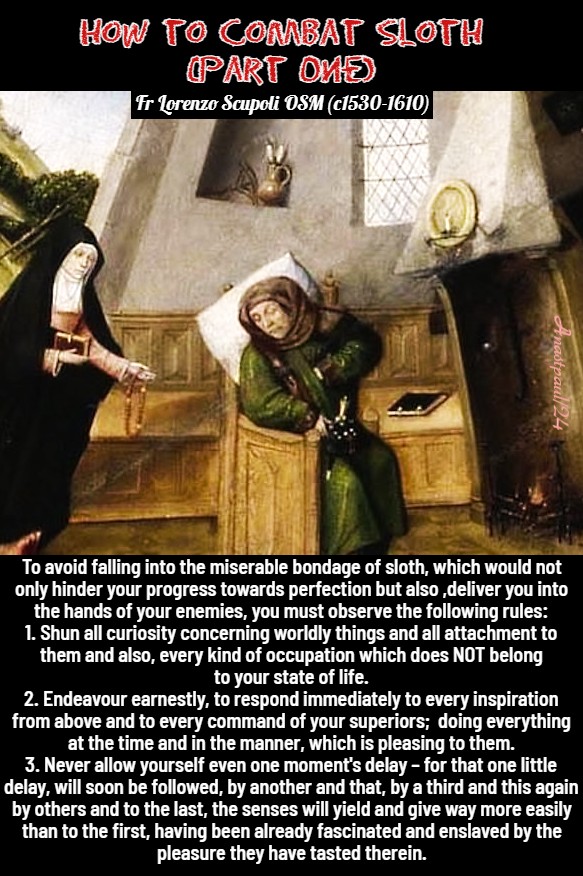
“To avoid falling into the miserable bondage of sloth, which would not only hinder your progress towards perfection but also ,deliver you into the hands of your enemies, you must observe the following rules:
- Shun all curiosity concerning worldly things and all attachment to them and also, every kind of occupation which does NOT belong to your state of life.
- Endeavour earnestly, to respond immediately to every inspiration from above and to every command of your superiors; doing everything at the time and in the manner, which is pleasing to them.
- Never allow yourself even one moment’s delay – for that one little delay, will soon be followed, by another and that, by a third and this again by others and to the last, the senses will yield and give way more easily than to the first, having been already fascinated and enslaved by the pleasure they have tasted therein.
Hence, the duty to be performed, is either begun too late, or sometimes laid aside altogether, as too irksome to be endured!
Thus, by degrees, a habit of sloth is acquired which, as we cannot disguise it from ourselves, we seek to excuse by vain purposes of future diligence and activity, while we are all the while held in bondage by it.
The poison of sloth overwhelms the whole man – not only infecting the will, by making exertion hateful to it but also, blinding the understanding, so that it is unable to see how vain and baseless are its intentions, to do promptly and diligently, at some future season, what should be done at once but is either willfully neglected altogether, or deferred to another time.
Nor is it enough that we perform our appointed work quickly; we must, in order to bring it to its highest possible perfection, do it at the very time required by its nature and quality and with all suitable diligence.
For that is not diligence but the subtlest form of sloth which leads us to do our work before its time – not seeking to do it well but dispatching it hastily, that we may afterwards indulge in the sluggish repose on which our thoughts have been dwelling, while we were hurrying over our business!
All this great evil proceeds from the want of duly, considering the value of a good work, performed at its right time and with a spirit determined to brave the toil and difficulty, put in the way of untried soldiers, by the sin of sloth.”
Dom Lorenzo Scupoli














 AnaStpaul
You must be logged in to post a comment.