Thought for the Day – 21 February – The Spiritual Combat (1589) – Dom Lorenzo Scupoli OSM (c1530-1610)
“None shall be crowned who has not fought well.” 2 Tim 2: 5
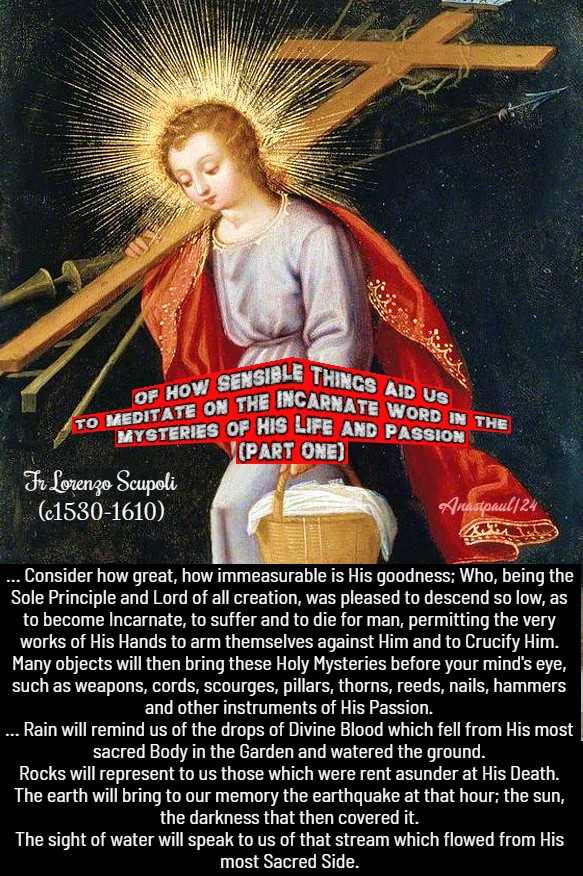
XXII: … Of How Sensible Things Aid Us to Meditate on the Incarnate Word in the Mysteries of His Life and Passion (Part One)
“I have shown you how we may raise our minds from sensible objects to the contemplation of the Divinity. Now, learn a method of taking occasion from the same, to meditate on the Incarnate Word and the most Sacred Mysteries of His Life and Passion.
All things in the universe may serve to this end, if first you behold God in them, as the sole first cause, Who has bestowed on them all the being, beauty and excellence which they possess. Passing on from this, consider how great, how immeasurable is His goodness; Who, being the Sole Principle and Lord of all creation, was pleased to descend so low, as to become Incarnate, to suffer and to die for man, permitting the very works of His Hands to arm themselves against Him and to Crucify Him. Many objects will then bring these Holy Mysteries before your mind’s eye, such as weapons, cords, scourges, pillars, thorns, reeds, nails, hammers and other instruments of His Passion.
Poor hovels will recall to our memory the stable and manger of our Lord. Rain will remind us of the drops of Divine Blood which fell from His most sacred Body in the Garden and watered the ground. Rocks will represent to us those which were rent asunder at His Death. The earth will bring to our memory the earthquake at that hour; the sun, the darkness that then covered it. The sight of water will speak to us of that stream which flowed from His most Sacred Side.”
Quote/s of the Day – 21 February – “The Month of the Most Holy and Blessed Trinity” – Ember Wednesday – 3 Kings 19:3-8; Matthew 12:38-50 – Scripture search here: https://www.drbo.org/
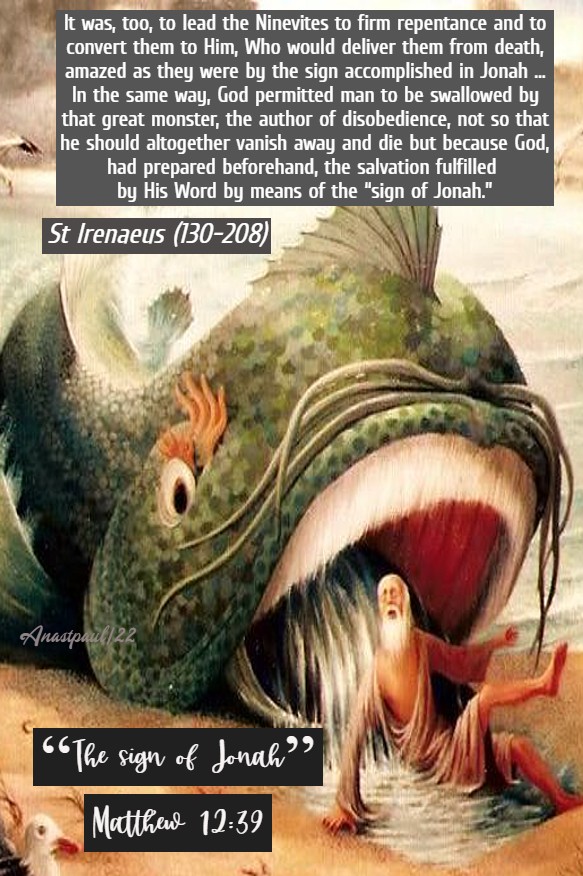
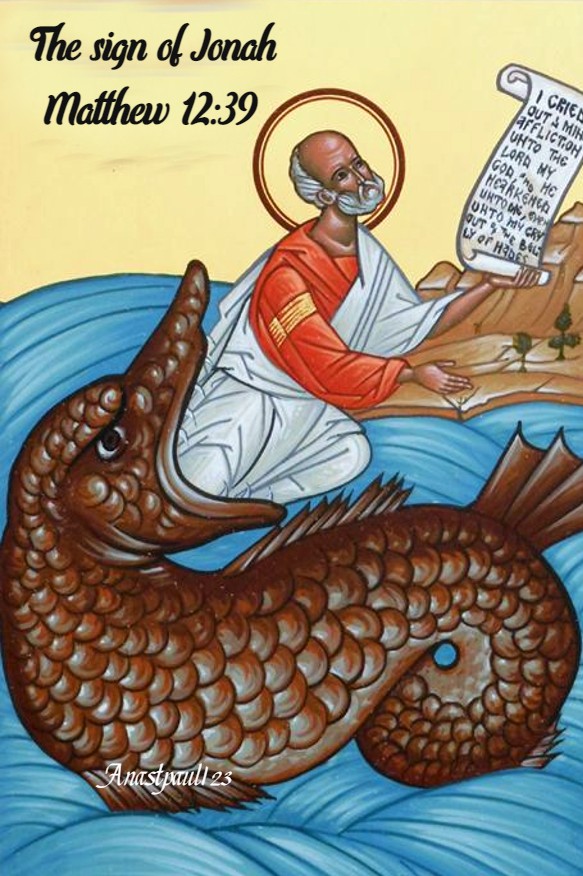
“The sign of Jonah”
Matthew 12:39
“It was, too, to lead the Ninevites to firm repentance and to convert them to Him, Who would deliver them from death, amazed as they were by the sign accomplished in Jonah … In the same way, God permitted man to be swallowed by that great monster, the author of disobedience, not so that he should altogether vanish away and die but because God, had prepared beforehand, the salvation fulfilled by His Word by means of the “sign of Jonah.”
St Irenaeus (130-208) Bishop of Lyons, Martyr and Father
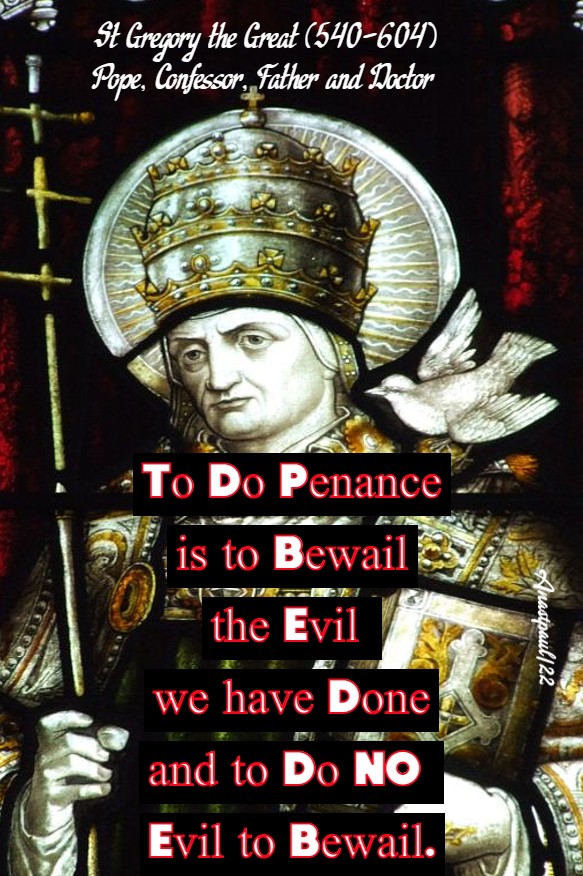
“To do penance is to bewail the evil we have done and to do no evil to bewail.”
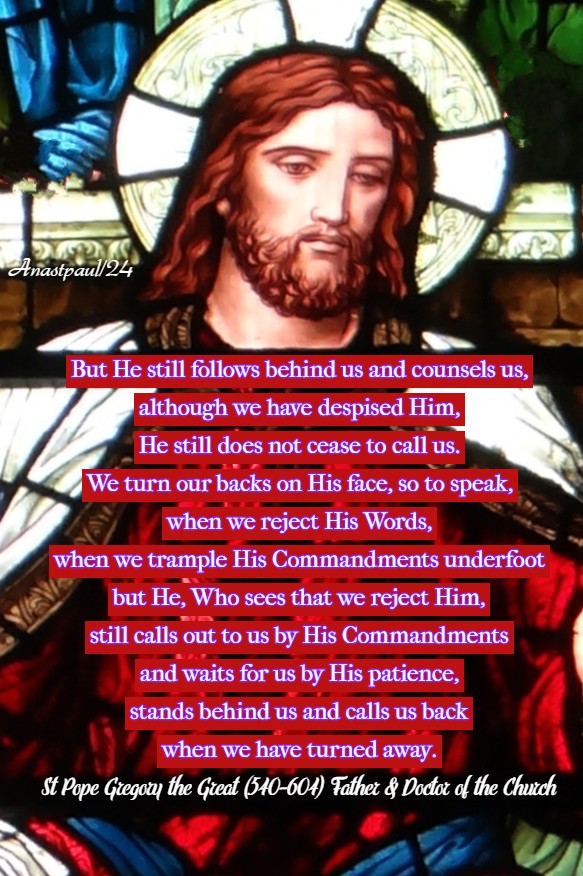
“But He still follows behind us and counsels us, although we have despised Him, He still does not cease to call us. We turn our backs on His face, so to speak, when we reject His Words, when we trample His Commandments underfoot but He, Who sees that we reject Him, still calls out to us by His Commandments and waits for us by His patience, stands behind us and calls us back when we have turned away.”
St Pope Gregory the Great (540-604) Father & Doctor of the Church
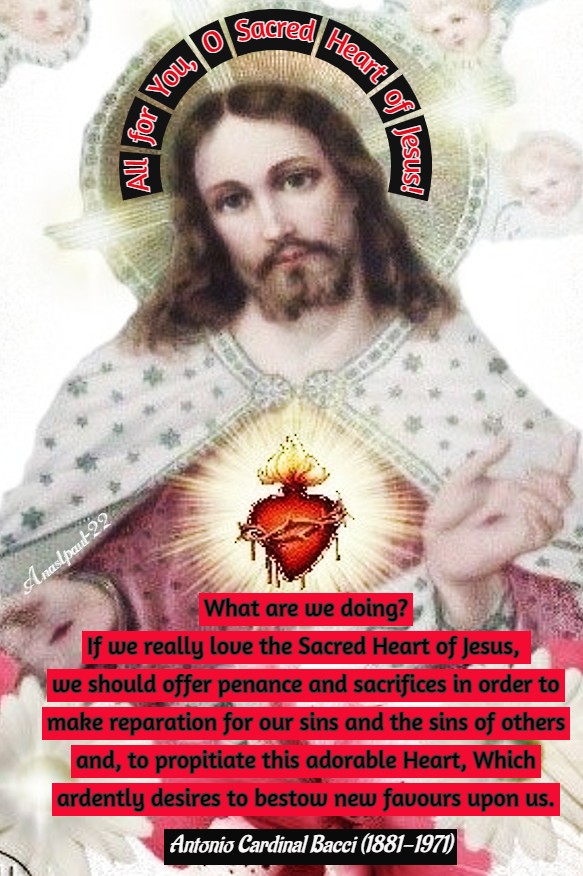
“What are we doing? If we really love the Sacred Heart of Jesus, we should offer penance and sacrifices in order to make reparation for our sins and the sins of others and, to propitiate this adorable Heart, Which ardently desires to bestow new favours upon us.”
Our Lenten Journey with the Angels and the Saints – 21 February – Ember Wednesday – 3 Kings 19:3-8; Matthew 12:38-50 – – Scripture search here: https://www.drbo.org/
“The troubles of my heart are multiplied, deliver me from my necessities. See my abjection and my labour and forgive me all my sins.” Psalm 24:17-18
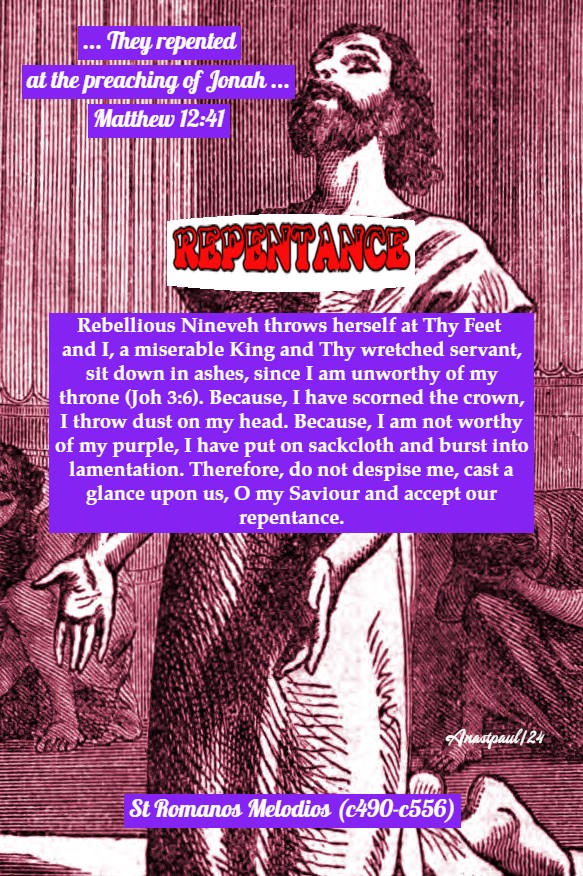
“The men of Nineveh will rise up in the judgement with this generation and will condemn it; for they repented at the preaching of Jonah and behold, One greater than Jonah is here.” Matthew 12:41
REPENTANCE
St Romanos Melodios (c490-c556) Monk, Hymnist, Poet
“Let us meditate on the Ninevites … let us listen to what they did. After the terrifying proclamation made by Jonah before this gluttonous and drunken people … like capable workmen, they made hast to restore the city their evil deeds had destroyed, taking a sure rock for its foundation … – REPENTANCE.
After washing away its filth, in the floods of their tears, they adorned their town with their prayer and converted Nineveh thus pleasing the Merciful One. Its King, a wise man, … prepared animals and flocks as if to bring them along in dowry, saying: “O God, my Saviour, I offer everything to Thee, only reconcile, bring back in grace, the one who prostituted herself and betrayed … Thy purity, for see how, in her love, she offers her repentance to Thee like a gift …”
If I, the sovereign King, have sinned, then strike me down alone and take pity on all these others. But if we have all fallen short, hear the voices of all … May Thy help come upon us and all fear will be dissolved. Nothing will dismay us if Thou receive what we are offering, our repentance …
Rebellious Nineveh throws herself at Thy Feet and I, a miserable King and Thy wretched servant, sit down in ashes, since I am unworthy of my throne (Joh 3:6). Because, I have scorned the crown, I throw dust on my head. Because, I am not worthy of my purple, I have put on sackcloth and burst into lamentation. Therefore, do not despise me, cast a glance upon us, O my Saviour and accept our repentance.
Son of the One God, O only God, protect those who love Thee, in Thy mercy … As in former days Thou took pity on the Ninevites … so today, release from judgement, those who sing to Thee and grant forgiveness in return for my Confession … Since I have no works worthy of Thy glory, at least save me, my Saviour, for my words of contrition, Thou Who loves repentance.” (Hymn ‘Nineveh’)
One Minute Reflection – 21 February – “The Month of the Most Holy and Blessed Trinity” – Ember Wednesday – 3 Kings 19:3-8; Matthew 12:38-50 – – Scripture search here: https://www.drbo.org/
“The sign of Jonah” – Matthew 12:39
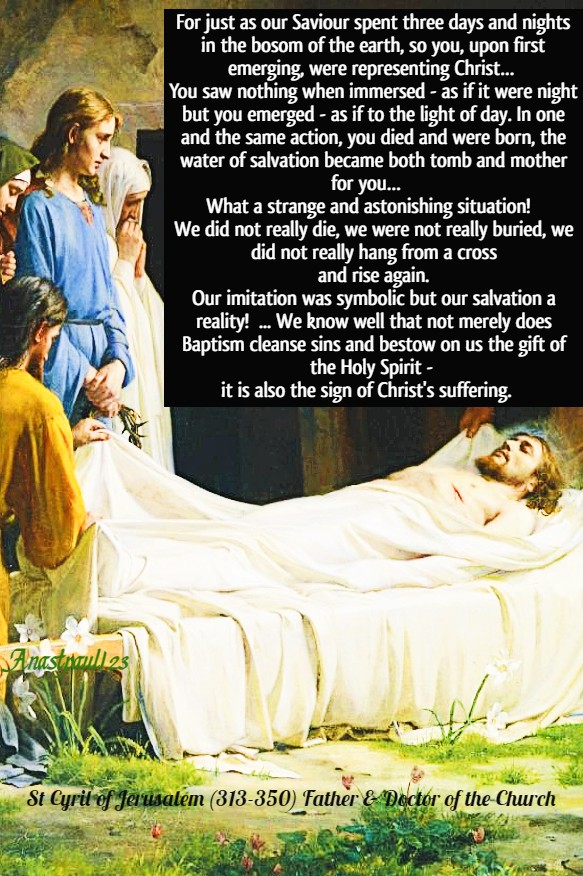
REFLECTION – “You were conducted by the hand to the holy pool of Sacred Baptism, just as Christ was conveyed from the Cross to the sepulchre close at hand [in this Church of the Holy Sepulchre]. Each person was asked if he believed in the Name of the Father and of the Son and of the Holy Spirit. You made the confession that brings salvation and submerged yourselves three times in the water and emerged, by this symbolic gesture, you were secretly re-enacting the burial of Christ, three days in the tomb. For just as our Saviour spent three days and nights in the bosom of the earth, so you, upon first emerging, were representing Christ… You saw nothing when immersed – as if it were night but you emerged – as if to the light of day. In one and the same action, you died and were born, the water of salvation became both tomb and mother for you…
What a strange and astonishing situation! We did not really die, we were not really buried, we did not really hang from a cross and rise again. Our imitation was symbolic but our salvation a reality! Christ truly hung from a Cross, was truly buried and truly rose again. All this He did gratuitously for us, so that we might share His sufferings by imitating them and gain salvation in actuality. What transcendent kindness! Christ endured nails in His innocent Hands and Feet and suffered pain and by letting me participate in the pain, without anguish or sweat, He freely bestows salvation on me! …
We know well that not merely does Baptism cleanse sins and bestow on us the gift of the Holy Spirit – it is also the sign of Christ’s suffering. This is why, as we heard just now, Paul cried out: “Are you unaware that we, who were Baptised into Christ Jesus, were Baptised into His Death? We were indeed buried with Him through Baptism into death”… So, in order that we may realise that Christ endured all His sufferings for us and our salvation IN actuality and not in symbolism and that, we share in His pains, Paul cried out the literal truth: “If we have grown into union with Him through a death like His, we shall also be united with Him in the resurrection,” (Rom 6,3-5). – St Cyril of Jerusalem (313-350) Bishop of Jerusalem, Father and Doctor of the Church (Catechesis no.20/2nd Mystagogy)
PRAYER – We beseech Thee, O Lord, look graciously upon the fervour of Thy people, who mortify themselves in the flesh through fasting and abstinence that they may be refreshed in spirit, by the fruit of these good works.Through Jesus Christ, Thy Son our Lord, Who lives and reigns with Thee, in the unity of the Holy Ghost, God, world without end. Amen (Collect).
Our Morning Offering – 21 February – Ember Wednesday
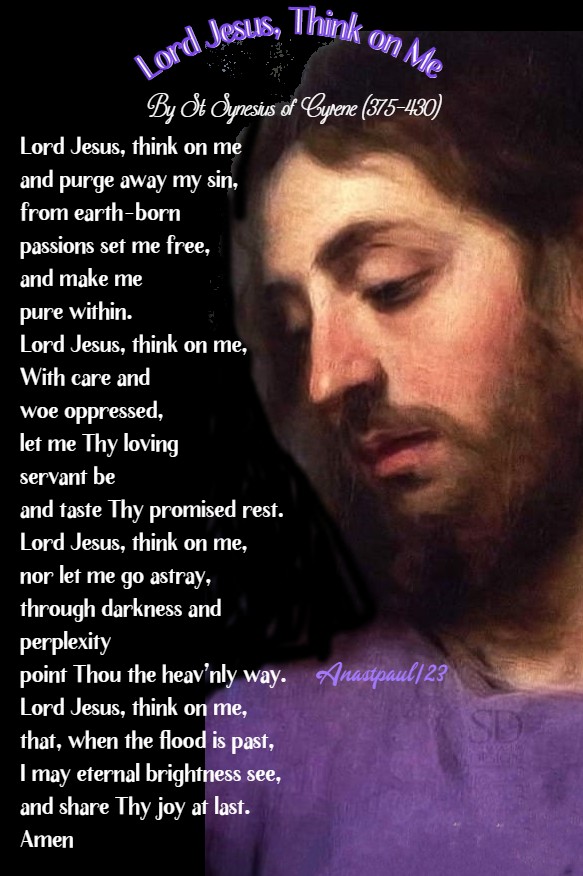
Lord Jesus, Think on Me By St Synesius of Cyrene (375-430) Bishop of Ptolemais, Father
Lord Jesus, think on me and purge away my sin, from earth-born passions set me free, and make me pure within. Lord Jesus, think on me, With care and woe oppressed, let me Thy loving servant be and taste Thy promised rest. Lord Jesus, think on me, nor let me go astray, through darkness and perplexity point Thou the heav’nly way. Lord Jesus, think on me, that, when the flood is past, I may eternal brightness see and share Thy joy at last. Amen
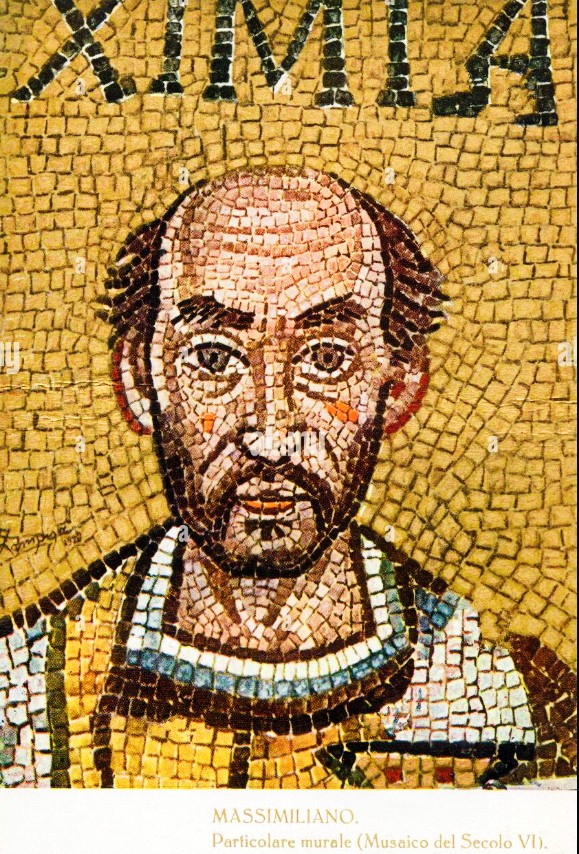
Saint of the Day – 21 February – Saint Maximian of Ravenna (c499-556) Bishop and Confessor, Defender of the orthodox Faith against heresy, a renowned Scholar and prolific Historical and Spiritual Writer. St Maximian was the 28th Bishop of Ravenna, indeed, he bears the honour of being the 1st Bishop in the West, to bear the title of Archbishop as holder of a City Diocese governing a number of surrounding Bishops. Born in c499 in Pola, Istria (modern Pula, Croatia) and died in 556 of natural causes in Ravenna, Italy. Also known as – Maximià, Massimiano, Maximianus.
The Roman Martyrology reads: “In Ravenna, St Maximian, Bishop, who faithfully carried out his pastoral office and defended the unity of the Church against heresy.”
Maximian had received Episcopal Consecration from Pope Vigilius in 546 and held the Seat for ten years. Thanks to his solid financial condition and exploiting, with his great intuition, the eminent position of Vicar of Pope Vigilius and the Emperor Justinian, he became one of the most important figures in 6th Century Italy.
Quite precise information has been handed down about him thanks to the Biography written by the Priest Historian, Andreas Agnellus, who, despite having lived two Centuries later, was a profound expert on the writings of the holy shepherd.
Maxiamian was born in c499 in Pola, Istria, today in Croatian territory and became a Deacon of the local Church. The fortunate discovery of a ‘treasure’ at the hands of himself or his father, allowed him to arrive at the Imperial Court of Constantinople, where he was able to earn the esteem of the Emperor Justinian.
In 545, upon the death of the Bishop of Ravenna, the faithful of the City asked the Emperor to award the Pallium to a candidate they had proposed but the latter instead, advised Pope Vigilius to appoint Maximian to the vacant See. So it was and the new Bishop was Consecrated on 14 October 546 but this inevitably caused strong friction with the population of Ravenna, who considered his appointment nothing more than an undue interference in City life. Maximian had no choice but to camp outside the walls, as a guest of the Arian bishop of the Goths but, with tact and diplomacy, he gradually managed to win the sympathy of his faithful and obtain permission to take possession of the Episcopal Seat.
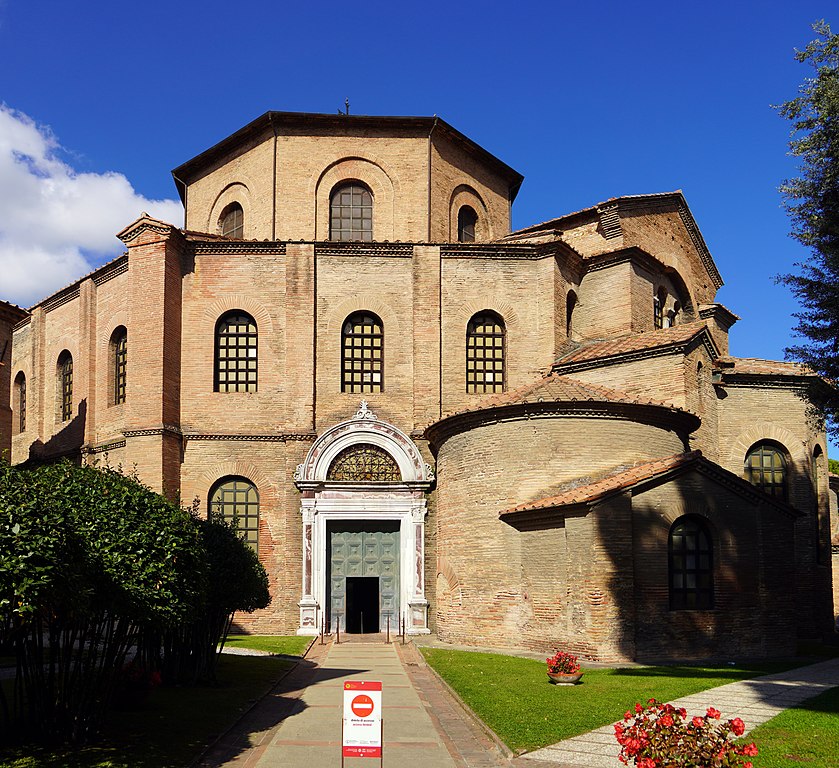
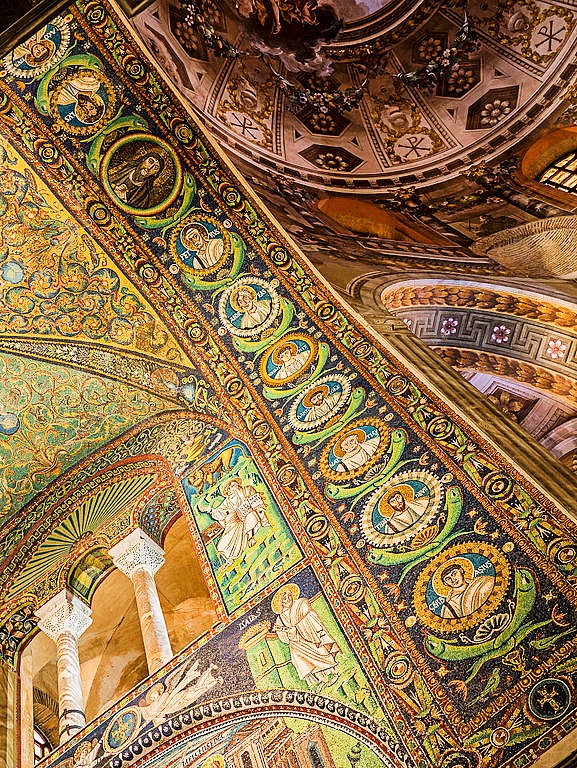
His Episcopate represented the golden age of the Church of Ravenna, in fact, the Basilicas of St Michael and St Vitale were completed and Consecrated. Many others were embellished,and St John, St Stephen and many other Churches in the Diocese, were built or embeliished and all entirely due to him, including the splendid mosaics.
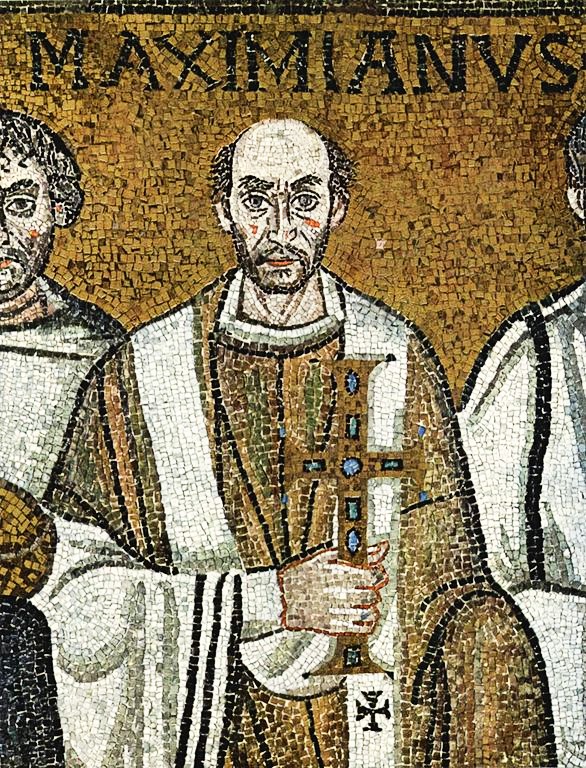
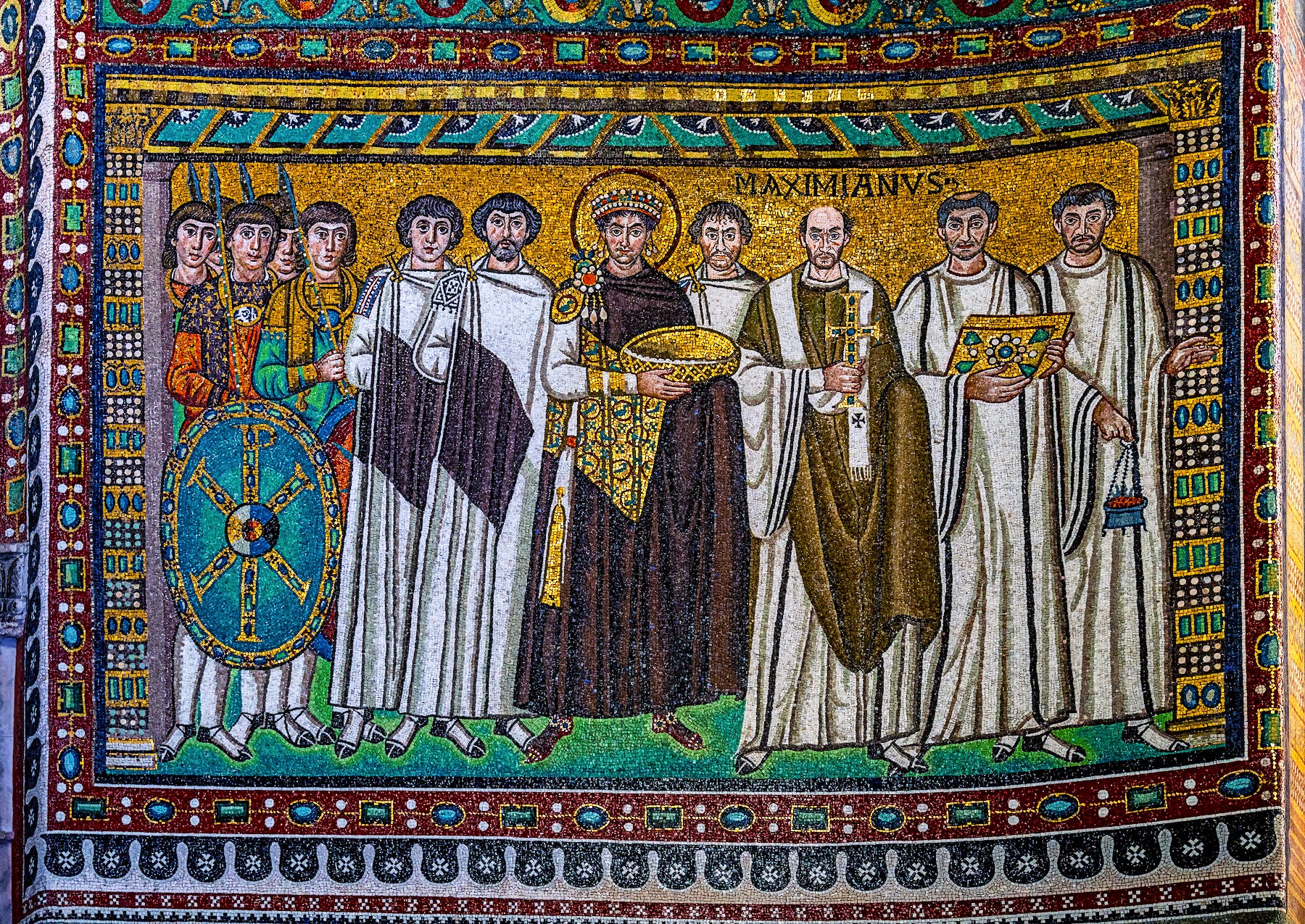
St Maximian on the left of Emperor Justinian
The quantity of books he authored was large – chronicles, descriptions of Ravenna, catalogues of the City’s Bishops and twelve volumes of his sermons! He also prepared an accurate edition of the Sacred Scriptures, accompanied by notes and commentary. He also wrote a Sacramentary on which the Leonine one was presumably later based. His activities extended to the whole of Italy, of which he was to all intents and purposes, Primate during the long absence from Rome of Pope Vigilius and his efforts were particularly focused on restoring harmony and unity within of the Churches, divided by the schism known as the “Three Chapters.” His Biographer, Andreas Agnellus also described him as a shepherd who “welcomed strangers, called back those who fell into error, gave the poor what they needed and consoled the suffering.”
Maximian died in Ravenna on 22 February 556 and his remains were buried in the Basilica of St Andrew, where they remained until 1809 when they were transferred to the Cathedral, following the deconsecration of the Church by the Napoleonic administration of the City. In the Basilica of St Vitale, inaugurated with great pomp in the presence of the Emperors Justinian and Theodora, Saint Maximian is depicted next to the Emperor in the grandiose mosaic on the north side of the Sanctuary, holding a gem-studded Cross in his hand.
Basilica of St Vitale
Triumphal Arch mosaics of Jesus Christ and the Apostles
St Avitus II of Clermont Bl Claudio di Portaceli St Daniel of Persia Bl Eleanora St Ercongotha St Felix of Metz St George of Amastris St Germanus of Granfield St Gundebert of Sens
St Maximian of Ravenna (c499-556) Archbishop of Ravenna and Confessor. completor of the immensely renowned Basilica of St Vitalis and many more Churches. He was a man of creative talents who ordered the creation of many famous and very beautiful artworks of various types, for his See, as well as, a great lover of Books and literature, (being a prolific Writer himself) ensuring the acquisition of many illuminated manuscripts. Maximian may have been the first Latin Bishop to use the title ‘Archbishop.’ Biography – his Feast Day was changed after 1969 to 22 February. Being rather confused, I have revisted him today again: https://anastpaul.com/2023/02/22/saint-of-the-day-22-february-saint-maximian-of-ravenna-499-556-bishop/
Blessed Noel Pinot (1747-1794) Priest and Martyr. During the French Revolution, he refused to take the oath of the Civil Constitution of the Clergy unlike his superio! He wore his Mass Vestments to execution and died reciting the opening words of the Mass. He was Beatified by Pope Pius XI on 31 October 1926. His Life and Death: https://anastpaul.com/2020/02/21/saint-of-the-day-21-february-blessed-noel-pinot-1747-1794-priest-and-martyr/
St Valerius of San Pedro de Montes St Verda of Persia
Martyrs of Sicily – 79 Saints: Sevent nine Christians Martyred together in the persecutions of Diocletian. They were Martyred in c 303 on Sicily.
Martyrs of Hadrumetum – A group of 26 Christians Martyred together by Vandals. We know little more than eight of their names – Alexander, Felix, Fortunatus, Saturninus, Secundinus, Servulus, Siricius and Verulus. c 434 at Hadrumetum (modern Sousse, Tunisia).



 AnaStpaul
You must be logged in to post a comment.