Posted in SAINT of the DAY

Saint of the Day – 21 February – Saint Maximian of Ravenna (c499-556) Bishop and Confessor

Saint of the Day – 21 February – Saint Maximian of Ravenna (c499-556) Bishop and Confessor, Defender of the orthodox Faith against heresy, a renowned Scholar and prolific Historical and Spiritual Writer. St Maximian was the 28th Bishop of Ravenna, indeed, he bears the honour of being the 1st Bishop in the West, to bear the title of Archbishop as holder of a City Diocese governing a number of surrounding Bishops. Born in c499 in Pola, Istria (modern Pula, Croatia) and died in 556 of natural causes in Ravenna, Italy. Also known as – Maximià, Massimiano, Maximianus.

The Roman Martyrology reads: “In Ravenna, St Maximian, Bishop, who faithfully carried out his pastoral office and defended the unity of the Church against heresy.

Maximian had received Episcopal Consecration from Pope Vigilius in 546 and held the Seat for ten years. Thanks to his solid financial condition and exploiting, with his great intuition, the eminent position of Vicar of Pope Vigilius and the Emperor Justinian, he became one of the most important figures in 6th Century Italy.

Quite precise information has been handed down about him thanks to the Biography written by the Priest Historian, Andreas Agnellus, who, despite having lived two Centuries later, was a profound expert on the writings of the holy shepherd.

Maxiamian was born in c499 in Pola, Istria, today in Croatian territory and became a Deacon of the local Church. The fortunate discovery of a ‘treasure’ at the hands of himself or his father, allowed him to arrive at the Imperial Court of Constantinople, where he was able to earn the esteem of the Emperor Justinian.

In 545, upon the death of the Bishop of Ravenna, the faithful of the City asked the Emperor to award the Pallium to a candidate they had proposed but the latter instead, advised Pope Vigilius to appoint Maximian to the vacant See. So it was and the new Bishop was Consecrated on 14 October 546 but this inevitably caused strong friction with the population of Ravenna, who considered his appointment nothing more than an undue interference in City life. Maximian had no choice but to camp outside the walls, as a guest of the Arian bishop of the Goths but, with tact and diplomacy, he gradually managed to win the sympathy of his faithful and obtain permission to take possession of the Episcopal Seat.

His Episcopate represented the golden age of the Church of Ravenna, in fact, the Basilicas of St Michael and St Vitale were completed and Consecrated. Many others were embellished,and St John, St Stephen and many other Churches in the Diocese, were built or embeliished and all entirely due to him, including the splendid mosaics.
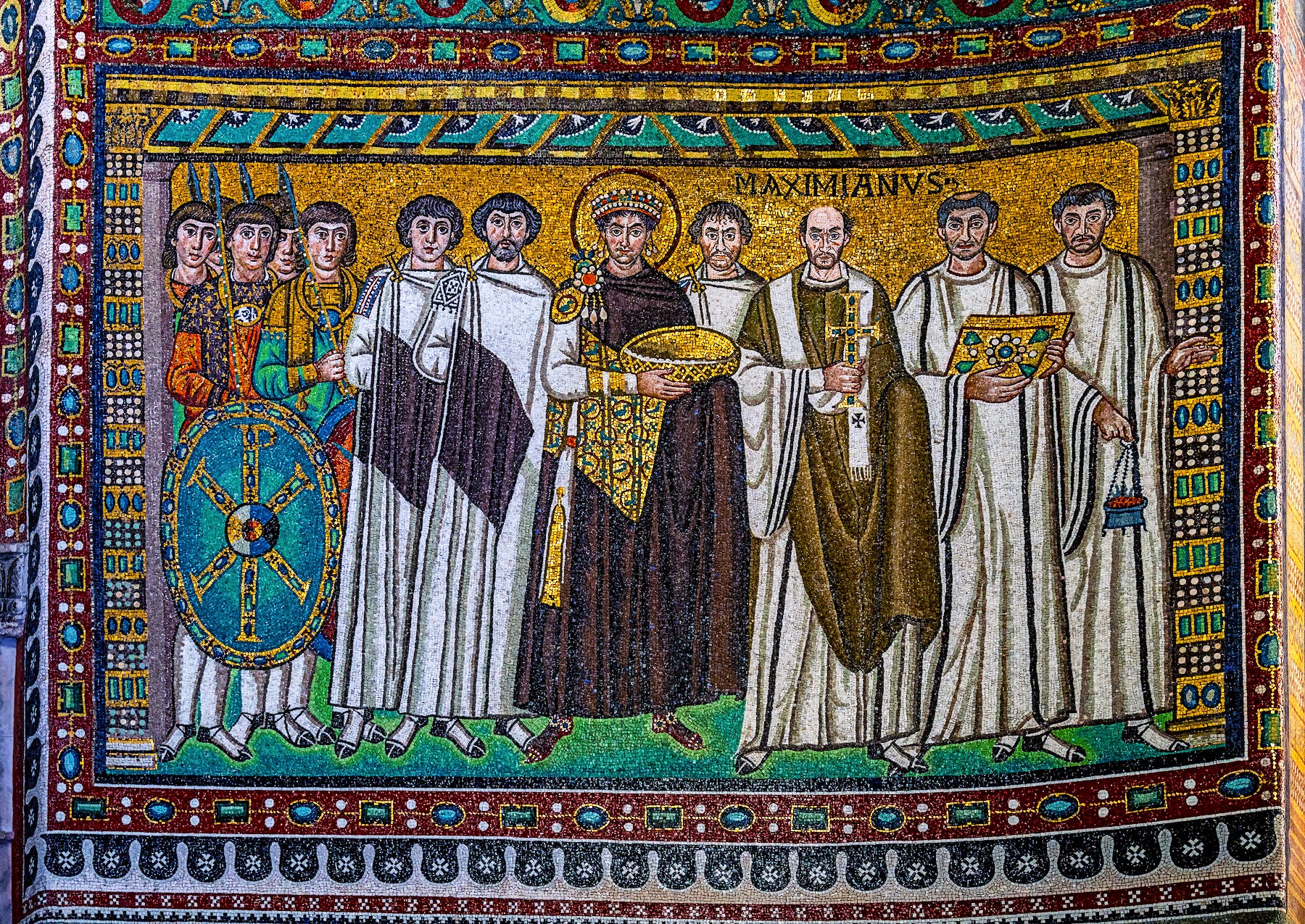
St Maximian on the left of Emperor Justinian

The quantity of books he authored was large – chronicles, descriptions of Ravenna, catalogues of the City’s Bishops and twelve volumes of his sermons! He also prepared an accurate edition of the Sacred Scriptures, accompanied by notes and commentary. He also wrote a Sacramentary on which the Leonine one was presumably later based. His activities extended to the whole of Italy, of which he was to all intents and purposes, Primate during the long absence from Rome of Pope Vigilius and his efforts were particularly focused on restoring harmony and unity within of the Churches, divided by the schism known as the “Three Chapters.” His Biographer, Andreas Agnellus also described him as a shepherd who “welcomed strangers, called back those who fell into error, gave the poor what they needed and consoled the suffering.

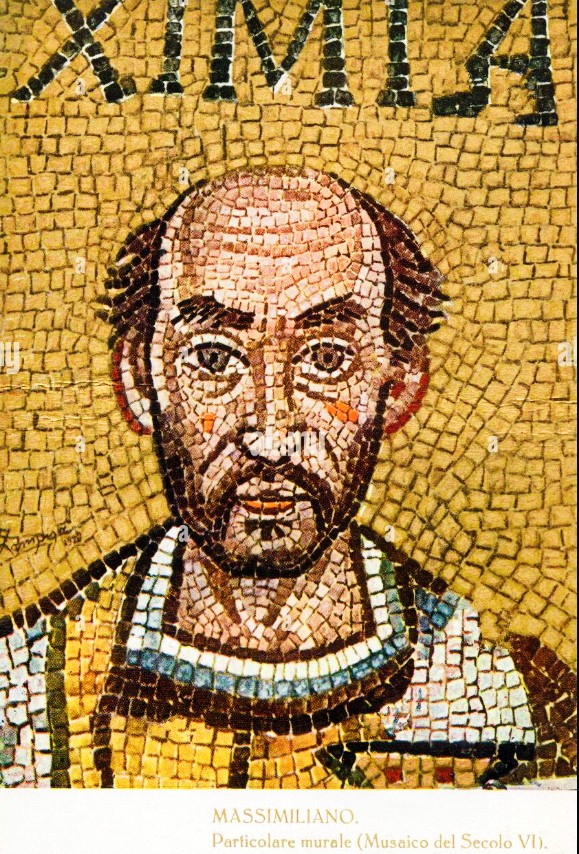
Maximian died in Ravenna on 22 February 556 and his remains were buried in the Basilica of St Andrew, where they remained until 1809 when they were transferred to the Cathedral, following the deconsecration of the Church by the Napoleonic administration of the City. In the Basilica of St Vitale, inaugurated with great pomp in the presence of the Emperors Justinian and Theodora, Saint Maximian is depicted next to the Emperor in the grandiose mosaic on the north side of the Sanctuary, holding a gem-studded Cross in his hand.
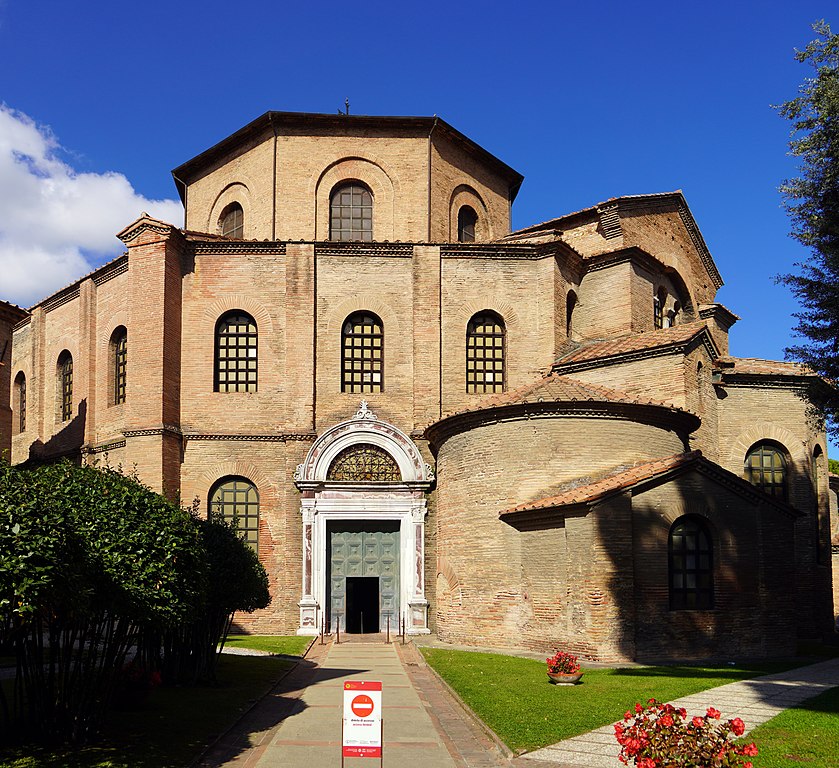

Basilica of St Vitale
Triumphal Arch mosaics of Jesus Christ and the Apostles
Posted in EMBER DAYS, JESUIT SJ, MARIAN TITLES, SAINT of the DAY

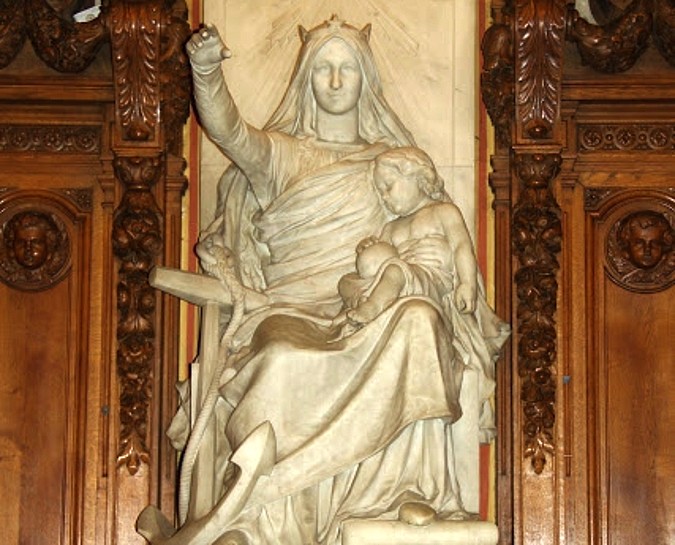
Ember Wednesday – Fast and Abstinence, Notre-Dame de Bon-Port / Our Lady of Bon Port/Good Haven, France (1838) and the Saints for 21 February

St Avitus II of Clermont
Bl Claudio di Portaceli
St Daniel of Persia
Bl Eleanora
St Ercongotha
St Felix of Metz
St George of Amastris
St Germanus of Granfield
St Gundebert of Sens

St Pepin of Landen
St Peter Mavimenus
St Randoald of Granfield
Blessed Richard Henkes

St Severian of Scythopolis
St Severus of Syrmium

St Valerius of San Pedro de Montes
St Verda of Persia

Posted in GOD ALONE!, QUOTES on LOVE of GOD, QUOTES on THE VOICE OF GOD, QUOTES on WISDOM, THE SPIRITUAL COMBAT - Fr Lorenzo Scupoli

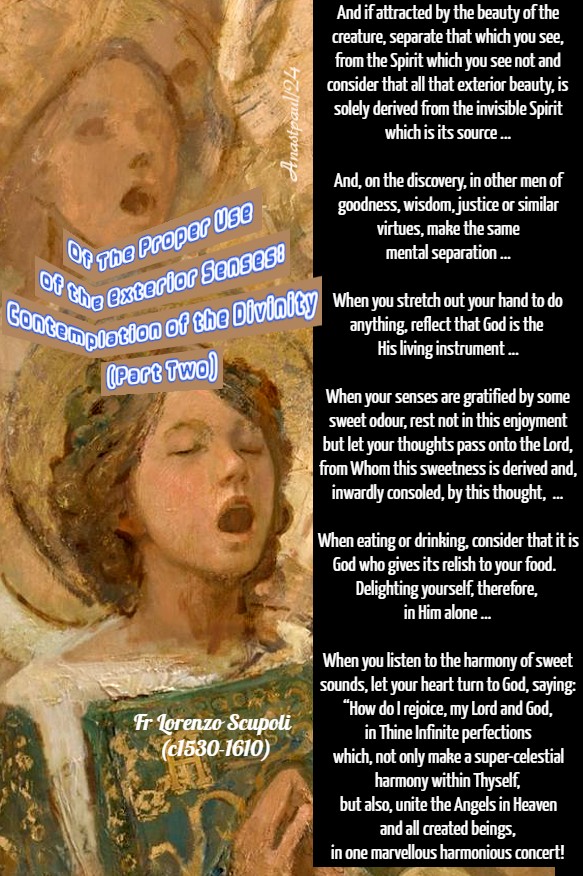
Thought for the Day – 20 February – Of the Proper Use of the Exterior Senses: Contemplation of the Divinity (Part Two)

Thought for the Day – 20 February – The Spiritual Combat (1589) – Dom Lorenzo Scupoli OSM (c1530-1610)

None shall be crowned who has not fought well.” 2 Tim 2: 5

XXI: … Of The Proper Use of the Exterior Senses:
Contemplation of the Divinity
(Part Two)

And if attracted by the beauty of the creature, separate that which you see, from the Spirit which you see not and consider that all that exterior beauty, is solely derived from the invisible Spirit which is its source and joyfully say:
Behold, these are streamlets
from the uncreated Fountain;
behold, these are drops
from the Infinite Ocean of all good.
O, how does my inmost heart rejoice
at the thought of that eternal Infinite Beauty
which is the Source and Origin of all created beauty!

And, on the discovery, in other men of goodness, wisdom, justice or similar virtues, make the same mental separation and say to God:
O most rich Treasure-house of all virtues,
how greatly do I rejoice that from Thee
and through Thee alone,
flows all goodness and, that all in comparison
with Thy Divine perfections, is as nothing!
I thank Thee, Lord, for this
and every good gift which Thou hast vouchsafed
to my neighbour; remember, Lord,
my poverty, and my great need of this very virtue.

When you stretch out your hand to do anything, reflect that God is the first cause of that action and you but His living instrument and raising your thoughts to Him, say thus:
How great, O supreme Lord of all,
is my interior joy, that without Thee
I can do nothing and that Thou,
art in truth, the first and chief Worker of all things!

When eating or drinking, consider that it is God who gives its relish to your food. Delighting yourself, therefore, in Him alone, say:
Rejoice, O my soul,
hat as there is no true contentment but in God,
so in Him alone, may you, in all things content yourself
.

When your senses are gratified by some sweet odour, rest not in this enjoyment but let your thoughts pass onto the Lord, from Whom this sweetness is derived and, inwardly consoled, by this thought, say:
Grant, O Lord, that as I rejoice
because all sweetness flows from Thee,
so may my soul, pure and free from all earthly pleasure,
ascend on high as a sweet savour,
acceptable unto Thee
.

When you listen to the harmony of sweet sounds, let your heart turn to God, saying:
How do I rejoice, my Lord and God,
in Thine Infinite perfections
which, not only make a super-celestial
harmony within Thyself,
but also, unite the Angels in Heaven
and all created beings,
in one marvellous harmonious concert!

Dom Lorenzo Scupoli

PART ONE:
https://anastpaul.com/2024/02/19/thought-for-the-day-19-february-of-the-proper-use-of-the-exterior-senses-contemplation-of-the-divinity-part-one/

Posted in franciscan OFM, I BELIEVE!, OCTOBER - The HOLY ROSARY and The HOLY ANGELS, QUOTES on CHARITY, QUOTES on FAITH, QUOTES on HOPE, QUOTES on Lukewarmness, QUOTES on PRAYER, QUOTES on SUFFERING, QUOTES on TEMPTATION, QUOTES on TRUTH, QUOTES on VIRTUE, QUOTES on WORK/LABOUR, ROSARY QUOTES, ROSARY REFLECTIONS and QUOTES, St Francis de Sales

Quote/s of the Day – 20 February – Prayer

Quote/s of the Day – 20 February – Tuesday of the First Week in Lent – Ferial Day – Isaias 55:6-11, Matthew 21:10-17 – Scripture search here: https://www.drbo.org/

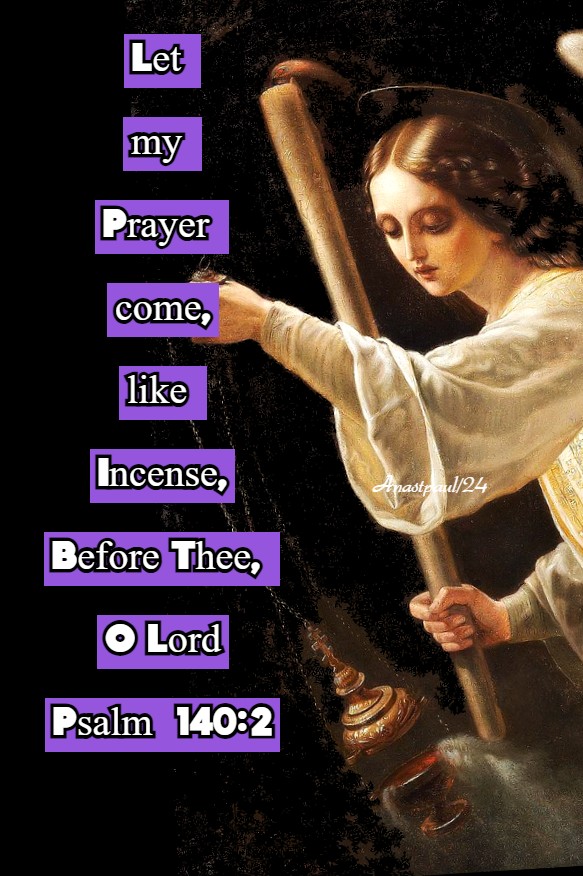
Let my prayer come
like incense before Thee, O Lord

Psalm 140:2

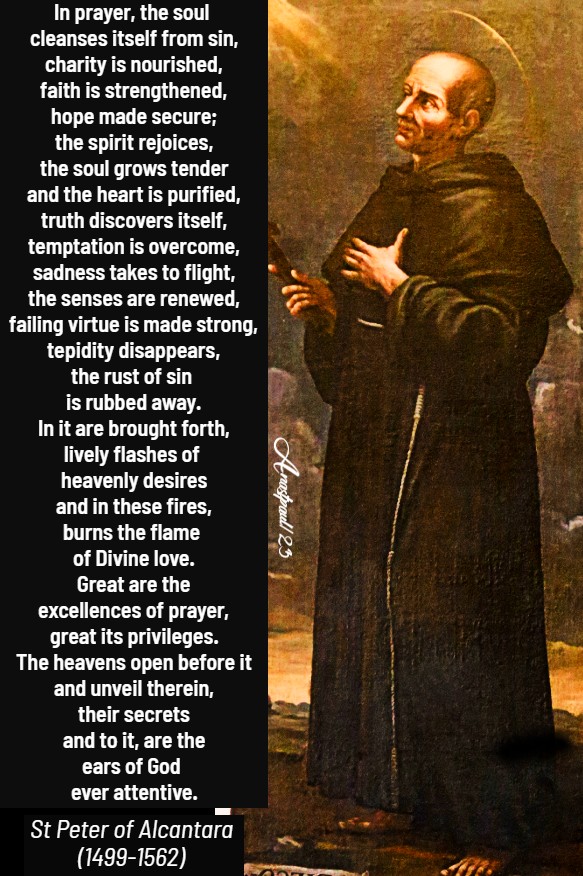
In prayer, the soul cleanses itself from sin,
charity is nourished,
faith is strengthened,
hope made secure;
the spirit rejoices,
the soul grows tender
and the heart is purified,
truth discovers itself,
temptation is overcome,
sadness takes to flight,
the senses are renewed,
failing virtue is made strong,
tepidity disappears,
the rust of sin is rubbed away.
In it are brought forth,
lively flashes of heavenly desires
and in these fires,
burns the flame of Divine love.
Great are the excellences of prayer,
great its privileges.
The heavens open before it
and unveil therein, their secrets
and to it, are the ears of God ever attentive.

A Golden Treatise of Mental Prayer
Download the book, “A Golden Treatise of Mental Prayer”

St Peter of Alcantara (1499-1562)

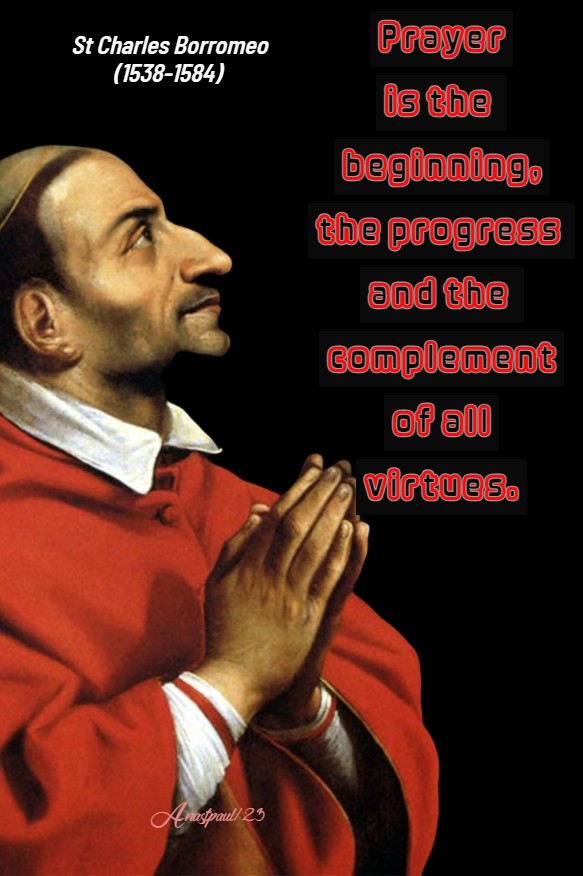
Prayer is the beginning,
the progress and the complement
of all virtues.

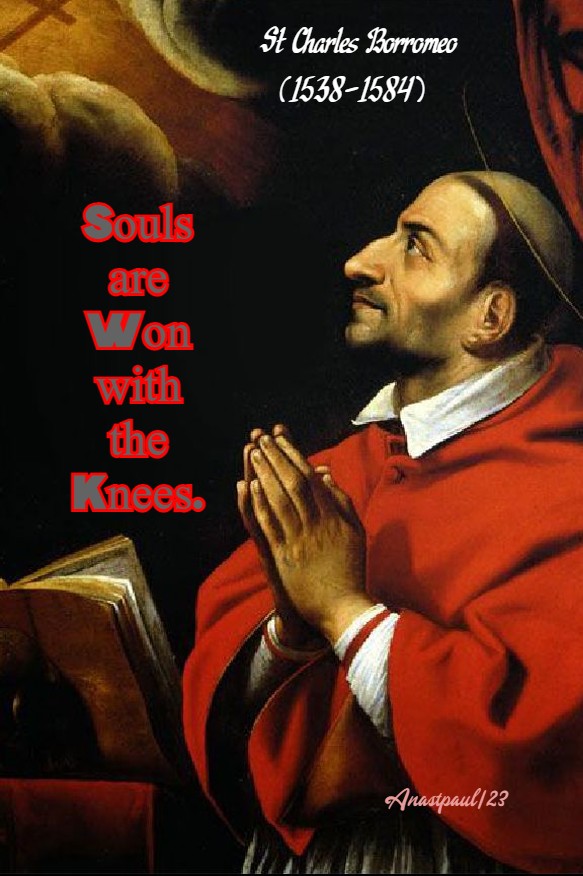
Souls are won with the knees.

St Charles Borromeo (1538-1584)

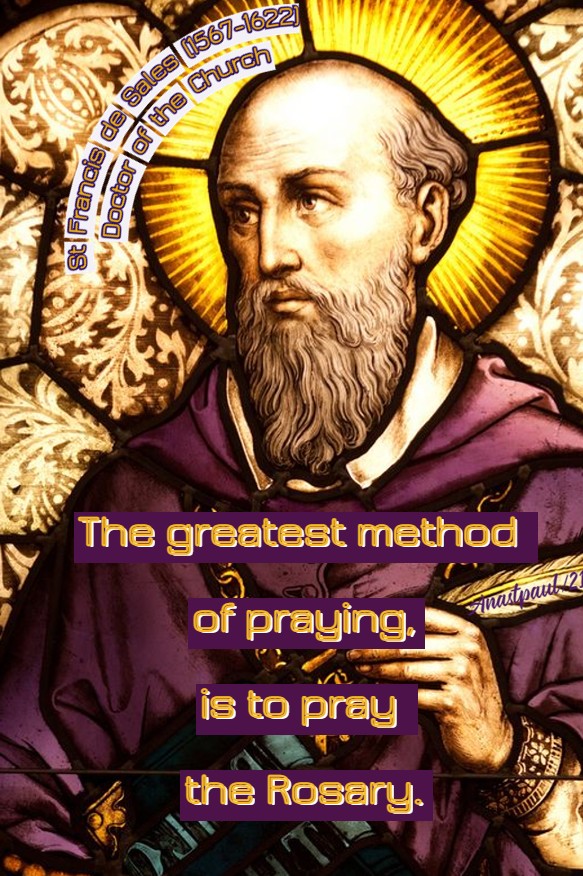
The greatest method of praying
is to pray the Rosary.

St Francis de Sales (1567-1622)

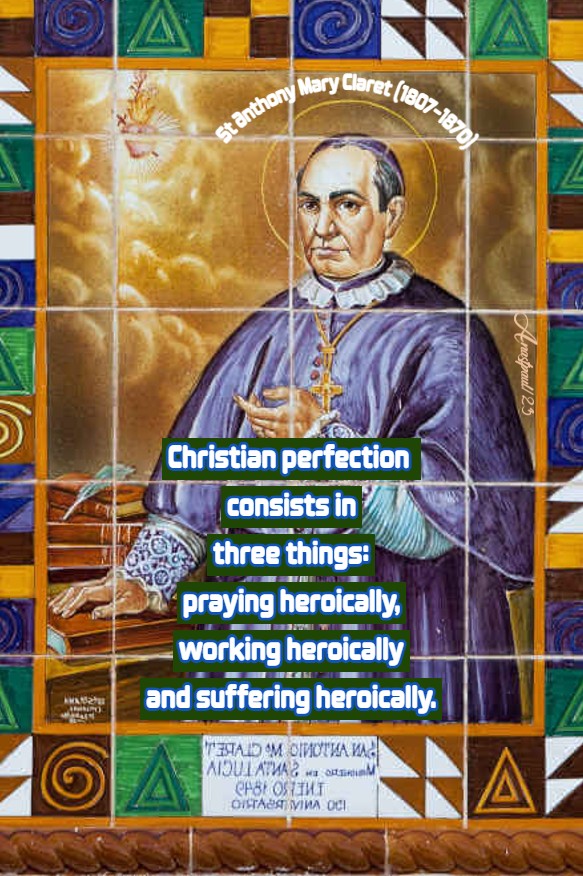
Christian perfection consists in three things:
praying heroically,
working heroically
and suffering heroically.

St Anthony Mary Claret (1807-1870)

Posted in GOD ALONE!, LENT 2024, LENTEN THOUGHTS, QUOTES on LOVE of GOD, QUOTES on Lukewarmness, QUOTES on PRAYER

Our Lenten Journey with the Angels and the Saints – 20 February – No Time to Pray!

Our Lenten Journey with the Angels and the Saints – 20 February – Tuesday of the First Week in Lent – Ferial Day – Isaias 55:6-11, Matthew 21:10-17 – Scripture search here: https://www.drbo.org/

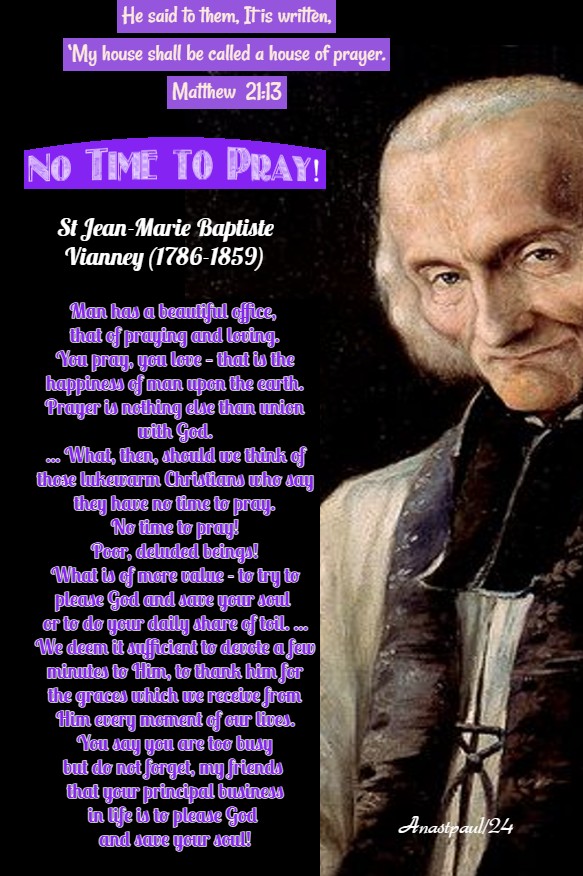
St Jean-Marie Baptiste Vianney (1786-1859)

Man has a beautiful office, that of praying and loving.
You pray, you love – that is the happiness of man upon the earth.
Prayer is nothing else than union with God.

I say that prayer is the lifting up of the heart to God.
Or, rather, it should be like a pleasant confidence, such as might exist between a child and his father, or between a friend and a friend. …

What, then, should we think of those lukewarm Christians who say they have no time to pray.
No time to pray!
Poor, deluded beings!
What is of more value – to try to please God and save your soul or to do your daily share of toil.
No time to pray!

Suppose God had let you die during the night, would you do your work today?
Or if God had sent you a protracted sickness, would you then be able to perform your daily labour?
Oh, what blindness! Such people deserve that God should let them perish in their blindness.
We deem it sufficient to devote a few minutes to Him, to thank him for the graces which we receive from Him every moment of our lives.
You say you are too busy but do not forget, my friends that your principal business in life is to please God and save your soul!

If you do not attend to your work yourself, somebody else will take your place and do it but if you lose your soul, who will save it for you?…

But you may ask, “How is it possible to be constantly praying?
My dear people there is nothing easier than that.
All that is necessary, is to occupy our minds from time to time, while we are working, with God, by making now and then an Act of Charity, to prove to Him that we love Him because He is goodness itself and deserves to be loved; or an Act of Humility, insofar as we deem ourselves unworthy of His graces which He imparts to us unceasingly; or, again, an Act of Confidence, by recalling to our mind that, al though we are laden with sin, He loves us and longs to make us happy.
Or at other times we should think of the Suffering and Passion of Jesus Christ, we should contemplate Him in the Garden of Olives … or some other time of His birth, His flight into Egypt; or again, of death, the Judgement, hell and Heaven.
Or we might say a little prayer in honour of our Guardian Angel and for one thing we should never omit to say – The Angelus, when the bells call …” (Sermons of the Curé d’Ars ).

Posted in CHRIST the WORD and WISDOM, CHRIST, the WAY,TRUTH,LIFE, FATHERS of the Church, GOD ALONE!, ONE Minute REFLECTION, QUOTES for CHRIST, QUOTES on THE VOICE OF GOD, The INCARNATION, The RESURRECTION, The WORD

One Minute Reflection – 20 February –’ … The Voice through which the dead shall live.’

One Minute Reflection – 20 February – Tuesday of the First Week in Lent – Ferial Day – Isaias 55:6-11, Matthew 21:10-17 – Scripture search here: https://www.drbo.org/

For just as from the Heavens, the rain and snow come down and do not return there, until they have watered the earth, making it fertile and fruitful, giving seed to him who sows and bread to him who eats.” – Isaias 55:11

REFLECTION – “For the rain and the snow do not return to Heaven but accomplish in the earth the will of Him Who sends themSo the Word that He shall send through His Christ, Who is Himself, the Word and the Message, shall return to Him with great power. For when He shall come and bring it, He shall come down like rain and snow and through Him all that is sown shall spring up and bear righteous fruit and the Word shall return to His Sender but not in vain shall His going have been but thus shall He say, in the presence of His Sender, “Behold, I and the children that the Lord has given Me.” And this is the Voice through which the dead shall live. And this is the Voice of God that shall sound from on high and raise up all the dead.” – St Aphraates “the Sage” (Died c 345) (Feast Day – 29 January) Abbot, Father of the Church [see note below] (Demonstrations 8).

PRAYER – From all perils of soul and body, defend us, O Lord, we beseech Thee and by the intercession of blessed and gloriosus ever Virgin Mary, Mother of God, of blessed Joseph, of Thy blessed Apostles Peter and Paul and all the Saints, graciously grant us safety and peace that all adversities and errors being overcome, Thy Church may serve Thee in security and freedom. Through Jesus Christ, Thy Son our Lord, Who lives and reigns with Thee, in the unity of the Holy Ghost, God, world without end. Amen (Collect).

St Aphraates was a Syriac Christian author of the third century from the Persian Empire who composed a series of twenty-three sermons on points of Christian doctrine and practice. He was an Ascetic and Celibate. He may have been a Bishop and later Syriac tradition places him at the head of Mar Mattai Monastery near Mosul, therefore, he was certainly an Abbot.

Posted in AUGUSTINIANS OSA, BLESSED TRINITY PRAYERS, DOCTORS of the Church, FATHERS of the Church, FEBRUARY - THE BLESSED TRINITY (Traditional), GOD the FATHER, Our MORNING Offering, PRAYERS of the SAINTS, QUOTES for CHRIST, The HEART, The MOST HOLY & BLESSED TRINITY

Our Morning Offering – 20 February – Almighty Father, Come Into Our Hearts By St Augustine

Our Morning Offering – 20 February – “The Month of the Most Holy and Blessed Trinity”

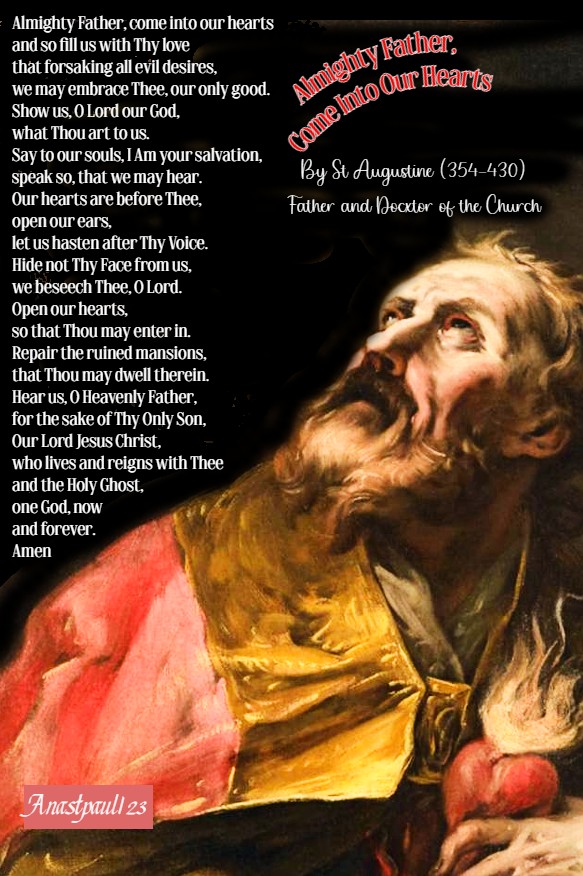
Almighty Father, Come Into Our Hearts
By St Augustine (354-430)

Almighty Father, come into our hearts
and so fill us with Thy love
that forsaking all evil desires,
we may embrace Thee, our only good.
Show us, O Lord our God,
what Thou art to us.
Say to our souls, I Am your salvation,
speak so, that we may hear.
Our hearts are before Thee,
open our ears,
let us hasten after Thy Voice.
Hide not Thy Face from us,
we beseech Thee, O Lord.
Open our hearts, so that Thou may enter in.
Repair the ruined mansions,
that Thou may dwell therein.
Hear us, O Heavenly Father,
for the sake of Thy Only Son,
Our Lord Jesus Christ,
who lives and reigns with Thee
and the Holy Ghost,
one God, now and forever.
Amen

Posted in Against ICONOCLASM, SAINT of the DAY

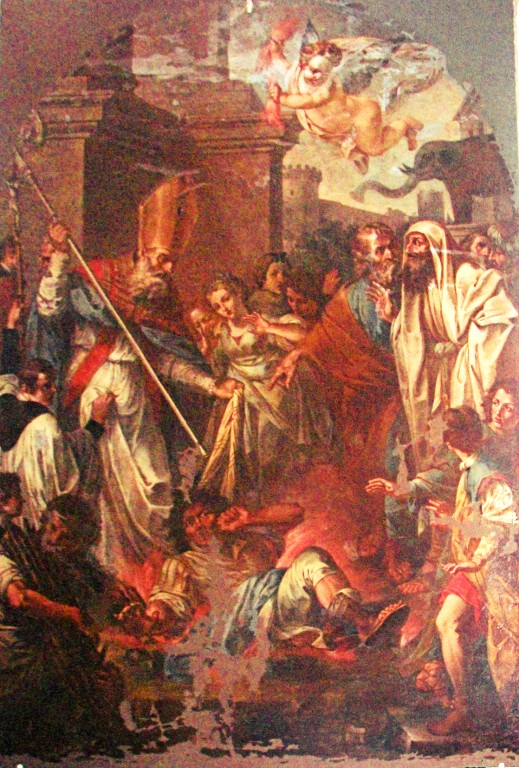
Saint of the Day – 20 February – St Leo of Catania (c720-789) Bishop

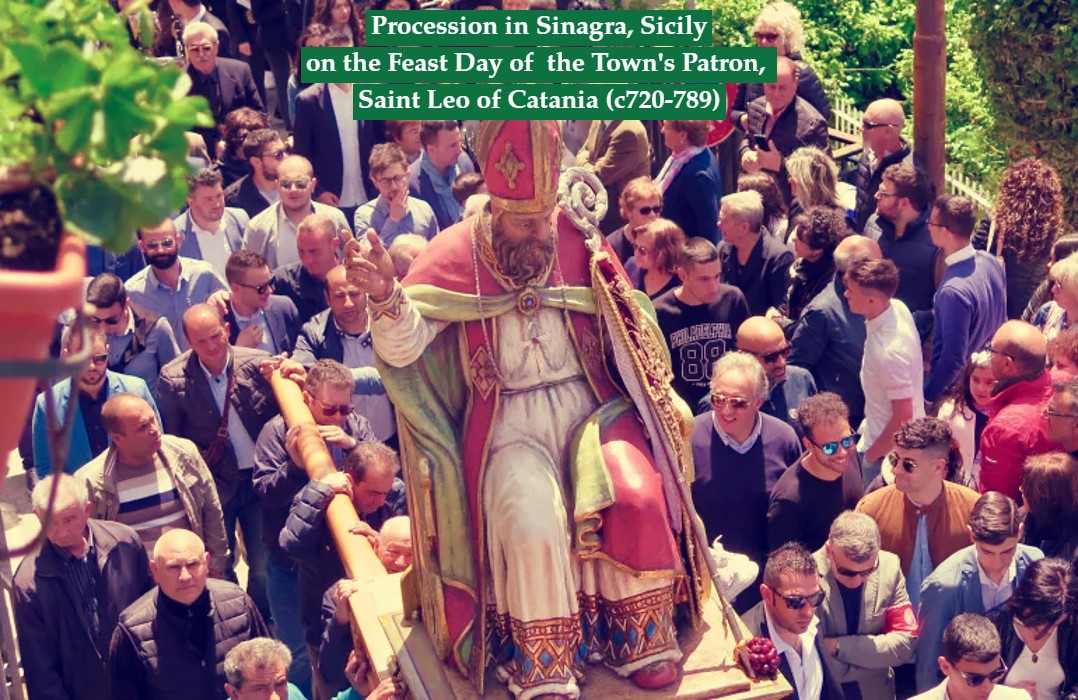
Saint of the Day – 20 February – St Leo of Catania (c720-789) Bishop, Defender of Sacred Images for which opposition he was forced to flee into exile for some years, Hermit. Born in c720 in Ravenna, Italy and died on 20 February 789 in Etna, Sicily, Italy, natural causes. St Leo was the 15th Bishop of Catania, Sicily, famed for his love and care for the poor, his brave opposition to the iconoclastic Government of the time and for his Miracles. Sadly I have found no accounts of his miracles but by the artworks below, it seems they were renowned in their day. Patronages – of these Cities and Towns in Sicily, Italy : Longi, Ronetta, Saracena, Sinagra. Also known as – “Il Maraviglioso” (the Wonderworker) or “He who performs Miracles” Leone.

The Roman Martyrology reads: “In Catania, Sicily, St Leo, the Bishop, illustrious vor virtue and miracles.

Leo was born in Ravenna in around 720. Since his childhood, he felt the call of God. It is said that his mother saw him on his knees absorbed in prayer at the age of two. While still very young, he entered the Order of Benedictine Monks and moved to Reggio Calabria. Here he remained until he was elected Bishop of Catania. It is reported that the people of Catania had received an angelic vision in a collective dream, wherein they were informed that Leo was the perfect choice to hold the office of their new Bishop. Initially, Leo, not considering himself worthy, did not want to accept but after the insistence of the Catanian faithful, he became thei 15th Bishop of Catania.

In those years, the ferocious destruction of sacred images “iconoclasm – considered a sign of idolatry” was taking place throughout the Byzantine Empire. Those who did not obey the edict which forbid the use of sacred images, were imprisoned and often ended in exile and even Martyrdom. The Bishop of Catania openly opposed the imperial laws. For this reason, the Byzantine Governor of Sicily, ordered Leo’s arrest who was forced to leave Catania and take refuge in the mountains. He wandered in the wooded peaks of the area, in the surroundings of Longi and Sinagra, protected by the faithful, who honoured him as the proud opponent of the unjust laws of the Empire and as a Miracle-worker.

He finally arrived in Rometta. Here, in the nearby Peloritan mountains, he lived as a Hermit in a cave he dug himself. After some years, he returned, uncontested, to Catania, where he resumed his Episcopal Seat and his fight, with ever more energy, against the iconoclastic laws. He died in the City of Etna on 20 February 789. The image below was taken during the annual Procession held in Sinagra.

Posted in franciscan OFM, MARIAN TITLES, MYSTICS, SAINT of the DAY

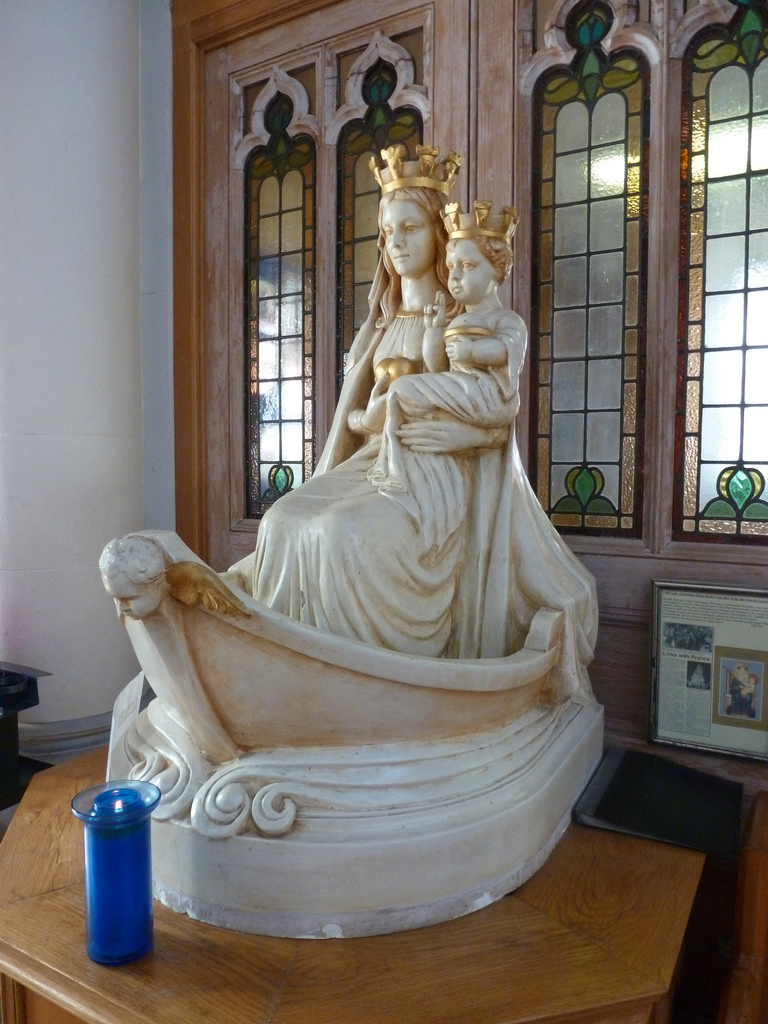
Tuesday of the First Week in Lent, Notre-Dame de Bolougne-sur-Mer / Our Lady of Bolougne-sur-Mer, France (633) and the Saints for 20 February

St Amata of Assisi OSC (Died c 1250)
St Bolcan of Derken
St Colgan

St Falco of Maastricht
St Leo of Catania (c720-789) Bishop
St Nemesius of Cyprus

St Pothamius of Cyprus
St Serapion of Alexandria
St Silvanus of Emesa
St Valerius of Courserans
St Wulfric of Haselbury
St Zenobius of Antioch

Posted in AUGUSTINIANS OSA, CHRIST the JUDGE, DIVINE Mercy, Goodness, Patience, DOCTORS of the Church, FATHERS of the Church, LENT 2024, LENTEN THOUGHTS, QUOTES on ALMS, QUOTES on CHARITY, QUOTES on FORGIVENESS, QUOTES on MERCY, QUOTES on the POOR, QUOTES on TRUTH, The SECOND COMING

Our Lenten Journey with the Angels and the Saints – 19 February – If You Wish to Receive Mercy, Be Merciful Before He Comes

Our Lenten Journey with the Angels and the Saints – 19 February – Monday of the First Week in Lent – Ferial Day –Ezechiel 34:11-16; Matthew 25:31-46 – Scripture search here: https://www.drbo.org/

St Augustine (354-430)
Father & Doctor of Grace

“He will judge the world with equity and the peoples in His truth. What are equity and truth? He will gather together with Himself, for the Judgement, His chosen ones but the others, He will set apart – for He will place some on His right, others on His left. What is more equitable, what more true, than that they should not, themselves expect mercy, from the Judge, who themselves were unwilling to show mercy before the Judge’s Coming. Those, however, who were willing to show mercy, will be judged with mercy. For it will be said to those placed on His right – Come, blessed of My Father, take possession of the Kingdom which has been prepared for you from the beginning of the world. And hH reckons to their account, their works of mercy – For I was hungry and you gave Me to eat; I was thirsty and you gave Me to drink.

What is imputed to those places on His left side? That they refused to show mercy. And where will they go? Depart into the everlasting fire. The hearing of this condemnation will cause much wailing. But what has another Psalm said? The just man will be held in everlasting remembrance; he will not fear the evil report. What is the evil report? Depart into the everlasting fire which was prepared for the devil and his angels. Whoever rejoices to hear the good report will not fear the bad. This is equity, this is truth.

Or do you, because you are unjust, expect the Judge not to be just? Or because you are a liar, will the Truthful One not be true? Rather, if you wish to receive mercy, be merciful before He comes – forgive whatever has been done against you; give of your abundance. Of whose possessions do you give, if not from His? If you were to give of your own, it would be largess but since you give of His, it is restitution. For what have you that you have not received? These are the sacrifices most pleasing to God – mercy, humility, praise, peace, charity. Such as these, then, let us bring and, free from fear, we shall await the Coming of the Judge, Who will judge the world in equity and the peoples in His Truth.” – (An excerpt from A Discourse on Psalm 95).

Posted in CONTEMPLATIVE Prayer, GOD ALONE!, QUOTES on CREATION, QUOTES on WATCHING, THE SPIRITUAL COMBAT - Fr Lorenzo Scupoli

Thought for the Day – 19 February – Of the Proper Use of the Exterior Senses: Contemplation of the Divinity (Part One)

Thought for the Day – 19 February – The Spiritual Combat (1589) – Dom Lorenzo Scupoli OSM (c1530-1610)

None shall be crowned who has not fought well.” 2 Tim 2: 5

XXI: … Of The Proper Use of the Exterior Senses:
Contemplation of the Divinity
(Part One)

Great watchfulness and continual exercise is needed, for the due ordering and regulation of the exterior senses – for the appetite which is, as it were, the captain of our corrupt nature, inclines us to an immoderate seeking after pleasure and enjoyment.
The appetite, being unable, by itself, to attain them, it uses the senses as its soldiers and as natural instruments for laying hold of objects, whose images it draws to itself and impresses on the mind.
Hence arises the pleasure which, by reason of the relationship subsisting, between it and the flesh, diffuses itself, over all the senses which are capable of it, infecting both soul and body with a common contagion which corrupts the whole.
You see the evil – now mark the remedy.

Take good heed not to let your senses stray freely where they will; nor to use them when pleasure alone and not utility, necessity, nor any good end, is the motive.
And, if inadvertently they have been allowed to wander too far, recall them at once; or so regulate them that, instead of remaining as before in a miserable captivity to empty pleasures, they may gather a noble spoil from each passing object and bring it home to the soul, that, collected within itself, if may rise with a steadier flight towards Heaven, to the contemplation of God.

Which maybe done in the following manner:
When any object is presented before one of your exterior senses, separate in your mind, from the material thing, the principle which is in it and reflect that, of itself, it possesses nothing of all that which it appears to have but, that all is the work of God, Who endows it invisibly, by His Spirit, with the being, beauty, goodness, or whatever virtue belongs to it.
Then rejoice that thy Lord alone is the Cause and Principle, of such great
and varied perfections and, that they are all eminently contained in Himself, all created excellences being but most minute degrees of His Divine and Infinite perfections.

When engaged in the contemplation of grand and noble objects, reduce the creature, mentally to its own nothingness, fixing your mind’s eye on the great Creator therein present, Who gave it that great and noble being and delighting yourself in Him alone, say:
O Divine Essence and above all things to be desired,
how greatly do I rejoice that Thou alone
art the InfInite Principle of every created being!

In like manner, at the sight of trees, plants, or such like objects, you will understand that the life which they have, they have not of themselves but, from the Spirit which you do not see,and which alone quickens them.
Say, therefore:
Behold here the true Life from which, in which and through which,
all things live and grow!
O living Joy of this heart!

So, at the sight of brute animals, raise your thoughts to God, Who gave them sensation and motion, saying:
O Thou First Mover of all that moves, Thou art Thyself immovable;
how greatly do I rejoice in Thy steadfastness and stability!

Dom Lorenzo Scupoli

Posted in CHRIST the JUDGE, DIVINE Mercy, Goodness, Patience, MEDITATIONS - ANTONIO CARD BACCI, QUOTES on ALMS, QUOTES on MERCY, QUOTES on POVERTY, QUOTES on WEALTH/RICHES, The WORD

Quote/s of the Day – 19 February – “For I was hungry and you gave me to eat …”

Quote/s of the Day – 19 February – Monday of the First Week in Lent – Ferial Day –Ezechiel 34:11-16; Matthew 25:31-46 – Scripture search here: https://www.drbo.org/

For I was hungry
and you gave me to eat

Matthew 25:35

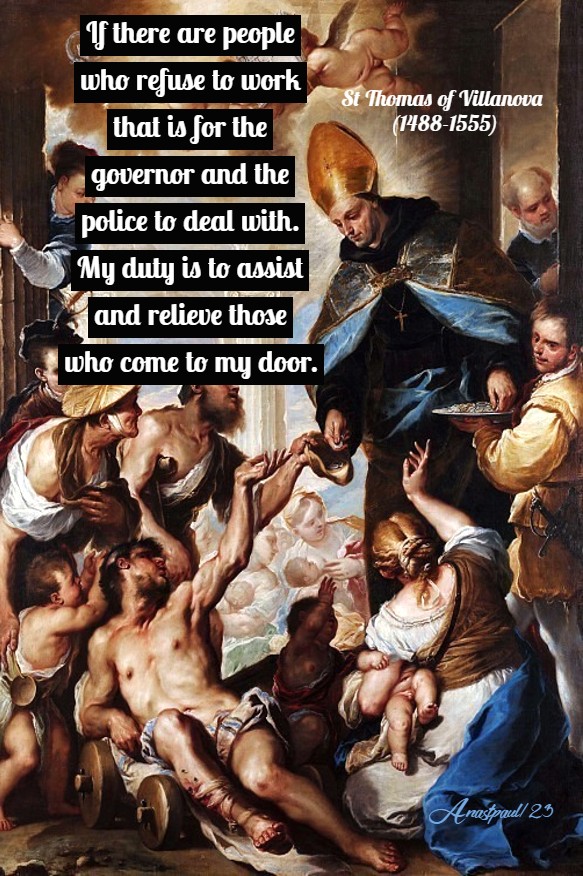
If there are people who refuse to work
that is for the governor and the police to deal with.
My duty is to assist
and relieve those
who come to my door.

St Thomas of Villanova OSA (1488-1555)
Archbishop, Confessor.

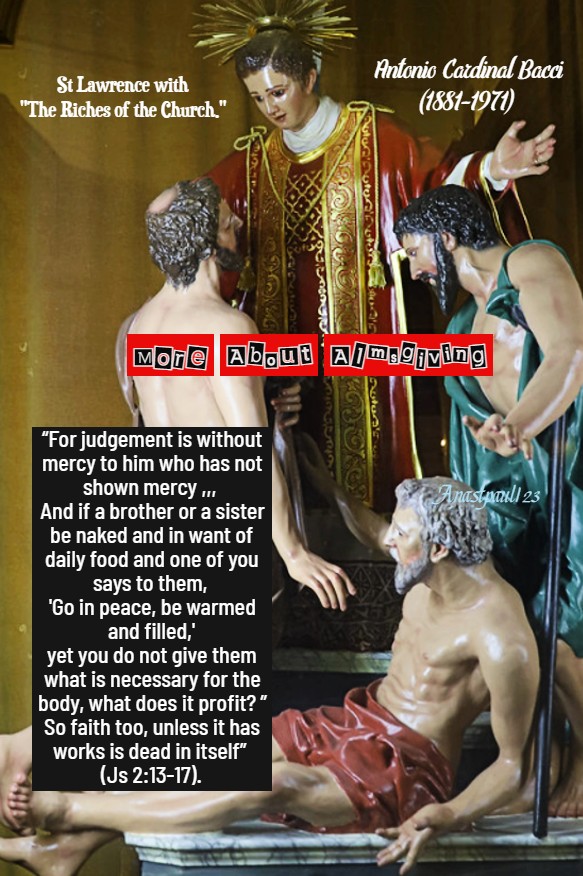
… We must remember that the precept
to “give that which remains, as alms” applies also to us.
If there is someone in grave need
whom we have the means of helping,
we are obliged to do so by the command of the Gospel.
It is the same Gospel which warns us
that if we fail to do so,
the Divine Judge will, one day, condemn us!

For judgement is without mercy
to him who has not shown mercy …
And if a brother or a sister be naked
and in want of daily food
and one of you says to them,
‘Go in peace, be warmed and filled,’
yet you do not give them
what is necessary for the body,
what does it profit? ”
So faith too, unless it has works
is dead in itself
” (Js 2:13-17).”

Antonio Cardinal Bacci (1881-1971)

Posted in FATHERS of the Church, ONE Minute REFLECTION, QUOTES on ALMS, QUOTES on CHARITY, QUOTES on MERCY, QUOTES on OBEDIENCE, QUOTES on the POOR, The LAST THINGS, The SECOND COMING, The WORD

One Minute Reflection – 19 February – ‘Do you suppose that charity is not an obligation but voluntary?’

One Minute Reflection – 19 February – Monday of the First Week in Lent – Ferial Day –Ezechiel 34:11-16; Matthew 25:31-46 – Scripture search here: https://www.drbo.org/

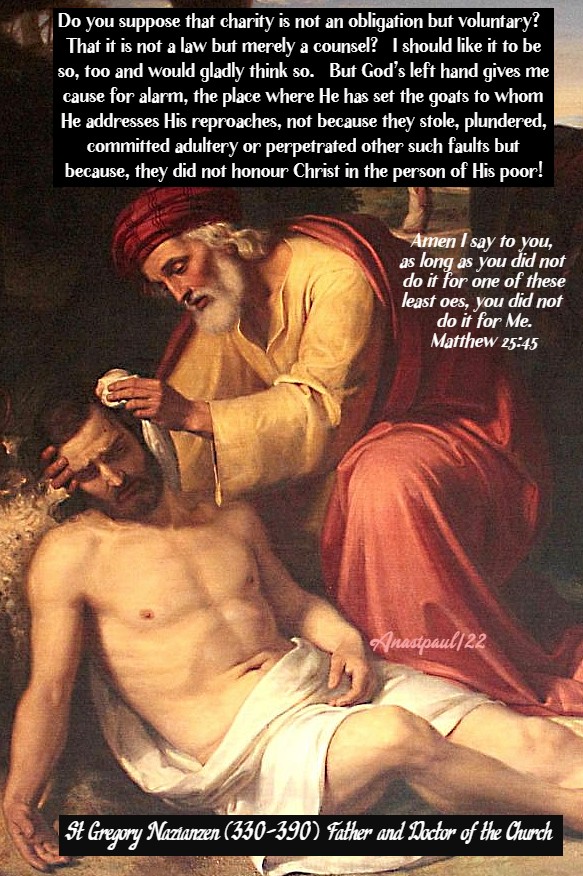
Amen I say to you, as long as you did not do it for one of these least ones, you did not do it for Me.” – Matthew 25:45

REFLECTION – “Do you suppose that charity is not an obligation but voluntary? That it is not a law but merely a counsel? I should like it to be so, too and would gladly think so. But God’s left hand gives me cause for alarm, the place where He has set the goats to whom He addresses His reproaches, not because they stole, plundered, committed adultery or perpetrated other such faults but because, they did not honour Christ in the person of His poor!

If you are willing to listen to me, then, O servants of Christ, His brothers and co-heirs, I say ,that we should visit Christ while there is an opportunity, take care of Him and feed Him. We should clothe Christ and welcome Him. We should honour Him, not only at our table, like some; not only with ointments, like Mary Magdalene; not only with a sepulchre, like Joseph of Arimathea; nor with things which have to do with His burial, like Nicodemus… nor finally, with gold, incense and myrrh, like the Magi.

But, as the Lord of all “desires mercy and not sacrifice” (Mt 9,13) and as compassion is better than tens of thousands of fat rams, let us offer Him this mercy through the needy and those who are at present cast down to the ground. Let us do this, so that, when we depart hence, they may “welcome us into the eternal habitations” (Lk 16:9), in the same Christ our Lord, to whom be glory forever.” – St Gregory Nazianzen (330-390) Archbishop of Constantinople, Father and Doctor of the Church (Sermon 14, on Love for the Poor, 27, 28, 39-40).

PRAYER – O God, our Saviour, direct our minds by Thy heavenly teaching, so that the Lenten fast may profit us. Through Jesus Christ, Thy Son our Lord, Who lives and reigns with Thee, in the unity of the Holy Ghost, God, world without end. Amen (Collect).

Posted in BLESSED TRINITY PRAYERS, FEBRUARY - THE BLESSED TRINITY (Traditional), JULY - The MOST PRECIOUS BLOOD, Our MORNING Offering, PRECIOUS BLOOD PRAYERS, QUOTES on the CROSS of CHRIST, The HOLY CROSS, The MOST HOLY & BLESSED TRINITY, The MOST PRECIOUS BLOOD, The PASSION

Our Morning Offering –19 February – I Rise In God’s Strength

Our Morning Offering – 19 February – “The Month of the Most Holy and Blessed Trinity”

I Rise In God’s Strength
An Old Morning Prayer
(Excerpt)
From The Blossoms of the Cross — 1894
The Sisters of St Joseph

I rise In God’s strength,
In God’s power,
In the Agony of Christ,
In the Cross of Christ,
In Christ’s Precious Blood,
These will sustain me against my enemies,
visible and invisible.
I rise in the blessing of Christ
which my dearest Jesus left to the whole world.
Protect me, All-Holy Trinity,
God the Father, Who created me,
God, the Son, Who redeemed me in His Precious Blood,
God, the Holy Ghost, Who sanctified me in Holy Baptism.
God, the Father, I give myself to Thee!
God, the Son, I commend myself to Thee!
God, the Holy Ghost, teach me!
Mary, Mother of God, assist me!
All you Saints of God, pray for me!
All you Holy Angels, protect me!
The Cross of Christ preserve me!
Amen

Posted in SAINT of the DAY

Saint of the Day – 19 February – Saint Mansuetus of Milan (Died c685) Archbishop of Milan and Confessor

Saint of the Day – 19 February – Saint Mansuetus of Milan (Died c685) Archbishop of Milan, Confessor, an active Defender of the Faith against heresy. Born in Rome and died in Milan in c685 of natural causes. A late tradition associates him with the Savelli family of Rome. Also known as – Mansuetus Savelli, Mansueto… Additional Memorila – 2 September in the Ambrosian Rite.

Among the scant information concerning Mansuetus’ life, it is known that in 679 he organised and held, a Synod with his suffragan Bishops in Milan, in order to condemn the Monothelite heretical doctrine.

According to the Historian, Paul the Deacon, this Synod issued a letter, written by a Damian later the Bishop of Pavia, directly to Emperor Constantine IV. A year later Mansuetus and his suffragan Bishops participated in Rome in a Synod opened by Pope Agatho on 27 March 680 and subscribed to the Decrees there issued. This latter Roman Synod was held in preparation for the Third Council of Constantinople which, a few months later, ondemned the heresy Monothelitism.

Mansuetus died on 19 February probably of 685. His remains were buried in the Basilica of St Ambrose but were later translated to the Basilica di Santo Stefano Maggiore and again ,in 1987, to the South transept of the Milan Cathedral.

Bust Reliquary of St Mansuetus at the Basilica of Saint Eustorgius in Milan
Posted in MARIAN TITLES, SAINT of the DAY

Monday of the First Week in Lent, Notre Dame-de-Bonne Nouvelle / Our Lady of Good Tidings, Lempdes, France (1500’s) and the Saints for 19 February

St Auxibius
St Baoithin

St Beatus
St Belina
St Boniface of Lausanne
St Conon of Alexandria

St Mansuetus of Milan (Died c685) Bishop
St Odran
St Proclus of Bisignano

St Valerius of Antibes
St Zambdas of Jerusalem

Posted in CHRIST, the BRIDEGROOM, DIVINE Mercy, Goodness, Patience, QUOTES on PRAYER, QUOTES on SELF-DENIAL, QUOTES on SLOTH, QUOTES on SUFFERING, QUOTES on THANKSGIVING, QUOTES on TRUST and complete CONFIDENCE in GOD, QUOTES on WATCHING, The PASSION, THE SPIRITUAL COMBAT - Fr Lorenzo Scupoli, The WILL of GOD

Thought for the Day – 18 February – How to Combat Sloth (Part Two)

Thought for the Day – 18 February – The Spiritual Combat (1589) – Dom Lorenzo Scupoli OSM (c1530-1610)

None shall be crowned who has not fought well.” 2 Tim 2: 5

XX: … How to Combat Sloth
(Part Two)

“Call to mind then, frequently that a single elevation of the heart to God, a single genuflection in His honour, is worth more than all the treasures of the world and that, as often as we do violence to ourselves and our sinful passions, a glorious crown of victory is prepared for us, by angels’ hands in the Kingdom of Heaven.
Remember too, on the other hand that God gradually withdraws from the slothfulm, the grace which He had once bestowed upon them; while He increases that of the diligent, permitting them, at last, to enter into His joy.

If you are unequal at first to a bold encounter with toil and hardship, disguise them from yourself, that they may not seem as formidable as sloth would represent them to you.

The exercise before you, is perhaps, to acquire some virtue by many repeated acts, by many days of toil and the enemies to be overcome, seem to you many and strong.
Begin these acts then, as if you had but a few of them to perform, that is, only a few days’ conflict to endure.
Fight only against one adversary, as if there were no more to be resisted and, in full confidence that, with the help of God, you will be stronger than they. By this means, sloth will begin to grow feeble and will make way. at last, for the gradual entrance of the contrary virtue.

I would say the same of prayer.
An hour of prayer is perhaps needful for you and this seems a difficult matter to sloth but apply yourself to it, as if intending to pray but for the eighth part of an hour, you will then easily pass on to another eighth and so on, to the whole.
But if, in the second, or any other of these divisions, you should feel too violent a repugnance and difficulty, leave the exercise awhile, lest you become weary but return to, it shortly.

You should pursue the same method with respect to manual labours, when you are called upon to do things which to sloth appear many in number and difficult of performance and so cause you much disturbance of mind.
Begin, therefore, quietly and courageously with one, as if you had no more to do and when you have dilligently accomplished this, you will be able to
perform all the others with far less labour than sloth would have you believe possible.
But if you do not pursue this method and encounter the toil and hardships which lie in your way, resolutely, the vice of sloth will so gain the mastery over you that you will be forever harassed and annoyed, not only by the present toil and difficulty which will always attend the first exercises of virtue but, even by the distant prospect of them.
You will be forever in fear of being tried and assailed by enemies, or laden with some fresh burden so that, even in the time of peace, you will live in perpetual disquiet.

Know too that this vice of sloth will, by its secret poison, not only consume, the first and feeble roots which would in time have produced habits of virtue but even the roots of habits already acquired.
Like a worm in the wood, it will go on insensibly corroding and eating away the marrow of the spiritual life.

By these means, the devil seeks to ensnare and delude all men but especially, spiritual persons.
Watch, therefore and pray and labour diligently and do not delay to weave the web of your wedding-garment that you may be found ready and adorned to meet the Bridegroom!
And remember daily that He, Who gives you the morning, does not promise you the evening and although He gives the evening, yet promises not the morrow.
Spend, therefore, every moment of every hour according to God’s will, as if it were your last and so much the more carefully, as, for every moment, you will have to give the strictest account!

Finally, I warn you to account that day lost, in which you will neither have gained some victory over your evil inclinations and your self-will, although it may have been full of busy action, nor returned thanksgiving to your Lord for His mercies and especially for His bitter Passion endured for you and for His sweet and fatherly correction, when He has made you worthy to receive, at
His Hand, the inestimable treasure of suffering.

Dom Lorenzo Scupoli

PART ONE:
https://anastpaul.com/2024/02/17/thought-for-the-day-17-february-how-to-combat-sloth-part-one/

Posted in GOD ALONE!, HOLY COMMUNION, QUOTES on SELF-DENIAL, The HOLY EUCHARIST / The HOLY MASS

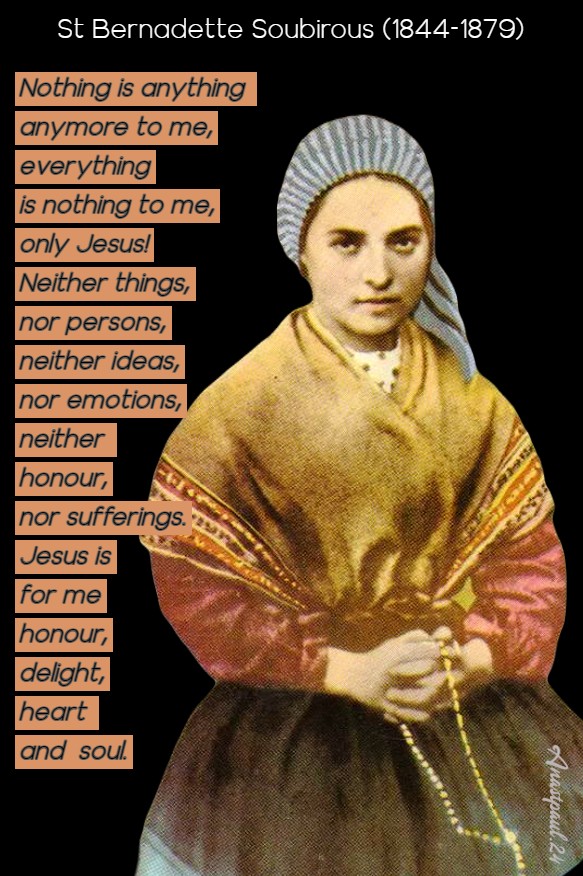
Quote/s of the Day – 18 February – St Bernadette

Quote/s of the Day – 18 February – St Bernadette Soubirous (1844-1879)
Virgin, The Visionary of Lourdes,

You must receive God well –
give Him a loving welcome,
for then, He has to pay us rent.

Nothing is anything anymore to me,
everything is nothing to me,
only Jesus!
Neither things,
nor persons,
neither ideas,
nor emotions,
neither honour,
nor sufferings.
Jesus is for me honour,
delight,
heart and soul.

St Bernadette Soubirous (1844-1879)

Posted in DIVINE Mercy, Goodness, Patience, DOCTORS of the Church, LENT 2024, LENTEN THOUGHTS, QUOTES on FORGIVENESS, QUOTES on SIN, REDEMPTORISTS CSSR, The WORD

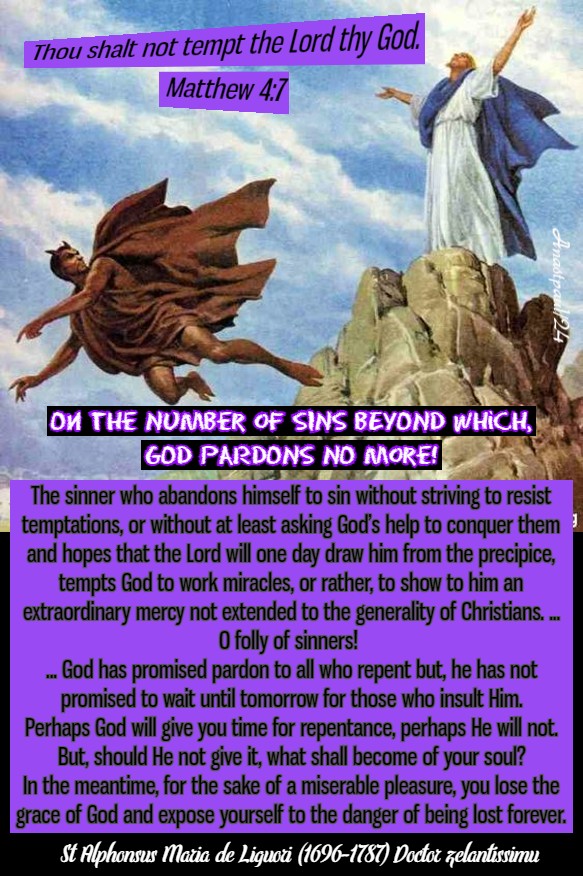
Our Lenten Journey with the Angels and the Saints – 18 February – “Thou shalt not tempt the Lord thy God.” Matthew 4:7

Our Lenten Journey with the Angels and the Saints – 18 February – The First Sunday of Lent – 2 Corinthians 6:1-10; Matthew 4:1-11 – Scripture search here: https://www.drbo.org/

St Alphonsus Maria de Liguori (1696-1787)
Doctor zelantissimu

The sinner who abandons himself to sin without striving to resist temptations, or without at least asking God’s help to conquer them and hopes that the Lord will one day draw him from the precipice, tempts God to work miracles, or rather, to show to him an extraordinary mercy not extended to the generality of Christians.
God, as the Apostle says, “will have all men to be saved,” (1 Tim 2;4) but, He also wishes us all to labour for our own salvation, at least by adopting the means of overcoming our enemies and, of obeying Him when He calls us to repentance.
Sinners hear the calls of God but they forget them and continue to offend Him.
But God does not forget them.
He numbers the graces which He dispenses, as well as the sins which we commit.
Hence, when the time which He has fixed arrives, God deprives us of His graces and begins to inflict chastisement.
… Be attentive. …

Hence, according to St Chrysostom, God is more to be feared, when He bears with sinners than when He instantly punishes their sins. “ Plus timendum est, cum tolerat quam cum festinanter punit.” (He is more to be feared when He tolerates than when He punishes quickly).
And why?
Because, says St Gregory, they to whom God has shown most mercy, shall, if they do not cease to offend Him, be chastised with the greatest rigour.
The saint adds that God often punishes such sinners with a sudden death and does not allow them time for repentance.
And the greater the light which God gives to certain sinners for their correction, the greater is their blindness and obstinacy in sin.
For it had been better for them not to have known the way of justice, than, after they had known it, to turn back.” (2 Pet 2: 21.)
Miserable the sinners who, after having been enlightened, return to the vomit.
St Paul says, that it is morally impossible for them to be again converted. “For it is impossible for those who were once illuminated, who have tasted also the heavenly gifts … and are fallen away, to be renewed again to penance.” (Heb 6:4, 6.) …

O folly of sinners!
If you purchase a house, you spare no pains to get all the securities necessary to guard against the loss of your money; if you take medicine, you are careful to assure yourself that it cannot injure you; if you pass over a river, you cautiously avoid all danger of falling into it but –
for a transitory enjoyment, for the gratification of revenge, for a beastly pleasure which lasts but a moment, you risk your eternal salvation, saying:
“I will go to Confession after I commit this sin.
And when, I ask, when are you to go to Confession?
You say: “On the morrow.”
But who promises you tomorrow?
Who assures you that you shall have time for Confession and that God will not deprive you of life, as He has deprived so many others, in the act of sin?
Diem tenes,” says St Augustine, “qui horam non tenes.”
You cannot be certain of living for another hour and you say: “I will go to confession to-morrow.
Listen to the words of St Gregory: “He who has promised pardon to penitents, has not promised tomorrow to sinners.” (Hom. xii. in Evan).

God has promised pardon to all who repent but, he has not promised to wait until tomorrow for those who insult Him.
Perhaps God will give you time for repentance, perhaps He will not.
But, should He not give it, what shall become of your soul?
In the meantime, for the sake of a miserable pleasure, you lose the grace of God and expose yourself to the danger of being lost forever.
”- (Extract fromSERMON XV. FIRST SUNDAY OF LENT.1,6,8).

Posted in "Follow Me", AUGUSTINIANS OSA, CHRIST the WORD and WISDOM, DOCTORS of the Church, GOD ALONE!, LENT 2024, ONE Minute REFLECTION, QUOTES for CHRIST, QUOTES on PRIDE, QUOTES on TEMPTATION, QUOTES on the DEVIL/EVIL, QUOTES on THE WORLD, The WORD

One Minute Reflection – 6 March – ‘Satan will return. He will enter Judas and will make him betray his Master.’

One Minute Reflection – 18 February – The First Sunday of Lent – St Bernadette Soubirous (1844-1879) of Lourdes – Virgin, The Visionary of Lourdes, – 2 Corinthians 6:1-10; Matthew 4:1-11 – Scripture search here: https://www.drbo.org/

Then the devil left Him …” – Matthew 4:11

REFLECTION – “When the Lord had been tempted with this triple temptation—because in all the allurements of the world these three are to be found, either pleasure, or curiosity, or pride — what did the Evangelist say? After the devil had concluded every temptation — every kind but of the alluring sort — there remained the other sort of temptation, by harsh and hard treatment, savage treatment, atrocious and ferocious treatment. Yes, there remained the other sort of temptation. Another Evangelist knew this, knew what had been carried out, what remained, and so he said, “After the devil had completed every temptation, he departed from Him, until the time.” He departed from Him in the form, that is, of the insidious serpent. He is going to come back in the form of the roaring lion. The One Who will trample on the lion and the cobra, will conquer him. Satan will return. He will enter Judas and will make him betray his Master. He will bring along the Jews, not flattering now but raging. Taking possession of his own instruments, he will cry out with the tongues of all of them, “Crucify him, crucify him!” That Christ was the Conqueror there, why should we be surprised? He is Almighty God.” – St Augustine (354-430) Bishop of Hippo, Father and Doctor of Grace (Ser

PRAYER – Almighty and eternal God, Who has dominion over both the living and the dead and has mercy upon all, whom Thou foreknow will be Thine own by faith and good works; we humbly beseech Thee that all, for whom we have resolved to make supplication, whether the present world still holds them in the flesh, or the world to come holds them out of the body, may, through the intercession of St Bedrnadette and all Thy Saints, obtain of Thine goodness and clemency, pardon for all their sins.Through Jesus Christ, Thy Son our Lord, Who lives and reigns with Thee, in the unity of the Holy Ghost, God, world without end. Amen (Collect).

Posted in CATHOLIC-PRAYERS OF THE CHURCH, DIVINE Mercy, Goodness, Patience, DOCTORS of the Church, FATHERS of the Church, HYMNS, LENT, LENT 2024, Our MORNING Offering, PRAYERS of the CHURCH, PRAYERS of the SAINTS, QUOTES on FASTING, QUOTES on FORGIVENESS, QUOTES on PRAYER, QUOTES on REPENTANCE, QUOTES on SIN, SOLDIERS/ARMOUR of CHRIST

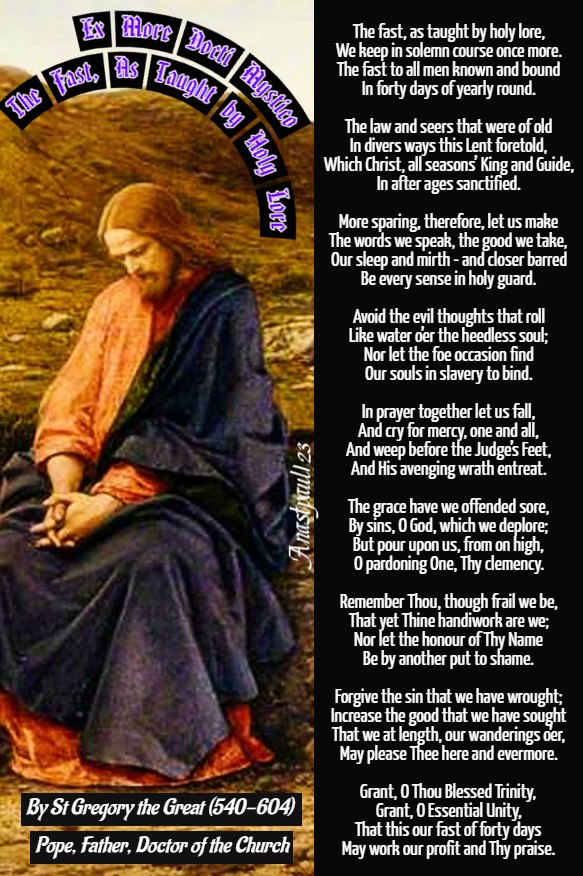
Our Morning Offering – 18 February – Ex More Docti Mystico, The Fast, As Taught by Holy Lore

Our Morning Offering – 17 February – The First Sunday of Lent

Ex More Docti Mystico
The Fast, As Taught by Holy Lore
By St Gregory the Great (540-604)
Pope, Father, Doctor of the Church

Trans. John Mason Neale

The fast, as taught by holy lore,
We keep in solemn course once more.
The fast to all men known and bound
In forty days of yearly round.

The law and seers that were of old
In divers ways this Lent foretold,
Which Christ, all seasons’ King and Guide,
In after ages sanctified.

More sparing, therefore, let us make
The words we speak, the good we take,
Our sleep and mirth – and closer barred
Be every sense in holy guard.

Avoid the evil thoughts that roll
Like water o’er the heedless soul;
Nor let the foe occasion find
Our souls in slavery to bind.

In prayer together let us fall,
And cry for mercy, one and all,
And weep before the Judge’s Feet,
And His avenging wrath entreat.

The grace have we offended sore,
By sins, O God, which we deplore;
But pour upon us, from on high,
O pardoning One, Thy clemency.

Remember Thou, though frail we be,
That yet Thine handiwork are we;
Nor let the honour of Thy Name
Be by another put to shame.

Forgive the sin that we have wrought;
Increase the good that we have sought
That we at length, our wanderings o’er,
May please Thee here and evermore.

Grant, O Thou Blessed Trinity,
Grant, O Essential Unity,
That this our fast of forty days
May work our profit and Thy praise.

There are twelve translations of this lovely Lenten Hymn.
This one by L M Neale
Liturgical Use: Matins Hymn on Sundays
and week-days during Lent.

Posted in MARIAN TITLES, MIRACLES, SAINT of the DAY

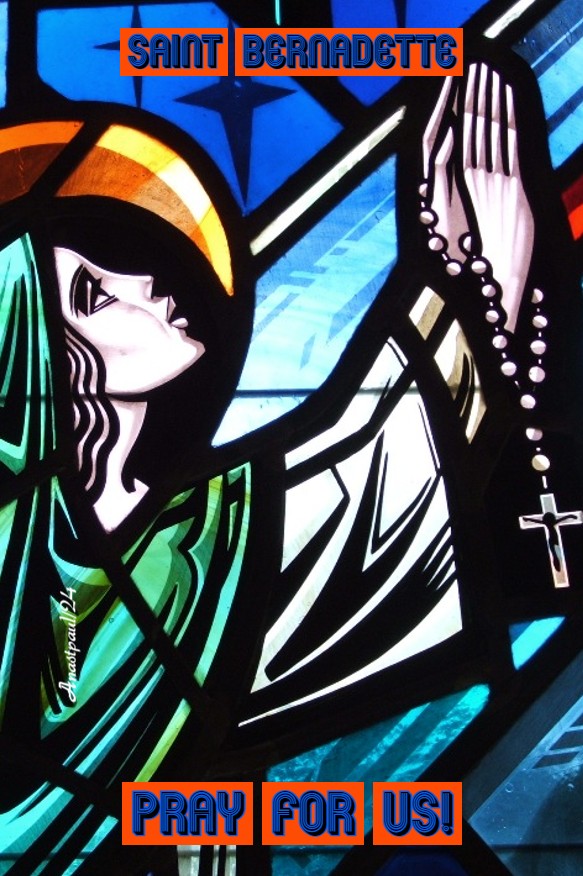
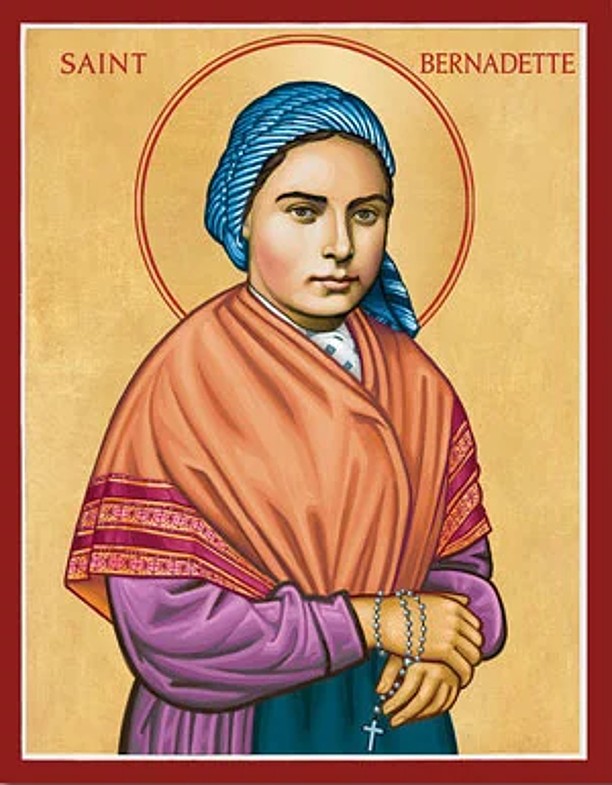
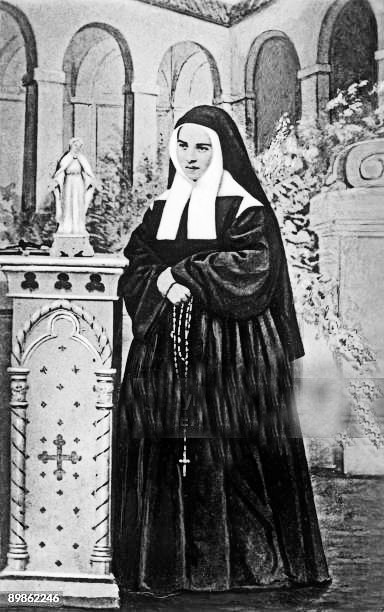
Saint of the Day – 18 February – St Bernadette Soubirous (1844-1879) Virgin

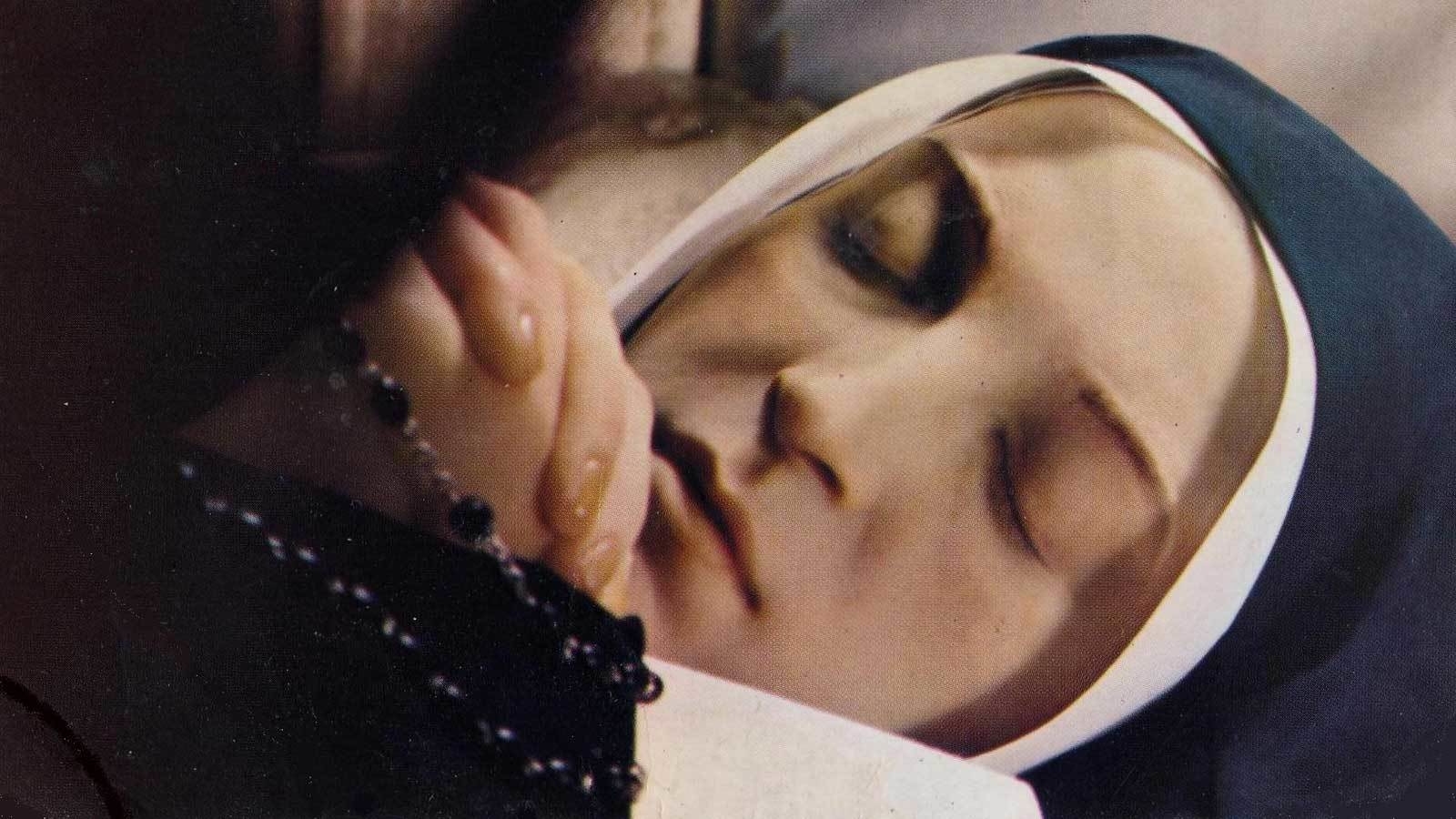
Saint of the Day – 18 February – St Bernadette Soubirous (1844-1879) of Lourdes – Virgin, The Visionary of Lourdes, Consecrated Religious. Born on 7 January 1844 at Lourdes, Hautes-Pyrénées, France and died on 16 April 1879, Nevers, Nièvre, France of natural causes, aged 35. Her Body is incorrupt and is on display in Nevers, France. Patronages – Bodily illness, Lourdes, France, shepherds, against poverty, people ridiculed for their faith. She was Canonised on 8 December 1933 by Pope Pius XI.

The Hidden Life at Nevers

St Bernadette, herself, used this expression:
I came here to hide myself.”

In Lourdes, she was Bernadette, the Visionary. In Nevers, she became Sister Marie Bernard, who would be a Saint. One often hears about the severity of her Superiors towards her but it has to be understood that she was a unique case – she had to be shielded from curiosity, to be protected and, the community too, had to be protected.

Bernadette gave her account of the Apparitions before the assembled community on the day after she arrived, thereafter, it was not to be spoken of. She was kept in the Mother House where she loved to care for the sick. On the day of her Profession, no particular office or task had been prepared for her for the Bishop declared that her work would be “the work of prayer.”
Pray for sinners” the Lady had said. She remained faithful to this task.
My weapons,” she wrote to the Holy Father, “are prayer and sacrifice.”

Her own illness made her a regular patient in the Infirmary and then, there were endless parlour visits. “These poor Bishops, they’d do better to stay at home.” Lourdes was a long way off … she would never return to the Grotto. But every day she made her pilgrimage in spirit. She did not speak of Lourdes but she lived its message.
You will become the first to live the message,” said her Confessor Father Douce. And in fact, after having been Assistant Infirmarian, she entered bit by bit into sickness herself.
She did “her work” in this, accepting all crosses for sinners, in an act of perfect love. “After all, they are our brothers.”

During long sleepless nights, uniting herself with the Masses celebrated throughout the world, she offered herself as a “living crucified” in the tremendous combat between light and darkness, bound, with the Blessed Virgin Mary, to the Mystery of the Redemption, eyes fixed on the Crucifix:
That is where I find my strength.

Our Lady of Lourdes – the Miracle of the Spring and St Bernadette

She died at Nevers on 16 April 1879, aged 35. The Church proclaimed her a Saint on 8 December , 1933, not for having been chosen for the Apparitions but for the way in which she responded to that grace

Dear little Saint Bernadette, Pray for us!

Posted in MARIAN TITLES, SAINT of the DAY

The First Sunday of Lent, Notre-Dame de Laon / Our Lady of Laon, Rheims, France (500), St Simeon of Jerusalem, Martyr, St Bernadette, Virgin and the Saints for 18 February

The First Sunday of Lent

St Esuperia of Vercelli
St Ethelina

St Gertrude Caterina Comensoli
St Helladius of Toledo
Bl John Pibush – one of the Martyrs of Douai
St Leo of Patera
St Paregorius of Patara
St Sadoth of Seleucia
St Tarasius of Constantinople

Bl William Harrington

Posted in QUOTES on SLOTH, QUOTES on THE WORLD, THE SPIRITUAL COMBAT - Fr Lorenzo Scupoli

Thought for the Day – 17 February – How to Combat Sloth (Part One)

Thought for the Day – 17 February – The Spiritual Combat (1589) – Dom Lorenzo Scupoli OSM (c1530-1610)

None shall be crowned who has not fought well.” 2 Tim 2: 5

XX: … How to Combat Sloth
(Part One)

To avoid falling into the miserable bondage of sloth, which would not only hinder your progress towards perfection but also ,deliver you into the hands of your enemies, you must observe the following rules:

  1. Shun all curiosity concerning worldly things and all attachment to them and also, every kind of occupation which does NOT belong to your state of life.
  2. Endeavour earnestly, to respond immediately to every inspiration from above and to every command of your superiors; doing everything at the time and in the manner, which is pleasing to them.
  3. Never allow yourself even one moment’s delay – for that one little delay, will soon be followed, by another and that, by a third and this again by others and to the last, the senses will yield and give way more easily than to the first, having been already fascinated and enslaved by the pleasure they have tasted therein.

Hence, the duty to be performed, is either begun too late, or sometimes laid aside altogether, as too irksome to be endured!
Thus, by degrees, a habit of sloth is acquired which, as we cannot disguise it from ourselves, we seek to excuse by vain purposes of future diligence and activity, while we are all the while held in bondage by it.

The poison of sloth overwhelms the whole man – not only infecting the will, by making exertion hateful to it but also, blinding the understanding, so that it is unable to see how vain and baseless are its intentions, to do promptly and diligently, at some future season, what should be done at once but is either willfully neglected altogether, or deferred to another time.

Nor is it enough that we perform our appointed work quickly; we must, in order to bring it to its highest possible perfection, do it at the very time required by its nature and quality and with all suitable diligence.
For that is not diligence but the subtlest form of sloth which leads us to do our work before its time – not seeking to do it well but dispatching it hastily, that we may afterwards indulge in the sluggish repose on which our thoughts have been dwelling, while we were hurrying over our business!

All this great evil proceeds from the want of duly, considering the value of a good work, performed at its right time and with a spirit determined to brave the toil and difficulty, put in the way of untried soldiers, by the sin of sloth.”

Dom Lorenzo Scupoli

Posted in LENT, QUOTES on ALMS, QUOTES on CHARITY, QUOTES on KINDNESS, The WORD

Quote of the Day – 17 February – Isaiah 58:9-11

Quote of the Day – 17 February – The First Saturday of Lent – Isaiah 58:9-14, Mark 6:47-56

Thus says the Lord God:
If you remove from your midst oppression,
false accusation
and malicious speech.
if you bestow your bread
on the hungry
and satisfy the afflicted;
then light shall rise
for you in the darkness
and the gloom
shall become for you,like midday;
then the Lord will guide you always
and give you plenty,
even on the parched land.
He will renew your strength
and you shall be like a watered garden,
like a spring whose water never fails.

Isaiah 58:9-11

Posted in CHRIST the PHYSICIAN, CHRIST the WORD and WISDOM, DIVINE Mercy, Goodness, Patience, DOCTORS of the Church, FATHERS of the Church, LENT 2024, LENTEN THOUGHTS, QUOTES on FORGIVENESS, QUOTES on REPENTANCE, QUOTES on SIN, The WORD

Our Lenten Journey with the Angels and the Saints – 17 February – The Wounds of the Soul

Our Lenten Journey with the Angels and the Saints – 17 February – Saturday after Ash Wednesday – Isaias 58:9-14, Mark 6:47-56 – Scripture search here: https://www.drbo.org/

St Gregory the Great (540-604)
Pope, Father & Doctor of the Church

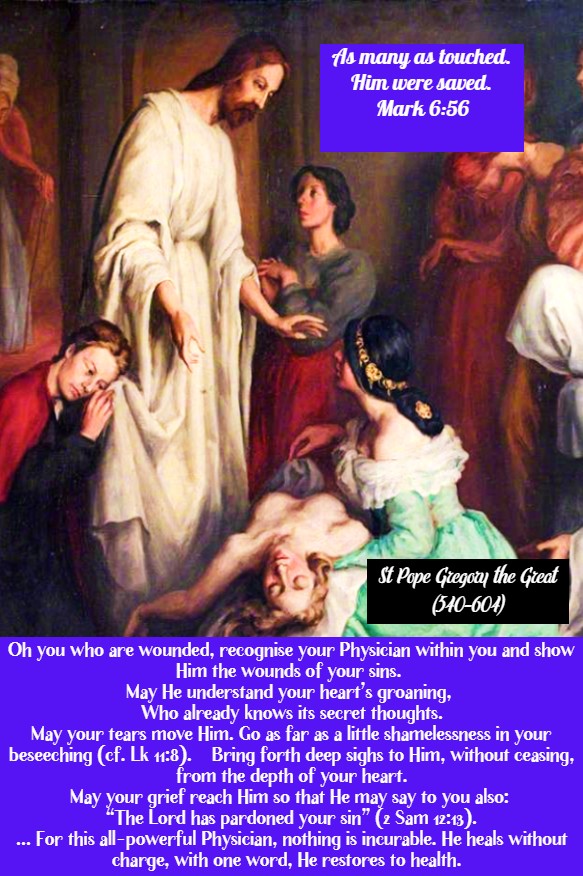
“Let us set before our interior consideration, someone gravely wounded who is about to breathe his last. … Now, the soul’s wound is sin, of which Scripture speaks in these terms: “Wound and welt and gaping gash, not drained or bandaged or eased with salve” (Is 1:6). Oh you who are wounded, recognise your Physician within you and show Him the wounds of your sins. May He understand your heart’s groaning, Who already knows its secret thoughts. May your tears move Him. Go as far as a little shamelessness in your beseeching (cf. Lk 11:8). Bring forth deep sighs to Him, without ceasing, from the depth of your heart.

May your grief reach Him so that He may say to you also : “The Lord has pardoned your sin” (2 Sam 12:13). Cry out with David, who said: “Have mercy on me, O God, in … the greatness of your compassion” (Ps 50[51]:3). It is as though one were to say: “I am in great danger because of an enormous wound, that no doctor can cure, unless the all-powerful Physician comes to help me.” For this all-powerful Physician, nothing is incurable. He heals without charge, with one word, He restores to health. I would have despaired of my wound, were it not that I placed my trust in the Almighty.” (Commentary on Psalm 50)

Posted in CATECHESIS, CHRIST the PHYSICIAN, DOCTORS of the Church, FATHERS of the Church, ONE Minute REFLECTION, QUOTES on REPENTANCE, QUOTES on SIN, QUOTES on the ANTI-christ, QUOTES on the CHURCH, QUOTES on TRUST and complete CONFIDENCE in GOD, The HEART, The SECOND COMING, The WORD

One Minute Reflection – 17 February – About the fourth watch of the night, He came …

One Minute Reflection – 17 February – The First Saturday of Lent – Isaias 58:9-14, Mark 6:47-56 – Scripture search here: https://www.drbo.org/

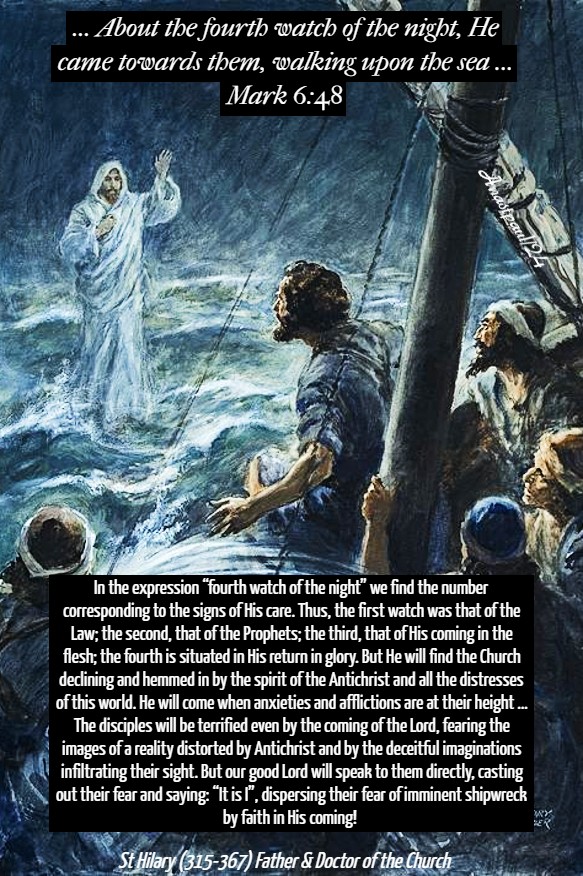
“… About the fourth watch of the night, He came towards them, walking upon the sea …” – Mark 6:48

REFLECTION – “Then He made the disciples get into the boat, while He dismissed the crowds. After doing so, He went up to pray. When it was evening, He was there alone” (Cf Mt 14:22-23). If we are to explain these happenings we must distinguish between the times. If He was alone in the evening, this points to His solitude at the hour of His Passion when panic had caused everyone to scatter. If He made His disciples get into the boat and cross over the sea, while He Himself dismissed the crowds and if, having dismissed them, He went up a mountain, this means that He directed them to remain in the Church and to sail across the sea – that is to say, this world – until, at His return in glory, He would grant salvation to all, who are to be the remnant of Israel (cf. Rom 11:5)… and this people would give thanks to God His Father and be set firm within His glory and majesty…

During the fourth watch of the night, He came toward them. In the expression “fourth watch of the night” we find the number corresponding to the signs of His care. Thus, the first watch was that of the Law; the second, that of the Prophets; the third, that of His coming in the flesh; the fourth is situated in His return in glory. But He will find the Church declining and hemmed in by the spirit of the Antichrist and all the distresses of this world. He will come when anxieties and afflictions are at their height … The disciples will be terrified even by the coming of the Lord, fearing the images of a reality distorted by Antichrist and by the deceitful imaginations infiltrating their sight. But our good Lord will speak to them directly, casting out their fear and saying: “It is I”, dispersing their fear of imminent shipwreck by faith in His coming! ”- St Hilary (315-368) Bishop of Poitiers, Father & Doctor of the Church (Commentary on the Gospel of Matthew).

PRAYER – Hear, O Lord, our humble prayers and grant that we may devoutly keep this fast which has been established, to cure our souls and bodies. Through Jesus Christ, Thy Son our Lord, Who lives and reigns with Thee, in the unity of the Holy Ghost, God, world without end. Amen (Collect).

Posted in DOCTORS of the Church, Our MORNING Offering, PRAYERS of the SAINTS, REDEMPTORISTS CSSR, The FLIGHT into EQYPT, The MOST HOLY REDEEMER, Our SAVIOUR

Our Morning Offering – 17 February – My Beloved Redeemer, Prayer for the Flight into Egypt

Our Morning Offering – 17 February – Feast of the Flight into Egypt

My Beloved Redeemer
Prayer for the Flight into Egypt (Excerpt)
By St Alphonsus Maria de Liguori (1696-1787)
Doctor of the Church

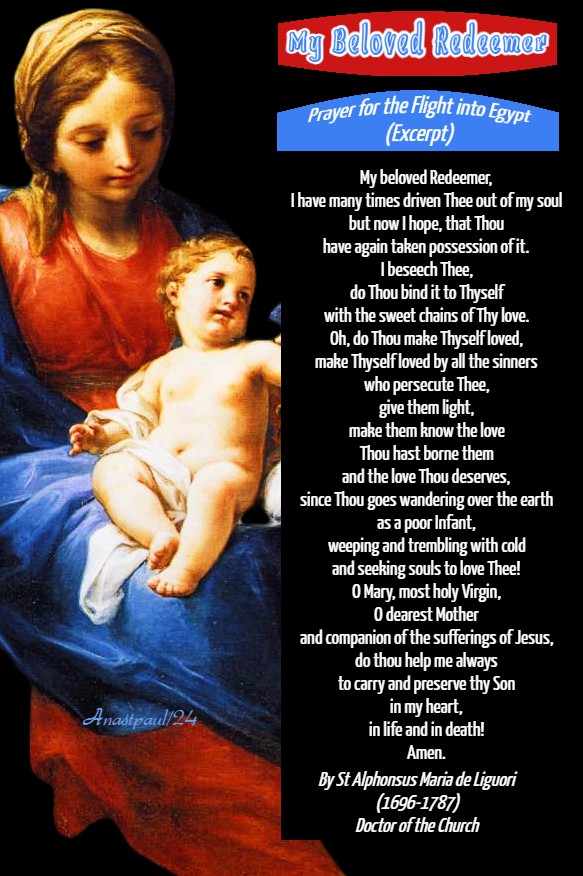
My beloved Redeemer,
I have many times driven Thee out of my soul
but now I hope, that Thou
have again taken possession of it.
I beseech Thee,
do Thou bind it to Thyself
with the sweet chains of Thy love.
Oh, do Thou make Thyself loved,
make Thyself loved by all the sinners
who persecute Thee,
give them light,
make them know the love
Thou hast borne them
and the love Thou deserves,
since Thou goes wandering over the earth
as a poor Infant,
weeping and trembling with cold
and seeking souls to love Thee!
O Mary, most holy Virgin,
O dearest Mother
and companion of the sufferings of Jesus,
do thou help me always
to carry and preserve thy Son
in my heart,
in life and in death!
Amen.

Posted in SAINT of the DAY

Saint of the Day – 17 February – Saint Finan of Iona or Lindisfarne (Died 661)

Saint of the Day – 17 February – Saint Finan of Iona or Lindisfarne (Died 661) the Second Bishop of Lindisfarne succeeding St Aidan on his death in 651. Monk and Missionary. Born in Ireland and died there on 9 February 661.
The Name Finan being derived from Finn (Finn-án — little Finn). Also known as – Finan of Lindisfarne, Fian of… Additional Memorial – 9 February on some calendars.

The Breviary of Aberdeen, Scotland, describes him “a man of venerable life, a Bishop of great sanctity, an eloquent teacher of unbelieving races, remarkable for his training in virtue and his liberal education, surpassing all his equals in every manner of knowledge, as well as in circumspection and prudence but chiefly, devoting himself to good works and presenting, in his life, a most apt example of virtue.

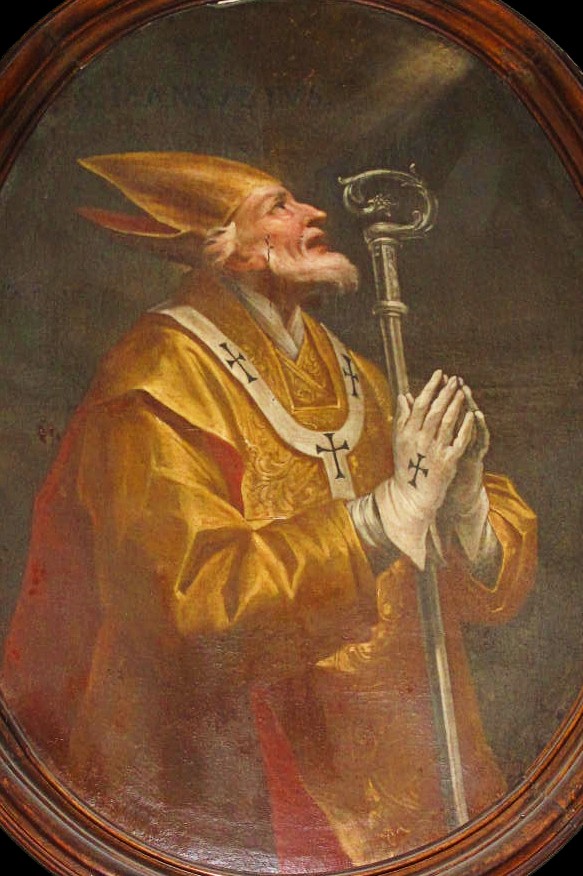
Finan was an Irish Monk who had been trained in Iona, Scotland and who was specially chosen by the St Columba (521-597) of Iona’s Monks to succeed the great St Aidan at Lindisfarne in Northumbria, England.
St Bede describes him as an able ruler and tells of his labours in the conversion of Northumbria. He built a Cathedral a Monastery on the site where King Oswin had been murdered “in the Irish fashion” employing “hewn oak, with an outer covering of reeds” which he dedicated to St Peter. His apostolic zeal resulted in the foundation of St Mary’s, a Monastery on the site where King Oswin had been murdered, at the mouth of the River Tyne — Gilling Abbey and the great Abbey of Streanaeshalch, or Whitby.
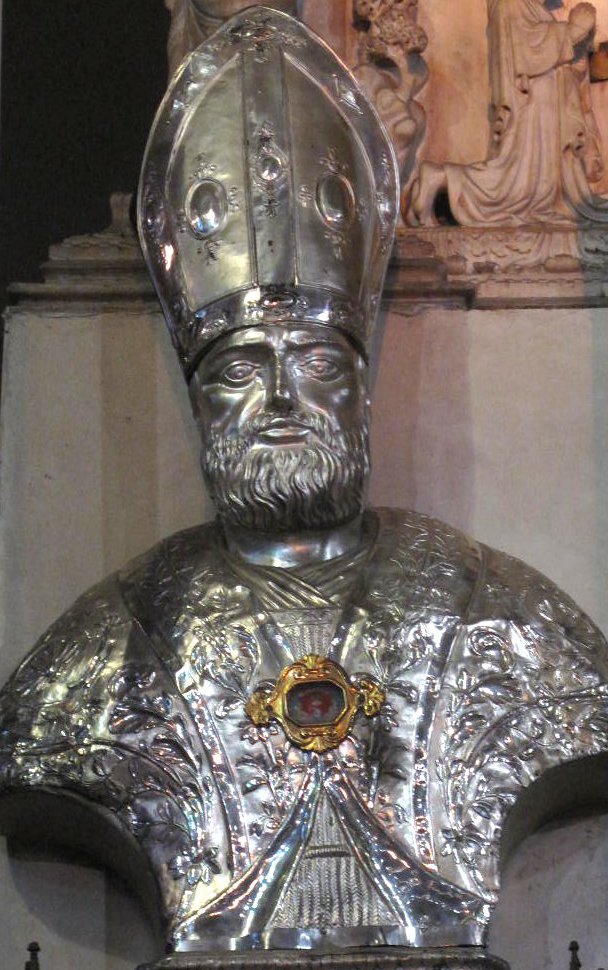
The Ruins of Whitby Abbey

Finan converted Peada, son of Penda, King of the Middle Angles, “with all his Nobles and Thanes” and gave him four Priests, including Diuma, whom he consecrated as the Bishop of Middle Angles and Mercia, under King Oswy.

In the mysterious ways of Divine Providence, the Abbey of Whitby, his chief foundation, was the scene of the famous Paschal controversy which resulted in the withdrawal of the Irish Monks from Lindisfarne. The inconvenience of the two systems — Irish and Roman — of keeping Easter, was specially felt when on one occasion King Oswy and his Court were celebrating Easter Sunday with St Finan, while on the same day, Queen Eanfled and her attendants were still fasting and celebrating Palm Sunday. Saint Finan was spared being present at the Synod of Whitby. He died in 661 and was buried at Lindisfarne, having held that See for ten years.

Posted in FEASTS and SOLEMNITIES, MARIAN DEVOTIONS, MARIAN TITLES, SAINT of the DAY

The Flight into Egypt (Year 1), Our Lady of Constantinople, Bari, Turkey (566), Saturday after Ash Wednesday and the Saints for 17 February

St Benedict of Cagliari
St Bonosus of Trier

St Donatus the Martyr
St Evermod of Ratzeburg
St Faustinus the Martyr
St Finan of Iona (Died 661) Bishop

St Flavian of Constantinople
St Fortchern of Trim
St Guevrock
St Habet-Deus
St Julian of Caesarea
St Loman of Trim

St Lupiano
St Mesrop the Teacher
St Polychronius of Babylon
St Romulus the Martyr
St Secundian the Martyr
St Silvinus of Auchy
St Theodulus of Caesarea