
Saint of the Day – 17 July – St Pope Leo IV (c790- 855) The 103rd Bishop of Rome. Papal Ascension: 847. Died: 855 at Rome. St Leo is particularly remembered for repairing Roman Churches which had been damaged during the Arab raid and for building the Leonine Wall around Vatican Hill to protect the City. Pope Leo organised a league of Italian Cities who fought and won ,the sea Battle of Ostia, against the Saracens.

He was the son of a Roman nobleman amd had been educated in the Monastery of “Saint Martin Without the Walls.” He attracted the notice of Pope Gregory IV, who made him a Subdeacon and was created Cardinal-priest of “The Four Crowned Martyrs – Santi Quattro Coronati” by Pope Sergius II.
He was chosen as the new Pope after the death of Sergius II in 847 and governed the Church for eight years, three months. The Saracens from Calabria had lately plundered Saint Peter’s Basilica on the Vatican Hill and were still hovering about Rome. Leo made it his first care to repair the ornamental parts of this beautiful Basilica, especially the Tomb of Saint Peter with the Altar which stood upon it. By Leo’s work, the Altar again received its gold covering (after being stolen) which weighed 94 kg (206 lb) and was studded with precious gems. He also restored and embellished the damaged Basilica of Saint Paul Outside the Walls.
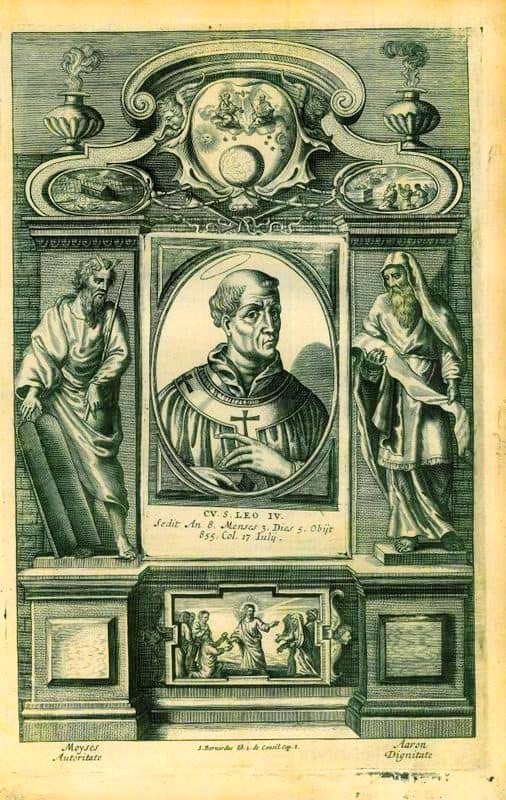
To prevent a second plundering of that holy place, he, with the approbation and liberal contributions of the Emperor Lothaire, enclosed the Basilica and the whole Vatican Hill with a wall and ordered a new line of walls encompassing the suburb on the right bank of the Tiber to be built, including St Peter’s Basilica which had been undefended until this time. The district enclosed by the walls is still known as the Leonine City.
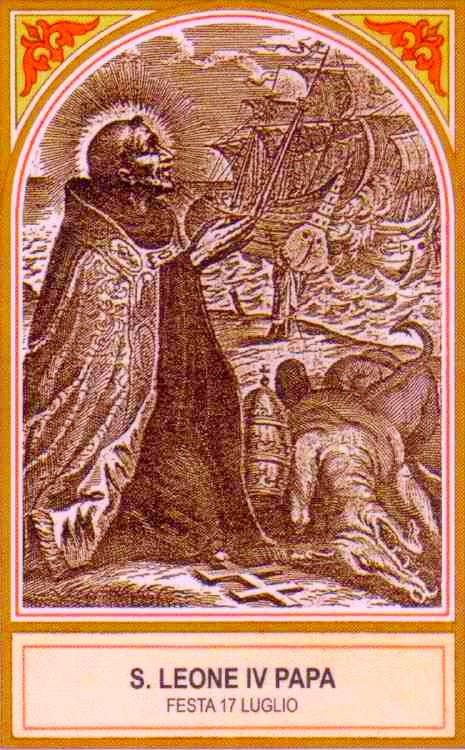
He rebuilt or repaired the walls of the City, fortified with fifteen towers. Whilst he was putting Rome in a posture of defence, In 849, when a Saracen fleet from Sardinia approached Portus, Leo IV summoned the maritime republics – Naples, Gaeta and Amalfi – to form a league. The command of the unified fleet was given to Cesarius, son of Duke Sergius I of Naples. Aided by a fierce storm, the league destroyed the Saracen fleet off Ostia. The Battle of Ostia was one of the most famous in the history of the Papacy and is celebrated in a famous fresco by Raphael and his pupils in the ‘Raphael Rooms’ dedicated to his works in the Vatican Palace. Raphael’s work, ‘The Fire’ in the Borgo, celebrates the incident in which, our Saint Leo stopped a fire in the pilgrims’ district by making the Sign of the Cross.
Leo IV held three Synods – the one in 850 distinguished by the presence of Emperor Louis. Before his death in 855, the Pope welcomed Aethelwulf, King of Wessex and his sons, including the seven year old St Alfred the Great, who at the age of 5 years, had already met Pope Leo as pilgrims to Rome.
Pope Leo directed to all Bishops a Homily on the Pastoral Care, published from the Vatican manuscripts. In it, Leo regulates all the chief functions of the pastoral charge and every duty enforced with no less learning than piety.

Among other miracles performed by this holy Pope, it is recorded that by the Sign of the Cross he extinguished a great fire in the City which threatened the Church of the Prince of the Apostles – this is mentioned above as having been immortalised by the art of Raphael and his School.
He died on the 17 July, 855 and Benedict III, Priest of the Church of Saint Calixtus, was immediately chosen Pope. He with many tears begged that so formidable a burden might not be laid on his shoulders but his protests could not prevail. Anastasius the deposed priest set up for pope and procured the protection of the Emperor Louid II but, the steady unanimity of the people in the election of Benedict III overcame this opposition and he was Consecrated on the 1 September in the same year, 855.
Leo IV was originally buried in his own monument in St Peter’s Basilica. Some years after his death, his remains were put into a Tomb which contained the first four Popes named Leo. In the 18th Century, the Relics of Leo the Great were separated from his namesakes and given their own Chapel.
Leo IV had the figure of a Rooster placed on the Old St. Peter’s Basilica which has served as a religious icon and reminder of St Peter’s denial of Christ since that time, with some Churches still having the cockerel on the steeple today. It is reputed that Pope Gregory I had previously said that the cock “was the most suitable emblem of Christianity” being “the emblem of St Peter”. After Leo IV, Pope Nicholas I, who had been made a Deacon by St Leo IV, decreed that the figure of the cock should be placed on every Church throughout the world.
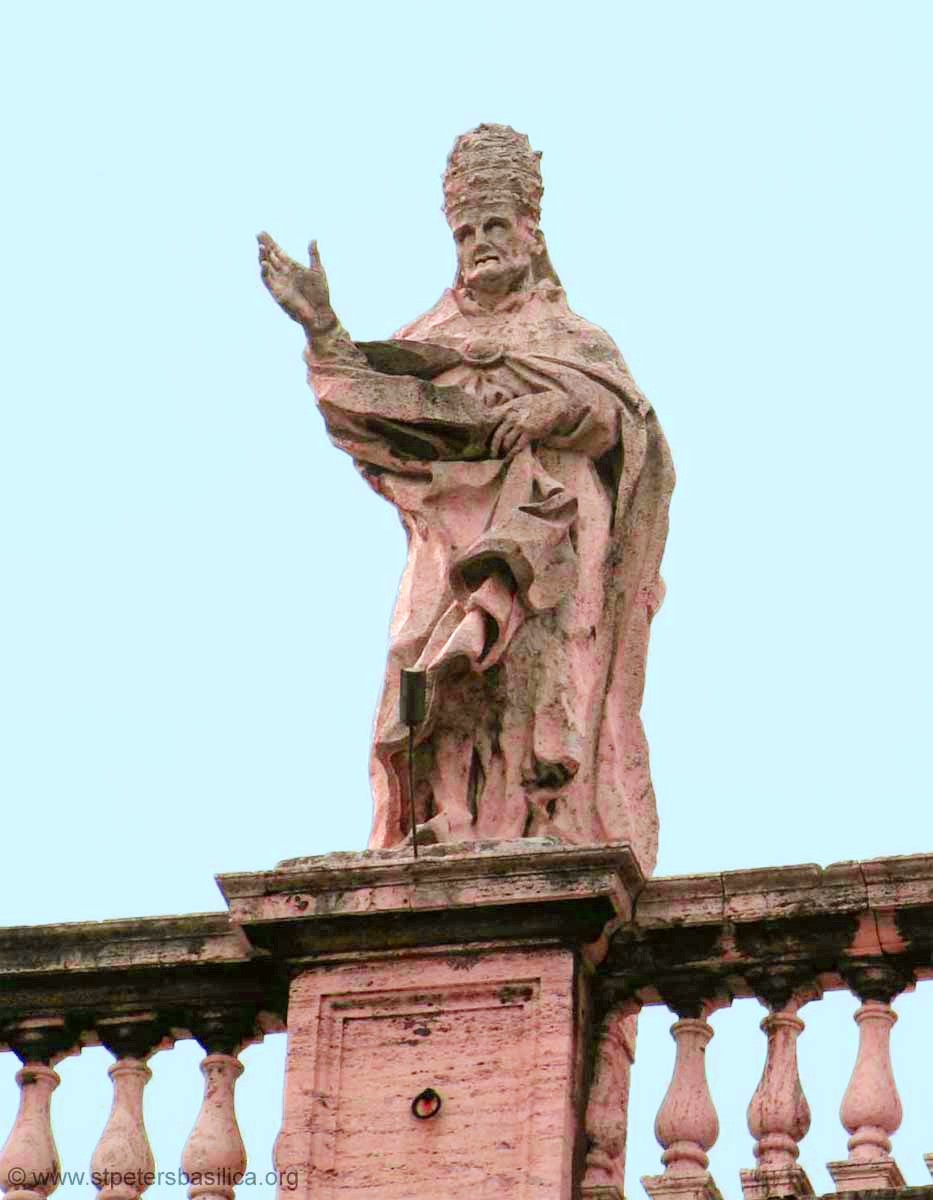
The Statue of St Leo is situate on the South Colonnade’s Curved Arm next to St Pope Clement I. St. Leo IV – Pope
Born – 790
Died – 17 July 855 in Rome
Feastday – 17 July
Sculptor – unknown
Based on the documents and stylistic features perhaps the work could be attributed, but it has been very damaged by time. However, it seem closest to the school of Algardi.
Statue created – c.1669-1670
The statue is part of a group of 16 installed between 1 May 1669 and 5 August 1670.


 AnaStpaul