Thought for the Day – 18 July – Meditations with Fr Richard Frederick Clarke SJ (1839-1900)
HUMILITY Meditations for a Month
Humility in Success
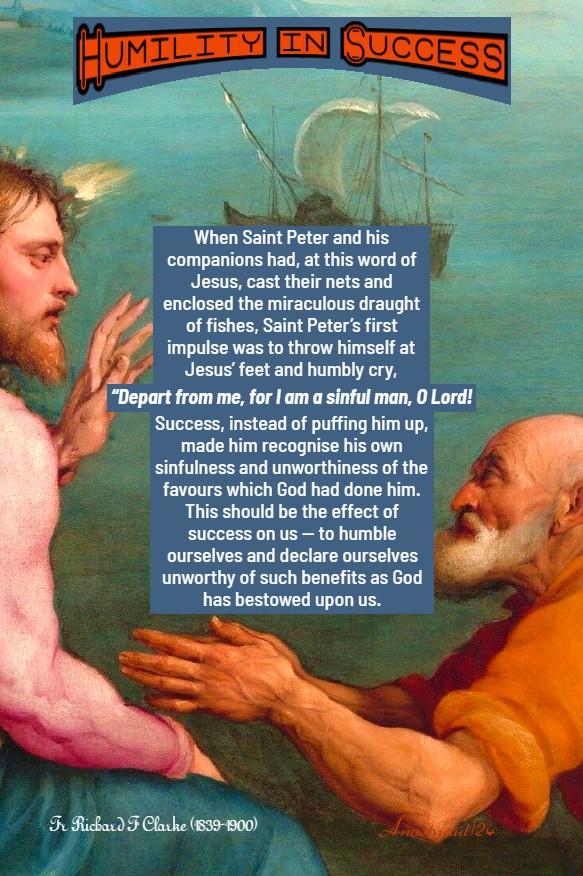
When Saint Peter and his companions had, at this word of Jesus, cast their nets and enclosed the miraculous draught of fishes, Saint Peter’s first impulse was to throw himself at Jesus’ feet and humbly cry, “Depart from me, for I am a sinful man, O Lord!” Success, instead of puffing him up, made him recognise his own sinfulness and unworthiness of the favours which God had done him. This should be the effect of success on us — to humble ourselves and declare ourselves unworthy of such benefits as God has bestowed upon us.
Yet success is meant to encourage us. We cannot help being conscious of having done well and given satisfaction and it would be foolish and ungrateful to ignore the fact. But, our spirit must be that of Saint Bernard, who did not deny the marvels God had wrought through him. Instead, he expressed his astonishment that God could make use of such an instrument! So, we should regard it as fresh proof of God’s power and love, that He should work the marvels of His grace through us.
Thus, to humble ourselves amid the approval and applause of others, is no easy task. It is very possible to cry out, “Not unto us, O Lord but to Thy Name be the praise” and, all the time, to be puffed up with pride. The real test is whether we pray at such moments,
“Humble me, O Lord. Teach me my own nothingness, make me continually depend on Thee and in my heart attribute to Thee all the glory and to myself nothing.” Such a prayer, if it comes from our heart, is a certain safeguard for our humility.
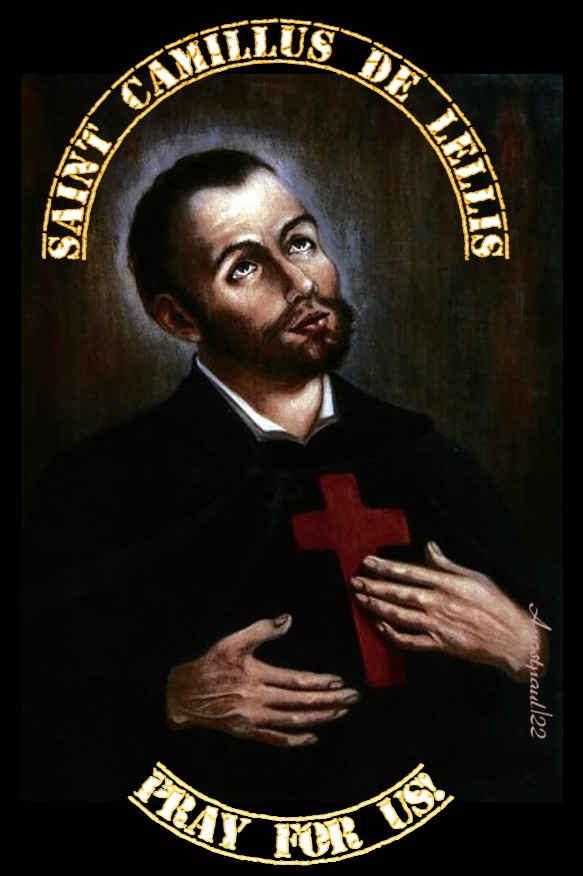
Quote/s of the Day – 18 July – St Camillus de Lellis MI (1550-1614) “The Giant of Charity,” Confessor, Priest and Founder the Order of the Ministers of the Sick, or simply as the “Camillians”
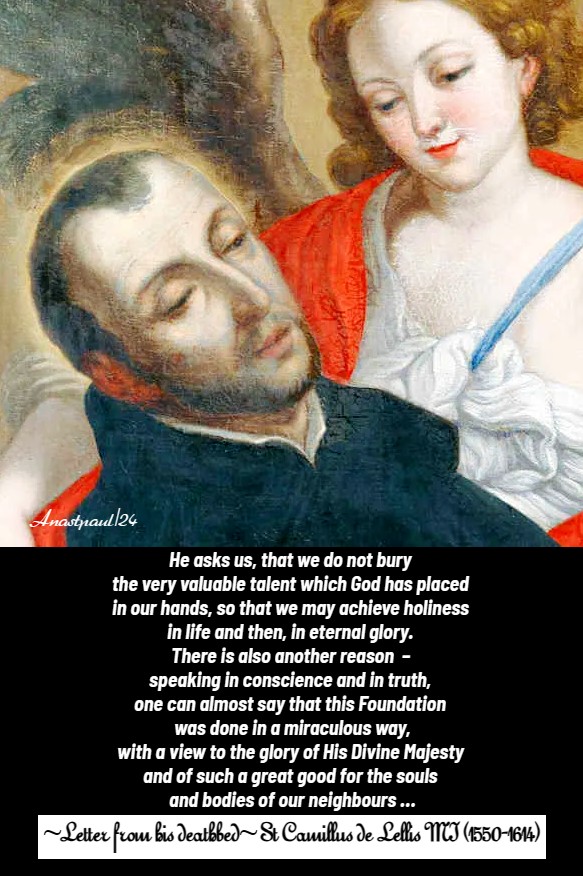
“Because, without doubt, within a few days, I will go to another life, given that I am most grave because of my long infirmities … it appears to me that I would fail in my duty, if, before this life ends, I did not tell you, with all simplicity and rectitude, what I have heard and hear in myself, about our holy Order, so that everyone may walk with the rectitude and faithfulness which God wants of us. He asks us, that we do not bury the very valuable talent which God has placed in our hands, so that we may achieve holiness in life and then, in eternal glory. There is also another reason – speaking in conscience and in truth, one can almost say that this Foundation was done in a miraculous way, with a view to the glory of His Divine Majesty and of such a great good for the souls and bodies of our neighbours …” ~Letter from his deathbed~
One Minute Reflection – 18 July – “The Month of the Most Precious Blood” – St Camillus de Lellis MI (1550-1614) Confessor, Priest and Founder, “The Giant of Charity.” – 1 John 3:13-18, John 15:12-16 – Scripture search here: https://www.drbo.org/
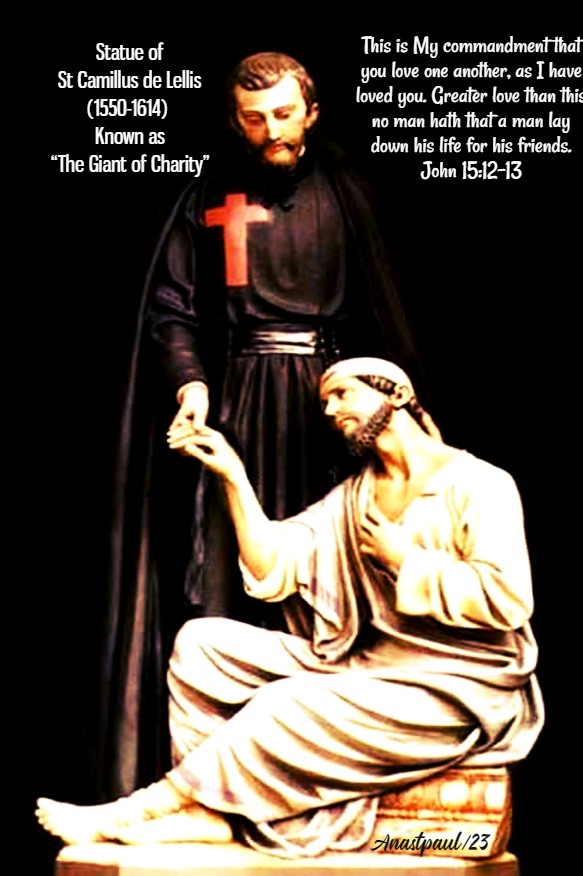
“This is My commandment that you love one another, as I have loved you. Greater love than this no man hath that a man lay down his life for his friends.” – John 15:12-13
REFLECTION – “The more we are united to our neighbour, the more we are united to God. So that you may understand the meaning of this saying, I am going to give you an picture, taken from the Fathers – imagine a circle drawn on the ground that is to say, a line drawn into a round shape, with a compass, having a centre. We refer to the middle of the circle as being the exact centre. Now, give your attention to what I am saying. Imagine that this circle is the world, its centre is God and each radius represents different ways or kinds of lifestyle. When the saints, desiring to draw near to God, move towards the middle of the circle, then to the degree to which they penetrate further into its interior, they draw closer to each other, even as they draw closer to God. The closer they draw to God, the closer they draw to each other and the closer they draw to each other, the closer they draw to God.
From this you will understand that the same thing applies conversely, when we turn away from God to withdraw outside the circle – then it becomes obvious that, the more we withdraw from God, the more we withdraw from each other and, the more we withdraw from each other, the more we also withdraw from God.
Such is the nature of charity. To the extent that we stand outside and do not love God, to the same extent, each one of us stands apart, with regard to their neighbour. But, if we love God, then, insofar as we come closer to God, through our love for Him, we also participate in love of neighbour to the same extent. And insofar as we are united to our neighbour, we are equally so to God.” – St Dorotheus of Gaza (c505-c565) Abbot, Father of the Church (Instructions VI, 76-78).
PRAYER – O God, Who endowed St Camillus with a special gift of charity for the help of souls struggling in their final agony, pour upon us, we beseech Thee, by his merits, the spirit of Thy love, so that at the hour of our death, we may be found worthy to overcome the enemy and attain the heavenly crown. Through Jesus Christ, Thy Son our Lord, Who lives and reigns with Thee, in the unity of the Holy Ghost, God, world without end. Amen (Collect).
Our Morning Offering – 18 July – “The Month of the Most Precious Blood”
Prayer in Praise of God By St Francis of Assisi (c1181-1226)
Thou art Holy, Lord, the only God and Thine Deeds art wonderful. Thou art Strong. Thou art Great. Thou art the Most High. Thou art Almighty. Thou, Holy Father art King of Heaven and earth. Thou art Three and One, Lord God, all Good. Thou art Good, all Good, Supreme Good, Lord God, Living and True. Thou art Love. Thou art Wisdom. Thou art Humility. Thou art Endurance. Thou art Rest. Thou art Peace. Thou art Joy and Gladness. Thou art Justice and Moderation. Thou art all our Riches and Thou art Suffice for us. Thou art Beauty. Thou art Gentleness. Thou art our Protector. Thou art our Guardian and Defender. Thou art our Courage. Thou art our Haven and our Hope. Thou art our Faith, our great Consolation. Thou art our Eternal Life, Great and Wonderful Lord, God Almighty, Merciful Saviour. Amen
Saint of the Day – 18 July – Saint Arnold of Arnoldsweiler (Died 793) Layman, Musician at the Court of Blessed Charlemagne, Apostle of the poor and needy, Tutor and substitute ruler of King Louis the Pious, Blessed Charlemagne’s son. Born in in Greece (?) or in Graz in Austria (?) and died on 18 July 793 in Arnoldsweiler, today a district of Düren in North Rhine-Westphalia, Germany. The name ‘Arnold’ means: ‘the one who rules like an eagle‘ (Old High German). Patronages – for a holy and gentle death, for the cure of livestock diseases, of musicians, of musical instrument manufacturers, of the Town of Arnoldsweiler, Germany.
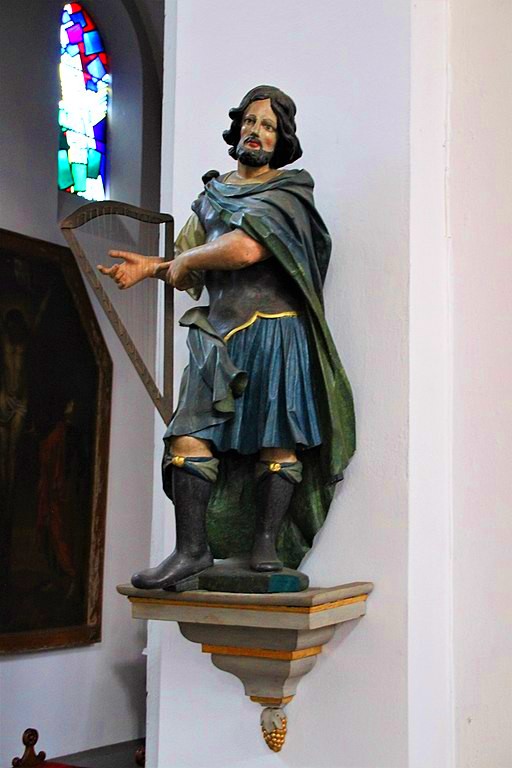
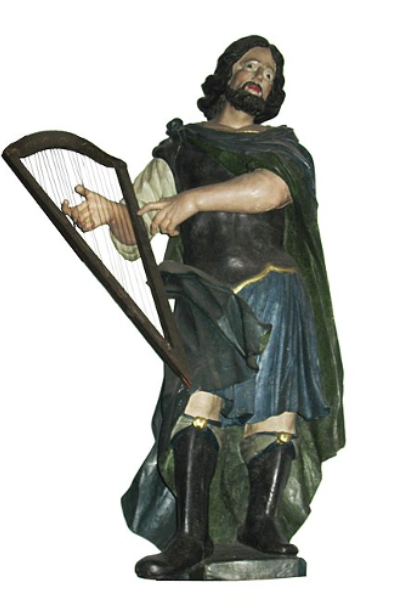
Statue, around 1800, in the Arnold Chapel in Arnoldsweiler
Arnold lived at the Court of Charlemagne, as a singer and harp player. In 779, Arnold saw the plight of the poor and took the opportunity, when the King was hunting in the village of Ginnizweiler – today’s Arnoldsweiler – to ask the King to give him as much of the forest as he could ride around during dinner.
The King granted the request and Arnold rode around the Bürgewald(wald meaning forest) northeast of Düren with 20 villages and these poor communities were now allowed – by official decision – to collect firewood from this forest.
Not long thereafter, Charlemagne appointed Arnold as the Count of Agde and Montpellier. In 781, Charlemagne appointed his son Louis – later called the Pious – as the Regent of Aquitaine and appointed Armold as his tutor and official substitute King until the minor came of age.
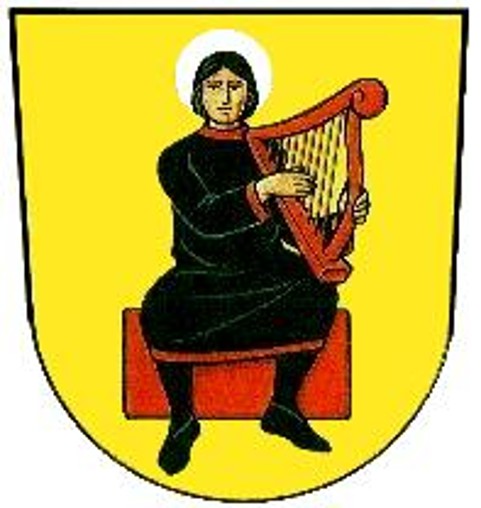
The Coat of Arms of the Municipality of Arnoldsweiler , 1966
During this time, Arnold maintained good relations with St Benedict of Aniane, the Abbot and monastic Reformer (known as “The Second Benedict”). When Louis came of age and our Saint’s substitution came to an end, Arnold, who was described as an exemplary ruler and deeply religious man with great commitment to the poor, donated all of the wealth he had acquired in Aquitaine to Benedict’s Abbey of Aniane.
In 792 he wanted to make a pilgrimage to the Tomb of James the Elder in Santiago de Compostela but because of a great famine, however, he only got as far as the Bordeaux region, turned back and spent the last years of his life in Ginnizweiler now the Town named after him.
18th Century Statue in Arnoldsweiler
Armold’s donations to the Monastery in Aniane are confirmed in two documents by Emperor Louis the Pious, the second of which dates from 822. A document by the same King names the former Ginnizweiler, as a hamlet named after Arnold and, it is attested tpp, in 1168 as .Wilre Sancti Arnoldi.’ The 20 communities around Arnoldsweiler which Arnold gifted with the right to harvest wood in the forest are recorded in a document by Archbishop Gero of Cologne from 973/976. In return for the right to harvest wood, the communities offered prayers at an annual candlelit procession to Arnold’s grave which, according to tradition, had already been ordered by Arnold at the time of the donation, as a wax offering for the Altar of the Church in Ginnizweiler every Pentecos .
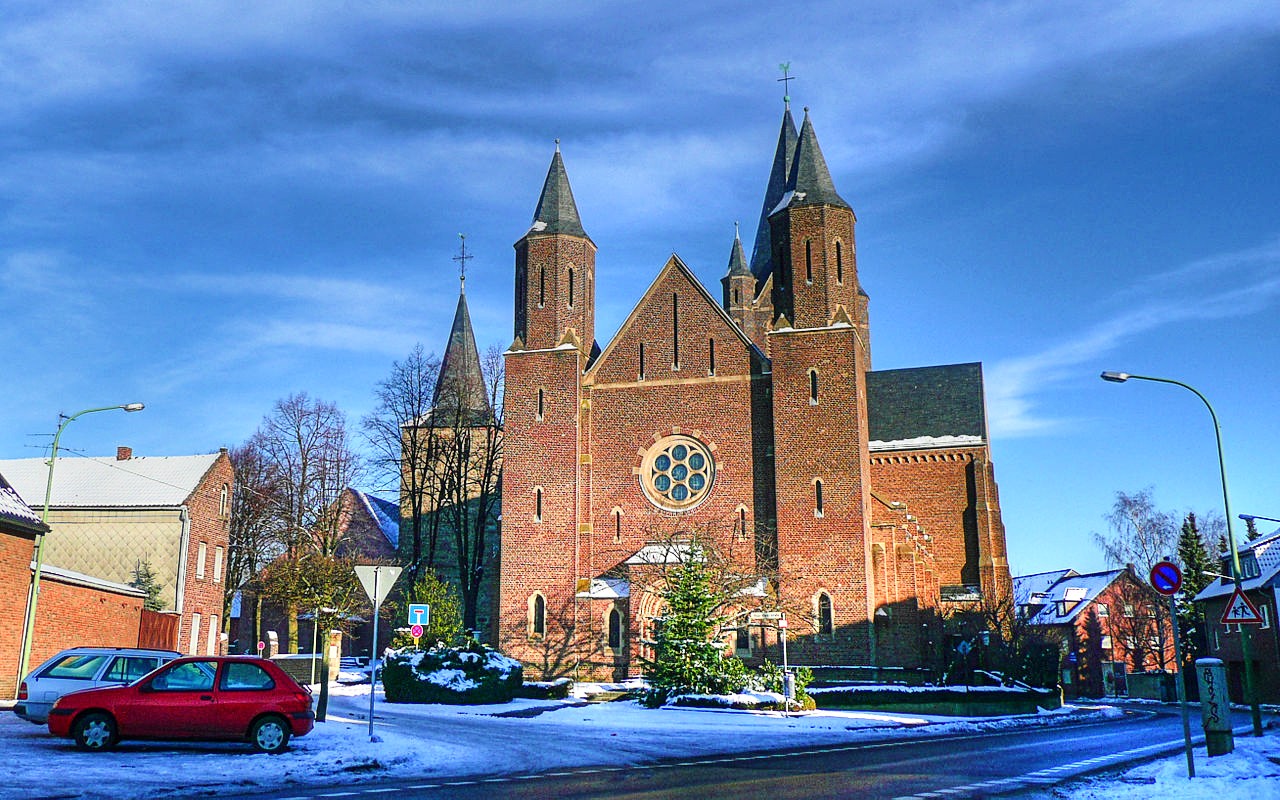
The Church of St Arnold in Arnoldsweiler
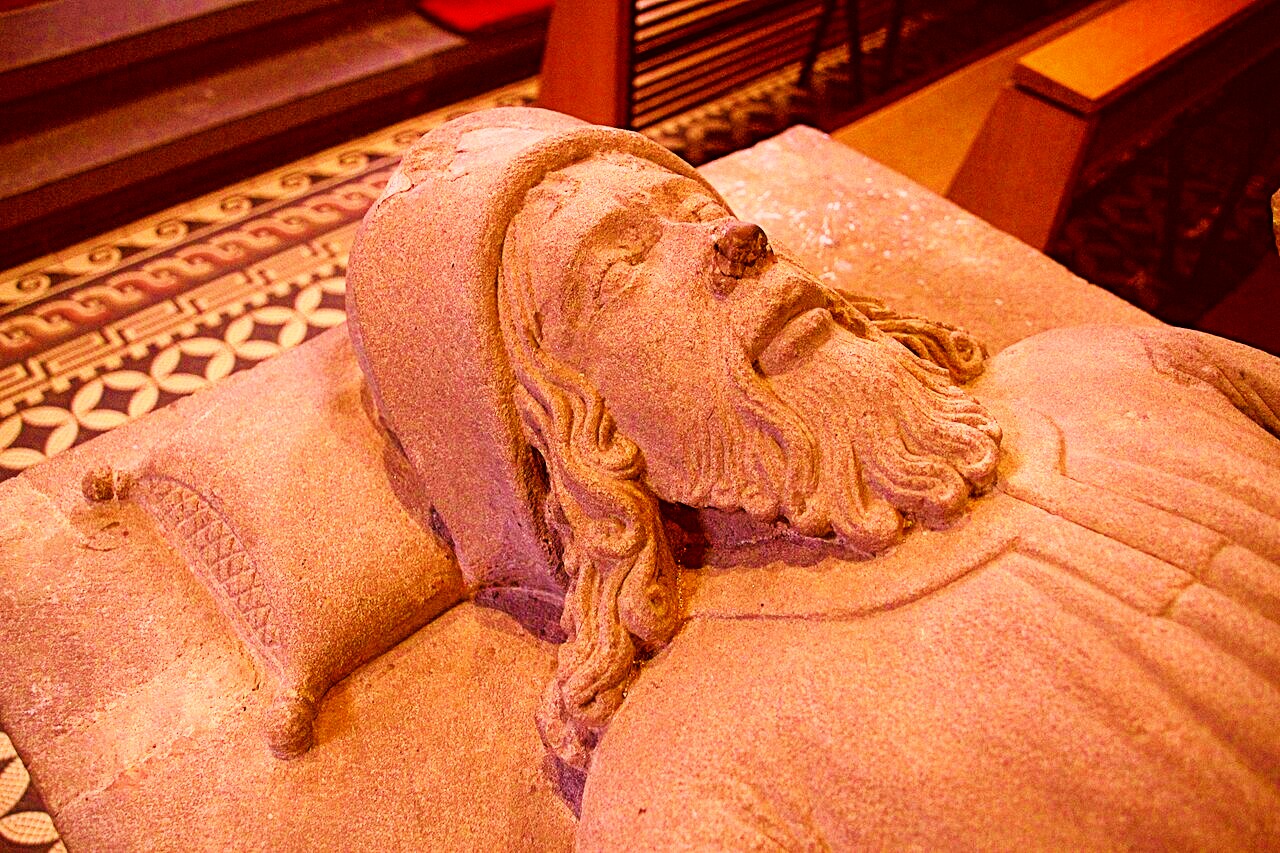
Arnold’s bones rest in a raised grave in the old Parish Church in Arnoldsweiler, now known as the Arnold Chapel. Parts of his head are now in the Arnold Church of the Steyler Missionaries in Neuenkirchen-St Arnold; its Founder, Father Arnold Janssen SVD (1837-1909), traced his name to Arnold of Arnoldsweiler. In the 15th Century, a brotherhood named after Arnold was founded in Arnoldsweiler, which still exists today. Arnoldus Week is celebrated in Arnoldsweiler around his memorial day, which concludes on Sunday with a Solemn High Nass and procession.
Arnold was probably Canonised by the Archbishop of Cologne as early as 820. However, the veneration was not officially confirmed until 18 February 1886 by Pope Leo XIII.
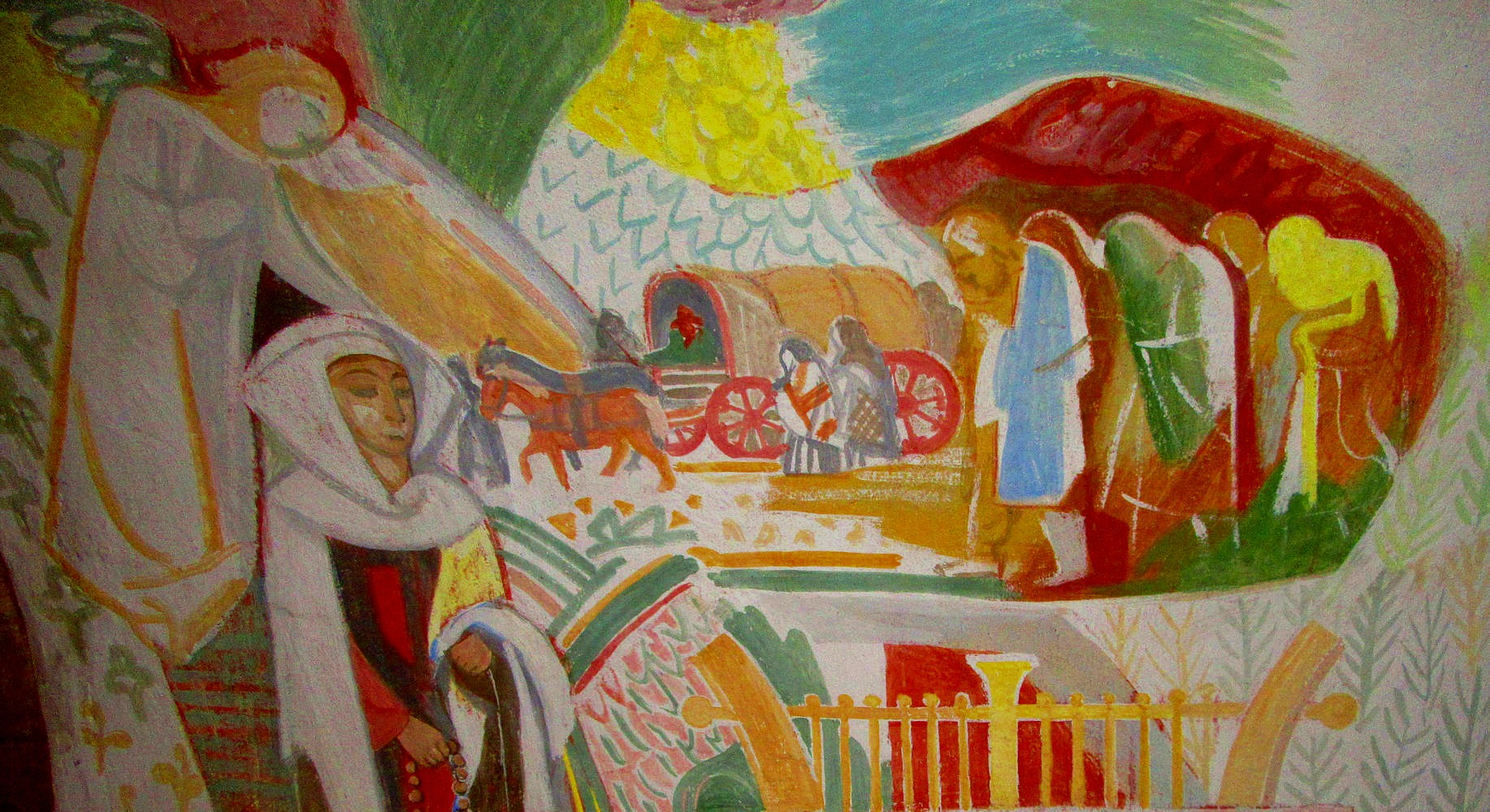
Peter Hecker: Duchess Magdalena of Jülich makes a pilgrimage to the grave of Armold in 1618, fresco, 1913, in the Arnold Chapel in Arnoldsweiler
St Symphorosa and her seven sons / Also known as – The Martyrs of Tivoli – 8 Saints: A widow, St Symphorosa and her seven sons ( Crescens, Eugene, Julian, Justin, Nemesius, Primitivus and Stracteus) Martyred in Tivoli, Italy in the 2nd-century persecutions of Hadrian.
St Aemilian of Dorostorium St Alanus of Sassovivo St Alfons Tracki Blessed Angeline of Marsciano Bl Arnold of Amiens St Arnold of Arnoldsweiler (Died 793) Layman St Arnoul the Martyr
Martyrs of Silistria – 7 Saints: Seven Christians who were Martyred together. No details about them have survived but the names – Bassus, Donata, Justus, Marinus, Maximus, Paulus and Secunda. They were martyred in Silistria (Durostorum), Moesia (in modern Bulgaria), date unknown.







 AnaStpaul
You must be logged in to post a comment.