Thought for the Day – 26 July – Meditations with Fr Richard Frederick Clarke SJ (1839-1900)
HUMILITY Meditations for a Month
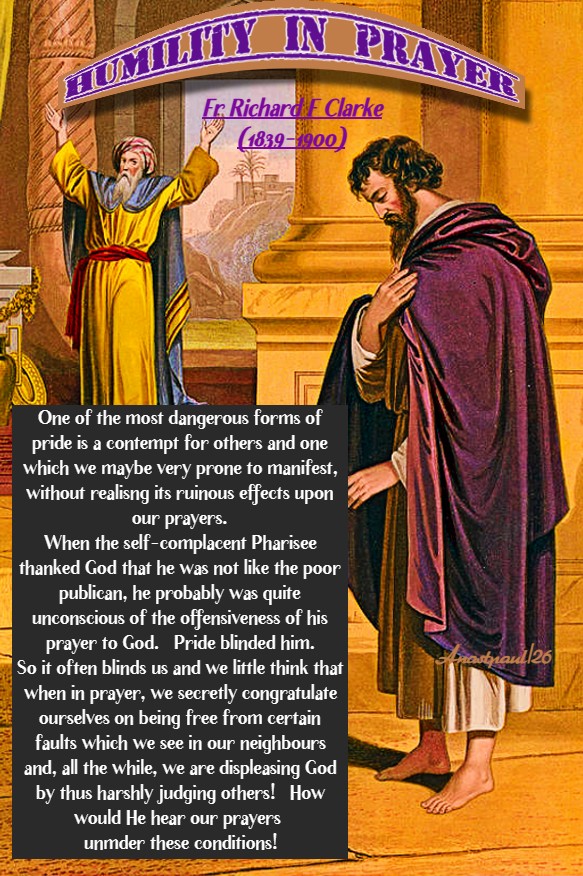
Humility in Prayer
We are all anxious that God should hear and grant our prayers. He is always ready to do so. The obstacles are always on our side and one of the chief of these is a want of humility. If God resists the proud, He is not likely to hear their prayers; hence, one of the first prerequisites of ssuccess in my prayers, is that I should humble myself before God. Then and not until then, will my prayer reach the ears of the Most High. “The prayer of him, who humbleth himself, pierces the clouds.”
One of the most dangerous forms of pride is a contempt for others and one which we maybe very prone to manifest, without realisng its ruinous effects upon our prayers. When the self-complacent Pharisee thanked God that he was not like the poor publican, he probably was quite unconscious of the offensiveness of his prayer to God. Pride blinded him. So it often blinds us and we little think that when in prayer, we secretly congratulate ourselves on being free from certain faults which we see in our neighbours and, all the while, we are displeasing God by thus harshly judging others! How would He hear our prayers unmder these conditions!
How are we to be humble in prayer? We should be humble in prayer by dwelling upon our own miseries and the good points we see in those around us or which we should see, if our own pride did not make us blind to others’ superiority to us and, the fact that, the graces God has liberally bestowed upon us, make our ingratitude and our want of correspondence to them, all the more culpable!
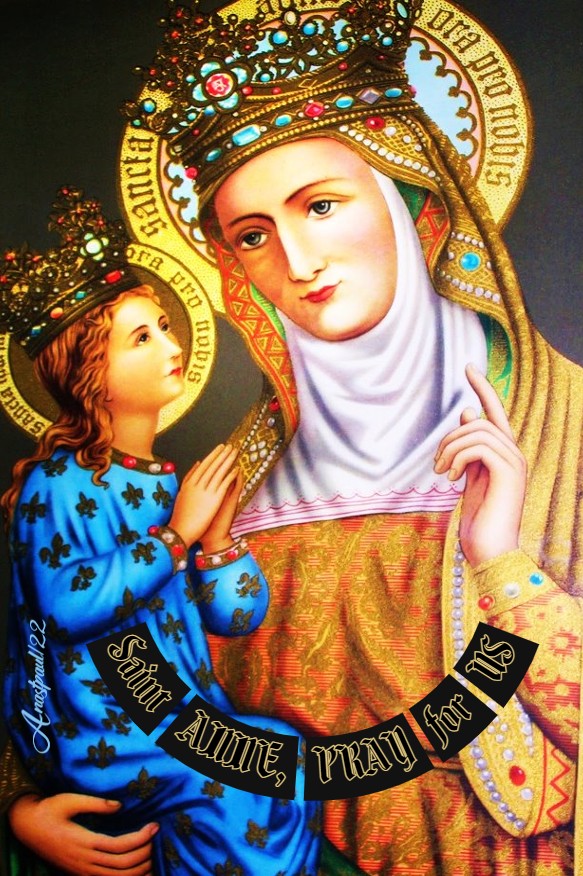
Quote/s of the Day – 26 July – St Anne, Mother of the Blessed Virgin Mary, Grandmother of Jesus.
St Anne, through her constant prayer, received, the Mother of God and then, became the Grandmother of God!
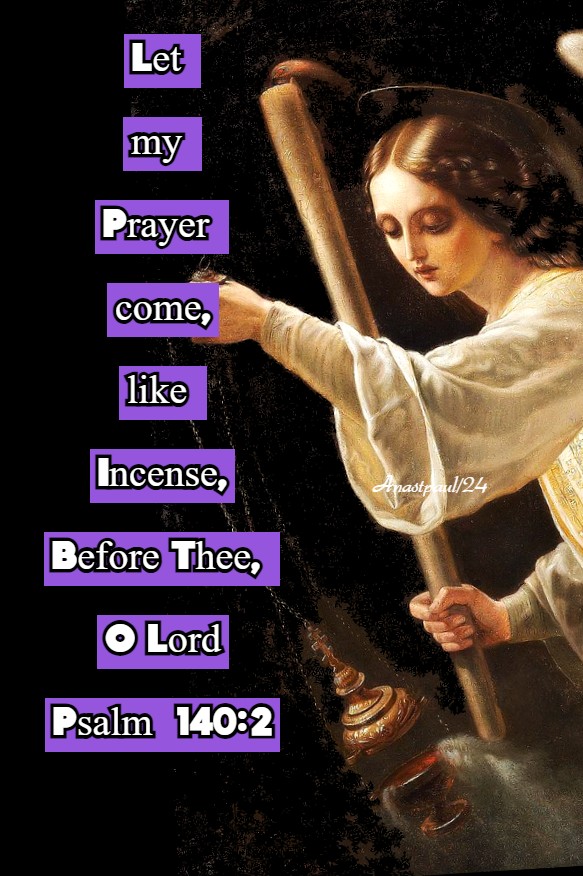
“Let my prayer come like incense before Thee, O Lord.”
Psalm 140:2
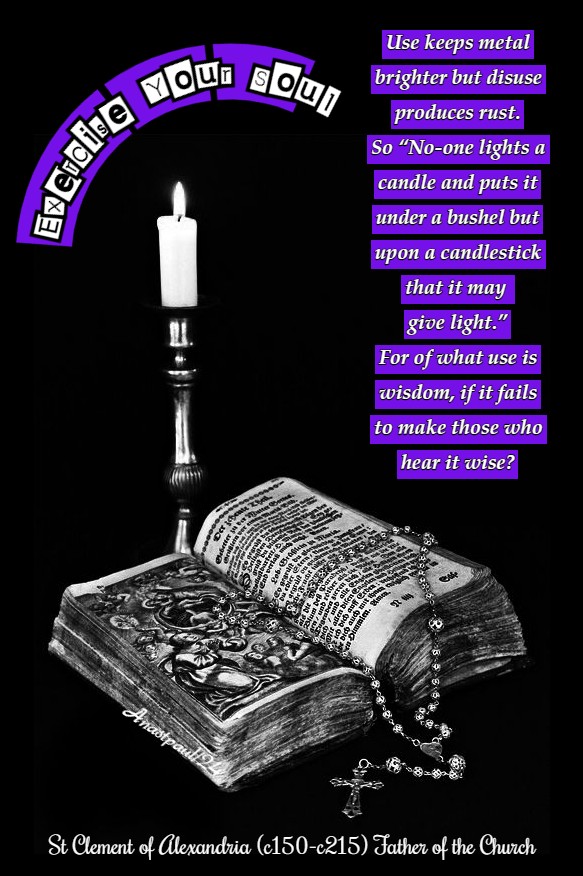
“Exercise your soul! Use keeps metal brighter but disuse produces rust. … So “No-one lights a candle and puts it under a bushel but upon a candlestick that it may give light.” For of what use is wisdom, if it fails to make those who hear it wise?”
St Clement of Alexandria (c150-c215) Father of the Church
“God accepts our desires as though they were of great value. He longs ardently for us to desire to and love Him. He accepts our petitions for benefits, as though we were doing Him a favour. His joy in giving, is greater than ours in receiving. So let us not be apathetic in our asking, nor set too narrow bounds to our requests; nor ask for frivolous things unworthy of God’s greatness.”
St Gregory Nazianzen (330-390) Father & Doctor of the Church
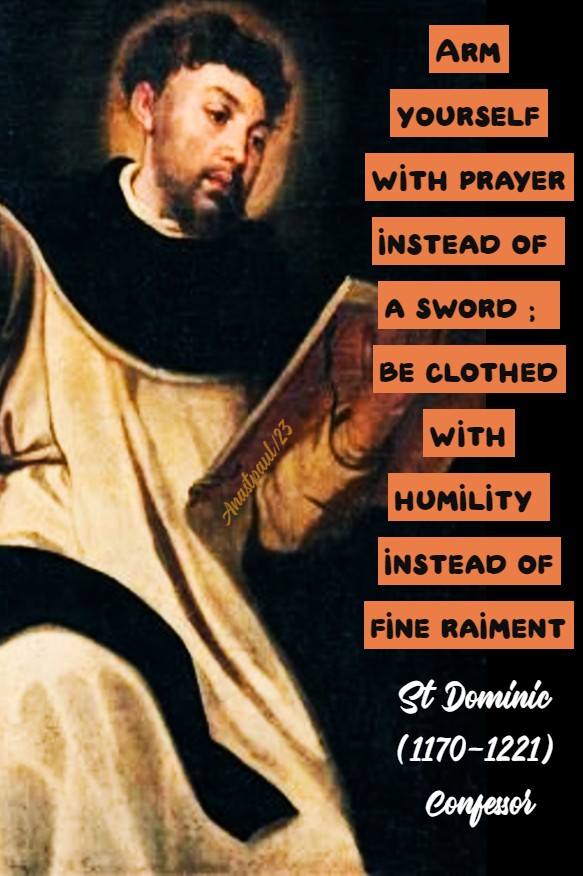
“Arm yourself with prayer instead of a sword; be clothed with humility instead of fine raiment.”
St Dominic OP (1170-1221)
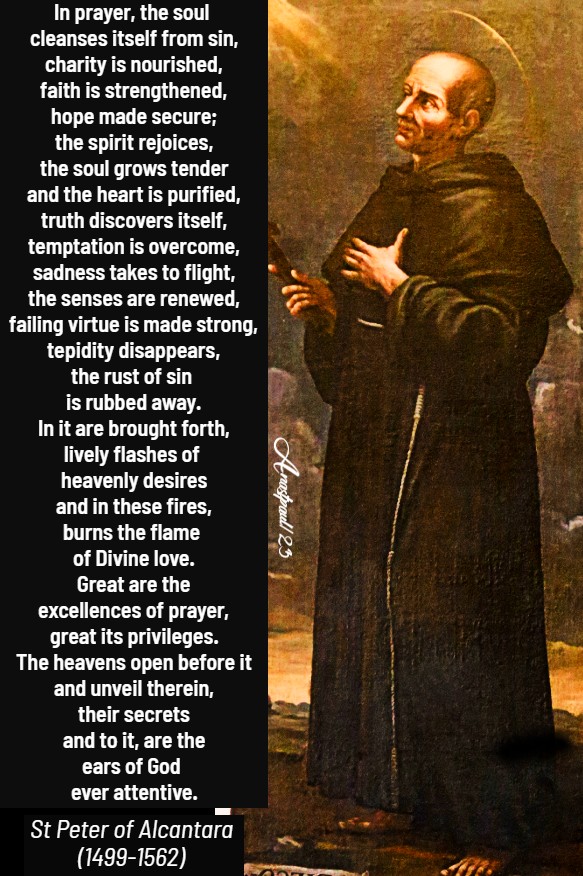
“In prayer, the soul cleanses itself from sin, charity is nourished, faith is strengthened, hope made secure; the spirit rejoices, the soul grows tender and the heart is purified, truth discovers itself, temptation is overcome, sadness takes to flight, the senses are renewed, failing virtue is made strong, tepidity disappears, the rust of sin is rubbed away. In it are brought forth, lively flashes of heavenly desires and in these fires, burns the flame of Divine love. Great are the excellences of prayer, great its privileges. The heavens open before it and unveil therein, their secrets and to it, are the ears of God ever attentive.”
A Golden Treatise of Mental Prayer Download the book, “A Golden Treatise of Mental Prayer”
St Peter of Alcantara (1499-1562)
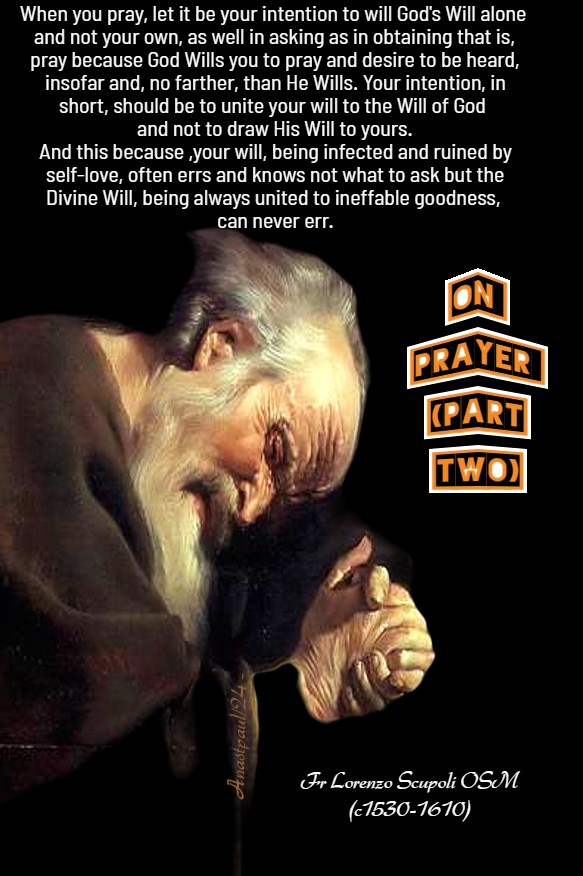
“When you pray, let it be your intention to will God’s Will alone and not your own, as well in asking as in obtaining that is, pray because God Wills you to pray and desire to be heard, insofar and, no farther, than He Wills. Your intention, in short, should be to unite your will to the Will of God and not to draw His Will to yours. And this because, your will, being infected and ruined by self-love, often errs and knows not what to ask but the Divine Will, being always united to ineffable goodness, can never err.”
One Minute Reflection – 26 July – “The Month of the Most Precious Blood” – St Anne, Mother of the Blessed Virgin Mary, Grandmother of Jesus.– Proverbs 31:10-31, Matthew 13:44-52 – Scripture search here: https://www.drbo.org/
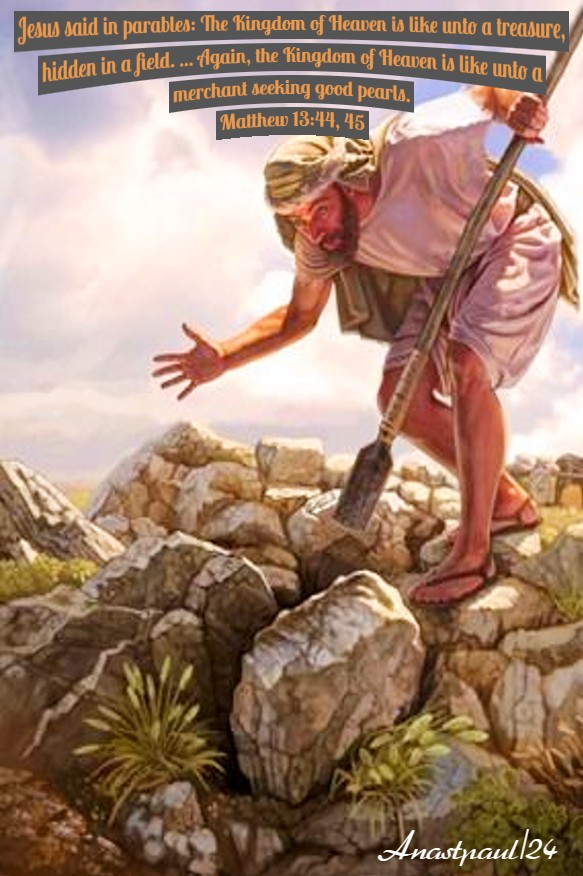
“Jesus said in parables: The Kingdom of Heaven is like unto a treasure, hidden in a field. … Again, the Kingdom of Heaven is like unto a merchant seeking good pearls. ”- Matthew 13:44 and 45
REFLECTION – “The two parables of the treasure and the pearl, both teach us the same thing – we should prefer the Gospel before all earthly treasures. … However, there is something even more praiseworthy than this – we should delight to give it preference, joyfully, unhesitatingly. Let us never forget this, to abandon all else, so as to follow God, is to gain more, than one loses. The preaching of the Gospel is hidden in this world like a hidden treasure, a treasure without price.
To gain this treasure … two conditions are required – the forsaking of this world’s goods and a firm determination. For, it is a question “of a merchant searching for fine pearls, when he finds a pearl of great price, he goes and sells all that he has and buys it.” This one pearl is Truth and Truth is one, it is not divided. Do you possess a pearl? Then you know your wealth, it is clenched in the palm of your hand, no-one is aware of your fortune.
So it is with the Gospel, if you embrace it with faith, if it remains enclosed in your heart, what a treasure you have You alone know it is there. Unbelievers, who know neither what it is nor what value it has, have no idea of your incredible wealth!” – St John Chrysostom (347-407) Bishop of Constantinople, Father and Doctor of the Church (Homilies on Saint Matthew’s Gospel No 47:2).
PRAYER – O God, Who in Thy kindness gave blessed Anne the grace to be the mother of her, who Mothered Thy Only-begotten Son, graciously grant that we who keep her feast, maybe helped by her intercession with Thee. Through the same Jesus Christ, Thy Son our Lord, Who lives and reigns with Thee, in the unity of the Holy Ghost, God, world without end. Amen (Collect).
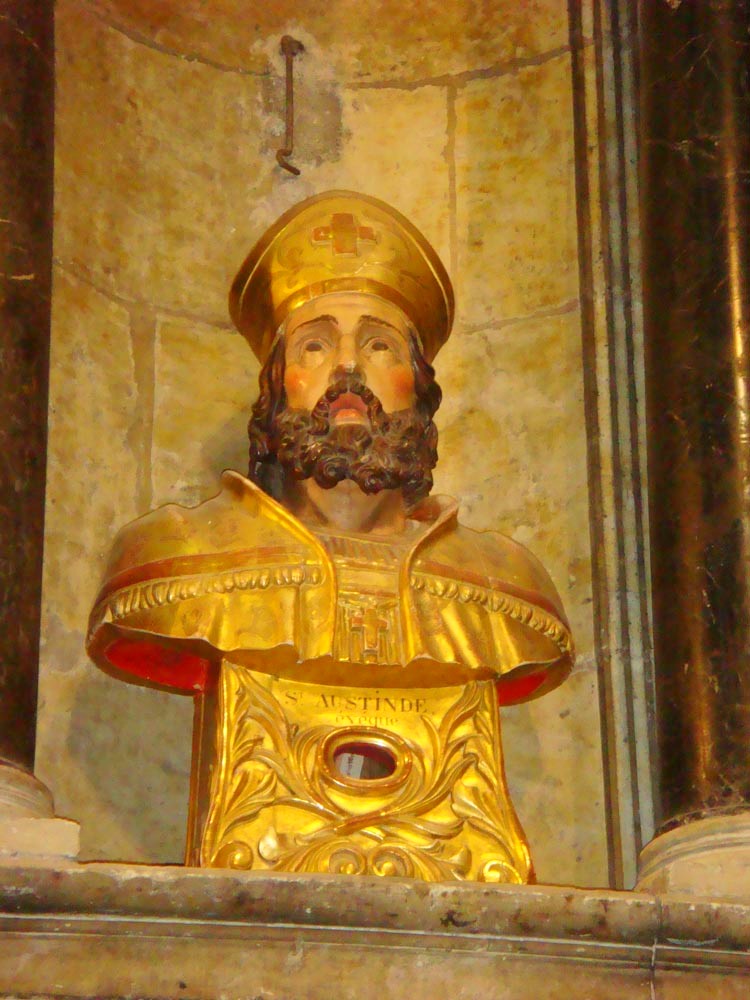
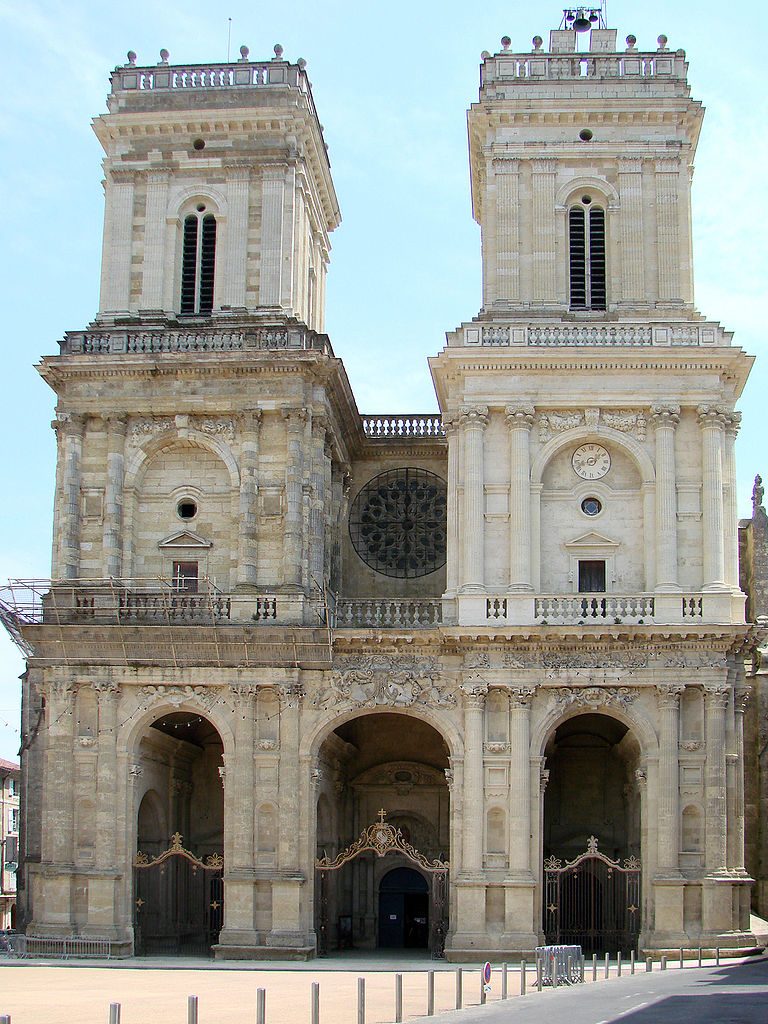
Saint of the Day – 26 July – Saint Austindus of Auch (c1000-1068) Archbishop of Auch in Aquitaine, France, Reformer of the faithful, Defender of the Church and Restorer and Builder of Churches. He is the actual Founder of the Auchs Cathedral which was completed during the reign of 3 of his successors. Born in c1000 in Bordeaux, France and died in 1068 at Auch, Aquitaine of natural causes. Also known as – Ostent, Austinde. Additional Memorial – 25 September (Archdiocese of Auch, France.
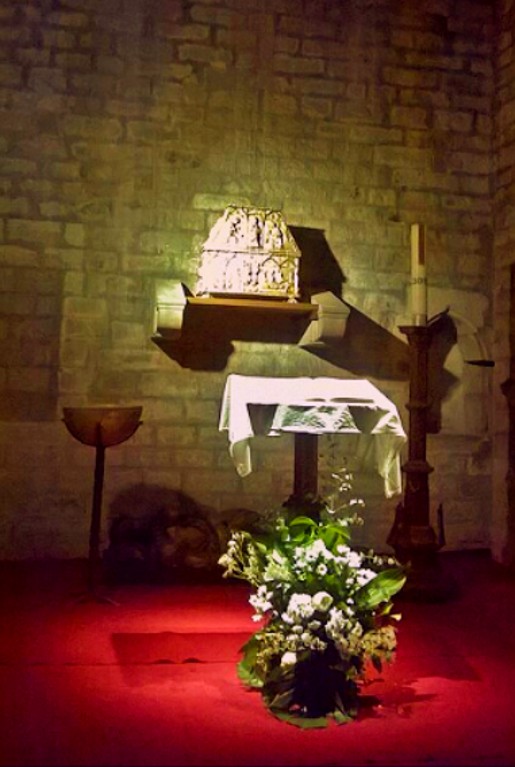
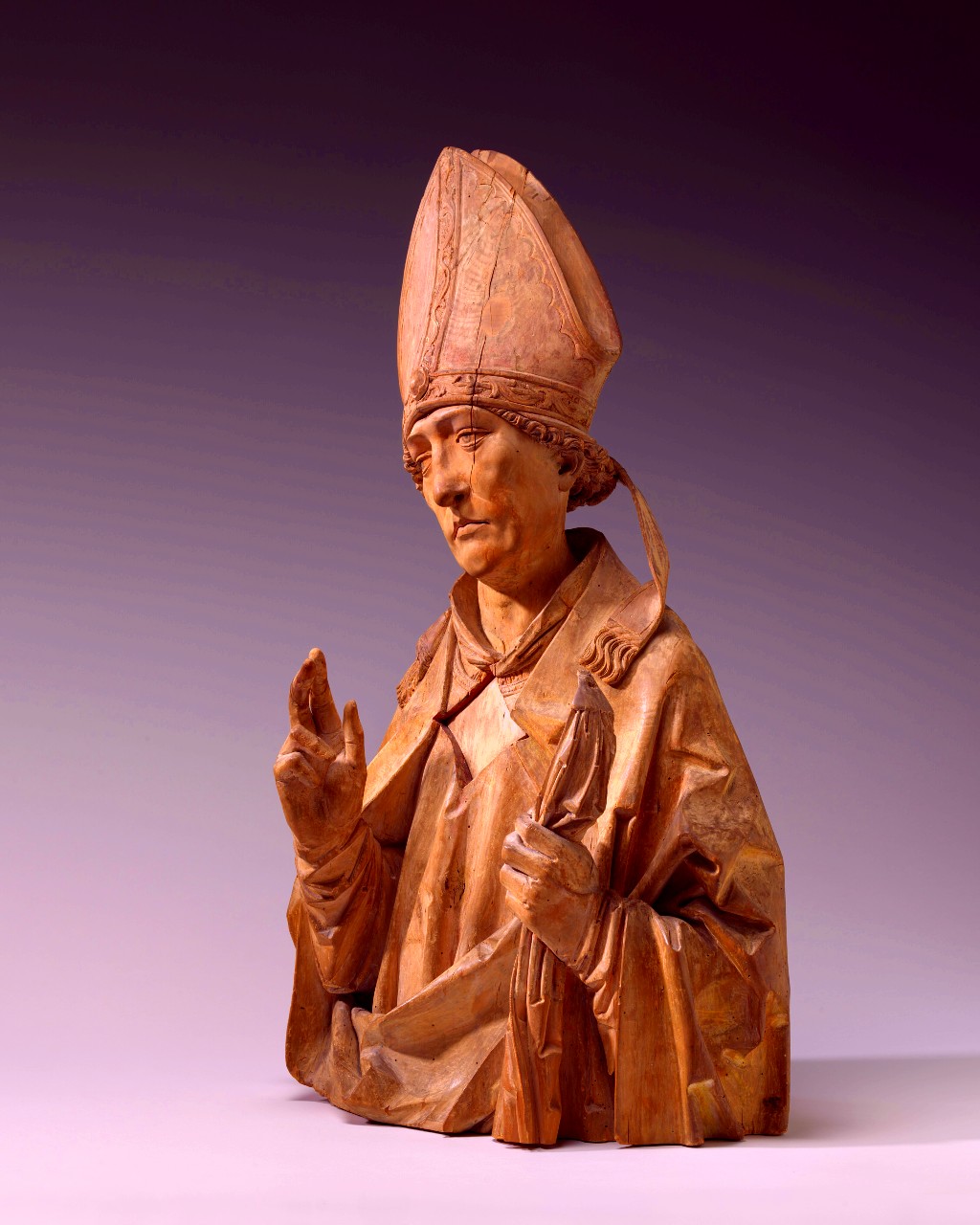
St Austindus Bust and Relics in his Shrine at Auch Cathedral
Austindus became a Benedictine Monk at Saint Orens’ Abbey in Auch, then Abbot of the Monastery. He was elected as the Archbishop of Auch, shortly after the middle of the 11th Century, in place of Raymond Copa who was deposed for simony.
St Orens Abbey
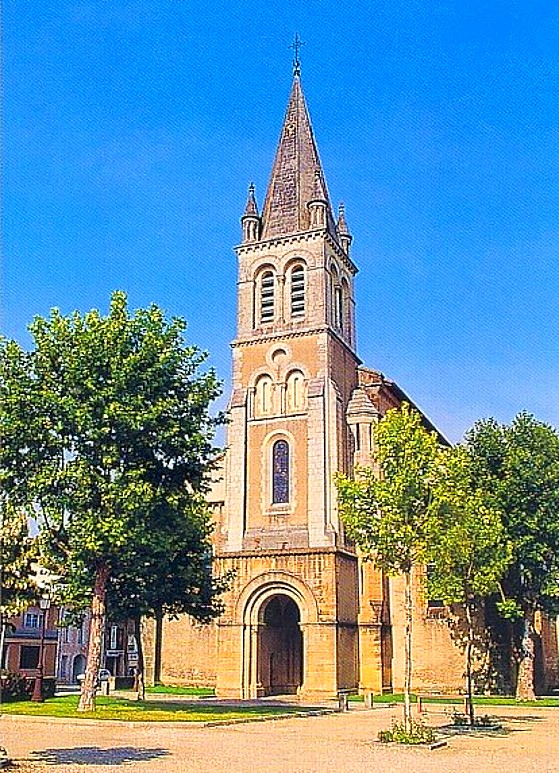
A builder, he erected a Chapter House with Cloister, began a new Cathedral between 1064 and 1069. It was finally completed and consecrated in 1121. Austindus founded the Town of Nogaro and its Collegiate Church dedicated to St Nicholas. “It was Saint-Austindus, Archbishop of Auch, who founded the Town on land sold to him by Guillaume Raymond Nogaro. He wanted to hold his Councils there. Austindus had a Church built dedicated to Saint Nicholas which he Consecrated in 1060 in the midst of a large crowd of people, lords and dignitaries who had come from all over Gascony. He very quickly equipped it with a Collegiate Church and established a College of Canons and Canonesses there.” ( History of the Town – Nogaro in Armagnac)
A reformer, he had the Rule of Cluny adopted, reinstated the abolished Bishoprics of Gascony, and directed Councils and Synods.
A defender, the struggles between the Frankish Princes and the Princes of Armagnac and Gascony, had repercussions on the rights of the Church which Austindus had to defend against the encroachments of the lords. We have his signature and notes on this matter, during a Council in Jacca in Spain. But this fight against lay usurpers forced him to take refuge in Rheims for two years. He returned to his Diocese and died shortly after a Synod, in 1068.
St Nicholas Church in the Town of Nogaro both Town and Church founded and built by St Austindus
St Benigno of Malcestine Bl Camilla Gentili St Charus of Malcestine Bl Edward Thwing Bl Élisabeth-Thérèse de Consolin St Erastus Bl Évangéliste of Verona St Exuperia the Martyr Bl George Swallowell St Gérontios St Gothalm St Hyacinth Bl Hugh of Sassoferrato Bl Jacques Netsetov Bl John Ingram St Joris Bl Marie-Claire du Bac Bl Marie-Madeleine Justamond Bl Marie-Marguerite Bonnet St Olympius the Tribune
Thought for the Day – 25 July – Meditations with Fr Richard Frederick Clarke SJ (1839-1900)
CHARITY Meditations for a Month
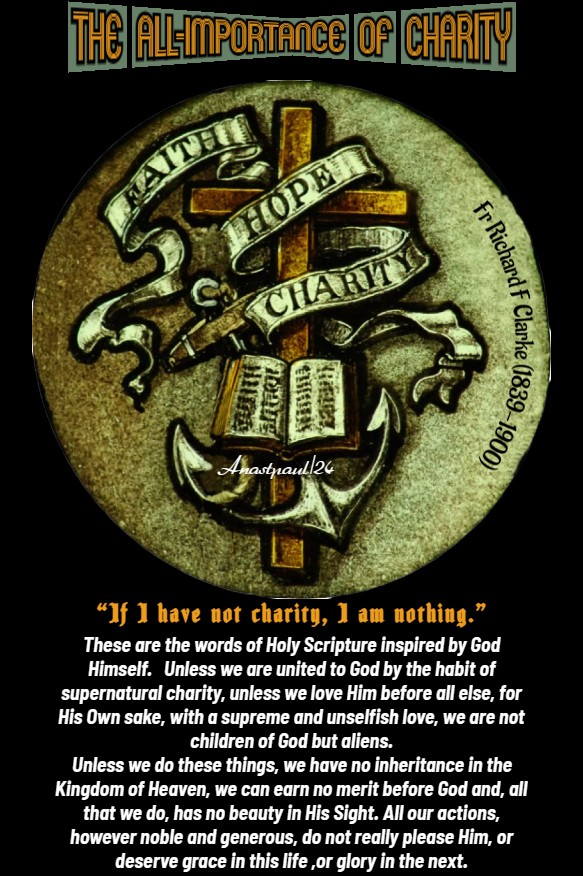
The All-Importance of Charity
“If I have not charity, I am nothing.” These are the words of Holy Scripture inspired by God Himself. Unless we are united to God by the habit of supernatural charity, unless we love Him before all else, for His Own sake, with a supreme and unselfish love, we are not children of God but aliens. Unless we do these things, we have no inheritance in the Kingdom of Heaven, we can earn no merit before God and, all that we do, has no beauty in His Sight. All our actions, however noble and generous, do not really please Him, or deserve grace in this life ,or glory in the next.
Moreover, unless there is at least an initial element of charity in our actions, they will not help us in any way on the road to Heaven. Acts of faith and hope, although they maybe performed by one who has not perfect charity, contain an unformed and rudimentary element of charity. They are the germ or bud from which charity may afterwards spring and, in this way, they lead to charity. In themselves, faith and hope gain no merit, unless they are the actions of one who already has charity in his heart.
Even if we have the habit of charity and are in a state of grace, our actions are not meritorious before God, unless they are done from a motive of charity. Charity must in some way influence faith and hope, if not with a present thought of God, yet, with the golden light of our love for Him lighting them up. Without this, they may count for nothing, or at most, merit only a natural reward. If I give money purely out of natural compassion and pity, I gain a temporal but not, an eternal reward. How careful I must be to offer to God each act of charity to men!
Quote/s of the Day – 25 July – The Feast of St James the Greater, Apostle and Martyr and of St Christopher (died c 251) One of the Fourteen Holy Helpers
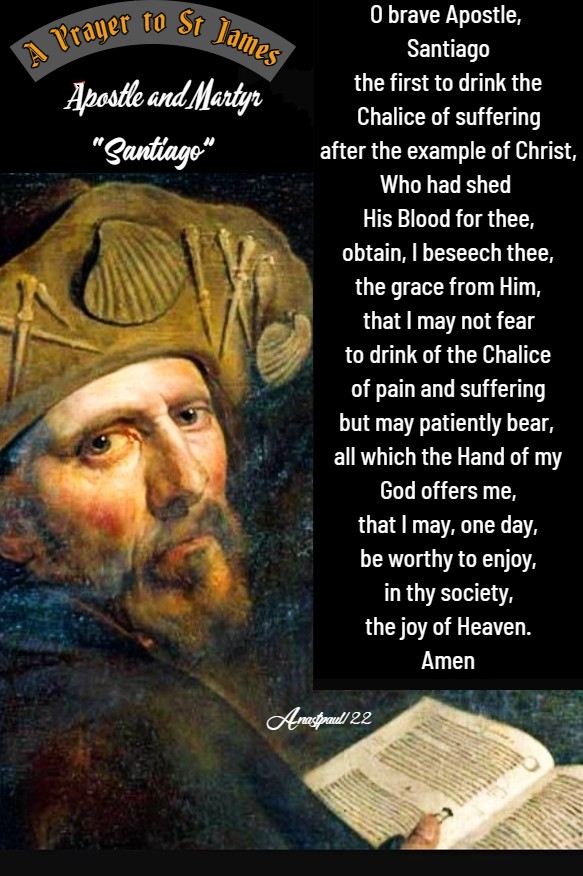
A Prayer to St James “Santiago”
O brave Apostle, Santiago the first to drink the Chalice of suffering after the example of Christ, Who had shed His Blood for thee, obtain from Him, I beseech thee, the grace that I may not fear, to drink of the Chalice, of pain and suffering but may patiently bear, all which the Hand of my God offers me, that I may, one day, be worthy to enjoy, in thy society, the joy of Heaven. Amen
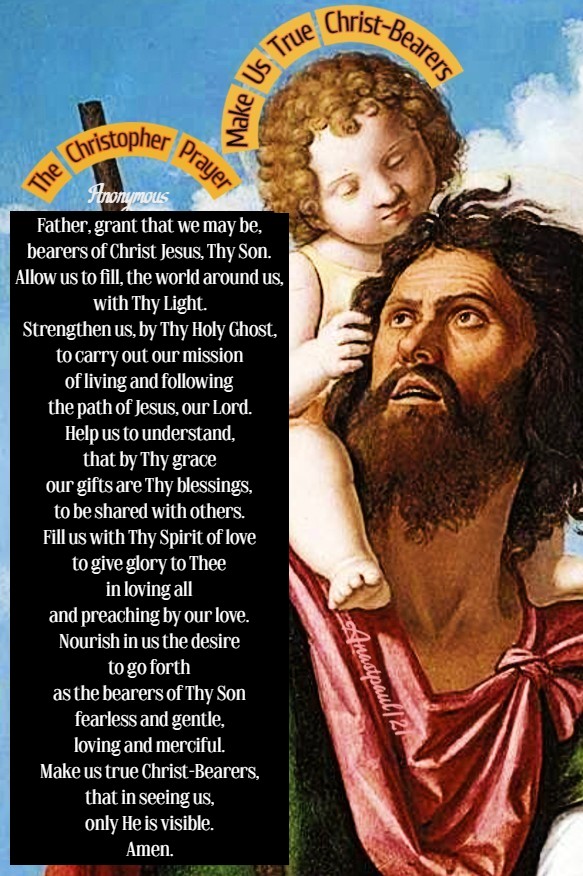
The Christopher Prayer, Make Us True Christ-Bearers Anonymous
Father, grant that we may be, bearers of Christ Jesus, Thy Son. Allow us to fill, the world around us, with Thy Light. Strengthen us, by Thy Holy Ghost, to carry out our mission of living and following the path of Jesus, our Lord. Help us to understand, that by Thy grace our gifts are Thy blessings, to be shared with others. Fill us with Thy Spirit of love to give glory to Thee in loving all and preaching by our love. Nourish in us the desire to go forth as the bearers of Thy Son fearless and gentle, loving and merciful. Make us true Christ-Bearers, that in seeing us, only He is visible. Amen.
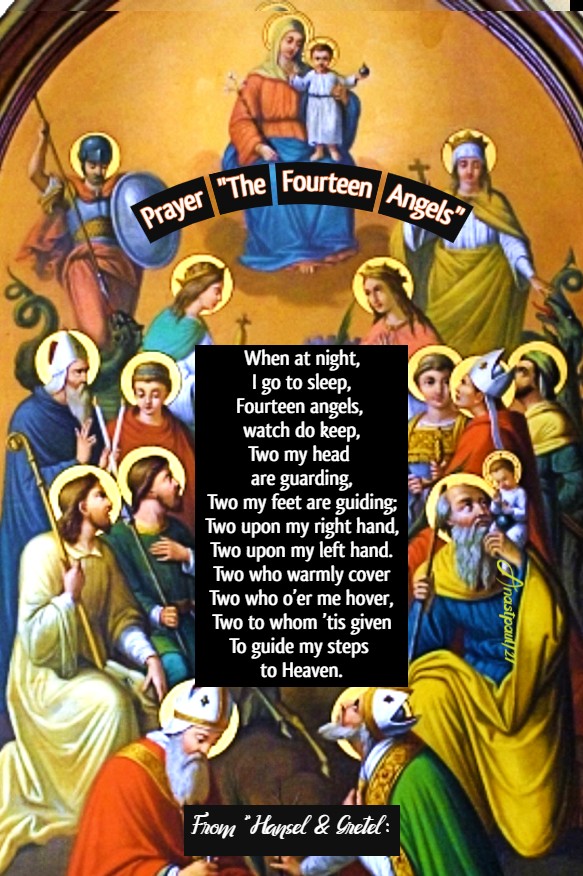
The “fourteen Angels” of the lost children’s prayer in the Composer, Engelbert Humperdinck’s (1854-1921) (not the popular Welsh singer) fairy opera, ‘Hansel and Gretel’, are the Fourteen Holy Helpers. The English words are familiar and very beautiful:
When at night, I go to sleep, Fourteen angels, watch do keep, Two my head are guarding, Two my feet are guiding; Two upon my right hand, Two upon my left hand. Two who warmly cover Two who o’er me hover, Two to whom ’tis given To guide my steps to Heaven.
One Minute Reflection – 25 July – “The Month of the Most Precious Blood” – The Feast of St James the Greater, Apostle and Martyr – 1 Corinthians 4:9-15; Matthew 20:20-23– Scripture search here: https://www.drbo.org/
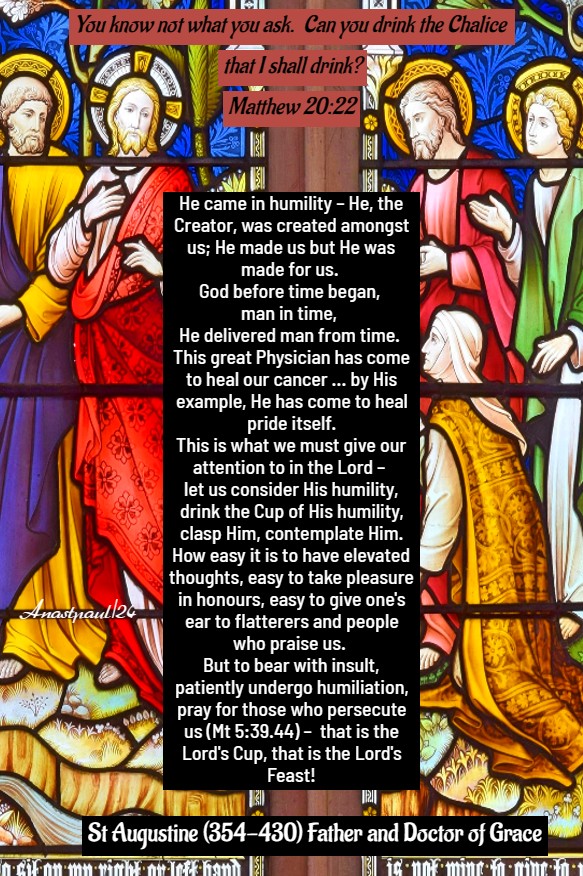
“ You know not what you ask. Can you drink the Chalice that I shall drink?” – Matthew 20:22
REFLECTION – “Christ laid down His life for us, so we ought to lay down our lives for our brothers” (1 Jn 3:16) … Jesus said to Peter: “When you were younger, you used to dress yourself and go where you wanted but when you grow old, … someone else will dress you and lead you where you do not want to go …” (Jn 21:18). It was the Cross, the Passion, he promised him. “Go even so far as to pasture My sheep, suffer for My sheep.” This is what a good Bishop is to be. If he is not, he is no Bishop!
… Now listen to this other testimony. Two of His disciples, the brothers John and James, who were sons of Zebedee, were ambitious for the first place, without consideration for the others. … Our Lord answered them: “You do not know what you are asking” for He added: “Can you drink the Chalice that I shall drink?” What cup is this if not that … of the Passion?… And they, forgetting their weakness, immediately said: “We can.” Then He said to them: “My Chalice you will indeed drink. But to sit at My right or at My left,is not Mine to give but is for those for whom it has been prepared by My Father.”… In this way, He gave proof of His humility, for in fact, everything the Father prepares is prepared too, for the Son … He came in humility – He, the Creator, was created amongst us; He made us but He was made for us. God before time began, man in time, He delivered man from time. This great Physician has come to heal our cancer … by His example, He has come to heal pride itself.
This is what we must give our attention to in the Lord – let us consider His humility, drink the Cup of His humility, clasp Him, contemplate Him. How easy it is to have elevated thoughts, easy to take pleasure in honours, easy to give one’s ear to flatterers and people who praise us. But to bear with insult, patiently undergo humiliation, pray for those who persecute us (Mt 5:39.44) – that is the Lord’s Cup, that is the Lord’s Feast!” – St Augustine (354-430) Father and Doctor of Grace (Extract from a Sermon for the Ordination of a Bishop).
PRAYER – Protect Thy people and make them holy, O Lord, so that, guarded by the help of Thy Apostle James, they may please Thee by their conduct and serve Thee with peace of mind. Through esus Christ, Thy Son our Lord, Who lives and reigns with Thee, in the unity of the Holy Ghost, God, world without end. Amen (Collect).
Our Morning Offering – 25 July – The Feast of St James the Greater, Apostle and Martyr
Aeterna Christi Munera The Eternal Gifts of Christ the King By St Ambrose (340-397) Father and Doctor of the Church
The eternal gifts of Christ the King, The Apostles’ glory let us sing. And al,l with hearts of gladness raise, Due hymns of thankful love and praise! For they the Church’s Princes are, Triumphant leaders in the warrior band, True lights to lighten every land.
Theirs was the steadfast faith of Saints, The hope which never yields nor faints, The love of Christ in perfect glow, That lay the prince of this world low, In them, the Father’s glory shone, In them, the Spirit’s will was done.
The Son Himself, exults in them, Joy fills the new Jerusalem. Praise to the Father, with the Son, And Holy Ghost, three in One; As ever was in ages past, And so shall be while ages last. Amen.
The Authorship of this Hymn is generally attributed to St Ambrose. He intended this composition of eight strophes to be used on the Feast Days of Martyrs. In the course of time, however,, the Hymn was selected for use on the Feast Days of the Apostles too. In each case, the Hymn praises the victory of the Apostles or Martyrs and expresses admiration for their constancy in specifically described trials and sufferings.
Saint of the Day – 25 July – St Cugat del Valles (Died c304) Lay Martyr, Preacher, Evangeliser, Miracle-worker. Born in North Africa and died by beheading in 304 near Barcelona, Spain. Pstronages – of hunchbacks, petty thieves, of the City of St Cugat del Valles in Spain. Also known as – Cobad, Cocoba, Cocobas, Cophan, Cougat, Covade, Cucao, Cucufa, Cucufas, Cucufat, Cucufate, Cucuphas, Cucuphat, Culgat, Guinefort, Gulnefort, Qaqophas, Qoqofas, Quiquefat, Quiquenfat. At Barcelona he is called Saint Cugat, at Ruel, near Paris, Saint Quiquenfat, in some other parts of France, Saint Guinefort. Additional Memorials – 27 July – in Barcelona to avoid a clash with today’s Feast of St James, 16 February (translation of relics to Léberan), 25 August (translation of relics to Saint-Denis).
The Roman Martyrology reads: “At Barcelona in Spain, during the persecution of Diocletian and under the Governor Darian, the birthday of the holy Martyr Cucuphas. After overcoming many torments, he was struck with the sword and thus went triumphantly to Heaven.”
Saint Cugat is one of the most venerated Saints in Spain but all that history has preserved of him is contained in a poem by the renowned Aurelius Prudentius (a Latin Christian poet of Spanish origin, (c348 – c413) ) who dedicates this short expression to him: “Barcelona will rise from the famous Cucufate.”
There is no certainty about the time of his Martyrdom, which. however. occurred during the persecution of Diocletian (243-313) and is placed at the beginning of the 4th Century. An anonymous author compiled the ‘Acts’ of the Martyrdom in the 8th Century but does not present historical elements.
Cugat and Felix, originally from Scillium in Africa, both noble and rich, having learned of the persecutions which had begun in the eastern provinces, fled to the West.
But when they landed in Barcelona, they realised that persecution was imminent there too, so as Christians they offered their goods to the poor, dedicating themselves to works of mercy and the spread of the Christian Gospel.
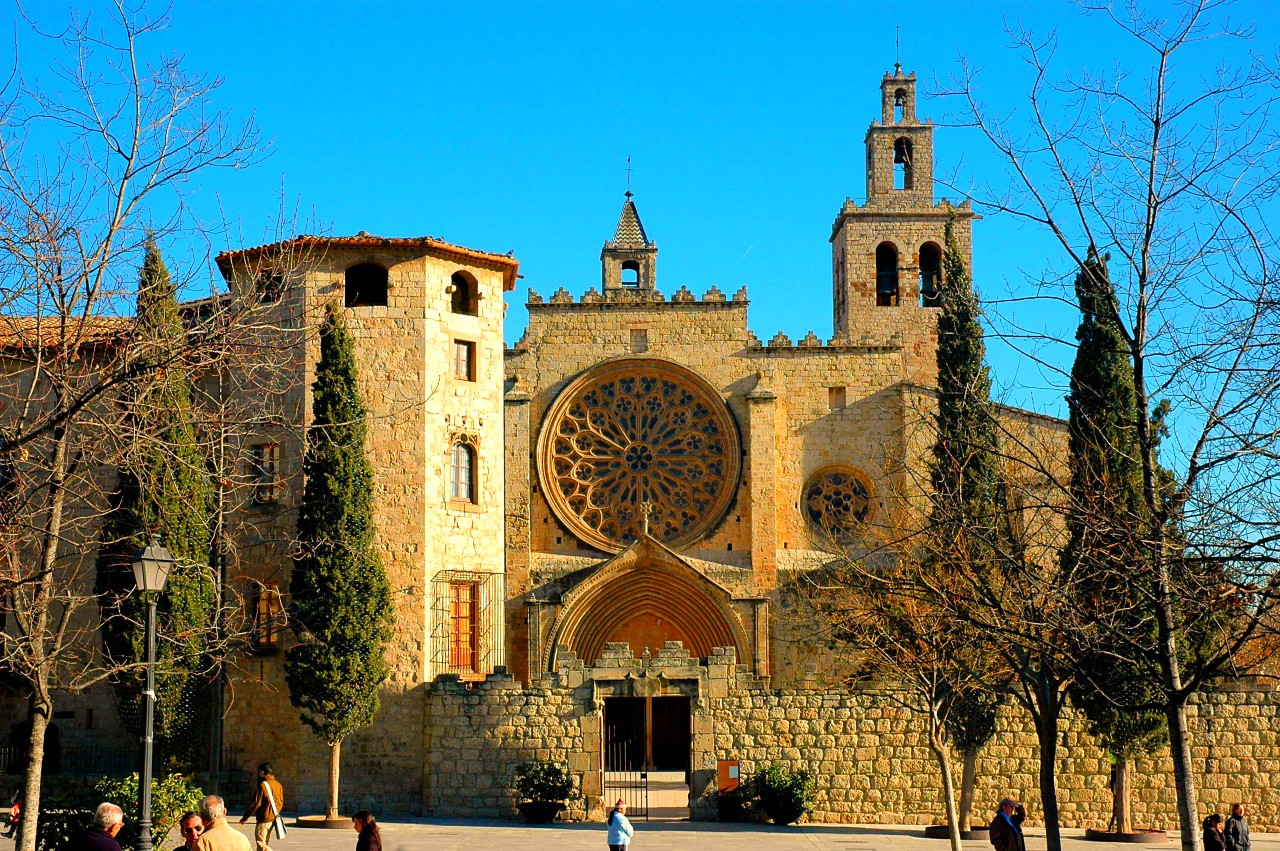
St Cugat del Valles Monastery and Church
Felix moved to Gerona in Catalonia, while Cugat remained in Barcelona, dedicating himself openly to preaching, which was accompanied by numerous miracles. He was arrested by order of the Proconsul Galerius and was tortured so savagely that his intestines were exposed, while he invoked the Lord God. The ‘Passio’ continues, saying that the twelve soldiers who tortured him were blinded by a flash of fire, while Galerius was burned together with the idols. Cugat.however, suddenly found himself completely unharmed.
In place of Galerius, Maximian, inflicting various and unheard of torments but again, miraculously he was Cugat suffered no injury. Then an Officer of the Prefect Dacianus, a certain Rufinus, intervened and had him beheaded.
His body was collected by the Christians and buried on 25 July of an unspecified year and place. But, in the middle of the 8th Century, the Abbot of St Denis near Paris, St Fulrad (Died784), managed to obtain the Relics of St Cugat, taking them to the Priory of Lièvre in Alsace (France) where they were placed, in the cell of St Fulrad. In 835 the Relics or a part thereof, were brought to St Denis by order of the Abbot Ilduinus and placed in the crypt of the Abbey Church.
In the early years of the 9th Century, the famous Benedictine Abbey of St Cugat del Vallés arose near Barcelona in a place called Octavian. In 1079, the Relics of an unknown Martyr were recognised as those of St Cugat, as only the head of the Martyr killed in Barcelona had been taken to France.
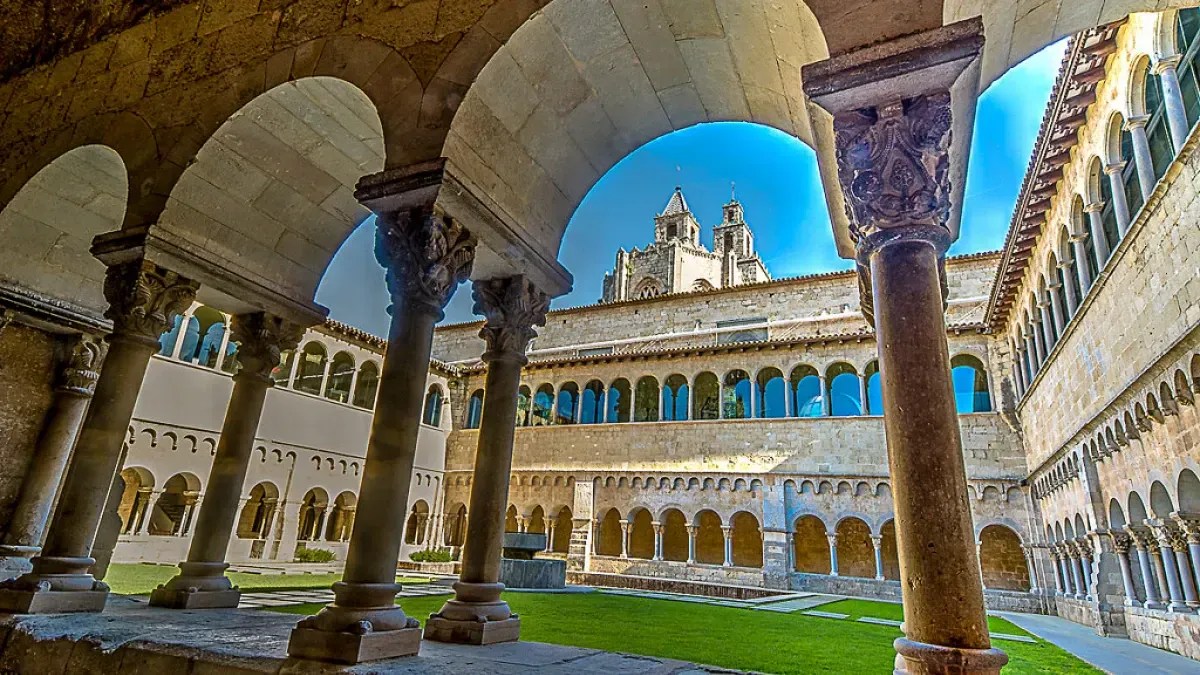
St Cugat’s Monastery C;oister
Several Churches are dedicated to him both in Spain and in France The various Martyrologies including the Roman celebrate him on 25 July. But, in Barcelona, St Cugat is celebrated on 27 July to avoide the ovvious clash with the celebration of St James the Apostle.
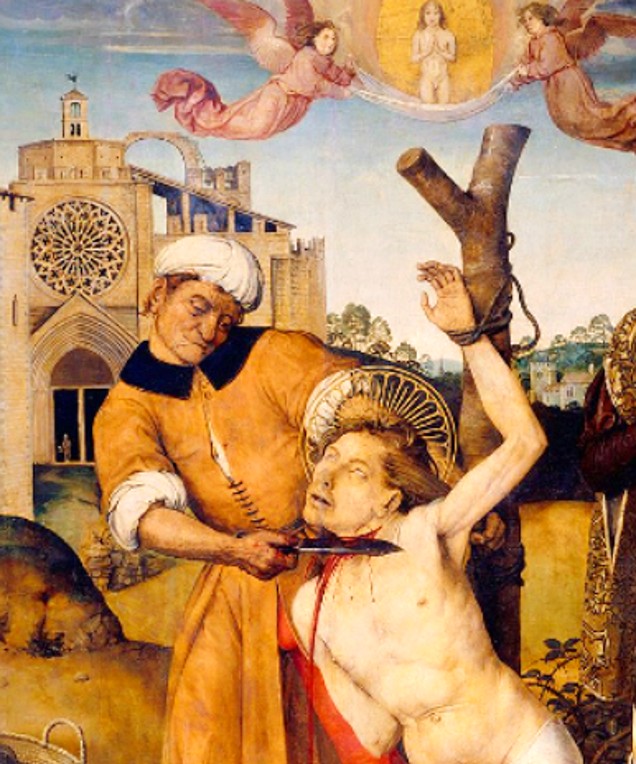
In the Museum of Catalanese Art in Barcelona, there is a painting by the Artist Ajna Brù, which depicts the very dramatic and violent scene of the beheading of St Cugat, with a large knife, giving particular emphasis to the perfidious and evil expression of the executioner – see the image above.
Bl Antonio of Olmedo St Bantu of Trier St Beatus of Trier St Cugat del Valles (Died c304) Lay Martyr St Ebrulfus St Fagildo of Santiago St Felix of Furcona St Florentius of Furcona St Glodesind of Metz
St Mordeyren St Nissen of Wexford St Olympiad of Constantinople St Paul of Palestine
Blessed Pietro Corradini OFM (1435–1490) Priest of the Franciscan Friars Minor, Confessor, Preacher, Spiritual Director. Pietro and a great devotion to the Holy Mother and constantly taught love of her. Fr Pietro served in several leadership positions within his Order. The Beatification process commenced not too long after Fr Pietro’s death and culminated on 10 August 1760 after Pope Clement XIII issued a formal decree that approved Corradini’s local ‘cultus’ thus naming him Blessed. A Special Child of Mary: https://anastpaul.com/2020/07/25/saint-of-the-day-25-july-blessed-pietro-corradini-ofm-1435-1490-priest/
St Theodemir of Cordoba
Martyrs of Caesarea – 3 Saints: Three Christians Martyred together in the pesecutions of emperor Maximilian and governor Firmilian – Paul, Tea and Valentina. 309 in Caesarea, Palestine.
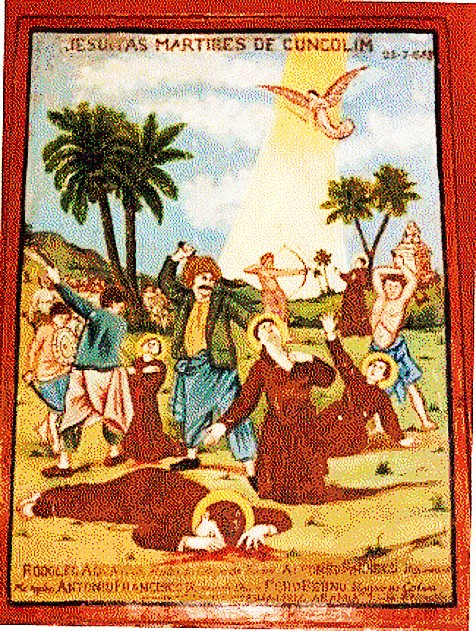
Martyrs of Cuncolim, Goa, south western India– 20 Saints: On 15 July 1583 the group met at the Church of Orlim and hiked to Cuncolim to erect a Cross and choose land for a new Church. Local anti-Christian Hindu pagans, seeing the unarmed Christians, gathered their weapons and marched on them. One of the Parishioners, a Portuguese emigre named Gonçalo Rodrigues, carried a firearm but Father Alphonsus Pacheco stopped him from using it. The Hindu pagans, numbering at least 500, then fell upon them and killed them all without mercy. They were – • Alphonsus Pacheco • Alphonsus the altar boy • Anthony Francis • Dominic of Cuncolim • Francis Aranha • Francis Rodrigues • Gonçalo Rodrigues • Paul da Costa • Peter Berno • Rudolph Acquaviva • ten other native Christian converts whose names have not come down to us They were Martyred on Monday 25 July 1583 at the village of Cuncolim, district of Salcete, territory of Goa, India. They were Beatified on 30 April 1893 by Pope Leo XIII.
Thought for the Day – 24 July – Meditations with Fr Richard Frederick Clarke SJ (1839-1900)
CHARITY Meditations for a Month
Charity and Self-love
If charity really promotes our highest interests and, even in its most disinterested form, ministers to our good, how is it that it is so often compared with self-love? When we speak of self-love, we do not mean the true love of self which is identical with charity. We mean the love of our lower self. We mean the choice of some immediate good instead of the far higher and nobler good which we shall secure by sacrifice of the lower good. Self-love is the love of the child for the unwholesome sweets which it knows will produce sickness on the morrow. How often my self-love has led me to grasp at the passing enjoyment instead of the solid happiness, I should have gained, by renouncing it.
Self-love does a still more mischievous work. It leads us to thrust ourselves into a position we know is a false one, in order to gratify our desire for independence and for liberty. Self-love hates subjection and is thus diametrically opposed to charity which loves to be subject. Self-love hates the lowest place or humble work and yearns after notoriety or prominence. Charity appreciates the nothingness of self and desires that God should be all in all!
Self-love, again, cannot endure any sort of reproof or correction. It rebels against those things and longs to revenge itself. It is thus, no true love of self, for he who really loves himself, or rather, who finds his highest happiness in preferring God to self, welcomes anything which tends to lower self and to make God the exclusive object of his love. Thus, in hating self, he loves self with a true self-love and will reach charity. Is this my relationship to self?
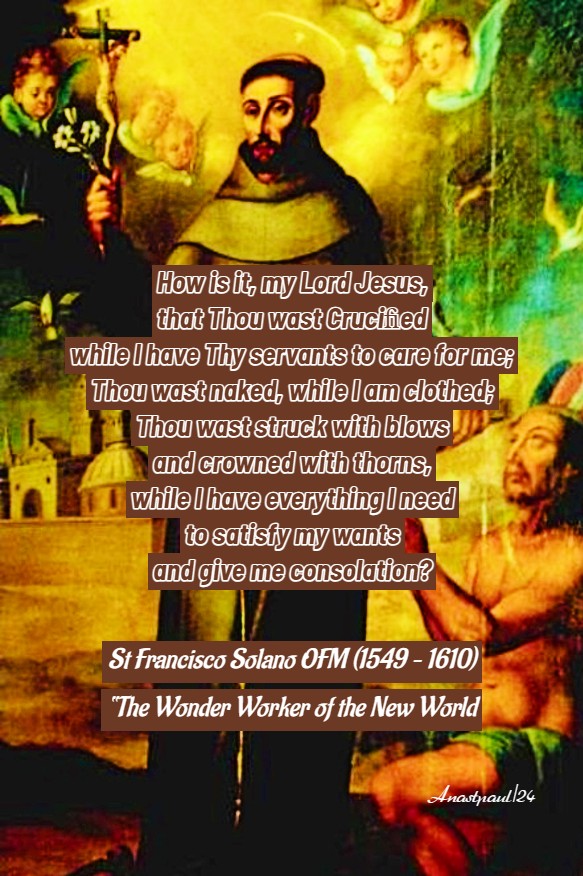
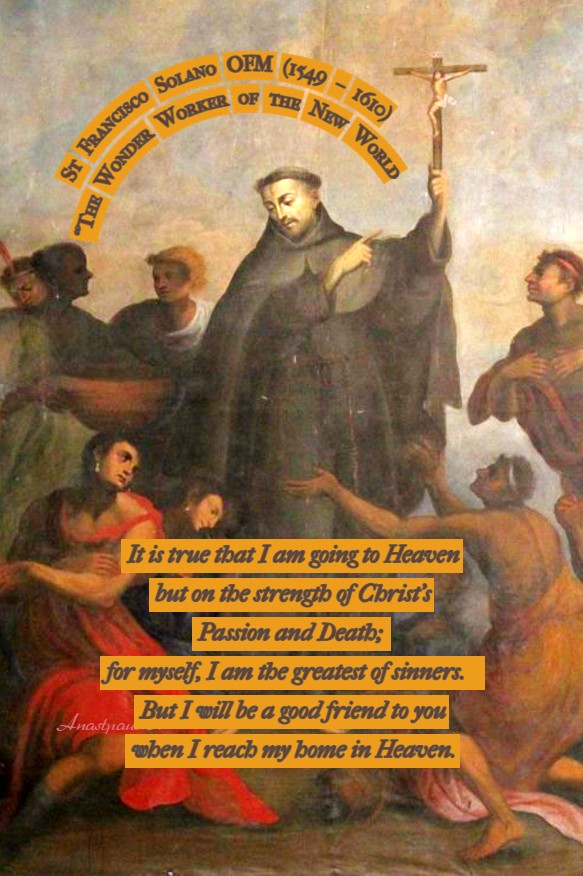
Quote/s of the Day – 24 July – St Francisco Solano OFM (1549 – 1610) “The Wonder Worker of the New World”
“How is it, my Lord Jesus, that Thou wast Crucified while I have Thy servants to care for me; Thou wast naked, while I am clothed; Thou wast struck with blows and crowned with thorns, while I have everything I need to satisfy my wants and give me consolation?”
“It is true that I am going to Heaven but on the strength of Christ’s Passion and Death; for myself, I am the greatest of sinners. But I will be a good friend to you when I reach my home in Heaven.”
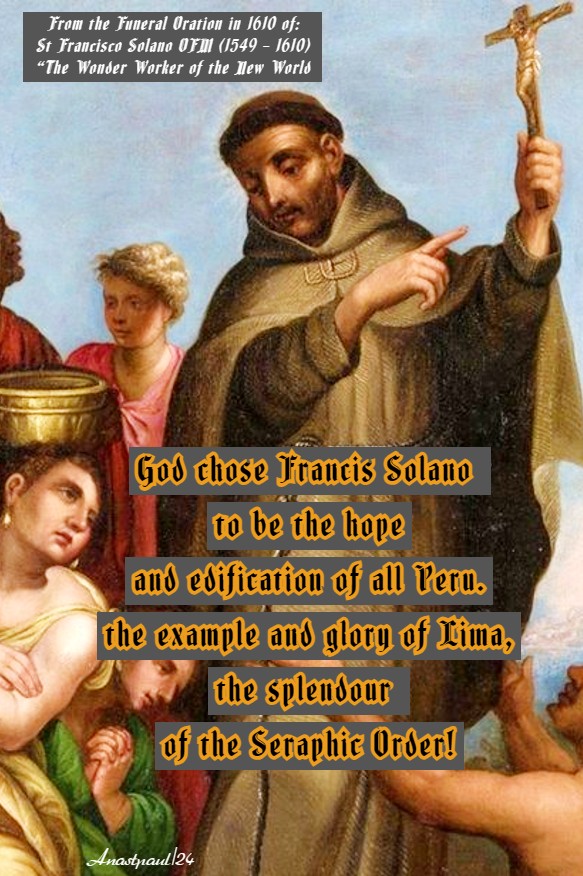
“God chose Francis Solano to be the hope and edification of all Peru. the example and glory of Lima, the splendour of the Seraphic Order!”
From the Funeral Oration in 1610
St Francisco Solano OFM (1549 – 1610) “The Wonder Worker of the New World
One Minute Reflection – 24 July – “The Month of the Most Precious Blood” – St Christina of Bolsena (3rd Century) Virgin Martyr – Ecclesiasticus Sir 44:25-27; 45:2-4; 45:6-9; John 15:12-16 – Scripture search here: https://www.drbo.org/
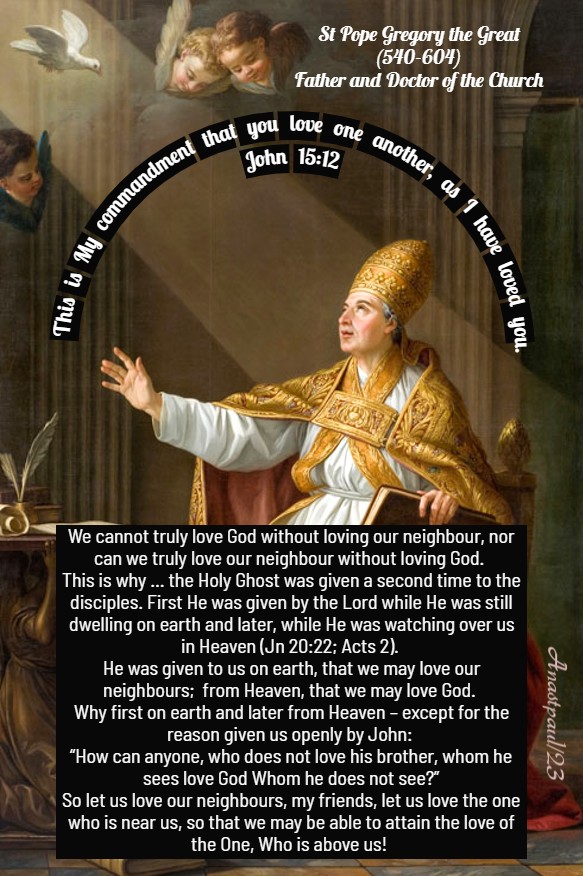
“This is My commandment that you love one another, as I have loved you. Greater love than this no man hath that a man lay down his life for his friends.” – John 15:12-13
REFLECTION – “We cannot truly love God without loving our neighbour, nor can we truly love our neighbour without loving God. This is why … the Holy Ghost was given a second time to the disciples. First He was given by the Lord while He was still dwelling on earth and later, while He was watching over us in Heaven (Jn 20:22; Acts 2). He was given to us on earth, that we may love our neighbours; from Heaven, that we may love God. Why first on earth and later from Heaven – except for the reason given us openly by John: “How can anyone, who does not love his brother, whom he sees love God Whom he does not see?”
So let us love our neighbours, my friends, let us love the one who is near us, so that we may be able to attain, the love of the One, Who is above us! Let our hearts reflect on what our neighbours hold up to God, so that we may be found completely worthy, to rejoice in God with them. Then shall we reach the happiness of the heavenly multitude, the happiness of which, we have received an assurance from the Holy Spirit. Let us move forward toward that goal, where we shall be happy without end, with all our love. There is the holy community of heavenly citizens, there is the sure and solemn observance, there untroubled rest, there the true peace which is no longer dependent on us but given to us through our Lord Jesus Christ (Jn 14:27).” – St Gregory the Great (540-604) Pope, Father and Doctor of the Church (Excerpt Sermons on the Gospel No 30).
PRAYER – O God, Who among the other miracles of Thy power have bestowed the victory of martyrdom even upon the weaker sex, graciously grant that we, who commemorate the anniversary of the death of blessed Christina, Your Virgin and Martyr, may come to Thee by the path of her example.Through Jesus Christ, Thy Son our Lord, Who lives and reigns with Thee, in the unity of the Holy Ghost, God, world without end. Amen (Collect).
Our Morning Offering – 24 July – “The Month of the Most Precious Blood”
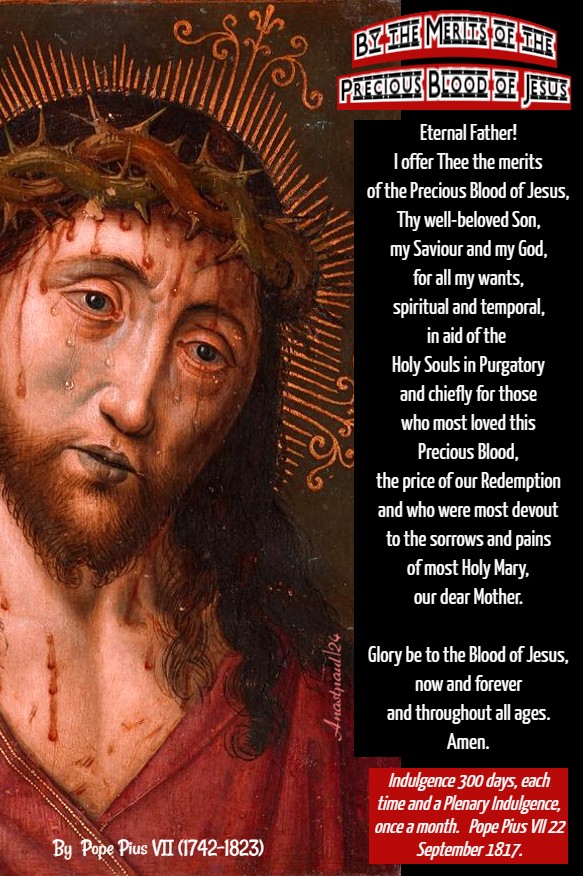
By the Merits of the Precious Blood of Jesus By Servant of God Pope Pius VII (1742-1823) Papacy from 1800 to 1823 Indulgenced Act of Oblation to Our Father
Eternal Father! I offer Thee the merits of the Precious Blood of Jesus, Thy well-beloved Son, my Saviour and my God, for all my wants, spiritual and temporal, in aid of the Holy Souls in Purgatory and chiefly for those who most loved this Precious Blood, the price of our Redemption and who were most devout to the sorrows and pains of most Holy Mary, our dear Mother.
Glory be to the Blood of Jesus, now and forever and throughout all ages. Amen.
Indulgence of 300 days, each time this prayed is offered, 22 September 1817 with a Plenary Indulgence, once a month, under the usual conditions.
Note of Interest:On 15 August 1811 – the Feast of the Assumption – it is recorded that the Pope celebrated Mass and was said to have entered a trance and began to levitate in a manner that drew him to the Altar. This particular episode aroused great wonder and awe among attendants, which included the French soldiers guarding him, who were awestruck at what had occurred and left records of it.
Saint of the Day – 24 July – Saint Ursicinus (Died c380) Bishop of Sens in France and Confessor, a powerful opponent of the Arians.
The Roman Martyrology mentions him today: “At Sens, St Ursicinus, Bishop and Confessor.”
Unknown Bishop Saint
During Ursicinus’ Ep[iscopate, the heresy of Arianism had gained significant ground within Sens and its surrounding regions. Recognising the danger it posed to his flock, Ursicinus vehemently opposed this heresy, engaging in debates and sermons to combat its spread. Through his charismatic preaching and unwavering commitment to the truth, Ursicinus was able to convince many of the error of Arianism and restore orthodoxy within the region.
St Ursicinus dies of natural causes in around 380 and is celebrated today, 24 July.
St Aliprandus of Pavia St Antinogenes of Merida St Aquilina the Martyr St Arnulf of Gruyere Bl Balduino of Rieti St Boris of Kiev St Capito
St Christina Mirabilis/the Astonishing (1150-1224) Virgin, mendicant, Penitent, Mystic. St Christina the Astonishing has been recognised as a Saint since the 12th century. She was placed in the calendar of the saints by at least two bishops of the Catholic Church in two different centuries (17th & 19th Her Amazing Life: https://anastpaul.com/2019/07/24/saint-of-the-day-24-july-saint-christina-mirabilis-1150-1224/
St Cyriacus of Ziganeus St Declan of Ardmore Bl Diego Martinez Bl Donatus of Urbino
Thought for the Day – 23 July – Meditations with Fr Richard Frederick Clarke SJ (1839-1900)
CHARITY Meditations for a Month
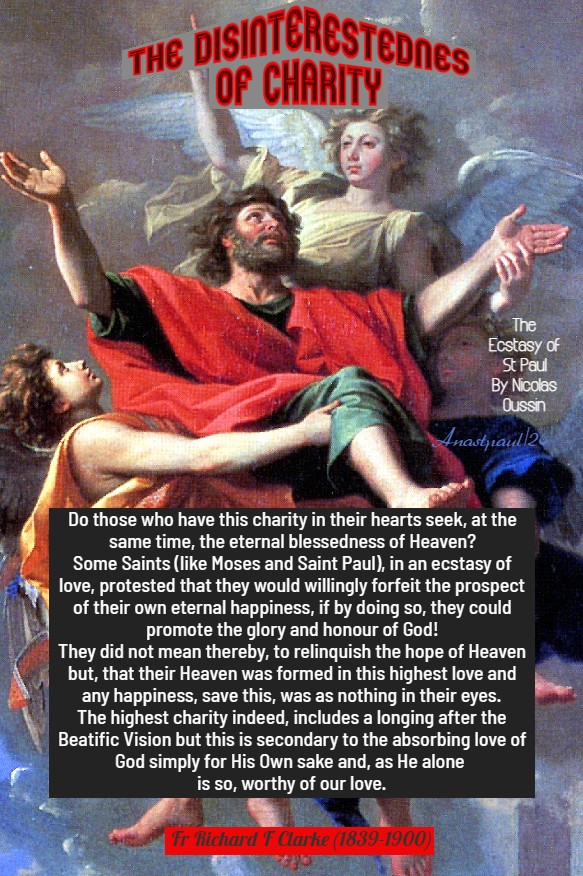
The Disinterestedness of Charity
Charity is a love of God for His Own sake. In its perfection, it banishes self altogether. It does not turn the mind to self or to that which self desires. It thinks only of God, His greatness and His goodness. It seeks to promote His honour and His glory, simply for the sake of promoting the honour and glory of One so infinitely worthy of our love and homage, quite independently of any reward or gain which is to accrue to ourselves thereby. Is this the nature of my love of God?
Yet, if “charity begins at home” and we, necessarily as rational beings, seek that which is good for ourselves, how is this disinterested love possible? It is possible because, those who possess it, find their highest and purest happiness in this forgetfulness of self. In their very neglect of the interests of self, they are actually procuring, for themselves, the greatest of all rewards — the joy which comes of loving and serving God, simply and solely, for His Own sake.
Do those who have this charity in their hearts seek, at the same time, the eternal blessedness of Heaven? Some Saints (like Moses and Saint Paul), in an ecstasy of love, protested that they would willingly forfeit the prospect of their own eternal happiness, if by doing so, they could promote the glory and honour of God! They did not mean thereby, to relinquish the hope of Heaven but, that their Heaven was formed in this highest love and any happiness, save this, was as nothing in their eyes. The highest charity indeed, includes a longing after the Beatific Vision but this is secondary to the absorbing love of God simply for His Own sake and, as He alone is so, worthy of our love.
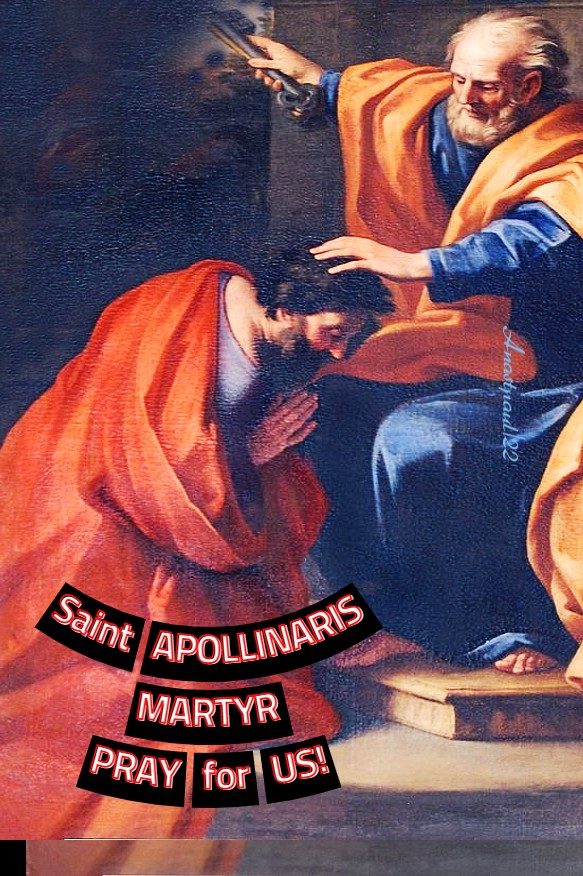
Quote/s of the Day – 23 July – The Memorial of St Apollinaris (1st Century) Bishop Martyr, Disciple of St Peter – 1 Peter 5:1-11, Luke 22:24-30
“Let him who is greatest among you, become as the youngest and he who is the leader, as the servant.”
Luke 22:25
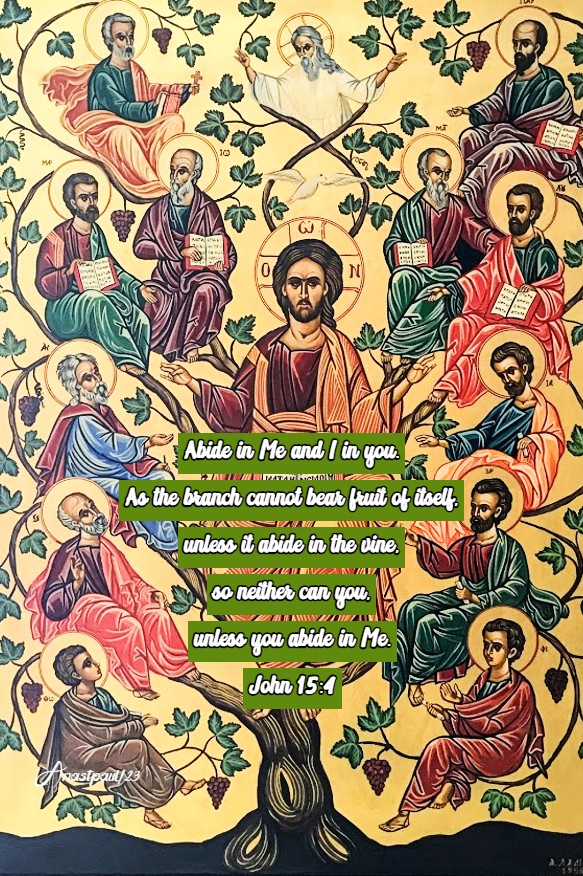
“Abide in Me and I in you. As the branch cannot bear fruit of itself, unless it abide in the vine, so neither can you, unless you abide in Me.”
John 15:4
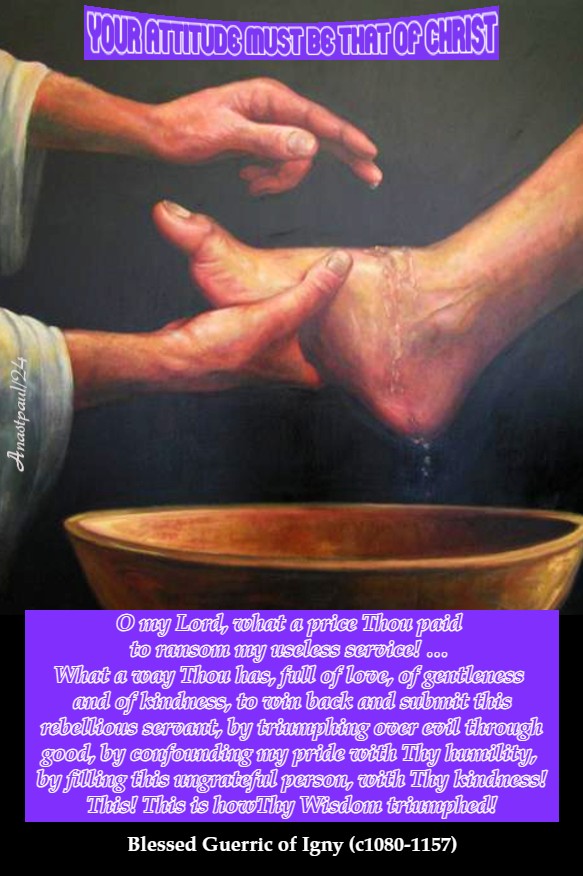
“O my Lord, what a price Thou paid to ransom my useless service! … What a way Thou has, full of love, of gentleness and of kindness, to win back and submit this rebellious servant, by triumphing over evil through good, by confounding my pride with Thy humility, by filling this ungrateful person, with Thy kindness! This! This is howThy Wisdom triumphed!”
Blessed Guerric of Igny (c1080-1157) Cistercian Abbot
“True humility consists in persuading and convincing oneself that without God, we are insignificant and despicable and, in accepting to be treated as such!”
St Ignatius Loyola SJ (1491-1556)
If, when stung by slander or ill-nature, we wax proud and swell with anger, it is a proof that our gentleness and humility are unreal and mere artificial show!”
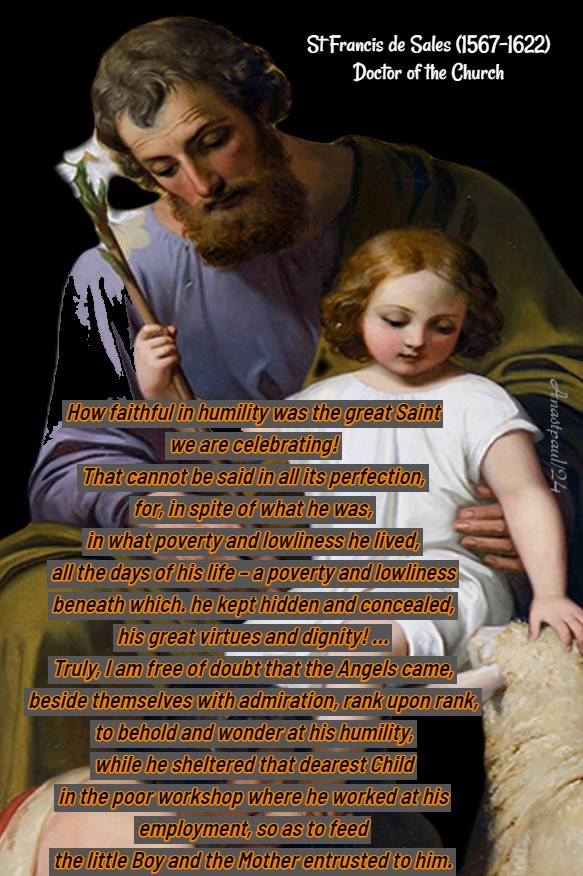
“How faithful in humility was the great Saint we are celebrating! That cannot be said in all its perfection, for, in spite of what he was, in what poverty and lowliness he lived, all the days of his life – a poverty and lowliness beneath which. he kept hidden and concealed, his great virtues and dignity! … Truly, I am free of doubt that the Angels came, beside themselves with admiration, rank upon rank, to behold and wonder at his humility, while he sheltered that dearest Child in the poor workshop where he worked at his employment, so as to feed the little Boy and the Mother entrusted to him.”
St Francis de Sales (1567-1622) Doctor of the Church
One Minute Reflection – 23 July – “The Month of the Most Precious Blood” – St Apollonaris (1st Century) Bishop Martyr, Disciple of St Peter – 1 Peter 5:1-11; Luke 22:24-30 – Scripture search here: https://www.drbo.org/
“For who is greater, he who sits at table or he who serves? Is not he who sits at table? But I Am in the midst of you, as He Who serves.” – Luke 22:27
REFLECTION – “By craving the first places, most important responsibilities and highest honours, it seems to me, the two brothers, James and John, were wanting to acquire authority over others. This was why Jesus was opposed to their pretension. By saying to them: “Whoever would be first will be servant of all” He uncovered their hidden thoughts. In other words: “If you are ambitious for the topmost place and the greatest honours, seek out the last place, strive to become the simplest, most humble and lowliest of all. Put yourself after others. This is the virtue which will win you the honour you covet. You have beside you a shining example: ‘for the Son of Man has not come to be served but to serve and to give His Life as a ransom for many’ (Mk 10:45). That is how you will gain glory and renown. See what has happened to Me: I seek neither honoor nor glory and yet, the gain I achieve in this way is Infinite.”
As we know, before the Incarnation of Christ and His coming down to us, all was lost, all was corrupt. But after He had been humbled, He raised up everything. He abolished the curse, destroyed death, opened Paradise, put sin to death, unbolted the Gates of Heaven to gather into it, the first-fruits of our humanity. He spread faith throughout the world, cast out error and restored virtue. He caused the first-fruits of our nature to mount a royal throne. Christ is the Author of numerous benefits which neither my words, nor any human word, is able to describe. Before He humbled Himself, He was known only to the Angels but since He was brought low, the whole human race has recognised Him!” – St John Chrysostom (345-407) Bishop of Constantinople, Father and Doctor of the Church (Sermon against the Anomeans Nos 8 and 6).
PRAYER – O God, the rewarder of faithful souls, grant that we may obtain pardon through the prayers of blessed Apollinaris, Thy Martyr and Bishop, whose feast we are celebrating .Through Jesus Christ, Thy Son our Lord, Who lives and reigns with Thee, in the unity of the Holy Ghost, God, world without end. Amen (Collect).
Our Morning Offering – 23 July – “The Month of the Most Precious Blood” –
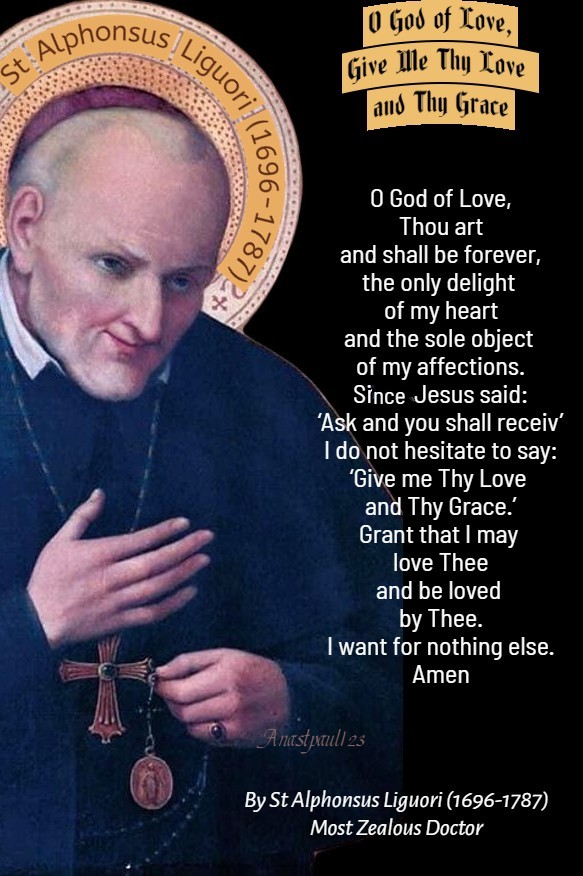
O God of Love, Give Me Thy Love and Thy Grace By St Alphonsus Liguori (1696-1787) Most Zealous Doctor
O God of Love, Thou art and shall be forever, the only delight of my heart and the sole object of my affections. Since Jesus said: ‘Ask and you shall receive,’ I do not hesitate to say: ‘Give me Thy Love and Thy Grace.’ Grant that I may love Thee and be loved by Thee. I want for nothing else. Amen
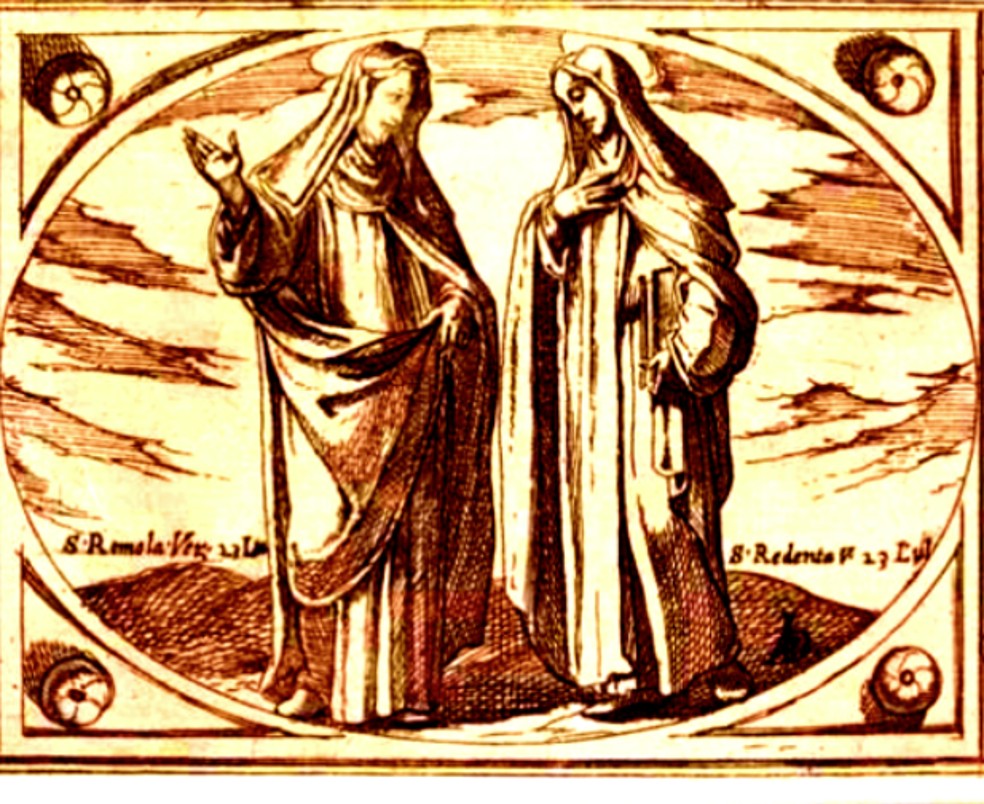
Saint of the Day – 23 July – Saint Romula of Rome (Died c580) Virgin, Recluse, Ascetic
Romula lived with St Redempta as a Recluse near the Basilica of St Mary Major in Rome. Redempta had been trained as a Nun by St Herundo in Palestine. These three formed a small community in Rome and they earned the praise of the Pope, St Gregory I the Great. Romula became ill and was paralysed for the last years of her life.
St Gregory wrote:
“At the time when I went to the Monastery, there was an old woman named Redempta who wore a Nun’s dress and lived by the Church of Mary here in the City. She was a disciple of the Herundo who is said to have lived as a hermit on the mountain near Preneste. Now this Redempta had two disciples in Nun’s garb, one named Romula and the other, who is still living, of whom I do not remember her name, although I would recognise her. So the three lived together in the same house, rich in Godliness but poor in this world’s goods.
Romula surpassed her fellow sister Redempta, by her great merits – admirably patient and perfectly obedient, she observed silence and was untiring in prayer. But now. it is often the case that those who are considered perfect by their fellow human beings, still have something imperfect about them, in the Creator’s eyes. (In the same way as when we, ignorant men, look at an unfinished sculpture and praise it as finished, while the artist, who probably hears our praise, improves it further by further polishing.) Romula was stricken with the disease which the Doctors call by its Greek name, paralysis.
For many years she was bedridden and almost completely deprived of the use of her limbs. But this trial did not make her impatient! The injury to her limbs only increased her virtues; she gave herself so much more to prayer that she was unable to do anything else.
One night she called out to Redempta, who was, as I said, like a mother to her two disciples: “Mother, come! Mother, come!” and she, Redempta, stood up with the other disciple. What then happened, they both told to many and I heard it too – as they stood by her bed in the middle of the night, a light from Heaven suddenly filled the whole cell. The sight was so overwhelming that they were struck with awe and (as they afterwards related) completely paralysed too.
They heard the sound of many people entering and touching the cell door, they felt the crowd coming in but said that, from fear and from the overwhelming character of the light, they could not see – their eyes were, as if closed to both. After the shining light followed a wonderful fragrance which was supposed to take away their fear of the brilliant light but, when they could not manage this last, Romula began, in a loving voice, to comfort her Superior Redempta, with the words: “Fear not, Mother, I will not die yet.” She said this repeatedly and the light faded but the sweet smell remained.
It remained too, on the second and third day. On the fourth night she again called her Superior, who came – she asked for Holy Communion and received it. Redempta and the other disciple had not yet left the Infirmary when suddenly, two choirs appeared in the square outside the cell, singing David’s Psalms. Their gender, they later said, they could hear from the voices – the men intoned and the women answered. And while this heavenly Liturgy took place outside the cell, Romula’s holy soul was separated from her body. As she was led up to Heaven, the Psalm sounded fainter and fainter as the soul rose higher and higher, then both ithe soul and the good fragrance were gone.”
Bl Juan de Luca Bl Juan de Montesinos Bl Leonard da Recanati Bl Mariano Brandi
St Phocas the Gardener (Died c303) Layman Martyr, Apostle of the poor and needy. Died by beheading c 303 in Sinope, Pontus (in modern Turkey). Patronages – against insect bites, against poisoning, against snake bites, agricultural workers, farm workers, farmers, field hands, boatmen, mariners, sailors, watermen, gardeners, husbandmen, market-gardeners. https://anastpaul.com/2022/07/23/saint-of-the-day-23-july-st-phocas-the-gardener-died-c-303-martyr/
St Primitiva of Rome St Rasyphus of Macé St Rasyphus of Rome St Ravennus of Macé *St Redempta of Rome + *St Romula of Rome + (Died c580) Virgin Recluse St Severus of Bizye St Theophilus of Rome St Trophimus of Rome St Valerian of Cimiez
Thought for the Day – 22 July – Meditations with Fr Richard Frederick Clarke SJ (1839-1900)
CHARITY Meditations for a Month
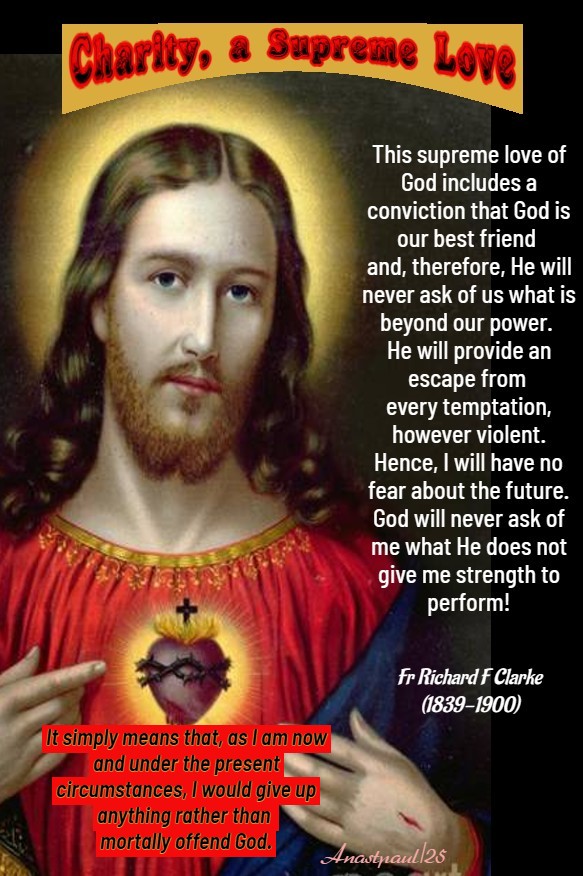
Charity, a Supreme Love
Charity does not exist within the soul of anyone who does not love God above all things. If some created being has the first place in our heart and God only the second, then, we are the enemies, not the friends of God. He must have all our heart or none! “Thou shalt love the Lord thy God, with thy whole heart and thy whole soul.” If, any person or thing, hinders this supreme love for God, we must avoid it at any cost. If this is impossible, we must pray earnestly that we may never fall into the terrible misfortune of loving the creature more than the Creator, Who is God, blessed forever.
This, however, does not mean that we must have a stronger feeling of love for God than for some loved object upon earth. We cannot always control our feelings. We are creatures of sense and our senses and imagination have great power over us. Nor does it mean that the love of God is to swallow up the love of created things. This is impossible. Nor, again, does it mean, there must be no possible circumstances which we can imagine, wherein we could not promise to choose God, however violent the temptation might be. It simply means that, as I am now and under the present circumstances, I would give up anything rather than mortally offend God.
This supreme love of God includes a conviction that God is our best friend and, therefore, He will never ask of us what is beyond our power. He will provide an escape from every temptation, however violent. Hence, I will have no fear about the future. God will never ask of me what He does not give me strength to perform!
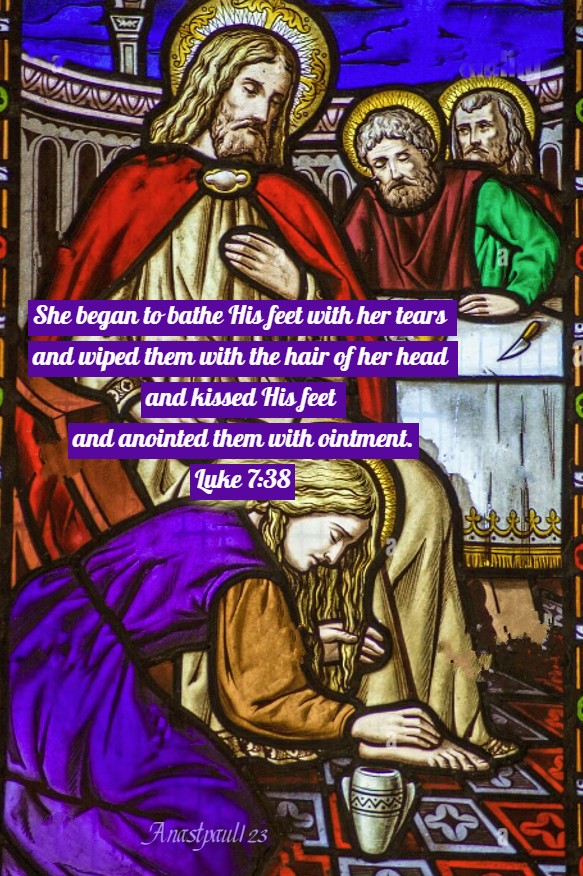
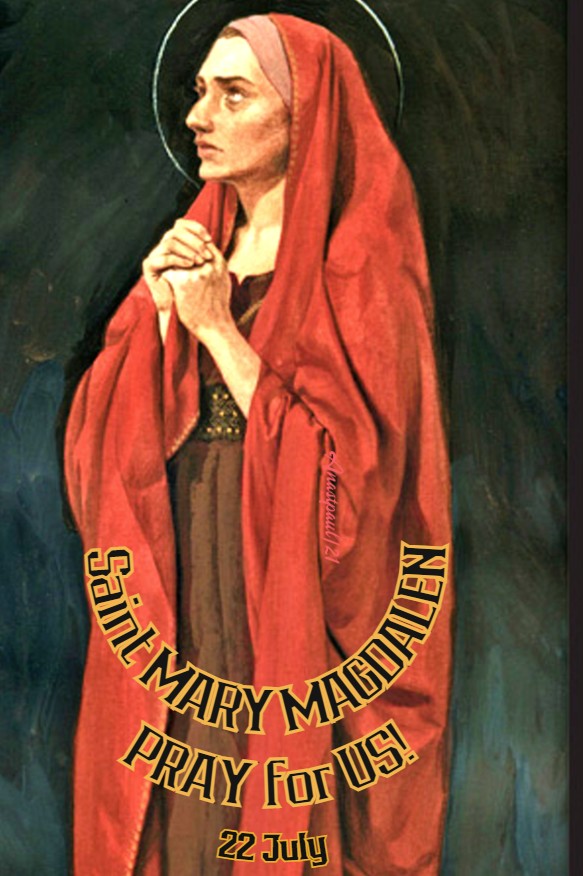
Quote/s of the Day – 22 July – St Mary Magdalen (1st Century) Penitent – Song 3:2-5; 8:6-7, Luke 7:36-50.
“She began to bathe His feet with her tears and wiped them with the hair of her head and kissed His feet and anointed them with ointment.”
Luke 7:38
“Remember not our former iniquities, let Thy mercies speedily prevent us, for we are become exceeding poor. Help us, O God, our Saviour and for the glory of Thy Name, O Lord, deliver us and forgive us our sins, for Thy Name’s sake.”
Psalm 78:8-9
“Let us then, my brethren, endure in hope. Let us devote ourselves, side-by-side with our hoping, so that the God of all the universe, as He beholds our intention, may cleanse us from all sins, fill us with high hopes from what we have in hand and grant us the change of heart which saves. God has called you and you have your calling!”
St Cyril of Jerusalem (315-387) Father and Doctor of the Church
“Prayer, appeases the anger of God; He pardons the sinner when he prays with humility.”
St Lawrence Justinian (1381-1455)
“We must be very sorry for faults with a repentance which is strong, constant, tranquil but not troubled, unquiet or fainthearted.”
(Treatise on the Love of God, Book 9, Chapter 7).
St Francis de Sales (1567-1622) Doctor Caritatis
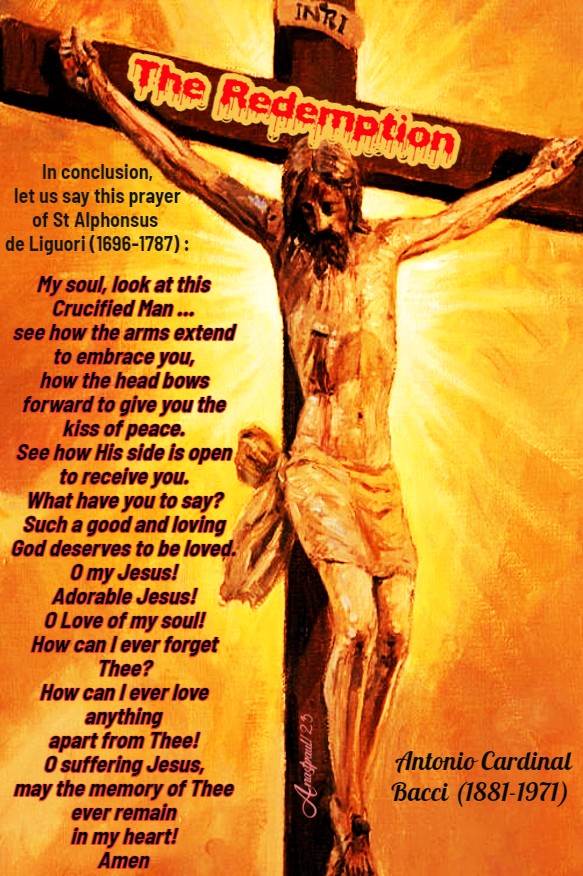
In conclusion, let us say this prayer of St Alphonsus de Liguori (1696-1787): “My soul, look at this Crucified Man … see how the arms extend to embrace you, how the head bows forward to give you the kiss of peace. See how His side is open to receive you. What have you to say? Such a good and loving God deserves to be loved. O my Jesus! Adorable Jesus! O Love of my soul! How can I ever forget Thee? How can I ever love anything apart from Thee! O suffering Jesus, may the memory of Thee ever remain in my heart!”
One Minute Reflection – 22 July – “The Month of the Most Precious Blood” – – St Mary Magdalene (1st Century) Penitent – Song 3:2-5; 8:6-7; Luke 7:36-50 – – Scripture search here: https://www.drbo.org/
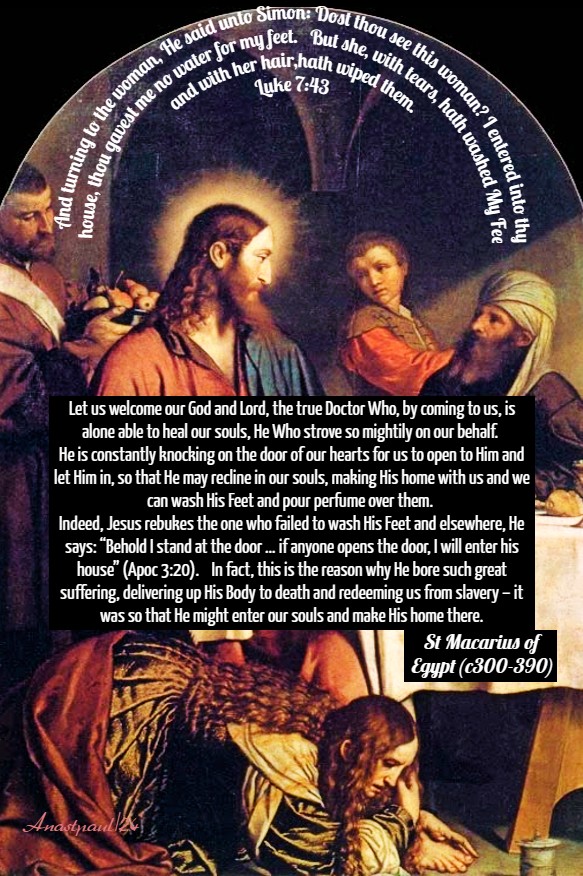
“And turning to the woman, He said unto Simon: Dost thou see this woman? I entered into thy house, thou gavest me no water for my feet. But she, with tears, hath washed My Feet and with her hair, hath wiped them.” – Luke 7:43
REFLECTION – “Let us welcome our God and Lord, the true Doctor Who, by coming to us, is alone able to heal our souls, He Who strove so mightily on our behalf. He is constantly knocking on the door of our hearts for us to open to Him and let Him in, so that He may recline in our souls, making His home with us and we can wash His Feet and pour perfume over them. Indeed, Jesus rebukes the one who failed to wash His Feet and elsewhere, He says: “Behold I stand at the door … if anyone opens the door, I will enter his house” (Apoc 3:20). In fact, this is the reason why He bore such great suffering, delivering up His Body to death and redeeming us from slavery – it was so that He might enter our souls and make His home there.
This was why our Lord says to those who are to stand on His left side at the judgement and be cast into the eternal fire: “I was a stranger and you gave me no welcome; I was hungry and you gave me no food; thirsty and you gave me no drink” (Mt 25:42) – because, His food and drink, His clothing, shelter and rest are all within our heart. This is why He is always knocking, trying to come into our house. So let us welcome Him and bring Him inside, within us, since He is our food, drink and eternal life, too.
And those souls who do not now receive Him within, for Him to find His rest in them, or rather that they might find rest in Him, will not inherit the Kingdom of Heaven with the Saints or be able to enter the heavenly City. But you, O Lord Jesus Christ, grant us to enter there, we who glorify Thy Name, with the Father and the Holy Ghost for ages unending. Amen.” – St Macarius of Egypt (c300-390) Monk, Father of the Church (Sermon attributed to St Macarius).
PRAYER – May the prayers of blessed Mary Magdalen help us, O Lord, Who was moved by her prayers, her love and peniteance, that we too may learn true repentance and sorrow for our sins..Through the same Jesus Christ, Thy Son our Lord, Who lives and reigns with Thee, in the unity of the Holy Ghost, God, world without end. Amen (Collect).
Our Morning Offering – 22 July – “The Month of the Most Precious Blood” – St Mary Magdalen (1st Century) Penitent
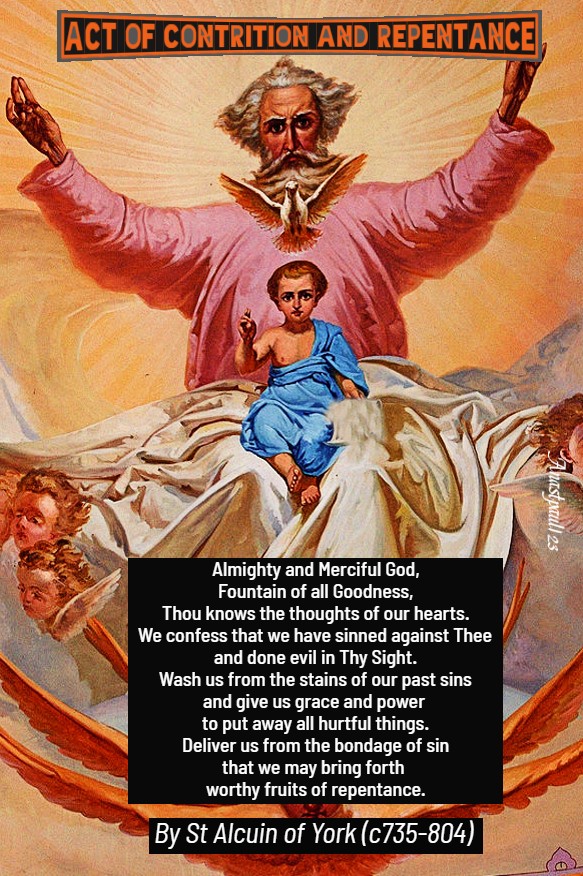
Act of Contrition and Repentance By St Alcuin of York (c735-804) Father of the Church
Almighty and merciful God, Fountain of all Goodness, Thou knows the thoughts of our hearts. We confess that we have sinned against Thee and done evil in Thy Sight. Wash us from the stains of our past sins and give us grace and power to put away all hurtful things. Deliver us from the bondage of sin that we may bring forth worthy fruits of repentance. Amen
Saint of the Day – 22 July – Saint Cyril of Antioch (Died c306) Bishop Martyr. Unknown birth date and location but we believe that he was a local of Antioch. He died most probably of ill-treatment and starvation, in the mines in Pannopia which is in tbe modern eastern European regions of Hungary, Sovalie etc. (He is not to be confused with St Cyril of Alexandria (376-444) the Doctor of the Church).
The Roman Martyrology reads: “At Antioch, the holy Bishop Cyril. who was distinguished for learning and holiness.”
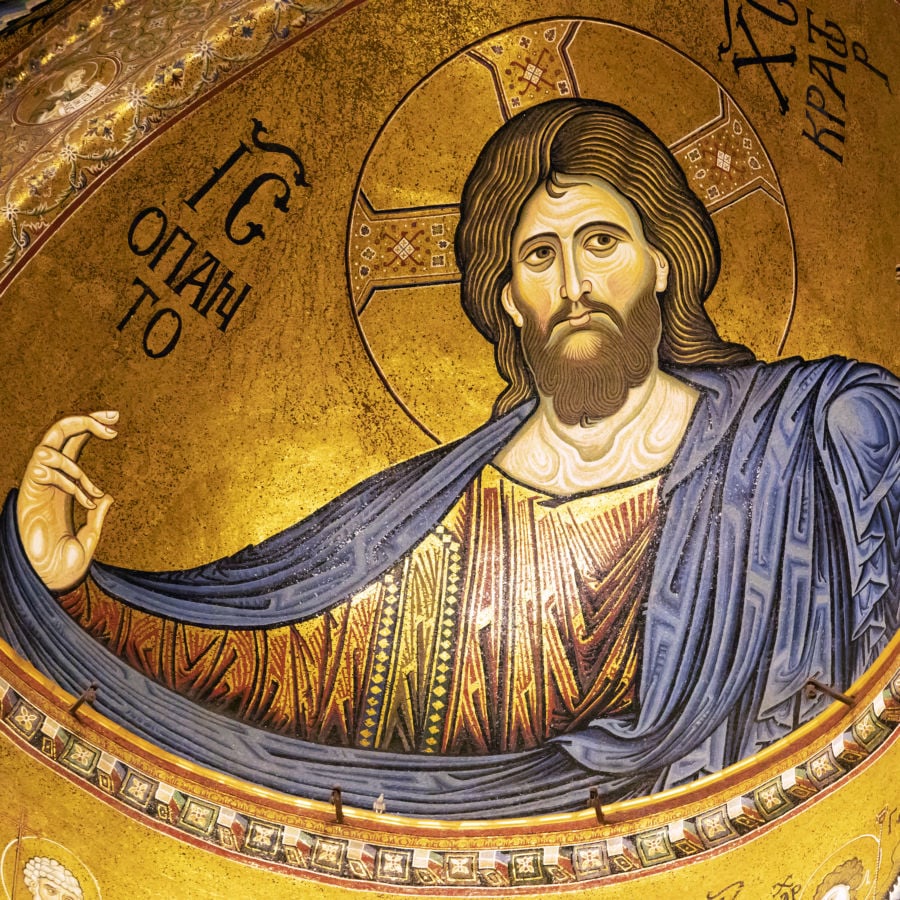
Ancient Greek Icon of Jesus
In the Episcopal lists of Antioch, our Saint appears after Timaeus, that is, he would have been elected around 279-80.
Nothing is known about Cyril’s Episcopate, except that he may have admitted to Ecclesiastical communion, the Priest Lucian, previously condemned for his relations with Paul of Samosata, who had been the Bishop of Antioch until 268 when he was deposted and excommunicated for the heresy of monarchianism (rejection of the Holy Trinity), of which he was the originator.
Lucian of Antioch – 985 in the Vatican Library, Rome
Most likely, upon the publication of the second edict of Diocletian in spring 303 which prescribed the arrest of all Church leaders, Cyril was arrested and sent to the minas in Pannonia. A passage from the Acts of the Four Crowned Saints can be interpreted in this sense.
His death occurred in exile around 306. Together with Cyril, a Martyr named Andrew is commemorated in the Martyrology of Hieronymia. This is an authentic Martyr who is remembered, always together with Cyril, in the list of Martyrs of Antioch, found in the sermon attributed to St Eusebius of Caesarea.
St Baudry of Montfaucon St Claudius Marius Victorinus of Saussaye St Cyril of Antioch (Died c306) Bishop, Martyr St Dabius St John Lloyd
St Joseph of Palestine (Died c 356) Layman, Convert from Judaism, a contemporary of Emperor Constantine, a Rabbinical scholar, member of the Sanhedrin and a disciple of Hillel II. Following his conversion, Emperor Constantine gave him the rank of Count, appointed him as supervisor of the Churches in Palestine and gave him permission to build Churches in the Galilee. Patronages – converts, guardians. A Very Interesting Saint: https://anastpaul.com/2022/07/22/saint-of-the-day-22-july-st-joseph-of-palestine-died-c-356/
St Lewine St Maria Wang Lishi St Meneleus of Ménat St Movean of Inis-Coosery St Pancharius of Besancon Bl Paolo de Lara
Martyrs of Marula/Massylis: – 3 Saints: Three Christians Martyred together. We know nothing else about them but the names – Ajabosus, Andrew and Elian. They were martyred in Massylis (Marula), Numidia (in modern Algeria).
Martyrs of Massilitani: A group of Christians Martyred together in northern Africa. Saint Augustine of Hippo wrote about them.




























 AnaStpaul
You must be logged in to post a comment.