Thought for the Day – 9 August – Meditations with Fr Richard Frederick Clarke SJ (1839-1900)
CHARITY Meditations for a Month
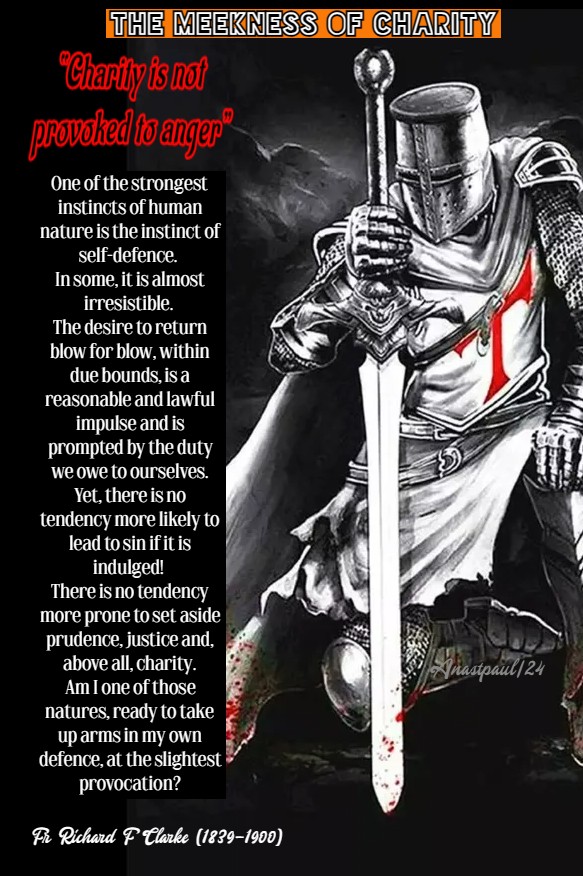
The Meekness of Charity “Charity is not provoked to anger”
One of the strongest instincts of human nature is the instinct of self-defence. In some, it is almost irresistible. The desire to return blow for blow, within due bounds, is a reasonable and lawful impulse and is prompted by the duty we owe to ourselves. Yet, there is no tendency more likely to lead to sin if it is indulged! There is no tendency more prone to set aside prudence, justice and, above all, charity. Am I one of those natures, ready to take up arms in my own defence, at the slightest provocation?
The instinct of self-defence is always prone to mislead us, due to our excessive self-love. We imagine we have been attacked, when in fact, nothing of the sort is the case. We see a slight or insult, when none was intended. We do not keep in mind how simple the true explanation may really be. We become angry, long for revenge and are carried beyond all bounds, by our wounded self-love. We say and do what we bitterly regret afterwards, alienating others from us and offending God by our angry words. How often, alas, I have done this!
How is this evil to be remedied? By charity and nothing else. If God were more prominent in our hearts, if we loved God more and ourselves less, if our ambition were to promote His honour and not our own, we should not indulge in these outbursts of intemperate or bitter words. Instead, we should not be easily provoked or become angry. We should take a gentle view of what has been done or we should accept the injury or unkindness done to us and offer it up for our sins in union with the supreme charity of Christ our Lord!
Quote/s of the Day – 9 August – St Jean-Marie-Baptiste Vianney (1786-1859) Confessor
“Man is a beggar who needs to ask God for everything.”
“When our hands have touched spices, they give fragrance to all they handle. Let us make our prayers pass through the hands of the Blessed Virgin. She will make them fragrant.”
“Prayer is the inner bath of love into which the soul plunges itself.”
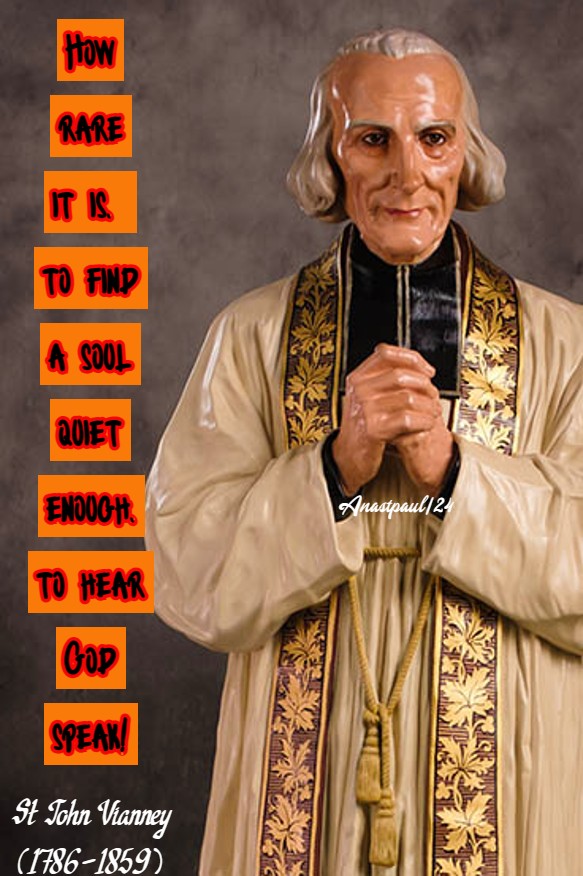
“How rare it is, to find a soul quiet enough, to hear God speak.”
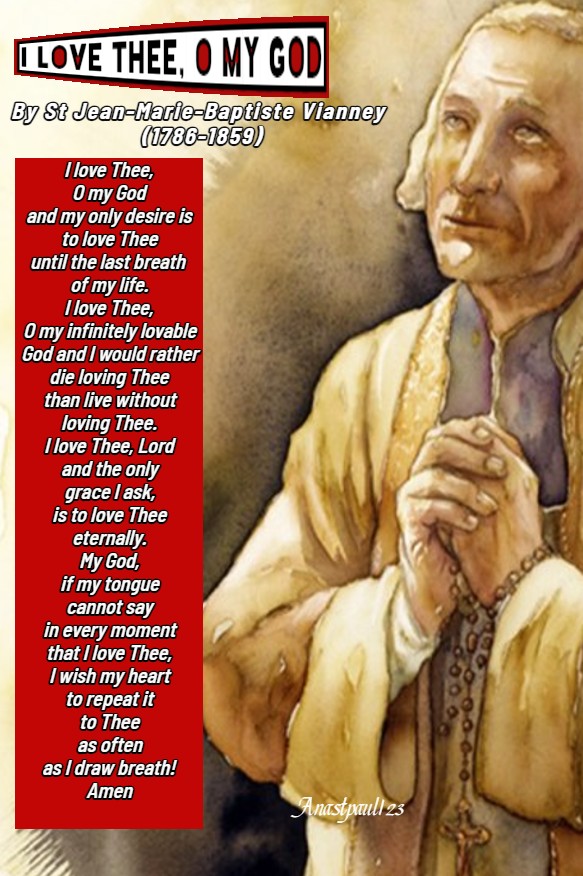
I Love Thee, O My God By St John Vianney (1786-1859)
I love Thee, O my God and my only desire is to love Thee until the last breath of my life. I love Thee, O my infinitely lovable God and I would rather die loving Thee than live without loving Thee. I love Thee, Lord and the only grace I ask, is to love Thee eternally. My God, if my tongue cannot say in every moment that I love Thee, I wish my heart to repeat it to Thee as often as I draw breath! Amen
One Minute Reflection – 9 August – “The Month of the Immaculate Heart of Mary” – St John Marie Vianney (1786-1859) Confessor – Sirach 31:8-11; Luke 12:35 – 40 – Scripture search here: https://www.drbo.org/
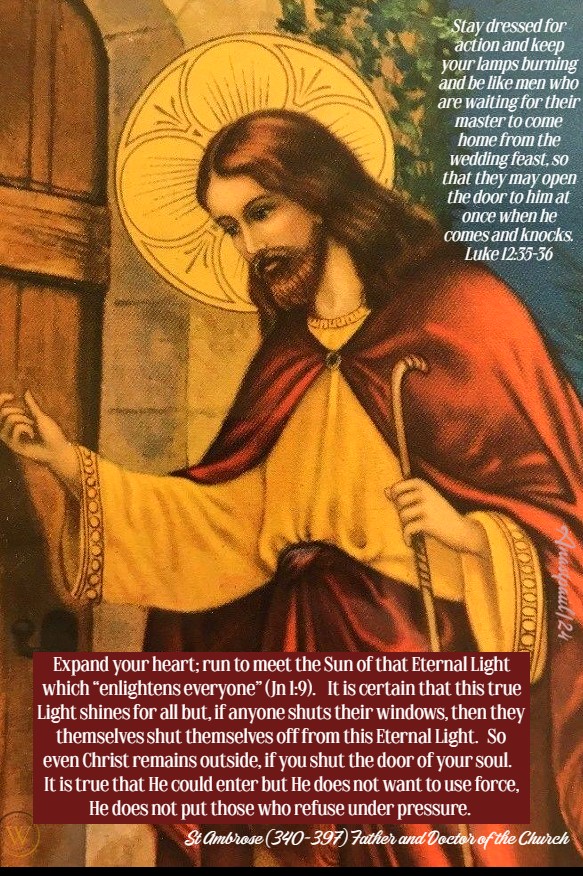
“Stay dressed for action and keep your lamps burning and be like men who are waiting for their master to come home from the wedding feast, so that they may open the door to him at once when he comes and knocks.” – Luke 12:35-36
REFLECTION – “God, the Word, stirs up the lazy and arouses the sleeper. For indeed, someone who comes knocking at the door is always wanting to come in. But it depends on us if He does not always enter or always remain. May your door be open to Him who comes; open your soul, enlarge your spiritual capacities that you may discover the riches of simplicity, the treasures of peace and sweetness of grace. Expand your heart; run to meet the Sun of that Eternal Light which “enlightens everyone” (Jn 1:9). It is certain that this true Light shines for all but, if anyone shuts their windows, then they themselves shut themselves off from this Eternal Light.
So even Christ remains outside, if you shut the door of your soul. It is true that He could enter but He does not want to use force, He does not put those who refuse under pressure. Descended from the Virgin, born from her womb, He shines throughout the universe to give Light to all. Those who long to receive the Light which shines with an everlasting brightness, open to Him. No night comes to intervene. Indeed, the sun we see each day gives way to night’s darkness but the Sun of Justice (Mal 3:20) knows no setting for Wisdom is not overcome by evil.” – St Ambrose (340-397) Bishop of Milan and Father and Doctor of the Church – 12th Sermon on Psalm 118
PRAYER – Almighty and merciful God, Who made St John-Marie glorious by priestly zeal and untiring fervoru in prayer and penance, grantP we beseech Thee that by his example and intercession, we may have strength to win for Christ, the souls of our brethren and, with them, attain everlasting glory.Through the same Jesus Christ, Thy Son our Lord, Who lives and reigns with Thee, in the unity of the Holy Ghost, God, world without end. Amen (Collect).
Our Morning Offering – 9 August – “The Month of the Immaculate Heart of Mary” – St Jean-Marie-Baptiste Vianney (1786-1859) Confessor
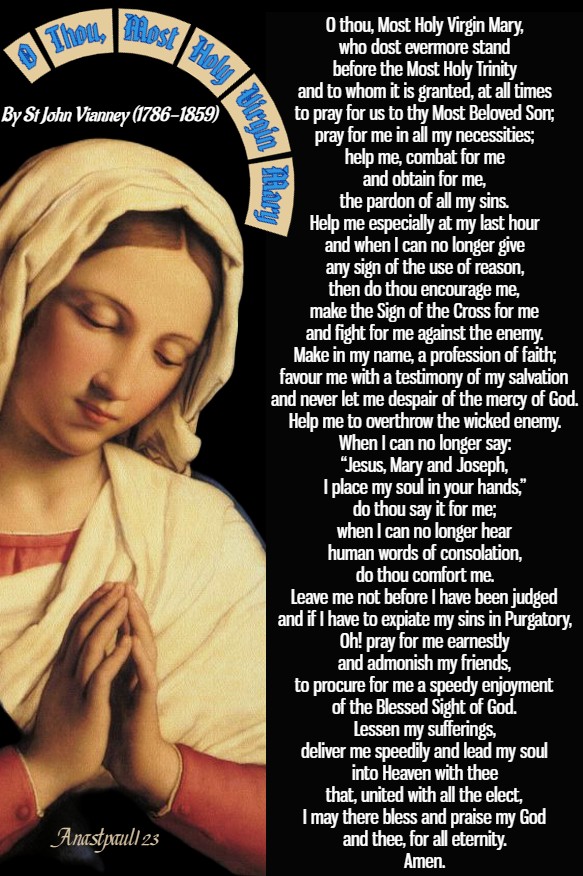
O Thou, Most Holy Virgin Mary (Pray for Me in All My Necessities) By St John Vianney (1786-1859)
O thou, Most Holy Virgin Mary, who dost evermore stand before the Most Holy Trinity and to whom it is granted, at all times to pray for us to thy Most Beloved Son; pray for me in all my necessities; help me, combat for me and obtain for me, the pardon of all my sins. Help me especially at my last hour and when I can no longer give any sign of the use of reason, then do thou encourage me, make the Sign of the Cross for me and fight for me against the enemy. Make in my name, a profession of faith; favour me with a testimony of my salvation and never let me despair of the mercy of God. Help me to overthrow the wicked enemy. When I can no longer say: “Jesus, Mary and Joseph, I place my soul in your hands,” do thou say it for me; when I can no longer hear human words of consolation, do thou comfort me. Leave me not before I have been judged and if I have to expiate my sins in Purgatory, Oh! pray for me earnestly and admonish my friends, to procure for me a speedy enjoyment of the Blessed Sight of God. Lessen my sufferings, deliver me speedily and lead my soul into Heaven with thee that, united with all the elect, I may there bless and praise my God and thee, for all eternity. Amen.
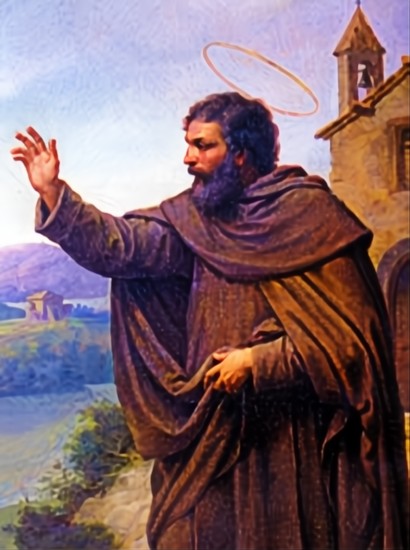
Saint of the Day – 9 August – Saint Falco of Palermo (Died mid 11th Century) Hermit, Monk, Miracle-worker. Born in the Calabria region of Italy and died ion 13 January of natural causes at Palermo, Italy. Also known as – Falcon, Falco the Hermit. Additional Memorias – 13 January in commemoration of his death and on the Sunday following 15 August 15 in memory of the translation of his Relics from the Church of St Egidius. St Falco was Canonised in 1893 by Pope Leo XIII.
Falco, born in Taverna in Calabria towards the middle of the tenth century, of the ancient and noble Poerio family, was, from a very young age, attracted by solitude andan eremetic life.
He soon decided to retire to the Monastery of Pesica near his hometown, among the Basilians, under the discipline of a holy Abbot named Ilarione. The community was already known throughout Calabria for the virtues and sanctity of all the brothers who formed it.
In 980 Calabria became the scene of ruin as a prey of the Saracens. From the Monastery of Taverna, the “seven brothers” (a long story of Falco’s friends who all entered religious life and were all Canonised with him) decided to leave for Abruzzo. Here they built some cells and a small Church, the ruins of which were visible until the end of the 19th Century. Here, they settled, living in poverty and sanctity, imposing rigid rules on themselves as true imitators of the ancient Monks of Egypt.
Under the guidance of their holy Abbot Hilarion, they led an austere life of fasting, eating mostly herbs, except on Sundays. Their conversation consisted of the practice of prayer and the recitation of praise. When the holy Abbot died, they elected as Superior, the youngest, Nicolò Greco, younger in age but not in merit. The new Abbot, to give thanks to God, asked his brothers to make a pilgrimage to Rome. During the journey, with their prayers, “the seven brothers” managed to free seven possessed people from evil spirits they had met near Lake Fucino. Once they set off again, one of them, weighed down by poor health, left his companions and, near Ortucchio, found shelter in the Church of the Santissima Vergine, in St Maria in Capo d’acqua.
The other companions, having completed the pilgrimage, returned to Prata to their monastic life. Nicolò was the Abbot for several years but at his death, the other brothers, unable to elect a successor, considered themselves free to follow their own path. Falco decided to return to Rome and set out but that same evening, having reached Palena, attempting to climb the mountain of Coccia, he felt his strength failing and was forced to rest in the nearby Church of St Egidius. At the unexpected arrival of this holy Friar, the district infested by evil spirits, was immediately purified and his presence was a reason for hope for the inhabitants of the place who immediately acclaimed him and showed him respect. He thus decided to remain in those mountains, continuing his life of rigours and prayers.
Out of extreme humility he never wished to embrace the Priesthood but to remain a very humble Friar, an example of virtue.
It was the morning of 13 January presumably of a year around the middle of the 11th Century, suddenly the small bell of the hermitage where Falco lived in retreat, was heard ringing. Many people rushed there, thinking that the Friar needed help and found him lifeless lying on a table with two lit candles. His body was transported to the Church of St Egidius Abate, where, after the funeral, he was buried.
A possessed man was passing by those parts when everyone with amazement, saw him break the ropes and run towards the Tomb of the Saint, where as soon as he arrived, he was freed from the devil. From that moment the fame of St Falco became even greater and confirmed by several other miracles, so much so that at the request of the people, the remains were exposed to public veneration.
If the archives of Sulmona and Palena had not been destroyed in a fire, we would today have countless descriptions of graces and miracles reported in the acts of his Canonisation.
In 1383, due to continuous raids and robberies, fearing for their fate, the Bishop of Sulmona decided to transfer the Relics and the Statue of St Falco to the Church of St Anthony Abbot in the centre of Palena. Since then, the Church and the Relics of St Falco became a destination for pilgrims, believers, devotees, the sick and the obsessed, even from far away.
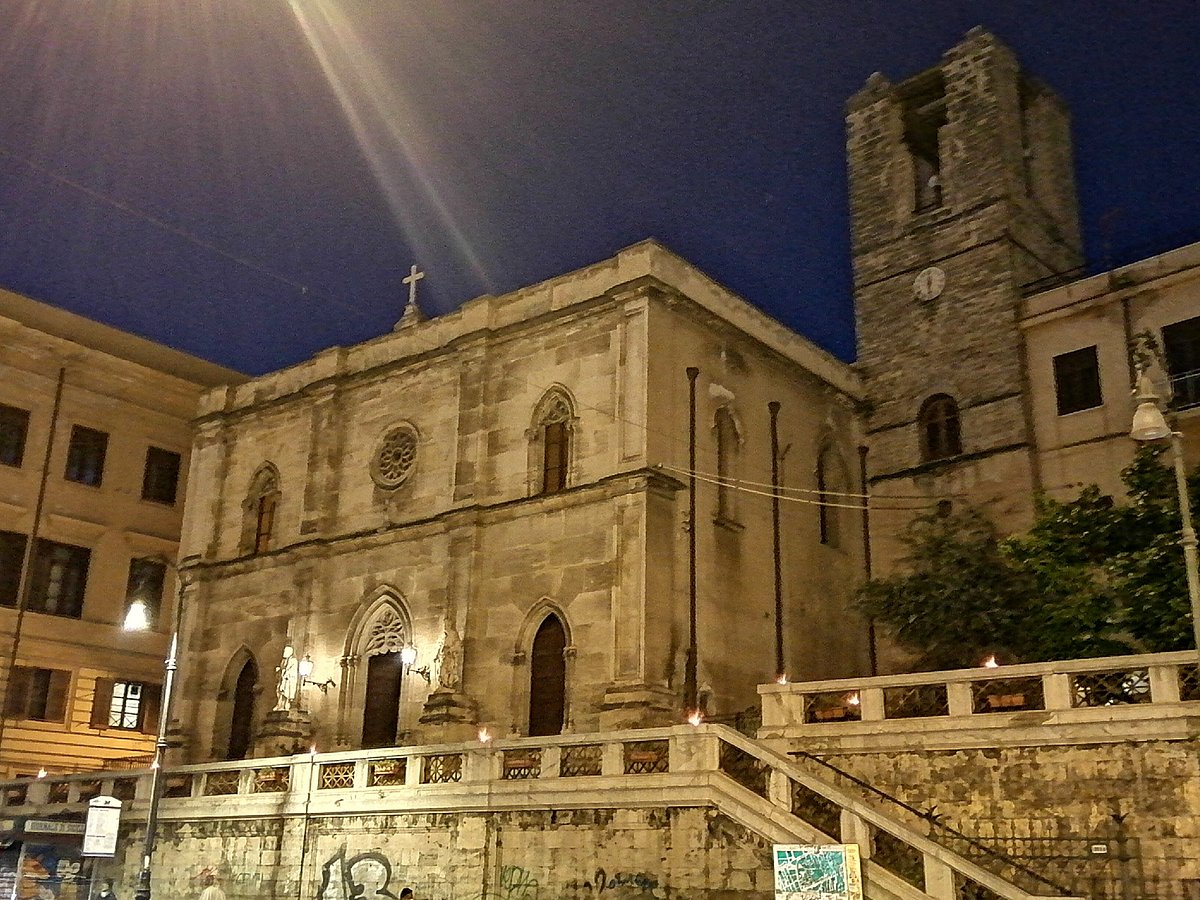
The Church of St Anthony Abbot in Palermo
In the earthquake of 1706, the Church was not exempt from disaster but was soon rebuilt with the help and devotion of the faithful. In 1841, fue to the growing devotion and the countless pilgrimages, it was decided to demolish the old Church to build a much larger and more spacious one and in 1842, thanks to the great devotion, a half-length silver Statue of the Saint was erected by the famous Domenico Capozzi.
The Shrine with his Relics, the Dalmatic tunic in the Greek style and the silver Statue containing his skull, are exposed twice a year for the devotion of the faithful, on 13 January in commemoration of his death and on the Sunday following 15 August 15 in memory of the translation of his Relics from the Church of St Egidius. St Falco was Canonised in 1893 by Pope Leo XIII.
Interior of the Church where St Falco is enshrined
St Nathy St Numidicus of Carthage St Phelim St Rusticus of Sirmium St Rusticus of Verona St Secundian of Civitavecchia St Stephen of Burgos St Verian of Civitavecchia
Martyrs of Civitavecchia: Three Christians Martyred together in the persecutions of Decius. We know little more than the names – Marcellian, Secundian and Verian. 250 near Civitavecchia, Italy.
Martyrs of Constantinople: 10 Saints: A group of ten Christians who were arrested, tortured and executed for defending an icon of Christ in defiance of orders from Emperor Leo the Isaurian. We know the names of three, but nothing else about them – Julian, Marcian and Mary. They were beheaded in Constantinople.







 AnaStpaul
You must be logged in to post a comment.