
Thought for the Day – 24 August – Meditations with Saint Alphonsus Maria de Liguori (1696-1787) Bishop, Confessor, Most Zealous Doctor of the Church
“Preparation for Death”
By St Alphonsus Maria de Liguori (1696-1787)
PREFACE
Part Two
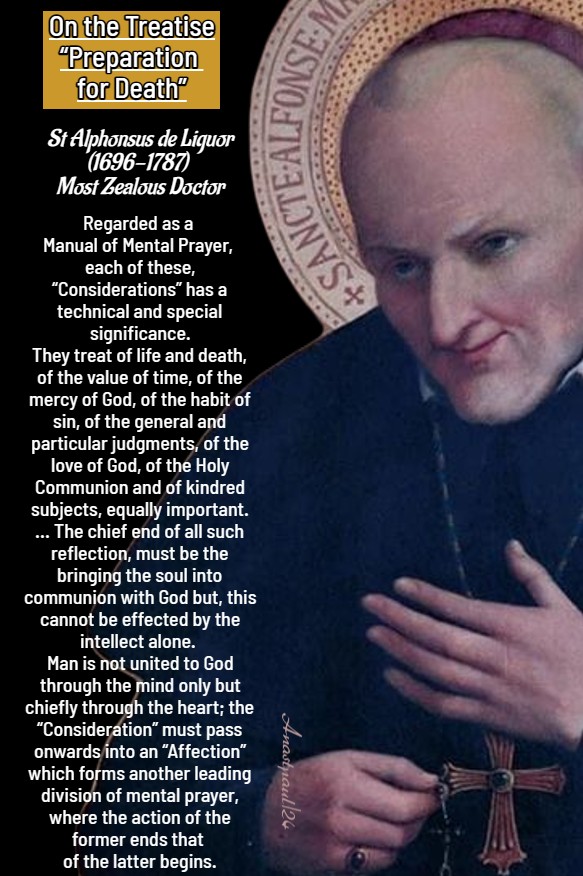
Regarded as a Manual of Mental Prayer, each of these, “Considerations” has a technical and special significance.
They treat of life and death, of the value of time, of the mercy of God, of the habit of sin, of the general and particular judgments, of the love of God, of the Holy Communion and of kindred subjects, equally important.
The “Consideration” as here used, implies far more, than a mere inquiry. Its equivalents, the Italian Considerazione,
and the Latin Consideration do not fully express its particular meaning in this Treatise, where it stands for a reflectional meditation. It calls into play the exercise of the memory which puts together all the circumstances of the subject under notice; it excites the imagination which represents, as in a picture, all such circumstances, bringing
~ them vividly before the mind’s eye and, lastly, it urges the will so to. fix and detain these things in the soul that, by its own effort, it may unite itself with the Will of God, so that God’s Will and the will of man, may become one.
St Thomas Aquinas defines “Consideration” to be “an act of the intellect andof the beholding the truth of a proposition,”(Sum. 22E Q liii. 4); to be, “moreover, principally related to the judgement.”
As one of the three divisions of prayer, properly so called, these Considerations must also be considered as reflections, as reasonings of the mind upon definite subjects, either for its perfect conviction of some vital truth, or for its persuasion to the formation of some holy resolution.
The chief end of all such reflection, must be the bringing the soul into communion with God but, this cannot be effected by the intellect alone. Man is not united to God through the mind only but chiefly through the heart; the “Consideration” must pass onwards into an “Affection” which forms another leading division of mental prayer, where the action of the former ends that of the latter begins.
Let us apply these “Consideration” to one or two of
the subjects which are treated of in the present Treatise.
At the first thought of Death, we are all naturally inclined to fear it but, the “Consideration” upon death (Chapter viii.) tends to remove this fear, since it brings death before us:
Firstly, as “the end of our labours” of that toil by which we are prepared for our eternal rest.
Secondly, as the “consummation of our victory” over sin and weakness; the struggle has been a sore one, the battle has been hardly fought but, it has been won at last! Thirdly, as the “gate of life” therefore, the death of the Saints is called, a birthday, a day in which they are born to that other and blessed life which can never end.
These are the three Points in the “Consideration” upon Death which disarms it of its terrors.
Again, are we sorely troubled by our struggles with self-will ? We find a “Consideration” on conformity to the Will of God (Chapter xxxiv, the “First Point” of which, indicates the connection between perfect resignation to God’s Will and perfect love towards His Person.
The “Second Point” shows that nothing comes amiss of earthly sorrow and humiliation, not even Martyrdom itself, if all things be submitted to His Divine Will.
The “Third Point” explains that peace of soul fills a heart whose every desire is in conformity to God’s Will. Let come what may, I wish for it because God Will’s it.









 AnaStpaul
You must be logged in to post a comment.