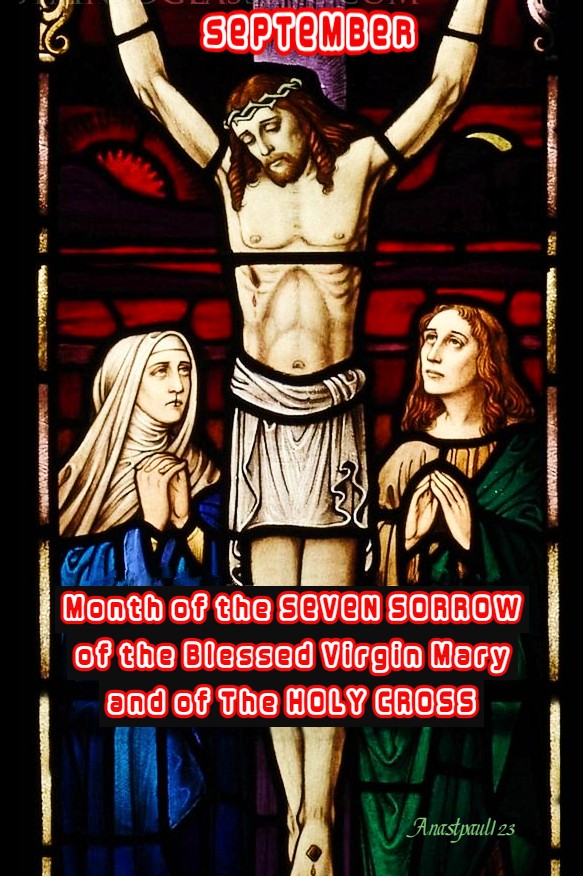
Month of The Seven Sorrows of the Blessed Virgin Mary and The Holy Cross
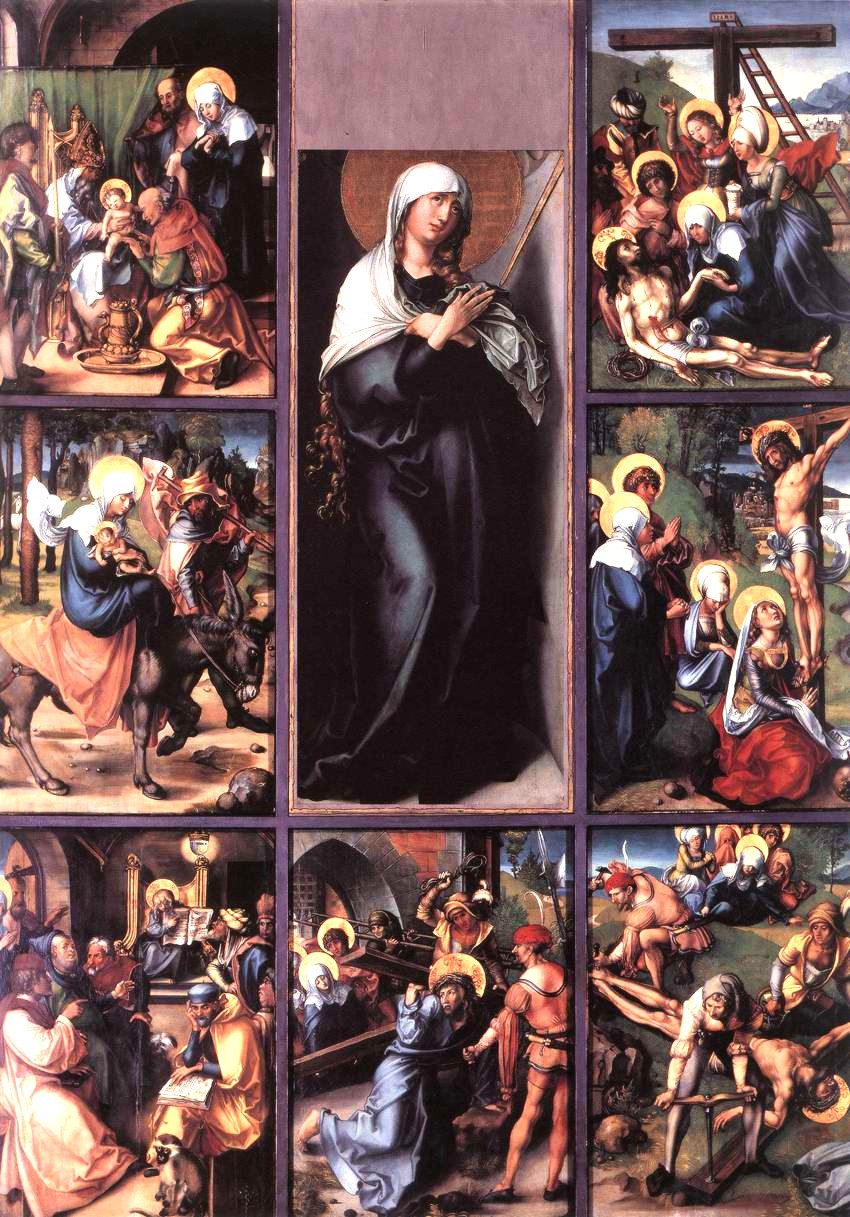
The Seven Sorrows of the Blessed Virgin Mary
1, The prophecy of Simeon 2. The Flight to Egypt 3. Loss of Child Jesus for 3 days 4. Meeting Jesus carrying His Cross 5. The Crucifixion of Jesus 6. The Pieta – receiving Jesus’ Body The Burial of Jesus
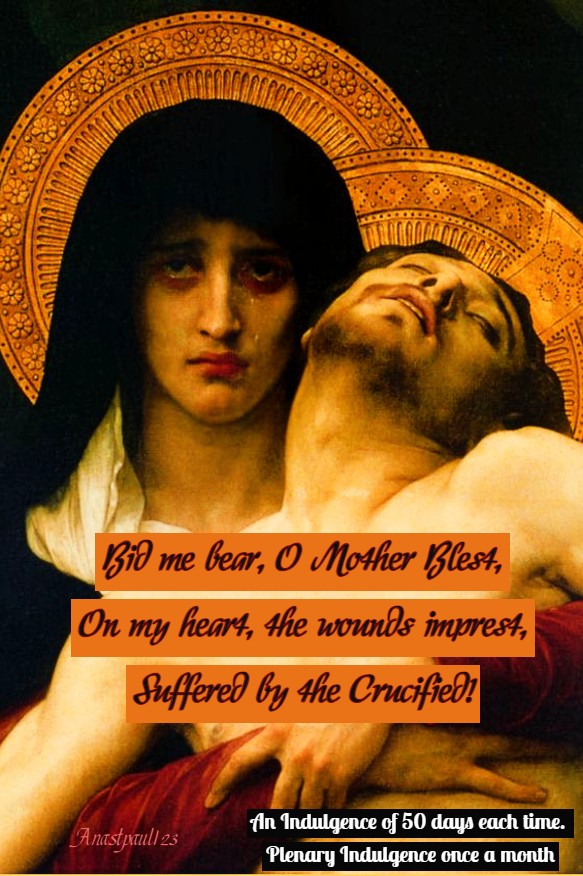
Bid me bear, O Mother Blest, On my heart, the wounds imprest, Suffered by the Crucified!
An Indulgence of 50 days each time. Plenary Indulgence once a month under the usual conditions.
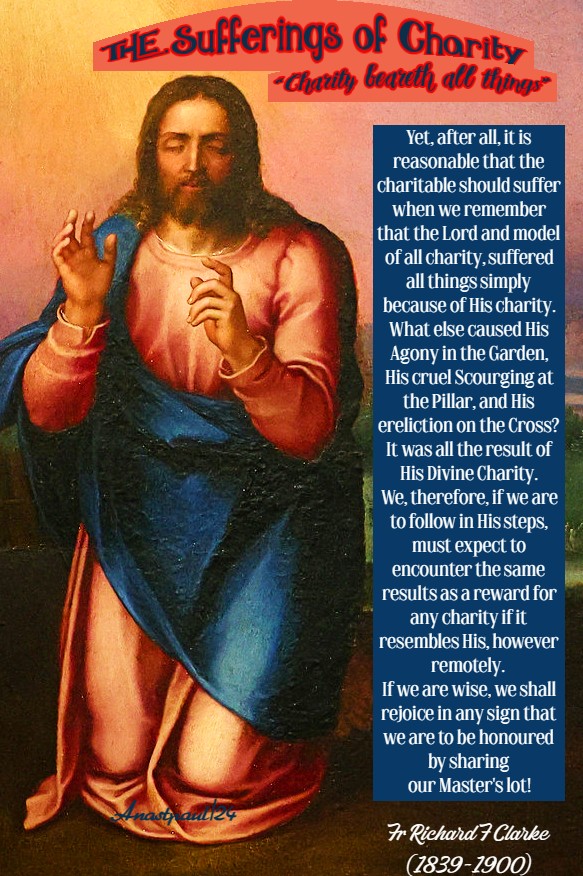
“Yet, after all, it is reasonable that the charitable should suffer when we remember that the Lord and model of all charity, suffered all things simply because of His charity. What else caused His Agony in the Garden, His cruel Scourging at the Pillar, and His dereliction on the Cross? It was all the result of His Divine Charity. We, therefore,, if we are to follow in His steps, must expect to encounter the same results as a reward for any charity if it resembles His, however remotely. If we are wise, we shall rejoice in any sign that we are to be honoured by sharing our Master’s lot!” Fr Richard Frederick Clarke SJ (1839-1900)
Thought for the Day – 1 September – Meditations with Saint Alphonsus Maria de Liguori (1696-1787) Bishop, Confessor, Most Zealous Doctor of the Church
“Preparation for Death” By St Alphonsus Maria de Liguori (1696-1787)
CONSIDERATION II
“An end, the end is come.” (Ezek vii: 2)
SECOND POINT: Philip II, King of Spain, being near death, called his son to him and casting aside his royal robe and showing him his breast which was all gnawed by worms, said to him: “Prince, see how we die and see how all the grandeur of this world is finished.” Theodoret spoke truly when he said, that “death fears neither riches nor guards, nor the purple; rottenness follows and health fails.” So that everyone who dies, although he may be a Prince, takes nothing with him to the grave; all the glory remains upon the bed where he died. “For he shall carry nothing away with him when he dieth, neither shall his pomp follow him.” (Ps xlix: 17).
St Antoninus relates that when Alexander the Great was dead, a certain philosopher, exclaiming, said: “Behold he who was treading upon the earth yesterday, now, by that same earth is possessed. Yesterday, the whole earth was not enough for him, now, he lies in about seven spans thereof. Yesterday, he conducted his armies over the earth and now, he is taken by a few men to be put under the earth.”
But ratherlet us listen to God, when He says: “Why are earth and ashes proud?” (Ecclus x: 9). Man, dost thou not see, that thou art nothing but dust and ashes and of what, therefore, art thou proud ? Why, therefore, dost thou spend thy years and thy thoughts in seeking to make thyself great in this world? Death will soon come and then, all thy grandeur will come to an end and also all thy designs. “And then, all his thoughts perish.” (Ps cxlvi: 3).
Oh how much happier was the death of St Paul the Hermit, who lived for sixty years shut up in a cave, than the death of Nero, who was the Emperor of Rome? How much happier was the death of Felix, a Capuchin Lay Brother, than the death of Henry VIII, who lived in Royal splendour but who was the enemy of God? But we must consider, that these holy men, in order to die such a happy death, gave up everything – their country, the hopes and pleasures which the world offered them and they embraced a life which was poor and despised. They buried their lives in this world, so that they might not be buried when dead, in hell!
But how can the worldly, who are living in sin in worldly pleasure, in dangerous occasions, how can they, I repeat, hope to die a happy death? God now threatens those who are living in sin that when they are on the bed of death, they will seek Him but they will not find Him. “Ye shall seek me and shall not find me.” (St John vii: 34) God says, that that will be the time for vengeance but not for mercy. “To Me belongetl vengeance and recompence.” (Deut xxxii: 35). Reason tells us the same, for at the hour of death, a worldly man will find his mind fails him, his heart dark and hardened because of his evil habits, his temptations will be very strong; how can he, who in life has been wont to yield to sin and to let sin conquer him, how can such an one, I say, ever expect to be able to resist temptation at the hour of death? An all-powerful Divine grace is then needed to change his heart but will God give him this Divine grace? Has he deserved it, during the unholy life he has led And does he deserve it now that he is dying? And yet, this is a question concerning his eternal happiness or his eternal misery! How is it then that he, who thinks upon this and believes in the Truths of Faith, does not give up everything, so as to give himself entirely to God, Who, according to our works, so will He judge us?
Affections andPrayers
Ah, Lord, how many nights have I, wretched one who I am, laid me down to sleep at enmity with Thee!? O God, what a wretched state was my soul then in! It was hated by Thee and it did not ‘mind Thy hatred. Once I was condemned to hell, the sentence only remained to be executed. But Thou, my God, hast never ceased to seek me, and to invite me to pardon. But who is it who can assure me that I am pardoned now? Must I live, my Jesus, in this fear until the time shall come for me to be judged? But the grief that I feel at having offended Thee; the desire which I have, to love Thee and much more, Thy great compassion, my Beloved Redeemer; make me hope to remain in Thy blessed favour. I am very sorry for having offended Thee, O Thou Sovereign Good and I love Thee beyond all things. I have resolved to lose all, rather than lose Thy grace and Thy holy Love. Thou desirest that heart which seeks Thee to rejoice. “Let the heart of them rejoice who seek the Lord.” (i Chron xvi: 10). O Lord, I detest my offences against Thee; give me courage and confidence do not reproach me with my ingratitude, for I am very conscious of it, I detest it. Thou hast said: “I have no pleasure in the death of the wicked but that the wicked turn from his way and live.” (Ezek xxxiii: 11). Yes, my God, I will leave all and be converted to Thee. I seek Thee, I desire Thee and I love Thee more than all things. Give me Thy holy Love and I ask for nothing more.
Quote/s of the Day – 1 September – Pentecost XV – Galatians 5:25-26; 6:1-10; Luke 7:11-16 – Scripture search here: https://www.drbo.org/
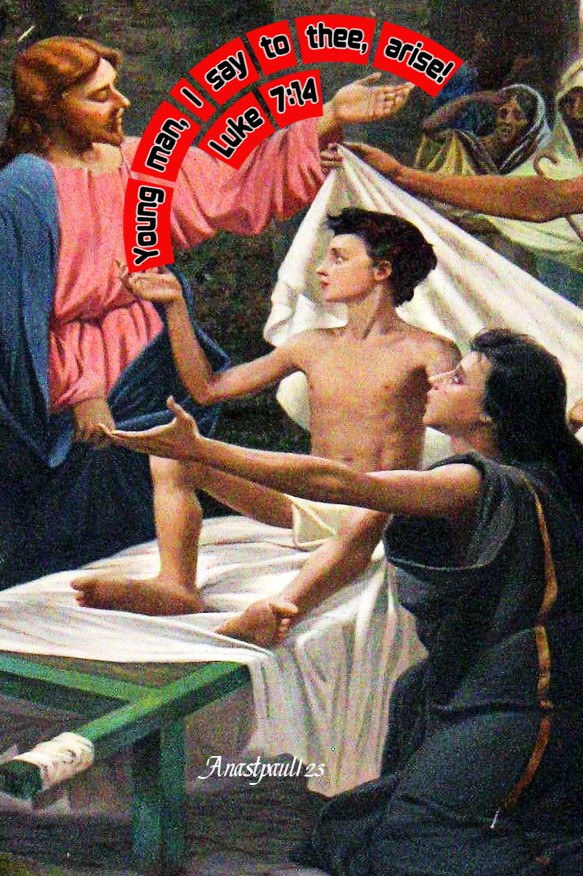
“Young man, I say to thee, arise!”
Luke 7:14
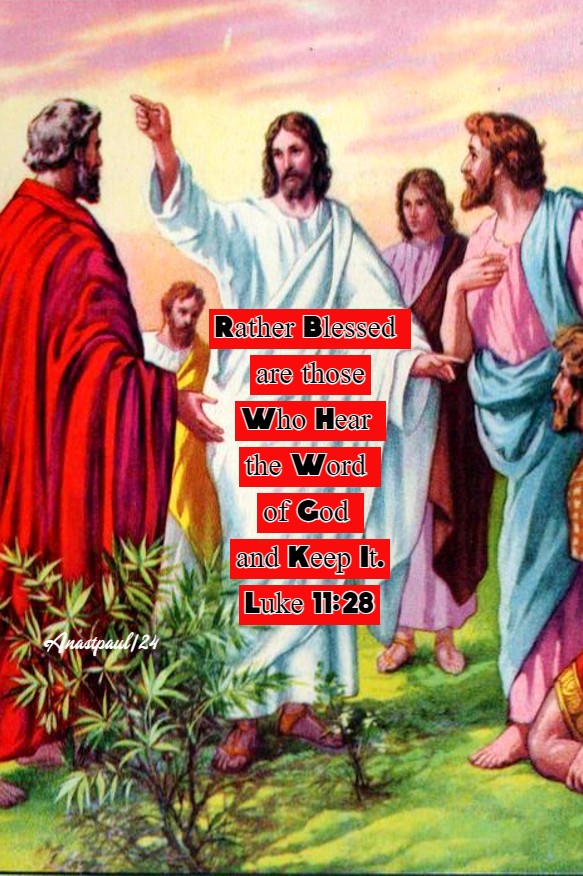
“Rather blessed are those who hear the Word of God and keep it.’”
Luke 11:28
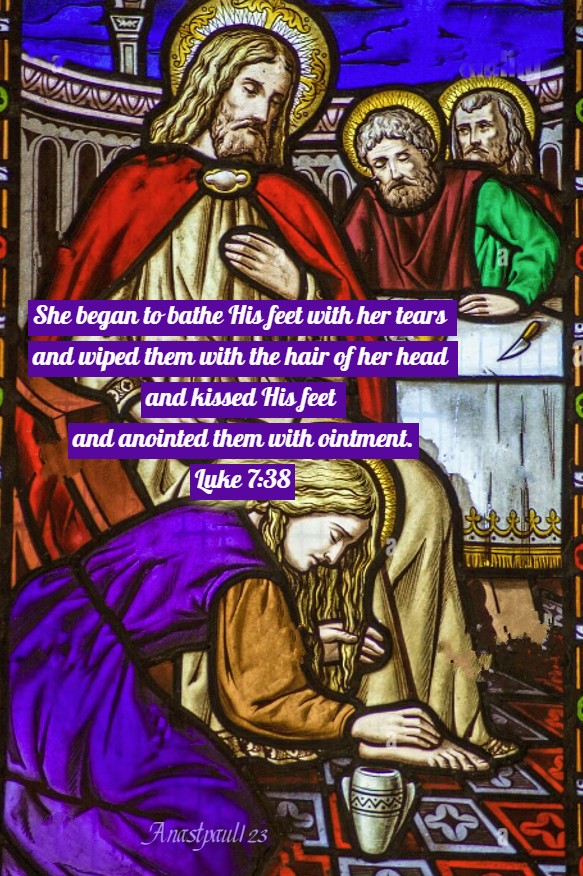
“She began to bathe His feet with her tears and wiped them with the hair of her head and kissed His feet and anointed them with ointment.”
Luke 7:38
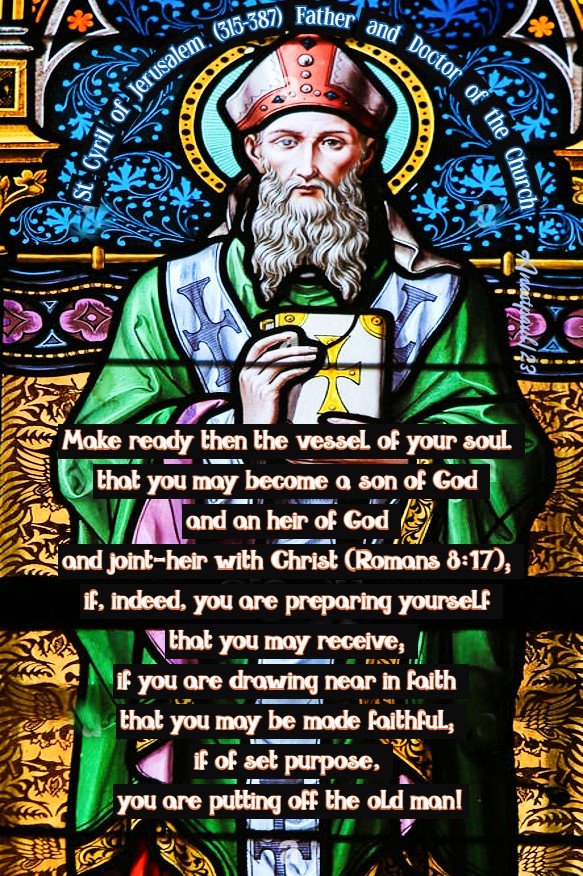
“Make ready then the vessel of your soul that you may become a son of God and an heir of God and joint-heir with Christ (Romans 8:17); if, indeed, you are preparing yourself that you may receive; if you are drawing near in faith that you may be made faithful; if of set purpose, you are putting off the old man!”
St Cyril of Jerusalem (315-387) Father and Doctor of the Church
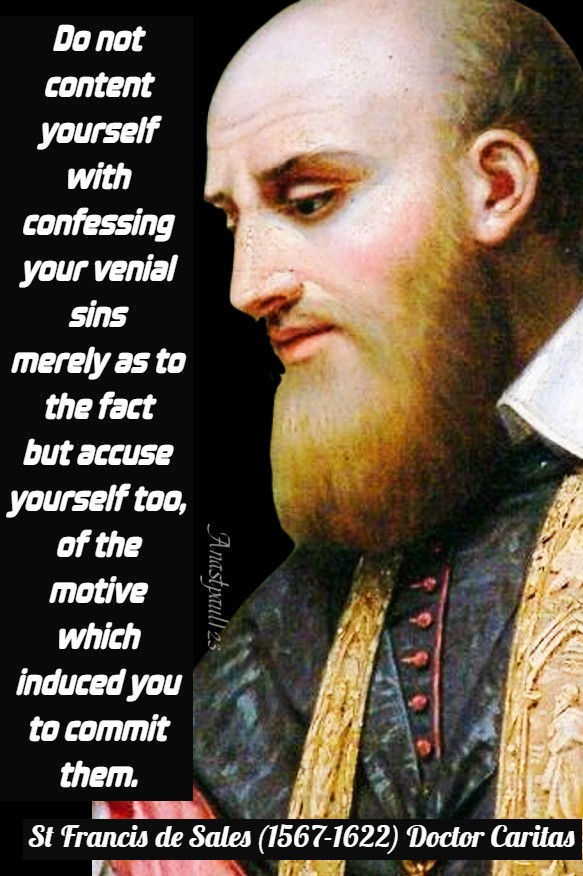
“Do not content yourself with confessing your venial sins merely as to the fact but accuse yourself too, of the motive which induced you to commit them.”
(Introduction to the Devout Life, Part II, Chapter 19).
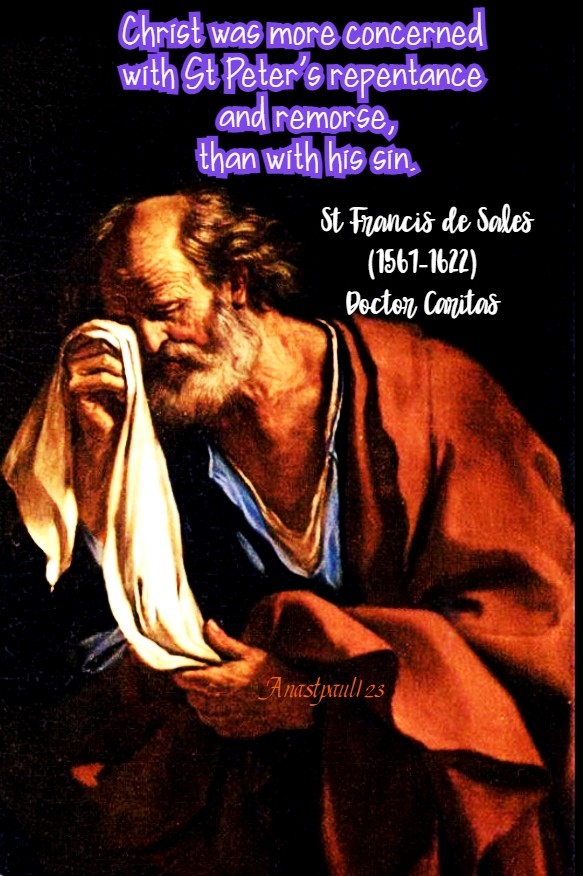
“Christ was more concerned with St. Peter’s repentance and remorse, than with his sin.”
One Minute Reflection – 1 September – “The Month of The Seven Sorrows of the Blessed Virgin Mary and The Holy Cross” – St Giles (c650 – c710) Abbot – Pentecost XV – Galatians 5:25-26; 6:1-10; Luke 7:11-16 – Scripture search here: https://www.drbo.org/
Young man, I say to thee, arise!” – Luke 7:14
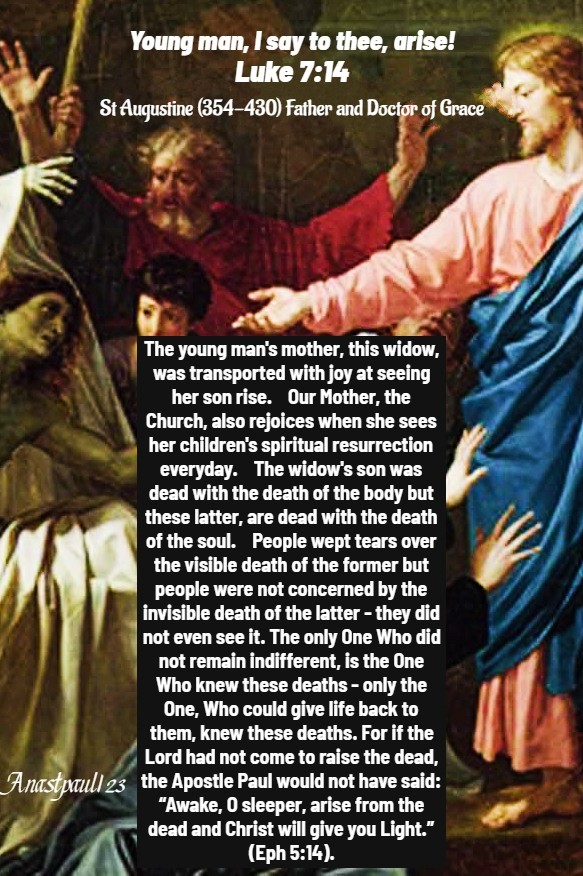
REFLECTION – “Let no-one who is Christian doubt that even now, dead people rise. Certainly, every human being has eyes, by which he can see dead people rising, in the way this widow’s son, whom we just heard about in the Gospel, arose. But not everyone can see people who are spiritually dead rise. For that, it is necessary to have already risen interiorly. It is greater to raise someone, who is to live forever than to raise someone, who will have to die again.
The young man’s mother, this widow, was transported with joy at seeing her son rise. Our Mother, the Church, also rejoices when she sees her children’s spiritual resurrection everyday. The widow’s son was dead with the death of the body but these latter, are dead with the death of the soul. People wept tears over the visible death of the former but people were not concerned by the invisible death of the latter – they did not even see it. The only One Who did not remain indifferent, is the One Who knew these deaths – only the One, Who could give life back to them, knew these deaths. For if the Lord had not come to raise the dead, the Apostle Paul would not have said: “Awake, O sleeper, arise from the dead and Christ will give you Light.” (Eph 5:14).” –St Augustine (354-430) Father and Doctor of Grace (Sermon 98).
PRAYER – May the pleading of blessed Giles Abbo,t make us acceptable unto Thee O Lord, we pray that what we may not have through any merits of our own, we may gain by means of his patronage. Through Jesus Christ, Thy Son our Lord, Who lives and reigns with Thee, in the unity of the Holy Ghost, God, world without end. Amen (Collect).
Our Morning Offering – 1 September – “The Month of The Seven Sorrows of the Blessed Virgin Mary and The Holy Cross”
What Can I Say? By St Anselm (1033-1109) Magnificent Doctor Marian Doctor
My most merciful Lady, what can I say about the fountains that flowed from your most pure eyes when you saw your only Son before you, bound, beaten and suffering? What do I know of the flood that drenched your matchless face, when you beheld your Son, your Lord and your God, stretched on the Cross without guilt, when the flesh of your flesh was cruelly butchered by wicked men? How can I judge, what sobs, troubled your most pure breast, when you heard, “Woman, behold your son,” and the disciple, “Behold, your Mother,” when you received as a son the disciple in place of the Master, the servant for the Lord? Amen
From “The Prayers and Meditations of Saint Anselm with the Proslogion,” Benedicta Ward, trans,1973, Penguin classics, Penguin Group (UK).
Saint of the Day – 1 September – St Constantius (Died c570) Bishop of Aquino, Italy. Gifted with the charism of Prophecy, St Gregory the Great himself says, in particular, that our Saint shone through the gift of prophecy and miracles. Patronage -Co-Patron with St Thomas Aquinas of the City of Aquino and the Diocese of Sora-Cassino-Aquino-Pontecorvo, Italy, Also known as – Constance, Costantino… Constanzo…
The Roman Martyrology reads today: “At Aquino, Saint Constantius, a Bishop renowned for the gift of prophecy and many virtues.”
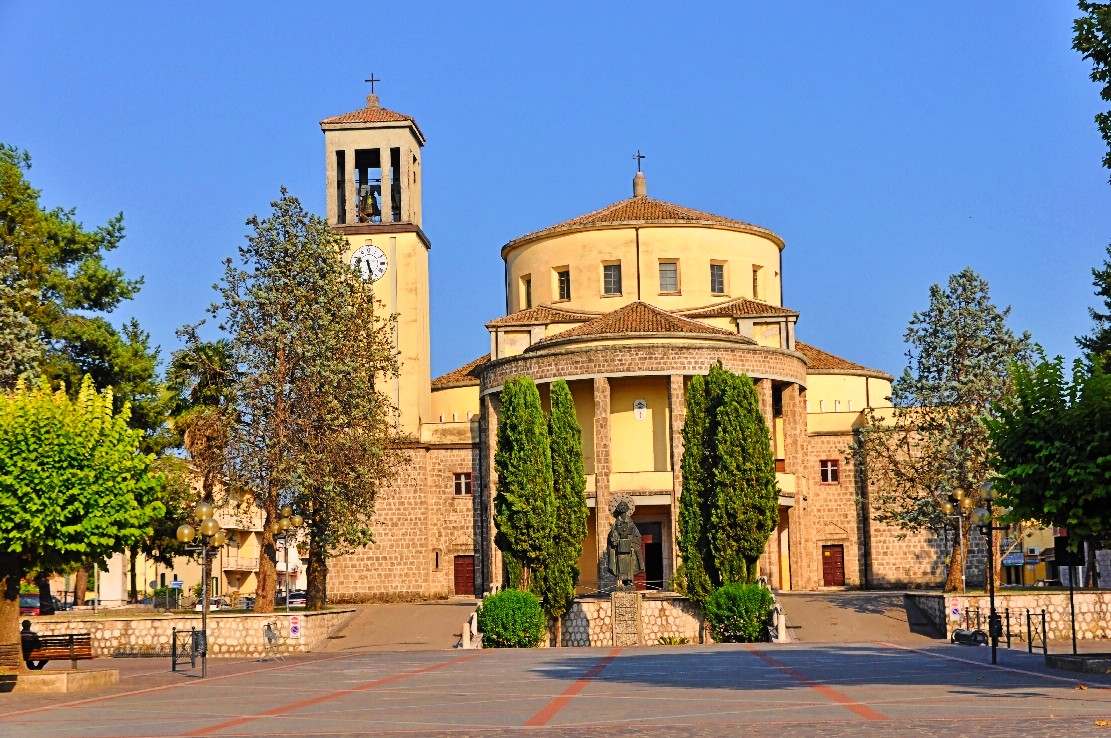
Aquino Cathedral dedicated to the Co-Patrons, St Constantius and St Thomas Aquinas
What we know about Constantius comes from two passages of St Gregory the Great, who reports that this holy Bishop of Aquino had died not long before, during the Pontificate of Pope John. Gifted with a prophetic spirit, when he was at the end of his life, his neighbours, who, mourning his imminent loss, anxiously asked him who they would have after him, Constantius replied: “After Constantius a muleteer and after the muleteer, a clothes washer, alas, miserable you, Aquino and let that be enough for you!”
Having said this, he died. His Deacon Andrew, who had previously governed mules and horses, succeeded him in the pastoral care and when he died, Giovinius, who had been a clothes washer in the same City, was elevated to the Episcopal dignity. He was still alive when Aquino was devastated by the Lombards, some of the inhabitants were killed by the invaders, some perished by a fierce pestilence, so that after his death, it was no longer known who the Bishop was bishop, nor for whom anyone should be the Bishop. Thus was fulfilled what the man of God had announced – after the death of his two successors, his Church would no longer have any Shepherd.
Already in narrating the deeds of Saint Benedict, St Gregory had recalled that a cleric of Aquino, tormented by the devil, had been directed by Bishop Costantius to many sanctuaries of Martyrs. These, however, did not want to restore his health, to demonstrate how much grace there was in Benedict, who, in fact, having had the cleric before him, with his prayers immediately freed him from the enemy.
We,, therefore, have from St Gregory the Great himself two certain data for the chronology of the life of St Constantius – he was already the Bishop of Aquino while Saint Benedict (Died 547) was still alive and he died during the Pontificate of John III (561-573). But although St Gregory does not expressly declare the identity of the person, this appears evident from the expressions he uses.
After the long period of abandonment following the Lombard devastation, the Episcopal See of Aquinas was reconstituted and sought the memories of its Patron Saint. Even if the legend, written by the Cassinese Deacon several centuries after the life of the Saint it deals with, could not have been very reliable, it is, nevertheless, for us evidence of the cult paid to Constantius in the reborn Diocese.
On 10 December 1742, Bishop Spadea proceeded to examine the Relics of the Patron Saint, found under the Altar of the ancient Cathedral dedicated to Saint Peter. After having honoUrably placed them in a new wooden urn, he had them translated to the new Cathedral dedicated to St Constantius, where they were placed under the High Altar. The same Bishop also informs us that, until 1644, the body of the Saint had been preserved in a Church dedicated to him, far from the City walls and no longer existing. The Cathedral of St Constantius, destroyed in May 1944, was rebuilt by Bishop Biagio Musto and dedicated, in October 1963, to Saints Constantius and St Thomas Aquinas, Co-Patron.
Twelve Holy Brothers: Martyrs of the South – A group of Martyrs who died c303 at various places in southern Italy. In 760 their relics were brought together and enshrined in Benevento, Italy as a group. Saint Arontius of Potenza, Saint Donatus of Sentianum, Saint Felix of Sentianum, Saint Felix of Venosa, Saint Fortunatus of Potenza, Saint Honoratus of Potenza, Saint Januarius of Venosa, Saint Repositus of Velleianum, Saint Sabinian of Potenza, Saint Sator of Velleianum, Saint Septiminus of Venosa, Saint Vitalis of Velleianum. One tradition describes Saint Boniface of Hadrumetum and Saint Thecla of Hadrumetum as their parents.
St Abigail the Matriarch St Aegidius St Agia St Anea St Arcanus St Arealdo of Brescia Bl Colomba of Mount Brancastello St Constantius (Died c570) Bishop of Aquino St Donatus of Sentianum St Felix of Sentianum









 AnaStpaul
You must be logged in to post a comment.