
Thought for the Day – 20 September – Meditations with Saint Alphonsus Maria de Liguori (1696-1787) Bishop, Confessor, Most Zealous Doctor of the Church
“Preparation for Death”
By St Alphonsus Maria de Liguori (1696-1787)
CONSIDERATION VIII
The Death of the Just
“Precious in the Sight of the Lord
is the death of His Saints.”
(Ps cxv: 15)
THIRD POINT:
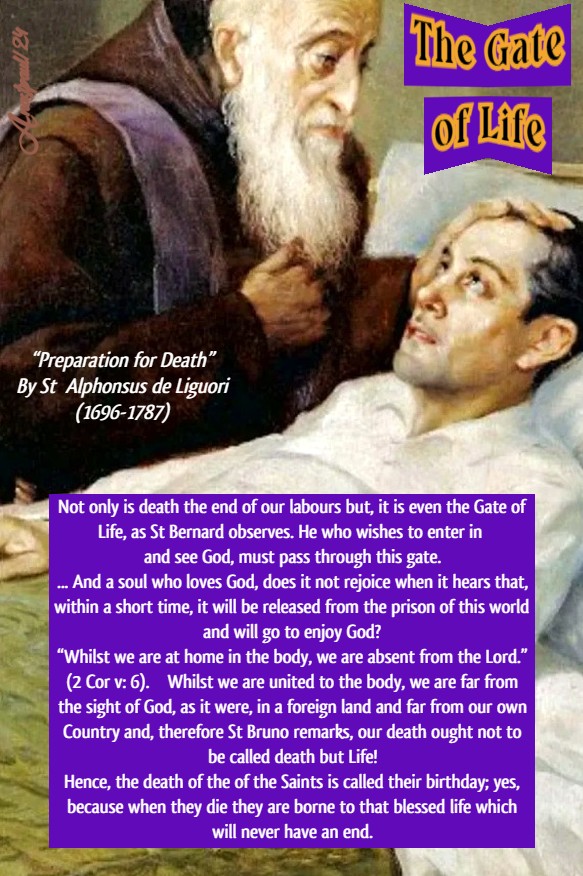
Not only is death the end of our labours but, it is even the Gate of Life, as St Bernard observes. He who wishes to enter in and see God, must pass through this gate.
“This is the gate of the Lord; the righteous shall enter into it.” (Ps cxviii: 20).
St Jerome called out to death and said: “Open to me, my sister.” My sister, death, if thou dost not open the door, I cannot go in to enjoy my Lord.
St Charles Borromeo, having a painting in his house which represented a skeleton with a scythe in the hand,called for the painter and ordered him to erase the scythe and to paint a golden key; desiring by this that the wish for death should ever be kindled in his heart, for death is that key which must open the Gate of Heaven for us to see God.
St John Chrysostom observes that if a King had prepared an apartment in his Palace for someone but, for some time desired that person to live in a hovel, how much would he not desire to leave the hovel and to go to the Palace?
The soul during this life, being in the body, is as it were, in a prison, from which it must pass to enter into the Kingdom of Heaven, therefore, David prayed, saying: “Bring my soul out of prison.” (Ps cxlii: 9).
And the holy Simeon, when he had the Infant Jesus in his arms, sought for no other favour than death, so as to be freed from the prison of this life: “Lord, now lettest Thou, Thy servant depart in peace.” (St Luke ii: 29).
St Ambrose also says: “he seeks, as if he were held by necessity, to be dismissed.”
The Apostle also desired the same grace when he said: “having a desire to depart and to be with Christ,” (Phil i:23).
What joy the cup-bearer of Pharaoh felt when he heard from Joseph that he should soon be released from prison and should return to his post!
And a soul who loves God, does it not rejoice when it hears that, within a short time, it will be released from the prison of this world and will go to enjoy God?
“Whilst we are at home in the body, we are absent from the Lord.” (2 Cor v: 6). Whilst we are united to the body, we are far from the sight of God, as it were, in a foreign land and far from our own Country and, therefore St Bruno remarks, our death ought not to be called death but Life!
Hence, the death of the of the Saints is called their birthday; yes, because when they die they are borne to that blessed life which will never have an end.
St Athanasius observes: “the just die not but are translated.”To the just, death is no other, than the transition to eternal life.”
“O beautiful death,” says St Augustine, “and who is he who does not long for thee, seeing thou art the end of all work, the end of toil and the beginning of eternal rest?”
Therefore, the Saint earnestly prayed, saying: “May I die, O Lord, that I may see Thee?”
St Cyprian observes, that death must indeed be feared by the sinner because he will pass from a temporal to an eternal death. “Let him fear to die, who shall pass to the second death” but he who is within the Grace of God, does not fear death because he will pass from death to an Eternal Life.
In the life of St John the Almoner, it is related, a certain rich man recommended his only son to the Saint and gave him many alms, so that the Saint might obtain a long life for his son from God but, the son soon afterwards died. As the father was grieving over the death of his son, God sent an Angel to him, who said: “Thou didst seek a long life for thy son, know that he is now enjoying it eternally in Paradise.” This is the Grace Jesus Christ obtained for us, as it was promised in Hosea: “O death, I will be thy plague.” (Hos xiii: 14). Jesus, in dying for us, made our death to become Life.
When Pionius the Martyr was being borne to the scaffold, he was asked by those who led him: “How it was he could go so joyfully to death?” The Saint answered: “You deceive yourselves; I go not to death but to Life.”
Even thus was the youthful St Symphorian encouraged by his mother when the time of his Martyrdom drew nigh: “O my son, life is not taken away from thee; it is exchanged for a better.”
Affections and Prayers
O God of my soul, for the time past I have dishonoured Thee, in turning away from Thee but Thy Son has honoured Thee in sacrificing His Life to Thee upon the Cross. Through the honour done to Thee by Thy dearly Beloved Son, forgive the dishonour I have done Thee.
I am very sorry, O my Sovereign Good, for having offended Thee and I promise, from this day forward, to love none other but Thee. I hope for my salvation from Thee. Whatever I have now that is good, is all of Thy Mercy; I know that I receive it all from Thee: “By the Grace of God, I am what I am.” (i Cor xv: l0).
If during the time past I have dishonoured Thee, I hope to honour Thee forever in eternity in blessing Thee for Thy Mercy.
I feel a great desire to love Thee but Thou givest me the desire and I thank Thee for it, O Jesus, my Love. Continue, oh, continue to help me, as Thou hast already done, for I hope, from this day forward, to be Thine and Thine alone.
I renounce all worldly pleasures, for what greater pleasure can I have, than pleasing Thee, my Lord, Who art so lovely, and Who hast loved me so much? I only seek for love, O my God and I hope ever to seek it from Thee, until dying in Thy Love, I shall reach the Kingdom of Love, where, without beseeching any longer, I shall be filled with love and never, for one moment, cease to love Thee, with all my strength, forever in eternity.


 AnaStpaul