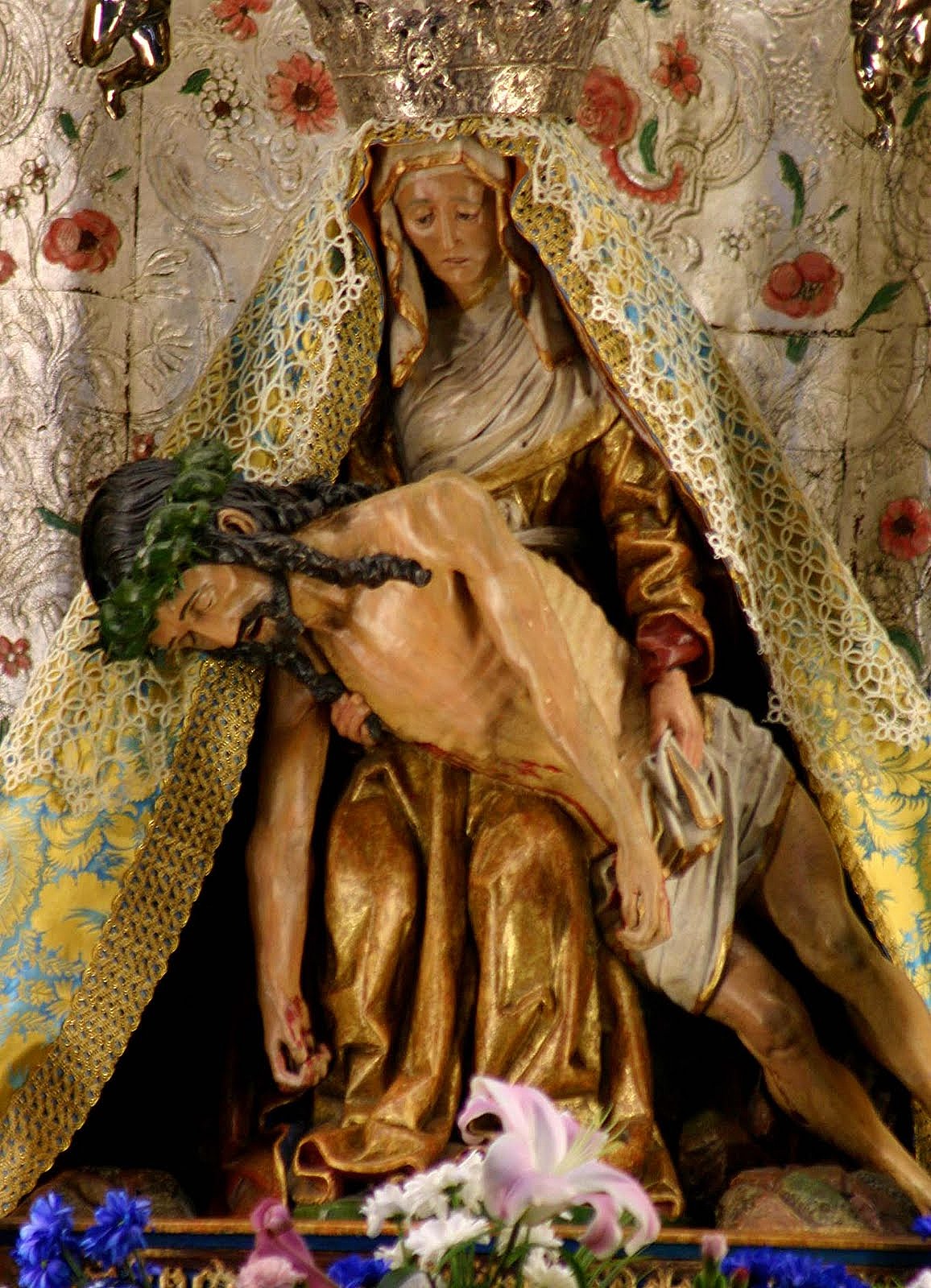
Posted in AUGUSTINIANS OSA, DIVINE Mercy, Goodness, Patience, PREPARATION for DEATH, QUOTES on DEATH, QUOTES on REPENTANCE, QUOTES on SIN

Thought for the Day – 19 October – CONSIDERATION XVII, Of the House of Divine Mercy

Thought for the Day – 19 October – Meditations with Saint Alphonsus Maria de Liguori (1696-1787) Bishop, Confessor, Most Zealous Doctor of the Church

“Preparation for Death”
By St Alphonsus Maria de Liguori (1696-1787)

CONSIDERATION XVII

FIRST POINT:
WE read in the parable in St Matthew xiii that the tares, having grown in a field together with the corn, the servants wished to pluck them up.
Wilt Thou then that we go and gather them up ?”
But the Master answered: “Nay; …. Let them both grow together until the harvest and at the time of harvest, I will say to the reapers, Gather ye together first the tares and bind them in bundles to burn them.

From this parable we learn the patience which the Lord shows to sinners and also, the severity which He shows to those who are obstinate.

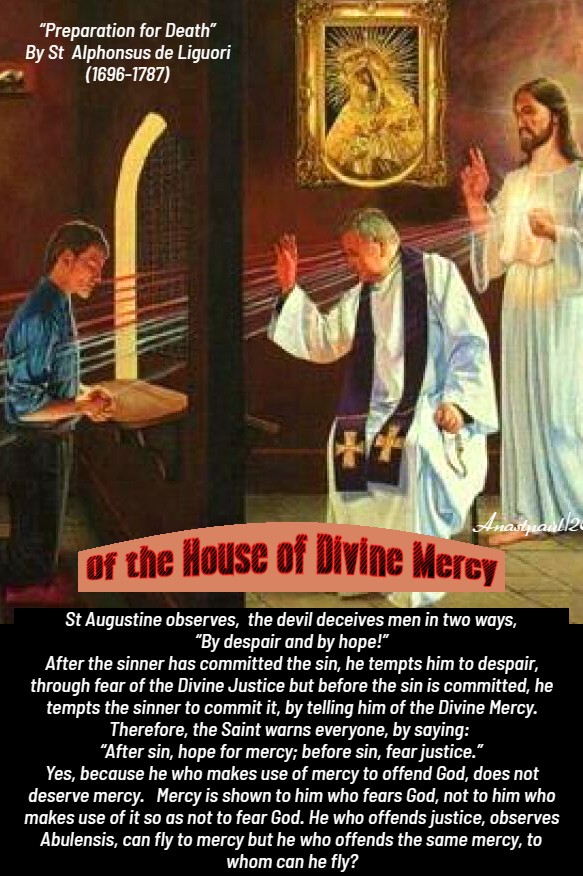
St Augustine observes, the devil deceives men in two ways,
By despair and by hope!
After the sinner has committed the sin, he tempts him to despair, through fear of the Divine Justice but before the sin is committed, he tempts the sinner to commit it, by telling him of the Divine Mercy.
Therefore, the Saint warns everyone, by saying: “After sin, hope for mercy; before sin, fear justice.
Yes, because he who makes use of mercy to offend God, does not deserve mercy.
Mercy is shown to him who fears God, not to him who makes use of it so as not to fear God. He who offends justice, observes Abulensis, can fly to mercy but he who offends the same mercy, to whom can he fly?

It is but seldom a sinner is found so hopeless, as to wish to be condemned. Sinners are willing to sin but they are not willing
to give up the hope of being saved. They commit sin and
say to themselves, God is merciful; I will commit this sin and
afterwards confess it. Behold, says St Augustine, this is how
sinnersspeak: “God is good, I will do what pleaseth me” but
O God, how many, who are now in hell, have said the same!

… The mercy of God is Infinite but the acts of this mercy are finite. God is merciful but He is also just. … As St Augustine observes, God never fails in His promises, neither does He fail in His threats!
Take care, says St Chrysostom, when the devil but not God, promises thee Divine Mercy, that thou mayest commit sin.
Woe, add St Augustine, to him who hopes, so that he may sin: “ Woe to that perverse hope.” Oh ! exclaims the Saint, how many there are, whom this vain hope has deceived and caused to be lost!

… In short, although God endures, for some time, yet He will not endure forever. If God were to suffer sin forever, no-one would be lost but it is the general opinion, that the greater part, even of Christians are lost.
For wide is the gate and broad is the way, which leadeth to destructio, and many there be, who go in thereat.” (Matt vii:13). …

Affections and Prayers

Ah, my God, I have been one of those who offended The,
notwithstanding Thou wast good to me. Lord, wait for me,
do not abandon me because I hope, Thy grace helping me,
never more to provoke Thee to abandon me.
I repent, O Thou
Infinite Goodness, for having offended Thee and for, having
thus abused Thy patience. I thank Thee that Thou hast
waited for me until now. From this day forward, I will never
more abuse Thee as I have done, in the time that .is past. Thou hast borne with me so long that Thou mightest one day see me made a lover of Thy Goodness.
That that day be already come, is my hope.

I love Thee more than anything and I prize Thy grace
more than all the kingdoms of the world; rather than lose it, I would lose my life, if it were possible to do so, many times over,
My God, for the love of Jesus Christ, give me holy perseverance until death, with Thy most holy love. Never allow me to betray Thee any more, neither to cease to love Thee.

Posted in CARMELITES, DOCTORS of the Church, QUOTES on CONSOLATION, QUOTES on SOLITUDE

Quote/s of the Day – 19 October – St Peter of Alcantara

Quote/s of the Day – 19 October – St Peter of Alcantara OFM (1499-1562) Confessor

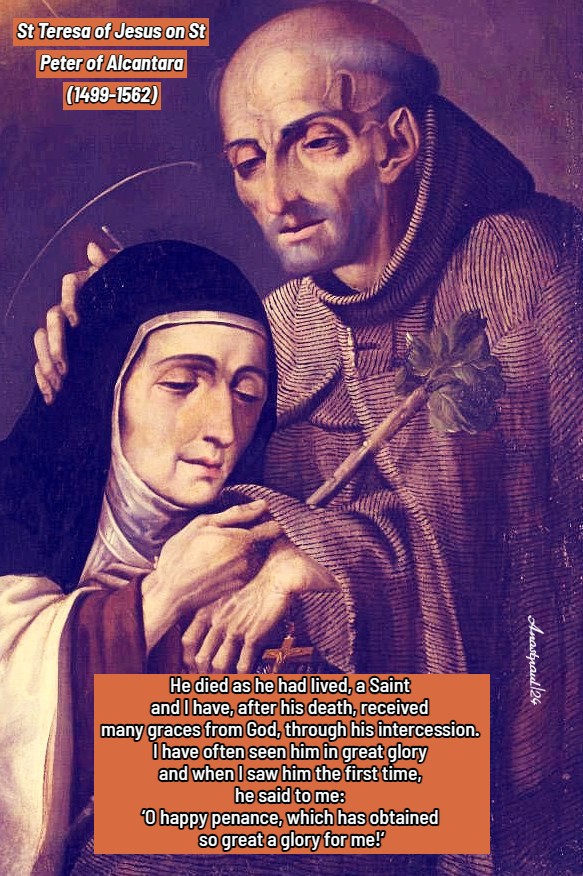
St Teresa, who has written much in his praise,
says among other things:

He died as he had lived, a Saint
and I have, after his death, received
many graces from God, through his intercession.
I have often seen him in great glory
and when I saw him the first time,
he said to me:

O happy penance, which has obtained
so great a glory for me!
‘”

Strain not after tears,
strive not for sentiments of devotion,
do not force your heart.
Rest rather in interior solitude.
Dwell therein quietly, waiting
until God’s will be accomplished in you.
When it shall please Him to send you tears,
oh, how sweet will those tears be,
for is not your impatience
which has secured them –
they are the fruits of humility and of peace.
On your part, then, you must receive them
with the deepest self-effacement,
allowing God to work in you.

Hear Me, O Lord
By St Peter of Alcantara (1499-1562)

Hear me, O Lord,
my soul’s delight,
joy of my heart,
not because of my merits
but because of Thy boundless goodness.
Teach me, enlighten me, direct me,
help me in all things
that I may never say
or do anything
but that which I know
to be pleasing in Thou sight.
Guide me, O God,
my Love, my Light and my Life!
Amen

MORE:
https://anastpaul.com/2023/10/19/quote-s-of-the-day-19-october-st-peter-of-alcantara-2/

St Peter of Alcantara (1499-1562)

Posted in FATHERS of the Church, ONE Minute REFLECTION, QUOTES on ALMS, QUOTES on POVERTY, QUOTES on the POOR, The HEART, The WORD

One Minute Reflection – 19 October – ‘ … Repay God, with the image of God …’

One Minute Reflection – 19 October – “The Month of the Most Holy Rosary and of the Angels” – St Peter of Alcantara OFM (1499-1562) Confessor – Philippians 3:7-12, Luke 12:32-34 – Scripture search here: https://www.drbo.org/

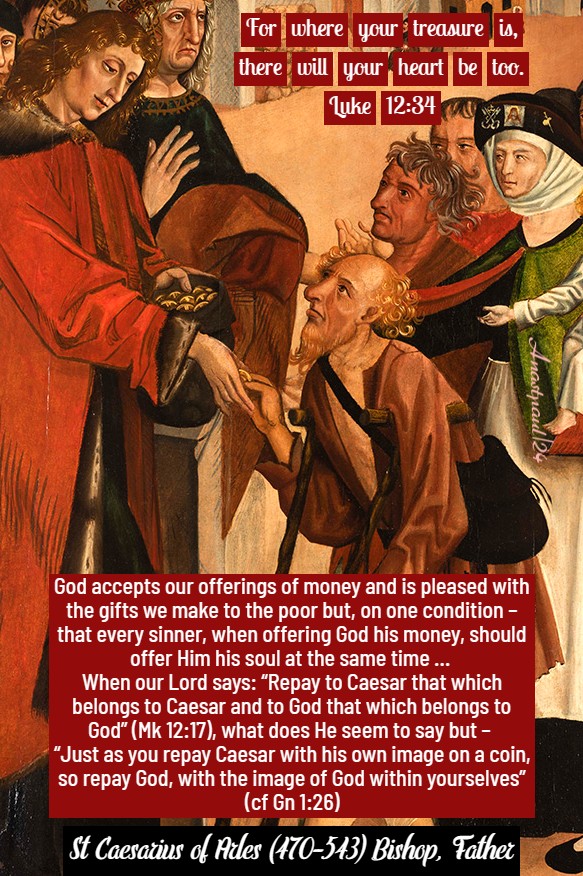
For where your treasure is, there will your heart be too.” – Luke 12:34

REFLECTION – “God accepts our offerings of money and is pleased with the gifts we make to the poor but, on one condition – that every sinner, when offering God his money, should offer Him his soul at the same time … When our Lord says: “Repay to Caesar that which belongs to Caesar and to God that which belongs to God” (Mk 12:17), what does He seem to say but – “Just as you repay Caesar with his own image on a coin, so repay God, with the image of God within ourselves” (cf Gn 1:26) …

This is why, as we have already said on numerous occasions, when we hand out money to the poor, let us offer our souls to God, so that, where our treasure is, there our heart may also be. Indeed, why does God ask us to give money? Unquestionably because, He knows the special love we have for it, we are always thinking about it and, where our money is, there too is our heart. This is why God urges us to make up our treasure in Heaven by making gifts of it to the poor; it is so that our hearts may follow where we have already sent our treasure and, when the Priest says: “Lift up your hearts” we may answer with peaceful conscience: “We lift them up to the Lord.” – St Caesarius of Arles (470-543) Bishop, Father (Sermon 32, 1-3).

PRAYER – O God, Who graciously made blessed Peter, Thy Confessor, glorious by the gift of remarkable penance and sublime contemplation, grant, we beseech Thee, that, by the merit of his prayers, we may the more easily understand the things of Heaven by curbing our passions. Through Jesus Christ, Thy Son our Lord, Who lives and reigns with Thee, in the unity of the Holy Ghost, God, world without end. Amen (Collect).

Posted in MARIAN HYMNS, MARIAN POETRY, MARIAN PRAYERS, MARIAN TITLES, Our MORNING Offering, ROSARY QUOTES, ROSARY REFLECTIONS and QUOTES, The HOLY ROSARY/ROSARY CRUSADE

Our Morning Offering – 19 October – Queen of the Holy Rosary

Our Morning Offering – 19 October – “The Month of the Most Holy Rosary and of the Angels”

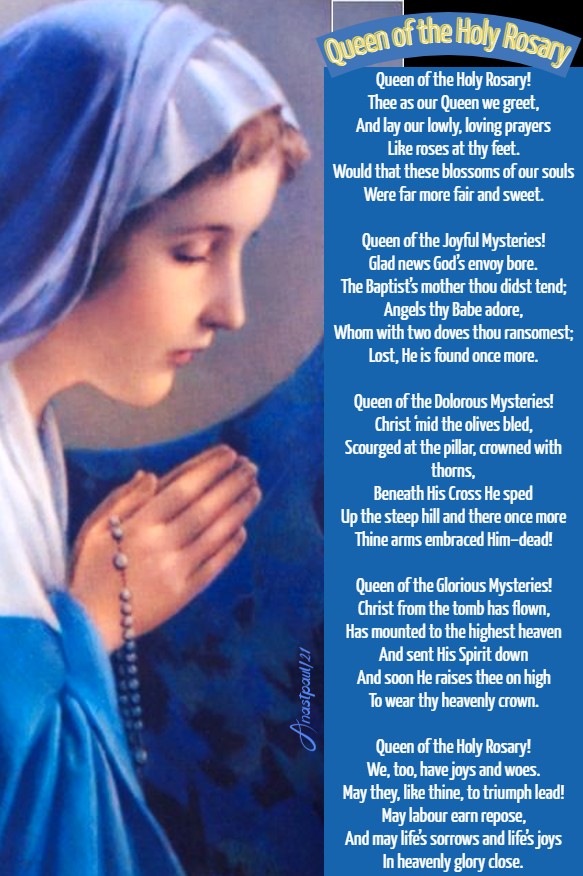
Queen of the Holy Rosary

Queen of the Holy Rosary!
Thee as our Queen we greet,
And lay our lowly, loving prayers
Like roses at thy feet.
Would that these blossoms of our souls
Were far more fair and sweet.

Queen of the Joyful Mysteries!
Glad news God’s envoy bore.
The Baptist’s mother thou didst tend;
Angels thy Babe adore,
Whom with two doves thou ransomest;
Lost, He is found once more.

Queen of the Dolorous Mysteries!
Christ ‘mid the olives bled,
Scourged at the pillar, crowned with thorns,
Beneath His Cross He sped
Up the steep hill and there once more
Thine arms embraced Him–dead!

Queen of the Glorious Mysteries!
Christ from the tomb has flown,
Has mounted to the highest heaven
And sent His Spirit down
And soon He raises thee on high
To wear thy heavenly crown.

Queen of the Holy Rosary!
We, too, have joys and woes.
May they, like thine, to triumph lead!
May labour earn repose,
And may life’s sorrows and life’s joys
In heavenly glory close.

Taken from:
Cyril Robert – Mary Immaculate:
God’s Mother and Mine. 1946

Posted in SAINT of the DAY

Saint of the Day – 19 October – Saint Frideswide (c665-c735) Virgin

Saint of the Day – 19 October – Saint Frideswide (c665-c735) Virgin, Abbess, Founder of the St Mary’s Convent, Miracle-worker The Convent is now Christ Church College, University of Oxford and the Convent Church became Oxford Cathedral. Born in c665 in the upper Thames region of England and died on 19 October 735 of natural causes at her little hermitage at Binsey. Patronage – of the City of Oxford, England and of the University of Oxford. Also known as – Fredeswida, Fredeswinda, Frévisse, Friday, Frideswida, Frideswith, Friðuswiþ, Fris, Fritheswithe, Frithuswith, Fridesvida.

The Roman Martyrology reads today: “At Oxford, in England, St Frideswide, Virgin.”

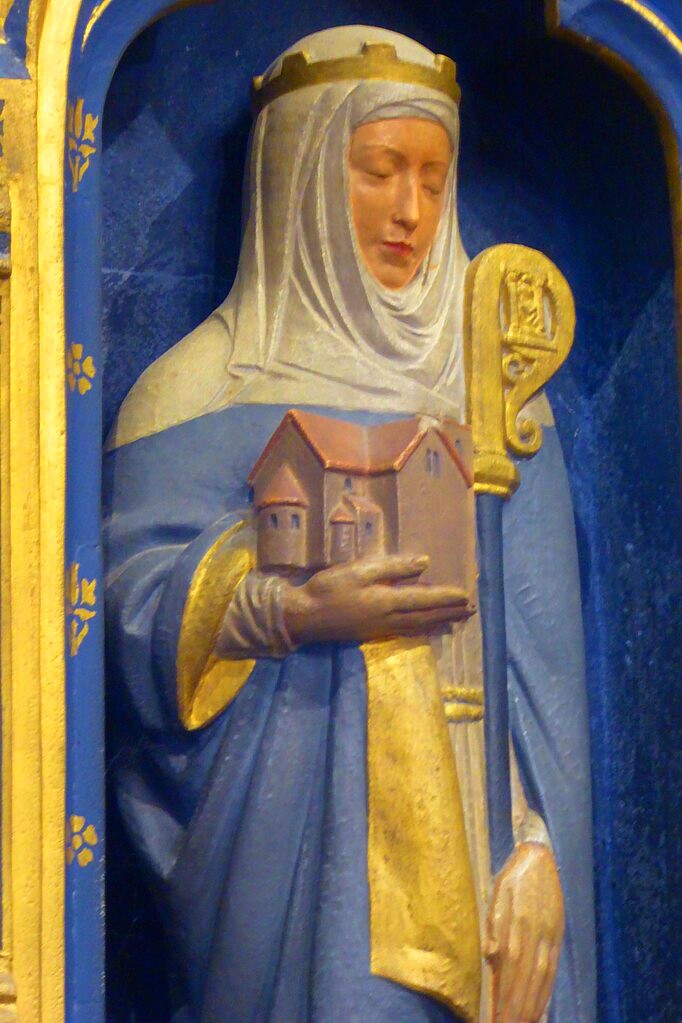
This Statue of St Frideswild at the St Michael’s Church Oxford

Today is the Feast of Oxford’s Patron St Frideswide, a true Anglo-Saxon Saint. She was born in the Southern border regions of the Kingdom of Mercia, traditionally at Oxford. She was the daughter of pious parents, Didan, the 7th Century sub-King of North and West Berkshire and his wife, Sefrida. These two committed her to the care of a holy woman named, Aelfgith, but, after her mother’s death, Frideswide returned to live with her father. She persuaded him to build her a Church at the gates of Oxford and, there, she took the veil with twelve young women of her acquaintance. Didan enhanced the establishment, by erecting Convent buildings nearby and, there, they lived, not bound by the rules of the cloister but by holy charity and love of seclusion.

Not long afterward, Aelfgar, a minor Prince of Mercia, heard of Frideswide’s great beauty, as well as her wealth as Didan’s heiress and sent a messenger to ask for her hand in marriage. She excused herself, upon the plea of her vow of celibacy but the Prince persisted and, eventually, made a plan to carry her off. Fortunately, Frideswide discovered the scheme and fled, just in time, to the River Thames. Finding an unattended boat there, she floated to a place, probably Bampton (Oxfordshire) or Frilsham (Berkshire). She took up her abode in a deserted hut used to shelter the pigs which fed upon the acorns in the surrounding forest. A fountain sprang up at her prayer and she was thus able to survive, concealed there for about three years.

Prince Aelfgar had been determined not to be beaten so easily, however and continued to try and find the lady’s hiding place. By the time she felt it safe to return to Oxford, he was absolutely fuming. Hearing of her return, Aelfgar besieged the City and threatened to burn it to the ground unless Frideswide was given up to him. He vowed to sacrifice the lady, not only to his own brutality but to that of his men. Both Frideswide and her father’s defending army were worn out with fatigue. Just as she was about to fall into Aelfgar’s hands, she was reminded of the early saintly ladies of the Church who had saved their honour at the price of life. She thus invoked Sts Catherine and Cecilia, who immediately struck her persecutor blind at the moment he broke through the City gates and entered Oxford. With their leader so wounded, Aelfgar’s fear-stricken men dispersed.

The Princess returned to her nunnery and collected around her a number of Saxon maidens and Monks, over whose double Monastery she presided in great holiness for many years. The origins of the University of Oxford are said, to lie in the school she established there.

Abbess Frideswide was well known for the miracles she performed during her own lifetime. One well-known tale reveals how she was once accosted by a local leper who appealed to her, in the name of Christ, to kiss him. Overcoming her fear of infection and natural disgust at his loathsome condition, the holy lady made the Sign of the Cross and kissed him. Immediately, the scales fell away and his flesh became like that of a child.

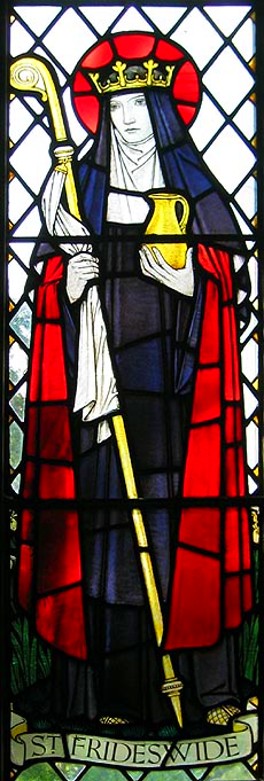
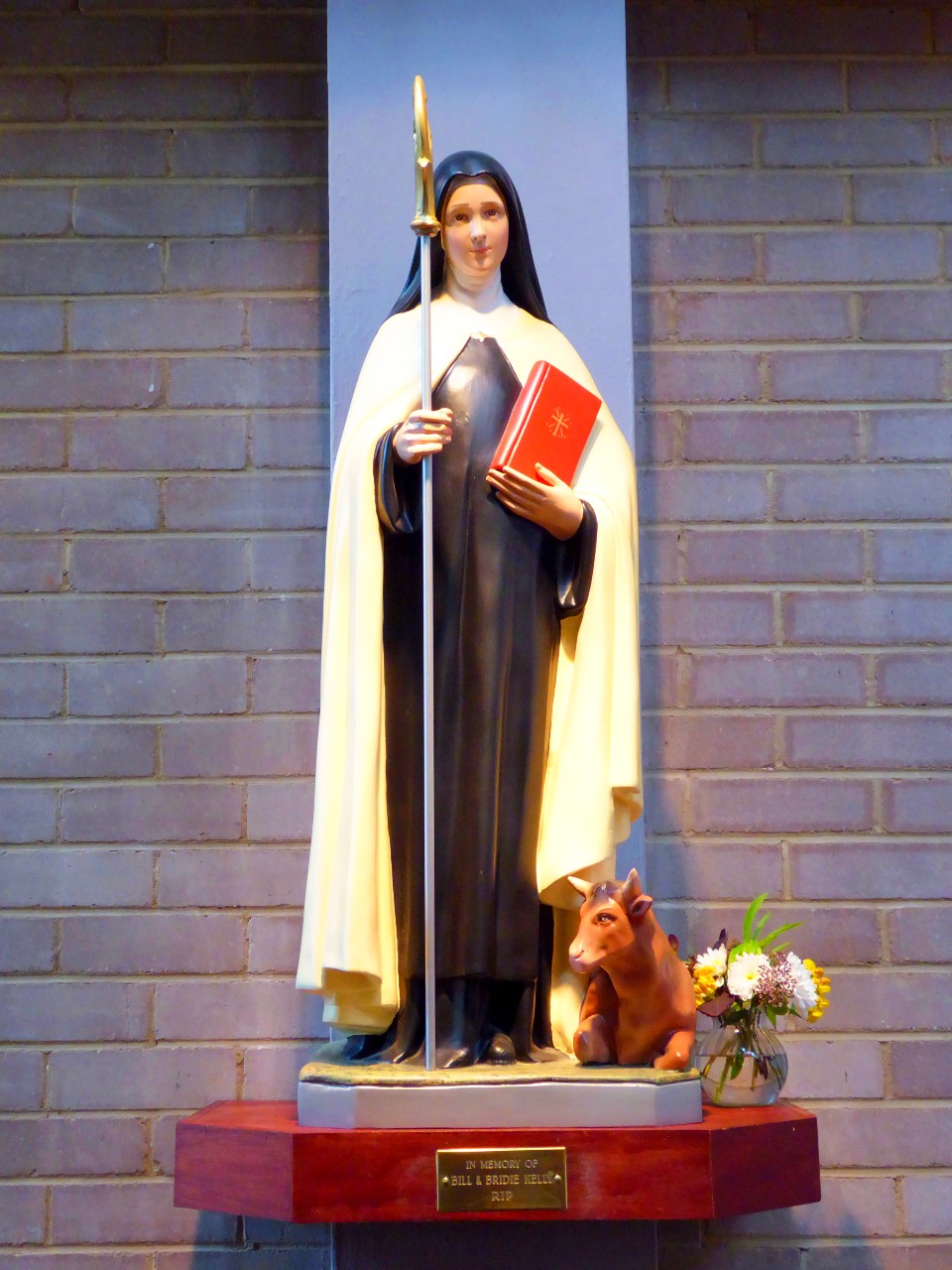
In later life, Frideswide retired to the transquility of a little hermitage at Binsey, not far outside Oxford. There she died on 19 October 735, being subsequently buried in her Monastery in Oxford, where Christ Church Cathedral now stands. Multitudes of pilgrims resorted to her tomb and to the Binsey Chapel, although the well and Chapel at Frilsham were eclipsed by other claimants. All became famous for miraculous cures. She is represented, in art, with the pastoral staff of an Abbess, a model of her foundation and Church, a fountain springing up near her and an ox at her feet.

The miraculous Well at Binsey
Posted in franciscan OFM, MARIAN TITLES, SAINT of the DAY

Virgen del Camino / Our Lady of the Way, Spain (1505), St Peter of Alcantara and Saints for 19 October

Virgen del Camino / Our Lady of the Way, Valverde de la Virgen, León, Castile and León, Spain (1505) – 19 October:
HERE:
https://anastpaul.com/2021/10/19/virgen-del-camino-our-lady-of-the-way-leon-spain-1505-and-memorials-of-the-saints-19-october/

St Peter of Alcantara OFM (1499-1562) Confessor, Franciscan Friar and Priest, Mystic, Ecstatic, Writer, Preacher, Reformer, Hermit, Apostle of Prayer, Eucharistic Adoration, the Passion and Charity, Miracle-worker.
Biography:

https://anastpaul.com/2018/10/19/saint-of-the-day-19-october-st-peter-of-alcantara-ofm-1499-1562/
AND:
https://anastpaul.com/2022/10/19/saint-of-the-day-19-october-st-peter-of-alcantara-ofm-1499-1562-confessor/

St Altinus
St Aquilinus of Evreux
St Asterius of Ostia
St Beronicus of Antioch
St Columban of Tours — Priest. Listed in the Martyrology of St Jerome. No other details have survived.


St Desiderius of Longoret
St Ednoth
St Ethbin
St Eusterius of Salerno
St Frideswide (c665-735) Virgin
St Laura of Cordoba
St Lucius of Rome
St Lupus of Soissons
St Pelagia of Antioch

St Philip Howard (1557–1595) Martyr, Married, Layman
His Life and Death:

https://anastpaul.com/2021/10/19/saint-of-the-day-19-october-saint-philip-howard-1557-1595-martyr/

St Potenzianus of Sens
St Ptolemy of Rome
St Sabiniano of Sens
St Theofrid

Blessed Thomas Hélye (c1180-1257) Priest, Penitent, Teacher, Missionary and renowned Preacher.
An unusual story:

https://anastpaul.com/2020/10/19/saint-of-the-day-19-october-blessed-thomas-helye-c-1180-1257/

St Varus and 6 Companions (Died c307) Martyrs, Soldier. Died in c307 by being tortured and then hanged from a tree on 19 October 307 in Kemet, Upper Egypt.
The Roman Martyrology reads: “In Egypt, St Varus, Solder under the Emperor Maximinus. He used to visit and comfort seven saintly Monks, detained in prison, when one of them happening to die, he wished to take his place and having suffered cruel afflictions, with them, he obtained the Palm of Martyrdom.
Their Lives and Deaths:
https://anastpaul.com/2023/10/19/saint-of-the-day-19-october-saint-varus-and-six-companions-died-c307-martyrs/

St Verano of Cavaillon