Thought for the Day – 12 November – Meditations with Saint Alphonsus Maria de Liguori (1696-1787) Bishop, Confessor, Most Zealous Doctor of the Church
“How to Pray at All Times” By St Alphonsus Maria de Liguori (1696-1787)
Pray In Your Joys Excerpt from Chapter Three:III
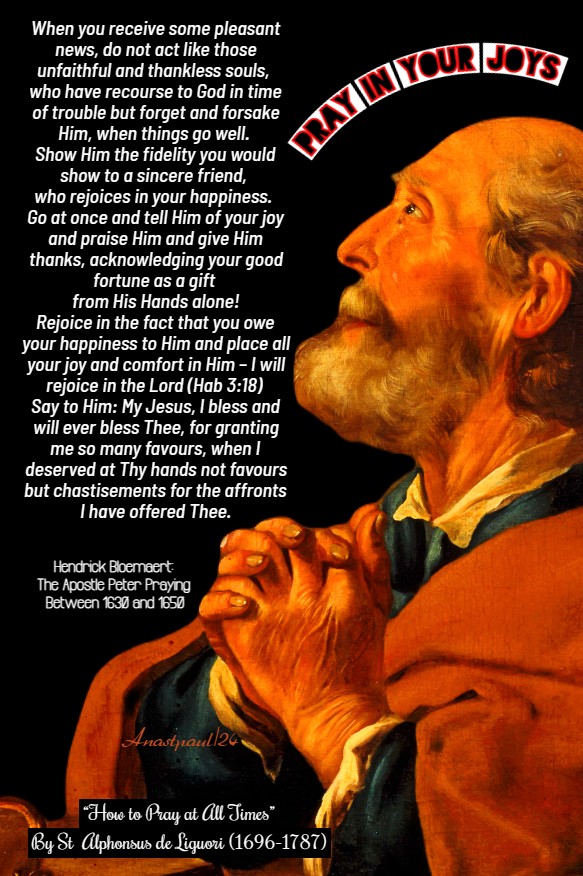
“When you receive some pleasant news, do not act like those unfaithful and thankless souls, who have recourse to God in time of trouble but forget and forsake Him, when things go well. Show Him the fidelity you would show to a sincere friend, who rejoices in your happiness. Go at once and tell Him of your joy and praise Him and give Him thanks, acknowledging your good fortune as a gift from His Hands alone! Rejoice in the fact that you owe your happiness to Him and place all your joy and comfort in Him – I will rejoice in the Lord (Hab 3:18) Say to Him: My Jesus, I bless and will ever bless Thee, for granting me so many favours, when I deserved at Thy hands not favours but chastisements for the affronts I have offered Thee.
… But, if you love your God, you ought to rejoice more in His blessedness than in your own. He, who has a dear friend, sometimes takes more delight in that friend’s good fortune than if it had been his own. Comfort yourself, then, in the knowledge that God is infinitely happy. Often say to Him – My beloved Lord, I rejoice more in Thy blessedness than in any happiness of my own, for I love Thee more than I love myself.”
Quote/s of the Day – 12 November – St Theodore the Studite (759-826) Abbot, Confessor, Father of the Church
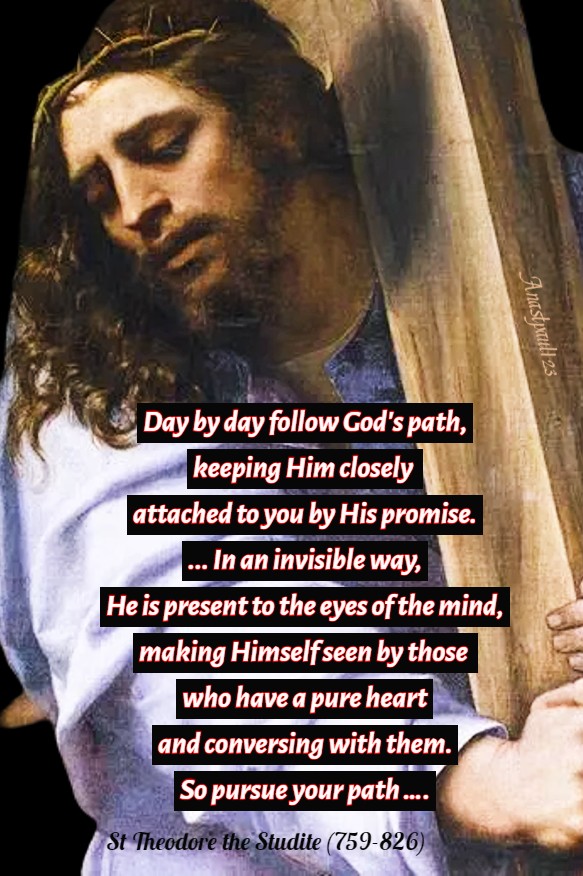
“Day by day follow God’s path, keeping Him closely attached to you by His promise. In fact, He Himself said, through the mediation of His Apostles, to all those who seek His will and His testimonies that He would be with them until the end of the world (Mt 28:20) where paths and footsteps will be unknown (cf Ps 76:20), as the divine David said in his songs. Yet, in an invisible way, He is present to the eyes of the mind, making Himself seen by those who have a pure heart and conversing with them. So pursue your path …. ”
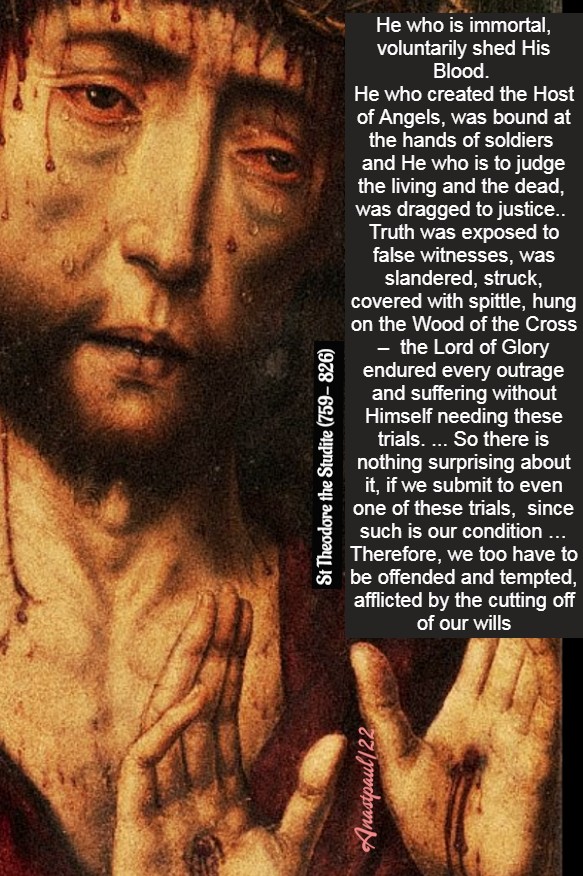
“He who is immortal, voluntarily shed His Blood. He who created the Host of Angels, was bound at the hands of soldiers and He who is to judge the living and the dead, was dragged to justice (cf. Acts 10:42; 2 Tm 4:1). Truth was exposed to false witnesses, was slandered, struck, covered with spittle, hung on the Wood of the Cross – the Lord of Glory (cf. 1 Cor 2:8) endured every outrage and suffering without Himself needing these trials. …
So there is nothing surprising about it, if we submit to even one of these trials, since such is our condition … Therefore, we too have to be offended and tempted, afflicted by the cutting off of our wills.” (Catecheses 1)
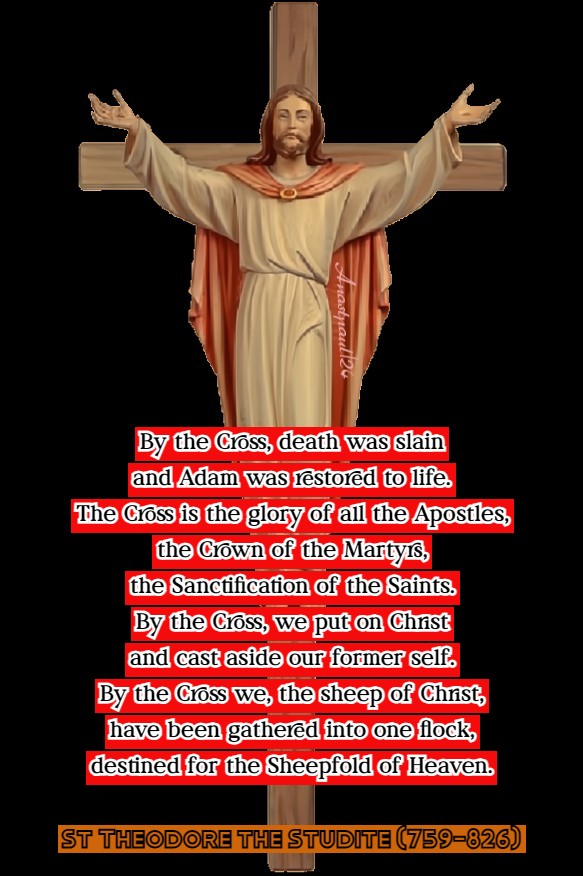
“By the Cross, death was slain and Adam was restored to life. The Cross is the glory of all the Apostles, the Crown of the Martyrs, the Sanctification of the Saints. By the Cross, we put on Christ and cast aside our former self. By the Cross we, the sheep of Christ, have been gathered into one flock, destined for the Sheepfold of Heaven.”
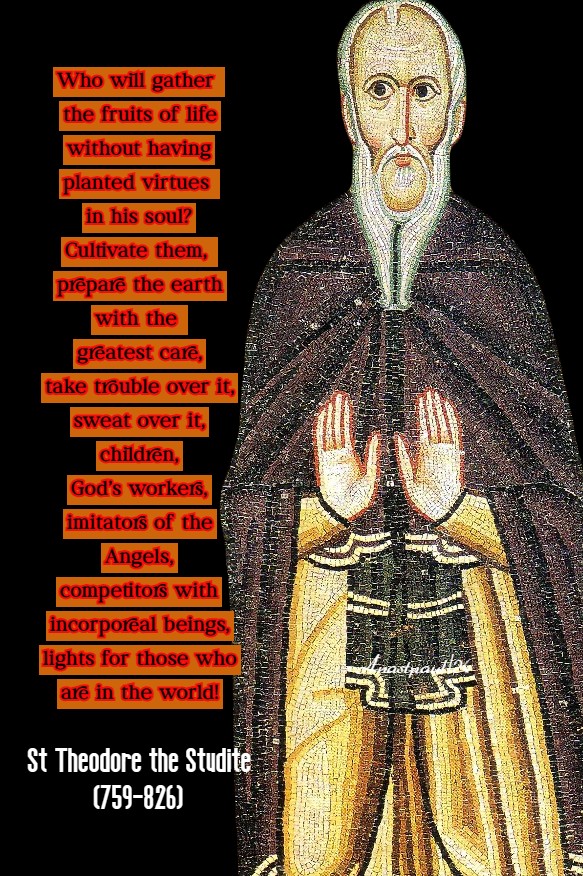
“Who will gather the fruits of life without having planted virtues in his soul? Cultivate them, prepare the earth with the greatest care, take trouble over it, sweat over it, children, God’s workers, imitators of the Angels, competitors with incorporeal beings, lights for those who are in the world!”
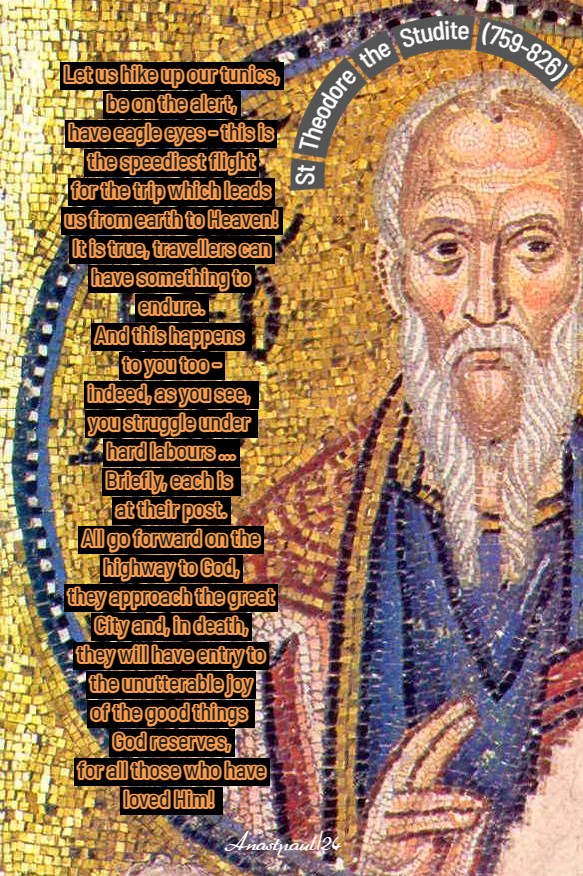
“Let us hike up our tunics, be on the alert, have eagle eyes – this is the speediest flight for the trip which leads us from earth to Heaven! It is true, travellers can have something to endure. And this happens to you too – indeed, as you see, you struggle under hard labours … Briefly, each is at their post. All go forward on the highway to God, they approach the great City and, in death, they will have entry to the unutterable joy of the good things God reserves, for all those who have loved Him! ”
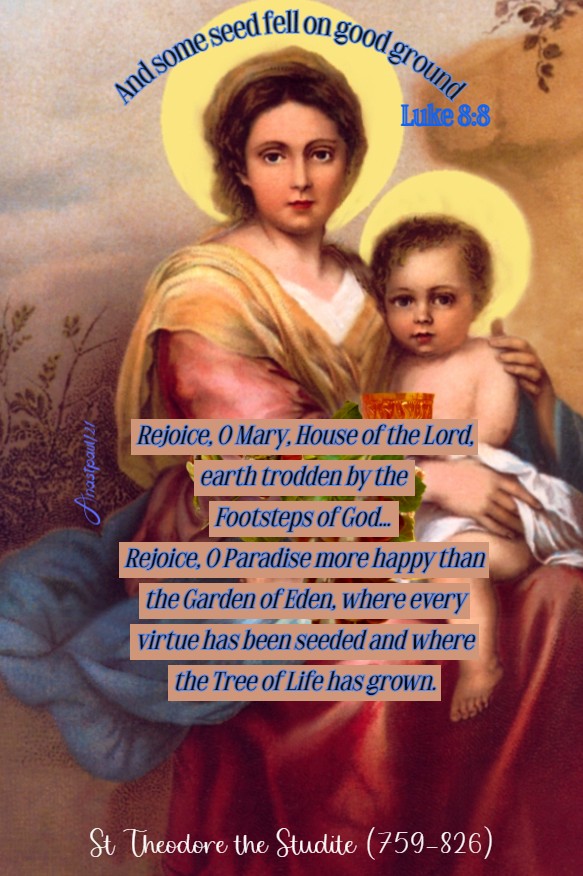
“Rejoice, O Mary, House of the Lord, earth trodden by the Footsteps of God… Rejoice, O Paradise more happy than the Garden of Eden, where every virtue has been seeded and where the Tree of Life has grown.”
St Theodore the Studite (759-826) Abbot, Confessor, Father of the Church
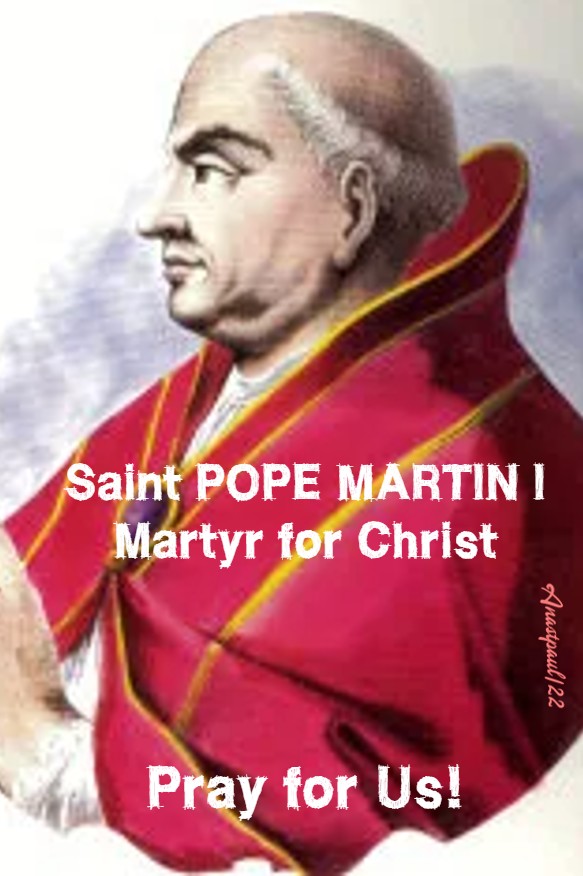
One Minute Reflection – 12 November – St Martin I, Pope (598-655) Martyr – 1 Peter 5:1-4; 5:10-11; Matthew 16:13-19 – Scripture search here: https://www.drbo.org/
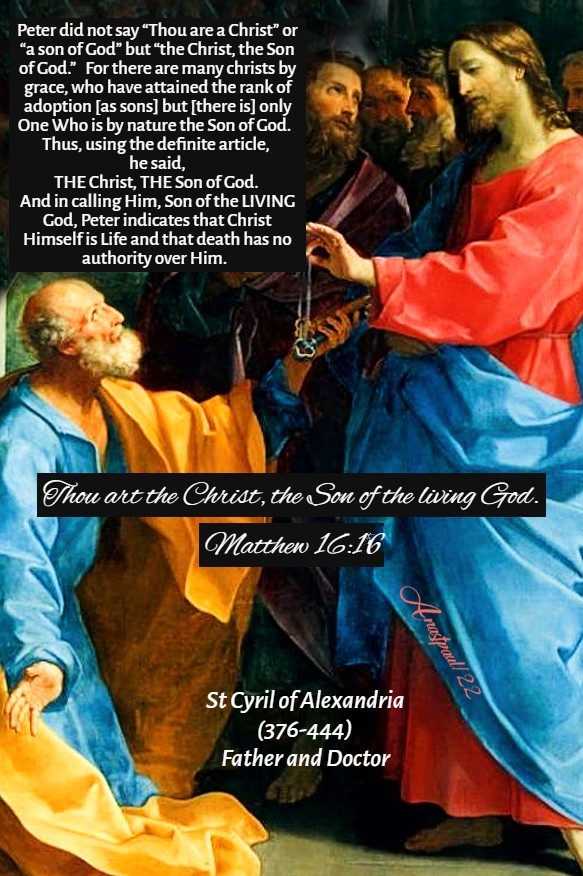
“Thou art the Christ, the Son of the living God.” – Matthew 16:16
REFLECTION – “Peter did not say “Thou are a Christ” or “a son of God” but “the Christ,the Son of God.” For there are many christs by grace, who have attained the rank of adoption [as sons] but, [there is] only One ,Who is by nature the Son of God. Thus, using the definite article, he said, THE Christ, THE Son of God. And in calling Him, Son of the LIVING God, Peter indicates that Christ Himself is Life and that death has no authority over Him. And even if the flesh, for a short while, was weak and died, nevertheless, it rose again, since the Word, Who dwelled in it, could not be held under the bonds of death.” – St Cyril of Alexandria (376-444) Known as “The Pillar of Faith” Archbishop of Alexandria, Father and Doctor Incarnationis (Doctor of the Incarnation) (Fragment 190).
PRAYER – Look forgivingly on Thy flock, Eternal Shepherd and keep it in Thy constant protection, by the intercession of blessed Martin Thy Martyr and Sovereign Pontiff, whom thou didst constitute Shepherd of the whole Church. Through Jesus Christ, Thy Son our Lord, Who lives and reigns with Thee, in the unity of the Holy Ghost, God, world without end. Amen (Collect).
Our Morning Offering – 12 November – “The Month of the Holy Souls in Purgatory”
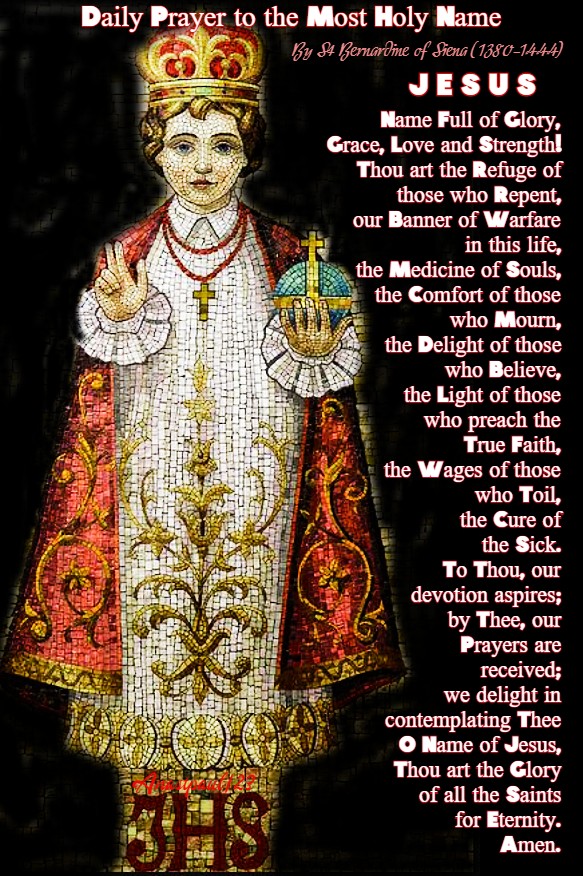
Daily Prayer to the Most Holy Name By St Bernardine of Siena (1380-1444) Apostle of the Most Holy Name
Jesus, Name full of glory, grace, love and strength! Thou art the Refuge of those who repent, our Banner of warfare in this life, the Medicine of souls, the Comfort of those who mourn, the Delight of those who believe, the Light of those who preach the True Faith, the Wages of those who toil, the Cure of the sick. To Thou, our devotion aspires; by Thee, our prayers are received; we delight in contemplating Thee. O Name of Jesus, Thou art the glory of all the Saints for eternity. Amen
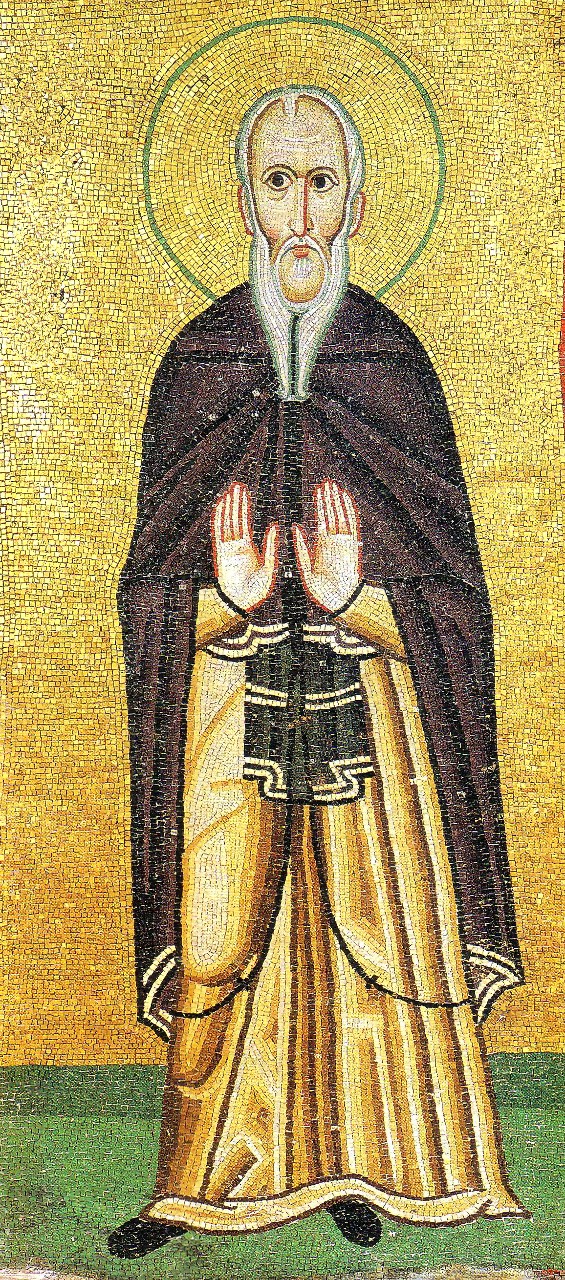
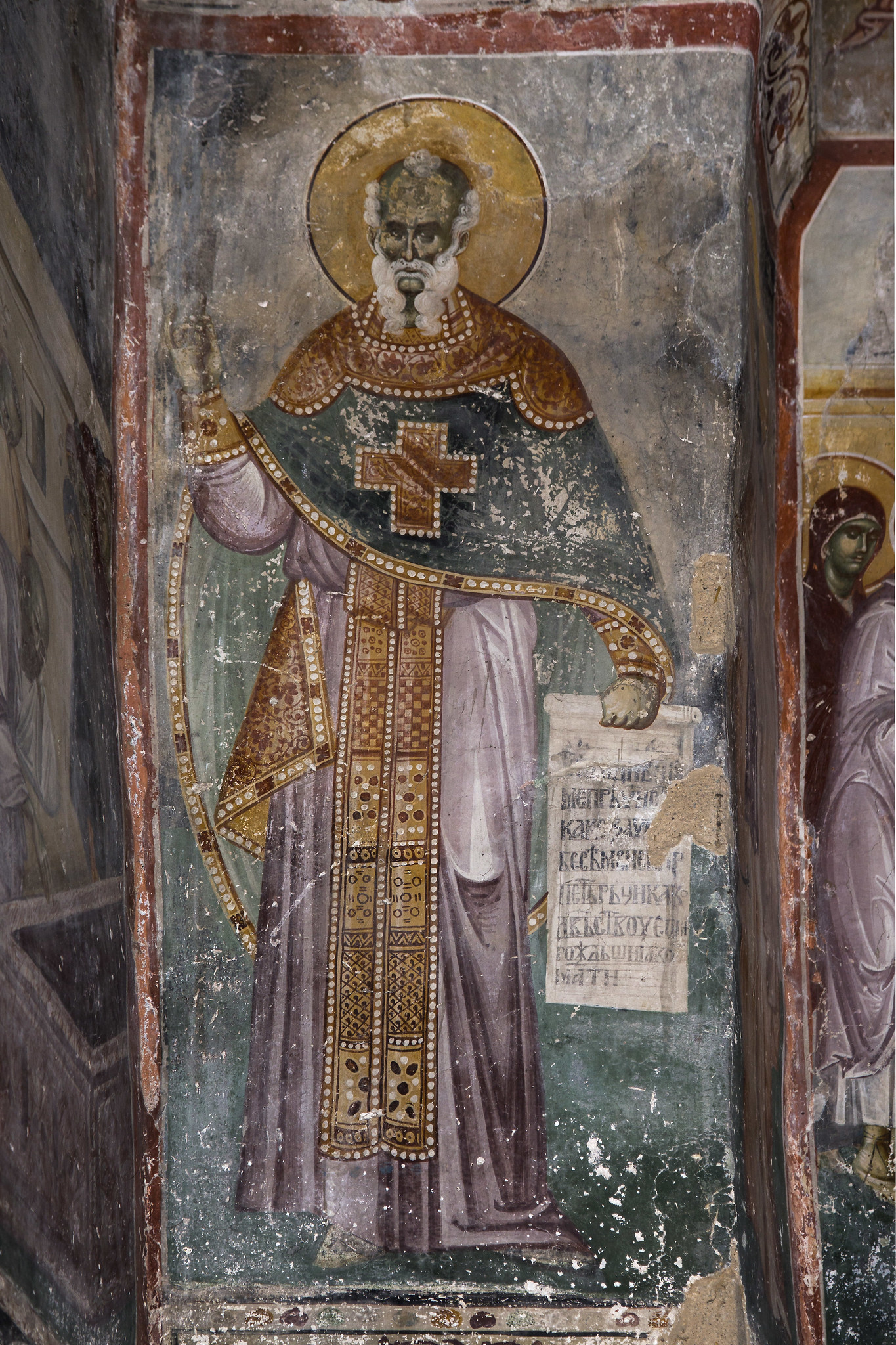
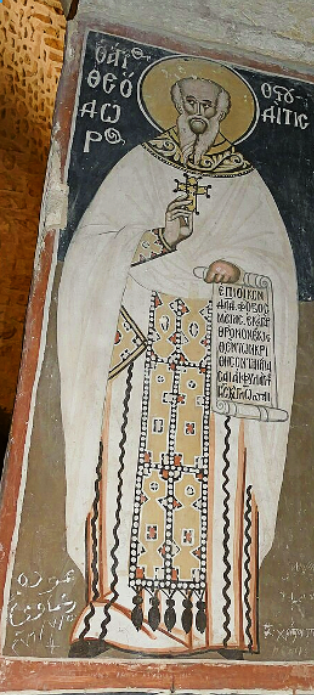
Saint of the Day – 12 November – St Theodore the Studite (759-826) Abbot of the Stoudios Monastery in Constantinople, Confessor, stern Reformer, zealous Defender of the sanctity of Marriage and of Sacred Images, two of several conflicts which set him at odds with both the Emperor and Bishops. He played a major role in the revivals both of Byzantine monasticism and of classical literary genres in Byzantium. He was a spiritual writer and exegesis and throughout his life, he maintained letter correspondences with many important spiritual, political and cultural figures of the Byzantine Empire. Born in 759 in Constantinople, (modern-day Istanbul, Turkey) and died on 11 November 826 (aged 66/67) whilst in exile in Cape Akritas (modern-day Tuzla, Istanbul, Turkey). Also known as – Theodorus Studita, Theodore of Studium, of Stoudios, of studion.
The Roman Martyrology reads today: “At Constantinople, St Theodore Studita, who became celebrated througout the whole Catholic Chirch by his vigorous defence of the Faith against the Iconoclasts.”
Theodore was born in Constantinople in 759 and from his youth he fought courageously in defence of the Sacred Imagery present in the capital of the Byzantine Empire, threatened by the adverse religious policy of the imperial government.
In 794 he succeeded his uncle Plato, (who ten years earlier had persuaded him to take monastic vows) in the direction of the Monastery of Sakkoudion in Bithynia. Shortly afterwards, however, he was sent into exile in Thessalonica, for having excommunicated the Emperor Constantine VI, later also venerated as a Saint, who had divorced his wife Mary to marry Theodota. This incident was not a simple occurence of one man’s sinful adultery but, under the name of “Synod of Adultery” an assembly of errant Bishops who, in the 9th Century, wished to approve the practice of second marriage after the repudiation of the legitimate wife, entered the history of the Church – (ring any bells – only no-one is being exiled for this now!?) Saint Theodore was the one who most vigorously opposed it and for this reason he was persecuted, imprisoned and exiled three times.
In 797, after the death of the Emperor, Theodore was recalled to his homeland with full honours, left Sakkoudion Monastery which, in the meantime, had been sacked by the Arabs and Theodore moved to the Monastery of Studios in Constantinople, from which he took his nickname. Here he undertook a powerful campaign in favour of asceticism and radical monastic reforms. The key points of his rule, later used in both Byzantine and Eastern Monasteries, were strict seclusion, poverty, discipline, study, religious offices and manual labour.
Abbot Theodore is also remembered for allowing his Monks to sprinkle nutmeg, one of the most expensive spices at the time, ontp their pea soup when they were forced to eat it. This anecdote, the veracity of which is difficult to ascertain, far from ridiculing the Saint, helps us to approach him in aspects of his daily life, as the shepherd of a community, certainly a firm spiritual leader but also, at the same time, a kindly shepherd displaying a generous love.
In 809, Theodore was again banished because of his refusal to receive Communion from Patriarch Nicephorus, who had reinstated the Priest Joseph, guilty of having officiated at the wedding between Constantine and Theodote. Two years later, Emperor Michael I, over whom our Saint had much influence, recalled him from exile but, he was again banished and flogged in 814 because of his strenuous opposition to the iconoclastic edict promulgated by Emperor Leo V which prohibited the veneration of Sacred Images. Released in 821 by Emperor Michael II, in 824 he promoted an insurrection against the latter, whom the Saint judged to be too indulgent towards the iconoclasts. However, when his plans failed, Theodore then thought it appropriate to leave Constantinople.
From that moment he wandered between various Monasteries in Bithynia and died in that of Chalcis on 11 November 826. Initially buried in that Monastery, on 26 January 844, his body was translated to Studios Monastery.
He is celebrated today 12 November, the day after his death. Saint Theodore composed several literary works. First of all, as an intrepid fighter for the defence of the indissolubility of Marriage; he wrote a treatise and a paper ‘On the economy in general’ which were unfortunately lost or more probably destroyed by order of the Patriarch Methodius. His letters the importance of which is constituted by the picture of the life and character of St Theodore which is displayed within them and, which also shed light, on the theological disputes in which he intervened. St Theodore also wrote Catechetical works divided into two collections, addressed to Monks and containing warnings and advice connected with spiritual life and monastic communities; funeral orations for his mother and for his uncle Plato; theological works focused on the use and veneration of Sacred Images; epigrams on various subjects, some of which demonstrate considerable originality and some Sacred Hymns. Furthermore, like all the Monks of the Studios, Saint Theodore was renowned too for his calligraphy and for his skill in copying manuscripts.
St Theodore the Studite, a simple but deeply religious man who dared to challenge the imperial power and the Ecclesiastical hierarchies of the time, should be considered one of the heavenly protectors of those who, even today, faced with the changed Church, have the courage to repeat an inflexible love of the One True Church and a denial of all unlawful practices. St Theodore the Studite, Pray for us!
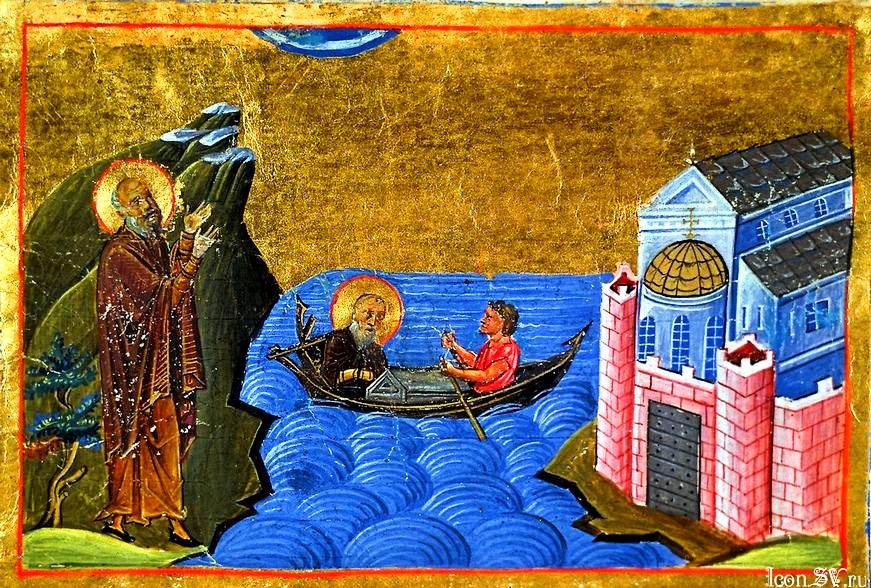
Byzantine miniature depicting the Stoudios Monastery and the Sea of Marmara.
St Livinus of Alost St Machar of Aberdeen St Namphasius St Nilus the Elder St Paternus of Sens St Publius St Renatus of Angers St Rufus of Avignon St Theodore the Studite (759-826) Abbot St Ymar of Reculver
Five Polish Brothers – Martyrs: They weren’t Polish and they weren’t related but were instead five Italian Benedictine Monks who worked with Saint Adalbert of Prague as missionaries to the Slavs and were Martyred together. They were – Benedict, Christinus, Isaac, John and Matthew. Born in Italy. They were Martyred in 1005 at the Benedictine Monastery near Gnesen, Poland and Canonised by Pope Julius II.




 AnaStpaul
You must be logged in to post a comment.