
Saint of the Day – 25 November – Saint Mercurius (3rd Century) Martyr, Soldier. Born in the City of Eskentos in Cappadocia, in Eastern Asia Minor (modern-day Turkey) and died by beheading bin c250 in Caesarea, Cappadocia. According to tradition, he was the soldier who killed Julian the Apostate during his campaign in Persia. Also known as – Mercury.
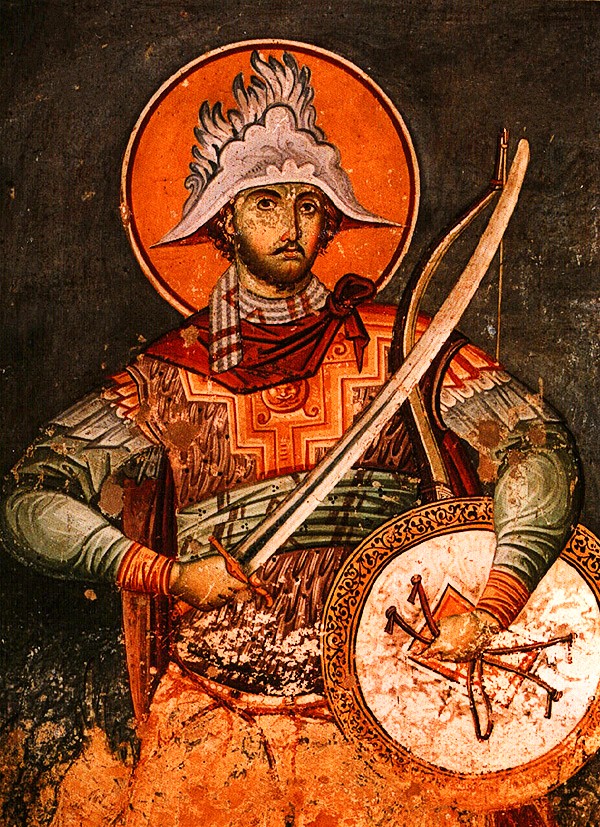
The Roman Martyrology reads today: “At Caesarea in Cappadocia, St Mercury, soldier, who vanquished the barbarians and triumphed over the cruelty of Decius, through the protection of his Guardian Angel. Finally, having acquired great glory from his sufferings, he was crowned with Martyrdom and went toi reigh forever in Heaven.”

Mercury was, for the pagans, the god of commerce and ingenious activities, the winged messenger of the other gods.
The corresponding divinity of the Greek Olympus, had the name of Hermes. And this name had and still has, greater fortune among the Baptised. Probably, this is due to the fact that the name had, as intermediaries, seven or eight Saints named Hermes. But not even the name of Mercury remained confined to the pagan world. In the Christian Calendar, in fact, there are two Saints of this name: both Martyrs and both soldiers. Today’s Saint, our Mercurius, then, also had a certain popularity, at least in the East, where his legendary Passion was formed and spread.
According to this Passio, Mercurius would have served with honour under Decius and Valerian, when these two Emperors published their edict of persecution. Mercurius, who had become the Commander-in-Chief of the army, remembered at a good moment that he was the son of a Christian and that he had been Baptised with the symbolic name of Philopatros, that is, “who loves the father.”
Out of love for his father and not only for his earthly father, the one whom his soldiers called Mercurius, thus presented himself to confess his Faith before his friend, the Emperor.
There followed the well-known tortures and bloody wounds which were healed three times by an Angel, until Mercurius was taken on the back of a donkey to Cappadocia that is, to his homeland, to be beheaded.

His Relics favoured prodigious cures and sudden conversions. But even greater fame came to the warrior Martyr from the miracle, according to which, he was, more than a hundred years later, the killer of the renegade Emperor, Julian the Apostate.
It is known from history that Julian fought against the Persians, on the eastern borders of the Empire and died during those battles. His death was welcomed as a liberation by the countless persecuted Christians, who saw in that tragic event, the just punishment of Heaven.
According to the faithful of Cappadocia, it was Saint Mercurius himself, who in the appeared in the guise of a soldier, who used his spear, by Divine order, against the chest of the Apostate Emperor! In reality, nothing historically certain is known about this event. But, what is certain, is the antiquity of Mercarius’ cult, in Caesarea of Cappadocia, on 25 November.
To the above I would like to add the following:
“God punishes men, for the most part, in kind, i.e. in the same way in which they have sinned.
“By what things a man sinneth,” says the Wise Man, “by the same he also is tormented.”
Absalom prided himself on his long hair and it caused his death.
The rich glutton sinned with his palate and it was his tongue and palate which were tormented in the fire of hell.
Antiochus tormented the seven Machabean brethren by tearing and maiming their flesh and his own flesh was eaten by worms (2 Mach ix 6).
Aman wished to hang Mardochai and prepared a gallows for him and on the same gallows he was himself hanged.
The women of Bethlehem would not shelter the Mother of God and the Divine Son and their children perished at the revengeful and cruel hand of Herod.
Napoleon I imprisoned the Holy Father and in his turn was imprisoned first in Elba and then in St Helena.
In these and many similar events, the Christian sees the Finger of God.” (The Catechism Explained By Fr Francis Spirago 1899).
And so we will add our St Macurius and God’s punishement of Julian the Apostate!


 AnaStpaul