
Saint of the Day – 26 November – Blessed Pontius of Faucigny (c1100-c1178) Abbot, Founder and the 1st Abbot of the Monastery of Faucigny. Born in c1100 in Faucigny, Savoy (in modern France) and died on 26 November 1178 or 1179 in Sixt, Savoy, also in modern France, of natural causes.
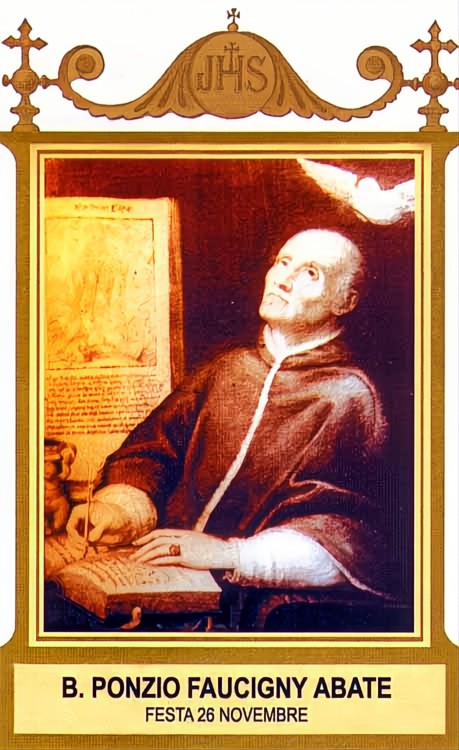
Pontius was born around the year 1100 to the noble family of Faucigny, lords of the region of Savoy. At a very young age he entered the Abbey of the Canons Regular of Abondance, of which he revised the Constitutions, harmonising them with the original Augustinian Rule.
In 1144 he was commissioned to found a religious house in Sixt region, also in Savoy which was ten year later, in 1155, promoted to an Abbey by Pope Adrian IV. Pontius became its first Abbot, while remaining in constant contact with Abondance.
In 1172 he was called to succeed Burcardius as the Abbot of Abondance and the following year he obtained the dignity of Abbey for the Monastery of Grandval.
However, wishing to be able to prepare himself more effectively for death, he abandoned all his duties to retire to Abondance as a simple Monk He died there on 26 November 1178 or 1179 and was buried in the Abbey Church.
His mortal remains, a few years later, were the object of an elevation and from then on he received a regular cult. On 14 November 1620, Saint Francis de Sales, a great devotee of the holy Abbot, his compatriot from Savoy, opened his tomb to take some of his Relics. Francis’s successor, Charles Augustus de Sales, also had great respect for Pontius.
The “Bollandists” observe that seven centuries passed between Pontius’s death and the appearance of his first biography, a factor which led to great caution regarding the veracity of certain data. Only in 1866, the cause for the official recognition of the cult paid to him from time immemorial was initiated by the Bishop of Annecy, Claude Magnin and was subsequently resumed in 1890 by Monsignor Ernest Isoard. Pope Leo XIII confirmed the cult “ab immemorabili” of Blessed Pontius of Faucigny, with a decree dated 15 December 1896. His Feast is still celebrated today on the anniversary of his death most especially by the Canons of the Lateran and by the Diocese of Annecy.


 AnaStpaul