
Just a reminder of this beautiful Catholic tradition
Prepare for the arrival of our King!

Thought for the Day –28 November – Meditations with Antonio Cardinal Bacci (1881-1971) [Revisiting our old friend, Cardinal Bacci , until Advent begins on Sunday.]
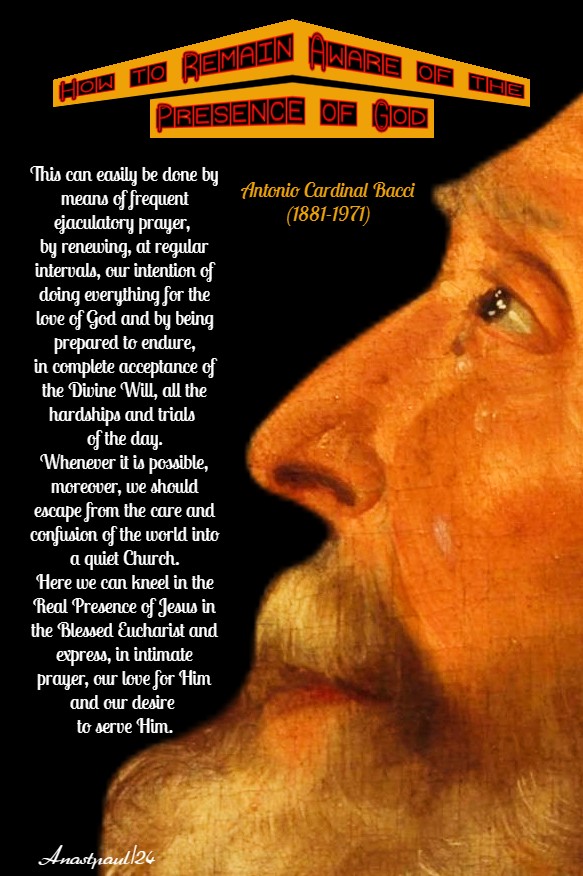
“It is useful to consider the ways in which we can develop a constant and effective awareness of the Presence of God.
The first way in which we can do this, is by cultivating a lively faith, which will help us to see God everywhere.
“Do not I fill heaven and earth, saith the Lord?” (Jer 23:24).
This kind of faith should deepen our sense of God’s Presence and inspire in us sentiments of love and gratitude, which will guide us in all our actions.
We cannot expect that we shall be able to remain in a state of constant contemplation of God, for this is the privilege enjoyed by the blessed in Heaven, for whom faith has been replaced by the Beatific Vision.
We must be satisfied with exciting in ourselves, as often as possible, the active awareness of God’s Presence.
This should be a quiet and peaceful process, not involving undue mental effort or anxiety.
We should be able to attend quite naturally to our work and other obligations and, we should be helped and consoled in this, by directing our thoughts to God from time to time, in order to offer ourselves to Him.
This can easily be done by means of frequent ejaculatory prayer, by renewing, at regular intervals, our intention of doing everything for the love of God and by being prepared to endure, in complete acceptance of the Divine Will, all the hardships and trials of the day.
Whenever it is possible, moreover, we should escape from the care and confusion of the world into a quiet Church.
Here we can kneel in the Real Presence of Jesus in the Blessed Eucharist and express, in intimate prayer, our love for Him and our desire to serve Him.”

Quote/s of the Day – 28 November – St Catherine Labouré DC (1806-1876) Visionary of the Miraculous Medal
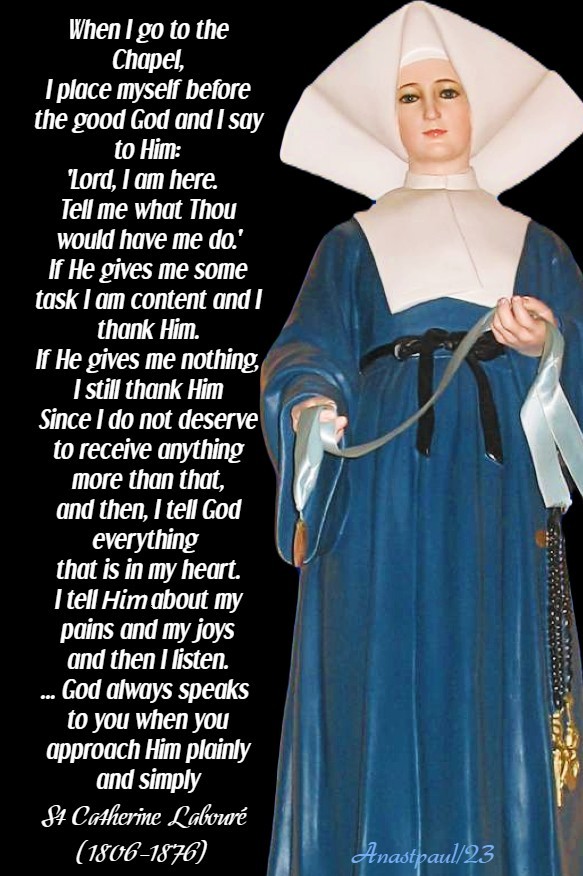
“When I go to the Chapel,
I place myself before the good God and I say to Him:
‘Lord, I am here.
Tell me what Thou would have me do.’
If He gives me some task I am content and I thank Him.
If He gives me nothing, I still thank Him
Since I do not deserve to receive anything more than that,
and then, I tell God everything that is in my heart.
I tell hIm about my pains and my joys and then I listen.
… God always speaks to you
when you approach Him plainly and simply.”
MORE:
https://anastpaul.com/2022/11/28/quote-s-of-the-day-28-november-st-catherine-laboure-and-our-lady/
One Minute Reflection – 28 November – St Catherine Labouré DC (1806-1876) Virgin, Religious Sister of the Daughters of Charity of Saint Vincent de Paul and the Marian Visionary of the Miraculous Meda – Feria Day of the Last Sunday after Pentecost – Colossians 1:9-14; Matthew 24:15-35 – Scripture search here: https://www.drbo.org/
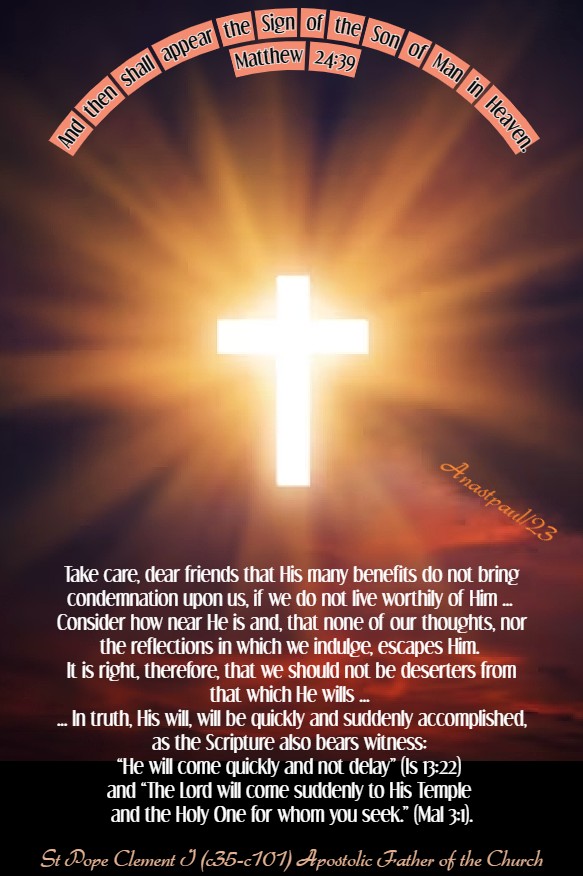
“And then shall appear the Sign of the Son of Man in Heaven. ” – Matthew 24:30
REFLECTION – “Let us fix our eyes on the Father and Creator of the world and cling to His splendid and surpassing gifts of peace and His benefits. Let us see Him with our mind and look with the eyes of the soul at His patient purpose. Let us consider how free from anger He is toward all His creation … For He ordered the universe to be in peace and harmony, in His kindness to all things but especially, to ourselves, who have taken refuge in His mercy …
Take care, dear friends that His many benefits do not bring condemnation upon us, if we do not live worthily of Him … Consider how near He is and, that none of our thoughts, nor the reflections in which we indulge, escapes Him. It is right, therefore, that we should not be deserters from that which He wills … . Far be it from us that Scripture, where it says: “How wretched are those who waver, who are of a doubting heart and say: “We heard those things even in our forefather’s time and here, we have grown old and none of them has happened to us.” You senseless people! Compare yourselves to a tree – take a vine. First it sheds its leaves, then a shoot appears, then a leaf, then a flower and afterward, a sour grape, then a ripe grape. You see in that, in a short time the fruit of the tree comes to maturity. In truth, His will, will be quickly and suddenly accomplished, as the Scripture also bears witness: “He will come quickly and not delay” (Is 13:22) and “The Lord will come suddenly to His Temple and the Holy One for Whom you seek.” (Mal 3:1).” – St Pope Clement I (c35-c101) Apostolic Father of the Church (Letter to the Corinthians 19-23)
PRAYER – From all perils of soul and body, defend us, O Lord, we beseech Thee and by the intercession of blessed and glorious ever Virgin Mary, Mother of God, of blessed Joseph, of thy blessed Apostles Peter and Paul and of blessed Catherine Labouré and all the Saints, graciously grant us safety and peace that all adversities and errors, being overcome, Thy Church may serve Thee in security and freedom. Through Jesus Christ, Thy Son our Lord, Who lives and reigns with Thee, in the unity of the Holy Ghost, God, world without end. Amen (Collect).


Our Morning Offering – 28 November
Suscipe
“Receive”
By St Ignatius Loyola (1491-1556)

Receive, O Lord,
all my liberty.
Take my memory, understanding
and entire will.
Whatsoever I have or hold,
Thou hast given it – I give all back to Thee
and commit it wholly to be governed by Thy Will.
Thy Love and Thy Grace give unto me
and I am rich enough
and ask for nothing more!
Amen
Saint of the Day – 28 November – Saint Honestus of Nimes (Died 270) Priest Martyr, Missionary. A disciple of St Saturninus of Toulouse (Died c257) Bishop and Martyr and a native of Nîmes. Born at Nimes, France and died in 270 at Pamplona, Spain by Martyrdom. Also known as – Honestus of Pamplona, Honesto, Honest.
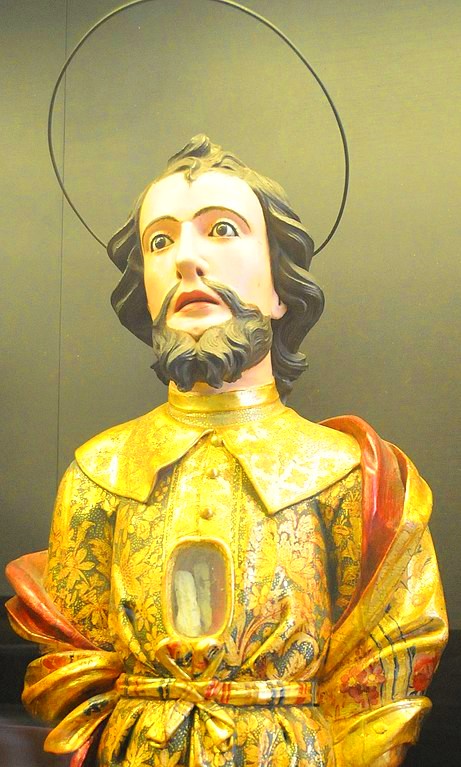
Saturninus and Honestus evangelised in Spain and Honestus was Martyred at Pampelona during the persecutions of Aurelian.
We believe Honestus was a nobleman of Nimes who was appointed ‘apostle to Navarre and the Basque Country.’
At Pampelona, he converted the Senator Firmus and his family to Christianity, while Firmus’s son, Saint Firminus, was christened by Saint Saturninus. Honestus Baptised Firminus himself.
St Honestus is venerated especially in Pamplona and in Nimes, Probably his Relics were shared between the two Cities.
St Catherine Labouré DC (1806-1876) Virgin, Religious Sister of the Daughters of Charity of Saint Vincent de Paul and the Marian visionary of the Miraculous Medal. St Catherine was Canonised on 27 July 1947 by Pope Pius XII. Her body is Incorrupt
St Catherine’s Story:
https://anastpaul.com/2018/11/28/saint-of-the-day-28-november-st-catherine-laboure-dc-1806-1876/
Bl Calimerius of Montechiaro
St Fionnchu of Bangor
St Pope Gregory III (Died 741) Bishop of Rome 11 February 731 until his death on 28 November 741. (His Feast was moved to 10 December in 1969), The Roman Martyrology states: “At Rome, the blessed Pope Gregory III, who departed for Heaven with a reputation for great sanctity and miracles.“
His Life:
https://anastpaul.com/2021/11/28/saint-of-the-day-28-november-saint-pope-gregory-iii-died-741/
St Hilary of Dijon
St Hippolytus of Saint Claude
St Honestus of Nimes (Died 270) Priest Martyr
St Irenarcus
St James of the Marches OFM Conv. (1391-1476) Priest of the Friars Minor Conventional, Confessor, brilliant Preacher, Penitent, Reformer, Writer, Papal legate, Inquisitor, founder of several monasteries in Bohemia, Hungary and Austria. St James was Canonised on 10 December 1726 by Pope Benedict XIII. His body is Incorrupt.
About St James:
https://anastpaul.com/2019/11/28/saint-of-the-day-28-november-saint-james-of-the-marches-ofm-1391-1476/
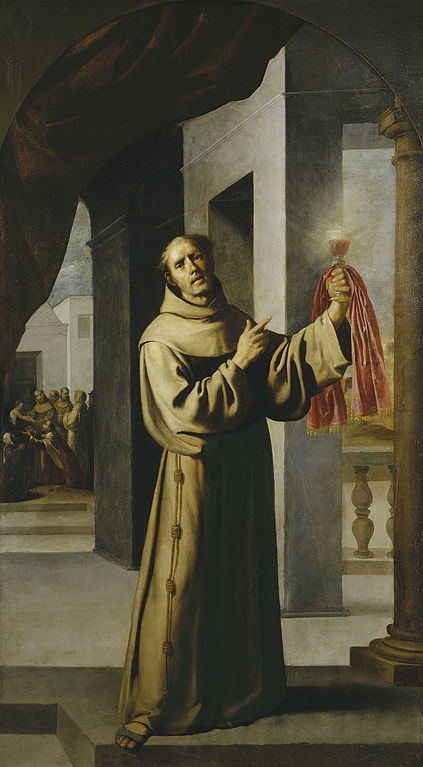
Blessed James Thompson (Died 1582) Priest Martyr.
He was Beatified on 29 December 1886 by Pope Leo XIII. Additional Memorial – 29 October as one of the Martyrs of Douai.
His Life and Death:
https://anastpaul.com/2022/11/28/saint-of-the-day-28-november-blessed-james-thompson-died-1582-priest-martyr/
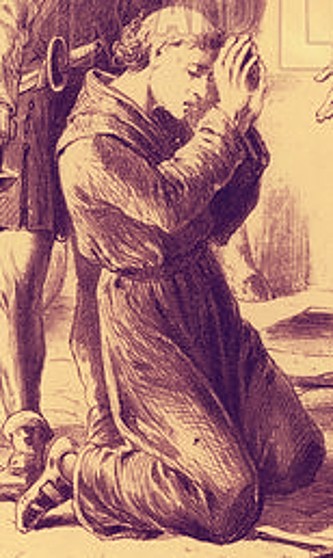
St Papius
St Quieta of Dijon
St Rufus
St Simeon the Logothete
St Sosthenes (1st Century) Bishop, Martyr, Jewish Ruler in Corinth, Converted by St Paul and became his disciple, who is mentioned by him in his First Epistle to the Corinthians (1 Corinthians 1:1–2) and by St Luke in Acts 18:12–17.
The Roman Martyrology reads: “At Corinth, the birthday of St Sosthenes, fisciple of the blessed Apostle Paul, who is mentioned by that Apostle in his first Epistle to the Corinthians. He was chief of the synagogue when converted to Christ and, as a glorious beginning, consecrated the first fruits of his faith by being scourged in the presence of the Proconsul, Gallio.”
His Life and Death:
https://anastpaul.com/2023/11/28/saint-of-the-day-28-november-st-sosthenes-1st-century-bishop/
St Stephen the Younger
Bl Theodora of Rossano
Martyrs of Constantinople – 8 Saints: A group of over 300 Christians Martyred during the persecutions of the Iconoclast Emperors. We have a lot of information on Saint Stephen the Younger, but for the others we have nothing but seven of their names – Andrew, Auxentius, Basil, Gregor, John, Peter and Stefan. They were
scourged, stoned and/or dragged to death through the streets of Constantinople in 764.
Martyrs of North Africa – 13 Saints: A group of thirteen Clerics killed or exiled in the persecutions of Arian Vandals in North Africa – Crescens, Crescentian, Cresconius, Eustace, Felix, Florentian, Habetdeum, Hortulanus, Mansuetus, Papinianus, Quodvultdeus, Urban and Valerian.
Martyrs of Tiberiopolis – 14 Saints: A group of fourteen Christian Laymen, Deacons, Priests and Bishops who were Martyred together in the persecutions of Julian the Apostate – Basil, Chariton, Comasios, Daniel, Etymasius, Hierotheos, John, Nicephorus, Peter, Sergius, Socrates, Theodore, Thomas and Timothy.
361 at Tiberiopolis, Phyrgia (in modern Turkey)
 AnaStpaul
You must be logged in to post a comment.