
Saint of the Day – 28 January – Saint John of Réomay (c425-c539) Founder Abbot of the Monastery of Réomay, Priest, Hermit, Reformer. Born in Dijon around 425 and died there at his Monastery, of natural causes in c539. Also known as – Jean, Giovanni.
The Roman Martyrology reads today: “In the Monastery of Rheims, the demise of a holy Priest name John, a man of God,”
Son of a senator of Dijon, Hilary and his wife, Quieta, John was born in Courtangy, a family property near Dijon. At the age of twenty, he left his home after having built a Chapel dedicated to Saint Stephen in the family property at Courtangy which later became a Parish. He went into the nearby forest and lived alone among the ruins of Roman buildings. All this happened around the years 460-465.
Soon becoming a popular source of spiritual guidance, John was joined by some disciples, He became the leader of a community and founded the renowned Monastery of Réomay. Then, becoming overwhelmed by the burdens of administration and governing, he fled to Lérins Monastery, at that time, one of the centres of expansion of western monasticism. Without revealing his identity, John enjoyed peace and a prayerful solitude, until a traveller recognised him and he was recalled by the Bishop of Langres, on whom he depended (the Vita calls him Gregory, 507-539).
But sadly he found that the Monks had become lax in their practices and he had to reform it by applying the Rule followed in Lerins (that of St Macarius). The Frankish Kings protected the Monastery of Réomay which became a place of reference and where great and holy figures passed through.
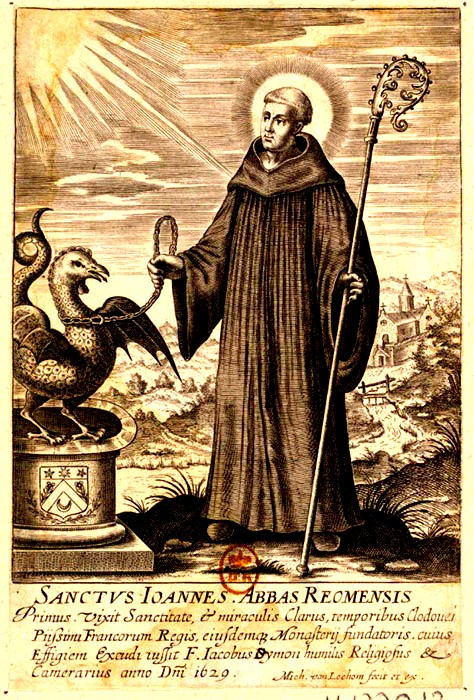
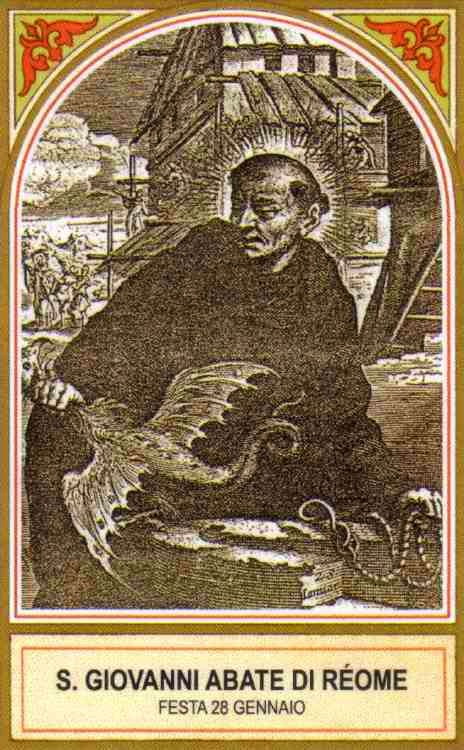
John is credited with several miracles, the best known being that of having returned the water to a necessary well and evicting the resident basilisk dragon which creature you see on the images of our Saint.
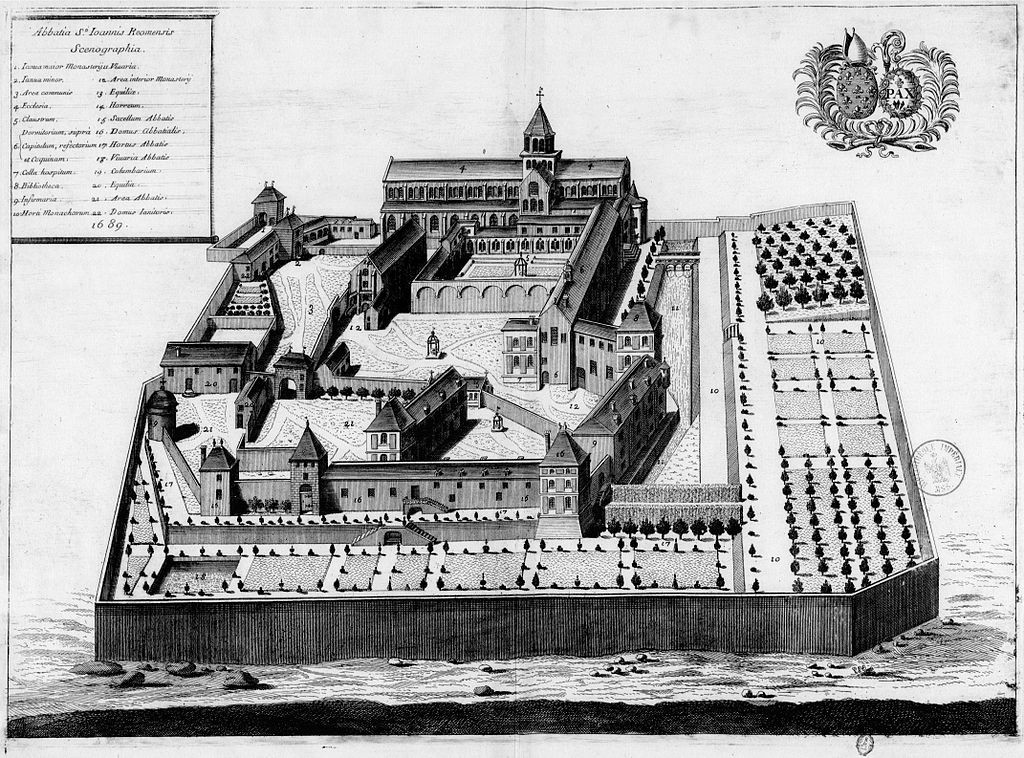
John died a centenarian shortly in 539. Jonah of Bobbio , his biographer, attributes to him one hundred and twenty years. His body, first buried in the territory of the Abbey, was later included within the walls of a Basilica which became a place of burial (the Church of Saint Maurice of Corsaint, corpus sanctum). Around 580, his fourth successor, the Abbot Leopardin, raised John’s body and transferred it to the Altar. Finally, after the reconstruction of the Monastery in the current village of Moutier-Saint-Jean, the Bishop of Langres, Betta (790-820) brought him to the new Abbey a few kilometers from the original burial site. St John’s is celebrated in Réomay today with the rest of the Church.

 AnaStpaul