Thought for the Day – 1 February – Meditations with Fr Richard Frederick Clarke SJ (1839-1900)
Meditations on “The Great Truths” From “The Devout Year” By Fr Richard Frederick Clarke SJ (1839-1900)
Ist Day – God our Lord
The Lord hath made all things for Himself. (Prov xvi:4)
+I. We are all of us jealous of that which belongs to ourselves. We resent it if anyone interferes with it, or deprives us of any portion of it Yet, no-one owns anything by a title, so absolute as that by which God is the Lord and Owner of all creatures in the universe. My body and my soul are His; everything I possess is His; every action, every thought belongs to Him. He has given all these in charge to me to use for Him alone. Do I do so?
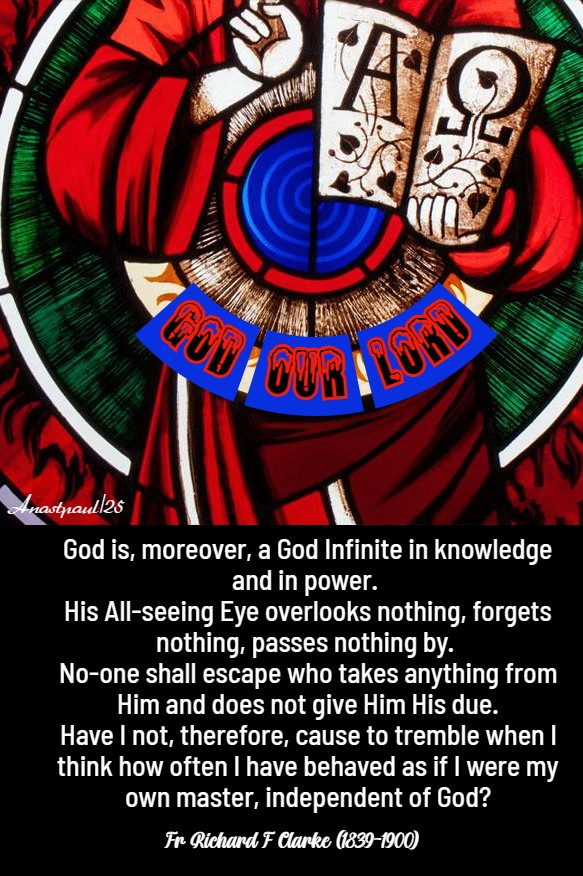
+2. God is, moreover, a God Infinite in knowledge and in power. His All-seeing Eye overlooks nothing, forgets nothing, passes nothing by. No-one shall escape who takes anything from Him and does not give Him His due. Have I not, therefore, cause to tremble when I think how often I have behaved as if I were my own master, independent of God?
+3. Yet, in the end, I must recognise God’s ownership; if I do not do so, willingly and with joyful loyalty, I shall have to do so unwillingly and in misery and pain. Everything I have taken from God and appropriated to myself will have to be given back to Him. I shall have to pay the penalty for each misuse of what was entrusted to me. How much wiser and happier to recognise Him now, in all things, as my Lord and Master! Offer yourself to God with loyal submission as your God and Lord!
Quote/s of the Day – 1 February – – St Ignatius of Antioch (c35 – c107) Martyr, Bishop of Antioch, Apostolic Father of the Church
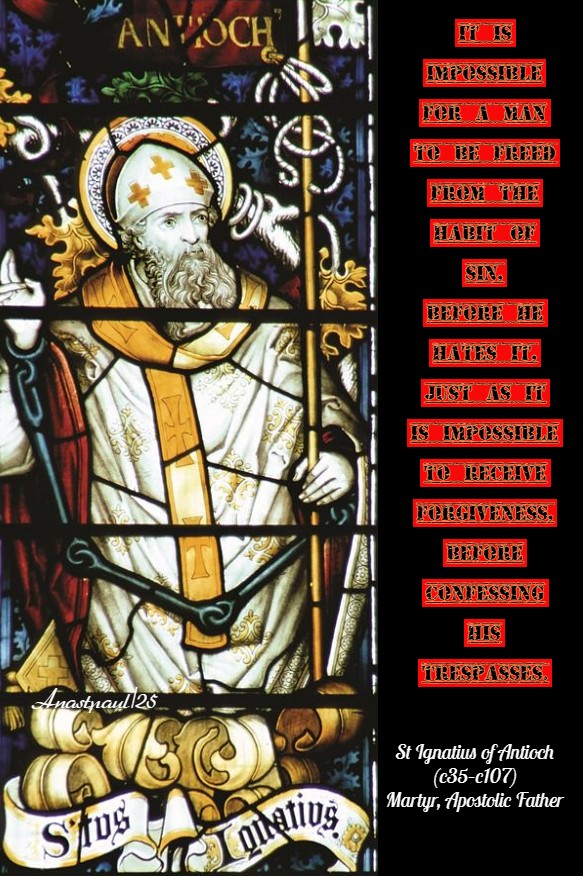
“It is impossible for a man to be freed from the habit of sin, before he hates it, just as it is impossible to receive forgiveness, before confessing his trespasses.”
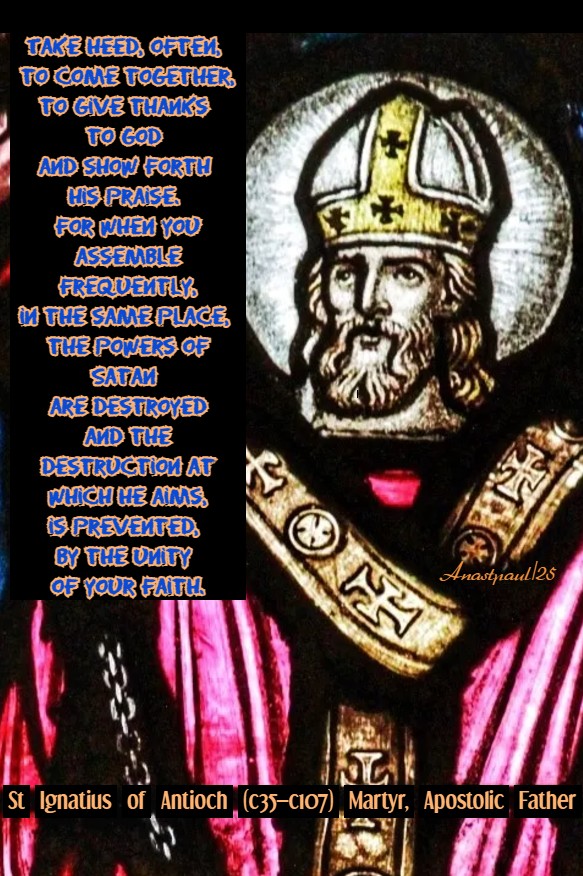
“Take heed, often, to come together, to give thanks to God and show forth His praise. For when you assemble frequently, in the same place, the powers of Satan are destroyed and the destruction at which he aims, is prevented, by the unity of your faith.”
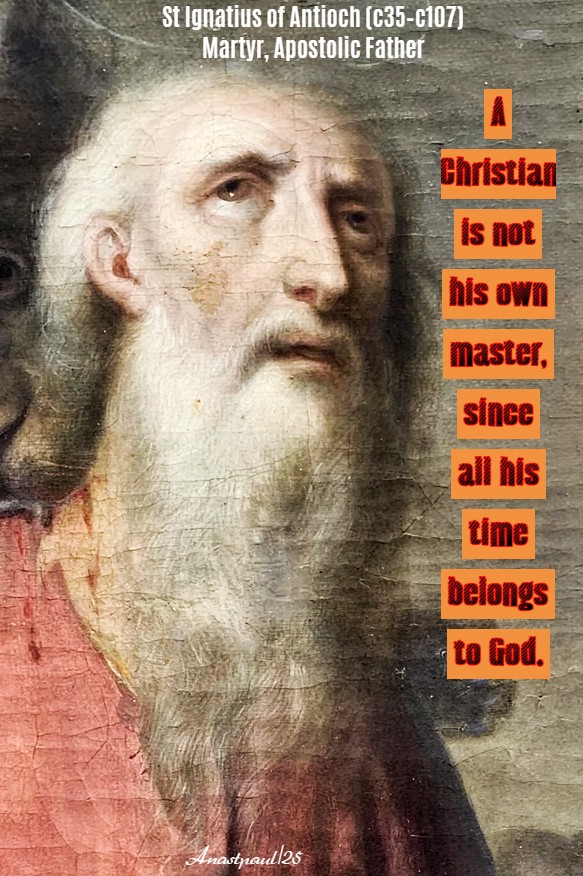
“A Christian is not his own master, since all his time belongs to God.”
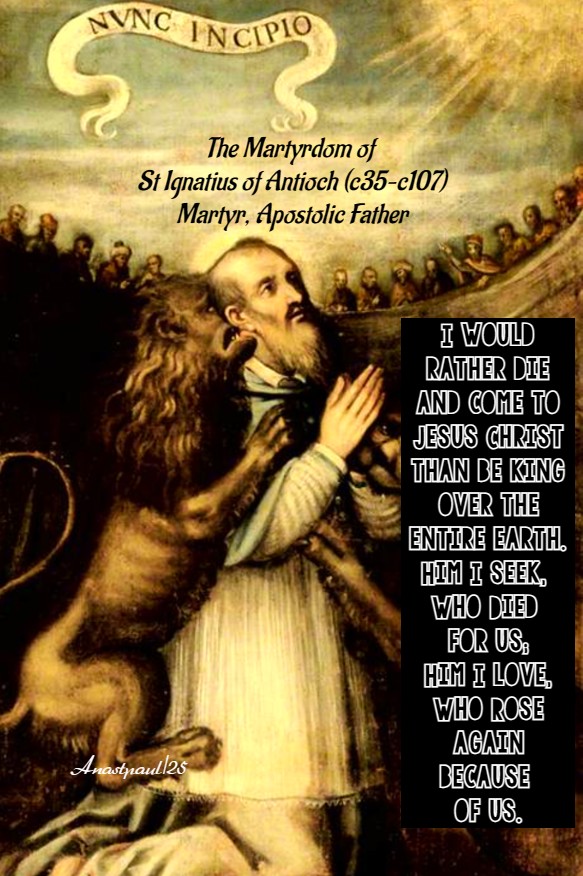
“I would rather die and come to Jesus Christ than be king over the entire earth. Him I seek, Who Died for us; Him I love, Who Rose again because of us.”
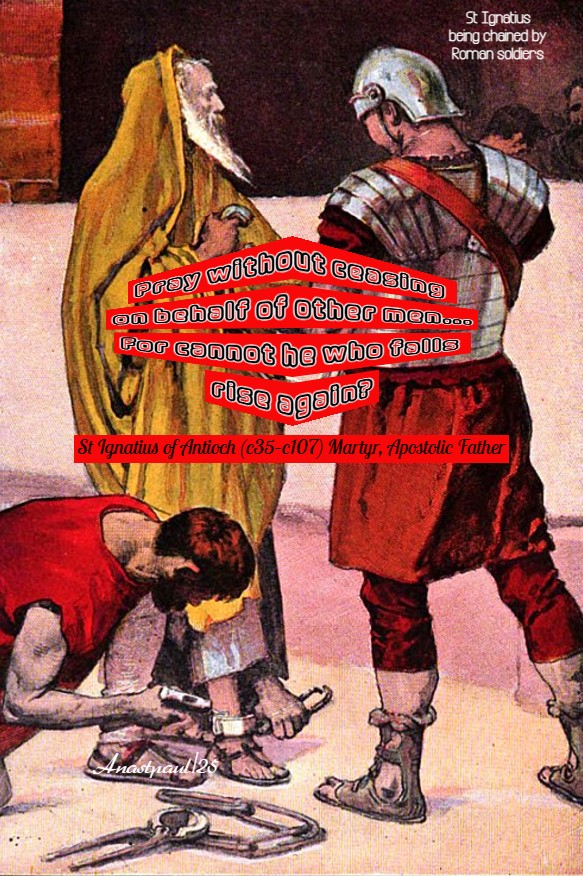
“Pray without ceasing on behalf of other men… For cannot he who falls rise again?”
One Minute Reflection – 1 February – “The Month of the Blessed Trinitys” – St Ignatius of Antioch (c35–107) Martyr, Bishop of Antioch, Apostolic Father of the Church. – Romans 8:35-39; John 12:24-26 – Scripture search here: https://www.drbo.org/
“He who loves his life, loses it and he who hates his life in this world, keeps it unto life everlasting. If anyone serves Me, let him follow Me and where I Am ,there also shall My servant be.” – John 12:25-26
REFLECTION – “… We are being towed along by a world which passes away, forgetting the world to come. We are greedy for present things but do not take into account the coming judgement. We will not run to meet the Lord as He Comes …
Let us turn back, brethren, let us turn back… By the very fact of His delay, of His still waiting, our Lord proves His desire to see us come back to Him, His desire that we should not perish. In His great goodness, He continues addressing these words to us: “I take no pleasure in the death of the wicked but would rather he would change his ways and live ”(Ez 33,11). So let us turn back to Him, brethren, not fearing that time is running short. The time that belongs to time’s Author cannot be shortened. The proof of it lies in the criminal in the Gospel, who, at the moment of dying on the cross, got away with his pardon, grabbed hold of life and, breaking into paradise like a burglar, managed to make his way into the Kingdom (cf. Lk 23,43)!” – St Peter Chrysologus (c 400-450) Bishop of Ravenna, Father and “Doctor of Sermons” of the Church (Excerpt from Sermon 167).
PRAYER – Be mindful of our weakness, O aAmighty God and since the burden of our deeds is grievous to us, grant that the glorious intercession of blessed Ignatius Thy Martyr and Bishop, may protect us. Through Jesus Christ, Thy Son our Lord, Who lives and reigns with Thee, in the unity of the Holy Ghost, God, world without end. Amen (Collect).
Our Morning Offering – 1 February – “The Month of the Blessed Trinity”
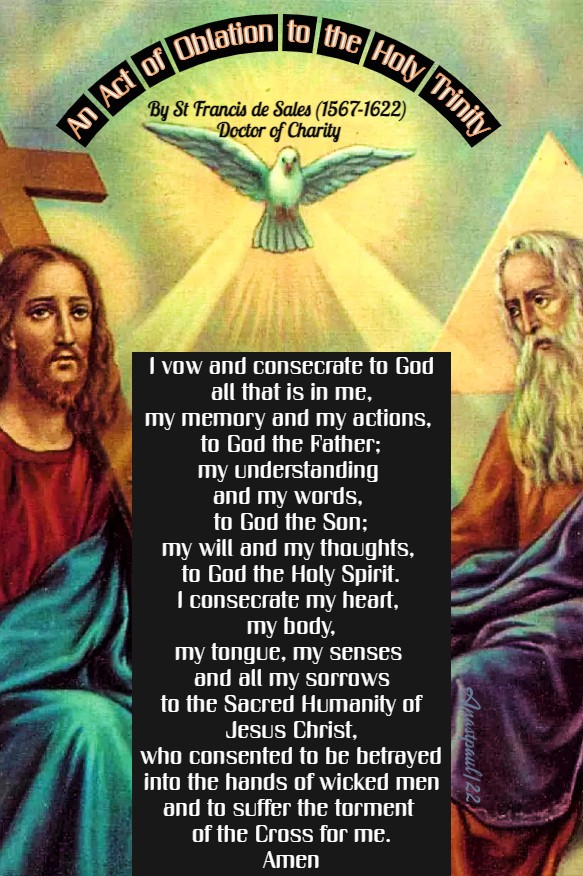
An Act of Oblation to the Most Blessed Trinity By St Francis de Sales (1567-1622) Doctor of Charity
I vow and consecrate to God all that is in me, my memory and my actions, to God the Father; my understanding and my words, to God the Son; my will and my thoughts, to God the Holy Spirit. I consecrate my heart, my body, my tongue, my senses and all my sorrows, to the Sacred Humanity of Jesus Christ, Who consented to be betrayed into the hands of wicked men and to suffer the torment of the Cross for me. Amen
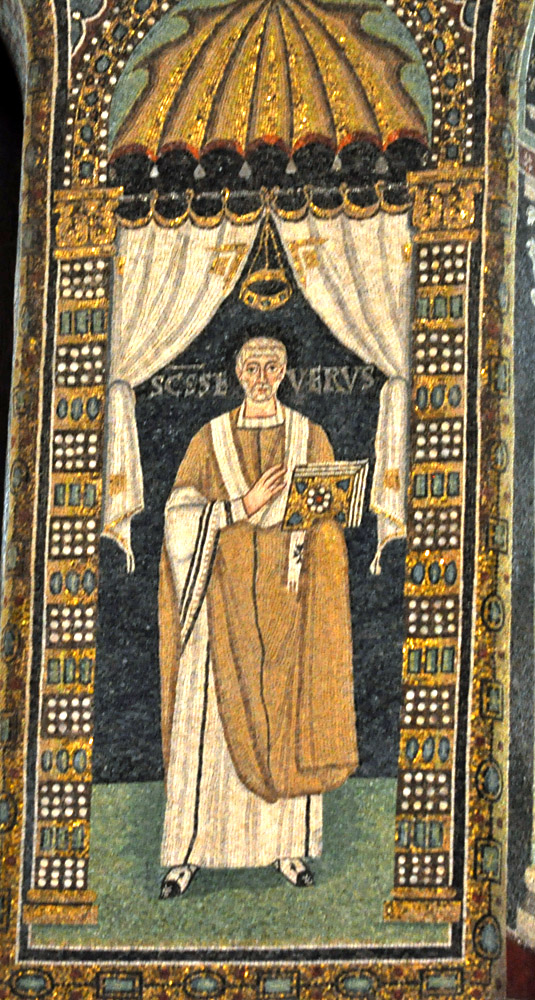
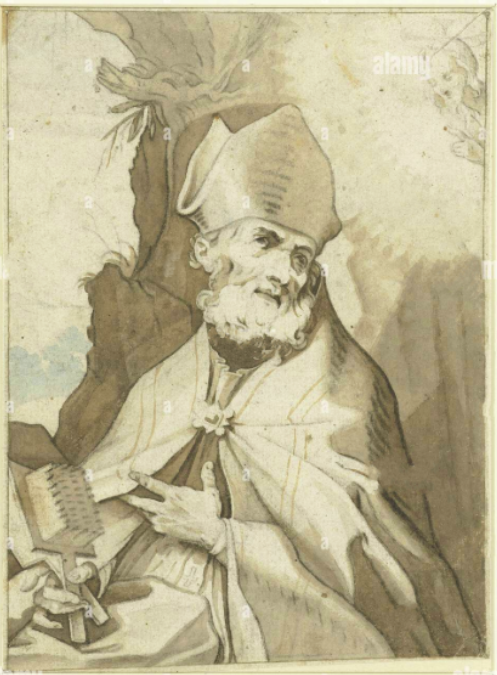
Saint of the Day – 1 February – Saint Severus (Died c344) the 12th Bishop of Ravenna, previously a married wool-merchant and father of 2 daughters. Severus had been miraculously elected as the Bishop by a Dove. Born in Ravenna and died there on 1 February in c344 of natural causes. Patronages – glove makers, hatters, weavers.
The Roman Martyrology states today: “At Ravenna, the holy Bishop Severus, whose great virtues deserved that he should be raised to the Episcopate by the sign of a Dove.”
Sant’Apollinare in Clase: St. Severus
From the ancient ‘Episcopal Catalogue’ we discover that St Severus was the 12th Bishop of Ravenna, after Marcellinus and before Liberius; unfortunately nothing is known about his life, except that his name appears among the participants in the Council of Sardica (ancient name of Sofia in Bulgaria), held in 342-343. He is among the signatories of the Decrees of this Council, of the letter to Pope St Julius I (337-352) and of that, to all the Bishops.
As reported by the medieval hagiographers Agnellus and Liutulf, Severus died on 1 February in a year after 342 and on this day, he was remembered in the ancient Italian Calendar, later inserted in the ‘Martyrology of St. Jerome.’ He was buried in the area of Classe near Ravenna, called the ‘Vicus Salutaris’ in a Chapel called “monasterium St Rophili” adjoining the south, of the 6th Century Basilica.
Testimonies of the ancient cult were reported in two translations ofthe Relics of our holy Bishop, St Severus, one cited on 27 November which took place in Milan, shortly after the Episcopate of St Ambrose (340-397), together with those of four other Saints and a second translation celebrated on 3 September in Aquileia, also with those of four other Saints, including St Andrew the Apostle.
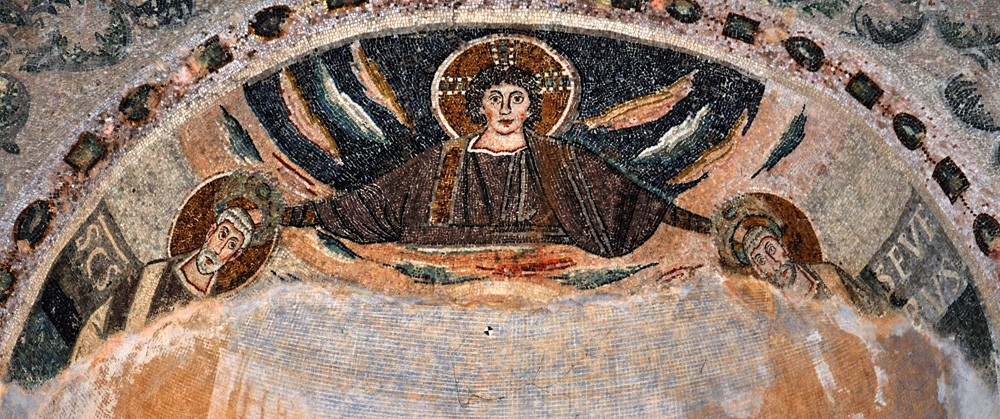
The great testimony of the cult paid to him in Ravenna are the mosaics of St Apollinare in Classe (consecrated in 549), located in the lower part of the apse, representing the Bishops St Severus, St Orsius, Ecclesius and Ursicinus, the first two bear the title “Sanctus” proof of this certain cult.
And then there is the great Basilica of St Severus, begun by Bishop Peter III in 575 and completed by Giovanni Romano (578-595) and Consecrated by him on 17 May 582, also placing the Sarcophagus of the Saint there. This Basilica, combined with a large Benedictine Monastery, remained intact until the 15th Century, then after various events, it was definitively abandoned and destroyed. It was a large Basilica with three naves divided by twelve columns on each side; it had a polygonal apse on the outside and a semi-circular one on the inside (Ravenna type).
As for the literary texts concerning St Severo, they are largely legendary, collected and transcribed by medieval hagiographers. But the two sermons by St Peter Damian (1007-1072) are of great value. The details drawn from these sermons, says that Severus had been a poor wool merchant from Ravenna and after attending Church after the death of Bishop Marcellinus, mistakenly attended at the election of his successor. There, a dove landed several times on his head, so that all the people recognised that he was the chosen one of God. St Peter Damian also reports that during the celebration of the Sacrifice of the Mass, Severus fell into ecstasy. And by a miracle of bilocation, St Severus was present at the death of his friend Saint Geminianus of Modena. Finally, feeling close to death, he opens the Tomb which he had prepared, lay down in it and gives up his soul to God.
In 842 a Frankish Monk named Felix stole St Severus’ Relics and transferred them first to Mainz and then to Erfurt, thus spreading the cult throughout Germany, with Churches being built in his honour. But much more numerous were the Churches dedicated to him throughout Ravenna and in the surrounding Italian districts.
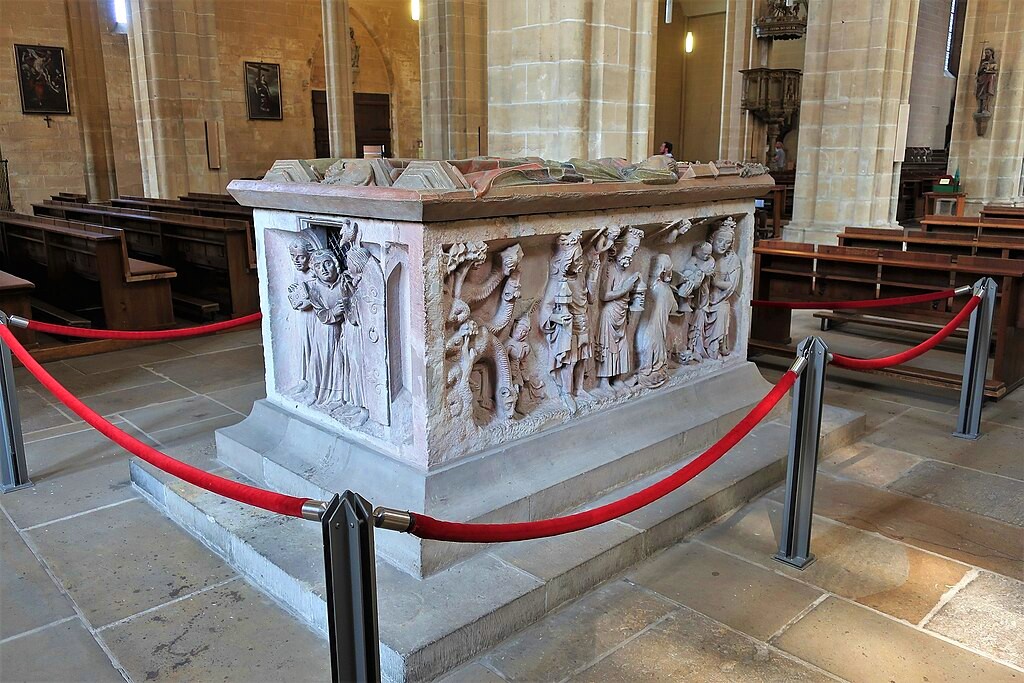
The marble bas-reliefs placed on the 14th Century Tomb in the Saint’s Church in Erfurt, depict him dressed in Bishop’s robes, surrounded by the figures of his wife and daughter, in a devout act of prayer.
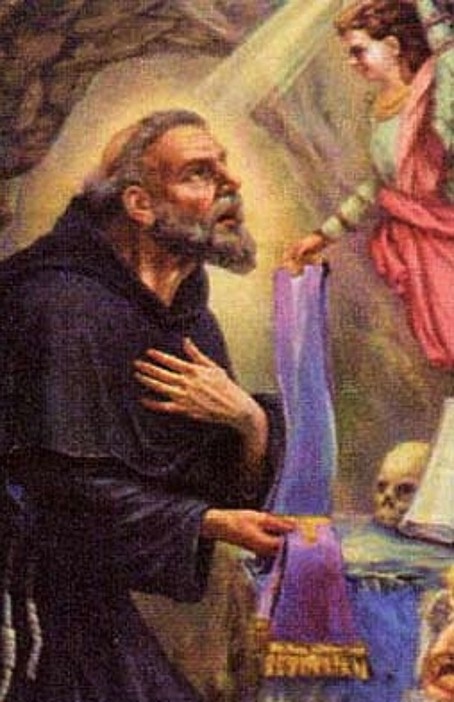
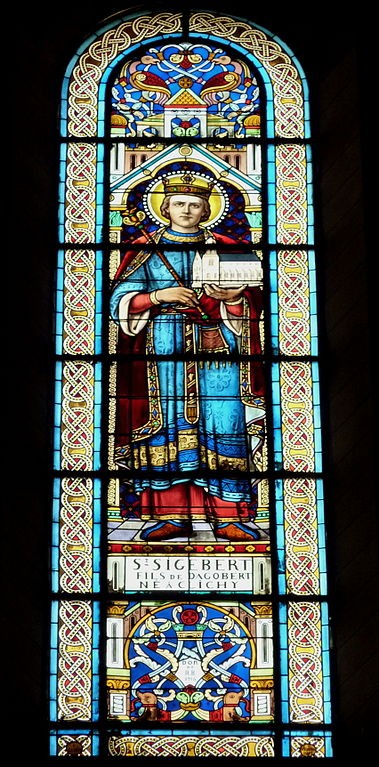
Bl Anthony Manzoni St Asclepiades St Autbert of Landevenec St Brigid of Fiesole St Cecilius of Granada St Cinnia of Ulster St Clarus of Seligenstadt St Crewenna St Darlaugdach of Kildare St Henry Morse St Jarlath Bl John of the Grating St Kinnia St Paul of Trois-Châteaux St Raymond of Fitero









 AnaStpaul
You must be logged in to post a comment.