Thought for the Day – 20 February – Meditations with Fr Richard Frederick Clarke SJ (1839-1900)
Meditations on “The Great Truths” From “The Devout Year” By Fr Richard Frederick Clarke SJ (1839-1900)
20th Day – Death
It is appointed unto men once to die. (Heb ix:27)
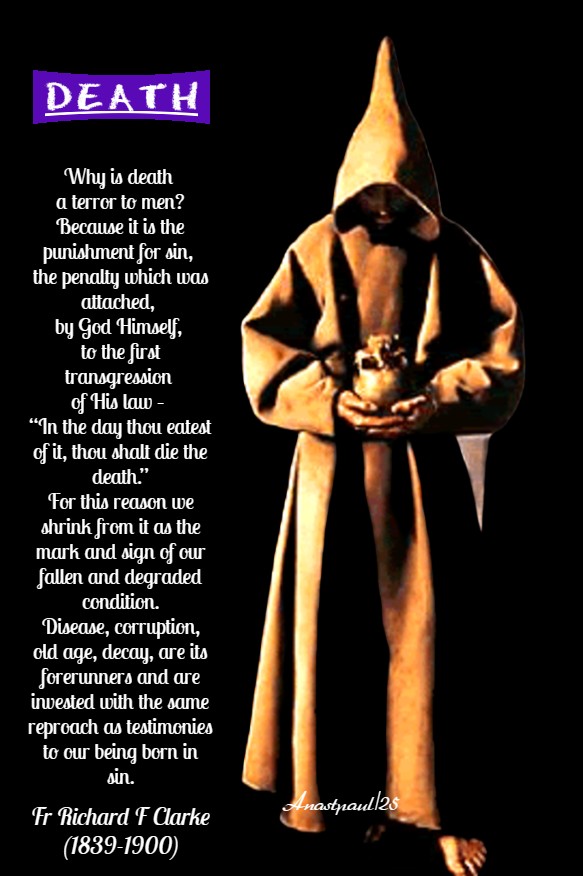
+1. Why is death a terror to men? Because it is the punishment for sin, the penalty which was attached, by God Himself, to the first transgression of His law – “In the day thou eatest of it, thou shalt die the death.” For this reason we shrink from it as the mark and sign of our fallen and degraded condition. Disease, corruption, old age, decay, are its forerunners and are invested with the same reproach as testimonies to our being born in sin.
+2. Death is the end of our time of trial. After it, our destiny will be irrevocably fixed. No more chance of doing penance, no more opportunities of contrition, no more merit, no more grace, no more calls to repentance, no more hope for those who reject God in this life. No wonder, then, men dread it! Yet death is standing at our very door; at any moment the King of Terrors may summon us away. Am I prepared for the summons?
+3. Yet to those who love God, death loses all its terrors. For them it is the beginning of their true life. All their hopes have been directed to the unseen world; why should they fear? Their heart is in Heaven and their treasure is in Heaven, their King and Lord is there and all their dearest and best friends and the Angels and the Saints. How happy are those who are thus detached from this world and ever look to the world to come! Pray for a happy death!
Quote/s of the Day – 20 February – Ferial Day – Septuagesima – 1 Corinthians 9,24-27.10; 1-5 – Matthew 20,1-16 – Scripture search here: https://www.drbo.org/
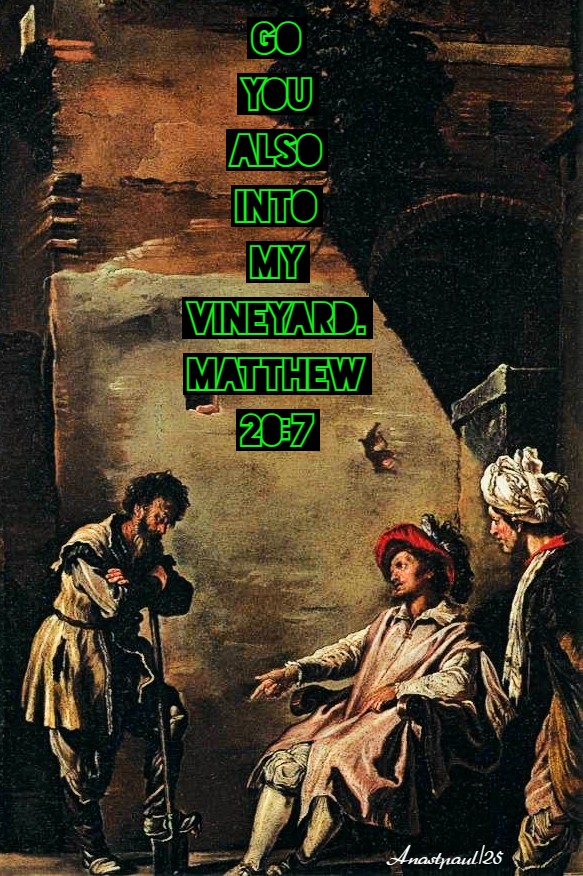
“Go you also into My Vineyard.”
Matthew 20:7
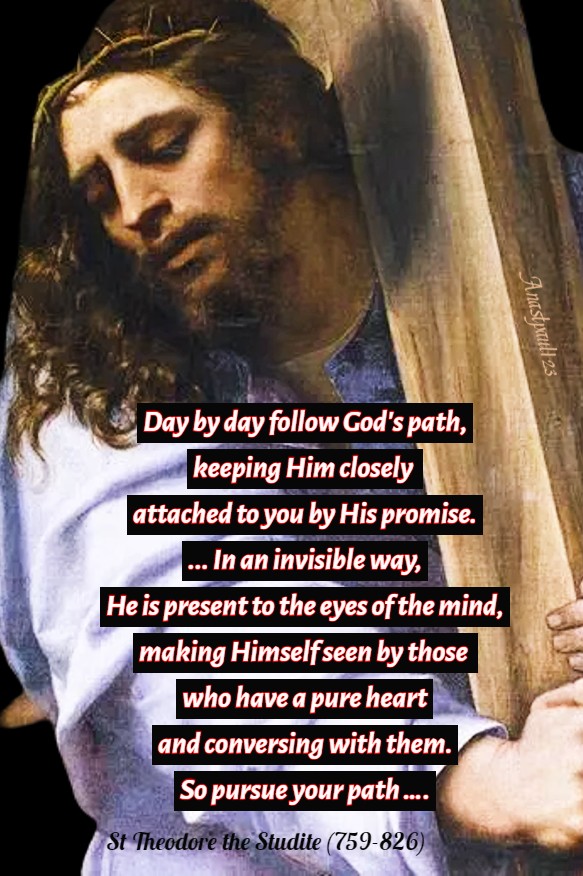
“Day by day follow God’s path, keeping Him closely attached to you by His promise. In fact, He Himself said, through the mediation of His Apostles, to all those who seek His will and His testimonies that He would be with them until the end of the world (Mt 28:20) where paths and footsteps will be unknown (cf Ps 76:20), as the divine David said in his songs. Yet, in an invisible way, He is present to the eyes of the mind, making Himself seen by those who have a pure heart and conversing with them. So pursue your path …. ”
St Theodore the Studite (759-826) Abbot, Confessor, Father of the Church
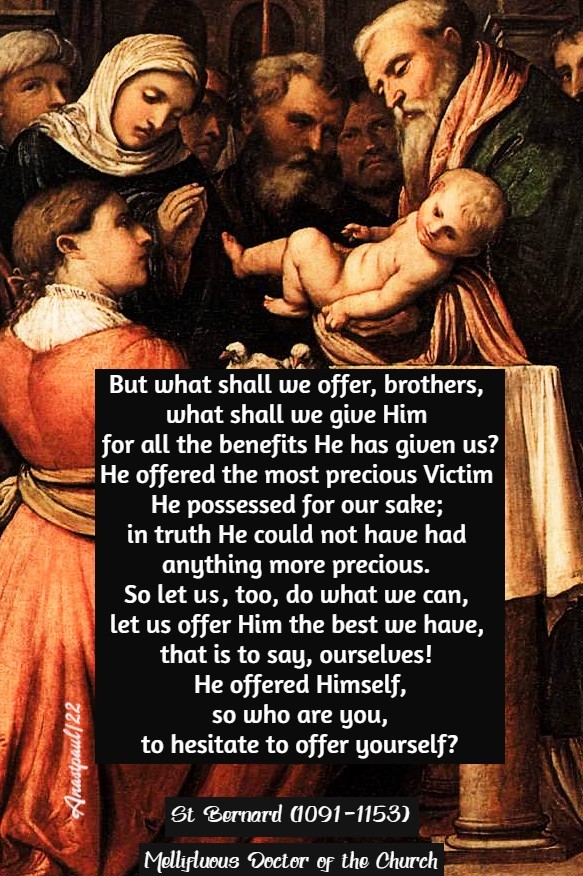
“But what shall we offer, brothers, what shall we give Him for all the benefits He has given us? He offered the most precious Victim He possessed for our sake; in truth, He could not have had anything more precious. So let us, too, do what we can, let us offer Him the best we have, that is to say, ourselves! He offered Himself, so who are you, to hesitate to offer yourself?”
St Bernard (1090-1153) Father & Mellifluous Doctor of the Church
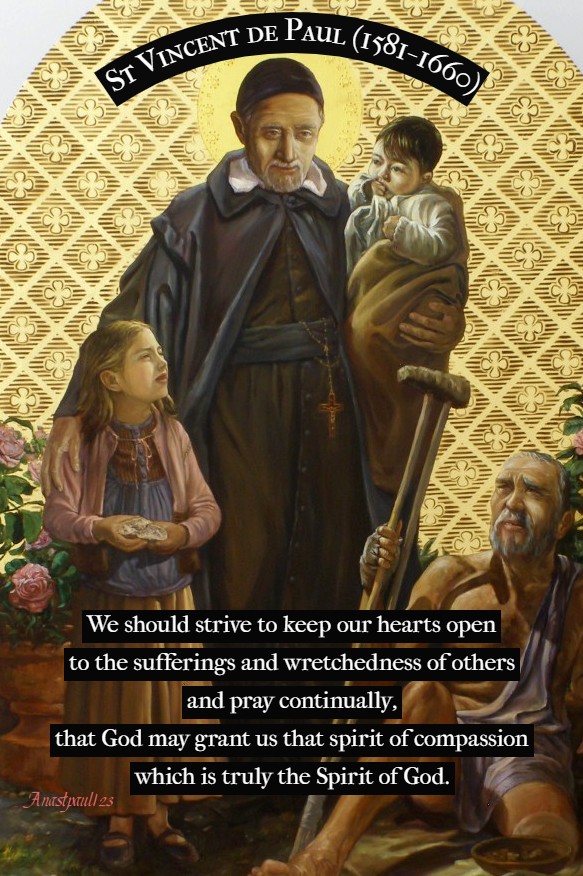
“We should strive to keep our hearts open to the sufferings and wretchedness of others and pray continually, that God may grant us that spirit of compassion which is truly the Spirit of God.”
One Minute Reflection – 20 February – “The Month of the Blessed Trinity” –Ferial Day – Septuagesima – 1 Corinthians 9,24-27.10; 1-5 – Matthew 20,1-16 – Scripture search here: https://www.drbo.org/
“Go you also into My Vineyard.” – Matthew 20:7
REFLECTION – “The Kingdom of Heaven is said to be like a Householder who hired workmen to cultivate His vineyard. Who better can we take to be the Householder than our Creator, Who rules over those He created and governs His Elect in the world, in the same way as a master does those subject to him in his house? He has a Vineyard, which is to say, the universal Church which, has brought forth many Saints as so many branches, from righteous Abel, up to the last of the Elect, who will be born at the end of the world.
The Householder hired workmen to cultivate His Vineyard, in the morning and at the third, sixth, ninth and eleventh hours, since preachers do not cease to preach for the instruction of the faithful, from the beginning of this world, up to its end. The morning indeed was from Adam to the time of Noah, the third hour from the time of Noah to the time of Abraham, the sixth from the time of Abraham to the time of Moses, the ninth from the time of Moses to the coming of the Lord and the eleventh, is from the coming of the Lord to the end of the world. In this period, the holy Apostles, who received a full reward, even though they came late, have been sent as preachers.
At no time then, did the Lord cease sending His People workmen to instruct them, to cultivate His Vineyard, as it were? When He first cultivated His People through the Patriarch and later through the teachers of the law and then, through the Prophets and at last, through the Apostles, He laboured at the cultivation of His Vineyard, as if by His workmen. Everyone though, who has the right faith with good works, in whatever capacity or measure, is a workman in His Vineyard.” – St Gregory the Great (540-604) Pope, Father & Doctor of the Church (Sermons on the Gospel No 19).
PRAYER – From all perils of soul and body, defend us, O Lord, we beseech Thee and by the intercession of blessed and gloriosus ever Virgin Mary, Mother of God, of blessed Joseph, of Thy blessed Apostles Peter and Paul and all the Saints, graciously grant us safety and peace that all adversities and errors being overcome, Thy Church may serve Thee in security and freedom. Through Jesus Christ, Thy Son our Lord, Who lives and reigns with Thee, in the unity of the Holy Ghost, God, world without end. Amen (Collect).
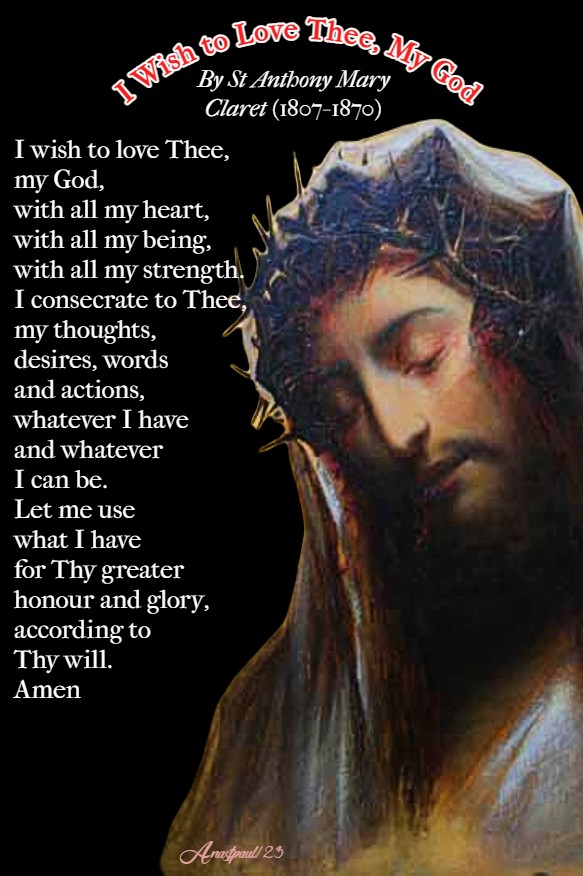
I Wish to Love Thee, My God By St Anthony Mary Claret (1807-1870)
I wish to love Thee, my God, with all my heart, with all my being, with all my strength. I consecrate to Thee, my thoughts, desires, words and actions, whatever I have and whatever I can be. Let me use what I have for Thy greater honour and glory, according to Thy will. Amen
Saint of the Day – 20 February – St Wulfric (c1080-1154) Priest,Penitent, Hermit, Ascetic, Advisor to Kings, gifted with the charism of prophecy and healing, Miracle-worker. Born in around 1080 near Bristol, England and died in Haselbury, Somerset, England of natural causes on 20 February 1154. He was a Hermit in Wiltshire, England and was frequently visited by King Stephen. Also known as – Wulfrick, Ulric, Ulrico, Ulrich.
An Unknown Hermit
Wulfric was born at Compton Martin, ten miles south of Bristol. After becoming a Priest, he at first exercised his ministry at Deverill, near Warminster. At this stage, he was apparently much addicted to hunting, with both hawks and hounds. A chance conversation with a beggar, however, converted him to his true vocation as a Priest and he returned to Compton Martin as Parish Priest.
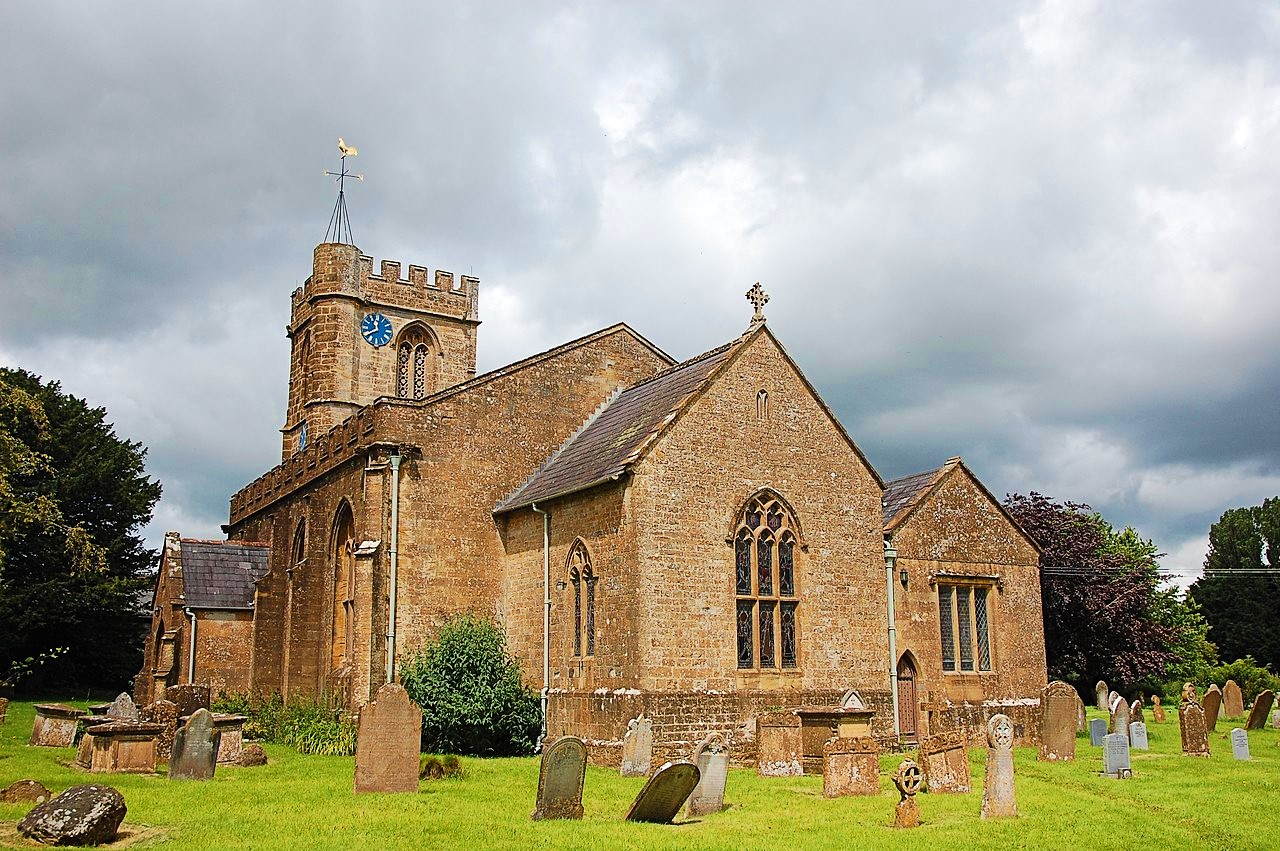
In the year 1125, Wulfric came to St Michael and All Angels Church in Haselbury Plucknett, Somerset. He wished to spend the rest of his life as a Hermit, withdrawn from the world, living in a cell adjacent to the Church. This cell stood on the cold northern side of the building. Although he apparently failed to obtain Episcopal permission for this move, he was supported by the Cluniac Monks at Montacute.
Sir William FitzWalter had a great respect for his saintly neighbour; he sent provisions to him and visited him from time to time. Wulfric numbered among his intimate friends Osbern, the village Priest; William, a lay brother of Forde Abbey and Brichtric, who seems to have joined him as a disciple.
Soon, people came to him for guidance and blessings. During the reigns of Kings Henry I and then King Stephen, Wulfric exercised a powerful influence, not only in his own neighbourhood but also at Court. Henry I was informed, correctly, that he would shortly die, while King Stephen was chastised for the evils of his government. Wulfric received the gifts of prophecy and healing and was involved in many miraculous happenings. He became known as a healer of body, mind, and spirit for all those who sought him out.
One of his visitors was Matilda of Wareham who had been planning to work overseas. Wulfric persuaded her that she should become a Recluse. She was committed and agreed to go to Wareham to work for over two years while a cell was created for her. She returned with her servant Gertrude. She died in the cell after fifteen years and Gertrude agreed to take her place.
According to Abbot John of Forde Abbey, Wulfric lived alone in these simple quarters for 29 years, devoting much of his time to reading the Sacred Scriptures, fasting and praying. He adopted stern ascetic practices: he deprived himself of sleep, ate a frugal and meatless diet, spent hours reciting the Psalms sitting in a bath of cold water and wore a hair shirt and heavy chain-mail tunic.
One of the most influential Hermit Priests of England, he died in his cell on 20 February 1154. At his death, a scuffle occurred in and around St Michael’s Church between black-robed Norman Cluniac Monks from Montacute and the laity from Haselbury and Crewkerne who had been summoned by Osbern, the Priest of Haselbury. The Monks maintained that providing food for the saintly Hermit which they had done for many years, gave them a claim to the holy man’s mortal remains. But the locals, forced them to withdraw and Wulfric was buried in his cell by the Bishop of Bath, who had visited him at his death-bed. For security reasons, Fr Osbern moved Wulfric’s remains twice, until they came to rest somewhere near the west end of the Church, “… in a place known only to himself and God” which we think would have suited St Wulfric’s penitent and humble spirit just fine especially as this Church would now be a protestant one.
St Leo of Catania (c720-789) Bishop, Defender of Sacred Images for which opposition he was forced to flee into exile for some years, Hermit. Born in c720 in Ravenna, Italy and died on 20 February 789 in Etna, Sicily, Italy, natural causes. St Leo was the 15th Bishop of Catania, Sicily, famed for his love and care for the poor, his brave opposition to the iconoclastic Government of the time and for his Miracles. Courageous St Leo: https://anastpaul.com/2024/02/20/saint-of-the-day-20-february-st-leo-of-catania-c720-789-bishop/ St Nemesius of Cyprus
St Pothamius of Cyprus St Serapion of Alexandria St Silvanus of Emesa St Valerius of Courserans St Wulfric (c1080-1154) Priest and Hermit St Zenobius of Antioch









 AnaStpaul
You must be logged in to post a comment.