Thought for the Day – 23 February – Meditations with Fr Richard Frederick Clarke SJ (1839-1900)
Meditations on “The Great Truths” From “The Devout Year” By Fr Richard Frederick Clarke SJ (1839-1900)
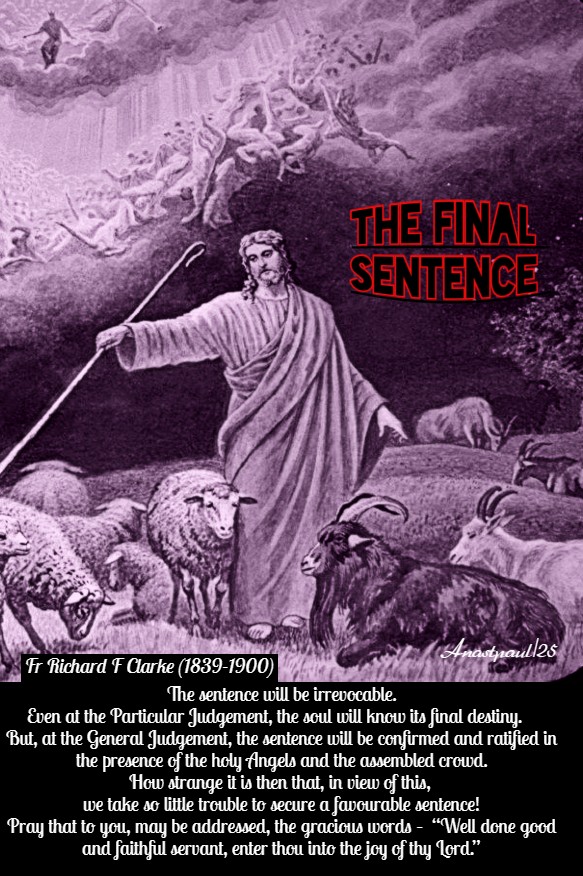
23d Day – The Final Sentence
The wicked shall go into everlasting punishment but the just into life everlasting, (St Matt xxv:46)
+1. The sentence pronounced at the Last Judgement, will be one of perfect justice. Every little circumstance will be taken into account – inherited character, natural disposition, fierce passions, favourable or unfavourable circumstances, early training, opportunities of grace sacraments, temptations, everything! All who are lost will confess that they have been treated with perfect justice that, it was their own fault that, it was they, who condemned themselves to eternal separation from God.
+2. The sentence will be, not only just but, merciful. All the lost will acknowledge that, their punishment is less than they deserved. They will recognise an element of mercy and will be forced amid their despair and hatred of God, amid their curses and blasphemies , to confess that they have been leniently dealt with in comparison with their sins!
+3. The sentence will be irrevocable. Even at the Particular Judgement, the soul will know its final destiny. But, at the General Judgement, the sentence will be confirmed and ratified in the presence of the holy Angels and the assembled crowd. How strange it is then that, in view of this, we take so little trouble to secure a favourable sentence! Pray that to you, may be addressed, the gracious words – “Well done good and faithful servant, enter thou into the joy of thy Lord.”
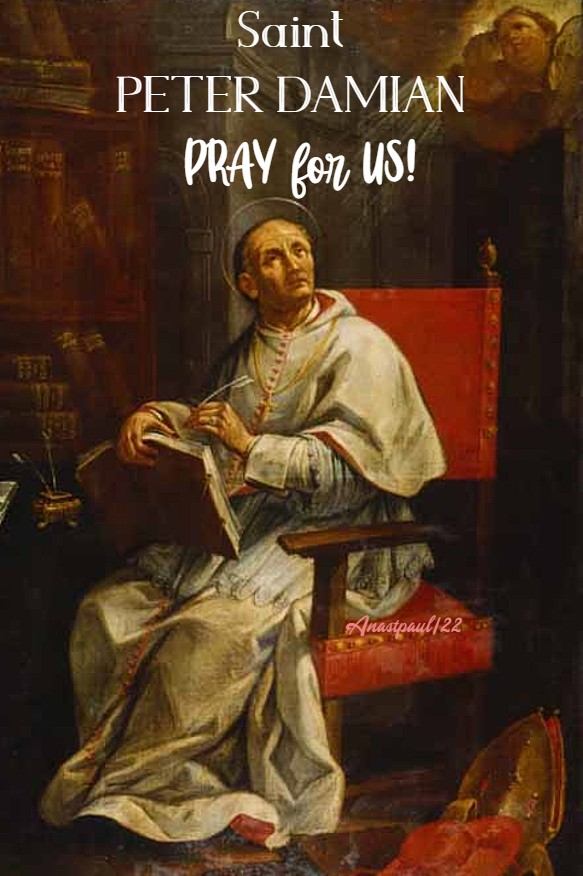
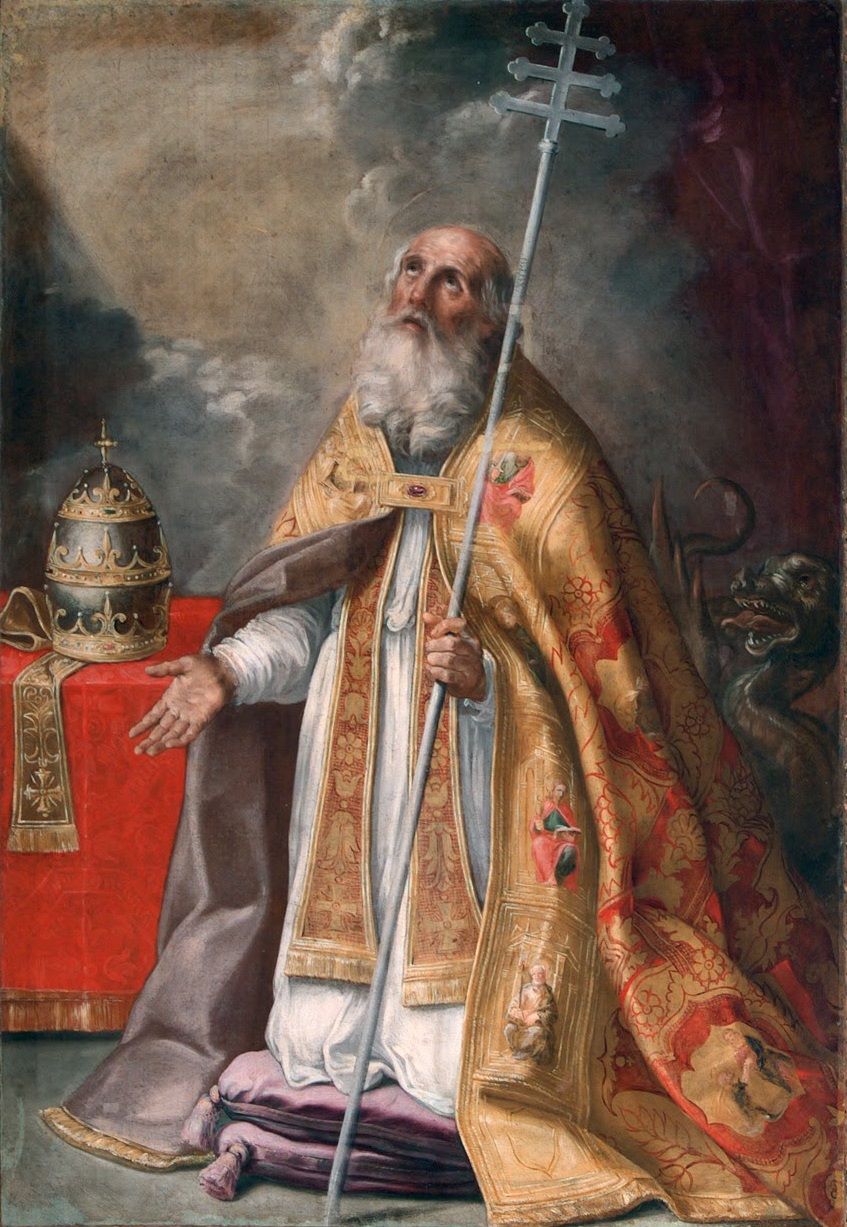
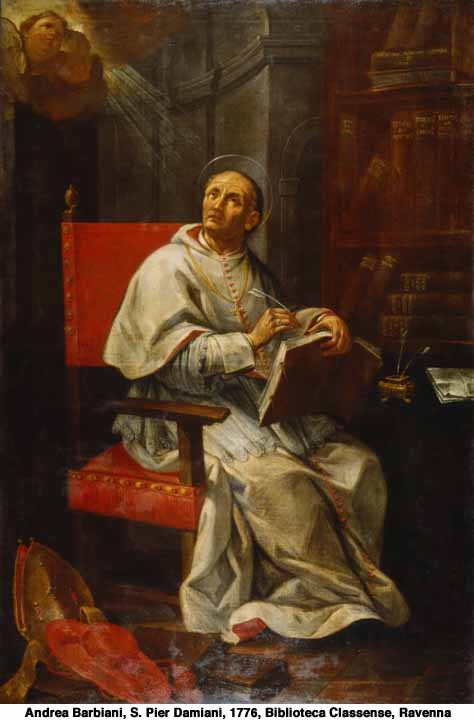
Quote/s of the Day – 23 February – St Peter Damian (1007-1072) Cardinal Bishop, Confessor, Father and Doctor of the Church
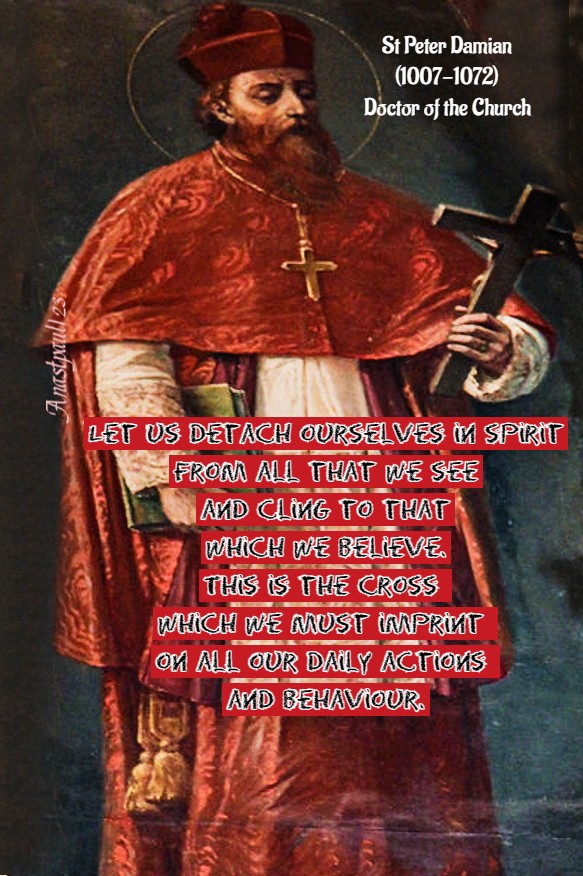
“Let us detach ourselves in spirit from all that we see and cling to that which we believe. This is the Cross which we must imprint on all our daily actions and behaviour.”
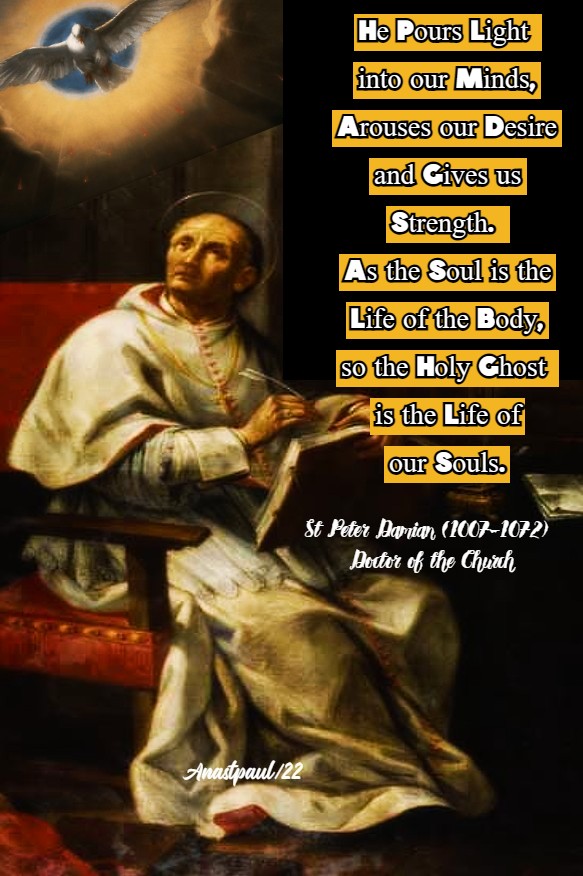
“He pours light into our minds, arouses our desire and gives us strength… As the soul is the life of the body, so the Holy Ghost is the life of our souls.”
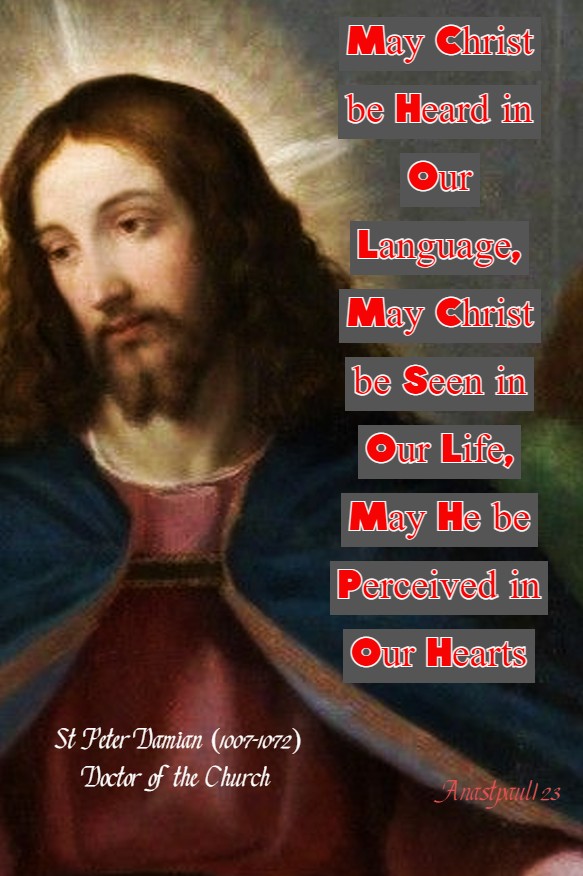
“May Christ be heard in our language, may Christ be seen in our life, may He be perceived in our hearts”
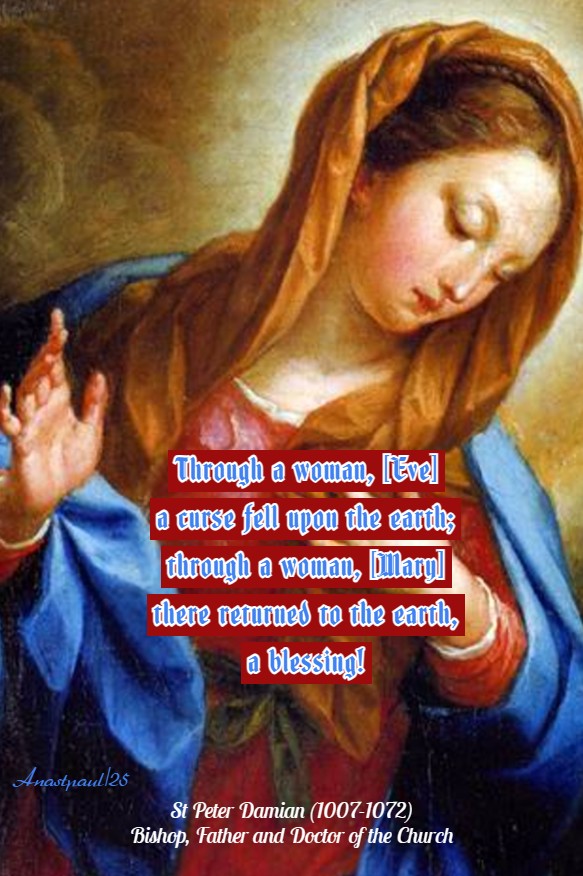
“Through a woman, [Eve] a curse fell upon the earth; through a woman, [Mary] there returned to the earth, a blessing!”
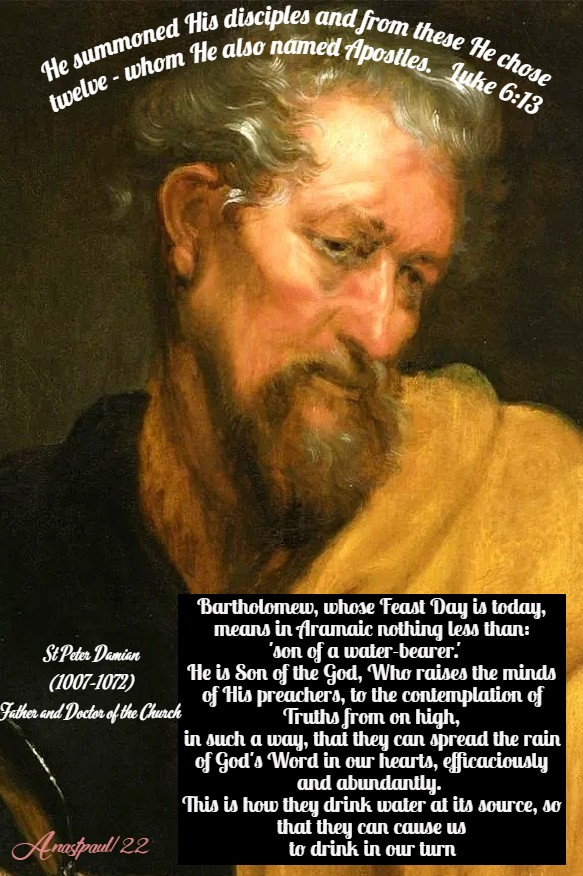
“And when day broke, He summoned His disciples and from these He chose twelve – whom He also named Apostles.” Luke 6:13
“Bartholomew, whose Feast Day is today, means in Aramaic, nothing less than: ‘son of a water-bearer.‘ He is Son of the God, Who raises the minds of His preachers, to the contemplation of Truths from on high, in such a way, that they can spread the rain of God’s Word in our hearts, efficaciously and abundantly . This is how they drink water at its source, so that they can cause us to drink in our turn.”
One Minute Reflection – 23 February – “The Month of the Blessed Trinity” – St Peter Damian (1007-1072) Cardinal Bishop, Confessor, Father and Doctor of the Church – 2 Corinthians 11,19-33; 12,1-9; – Luke 8:4-15 – Scripture search here: https://www.drbo.org/
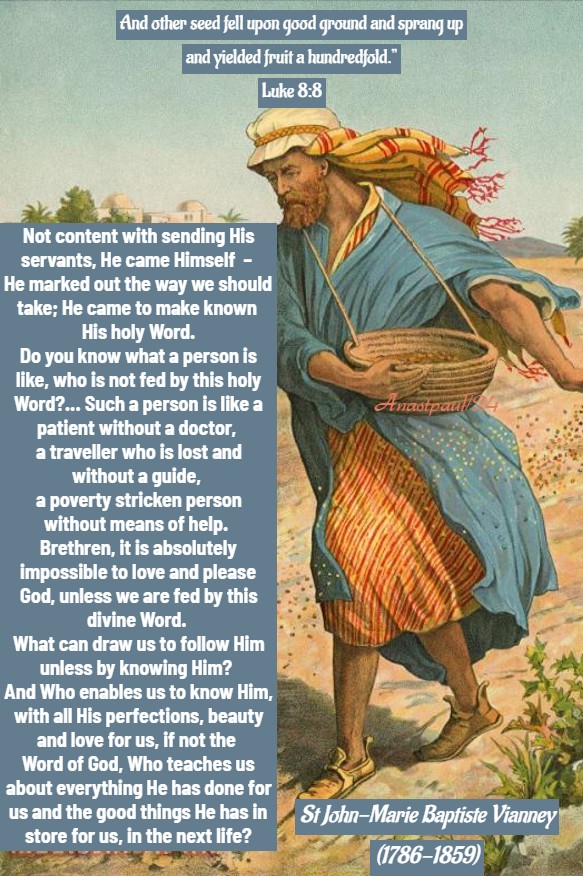
“And other seed fell upon good ground and sprang up and yielded fruit a hundredfold.” – Luke 8:8
REFLECTION – “If you ask me what Jesus Christ means by this Sower Who goes out early to cast his seed over his field then, my brethren, that Sower is the good God Himself, Who began the work of our salvation, from the beginning of the world, by sending us His Prophets, before the coming of Christ, to teach us what was needed, if we would be saved. Not content with sending His servants, He came Himself – He marked out the way we should take; He came to make known His holy Word.
Do you know what a person is like, who is not fed by this holy Word?… Such a person is like a patient without a doctor, a traveller who is lost and without a guide, a poverty stricken person without means of help. Brethren, it is absolutely impossible to love and please God, unless we are fed by this Divine Word. What can draw us to follow Him unless by knowing Him? And Who enables us to know Him, with all His perfections, beauty and love for us, if not the Word of God, Who teaches us about everything He has done for us and the good things He has in store for us, in the next life?” – St John-Marie Baptiste Vianney (1786-1859) The Curé of Ars (Sermons)
PRAYER – Grant us, we beseech Thee, Almighty God, to follow the counsel and examples of St Peter, Thy Confessor and Bishop, so that by setting earthly goods at naught we may attain everlasting happiness. Through Jesus Christ, Thy Son our Lord, Who lives and reigns with Thee, in the unity of the Holy Ghost, God, world without end. Amen (Collect).
Our Morning Offering – 23 February – Sexagesima Sunday and the Feast of St Peter Damian (1007-1072) Cardinal Bishop, Confessor, Father and Doctor of the Church
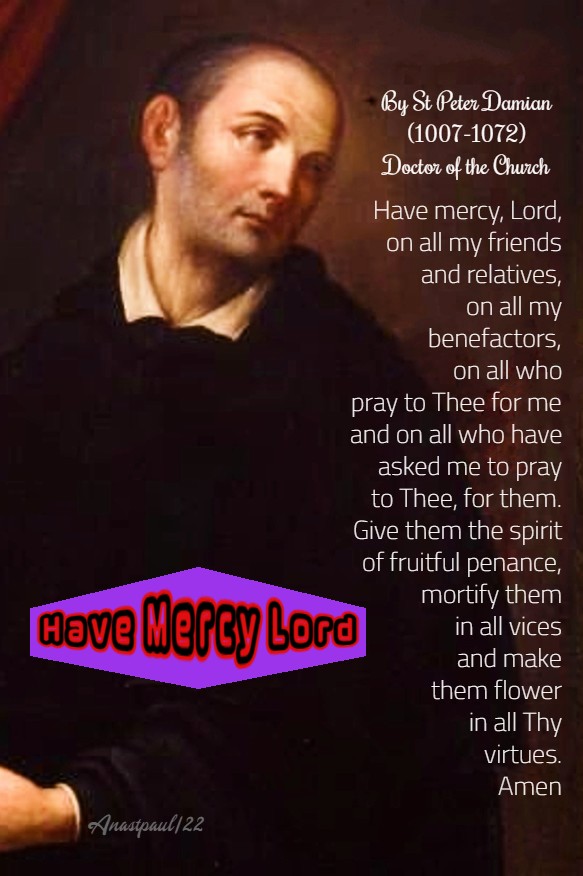
Have Mercy, Lord By St Peter Damian (1007-1072) Father & Doctor of the Church
Have mercy, Lord, on all my friends and relatives, on all my benefactors, on all who pray to Thee for me and on all who have asked me to pray to Thee, for them. Give them the spirit of fruitful penance, mortify them in all vices and make them flower in all Thy virtues. Amen
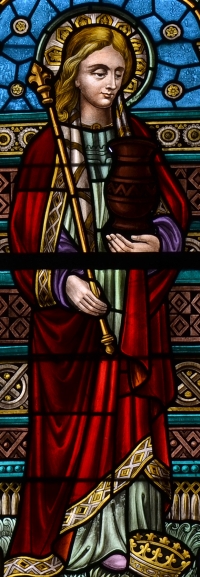
Saint of the Day – 23 February – Saint Romana (Died c324) Virgin, Recluse, Miracle-worker. Born in c308 and died in c324 in her cave in Todi, Umbria, Italy of natural causes.
The Roman Martyrology reads today: “At Todi, St Romana, Viurgin, who was Baptised by Pope St Sylvester. She led a heavenly life in caves and dens and wrought glorious miracles.”
St Pope Sylvester
Romana was the daughter of Calfurnius, the Prefect of Rome. Having embraced the Christian Faith, she renounced all the comforts and conveniences which her rank would have allowed her.
Following her religious vocation, she ran away from home and, at the age of 10, she reached St Silvester on Mount Soratte, to be Baptised.
Inside the church of Santa Romana on Soratte (a mountain in Sabina) there is the following inscription: “23 FEBEUARII ^ TUDERTI ^ St ROMANE VIRGINIS QUE A S. SILVESTRO BAPTIZATA IN HANC ANTRI ET SPELUCIS CELESTE VITA DUXIT ET MIRACULORV.GLORIS CLARUIT.” (23 FEBRUARY ^ TUDERTI ^ ST ROMAN VIRGIN WHO WAS BAPTISED BY ST SILVESTER IN THIS CAVE. SHE LIVED A CELESTIAL LIFE AND WAS REPLETE WITH MIRACULOUS GLORY). Nowadays it is almost illegible.
Romana on Mount Soratte. lived in a hermitage, She wanted to live in that very cave, perhaps because she felt close to Pope Sylvester, whose sanctity she admired. And it is in these places that a legendary relationship was born, between the Saint and his devotee, who reached him at the top of the mountain, perhaps using some secret passage, wedging herself into the bowels of the mountain.
Silvester warned her each time and once said to her: “now you will return when the roses have bloomed.” It was the middle of winter which had often stained the steep climbs of the mountain with white, when one morning Romana returned to Silvester with a rose; it had bloomed.
The Saint then set out alone towards the City of Todi. In the gorges of Forello, she established her home inside a cave. Although she lived alone, her constant prayer and her faith, were such that many Christians approached her, praising her sanctity.
Romana died in prayer surrounded by the faithful, in the year c324. The body of the Saint was buried in the cave where she lived and in which an Altar was built, where masses were continuously celebrated.
In 1301 her body was transferred to St Fortunatus Church in Todi.
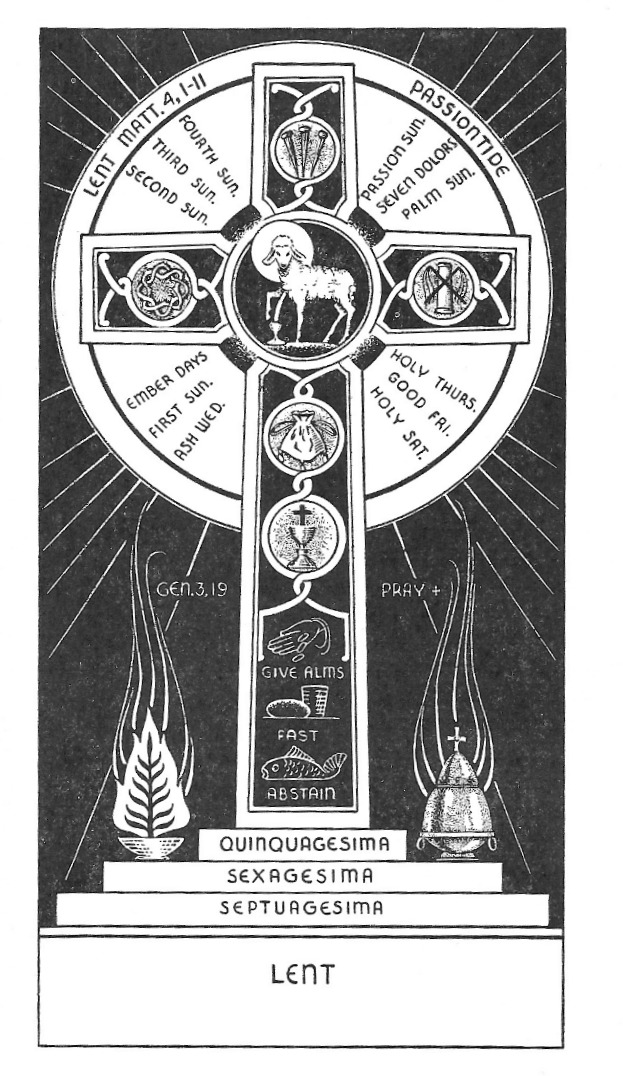
SEXAGESIMASUNDAY: (Latin – Sexagesima, sixieth) The name means “sixtieth” as it falls within the 50-60 day ranges before Easter and the second before Lent. The Ordo Romanus, St Alcuin and others, count the Sexagesima from this day to Wednesday after Easter. The name was already known to the Fourth Council of Orléans in 541. To the Latins it is also known as “Exsurge” from the beginning of the Introit. The Station was at Saint Paul’s Outside the Walls of Rome and hence, the oratio calls upon the Doctor of the Gentiles. The Epistle is from Paul, 2 Corinthians 11 and 12, describing his suffering and labours for the Church. The Gospel (Luke 8) relates the falling of the seed on good and on bad ground, while the Lessons of the first Nocturn continue the history of man’s iniquity and speak of Noah and of the Deluge.
St Alexander Akimetes St Boswell St Dositheus of Egypt St Felix of Brescia St Florentius of Seville St Giovanni Theristi (1049–1129) Monk Bl John of Hungary
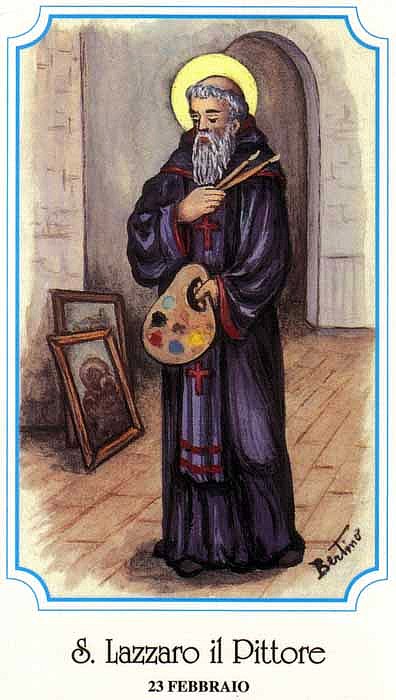
St Lazarus Zographos (c810-c 867) Priest, Monk known as “the Painter and the Iconographer.” Lazarus lived before and during the second period of Byzantine Iconoclasm. The Roman Martyrology states of him today: “St Lazarus, a Monk, whom the Iconoclast Emperor Theophilus ordered to be put to torture for having painted holy images. His hand was burned with a hot iron but, being healed by the power of God, he painted anew the holy images which had been defaced and finally rested in peace.” The Painter Saint: https://anastpaul.com/2022/02/23/saint-of-the-day-23-february-st-lazarus-zographos-810-865/
St Ordonius St Polycarp of Rome St Romana (Died c324) Virgin
St Serenus the Gardener (Died 307) Martyr. Serenus was by birth a Grecian. He left his family estate, friends and country to serve God in celibacy, penance and prayer. With this design he bought a garden in Sirmium in Pannonia, which he cultivated with his own hands and lived on the fruits and herbs it produced. His Life and Death: https://anastpaul.com/2019/02/23/saint-of-the-day-23-february-st-serenus-the-gardener-died-307-martyr/
Martyrs of Syrmium – 73 Christians who were Martyred together in the persecutions of Diocletian. We know no details about them, and only six of their names – Antigonus, Libius, Rogatianus, Rutilus, Senerotas and Syncrotas.
Thought for the Day – 22 February – Meditations with Fr Richard Frederick Clarke SJ (1839-1900)
Meditations on “The Great Truths” From “The Devout Year” By Fr Richard Frederick Clarke SJ (1839-1900)
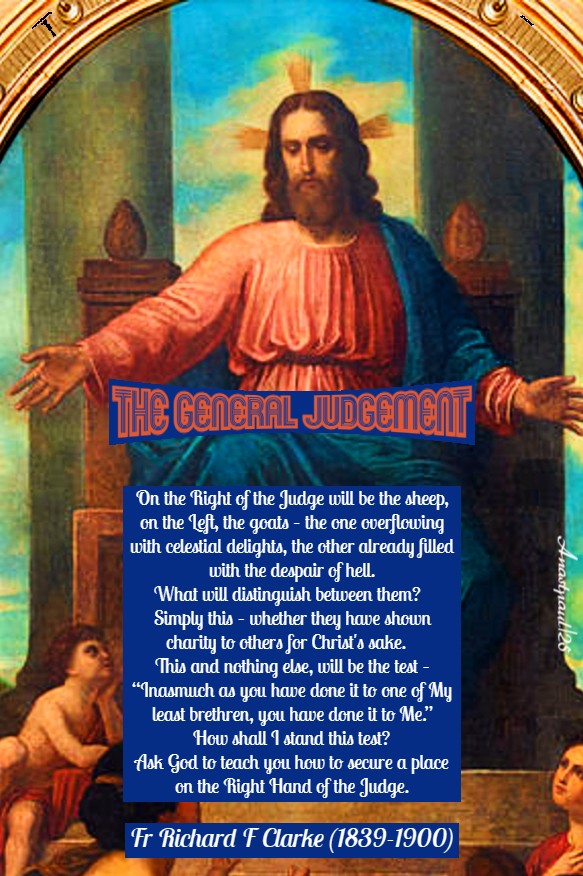
22nd Day – The General Judgement .
Behold He cometh with the clouds and every eye shall see Him and they also who pierced Him . (Apoc i:7)
+1. At the General Judgement, Christ as Man, will be the Judge of men because He is at once God and Man. He will, therefore, have not only the most intimate knowledge of all our lives but a sympathy with us, an understanding of our nature from experience which will give Him, in the natural order, the highest qualifications for being our Judge.
+2. On that day, what a complete reverse there will be of all the world’s unjust verdicts! How many, now ridiculed, despised, condemned, will then be glorious and honoured before men and Angels! What will my sentiments be on that day, when the thoughts of all hearts will be revealed?
+3. On the Right of the Judge will be the sheep, on the Left, the goats – the one overflowing with celestial delights, the other already filled with the despair of hell. What will distinguish between them? Simply this – whether they have shown charity to others for Christ’s sake. This and nothing else, will be the test – “Inasmuch as you have done it to one of My least brethren, you have done it to Me.” How shall I stand this test? Ask God to teach you how to secure a place on the Right Hand of the Judge.
Quote/s of the Day – 22 February – The Feast of the Chair of St Peter at Antioch –1 Peter 1:1-7; Matthew 16:13-19 – Scripture search here: https://www.drbo.org/
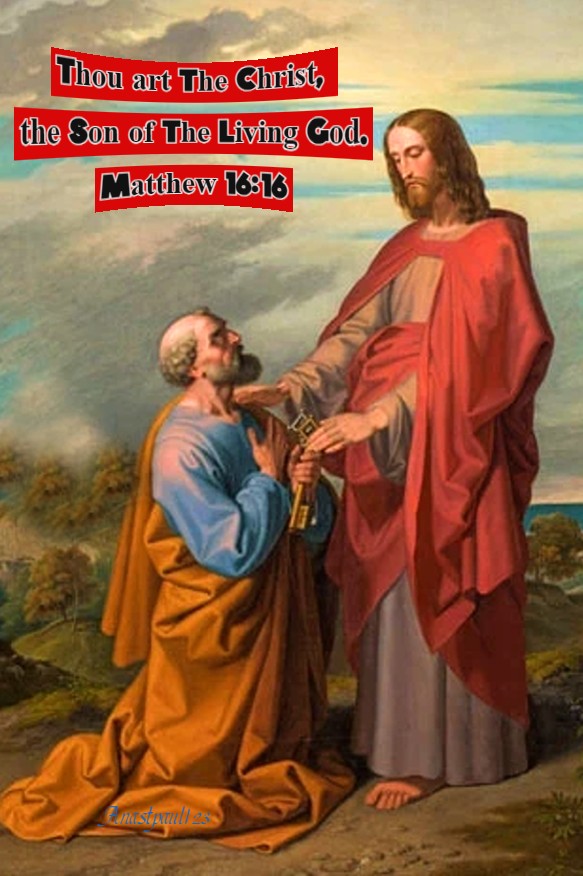
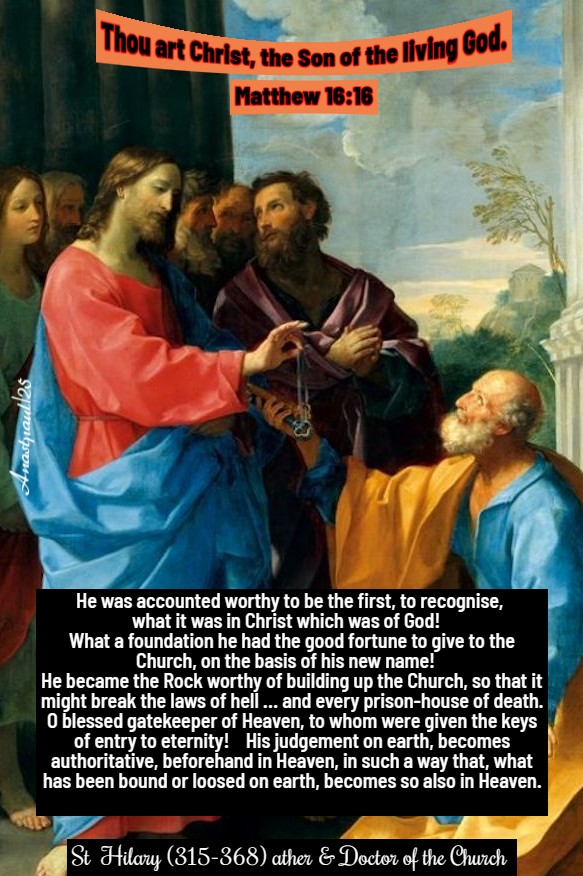
“Thou art Christ, the Son of the living God.”
Matthew 16:16
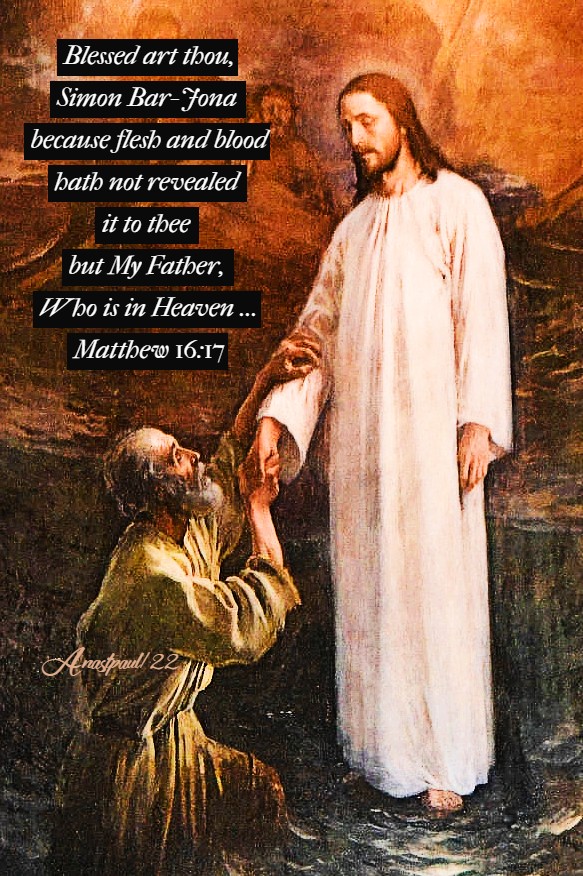
“Blessed art thou, Simon Bar-Jona because flesh and blood hath not revealed it to thee but My Father Who is in Heaven.”
Matthew 16:17
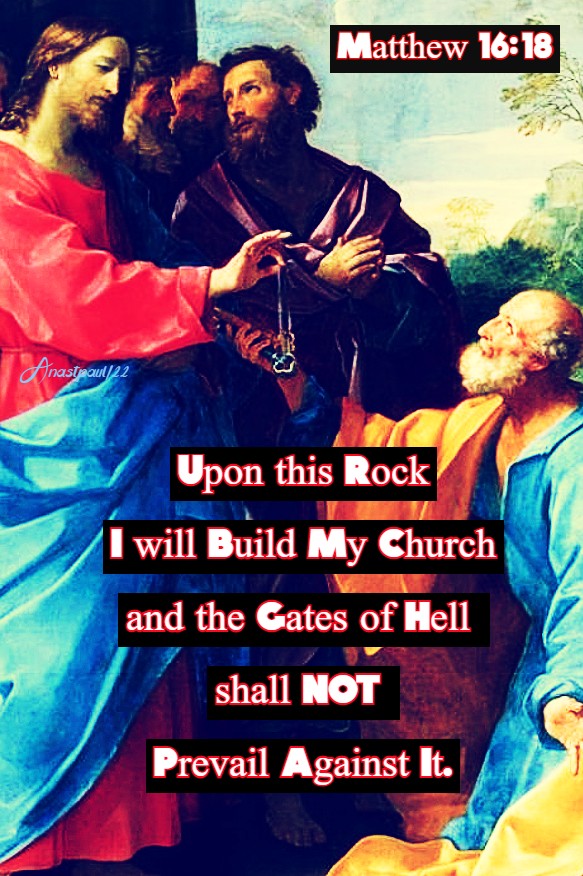
“Upon this Rock I will build My Church”
Matthew 16:18
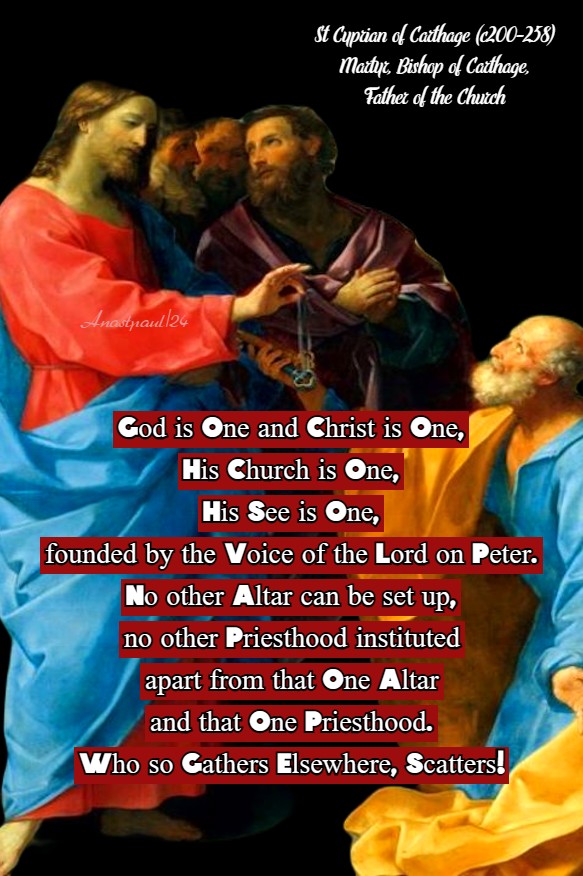
“God is One and Christ is One, His Church is One, His See is One, founded by the Voice of the Lord on Peter. No other Altar can be set up, no other Priesthood instituted apart from that One Altar and that One Priesthood. Who so gathers elsewhere, scatters!”
St Cyprian of Carthage (c 200-258) Martyr, Bishop of Carthage, Father of the Church
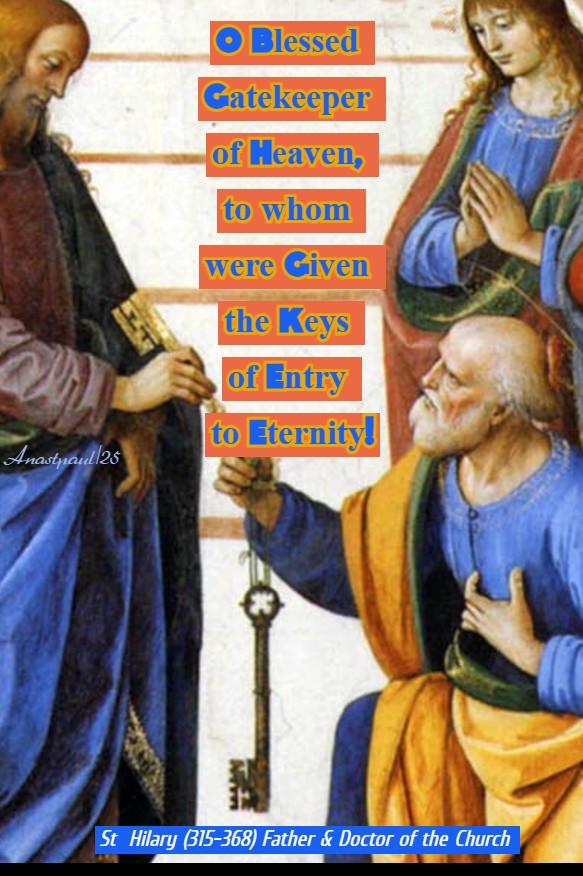
“ O blessed gatekeeper of Heaven, to whom were given the keys of entry to eternity! ”
St Hilary (315-368) Bishop of Poitiers, Father & Doctor of the Church
One Minute Reflection – 22 February – The Feast of the Chair of St Peter at Antioch –1 Peter 1:1-7; Matthew 16:13-19 – Scripture search here: https://www.drbo.org/
“Thou art Christ, the Son of the living God.” – Matthew 16:16
REFLECTION – “The Lord had asked: “Who do people say that the Son of Man is?” To be sure, His bodily appearance made known the Son of Man but, in putting this question, He led people to understand that, there was something else to be discerned, over and above what could be seen … The object of the question was, a mystery towards which the faith of the believer had to tend.
Peter’s confession was fully recompensed, as he deserved for having seen the Son of God within the Man. “Blessed” is he, indeed and praised, for having penetrated beyond merely human sight, not looking to that which comes of flesh and blood but, beholding the Son of God, revealed by His heavenly Father. He was accounted worthy to be the first, to recognise, what it was in Christ which was of God! What a foundation he had the good fortune to give to the Church, on the basis of his new name! He became the Rock worthy of building up the Church, so that it might break the laws of hell … and every prison-house of death. O blessed gatekeeper of Heaven, to whom were given the keys of entry to eternity! His judgement on earth, becomes authoritative, beforehand in Heaven, in such a way that, what has been bound or loosed on earth, becomes so also in Heaven.
Jesus also commands His disciples not to tell anyone He is the Christ, since others, namely the Law and the Prophets, must be the witnesses of His Spirit, while witness to the Resurrection belongs to the Apostles. And, just as the blessedness of those, who know Christ in the Spirit, was made known, so also, was made known, the danger of misunderstanding His humility and passion.” – St Hilary (315-368) Bishop of Poitiers, Father & Doctor of the Church (Commentary on St Matthew’s Gospel 16).
PRAYER – O God, Who when giving blessed Peter, Thine Apostle, the keys of the Heavenly Kingdom, bestowed on him the power of binding and loosing, grant that by the help of his intercession, we may be delivered from the bonds of our sins. Through Jesus Christ, Thy Son our Lord, Who lives and reigns with Thee, in the unity of the Holy Ghost, God, world without end. Amen (Collect).
Our Morning Offering – 22 February – The Chair of St Peter at Antioch
O Prince of the Apostolic Senate! Hymn to the Prince of the Apostles By St Peter Damian (1007-1072) Cardinal Bishop of Ostia Doctor of the Church
O Prince of the Apostolic Senate! Herald of our Lord! First Shepherd of the Faithful! watch over the Flock intrusted to thee.
Lead us through verdant pastures, feeding us with the nourishment of the Word and lead us, thus fed, into the heavenly fold, whither thou hast already gone.
To thee, Peter, have been delivered the Keys of heaven’s gate and all things, both in Heaven and on earth, acknowledge thy authority.
Tis thou that choosest the City where is to be established the Rock of the True Faith, the foundation of the building, on which the Catholic Church stands immoveable.
Thy shadow, as thou passest by, heals the sick and Tabitha, who made garments for the poor, was raised to life at thy bidding.
Bound with two chains, thou wast set free by an Angel’s power; he bids thee put on thy garments and thy sandals and lo! the prison door is opened.
To the Father unbegotten and to the Only-Begotten Son and to the co-equal Spirit of them both, be praise and kingly highest power. Amen.
Saint of the Day – 22 February – St Abilius (Died c98) the 2nd Bishop of Alexandria, Egypt. He was the 2nd Bishop of Alexandria. He was Ordained by Saint Mark the Evangelist and was also the first convert Mark won to Christianity in the region. Also known as – Abilio, Abitius, Abylius, Avilio, Avilius, Anamia, Melyos, Mielo, Milius, Sabellius’
The Roman Martyrology reads today: “At Alexandria, St Abilius, Bishop, who was the 2nd shepherd of the City after St Mark and administered his charge with eminent piety.”
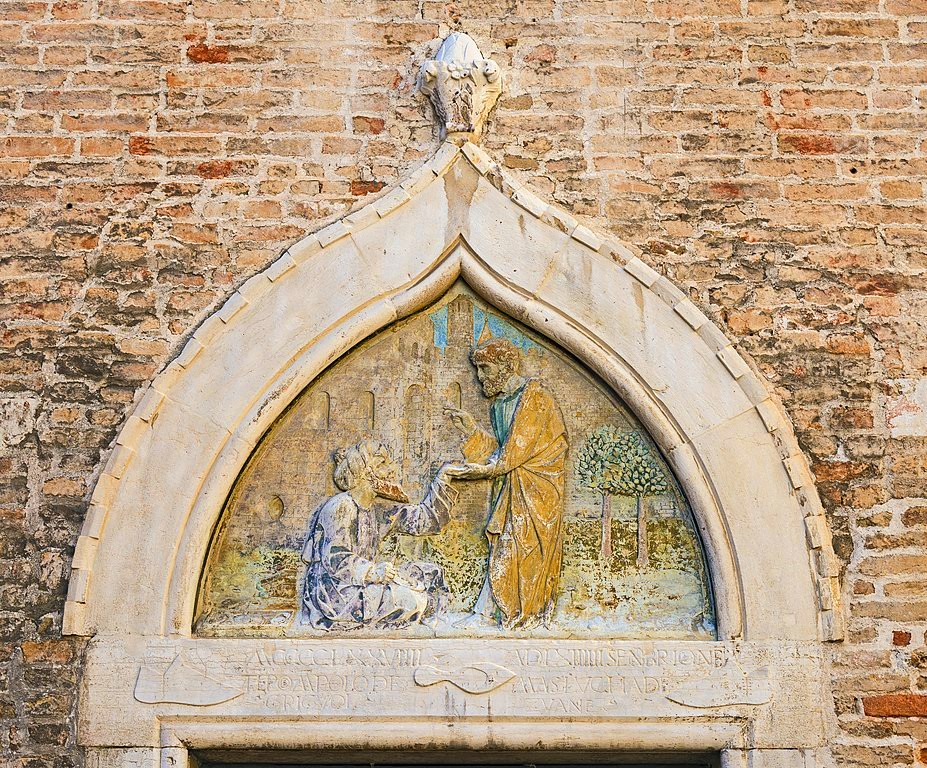
Relief of St Mark and St Abilius by Pietro Lombardo, 1478
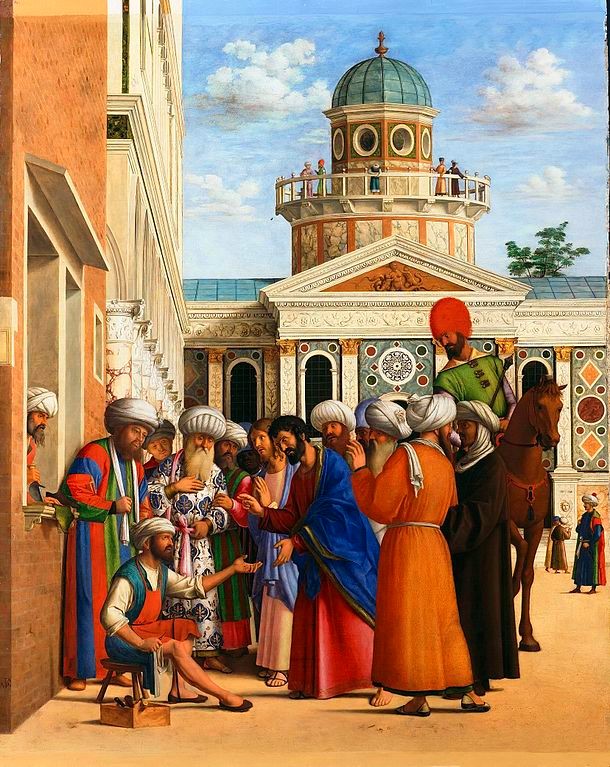
As St Mark was entering Rakotis, a suburb of Alexandria, after his travels from Cyrene, the strap of his sandal detached itself. He found a cobbler, Abilius, to repair it. While he was working on the sandal, the awl slipped in Abilius’ hand, piercing it. Anianus cried out “God is One – Heis ho Theos” in response to the pain. Mark took the opportunity to preach the Gospel to him, at the same time miraculously healing Abilius’ hand of its wound.
Mark was invited to Agilius’ house, where he taught him and his family the Gospel and, thereafter, Baptised them all. A large number of natives of the area were quickly converted by Mark too causing those pagans, who did not convert, to defend their local gods against the new Faith.
Mark, the outsider, decided it might be best if he were to leave the area for a while. He Ordained Abilius and Consecrated him as the Bishop in his absence. He also Ordained three Priests and seven Deacons, charging them with the care of the Church in his absence.
Mark was gone for a period of two years, during which time tradition believes that he attended St Peter in Rome. Abiliuss and his Priests, the meantime, spread the Gospel in the region, performing miracles and winning many to Christ. On Mark’s return, he found the Church in Alexandria had grown significantly and they were able to build a Church at Bucolia on the shore of the Alexandrian eastern harbour.
St Abilius repairing St Mark’s sandal by Cima da Conegliano
Following St Mark’s Martyrdom Abilius took his place in the Church in Alexandria. He would remain in that capacity for over seventeen years. During that time, the number of Christians in the area grew significantly and Abilius Ordained new Priests and Deacons for the growing Church. The extent of the evangelisation they performed is unknown, although it has been thought by some that it was done at least somewhat covertly, given the hostility the pagan population demonstrated to the new Faith.
Abilius died in bed and was buried next to St Mark at the Church in Baucalis. Later, as we know, St Mark’s Relics were translated to Venice.
The Chair of Saint Peter at Antioch – where the disciples were first entitled “Christians.” The Chair/Throne or Cathedra itself is a Relic conserved in St Peter’s Basilica although it seems not to be the original Chair. This Antioch is where the disciples were first called CHRISTIANS. https://anastpaul.com/2022/02/22/the-feast-of-the-chair-of-saint-peter-at-antioch-22-february/
St John the Saxon St Limnaes Bl Mohammed Abdalla St Papias of Heirapolis St Paschasius of Vienne St Raynerius of Beaulieu St Thalassius
Martyrs of Arabia – A memorial for all the unnamed Christians Martyred in the desert and mountainous areas south of the Dead Sea during the persecutions of Emperor Valerius Maximianus Galerius.
Thought for the Day – 21 February – Meditations with Fr Richard Frederick Clarke SJ (1839-1900)
Meditations on “The Great Truths” From “The Devout Year” By Fr Richard Frederick Clarke SJ (1839-1900)
21st Day – The Particular Judgement .
We must all be manifested before the Judgement-seat of Christ. (2 Cor v:10)
+1. At the Particular Judgement, we shall see our lives as they never appeared to us before. In an instant, we shall live them over again. Each thought word, act, will be clear and distinct, with its true character no longer hidden by our own wilful blindness but, in all its foulness, baseness, ingratitude, revealed to us in the bright Light of God.
+2. We shall then stand face-to-face with Jesus Christ, no longer as our Advocate but, as our Judge; no longer pleading for us but dealing out strict justice, according to our deserts. He will be clothed with a Divine glory which will attract us and, at the same time, fill us with dismay, at the thought of having offended Him. St Teresa said that what struck her most forcibly in the vision she had of Him, was how awful would be the anger of One so full of Divine sweetness!
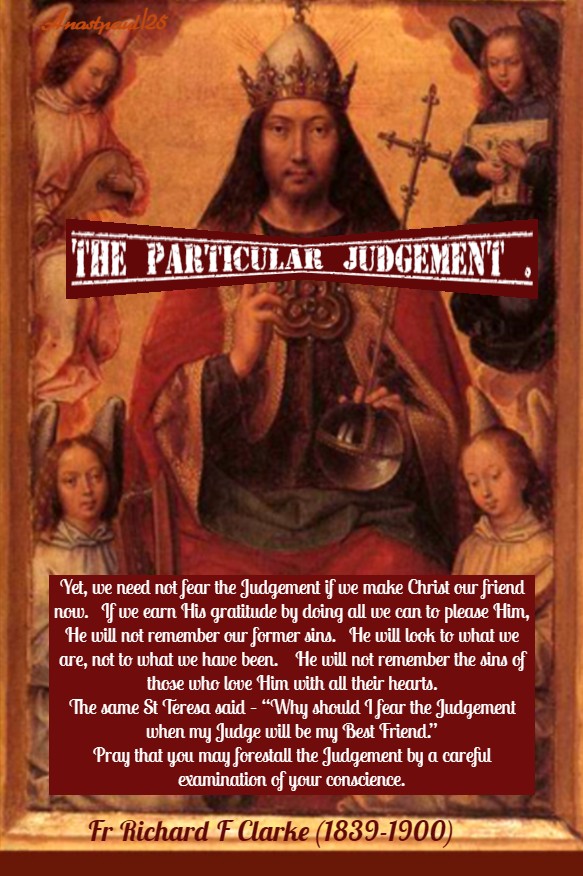
+3. Yet, we need not fear the Judgement if we make Christ our friend now. If we earn His gratitude by doing all we can to please Him, He will not remember our former sins. He will look to what we are, not to what we have been. He will not remember the sins of those who love Him with all their hearts. The same St Teresa said – “Why should I fear the Judgement when my Judge will be my Best Friend.” Pray that you may forestall the Judgement by a careful examination of your conscience.
Quote/s of the Day – 21 February – Preparing to Prepare
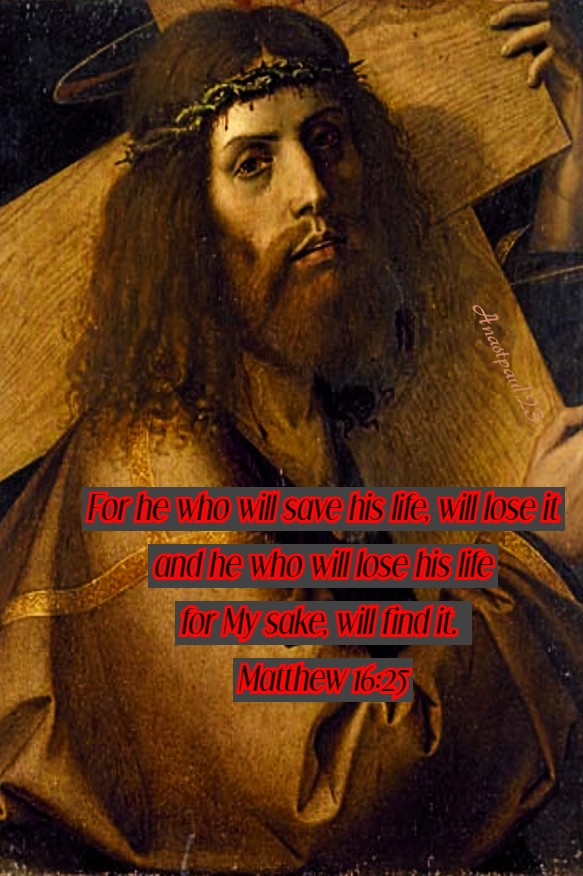
“For he who would save his life will lose it but he who loses his life, for My sake will find it.”
Matthew 16:25
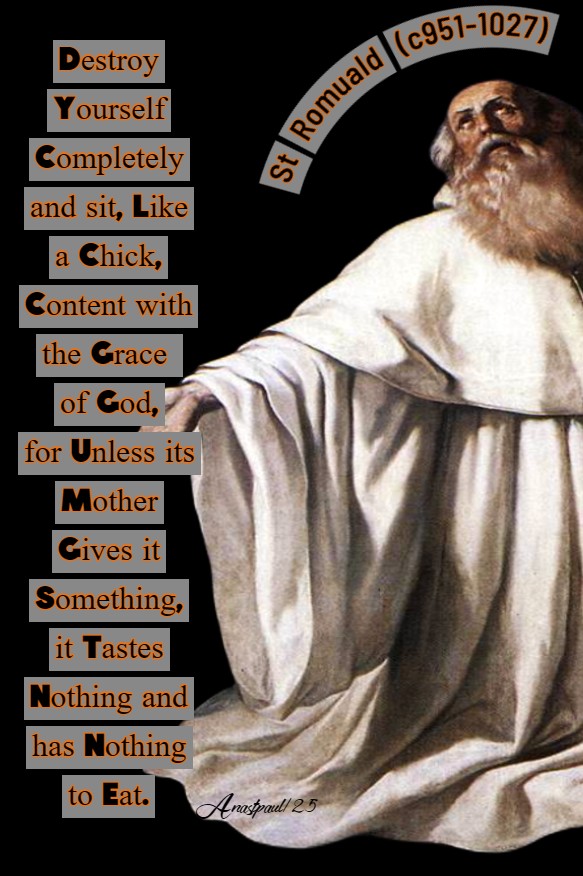
“Destroy yourself completely and sit, like a chick, content with the grace of God, for unless its mother gives it something, it tastes nothing and has nothing to eat.”
St Romuald (c951-1027)
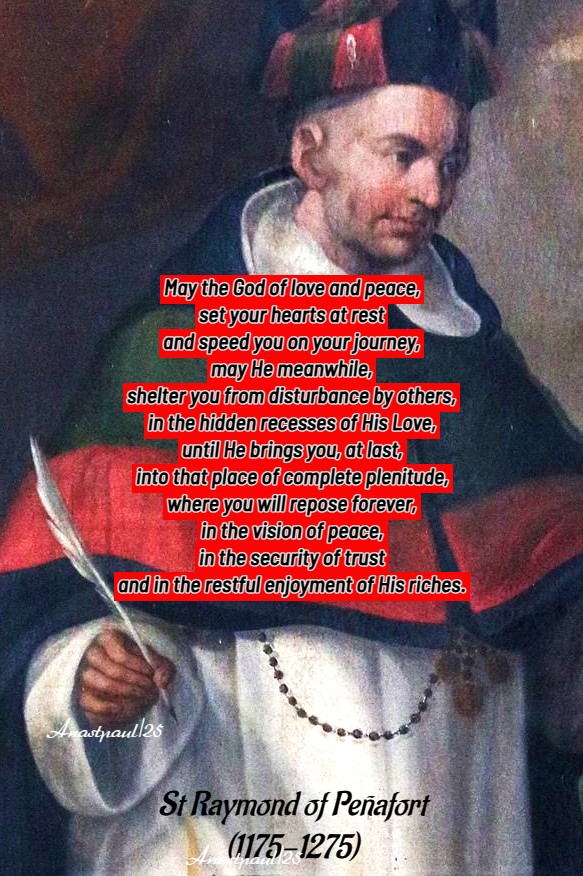
“May the God of love and peace, set your hearts at rest and speed you on your journey, may He meanwhile, shelter you from disturbance by others, in the hidden recesses of His Love, until He brings you, at last, into that place of complete plenitude, where you will repose forever, in the vision of peace, in the security of trust and in the restful enjoyment of His riches.”
St Raymond of Peñafort (1175-1275)
“When I look at successful men, I find in all, three characteristics: (1) A spirit of cheerfulness and confidence. They know how to look at everything from its best side. Hence, I must pray for these attributes. (2) A spirit of perseverance. They are not discouraged by failures. They recover themselves without delay. What a lesson for me, not to lose heart but to say, when I fall, I will rise again and that, promptly! (3) A spirit of single-mindedness. They keep the end in view steadily before them. If I am to attain, to the End of my life, to succeed in coming to God at last, I must keep Him always before me.”
One Minute Reflection – 21 February – “The Month of the Blessed Trinity” – Ferial Day – Septuagesima – 1 Corinthians 9,24-27.10; 1-5 – Matthew 20,1-16 – Scripture search here: https://www.drbo.org/
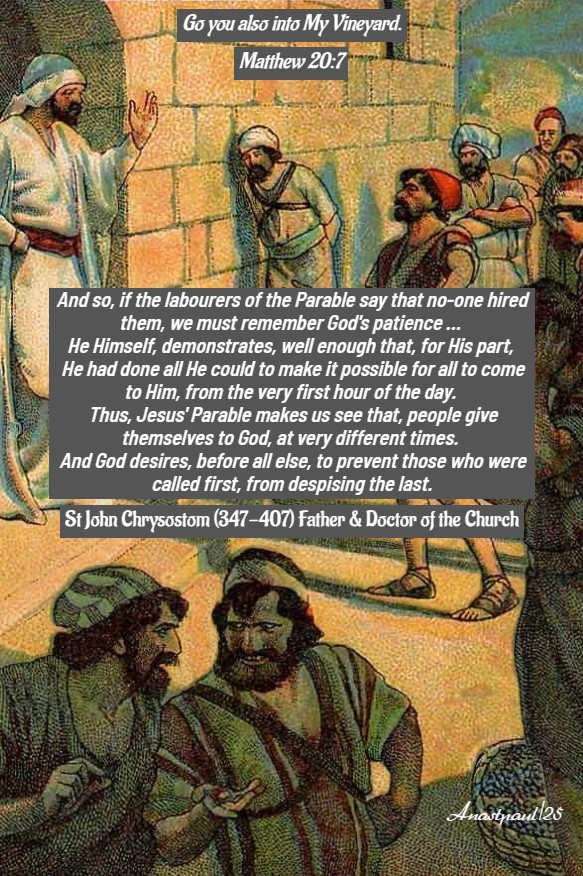
“Go you also into My Vineyard.” – Matthew 20:7
REFLECTION – “My brethren, you may perhaps ask why all these laboUrers were not sent into the Lord’s Vineyard at the same time? I reply that God’s intention was to call them all at once. But they had not wanted to come, as soon as they were called, at the first hour and this was the cause of their refusal. That was why God Himself went to call each one individually… at the moment when He thought they might turn back and respond to His invitation.
This is what the Apostle Paul clearly notes with regard to himself: “When it pleased God, He set me apart in my mother’s womb,” (cf Gal 1:15). When was it that it pleased God, if not when He saw that Paul would surrender to His call? To be sure, God would have liked to have called him at the beginning of his life but because Paul would not have responded to His Voice, God opted not to call him until he saw that he would respond. In the same way, God did not call the good thief until the last moment, even though He could have done so earlier, if He had foreseen that the man would have surrendered to His call.
And so, if the labourers of the Parable say that no-one hired them, we must remember God’s patience … He Himself, demonstrates , well enough that, for His part, He had done all He could to make it possible, for all to come to Him,from the very first hour of the day. Thus, Jesus’ Parable makes us see that people give themselves to God, at very different times. And God desires, before all else, to prevent those who were called first, from despising the last.” – St John Chrysostom (347-407) Bishop of Constantinople, Father & Doctor of the Church (Sermon 64).
PRAYER – From all perils of soul and body, defend us, O Lord, we beseech Thee and by the intercession of blessed and gloriosus ever Virgin Mary, Mother of God, of blessed Joseph, of Thy blessed Apostles Peter and Paul and all the Saints, graciously grant us safety and peace that all adversities and errors being overcome, Thy Church may serve Thee in security and freedom. Through Jesus Christ, Thy Son our Lord, Who lives and reigns with Thee, in the unity of the Holy Ghost, God, world without end. Amen (Collect).
Our Morning Offering – 21 February – Passion Friday in Septuagesima Week
Glory, Honour and Praise, To Our Lord Jesus Christ! A devout Prayer to our Lord Jesus Christ, to be said both Morning and Evening By St Robert Bellarmine (1542-1621) Doctor of the Church (From His “A Brief Christian Doctrine”)
GLory, Honour and Praise Be, May all the world adore Thee, blessed be Thy Holy Name, Who for us sinners, vouchsafest to be born of a humble Virgin and blessed be Thine Infinite Goodness, Who died upon the Cross for our Redemption. O Jesus, Son of God and Saviour of mankind, have mercy upon us and so dispose our lives here, by Thy Grace that we may, hereafter, rejoice with Thee forever in Thy Heavenly Kingdom, Amen
Saint of the Day – 21 February – St Felix (4th Century) Bishop of Metz. Also known as – Felice, Felix I, Felix I of Metz.
The Roman Martyrology simply reads today: “At Metz, St Felix, Bishop”
An ancient unknown French Bishop
Felix I was the 3rd Bishop of Metz. He was included in the chronology of the Diocese by a catalogue compiled around 776. He is preceded by Saint Clement and Saint Celeste and followed by Saint Patient, Saint Victor I and Saint Victor II.
Thanks to the presence of Saint Victor I, documented around 346, it is possible to hypothesise that Saint Felix I governed the City in the second or third decade of the 4th Century. Tradition believes that he was the shepherd of Metz for forty-two years and six months and died on 21 February in an unspecified year but, this information has no historical foundation.
The Bollandists, in their commentary on the Roman Martyrology, confirm that the origins of the Seat of Metz are very dubious and controversial.
Tradition has it that during the 11th Century Felix’s Relics were delivered by Tierry of Luxembourg, the 42nd Bishop of Metz from 1006-1047, to the Archbishop of Bamberg.
St Avitus II of Clermont Bl Claudio di Portaceli St Daniel of Persia Bl Eleanora St Ercongotha St Felix (4th Century) Bishop of Metz St George of Amastris St Germanus of Granfield St Gundebert of Sens
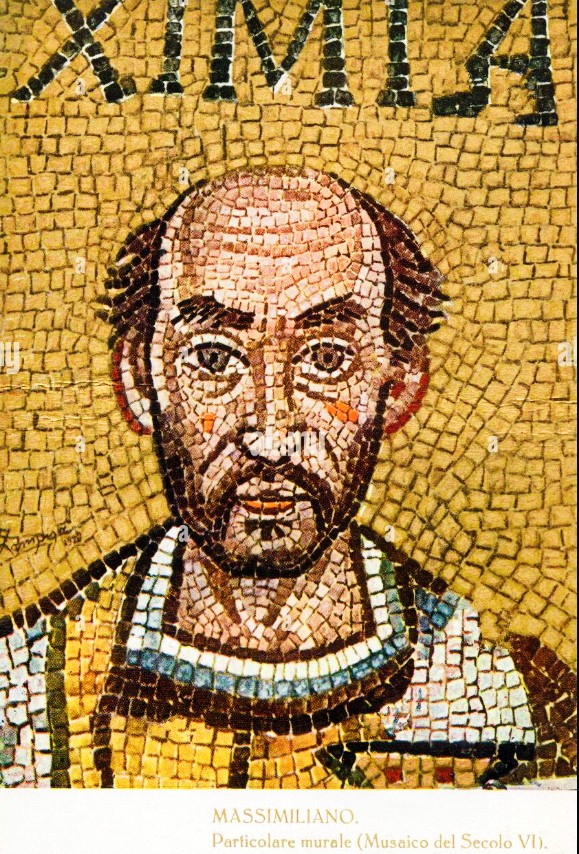
St Maximian of Ravenna (c499-556) Archbishop of Ravenna and Confessor. completor of the immensely renowned Basilica of St Vitalis and many more Churches. He was a man of creative talents who ordered the creation of many famous and very beautiful artworks of various types, for his See, as well as, a great lover of Books and literature, (being a prolific Writer himself) ensuring the acquisition of many illuminated manuscripts. Maximian may have been the first Latin Bishop to use the title ‘Archbishop.’ Biography – his Feast Day was changed after 1969 to 22 February. Being rather confused, I have revisted him today again: Talented St Maximian: https://anastpaul.com/2024/02/21/saint-of-the-day-21-february-saint-maximian-of-ravenna-c499-556-bishop-and-confessor/ AND: https://anastpaul.com/2023/02/22/saint-of-the-day-22-february-saint-maximian-of-ravenna-499-556-bishop/
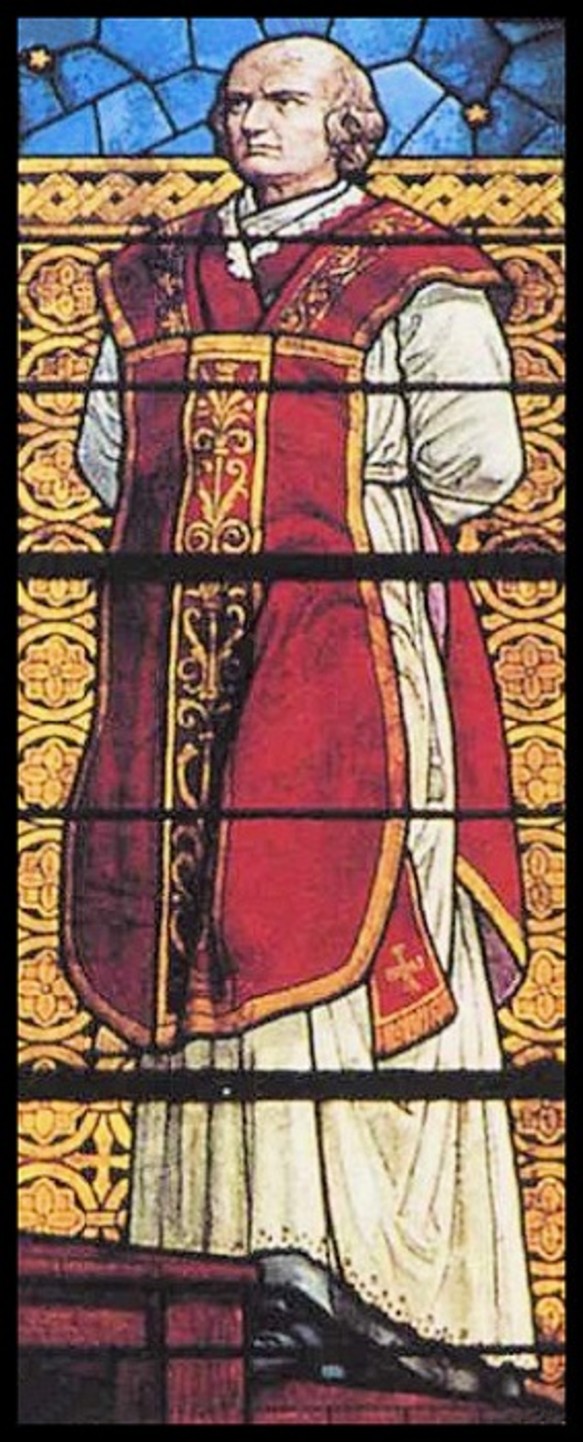
Blessed Noel Pinot (1747-1794) Priest and Martyr. During the French Revolution, he refused to take the oath of the Civil Constitution of the Clergy unlike his superio! He wore his Mass Vestments to execution and died reciting the opening words of the Mass. He was Beatified by Pope Pius XI on 31 October 1926. His Life and Death: https://anastpaul.com/2020/02/21/saint-of-the-day-21-february-blessed-noel-pinot-1747-1794-priest-and-martyr/
St Valerius of San Pedro de Montes St Verda of Persia
Martyrs of Sicily – 79 Saints: Sevent nine Christians Martyred together in the persecutions of Diocletian. They were Martyred in c 303 on Sicily.
Martyrs of Hadrumetum – A group of 26 Christians Martyred together by Vandals. We know little more than eight of their names – Alexander, Felix, Fortunatus, Saturninus, Secundinus, Servulus, Siricius and Verulus. c 434 at Hadrumetum (modern Sousse, Tunisia).
Thought for the Day – 20 February – Meditations with Fr Richard Frederick Clarke SJ (1839-1900)
Meditations on “The Great Truths” From “The Devout Year” By Fr Richard Frederick Clarke SJ (1839-1900)
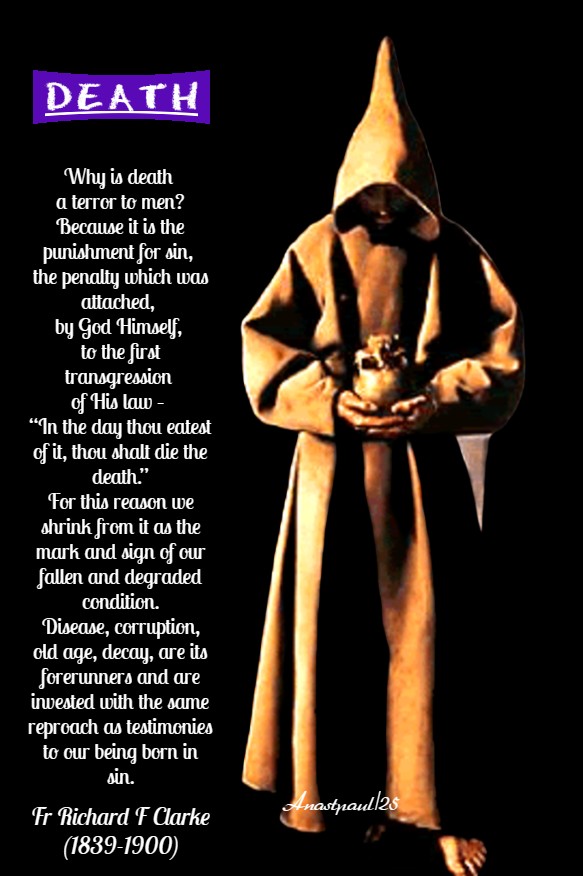
20th Day – Death
It is appointed unto men once to die. (Heb ix:27)
+1. Why is death a terror to men? Because it is the punishment for sin, the penalty which was attached, by God Himself, to the first transgression of His law – “In the day thou eatest of it, thou shalt die the death.” For this reason we shrink from it as the mark and sign of our fallen and degraded condition. Disease, corruption, old age, decay, are its forerunners and are invested with the same reproach as testimonies to our being born in sin.
+2. Death is the end of our time of trial. After it, our destiny will be irrevocably fixed. No more chance of doing penance, no more opportunities of contrition, no more merit, no more grace, no more calls to repentance, no more hope for those who reject God in this life. No wonder, then, men dread it! Yet death is standing at our very door; at any moment the King of Terrors may summon us away. Am I prepared for the summons?
+3. Yet to those who love God, death loses all its terrors. For them it is the beginning of their true life. All their hopes have been directed to the unseen world; why should they fear? Their heart is in Heaven and their treasure is in Heaven, their King and Lord is there and all their dearest and best friends and the Angels and the Saints. How happy are those who are thus detached from this world and ever look to the world to come! Pray for a happy death!
Quote/s of the Day – 20 February – Ferial Day – Septuagesima – 1 Corinthians 9,24-27.10; 1-5 – Matthew 20,1-16 – Scripture search here: https://www.drbo.org/
“Go you also into My Vineyard.”
Matthew 20:7
“Day by day follow God’s path, keeping Him closely attached to you by His promise. In fact, He Himself said, through the mediation of His Apostles, to all those who seek His will and His testimonies that He would be with them until the end of the world (Mt 28:20) where paths and footsteps will be unknown (cf Ps 76:20), as the divine David said in his songs. Yet, in an invisible way, He is present to the eyes of the mind, making Himself seen by those who have a pure heart and conversing with them. So pursue your path …. ”
St Theodore the Studite (759-826) Abbot, Confessor, Father of the Church
“But what shall we offer, brothers, what shall we give Him for all the benefits He has given us? He offered the most precious Victim He possessed for our sake; in truth, He could not have had anything more precious. So let us, too, do what we can, let us offer Him the best we have, that is to say, ourselves! He offered Himself, so who are you, to hesitate to offer yourself?”
St Bernard (1090-1153) Father & Mellifluous Doctor of the Church
“We should strive to keep our hearts open to the sufferings and wretchedness of others and pray continually, that God may grant us that spirit of compassion which is truly the Spirit of God.”
One Minute Reflection – 20 February – “The Month of the Blessed Trinity” –Ferial Day – Septuagesima – 1 Corinthians 9,24-27.10; 1-5 – Matthew 20,1-16 – Scripture search here: https://www.drbo.org/
“Go you also into My Vineyard.” – Matthew 20:7
REFLECTION – “The Kingdom of Heaven is said to be like a Householder who hired workmen to cultivate His vineyard. Who better can we take to be the Householder than our Creator, Who rules over those He created and governs His Elect in the world, in the same way as a master does those subject to him in his house? He has a Vineyard, which is to say, the universal Church which, has brought forth many Saints as so many branches, from righteous Abel, up to the last of the Elect, who will be born at the end of the world.
The Householder hired workmen to cultivate His Vineyard, in the morning and at the third, sixth, ninth and eleventh hours, since preachers do not cease to preach for the instruction of the faithful, from the beginning of this world, up to its end. The morning indeed was from Adam to the time of Noah, the third hour from the time of Noah to the time of Abraham, the sixth from the time of Abraham to the time of Moses, the ninth from the time of Moses to the coming of the Lord and the eleventh, is from the coming of the Lord to the end of the world. In this period, the holy Apostles, who received a full reward, even though they came late, have been sent as preachers.
At no time then, did the Lord cease sending His People workmen to instruct them, to cultivate His Vineyard, as it were? When He first cultivated His People through the Patriarch and later through the teachers of the law and then, through the Prophets and at last, through the Apostles, He laboured at the cultivation of His Vineyard, as if by His workmen. Everyone though, who has the right faith with good works, in whatever capacity or measure, is a workman in His Vineyard.” – St Gregory the Great (540-604) Pope, Father & Doctor of the Church (Sermons on the Gospel No 19).
PRAYER – From all perils of soul and body, defend us, O Lord, we beseech Thee and by the intercession of blessed and gloriosus ever Virgin Mary, Mother of God, of blessed Joseph, of Thy blessed Apostles Peter and Paul and all the Saints, graciously grant us safety and peace that all adversities and errors being overcome, Thy Church may serve Thee in security and freedom. Through Jesus Christ, Thy Son our Lord, Who lives and reigns with Thee, in the unity of the Holy Ghost, God, world without end. Amen (Collect).
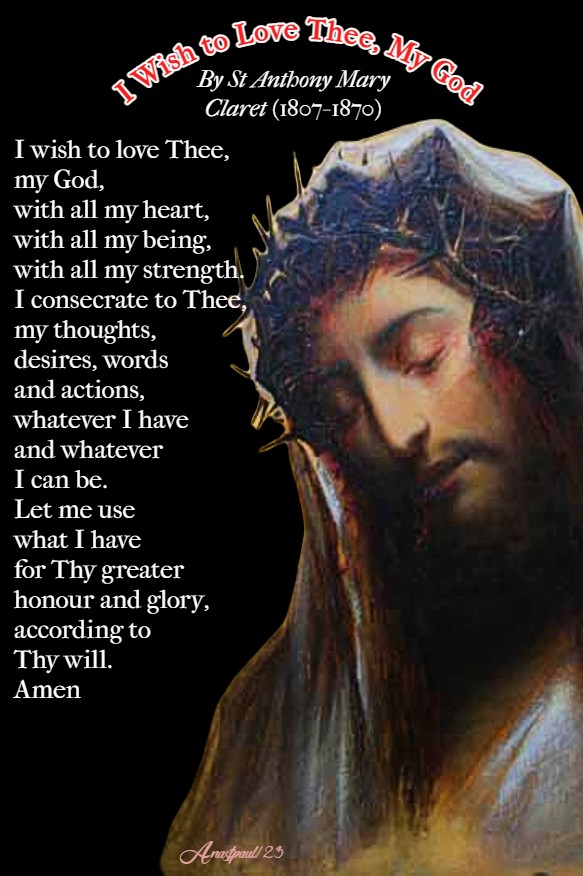
I Wish to Love Thee, My God By St Anthony Mary Claret (1807-1870)
I wish to love Thee, my God, with all my heart, with all my being, with all my strength. I consecrate to Thee, my thoughts, desires, words and actions, whatever I have and whatever I can be. Let me use what I have for Thy greater honour and glory, according to Thy will. Amen
Saint of the Day – 20 February – St Wulfric (c1080-1154) Priest,Penitent, Hermit, Ascetic, Advisor to Kings, gifted with the charism of prophecy and healing, Miracle-worker. Born in around 1080 near Bristol, England and died in Haselbury, Somerset, England of natural causes on 20 February 1154. He was a Hermit in Wiltshire, England and was frequently visited by King Stephen. Also known as – Wulfrick, Ulric, Ulrico, Ulrich.
An Unknown Hermit
Wulfric was born at Compton Martin, ten miles south of Bristol. After becoming a Priest, he at first exercised his ministry at Deverill, near Warminster. At this stage, he was apparently much addicted to hunting, with both hawks and hounds. A chance conversation with a beggar, however, converted him to his true vocation as a Priest and he returned to Compton Martin as Parish Priest.
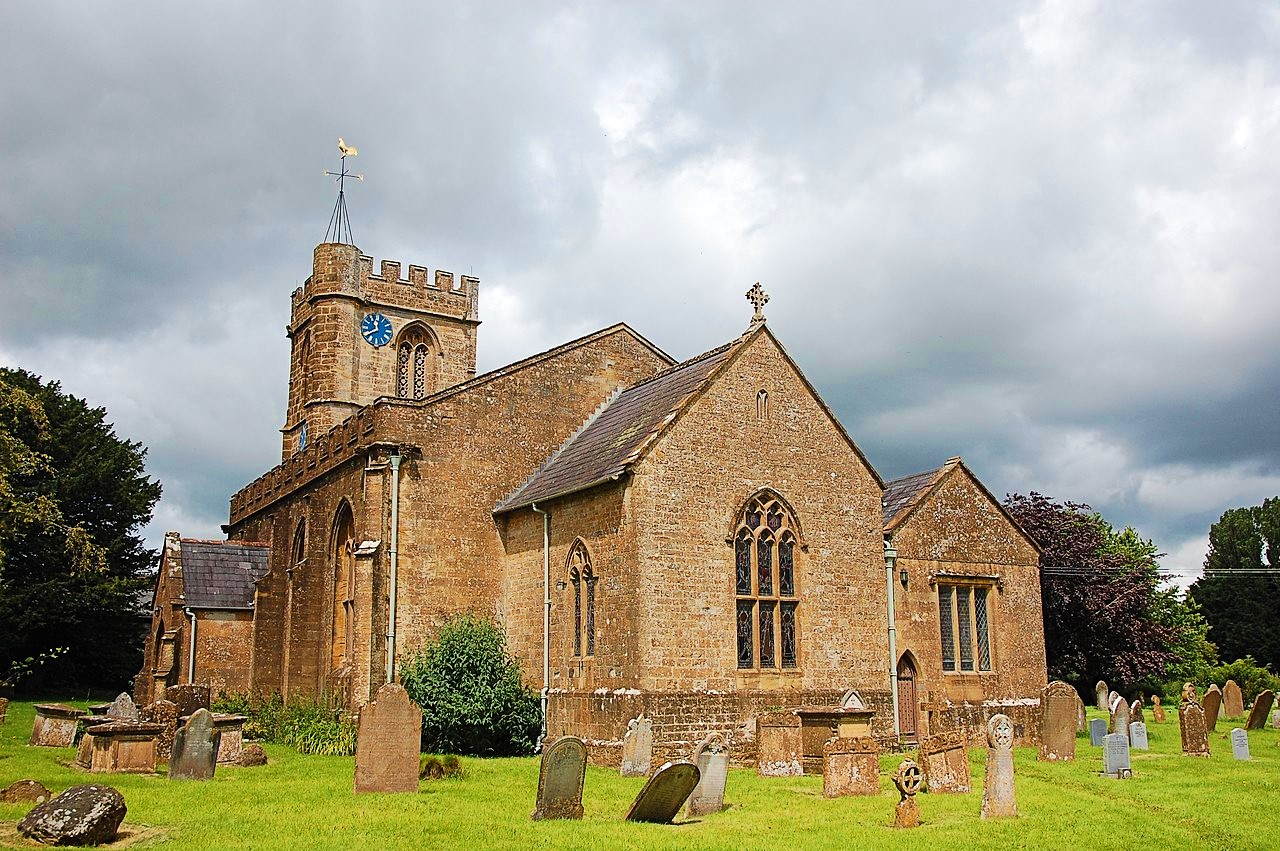
In the year 1125, Wulfric came to St Michael and All Angels Church in Haselbury Plucknett, Somerset. He wished to spend the rest of his life as a Hermit, withdrawn from the world, living in a cell adjacent to the Church. This cell stood on the cold northern side of the building. Although he apparently failed to obtain Episcopal permission for this move, he was supported by the Cluniac Monks at Montacute.
Sir William FitzWalter had a great respect for his saintly neighbour; he sent provisions to him and visited him from time to time. Wulfric numbered among his intimate friends Osbern, the village Priest; William, a lay brother of Forde Abbey and Brichtric, who seems to have joined him as a disciple.
Soon, people came to him for guidance and blessings. During the reigns of Kings Henry I and then King Stephen, Wulfric exercised a powerful influence, not only in his own neighbourhood but also at Court. Henry I was informed, correctly, that he would shortly die, while King Stephen was chastised for the evils of his government. Wulfric received the gifts of prophecy and healing and was involved in many miraculous happenings. He became known as a healer of body, mind, and spirit for all those who sought him out.
One of his visitors was Matilda of Wareham who had been planning to work overseas. Wulfric persuaded her that she should become a Recluse. She was committed and agreed to go to Wareham to work for over two years while a cell was created for her. She returned with her servant Gertrude. She died in the cell after fifteen years and Gertrude agreed to take her place.
According to Abbot John of Forde Abbey, Wulfric lived alone in these simple quarters for 29 years, devoting much of his time to reading the Sacred Scriptures, fasting and praying. He adopted stern ascetic practices: he deprived himself of sleep, ate a frugal and meatless diet, spent hours reciting the Psalms sitting in a bath of cold water and wore a hair shirt and heavy chain-mail tunic.
One of the most influential Hermit Priests of England, he died in his cell on 20 February 1154. At his death, a scuffle occurred in and around St Michael’s Church between black-robed Norman Cluniac Monks from Montacute and the laity from Haselbury and Crewkerne who had been summoned by Osbern, the Priest of Haselbury. The Monks maintained that providing food for the saintly Hermit which they had done for many years, gave them a claim to the holy man’s mortal remains. But the locals, forced them to withdraw and Wulfric was buried in his cell by the Bishop of Bath, who had visited him at his death-bed. For security reasons, Fr Osbern moved Wulfric’s remains twice, until they came to rest somewhere near the west end of the Church, “… in a place known only to himself and God” which we think would have suited St Wulfric’s penitent and humble spirit just fine especially as this Church would now be a protestant one.
St Leo of Catania (c720-789) Bishop, Defender of Sacred Images for which opposition he was forced to flee into exile for some years, Hermit. Born in c720 in Ravenna, Italy and died on 20 February 789 in Etna, Sicily, Italy, natural causes. St Leo was the 15th Bishop of Catania, Sicily, famed for his love and care for the poor, his brave opposition to the iconoclastic Government of the time and for his Miracles. Courageous St Leo: https://anastpaul.com/2024/02/20/saint-of-the-day-20-february-st-leo-of-catania-c720-789-bishop/ St Nemesius of Cyprus
St Pothamius of Cyprus St Serapion of Alexandria St Silvanus of Emesa St Valerius of Courserans St Wulfric (c1080-1154) Priest and Hermit St Zenobius of Antioch
Thought for the Day – 19 February – Meditations with Fr Richard Frederick Clarke SJ (1839-1900)
Meditations on “The Great Truths” From “The Devout Year” By Fr Richard Frederick Clarke SJ (1839-1900)
19th Day – The Punishment of Venial Sin
Thou shalt not go out from thence until thou repay the last farthing. (St Matthew v:26)
Venial Sin is the great evil in the world next to mortal sin and, therefore, it deserves a punishment greater than all the miseries of earth. God has taught us what sort of an evil it is, by one or two instances of the way in which He visits it in this life.
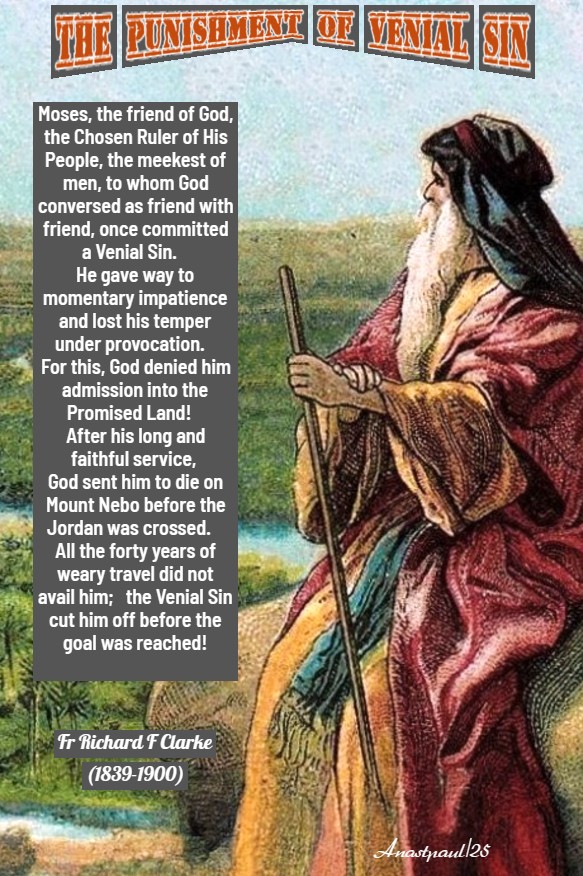
+1. Moses, the friend of God, the Chosen Ruler of His People, the meekest of men, to whom God conversed as friend with friend, once committed a Venial Sin. He gave way to momentary impatience and lost his temper under provocation. For this, God denied him admission into the Promised Land! After his long and faithful service, God sent him to die on Mount Nebo before the Jordan was crossed. All the forty years of weary travel did not avail him; the Venial Sin cut him off before the goal was reached!
+2. David , the man after God’s Own Heart, in a moment of vanity, determined to number the people, boastfully priding himself on the strength of his fighting men. In punishment of this, God sent a pestilence which, in less than three days, destroyed seventy thousand Israelites. Jerusalem itself, would have been decimated, had not David entreated God to avert His destroying Hand. How God must hate Venial Sin!
+3. After death, there will remain for most, a debt still to be paid for Venial Sin. It is in Purgatory where we shall see its true character. No earthly agony even approaches the agony of the Purgatorial Fire. The souls God loves, must be tormented there until they have paid the last farthing. Alas! what do I still owe? Am I doing my best to pay the debt and avoid adding to it? Beg for an intense dread of Venial Sin .
Quote/s of the Day – 19 February – – Ferial Day – Septuagesima – 1 Corinthians 9,24-27.10; 1-5 – Matthew 20,1-16 – Scripture search here: https://www.drbo.org/
“Know you not that they, who run in the race, all run indeed but one receiveth the prize? So run that you may obtain.”
St Paul – 1 Corinthians 9:24
“What determines that the gifts of God dwells in us, is the measure of each one’s faith. Because, it is to the extent that we believe that the enthusiasm to act is given us. And so, those who act, reveal the measure of their faith proportionate to their action, they receive their measure of grace according to what they have believed. …”
St Maximus the Confessor (c580-662) Father of the Church
“Since happiness is nothing else than the enjoyment of the Supreme Good and the Supreme Good is above us, no-one can enjoy happiness, unless he rises above himself.”
St Bonaventure (1221-1274) Franciscan Seraphic Doctor of the Church
“Be brave and try to detach your heart from worldly things. Do your utmost to banish darkness from your mind and come to understand what true, selfless piety is. Through confession, endeavour to purify your heart of anything which may still taint it. Enliven your faith which is essential to understand and achieve piety.”
One Minute Reflection – 19 February – “The Month of the Blessed Trinity” – Ferial Day – Septuagesima – 1 Corinthians 9,24-27.10; 1-5 – Matthew 20,1-16 – Scripture search here: https://www.drbo.org/
“Or, is it not lawful for Me to do what I will?” – Matthew 20:15
REFLECTION – “These men were all ready to work but “no-one had hired them” they were hard workers yet, were made lazy, through lack of both ,work and an employer. Then, a Voice hired them, a Word set them going and, in their zeal, they did not fix on a wage for their work beforehand, as the first comers had done. The Master calculated their labours wisely and paid them as much as the others. Our Lord spoke this parable, so that no-one might say: “Since I was not called in my youth, therefore, I cannot be accepted.” He has shown that, no matter when they are converted, each one is welcomed … “He went out in the morning, at the third, the sixth, the ninth and the eleventh hour” – this can be understood of the beginning of His preaching and then of the course of His Life, up to the Cross, since, it was at the “eleventh hour” when the thief entered into Paradise (Lk 23:43). Lest we call the thief to account for it, Our Lord emphasises his goodwill; if someone had hired him, he would have worked: “No-one has hired us.”
Whatever we give to God, is far from worthy of Him and what He gives to us, is a great deal more than we are worth. We are hired for a task which matches our strength but offered a wage far greater than our work demands … He acts in the same way, to both the first and the last comers: “each one received one gold coin” bearing the King’s image. This signifies. the Bread of Life (Jn 6:35) which, is the same for all; there is a single medicine of Life for those who take it.
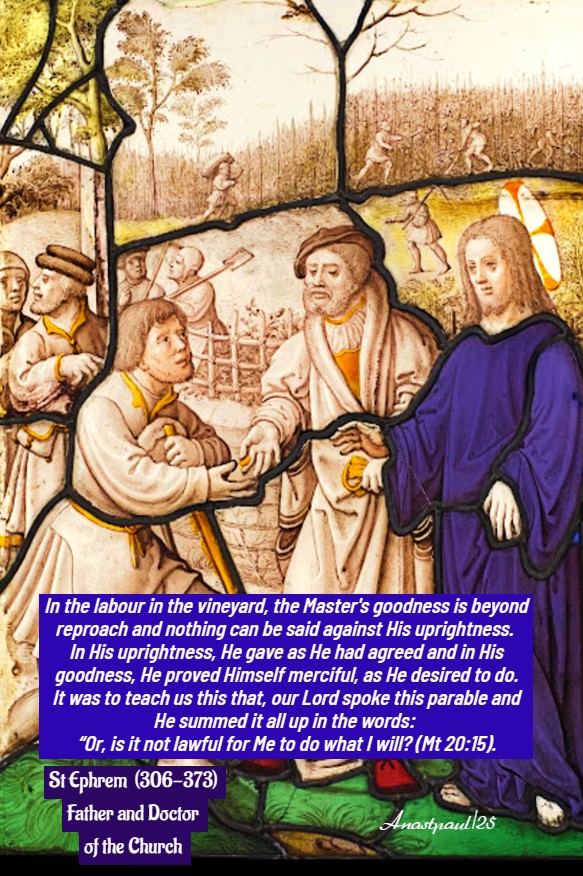
In the labour in the vineyard, the Master’s goodness is beyond reproach and nothing can be said against His uprightness. In His uprightness, He gave as He had agreed and in His goodness, He proved Himself merciful, as He desired to do. It was to teach us this that, our Lord spoke this parable and He summed it all up in the words: “Or, is it not lawful for Me to do what I will? (Mt 20:15).” – St Ephrem (306-373) Father and Doctor of the Church (Diatessaron 15: 15-17).
PRAYER – From all perils of soul and body defend us, O Lord, we beseech Thee and by the intercession of blessed and gloriosus ever Virgin Mary, Mother of God, of blessed Joseph, of thy blessed Apostles, Peter and Paul and of all the Saints, graciously grant us safety and peace, that all adversities and errors being overcome, Thy Church may serve Thee in security and freedom.Through the same Jesus Christ, Thy Son our Lord, Who lives and reigns with Thee, in the unity of the Holy Ghost, God, world without end. Amen (Collect).
Our Morning Offering – 19 February – “The Month of the Blessed Trinity”
Prayer of Blessed Severinus Boethius (c 475-524) Martyr
O Father, enable our minds, to rise to Thy ineffable dwelling place. Let us find the light and direct the eyes of our soul to Thee. Dispel the mists and the opaqueness of the earthly mass and shine out with Thy splendour. Thou art the serene and tranquil abode of those who persevere in their goal of seeing Thee. Thou art, at the same time, the Beginning, the Vehicle, the Guide, the Way and the Goal. Amen
Saint of the Day – 19 February – Saint Auxibius (Died c102) the 1st Bishop of Soloi on the Island of Cyprus. He was born in Rome and died in Soloi around the year 102. Also known as – Auxibius of Cyprus, … of Soloi, Ausibio…
The Roman Martyrology reads today: “At Soloi, St Auxibius, Bishop”
Auxibius was born into a wealthy family in Rome and grew up there with his brother, Tempstagoras. He was taught secular sciences.
To avoid his parents’ wish that he should marry, he secretly left Rome and came first to the Island of Rhodes and then, to the Island of Cyprus.
Auxibius lived in the area around Limnitis, near the then important City of Soloi. There he met the Apostle and Evangelist St Mark, who converted him through his preaching and Baptised him.
Auxibius was appointed as the Bishop of the City of Soli by Archbishop St Herakleidius, as a document from the 7th Century reports, although some give this honour to St Paul himself. This St Herakleidius (1st Century), showed the Apostles Paul and Barnabas, the way from Salamis to Paphos on their first missionary journey (45 – 53) in Cyprus and also led them to Tamassos, a City-Kingdom which was then important due to its copper mining. Paul and Barnabas BaptiSed Herakleidos and later Ordained him as Bishop of Tamassos, one of the first in Cyprus.
Auxibius held the Episcopal Seat for about 50 years before he died around the year 102.
The 4th Century Basilica, now in ruins, in Soli is named after St Auxibius.
St Quodvultdeus (Died c450) Bishop, Confessor, Father of the Church, Writer and Theologian, spiritual student, friend and correspondent of St Augustine, who dedicated some of his works to St Quodvultdeus. Name Meaning – “What God wants.” The Roman Martyrology reads: “In Naples, deposition of St Quodvultdeus, Bishop of Carthage, who was sent into exile together with his clergy by the Arian king Genseric and placed on disused ships without sails or oars. Against all hope he landed in Naples, where he died. Confessor of the faith.” His Holy Life: https://anastpaul.com/2022/02/19/saint-of-the-day-19-february-saint-quodvultdeus-died-c-450-f/

























 AnaStpaul
You must be logged in to post a comment.