Thought for the Day – 4 March – Meditations with Fr Richard Frederick Clarke SJ (1839-1900)
“Short Meditations for March, St Joseph” From “The Devout Year” By Fr Richard Frederick Clarke SJ (1839-1900)
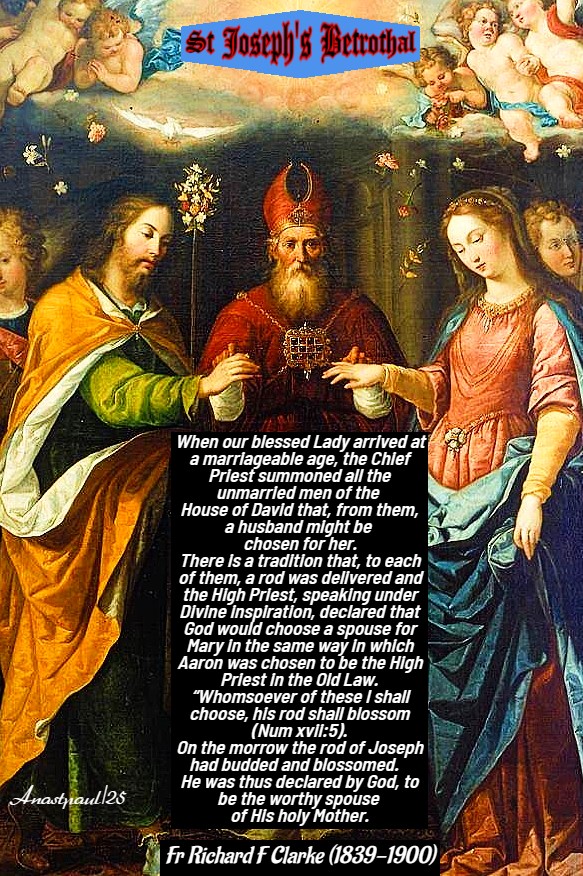
4th Day – St Joseph’s Betrothal
+1. When our blessed Lady arrived at a marriageable age, the Chief Priest summoned all the unmarried men of the House of David that, from them, a husband might be chosen for her. There is a tradition that, to each of them, a rod was delivered and the High Priest, speaking under Divine inspiration, declared that God would choose a spouse for Mary in the same way in which Aaron was chosen to be the High Priest in the Old Law. “Whomsoever of these I shall choose, his rod shall blossom (Num xvii:5). On the morrow the rod of Joseph had budded and blossomed. He was thus declared by God, to be the worthy spouse of His holy Mother.
+2. But Joseph had promised God, to remain ever a virgin.* How could he then consent to marriage? He knew by Divine revelation that Mary had made a similar vow and Mary knew the same of him O happy , O ideal union! where the sublime gift of virginity was united to the mutual love and dependence of husband on wife and wife on husband.
+3. But thus it is that God provides for His elect. He plans for them in a way which utterly sets at naught, the prudence of the world. He never disappoints those who leave themselves in His Hands but exercisesH a Divine ingenuity in fulfilling all the desires of their hearts, in most unexpected ways, in return for their submission and obedience to His holy Will. Thus it is, those who do God’s Will, always do their own will , for their will is His and His Will is theirs. (* St Thomas in Quæst Sent ii I).
Quote/s of the Day – 4 March – Feast of the Holy Face of Jesus
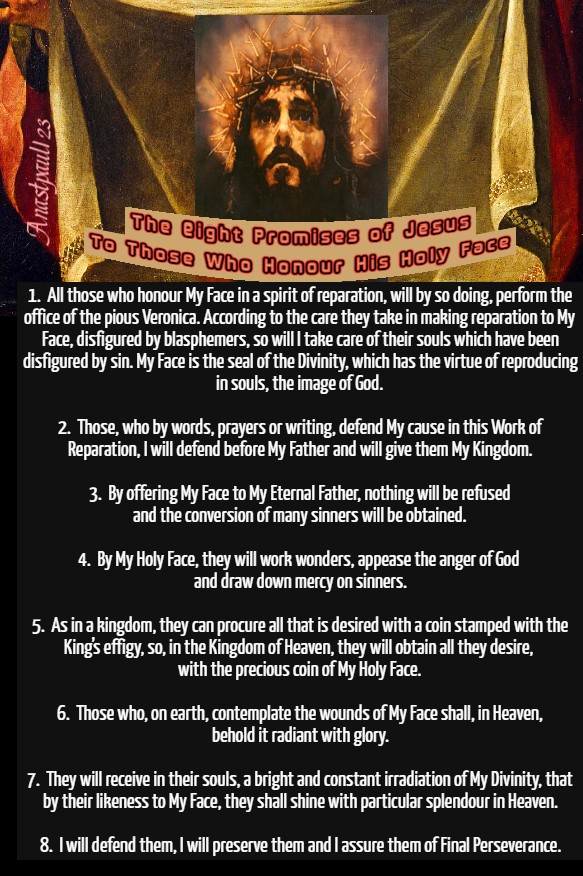
The Eight Promises of Jesus To Those Who Honour His Holy Face
All those who honour My Face in a spirit of reparation, will by so doing, perform the office of the pious Veronica. According to the care they take in making reparation to My Face, disfigured by blasphemers, so will I take care of their souls which have been disfigured by sin. My Face is the seal of the Divinity, which has the virtue of reproducing in souls, the image of God.
Those, who by words, prayers or writing, defend My cause in this Work of Reparation, I will defend before My Father and will give them My Kingdom.
By offering My Face to My Eternal Father, nothing will be refused and the conversion of many sinners will be obtained.
By My Holy Face, they will work wonders, appease the anger of God and draw down mercy on sinners.
As in a kingdom, they can procure all that is desired with a coin stamped with the King’s effigy, so, in the Kingdom of Heaven, they will obtain all they desire, with the precious coin of My Holy Face.
Those who, on earth, contemplate the wounds of My Face shall, in Heaven, behold it radiant with glory.
They will receive in their souls, a bright and constant irradiation of My Divinity, that by their likeness to My Face, they shall shine with particular splendour in Heaven.
I will defend them, I will preserve them and I assure them of Final Perseverance.
One Minute Reflection – 4 March – “The Month of Saint Joseph” – Feast of the Holy Face of Jesus – St Casimir (1458-1484) Confessor, Prince – Ecclesiasticus Sir 31:8-11 – Luke 12:35-40 – Scripture search here: https://www.drbo.org/
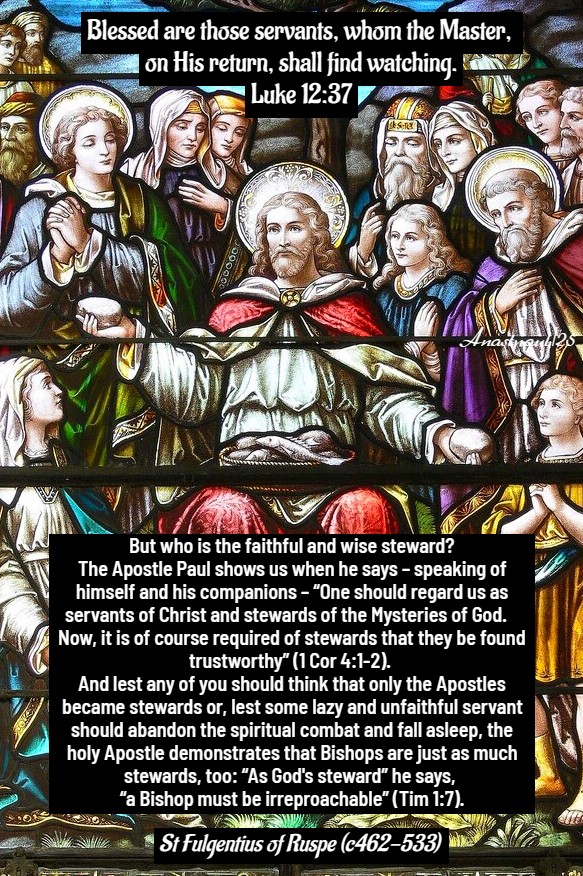
“Blessed are those servants, whom the Master, on His Return, shall find watching.” – Luke 12:37
REFLECTION – “Our Lord spoke these words, recorded by the Gospel, to clarify the function of the servants, He had set at the head of His people: “Who is the faithful and prudent Steward Whom the Master will put in charge of His servants, to distribute the food allowance, at the proper time? Blessed is that servant, whom his Master, on arrival, finds doing so” Who is that Steward, my friends? Undoubtedly, it is Christ, Who said to His disciples: “You call me ‘Teacher’ and ‘Master’ and rightly so, for indeed I Am” (Jn 13:13). And what is that Master’s Household? Surely the one which our Lord Himself Redeemed from the hands of the enemy and took to Himself. This Household is the Holy and Universal Church, spreading with remarkable fecundity throughout the world and priding itself on having been redeemed at the price of His Blood…
But who is the faithful and wise steward? The Apostle Paul shows us when he says – speaking of himself and his companions – “One should regard us as servants of Christ and stewards of the Mysteries of God. Now, it is of course required of stewards that they be found trustworthy” (1 Cor 4:1-2). And lest any of you should think that only the Apostles became stewards or, lest some lazy and unfaithful servant should abandon the spiritual combat and fall asleep, the holy Apostle demonstrates that Bishops are just as much stewards, too: “As God’s steward” he says, “a Bishop must be irreproachable” (Tim 1:7). Therefore, we are servants of the Householder, stewards of our Lord and, it is we, who have received the measure of wheat, to be distributed among you.” – St Fulgentius of Ruspe (c462-533) Bishop and Father of the Church (Sermon 1)
PRAYER – O Lord, we beseech Thee, mercifully hear our prayers; loose us from the chains of our sins and keep us from all adversity. Through Jesus Christ, Thy Son our Lord, Who lives and reigns with Thee, in the unity of the Holy Ghost, God, world without end. Amen (Collect).
An Aspiration to the Eternal Father to be Frequently Recited During the Day …
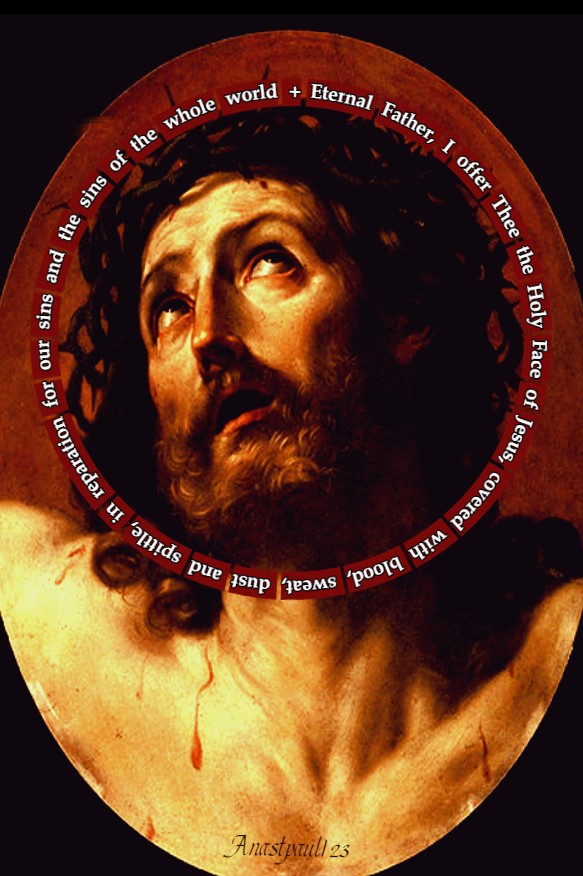
Eternal Father, I offer Thee the Holy Face of Jesus, covered with blood, sweat, dust and spittle, in reparation for our sins and the sins of the whole world.
Our Morning Offering – 4 March – Feast of the Holy Face of Jesus and Shrove Tuesday
As part of the preparations for Lent, it is appropriate to celebrate the Feast of the Holy Face by spending some time before the Blessed Sacrament and reciting the prayers of reparation. In addition, the repetition of this Devotion each Tuesday in Lent maybe a means of drawing closer to Our Lord during this time of more intense prayer and conversion.
TAKEN FROM THE AUTOBIOGRAPHY OF SR MARY OF ST PETER OCD (1816-1848).
“Do you see how I suffer? Yet, very few understand Me. Those who say they love Me are very ungrateful! I have given My Heart as the sensible object of My great love to men and I give My Face as the sensible object of My sorrow for all the sins of men. I wish that it be venerated by a special Feast on Tuesday, the day before Ash Wednesday. I wish that the Feast be preceded by a Novena in which the faithful make reparation with Me, joining together and sharing in My sorrow.” (Sadly I rem;embered the Novena too late this year, I hope you remembered.)
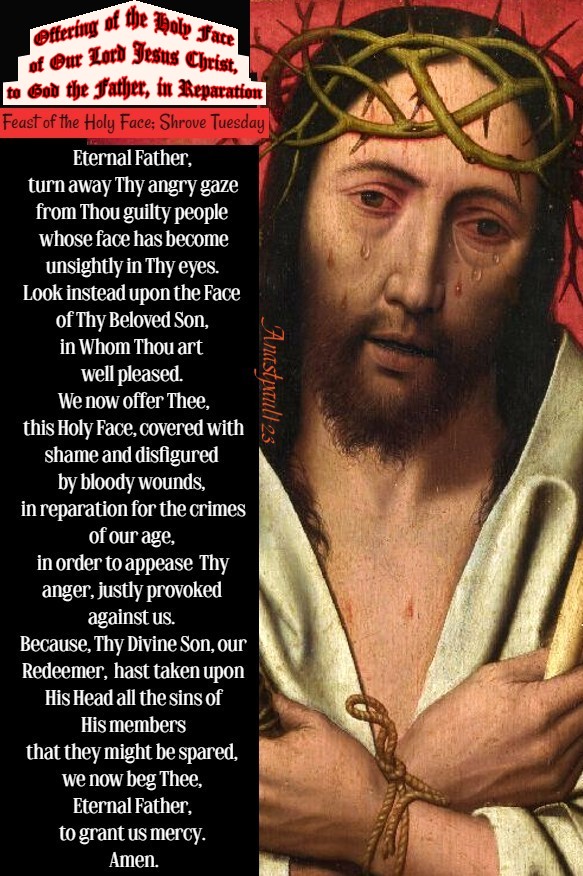
Offering of the Holy Face of Our Lord Jesus Christ, to God the Father, in Reparation
Eternal Father, turn away Thy angry gaze from Thou guilty people whose face has become unsightly in Thy eyes. Look instead upon the Face of Thy beloved Son, in Whom Thou art well pleased. We now offer Thee, this Holy Face, covered with shame and disfigured by bloody wounds, in reparation for the crimes of our age, in order to appease Thy anger, justly provoked against us. Because, Thy Divine Son, our Redeemer, hast taken upon His Head all the sins of His members that they might be spared, we now beg Thee, Eternal Father, to grant us mercy. Amen.
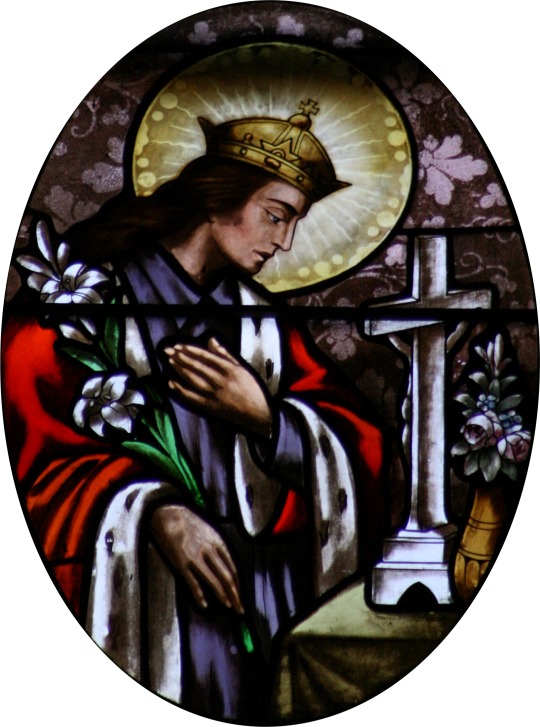
Saint of the Day – 4 March – St Felix (c970-1038) Abbot and restorer ofSt Gildas’ Abbey at Rhuys, Hermit. Born in c970 near Quimper, Brittany, France and died on 4 March 1038 of natural causes at the reconstructed Rhuys Abbey. Additional Memorial – 9 March 9 in the Liturgical Calendar of the Diocese of Vannes.
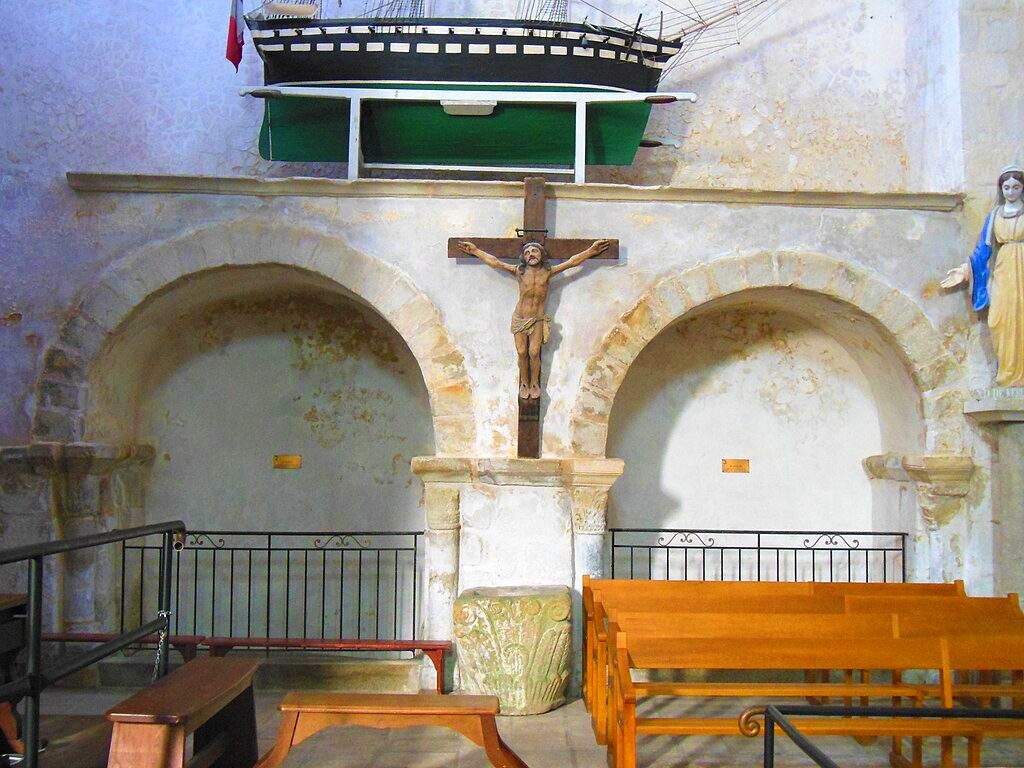
Tomb of Saint Felix (right) and Saint Rioc in the Saint-Gildas de Rhuys
Felix was born of wealthy parents in Quimper around 970. He had a great rdevotion for Saint Paul Aurelian who had built a Monastery at Lampoul and whose Relics, in 960, had been translated to Fleury Abbey.
Felix became a Hermit on Ushant but was forced to leave his hermitage during the Norman invasions to take refuge at Fleury in Saint-Benoît-sur-Loire, where he was welcomed by Abbo of Fleury.
Geoffrey I, the Duke of Brittany, asked the Abbot of Fleury to re-establish Rhuys Abbey which had been founded by Saint Gildas in the 6th Century on the Gulf of Morbihan and had been destroyed by the Normans. Father Abbot entrusted Felix with the task of rebuilding this renowned Monastery. The original Abbey had been built in wood on the remains of a Roman settlement.
But Felix now built in stone. Begun in 1008, the reconstruction ended in 1032 with the Consecration of the Church on 30 September, by Judicaël, the Bishop of Vannes and brother of the Duke. Felix was also consecrated as the Abbot, thus forcing him to remain there although his heart still desired to return to the Fleury. He opened a school too.
Félix died there on 4 March 1038 and was buried in his new Abbey. His tomb is now in the north transept of the Abbey Church. He is considered a Saint and his Feastday is set for 4 March ( 9 March 9 in the Liturgical Calendar of the Diocese of Vannes.)
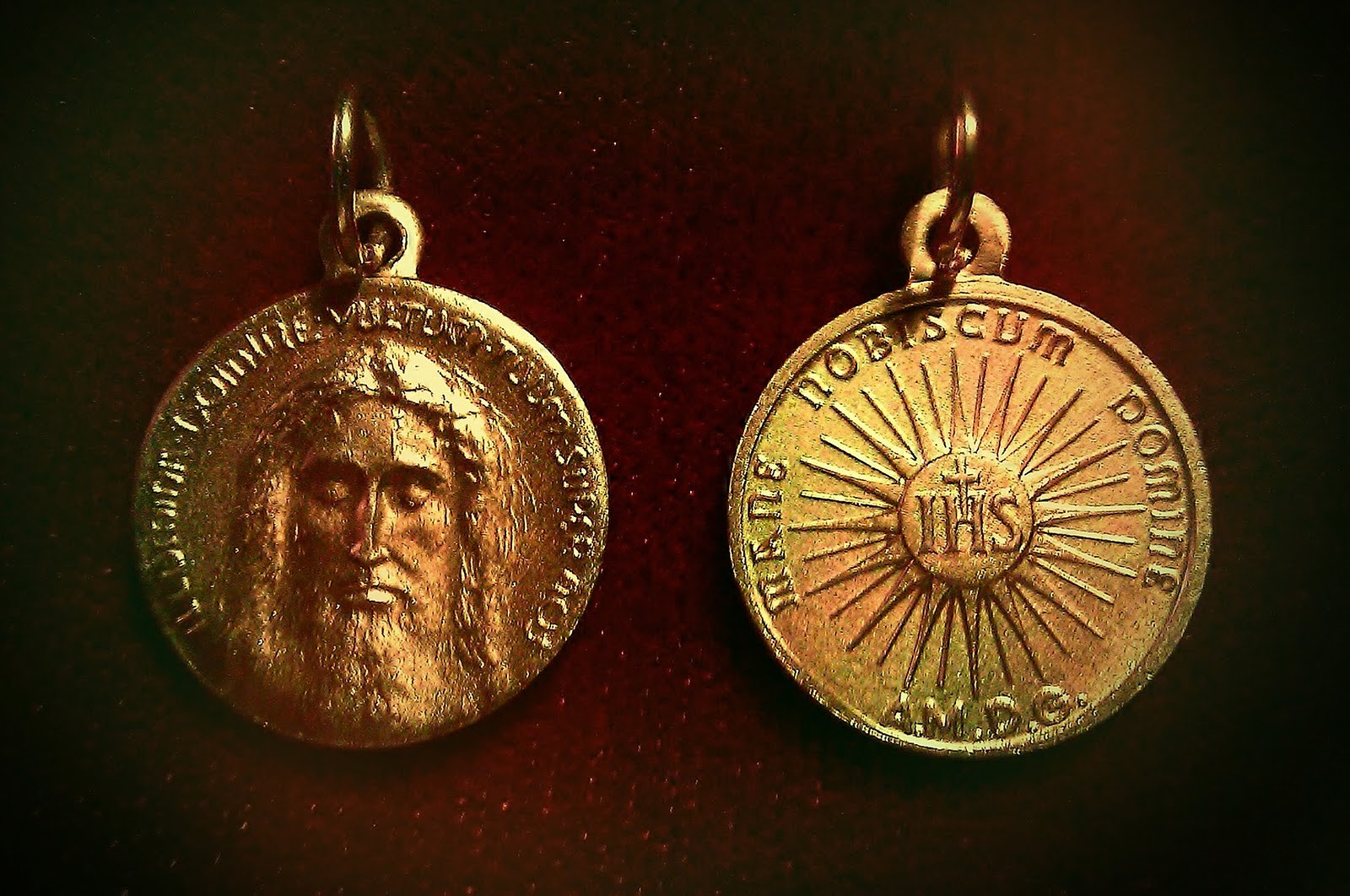
The Feast of the HOLY FACE of JESUS: In the 19th Century Jesus expressed His wishes to Sister Mary of St Peter (1816-1848), a Carmelite Nun in Tours, France, that there be an actual Devotion to his Holy Face. Our Lord wanted this in reparation for blasphemies against Himself and His Holy Name as well, as for the profanation of Sunday (when people engage unnecessarily in commerce and other such labours and chores on Sunday, a day meant for rest and reflection on God). In August of 1843 He dictated to her the well-known Golden Arrow Prayer. He also gave her Promises for those who would honour His Holy Face. The first Holy Medal of the Holy Face was given to Ven Pope Pius XII, who approved the Devotion and the Medal. In 1958 he formally declared the Feast of the Holy Face of Jesus as Shrove Tuesday for all Catholics in perpetuity. https://anastpaul.com/2022/03/01/feast-of-the-holy-face/
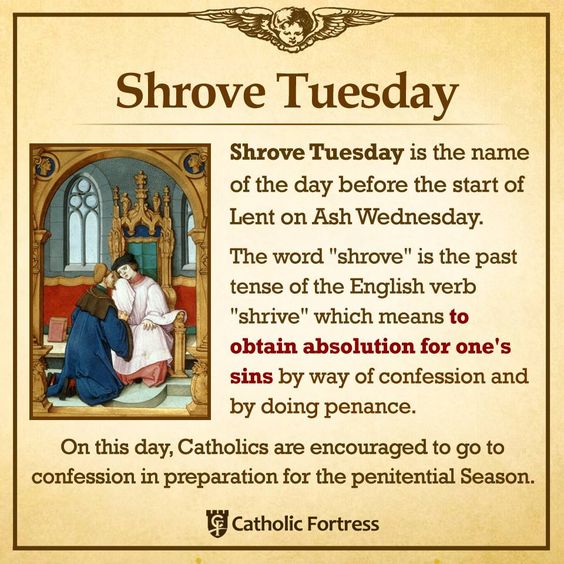
Shrove Tuesday: Shrove is the past tense of the word Shrive, which means “to hear a confession, assign penance and absolve from sin.” In the Middle Ages, especially in Northern Europe and England, it became the custom to confess one’s sins on the day before Lent began in order to enter the penitential season in a repentant spirit.
St Lucius I (Died 254) Pope and Martyr. The 22nd Bishop of Rome from 25 June 253 to his death on 5 March 254. He was banished soon after his consecration but gained permission to return. Patronage – Copenhagen, Denmark. Lucius I’s Tombstone is still extant in the Catacomb of Callixtus. His Relics were later brought to the Church of Santa Cecilia in Trastevere, along with the Relics of St Cecilia and others. His head is preserved in a reliquary in St. Ansgar’s Cathedral in Copenhagen, Denmark. This Relic was brought to Roskilde around the year 1100, after Lucius had been declared Patron Saint of the Danish region Zeeland. The Roman Martyrology reads today: “At Rome, on the Appian Way. during the persecution of Valerian, the birthday of St Lucius, Pope and Martyr, who was first exiled for the Faith of Christ but, being permitted by Divine Providence to return to his Church, he suffered Martyrdom by decapitation, after having combated the Novatians. His praises have been published by the blesseed Saint Cyprian, Bishop of Carthage(200-258).” His Life and Death: https://anastpaul.com/2023/03/04/saint-of-the-day-4-march-st-lucius-i-died-254-pope-and-martyr/
St Adrian of May St Adrian of Nicomedia Bl Alexander Blake St Appian of Comacchio St Arcadius of Cyprus St Basinus of Trier Bl Christopher Bales St Felix (c970-1038) Abbot of Rhuys Abbey St Gaius of Nicomedia
Blessed Humbert III Count of Savoy (1136–1189) Layman Prince. It is recorded of Humberto “who, forced to leave the cloister to deal with public affairs, practiced the monastic life with greater dedication, to which he later returned.” Born in 1136 in Avigliana, Italy and died on 4 March 1189 in Chambéry, France of natural causes. Beatified in 1838 by Pope Gregory XVI. Holy Humbert: https://anastpaul.com/2024/03/04/saint-of-the-day-4-march-blessed-humbert-iii-count-of-savoy-1136-1189/
St Leonard of Avranches Bl Nicholas Horner St Nestor the Martyr St Owen Bl Paolo of Brescia
Martyrs on the Appian Way – 900 Saints: Group of 900 Martyrs buried in the Catacombs of Saint Callixtus on the Appian Way, Rome.
Martyrs of Nicomedia – 20 Saints: A group of 20 Christians murdered together for their faith. The only details about them to survive are three of their names – Archelaus, Cyrillos and Photius. Nicomedia, Bithynia (in modern Turkey)
Martyrs of the Crimea – 7 Saints: A group of 4th century missionary Bishops who evangelised in the Crimea and southern Russia and were Martyred for their work. We know little else beyond the names – Aetherius, Agathodorus, Basil, Elpidius, Ephrem, Eugene and Gapito.








 AnaStpaul
You must be logged in to post a comment.