Posted in AUGUSTINIANS OSA, GOD ALONE!, LOVE of NEIGHBOUR, MEDITATIONS - ANTONIO CARD BACCI, QUOTES on CHARITY, QUOTES on LOVE of GOD

Thought for the Day – 4 April – The Love of God

Thought for the Day – 4 April– Meditations with Antonio Cardinal Bacci (1881-1971)

The Love of God

“God’s law is founded on love.
We read in the Gospel how the Pharisees asked Jesus which was the greatest commandment of the Law.
Jesus replied:  “Thou shalt love the Lord thy God with thy whole heart and with thy whole soul and with thy whole mind. This is the greatest and the first commandment. And the second is like it.   Thou shalt love thy neighbour as thyself.   On these two commandments depend the whole Law and the Prophets” (Mt 22:37-40).

If a man wants to know if he is living a good Christian life, therefore, all he has to do is ask himself if he loves God above everything and his neighbour as himself.
If he lacks this love, he is not a true Christian – everything else is insignificant, if not useless.
“Love God,” says St Augustine “and do what you will.”
Why so?
Because, if anyone loves God sincerely, he does not offend Him.
Moreover, he serves Him diligently and promotes His honour and glory by every means in his power.
Nor does he find it very difficult to do this.
Love gives wings to his feet and pours enthusiasm and fervour into his heart.
“He who loves does not feel tired,” says St Augustine.
“Where there is love,” adds St Bernard, “there is no weariness but a gentle pleasure instead.”

Antonio Cardinal Bacc

Posted in CHRIST the LIGHT, CHRIST the WORD and WISDOM, DOCTORS of the Church, FATHERS of the Church, GOD ALONE!, In the PRESENCE of GOD, MARIAN QUOTES, QUOTES on HEAVEN, QUOTES on SACRED SCRIPTURE, QUOTES on SUFFERING, The HOLY NAME of MARY, The WORD

Quote/s of the Day – 4 April – St Isidore of Seville

Quote/s of the Day – 4 April – St Isidore of Seville (c 560-636) Bishop, Confessor, Father & Doctor of the Church

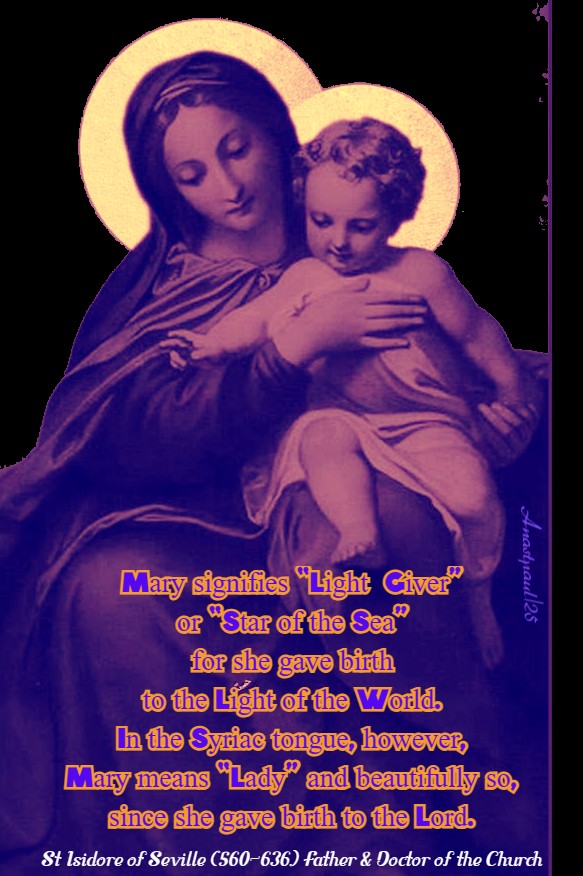
Mary signifies “Light-Giver”
or “Star of the Sea”
for she gave birth
to the Light of the World.
In the Syriac tongue, however,
Mary means “Lady” and beautifully so,
since she gave birth to the Lord
.”

If a man wishes to be always in God’s company,
he must pray regularly and read regularly.
When we pray, we talk to God;
when we read, God talks to us.

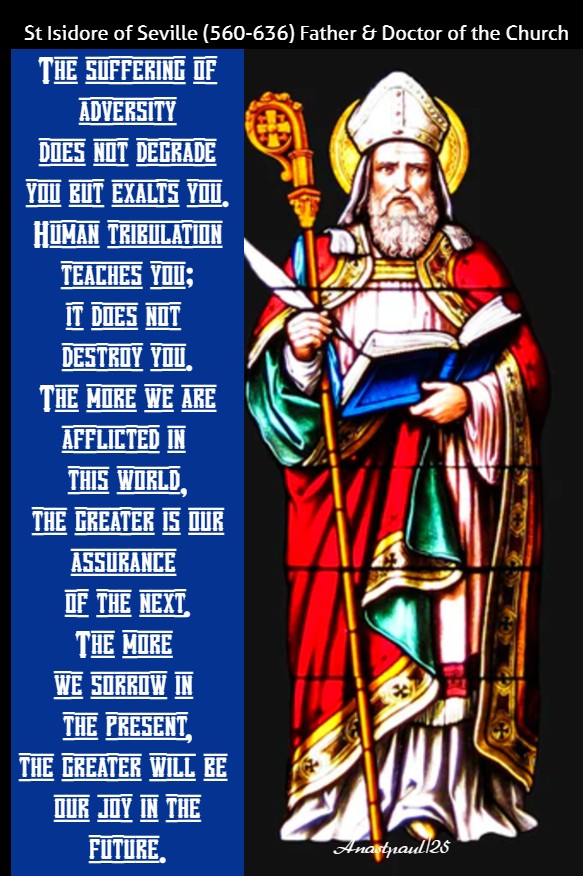
The suffering of adversity
does not degrade you but exalts you.
Human tribulation teaches you;
it does not destroy you.
The more we are afflicted in this world,
the greater is our assurance of the next.
The more we sorrow in the present,
the greater will be our joy in the future.

MORE:
https://anastpaul.com/2023/04/04/quote-s-of-the-day-4-april-st-isidore-of-seville-3/

St Isidore of Seville (c560-636)
Father & Doctor of the Church

Posted in HUMILITY-Fr Richard Clarke, QUOTES on SIN, The PASSION, The SACRED PASSION - Meditations for LENT

Lenten Meditations – 4 April – Ecce Homo

Lenten Meditations – 4 April – With Fr Richard Frederick Clarke SJ (1839-1900) Scripture search here: https://www.drbo.org/

“The Sacred Passion of Our Lord Jesus Christ”
“Short Meditations for Lent”
From “The Devout Year
By Fr Richard Frederick Clarke SJ (1839-1900)

Friday after the Fourth Sunday in Lent
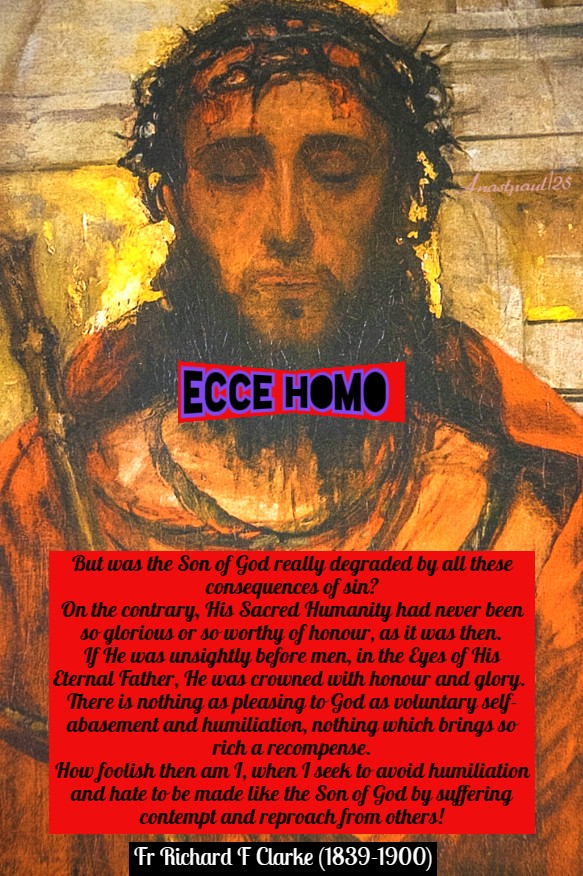
Ecce Homo

Read St John xix:4-6

[4] Pilate, therefore, went forth again and saith to them: Behold, I bring Him forth unto you, that you may know, I find no cause in Him. [5] (Jesus, therefore, came forth, bearing the Crown of Thorns and the purple garment). And Pilate saith to them: Behold the Man.
[6] When the chief priests, therefore and the servants, had seen Him, they cried out, saying: Crucify Him, crucify Him. Pilate saith to them: Take Him you and crucify Him, for I find no cause in Him. [John 19:4-6]

+1. The Scourging and Crowning with Thorns, have brought the Son of God to a condition pitiable to contemplate. We have seen Him and there is no beauty in Him that we should desire Him. Pity, contempt, horror, disgust, disdain, are mingled in the hearts of those who behold Him . He is indeed, a worm and not a man. He, the fairest among ten thousand! He, the sinless Lamb of God!
Oh, how frightful must sin be, if it can work such havoc, even in the Sacred Person of the Son of God!

+2. The sin which did this work, moreover, was the sin of others, not His own. It was something external to Him. He indeed, took it upon Himself, He was made sin for our redemption but sin was never His own, as it is ours! If it could so disfigure and degrade the sinless Lamb of God, when laid upon Him from without, what must be the disfigurement and degradation which sin works in us, springing up as it does, out of ourselves, being a part of our sinful nature, producing its
natural fruits?

+3. But was the Son of God really degraded by all these consequences of sin?
On the contrary, His Sacred Humanity had never been so glorious or so worthy of honour, as it was then.
If He was unsightly before men, in the Eyes of His Eternal Father, He was crowned with honour and glory. There is nothing as pleasing to God as voluntary self- abasement and humiliation, nothing which brings so rich a recompense.
How foolish then am I, when I seek to avoid humiliation and hate to be made like the Son of God by suffering contempt and reproach from others!

Posted in DOCTORS of the Church, FATHERS of the Church, ONE Minute REFLECTION, The KINGDOM of GOD / HEAVEN, The RESURRECTION, The SECOND COMING, The WORD

One Minute Reflection –4 April – The least in the Kingdom of Heaven – Matthew 5:19

One Minute Reflection –4 April – “The Month of the Resurrection and the Blessed Sacrament” – St Isidore of Seville (c560-636) Bishop, Confessor, Father & Doctor of the Church – 2 Tim 4:1-8 – Matthew 5:13-19 – Scripture search here: https://www.drbo.org/

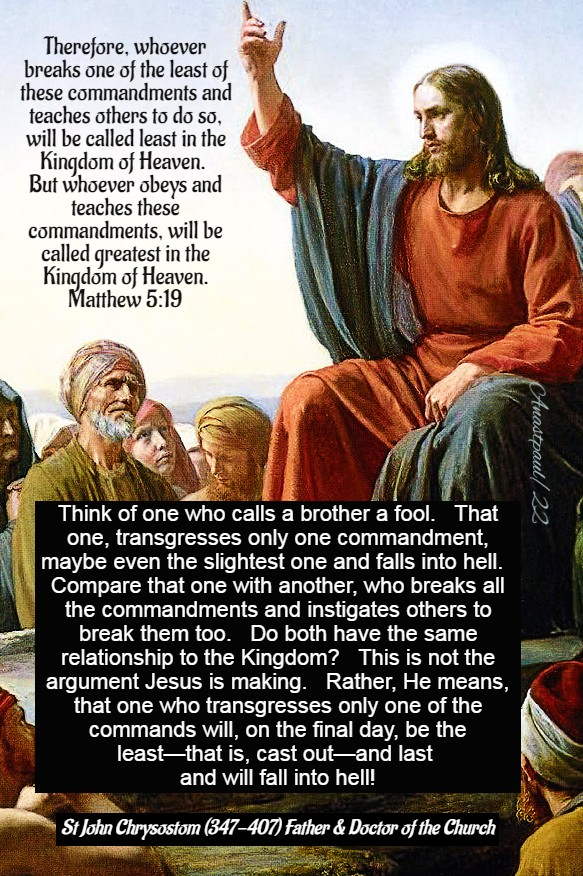
“Therefore, whoever breaks one of the least of these commandments and teaches others to do so, will be called least in the Kingdom of Heaven. But whoever obeys and teaches these commandments, will be called greatest in the Kingdom of Heaven.” – Matthew 5:19

REFLECTION – “For what reason then does He call some of these commandments “least,” although they are so magnificent and lofty? Jesus spoke this way because, He was about to introduce His own teaching, as a new law . As He humbles Himself and speaks of Himself with great modesty, so He refers to His own teaching in the same manner. In this way, Jesus teaches us to practice humility in everything. And besides, since some suspected His teaching to be a new departure, He temporarily taught it in a more reserved way.

But when you hear “least in the Kingdom of Heaven,” you are to think of nothing but hell and punishment. For it was His practice to speak, not only of the joy the Kingdom brings but also, of the time of the resurrection and the fearful event of the Second Coming.

Think of one who calls a brother a fool. That one, transgresses only one commandment, maybe even the slightest one and falls into hell. Compare that one with another, who breaks all the commandments and instigates others to break them too. Do both have the same relationship to the Kingdom? This is not the argument Jesus is making. Rather, He means, that one who transgresses only one of the commands will, on the final day, be the least — that is, cast out — and last and will fall into hell!” – St John Chrysostom (347-407) Archbishop of Constantinople, Father and Doctor of the Church (The Gospel of Saint Matthew, Homily 16).

PRAYER – O God, Who granted to Thy people blessed Isidore as ashepherd of salvation, grant, we beseech Thee that we who cherished him on earth as a teacher of life may be found worthy to have him as an intercessor in Heaven.
T hrough Jesus Christ, Thy Son our Lord, Who lives and reigns with Thee, in the unity of the Holy Ghost, God, world without end. Amen (Collect).

Posted in INDULGENCES, Our MORNING Offering, PAPAL PRAYERS, PARTIAL Indulgence, PLENARY Indulgences, PRAYERS of the SAINTS, PRECIOUS BLOOD PRAYERS, The SEVEN PASSION Feasts

Our Morning Offering – 4 April – Indulgenced Act of Oblation to Our Father

Our Morning Offering – 4 April – “The Month of the Resurrection and the Blessed Sacrament”– The Feast of the Most Precious Blood for the Friday after Laetare Sunday

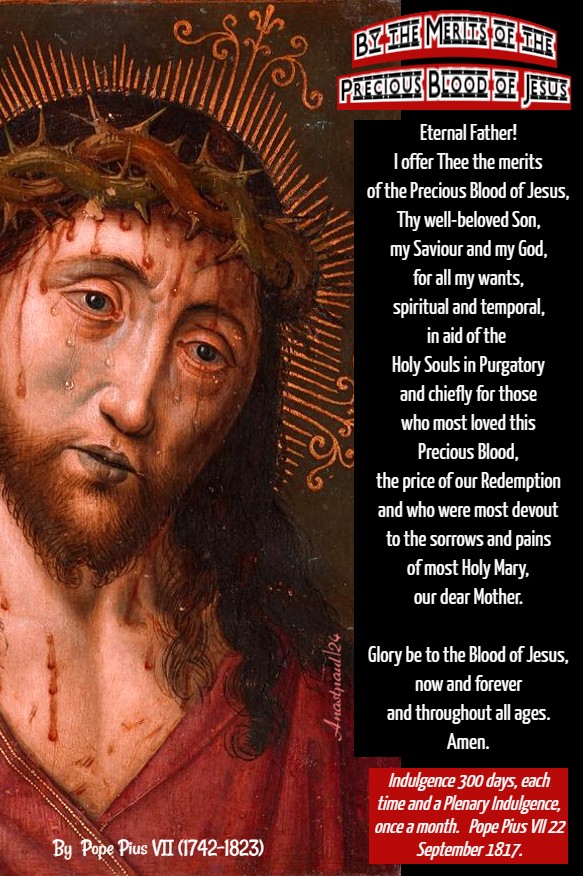
By the Merits of the
Precious Blood of Jesus
By Servant of God Pope Pius VII (1742-1823)

Papacy from 1800 to 1823
Indulgenced Act of Oblation to Our Father

Eternal Father!
I offer Thee the merits
of the Precious Blood of Jesus,
Thy well-beloved Son,
my Saviour and my God,
for all my wants,
spiritual and temporal,
in aid of the Holy Souls in Purgatory
and chiefly for those
who most loved this Precious Blood,
the price of our redemption
and who were most devout
to the sorrows and pains
of most Holy Mary,
our dear Mother.

Glory be to the Blood of Jesus,
now and forever
and throughout all ages.
Amen.

Indulgence of 300 days, each time this prayed is offered,
22 September 1817 with a Plenary Indulgence, once a month,
under the usual conditions.

Note of Interest: On 15 August 1811 – the Feast of the Assumption – it is recorded that the Pope celebrated Mass and was said to have entered a trance and began to levitate in a manner that drew him to the Altar. This particular episode aroused great wonder and awe among attendants, which included the French soldiers guarding him, who were awestruck at what had occurred and left records of it.

Posted in SAINT of the DAY

Saint of the Day – 4 April – Saint Guerir (8th Century) Hermit

Saint of the Day – 4 April – Saint Guerir (8th Century) Monk and Hermit in Liskeard, Cornwall, England, known for his ascetic life of prayer and mortifications. His sanctity drew great admiration. Upon his death, the King of England, St Alfred the Great, when visiting his grave was miraculously cured of a serious illness, leading to the cult of veneration. Also known as – Guier, Gwerir, … of Liskeard.

An unknown Hermit

Our Saint today emerges from the pages of history thanks to the testimony of Saint Neot (Died 877), a Monk of Glastonbury and a distant relative of King Alfred the Great. Guerir’s life, dedicated to solitude and prayer, is intertwined with that of Saint Neot, giving life to an edifying tale of sanctity and miracles.

Guerir chose the path of solitude, settling in a cell near Liskeard, in Cornwall. His ascetic existence, marked by frugality and mortification, soon earned him a reputation for sanctity among the local people. His reputation as an irreproachable holy man of profound ssanctityy, attracted the attention of Saint Neot, who, while seeking a place suitable to accommodate him in a life of solitude, decided to visit him.

The meeting between the two holy Monks marked a turning point in their lives. Neot, in admiration of Guerir’s sanctity, was deeply impressed by his humility and religious fervour.

When Guerir died in the second half of the 9th Century, Neot decided to occupy his cell, perpetuating the tradition of the eremetical in that place.

Guerir’s fame for sanctity did not die with his death. On the contrary, it increased when King Alfred the Great, visiting Saint Neot, wanted to pay homage to the holy Hermit Guerir, by praying at his Tomb. Afflicted by a serious illness, Alfred devoutly asked for a cure through Guerir’s intercession. His prayers were answered and the King obtained the miraculous cure.

In recognition of the miracle, King Alfred built a Collegiate Church on the site of the cells of the two holy Hermits. Their remains were venerated together and Saint Guerir became the object of popular devotion, especially in the region of Cornwall. His memory is celebrated on 4 April every year.

Posted in DOCTORS of the Church, FATHERS of the Church, MARIAN TITLES, SAINT of the DAY, Uncategorized

First Friday, Friday in the 4th Week in Lent – Fast & Abstinence, Notre-Dame de Grace, Honfleur/ Our Lady of Grace, Normandy, France, St Isidore of Seville and the Saints for 4 April

Friday in the Fourth Week of Lent – Fast & Abstinence

First Friday of the Month

Notre-Dame de Grace, Honfleur, Normandie / Our Lady of Grace, Normandy, France – 4 April:
HERE:

https://anastpaul.com/2021/04/04/easter-sunday-2021-the-resurrection-of-the-lord-solemnity-of-solemnities-our-lady-of-grace-normandy-and-memorials-of-the-saints/

St Isidore of Seville (c560-636) Bishop, Confessor, Father & Doctor of the Church, Writer, Teacher, Reformer and Evangelist. Sometimes called – “The Last Scholar of the Ancient World.”
Brilliant St Isidore’s life:

https://anastpaul.wordpress.com/2017/04/04/saint-of-the-day-4-april-st-isidore-of-seville-father-and-doctor-of-the-church/

St Benedict of Palermo OFM (1526-1589) Friar Minor of the Observance, Confessor.
Celebrated yesterday 3 April and today on some calendars.
About St Benedict:

https://anastpaul.wordpress.com/2018/04/04/saint-of-the-day-4-april-st-benedict-of-sicily-o-f-m-1526-1589/

St Aleth of Dijon (1064-1106) Laywoman, Mother of 7, 4 of whom are Saints including the Doctor of Light, St Bernard (of Clairvaux), The other 3 Saints are St Humbeline of Jully (c1091-c1136) a Benedictine Nun, St Gerard of Clairvaux (Died 1138) Bernard older brother, Blessed Nivard of Clairvaux (c1100-c1150) Bernard’s youngest brother.
Lovely St Aleth:
https://anastpaul.com/2024/04/04/saint-of-the-day-4-april-saint-aleth-of-dijon-1064-1106-laywoman/

St Guerir (8th Century) Monk and Hermit
St Henry of Gheest
St Hildebert of Ghent
St Peter of Poitiers (c1130-1215) Bishop

St Plato (c734-813) Monk, Confessor, Defender of sacred images and of the Sacraments of Marriage and Holy Orders.
St Plato’s Courageous Life:

https://anastpaul.com/2021/04/04/saint-of-the-day-4-april-saint-plato-c-734-813/

St Theodulus of Thessalonica
St Theonas of Egypt
St Tigernach of Clogher

St Zosimus of Palestine (Died c560) Priest, Monk, Hermit.
As already reported in the legendary life of St Mary of Egypt, St Zosimus, a Monk and Hermit, is the one who discovers St Mary in the desert and gave her Holy Communion shortly before her death.
The Roman Martyrology reports: “In Palestine, the Anchorite, St Zosimus, who buried the remains of St Mary of Egypt.
His Holy Life:

https://anastpaul.com/2023/04/04/saint-of-the-day-4-april-st-zosimus-of-palestine-c-460-c-560-priest-hermit/

Martyred in Cairo
François de la Terre de Labour
Nicolas of Montecorpino

Martyrs of Thessalonica – 14 Saints: Fourteen Christians who were Martyred together, date unknown. No other information, except the names of 12 of them, has survived – Ingenuus, Julianus, Julius, Matutinus, Orbanus, Palatinus, Paulus, Publius, Quinilianus, Saturninus, Successus, Victor and two whose names have not come down to us.
Agathopus the Deacon, Theodulus the Lector.