Thought for the Day – 11 April – Meditations with Antonio Cardinal Bacci (1881-1971)
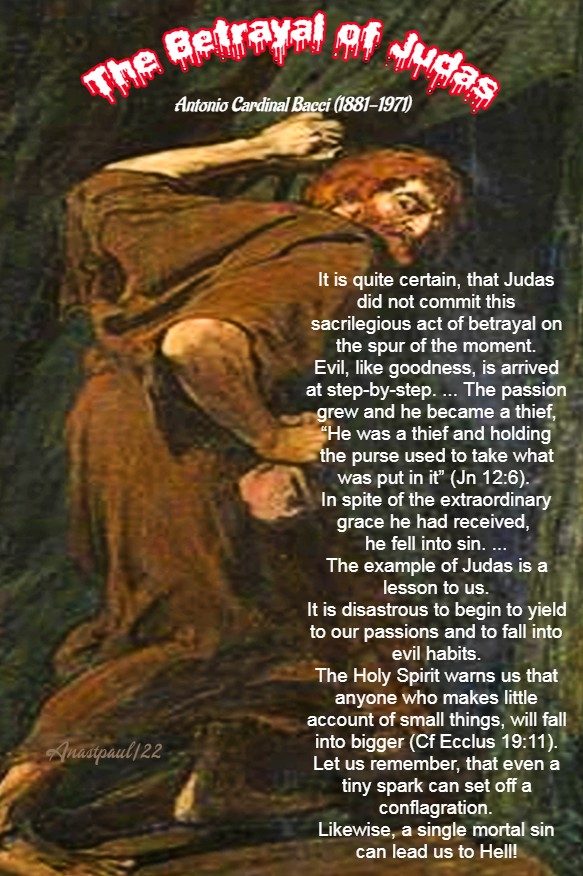
The Betrayal of Judas
“It is quite certain, that Judas did not commit this sacrilegious act of betrayal on the spur of the moment. Evil, like goodness, is arrived at step-by-step. Perhaps it was some motive of self-interest, rather than of pure love,which led Judas to become one of Jesus; Apostles. Covetousness, “the root of all evils,” (Cf 1 Tim 6:10) seems to have been his dominant passion. As the Gospel tells us, he kept the money offerings which those who had been converted, gave to Jesus for His support and for that of His Apostles. Judas did not know how to suppress his dominant passion at times. On one occasion, he complained about Mary Magdalen, when she anointed the feet of Jesus with precious ointment. The passion grew and he became a thief, “He was a thief and holding the purse used to take what was put in it” (Jn 12:6). In spite of the extraordinary grace he had received, he fell into sin. Finally, he was guilty of the betrayal, of the sacrilegious communion at the last supper and of the kiss of hypocrisy in Gethsemane.
The example of Judas is a lesson to us. It is disastrous to begin to yield to our passions and to fall into evil habits. The Holy Spirit warns us that anyone who makes little account of small things, will fall into bigger (Cf Ecclus 19:11). Let us remember, that even a tiny spark can set off a conflagration. Likewise, a single mortal sin can lead us to Hell!”
Quote/s of the Day – 11 April – St Leo I, the Great (c400-461) Pope, Confessor, Father and Doctor of the Church
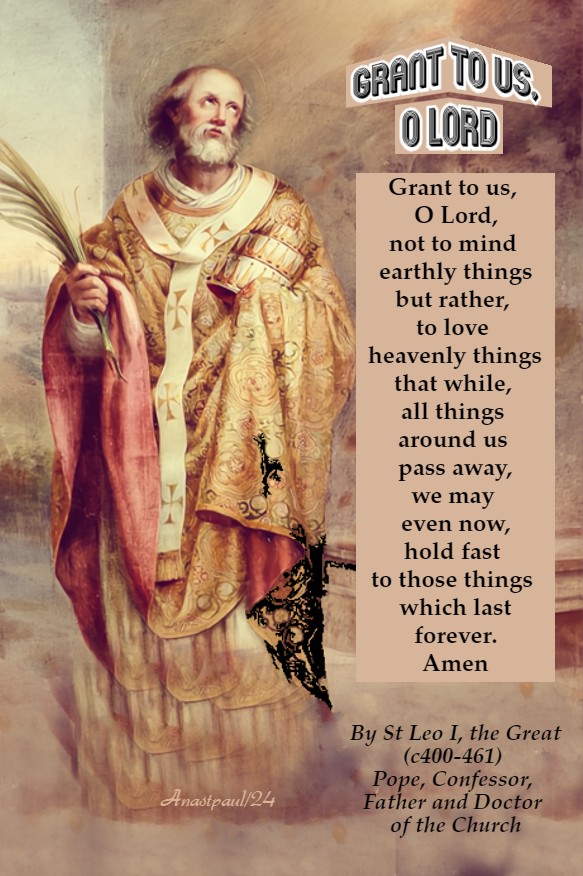
Grant to Us, O Lord By St Leo I, the Great (c400-461) Pope, Confessor, Father and Doctor of the Church
Grant to us, O Lord, not to mind earthly things but rather, to love heavenly things that while, all things around us pass away, we may even now, hold fast to those things which last forever. Amen
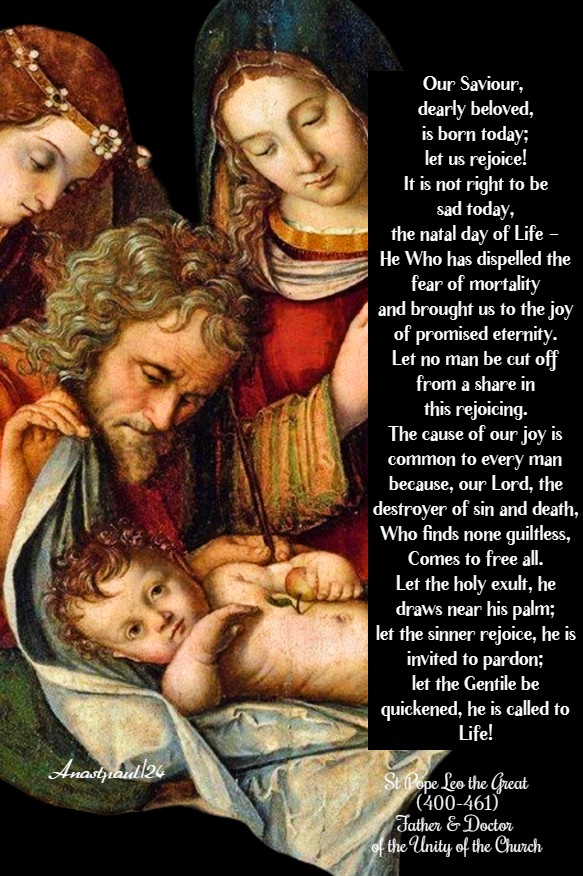
“Our Saviour, dearly beloved, is born today; let us rejoice! It is not right to be sad today, the natal day of Life – He Who has dispelled the fear of mortality and brought us to the joy of promised eternity. Let no man be cut off from a share in this rejoicing. The cause of our joy is common to every man because, our Lord, the destroyer of sin and death, Who finds none guiltless, Comes to free all. Let the holy exult, he draws near his palm; let the sinner rejoice, he is invited to pardon; let the Gentile be quickened, he is called to Life!”
“The obedience of the Star calls us to imitate its humble service: to be servants, as best we can, of the grace which invites all men to find Christ.”
“No-one, however weak, is denied a share in the victory of the Cross. No-one is beyond the help of the prayer of Christ.”
“What is a man’s treasure but the heaping up of profits and the fruit of his toil? For, whatever a man sows, this too will he reap and each man’s gain, matches his toil and where delight and enjoyment are found, there the heart’s desire is attached. Now, there are many kinds of wealth and a variety of grounds for rejoicing – every man’s treasure is that, which he desires. If it is based on earthly ambitions, its acquisition makes men not blessed but wretched. … By distributing what might be superfluous to support the poor, they are amassing imperishable riches, so that what they have discreetly given, cannot be subject to loss. They have properly placed those riches, where their heart is – it is a most blessed thing, to work to increase such riches, rather than to fear that they may pass away.”
St Pope Leo the Great (400-461) ather and Doctor of the Church
Lenten Meditations – 11 April – With Fr Richard Frederick Clarke SJ (1839-1900) Scripture search here: https://www.drbo.org/
“The Sacred Passion of Our Lord Jesus Christ” “Short Meditations for Lent” From “The Devout Year” By Fr Richard Frederick Clarke SJ (1839-1900)
Friday after the Fifth Sunday in Lent Jesus is Derided
Read St Matthew xxvii:39-44
[39] And they that passed by, blasphemed Him, nodding their heads [40] and saying: Vah, Thou Who destroyest the temple of God and in three days dost rebuild it, save Thy Own Self, if Thou be the Son of God, come down from the Cross. [41] In like manner too, the chief priests, with the scribes and ancients, mocking, said: [42] He saved others;imself, He cannot save. If He be the King of Israel, let Him now come down from the Cross and we will believe Him. [43] He trusted in God; let Him now deliver Him if He will have Him, for He said: I Am the Son of God. [44] And the selfsame thing, the thieves too, who were crucified with Him, reproached Him with. [Matthew 27:39-44]
+1. The sight of Jesus hanging on the Cross, so far from melting the hearts of the Jews, only hardened them the more against Him. Instead of feeling pity, they rejoiced over their Victim and insulted Him in His misery. When men deliberately refuse to listen to the Voice of Jesus, they become quite insensible, after a time, to His claim on them. They think evil good and good evil; they aresubmit to a reprobate mind. Even in little matters. those who do not obey the impulses of grace, become deaf to its calls, or even feel a positive aversion for that which they once loved but have now rejected.
+2. How apparently impotent the King of Glory seems to save Himself! But that weakness is true strength. It is by these outrages and insults, by this passive endurance of their jeers and gibes that Christ Our Lord, is doing the wondrous work of our Redemption and earning graces for all those who suffer insult for Him, to rejoice in being counted worthy to suffer shame for His Sake.
+3. But He is doing more than this. He is also preparing a glory corresponding to all this ignominy, for His Sacred Humanity. Of Him it is true, beyond all others that he who humbles himself shall be exalted. Each taunt, each mocking word, was to earn the praise of the Angels and Saints for all eternity. Here is an encouragement for us! What matters it, if men despise and insult us, if God approves? The Just Judge on the day of account, will not forget, what we have suffered for Him!
One Minute Reflection – 11 April – “The Month of the Resurrection and the Blessed Sacrament” – Friday of Passion Week – St Leo I, the Great (c400-461) Pope, Confessor, Father and Doctor of the Church – Our Lady of the Seven Sorrows – Judith 13:22, 25 – John 19:25-27–Scripture search here: https://www.drbo.org/
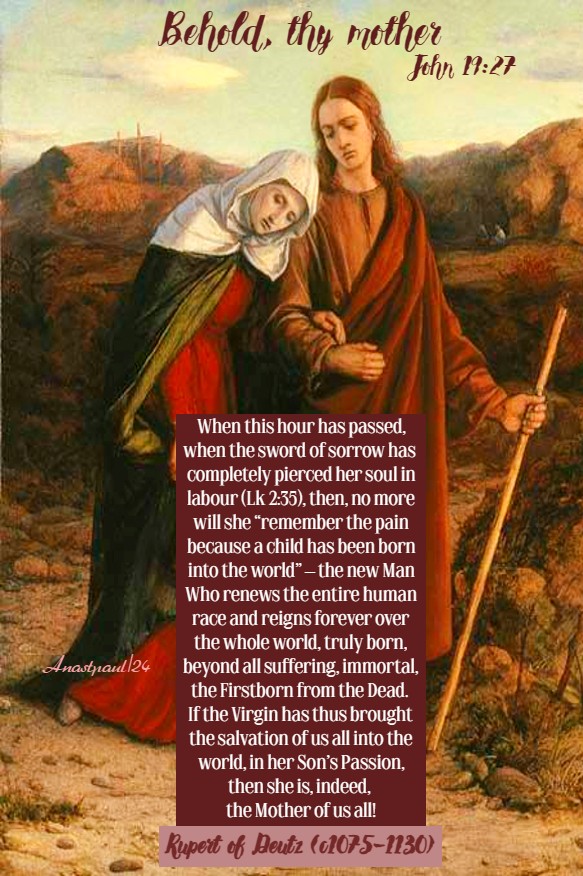
“Behold, thy mother” – John 19:27
REFLECTION – “Woman, this is thy son. This is thy mother.” By what right is the disciple. whom Jesus loved, the son of the Lord’s mother? By what right is she his mother? By the fact that, without pain, she brought into the world the salvation of us all, when she gave birth in the flesh to the God-Man. But now, she is in labour, with great pain as she stands at the foot of the Cross!
At the hour of His Passion, the Lord Himself rightly compared the Apostles to a woman in childbirth, when He said: “When a woman is in labour she is in anguish because a child is born into the world” (cf Jn 16:21). How much more, then, might such a Son compare such a Mother, the Mother standing at the foot of His Cross, to a woman in labour? What am I saying? “Compare?” She is indeed truly a woman and truly a mother and, at this hour, she is truly experiencing the pains of childbirth. When her Son was born she did not experience the anguish of giving birth in pain as other women do; it is now that she is suffering, that she is crucified, that she experiences sorrow; like a woman in labour because her hour has come ( Jn 16:21; cf 13:1; 17:1). …
When this hour has passed, when the sword of sorrow has completely pierced her soul in labour (Lk 2:35), then, no more will she “remember the pain because a child has been born into the world” – the new Man Who renews the entire human race and reigns forever over the whole world, truly born, beyond all suffering, immortal, the Firstborn from the Dead. If the Virgin has thus brought the salvation of us all into the world, in her Son’s Passion, then she is, indeed, the Mother of us all!” – Rupert of Deutz (c1075-1130) Benedictine Monk, Theologian, Exegete and Writer – (Commentary on Saint Johns Gospel, 13).
PRAYER – O God, in Whose Passion the sword, according to the prophecy of blessed Simeon, pierced through the soul of Mary, the glorious Virgin and Mother, mercifully grant that we, who reverently commemorate her piercing through and her suffering, may, by the interceding glorious merits of all the Saints faithfully standing by the Cross, obtain the abundant fruit of Thine Passion. Who lives and reigns with God the Father, in the unity of the Holy Ghost, God, world without end. Amen (Collect).
Our Morning Offering – 11 April – Feast of the Seven Sorrows of Our Lady of Sorrows
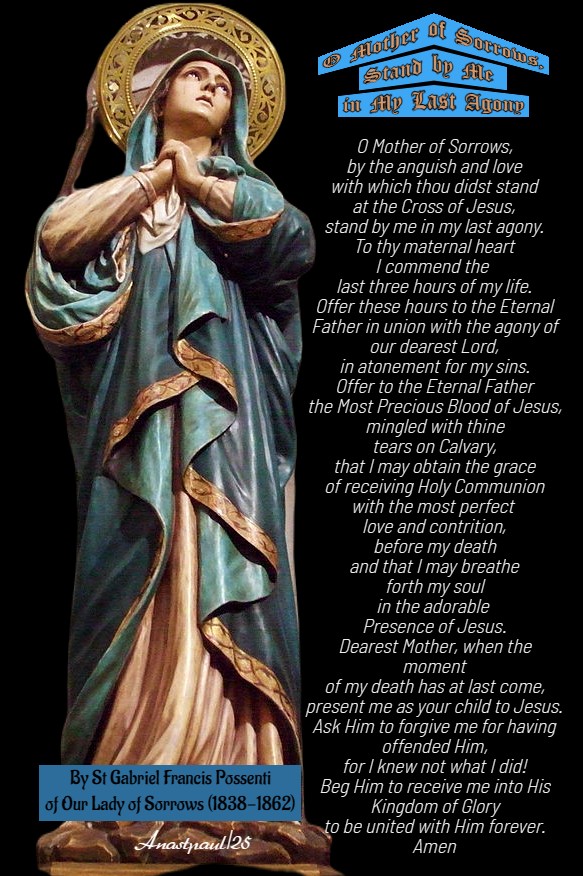
O Mother of Sorrows, Stand by Me in My Last Agony By St Gabriel Francis Possenti of Our Lady of Sorrows (1838-1862)
O Mother of Sorrows, by the anguish and love with which thou didst stand at the Cross of Jesus, stand by me in my last agony. To thy maternal heart I commend the last three hours of my life. Offer these hours to the Eternal Father in union with the agony of our dearest Lord, in atonement for my sins. Offer to the Eternal Father the Most Precious Blood of Jesus, mingled with your tears on Calvary, that I may obtain the grace of receiving Holy Communion with the most perfect love and contrition, before my death and that I may breathe forth my soul in the adorable Presence of Jesus. Dearest Mother, when the moment of my death has at last come, present me as your child to Jesus. Ask Him to forgive me for having offended Him, for I knew not what I did! Beg Him to receive me into His Kingdom of Glory to be united with Him forever. Amen
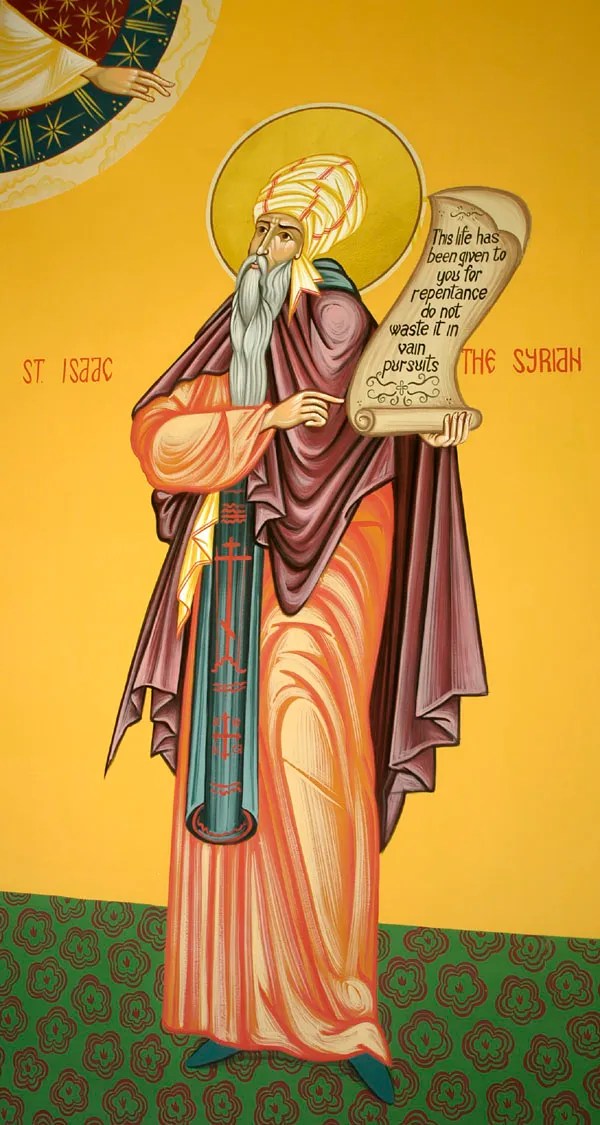
Saint of the Day – 11 April – St Isaac of Spoleto (Died c550) Abbot and Confessor, Hermit, Founded a Monastery,in Monteluco, graced with the charism of Prophecy and Miracles, many of his sermons have been preserved. Born in Syria on an unknown date and died in c550 in Spoleto, Italy of natural causes. Also known as – Isaac of Monteluco, Isaac the Syrian.
The Roman Martyrology reads today: “At Spoleto, St Isaac, Monk and Confessor, whose virtues are recorded by Pope St Gregory.”
Photo by HEN-Magonza. on flickr. Detail of a Fresco in the St Isaac Crypt in Apoleto in the Church of St Ansano
St Isaac in the Dialogues of St Gregory the Great:
According to the Dialogues of St Pope Gregory I, St Isaac, a man of God, arrived in Spoleto from Syria “at the time that the Goths first invaded Italy” and lived there “almost to the last days of the Goths.” When he first arrived in Spoleto, “the keepers” of a Church allowed him to stay there overnight. However, on the third night, one of the keepers denounced him as a “hypocrite and one that desired to be reputed an holy man” and ejected him by force. The keeper was immediately possessed by “a wicked spirit” and had to implore Isaac to drive it out. As the news of the exorcism spread, “men and women, rich and poor, came running, everyone striving to bring him home to their own house.”
Many offered land and/or money for an Abbey but Isaac refused and left the City. “Not far off, he found a desert place, where he built a little cottage for himself.” He attracted many converts who “under his discipline and government, gave themselves to the service of Almighty God.”
Some of his new followers argued that “it was good for the necessity of the Abbey to take such livings as were offered” but St Isaac refused, saying: “A Monk whoseeketh for livings upon earth is no Monk!”
Detail of a Fresco (12th Century) of St Michael appearing to St Isaac and another Monk slso in the Crypt of St Isaac in Spoleto at the Church of San Ansano
Isaac became renowned for his gift of prophecy and for the miracles which he was granted by God:
One night, Isaac told his Monks to leave a certain number of spades in the garden and to “make pottage for our workmen.” Later, a number of thieves, one for each spade, entered the garden, as Isaac had expected. God inspired them to turn from their planned robbery and instead, to use the spades to till the ground. Isaac greeted them the next morning with the words: “God save you, good brethren, you have laboured long, wherefore now rest yourselves.” He gave them the pottage and then admonished: “Do not any more, hereafter, harm but when you desire anything in the garden, come to the gate, quietly ask it and take it with God’s blessing.”
On another occasion, some beggars approached him in tattered rags and begged for new clothes. He quietly sent one of his Monks into the surrounding woods to look for a hollow tree and to bring to him the clothes he found therein. The Monk did as he was told and duly found the clothes which Isaac gave to the beggars. They, of course, recognised them as their own and were filled with shame.
On a third occasion, a man sent his servant with two baskets of meat for Isaac and a request to be remembered in his prayers. The servant hid one basket in a bush and gave only one to Isaac. Isaac knew what had happened and warned the servant that a poisonous snake had slipped into the second basket. When he found this to be the case, he too was filled with shame.
St Gregory had two source of information for this account:
One was “the holy virgin Gregoria” who, when she was young, had sought Isaac’s assistance in order to avoid marriage and to become a Nun. She had later moved to the nunnery next to the Monastery of St Gregoryin Rome.
The other was “the reverent man Eleutherius” who, as Abbot of San Marco,, had been “familiarly acquainted with” Isaac. He had later moved to the Monastery of St Gregory in Rome, where he had become close to St Gregory. At the time Gregory was writing, St Eleutherius had recently died.
Isaac, famous for his sanctity, miracles and prophetic gifts, died around 550 and his Relics are preserved in Spoleto. 63 sermons are attributed to him, perhaps confused with those of St Isaac of Antioch.
St Antipas of Pergamum (Died c92) Martyr, Bishop of Pergamon, Greece (in modern Turkey), spiritual student of Saint John the Apostle and Evangelist. His Life and Death: https://anastpaul.com/2021/04/11/saint-of-the-day-11-april-st-antipas-of-pergamum-died-c-92-spiritual-student-of-saint-john-the-apostle-and-evangelist/
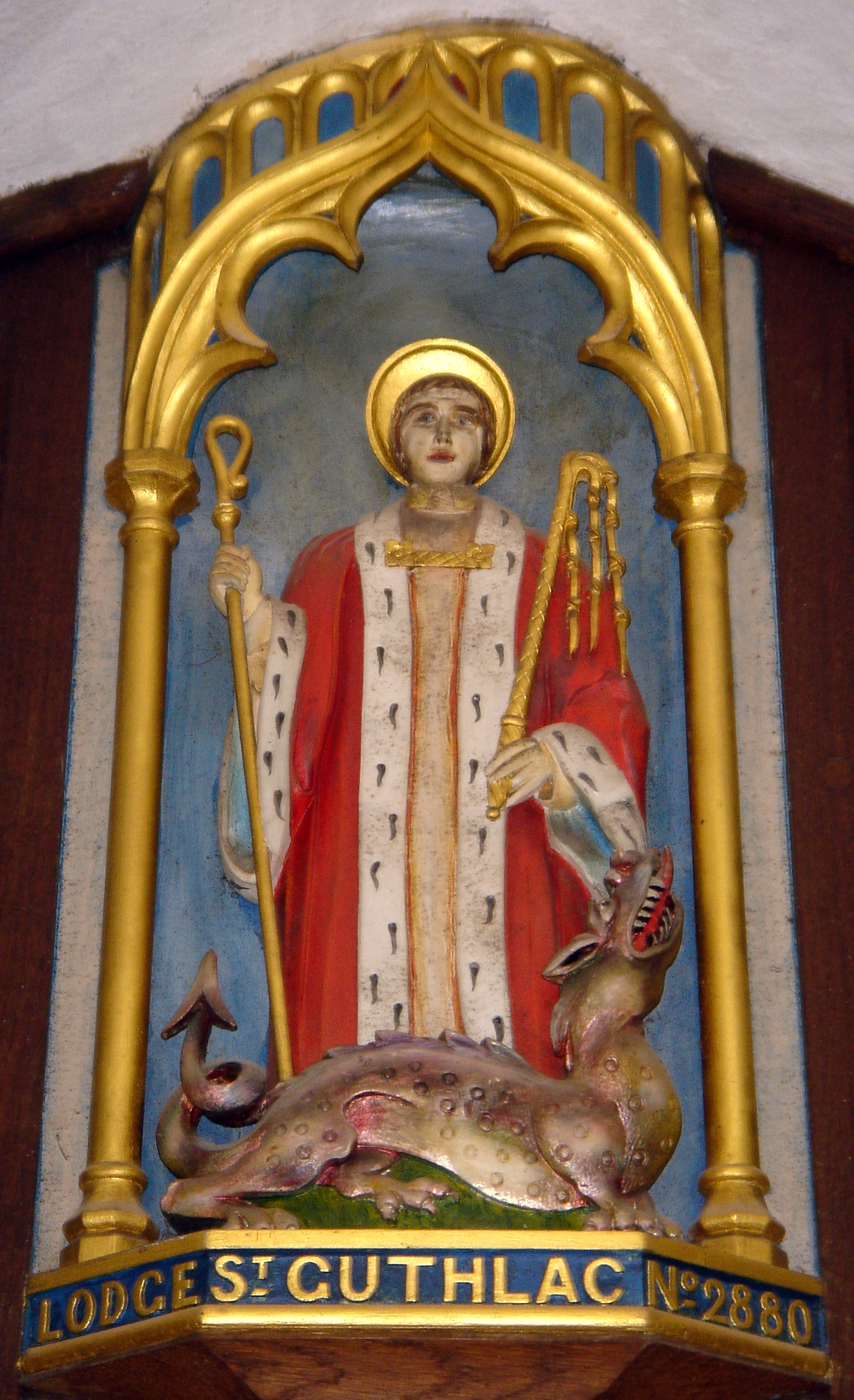
St Guthlac (674–715) Monk, Hermit, Ascetic. St Guthlac was from Lincolnshire in England. He is particularly venerated in the Fens of eastern England where many Churches are dedicated to him. His sister is venerated as Saint Pega, an anchoress. His body was incorrupt until its destruction in the 16th century by the dissolution of the Monasteries by Henry VIII. Holy St Guthlac: https://anastpaul.com/2019/04/11/saint-of-the-day-11-april-st-guthlac-674-715/
St Hildebrand of Saint-Gilles St Isaac of Spoleto (Died c550) Abbot and Confessor Bl James of Africa Bl John of Cupramontana Bl Lanunio St Machai St Maedhog of Clonmore Bl Mechthild of Lappion Bl Paul of Africa St Philip of Gortyna St Raynerius Inclusus St Sancha of Portugal St Stephen of Saint-Gilles














 AnaStpaul
You must be logged in to post a comment.