Thought for the Day – 16 April – The Spiritual Combat (1589) – Dom Lorenzo Scupoli OSM (c1530-1610)
“None shall be crowned who has not fought well.” 2 Tim 2: 5
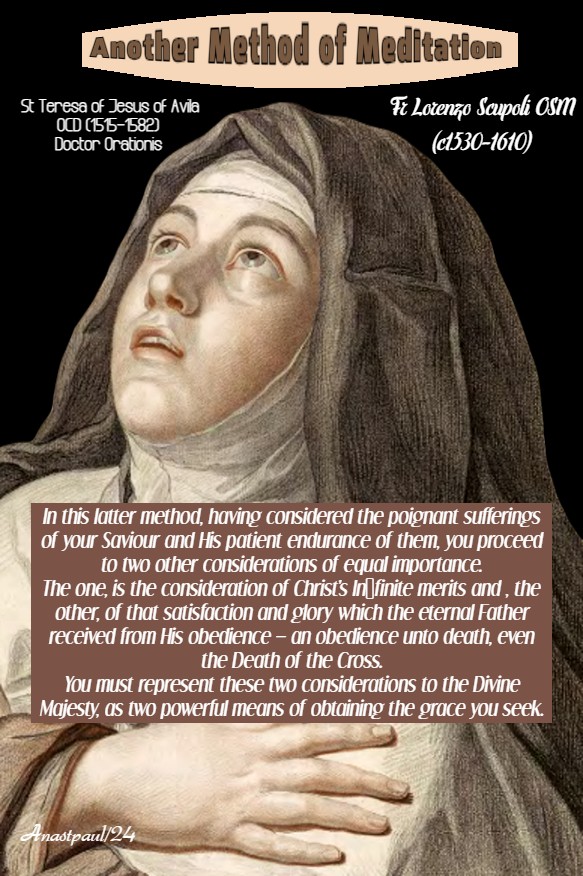
XLVII: … Another Method of Meditation
“There is another method of prayer and meditation besides the one to which we have referred.
In this latter method, having considered the poignant sufferings of your Saviour and His patient endurance of them, you proceed to two other considerations of equal importance. The one, is the consideration of Christ’s Infinite merits and, the other, of that satisfaction and glory which the eternal Father received from His obedience – an obedience unto death, even the Death of the Cross. You must represent these two considerations to the Divine Majesty, as two powerful means of obtaining the grace you seek.
This method is applicable, not only to all the Mysteries of Our Lord’s Passion but, to every exterior or interior act He performed in the course of His Passion.”
Quote/s of the Day – 16 April – Spy Wednesday in Holy Week – Isaias 53:1-12, Luke 22:39-71; 23:1-53
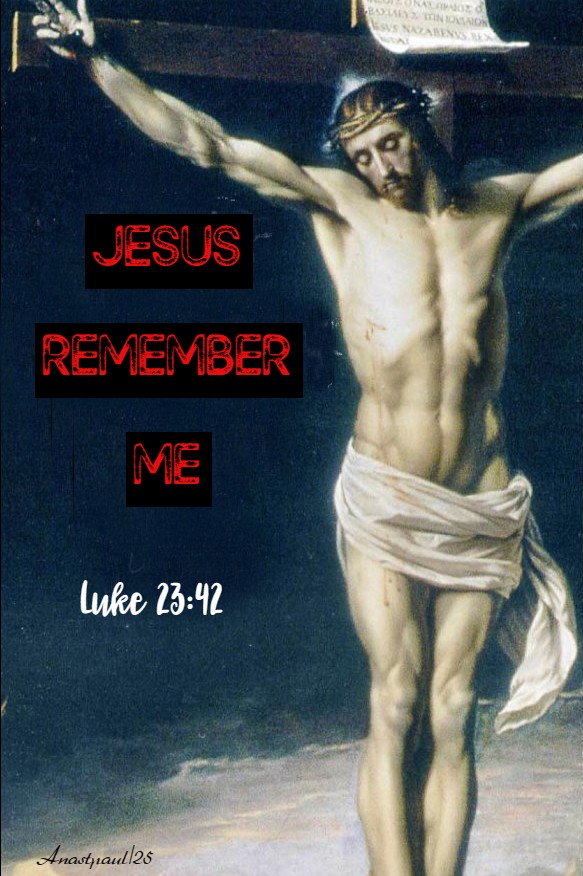
“Jesus remember me”
Luke 23:42
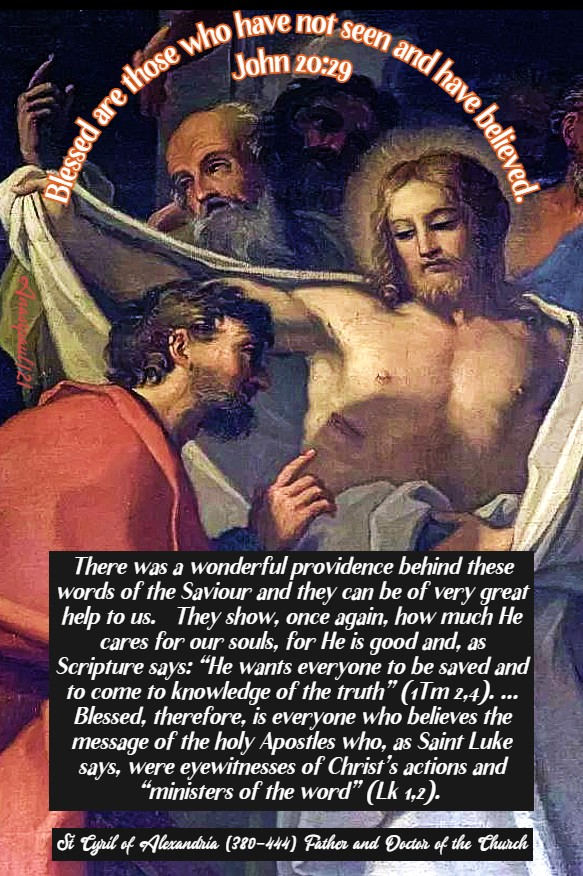
“Blessed are those who have not seen and have believed.” John 20:29
“Blessed, therefore, is everyone who believes the message of the holy Apostles who, as Saint Luke says, were eyewitnesses of Christ’s actions and “ministers of the word” (Lk 1,2).”
St Cyril of Alexandria (380-444) Father and Doctor of the Church
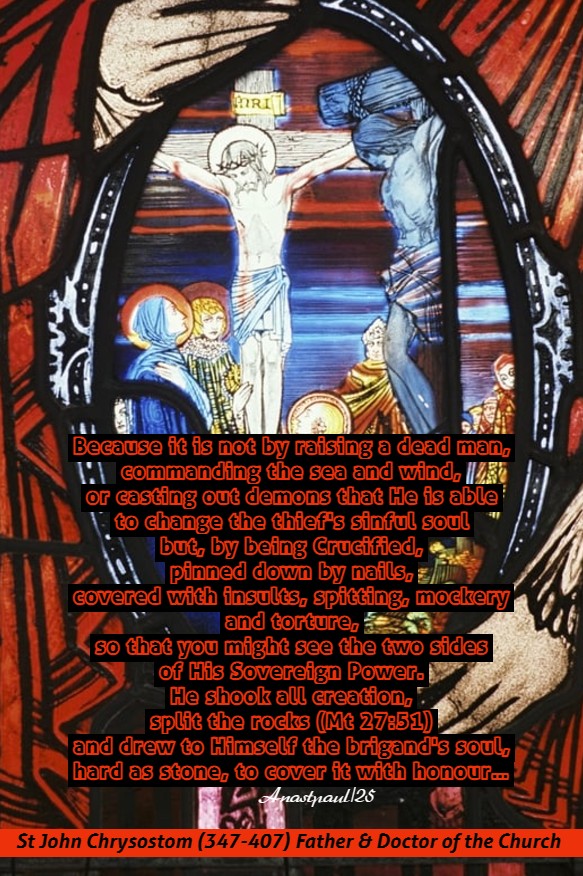
“Because it is not by raising a dead man, commanding the sea and wind, or casting out demons that He is able to change the thief’s sinful soul but, by being Crucified, pinned down by nails, covered with insults, spitting, mockery and torture, so that you might see the two sides of His Sovereign Power. He shook all creation, split the rocks (Mt 27:51) and drew to Himself the brigand’s soul, hard as stone, to cover it with honour…”
St John Chrysostom (347-407) Father & Doctor of the Church
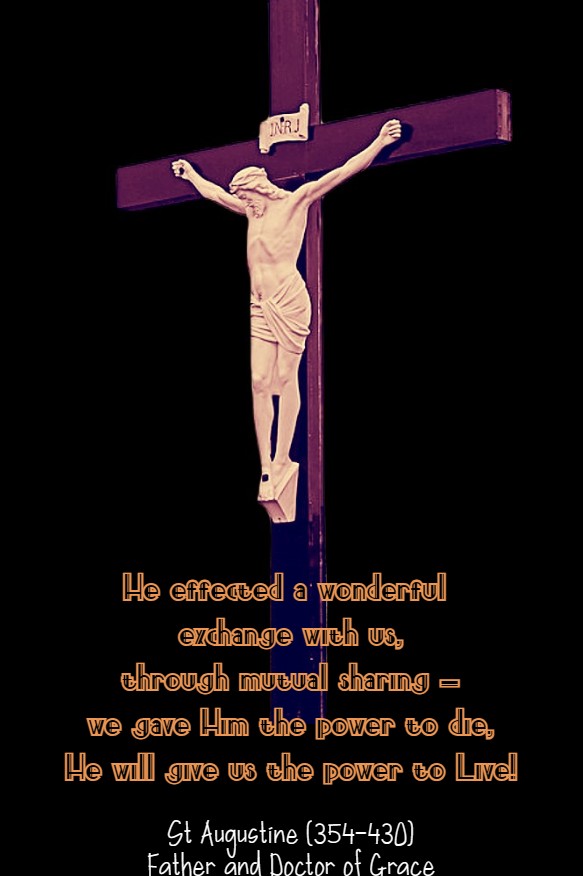
“… He effected a wonderful exchange with us, through mutual sharing – we gave Him the power to die, He will give us the power to Live!”
St Augustine (354-430) Father and Doctor of Grace
“Sacrilegious tongues blaspheme the God Who preserves their existence! … you should be damned forever and, instead of thanking Him for His goodness, you, at the very time that He bestows His favours upon you, YOU blaspheme His Holy Name!”
St Alphonsus Maria de Liguori (1696-1787) Most Zealous Doctor
Lenten Meditations – 16 April – With Fr Richard Frederick Clarke SJ (1839-1900) Scripture search here: https://www.drbo.org/
“The Sacred Passion of Our Lord Jesus Christ” “Short Meditations for Lent” From “The Devout Year” By Fr Richard Frederick Clarke SJ (1839-1900)
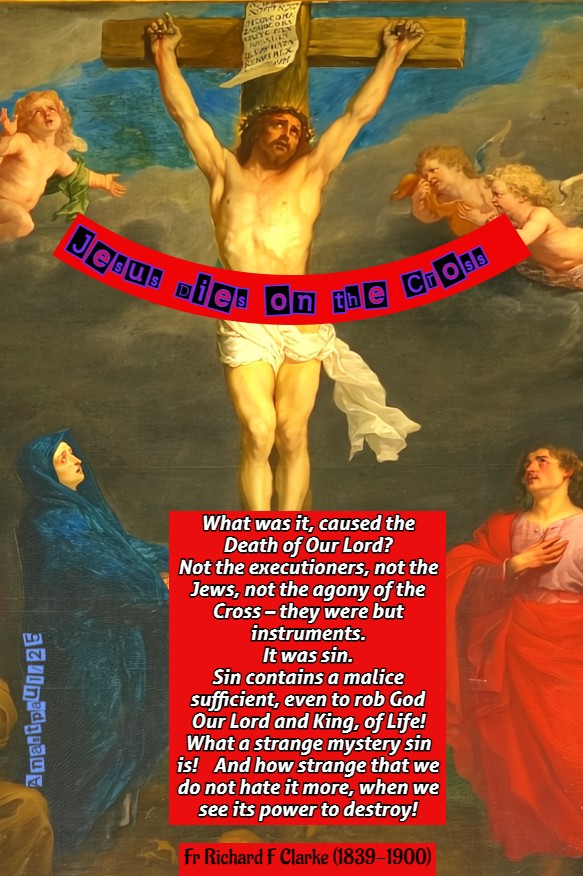
Wednesday in Holy Week Jesus Dies on the Cross
Read St Luke xxiii:45-48
[45] And the sun was darkened and the veil of the temple was rent in the middle. [46] And Jesus, crying with a loud Voice, said: Father, into Thy Hands I commend My Spirit. And saying this, He gave up the ghost. [47] Now the centurion, seeing what was done, glorified God, saying: Indeed this was a just man. [48] And all the multitude of them who were come together to that sight and saw the things which were done, returned, striking their breasts. [Luke 23:45-48]
+1. After Our Lord has hung in agony upon the Cross, for three hours, at last the time approach’s when His deliverance is at hand. He has endured every possible form of suffering, bodily and mental. His Body has been subjected to a physical torture far worse than the accumulated sufferings of the Martyrs; His Sacred Soul has been rent asunder with an anguish and desolation more awful than any, save the eternal anguish of hell. He has sacrificed His honour, His reputation; He has been esteemed a fool and a madman. Now, there is only one sacrifice more He can make,for mankind, to His Eternal Father, – the sacrifice of His Life. He is determined to give up all for us, to be obedient, even tuno death.
+2. What was it, caused the Death of Our Lord? Not the executioners, not the Jews, not the agony of the Cross – they were but instruments. It was sin. Sin contains a malice sufficient, even to rob God Our Lord and King, of Life! What a strange mystery sin is! And how strange that we do not hate it more, when we see its power to destroy!
+3. Jesus’ Death was no transient occurrence. He still mystically dies for us each day and each hour. When we receive Holy Communion, we exhibit the Death of the Lord until He Comes and, therefore, His Sacred Passion and Death, should be the chief subject of our thoughts whenever we approach the Holy Table and especially, on the eve of the solemn day when He instituted the Sacrament of His Love.
One Minute Reflection – 16 April – “The Month of the Resurrection and the Blessed Sacrament” – Spy Wednesday in Holy Week – Isaias 53:1-12 – Luke 22:39-71; 23:1-53 – Scripture search here: https://www.drbo.org/
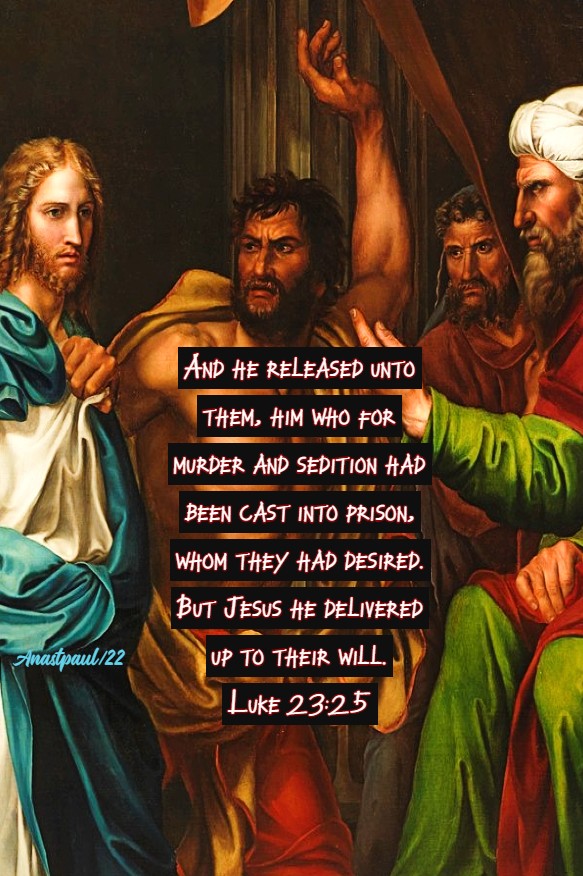
“And he released unto them, him who for murder and sedition had been cast into prison, whom they had desired. But Jesus he delivered up to their will.” – Luke 23:25
REFLECTION – “Jesus made His way of His Own free will towards the sufferings Scripture had foretold. He had frequently predicted them to His disciples and had even severely rebuked Peter, who had received their discovery with indignation (Mt 16:23). Finally, He showed how they were the cause of the world’s salvation. This was why, to the men coming to arrest Him, He referred to Himself as: “I Am He Whom you are seeking” (cf. Jn 18:5.8) … He was struck, covered with spittle, mocked, tortured, scourged and, in the end, Crucified. He allowed two outlaws, one at His right and one at His left, to share His suffering. Classed alongside murderers and criminal, He took vinegar and gall, fruits of a bitter vine. He was struck in mockery by a reed, pierced by a lance in His side and, in the end, laid in a tomb.
All this He suffered while working out our salvation … By His thorns He brought an end to the punishment laid on Adam, since the latter, having sinned, received this sentence: “Cursed be the ground because of you! Thorns and thistles shall it bring forth to you” (Gn 3:17-18). With the gall He took to Himself all that is bitter and painful in mortal life and sorrowful to men. With the vinegar He accepted human nature’s decline and bestowed on it, its restoration to a higher state. By the purple he symbolised His royalty; with the reed, He indicated how weak and feeble the devil’s power is. Being slapped, He made known our enfranchisement [just as we do in the case of a slave]. He bore with the abuse, punishment and beating due to us.
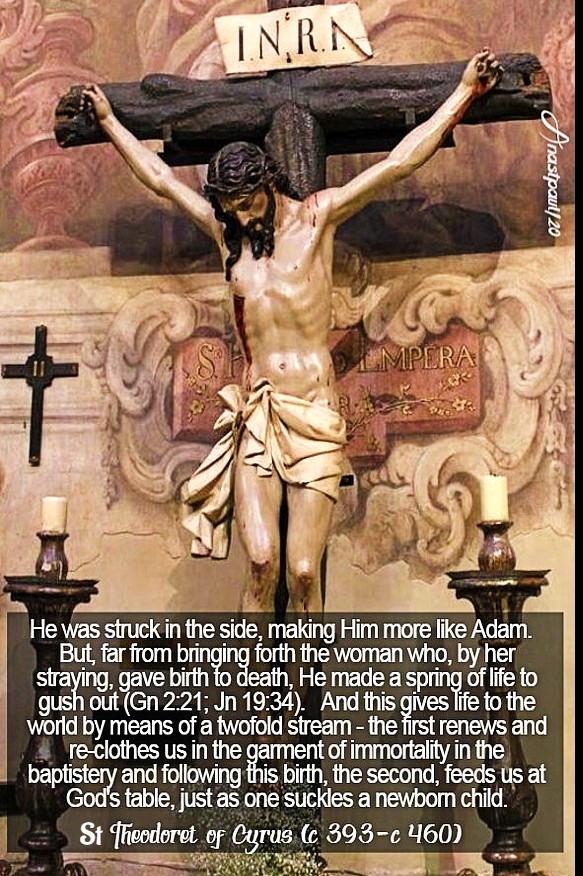
He was struck in the side, making Him more like Adam. But, far from bringing forth the woman, who, by her straying, gave birth to death, He made a spring of life to gush out (Gn 2:21; Jn 19:34). And this gives life to the world by means of a twofold stream – the first renews and re-clothes us in the garment of immortality in the baptistery and following this birth, the second, feeds us at God’s Table, just as one suckles a newborn child.” … St Theodoret of Cyrus (c 393-c 460) Bishop (Treatise on the Incarnation, 26-27).
PRAYER – O God, Who to drive far from us, the power of the enemy, didst will that Thy Son should suffer for us on the gibbet of the Cross, grant us Thy servants, that we may obtain the grace of the resurrection. Through the same Jesus Christ, Thy Son, Our Lord, Who lives and reigns with Thee in the unity of the Holy Ghost, God, world without end. Amen (Collect).
Our Morning Offering – 16 April – “Spy” Wednesday in Holy Week
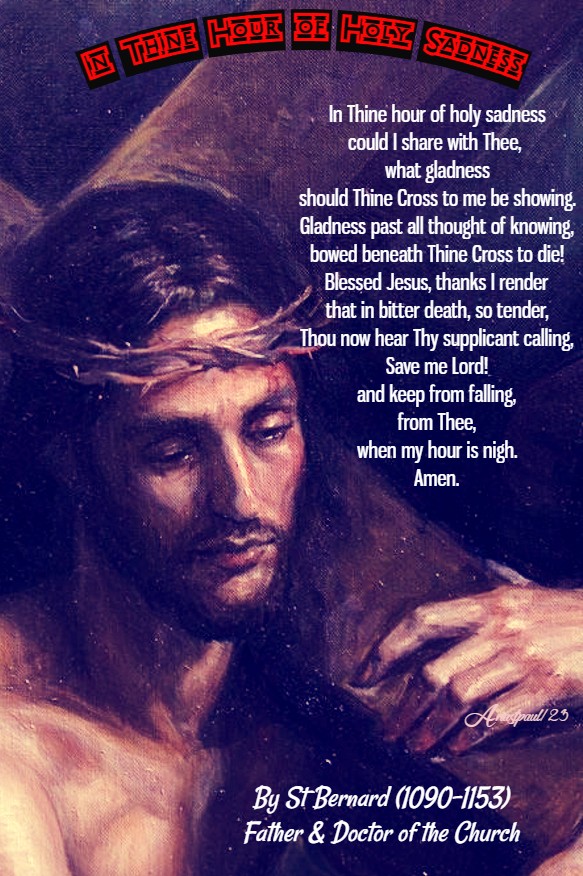
In Thine Hour of Holy Sadness By St Bernard (1090-1153) Father & Doctor of the Church
In Thine hour of holy sadness could I share with Thee, what gladness should Thine Cross to me be showing. Gladness past all thought of knowing, bowed beneath Thine Cross to die! Blessed Jesus, thanks I render that in bitter death, so tender, Thou now hear Thy supplicant calling, Save me Lord! and keep from falling, from Thee, when my hour is nigh. Amen.
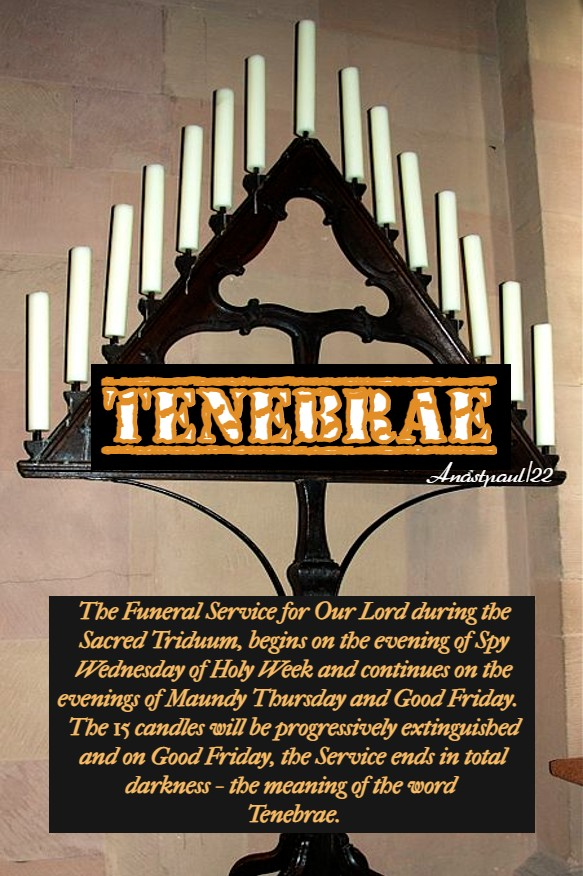
The Office of Tenebrae The public singing of part of the Divine Office, on Wednesday, Thursday and Friday evenings in Holy Week, anticipating Matins and Lauds of Holy Thursday, Good Friday and Holy Saturday. This custom goes back centuries and acquired the name because of the mourning ritual surrounding the ceremony which includes a triangular candlabra bearing fifteen candles. These are extinguishedt one by one until, after the last candle is extinguished, a prayer is said in darkness, one candle is lit and the assembly dispersed in silence.
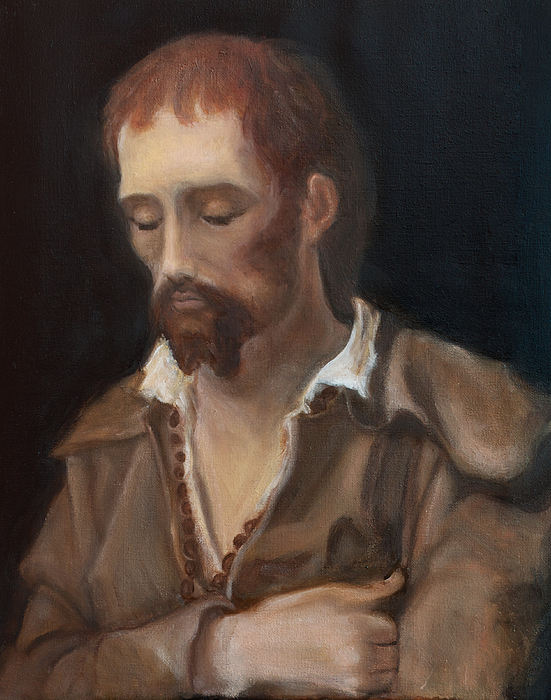
St Benedict Joseph Labre – Known as the Beggar of Perpetual Adoration (1748-1783) Lay Penitent and Pilgrim – he “abandoned his country, his parents and whatever is flattering in the world, to lead a new sort of life, a life most painful, most penitential, not in a wilderness, nor in a cloister but in the midst of the world, devoutly visiting as a pilgrim the famous places of Christian devotion.” Canonised by Pope Leo XIII on 8 December 1881. Dearest St Benedict Joseph: https://anastpaul.wordpress.com/2017/04/16/saint-of-the-day-16-april-st-benedict-joseph-labre/
Blessed Arcangelo Canetoli (1460-1513) Priest and Canon of the Canons Regular of the Congregation of the Most Holy Saviour at Bologna, Mystic gifted with the charism of prophecy and of many visions of the Blessed Virgin, Born in 1460 in Bologna, Italy and died on 16 April 1513 (aged 53) in Gubbio, Italy of natural causes. His body is incorrupt. Arcangelo was Beatified on 2 October 1748 by Pope Benedict XIV. Holy Arcangelo: https://anastpaul.com/2023/04/16/saint-of-the-day-16-april-blessed-arcangelo-canetoli-crssb-1460-1513-priest/
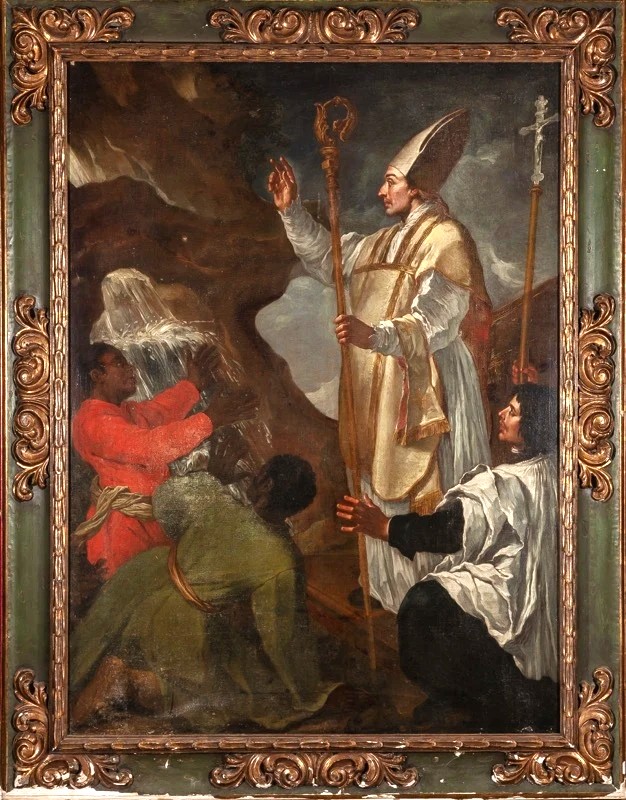
St Turibius (c402-c460) Bishop of Astorga in Spain, Hermit, Monk, Defender of the Faith against heresy, in particular, the heresy of Priscilian., Miracle-worker. Born in Astorga, Spain in c402 and died there in c460 of natural causes. Patronages – Diocese of Palencia, Diocese of Santander, Diocese of Astorga, all in Spain. The Roman Martyrology reads: “At Palencia, St Turibius, the Bishop of Astorga, Spain, who with the aid of Pope St Leo the Great, drove the heresy of Priscilian entirely out of Spain and, went to rest in the Lord with a great renown for miracles.” Zealous and Miraculous St Turibius: https://anastpaul.com/2024/04/16/saint-of-the-day-16-april-saint-turibius-of-astorga-c402-c460-bishop/
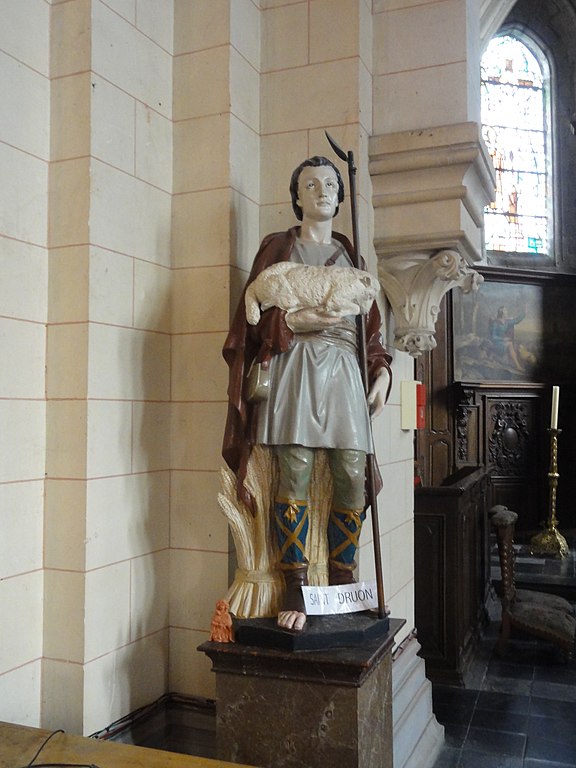
St Vaise Blessed William Gnoffi (1256-1317) Hermit
Martyrs of Corinth – 9 Saints: A group of nine Christians who were tortured and Martyred together in the persecutions of Decius. We know little more than three of their names – Callistus, Charisius and Leonide. They were thrown into the sea at Corinth, Greece c250.
Martyrs of Saragossa: Group of 18 Martyrs murdered in 304 in Saragossa, Spain in the persecutions of Diocletian and the prefect Dacean. We know little more than the names – Apodemus, Caecilian, Caius, Crementius, Engratia, Eventius, Felix, Fronto, Gaius, Julia, Lambert, Lupercus, Martial, Optatus, Primitivus, Publius, Quintilian, Saturnius (4 men of this name), Succesus and Urban. Their graves re-discovered in 1389 in the crypt under the Church of San Encrazia in Saragossa.






 AnaStpaul
You must be logged in to post a comment.