Thought for the Day – 17 April – Meditations with Antonio Cardinal Bacci (1881-1971)
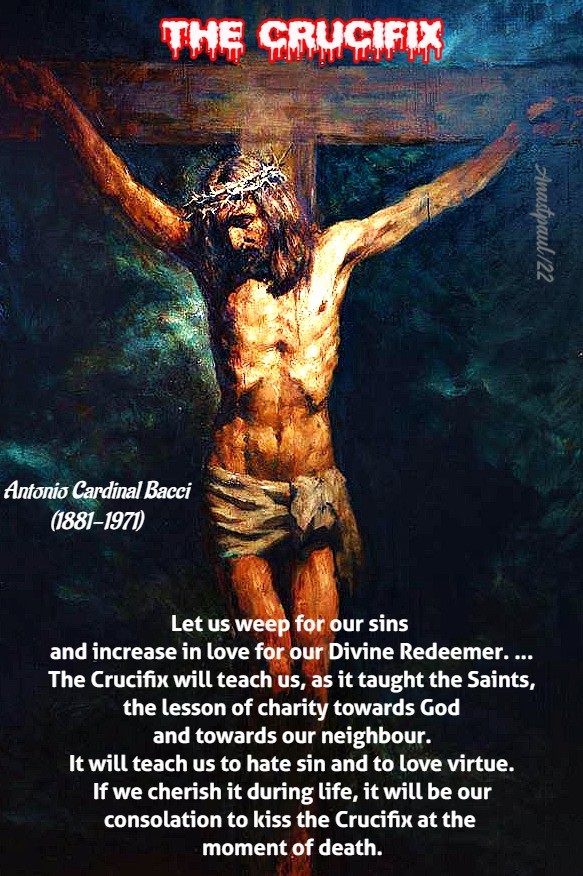
THE CRUCIFIX
“Let us weep for our sins and increase in love for our Divine Redeemer. When we are oppressed by the weight of our own cross, we shall look at the Crucifix and find comfort. When we are tempted, we shall grasp the Crucifix and turn away with horror from thoughts of sin and ingratitude.
The Crucifix will teach us, as it taught the Saints, the lesson of charity towards God and towards our neighbour. It will teach us to hate sin and to love virtue. If we cherish it during life, it will be our consolation to kiss the Crucifix at the moment of death.”
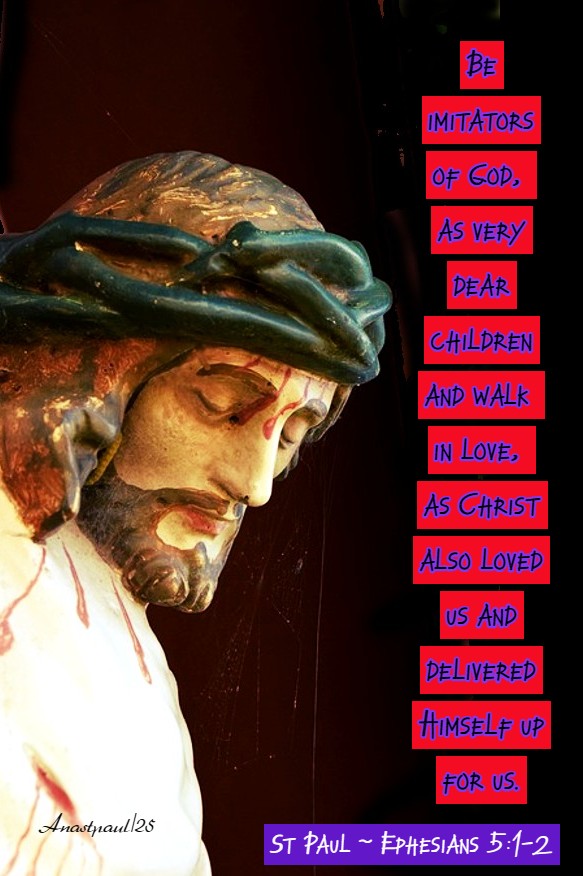
“Be imitators of God, as very dear children and walk in love, as Christ also loved us and delivered Himself up for us …”
St Paul … Ephesians 5:1-2
“But I say to you, Love your enemies …”
Matthew 5:44
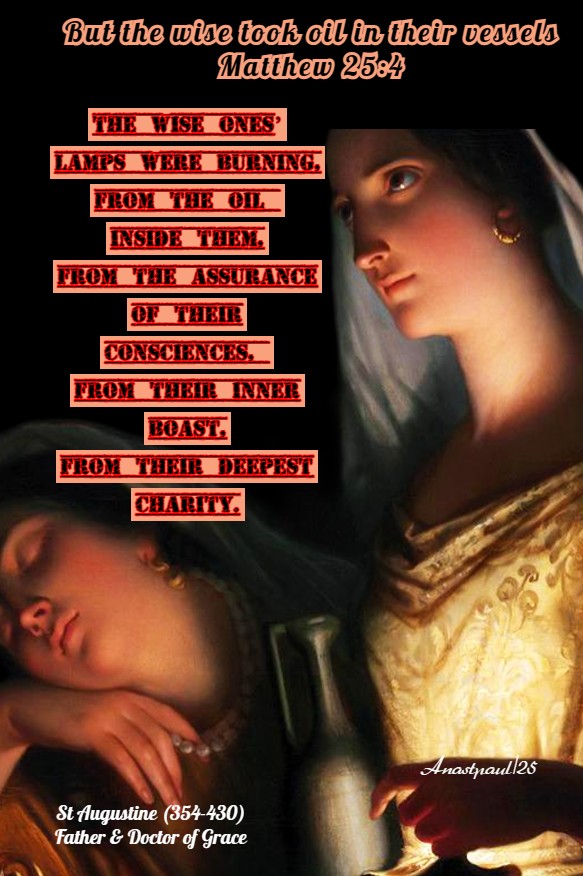
“But the wise took oil in their vessels”
Matthew 25:4
“The wise ones’ lamps were burning, from the oil inside them, from the assurance of their consciences, from their inner boast, from their deepest charity.”
St Augustine (354-430) Father & Doctor of Grace
“Father, forgive them.” With this prayer, He wanted to make us understand the love He bore us, undiminished by any suffering and to teach us how our heart should be toward our neighbour.”
St Francis de Sales (1567-1622) Doctor Caritas
“He loves you as though He had no-one else to love but you alone. You, too, should love Him alone and all others for His Sake. Of Him you may say and, indeed, you should say: My Beloved to me and I to Him (Cant, 2:16). My God has given Himself all to me and I give myself all to Him; He has chosen me for His beloved and I choose Him, above all others, for my only Love.”
“How to Pray at All Times” By St Alphonsus Maria de Liguori (1696-1787)
Lenten Meditations – 17 April – With Fr Richard Frederick Clarke SJ (1839-1900) Scripture search here: https://www.drbo.org/
“The Sacred Passion of Our Lord Jesus Christ” “Short Meditations for Lent” From “The Devout Year” By Fr Richard Frederick Clarke SJ (1839-1900)
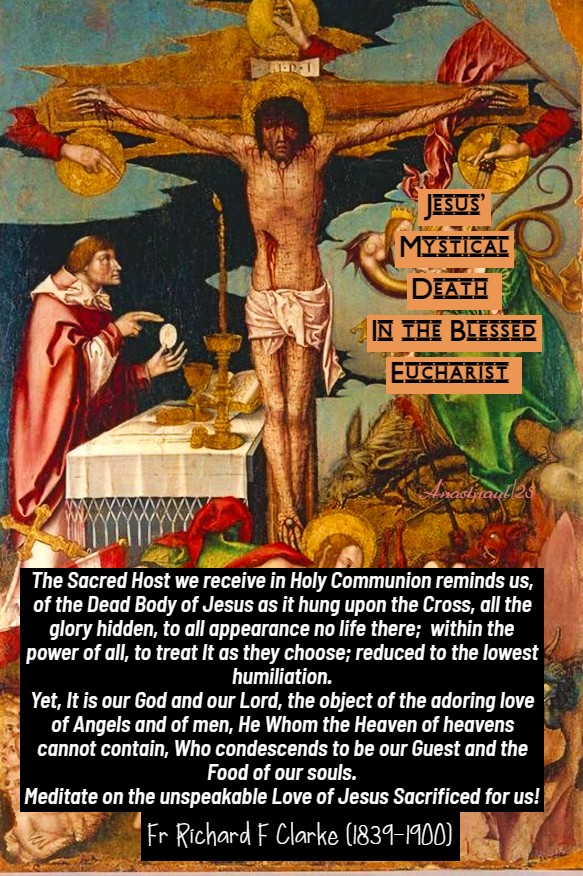
Maundy Thursday Jesus’ Mystical Death In the Blessed Eucharist
Read St John xix:34-37
[34] But one of the soldiers with a spearm opened His Side and immediately there came forth Blood and Water. [35] And he who saw it, hath given testimony and his testimony is true. And he knoweth that he saith true; that you also may believe. [36] For these things were done that the scripture might be fulfilled: You shall not break a bone of Him. [37] And again another scripture saith: They shall look on Him Whom they pierced [John 19:34-37]
+1. Each time the Holy Mass is celebrated, the Sacrifice of our Blessed Lord upon the Cross is represented, in the Sacrifice which takes place upon the Altar. Thus, the Lamb slain from the foundation of the world, on the Divine Decree, continues to be mystically slain and will continue as long as the world shall last. With such a sight before our eyes, how can we ever forget Him? How can we ever lose heart or become dejected, with this abiding proof of His tender Love before our eyes?
+2. In the Blood and Water which flowed from Our Lord’s Side when pierced by the centurion’s spear are represented the Sacraments of the Church, the Blood of Christ which extricates us in Holy Communion, the Water which cleanses our souls in Baptism and Penance. His Sacred Heart which was opened then, is open still; the rich stream of graces still continues; it has flowed even unto me. What countless graces I have received from the Love which has been poured upon me from the Sacred Heart of Jesus!
+3. The Sacred Host we receive in Holy Communion reminds us, of the Dead Body of Jesus as it hung upon the Cross, all the glory hidden, to all appearance no life there; within the power of all, to treat It as they choose; reduced to the lowest humiliation. Yet, It is our God and our Lord, the object of the adoring love of Angels and of men, He Whom the Heaven of heavens cannot contain, Who condescends to be our Guest and the Food of our souls. Meditate on the unspeakable Love of Jesus Sacrificed for us!
One Minute Reflection – 17 April – “The Month of the Resurrection and the Blessed Sacrament” – Maundy Thursday – 1 Corinthians 11:20-32 – John 13:1-15 – Scripture search here: https://www.drbo.org/
“He loved them unto the end.” – John 13:1
REFLECTION – “Before the feast of the Pasch, Jesus, knowing His hour had come to leave this world and go unto His Father, “having loved those who were His Own, unto the end, He loved them”… In the Gospel John was specially called “the disciple whom Jesus loved.” This disciple declares here what manner of faithful Lover our holy Saviour was, of Whom he, himself, was so beloved.
For unto these words, he straightaway joins, the rehearsing of Christ’s bitter Passion, beginning with the Last Supper and therein, His humble washing of His disciples’ feet, the sending forth of the traitor and after that, His teaching, His prayer, His capture, His judging, His scourging, His crucifying andH all the whole piteous tragedy of His most bitter Passion.
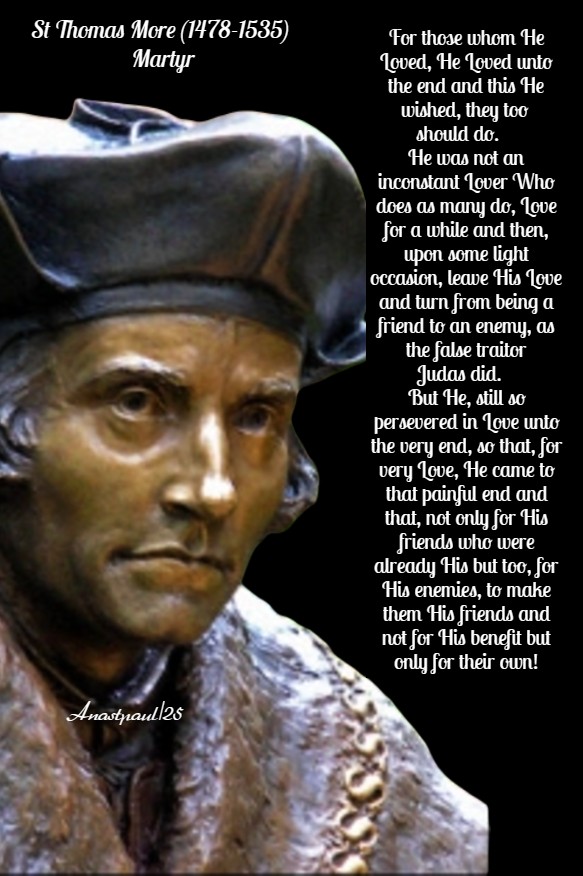
Before which things, St John sets the aforesaid words to declare all these things which Christ did, in all this, He did it for very Love. Which Love He declared well unto his disciples in many ways, at the time of His Last Supper, giving them charge that, in loving each other they should follow His example (Jn 13:34). For those whom He Loved, He Loved unto the end and this He wished, they too should do. He was not an inconstant Lover Who does as many do, Love for a while and then, upon some light occasion, leave His Love and turn from being a friend to an enemy, as the false traitor, Judas did.But He, still so persevered in Love unto the very end, so that, for very Love, He came to that painful end and that, not only for His friends who were already His but too, for His enemies, to make them His friends and not for His benefit but only for their own!” – St Thomas More (1478-1535) Martyr, Lord Chancellor of England (Treatise on the Passion, 1).
PRAYER – O God, from Whom Judas received the punishment of his guilt and the thief the reward of his confession: grant unto us the full fruit of Thy clemency, that even as in His Passion, our Lord Jesus Christ gave to each a retribution according to his merits, so having taken away our old sins, He may bestow upon us the grace of His Resurrection. Who with Thee lives and reigns in the unity of the Holy Ghost, God, world without end. Amen (Collect).
Our Morning Offering – 17 April – Maundy Thursday in Holy Week
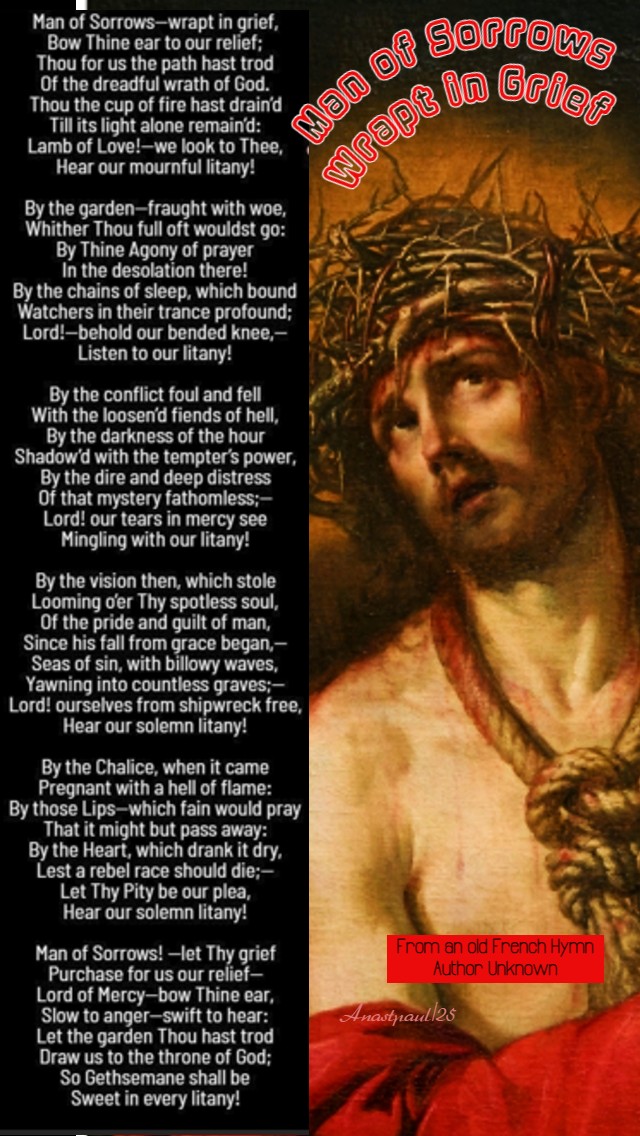
Man of Sorrows—Wrapt in Grief From an old French Hymn Author Unknown
Man of Sorrows—wrapt in grief, Bow Thine ear to our relief; Thou for us the path hast trod Of the dreadful wrath of God. Thou the cup of fire hast drain’d Till its light alone remain’d: Lamb of Love!—we look to Thee, Hear our mournful litany!
By the garden—fraught with woe, Whither Thou full oft wouldst go: By Thine Agony of prayer In the desolation there! By the chains of sleep, which bound Watchers in their trance profound; Lord!—behold our bended knee,— Listen to our litany!
By the conflict foul and fell With the loosen’d fiends of hell, By the darkness of the hour Shadow’d with the tempter’s power, By the dire and deep distress Of that mystery fathomless;— Lord! our tears in mercy see Mingling with our litany!
By the vision then, which stole Looming o’er Thy spotless soul, Of the pride and guilt of man, Since his fall from grace began,— Seas of sin, with billowy waves, Yawning into countless graves;— Lord! ourselves from shipwreck free, Hear our solemn litany!
By the Chalice, when it came Pregnant with a hell of flame: By those Lips—which fain would pray That it might but pass away: By the Heart, which drank it dry, Lest a rebel race should die;— Let Thy Pity be our plea, Hear our solemn litany!
Man of Sorrows! —let Thy grief Purchase for us our relief— Lord of Mercy—bow Thine ear, Slow to anger—swift to hear: Let the garden Thou hast trod Draw us to the throne of God; So Gethsemane shall be Sweet in every litany!
This translation by Matthew Bridges (1800-1894) (The Passion of Jesus 1852) Hymnist, Poet, Writer Converted to Catholicism in 1848, by the influence of John Henry Newman (1801-1890)
Saint of the Day – 17 April – Saint Wando (c665-756) Abbot of Fontenelle/St Wandrille’s Monastery. Born in Neustria in France and died on 17 April 756 at the Abbey of Fontenelle in Normandy. Also known as – Vando… Vandone … Wanda.
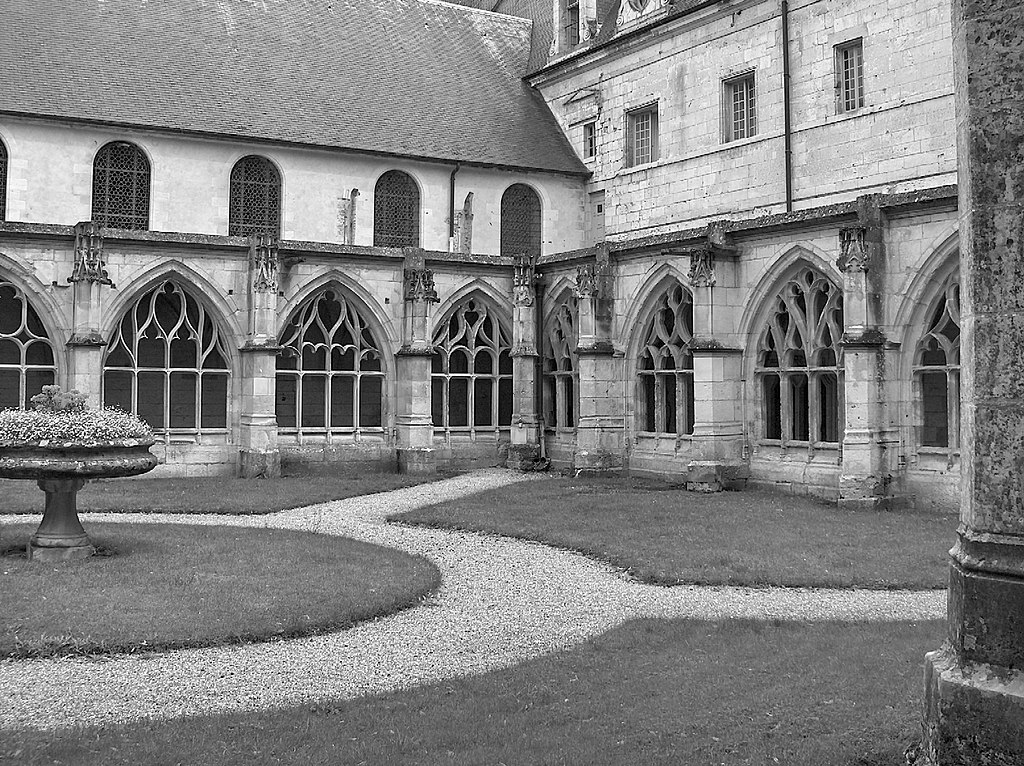
This is St Wandrille who founded Fontenelle Abbey
Wando was born into a noble family in Neustria, France, around 665. From his youth he showed a deep inclination for religious life, so much so that, he chose to embrace the monastic vocation.
He joined the Abbey of Fontenelle, in Normandy, under the guidance of the Abbot Saint Lanfranc. Wando distinguished himself for his piety, religious fervour and obedience to the Benedictine Rule.
He was soon appointed Prior of the Monastery, a position he held with wisdom and dedication. His fame for sanctity soon spread, attracting numerous faithful to the Abbey, who desired to receive his spiritual guidance.
However, his life was not without turbulence. In 716, due to political intrigues, he was unjustly accused of treason and forced into exile. He took refuge in the Monastery of Saint Servatius in Maastricht, where he spent 28 years in exile, dedicating himself to prayer, meditation and study. In 747, with the accession to the throne of Pepin the Short, son of Charles Martel, Wando was finally rehabilitated and recalled to the Abbey of Fontenelle. Despite his advanced age and the blindness that afflicted him, he resumed the leadership of the Monastery with the same zeal and wisdom as before.
Wando concluded his earthly existence on 17 April 754, at the age of about 90 at his beloved Fontanelle Abbey.
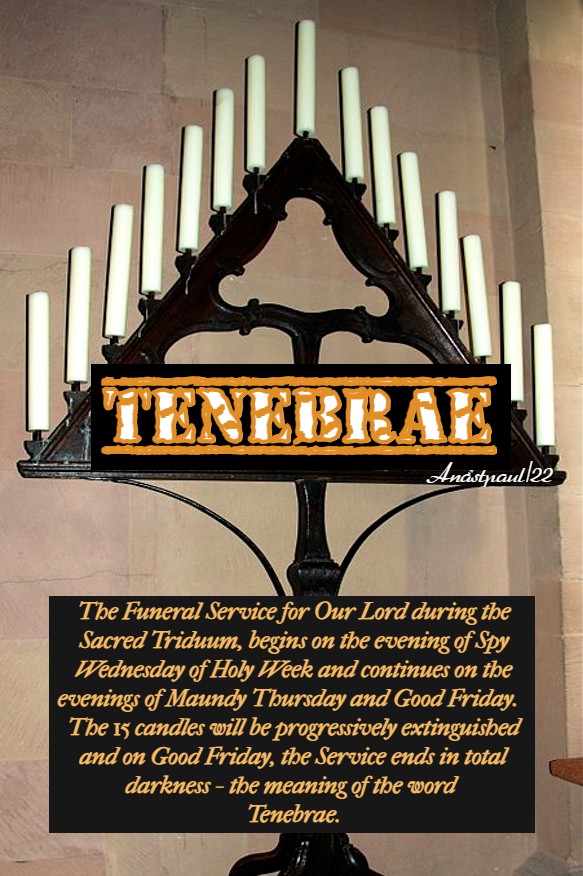
The OFFICE of TENEBRAE The Office of Tenebrae The public singing of part of the Divine Office, on Wednesday, Thursday and Friday evenings in Holy Week, anticipating Matins and Lauds of Holy Thursday, Good Friday and Holy Saturday. This custom goes back centuries and acquired the name because of the mourning ritual surrounding the ceremony which includes a triangular candlabra bearing fifteen candles. These are extinguishedt one by one until, after the last candle is extinguished, a prayer is said in darkness, one candle is lit and the assembly dispersed in silence.
Bl essed Andrés Hibernón Real OFM (1534-1602) Religious Friar, Apostle of the Holy Eucharist, the Blessed Virgin and the Holy Rosary, Apostle of the poor. He predicted the date of his death four years before the fact, which was 18 April 1602 in Gandia, Valencia, Spain of natural causes immediately after having prayed a rosary. He was Beatified on 22 May 1791 by Pope Pius VI. His body is incorrupt. A Life of Love: https://anastpaul.wordpress.com/2018/04/17/saint-of-the-day-17-april-blessed-andres-hibernon-real-o-f-m-1534-1602/
St Agia of Hainault St Anthia of Illyria St Athanasia of Aegina St Bitheus St Calocerus of Brescia St Cogitosus St Corebus
St Eleuterius of Illyria St Elpidius of Melitene St Eusebius of Fano St Galdinus of Milan St Gebuinus of Lyons St Genocus St Hermogenes of Melitene St Innocent of Tortona Bishop and Confessor Bl Idesbald of Dunes Blessed James of Cerqueto OSA (1285-1366)
Blessed Mariana of Jesus OdeM (c1565-1624) “The Lily of Madrid” Tertiary Sister of the Mercadarian Order (the Servants of Mary) Mystic and Ecstatic, graced with Visions of Our Lord and His Mother and granted the ability, by her intercession, to be responsible for many miracles, Spiritual Director and Apostle of the poor and the sick. In addition, Mariana was known to bilocate and levitate during her ecstasies. Patronages – of Madrid, Mercedarian Tertiaries Mercedarian Lay Fraternities and Apostolates. Her body is Incorrupt. “The Lily of Madrid”: https://anastpaul.com/2024/04/17/saint-of-the-day-17-april-blessed-mariana-of-jesus-odemc1565-1624-the-lily-of-madrid/
St Pantagathus of Vienne Bishop St Perfecto of Córdoba St Pusicio
St Robert de Turlande/Chaise-Dieu OSB (c1000-1067) Priest, professed religious of the Order of St Benedict, Monk, Abbot, Apostle of Charity, Marian devotee. He was of noble stock, was related to Saint Gerald of Aurillac (c855–c909) and was a descendant of St Caesarius of Arles (470-543). He is best known for the establishment of the Benedictine Convent of La Chaise-Dieu (‘Home of God’) and for his total commitment to the poor. He became a spiritual inspiration for Pope Clement VI (1291–1352) – whose own origin,s in the religious life were based at that Convent – and it was Pope Clement who confirmed the Canonisation of the Benedictine Abbot on 19 September 1351 in Avignon. His Devoted Life: https://anastpaul.com/2019/04/17/saint-of-the-day-17-april-st-robert-de-chaise-dieu-osb-c-1000-1067/














 AnaStpaul
You must be logged in to post a comment.