Thought for the Day – 18 June – Meditations with Antonio Cardinal Bacci (1881-1971)
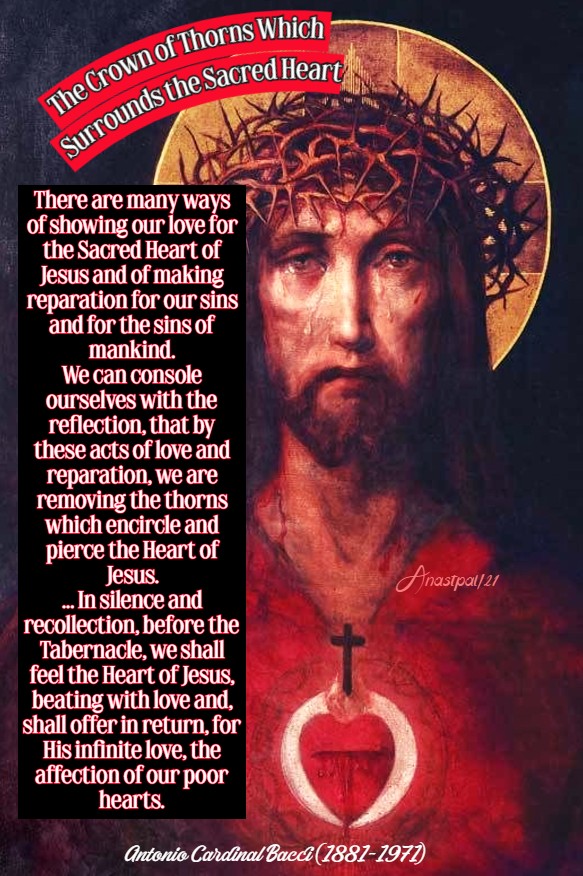
The Crown of Thorns Which Surrounds the Sacred Heart
“There are many ways of showing our love for the Sacred Heart of Jesus and of making reparation for our sins and for the sins of mankind. We can console ourselves with the reflection, that by these acts of love and reparation, we are removing the thorns which encircle and pierce the Heart of Jesus. The simplest ways of doing this, are by prayers, aspirations and expressions of love, directed towards the adorable Heart of our Redeemer and, by visits to Jesus in the Blessed Sacrament. In silence and recollection, before the Tabernacle, we shall feel the Heart of Jesus, beating with love and, shall offer in return, for His infinite love, the affection of our poor hearts.
We can also receive Holy Communion in reparation. When Jesus is in us and we are in Jesus, it will be easier and more pleasant, to offer Him our love and expiation. We can make reparation also, by practising the devotion of the First Fridays of the month. This pious practice, so pleasing to the Heart of Jesus, aims at being a mass offering of love and reparation, for the sins of the entire human race!”
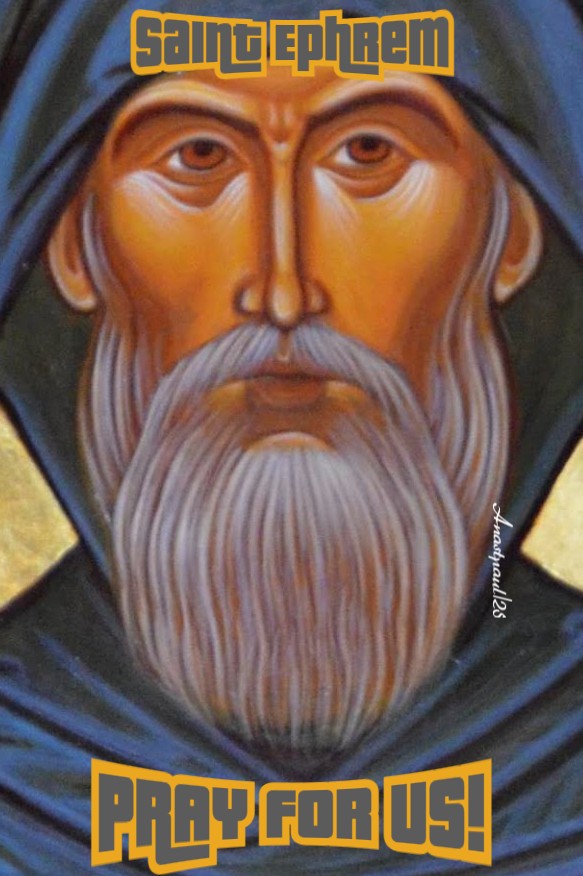
Quote/s of the Day – 18 June – St Ephrem (306-373) Father & Doctor of the Church, “The Harp of the Holy Ghost!”
“And lo a Voice out of the cloud, saying: This is My Beloved Son, in Whom I Am well pleased, hear ye Him.” Matthew 17:5
“He leads them up a high mountain and shows them His royalty before suffering, His power before dying, His glory before being insulted and His honour before undergoing ignominy. In this way, when He will be captured and Crucified, His Apostles will understand that He did not undergo this because of weakness but, to consent and willingly so, for the salvation of the world.”
“The Cross gives Light to the whole universe; it casts out darkness and gathers nations together in charity, into One Church, One Faith, One Baptism…”
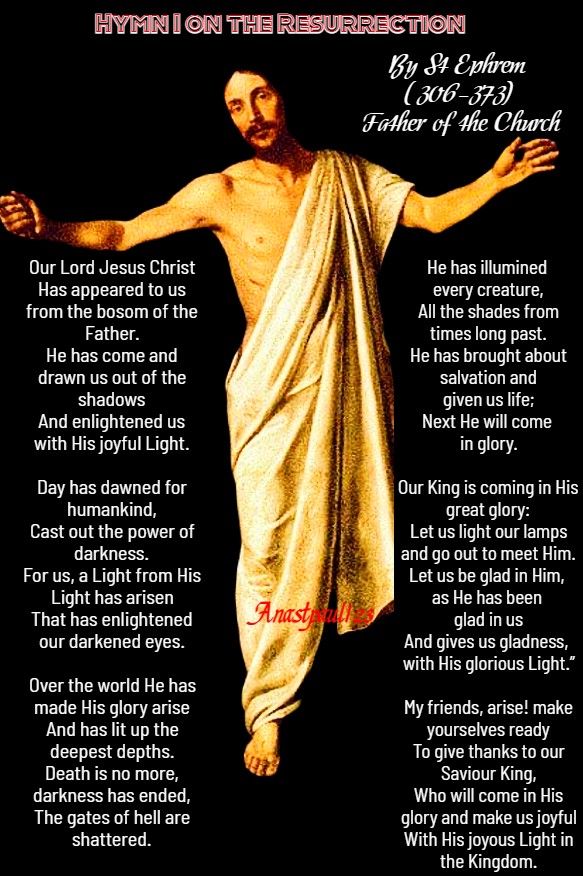
“Our Lord Jesus Christ Has appeared to us from the bosom of the Father. He has come and drawn us out of the shadows And enlightened us with His joyful Light.
Day has dawned for humankind, Cast out the power of darkness. For us, a Light from His Light has arisen That has enlightened our darkened eyes.
Over the world He has made His glory arise And has lit up the deepest depths. Death is no more, darkness has ended, The gates of hell are shattered.
He has illumined every creature, All the shades from times long past. He has brought about salvation and given us Life; Next He will come in glory.
Our King is coming in His great glory: Let us light our lamps and go out to meet Him (Mt 25,6); Let us be glad in Him, as He has been glad in us And gives us gladness, with His glorious Light.
My friends, arise! make yourselves ready To give thanks to our Saviour King, Who will come in His glory and make us joyful With His joyous Light in the Kingdom.”
(Hymn I on the Resurrection)
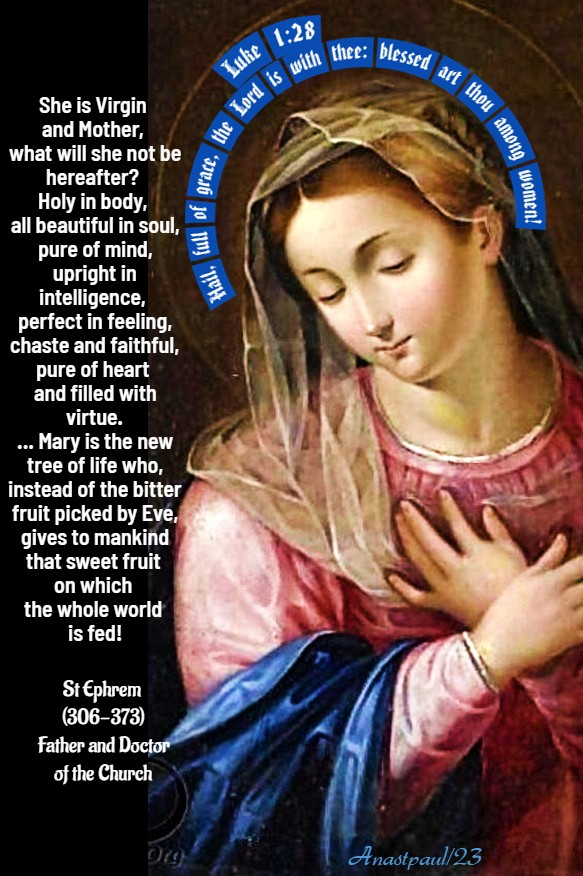
“She is Virgin and Mother, what will she not be hereafter? Holy in body, all beautiful in soul, pure of mind, upright in intelligence, perfect in feeling, chaste and faithful, pure of heart and filled with virtue.
… Mary is the new Tree of Life, who, instead of the bitter fruit picked by Eve, gives to mankind that Sweet Fruit on which the whole world is fed.”
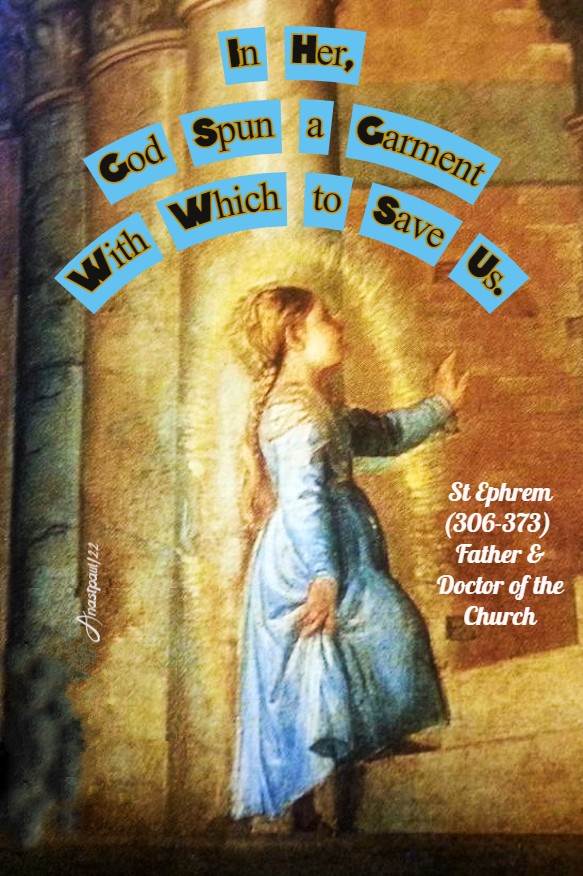
“In her, God spun a garment with which to save us.”
One Minute Reflection – 18 June – “The Month of the Most Sacred Heart of Jesus” – St Ephrem (306-373) Father & Doctor of the Church, “The Harp of the Holy Ghost!” – Timothy 4:1-8 – Matthew 5:13-19 – Scripture search here: https://www.drbo.org/
“Neither do men light a candle and put it under a bushel but upon a candlestick that it may shine to all in the house.” – Matthew 5:15
REFLECTION – “Men do not light a candle and put it under a bushel …” Through these words, Jesus again encourages His disciples to lead an irreproachable life, by advising them to watch over themselves constantly because, they are placed in the sight of all humankind, like athletes in a stadium, who are seen by the whole world (1 Cor 4:9).
He told them: “Do not say to yourselves: ‘Now we can stay here quietly sitting, we are hidden in a little corner of the world,’ for you will be visible to all humankind, like a City on top of a mountain (Mt 5:14), like a light in the house which has been placed on the lamp stand … I have lit the light of your torch but it is up to you to see it is kept burning, not just to your personal advantage but also, in the interest of all who will see it and who, through it, will be led to the Truth. The worst wickedness would not put a shadow over your light, if you live with the vigilance of those who are called to bring the whole world to good. So, let your life correspond to the holiness of your mission, so that God’s grace may be proclaimed everywhere.” – St John Chrysostom (347-407) Father and Doctor of the Church (Homilies on St Matthew’s Gospel No 15).
PRAYERS – O God, Who willed to enlighten Thy Church by the wondrous learning and glorious merits of the life of blessed Ephrem, Thy Confessor and Doctor, we humbly pray Thee that, by his pleading, Thou will shield her with Thy lasting power, against the snares of error and evil. Through Jesus Christ, Thy Son our Lord, Who lives and reigns with Thee, in the unity of the Holy Ghost, God, world without end. Amen (Collect).
MAY the Heart of JESUS in the most Blessed Sacrament be praised, adored and loved with grateful affection, at every moment, in all the Tabernacles of the world, even to the end of time. Amen.Indulgence 100 Days, Once a day. Raccolta 161 Blessed Pius IX, 29 February 1868.
Our Morning Offering – 18 June – “The Month of the Most Sacred Heart of Jesus”
O Heart of Jesus in the Blessed Sacrament By The League of the Sacred Heart 1929 (Ireland)
O Heart of Jesus in the Blessed Sacrament, overflowing with gentleness, tenderness and charity, I bury in the abyss of Thy Mercy, all my iniquities and all my negligence. I offer Thee my labours and my sufferings, my sorrows and my miseries, I recommend to Thee my life and my death. Solace my doubts Sweet Jesus, calm my fears and grant, that day-by-day, I may become more united to Thy Sacred Heart, learning Thy love and Thy holiness. Amen
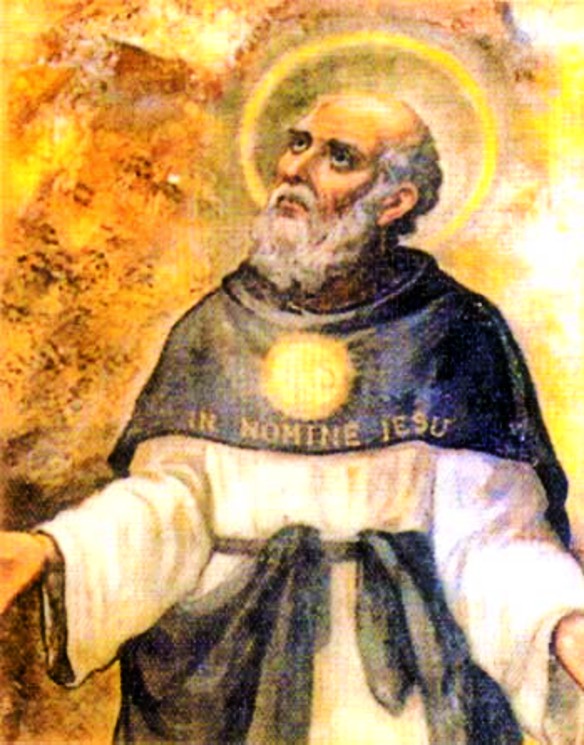
Saint of the Day – 18 June – Saint Calogerus (c466-c561) Hermit in Sicily, Missionary evangeliser graced with visions and the charism of casting out demons as an Exorcist, Born in c466 in Chalcedon, Thrace in Egypt and died in c561 at Monte Cronios, Sciacca, Sicily. Patronage – of Petralia Sottana a Town in Sicily. Also known as – Calogero, Calogerus of Sicily, … the Hermit, Calogerus of Sicily. The name Calogerus, is of Greek origin and means “elderly beauty.” In the Greek ideal of beauty, that which is beautiful is also fair and good, suffice it to remember in the Gospel according to St John, the original Greek version calls Jesus the “beautiful Shepherd” which later became the “good Shepherd.”
This term was used in the East and in southern Italy for the Hermit Monks, who were thus called Caloyers or Calogeri, Therefore, some experts believe that this was not the name of our Hermit Haint but rather the appellation he was recognised by. However, other scholars are convinced that this was, in fact, his name.
The Roman Martyrology reads today: “At Sacca, in Sicily,, St Calogerus, Hermit, whose holiness is principally manifested by the deliverance of possessed persons.”
According to tradition, since there is no certain documentation, Calogerus was born around 466 in Chalcedon on the Bosphorus, a Town in ancient Thrace which, in 46 became a Roman Province and then followed the fate of the Byzantine Empire.
Since Calogerus’ childhood he fasted, prayed and studied the Holy Scripture and according to the ‘Acts’ taken from the ancient Siculo-Gallican Breviary, in use in Sicily from the 9th Century to the 16th, he came to Rome on a pilgrimage, receiving from Pope Felix III (483-492), permission to live in solitude in an unspecified place.
Here, he had an angelic vision or a celestial inspiration which instructed him to evangelise Sicily. When he returned from the Pope, he obtained authorisation to go to the island, with his companions Philip, Onofrius and Archileone, to free that people from demons and from the worship of pagan gods. He and his companions spread out to different places to more effectively spread the Gospel.
During stay on the island of Lipari, Calogerus had a vision of the death of King Theodoric († 526) who, in recent years had begun to persecute those Latins he considered a danger to his kingdom, among whom were the philosopher Boethius (480-524). This is reported in the ‘Dialogues’ of Pope St Gregory I the Great, the vision had come true on the exact day and hour of the King’s death and Calogerus saw his soul hurled into the crater of the nearby Volcano.
Calogerus is also held to have worked as a missionary on Lipari in the Aeolian Islands, before retiring to live as a solitary Hermit on Monte Giummariaro which is now sometimes called in Sicilian: Monte San Caluòru in his honour, as is another mountain near Palermo. Calogerus settled in a cave adjacent to the vaporous ones, which, as in Lipari, also exist here in abundance.
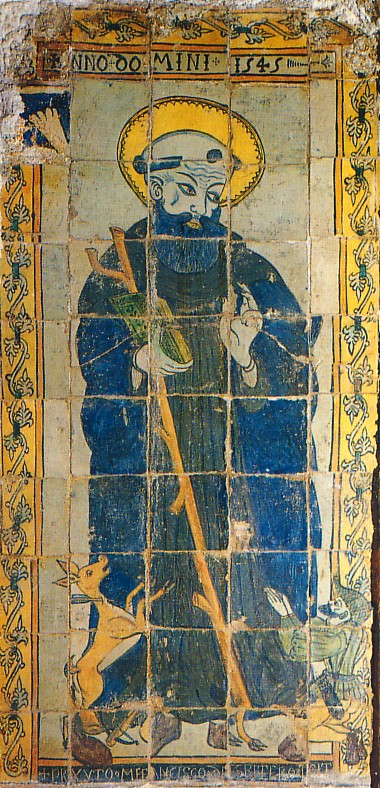
In said cave, there is a majolica image (see below) of St Calogerus walled into the rock, placed above a rustic Altar which is said to have been built by himself, The image is from 1545 and represents the bearded hermit holding a book and a stick-branch in his right hand, at his feet there is a kneeling believer and a doe collapsed and wounded by an arrow.
Saint Calogerus from the Cave above Monte Giummariaro dated 1545, Calogerus the Hermit, Calogerus of Sicily, San Calogero
The image refers to an episode of his last days, being now over ninety years old, he could no longer feed himself, so God sent him a doe which fed him with her delicate milk. One day, a hunter named Sierus, seeing the animal, took his bow and pierced the doe with an arrow which managed to drag itself inside Calogerus’ cave, dying in his arms.
The repentant and crying hunter, recognised, in the old man, the one who had Baptised him years before, asked for forgiveness and Calogerus took him to the nearby steamy cave, giving him instructions for the healing properties of that steam and the waters which flowed from that mountain. The hunter Sierus, who had become his disciple, often climbed the mountain to visit him but 40 days after killing the doe, he found the old hermit dead, still kneeling before the Altar. According to tradition, he had died in the cave between 17 and 18 June 561 and had lived in that place for 35 years.
When the news spread, the inhabitants of the nearby Towns flocked to him and buried him in the cave itself which was then transferred to another cave, whose memory has been lost over the centuries.
It should be added that the Relics of the Saint, according to another tradition, were later transferred to a Monastery three km from the cave. And, in 1490 they were moved to Fragalà (Messina) by the Basilian Monk Urbano da Naso and then to Frazzanò (Messina), to the Parish Church. Some of his Relics are kept in the Sanctuary of San Calogerus built near his cave in the 17 Century. This Church is now a destination for pilgrimages.
In any case, St Calogerus is venerated throughout Sicily and in all the Cities he is honoured with Processions and celebrations, typical of the intense pirty and devotion of the Sicilians, almost all of which take place on his Feastday on 18 June.
St Alena of Dilbeek St Amandus of Bordeaux St Arcontius of Brioude St Athenogenes of Pontus St Calogerus (c466-c561) Hermit in Sicily St Calogerus of Fragalata St Calogerus the Anchorite St Colman mac Mici St Cyriacus of Malaga St Demetrius of Fragalata St Edith of Aylesbury
St Elpidius of Brioude St Equizio of Telese St Erasmo St Etherius of Nicomedia Bl Euphemia of Altenmünster St Fortunatus the Philosopher St Gerland of Caltagirone St Gregory of Fragalata
St Osanna of Northumberland St Osmanna of Jouarre St Paula of Malaga Bl Peter Sanchez
Hermits of Karden: A father (Felicio) and his two sons (Simplicio and Potentino) who became pilgrim to various European holy places and then Hermits at Karden (modern Treis-Karden, Germany). (Born in Aquitaine (in modern France. ) Their relics transferred to places in the Eifel region of western Germany at some point prior to 930. They were Canonised on 12 August 1908 by Pope Pius X (cultus confirmation).
Martyrs of Ravenna – 4 Saints: A group of four Christians Martyred together. We have no details but their names – Crispin, Cruciatus, Emilius and Felix. They were martyred in Ravenna, Italy, date unknown.
Martyrs of Rome – 3 Saints: Three Christians Martyred together . We have no details but their names – Cyriacus, Paul and Thomas. In Rome, Italy, date unknown.
Martyrs of Tripoli – 3 Saints: Three imperial Roman soldiers, at last two of them recent converts, who were imprisoned, tortured and executed for their faith. Martyrs – Hypatius, Leontius and Theodulus. They were Greek born and they died c135 at Tripoli, Phoenicia (in modern Lebanon).










 AnaStpaul
You must be logged in to post a comment.