Posted in "Follow Me", CATHOLIC Quotes, CHRIST, the WAY,TRUTH,LIFE, FEASTS and SOLEMNITIES, LOVE of NEIGHBOUR, OUR Cross, QUOTES on BAD CONVERSATION, QUOTES on CHARITY, QUOTES on COURAGE, QUOTES on DISCIPLESHIP, QUOTES on HUMILITY, QUOTES on LOVE of GOD, QUOTES on REPENTANCE

Thought for the Day – 24 June – The Forerunner’s Office

Thought for the Day – 24 June – Meditations with Fr Richard Frederick Clarke SJ (1839-1900)

From “The Devout Year”
By Fr Richard Frederick Clarke SJ (1839-1900)

The Forerunner’s Office .
+1. St John was something more than a Herald.
He had to prepare the way for the King, to make the crooked ways straight and the rough places smooth. His office was that which is entrusted to us all in our own sphere – to try and make the way in which the followers of Christ have to tread straight and easy.
What a privilege, if we can, by our charity and our edifying life, make the path of life easier for those whose lot it is to tread the way of the Cross and to walk over rough or stormy paths!
Is this your endeavour in your daily life, or do you place obstacles in the path of others by your bad example, want of charity and consideration, impatience, etc?

+2. St John , as the Herald or Forerunner of Christ, had to proclaim the coming of the King.
He, himself expresses this by his description of himself as the voice of one who cries in the desert; that is , Christ spoke through his mouth.
So He speaks through the mouths of all His servants in proportion to their devotion and singleness of purpose.
How poor an echo are my words of the whispers of Christ to the faithful soul! How mixed with the discordant notes
of self-will and worldliness!

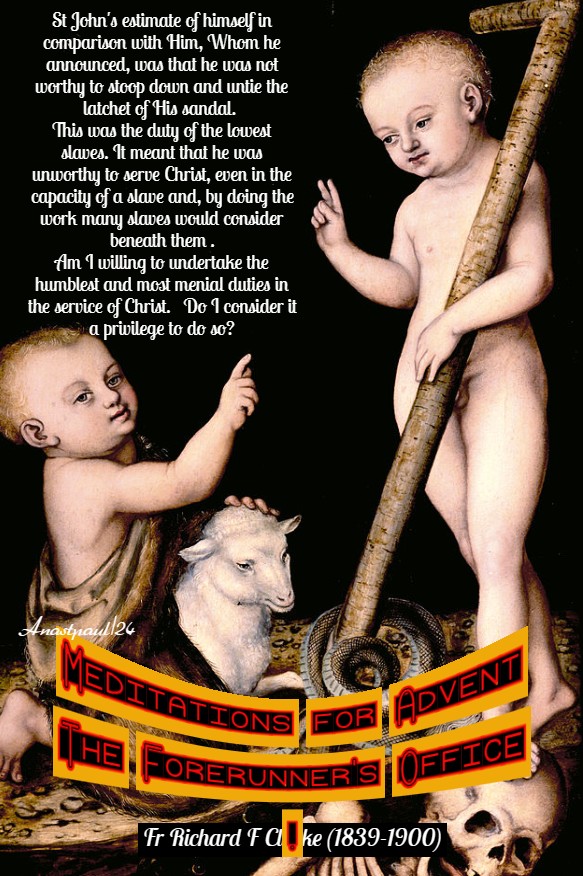
+3. St John’s estimate of himself in comparison with Him, Whom he announced, was that he was not worthy to stoop down and untie the latchet of His sandal. This was the duty of the lowest slaves. It meant that he was unworthy to serve Christ, even in the capacity of a slave and, by doing the work many slaves would consider beneath them .
Am I willing to undertake the humblest and most menial duties in the service of Christ. Do I consider it a privilege to do so?

Posted in HYMNS, POETRY, St JOHN the BAPTIST, The WORD

Quote/s of the Day – 24 June – St John the Baptist

Quote/s of the Day – 24 June – The Nativity of St John the Baptist

Amen I say to you.
there hath not risen
among them that are
born of women,
a greater than
John the Baptist.

Matthew 11:11

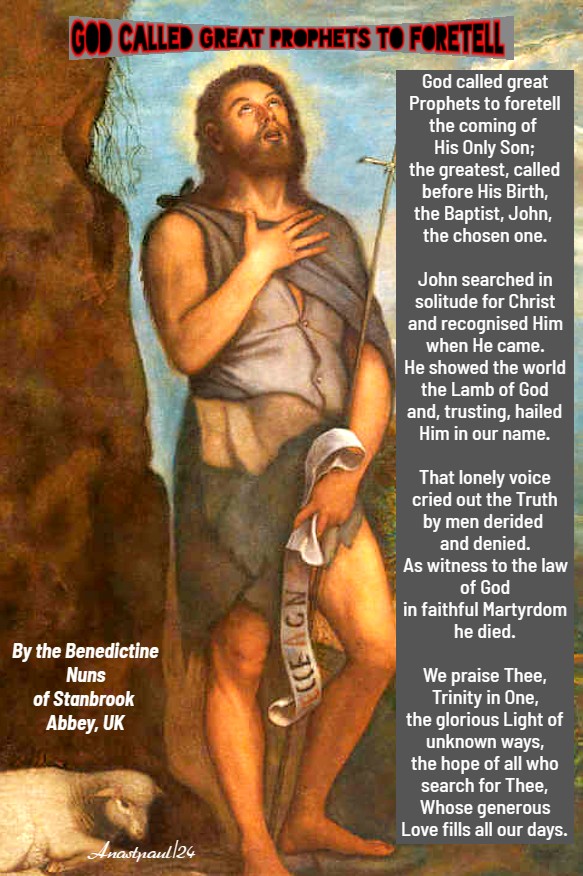
God Called Great Prophets to Foretell
By the Benedictine Nuns
of Stanbrook Abbey, UK

God called great Prophets to foretell
the coming of His Only Son;
the greatest, called before His Birth,
the Baptist, John, the chosen one.

John searched in solitude for Christ
and recognised Him when He came.
He showed the world the Lamb of God
and, trusting, hailed Him in our name.

That lonely voice cried out the Truth
by men derided and denied.
As witness to the law of God
in faithful Martyrdom he died.

We praise Thee, Trinity in One,
the glorious Light of unknown ways,
the hope of all who search for Thee,
Whose generous Love fills all our days.

In the Divine Office, God Called Great Prophets to Foretell, is used for Morning Prayer on the Memorial of the Beheading of St John the Baptist, as well as with Evening Prayer I on Solemnity of the Birth of St John the Baptist.

Posted in BAPTISM, CHRIST the LIGHT, CONFESSION/PENANCE, FATHERS of the Church, ONE Minute REFLECTION, QUOTES on the CHURCH, SACRED HEART ASPIRATIONS, St JOHN the BAPTIST, The WORD

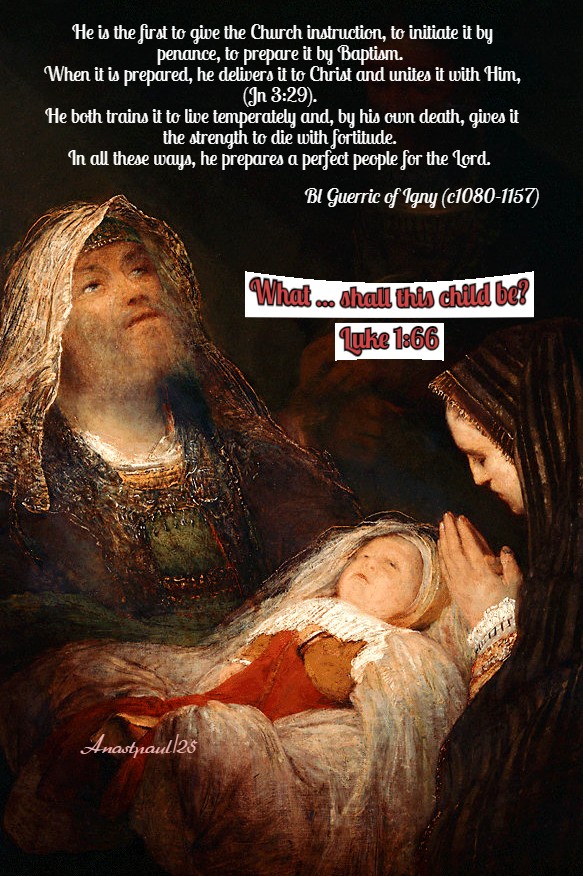
One Minute Reflection – 24 June – What … shall this child be?

One Minute Reflection – 24 June – “The Month of the Most Sacred Heart of Jesus”– Within the Corpus Christi Octave – The Nativity of St John the Baptist – Isaias 49:1-3, 5-7 – Luke 1:57-68 – Scripture search here: https://www.drbo.org/

What … shall this child be? For the hand of the Lord was with him.” – Luke 1:66

REFLECTION – “Rightly then, did the birth of this child make many rejoice then and does make many rejoice today – born in the old age of his parents, he was to preach the grace of rebirth to an aging world. Rightly does the Church solemnly venerate this birth which is wonderfully brought about by grace and, at which nature wonders.

To me certainly, the birth of the world’s Lamp (Jn 5:35) brings fresh joy, for it enabled me to recognise the true Light shining in the darkness but not mastered by the darkness, (Jn1:5.9). His birth brings me a joy utterly unspeakable, for so many outstanding benefits accrue to the world through it.
He is the first to give the Church instruction, to initiate it by penance, to prepare it by Baptism. When it is prepared, he delivers it to Christ and unites it with Him, (Jn 3:29). He both trains it to live temperately and, by his own death, gives it the strength to die with fortitude. In all these ways, he prepares a perfect people for the Lord. (Lk 1:17).” – Bl Guerric of Igny (c1080-1157) Cistercian Abbot (Sermon 1 for Saint John the Baptist).

PRAYER – O God, Who made this a day most worthy of our celebration because of blessed John; grant Thy people the grace of spiritual joys and direct the minds of all the faithful into the path of eternal salvation. T hrough Jesus Christ, thy Son our Lord, Who liveth and reigneth with thee, in the unity of the Holy Ghost, God, world without end. Amen (Collect).

Sweet Heart of my JESUS, Make me love Thee ever more and more!
INDULGENCE – 300 Days. i. Partial, Every time ii. Plenary, once a month. Pope Pius IX, 26 November 1876 Raccolta 162

Posted in BREVIARY Prayers, CATHOLIC-PRAYERS OF THE CHURCH, FATHERS of the Church, Our MORNING Offering, PRAYERS of the CHURCH, St JOHN the BAPTIST

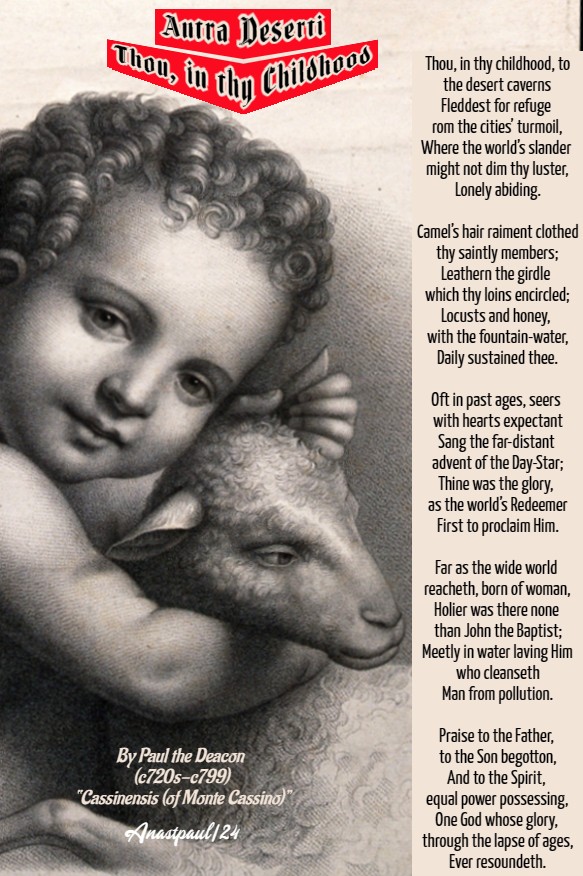
Our Morning Offering – 24 June – Antra Deserti – Thou, in thy Childhood

Our Morning Offering – 24 June – “The Month of the Sacred Heart of Jesus” – Within the Corpus Christi Octave – The Feast of the Nativity of St John the Baptist

Antra Deserti
Thou, in thy Childhood
By Paul the Deacon (c720s-c799)
“Cassinensis (of Monte Cassino)”
Monk, Spiritual Author, Historian, Poet

Thou, in thy childhood, to the desert caverns
Fleddest for refuge from the cities’ turmoil,
Where the world’s slander might not dim thy luster,
Lonely abiding.

Camel’s hair raiment clothed thy saintly members;
Leathern the girdle which thy loins encircled;
Locusts and honey, with the fountain-water,
Daily sustained thee.

Oft in past ages, seers with hearts expectant
Sang the far-distant advent of the Day-Star;
Thine was the glory, as the world’s Redeemer
First to proclaim Him.

Far as the wide world reacheth, born of woman,
Holier was there none than John the Baptist;
Meetly in water laving Him who cleanseth
Man from pollution.

Praise to the Father, to the Son begotton,
And to the Spirit, equal power possessing,
One God whose glory, through the lapse of ages,
Ever resoundeth.

This Hymn, “Ut queant laxis resonare fibris”, is in three parts.
The Breviary and Roman Missal list the above for Matins today, on the Feast of the Nativity of St John the Baptist.

Posted in SAINT of the DAY

Saint of the Day – 24 June – Saint Simplicius (Died c375) Bishop and Confessor

Saint of the Day – 24 June – Saint Simplicius (Died c375) Bishop and Confessor of Autun, married but living in a chaste marriage by mutual consent, Defender of the Faith against heresies, excellent administrator and devoted and zealous shepherd of his flock paying great attention to the temporal and spiritual needs of the poor and lowly. Miracle-worker. He led his Diocese with wisdom and compassion, preaching the Gospel and fighting the heresies which threatened to corrupt the faith of the faithful.

The Roman Martyrology reads today: “At Autun, the demise of St Simplicius, Bishop and Confessor.

Unknown Bishop Statue

Simplicius was born into a noble Gallo-Roman family in Autun, in present-day France. From a young age, he stood out for his piety and moral rigour.

At a time when society was still permeated by pagan customs, Simplicius and his wife, a woman of equal virtue, chose to live in chastity, while remaining united in marriage. This bold and unconventional choice testifies to the depth of their faith and their desire to consecrate themselves entirely to God.

Simplicius’ fame for sanctity and wisdom soon spread, winning the applause and esteem of his fellow citizens. Upon the death of Bishop Hegemonius, the choice of successor fell unanimously upon him. Recognising in him a man of profound faith and exceptional virtue, the people of Autun saw in Simplicius, the idealshepherd for their community.
Having assumed the Episcopate, Simplicius devoted himself with zeal and self-denial to his pastoral task. His work was distinguished by the particular attention paid to the poorest and the needy, to whom he offered relief and material and spiritual support.

The life of Saint Simplicius was studded with miracles and wonders which consolidated his reputation for sanctity. Among the most famous is the miracle performed to expose the falsity of the pagan cult of the pagan goddess, Cybele Berecintiana. According to tradition, Simplicius, with a gesture of unshakable faith, caused the statue of the goddess to collapse, demonstrating the futility of idolatry and converting numerous pagans to Christianity.

Another episode exemplifies his moral integrity and his unshakable faith. Unjustly accused of immorality by his jealous detractors, Simplicius subjected himself to the test of fire, walking barefoot on burning coals. He emerged unscathed from this ordeal, proving his innocence and strengthening his spiritual authority.

Saint Simplicius died in Autun around 375, leaving behind an invaluable spiritual legacy. His memory was immediately venerated by the faithful who considered him a miracle-worker and an intercessor with God. His remains were buried in the Cathedral of Autun, where they became a place of pilgrimage for devotees from all over the region and further afield.

Even today, Saint Simplicius is highly venerated by the Church which celebrates his memory on 24 June. (Author: Franco Diego).

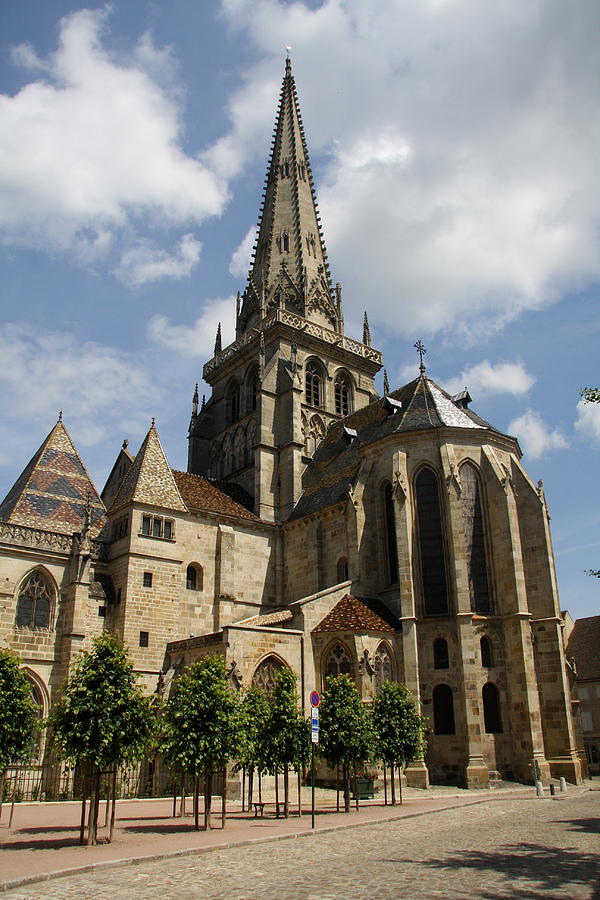
Autun Cathedral
Posted in MARIAN TITLES, SAINT of the DAY, St JOHN the BAPTIST

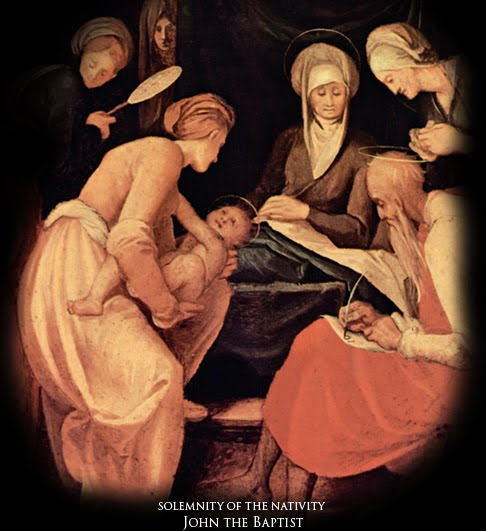
The Nativity of Saint John the Baptist, Madonna della Navicella / Our Lady of the Ship , Italy (1508) and the Saints celebrated on 24 June

Within the Corpus Christi Octave

The Nativity of Saint John the Baptist “The precursor of Jesus”
The Great St John!:

https://anastpaul.com/2018/06/24/the-solemnity-of-the-nativity-of-st-john-the-baptist-24-june/
AND:
https://anastpaul.com/2023/06/24/saint-of-the-day-24-june-the-nativity-of-st-john-the-baptist/

Madonna della Navicella / Our Lady of the Ship , Chioggia, Venezia, Veneto, Italy (1508) – 24 June:
HERE:

https://anastpaul.com/2021/06/24/solemnity-of-the-nativity-of-saint-john-the-baptist-feast-of-the-madonna-della-navicella-our-lady-of-the-ship-chioggia-venezia-veneto-italy-1508-and-memorials-of-the-saints-24-june/

St Aglibert of Créteil
St Agoard of Créteil
St Amphibalus of Verulam

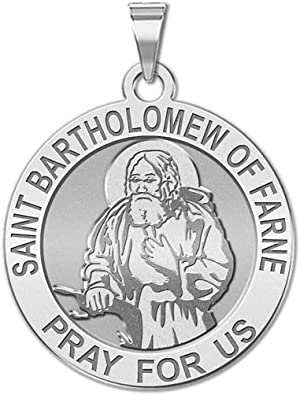
St Bartholomew OSB (Died 1193) Priest, Monk, Hermit of Farne
His Life of Love:

https://anastpaul.com/2020/06/24/saint-of-the-day-24-june-saint-bartholomew-of-farne-osb-died-1193/

St Erembert I of Kremsmünster
St Faustus of Rome and Companions
St Festus of Rome
St Germoc

St Gohardus (Died 843) Bishop of Nantes, Martyr, a Cephalophore (from the Greek for “head-carrier”), Lord of Blain. Born in 8th Century Angers, Neustria (in modern France) died on 24 June 843 in the Cathedral of Saint Peter, Nantes, Marche de Bretagne.
His Holy Life and Death:

https://anastpaul.com/2024/06/24/saint-of-the-day-24-june-saint-gohardus-of-nantes-died-843-and-his-companions-bishop-martyr/

St Henry of Auxerre/the Hagiographer
St Ivan of Bohemia
St John of Rome

St John Theristus (c1049-1129) Italian Basilian Monk and Hermit, called Theristus or “Harvester,” Miracle-worker.
His Life:

https://anastpaul.com/2021/06/24/saint-of-the-day-23-june-st-john-theristus-c-1049-1129/

St John of Tuy
St Joseph Yuan Zaide
St Rumold
St Simplicius (Died c375) Bishop and Confessor of Autun
St Theodulphus of Lobbes

The First Martyrs of the Church of Rome: Countless numbers were Christians Martyred in the City of Rome during Nero’s persecution in 64. The event is recorded by both Tacitus and Pope Clement I, among others. They are celebrated today.

Martyrs of Satala: Seven Christian brothers who were soldiers in the imperial Roman army. They were expelled from the military, exiled and eventually martyred in the persecutions of Maximian. We know little more about them than their names – Cyriacus, Firminus, Firmus, Longinus, Pharnacius, Heros and Orentius. The martyrdoms occurred in c 311 at assorted locations around the Black Sea.