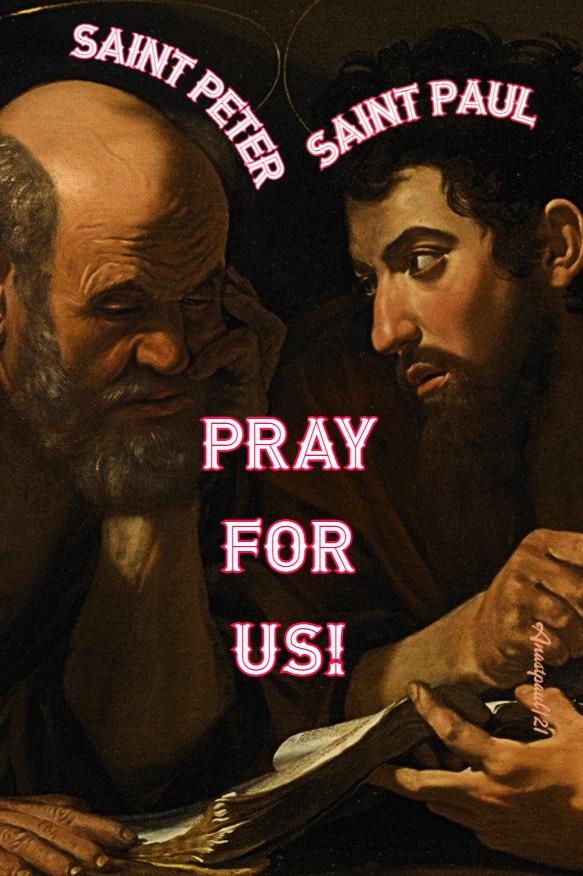
Quote/s of the Day – 29 June – Saints Peter and Paul, Apostles – Acts 12:1-11; Matthew 16:13-19 – – Scripture search here: https://www.drbo.org/
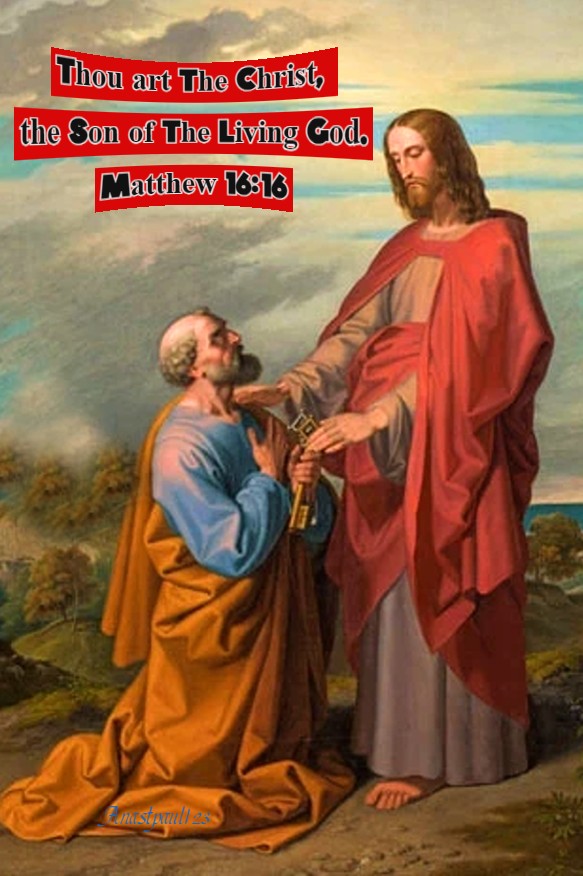
“Thou art the Christ, the Son of the living God.”
Matthew 16:16
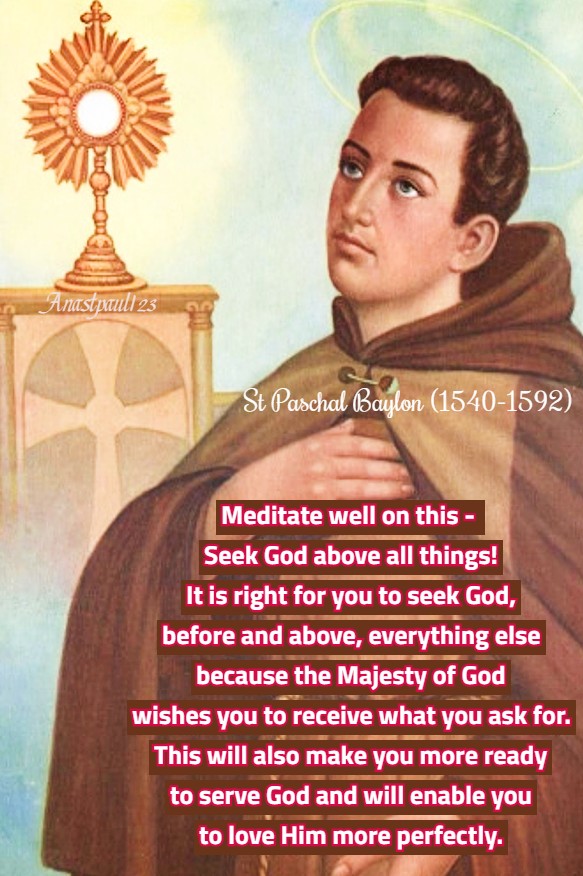
“Meditate well on this – Seek God above all things! It is right for you to seek God, before and above, everything else because the Majesty of God wishes you to receive what you ask for. This will also make you more ready to serve God and will enable you to love Him more perfectly.”
St Paschal Baylon (1540-1592)
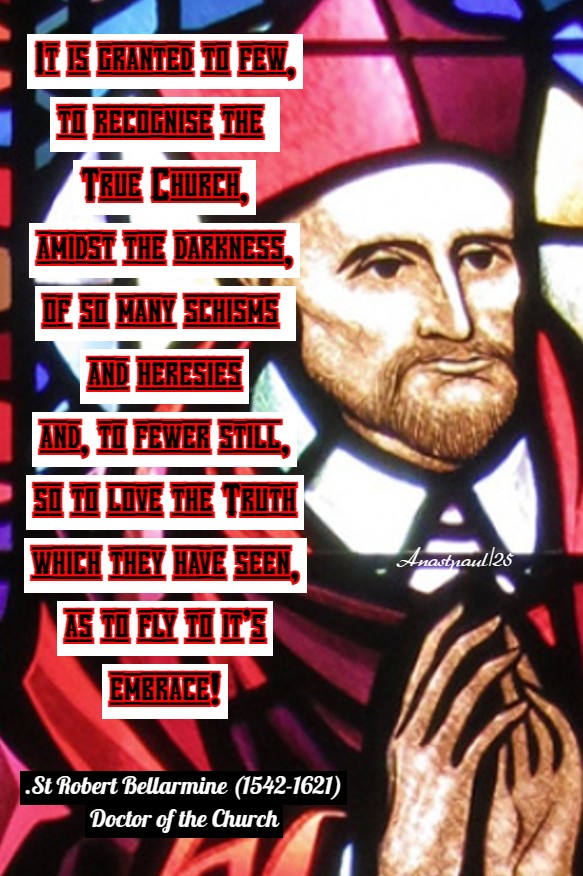
“It is granted to few, to recognise the True Church, amidst the darkness, of so many schisms and heresies and, to fewer still, so to love the Truth which they have seen, as to fly to it’s embrace!”
St Robert Bellarmine (1542-1621) Doctor of the Church
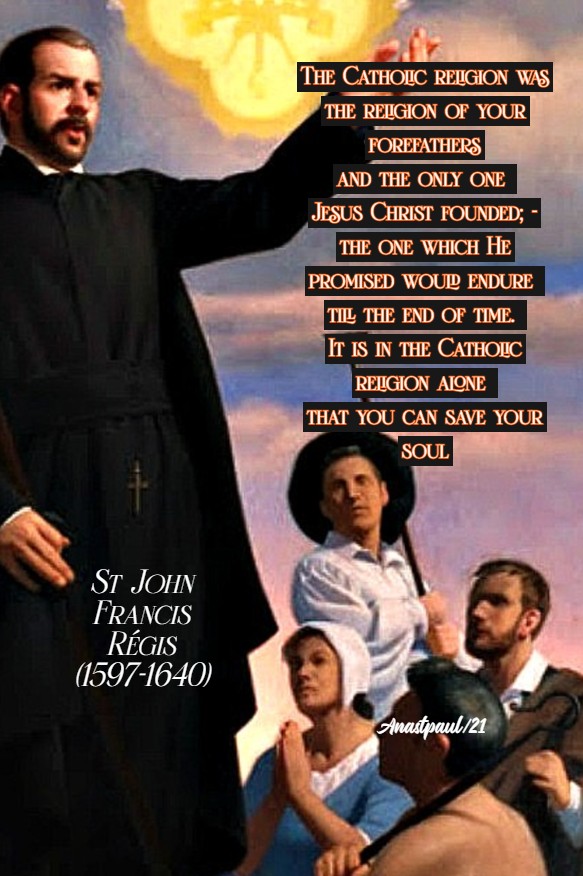
“The Catholic religion was the religion of your forefathers and the only one Jesus Christ founded; – the one which He promised would endure till the end of time. It is in the Catholic religion alone that you can save your soul.”
St John Francis Régis (1597-1640)
“He who most loves, will be most loved.”
St Francis de Sales (1567-1622) Doctor of the Church
One Minute Reflection – 29 June – “The Month of the Most Sacred Heart of Jesus” – Saints Peter and Paul, Apostles – Within the Octave of the Sacred Heart – Pentecost III – Acts 12:1-11 – Matthew 16:13-19 – Scripture search here: https://www.drbo.org/
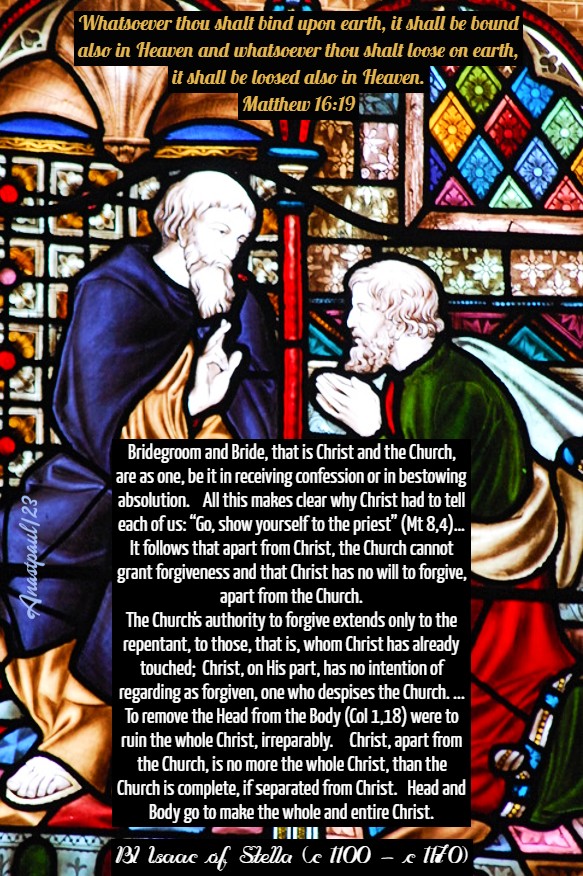
“Whatsoever thou shalt bind upon earth, it shall be bound also in Heaven and whatsoever thou shalt loose on earth, it shall be loosed also in Heaven.” – Matthew 16:19
REFLECTION – “Bridegroom and Bride, that is Christ and the Church, are as one, be it in receiving confession or in bestowing absolution. All this makes clear why Christ had to tell each of us: “Go, show yourself to the priest” (Mt 8,4)… It follows that apart from Christ, the Church cannot grant forgiveness and that Christ has no will to forgive, apart from the Church. The Church’s authority to forgive extends only to the repentant, to those, that is, whom Christ has already touched; Christ, on His part, has no intention of regarding as forgiven, one who despises the Church.
Doubtless, Christ need accept no restraints to His power of Baptising, Consecrating the Eucharist, Ordaining Priests, forgiving sins and the like but, the humble and faithful Bridegroom, prefers to confer such blessings, with the co-operation of His Bride. “What God,” then, “has joined, let no man put asunder” (Mt 19,6). “I say this is a great mystery and refers to Christ and the Church” (Eph 5,32)… To remove the Head from the Body (Col 1,18) were to ruin the whole Christ, irreparably. Christ, apart from the Church, is no more the whole Christ, than the Church is complete, if separated from Christ. Head and Body go to make the whole and entire Christ.” – Bl Isaac of Stella (c 1100 – c 1170) Cistercian Monk, Abbot, Theologian, Philosopher (Sermon 11, §11-814).
PRAYER – O God, Who made this day holy by the Martyrdom of Thy Apostles Peter and Paul, grant Thy Church to follow in all things the teaching of those from whom she first received the faith. Through Jesus Christ, Thy Son our Lord, Who lives and reigns with Thee, in the unity of the Holy Ghost, God, world without end. Amen (Collect).
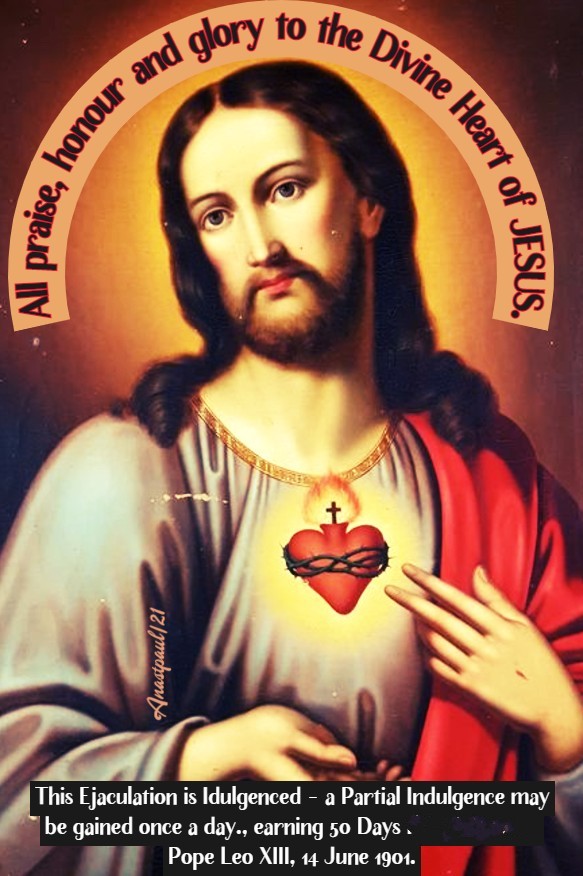
ALL PRAISE, honour and glory to the Divine Heart of JESUS.Indulgenced– 50 Days, once a day. 168 Pope Leo XIII, 14 June 1901.
Our Morning Offering – 29 June – “The Month of the Most Sacred Heart of Jesus”
Apostolorum Passio By St Ambrose (c340-397) Father and Doctor of the Church
This happy day is sanctified As Martyr’s glory we recall, The cross bedewed with Peter’s blood, The sword that won a crown for Paul.
The triumph of their Martyrdom United these great souls in death, Whose faith in Christ had crowned their lives In service to their latest breath.
Saint Peter held the primacy, Saint Paul would equal him in grace, When once, as chosen instrument The cause of Christ, he would embrace
Once, Simon, leaving Rome, turned back To give, by death, full praise to God, That by the cross he too should tread The self-same path his Master trod.
Now Rome exults, as well she may And strives to give devotion’s due To one who sealed with his own blood His work as Priest and Shepherd true.
And who can count the crowds that come As loving children to her gate, Where nations’ teacher, holy Paul Once dwelt and gladly met his fate.
Grant us, O Lord, the final grace Of sharing in their joy above, That with such Princes we may praise Your bounty and undying love. Amen
Translation: The Benedictines of Saint Cecilia’s Abbey, Ryde, UK
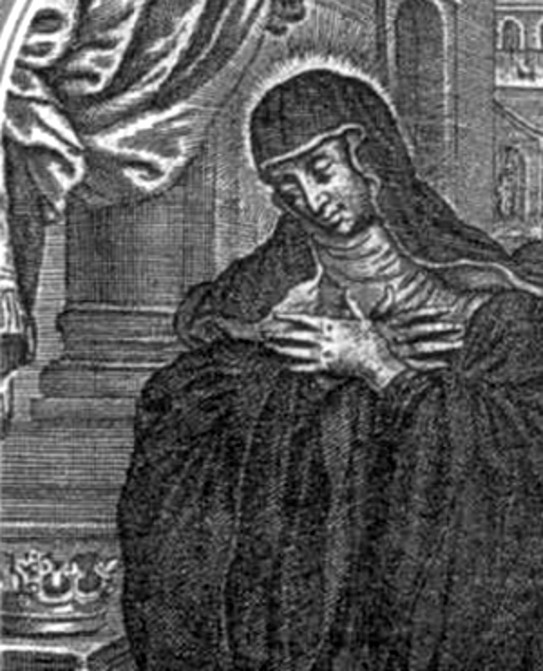
Saint/s of the Day – 29 June – Saint Judith Widow, Recluse and St Salome (9th Century) Recluse both of Niederaltaich in Bavaria.
There is considerable debate regarding the identity of Judith and her companion, St Salome. They may have been cousins (or Judith the aunt of Salome) of Anglo-Saxon Royal lineage, who lived for a considerable period as Recluses under Abbot Walther (or Walker) in Oberaltaich-am-Donau. A later tradition identifies Salome as St Edburga, daughter of King Offa of Mercia, who was exiled for accidentally poisoning her husband. She was then befriended by the Bavarian widow, Judith.
Relics of both were later disinterred and buried near the Altar of St Giles. It is thought that their bodies came to Niederaltaich on the occasion of the destruction of Oberaltaich by the Hungarians.
Another source states that the two Recluses lived in Niederaltaich in about 1100. According to this version, while in the neighbourhood of Regensburg in Germany, after a pilgrimage to the Holy Land, Salome became blind, in answer to prayer, asking for this affliction to escape from sinful proposals.
St Salome
She lived by begging. Once she fell into the Danube and was rescued by a passing boat which took her to Passau. She was recommended to the Abbot of Niederaltaich, who had a Recluse’s cell built for her beside the Monastery Church. Here she was found by her blood relative and childhood playmate, Judith, who having been widowed young and having likewise gone to Jerusalem, had searched for Salome. With permission of the Abbot and the Chapter, Judith was then also given a cell by the Church of Niederaltaich. Both women worked as servants in the Monastery. Both died before the end of the 11th Century, Salome first. This Vita dates from the 13th or 14th Century.
It claims that both bodies were interred in a common Shrine before the Altar of St Giles although they have since been lost.
Judith and Salome were venerated in monastic martyrologies and in art but had no liturgical cult.
Sts Peter and Paul, Apostles: The joint commemoration of the Apostles, Peter and Paul, is one of the most ancient customs of the Roman Church, attested already in the oldest surviving Roman Liturgical Calendar, the Depositio Martyrum, written in 336. A verse of the Hymn, Apostolorum Passio, an authentic work of St Ambrose († 397) and still used in the Ambrosian liturgy, says that “the thick crowds make their way through the circuit of so great a city; the feast of the sacred Martyrs is celebrated on three streets.” These “three streets” are the via Cornelia, the main street running up to and over the Vatican hill; the via Ostiensis, where the burial and Church of St Paul are and the via Appia, on which resides the Cemetery “in Catacumbas.”
St Anastasius of Bourges (Died c274) Soldier. Martyr. Scourged to death in c274, no other information has survived.
St Benedicta of Sens
St Cassius (Died 558) Bishop of Narni, Italy from 537 to 558, the date of his deat, Miracle-worker. He was praised by St Gregory the Great and was noted for his charity. Died on 30 June 558 in Narni, Italy of natural causes. Relics enshrined in the Cathedral of Narni, Italy. The Roman Martyrology reads: “At Narni, St Cassius, Bishop of that City of whom St Gregory the Great relates, in writing and in sermons, that Cassius permitted scarely any day of his life to pass without offering the Victim of propitiation to Almight God and he was well worthy to do so, for he distributed in alms, all he possessed and his devotion was such that abundant tears flowed from his eyes during the Holy Sacrifice.At Last, he came to Rome on the birthday of the Apostles, as was his yearly custom and after having solemnly celebrated Mass and given the Lord’s Body and the Kiss of Peace to all, he departed for Heaven, the next day at Narni” This Holy man of God: https://anastpaul.com/2023/06/29/saint-of-the-day-29-june-st-cassius-died-558-bishop-of-narni/
St Ciwg ap Arawn St Cocha St Ilud Ferch Brychan St Judith (9th Century) Widow and Recluse AND St Salome (9th Century) Recluse of Niederaltaich
St Marcellus of Bourges (Died c274) Soldier. Martyr. Beheaded in c274, no other information has survived.







 AnaStpaul
You must be logged in to post a comment.