Thought for the Day – 13 September – Meditations with Antonio Cardinal Bacci (1881-1971)
“Holy Mary”
“The Angel’s greeting was completed later by the salutation of St Elizabeth. As soon as Elizabeth saw the Blessed Virgin coming to visit her, she cried out in humble veneratin: “Blessed art thou among women and blessed is the fruit of thy womb!” (Lk 1:42).
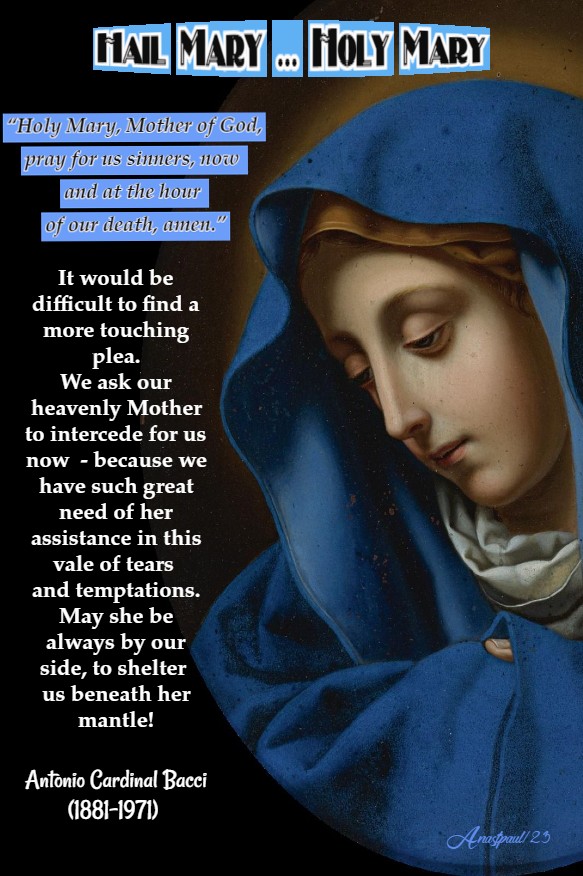
In the first part of the Hail Mary, then, we pay her the words of the Gospel, the highest tributes ever accorded to any human creature, proclaiming her to be full of grace, blessed among women and Mother of the Redeemer. The second part which was later added by the Church, (composed and proposed by St Peter Canisius 1521-1597) Doctor of the Church), is a heartfelt supplication addressed to Mary as the Mother of God and our Mother. “Holy Mary, Mother of God, pray for us sinners, now and at the hour of our death, amen.” It would be difficult to find a more touching plea. We ask our heavenly Mother to intercede for us now – because we have such great need of her assistance in this vale of tears and temptations. May she be always by our side, to shelter us beneath her mantle!”
Quote/s of the Day – 13 September – Our Holy Mother’s Day – Sanctæ Mariæ Sabbato
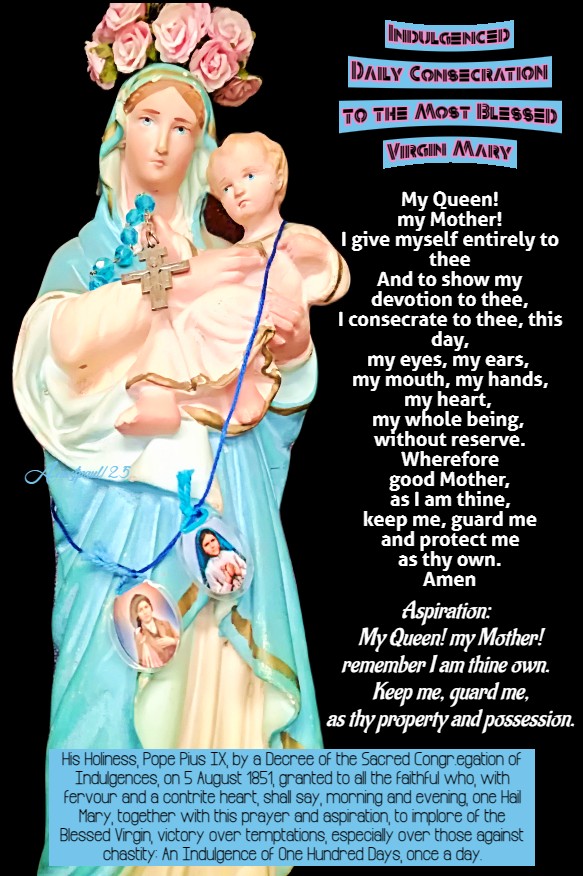
Indulgenced Daily Consecration to the Most Blessed Virgin Mary
My Queen! my Mother! I give myself entirely to thee And to show my devotion to thee, I consecrate to thee, this day, my eyes, my ears, my mouth, my hands, my heart, my whole being, without reserve. Wherefore, good Mother, as I am thine, keep me, guard me, and protect me as thy own. Amen
Aspiration:My Queen! my Mother! remember I am thine own. Keep me, guard me, as thy property and possession.
His Holiness, Pope Pius IX, by a Decree of the Sacred Congr.egation of Indulgences, on 5 August 1851, granted to all the faithful who, with fervour and a contrite heart, shall say, morning and evening, one Hail Mary, together with this prayer and aspiration, to implore of the Blessed Virgin, victory over temptations, especially over those against chastity: An Indulgence of One Hundred Days, once a day.
The Memorare Indulgence of three years – Raccolta 339. Plenary indulgence – once a month for the daily recitation of this prayer.
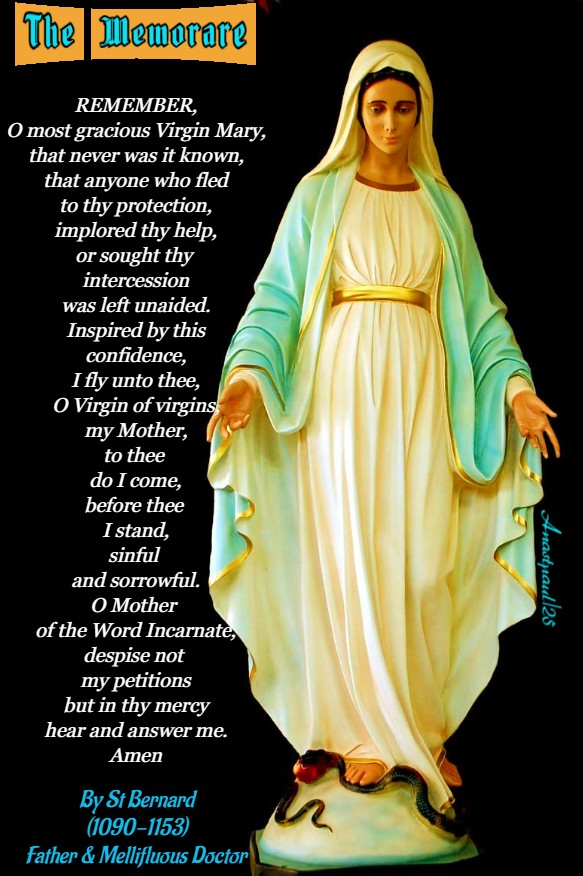
The Memorare By St Bernard (1090-1153) Father and Mellifluous Doctor
REMEMBER, O most gracious Virgin Mary, that never was it known, that anyone who fled to thy protection, implored thy help, or sought thy intercession was left unaided. Inspired by this confidence, I fly unto thee, O Virgin of virgins, my Mother, to thee do I come, before thee I stand, sinful and sorrowful. O Mother of the Word Incarnate, despise not my petitions but in thy mercy hear and answer me. Amen
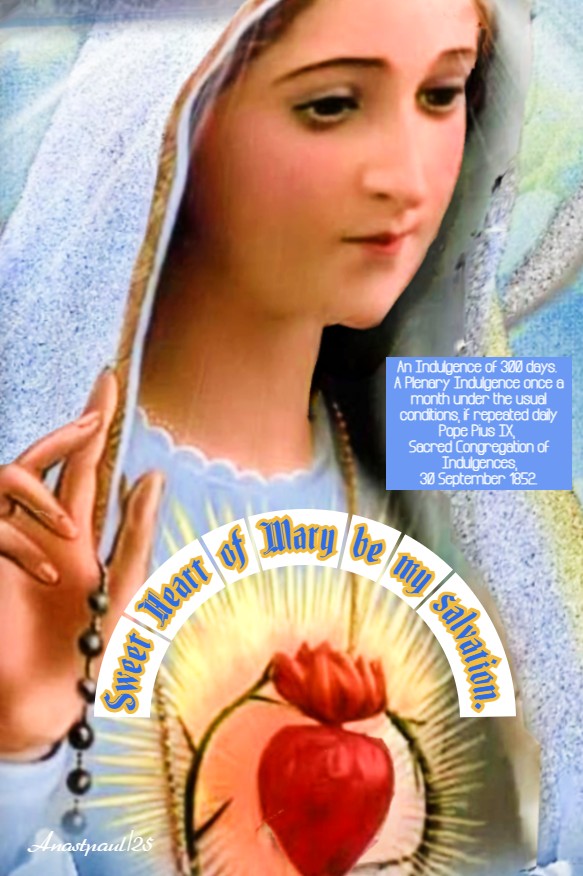
Sweet Heart of Mary be my salvation.
An Indulgence of 300 days. A Plenary Indulgence once a month under the usual conditions, if repeated daily Pope Pius IX, Sacred Congregation of Indulgences, 30 September 1852.
One Minute Reflection – 13 September – “The Month of The Seven Sorrows of the Blessed Virgin Mary and The Holy Cross” –Sanctæ Mariæ Sabbato – Prov 8:22-35 – Matthew 1:1-16 – Scripture search here: https://www.drbo.org/
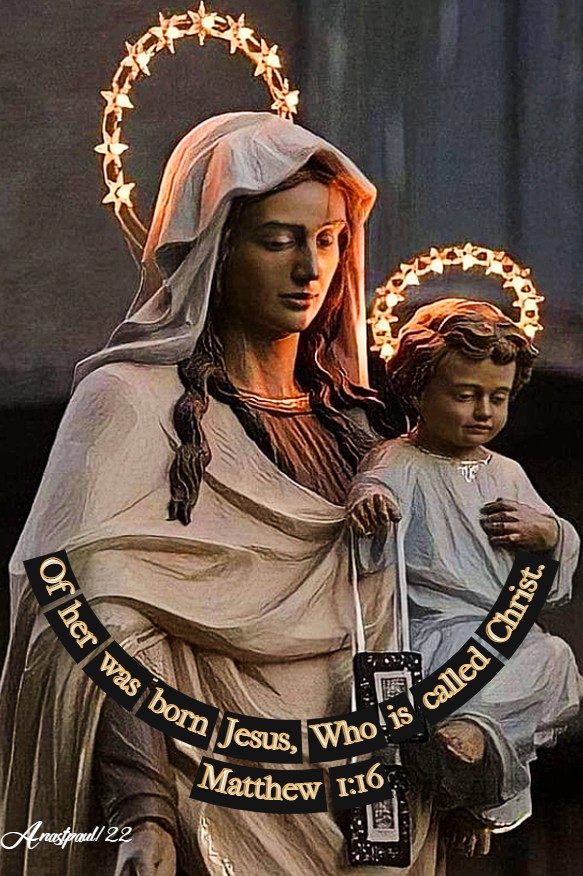
“And Jacob begot Joseph, the husband of Mary and of her was born Jesus, Who is called Christ.” – Matthew 1:16
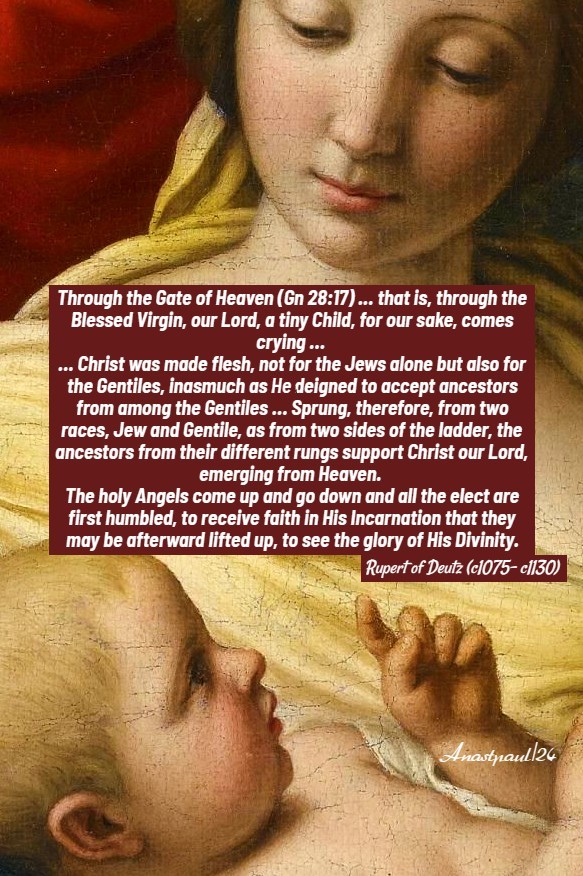
REFLECTION – “The genealogy of Jesus Christ from St Matthew’s Gospel is read to us. It is a custom handed down by holy Church with a beauty and mystery of its own. For behold, how in truth this reading puts before us, at dead of night that ladder, which Jacob saw at night in his sleep (Gn 28:12). Supported on the topmost rung of the ladder, where it reached Heaven, the Lord appeared to Jacob and promised him that his posterity would inherit the earth … Now, as we know, “all these things happened to them in figure” (1 Cor 10:11). The ladder by which the Lord appeared to be supported, prefigured the family-tree of Jesus Christ which the holy Gospel-writer so drew up, as to come through Joseph. It is, by Joseph that our Lord, as a small Child, is supported. Through the Gate of Heaven (Gn 28:17) … that is, through the Blessed Virgin, our Lord, a tiny Child, for our sake, comes crying … The words which Jacob, in his sleep heard the Lord say, “And in thy posterity shall all the nations of the earth be blessed” are fulfilled, by the birth of Christ.
The divine writer, bearing in mind this very point, put the names of Rahab, the prostitute and Ruth, the Moabite, into his genealogy. For he saw that Christ was made flesh, not for the Jews alone but also for the Gentiles, inasmuch as He deigned to accept ancestors from among the Gentiles … Sprung, therefore, from two races, Jew and Gentile, as from two sides of the ladder, the ancestors from their different rungs support Christ our Lord, emerging from Heaven. The holy Angels come up and go down and all the elect are first humbled, to receive faith in His Incarnation that they may be afterward lifted up, to see the glory of His Divinity.” – Rupert of Deutz (c1075- c1130) Monk, Theologian and Writer (De Divinis Officiis 3, 18).
PRAYER – Lord God, the day of our salvation dawned when the Blessed Virgin gave birth to Your Son. As we celebrate her nativity, grant us Your grace and Your peace. Through Christ, Thy Son our Lord, Who lives and reigns with Thee, in the unity of the Holy Ghost, God, world without end. Amen (Collect).
Our Morning Offering – 13 September – “The Month of The Seven Sorrows of the Blessed Virgin Mary and The Holy Cross” and Sanctæ Mariæ Sabbato, Our Lady’s Saturday
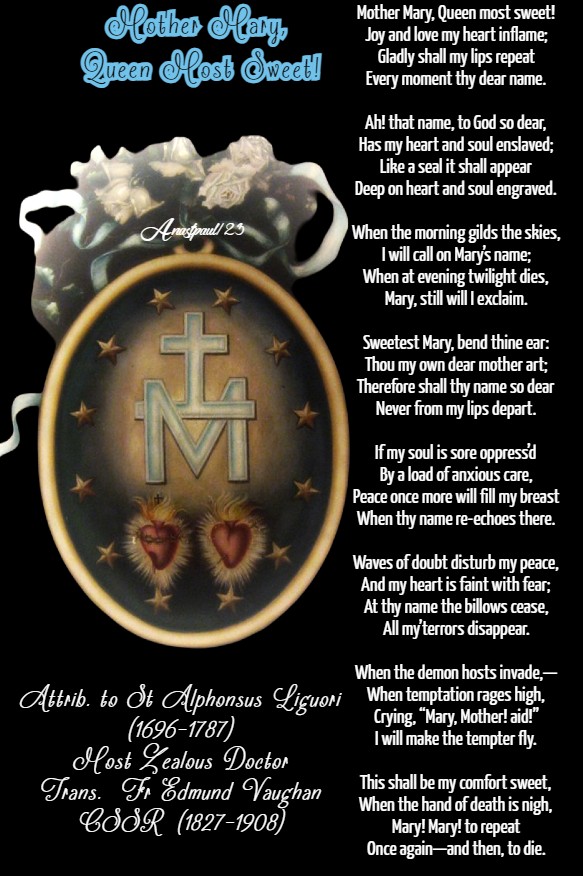
Mother Mary, Queen Most Sweet! Attrib. to St Alphonsus Liguori (1696-1787) Most Zealous Doctor Italian Hymn Trans. Fr Edmund Vaughan CSSR (1827-1908)
Mother Mary, Queen most sweet! Joy and love my heart inflame; Gladly shall my lips repeat Every moment thy dear name.
Ah! that name, to God so dear, Has my heart and soul enslaved; Like a seal it shall appear Deep on heart and soul engraved.
When the morning gilds the skies, I will call on Mary’s name; When at evening twilight dies, Mary, still will I exclaim.
Sweetest Mary, bend thine ear: Thou my own dear mother art; Therefore, shall thy name so dear Never from my lips depart.
If my soul is sore oppress’d By a load of anxious care, Peace once more will fill my breast When thy name re-echoes there.
Waves of doubt disturb my peace, And my heart is faint with fear; At thy name the billows cease, All my’terrors disappear.
When the demon hosts invade,— When temptation rages high, Crying, “Mary, Mother! aid!” I will make the tempter fly.
This shall be my comfort sweet, When the hand of death is nigh, Mary! Mary! to repeat Once again—and then, to die.
This Hymn is an Anonymous Hymn belonging to the Redemptorist tradition but Hymnary.org attributes it to St Alphonsus Liguori. “Hymns and Verses on Spiritual Subjects” (1863) notes that this is one of two Hymns, translated in that book, mentioned above, which come from a Neapolitan published collection of Mission Hymns which are attributed to St Alphonsus.
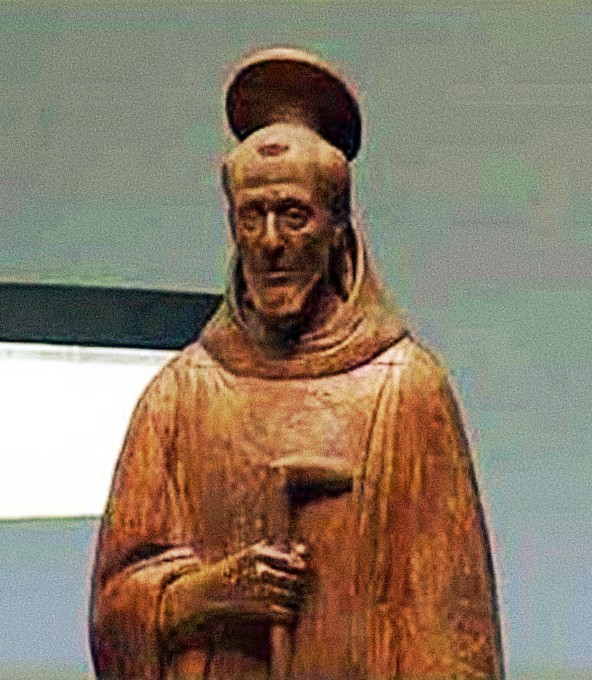
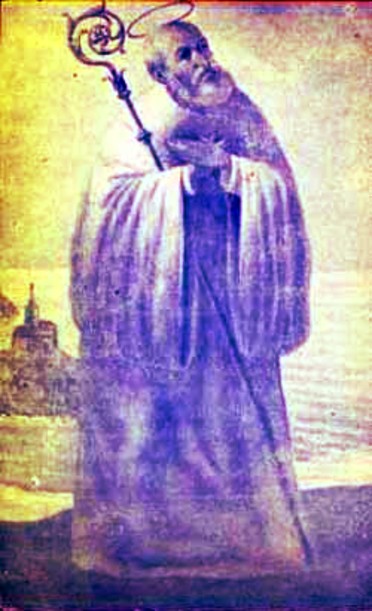
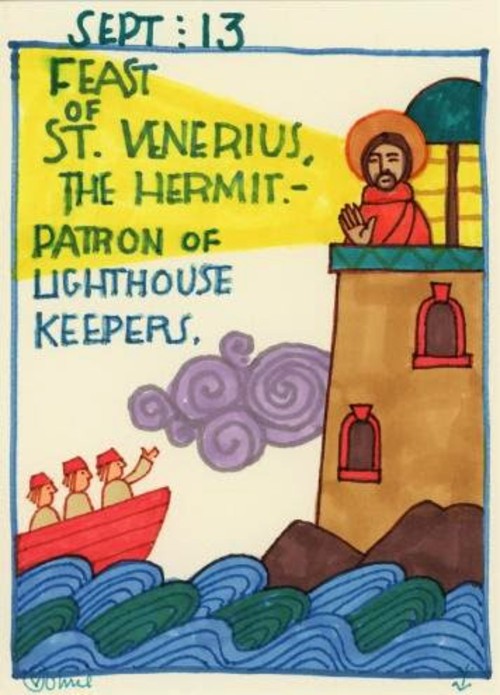
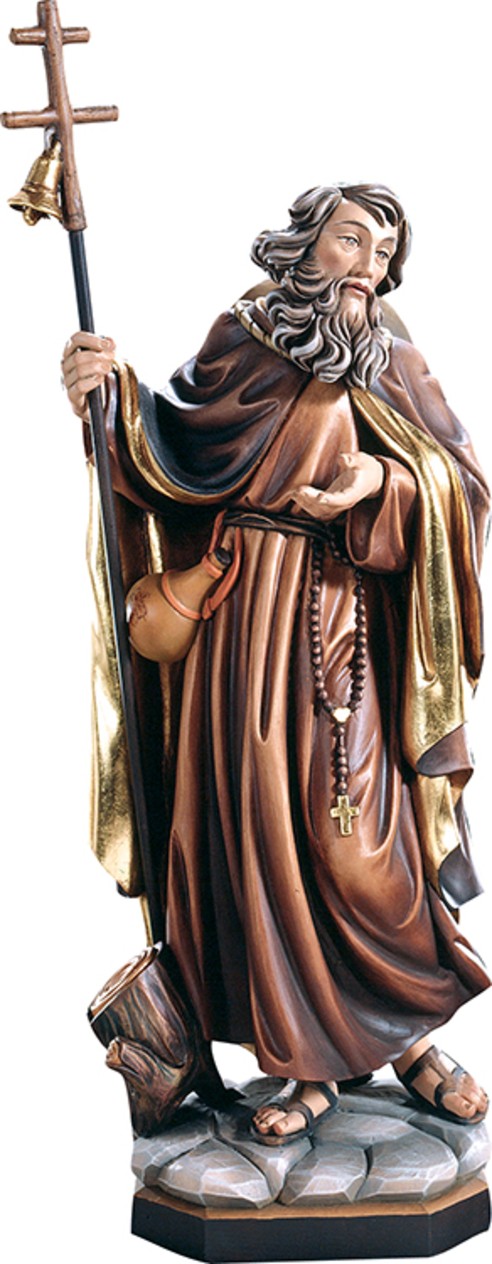
Saint of the Day – 13 September – St Venerius (c560-630) Confessor, Founder Abbot of the Monastery on the Island of Tino, near Genoa, Italy, Hermit, Ascetic, spiritual Counsellor, Miricle-worker. Borin in c560 on the Island of Palmaria and died in 630 on Timo Island. Patronages – of the Gulf of La Spezia, of Lighthouse Keepers. Also known as – Venerio.
The Roman Martyrology reads today: “St Venerius, Confessor, a man of admirable sancity, who led an eremitical life on the Island of Timo.”
Little is known of Venerius’ early life and family background. However, it is believed that he had a deep faith and piety from a young age. Venerius was drawn to a life of solitude and seclusion, seeking a deeper spiritual union with God. He decided to dedicate his life to prayer and contemplation, ultimately becoming a Hermit on the Island of Tino.
As a Hermit, Venerius lived a life of simplicity and asceticism, distancing himself from worldly distractions and focusing solely on his devotion to God. His exceptional piety and profound spiritual insight attracted disciples who sought his guidance. Thus Venerius was led to establish a Monastic community on the Island.
Under his leadership, the Monastery flourished, attracting many individuals seeking a life of prayer in quiet surroundings. Venerius, as an Abbot, nurtured the spiritual growth of his fellow Monks, instilling in them the values of humility, discipline and dedication to God.
Among the notable aspects of Venerius’ life, is the Lighthouse on the Island of Tino. This Lighthouse which served as a beacon of light and safety for ships navigating the treacherous waters, became a symbol of hope and spiritual guidance. Due to its importance, Venerius’ association with the Lighthouse, led to his Patronage becoming closely tied with Lighthouse Keepers.
Despite living a secluded life, Venerius never failed to extend his support and prayers to those who depended upon him for counsel. Pilgrims from near and far sought his intercession, seeking his spiritual counsel and assistance in their quest for holiness. Known for his deep faith and miraculous abilities, Venerius was credited with numerous cures and graces granted through his intercession.
Saint Venerius departed from this earthly life on 13 September 630, leaving behind a legacy of holiness, wisdom and devotion to God. His sanctity was widely recognised even during his lifetime and after his death, his reputation as a saintly man only grew.
Venerius’ exemplary life and the countless miracles attributed to him, led to his veneration as a Saint by the faithful. His Feast Day is celebrated on 13 September, commemorating the day of his birthday into eternal life. Saint Venerius is honoured as the Patron Saint of Lighthouse Keepers, who look to him as a heavenly protector and advocate. His dedication to God, his life as a Hermit and Abbot continue to inspire and offer solace to those entrusted with the safety and guidance of seafarers.
To this day, the memory of Saint Venerius lives on, serving as a testament to the power of prayer, the selflessness of a life devoted to God and the immense impact one individual can make in the lives of others.
Even in death, Venerius remains in the hearts of the people of the Gulf of La Spezia, of which he is the Patron, so much so that, when, about a century after his death, these lands and Towns were attacked by Saracen and then Norman ships, the first concern of the inhabitants of Porto Venere (named after our Saint) was to secure the Saint’s venerated remains.
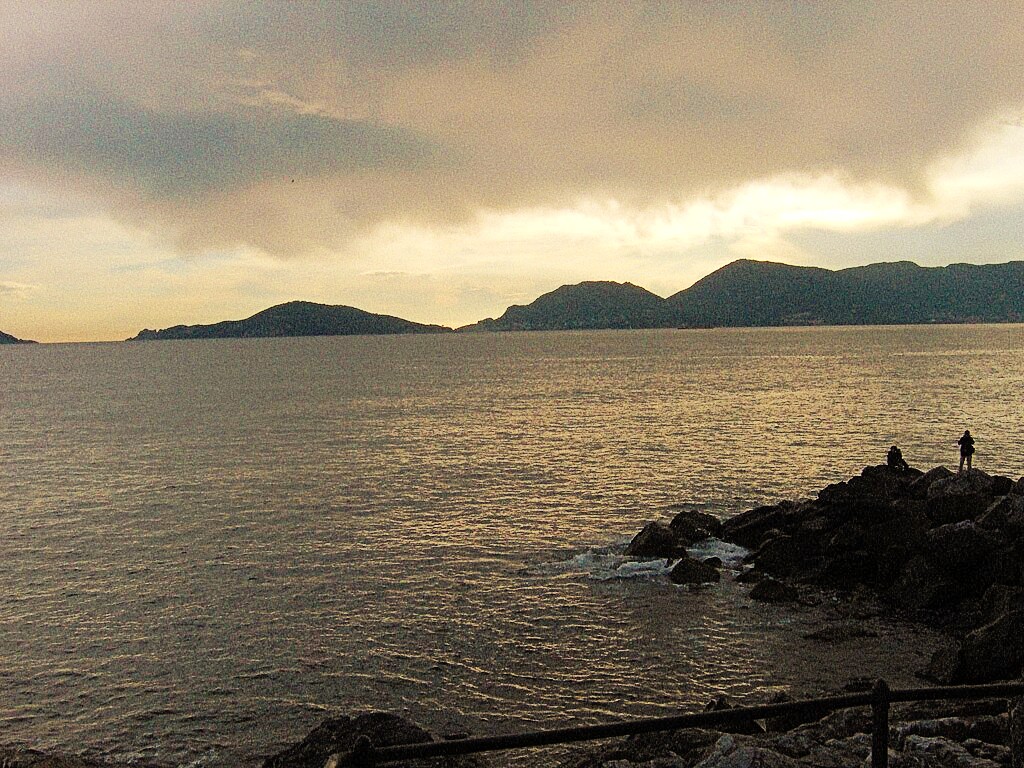
NOTE: The Gulf of La Spezia, is a body of water on the north-western coast of Italy and part of the northern Tyrrhenian Sea, specifically of Ligurian Sea.
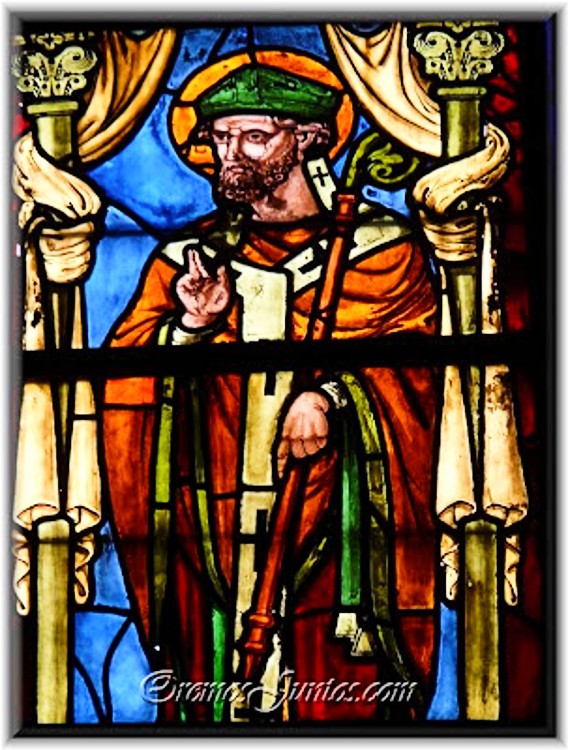
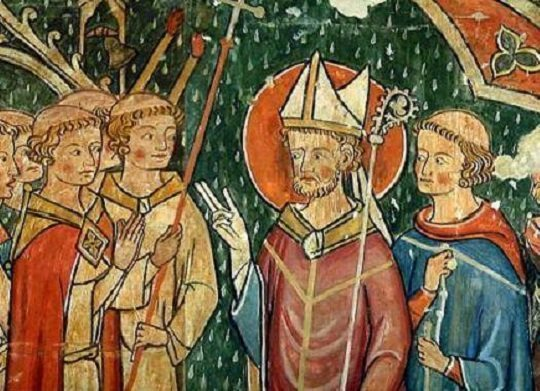
St Evantius of Autun St Gordian of Pontus St Julian of Ankyra St Litorius (Died 371) Bishopof Tours the 2nd Bishop of Tour, reigning for 34 years from 337 until his death in 371. He built the first Churches and the Basilica of Tours. Born in Tours and died there on 13 September 371 of natural causes. A Lengthy Career of Love: https://anastpaul.com/2024/09/13/saint-of-the-day-13-september-saint-litorius-of-tours-died-371-bishop/








 AnaStpaul
You must be logged in to post a comment.