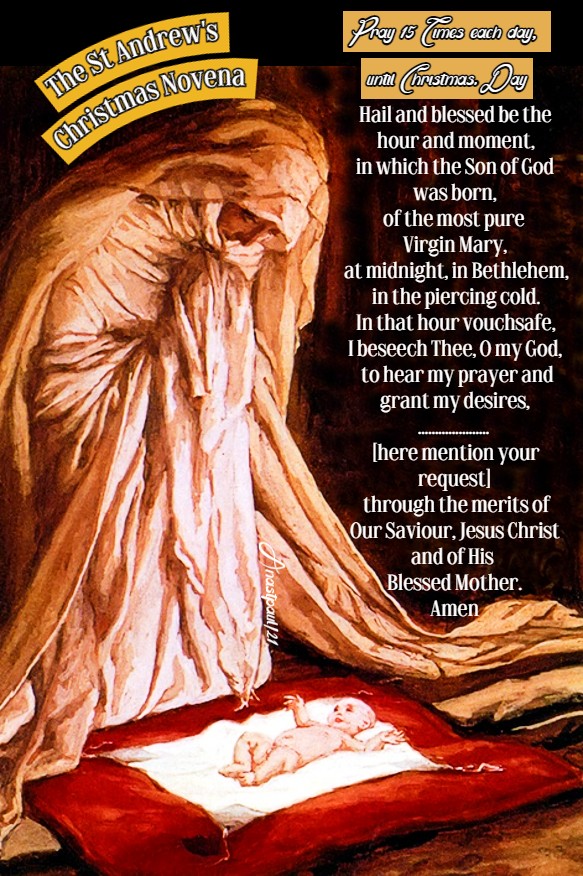
The St Andrew’s Christmas Novena The Christmas Anticipation Prayer
The Novena is not actually addressed to Saint Andrew but to God Himself, asking Him to grant our request in honour of the birth of His Son at Christmas. You can say the prayer all 15 times, all at once; or divide up the recitation as necessary (perhaps five times at each meal). We say ours after the Family Rosary each day, with each member saying it a number of times to total 15.
Prayed as a family, the Saint Andrew Christmas Novena is a very good way to help focus the attention of your family and children on the Advent season. nd the reason for the festivities to come.
This lovely Christmas Anticipatory Prayer, although the Author is Unknown, is traditionally believed to have originated in Ireland in the early 1900s or even before. I know, I myself, in my childhood, prayed this both at home and in my Irish Convent School. It is piously believed that whoever recites the above prayer fifteen times a day from the Feast of St Andrew, until Christmas Fay or after Midnight Mass, will obtain that which he has petitioned.
Imprimatur † Michael Augustine, Archbishop of New York New York, February 6, 1897
Pray 15 Times each day, until Christmas Day
Hail and blessed be the hour and moment, in which the Son of God was born, of the most pure Virgin Mary, at midnight, in Bethlehem, in the piercing cold. In that hour vouchsafe, I beseech Thee, O my God, to hear my prayer and grant my desires, ………………… [here mention your request] through the merits of Our Saviour, Jesus Christ and of His Blessed Mother. Amen
Thought for the Day – 30 November – Meditations with Antonio Cardinal Bacci (1881-1971)
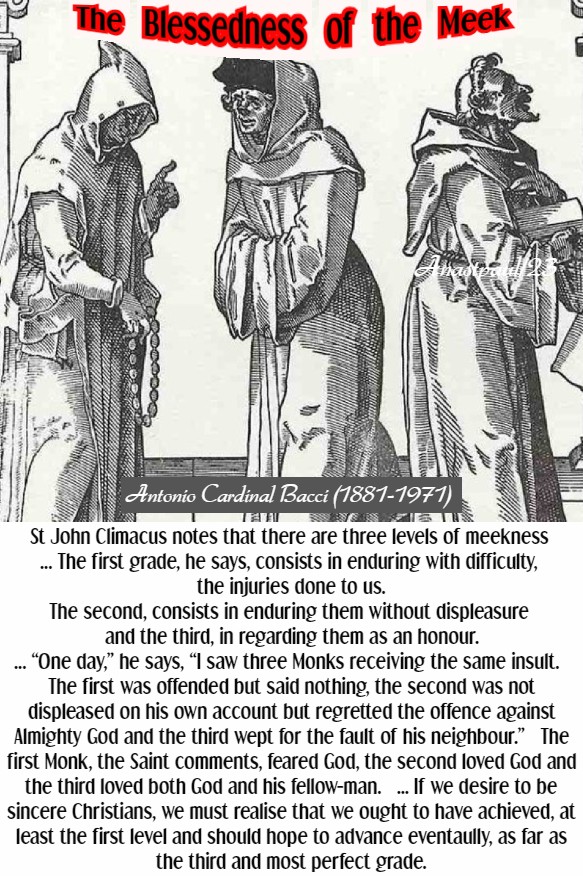
The Blessedness of the Meek
“St John Climacus notes that there are three levels of meekness (Dcala Paradist pp 296-298). The first grade, he says, consists in enduring with difficulty, the injuries done to us. The second, consists in enduring them without displeasure and the third, in regarding them as an honour.
Those who reach the first level are to be congratulated, those who reach the second are to be applauded but, those in the third and highest category, are really blessed by God.
“One day,” he says, “I saw three Monks receiving the same insult. The first was offended but said nothing, the second was not displeased on his own account but regretted the offence against Almighty God and the third wept for the fault of his neighbour.” The first Monk, the Saint comments, feared God, the second loved God and the third loved both God and his fellow-man.
At What stage of perfection in this virtue can we claim to have arrived? If we desire to be sincere Christians, we must realise that we ought to have achieved, at least the first level and should hope to advance eventaully, as far as the third and most perfect grade.”
Quote/s of the Day – 30 November –The First Sunday of Advent – Romans 13:11-14 – Luke 21:25-33 – Scripture search here: https://www.drbo.org
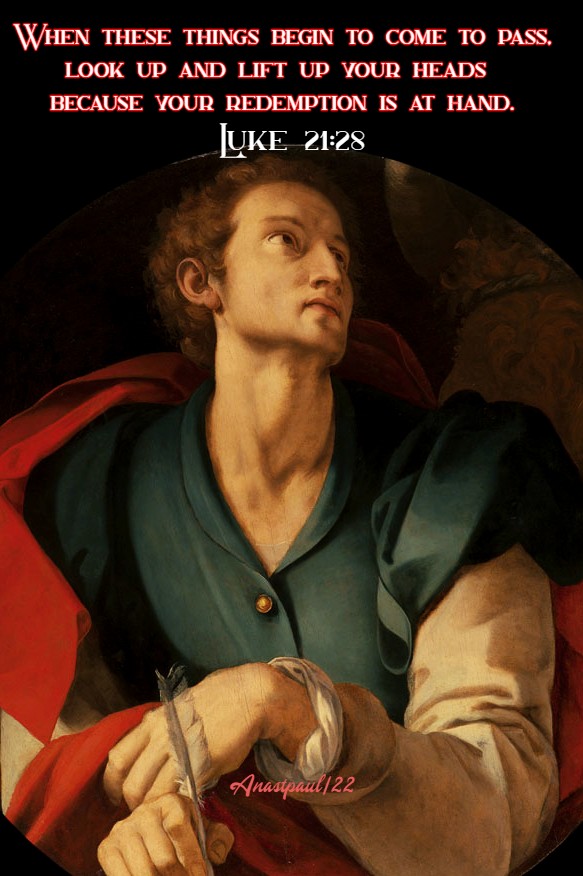
“But when these things begin to come to pass, look up and lift up your heads because your redemption is at hand.”
Luke 21:28
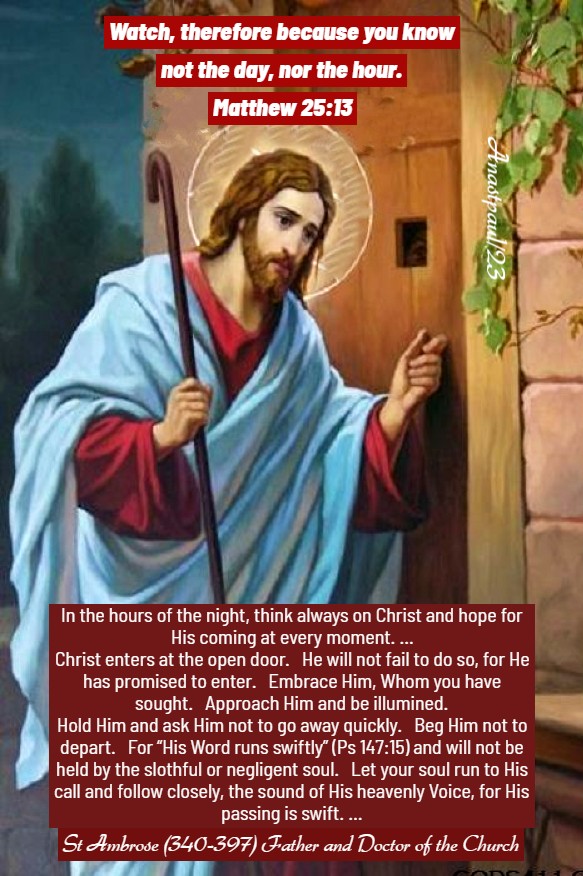
“Watch, therefore because you know not the day, nor the hour.” Matthew 25:13
“ In the hours of the night, think always on Christ and hope for His Coming at every moment. … Christ enters at the open door. He will not fail to do so, for He has promised to enter. Embrace Him, Whom you have sought. Approach Him and be illumined. Hold Him and ask Him not to go away quickly. Beg Him not to depart. For “His Word runs swiftly” (Ps 147:15) and will not be held by the slothful or negligent soul. Let your soul run to His call and follow closely, the sound of His heavenly Voice, for His passing is swift. …”
St Ambrose (340-397) Father and Doctor of the Church
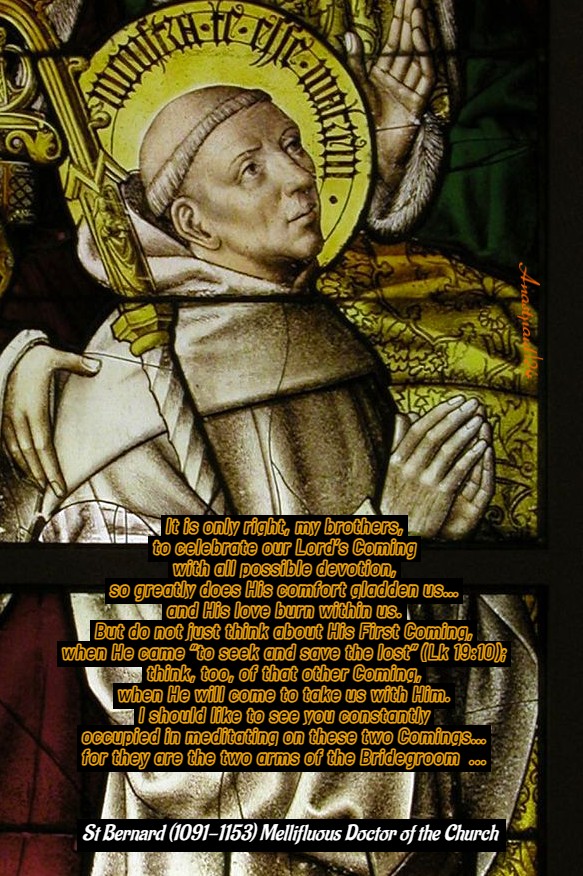
“It is only right, my brothers, to celebrate our Lord’s Coming with all possible devotion, so greatly does His comfort gladden us… and His love burn within us. But do not just think about His First Coming, when He Came “to seek and save the lost” (Lk 19:10); think, too, of that other Coming, when He will come to take us with Him. I should like to see you constantly occupied in meditating on these two Comings… for they are the two arms of the Bridegroom …”
St Bernard (1091-1153) Mellifluous Doctor of the Church
One Minute Reflection – 30 November – “The Month of The Holy Souls in Purgatory” – The First Sunday of Advent – Romans 13:11-14 – Luke 21:25-33 – Scripture search here: https://www.drbo.org/
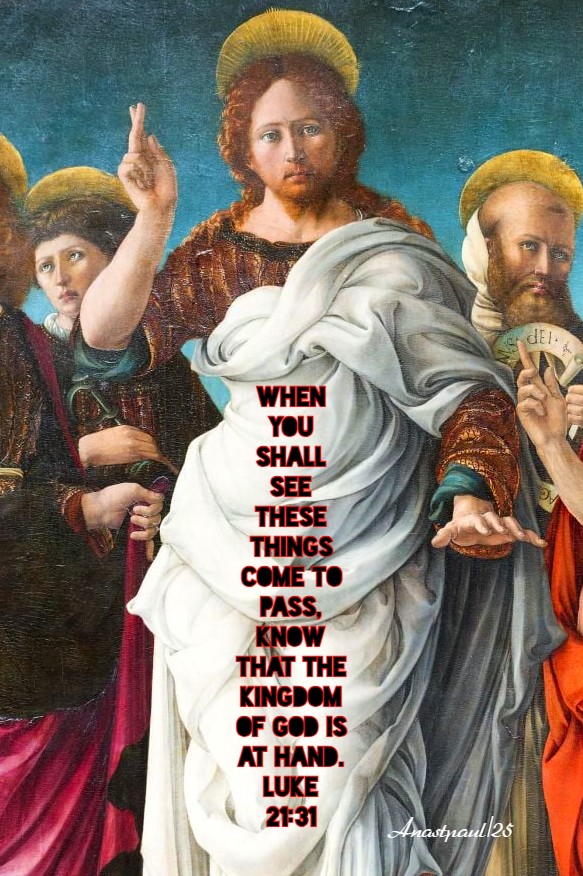
“When you shall see these things come to pass, know that the Kingdom of God is at hand.” – Luke 21:31
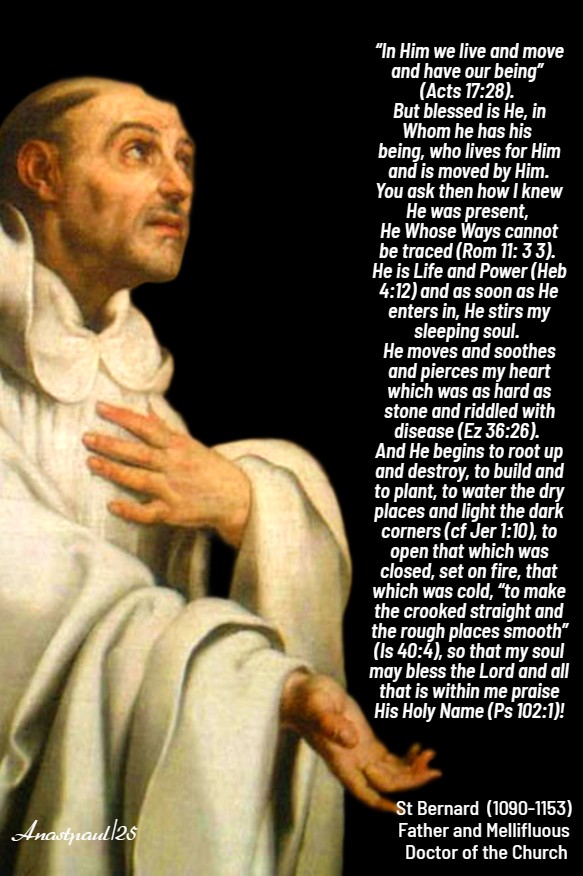
REFLECTION – “In Him we live and move and have our being”(Acts 17:28). But blessed is He, in Whom he has his being, who lives for Him and is moved by Him. You ask then how I knew He was present, He Whose Ways cannot be traced (Rom 11: 3 3). He is Life and Power (Heb 4:12) and as soon as He enters in, He stirs my sleeping soul. He moves and soothes and pierces my heart which was as hard as stone and riddled with disease (Ez 36:26). And He begins to root up and destroy, to build and to plant, to water the dry places and light the dark corners (cf Jer 1:10), to open that which was closed, set on fire, that which was cold, “to make the crooked straight and the rough places smooth” (Is 40:4), so that my soul may bless the Lord and all that is within me praise His Holy Name (Ps 102:1)!
And so, when the Bridegroom, the Word, came to me, He did not make any sign that He was on His way … Only by the warmth of my heart, as I said before, did I know that He was there and, I knew the power of His Might because my faults were purged and my body’s yearnings brought under control. And when my secret faults were revealed and made visible, I have been amazed at the depth of His Wisdom, At the slightest amendment of my life, I have experienced the goodness of His Mercy. In the making and renewing of the spirit of my mind, (2 Cor 4:16; Eph 4:23) that is, the inner man, I perceived the excellence of His glorious Beauty and when, I contemplate all these things, I am filled with awe of His manifold greatness.” – St Bernard (1090-1153) Cistercian Abbot at Clairvaux, the last Father and Mellifluous Doctor of the Church (Sermons on the Song of Songs no 74).
PRAYER – O God, Who, by the message of an Angel, willed to take flesh in the womb of the Blessed Virgin Mary, grant we, Thou suppliants, who believe her to be truly the Mother of God, maybe aided by her intercession with Thee. Through the same Jesus Christ, Thy Son our Lord, Who lives and reigns with Thee, in the unity of the Holy Ghost, God, world without end. Amen (Collect).
Our Morning Offering – 30 November – The First Sunday of Advent
O Come, O come, Emmanuel
O Come, O come, Emmanuel And ransom captive Israel, That mourns in lonely exile here Until the Son of God appear. Refrain: Rejoice! Rejoice! Emmanuel Shall come to thee, O Israel!
O come, Thou Wisdom, from on high And order all things far and nigh, To us the path of knowledge show And teach us in her ways to go. Refrain
O come, o come, Thou Lord of might, Who to Thy tribes on Sinai’s height In ancient times did give the law, In cloud and majesty and awe. Refrain
O come, Thou Rod of Jesse’s stem, From ev’ry foe deliver them That trust Thy mighty power to save And give them vict’ry o’er the grave. Refrain
O come, Thou Key of David, come And open wide our heav’nly home, Make safe the way that leads on high, That we no more have cause to sigh. Refrain
O come, Thou Dayspring from on high And cheer us by Thy drawing nigh. Disperse the gloomy clouds of night And death’s dark shadow put to flight. Refrain
O come, Desire of nations, bind In one the hearts of all mankind. Bid every strife and quarrel cease And fill the world with heaven’s peace. Refrain
The favourite O Come, O Come Emmanuel Carol was originally written in Latin text in the 12th Century. The author of the words and composer of the music of O Come, O Come Emmanuel, is unknown. It is, however, believed that the melody was of French origin and added to the text a hundred years later. The Latin was translated into English by John Mason Neale in 1851.
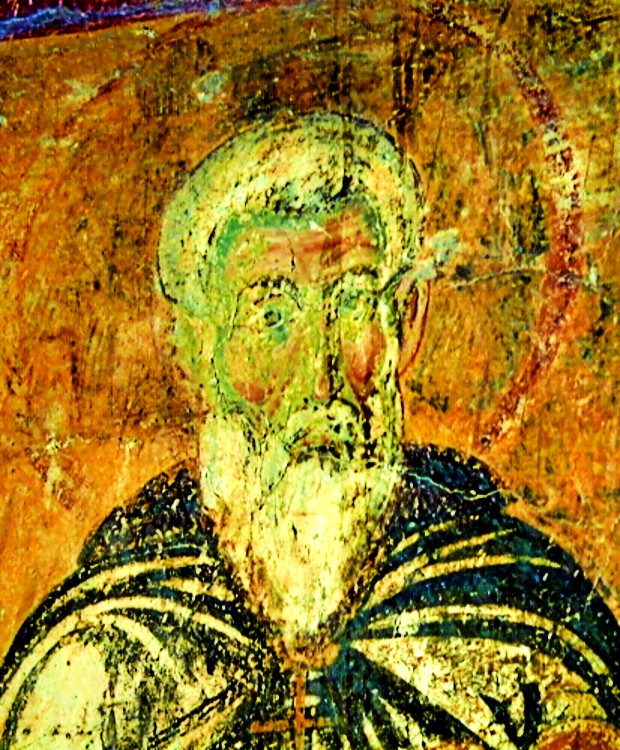
Saint of the Day – 30 November – Saint Constantius (5th Century) Confessor of Rome.
The Roman Martyrology reads today: “At Rome, St Constantius, Confessor, who strongly opposed the Pelagians and by enduring many injuries from them, gained a place among holy Confessors.”
Nothing is known of the background or detail of this Saint, so much so that it appears uncertain whether he was a Priest or a Layman.
However, he was certainly a Confessor of Christ by his vehement and ardent defence against the heresy of the Pelagians.
He is proudly listed in the Roman Martyrology for today and has gained the auspicious title of Confessor.
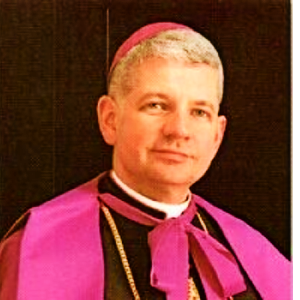
Today, 31 years ago, 30 November 1993, the late Bishop Daniel L Dolan was Consecrated as a Bishop. Remembering this zealous and loving Shepherd and praying for his eternal rest.
St Abraham of Persia St Anders of Slagelse Bl Andrew of Antioch Bl Arnold of Gemblours
St Castulus of Rome (c288) Martyr, married to Saint Irene of Rome (the woman who assisted St Sebastian after he had been wounded by the Imperial archers) and father of 2 children, Military Officer and he was the Chamberlain (or officer, valet) of Emperor Diocletian. His Feast day was moved to 26 March in 1969. His Life and Death: https://anastpaul.com/2021/03/26/saint-of-the-day-26-march-saint-castulus-of-rome-died-c-288-martyr/
St Constantius (5th Century) Confessor of Rome St Crider of Cornwall
Bl Joscius Roseus St Justina of Constantinople St Mahanes the Persian St Maura of Constantinople St Merola of Antioch St Mirocles of Milan St Sapor St Simeon of Persia St Trojan St Tudwal of Tréguier Bl William de Paulo Zosimus the Wonder Worker
Martyrs of Saxony – 6 Saints: Missionaries who worked with Saint Willehad of Bremen. Martyrs. – Attroban, Benjamin, Emmingen, Folkard, Gerwald and Grisold. They were martyred on 30 November 782 at River Weser, Lawer Saxony, Germany.
Thought for the Day – 29 November – Meditations with Antonio Cardinal Bacci (1881-1971)
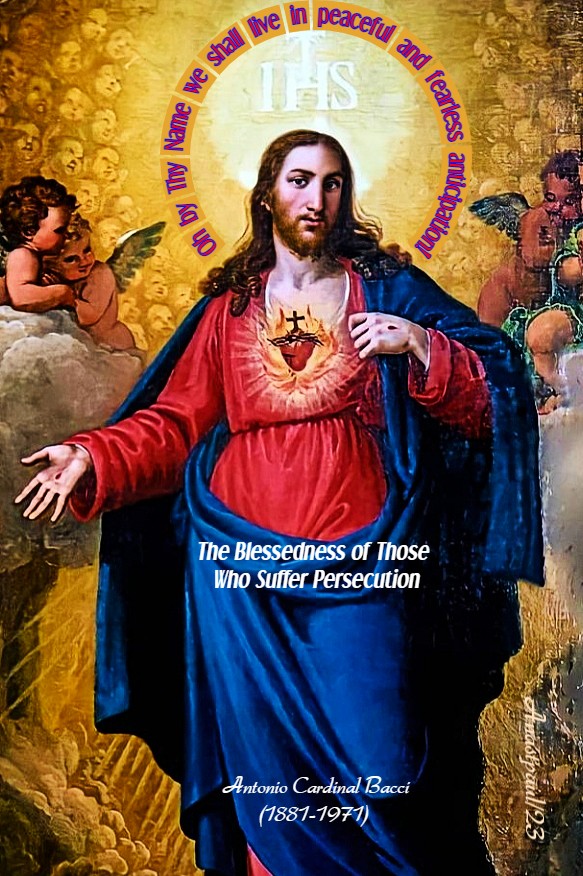
The Blessedness of Those Who Suffer Persecution
“Let us implore the Holy Ghost to enlighten us and to grant us this serene joy which is a reflection of the happiness of Heaven. Oh by Thy Name we shall live in peaceful and fearless anticipation!”
Quote/s of the Day – 29 November – Vigil of St Andrew Apostle – Ecclesiasticus 44:25-27; 45:2-4; 45:6-9; John 1:35-51 – Scripture search here: https://www.drbo.org/
“Jesus turned and saw them following Him and said to them, “What are you looking for?”
John 1:38
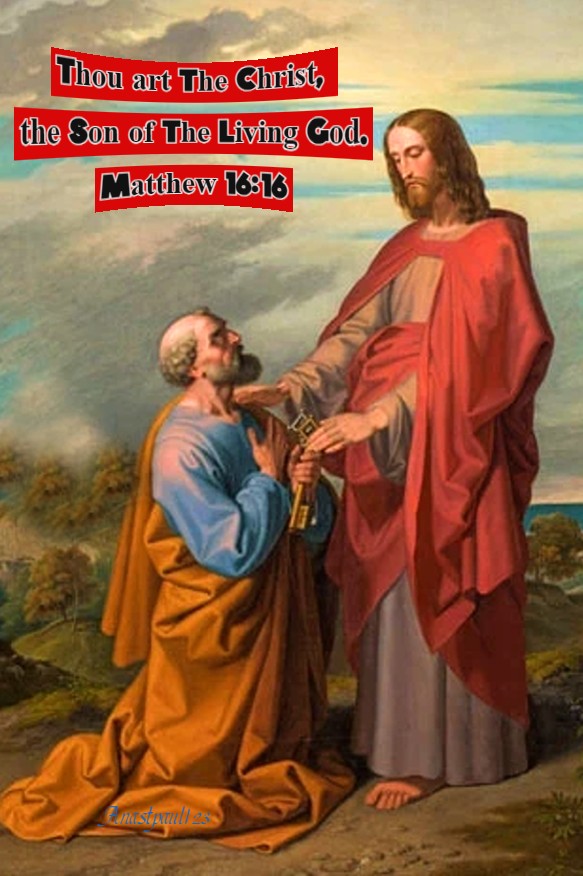
“Thou art the Christ, the Son of the living God!”
Matthew 16:16
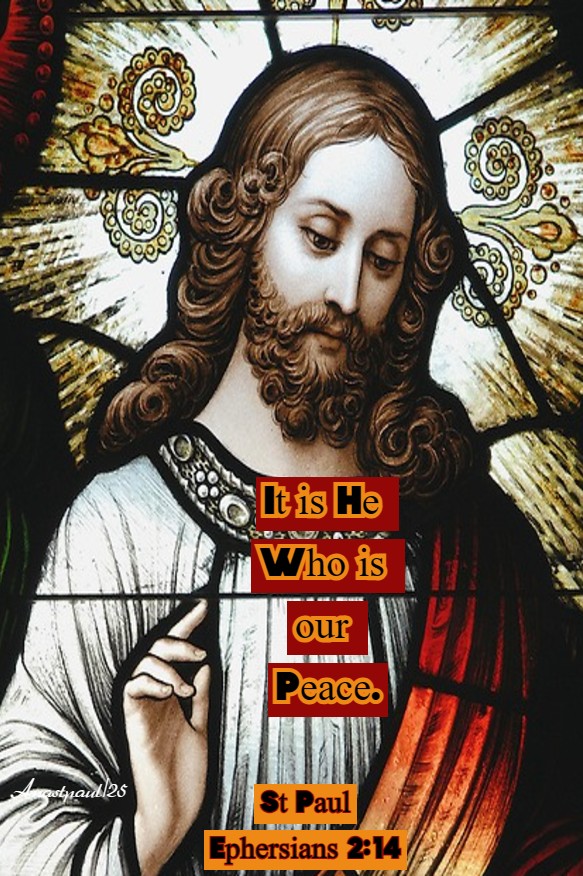
“It is He Who is our peace.”
St Paul Ephesians 2:14
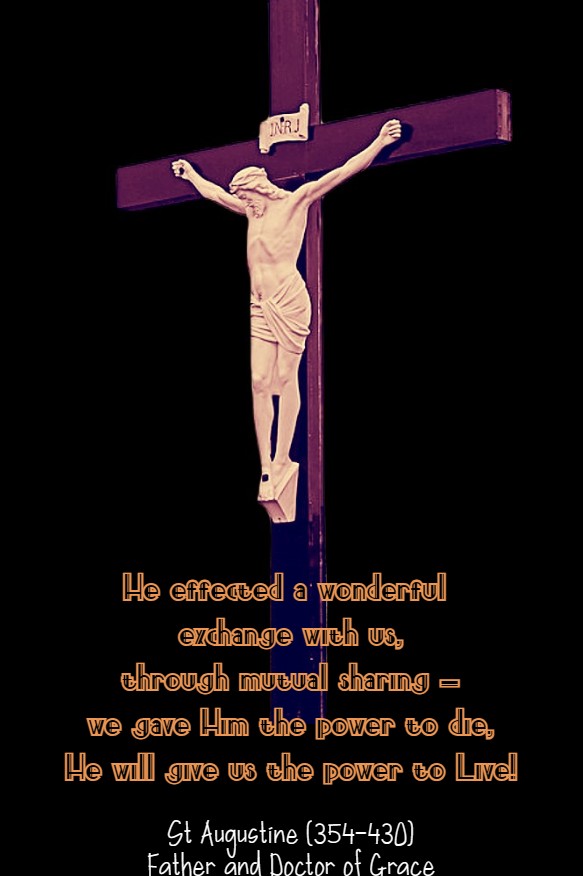
“… He effected a wonderful exchange with us, through mutual sharing – we gave Him the power to die, He will give us the power to Live!”
St Augustine (354-430) Father and Doctor of Grace
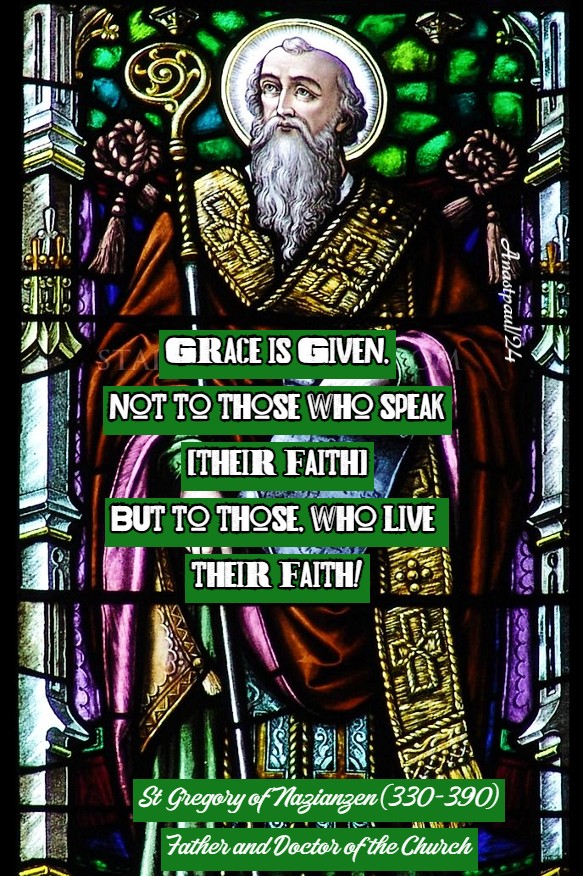
“Grace is given, not to those who speak [their faith] but to those, who live their faith!”
St Gregory Nazianzen (330-390) Father and Doctor of the Church
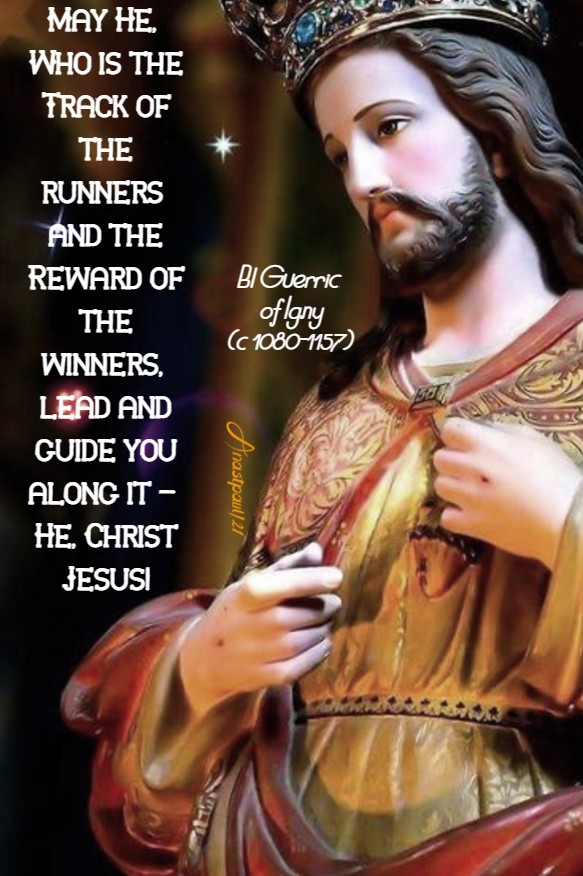
“May He, Who is the Track of the runners and the Reward of the winners, lead and guide you along it – He, Christ Jesus!”
Bl Guerric of Igny O.Cist (c1080-1157)
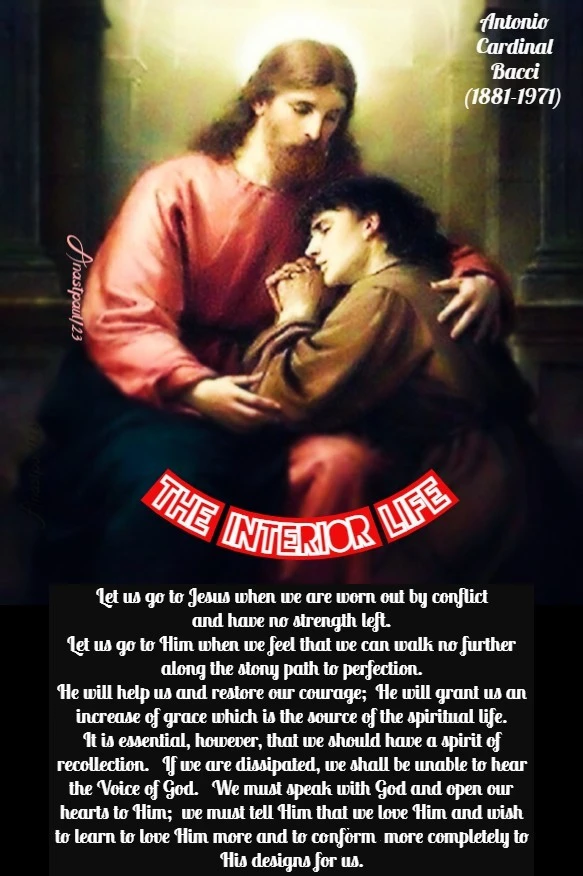
“Let us go to Jesus when we are worn out by conflict and have no strength left. Let us go to Him when we feel that we can walk no further along the stony path to perfection. He will help us and restore our courage; He will grant us an increase of grace which is the source of the spiritual life. It is essential, however, that we should have a spirit of recollection. If we are dissipated, we shall be unable to hear the Voice of God. We must speak with God and open our hearts to Him; we must tell Him that we love Him and wish to learn to love Him more and to conform more completely to His designs for us.”
One Minute Reflection – 29 November – “The Month of The Holy Souls in Purgatory” – The Vigil of the Feast of St Andrew Apostle – Ecclesiasticus Sirach 44:25-27; 45:2-4; 45:6-9 – John 1:35-51 – Scripture search here: https://www.drbo.org/
“He said to them, “Come and see.” They came and saw where He was staying and they stayed with Him that day.” – John 1:39
REFLECTION – “John was there and two of his disciples with him.” John was such “a friend of the Bridegroom” that he did not seek his own glory, he simply bore witness to the truth (Jn 3:29,26). Did he dream of keeping back his disciples and preventing them from following the Lord? Not in the least! He, himself, showed them the One they were to follow … He declared: “Why cling to me? I am not the Lamb of God. Behold the Lamb of God … Behold Him who takes away the sins of the world.”
At these words the two disciples who were with John, followed Jesus. “Jesus turned and saw that they were following Him and said to them: ‘What are you looking for?’ They said to Him: ‘Rabbi, where are you staying?” As yet they were not following Him definitively, as we know, they joined themselves to Him, when He called them to leave their boat … when He said to them: “Come after me and I will make you fishers of men” (Mt 4:19). That was the moment they joined Him definitively, no longer to leave Him. But for now they wanted to see where Jesus was living and put into practice the words of Scripture: “If you see an intelligent man, seek him out at daybreak; let your feet wear away his doorstep! Learn from him the precepts of the Lord” (cf. Sir 6:36). So Jesus showed them where He was living, they went and stayed with Him. What a happy day they spent! What a blessed night! Who can say what it was they heard from the Lord’s mouth? Let us, too, build a dwelling in our hearts, construct a house where Christ can come to teach and converse with us.” … St Augustine (354-430) Father and Doctor of the Church (Sermons on Saint John’s Gospel No 7).
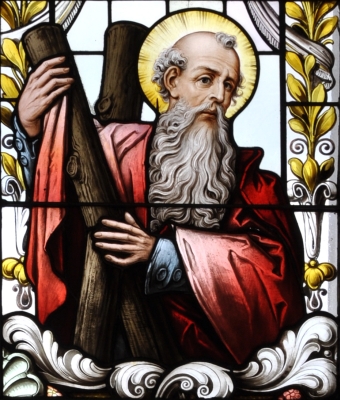
PRAYER – We humbly pray Thy majesty, O Lord, that, as blessed Andrew was a preacher and ruler in Thy Church, so he may always intercede for us with Thee. Through Jesus Christ, Thy Son our Lord, Who lives and reigns with Thee, in the unity of the Holy Ghost, God, world without end. Amen (Collect).
Our Morning Offering – 29 November – Feast of St Andrew ,Apostle and Martyr
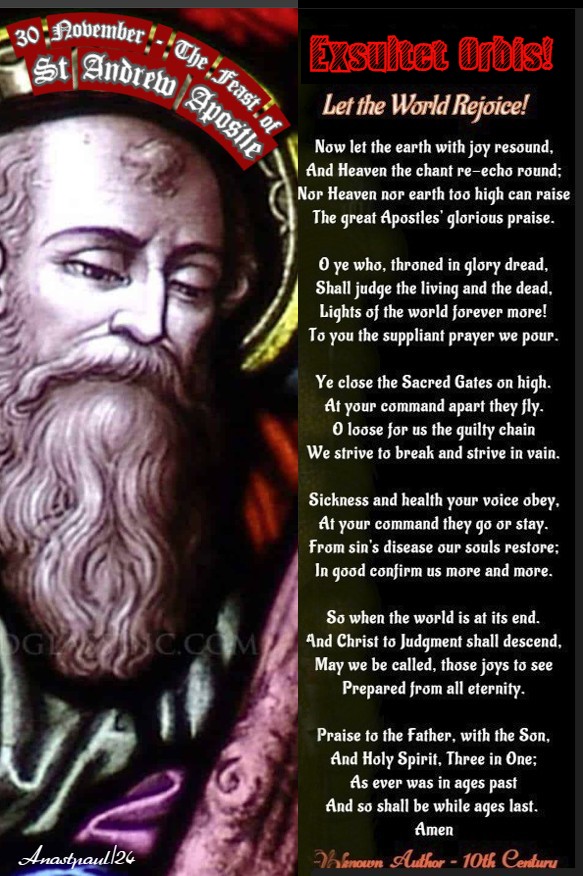
Exsultet Orbis! Let the World Rejoice! Unknown Author
Now let the earth with joy resound, And Heaven the chant re-echo round; Nor Heaven nor earth too high can raise The great Apostles’ glorious praise.
O ye who, throned in glory dread, Shall judge the living and the dead, Lights of the world forever more! To you the suppliant prayer we pour.
Ye close the Sacred Gates on high. At your command apart they fly. O loose for us the guilty chain We strive to break and strive in vain.
Sickness and health your voice obey, At your command they go or stay. From sin’s disease our souls restore; In good confirm us more and more.
So when the world is at its end. And Christ to Judgment shall descend, May we be called, those joys to see Prepared from all eternity.
Praise to the Father, with the Son, And Holy Spirit, Three in One; As ever was in ages past And so shall be while ages last. Amen
(Roman Breviary for the Common of Apostles) An Office Hymn that was traditionally prescribed for Vespers and Lauds on the Feasts of Apostles and Evangelists outside Easter time. The Hymn is found as early as the tenth century in a hymnal of Moissac Abbey.
Saint of the Day – 29 November – Saint Hardoin (Died 650) Bishop of St Pol de-Leon, in Brittany, France. Born in the British Isles and died in c650 in his Diocese in Brittany. Patronages – Landerneau, France and of sailors (this latter patronage due to the tradition that St Hardoin travelled to Brittany in a stone boat from the British Isles). Also known as – Hardouin… Harduinus…Hoardon… Hoardonus…Hoarzon… and more.
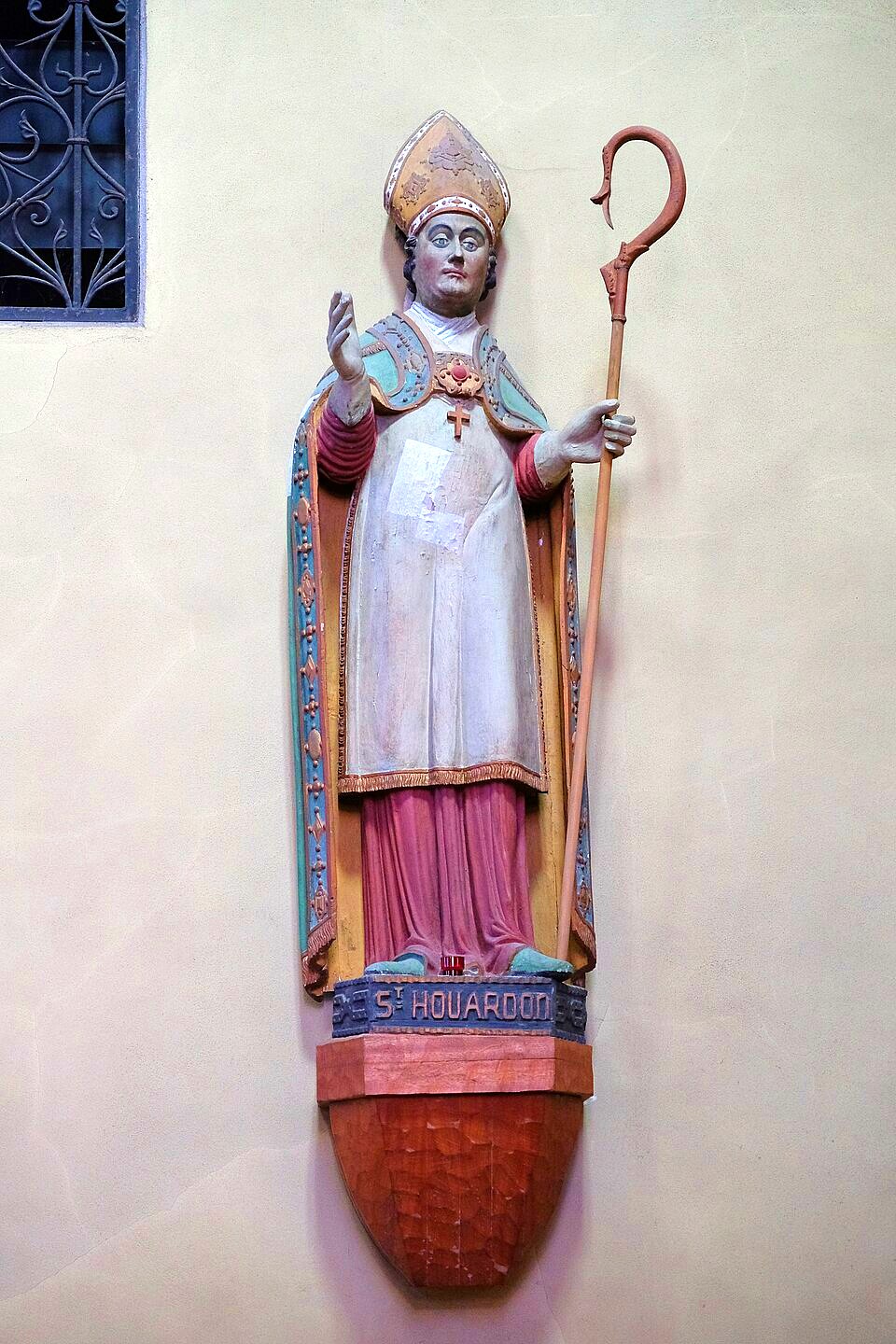
In Landerneau, the Town of which he is the Patron Saint, a 17th Century Statue depicts Hardoin dressed as a Bishop, with Miter and Crozier, in the act of blessing.
Landerneau – Place de l’Église Saint-Houardon
The Episcopal Registers of the Diocese were completed much after his time and are, therefore, unreliable but in the 17th Century, there was no hesitation in specifying that Hardoin was the 8th Bishop of Léon, “elected in the year 635 under Pope Honorius I, Emperor Heraclius and King Hoël III of Brittany” and that he “died in the year 650.”
He did not have the honour of having his ‘Vita’ recorded and appears only in the legendary and recent Vitae of St Herveus and St Goeznoveus. In the first, Hardoin, protector and friend of St Herveus, labouriously and slowly leads the blind bard to the Council of Breton Bishops gathered on the summit of Menez Bré, to condemn the famous tyrant Conomor, who had killed his wife, St Tryphina and his son, St Tremor.
St Hardoin left and St Goeznoveus.
Returning from the Council, Herveus asked Hardoin to pray to God that he too might contemplate the wonders of eaven, despite his blind eyes. After three days of fasting and prayer, both saw the heavens open and they contemplated the Choirs of Angels and Saints, whom St Herveus recognised as they passed by, to the sound of an enchanting melody. When they intoned the canticle Cantemus Domino, Heaven closed again, but Hardoin struggled to return to earth. When he became ill, he summoned Abbot St Goeznoveus to assist him and administer the last Sacraments and chose him as his successor.
While it is not possible to document anything about the Episcopate and the era of Hardoin, it must be recognised that the cult is ancient and that he is invoked in the ancient Breton Litanies of the 9th Century under the names of Hoierdonus and Hoardonus.
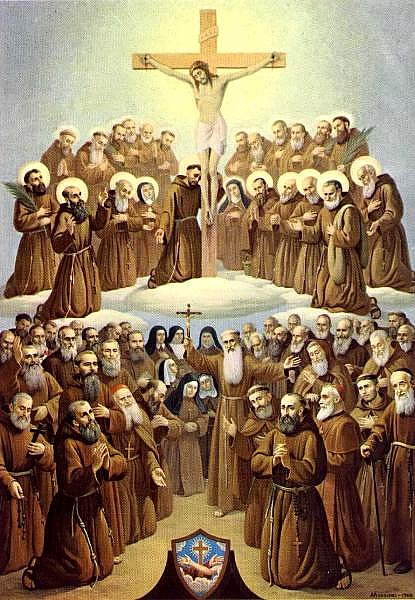
All Saints of the Seraphic Order (Franciscan): the Church celebrates the many Franciscan Saints who followed in the footsteps of St Francis. It is a special day for all Franciscans to celebrate the Feast of ‘All the Saints of the Seraphic Order.’ Also on this day in 1223, the final Rule of life for Franciscan Friars was approved. To commemorate this and all the saintly examples produced in the Franciscan Order, on this day all the Saints of the Seraphic order are remembered at Franciscan Churches throughout the world.
St Hardoin (Died 650) Bishop of St Pol de-Leon, in Brittany, France. St Illuminata Virgin of Todi, Italy. Venerated in her home town, but her biography has been lost. St James of Saroug Bl Jutta of Heiligenthal St Paphnutius of Heracleopolis St Paramon St Philomenus of Ancyra St Radbod of Utrecht
St Saturninus of Rome (Died c304) + Priest and Martyrand St Sisinius of Rome (Died c304) + Deacon and Martyr The Roman Martyrology reads: “At Rome, on the Salarian road, the birthday of the holy Martyr Saturninus, an aged man and the Deacon Sisinius, in the time of the Emperor Maximian. After a long imprisonment, they were, by order of the Prefect of the City, placed on the rack, distended with ropes, scourged with rods and whips garnished with metal, then exposed to the flames, taken down from the rack and beheaded.” Their Lives and Deaths: https://anastpaul.com/2023/11/29/saint-s-of-the-day-29-november-saint-saturninus-of-rome-priest-martyr-and-saint-sisinius-of-rome-deacon-martyr-died-c304/
Thought for the Day – 28 November – Meditations with Antonio Cardinal Bacci (1881-1971)
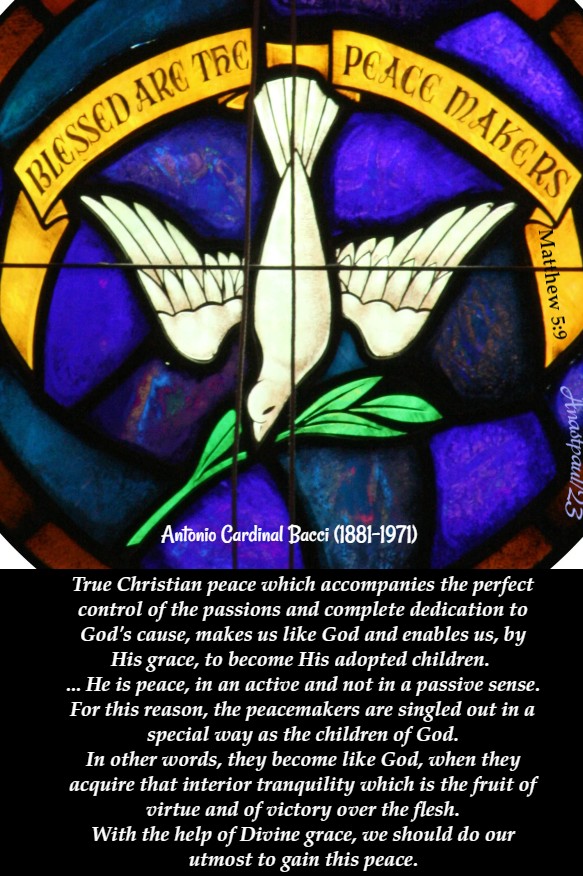
The Blessedness of the Peacemakers
“Blessed are the peacemakers,” said Jesus in the Sermon on the Mount, “for they shall be called children of God” (Mt 5:9).
True Christian peace which accompanies the perfect control of the passions and complete dedication to God’s cause, makes us like God and enables us, by His grace, to become His adopted children. He is the God of peace, in Whom there is no conflict but only perfect order and harmony. Since He is pure act, He understands Himself fully in all His beauty and perfection and, knowing Himself, He loves Himself. He is peace, in an active and not in a passive sense. For this reason, the peacemakers are singled out in a special way as the children of God. In other words, they become like God, when they acquire that interior tranquility which is the fruit of virtue and of victory over the flesh. With the help of Divine grace, we should do our utmost to gain this peace.”
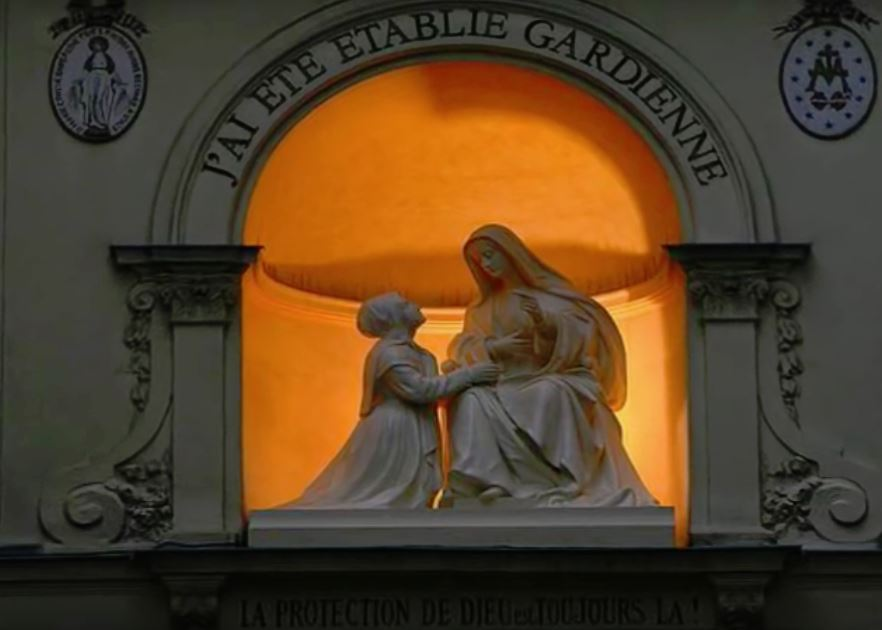
Quote/s of the Day – 28 November – The Memorial of St Catherine Labouré DC (1806-1876) Virgin, Religious Sister of the Daughters of Charity of Saint Vincent de Paul and the Marian visionary of the Miraculous Medal.
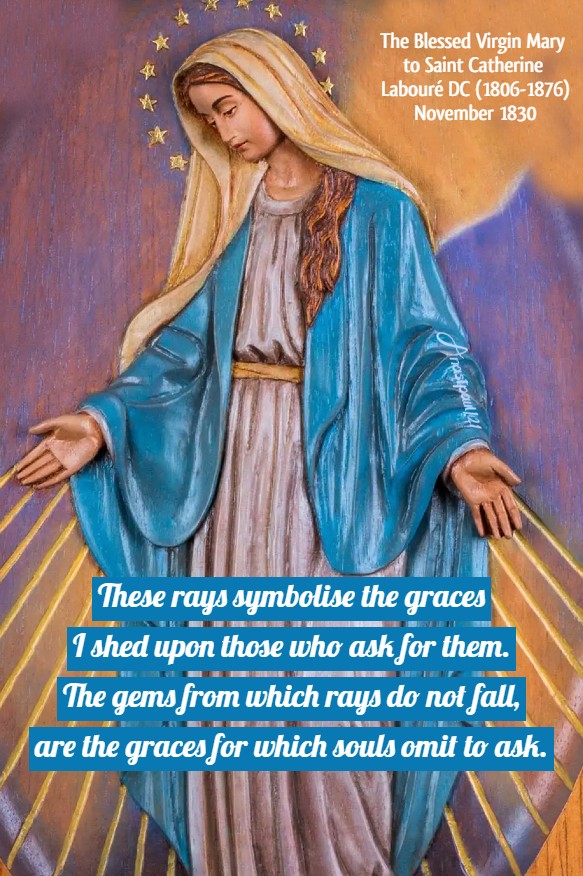
THE PROMISES OF THE MEDAL When Our Lady appeared to Saint Catherine Labouré on 27 November 1830, rays of light flowed from the rings (made of precious stones) on her fingers. However, some of the stones on the rings did not shine.
Our Lady explained:
“These rays symbolise the graces I shed upon those who ask for them. The gems from which rays do not fall are the graces for which souls omit to ask.”
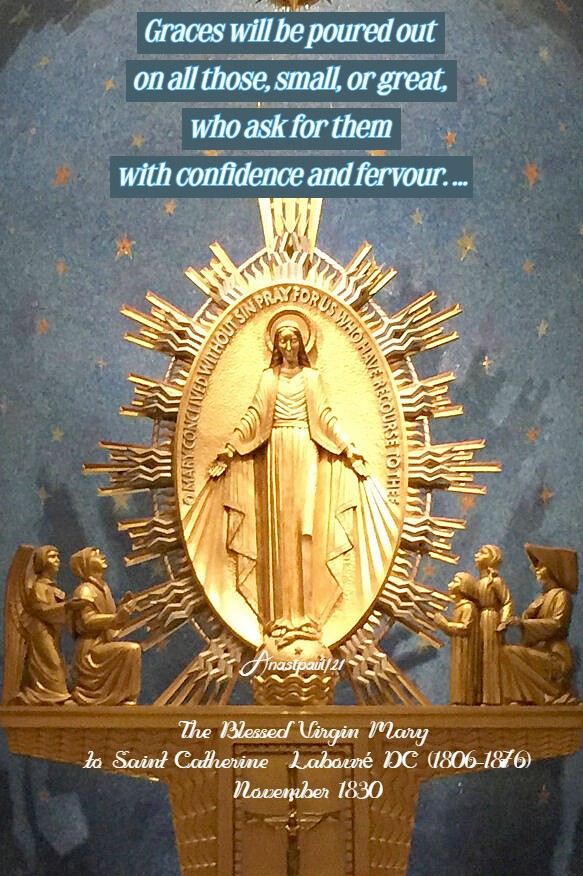
“Graces will be poured out on all those, small, or great, who ask for them with confidence and fervour. … ”
The Blessed Virgin Mary to Saint Catherine Labouré DC (1806-1876) November 1830
One Minute Reflection – 28 November – “The Month of The Holy Souls in Purgatory” – St Catherine Labouré DC (1806-1876) Virgin, Religious Sister of the Daughters of Charity of Saint Vincent de Paul and the Marian Visionary of the Miraculous Medal – Ferial Day – Colossians 1:9-14 – Matthew 24:15-35 – Scripture search here: https://www.drbo.org/
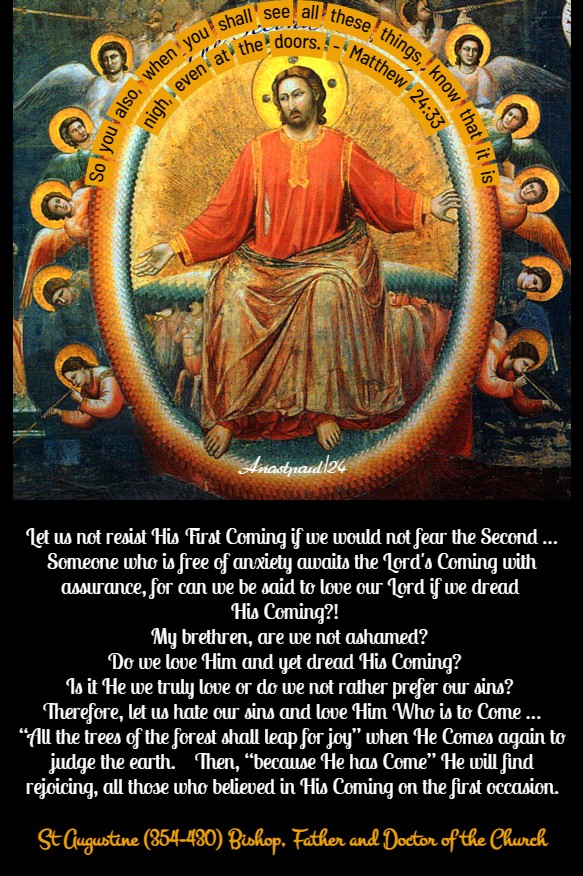
“So you also, when you shall see all these things, know that it is nigh, even at the doors.” – Matthew 24:33
REFLECTION – “Then, all the trees of the forest shall leap for joy before the Lord, for He Comes, He Comes to rule the earth” (Ps 95:12-13). Our Lord came the first time and will come again anew. He came into His Church to begin with “on the clouds” (Mt 26:64). What are those clouds which bore Him? Apostles, preachers… He came, borne by His preachers to begin with and He filled the whole earth. Let us not resist His First Coming if we would not fear the Second…
What, then, should Christians do? Take advantage of this world but do not serve this world. What does that mean? “Possess as if one did not possess.” This is what Saint Paul said … “Brothers, the time is growing short. From now on… let those who weep act like those who do not weep, those rejoicing as not rejoicing, those buying as not owning, those using the world as not using it fully, For the world in its present form is passing away. I should like you to be free of anxieties” (1 Cor 7:29-32). Someone who is free of anxiety awaits the Lord’s Coming with assurance, for can we be said to love our Lord if we dread His Coming?! My brethren, are we not ashamed? Do we love Him and yet dread His Coming? Is it He we truly love or do we not rather prefer our sins? Therefore, let us hate our sins and love Him Who is to Come …
“All the trees of the forest shall leap for joy before the Lord, for He has Come” for the first time… “All the trees of the forest shall leap for joy” when He Comes again to judge the earth. Then, “because He has Come” He will find rejoicing, all those who believed in His Coming on the first occasion.” – St Augustine (354-430) Bishop, Father and Doctor of the Church (Discourses on the Psalms Ps 95).
PRAYER – From all perils of soul and body, defend us, O Lord, we beseech Thee and by the intercession of blessed and glorious ever Virgin Mary, Mother of God, of blessed Joseph, of thy blessed Apostles Peter and Paul and of blessed Catherine Labouré and all the Saints, graciously grant us safety and peace that all adversities and errors, being overcome, Thy Church may serve Thee in security and freedom. Through Jesus Christ, Thy Son our Lord, Who lives and reigns with Thee, in the unity of the Holy Ghost, God, world without end. Amen (Collect).
Our Morning Offering – 28 Novemer – “The Month of The Holy Souls in Purgatory”
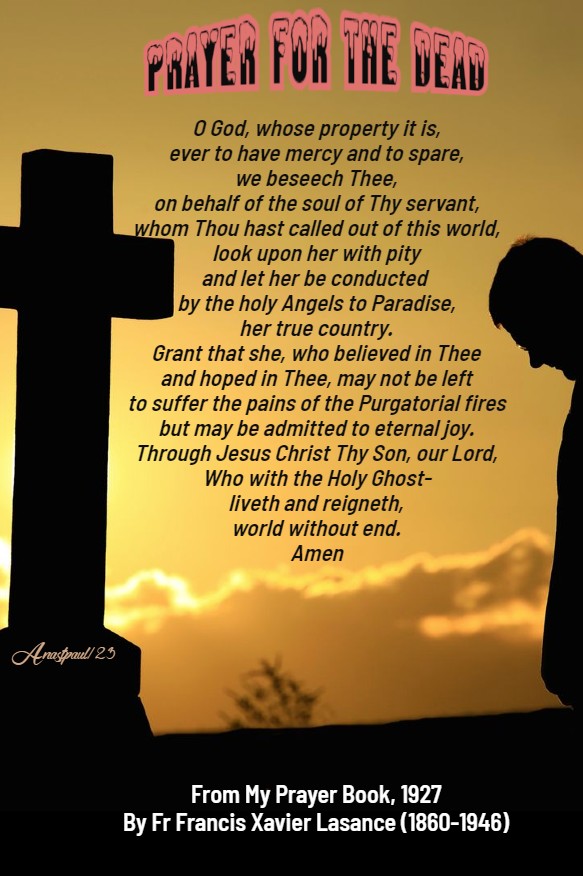
Prayer for the Dead From My Prayer Book, 1927 By Fr Francis Xavier Lasance (1860-1946)
O God, whose property it is, ever to have mercy and to spare, we beseech Thee, on behalf of the soul of Thy servant, whom Thou hast called out of this world, look upon her with pity and let her be conducted by the holy Angels to Paradise, her true country. Grant that she, who believed in Thee and hoped in Thee, may not be left to suffer the pains of the Purgatorial fires but may be admitted to eternal joy. Through Jesus Christ Thy Son, our Lord, Who with the Holy Ghost- liveth and reigneth, world without end. Amen
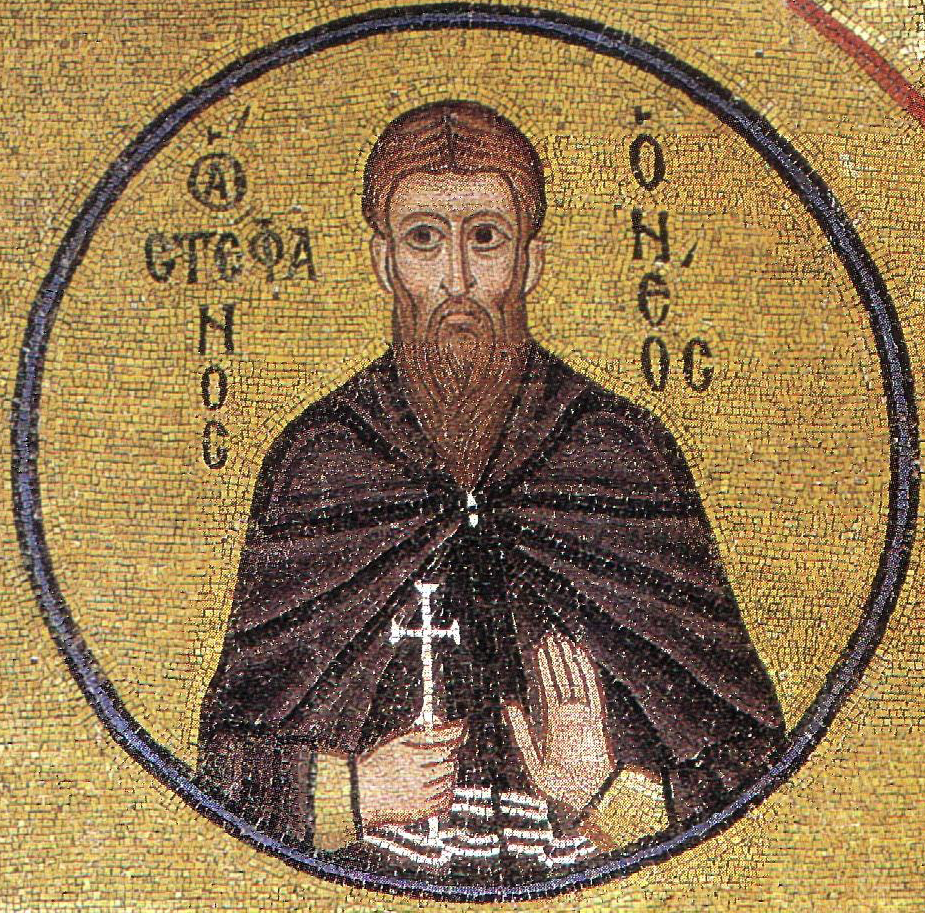
Saint of the Day – 28 November – Saint Stephen the Younger (c713-764) Abbot Martyr, Defender of Sacred Images, Born in c713 in Constantinople and died there in 764 by being scourged, stoned and dragged to death through the streets. Patronage – coin collectors, numismatists, smelters.
The Roman Martyrology reads today: “At Constantinople in the time of Constantine Copronymus, the holy Martyrs, Stephen the Younger, Basil, Peter, Andrew and their companions, numbering 339 Monks who were subjected to various torments for the veneration of holy images and confirmed the Catholic truth with the shedding of their blood.”
The ‘Life’ of this Monk was written around the year 809 by his namesake, the Deacon Stephen of Constantinople. The holy Abbot Stephen the Younger, was born in 713-715 in Constantinople, ancient Byzantium. As a young man, he initially placed himself under the guidance of a Hermit but then, choosing the religious life, entered the Monastery of Mount Auxentius in Bithynia, near Chalcedon. Here, he later became its Abbot.
He lived in this Monastery for ymany ears, devoted to prayer and as a copyist, the meritorious work of the Monks who copied ancient texts. At that time, the Eastern Emperor Constantine V Copronymus (718-775) was ruling, son of Leo III the Isaurian (675-741), the Emperor who, in 726, had initiated the religious policy against the veneration of images. This iconoclastic movement continued with his son Constantine V, who waged a fierce struggle, especially against the Monks, even convening the Council of Hiera, in 753 which condemned the defenders of the cult of sacred images.
Our Saint, the Abbot Stephen, openly opposed the decrees of this Council convened by the Emperor and not by the Pope, decrees which would later be disavowed with the approval of the veneration of images at the subsequent Second Council of Nicaea in 787.
Meanwhile, Constantine V Copronymus, in June 762, enjoined the Abbot of Mount Auxentius, to respect and adhere to the canons promulgated at Hiera; when he refused, he was taken to the Monastery of Chrysopolis near Constantinople and from there sent into exile on the Island of Proconnesus, allowing his mother and sister to join him.
After a year, in 763, he was brought back to Constantinople, where more than 300 Monks had been imprisoned for their devotion to the veneration of sacred images. Then, after another year of constant harassment and insults, on 28 November 764, Abbot Stephen was killed by Palace Officials during celebrations for Empress Eudoxia but without any order from the Emperor.
His Relics are recorded in various Churches and Monasteries during the 13th–15th Centuries. His body was deposited either at the Lips Monastery or the cemetary of St Stephen the Protomartyr, in Constantininople and his right hand was at the Pantokrator Monastery.
Bl Calimerius of Montechiaro St Fionnchu of Bangor
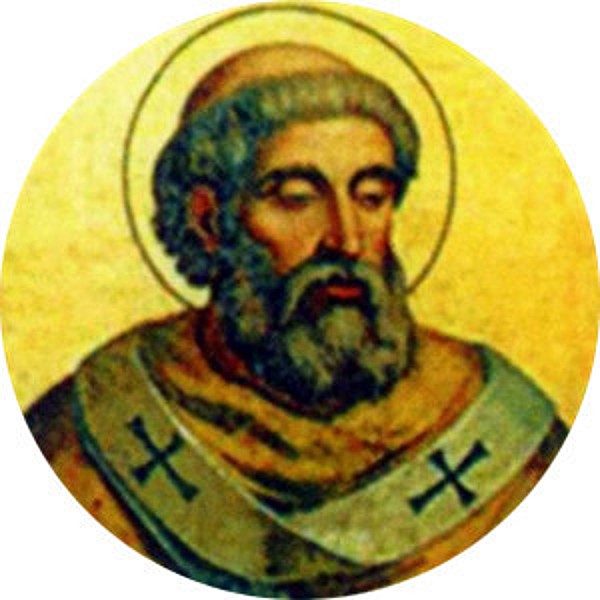
St Pope Gregory III (Died 741) Bishop of Rome 11 February 731 until his death on 28 November 741. (His Feast was moved to 10 December in 1969), The Roman Martyrology states: “At Rome, the blessed Pope Gregory III, who departed for Heaven with a reputation for great sanctity and miracles.“ His Life: https://anastpaul.com/2021/11/28/saint-of-the-day-28-november-saint-pope-gregory-iii-died-741/
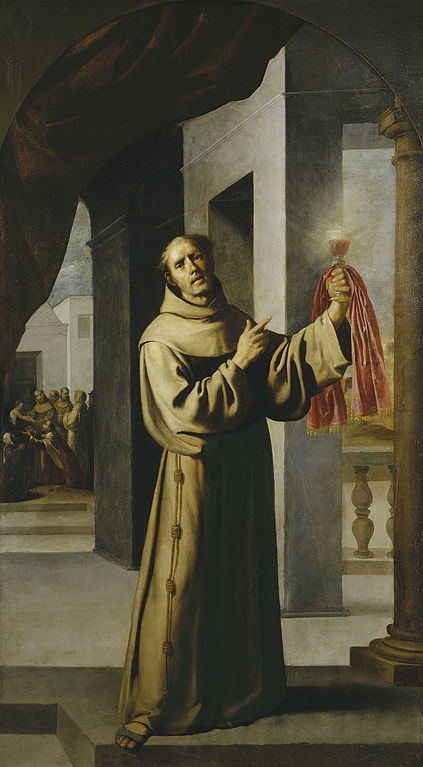
St James of the Marches OFM Conv. (1391-1476) Priest of the Friars Minor Conventional, Confessor, brilliant Preacher, Penitent, Reformer, Writer, Papal legate, Inquisitor, founder of several monasteries in Bohemia, Hungary and Austria. St James was Canonised on 10 December 1726 by Pope Benedict XIII. His body is Incorrupt. About St James: https://anastpaul.com/2019/11/28/saint-of-the-day-28-november-saint-james-of-the-marches-ofm-1391-1476/
St Papius St Quieta of Dijon St Rufus St Simeon the Logothete
St Sosthenes (1st Century) Bishop, Martyr, Jewish Ruler in Corinth, Converted by St Pauland became his disciple, who is mentioned by him in his First Epistle to the Corinthians (1 Corinthians 1:1–2) and by St Luke in Acts 18:12–17. The Roman Martyrology reads: “At Corinth, the birthday of St Sosthenes, disciple of the blessed Apostle Paul, who is mentioned by that Apostle in his first Epistle to the Corinthians. He was chief of the synagogue when converted to Christ and, as a glorious beginning, consecrated the first fruits of his faith by being scourged in the presence of the Proconsul, Gallio.” His Life and Death: https://anastpaul.com/2023/11/28/saint-of-the-day-28-november-st-sosthenes-1st-century-bishop/
St Stephen the Younger (c713-764) Abbot Martyr
Bl Theodora of Rossano
Martyrs of Constantinople – 8 Saints: A group of over 300 Christians Martyred during the persecutions of the Iconoclast Emperors. We have a lot of information on Saint Stephen the Younger but for the others we have nothing but seven of their names – Andrew, Auxentius, Basil, Gregor, John, Peter and Stefan. They were scourged, stoned and/or dragged to death through the streets of Constantinople in 764.
Martyrs of North Africa – 13 Saints: A group of thirteen Clerics killed or exiled in the persecutions of Arian Vandals in North Africa – Crescens, Crescentian, Cresconius, Eustace, Felix, Florentian, Habetdeum, Hortulanus, Mansuetus, Papinianus, Quodvultdeus, Urban and Valerian.
Martyrs of Tiberiopolis – 14 Saints: A group of fourteen Christian Laymen, Deacons, Priests and Bishops who were Martyred together in the persecutions of Julian the Apostate – Basil, Chariton, Comasios, Daniel, Etymasius, Hierotheos, John, Nicephorus, Peter, Sergius, Socrates, Theodore, Thomas and Timothy. 361 at Tiberiopolis, Phyrgia (in modern Turkey)
Thought for the Day – 27 November – Meditations with Antonio Cardinal Bacci (1881-1971)
The Blessedness of the Pure of Heart
“Let us conclude this meditation with an appropriate prayer of St Thomas Aquinas.
“Make my heart watchful, O God, so that no vain thoughts may distract it from Thee. Make it noble, so that it may never be seduced by any base affection. Make it steadfast, so that troubles may not dismay it. Make it free, so that it may not yield to the onslaughts of passion. Grant me, my God, the intelligence, to understand Thee, the love, to seek Thee, the wisdom, to find Thee, words, to please Thee, the perseverance, to wait faithfully for Thee and, the hope of embracing Thee, at last. Grant that I, a repentant sinner, may bear Thy chastisements with resignation. Poor pilgrim which I am, may I draw on the treasury of Thine grace and may I one day, be eternally happy with Thee in Heavnely glory! Amen.”
Quote/s of the Day – 27 November – “The Month of The Holy Souls in Purgatory” –Ferial of the Last Sunday after Pentecost – Colossians 1:9-14; Matthew 24:15-35 – Scripture search here: https://www.drbo.org/
“Tell us when shall these things be? and what shall be the sign of Thy Coming and of the consummation of the world? ”
Matthew 24:3
“But he who shall persevere to the end, he shall be saved.”
Matthew 24:13
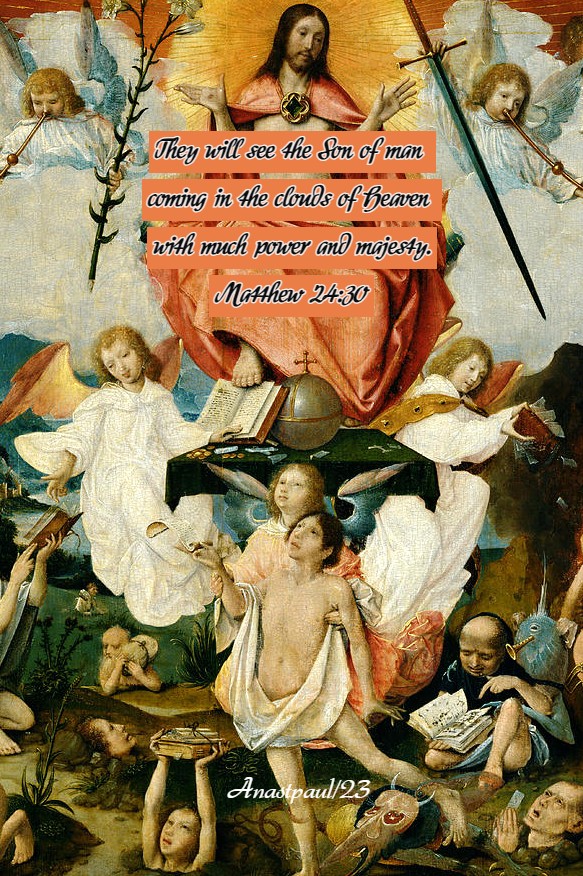
“They will see the Son of Man coming in the clouds of Heaven with much power and majesty.”
Matthew 24:30
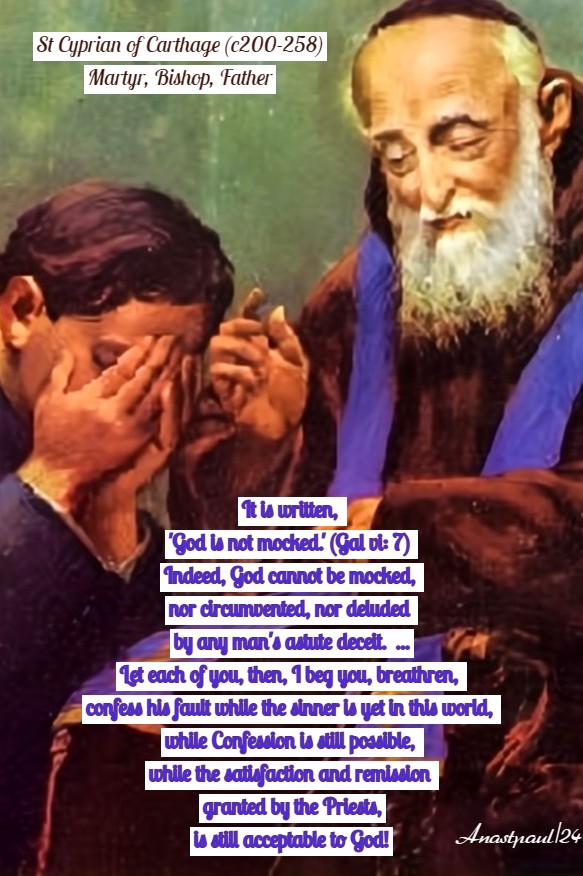
“It is written, ‘God is not mocked.’ (Gal 6: 7) Indeed, God cannot be mocked, nor circumvented, nor deluded by any man’s astute deceit. … Let each of you, then, I beg you, brethren, confess his fault while the sinner is yet in this world, while Confession is still possible, while the satisfaction and remission granted by the Priests, is still acceptable to God!”
St Cyprian of Carthage (c200-258) Martyr, Bishop of Carthage, Father of the Church
“Let us then, my brethren, endure in hope. Let us devote ourselves, side-by-side with our hoping, so that the God of all the universe, as He beholds our intention, may cleanse us from all sins, fill us with high hopes from what we have in hand and grant us the change of heart which saves. God has called you and you have your calling!”
St Cyril of Jerusalem (315-387) Father and Doctor of the Church
One Minute Reflection – 27 November – “The Month of the Holy Souls in Purgatory” – Our Lady of the Miraculous Medal – Feria of the Last Sunday after Pentecost – Colossians 1:9-14; Matthew 24:15-35 – Scripture search here: https://www.drbo.org/
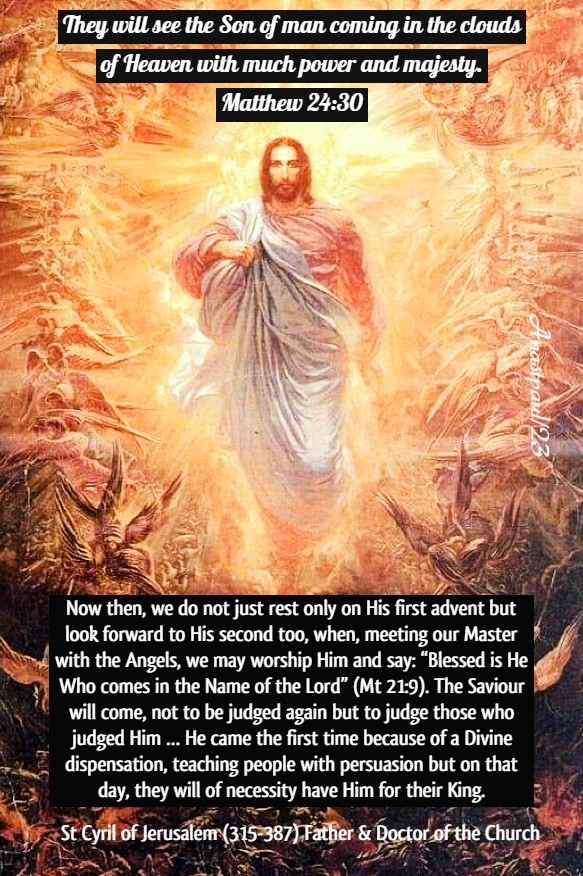
“They will see the Son of man coming in the clouds of Heaven with much power and majesty.” – Matthew 24:30
REFLECTION – “We do not preach only one advent of Christ but a second also, far more glorious than the first. For the first gave us a glimpse of His patience but the second brings with it, the Crown of a Divine Kingdom… In His former advent, He was wrapped in swaddling clothes in the manger; in His second, “He covers Himself with Light as with a garment” (Ps 103:2). In His first coming, He endured the Cross, despising shame (Heb 12:2); in His second, He comes attended by a host of Angels, receiving glory.
Now then, we do not just rest only on His first advent but look forward to His second too, when, meeting our Master with the Angels, we may worship Him and say: “Blessed is He Who comes in the Name of the Lord” (Mt 21:9). The Saviour will come, not to be judged again but to judge those who judged Him … He came the first time because of a Divine dispensation, teaching people with persuasion but on that day, they will of necessity have Him for their King.” – St Cyril of Jerusalem (315-387) Bishop of Jerusalem, Father and Doctor of the Church (Catechetical lectures 15, 1).
PRAYER – O God, Who, by the message of an Angel, willed to take flesh in the womb of the Blessed Virgin Mary, grant that we, Thy suppliants, who believe her to be truly the Mother of God, may be helped by her intercession with You. Through Jesus Christ, Thy Son our Lord, Who lives and reigns with Thee, in the unity of the Holy Ghost, God, world without end. Amen (Collect).
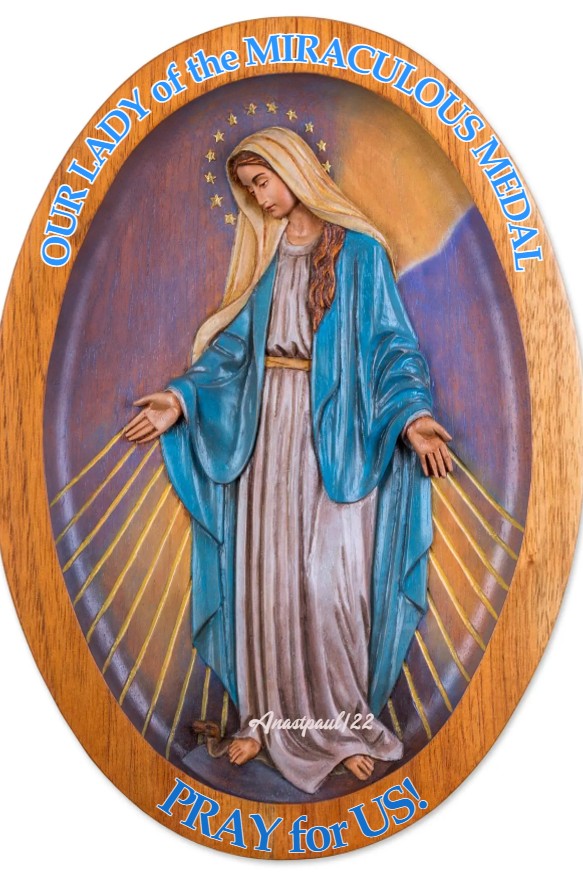
Our Morning Offering – 27 November – Feast of Our Lady of the Miraculous Medal – Patronages : … Special graces, miracles of healing, for conversions, for believers.
Our Blessed Lady and her Miraculous Medal are the solution to the difficulties we are facing. Now, more than ever, we need our Blessed Mother’s comfort and protection. Now, more than ever, we need to discover her peace. Now, more than ever, we need to know that our Mother is with us.
Prayer to Our Lady of the Miraculous Medal
Virgin Mother of God, Mary Immaculate, we unite ourselves to thee under thy title of Blessed Mother, Our Lady of the Miraculous Medal. May this medal be, for each one of us, a sure sign of thy motherly affection for us and a constant reminder of our filial duties towards thee. While wearing it, may we be blessed by thy loving protection and preserved in the grace of thy Son. Most powerful Virgin, Mother of our Saviour, keep us close to thee, every moment of our lives so that like thee, we may live and act according to the teaching and example of thy Son. Obtain for us, thy children, the grace of a happy death, so that in union with thee we may enjoy the happiness of heaven forever. Amen
Saint of the Day – 27 November – Saint Severin the Hermit (Died c540) Monk and Hermit. Also known as – Severinus.
The Roman Martyrology reads today: “At Paris, the departure from this world of St Severin, Monk and Solitary.”
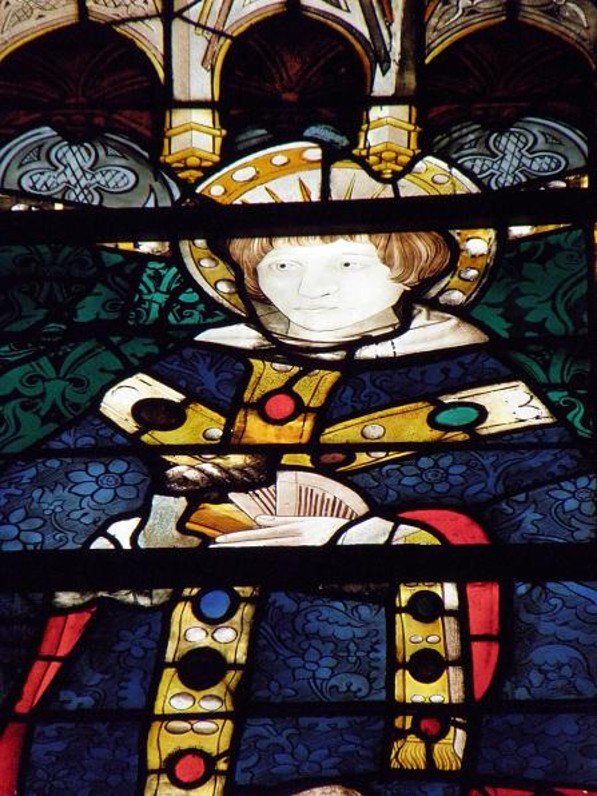
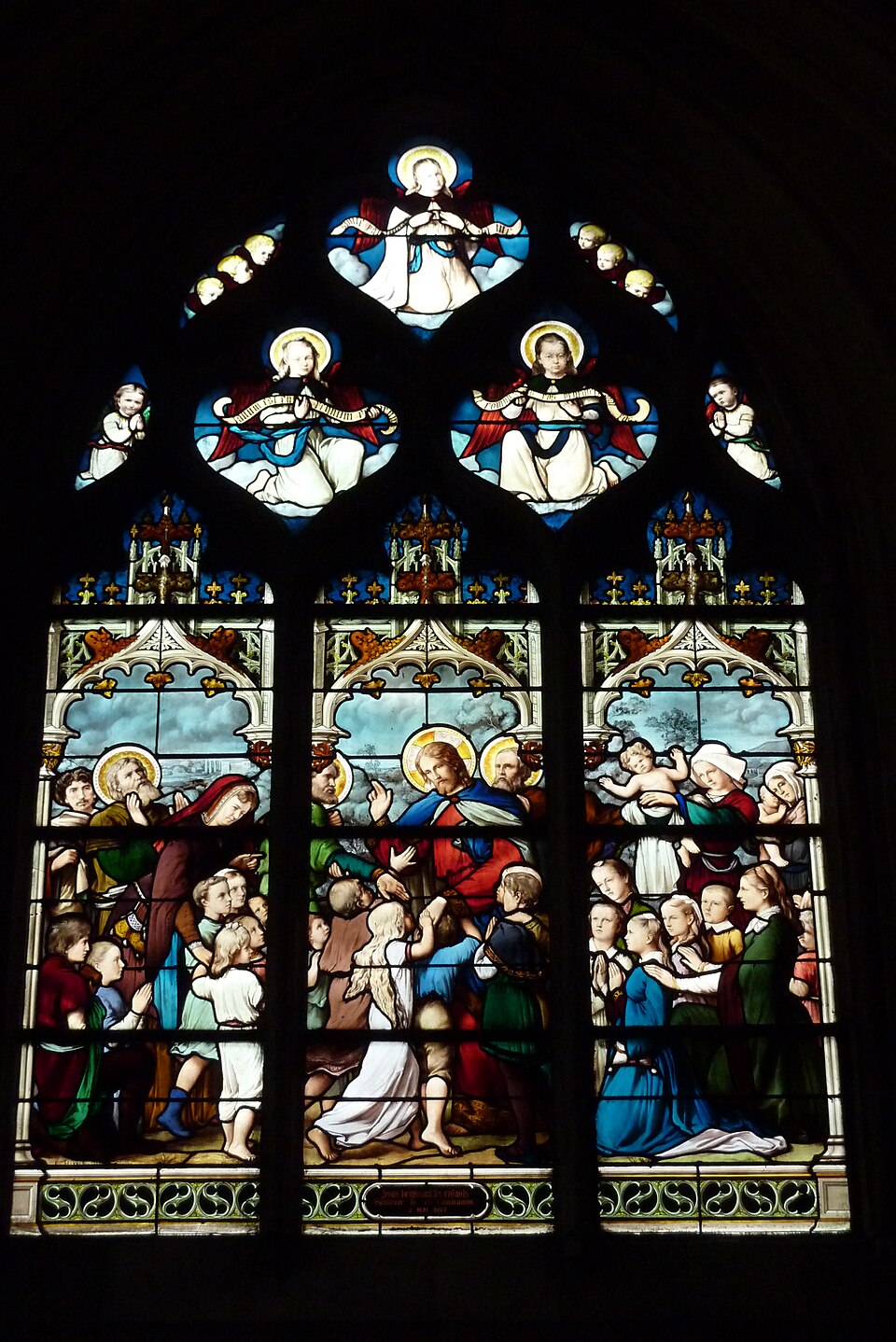
St Severin window in the Church dedicated to him in Paris and built above his Hermitage. See the full window below with Jesus and the children and St Severin top left
Severin of Paris, was a devout Monk who became a Hermit living at the site of the Saint-Severin Church in the 6th Century and died in about 540.
One of his disciples was Saint Cloud, a Merovingian Prince who left the Royal Court to become a Monk and Hermit.
After the death of Severin, a Chapel was erected on the site of his cell, believed to be near the Oratory of Saint Martin in the present Church. This Chapel was destroyed during the Norman invasions in the 9th Century, then rebuilt in the Romanesque style in the 11th Century.
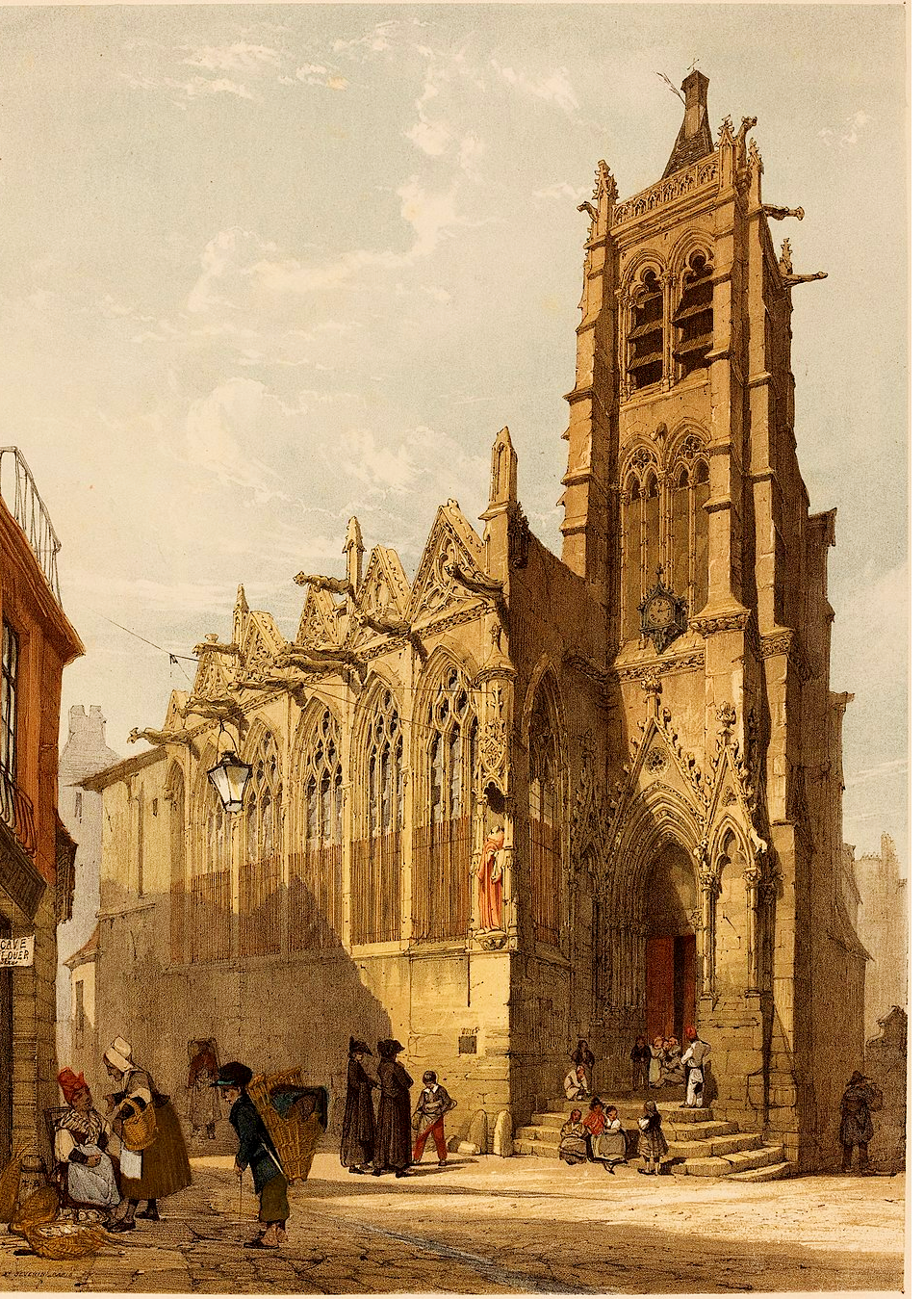
The current building which is situate in the Latin Quarter of Paris, on the lively tourist Street, Rue Saint-Séverin. It was constructed beginning in 1230, then, after a fire, rebuilt and enlarged in the 15th to 17th Centuries in the Flamboyant Gothic style. It is the Parish Church for students at the University of Paris and is one of the oldest Churches which remains standing on the Left Bank.
Engraving by Thomas Shotter Boys, St Severin, Paris, 1839
Two of the most famous conversions due to the Miraculous medal was that of Fr Alphonse Ratisbonne NDS (1814-1884), an anti-Catholic Jewish banker and Claude Newman (1923-1944). Fr Alphonse Ratisbonne received a vision of Our Lady of the Miraculous Medal. After his conversion, he became a Priest and worked for the conversion of the Jewish people.
St Acacius of Sebaste St Acharius of Noyon St Apollinaris of Monte Cassino St Barlaam
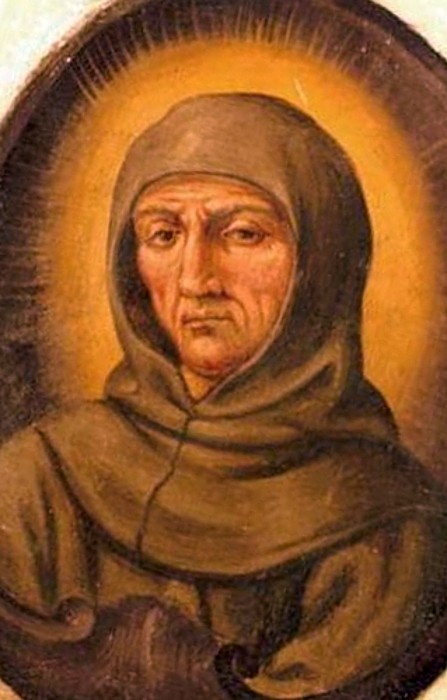
Blessed Bernardine of Fossa OFM (1420-1503) Priest, Friar of the Friars Minor, Missionary in Italy and a renowned Preacher, noted Historian, Lawyer, Ascetical Writer, rising within the Order to important positions. His cult was later confirmed by the Beatification of Pope Leo XII on 26 March 1828. The Roman Martyrology states: “At L’Aquila, blessed Bernardino da Fossa (Giovanni) Amici, Priest of the Order of Minors, who preached the Catholic Faith in many Provinces of Italy.“ A Faithful Imitator of his Namesake, St Bernardine of Siena: https://anastpaul.com/2021/11/27/saint-of-the-day-27-november-blessed-bernardine-of-fossa-ofm-1420-1503/
St Bilhild of Altmünster St Eusician St Facundus St Fergus the Pict St Gallgo of Wales St Gregory of Sinai St Gulstan St Hirenarchus of Sebaste St James Intercisus St John Angeloptes
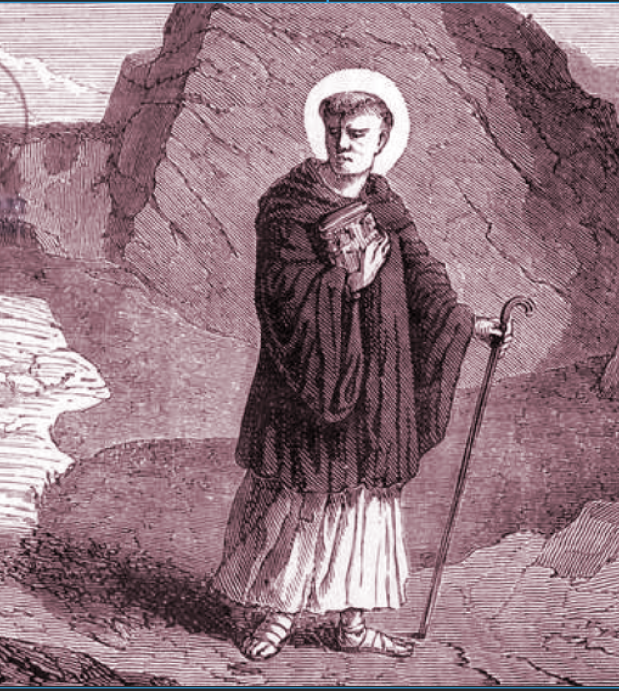
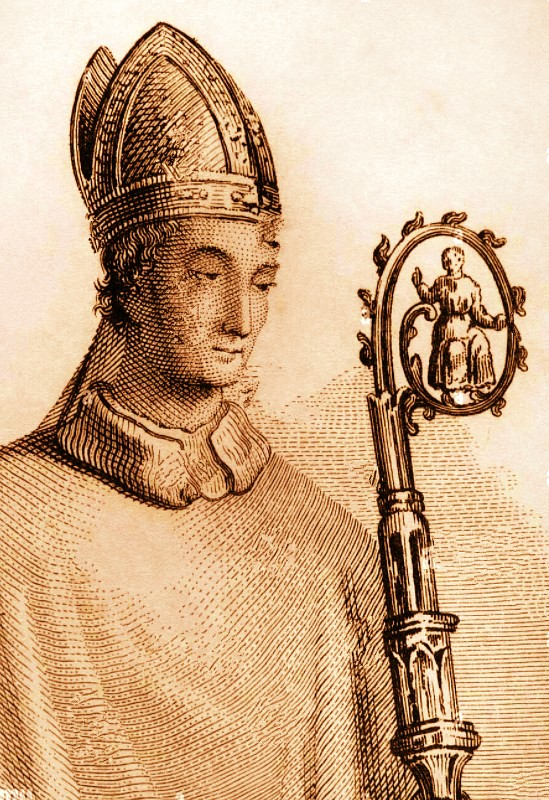
St Maximus (Died 460) Bishop of Riez , Confessor, Abbot, Hermit, zealous and highly efficient leader, Miracle-worker. The Roman Martyrology reads: “At Riez, in France, St Maximus, Bishop and Confessor, who, from his tender years, was endowed with every grace and virtue. Being first the Superior of the Monastery of Lérins and afterwards, Bishop of the Church of Riez, he was celebrated for the working of miracles and prodigies.” His Life of Love: https://anastpaul.com/2023/11/27/saint-of-the-day-27-november-saint-maximus-of-riez-died-460-bishop-confessor/
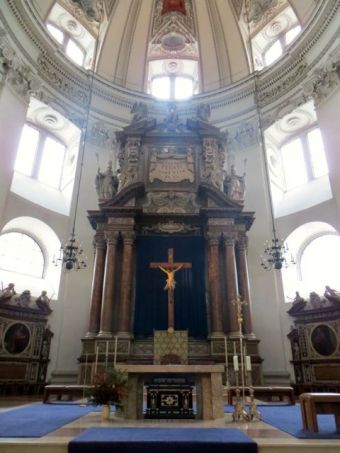
High Altar, Salzburg Cathedral (Salzburger Dom) Salzburg, Austria. Saint Rupert is depicted atop the altar carrying a barrel of salt in his left hand and a bishop’s crozier in his right. Saint Virgil is also represented atop the altar, opposite Saint Rupert.
Martyrs of Antioch – 3 Saints: A group of Christians Martyred together for their faith. Little information has survived except for their names – Auxilius, Basileus and Saturninus.
Martyrs of Nagasaki – 11 Beati: A group of eleven Christians Martyred together for their faith during a period of official persecution in Japan. They are: Blessed Alexius Nakamura Blessed Antonius Kimura Blessed Bartholomaeus Seki Blessed Ioannes Iwanaga Blessed Ioannes Motoyama Blessed Leo Nakanishi Blessed Matthias Kozasa Blessed Matthias Nakano Blessed Michaël Takeshita Blessed Romanus Motoyama Myotaro Blessed Thomas Koteda Kyumi They were Martyred on 27 November 1619 in Nagasaki, Japan and Beatified on 7 May 1867 by Pope Pius IX.
The Dogma was promulgated by Blessed Pius IX in 1854 in the Bull Ineffabilis Deus. This Dogma is rejected by all Protestants including the Orthodox – another reason why we cannot interact with these the way some do and the Vatican II church endorses.
Let us Pray to our Mother, the Immaculate and Blessed Virgin Mary, conceived without sin.
Thought for the Day – 26 November – Meditations with Antonio Cardinal Bacci (1881-1971)
The Blessedness of the Merciful
“Let us remember that we have often made ourselves God’s enemies, by our sins. We were often in need, when we were deprived of Divine grace. On these occasions, God was merciful to us, for He granted us His forgiveness and His friendship. These gifts of God, place an obligation on us, to behave in the same way to those who are in need, by assisting them willingly and generously and, to those who are unhappy, by consoling them as far as possible.
Let us remember, the great principle which Jesus Christ has given us. “Even as you wish men to do to you, so also, do you unto them … Do good to those who hate you … Do not judge and you shall not be judged; do not condemn and you shall not be condemned. Forgive and you shall be forgiven, give and it shall be given to you …” (Cf Lk 6:30-38). “With what judgement you judge, you shall be judged and with what measure you measure, it shall be measured to you” (Mt 7:1). So it shall be on the day of death, when we shall appear before the Supreme Judge!
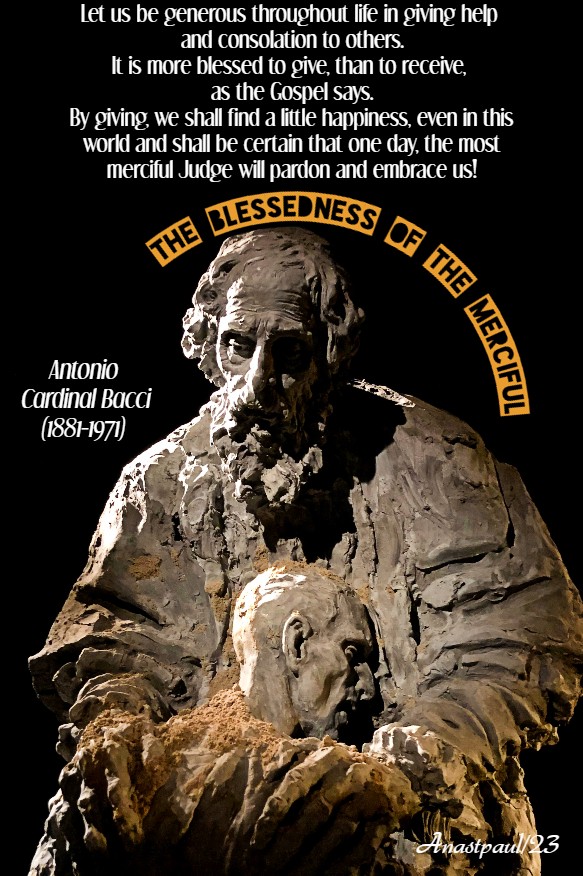
Let us be generous throughout life in giving help and consolation to others. It is more blessed to give, than to receive, as the Gospel says. By giving, we shall find a little happiness, even in this world and shall be certain that one day, the most merciful Judge will pardon and embrace us!”
Quote/s of the Day – 26 November – St Leonard of Port Maurice OFM (1676-1751) Confessor, Priest and Franciscan Friar
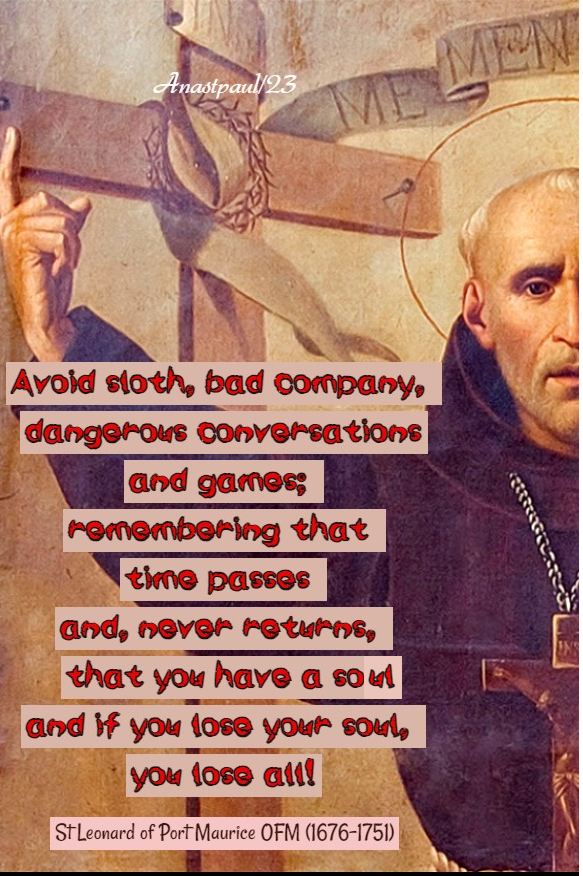
“Avoid sloth, bad company, dangerous conversations and games; remembering that time passes and never returns, that you have a soul and, if you lose your soul, you lose all!”
One Minute Reflection – 26 November – “The Month of The Holy Souls in Purgatory” – St Sylvester Gozzolini OSB Silv. (1177– 1267) Priest, Abbot – Ecclesiasticus 45:1-6 – Matthew 19:27-29 – Scripture search here: https://www.drbo.org/
“… Shall receive a hundredfold and shall possess life everlasting.” – Matthew 19:29
REFLECTION – “The possessions which we have, are not our own: God has given them to us to cultivate and He wishes us to render them fruitful and profitable … Always deprive yourself, therefore, of some part of your means, giving them to the poor with a willing heart … It is true that God will return it to you, not only in the next world but also in this, for there is nothing which makes a person prosper, in temporal matters, so much, as almsgiving. But until such time as God shall repay it, you will always be impoverished to that extent. Oh! how holy and rich is the impoverishment which is caused by almsgiving.
Love the poor and poverty, for by this love you will become truly poor, since, as Scripture says: “We become like the things that we love” (cf Hos 9:10). Love makes those who love, equal to one another: “Who is weak and I am not weak?” says St Paul (2 Cor 11:29). He might have said: “Who is poor, with whom I am not poor?” For love made him become, such as those whom he loved. If, then, you love the poor, you will be truly participating in their poverty and poor like them. Now, if you love the poor, be often among them; be pleased to see them in your house and to visit them in theirs; associate willingly with them; be glad that they are near you in the Churches, in the streets and elsewhere. Be poor in speech with them, speaking to them as their equal but be rich in deed, giving them of your goods, as one who possesses more abundantly.
Will you do even more? … Become a servant of the poor; go to serve them … with your own hands … and at your own expense. This service has more glory in it than a throne!” – St Francis de Sales (1567-1622) Bishop of Geneva and Doctor of the Church (Introduction to the devout life, Part three Ch 15).
PRAYER – Most merciful God, Who when the holy Abbot Sylvester was devoutly meditating upon the vanity of this world beside an open grave, graciously willed to call him into the desert and enrich him with unusual merits, we humbly pray that, following his example, despising the things of earth, we may thoroughly enjoy Thy everlasting presence. Through Jesus Christ, Thy Son our Lord, Who lives and reigns with Thee, in the unity of the Holy Ghost, God, world without end. Amen (Collect).





























 AnaStpaul
You must be logged in to post a comment.