Thought for the Day – 3 November – Meditations with Antonio Cardinal Bacci (1881-1971)
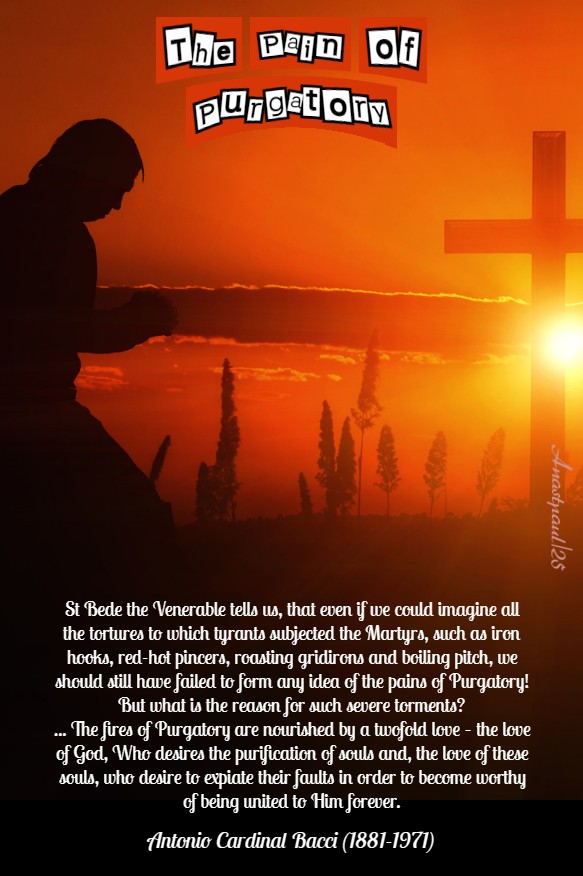
The Pain of Purgatory
“The Tradition of the Fathers and the ordinary teaching of the Church, describe the pains of Purgatory in such a fashion, that they should prompt us to avoid even the smallest sin, not only because it is an offence against the most amiable God but also because, it will be severely punished by Him. This teaching, moreover, should move us to pity for the poor suffering souls, who are enduring such torments.
St Cyril of Jerusalem states, that the sum total of the sufferings of this world, is nothing in comparison to the sufferings of Purgatory. He adds, moreover, that the pain of Purgatory is equal to the severity of the torments of Hell; the only difference is that the latter are everlasting, whereas the former, will have an end. St Athanasius assures us that the least pang of suffering in Purgatory, is sharper than all the torments which it is possible to undergo on earth. Moreover he adds, in comparison with the fire which afflicts the suffering souls, earthly fire is hardly even real! St Bede the Venerable tells us, that even if we could imagine all the tortures to which tyrants subjected the Martyrs, such as iron hooks, red-hot pincers, roasting gridirons and boiling pitch, we should still have failed to form any idea of the pains of Purgatory!
But what is the reason for such severe torments? It is that God loves these souls and desires that they be purified of sins, as soon as possible and be made worthy of infinite happiness.
The fires of Purgatory are nourished by a twofold love – the love of God, Who desires the purification of souls and, the love of these souls, who desire to expiate their faults in order to become worthy of being united to Him forever.”
Quote/s of the Day – 3 November – “The Month of The Holy Souls in Purgatory” and the Feast of the Holy Souls in Purgatory
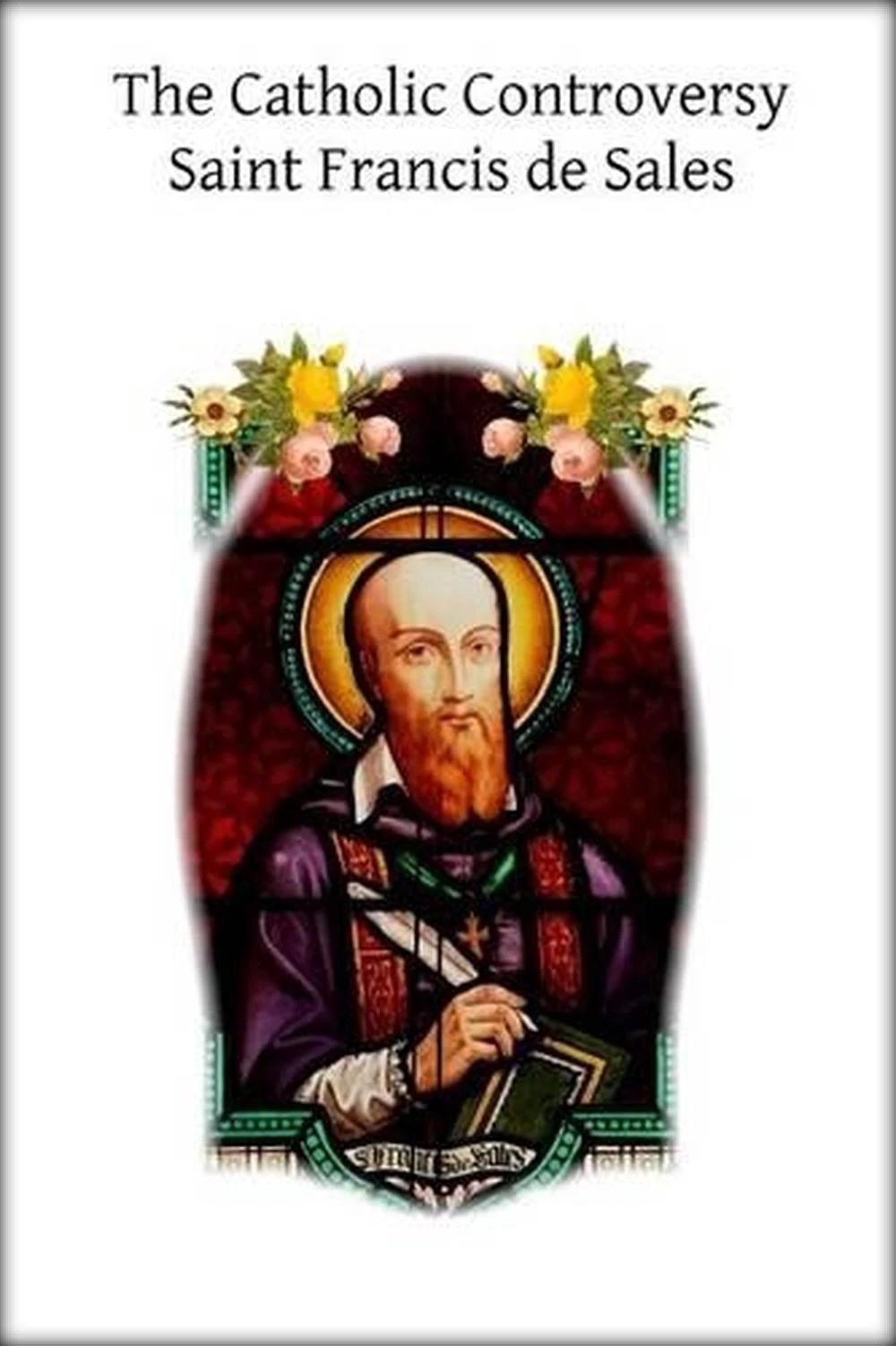
The Doctrine of Purgatory by Saint Francis de Sales (1567-1622) Bishop of Geneva Doctor of Charity of the Church
From “The Catholic Controversy“ (originally published by Burns and Oates, London 1886) Translated by Rev Henry Benedict Mackey OSB (19th Century) English Canon of the Isle of Wight
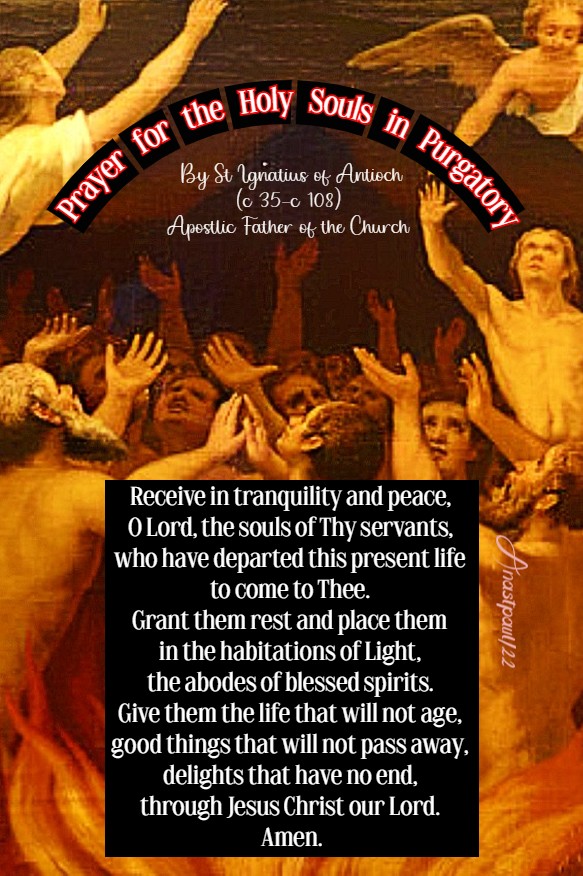
Prayer for the Holy Souls in Purgatory By St Ignatius of Antioch (c 35-c 108) Apostolic Father of the Church
Receive in tranquility and peace, O Lord, the souls of Thy servants, who have departed this present life to come to Thee. Grant them rest and place them in the habitations of Light, the abodes of blessed spirits. Give them the life that will not age, good things that will not pass away, delights that have no end, through Jesus Christ our Lord. Amen.
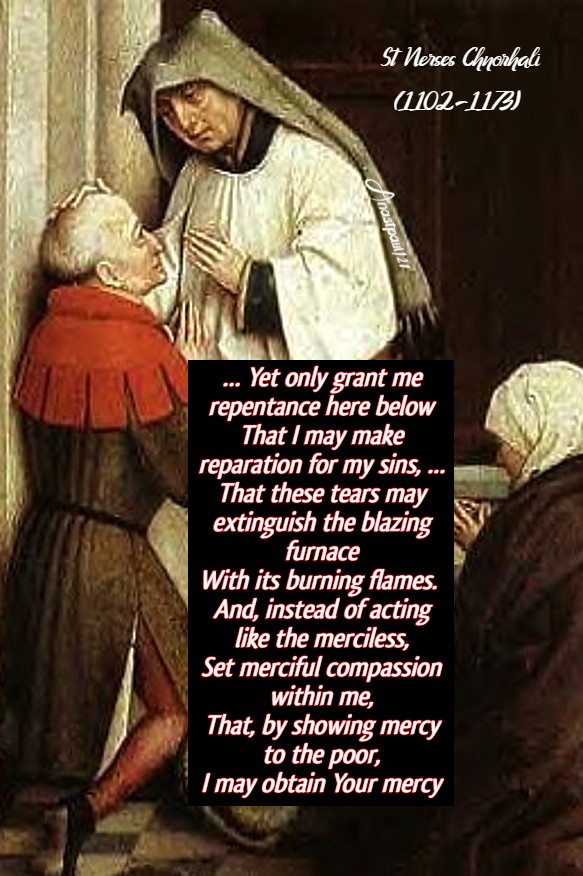
“ … Yet only grant me repentance here below That I may make reparation for my sins, … That these tears may extinguish the blazing furnace With its burning flames. …
And, instead of acting like the merciless, Set merciful compassion within me, That, by showing mercy to the poor, I may obtain Your mercy.”
St Nerses Chnorhali (1102-1173) Armenian Bishop
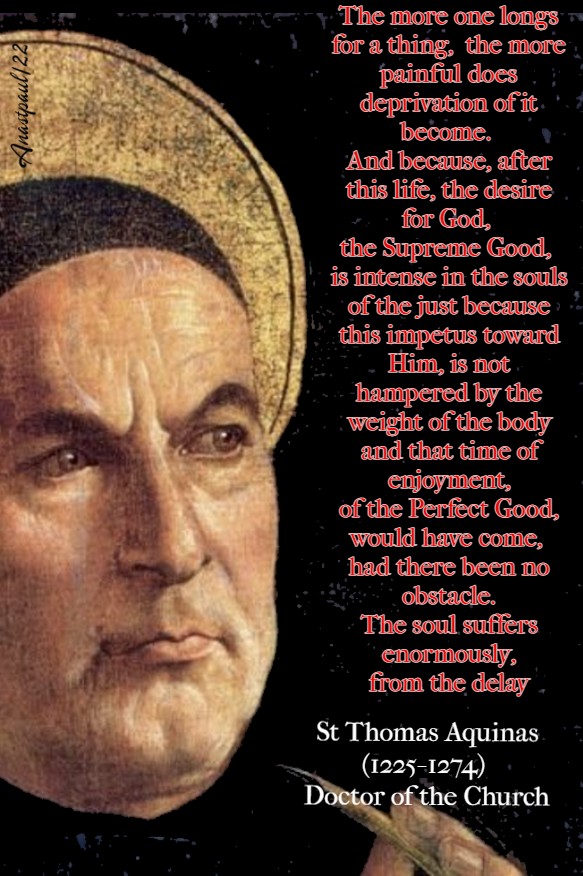
“The more one longs for a thing, the more painful does deprivation of it become. And because, after this life, the desire for God, the Supreme Good, is intense in the souls of the just – (because this impetus toward Him, is not hampered by the weight of the body and that time of enjoyment, of the Perfect Good, would have come) had there been no obstacle. The soul suffers enormously, from the delay.”
St Thomas Aquinas (1225-1274) Angelic Doctor
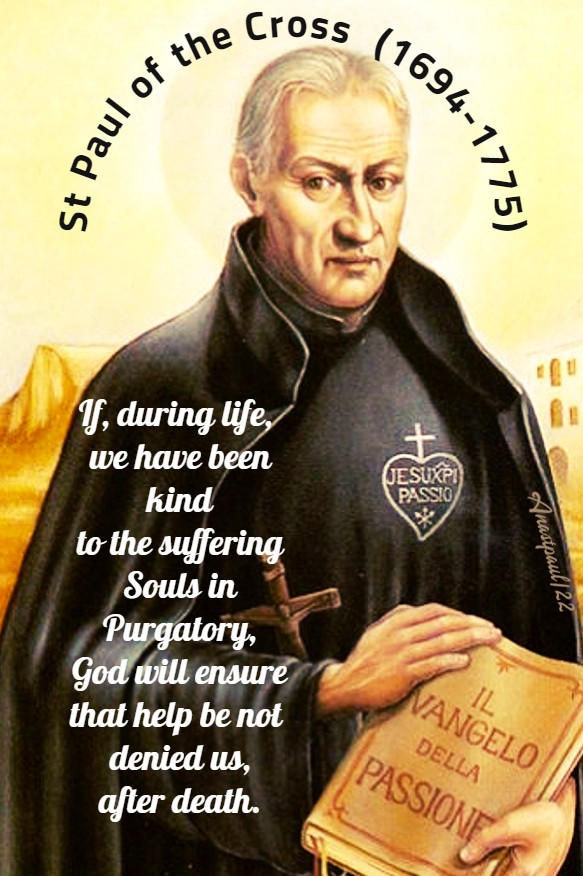
“If, during life, we have been kind to the suffering Souls in Purgatory, God will ensure that help be not denied us, after death.”
St Paul of the Cross (1694-1775)
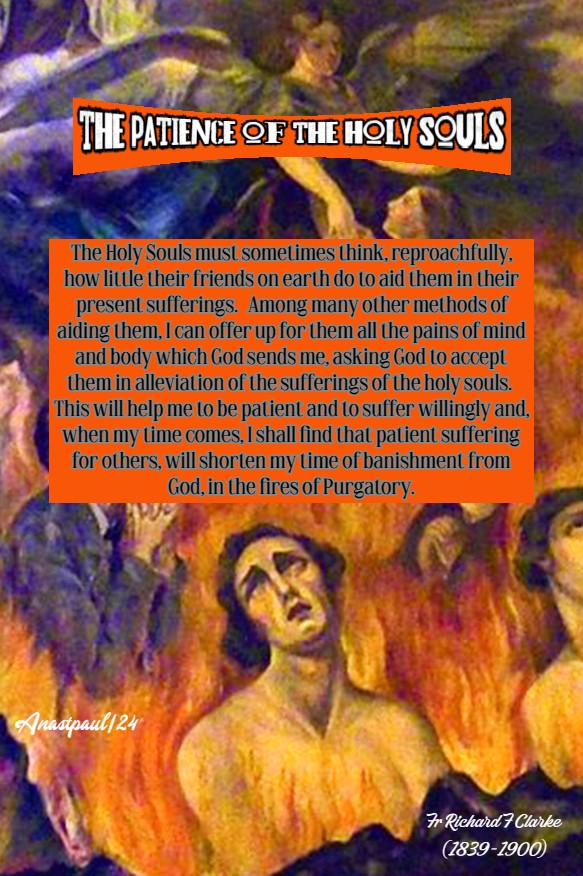
“The Holy Souls must sometimes think, reproachfully, how little their friends on earth do to aid them in their present sufferings. Among many other methods of aiding them, I can offer up for them all the pains of mind and body which God sends me, asking God to accept them in alleviation of the sufferings of the holy souls. This will help me to be patient and to suffer willingly and, when my time comes, I shall find that patient suffering for others, will shorten my time of banishment from God, in the fires of Purgatory.”
One Minute Reflection – 3 November – “The Month of The Holy Souls in Purgatory” – Within the Octave of All Saints – All Holy Souls in Purgatory – 1 Corinthians 15:51-57 – John 5:25-29 – Scripture search here: https://www.drbo.org/
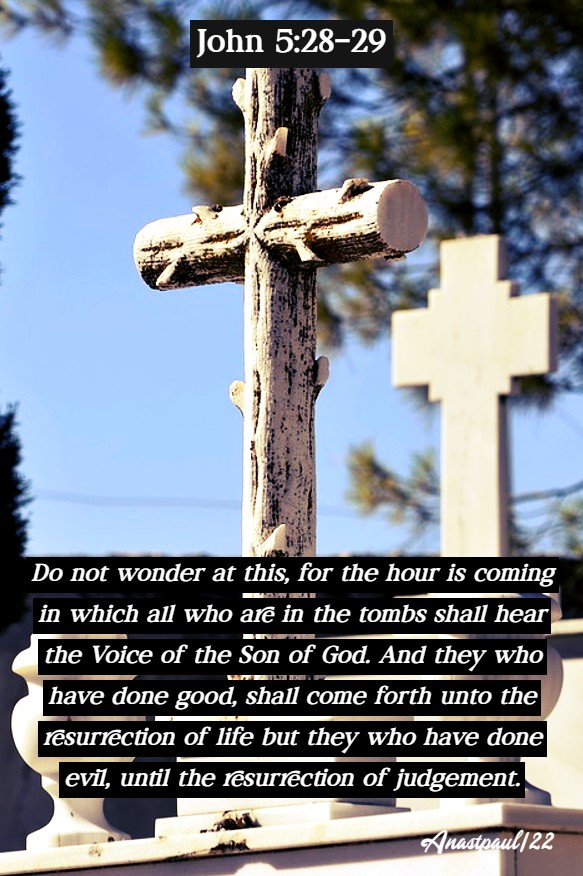
“Do not wonder at this, for the hour is coming in which all who are in the tombs shall hear the Voice of the Son of God. And they who have done good, shall come forth unto the resurrection of Life but they who have done evil, until the resurrection of judgement.” – John 5:28-29
REFLECTION – “We should consider, beloved brethren and we should reflect constantly that we have renounced the world and as strangers and foreigners, we sojourn here for a time (Heb 11:13). Let us embrace the day which assigns each of us to his dwelling which, on our being rescued from here and released from the snares of the world, restores us to Paradise and the Kingdom. What man, after having been abroad, would not hasten to return to his native land? Who, when hurrying to sail to his family, would not more eagerly long for a favourable wind that he might more quickly embrace his dear ones? We account Paradise our country, we have already begun to look upon the patriarchs as our parents.
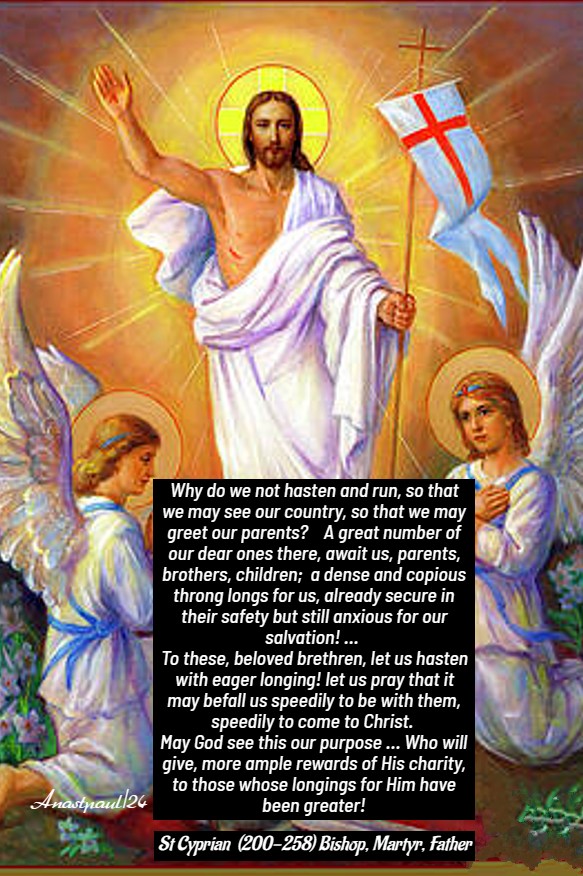
Why do we not hasten and run, so that we may see our country, so that we may greet our parents? A great number of our dear ones there, await us, parents, brothers, children; a dense and copious throng longs for us, already secure in their safety but still anxious for our salvation! … There, are to be found, the glorious choir of Apostles, there, the throng of exultant Prophets, there, the innumerable multitude of Martyrs wearing crowns on account of the glory and victory of their struggle and passion, there, the triumphant Virgins … the merciful enjoying their reward, who have performed works of justice by giving food and alms to the poor, who, in observing the precepts of the Lord, have transferred their earthlyinheritance to the treasuries of Heaven!
To these, beloved brethren, let us hasten with eager longing! let us pray that it may befall us speedily to be with them, speedily to come to Christ. May God see this our purpose … Who will give, more ample rewards of His charity, to those whose longings for Him have been greater.” – St Cyprian (200-258) Bishop of Carthage, Martyr, Father (On Mortality 26).
PRAYER – O God, Creator and Redeemer of all the faithful, grant to the souls of Thy servants and handmaids, the remission of all their sins, that they may obtain, by our loving prayer,s the forgiveness which they have always desired. Who lives and reigns with God the Father, in the unity of the Holy Spirit, God, world without end. Amen (Collect).
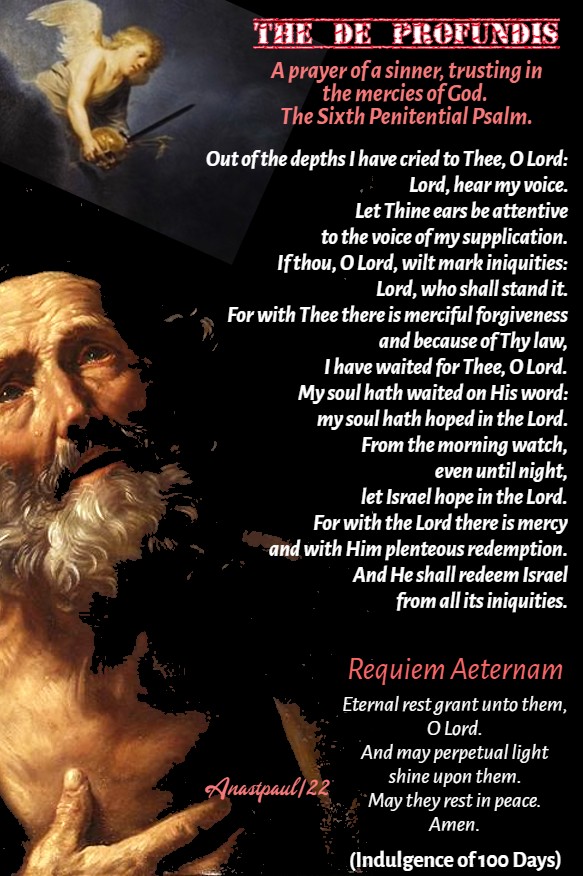
A prayer of a sinner, trusting in the mercies of God. The Sixth Penitential Psalm.
Out of the depths I have cried to Thee, O Lord: Lord, hear my voice. Let Thine Ears be attentive to the voice of my supplication. If Thou, O Lord, wilt mark iniquities: Lord, who shall stand it. For with Thee there is merciful forgiveness and because of Thy law, I have waited for Thee, O Lord. My soul hath waited on His word: my soul hath hoped in the Lord. From the morning watch, even until night, let Israel hope in the Lord. For with the Lord there is mercy and with Him plenteous redemption. And He shall redeem Israel from all its iniquities.
(Eternal rest or “Requiem aeternam”) Eternal rest grant unto them, O Lord. And may perpetual light shine upon them. May they rest in peace. Amen.
Saint of the Day – 3 November – Saint Pirminus (c690-753) Missionary Bishop on the Upper Rhine in Germany, Abbot, Founder of Monasteries, Reformer, Miracle-worker, Born in around 690 in Ireland or in Narbonne or in Paris, France and died on 3 November in 753 in Hornbach, Germany. Patronages – against eye ailments, against plague/epidemics, against poisoning, against rheumatism, against snake bites, against vermin, for happy birth, of livestock; in Austria – Innsbruck; in France – Alsace; in Germany – Amorbach, Monsheim, Palatinate, Pirmasens, Reichenau Island, Speyer, Diocese (with St Bernard). Also known as – Pirmin, Pirminius.
The Roman Martyrology reads today: “The departure from this life of St Pirminus, Bishop of Meaux.”
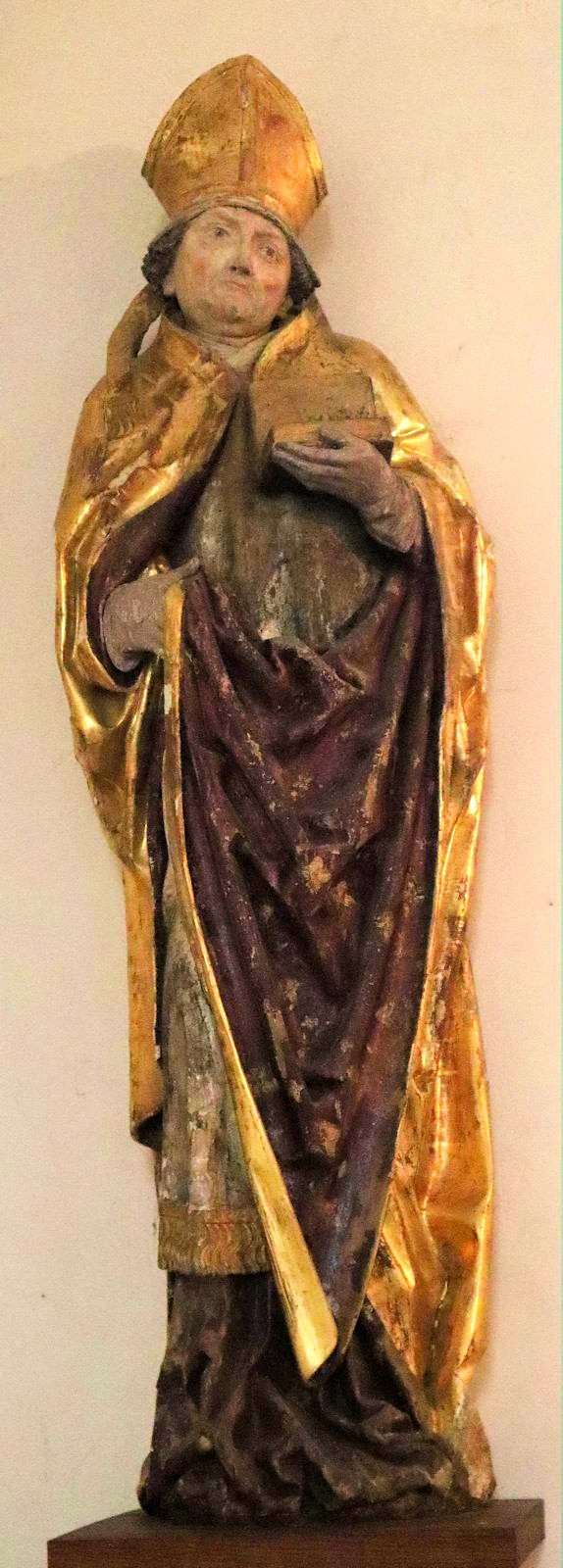
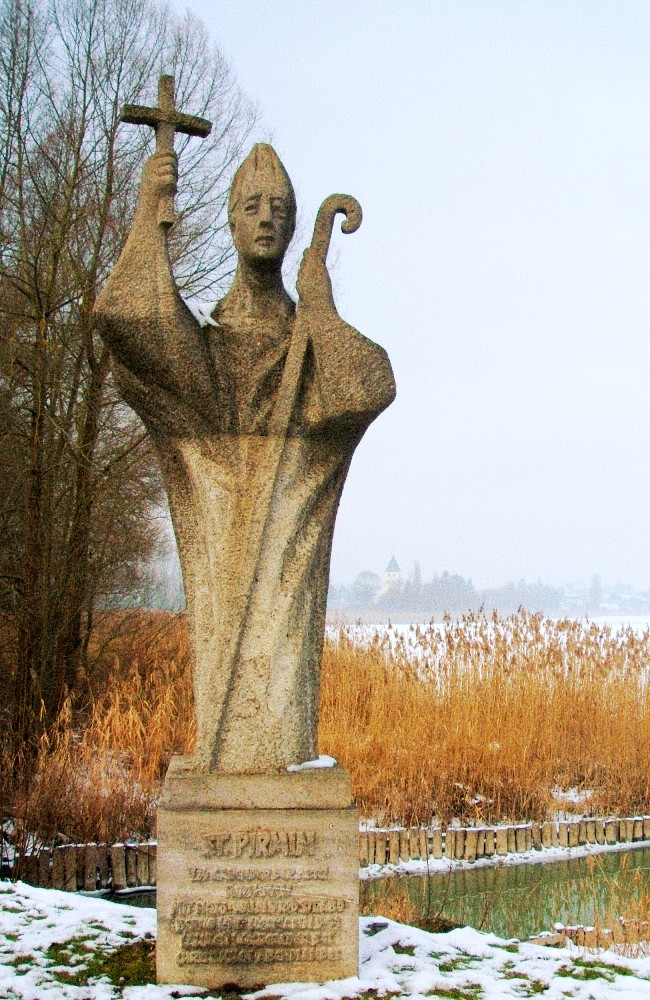
St Pirminus Statue in the Murbach Monastery
Pirminus is described in various sources, as a Visigoth, an Irish Scot, or of Roman origin. He was Consecrated as an itinerant Bishop around 720 – possibly in Meaux in France – and sent on a mission to north-western France and the Upper Rhine region.
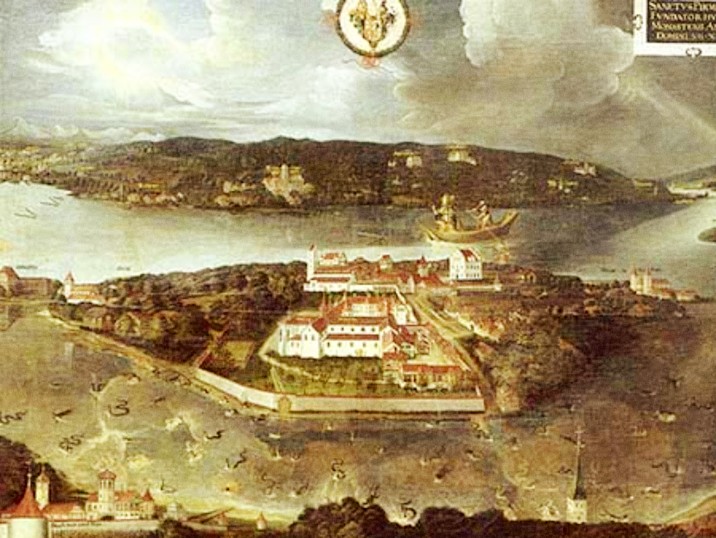
Arrival of Saint Pirmin on the Island of Reichenau
He maintained good relations with the Frankish Mayor of the Palace, Charles Martel, who, in 724, placed him under his protection and founded numerous Monasteries, including probably Pfungen near Winterthur and certainly the Mittelzell Monastery on the Lake Constance Island of Reichenau. All the crawling creatures which damaged the Island are said to have fallen into the water upon his arrival and thus disappeared. According to tradition, Pirminus remained on Reichenau until 726 and was then expelled by Duke Theobald.
Pirminus then went to Alsace to continue his work there. Here he was active in the Carolingian territory. In 727, he founded what was then Murbach Abbey and was able to realise his ideas there, that is, monastic life based on the Benedictine Rule, understood as a permanent pilgrimage without worldly ties and the Abbey’s freedom from the local Bishop, led by its own Abbot. Pirminus held this office in Murbach. The founding of the Monasteries in Neuweiler (present-day Neuwiller-lès-Saverne ) , Schwarzach in Rheinmünster in Baden and Pfäfers near Chur, are also attributed to Pirminus. According to local tradition, he lived for a time in the cave near Winterthur which was later named after him.
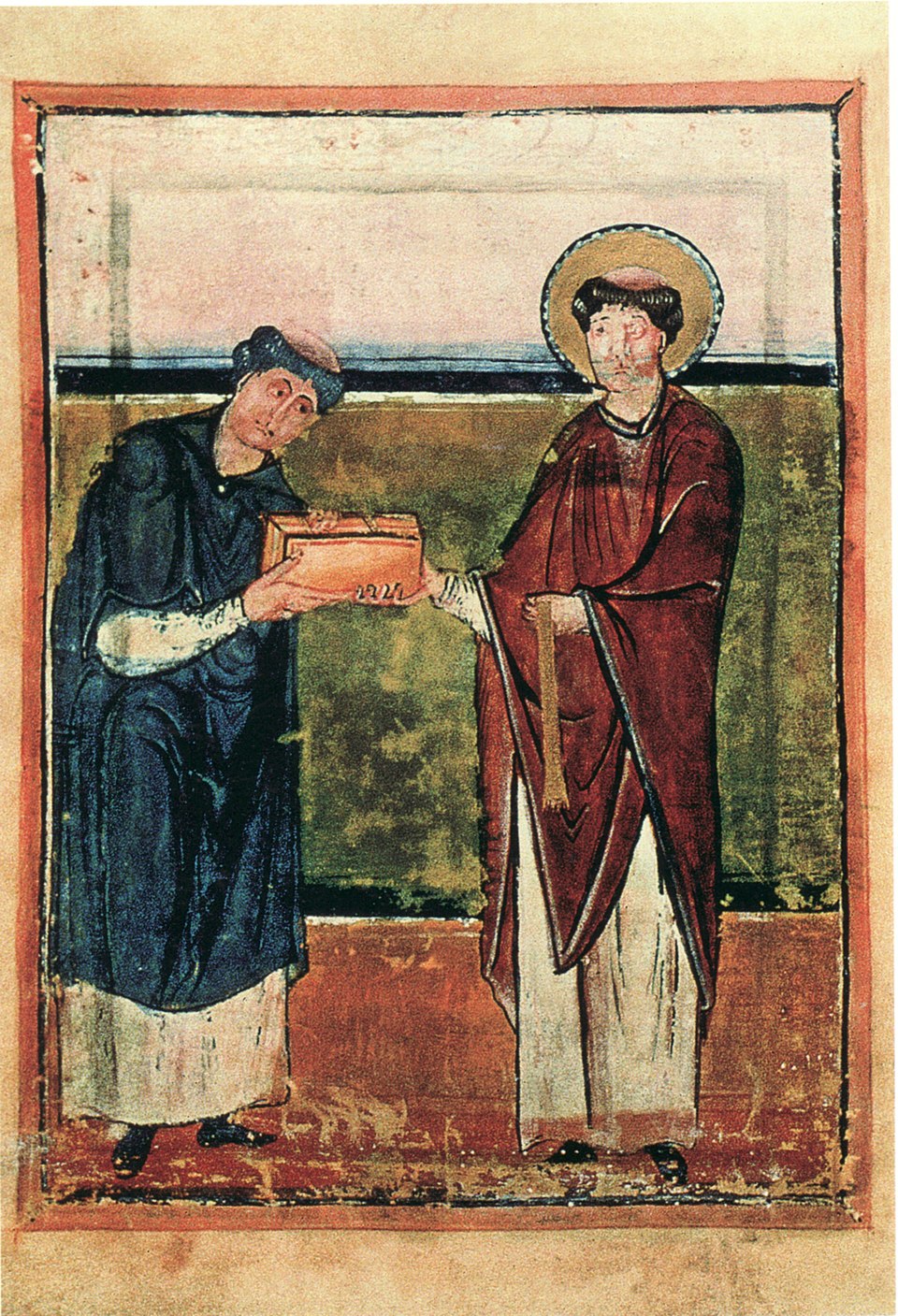
Illustration from the Hornbach Sacramentary: Abbot Adalbert of Hornbach presents the manuscript to his Patron Saint, St Pirminus
According to 9th and 12th Century traditions, Pirminus founded the Monastery in Gengenbach with the support of the Frankish nobleman Ruthard. By 820, it was the largest Monastery in the region and an Imperial Abbey. He is said to have introduced the Benedictine Rule at the Monastery in Schuttern, thus initiating its flourishing. The Monastery of Amorbach in the Odenwald may also indeed, have originated by our Saint Pirminus. In around 742, Pirminus founded the Monastery in Hornbach in the Palatinate on a hill where a Roman sanctuary had likely previously stood. He reformed the Monasteries in Weißenburg /Wissembourg and Maursmünster Marmoutier in Alsace which had been founded in the 5th/6th Centuries and, in 741 he sent Monks from Mittelzell to found Niederaltaich Abbey.
St Pirminus Relics at Speyer Cathedral
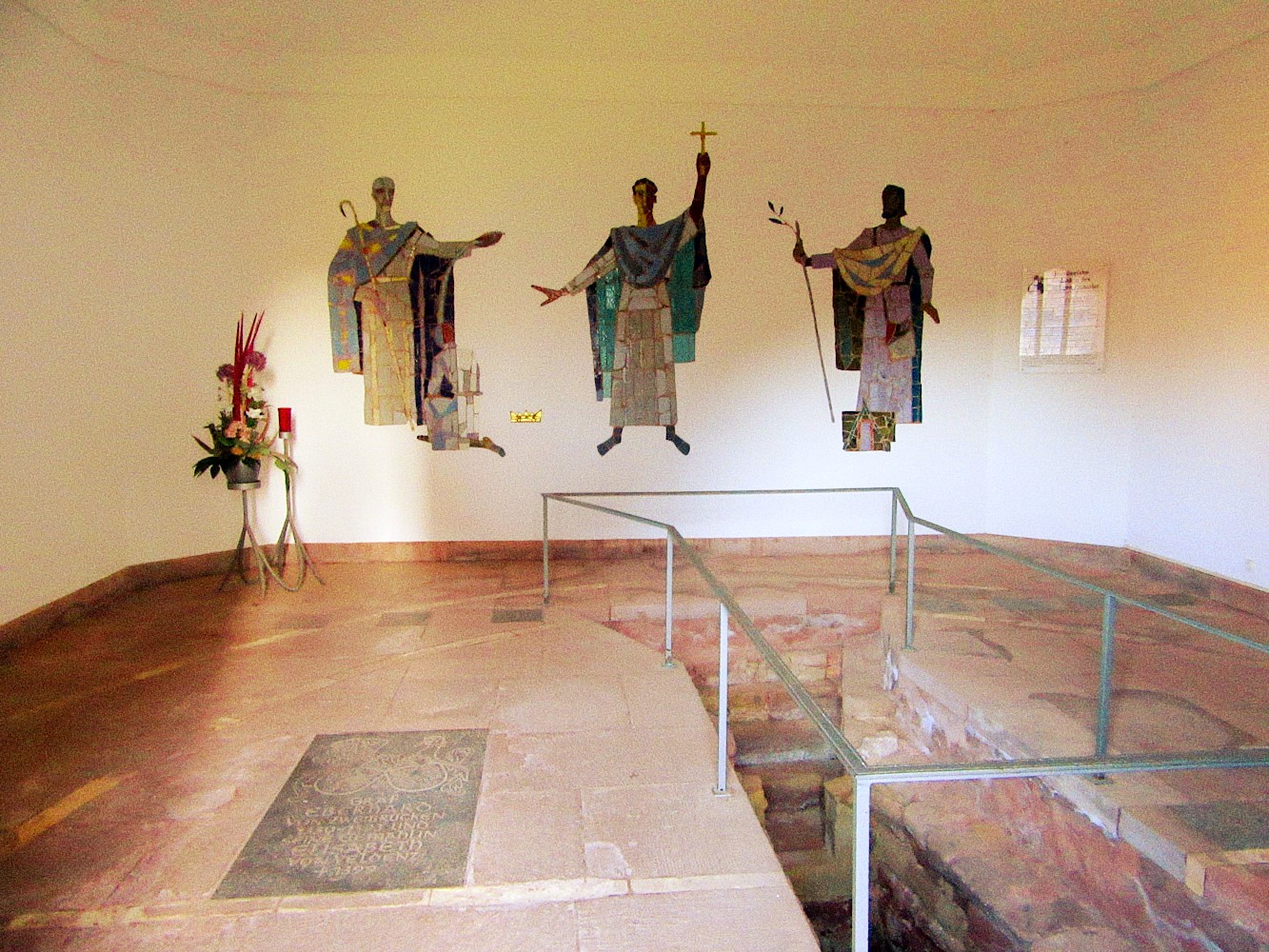
Pirminus died in his Monastery in Hornbach. As early as the end of the 8th Century, he was referred to as a Saint in a manuscript from Metz . After 814, Abbot Wyerund of Hornbach Monastery had Pirminus’ remains exhumed and interred in the Church he had recently built. In 827, Pirminus was first mentioned as the Church’s Patron Saint, and Hrabanus Maurus wrote a Tomb Inscription. The Tomb was excavated in 1953 and, in 1957, the present Chapel was built over it.
St Pirminus Grave built in 1957
“The first recorded version of the Apostles’ Creed, as it is known today, is found in the Treatise De singulis libris canonicis scarapsus (Excerpt from the Unique Canonical Books), most possibly written by St Pirminus. In it, he describes how the Apostles were gathered at Pentecost, the Holy Ghost descended upon them and they then began to speak in turn: Peter : I believe in God, the Father Almighty, Creator of Heaven and earth. John : And in Jesus Christ, His only Son, our Lord. James said: He was conceived by the Holy Ghost and born of the Virgin Mary. Andrew said: He suffered under Pontius Pilate, was Crucified, Died and was buried. Philip said: He descended into Hades. Thomas said: On the third day He Rose from the dead. Bartholomew said: He Ascended into Heaven and was seated at the Right Hand of God the Father Almighty. Matthew said: From thence He shall come to judge the living and the dead. James, the son of Alpheus, said: I believe in the Holy Ghost. Simon the Zealot said: And the Holy Catholic Church. Jude, the son of James, said: In the communion of the Saints and the forgiveness of sins. Likewise, Thomas said [he spoke a second time]: In the Resurrection of the body and eternal life.”




 AnaStpaul
You must be logged in to post a comment.