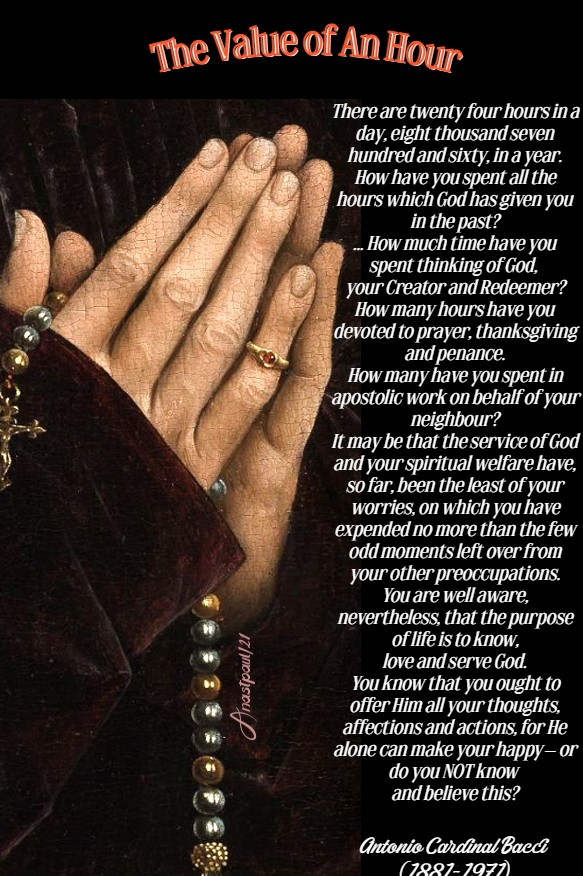
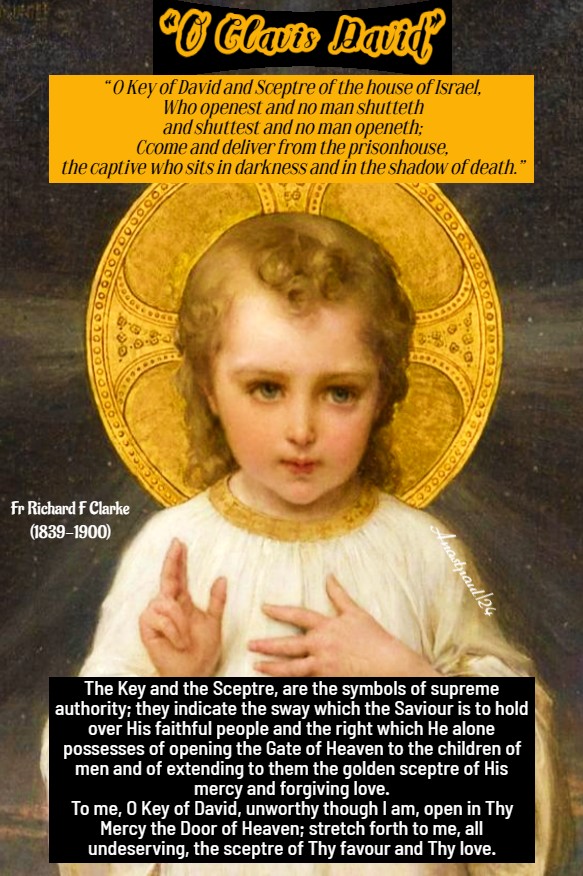
Thought for the Day – 11 December – Meditations with Antonio Cardinal Bacci (1881-1971)
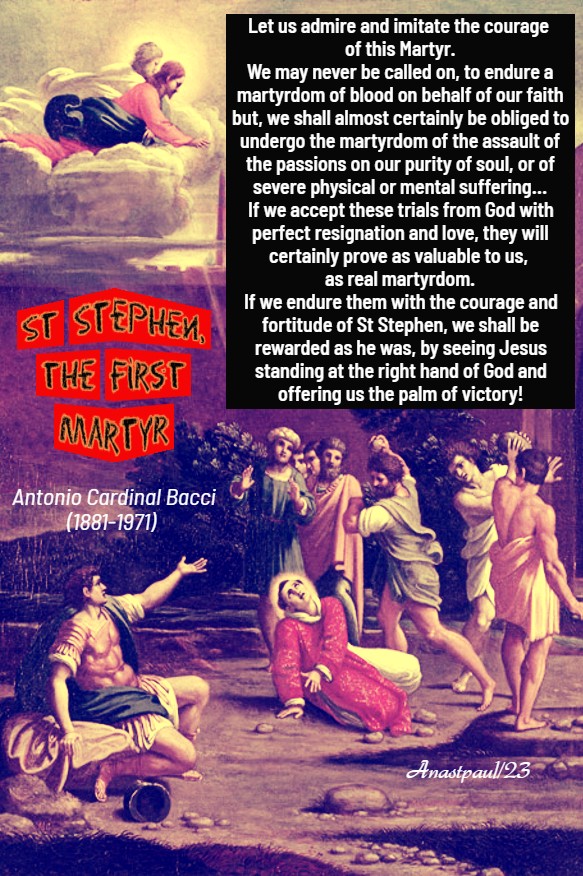
Mary, the Source of Holiness
“Since we are Mary’s children, we should try and reproduce her holiness in ourselves. Although, it is higher than that of the Angels, her sanctity is easy to imitate. There is no record that she ever had ecstasies or worked miracles. Her’s was a perfect internal sanctity, consisting of total conformity with the Will of God and an intense love for Him. We must aspire to this kind of holiness and model our lives upon it. There is no point in arguing that it is sufficient to be good Catholics and, that it is not necessary to be holy. A Catholic, to be truly such, MUST be holy!
St Paul referred to the early faithful as saints (Eph 1:1). “You are a chosen race,” said St Peter, “a royal priesthood, a holy nation, a purchased people,” (1 Peter 1:16, Lev 11:44) “You are to be perfect,” Jesus Himself had commanded, “even as your heavenly Father is perfect,” (Mt 5:48), This was the reason, He indicated why He had come into the world – “that they may have life and have it more abundantly” (Jn 10:10). This is the purpose of the Gospel and this must be the purpose of our lives. Some day, we shall either be holy in Heaven, or we shall be damned. We shall either be saints in Heaven or condemned forever in Hell. This truth merits careful though – everything else is passing but this is something which will never pass away. This command to sanctify ourselves is a reality which is present at every moment of our lives. Let us do our best to obey it, at any cost!”
Quote/s of the Day – 11 December – “The Month of the Divine Infancy and the Immaculate Conception of the Blessed Virgin Mary” – Sirach 44:16-27; 45:3-20; Matthew 25:14-23 – Scripture search here: https://www.drbo.org/
“ Enter thou into the joy of thy Lord.”
Matthew 25:21
“Blessed are you poor, for the Kingdom of God is yours …”
Luke 6:20
“Let us keep our eyes unceasingly fixed upon the Divine Ideal; let us work to realise, within ourselves, the perfection to which God wishes us to reach, in order to imitate His Divine Son.”
Columba Marmion (1858-1923) Abbot
“Christ acts like a loving mother. To induce us to follow Him, He gives us Himself as an example and promises us a reward in His kingdom.”
St Anthony of Padua (1195-1231) Evangelical Doctor
“Do not fix your longings on anything which you do not possess; do not let your heart rest in that which you have; do not grieve overmuch, at the losses which may happen to you – and then, you may reasonably believe that although rich in fact, you are not so in affection but that you are poor in spirit and, therefore, blessed, for the Kingdom of Heaven is yours.”
One Minute Reflection – 11 December – “The Month of the Divine Infancy and the Immaculate Conception of the Blessed Virgin Mary” – Within the Octave – St Pope Damasus I (c305-384) Confessor – Ecclesiasticus Sirach 4 – Matthew 25:14-23 – Scripture search here: https://www.drbo.org/
“Well done, good and faithful servant … Enter thou into the joy of thy Lord.”- Matthew 25:21
REFLECTION – “The Word of the Father, Only-begotten Son of God, Sun of Justice (Mal 3:20), is the great Merchant Who has brought us the price of our redemption. It is a truly precious exchange which we can never value sufficiently, when a King, Son of the King Most High, has become the Coin, the Gold has paid our dues, the Just Man is given for the sinner. Truly unmerited mercy, perfectly disinterested love, astonishing goodness … it is a completely disproportionate purchase, in which the Son of God is delivered up for the servant, the Creator is put to death for the one He has created, the Lord is condemned for His slave.
O Christ, these are Thine Works, Thou Who descended from Heaven’s brightness into our hellish darkness, to bring Light to our gloomy prison. Thou came down from the Right Hand of the Divine Majesty, into our human misery, to redeem the human race, Thou Who descended from the Father’s glory, to death on the Cross, to triumph over death and its author. Thou art the only One and there is no other but Thee Who could have been drawn to redeem us through Thine Own Goodness…
Let all the merchants of Teman (Bar 3:23) withdraw from this place … it is not they but Israel [Thy] beloved whom [Thou hast] chosen, Thou Who hide these mysteries from the wise and prudent and have revealed them to those babes and humble servants of Thine (Lk 10:21) … O Lord, I willingly embrace this purchase since it concerns me! … I remember all the things Thou hast done, Thou Who desire that I should keep them alive … Therefore, I shall profit by this talent which Thou hast lent to me until Thy return and will stand before Thee with great joy. O God, grant that I may then hear these sweet words: “Well done, good and faithful servant! Enter thou into the joy of thy Lord” (Mt 25:21).” – St Bernard O.Cist. (1091-1153) Cistercian Monk, known as the Last Father and the Mellifluous Doctor of the Church (Selected sermons, no 42: The Five Purchases).
PRAYER – Look forgivingly on Thy flock, Eternal Shepherd and keep it in Thy constant protection, by the intercession of blessed Damasus Thy Sovereign Pontiff, whom Thou didst constitute Shepherd of the whole Church. Through Jesus Christ, Thy Son our Lord, Who lives and reigns with Thee, in the unity of the Holy Ghost, God, world without end. Amen (Collect).
Our Morning Offering – 11 December – “The Month of the Divine Infancy and the Immaculate Conception of the Blessed Virgin Mary” – Within the Octave
O Gloriosa Femina O Glorious Maid, Exalted Far By St Venantius Fortunatus (c530 – c609) Bishop, Father o the Church
O Glorious Maid, exalted far Beyond the light of burning star, From Him who made thee, thou hast won Grace to be Mother of His Son.
That which was lost in hapless Eve Thy holy Scion did retrieve: The tear-worn sons of Adam’s race Through thee have seen the heavenly place.
Thou wast the gate of Heaven’s high Lord, The door through which the Light hath poured. Christians rejoice, for through a Maid To all mankind is life conveyed!
All honour, laud and glory be, O Jesu, Virgin-born, to Thee; All glory, as is ever meet, To Father and to Paraclete. Amen.
This Hymn was used for Lauds in the Sarum Breviary for the Feasts of the Immaculate Conception, the Purification of the Blessed Virgin Mary, the Annunciation, the Assumption and the Nativity of the Blessed Virgin Mary. The above is the original text of this Hymn as it appears in The English Hymnal (1906), where it is listed as a Morning Office Hymn for Feasts of the Blessed Virgin Mary: Chant Tone: “O Gloriosa Domina” Gregorian Chant, Mode II, traditional.
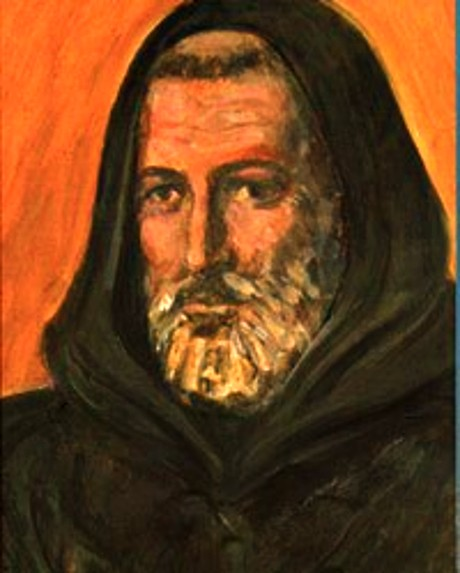
Saint of the Day – 11 December – Blessed Hugolinus Magalotti (Died 1373) Hermit, spiritual guide, Miracle-worker. A holy solitary so steeped in prayer, virtue and mortification that he became the target of the devil’s attacks, who sought constantly to lead him astray by ferocious temptations. Born in Camerino, Italy and died there om 11 December1373. Also known as – Hugoline, Hugolino, Ugolino. Beatified on 4 December 1856 by Pope Pius IX.
Hugolinus was a scion of the famous and noble family of the Magalotti. He was born toward the close of the fourteenth Century on an estate near the City of Camerino, Italy. His mother died while he was still quite young but his excellent father was deeply concerned about the education of the boy, so that nothing was left wanting. By his obedience, affection and other virtues, Hugolinus gave much joy to this father. His lively temperament caused him many a struggle but the the grace of God and the guidance of his father helped him overcome his evil inclinations.
As he grew older, Hugolinus applied himself to the study of the sciences. Spiritual books, however, held the greatest attraction for him. He read them constantly, impressed their lessons on his mind and heart and regulated his life accordingly. He did not speak much but his example edified everyone.
After his father died, the youth thought he heard addressed to him the words of our Lord to the rich young man: “If you wish to be perfect, go, sell what you have and give to the poor” (Mt 19:21). Hugolinus did not hesitate a moment. He sold all his possessions and divided the proceeds among the poor, particularly the widows and orphans. Stripped of all material things, Hugolinus Magalotti withdrew to a hermitage, where he led a truly celestial life. Prayer and meditation were the nourishment of his soul and upon his body he imposed the severest fasts and mortifications.
The enemy of virtue did not neglect to attack him severely. He would tempt him by stirring up sensual desires and reminding him of the pleasures he could enjoy in the world. At other times, he would frighten him by appearing to him in horrible forms. But Hugolinus proved to be a good soldier of Jesus Christ; prayer, penance and especially trustful appeal to the Immaculate Mother of God, made him victorious in every struggle.
God rewarded the fidelity of His servant with extraordinary favours. Enlightened by God, he gave advice and consolation to the faithful, who approached him in great numbers. He miraculously restored health to many of them who were ill.
When Hugolinus perceived his end was drawing near, he became even more intimately united to God. Having received the last Sacraments several times, he died peacefully in the Lord in 1373. His body was laid to rest in the Church of St John the Baptist at Figni, Camerino and immediately the people began to venerate him. This veneration was approved by Pope Pius IX and Pope Leo XIII granted affirmation of his Feast.
Blessed Jerome Ranuzzi OSM (c 1410-c 1468) “The Angel of Good Counsel,” “The Blessed Bachelor,” Priest and Friar of the Order of the Servants of Mary, the Servites, Theologian, Adviser both spiritual and secular, renowned for his learning and scholarship, Penitent and Hermit with a great love of solitude and silence. His body is incorrupt and is still available for veneration in St Mary of the Servites, Urbano, Italy. His cult was confirmed on 1 April 1775 by Pope Pius VI with the title of Blessed. The Roman Martyrology states: “In Sant’Angelo in Vado always in the Marches, Blessed Girolamo, Priest of the Order of the Servants of Mary, who in solitude and silence reached the wisdom of holiness.” The Angel of Good Counsel: https://anastpaul.com/2021/12/11/saint-of-the-day-11-december-blessed-jerome-ranuzzi-osm-c-1410-c-1468-the-angel-of-good-counsel/
Blessed Severin Ott O.Praem. (1627-1708) Priest and Friar of the Norbertines or Premonstratensians.
Martyrs of Saint Aux-Bois – 3 Saints: Two Christian missionaries and one of their local defenders who faith in the persecutions of governor Rictiovarus – Fuscian, Gentian and Victoricus. They were beheaded in 287 in Saint Aux-Bois, Gaul (in modern France).
Martyrs of Rome – 3 Saints: Three Christians murdered in the persecutions of Diocletian for giving aid to Christian prisoners – Pontian, Practextatus and Trason. They were imperial Roman citizens. They were martyred in c 303 in Rome, Italy.
Thought for the Day – 10 December – Meditations with Antonio Cardinal Bacci (1881-1971) – Within the Octave of the Immaculate Conception
Holy Purity
“Since Mary excelled so much in this virtue and had so great a love for it, she will obtain for us from God, the grace necessary for us to preserve it, as long as we pray humbly to her, especially in times of temptation.
Let us remember, that at Baptism, we became members of the Mystical Body of Christ and temples of the Holy Spirit (Cf 1 Cor 6:15-20). We are obliged to avoid defiling this temple and making the Mystical Body of Christ a dwelling-place for the devil! It is not true to say, that this is an impossible fight. We know, from our own experience, that we can win. We have often battled with, or fled from occasions of sin. We have prayed and made sacrifices, in order to avoid sin and, with the help of God and the protection of the Blessed Virgin, we have won! After our victory, we have felt elated and have experienced that peace, which only God’s grace can bestow. If we have succeeded so many times, why cannot we do the same always? There is no need to be afraid. If we do all that we can, God’s grace will do the rest. “I can do all things in Him, Who strengthens me,” Phil 4:12) says St Paul. “God is faithful,” he writes elsewhere “and will not permit you to be tempted beyond your strength but, with the temptation, will also give you a way out, that you may be able to bear it” (1 Cor 10:13).
If we remain pure, we shall see God. We shall see Him in the work of His creation in this world and we shall see and enjoy Him forever in Heaven. “Blessed are the pure of heart, for they shall see God” (Mt 5:8).”
Quote/s of the Day – 10 December – “The Month of the Divine Infancy and the Immaculate Conception of the Blessed Virgin Mary” – – Within the Octave – Proverbs 8:22-35 – Luke 1:26-28 – Scripture search here: https://www.drbo.org/
“The very fact that God has elected her, proves that none was ever holier than Mary; if any stain had disfigured her soul, if any other virgin had been purer and holier, God would have selected her and rejected Mary.”
St Jacob of Sarug (c 451-521) Bishop, Theologian, Poet, Writer
“He Who is Infinite, Limitless, came to dwell in your womb; God, the Child Jesus, was nourished by your milk. You are the ever virginal Doorway of God; your hands hold your God; your lap is a throne raised up above the Cherubim… You are the wedding chamber of the Spirit, the “city of the living God, gladdened by the runlets of the stream” that is to say, the waves of the Spirit’s gifts. You are “all fair, the Beloved” of God.”
St John Damascene (675-749) Father and Doctor of the Church
One Minute Reflection – December – “The Month of the Divine Infancy and the Immaculate Conception of the Blessed Virgin Mary” – Within the Octave – Proverbs 8:22-35 – Luke 1:26-28 – Scripture search here: https://www.drbo.org/
“Hail, full of grace, the Lord is with thee: blessed art thou among women” – Luke 1:28
REFLECTION – “Son of God, grant me your own admirable Gift that I may celebrate the wondrous beauty of Thy beloved Mother! The Virgin gave birth to a Son while preserving her virginity; she suckled Him Who gives nourishment to the peoples; in her immaculate breast, she bore Him Who carries the whole world in His Hands. She is Virgin and Mother, what will she not be hereafter? Holy in body, all beautiful in soul, pure of mind, upright in intelligence, perfect in feeling, chaste and faithful, pure of heart and filled with virtue.
May the hearts of virgins rejoice in Mary, since of her was born the One Who set humankind free from dreadful slavery. May the old Adam, wounded by the serpent, rejoice in Mary; it is Mary who gives Adam a posterity which allows Him to crush the accursed serpent and Who cures him of his mortal wound (Gen 3:15). Let Priests rejoice in the blessed Virgin; she has brought the High Priest into the world, Who gave Himself as a Victim, putting an end to the sacrifices of the Old Covenant. … Let the Prophets rejoice in Mary, since in her were fulfilled their visions, in her were realised their prophecies, in her were confirmed their oracles. Let all the Patriarchs rejoice in Mary, since she received the blessing promised to them, she, who, in her Son, has brought them to completion. …
Mary is the new tree of life who, instead of the bitter fruit picked by Eve, gives to mankind that sweet fruit on which the whole world is fed!” – St Ephrem (306-373) Deacon in Syria, Father and Doctor of the Church (Marian Hymn).
PRAYER – Stir up our hearts, O Lord, to prepare the ways of Thy only-begotten Son, so that through His coming we may be able to serve Thee with purified minds. Who lives and reigns with Thee, in the unity of the Holy Ghost, God, world without end. Amen (Collect).
Thou art inviolate, undefiled and chaste, O Mary. Thou has become the resplendent Gate of Heaven, O loving and dearest Mother of Christ, Accept our devout acclamations in praise of thee. That our minds and bodies may be pure, Devoted hearts and lips now implore thee. Through thy sweet sounding prayers, Gain us pardon forever. O kind one, who alone didst remain inviolate. Amen
The Hymn Inviolata has been claimed by the Carmelite Order, as a Traditional Hymn originating within their ranks. The Hymn is also used by Dominican Friars in the chanting of Compline. Its origins trace to the 11th Century. It appears in Hymnals from 1860 to 1920.
Saint of the Day – 10 December – Blessed Brian Lacey (Died 1591) Lay Martyr. Born in Brockdish, Norfolk, England and died by being hanged on 10 December 1591 at Tyburn Tree London, England. Beatified on 15 December 1929 by Pope Pius XI.
Brian Lacey was one of the London Martyrs of 1591. On 18 October 1591, a royal proclamation led to the stricter enforcement of the laws against Catholics in England, the first fruits of which were seven Martyrdoms in London on the following 10 December, one of whom was Brian Lacey.
Brian, a Yorkshire gentleman, was a cousin and assistant of the Venerable Montford Scott and after torture, was condemned for aiding and helping this Priest. Brian’s own brother had informed against them!
Lacey was committed to Bridewell Palace where he was cruelly tortured by Topcliffe in the vain endeavour to elicit at whose houses he had visited with Scott. He was arraigned before the Lord Mayor at the Old Bailey and condemned to be hanged for aiding and abetting a Piests.
Five years previously Lacey had suffered imprisonment in Newgate for religion and he was then three times examined by Justice Young. Information against him as a distributor and dispenser of letters to Catholics and against Montford Scott had been given by his own brother, Richard Lacey, gentleman, of Brockdish, Norfolk.
St Abundius Blessed Brian Lacey (Died 1591) Lay Martyr BL Bruno of Rommersdorf St Caesarius of Epidamnus St Carpophorus St Deusdedit of Brescia (Died c700) Bishop
St Edmund Gennings St Emérico Martín Rubio St Florentius of Carracedo St Fulgentius of Afflighem St Gemellus of Ancyra St Gonzalo Viñes Masip Bl Guglielmo de Carraria St Guitmarus St Hildemar of Beauvais Bl Jerome Ranuzzi Bl John Mason
St Julia of Merida St Lucerius St Maurus of Rome St Mercury of Lentini St Polydore Plasden Bl Sebastian Montanol Bl Sidney Hodgson St Sindulf of Vienne St Swithun Wells
Martyrs of Alexandria – 3 Saints: A group of Christians murdered for their faith in the persecutions of Galerius Maximian – c 312. The only details that have survived are three of the names – Eugraphus, Hermogenes and Mennas.
Thought for the Day – 9 December – Meditations with Antonio Cardinal Bacci (1881-1971) – Within the Octave of the Immaculate Conception
The Virginal Purity of Mary
“Purity is the most beautiful of virtues.
It is a virtue which is admired by God and by men, even by the most corrupt. It is often said, that it makes us like the Angels but in fact, looking at it in a particular way, it makes us superior to the Angels. Since they have no bodies, the angels cannot sin against purity, while we have to fight many battles and overcome many temptations, in order to preserve our chastity. Jesus had a very special love for this virtue. He chose to be born of a Virgin and, He showed a particular affection for St John, who was a dedicated celibate. On one occasion, He placed His Hands on the head of a little child and said: “Unless you turn and become like little children, you will not enter into the kingdom of Heaven “(Mt:18.3)
Unfortunately, the virtue of purity is as fragile as it is beautiful. It can be lost in a single moment of weakness. We must love this virtue as Mary loved it. We must be prepared to make any sacrifice, even the most heroic, rather than lose it. Worldly charm and beauty attract us and the devil works ferociously to control our imagination and our affections. On account of the disturbance of original sin, the flesh is like a terrible weight retarding our spiritual advancement. Sometimes it seems as if it is irresistibly drawing us towards the abyss of impurity. But we need not be dragged down, if we are prepared to fly from the occasions of sin and to pray to God and to our heavenly Mother for her intercession. We must always act at once, for there is no time to dally. It is fatal to remain inactive and to allow temptation to make its way into our soul. This kind of battle, said St Francis de Sales, is won only by soldiers who flee. We must fly from the occasions of sin, no matter what sacrifice this entails. Jesus has warned us, that it is better to enter Heaven without a hand or a foot, than to be cast into hell.
We know the remedies – instant flight, heroic sacrifice and constant prayer. We can leave the rest to the grace of God and to the maternal protection of Mary.”
Quote/s of the Day – 9 December – “The Month of the Divine Infancy and the Immaculate Conception of the Blessed Virgin Mary” – Within the Octave of the Immaculate Conception of the Blessed Virgin Mary, Mother of God – Proverbs 8:22-35 – Luke 1:26-28 – Scripture search here: https://www.drbo.org/
“O Mary, Conceived without sin, pray for us who have recourse to thee.”
“You have guarded the integrity of the temple [of your body]; you have kept your tabernacle free from all sin, so that the Father becomes your guest, the Holy Ghost overshadows you and the Only-begotten Son Incarnate is born of you.”
St Hesychius of Jerusalem (Died c450) Priest, Exegete, Father
“O Mother blest! And chosen Shrine wherein the Architect Divine, Whose Hand contains the earth and sky vouchsafed in hidden guise to lie; Blest in the message Gabriel brought; blest in the work, the Spirit wrought; Most blest, to bring to human birth, the long desired of all the earth!”
St Venantius Fortunatus (c530 – c609) Bishop, Poet, Theologian, Father
One Minute Reflection – 9 December – “The Month of the Divine Infancy and the Immaculate Conception of the Blessed Virgin Mary” – Within the Octave of the Immaculate Conception of the Blessed Virgin Mary, Mother of God – Proverbs 8:22-35 – Luke 1:26-28 – Scripture search here: https://www.drbo.org/
“Hail, full of grace …” – Luke 1:28
REFLECTION – “How can I speak? What praises could I possibly make of the holy and glorious Virgin? She surpasses all other beings except for God Himself. She is by nature more beautiful than the Cherubim and Seraphim and the whole Angelic Host. No language, whether of Heaven or earth, or even of the Angels, is enough to praise her. Blessed Virgin, spotless dove, heavenly bride… temple and throne of the Godhead! Christ, the Sun Who shines resplendently in Heaven and on earth, belongs to thee. Thou art the luminous cloud which brought Christ down to earth, He Who is the bright streak of lightening, Who shines across the world.
Rejoice, full of grace, gate of Heaven! It was of thee, the author of the Song of Songs speaks… when he cries aloud: “A garden enclosed is my sister, my bride; an enclosed garden, a fountain sealed” (4:12)… Holy Mother of God, spotless ewe – thou gave birth to Christ, the Lamb, the Word made flesh in thee … How amazing a wonder in the heavens – a woman clothed with the sun (Apoc 12:1), carrying the Light in her arms! … How amazing a wonder in the heavens – the Lord of Angels becomes the Virgin’s Child. Angels judged Eve; now they fill Mary with glory, since it was she who raised Eve from her fall and brought Adam, expelled from Paradise, into Heaven.
Vast is the grace given to this Holy Virgin. Hence Gabriel, first addresses her with this greeting: “Hail, full of grace” resplendent as the Heaven. “Hail, full of grace” Virgin adorned with countless virtues… “Hail, full of grace” thou quench our thirst at the sweetness of the everlasting stream. Hail, holy and Immaculate Mother, thou conceived the Christ Who existed before thee. Hail, royal purple, thou clothed the King of Heaven and earth. Hail, O sealed book, thou enabled the world to read the Word, the Father’s Son!” – St Epiphanius of Salamis (c315-403) Bishop of Salamis, known as the Oracle of Palestine and Father of the Church (Sermon No 5)
PRAYER – Stir up our hearts, O Lord, to prepare the ways of Thy only-begotten Son, so that through His coming we may be able to serve Thee with purified minds. Who lives and reigns with Thee, in the unity of the Holy Ghost, God, world without end. Amen (Collect).
Our Morning Offering – 9 December – “The Month of the Divine Infancy and the Immaculate Conception of the Blessed Virgin Mary” – Within the Octave
Tota Pulchra Es, Maria You Are All Beautiful, Mary Unknown Author – 4th Century
You are all beautiful, Mary, and the original stain is not in you. You are the glory of Jerusalem, you are the joy of Israel, you give honour to our people. You are an advocate of sinners. O Mary, O Mary, Virgin most intelligent, Mother most merciful. Pray for us, Plead for us, To the Lord Jesus Christ.
Tota pulchra es, Maria. Et macula originalis non est in Te. Tu gloria Ierusalem. Tu laetitia Israel. Tu honorificentia populi nostri. Tu advocata peccatorum. O Maria, O Maria, Virgo prudentissima. Mater clementissima. Ora pro nobis. Intercede pro nobis. Ad Dominum Iesum Christum.
This prayer used by the Church since the 4th Century for the Feast of the Immaculate Conception and the Purity of the Blessed Virgin. It takes some text from the book of Judith and other text from Song of Songs, specifically 4:7. Many composers have set this prayer to music over the centuries.
Saint of the Day – 9 December – Saint Cyprian (Died c586) Abbot of Perigord, France, Hermit, miracle-worker. Also known as – Cyprien.
The Roman Martyrology reads today: “At Perigord in France, the holy Abbot Cyprian, a man of great sanctity.”
St Gregory of Tours, after calling Cyprian a man “of great sanctity,” says of him: “He has often cured lame hands, restored the use of limbs to paralytics and restored sight to the blind. Three lepers have recovered their health thanks to his anointings. And nowadays it is not uncommon for the sick to be cured by praying with faith, at his Tomb.”
Adonis, who composed the Eulogy following St Gregory, mentions him in his Martyrology on 9 December, certainly arbitrarily; Usuard placed the Feast of the holy Abbot on the same date, as well as the Churches which celebrated his memory.
Further details of Cyprian are given in the Vitae of Saint Amandus and Saint Sorus – according to these texts, three young men from Auvergne, namely Sorus, Amandus and Cyprian, at the time of Clotaire I (511-561) placed themselves under the direction of Savalone, Abbot of the Monastery of Genouillac. After three years they retired to a secluded place but then separated to live in solitude. Sorus (whose name, from then on, meant “hermit” in the Celtic language) retired to Terranova, Amand and Cyprian to places that later took their names (St Amand-de-Coly and St Cyprien, in the Dordogne). Sorus cured the King of Burgundy, Saint Guntram (561-592), of leprosy and, upon his death, was buried by Cyprian and Amand.
According to another source, Cyprian lived at the time of Carterius, the Bishop of Périgord, who participated in the Council of Mâcon in 585 – accepting these chronological data, it must be admitted that Cyprian was a contemporary of St Gregory of Tours but that he died before 587, the year in which the latter began composing the In Gloria Confessorum.
St Michaela Andrusikiewicz St Nectarius of Auvergne
St Peter Fourier CRSA (1565-1640) “The Good Father of Mattaincourt,” Priest, Founder, Reformer, Confessor, Ascetic, Theologian, Teacher, Preacher, Apostle of Prayer, Penance and Charity, Marian devotee. In 1597, together with the Blessed Alix Le Clerc, St Peter founded the Congregation of Notre Dame of Canonesses Regular of St Augustine, who were committed to the free education of children, taking a fourth vow to that goal. St Peter was Beatified on 20 January 1730 by Pope Benedict XIII and Canonised on 27 May 1897 by Pope Leo XIII. “The Good Father of Mattaincourt” : https://anastpaul.com/2018/12/09/saint-of-the-day-9-december-st-peter-fourier-c-r-s-a-1565-1640/
Blessed Mercedarian Fathers – (10 Beati): The memorial of ten Mercedarian Friars who were especially celebrated for their holiness: Arnaldo de Querol • Berengario Pic • Bernardo de Collotorto • Domenico de Ripparia • Giovanni de Mora • Guglielmo Pagesi • Lorenzo da Lorca • Pietro Serra • Raimondo Binezes • Sancio de Vaillo
Martyrs of North Africa – (24 Saints): Twenty-four Christians murdered together in North Africa for their faith. The only details to survive are four of their names – Bassian, Peter, Primitivus and Successus.
Martyrs of Samosata – (7 Saints): Seven Martyrs crucified in 297 in Samosata (an area of modern Turkey) for refusing to perform a pagan rite in celebration of the victory of Emperor Maximian over the Persians. They are – Abibus, Hipparchus, James, Lollian, Paragnus, Philotheus and Romanus. They were crucified in 297 in Samosata (an area in modern Turkey).
Thought for the Day – 8 December – Meditations with Antonio Cardinal Bacci (1881-1971)
THE IMMACULATE CONCEPTION
“Let us read the first chapter of St Luke’s Gospel in order to try and understand, as far as possible, the Immaculate Conception and the sublime holiness of Mary. “The angel Gabriel was sent from God to a town of Galilee called Nazareth, to a virgin betrothed to a man named Joseph, of the house of David and the virgin’s name was Mary. And when the angel had come to her, he said, ‘Hail, full of grace, the Lord is with thee. Blessed are thou among women’” (Lk 1:26-28). The Blessed Virgin was troubled when she heard these words but the Angel reassured her. He told her that she had found favour with God and added, that she would become the Mother of God, for the Word would become flesh in her womb through the power of the Holy Ghost, in such a manner that in her nature, the privileges of virginity and of the divine motherhood, would be miraculously united. Mary then gave her assent to the Will of God and, her ‘Fiat’ placed her on a pedestal, high above all the generations of humanity and all the choirs of the angelic kingdom.
It is on this passage of the Gospel that the Dogma of the Immaculate Conception of Our Lady, chiefly depends. She was full of grace and the supremely beloved of God. How then could she have been subject to the rule of sin which we inherited from Adam? If her soul had been stained with sin at the first moment of her conception, she would not have enjoyed the special favour of God and the plenitude of grace. She was, moreover, predestined to become the Mother of God. Was it possible that the Divine Word, Who was to become her Son, could have permitted her soul to have been sullied, even for a single instant, by sin, which deprives us of grace and makes us enemies of God? It was on good grounds, therefore, that the Church defined, that from the first moment of her conception, Mary was free from all taint of sin, by a singular privilege conferred on her by God and through the merits of her Divine Son, Jesus Christ.”
Quote/s of the Day – 8 December – “The Month of the Divine Infancy and the Immaculate Conception of the Blessed Virgin Mary” – The Feast of the Immaculate Conception
“Hail, full of grace, the Lord is with thee, blessed art thou among women”
Luke 1:28
On 8 December 1854, Pope Pius IX promulgated Ineffabilis Deus, the Doctrine of the Immaculate Conception. On 25 March 1858, at Lourdes, when asked by St Bernadette, who she was, Our Lady replied:
“I am the Immaculate Conception”
Our Lady to St Bernadette at Lourdes on 25 March 1858
“She saw herself raised to the highest dignity that ever was or will be, for although it should please God to create anew many worlds, He could never make a pure creature be greater than the Mother of God.
Our Lady humbled herself and acknowledged herself unworthy of being raised to the high dignity of Mother of God, therefore, she was made to be His Mother, for she had no sooner uttered the protestation of her littleness, than, having abandoned herself to Him, by an act of incomparable charity, she became the Mother of the Most High, Who is the Saviour of our souls!”
St Francis de Sales (1567-1622) Doctor of Charity
“The Second Person of the Blessed Trinity had also been waiting for one, whose immaculate purity should make her fit, as far as any child of Adam could be fit, to be His Mother. There had been many holy women among the daughters of Abraham but none, without sin and, therefore, none in whose womb the Son of God could find repose. If Christ thus could not come to dwell with one who was stained with sin, what must be the purity He requires now, of those whose Guest He becomes in Holy Communion O Jesus, forgive me all my careless receptions of Thee, my want of careful preparation, my faults innumerable!”
Fr Richard Frederick Clarke SJ (1839-1900) The Fulfilment of the Decree
One Minute Reflection – 8 December – “The Month of the Divine Infancy and the Immaculate Conception of the Blessed Virgin Mary” – The Feast of the Immaculate Conception – Proverbs 8:22-35 – Luke 1:26-28 – Scripture search here: https://www.drbo.org/
“Hail, full of grace!” – Luke 1:28
REFLECTION – “The degeneration caused by sin had obscured the beauty of our original nobility. But when the mother of Supreme Beauty is born, our nature finds its purity once more and sees itself moulded according to the perfect model, worthy of God (Gn 1:26)… We had all preferred the world below, to that above. There no longer remained any hope of salvation. The state of our nature cried aloud to Heaven to come to the rescue… Then at last, in His good pleasure, the world’s Divine Artificer determined to make a new world appear, a different world full of harmony and youth.
Now was it not fitting, that a most pure virgin without stain, should place herself at the service of this mysterious plan first of all?… And where was this virgin to be found, if not in this woman, alone of her kind, chosen by the world’s Creator before all generations? Yes, she indeed is Mother of God, divinely named Mary, whose womb gave birth to God Incarnate and whom, He Himself had supernaturally prepared, as His Temple…
In this way then, the design of the Redeemer of our race was to bring about a birth and, as it were, a new creation to replace the one that went before. Therefore, just as in Paradise, He had taken a little clay out of the pure and spotless earth, to fashion the first Adam (Gn 2:7), so, at the moment of bringing about His Own Incarnation, He made use of another earth, so to speak, namely, this Pure and Immaculate Virgin, chosen from among all other beings He had created. It is in her that He, Adam’s Creator, has remade us in our very substance and become a new Adam (1 Cor 15:45), that the old might be saved by the new and eternal.” – St Andrew of Crete (660-740) Bishop (Sermon 1 for the Nativity of the Mother of God ; PG 97, 812).
PRAYER – O God, Who by the Immaculate Conception of the Virgin, prepared a worthy dwelling for Thy Son, and Who, by Thy Son’s death, foreseen by Thee, preserved her from all taint, grant, we beseech Thee, through her intercession that we too, may come to Thee, unstained by sin. T Through Jesus Christ, Thy Son our Lord, Who lives and reigns with Thee, in the unity of the Holy Ghost, God, world without end. Amen (Collect).
Our Morning Offering – 8 December – “The Month of the Divine Infancy and the Immaculate Conception of the Blessed Virgin Mary” and The Feast of the Immaculate Conception
Immaculate! Immaculate! By Fr Frederick William Faber CO (1814-1863)
O Mother! I could weep for mirth, Joy fills my heart so fast; My soul today is Heaven on earth, O could the transport last! I think of thee and what thou art, Thy majesty, thy state And I keep singing, in my heart, Immaculate! Immaculate!
When Jesus looks upon thy face, His Heart with rapture glows And in the Church, by His sweet Grace, Thy blessed worship grows. I think of thee and what thou art, Thy majesty, thy state And I keep singing, in my heart,— Immaculate! Immaculate!
The Angels answer with their songs, Bright choirs in gleaming rows And Saints flock round thy feet in throngs And Heaven with bliss o’erflows. I think of thee and what thou art, Thy majesty, thy state And I keep singing, in my heart, Immaculate! Immaculate!
This Hymn comes from Hymns By Frederick Faber, (1871 edition) and is under the title “Immaculate! Immaculate!” It is a Hymn for the Feast of the Immaculate Conception on 8 December.
Saint of the Day – 8 December – Saint Patapius (7th Century) Hermit, spiritual guide, Miracle-worker. Born in Thebes in Egypt and died in Constantinople. Patronage – against Dropsy (oedema). Also known as – Patapius of Thebes, Patapius of Egypt, Patapios…Patario…Patapius…
The Roman Martyrology reads today: “At Constantinople, St Patapius, Solitary, renowned for virtues and miracles.”
We have no certain information regarding the exact period of his life; some evidence suggests he had arrived in Constantinople around the time in which two other Egyptians, Bara and Rabula, founded Monasteries there (late 5th, early 6th Century). The Bollandists propose the 7th Century.
St Andrew of Crete (660-740), who lived at a time close to that of Patapius, wrote a Life, a narrative of his miracles. John of Euchaites (11th Century) speaks of an ancient Life, already mentioned by St Andrew of Crete but both authors certainly adhered to tradition in their works, developing above all the hagiographical style.
Patapius, originally from Thebes in Egypt, spent a certain number of years in solitude in the surroundings of this City; then he went to Constantinople, stopping in the Blachernae district, near the City Walls, where he lived for a long time. His fame for sanctity immediately attracted numerous visitors. He cured a blind man, a man with dropsy, a possessed man and a woman suffering from a breast disease. Upon his death, amid popular veneration, he was buried in the Church of St John the Baptist in a nearby Monastery called the Egyptian Monastery, where his body was still venerated at least until the 15th Century.
St Anastasia of Pomerania St Anthusa of Afric St Casari of Villeneuve-lès-Avignon
St Eucharius of Trier (Died 3rd Century) the First Bishop of Trier, Germany, Date and place of birth are unknown but Eucharius is believed to have been of Italian origin. Additional Memorial in Limburg, Germany of the 3 Bishops sent by St Peter, occurs on 11 September. – The Roman Martyrology reads: “At Treves, St Eucharius, disciple of the blessed Apostle Peter and the first Bishop of that City.” His Holy Life: https://anastpaul.com/2023/12/08/saint-of-the-day-8-december-saint-eucharius-of-trier-died-3rd-century-bishop/
St Gunthildis St Macarius of Alexandria St Patapius (7th Century) Hermit
St Romaric (Died 653) Married French noble layman, Abbot, Founder of the renowned Remiremont double Monastery in north-eastern France. Died in 653 of natural causes. He was Canonised on 3 December 1049 by Pope Leo IX. The Roman Martyrology reads today: “In the Monastery of Luxeuil, St Romericus, Abbot, who left the highest station at the Court of King Theodebert, renounced the world and surpassed all others in the observance of monastic discipline.” About St Romaric: https://anastpaul.com/2022/12/08/saint-of-the-day-8-december-saint-romaric-died-653-abbot/
St Sophronius of Cyprus(6th Century) Bishop of the Island of Cyprus, off the coast of Greece, Apostle of widows and orphans, the poor and needy. It is believe, by his name which Greek meaning is ‘the wise‘, that he was of noble Greek origin. The Roman Martyrology reads today: “In Cyprus, the holy Bishop Sophronius, who was a devoted protector of orphans and widows and a friend to the poor and the opporessed.” His Fervent Life: https://anastpaul.com/2024/12/08/saint-of-the-day-8-december-saint-sophronius-of-cyprus-6th-century-bishop/
DISCLAIMER: Please note: I cannot control the content of the Advertisements on this Site, or of pop-ups which may appear, The revenue from the Advertisements, however, does provide a little assistance in the support of the Site. I do apologise for any inappropriate content.
Thought for the Day – 7 December – Meditations with Antonio Cardinal Bacci (1881-1971)
TRUE WISDOM
“According to Christian teaching, both knowledge and wisdom, properly understood, are gifts of the Holy Ghost. Only the Light and Grace of the Holy Ghost, can enable us to comprehend the Truth which, in its plenitude, is God Himself and to appreciate the vanity of human things, as long as they are not ordained to their final end which is God and the everlasting life of happiness.
St Thomas Aquinas holds that human and earthly things are the proper object of science, insofar however, as they ought to be directed towards God. “The man who has a correct approach to science, regards creatures as ordained to God, does not value them for more than they are worth and does not permit them to constitute the purpose of his life” (Summa Theologiae II-II q9 a4). “All creatures are ordained to God and to His glory,” he writes elsewhere, “in that they manifest the Divine Goodness in themselves; they are, moreover, the means to everlasting happiness” (Quaestiones disputate, De Caritate q1 a7).
Nature maybe said to be a sacrament which enables us to gain experience of God (Summa Theologiae III q60 a2 ad1). This is how knowledge becomes wisdom which is not content merely to have a proper estimation of human objects but, proceeds to penetrate, with the assistance of Revelation and of Grace, into the transcendent Mysteries of the Divinity. Wisdom, moreover, guides the will and the heart, as well as the intellect. It is practical, as well as speculative, for it directs our actions, as well as our thoughts towards God. Like the Saints, we should be guided entirely by this true intellectual and practical wisdom. “Grant me, O Lord, celestial wisdom,” we should pray with the Author of The Imitation of Christ, “that I may learn, above all things, to seek Tbee and to find Thee; above all things, to relish Thee and to love Thee and to understand, all other things, as they are, according to the order of Thy Wisdom!” (Bk III c27).”
Quote/s of the Day – 7 December – “The Month of the Divine Infancy and the Immaculate Conception of the Blessed Virgin Mary” – St Ambrose (340-397) Confessor, Bishop, Father and Doctor of the Church
“O, that the soul of Mary were in us, to glorify the Lord! That the spirit of Mary were in us, to rejoice in God. May the life of Blessed Mary be ever present to our awareness. In her, as in a mirror, the form of virtue and beauty of chastity, shine forth. She was Virgin, not only in body but in mind and spirit. She never sullied the pure affection of her heart by unworthy feelings. She was humble of heart. She was serious in her conversations. She was prudent in her counsels. She preferred to pray rather than to speak. She united in her heart the prayers of the poor and avoided the uncertainty of worldly riches. She was ever faithful to her daily duties, reserved in her conversations and always accustomed to recognise God as the witness of her thoughts. Blessed be the Name of Jesus!”
(On Virginity II 2.7)
“Our own evil inclinations are far more dangerous, than any external enemies. ”
“Up you get, then and hurry along to the Church — there is the Father, there the Son, there the Holy Ghost. He, Who hears you speaking in the intimate depths of your soul, is coming to meet you and, when you are still far off, He sees you and starts running. He sees your heart; He runs up lest anyone delay you and embraces you … He flings His arms around your neck to raise you up, you who were prostrate, burdened with sins, face to the ground. He turns you over to face Heaven, so that you can seek your Creator there. He causes a Robe, a Ring and Sandals to be brought. The Robe is the garment of wisdom… spiritual clothing — the wedding garment. What is the Ring if not the seal of a genuine faith and the imprint of truth? And as for the Sandals — these are the preaching of the Gospel.”
“Come, then and search out Thy sheep, not through Thy servants or hired men but do it Thineself. Lift me up bodily and in the flesh, which is fallen in Adam. Lift me up, not from Sarah but from Mary, a Virgin, not only undefiled but a Virgin, whom grace had made inviolate, free of every stain of sin.”
One Minute Reflection – 7 December – “The Month of the Divine Infancy and the Immaculate Conception of the Blessed Virgin Mary” – Advent II – St Ambrose (340-397) – Confessor, Bishop, Father and Doctor of the Church – Romans15:4-13 – Matthew 11:2-10 – Scripture search here: https://www.drbo.org/
“Brethren, what things soever were written, were written for our learning: that, through patience and the comfort of the Scriptures, we might have hope. ” – Roman 15:4
REFLECTION – “My brethren, do not let us remain in carelessness and ease, or lightly put off for tomorrow, or even later, a start to our work. “Now is the favourable time,” the Apostle Paul says, “this is the day of salvation” (2 Cor 6:2). The present moment is the time for repentance, later on will be that of reward; now is the time of perseverance, our day of comforting is yet to come. Now God is helping those who turn away from evil, later He will judge our deeds and words and thoughts. Today we are profiting from his patience; at the resurrection, when each of us receives according to our deeds, we shall know the justice of His Judgments.
Oh, how much longer will we delay from obeying Christ, Who calls us into His heavenly Kingdom? Are we not going to purify ourselves? Will we not firmly decide to forsake our customary way of life, so as to follow the Gospel to the end?” – St Basil the Great (330-379) Bishop of Caesarea in Cappadocia, Father and Doctor of the Church (Prologue to the Great Rules)
PRAYER – O God, Thou Who have given blessed Ambrose to Thy people as a help for eternal salvation, grant, we beseech Thee that we may be worthy to have him as our intercessor in Heaven, whom we have had as a teacher of life, on earth. ThroughJesus Christ, Thy Son our Lord, Who lives and reigns with Thee, in the unity of the Holy Ghost, God, world without end. Amen (Collect).
“The Month of the Divine Infancy and the Immaculate Conception of the Blessed Virgin Mary” – Advent II – The Feast of St Ambrose (340-397) – Confessor, Bishop, Father and Doctor of the Church
Veni Redemptor Gentium Saviour of the Nations, Come! By St Ambrose’s Advent Hymn
Saviour of the nations, come! Virgin’s Son, here make Thy home! Marvel now, O Heaven and earth, That the Lord chose such a birth.
Not by human flesh and blood; By the Spirit of our God Was the Word of God made flesh, Woman’s offspring, pure and fresh.
Wondrous birth! O wondrous Child Of the Virgin undefiled! Though by all the world disowned, Still to be in Heaven enthroned.
From the Father forth He came And returneth to the same, Captive leading death and hell High the song of triumph swell!
Thou, the Father’s only Son, Hast over sin the victory won. Boundless shall Thy Kingdom be; When shall we its glories see?
Brightly doth Thy Manger shine, Glorious is its Light Divine. Let not sin o’ercloud this Light; Ever be our faith thus bright.
Praise to God the Father sing, Praise to God the Son, our King, Praise to God the Spirit be Ever and eternally. Amen!
Saint of the Day – 7 December – Saint Geretranus (6th Century) Bishop of Bayeux in Normandy, France. Also known as – Gérétran, Geretrandno, Geretrand.
In the chronology of Bishops, Geretranus is listed eleventh after Leudovald, mentioned after 614 and before Saint Ragnobert, mentioned before 627.
Geretranus is only mentioned in the ancient Episcopal catalogues and we know absolutely nothing about him, his life and his Episcopate.
It should be noted that the Episcopal catalogues of Bayeux from the 12th and 13th Centuries are reliable and historically documented but they only begin with Bishop Hugh of Ivry, who lived at the of the advent of the 1th Century and died in 1049.
Regarding the early Bishops, the catalogues are incomplete, although they present a series of 14 Saintly Bishops, most of whom are derived from hagiographical and liturgical traditions.
In local Martyrologies, Geretranus’ Feast Day was set on 7 December but according to some, even that date does not correspond to ab authentic date i.e. of his death, given that on that day the Bishop St Gerbold (Died c691) was celebrated, who governed the Diocese after some years of Geretranus. However St Gerbold’s Feast is actually now on 5 December due to the conflict with St Ambrose on 7 December.
You must be logged in to post a comment.