
Lenten Preparation Novena
in Reparation to the Holy Face
Day Nine
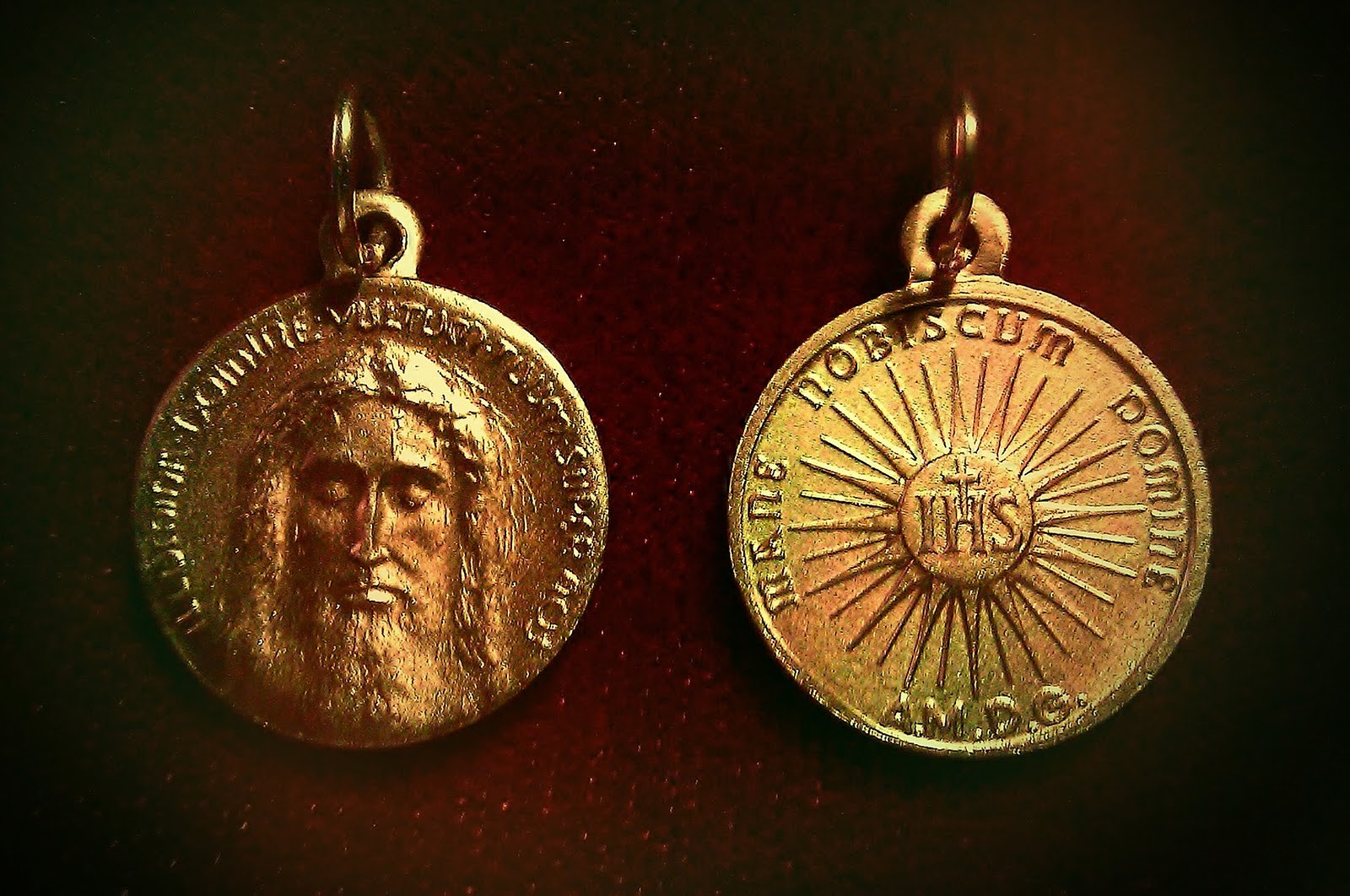
“All those who, attracted by My Love and venerating My Countenance, shall receive, by virtue of My Humanity, a brilliant and vivid impression of My Divinity. This splendour shall enlighten the depths of their souls, so that in eternal glory the celestial court shall marvel at the marked likeness of their features, with My Divine Countenance.” … Our Lord Jesus Christ to St Gertrude the Great (1256-1302)
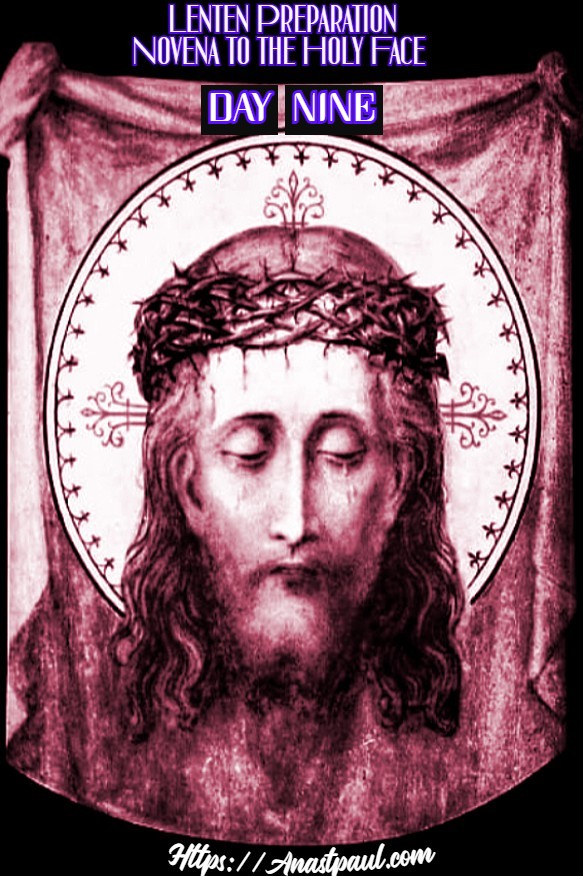
(Console the Holy Face
and recite Daily Preparatory Prayer) below.
DAILY PREPARATORY PRAYER
O Most Holy and Blessed Trinity,
through the intercession of Holy Mary,
whose soul was pierced through
by a sword of sorrow
at the sight of the Passion of her Divine Son,
we ask Thy help,
in making a perfect Novena of Reparation with Jesus,
united with all His sorrows, love and total abandonment.
We now implore all the Angels and Saints
to intercede for us as we pray this Holy Novena
to the Most Holy Face of Jesus
and for the glory of the most Holy Trinity,
Father, Son and Holy Ghost.
Amen
THE NINTH DAY
Psalm 50:18-19:
For in sacrifice Thou take no delight,
burnt offering Thou wouldst refuse.
A sacrifice to God is an afflicted spirit,
a contrite and humble heart, O God,
Thou wilt not despise.
Sacred Face of our Lord and our God,
what words can we say
to express our gratitude?
How can we speak of our joy?
That Thou hast deigned to hear us,
that Thou hast chosen to answer us
in our hour of need.
We say this because we know,
that our prayers will be granted.
We know that Thou,
in Thy loving kindness,
listen to our pleading hearts
and will give, out of Thy fullness,
the answer to our prayers.
Mary, our Mother,
thank you for your intercession on our behalf.
Saint Joseph, thank you for your prayers.
Through the merits of your precious blood
and your Holy Face, O Jesus,
grant us our petition………………
Pardon and mercy.
Amen.
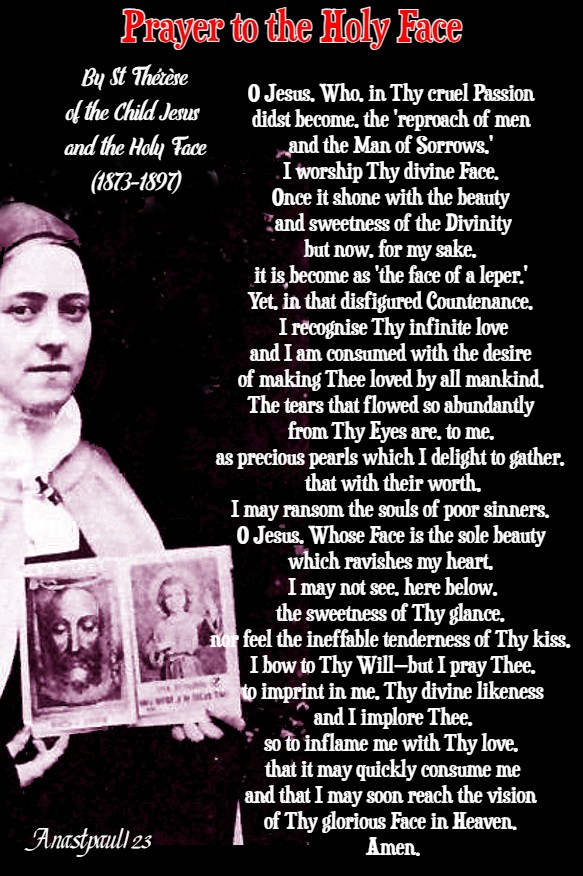
Prayer to the Holy Face
By St Thérèse of the Child Jesus
and the Holy Face (1873-1897)
O Jesus, Who, in Thy cruel Passion
didst become, the ‘reproach of men
and the Man of Sorrows,’
I worship Thy divine Face.
Once it shone with the beauty
and sweetness of the Divinity
but now, for my sake,
it is become as ‘the face of a leper.’
Yet, in that disfigured Countenance,
I recognise Thy infinite love
and I am consumed with the desire
of making Thee loved by all mankind.
The tears that flowed so abundantly
from Thy Eyes are, to me,
as precious pearls which I delight to gather,
that with their worth,
I may ransom the souls of poor sinners.
O Jesus, Whose Face is the sole beauty
which ravishes my heart,
I may not see, here below,
the sweetness of Thy glance,
nor feel the ineffable tenderness of Thy kiss,
I bow to Thy Will—but I pray Thee,
to imprint in me, Thy divine likeness
and I implore Thee,
so to inflame me with Thy love,
that it may quickly consume me
and that I may soon reach the vision
of Thy glorious Face in Heaven.
Amen.
Pray (1) Our Father, three (3) Hail Marys, one (1) Glory Be
O Bleeding Face, O Face Divine,
be every Adoration Thine
(Three times)








 AnaStpaul
You must be logged in to post a comment.