Posted in DOCTORS of the Church, DOMINICAN OP, LENT, LENT 2026, QUOTES on DEATH, QUOTES on SIN, QUOTES on SUFFERING, Thomas Aquinas

Ash Wednesday – 18 February – Our Lenten Journey With St Thomas Aquinas Begins

Ash Wednesday – 18 February – Our Lenten Journey With St Thomas Aquinas (1225-1274), Doctor of the Church

Ash Wednesday : Death
By one man sin entered into this world and by sin death.” – Romans v. 12.

  1. If for some wrongdoing a man is deprived of some benefit once given to him, that he should lack that benefit is the punishment of his sin.

Now, in man’s first creation he was divinely endowed with this advantage that, as long as his mind remained subject to God, the lower powers of his soul were subjected to the reason and the body was subjected to the soul.

But because by sin man’s mind moved away from its subjection to God, it followed that the lower parts of his mind ceased to be wholly subjected to the reason. From this there followed such a rebellion of the bodily inclination against the reason, that the body was no longer wholly subject to the soul.

Whence followed death and all the bodily defects. For life and wholeness of body are bound up with this, that the body is wholly subject to the soul, as a thing which can be made perfect is subject to that which makes it perfect. So it comes about that, conversely, there are such things as death, sickness and every other bodily defect, for such misfortunes are bound up with an incomplete subjection of body to soul.

  1. The rational soul is of its nature immortal and, therefore, death is not natural to man insofar as man has a soul. It is natural to his body, for the body, since it is formed of things contrary to each other in nature, is necessarily liable to corruption and, it is in this respect, that death is natural to man.

But God who fashioned man is all powerful. And hence, by an advantage conferred on the first man, He took away that necessity of dying which was bound up with the matter of which man was made. This advantage was, however, withdrawn through the sin of our first parents.

Death is then natural, if we consider the matter of which man is made and it is a penalty, inasmuch as it happens through the loss of the privilege whereby man was preserved from dying.

  1. Sin – Original Sin and actual sin – is taken away by Christ, that is to say, by Him Who is also the remover of all bodily defects. He shall quicken also your mortal bodies because of His Spirit Who dwelleth in you (Romams viii. II).

But, according to the order appointed by a wisdom which is Divine, it is at the time which best suits, when Christ takes away both the one and the other, i.e., both sin and bodily defects.

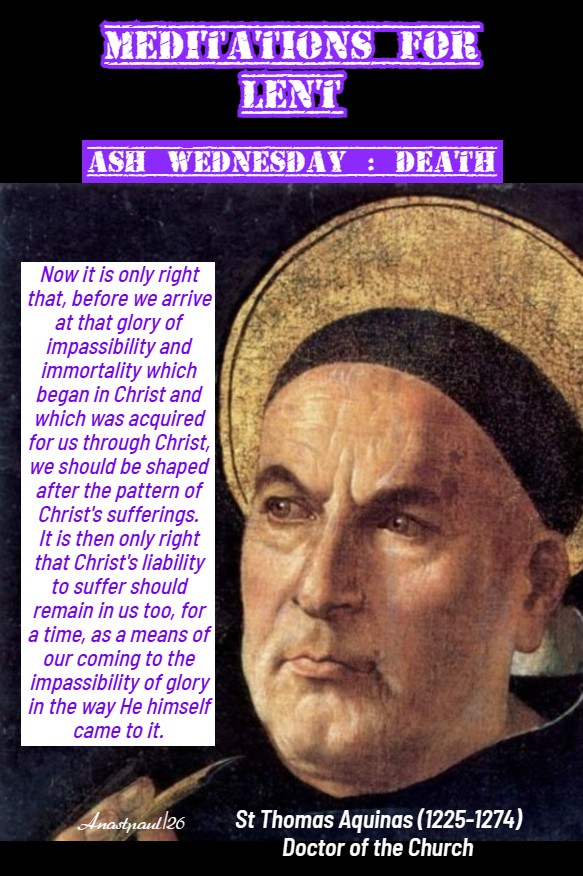
Now it is only right that, before we arrive at that glory of impassibility and immortality which began in Christ and which was acquired for us through Christ, we should be shaped after the pattern of Christ’s sufferings.
It is then only right that Christ’s liability to suffer should remain in us too, for a time, as a means of our coming to the impassibility of glory in the way He himself came to it.

ST THOMAS AQUINAS (1225-1274)
Priest, Theologian, Dominican
Doctor Angelicus (Angelic Doctor)
Doctor Communis (Common Doctor)
Added by Pope Saint Pius V in 1568
Posted in DOCTORS of the Church, FATHERS of the Church, QUOTES on FASTING, QUOTES on MERCY, QUOTES on PRAYER

Quote/s of the Day – 18 Februaryr – Ash Wednesday – Prayer, Fasting and Mercy

Quote/s of the Day – 18 Februaryr – Ash Wednesday

Prayer, Fasting and Mercy
St Peter Chrysologus (c400-450)
Bishop of Ravenna
“Doctor of Homilies”
Father and Doctor of the Church

“There are three things, my brethren, by which faith stands firm, devotion remains constant and virtue endures. They are prayer, fasting and mercy. Prayer knocks at the door, fasting obtains, mercy receives. Prayer, mercy and fasting: these three are one and they give life to each other.

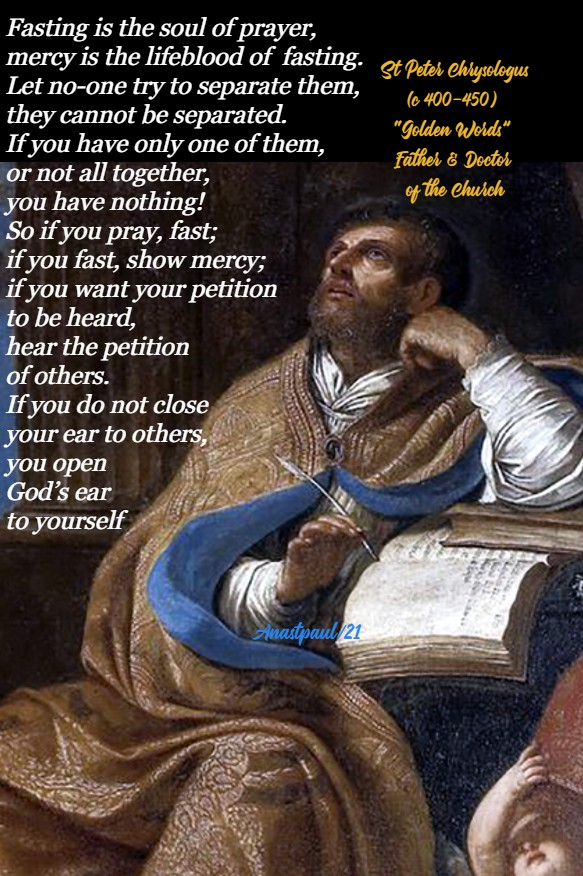
Fasting is the soul of prayer, mercy is the lifeblood of fasting. Let no-one try to separate them; they cannot be separated. If you have only one of them, or not all together, you have nothing. So if you pray, fast; if you fast, show mercy; if you want your petition to be heard, hear the petition of others. If you do not close your ear to others you open God’s ear to yourself.

When you fast, see the fasting of others. If you want God to know that you are hungry, know that another is hungry. If you hope for mercy, show mercy. If you look for kindness, show kindness. If you want to receive, give. If you ask for yourself, that which you deny to others, your asking is a mockery.

Let this be the pattern for all men when they practice mercy – show mercy to others in the same way, with the same generosity, with the same promptness, as you wish others to show mercy to you.

Therefore, let prayer, mercy and fasting be one single plea to God on our behalf, one speech in our defence, a threefold united prayer in our favour.” – (An excerpt from his Sermon 43)

Posted in CATHOLIC-PRAYERS OF THE CHURCH, DOCTORS of the Church, FATHERS of the Church, HYMNS, LENT, LENT 2026, Our MORNING Offering, PRAYERS of the CHURCH, PRAYERS of the SAINTS

Our Morning Offering – 18 February – The Glory of These Forty Days By St Gregory the Great

Our Morning Offering – 18 February – Ash Wednesday

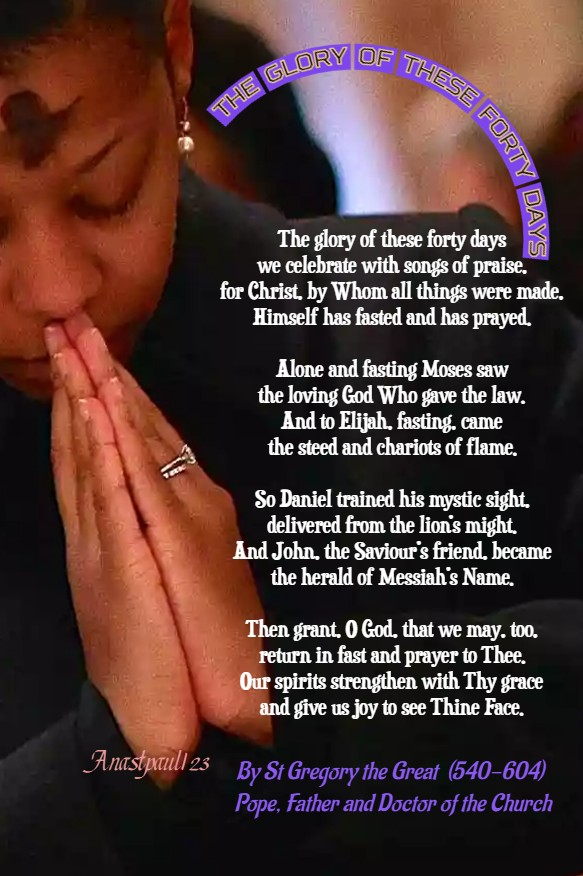
The Glory of These Forty Days
By St Gregory the Great (540-604)
Pope, Father and Doctor of the Church

The glory of these forty days
we celebrate with songs of praise,
for Christ, by Whom all things were made,
Himself has fasted and has prayed.

Alone and fasting Moses saw
the loving God Who gave the law.
And to Elijah, fasting, came
the steed and chariots of flame.

So Daniel trained his mystic sight,
delivered from the lion’s might.
And John, the Saviour’s friend, became
the herald of Messiah’s Name.

Then grant, O God, that we may, too,
return in fast and prayer to Thee.
Our spirits strengthen with Thy grace
and give us joy to see Thine Face.

Translator: Maurice F Bell 1862-1947)

Posted in SAINT of the DAY

Saint of the Day – 18 February – Saint Angilbert (c750-814) Abbot

Saint of the Day – 18 February – Saint Angilbert (c750-814) Abbot of Saint-Riquier at Centula, Poet, Official, Advisor and close friend at the Court of Charlemagne, Count of Ponthieu. He married Charlemagne’s daughter but by mutual consent both entered the Religious Life. Born in Aachen, Kingdom of the Franks [now in Germany] around 750 and died on 18 February 814 at the Monastery at Centula, Picardy, France. Also known as – Angilbert of Saint-Riquier, Angilberto…Enghelberto…Homer… (this latter name relates to his great talent as a Poet).

Angilbert, born into a noble family, became an important figure at Charlemagne’s Court. Educated at the Court by the great St Alcuin, he became the Emperor’s friend, confidant, advisor and secretary.

In 781, when the young Pepin was crowned King of Italy, Angilbert became his Attaché, with the title of Primicerius (Chief Administrator) of the Palace. Later, he was named Count of Ponthieu and Abbot of Saint-Riquier.

Angilbert led a dissolute life and fell in love with Princess Bertha, Charlemagne’s daughter. The two had two children, Armida and Nithard. Charlemagne, who was not a paragon of morality, did not at first allow the two lovers to marry but granted Angilbert the commendation of the Abbey of Saint-Riquier.

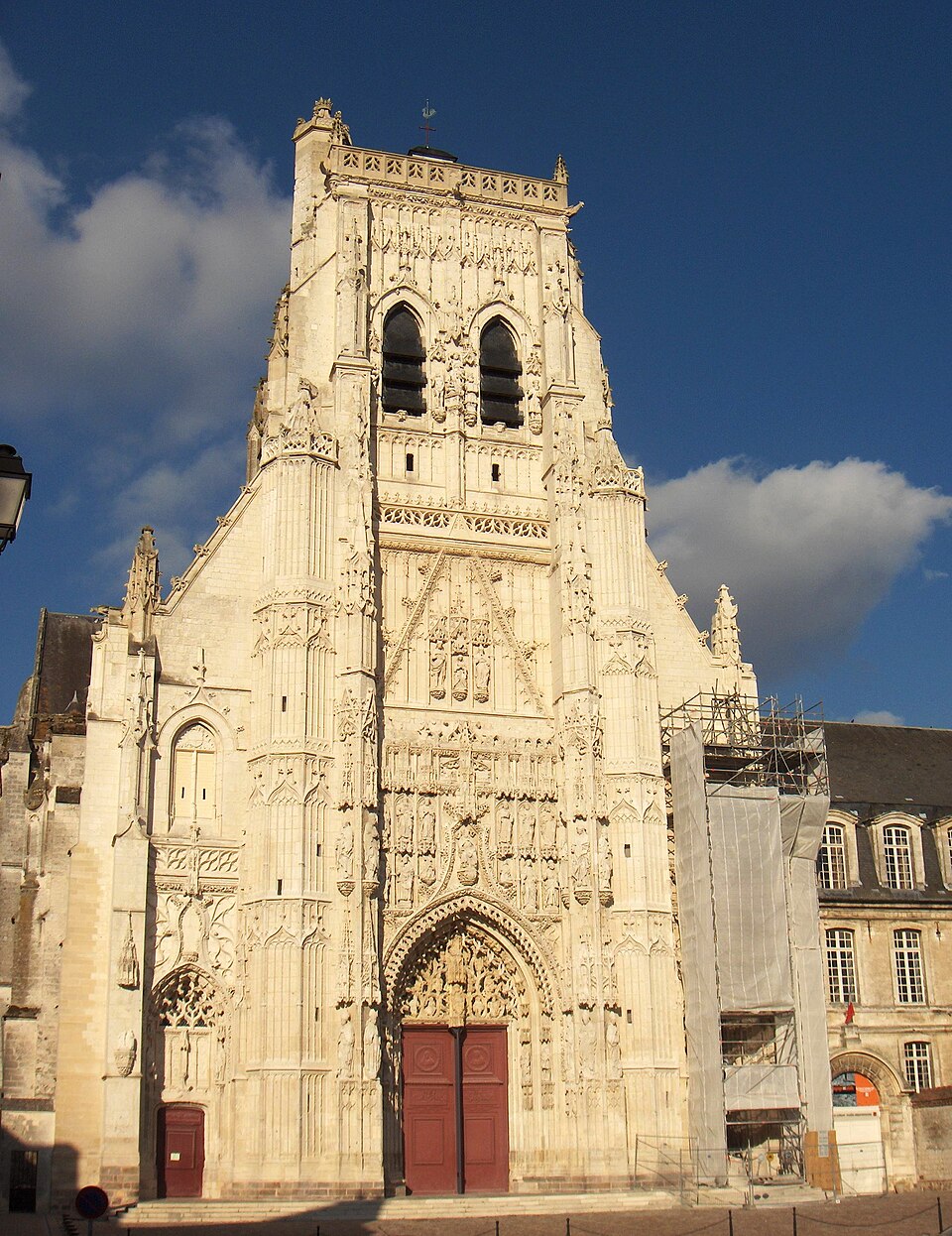
Abbey of Saint-Riquier

After a serious illness and a victory over the Danes, Angilbert decided to embrace Religious life. He became a Priest and then Abbot of Saint-Riquier.

In 792, Angilbert brought Felix, Bishop of Urgel, condemned for heresy, to Rome. In 794, he submitted the “Carolingian Books” to the Pope which reiterated the condemnation of iconoclasm. In 796, he presented to the Pope, part of the treasures captured by the Frankish army.

After his last mission to Rome, Angilbert retired to his Abbey, where he devoted himself to religious life and the reconstruction of the building.

In 800, Angilbert followed Charlemagne to Rome for his Coronation as Emperor.

Angilbert died on18 February 814, 22 days after Charlemagne’s death. He was buried before the main door of the Basilica of Saint-Riquier. In 1100, Pope Paschal II Canonised him.

St Angilbert Statue at Abbey of Saint-Riquier
Posted in LENT 2026, MARIAN TITLES, SAINT of the DAY

Ash Wednesday +2025 – Obligatory FAST and ABSTINENCE, Notre-Dame de Laon / Our Lady of Laon, Rheims, France (500), St Simeon of Jerusalem, Martyr, St Bernadette, Virgin and the Saints for 18 February

Ash Wednesday +2025 – Obligatory FAST and ABSTINENCE,

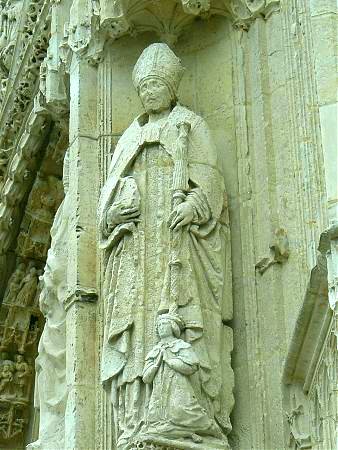
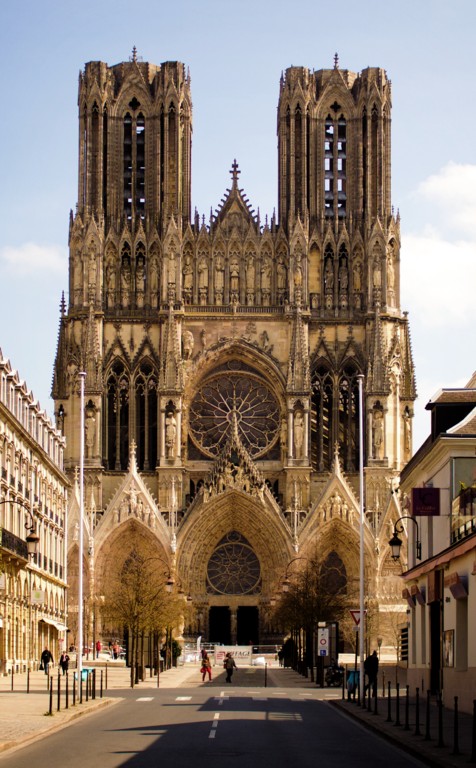
Notre-Dame de Laon / Our Lady of Laon, Rheims, France (500), founded by St Remigius – 18 February:
HERE:

https://anastpaul.com/2021/02/18/our-lady-of-laon-rheims-france-500-and-memorials-of-the-saints-18-february/

St Simeon of Jerusalem (Died c 106) Martyr, Bishop of Jerusalem, Cousin of Jesus. Son of Cleopas, was a Jewish Christian leader and the second Bishop of Jerusalem (62 or 70–106).
His Life and Death:

https://anastpaul.com/2022/02/18/saint-of-the-day-18-february-st-simeon-died-c-106-martyr/

St Bernadette Soubirous (1844-1879) of Lourdes – Virgin, The Visionary of Lourdes, Consecrated Religious. Born on 7 January 1844 at Lourdes, Hautes-Pyrénées, France and died on 16 April 1879, Nevers, Nièvre, France of natural causes, aged 35. Her Body is incorrupt and is on display in Nevers, France.
She was Canonised on 8 December 1933 by Pope Pius XI.
St Bernadette!

https://anastpaul.wordpress.com/2018/04/16/saint-of-the-day-16-april-saint-bernadette-soubirous-1844-1879/
AND:
https://anastpaul.com/2024/02/18/saint-of-the-day-18-february-st-bernadette-soubirous-1844-1879-virgin/

St Esuperia of Vercelli
St Ethelina

St Flavian (Died 449) Martyr, Archbishop of Constantinople, Confessor, Defender of the Christ’s two natures, both divine and human.
His Life and Death:

https://anastpaul.com/2019/02/18/saint-of-the-day-18-february-st-flavian-of-constantinople-died-449-martyr/

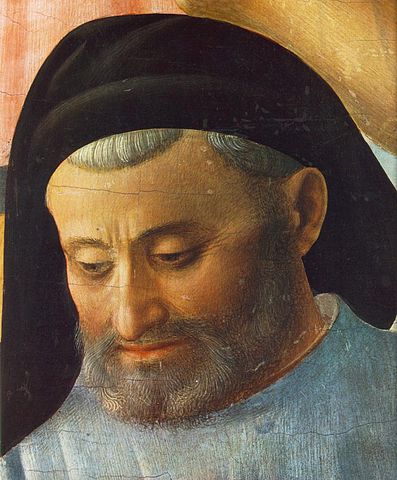
Blessed John of Fiesole/Fra Angelico OP – The Angelic Friar Giovanni (1387-1455)
The Artist:

https://anastpaul.wordpress.com/2018/02/18/saint-of-the-day-18-february-blessed-john-of-fiesole-fra-angelico-o-p-1387-1455/

Saint Angilbert (c750-814) Abbot Saint-Riquier at Centula

St Gertrude Caterina Comensoli

St Helladius (c566-633) Bishop and Confessor, Archbishop of Tiledo for 18 years, Abbot before that, Apostle of the poor and needy. Born in c566 in Toledo, Spain and died there in 632 of natural causes. For his charity towards the poor, he was called “A Sun which Illuminates the Darkness.” Also known as – Eladio, Eladius, Elladio, Heladio.
“A Sun which Illuminates the Darkness.”
https://anastpaul.com/2025/02/18/saint-of-the-day-18-february-st-helladius-c566-633-bishop-and-confessor-a-sun-which-illuminates-the-darkness/

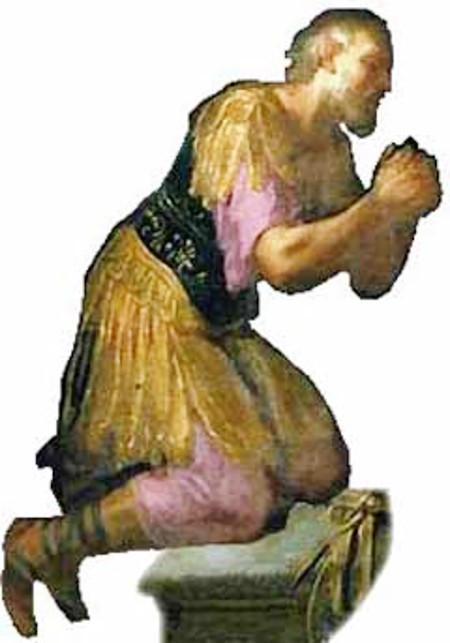
Almsgiving of Saint Helladius (Eladius), oil painting by Francisco Bayeu c1770.

Bl John Pibush – one of the Martyrs of Douai
St Leo of Patera
St Paregorius of Patara
St Sadoth of Seleucia
St Tarasius of Constantinople

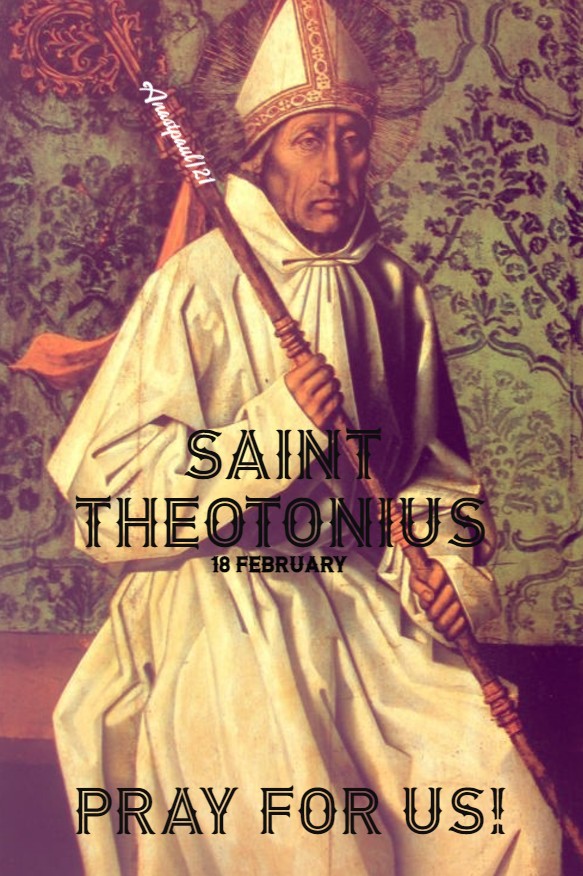
St Theotonius OSC (1082-1162) Priest of the Canons Regular, Reformer of religious life in Portugal, Royal Counsellor,, Apostle of the poor, Founder of the Canons Regular of the Holy Cross, now known as “The Crosiers.” He is the first Portuguese Saint.
His Life Story:

https://anastpaul.com/2021/02/18/saint-of-the-day-18-february-saint-theotinius-1082-1162/

Bl William Harrington

Martyrs of North Africa – 7 Saints: Group of Christians who were Martyred together, date unknown. We know nothing else but seven of their names – Classicus, Fructulus, Lucius, Maximus, Rutulus, Secundinus and Silvanus.
They were born and martyred in North Africa.

Martyrs of Rome – 5 Saints: A group of Christians Martyred together in the persecutions of Diocletian. We know nothing else but their names – Alexander, Claudius, Cutias, Maximus and Praepedigna. They were martyred in 295 in Rome, Italy.