Posted in LENT 2026, QUOTES on SUFFERING, The PASSION, Thomas a Kempis

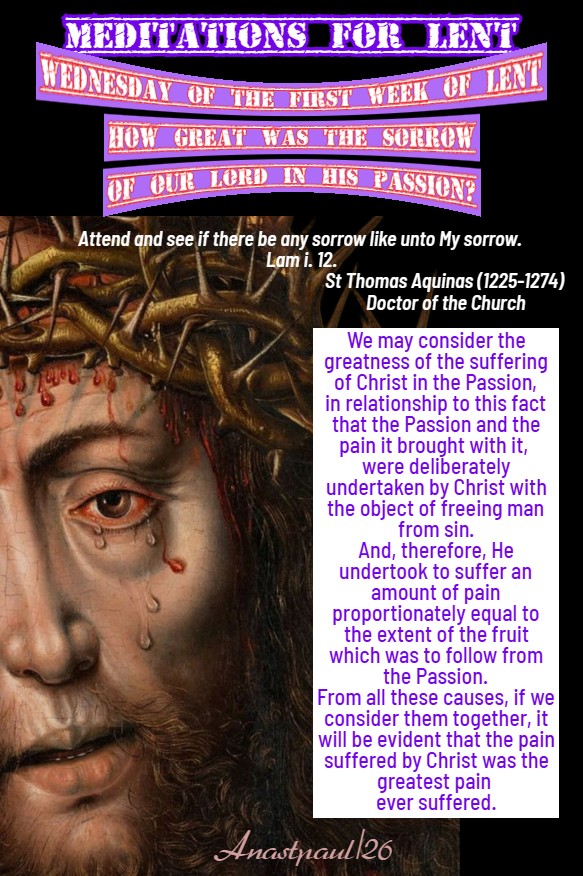
Wednesday of the First Week of Lent – 25 February – Our Lenten Journey With St Thomas Aquinas – How Great was the Sorrowo of Our Lord in His Passion?

Wednesday of the First Week of Lent – 25 February – Our Lenten Journey With St Thomas Aquinas (1225-1274) Doctor of the Church

Wednesday of the First Week of Lent
How Great was the Sorrow
of Our Lord in His Passion?

“Attend and see if there be any sorrow like unto My sorrow.
Lam i. 12.

Our Lord as He suffered felt in reality and in His Senses, that pain which is caused by some harmful bodily injuries.
He also felt that interior pain which is caused by the fear of something harmful and, which we call sadness.
In both these respects, the pain suffered by Our Lord was the greatest pain possible in this present life.
There are four reasons why this was so.

  1. The causes of the pain.
    The cause of the pain in the senses was the catastrophic injuries to the body, a pain whose bitterness derived partly from the fact that the sufferings attacked every part of His Body and partly, from the fact that, of all species of torture , death by Crucifixion is undoubtedly the most bitter.
    The nails are driven through the most sensitive of all places, the hands and the feet, the weight of the body itself increases the pain every moment.
    Add to this the long extentuated agony, for the Crucified do not die immediately as do those who are beheaded. The cause of the internal pain was:
    (i) All the sins of all mankind for which, by suffering, He was making satisfaction, so that, in a sense, He took them to Himself as though they were His own. The words of my sins, it says in the Psalms (Ps xxi. 2).

(ii) The special case of the Jews and the others who had had a share in the sin of His death and especially, the case of His disciples for whom His death had been a thing to be ashamed of.

(iii) The loss of His Bodily Life which, by the nature of things, is something from which human nature turns away in horror.

  1. We may consider the greatness of the pain according to the capacity, bodily and spiritual, for suffering of Him Who suffered. In
    His Body He was most admirably formed, for it was formed by the miraculous operation of the Holy Ghost and, therefore, Iits Sense of Touch, the sense through which we experience pain, was of the keenest.
    His Soul likewise, from Its interior powers, had a knowledge as from experience of all the causes of sorrow.
  2. The greatness of Our Lord’s Suffering can be considered in regard to this that the pain and sadness were without any alleviation. For, in the case of no matter what other sufferer, the sadness of mind and even the bodily pain, is lessened through a certain kind of reasoning, by means of which there is brought about a distraction of the sorrow from the higher powers to the lower.
    But when Our Lord suffered this did not happen, for He allowed each of His Powers to act and suffer to the fullness of its special capacity.
  3. We may consider the greatness of the suffering of Christ in the Passion, in relationship to this fact, that the Passion and the pain it brought with it, were deliberately undertaken by Christ with the object of freeing man from sin.
    And, therefore, He undertook to suffer an amount of pain proportionately equal to the extent of the fruit which was to follow from the Passion.

From all these causes, if we consider them together, it will be evident that the pain suffered by Christ was the greatest pain ever suffered.

ST THOMAS AQUINAS (1225-1274)
Priest, Theologian, Dominican
Doctor Angelicus (Angelic Doctor)
Doctor Communis (Common Doctor)
Added by Pope Saint Pius V in 1568


Posted in CHRIST the WORD and WISDOM, CONFESSION/PENANCE, DOCTORS of the Church, FATHERS of the Church, GOD is LOVE, JUNE-THE SACRED HEART, MEDITATIONS - ANTONIO CARD BACCI, QUOTES for CHRIST, QUOTES on OBEDIENCE, QUOTES on PATIENCE, QUOTES on REPARATION/EXPIATION, QUOTES on REPENTANCE, QUOTES on SACRIFICE, SACRED and IMMACULATE HEARTS, SACRED HEART QUOTES, The WORD

Quote/s of the Day – 25 February – Repent

Quote/s of the Day – 25 February –– Ember Wednesday – 3 Kings 19:3-8; Matthew 12:38-50 – Scripture search here: https://www.drbo.org/

The sign of Jonah

Matthew 12:39

It was, too, to lead the Ninevites
to firm repentance and to convert them
to Him, Who would deliver them from death,
amazed as they were by the sign accomplished in Jonah …
In the same way, God permitted man
to be swallowed by that great monster,
the author of disobedience,
not so that he should altogether vanish away
and die but because God, had prepared beforehand,
the salvation fulfilled by His Word
by means of the “sign of Jonah.

St Irenaeus (130-208)
Bishop of Lyons, Martyr and Father

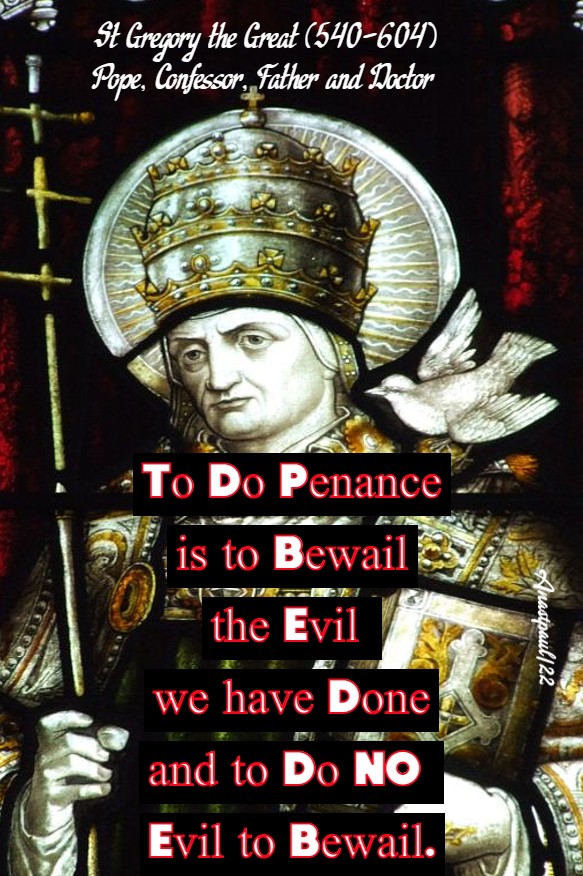
To do penance is to bewail
the evil we have done
and to do no evil to bewail.

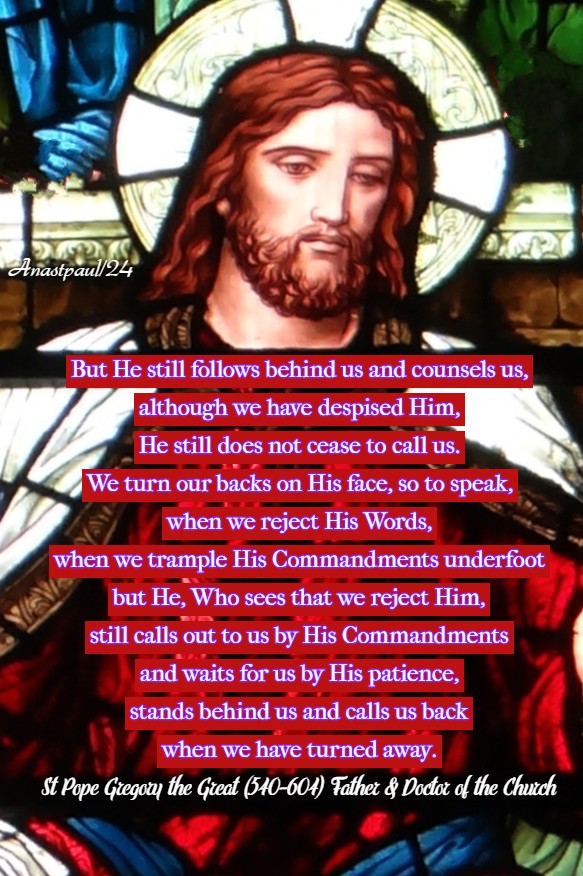
But He still follows behind us and counsels us,
although we have despised Him,
He still does not cease to call us.
We turn our backs on His face, so to speak,
when we reject His Words,
when we trample His Commandments underfoot
but He, Who sees that we reject Him,
still calls out to us by His Commandments
and waits for us by His patience,
stands behind us and calls us back
when we have turned away.

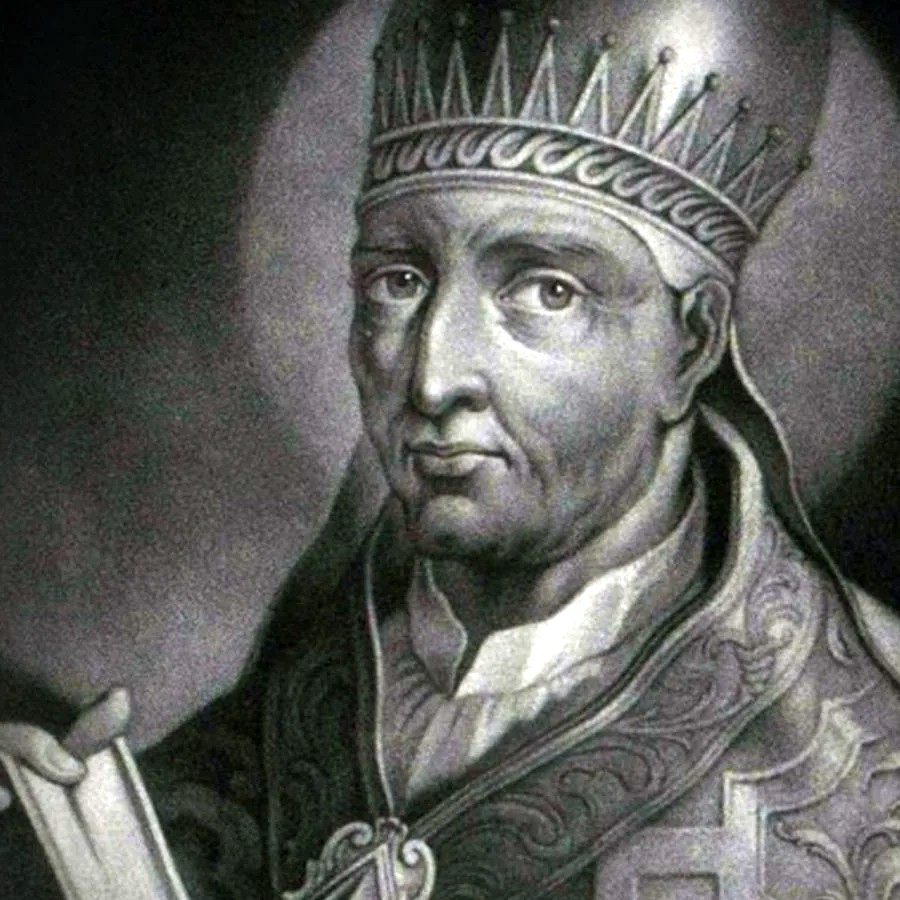
St Pope Gregory the Great (540-604)
Father & Doctor of the Church

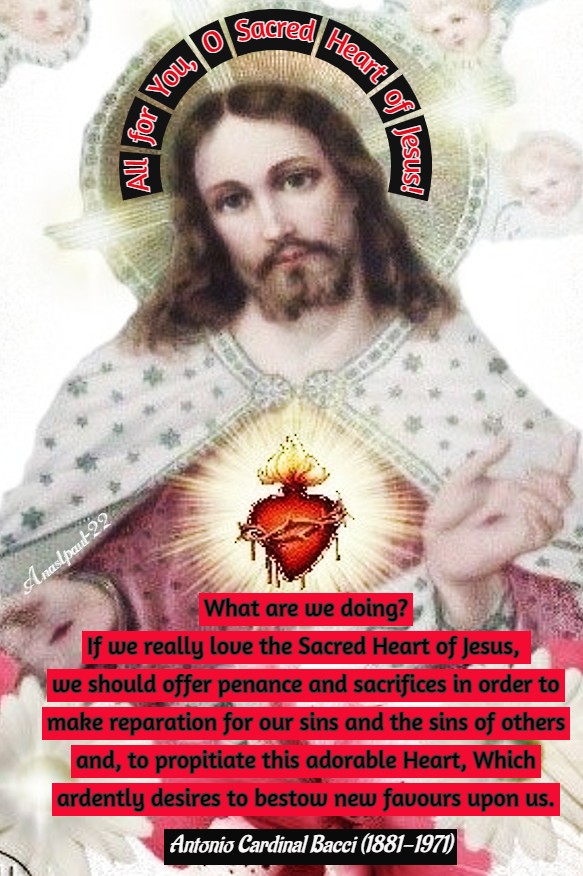
What are we doing?
If we really love the Sacred Heart of Jesus,
we should offer penance and sacrifices
in order to make reparation for our sins
and the sins of others
and, to propitiate this adorable Heart,
Which ardently desires to bestow
new favours upon us.

Antonio Cardinal Bacci (1881-1971)

Posted in DIVINE Mercy, Goodness, Patience, DOCTORS of the Church, FATHERS of the Church, HYMNS, LENT 2026, Our MORNING Offering, PRAYERS of the SAINTS, QUOTES on FASTING, QUOTES on FORGIVENESS

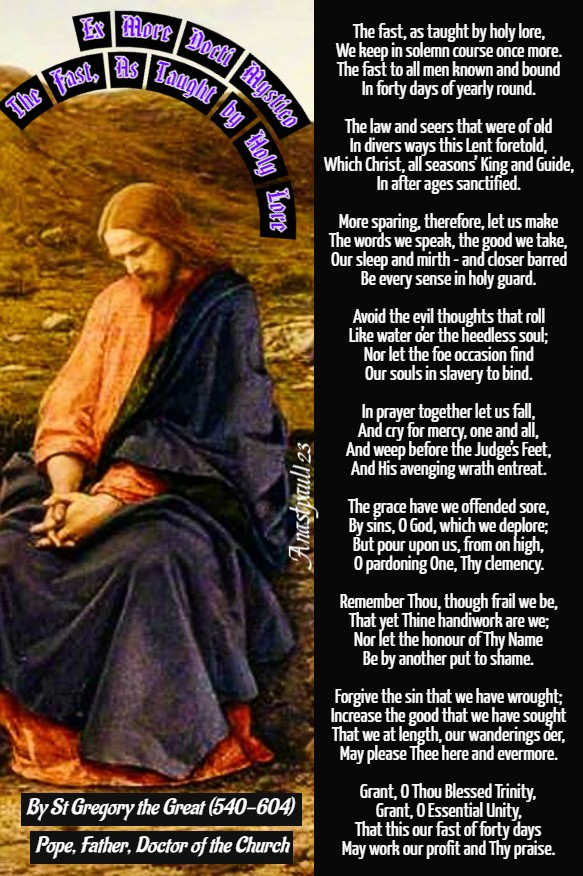
Our Morning Offering – 25 February – Ex More Docti Mystico, The Fast, As Taught by Holy Lore

Our Morning Offering – 25 February – “Wednesday of The First Week of Lent

Ex More Docti Mystico
The Fast, As Taught by Holy Lore
By St Gregory the Great (540-604)
Pope, Father, Doctor of the Church

Trans. John Mason Neale

The fast, as taught by holy lore,
We keep in solemn course once more.
The fast to all men known and bound
In forty days of yearly round.

The law and seers that were of old
In divers ways this Lent foretold,
Which Christ, all seasons’ King and Guide,
In after ages sanctified.

More sparing, therefore, let us make
The words we speak, the good we take,
Our sleep and mirth – and closer barred
Be every sense in holy guard.

Avoid the evil thoughts that roll
Like water o’er the heedless soul;
Nor let the foe occasion find
Our souls in slavery to bind.

In prayer together let us fall,
And cry for mercy, one and all,
And weep before the Judge’s Feet,
And His avenging wrath entreat.

The grace have we offended sore,
By sins, O God, which we deplore;
But pour upon us, from on high,
O pardoning One, Thy clemency.

Remember Thou, though frail we be,
That yet Thine handiwork are we;
Nor let the honour of Thy Name
Be by another put to shame.

Forgive the sin that we have wrought;
Increase the good that we have sought
That we at length, our wanderings o’er,
May please Thee here and evermore.

Grant, O Thou Blessed Trinity,
Grant, O Essential Unity,
That this our fast of forty days
May work our profit and Thy praise.

There are twelve translations of this lovely Lenten Hymn.
This one by L M Neale
Liturgical Use: Matins Hymn on Sundays
and week-days during Lent.

Posted in SAINT of the DAY

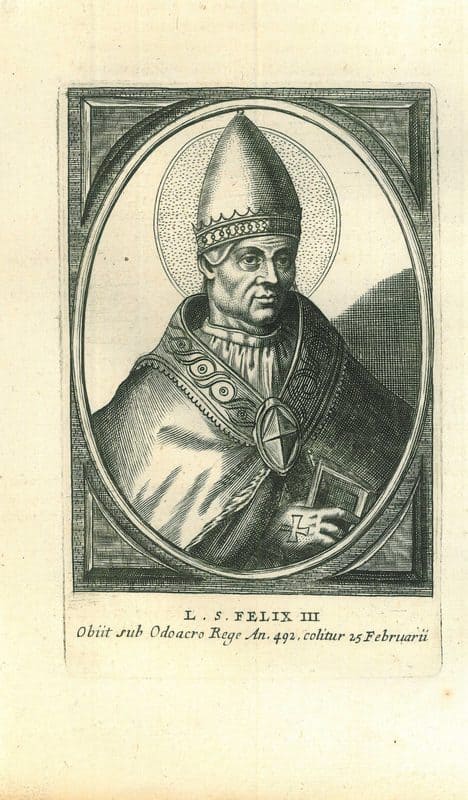
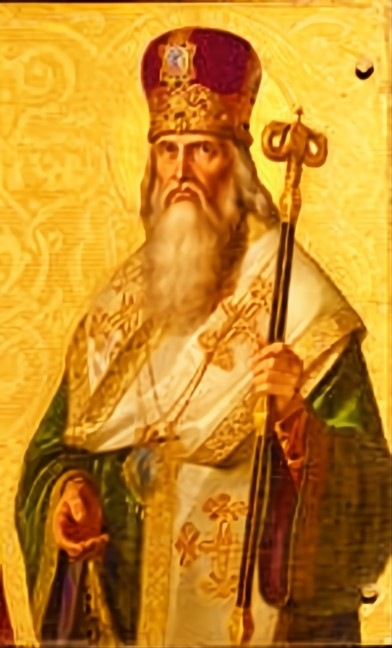
Saint of the Day – 25 February – Saint Pope Felix III (Died 492)

Saint of the Day – 25 February – Saint Pope Felix III (Died 492) Papacy from 13 March 483 to his death on 1 March 492. He was the great-grandfather of St Pope Gregory the Great.

The Roman Martyrology reads today: “At Rome, the birthday of Pope St Felix III, great-grandfather of St Pope Gregory the Great, who relates of him that he appeared to St Tharsilla, his niece and called her to the Kingdom of Heaven.”

Felix III Descendant of aristocrats and the son of a Priest, was ahimself a widower with 2 children when he was elected to the papacy in 483.

He was the first Pope to announce his election to the Emperor in Constantinople. The following year, he excommunicated Patriarch Acacius of Constantinople, who was a monothelite.

The Catholics appealed to Felix, who convened a Synod in 487 and sent a letter to the Bishops of Africa, expounding the conditions under which the unwilling apostates were to be allowed to return to the Church. Felix addressed the issue of readmitting to the Church of those who through fear, the Arians had forcibly re-baptised i.e. members of the flock were allowed to return to the fold of the Church after penance and Clergy were allowed to return only on their deathbed.

Felix died in 492 and was buried in the Basilica of St Paul Outside the Walls in Rome.

Posted in EMBER DAYS

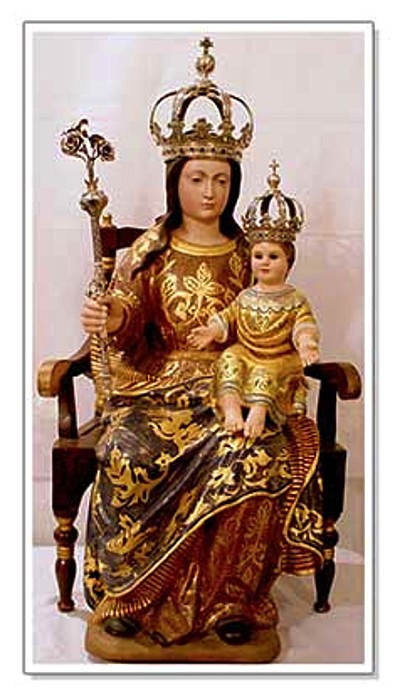
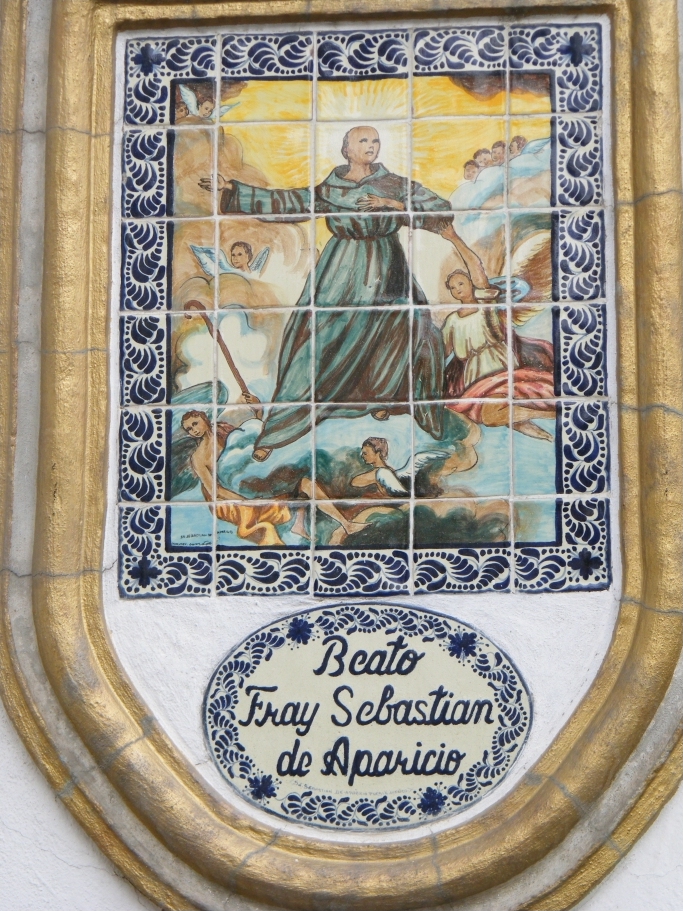
Ember Wednesday, Notre-Dame-de-Grande-Puissance / Our Lady of Great Power, Quebec (1673), St Walburga, Blessed Sebastian of Aparicio and the Saints for 25 February

EMBER WEDNESDAY – Fast & Abstinence
https://anastpaul.com/2020/12/16/today-is-an-ember-day-did-you-remember/

Notre-Dame-de-Grande-Puissance / Our Lady of Great Power, Quebec, Canada, (1673) – 25 February:
HERE:

https://anastpaul.com/2021/02/25/our-lady-of-great-power-quebec-canada-1673-and-memorials-of-the-saints-25-february/

St Walburga (c710-779) Virgin, Nun and Missionary. Daughter of St Richard the King. Sister of St Willibald and St Winebald, niece of St Boniface.
The Life of St Walburga – image below with her noble and Saintly family:
https://anastpaul.com/2017/02/25/saint-of-the-day-25-february-st-walburga/

Blessed Sebastian of Aparicio OFM (1502-1600) “The Angel of Mexico,” Franciscan Lay Brother, Confessor, Ascetic, apostle of the poor, builder of roads and bridges in Mexico and thus is honoured as the founder of the transport and road system in Mexico.
About the Amazing Blessed Sebastian:

https://anastpaul.com/2021/02/25/saint-of-the-day-25-february-blessed-sebastian-of-aparicio-ofm-1502-1600-the-angel-of-mexico/

St Adelelmo of Engelberg
St Aldetrudis
St Ananias of Phoenicia

Blessed Avertano of Lucca O.Carm ( 1320-1380 ) Lay Brother of the Order of Carmel, Miracle-worker, Avertano had a great devotion to the Passion of Christ.
Biography:

https://anastpaul.com/2022/02/25/saint-of-the-day-25-february-blessed-avertano-of-lucca-o-carm-1320-c-1366/

St Caesarius of Nazianzen (c329-369) Celibate Layman, a prominent Physician and Politician, Son of Saint Gregory of Nazianzen the Elder and Saint Nonna, Brother of Saint Gorgonia and Saint Gregory of Nazianzen. Patronages – of Physicians and bachelors.
His Holy Life:

https://anastpaul.com/2024/02/25/131658/

St Donatus the Martyr
St Felix III, Pope (Died 492)
St Gerland the Bishop
St Gothard the Hermit
St Herena the Martyr
St Justus the Martyr

St Nestor of Side
St Riginos

Blessed Robert of Arbrissel (c1045 – 1116) Priest, Itinerant Missionary Preacher, Founder of the renowned dual Monastery of Fontevraud-l’Abbaye in Pays-de-la-Loire, France, Teacher, both a Reformer, as well as possessing the opposite virtue of being a Peacemaker. A quite astonishing man!
https://anastpaul.com/2023/02/25/saint-of-the-day-25-february-blessed-robert-of-arbrissel-c1045-1116-priest-missionary-preacher-founder/

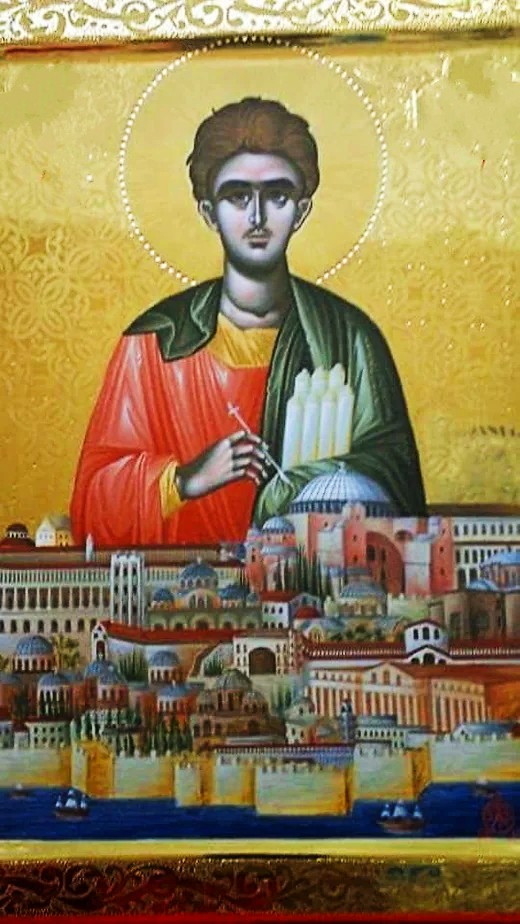
St Tharasius (c730-806) Bishop of Constantinople from 25 December 784 until his death on 25 February 806, Defender of Sacred images and of the sanctity of marriage against the imperial powers.
The Roman Martyrology reads today: “At Constantinople, St Tharasius, the Bishop, a man of great erudition and piety, to whom is addressed an epistle of Pope Adrian I, in defence of holy images.”
His Fervent Life:

https://anastpaul.com/2025/02/25/saint-of-the-day-25-february-saint-tharasius-c730-806-bishop/

St Victor of Saint Gall

Martyrs of Egypt – A group oSeven f Christian men who were exiled to Egypt for their faith and were eventually Martyred for their faith in the persecutions of Numerian. We know little more than their names: Claudianus, Dioscurus, Nicephorus, Papias, Serapion, Victor, Victorinus.