Posted in DOCTORS of the Church, FATHERS of the Church, LENT 2026, The PASSION, Thomas Aquinas

Thursday of the First Week of Lent – 26 February – Our Lenten Journey With St Thomas Aquinas – It was fitting that Christ should be Crucified with the Thieves

Thursday of the First Week of Lent – 26 February – Our Lenten Journey With St Thomas Aquinas (1225-1274) Doctor of the Church

Thursday of the First Week of Lent
It was fitting that Christ
should be Crucified with the Thieves
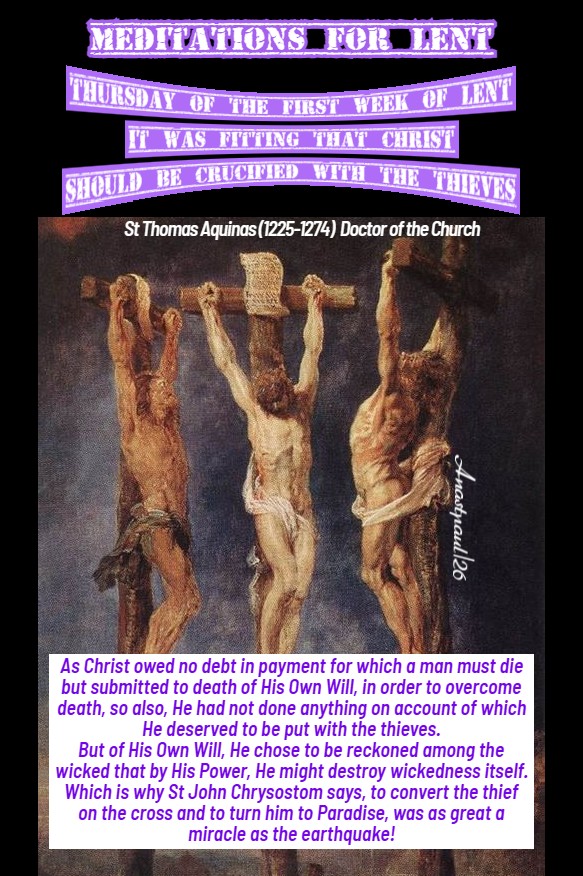
Christ was Crucified between the thieves because such was the will of the Jews and also because, this was part of God’s Design.
But the reasons why this was appointed, were not the same in each of these cases.

  1. As far as the Jews were concerned, Our Lord was Crucified with the thieves on either side to encourage the suspicion that He too was a criminal.
    But it transpired otherwise!
    The thieves themselves have left not a trace in the remembrance of man, while His Cross is everywhere held in honour. Kings lying their crowns aside, have embroidered the Cross on their Royal robes. They have placed it on their crowns; on their armiur. It has its place on the very Altars. Everywhere, throughout the world, we behold the splendour of the Cross.

In God’s Plan, Christ was Crucified with the thieves in order, for our sakes, He became accursed of the Cross, so, for our salvation, He is Cucified like an evil Man amongst evil men.

  1. The Pope, St Leo the Great, says that the thieves were crucified, one on either side of Our Lord, so that, in the very appearance of the scene of His Suffering, there might be set forth that distinction which should be made in the judgement of each one of us.
    St Augustine has the same thought. “The Cross itself,” he says, “was a tribunal. In the centre was the Judge. To the one side a man who believed and was set free, to the other side, a scoffer and he was condemned.”
    Already there was made clear the final fate of the living and the dead, the one class placed at His Right, the other on His Left.
  2. According to St Hilary, the two thieves, placed to right and to left, typify that the whole of mankind is called to the mystery of Our Lord’s Passion. And, since division of things, according to right and left is made with reference to believers and those who will not believe, one of the two, placed on the right, is saved by justifying faith.
  3. As St Bede says, the thieves who were crucified with Our Lord, represent those who, for the faith and to confess Christ, undergo the agony of martyrdom or the severe discipline of a more perfect life.
    Those who do this for the sake of eternal glory are typified by the thief on the Right Hand.
    Those whose motive is the admiration of whoever beholds them, imitate the spirit and the act of the thief on the Left Hand.

As Christ owed no debt in payment for which a man must die but submitted to death of His Own Will, in order to overcome death, so also, He had not done anything on account of which He deserved to be put with the thieves.
But of His Own Will, He chose to be reckoned among the wicked that by His Power, He might destroy wickedness itself.
Which is why St John Chrysostom says, to convert the thief on the cross and to turn him to Paradise, was as great a miracle as the earthquake!

ST THOMAS AQUINAS (1225-1274)
Priest, Theologian, Dominican
Doctor Angelicus (Angelic Doctor)
Doctor Communis (Common Doctor)
Added by Pope Saint Pius V in 1568

Posted in CONFESSION/PENANCE, GOD ALONE!, HOLY COMMUNION

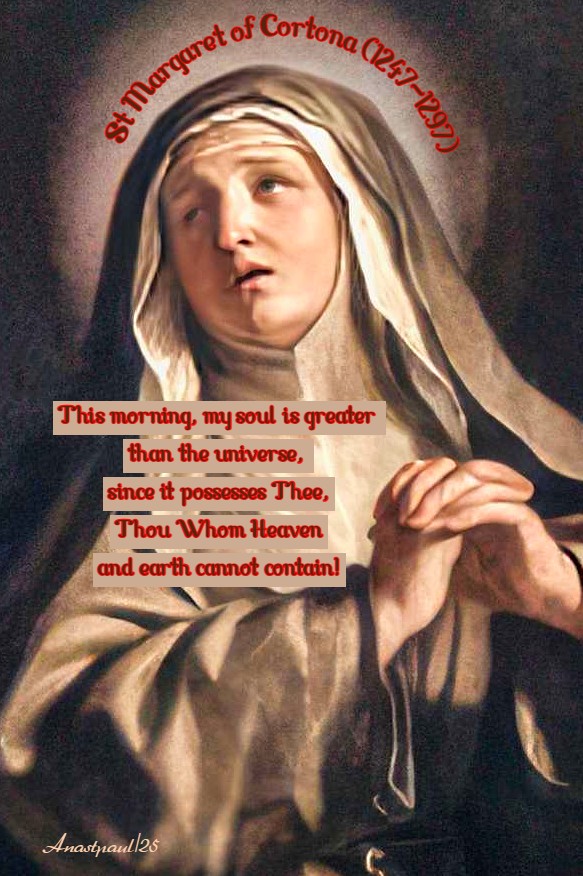
Quote/s of the Day – 26 February – St Margaret of Cortona (

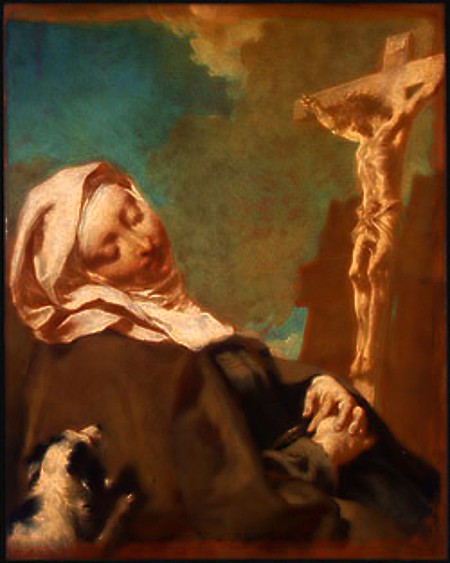
Quote/s of the Day – 26 February – St Margaret of Cortona (1247–1297) Penitent

This morning, my soul is greater
than the universe, since it possesses Thee,
Thou Whom Heaven and earth cannot contain
!”

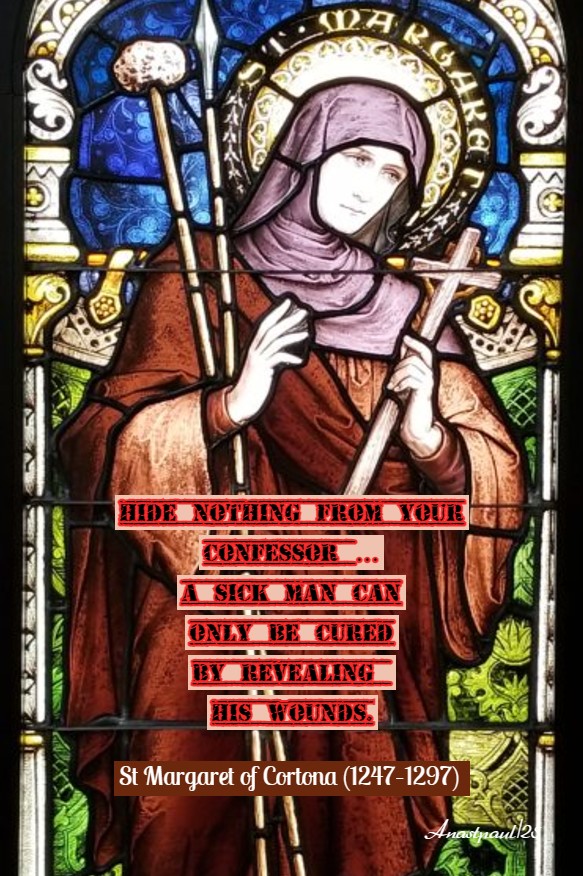
Hide nothing from your Confessor …
a sick man can only be cured
by revealing his wounds
.”

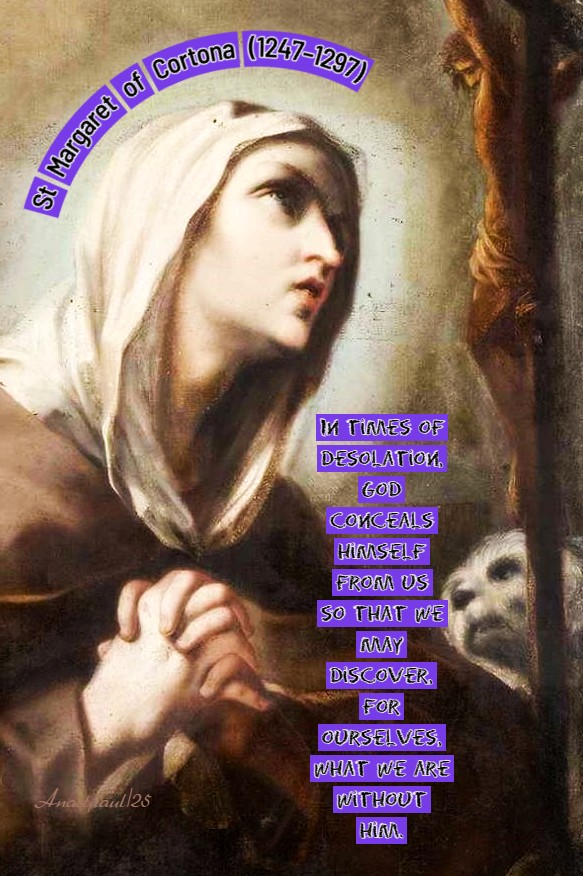
In times of desolation,
God conceals Himself from us
so that we may discover, for ourselves,
what we are without Him.

St Margaret of Cortona (1247–1297)
Penitent

Posted in DIVINE Mercy, Goodness, Patience, FATHERS of the Church, GOD ALONE!, Our MORNING Offering, PRAYERS of the SAINTS, QUOTES on HOPE, QUOTES on the DEVIL/EVIL

Our Morning Offering – 26 February – To Thee, O Master

Our Morning Offering – 26 February – Thursday of the First Week of Lent – Ferial Day

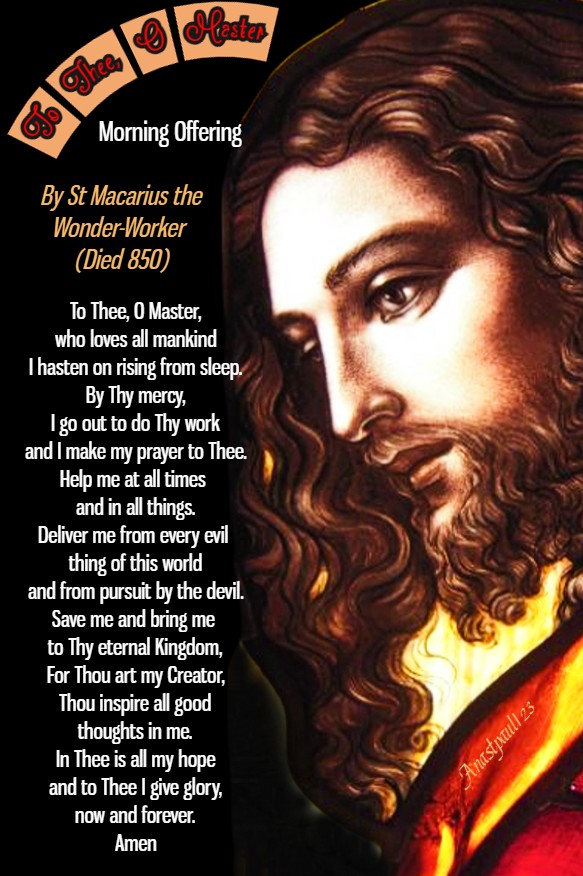
To Thee, O Master
Morning Offering
By St Macarius the Wonder-Worker (Died 850)

To Thee, O Master,
Who loves all mankind
I hasten Mn rising from sleep.
By Thy Mercy,
I go out to do Thy Work
and I make my prayer to Thee.
Help me at all times and in all things.
Deliver me from every evil thing of this world
and from pursuit by the devil.
Save me and bring me to Thy eternal Kingdom,
For Thou art my Creator,
Thou inspire all good thoughts in me.
In Thee is all my hope
and to Thee I give glory,
now and forever.
Amen

Posted in SAINT of the DAY

Saint of the Day – 26 February – St Andrew (9th Century) Bishop and Confessor of Florence

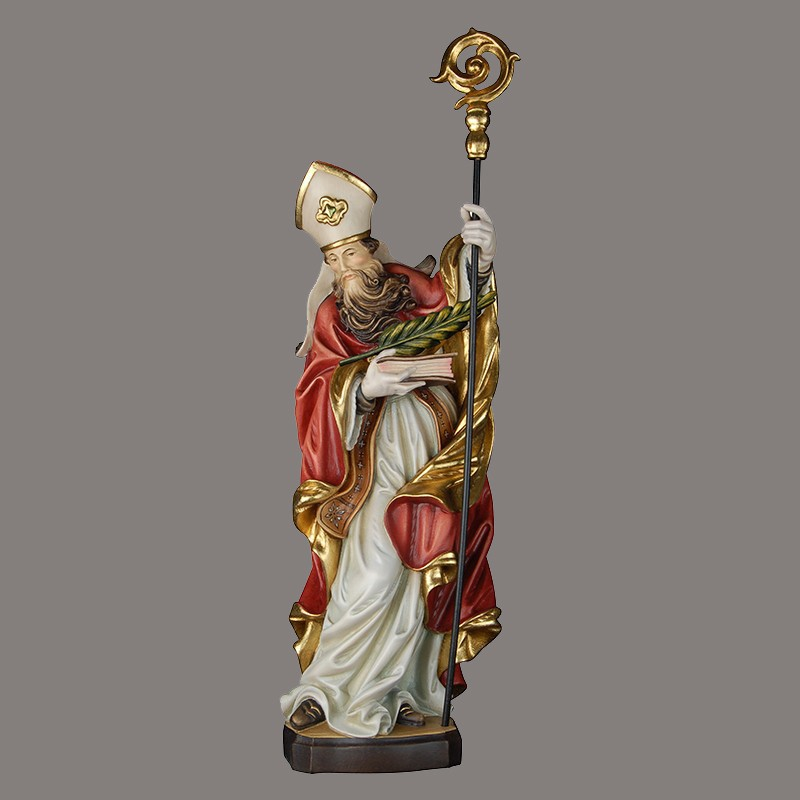
Saint of the Day – 26 February – St Andrew (9th Century) Bishop and Confessor of Florence. Also known as – Andrea.

The Roman Martyrology reads today: “At Florence, St Andrew, Bishop and Confessor.”

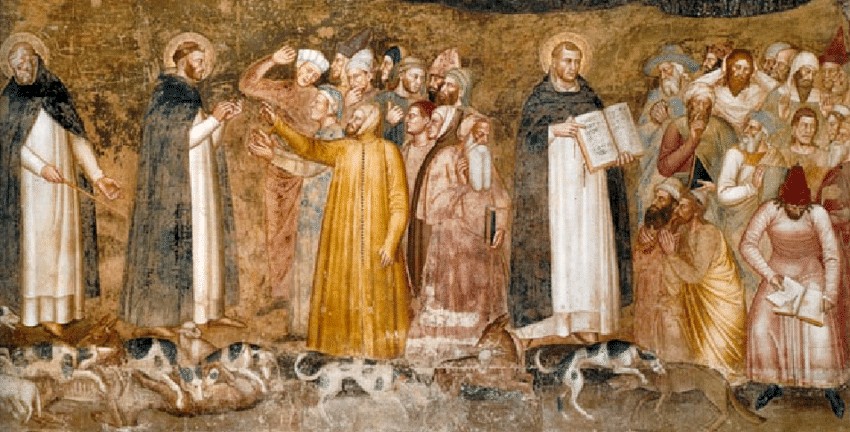
Andrea da Firenze, Spanish Chapel, Santa Maria Novella, Florence, Fresco, 1365-1367.

Information regarding St Andrew’s life is scarce and fragmentary. According to tradition, he lived in the 9th Century and was the Bishop of Florence.

The first documented record dates to 18 December 871, when he is mentioned as an Imperial Envoy attended at Court with Margrave Adalbert. In 874, he obtained from Emperor Louis II the German, the privilege of immunity for the Bishop’s property. On 1 March 893, his Envoys are reported to have handed his niece to Bertha, Abbess of the Abbey of Sant’Andrea, to be educated and trained to succeed the Abbess.

This scant information does not allow us to reconstruct Saint Andrew’s life. However, it is possible to hypothesise that he was a man of great faith and profound culture. His presence in Florence is attested by several documents and by his Liturgical Feast celebrated today.

Saint Andrew is considered the protector of the City of Florence. His figure has been depicted in several works of art, including a 15th Century Altarpiece preserved in the Church of Sant’Andrea in Florence.

A Church dedicated to him existed as early as the 13th Century, located in the Square of the same name in the historic center of the City. This Church was replaced and today, the memory of Saint Andrew is preserved in the Cathedral of Florence. A Chapel is also dedicated to him in the Church of San Lorenzo, where the Relics of his predecessor, Saint Zenobius, are preserved.

Posted in MARIAN TITLES, SAINT of the DAY

Notre-Dame des Champs / Our Lady of the Fields, Paris (250), St Margaret of Cortona and the Saints for 26 February

THURSDAY of the FIRST WEEK of LENT

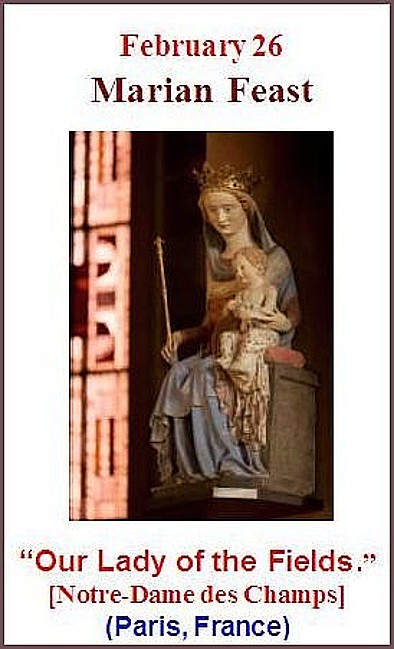
Notre-Dame des Champs / Our Lady of the Fields, Paris, France, consecrated by St Denis (250) – 26 February:
HERE:

https://anastpaul.com/2021/02/26/our-lady-of-the-fields-paris-france-consecrated-by-st-denis-250-and-memorials-of-the-saints-26-february/

St Margaret of Cortona TOSF (1247–1297) Penitent, Franciscan Tertiary, Mystic, Apostle of Charity, Founder of a charitable Lay Apostolate and an Order of Sisters known as “Le Poverelle” – Italian for “The Little Poor Ones.”
“Le Poverelle” :

https://anastpaul.com/2019/02/22/saint-of-the-day-22-february-st-margaret-of-cortona-tosf-1247-1297/

Bl Adalbert of Tegernsee
St Agricola of Nevers

St Alexander of Alexandria (Died c326) Bishop of Alexandria, Confessor, Defender of the True Faith against heresies, in particular the Arians.
The Roman Martyrology states of him today: “At Alexandria, the Bishop St Alexander, an aged man held in great honour who was a successor of the blessed Peter as Bishop of the City. He expelled from the Church, Arius, one of his Priests, tainted with heretical impiety and convicted by Divine Truth and, subsequently, was one of the three hundred and eighteen Fathers, who condemned him at the Council of Nicea.
Holy Father St Alexander:

https://anastpaul.com/2022/02/26/saint-of-the-day-26-february-st-alexander-of-alexandria-died-c-326/

St Andrew (9th Century) Bishop and Confessor of Florence
St Dionysius of Augsburg

St Faustinian (4th Century)The 2nd Bishop of Bologna.
The Roman Martyrology reads today: “At Bologna, the Bishop St Faustinian, whose preaching strengthened and multiplied the faithful of that Church which had been much afflicted during the persecutions of Diocletian.”
A Brave and Zealous Shepherd:

https://anastpaul.com/2025/02/26/saint-of-the-day-26-february-st-faustinian-4th-century-the-2nd-bishop-of-bologna/

St Felix
St Fortunatus
St Irene
Bl Ottokar of Tegernsee

St Porphyrius of Gaza (Died 420) Bishop of Gaza from 395 to 420, known, from the account in his Life, for Christianising the recalcitrant pagan City of Gaza in Palestine and demolishing its pagan temples. Previously he had been a Hermit.
His Life:

https://anastpaul.com/2023/02/26/saint-of-the-day-26-february-saint-porphyrius-of-gaza-died-420-bishop/

Blessed Ulrik O.Praem. (Died1187) Priest, Prior of the Monastery of Obermarchtal
Blessed Ulrik’s Life:

https://anastpaul.com/2024/02/26/saint-of-the-day-26-february-blessed-ulrik-of-obermarchtal-o-praem-died-1187-priest/

St Victor the Hermit (Died 6th Century) Priest, Monk, Hermit, miracle-worker.
Holy St Victor:

https://anastpaul.com/2021/02/26/saint-of-the-day-26-february-saint-victor-the-hermit-died-6th-century-priest/