Quote of the Day – 1 March – The Second Sunday in Lent – Thessalonians 5:14-23, Matthew 17:1-9 – Scripture search here: https://www.drbo.org/
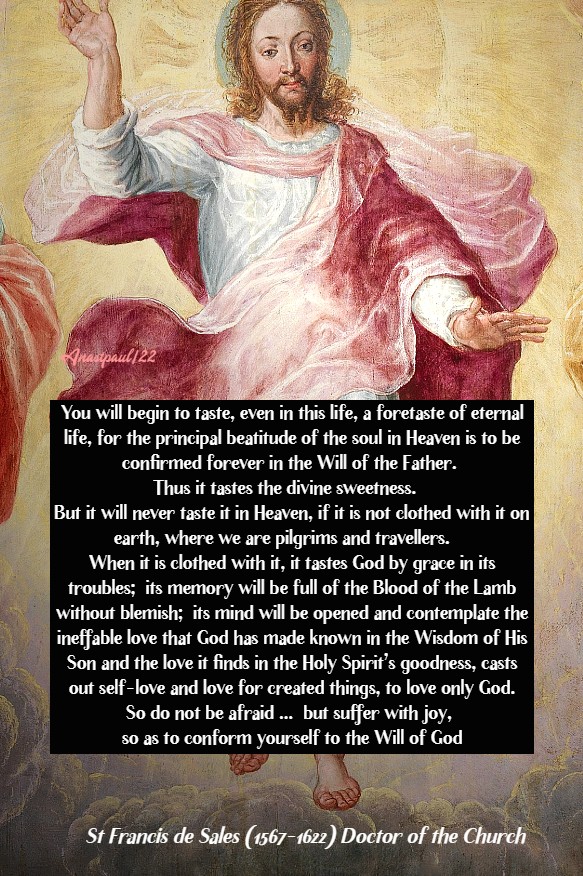
“You will begin to taste, even in this life, a foretaste of eternal life, for the principal beatitude of the soul in Heaven, is to be confirmed forever in the Will of the Father. Thus, it tastes the Divine sweetness. But it will never taste it in Heaven, if it is not clothed with it on earth, where we are pilgrims and travellers. When it is clothed with it, it tastes God by grace in its troubles; its memory will be full of the Blood of the Lamb without blemish; its mind will be opened and contemplate the ineffable Love that God has made known in the Wisdom of His Son and the love it finds, in the Holy Spirit’s goodness, casts out self-love and love for created things, to love only God. So do not be afraid … but suffer with joy, so as to conform yourself to the Will of God.””
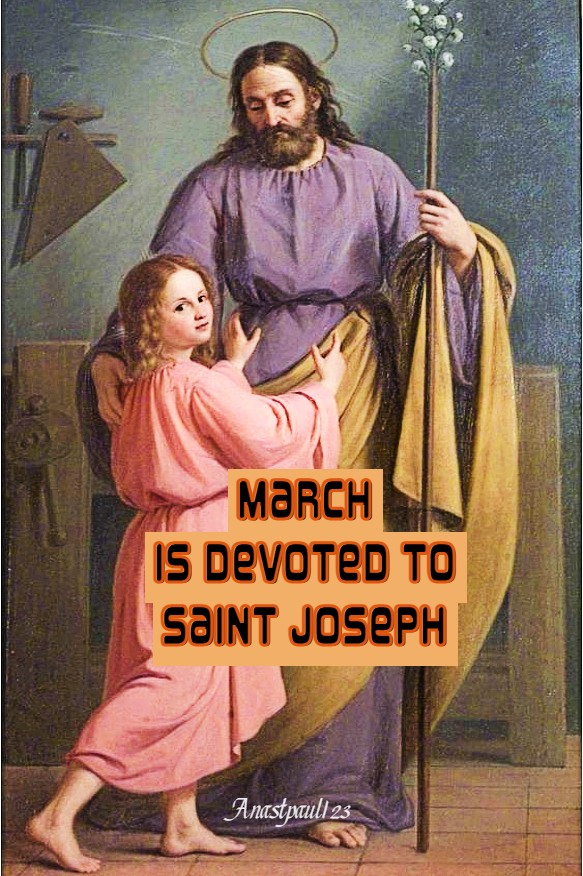
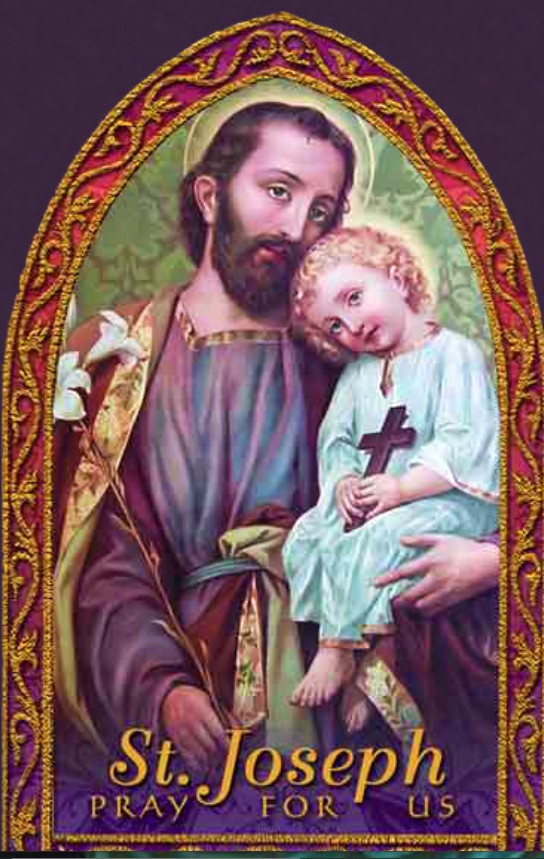
The beloved Foster-Father and Guardian of Jesus and Protector of the Holy Family, is celebrated for this whole month and his Feast Day falls on 19 March .
“Quamquam Pluries” On the Devotion to St Joseph Pope Leo XIII
“On 10 March, we begin the Novena to St Joseph, entrusting so many of our woes and cares to his holy and fatherly care and intercession. His Patronages are numerous, as we know, one of them will fit our needs perfectly and if not, then we should all ask him to intercede on our behalf for our families and for a Happy and Holy Death.”
Indulgenced Prayer to St Joseph O St Joseph! Pray for Us Daily O Joseph! virgin father of Jesus, pure Spouse of the Virgin Mother, pray for us daily to the Son of God, that, armed with the weapons of His grace, we may fight as we ought in life and be crowned by Him in death. Amen (Indulgence of 100 days, twice a day St Pius X 26 November 1906)
Patronages in Alphabetical Order:
of Accountants • Bursars • Cabinetmakers • Carpenters • Catholic Church • Cemetery Workers • Children • Civil Engineers • against Communism • Confectioners • Craftsmen • against Doubt and Hesitation • the Dying • Emigrants • Exiles • Expectant Mothers • Families • Fathers • Furniture Makers • Grave diggers • Happy Death • Holy Death • House Hunters • House Sellers • Immigrants • Joiners • Labourers • all the Legal Profession • Married Couples • Oblates of Saint Joseph • Orphans • Pioneers • Social Justice • Teachers • Travellers • the Unborn • Wheelwrights • Workers • Americas • Austria • Belgium • Bohemia • Canada • China • Croatian people • Korea • Mexico • New France • New World • Peru • Philippines • Vatican City • VietNam • Canadian Armed Forces • Papal States • 46 Diocese • 26 Cities,States and Regions.
The Second Sunday of Lent – 1 March – Our Lenten Journey With St Thomas Aquinas (1225-1274) Doctor of the Church
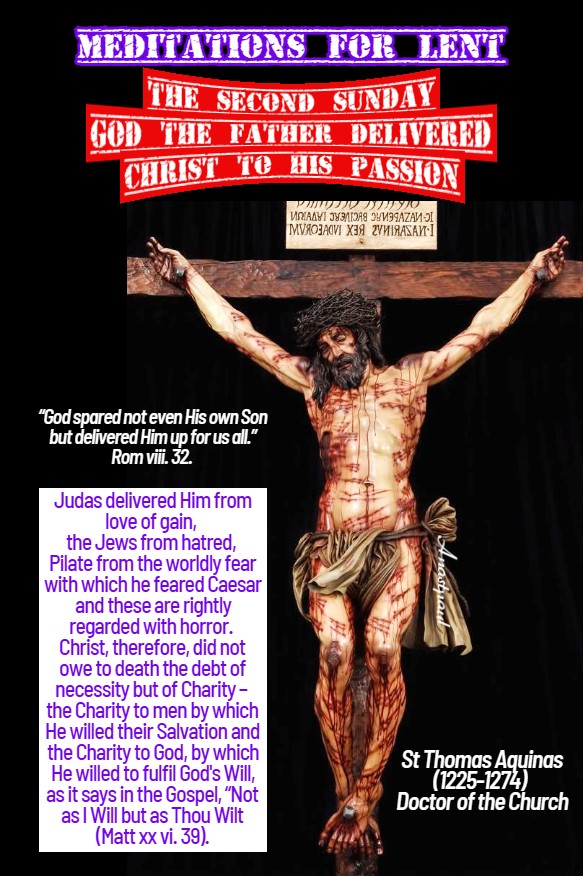
The Second Sunday God the Father Delivered Christ to His Passion
“God spared not even His own Son but delivered Him up for us all.” Rom viii. 32.
Christ suffered willingly, moved by obedience to His Father. Wherefore, God the Father delivered Christ to His Passion and this, in three ways:
Because the Father, of His Eternal Will, preordained the Passion of Christ as the means whereby to free the human race. So it is said in Isaias, “The Lord hath laid on Him the iniquity of us all” (Isa liii. 6) and again, “The Lord was pleased to bruise Him in infirmity” (ibid liii. 10).
Because He inspired Our Lord with the willingness to suffer for us, pouring into His Soul the Love which produced the will to suffer. Whence the Prophet goes on to say, “He was offered because it was His Own Will” (Isa liii. 7).
Because He did not protect Our Lord from the Passion but exposed Him to His persecutors. Whence we read in St Matthew’s Gospel: as He hung on the cross Christ said, “My God, My God, why hast thou forsaken Me” (Matt xxvii. 46). For God the Father, that is to say, had left Him at the mercy of His torturers.
To hand over an innocent man to suffering and to death, against his will, compelling him to die as it were, would indeed be cruel and wicked. But it was not in this way God the Father delivered Christ. He delivered Christ by inspiring Him with the Will to suffer for us. By so doing, the severity of God is made clear – no sin is forgiven without punishment! which St Paul again teaches when he says, God spared not His Own Son.
At the same time God’s kindness and goodness is exhibited in the fact that whereas man could not, no matter what his punishment, sufficiently make satisfaction, God has given man someone Who is able to make that satisfaction for him. Which is what St Paul means by, He delivered Him up for us all and again when he says, God hath proposed Christ to be an appeasement through faith in His Blood (Rom iii. 25). The same activity in a good man and in a bad man is differently judged, inasmuch as the root from which it proceeds is different. The Father, for example, delivered Christ and Christ delivered Himself and this from love and, therefore, They are praised.
Judas delivered Him from love of gain, the Jews from hatred, Pilate from the worldly fear with which he feared Caesar and these are rightly regarded with horror. Christ, therefore, did not owe to death the debt of necessity but of Charity – the Charity to men by which He willed their Salvation and the Charity to God, by which He willed to fulfil God’s Will, as it says in the Gospel, “Not as I Will but as Thou Wilt (Matt xx vi. 39).
ST THOMAS AQUINAS (1225-1274) Priest, Theologian, Dominican Doctor Angelicus (Angelic Doctor) Doctor Communis (Common Doctor) Added by Pope Saint Pius V in 1568
Our Morning Offering – 1 March– “The Month of the St Joseph” – The Second Sunday of Lent
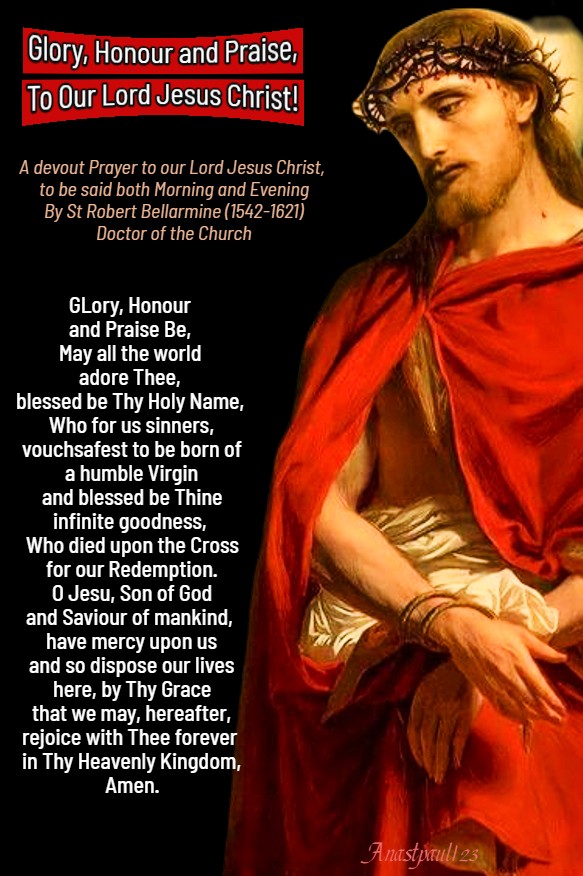
Glory, Honour and Praise, To Our Lord Jesus Christ! A devout Prayer to our Lord Jesus Christ, to be said both Morning and Evening By St Robert Bellarmine (1542-1621) Doctor of the Church (From His “A Brief Christian Doctrine”)
GLory, Honour and Praise Be, May all the world adore Thee, blessed be Thy Holy Name, Who for us sinners, vouchsafest to be born of a humble Virgin and blessed be Thine Infinite Goodness, Who died upon the Cross for our Redemption. O Jesu, Son of God and Saviour of mankind, have mercy upon us and so dispose our lives here, by Thy Grace that we may, hereafter, rejoice with Thee forever in Thy Heavenly Kingdom, Amen.
Saint of the Day – 1 March – St Siviard (Died 687) Priest and the 5th Abbot of the Moinastery of Saint-Calais in Maine, France, Author, a man of great humility and leadership skills. Also known as – Siard, Siviardus, Siviardo.
The Roman Martyrology reads today: “At Le Mans, St Siviard, Abbot.”
Siviard’s biographer, Jean-Barthélemy Hauréau, was one of his contemporaries, a 7th-century Monk.
According to the narrator, he had known the holy Abbot ,not only in the Monastery, where he had had him as his father but during his childhood and, therefore, in his native village.
Siviard’s father was Sigiram, a Frankish noble and his mother was Adda. Since Bertrand du Mans, the Bishop of Le Mans, had donated lands to his beloved nephew Sigiram in the Diablintic region. It is assumed that Sigiram was himself a Cleric and Abbot.
In Siviard’s life, he tells us only of his childhood passion for study, his vocation to religious life, where he wished to be buried among the most obscure Monks, the choice of his superiors who elevated him to the Priesthood, the virtues he practiced, worthy of all the praise that Scripture bestows on the holy ministers of the Lord and his eventual election to the Abbatial chair after his father’s death.
King Thierry III, who named Siviard, confirmed his possession of the Monastery’s property in 676. Siviard built the house of God magnificently, both in material structure and spiritual discipline. Siviard received the places of Villiers and Lantion from Bishop Aigilbert and built a villa and probably a small Monastery on the grounds of Saint-Georges-de-la-Coué.
St Siviard died without sadness, without regret, on the first day of March 687. One of the Monks was warned of this death, by a vision in which the Abbot was shown to him in celestial light accompanied by Saints Peter and Paul and recommended that he carry to his sister the Eulogies he had prepared.
A diploma of Charlemagne from 774 expressly states that Siviard’s body rests in the villa of Savonnières in Saint-Georges-db-la-Coué, the last foundation of the holy Abbot. It was here that his bones were removed and then transported to Sens during the Norman invasions. The Church of Laval has occupied a significant part of the site since 1883.
At the behest of several Bishops, Siviard wrote the life of Saint Calais, founder of the Abbey he had governed.
St David of Wales (c542-c601) Bishop, Prince, Monk, Confessor, Missionary, Founder of Monasteries. Uncle of King Arthur. David studied under Saint Paul Aurelian. Worked with Saint Columbanus, Saint Gildas the Wise and Saint Finnigan. He was officially Canonised in 1120 by Pope Callistus II. Beloved St David: https://anastpaul.com/2017/03/01/saint-of-the-day-1-march-st-david-of-wales/
St Abdalong of Marseilles St Adrian of Numidia St Agapios of Vatopedi St Agnes Cao Guiying
St Albinus of Vercelli St Amandus of Boixe St Antonina of Bithynia Bl Aurelia of Wirberg Bl Bonavita of Lugo St Bono of Cagliari Bl Christopher of Milan Bl Claudius Gabriel Faber St Domnina of Syria St Domnina of Syria St Donatus of Carthage St Eudocia of Heliopolis Bl George Biandrate Bl Giovanna Maria Bonomo Bl Gonzalo de Ubeda St Hermes of Numidia St Jared the Patriarch St Leo of Rouen
St Leolucas OBas (c815-c915) Abbot of the Basilian Order, Mystic, Ascetic, Miracle-worker. He lived as a Monk for more than 80 years. The Roman Martyrology reads: “In the Monastery of Avena between the slopes of Mount Mercurio in Calabria, St Leone Luca, Abbot of Monte Mula, who shone in the hermitic life, as in the cenobitic life, following the rules of the oriental Monks.” His Life of Grace: https://anastpaul.com/2023/03/01/saint-of-the-day-1-march-saint-leolucas-of-corleone-obas-c815-c915-abbot/
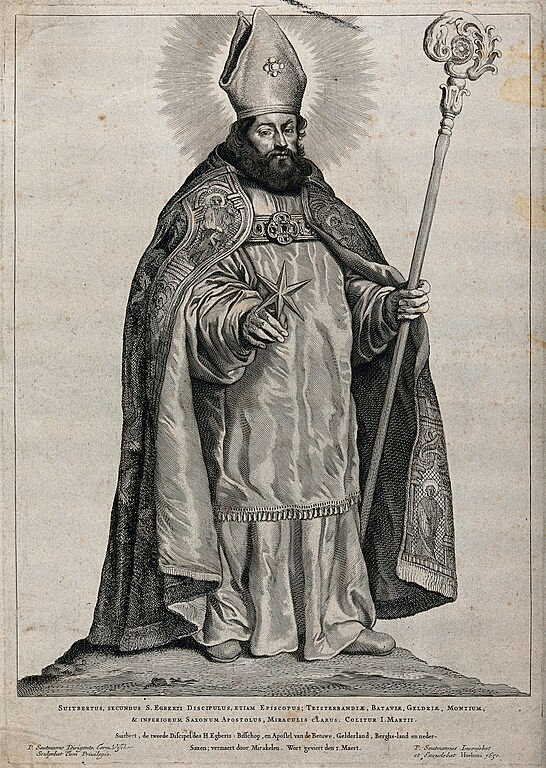
St Lupercus St Marnock St Monan Bl Pietro Ernandez Bl Roger Lefort St Rudesind St Simplicius of Bourges St Siviard (Died 687) Abbot
Martyrs of Africa – A group of 13 Christians executed together for their faith in Africa. The only details about them to survive are ten names – Abundantius, Adrastus, Agapius, Charisius, Donatilla, Donatus, Fortunus, Leo, Nicephorus and Polocronius. c290
Martyrs of Antwerp – A group of 14 Christians Martyred together, buried together and whose Relics were transferred and enshrined together. We know nothing else but their names – Benignus, Donatus, Felician, Fidelis, Filemon, Herculanus, Julius, Justus, Maximus, Pelagius, Pius, Primus, Procopius and Silvius. Died in the 2nd Century in Rome. They are buried in the St Callixtus Catacombs and their Relics were enshrined in the Jesuit Church in Antwerp on 28 February 1600.
Martyrs of the Salarian Way – A group of 260 Christians who, for their faith, were condemned to road work on the Salarian Way in Rome, Italy during the persecutions of Claudius II. When they were no longer needed for work, they were publicly murdered in the amphitheatre. Martyrs. c269 in Rome.
Martyrs Under Alexander – A large but unspecified number of Christians Martyred in the persecutions of Emperor Alexander Severus and the praefect Ulpian who saw any non-state religion to be a dangerous treason. c 19.






 AnaStpaul
You must be logged in to post a comment.