Passionate Catholic.
Being a Catholic is a way of life - a love affair "Religion must be like the air we breathe..."- St John Bosco
Prayer is what the world needs combined with the example of our lives which testify to the Light of Christ.
This site, which is now using the Traditional Calendar, will mainly concentrate on Daily Prayers, Novenas and the Memorials and Feast Days of our friends in Heaven, the Saints who went before us and the great blessings the Church provides in our Catholic Monthly Devotions.
This Site is placed under the Patronage of my many favourite Saints and especially, St Paul.
"For the Saints are sent to us by God
as so many sermons.
We do not use them, it is they who move us
and lead us, to where we had not expected to go.”
Charles Cardinal Journet (1891-1975)
This site adheres to the pre-Vatican II Catholic Church and all her teachings. .
PLEASE ADVISE ME OF ANY GLARING TYPOS etc - In June 2021 I lost 100% sight in my left eye and sometimes miss errors. Thank you and I pray all those who visit here will be abundantly blessed. Pax et bonum! 🙏
Quote/s of the Day – 25 March – Monday in Holy Week
I Beg Thee, Lord By St Francis of Assisi (c1181–1226)
I beg Thee, Lord, let the fiery, gentle power of Thy love take possession of my soul and snatch it away, from everything under Heaven, that I may die, for love of Thy love, as Thou saw fit, to die for love of mine! Amen
“Now it is that we are to show an invincible courage towards our Saviour, serving Him purely for the love of His will, not only without pleasure but amid this deluge of sorrows, horrors, distresses and assaults, as did his glorious Mother and St John, upon the day of His Passion. Amongst so many blasphemies, sorrows and deadly distresses, they remained constant in love …”
Our Lenten Journey with the Angels and the Saints – 25 March – Monday in Holy Week – Isaias 50:5-10, John 12:1-9 – Scripture search here: https://www.drbo.org/
“Whatever you did for one of these least brothers of Mine, you did for Me.” Matthew 25:40
“For the poor you have always with you but Me, you have not always.” John 12:8
Pour Precious Perfume On the Lord’s Feet and Wipe Them With Your Hair!
St Augustine (354-430) Father and Doctor of Grace
“Whoever you are, if you wish to be faithful, pour precious perfume on the Lord’s Feet, along with Mary. This perfume is uprightness… Pour perfume on the Feet of Jesus – follow in the Lord’s Footsteps by a holy way of life. Wipe His Feet with your hair – if you have more than enough, give to the poor and in this way you will have wiped the Lord’s Feet… Perhaps the Lord’s Feet on earth, are in need. Indeed, is it not about His Members, He will say at the end of the world: “Whatever you did for one of these least brothers of Mine, you did for Me” (Mt 25:40)?” – (Sermons on Saint John’s Gospel No 50: 6-7).
One Minute Reflection – 25 March – – Monday in Holy Week – Isaias 50:5-10, John 12:1-9 – Scripture search here: https://www.drbo.org/
“The house was filled with the odour of the ointment.” – John 12:3
REFLECTION – “When she had anointed the Lord’s feet this woman did not wipe them with a cloth but with her own hair, to show Him greater honour … Like a thirsty person drinking from a fresh waterfall, this holy woman drank in grace full of delights, from the Springs of Holiness, to quench the thirst of her faith.
However, in the allegorical or mystical sense, this woman prefigured the Church, which offered the full and entire devotion of its faith to Christ …There are twelve ounces to a pound and this is the amount of perfume the Church possesses, having received the teaching of the twelve Apostles, as if it were a precious perfume. Indeed, what more precious is there than the Apostles’ teaching, which contains both faith in Christ and the glory of the Kingdom of Heaven? Furthermore, it is related that the whole house was filled with the scent of that perfume because, the whole world has been filled with the Apostles’ teaching. As it is written: “Through all the earth their voice resounds and to the ends of the world, their message” (Ps 19[18]:5).
In the Song of Songs we read the following words addressed through Solomon, to the Church: “Your name spoken is a spreading perfume” (1,2). Not without cause, is the Lord’s Name called a “spreading perfume.” As you know, as long as perfume is preserved inside its flask, it keeps its fragrance but, as soon as is poured out or emptied, it spreads out its fragrant scent. Even so, as long as our Lord and Saviour reigned with His Father in Heaven, the world was unaware of Him, He was unknown here below. But when, for our salvation, He deigned to humble Himself, by descending from Heaven, to take on a human body, then He spread abroad in the world, the sweetness and perfume of His Name.“ – St Chromatius of Aquilaea(Died c 407) – Bishop of Aquileia, Italy, Theologian, Exegete (Sermon 11).
PRAYER – Grant, we beseech Thee, Almighty God, that we who fail through our weakness in so many difficulties, may be relieved through the pleading of the Passion of Thy Only-begotten Son. Through the same Jesus Christ, Thy Son our Lord, Who lives and reigns with Thee, in the unity of the Holy Ghost, God, world without end. Amen (Collect).
Our Morning Offering – 25 March – Monday in Holy Week
A Prayer of the Passion By St Melito of Sardis (Died 180) Bishop of Sardis, Apologist, Father
Lord Jesus Christ, You were bound as a ram, You were shorn like a lamb, You were led to the slaughter like a sheep, You bore the wood of the Cross on Your shoulders, You were led up the hill of Calvary, You were displayed naked on the Cross, You were nailed to the bitter Cross by three spikes, You delivered Your last Seven Words from the Cross You died on the Cross, with a shout of victory, You were buried in noble Joseph’s rock-hewn tomb, By Your boundless suffering on our behalf, fix our eyes unceasingly on Your broken Body and the Blood that poured from Your Hands, Feet and Side. By the Holy Sacrifice of the Mass that renews each day Your Sacrifice of the Cross on our Altars, apply the merits of the Cross to all humanity and, especially to those who worship it daily and who offer themselves back to You, our great High Priest and perpetually Intercessor, before the Eternal Throne of God. You live and reign, through all the ages of ages. Amen.
Saint of the Day – 25 March – Blessed Placido Riccardi OSB (1844-1915). Priest and Friar of the Order of St Benedict. He founded a branch thereof known as the Cassinese Congregation, a reform of the standard way of life of the Monasteries. Born on 24 June 1844 as Tommaso Riccardi in Trevi, Umbria, Italy and died aged 70 in Rome, on 25 March 1915. PATRONAGES – against Malaria, against all bodily illnesses. Also known as – Tommaso Riccardi, Thomas Riccardi. He was Beatified on 5 Dercember 1954 by Pope Pius XII.
Tommaso Riccardi was born in Trevi on 24 June 1844 to Francesco and Maria Stella Paoletti, the third of ten children. He was Baptised in the nearby Church of St Emilian and, as soon as he was reborn with Baptism, he was placed on the Altar of Our Lady of Sorrows, in an act of consecration.
In 1853 he entered the Lucarini College where he distinguished himself as attested by numerous mentions and medals, awarded to him. In 1862, when the Lucarini College was closed for political reasons, he placed himself under the spiritual direction of Don Ludovico Pieri, a holy Priest from Trevia, spiritual father and inspiration of Blessed Pietro Bonilli. In 1865, in the the act of resigning from Pieri to continue his studies in Rome, the latter prophesied his future vocation but Tommaso made a gesture of rebellion and, throwing the hat he was holding in his hand, to the ground and stepping on it, exclaimed: “If this vocation comes to me, I drown!”
Just a year later, 1866, after a pilgrimage to Loreto and a course of spiritual exercises, he knocked on the door of the Abbey of St Paul. Admitted to the Novitiate on 5 January 1867 with the name of Placido, he was Ordained Subdeacon on 2 April 1870 and Deacon on 224 September 1870.
Called up for Military Service, he took a few days to finish his exams but was immediately declared a deserter because of this delay! Having arrived in Spoleto to plead his case, since in the meantime, the Piedmontese government which also dominated Rome, had decreed an amnesty, it was discovered that his case did not fall within it and, therefore, he was arrested at the Fonti del Clitunno, while returning to Trevi. Transferred to Florence, he was tried and sentenced to one year’s imprisonment, then pardoned and sent to the Regiment in Pisa but, after medical tests, declared unfit, he was discharged on 27 January 1871. On 7 February he returned to St Paul’s where, on 10 March he made his Solemn Profession and on 25 March he was Ordained a Priest.
At The Beatification in St Peter’s Square
He held various positions: Deputy Master of Students, Master of Novices, Abbey Vicar of the Benedictines of St Magno in Amelia in two different periods. In 1994, while he was leaving the Amelia Monastery to return to Rome due to his poor health, a Nun wrote about him as follows: “Don Placido left leaving everyone in the deepest pain. Austere with himself but all charity for us, especially the sick. His charity also extended to the poor in Amelia. His virtues have aroused the admiration of the whole City!”
But the apotheosis of the humiliation and triumph of Don Placido’s sanctity occurred in Farfa, where he was sent to try to save what could be saved. The glorious Abbey, already powerful in the time of the Lombards, was reduced to miserable conditions. Overwhelmed by the latest political events and its assets passed to private individuals, the Abbot’s residence itself was absolutely uninhabitable! Don Placido turned his attention to the people, generally poor shepherds who came to him after Sunday Mass. In their extreme need, they were helped spiritually and materially. In his prodigality Don Placido regretted that he no longer even had his own personal effects to donate to the poor, since those he possessed were rejected several times because they were too poor. It is said that he also provided suggestions and medicinal remedies described in the ancient codes.
Farfa Abbey
In 1912, after almost twenty years of staying in Farfa, his body, which had always been in poor health, further weakened by a life of penance and deprivation, was so weakened he contracted Malaria and the holy man had to be brought back to Rome. He lived for another two and a half years, assisted by his disciple and friend Don Idelfonso Schuster, later Cardina, Bishop of Milan and his Biographer.
He passed away on the evening of 25 March 1915 and the following day, when his body was transported to the Basilica, the bells rang out without assistance.
In 1925 the body was moved to Farfa Monastery and in 1928 the process of Canonisation began band in the 1950s Pope Pius XII proclaimed him Blessed. .
On 5 December 2008, a day of study was dedicated to the Blessed. In Trevi the road which goes from Piazza del Comune up towards the Church of St Emilian, where our Saint was Baptised and which was since named after him, passing in front of his house, where a plaque was placed. The large square behind the Basilica of St Paul in Rome also bears his name and in Milan, a central street, parallel to Via Palmanova.
THIS IS THE HOUSE WHERE HE WAS BORN, ON 24 JUNE 1844 AND HE LIVED, FOR MANY YEARS, TOMMASO RICCARDI. WITH THE NAME OF PLACIDO ETERNATED IN THE LIGHT OF THE ALTARS FOR HIS VIRTUES – GLORIFYING SELF AND HOMELAND
FELLOW CITIZENS IN THE YEAR 1955 CELEBRATING HIS BEATIFICATION
St Dula the Slave Bl Everard of Nellenburg Bl Herman of Zahringen St Hermenlandus (Died Priest, Abbot St Humbert of Pelagius Bl James Bird St Kennocha of Fife
St Lucia Filippini (1672-1732) Virgin, Religious Sister, Founder. On 22 June 1930, Lucia Filippini was declared a Saint of the Church by Pope Pius XI and her Statue was given the last available niche in the Basilica of Saint Peter in Rome. Her statue can be seen in the first upper niche from the main entrance on the left (south) side of the nave of St Peter’s. Biography: https://anastpaul.com/2022/03/25/saint-of-the-day-25-march-st-lucia-filippini-1672-1732/
St Matrona of Barcelona St Matrona of Thessaloniki St Mona of Milan St Nicodemus of Mammola St Pelagius of Laodicea Bishop Blessed Placido Riccardi OSB (1844-1915. Priest and Friar of the Order of St Benedict. He was Beatified on 5 Dercember 1954 by Pope Pius XII.
St Procopius St Quirinus of Rome Bl Tommaso of Costacciaro
262 Martyrs of Rome: A group 262 Christians Martyred together in Rome. We know nothing else about them, not even their names.
Thought for the Day – 24 March – The Spiritual Combat (1589) – Dom Lorenzo Scupoli OSM (c1530-1610)
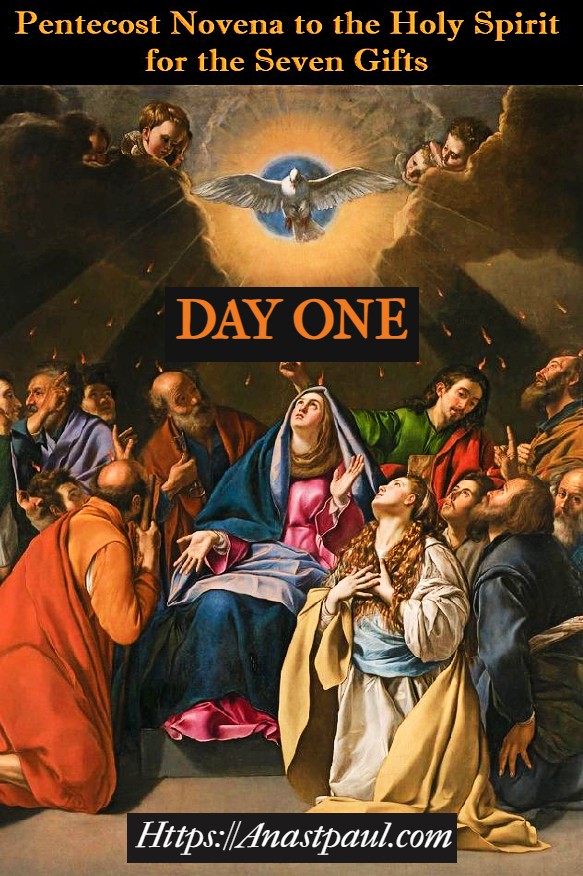
“None shall be crowned who has not fought well.” 2 Tim 2: 5
XXXVII: … Do Not Shun Any Opportunity which Offers the Attainment of Virtue
“We have seen very clearly that we must go forward without ever stopping in the way of perfection. To this end, we ought to be very careful and vigilant, not to let slip any opportunity which may present itself for the attainment of any virtue. For they have very little knowledge of this way, who avoid, as much as they can, all such adverse things as might greatly assist their progress.
For, not to forget my accustomed advice, if you would acquire the habit of patience, it is not expedient to avoid those persons, actions, or thoughts which move you to impatience. Withdraw not, therefore, from the society of anyone because it is disagreeable but, whilst conversing and holding intercourse with those who most annoy you, keep your will always ready and disposed, to endure whatever may befall you, however wearisome and annoying; for otherwise, you will never learn to be patient.
In like manner, if you find any occupation irksome, either in itself, or because of the person who imposed it upon you, or because it hinders you from doing something else more pleasing, do not, therefore, shrink from undertaking and persevering in it, although it disquiets you and although you think to find peace by neglecting it; for this would be no true peace, as proceeding, not from a soul purified from passion and adorned with virtues, neither could you ever, in this way, learn to suffer.
I would say the same of harassing thoughts — which, at times, will annoy and disturb your mind. There is no need to drive them entirely from you, for besides the pain they occasion, they accustom you too, to bear contradiction. And to give you contrary advice, would be to teach you rather to shun labour, than to attain to that virtue which you have in view.
It is very true that it becomes every man and especially the tried soldier, to defend himself on these occasions with vigilance and dexterity – now confronting his enemies, now evading them, according to the measure of spiritual strength and virtue which he has attained.
But, for all this, he must never actually turn back and retreat, so as to leave behind all opposition, for, even if we thereby save ourselves for the time, from the peril of falling, we shall risk exposing ourselves, more to future attacks of temptation, not being armed and fortified beforehand, by the exercise of the contrary virtue. This counsel, however, applies not to the sins of the flesh, of which we have already spoken more particularly.”
Quote/s of the Day – 24 March – Palm Sunday – Philippians 2:5-11, Matthew 26:36-75; 27:1-60 – Scripture search here: https://www.drbo.org/
“Behold the hour is at hand and the Son of man shall be betrayed into the hands of sinners.”
Matthew 26:45
“Yesterday, Christ raised Lazarus from the dead; today, He is going to His own death. Yesterday, He tore off the strips of cloth which bound Lazarus; today, He is stretching out His Hand, to those who want to bind Him. Yesterday, He tore that man away from darkness; today, for humankind, He is going down into darkness and the shadow of death. And the Church is celebrating. She is beginning the feast of Feasts, for she is receiving her King as a Spouse, for her King is in her midst.”
St Ephrem (306-373) (Attri) Father ad Doctor of the Church
“Oh! how blessed are they whom our Divine Master chooses to carry Him, who are covered with the Apostles’ cloaks, that is, clothed with apostolic virtues, which render them worthy of bearing our dear Saviour and of being led by Him. Blessed are they who conduct themselves here in lowliness and humility. They will be exalted in Heaven [Matt. 18:4; 23:12; Lk. 14:11; 18:14]. Their patience will win for them perpetual peace and tranquility; for their obedience they shall receive a crown of glory [Tab. 3:21; James 1:12]; finally, they shall be covered with the hundredfold of blessings in this life and shall bless the Father, Son and Holy Ghost, eternally in the next. May God give us this grace. Amen.”
Our Lenten Journey with the Angels and the Saints – 24 March – Palm Sunday – Philippians 2:5-11, Matthew 26:36-75; 2 – Scripture search here: https://www.drbo.org/
“Behold the Lamb of God Who takes away the sin of the world ” John 1:29
“Behold the hour is at hand and the Son of man shall be betrayed into the hands of sinners.” Matthew 26:45
PALM SUNDAY – Behold the Lamb
St Bede the Venerable (673-735) Father and Doctor of the Church
“Towards the Lamb of God arise ,the Hosannas of the people, all those pressing round Him in the crowd, praise Him with one and the same confession of faith: “Hosanna to the son of David!” (Mt 21:9). This praise already echoes the choir of Saints, singing: “Salvation comes from our God, Who is seated on the throne, and from the Lamb!” (Apoc 7:10). He goes up to where, day-by-day, He will give His last teaching (Lk 20:47). It is there He will accomplish the sacrament of the Jewish Passover, faithfully observed hitherto. He Himself, will bestow a new Pasch on His own, when, having left for the Mount of Olives, He will be put to the test by His enemies and, the following day, set on the Cross. Of such is the Paschal Lamb, see Him draw near today to the place of His Passion and fulfil the prophecy of Isaias: “Like a lamb led to the slaughter or a sheep before the shearers” (53:7).
He desires to enter His City five days before His Passion; by this He proves that He is indeed the Lamb without blemish Who comes to take away the sin of the world (Jn 1:29). He is indeed the Paschal Lamb, Who, when sacrificed, will set the new Israel free from its slavery in Egypt (Ex 12). It is truly five days before His Passion when His enemies irrevocably agree on His death. Today He shows us by this that He is going to redeem us all by His Blood (Apoc 5:9). As from today, He enters God’s Temple amongst the joyful jubilation of those who surround him (Mt 21:12). The “Mediator between God and man, the man Christ Jesus” (1Tm 2:5) will suffer for humankind’s salvation – that indeed is why He came down to earth from Heaven – and today, He wills to draw near to the place of His Passion. Thus it will be clear to all that He bears His Passion of His own free will and by no means by force.” (Sermon No 23).
One Minute Reflection – 24 March – Palm Sunday – Philippians 2:5-11, Matthew 26:36-75; 27:1-60. – Scripture search here: https://www.drbo.org/
“Behold the hour is at hand and the Son of man shall be betrayed into the hands of sinners.” – Matthew 26:45
REFLECTION – By St Nerses Chnorhali (1102-1173) Armenian Bishop (Jesus, Only Son of the Father 708-724)
“Because of sin, O innocent One, You were set before the criminal’s judgement seat; When You return in the Father’s glory Do not judge me together with him.
You were put to scorn with sacrilegious spittle On account of the first created man’s shame; Wipe away the dishonour of the impudent man’s sins, With which my Face is covered…
You have put on crimson, Set the scarlet cloak over You As a dishonour and an affront, As Pontius Pilate’s soldiers thought it to be (Mt 27:28).
Remove sin’s shirt of hair from Me, Crimson red, colour of blood, Re-clothe me in the garment of joy With which You clothed the first man.
Kneeling, they made sport, Acting ridicule, they mocked; When they saw it, Heaven’s armies Worshipped in fear.
This You underwent that You might remove The shame, of being sin’s accomplice, from Adam’s nature in us That, from my soul and my conscience, You might suppress my sorrowing shame…
Following the judge’s verdict, You received the terrible blows of flagellation Over Your whole body And on Your limbs’ every part.
As for me who, from foot to head Suffer unbearable pain: Be pleased to heal me once again As through the grace of Baptism’s fount.
In exchange for the thorns of sin That the curse caused to grow up for us (Gn 3,18) A Crown of Thorns was set on Your Head By the labourers in Jerusalem’s vineyard (Mt 21,33f.).
Pull out the thorns of sin from me, Which my enemy planted within me, And heal in me the bite of the wound That the marks of sin might be erased.”
PRAYER – Almighty, eternal God, Who, to provide mankind an example of humility for it to imitate, willed that the Saviour should assume our flesh and suffer death upon the Cross, mercifully grant that we may be found worthy of the lesson of His endurance and the fellowship of His Resurrection. Through the same Jesus Christ, Thy Son our Lord, Who lives and reigns with Thee, in the unity of the Holy Ghost, God, world without end. Amen (Collect).
To Thee, O Jesus, Hosanna! By St Bonaventure (1217-1274) Seraphic Doctor of the Church
To Thee, O Jesus, do I turn, as my true and last end. Thou art the River of Life which alone can satisfy my thirst. Without Thee, all else is barren and void. Without all else, Thou alone art enough for me. Thou art the Redeemer of those that are lost, the sweet Consoler of the sorrowful, the Crown of Glory of the victors, the recompense of the Blessed. One day I hope to receive of Thy Fullness and to sing the song of praise, in my true home. Give me only on earth, some few drops of consolation and I will patiently await Thy Coming, when I hope to enter into the joy of my Lord. Hosanna!
Saint of the Day – 24 March – Blessed Bertrada of Laon (c726-783) Married to King Pepin the Short. Queen of the Franks. Mother of Blessed Charlemagne. Bertrada was known to instil piety and devotion in her Court, following strict schedules of prayer and Liturgical celebrations for her family and for the Court generally. Born in c726 at Laon, France and died on 12 July 783 of natural causes at Choisy-au-Bac, Francia. Patronage – of Spinners. Also known as – Bertrada the Pius, Bertrada la Pia, Bertha… Berta…
We know nothing definite about Bertrada’s exact origins. According to some, she was the daughter of Charibert, Count of Laon, while others would even consider her the daughter of an Emperor of Constantinople. However, it is well known that the Frankish Kings cared little about the more or less illustrious origins of their wives and no-one has ever taken the trouble to discover where Queen Bertha probably came from, given that even ancient heroic poetry and various legends, left the question aside.
In 741, she married Pepin the Short, the son of Charles Martel, the Frankish Chancellor. However, Pepin and Bertrada’s union was not canonically sanctioned until 749, after the birth of Charlemagne. Besides Charlemagne, Bertrada and Pepin are known to have had seven further children, of whom 3 were sons. One of their daughters, Gisela, became a nun at Chelles Abbey.
In 751, Pepin and Bertrada became King and Queen of the Franks, following Pepin’s successful coup against the Frankish Merovingian monarchs. Pepin was crowned in June 754 and Bertrada, Charlemagne, and Carloman were blessed by Pope Stephen II. (See the wonderful painting below by François Dubois.
After Pepin’s death in 768, Bertrada lost her title as Queen of the Franks. Charlemagne and Carloman inherited the two halves of Pepin’s Kingdom. Bertrada stayed at the Charlemagne’s Court and often tried to stop arguments between the two brothers. It is reported that her relationship with her sons was excellent, especially with Charlemagne. Historians say that the great Emperor had a respectful tenderness towards his mother and that he listened to her advice with a certain deference and trust.
In 771, Bertrada retired from the Court after Carloman’s death to live in Choisy-au-Bac, where Charlemagne had set aside a Royal house for her. Choisy-au-Bac was favourable because of its history of being the home and burial place of several Royals.
Bertrada died on 12 July 783 and was buried in Saint-Denis, where her Tomb, restored by the French King Saint Louis IX, bears the only inscription “Berta, Mater Caroli Magni.” The cult of her as Beatification has a purely local character.
The Archangel Saint Gabriel The Feast of Saint Gabriel was included by Pope Benedict XV in the General Roman Calendar in 1921, for celebration on 24 March. The Archangel Saint Gabriel’s name means “the Power of God” He appeared to the Prophet Daniel (Dan 8:16; 9:21), to the priest Zachary to announce the forthcoming birth of Saint John the Baptist (Luke 1:11, 19) and, most importantly, to the Blessed Virgin Mary to announce the birth of Our Saviour (Luke 1:26). St Gabriel! https://anastpaul.com/2022/03/24/saint-of-the-day-24-march-the-archangel-saint-gabriel/
St Agapitus of Synnada (Died 3rd Century) Bishop of Synnada, Phrygia, in Asia Minor. Its site is now occupied by the modern Turkish Town of Suhut. We have no further information on the life of St Agapitus..
St Bernulf of Mondov Bl Bertha de’Alberti of Cavriglia Blessed Bertrada of Laon (c726-783) Married to King Pepin the Short. Queen of the Franks. Mother of Blessed Charlemagne. St Caimin of Lough Derg St Cairlon of Cashel
St Latinus of Brescia St Macartan of Clogher St Mark of Rome St Pigmenius of Rome St Romulus of North Africa St Secundus of North Africa St Seleucus of Syria St Severo of Catania St Timothy of Rome
Martyrs of Africa – 9 Saints: A group of Christians murdered for their faith in Africa, date unknown. The only details about their that survive are the names – Aprilis, Autus, Catula, Coliondola, Joseph, Rogatus, Salitor, Saturninus and Victorinus. .
Martyrs of Caesarea – 6 Saints: A group of Christians Martyred together in the persecutions of Diocletian. We know little else but six of their names – Agapius, Alexander, Dionysius, Pausis, Romulus and Timolaus. They were martyred by beheading in 303 at Caesarea, Palestine.
Thought for the Day – 23 March – The Spiritual Combat (1589) – Dom Lorenzo Scupoli OSM (c1530-1610)
“None shall be crowned who has not fought well.” 2 Tim 2: 5
XXXVI: … Proceed with Unceasing Watchfulness in the Exercise of Virtue
“One of the most important and necessary means for the attainment of virtue, besides what has been already taught, is to press forward continually to the end we have proposed to ourselves, lest by standing still, we fall back.
For, when we cease to produce acts of virtue, many unruly passions are generated within us by the violent inclination of the sensitive appetite and, by other exterior influences, whereby virtue is destroyed, or at least diminished and moreover, we thus lose many gifts and graces with which our Lord might have rewarded our further progress.
Therefore, the spiritual journey is different from the course of the earthly traveller; for he, by standing still, loses nothing of the ground already gained as is the case with him, who travels heavenward. And moreover, the weariness of the earthly pilgrim increases with the continuance of his bodily motion, while, in the spiritual journey, the farther a man advances, the more does his vigour and strength increase!
For, by the exercise of virtue, the resistance of the inferior part of the soul which made the way difficult and wearisome, grows daily weaker while the superior part, wherein the virtue resides, is estalished, in the same proportion and strengthened.
Hence, as we advance in holiness, the pain which accompanied the progress, gradually diminishes and, a certain secret joy which, by the Divine operation, is mingled with that pain, increases hourly more and more. And thus, proceeding with increasing ease and delight, from virtue to virtue, we at last reach the mountaintop, where the perfected spirit henceforth labours without weariness but, rather with joy and ecstasy because, having now tamed and conquered its unruly passions and overcome itself and all created things, it dwells forever blessed in the bosom of the Most High and there, while sweetly labouring, takes its rest. Amen.”
Quote/s of the Day – 23 March – Saturday in Passion Week
“The illusions of this world soon vanish, especially if a man arms himself with the Sign of the Cross. The devils tremble at the Sign of the Cross of our Lord, by which He triumphed over and disarmed them.”
St Anthony Abbot (251-356)
“The day will come when this Child will no longer be offered in the Temple, nor in Simeon’s arms but outside the City in the arms of the Cross. The day will come when He will not be redeemed by the blood of a sacrifice but redeem others , with His own Blood. …” That will be the evening sacrifice; this is the morning sacrifice; this one is the happiest but that one is the most complete; for this one was offered at the time of birth and that one will be offered in the fullness of time,..”
St Bernard (1091-1153) Mellifluous Doctor of the Church
“Look then on Jesus, the Author and Preserver of faith — in complete sinlessness, He suffered and, at the hands of those who were His own and was numbered among the wicked. As you drink the cup of the Lord Jesus (how glorious it is!), give thanks to the Lord, the Giver of all blessings. May the God of love and peace set your hearts at rest and speed you on your journey; may He meanwhile, shelter you from disturbance by others in the hidden recesses of His Love, until He brings you, at last, into that place of complete plenitude, where you will repose forever in the vision of peace, in the security of trust and in the restful enjoyment of His riches. ”
Our Lenten Journey with the Angels and the Saints – 23 March – Saturday in Passion Week – Jeremias18:18-23, John 12:10-36 – Scripture search here: https://www.drbo.org/
“Shall evil be rendered for good because they have dug a pit for my soul?” Jeremias 18:20
“The hour is come when the Son of man should be glorified.” John 12:23
What Happened on the Cross?
St John Damascene (675-749) Father and Doctor of the Church
“By nothing else except the Cross of our Lord Jesus Christ has death been brought low:
The sin of our first parent destroyed, hell plundered, resurrection bestowed, the power given us to despise the things of this world, even death itself, the road back to the former blessedness made smooth, the gates of paradise opened, our nature seated at the right hand of God and we made children and heirs of God.
By the Cross all these things have been set aright…
It is a seal that the destroyer may not strike us, a raising up of those who lie fallen, a support for those who stand, a staff for the infirm, a crook for the shepherded, a guide for the wandering, a perfecting of the advanced, salvation for soul and body, a deflector of all evils, a cause of all goods, a destruction of sin, a plant of resurrection and a tree of eternal life.”
(Reflections on the Cross of Christ from the Early Church Fathers – Orthodox Faith 4).
One Minute Reflection – 23 March – Saturday in Passion Week – Jeremias18:18-23, John 12:10-36 – Scripture search here: https://www.drbo.org/
“Sir, we wish to see Jesus.” – John 12:21
REFLECTION – “At Jerusalem the crowd cried out: “Hosanna in the highest! Blessed is He Who comes in the Name of the Lord, the King of Israel” (cf Mk 11:10). The phrase “He Who comes.” is well said because He is always coming, He never fails us – “The Lord is close to those who call upon Him in truth. Blessed is He Who comes in the Name of the Lord” (Ps 144:18; 117:26). The gentle King of peace stands at our door… Soldiers here below, Angels in Heaven, mortals and immortals… cry aloud: “Blessed is He Who comes in the Name of the Lord, the King of Israel.” The Pharisees, however, stand aloof (Jn 12:19) and the priests are incensed by it. But the voices which sing God’s praises ring out without ceasing – creation is full of joy…
That is why, on this very day, some Greeks, prompted by this tremendous acclamation to worship God with devotion, approached one of the Apostles, named Philip and said to him: “We would like to see Jesus.” Note well, it is the whole crowd who carries out the task of herald and prompts these Greeks to be converted. Straightaway, these latter address Christ’s disciples – “We would like to see Jesus.” Those gentiles are imitating Zachaeus, not that they climb a sycamore tree [to see Jesus] but, they make haste to rise up in their knowledge of God (Lk 19:3). “We should like to see Jesus” not so much to behold His Face but, to bear His Cross. For Jesus, Who could see their desire, had unambiguously declared to those who were standing by: “Now the hour has come for the Son of Man to be glorified” calling “glory” the conversion of the gentiles.
And He gave the name “glory” to the Cross. For, from that day to this, the Cross is glorified. Indeed, it is the Cross which still today, Consecrates Kings, adorns Priests, protects Virgins, gives constancy to Hermits, reinforces the Marriage bond and strengthens Widows. It is the Cross which makes the Church fruitful, brings light to the peoples, guards the desert, opens paradise.” – St Proclus of Constantinople (Died c446) Archbishop of Constantinople, Confessor, Defender of the Church and of the Blessed Virgin, Writer, renowned Preacher, Father of the C hurch (Sermon for Palm Sunday).
PRAYER – O Lord, may the people dedicated to Thee desire to serve Thee more and more that, taught by these sacred rites, they may be enriched by more precious gift,s as they grow in favour with Thy majesty. Through Jesus Christ, Thy Son our Lord, Who lives and reigns with Thee, in the unity of the Holy Ghost, God, world without end. Amen (Collect).
Our Morning Offering – 23 March – Saturday in Passion Week
What Can I Say? By St Anselm (1033-1109) Magnificent Doctor Marian Doctor
My most merciful Lady, what can I say about the fountains which flowed from thy most pure eyes when thou saw thy only Son before thee, bound, beaten and suffering? What do I know of the flood which drenched thy matchless face, when thou beheld thy Son, thy Lord and thy God, stretched on the Cross without guilt, when the flesh of thy flesh was cruelly butchered by wicked men? How can I judge, what sobs, troubled thy most pure breast, when thou heard, “Woman, behold thy son,” and the disciple, “Behold, thy Mother,” when thou received as a son, the disciple, in place of the Master, the servant, for the Lord? Amen
From “The Prayers and Meditations of Saint Anselm with the Proslogion,” Benedicta Ward, trans,1973, Penguin classics, Penguin Group (UK)
Saint of the Day – 23 March – Saint Ethelwald of Farne (Died 699) Priest, Monk and Hermit. Died on the Island of Inner Farne in 699. Also known as – Ethelwald the Hermit, Aethelwold… Ethelwold … Edelwald… He should not be confused with his near contemporary, Saint Ethelwald the Bishop of Lindisfarne who died in 740).
Inner Farne Island
Little is known about our Saint, apart from that which is recorded in the writings of the Venerable St Bede.
Ethelwald, a holy Priest and Monk of Ripon Monastery, in North Yorkshire, England, being desirous of some solitude, he succeeded to the tiny Hermitage of Saint Cuthbert on the lonely Island of Inner Farne, after the latter’s death in 687.
The Hermitage and Chapel on Inner Farne Isle
The best-known miracle of Ethelwald, related by St Bede, records how the future Abbot Guthrid visited him on Farne with two Lindisfarne Monks and, on his journey home, was saved from shipwreck by the Saint’s prayers. St Bede wrote through the lips of Abbot Guthrid:
“I came,” says he, “to the Island of Fame, with two others of the brethren, desiring to speak with the most reverend Father, Ethelwald. Having been refreshed with his discourse and asked for his blessing, as we were returning home, behold on a sudden, when we were in the midst of the sea, the fair weather, in which we were sailing, was broken and there arose so great and terrible a tempest that neither sails, nor oars, were of any use to us, nor had we anything to expect but death.
After long struggling with the wind and waves to no effect, at last we looked back to see whether it was possible, by any means, at least to return to the Island whence we came but we found that we were, on all sides alike, cut off by the storm and there was no hope of escape by our own efforts.
But looking further, we perceived, on the Island of Fame, our Father Ethelwald, beloved of God, come out of his retreat to watch our course, for, hearing the noise of the tempest and raging sea, he had come forth to see what would become of us. When he beheld us in distress and despair, he bowed his knees to the Father of our Lord Jesus Christ, in prayer for our life and safety and, as he finished his prayer, he calmed the swelling water, in such sort that the fierceness of the storm ceased on all sides and fair winds attended us over a smooth sea to the very shore. When we had landed and had pulled up our small vessel from the waves, the storm, which had ceased a short time for our sake, presently returned and raged furiously during the whole day, so that it plainly appeared that the brief interval of calm had been granted by Heaven, in answer to the prayers of the man of God, to the end that we might escape.”
The man of God remained on the Isle of Inner Fame for twelve years and died there. Upon his death, his body was translated to Lindisfarne and laid next to those of Saints Cuthbert and Edbert. Later his Relics were carried from place to place with those of St Cuthbert until they were settled in Durham Cathedral. Many miracles were attributed by St Florence of Worcester to the intercession of Saint Ethelwald
This is St Cuthbert’s Tombstone and St Ethelwald is presumably nearby
St Benedict of Campagna St Crescentius of Carthage St Ethelwald of Farne (Died 699) Priest, Monk and Hermit St Felix the Martyr St Felix of Monte Cassino St Fergus of Duleek St Fidelis the Martyr St Frumentius of Hadrumetum St Gwinear
St Julian the Confessor St Liberatus of Carthage St Maidoc of Fiddown St Nicon of Sicily
St Ottone Frangipane (1040-1127) Layman, military Knight, Pilgrim, Ascetic, Hermit, Miracle-worker both during life and after his death. Founder of a Pilgrim’s Hospice in Ariano which later became a huge Hospital. Born in 1040 in Rome, Italy and died on 23 March 1127 in Ariano Irpino, Italy of natural causes. His Life: https://anastpaul.com/2023/03/23/saint-of-the-day-23-march-st-ottone-frangipane-1040-1127/
Daughters of Feradhach: They are mentioned in early calendars and martyrologies but no information about them has survived.
Martyrs of Caesarea – 5 Saints: A group of five Christians who protested public games which were dedicated to pagan gods. Martyred in the persecutions Julian the Apostate. The only details we know about them are their names – Aquila, Domitius, Eparchius, Pelagia and Theodosia. They were martyred in 361 in Caesarea, Palestine.
Thought for the Day – 22 March – The Spiritual Combat (1589) – Dom Lorenzo Scupoli OSM (c1530-1610)
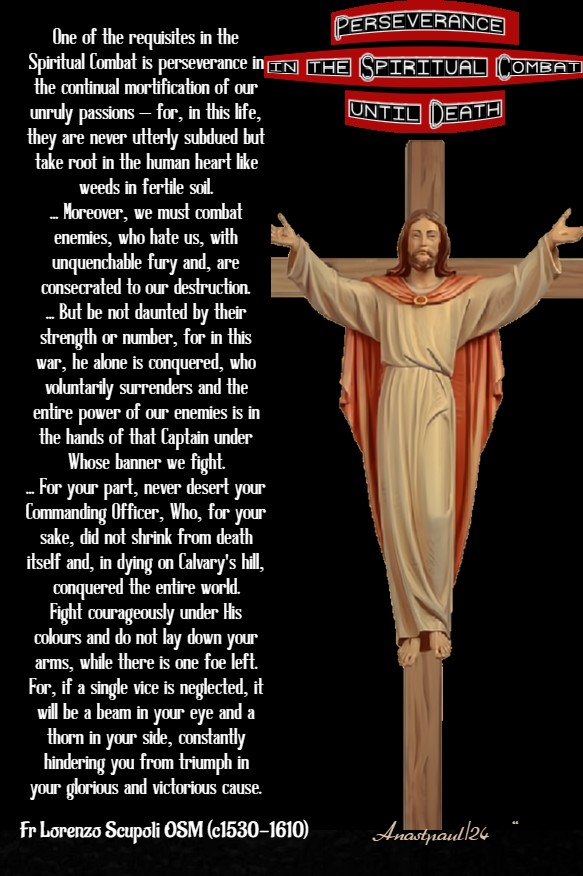
“None shall be crowned who has not fought well.” 2 Tim 2: 5
XXXV: … Of the Means Whereby Virtues are Acquired (Part Two)
“The Sacred Words of Holy Scripture, either uttered with the lips or pondered in the heart, as may best suit our case, have a marvellous power to aid us in this exercise. We should, therefore, have many such in readiness to bear upon the virtue we wish to practice and these, we should repeat continually throughout the day and especially, at each rising of the rebellious passion. For instance, if we are striving to attain the virtue of patience, we may repeat the following words, or others like them:
“My children, suffer patiently the wrath which is come upon you.” Baruch 4:25. “The patience of the poor, shall not perish for ever.” Psalm 9:18. “The patient man is better than the valiant and he who ruleth his spirit, than he who taketh cities.” Proverbs 16:32. “In your patience you shall possess your souls.” Luke 21:19. “Let us run with patience to the fight proposed to us.” Hebrews 12:1.
To the same end, we may, in like manner, use such prayers as the following:
“When, O my God, shall this heart of mine be armed with the buckler of patience?” “When shall I learn to bear every trouble with a quiet mind, so I may please my Lord?” “O most dear sufferings which liken me unto my Lord Jesus, crucified for me!” “Only Life of my soul, I shall ever, for Thy glory, live contented amid a thousand torments!” “How blessed shall I be, if, in the midst of the fire of tribulation, I burn with the desire of even greater sufferings!”
Let us use these short prayers and others suitable to our advancement in holiness so that we may acquire the spirit of devotion. These short prayers are called Ejaculations because they are darted like javelins towards Heaven. They have great power to speed us towards virtue and will penetrate even to the heart of God, if only they have these two accompaniments for their wings:
+++ The one – a full certainty that our exercise of virtue is greatly pleasing to our God. +++ The other – a true and fervent desire for the attainment of virtue, for the sole end of pleasing His Divine Majesty.”
Quote of the Day – 22 March – Friday in Passion Week, the Fifth Friday in Lent, Our Lady of the Seven Sorrows
STABAT MATER
At the Cross her station keeping, Stood the mournful Mother weeping, Close to Jesus to the last. Through her heart, His sorrow sharing, All His bitter anguish bearing, Now at length the sword had passed.
Oh, how sad and sore distressed Was that Mother highly blest, Of the sole begotten One! Christ above in torment hangs. She beneath beholds the pangs Of her dying glorious Son.
Is there one who would not weep, Whelmed in miseries so deep, Christ’s dear Mother to behold? Can the human heart refrain From partaking in her pain, In that Mother’s pain untold?
Bruised, derided, cursed, defiled, She beheld her tender Child, All with bloody scourges rent. For the sins of His own nation, Saw Him hang in desolation Till His spirit forth He sent.
O thou Mother: fount of love! Touch my spirit from above, Make my heart with thine accord. Make me feel as thou hast felt; Make my soul to glow and melt With the love of Christ my Lord.
Holy Mother, pierce me through; In my heart each wound renew Of my Saviour Crucified. Let me share with thee His pain, Who for all my sins was slain, Who for me in torment died.
Let me mingle tears with thee, Mourning Him who mourned for me, All the days that I may live. By the Cross with thee to stay; There with thee to weep and pray, Is all I ask of thee to give.
Virgin of all virgins best, Listen to my fond request: Let me share thy grief divine. Let me to my latest breath, In my body bear the death Of that dying Son of thine.
Wounded with His every wound, Steep my soul till it hath swooned In His very blood away. Be to me, O Virgin, nigh, Lest in flames I burn and die, In His awful Judgment day.
Christ, when Thou shalt call me hence, Be Thy Mother my defence, Be Thy Cross my victory. While my body here decays, May my soul Thy goodness praise, Safe in Paradise with Thee. Amen
Note: This text of the Stabat Mater is one of over 60 translations of this famous 13th Century Latin Hymn/Prayer. The Author is uncertain but is believed to be either St Jacopone da Todi OFM (1230-1306) or Pope Innocent III (1161-1216)[reigned from from 8 January 1198 until his death on 16 July 1216]. The title comes from its first line, “Stabat Mater dolorosa” – which means “the sorrowful mother was standing.” It is often used when praying the Stations of the Cross. The original Latin text of the Stabat Mater has also been set to music by such composers as Haydn, Rossini, and Poulenc.
Our Lenten Journey with the Angels and the Saints – 22 March – Friday in Passion Week, the Fifth Friday in Lent, Our Lady of the Seven Sorrows – Judith 13:22, 25; John 19:25-27 – Scripture search here: https://www.drbo.org/
“Virgin of all virgins best, Listen to my fond request: Let me share thy grief divine. Let me to my latest breath, In my body bear the death Of that dying Son of thine.” Stabat Mater
“And from that hour, the disciple took her to his own.” John 19:27
At the Lord’s Cross with His Mother and Ours
Blessed Guerric of Igny O. Cist. (c1080-1157) Cistercian Abbot
“When Jesus was going round towns and villages preaching the Gospel, Mary was His inseparable companion, clinging to His footsteps and hanging upon His words, as He taught, so much so, that neither the storm of persecution, nor dread of punishment, could deter her from following her Son and Master.
“By the Lord’s Cross there stood Mary, His Mother.” Truly a Mother, who did not abandon her Son, even in the face of death! How could she be frightened of death, when “her love was as strong as death,” (Sg 8:6) or rather, stronger than death? Truly she stood by Jesus’ Cross, when, at the same time, the pain of the Cross crucified her mind and, as manifold a sword, pierced her own soul, (Lk 2:35) as she beheld the body of her Son, pierced with wounds. Rightly, therefore, was she recognised as His Mother there and by His care, entrusted to a suitable protector, in which both the mother’s unalloyed love for her Son and the Son’s kindness toward His Mother, were proved to the utmost …
Loving her as He did, Jesus “Loved her to the end” (Jn 13:1), so as not only to bring His life to an end, for her but also, to speak almost His last words for her benefit. As His last will and testament, He committed, to His beloved heir, the care of His Mother… The Church fell to Peter, Mary to John. This bequest belonged to John, not only by right of kinship but too, because of the privilege, love had bestowed and the witness, his chastity bore… It was fitting that none other than the beloved of her Son, should minister to the Mother of the Lord… Providence too arranged, very conveniently that he who was to write a Gospel, should have intimate conferences with her, who knew about them all, for she had taken note from the beginning, of everything that happened to her Son and “treasured all the words concerning Him, pondering them in her heart” (Lk 2:19).” – (4th Sermon for the Assumption).
One Minute Reflection – 22 March – Friday in Passion Week, the Fifth Friday in Lent, Our Lady of the Seven Sorrows – Judith 13:22, 25, John 19:25-27 – Scripture search here: https://www.drbo.org/
REFLECTION – “Mary, the Mother of the Lord, stood by her Son’s Cross. No-one has taught me this but the holy Evangelist John. Others have related how the earth was shaken at the Lord’s Passion, the sky was covered with darkness, the sun withdrew itself and how, the thief was, after a faithful confession, received into paradise. John tells us what the others have not told, how the Lord, while fixed on the Cross called to His Mother. He thought it was more important that, victorious over His sufferings, Jesus gave her the offices of piety, than that He gave her a Heavenly Kingdom. For if it is the mark of religion to grant pardon to the thief, it is a mark of much greater piety, that a mother is honoured with such affection, by her Son. “Behold,” He says, “thy son.” “Behold thy mother.” Christ testified from the Cross and divided the offices of piety, between the mother and the disciple.
Nor was Mary below what was becoming the Mother of Christ. When the Apostles fled, she stood at the Cross and with pious eyes beheld her Son’s wounds. For she did not look to the death of her offspring but to the salvation of the world. Or perhaps, because that “royal hall” knew, that the redemption of the world would be through the death of her Son, she thought that by her death, she also might add something to that universal gift. But Jesus did not need a helper, for the redemption of all, Who saved all without a helper. This is why He says, “I am counted among those who go down to the pit. I am like those who have no help.” He received indeed, the affection of His Mother but sought not another’s help. Imitate her, holy mothers, who in her only dearly beloved Son, set forth so great an example of maternal virtue. For neither have you sweeter children, nor did the Virgin seek the consolation of being able to bear another son.” – St Ambrose (340-397) Archbishop of Milan, Great Western Father and Doctor (Letter 63)
PRAYER – O God, in Whose Passion the sword, according to the prophecy of blessed Simeon, pierced through the soul of Mary, the glorious Virgin and Mother, mercifully grant that we, who reverently commemorate her piercing through and her suffering, may, by the interceding glorious merits of all the saints faithfully standing by the Cross, obtain the abundant fruit of Thy Passion. Through the same Jesus Christ, Thy Son our Lord, Who lives and reigns with Thee, in the unity of the Holy Ghost, God, world without end. Amen (Collect).
Our Morning Offering – 22 March – Friday in Passion Week, the Fifth Friday in Lent, Our Lady of the Seven Sorrows
My Sorrowful Mother, Help Me to Bear My Crosses By St Alphonsus Liguori (1696-1787) Doctor of the Church
My sorrowful Mother, by the merit of that grief which you felt at seeing your beloved Jesus led to death, obtain for me the grace to bear with patience, those crosses which God sends me. I will be fortunate if I also shall know how to accompany you with my cross until death. You and Jesus, both innocent, have borne a heavy cross and shall I, a sinner who has merited hell, refuse mine? Immaculate Virgin, I hope you will help me to bear my crosses with patience. Amen
Saint of the Day – 22 March – Blessed Lukarda of Oberweimar O.Cist (c1275-1309) Virgin, German Cistercian Nun, Mystic, Miracle-worker. She was gifted with visions and the Stigmata of the Wounds of Our Lord. Born in c1275, probably in Erfurt, Germany and died on 22 March (Palm Sunday) 1309 at the Oberweimar Abbey, Weimar, Thuringia (in modern Germany) of natural causes, aged 33. Also known as – Lukarda of Erfurt, Lukardis… Lucardis… Lutgarda… Her name means — “the protector of the people” (Old High German).
Lukarda was born in 1275 or 1276 near Erfurt in Germany. At the age of twelve, she entered the Cistercians of Oberweimar Abbey, near modern-day Weimar.
Although she herself was not physically strong she was placed in the Infirmary of the Monastery to care for the ill and those even less healthy than herself. Lukarda dedicated herself with great assiduity to the needs of all the ailing patients.
Lukarda, afflicted by numerous sufferings which she endured with great patience and firmness of mind, was comforted by the Virgin Mary and Saint John the Baptist. She was deeply devoted to the Passion of Our Lord. Once, during a vision of the Saviour, the image of His Wounds were imprinted on her body and it was announced to her that she would only live for thirty-three years.
She had the gift of miracles, so much so that, through her intercession many people were cured of their sufferings and illnesses. Two blind men regained their sight when clothes stained by the blood of Saint Lukarda’s Stigmata were placed over there eyes.
She died on 22 March 1309 and was buried in the side Chapel of Oberweimar Abbey Church (see below). After her death she was immediately honoured with her own cult and was invoked by many who obtained extraordinary graces and cures through Lukarda’s intercession. She has been remembered and celebrated in Weimar on her Feast day, the Anniversary of her death for Centuries until the protestants sought to disrupt and prevent such devotions.
Church of St Peter and Paul of the former Cistercian Monastery in Oberweimar
Our Lady of the Seven Sorrows THE FEAST DAY OF THE SEVEN DOLORS IS TRADITIONALLY THE FRIDAY OF PASSION WEEK, WHICH IS THE FRIDAY BEFORE GOOD FRIDAY, AND ON 15 SEPTEMBER.
St Callinica of Galatia St Catherine of Sweden St Darerca of Ireland St Deghitche
St Epaphroditus of Terracina (1st Century) First Bishop of Terracina, Italy, Missionary, Evangelist, Disciple of the Apostles, Friend and Envoy of St Paul Apostle. St Hippolytus’ list of the Seventy Disciples includes “Epaphroditus, Bishop of Andriace.” The Roman Martyrology reads: “At Terracina, St Epaphroditus, a disciple of the Apostles, who was Consecrated Bishop of that City by the blessed Apostle Peter.” Biography: https://anastpaul.com/2022/03/22/saint-of-the-day-22-march-saint-epaphroditus-of-terracina-1st-century/
Thought for the Day – 21 March – The Spiritual Combat (1589) – Dom Lorenzo Scupoli OSM (c1530-1610)
“None shall be crowned who has not fought well.” 2 Tim 2: 5
XXXV: … Of the Means Whereby Virtues are Acquired (Part One)
“For the attainment of holiness, we need, besides all that has been already described, a great and generous heart, a will which is neither slack nor remiss but firm and resolute and withal, a certain expectation of having to pass through many bitter and adverse trials.
And furthermore, there are particular inclinations and affections which we may acquire by frequently considering how pleasing they are to God, how excellent and noble in themselves and, how useful and necessary to us, inasmuch as from them and in them, all perfection has its origin and end.
Let us, then, make a steadfast resolution every morning to exercise ourselves therein, according to the occasions which may arise in the course of the day; during which, we should often examine ourselves, to see, whether or not, we have fulfilled them, renewing them afterwards more earnestly. And all this with especial reference to that virtue which we have in hand.
So also, let the examples of the Saints and our prayers and meditations on the life and passion of Christ, which are so needful in every spiritual exercise, be applied principally to the particular virtue in which we are, for the time exercising ourselves.
Let us do the same on all occasions which may arise, however variant in kind, as we shall presently explain more particularly.
Let us so inure ourselves to acts of virtue, both interior and exterior,that we may come at last to perform them with the same promptness and facility, with which, in times past, we performed others agreeable to our natural will. And, as we said before, the more opposed such acts are to these natural wishes, the more speedily will the good habit be introduced into our soul.”
Quote/s of the Day – 21 March – St Benedict OSB (c480-547) Abbot
“Listen and attend with the ear of your heart.”
“Be careful to be gentle, lest in removing the rust, you break the whole instrument.”
“Idleness is an enemy of the soul.”
O God, Be With Us By St Benedict (c480-547)
O God, from Whom to be turned, is to fall, to Whom to be turned, is to rise, and in Whom to stand, is to abide forever. Grant us in all our duties, Thy help, in all our perplexities, Thy guidance, in all our dangers, Thy protection, and in all our sorrows, Thy peace, through Jesus Christ our Lord. Amen.
Our Lenten Journey with the Angels and the Saints – 21 March – Thursday of Passion Week – Ecclesiasticus 45:1-6, Matthew 19:27-29 – Scripture search here: https://www.drbo.org/
“He asked life of Thee, Thou hast given him length of days, forever and ever.” Psalm 20:5
“And everyone who has left house, or brethren, or sisters, or father, or mother, or wife, or children, or lands for My Name’s sake, shall receive a hundredfold and shall possess life everlasting.” Matthew 19:29
Seek for Nothing!
By St John of the Cross (1542-1591) Doctor of the Church
“Seek for nothing, desiring to enter for love of Jesus, with detachment, emptiness and poverty in everything in this world. You will never have to do with necessities greater than those to which you made your heart yield itself – for the poor in spirit are most happy and joyful in a state of privation and he, who has set his heart on nothing, finds satisfaction everywhere.
The poor in spirit (Mt 5:3) give generously all they have and their pleasure consists in being thus deprived of everything for God’s sake and out of love for their neighbour … Not only do temporal goods – the delights and tastes of the senses – hinder and thwart the way of God but, spiritual delights and consolations also, if sought for or clung to eagerly, disturb the way of virtue.” – (Spiritual maxims, nos. 352, 355,356, 364; 1693 Edition).
You must be logged in to post a comment.