Passionate Catholic.
Being a Catholic is a way of life - a love affair "Religion must be like the air we breathe..."- St John Bosco
Prayer is what the world needs combined with the example of our lives which testify to the Light of Christ.
This site, which is now using the Traditional Calendar, will mainly concentrate on Daily Prayers, Novenas and the Memorials and Feast Days of our friends in Heaven, the Saints who went before us and the great blessings the Church provides in our Catholic Monthly Devotions.
This Site is placed under the Patronage of my many favourite Saints and especially, St Paul.
"For the Saints are sent to us by God
as so many sermons.
We do not use them, it is they who move us
and lead us, to where we had not expected to go.”
Charles Cardinal Journet (1891-1975)
This site adheres to the pre-Vatican II Catholic Church and all her teachings. .
PLEASE ADVISE ME OF ANY GLARING TYPOS etc - In June 2021 I lost 100% sight in my left eye and sometimes miss errors. Thank you and I pray all those who visit here will be abundantly blessed. Pax et bonum! 🙏
Our Morning Offering – 22 August – “The Feast and the Month of the Immaculate Heart of Mary”
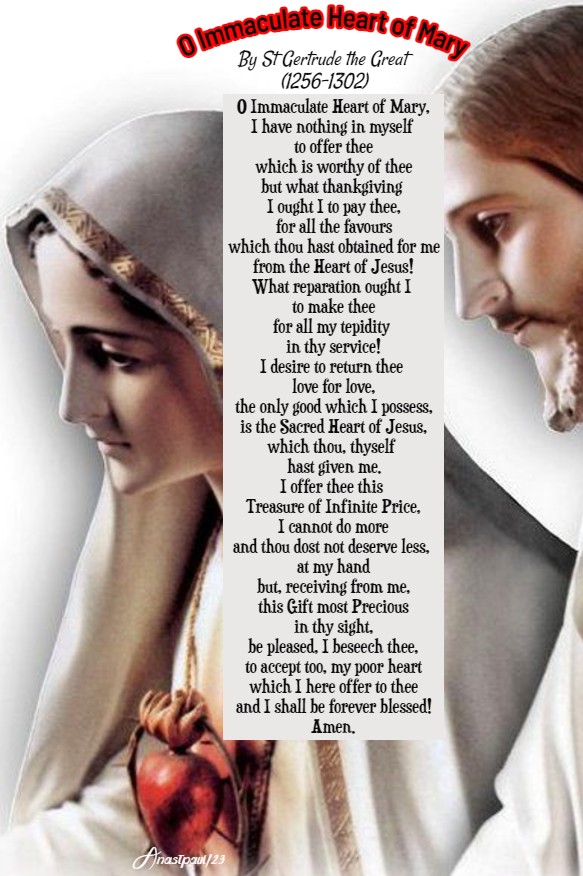
O Immaculate Heart of Mary By St Gertrude the Great (1256-1302)
O Immaculate Heart of Mary, I have nothing in myself to offer thee which is worthy of thee but what thankgiving I ought I to pay thee, for all the favours which thou hast obtained for me from the Heart of Jesus! What reparation ought I to make thee for all my tepidity in thy service! I desire to return thee love for love, the only good which I possess, is the Sacred Heart of Jesus, which thou, thyself hast given me. I offer thee this Treasure of Infinite Price, I cannot do more and thou dost not deserve less, at my hand but, receiving from me, this Gift most Precious in thy sight, be pleased, I beseech thee, to accept too, my poor heart which I here offer to thee and I shall be forever blessed! Amen.
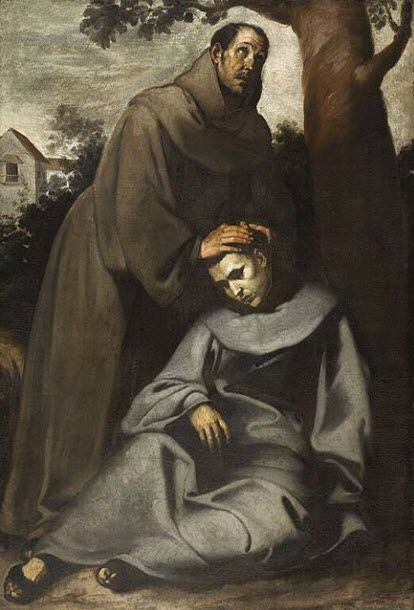
Saint of the Day – 22 August – Blessed Bernard Perani OFM,Cap. (1604-1694) Lay Brother of the Capuchin Branch of the Order of Friars Minor, Lay Brother fulfilling various roles in the service of his fellow Friars, Apostle of the poor and sick, Mystic with various charisms and a powerful devotion to the Blessed Sacrament. Born on 7 November 1604 at Villa d’Appignano, Offida, in the Marche, Italy as Dominico Francesco and died in 1694 at his Monastery in Offida aged 89 years old. Patronage – of the City and Diocese of Offida, Italy. Also known as – Bernard Offida, Bernard Offidski, Bernard z Offidy, Dominico Francesco. …
Domenico Perani was born to the peasant family of Domenico Perani and Elisabetta Puccio Perani as the third of eight children. His mother often held him up as an example worthy of imitation, to his siblings. At his Baptism he was given the names of Domenico Francesco. He assisted his father as a shepherd in his childhood.
In 1626 at the age of 22, Dominico entered the Order of Friars Minor Capuchin in Corinaldo, taking the name of Bernard. From his entrance until 1633, he worked in the kitchen.
He became an ardent student of Sacred Scripture and devotee of the Blessed Sacrament, being seen to experience ecstasy whilst praying before the Tabernacle. He practised severed mortifications and penances.
He was placed in the Friary at Fermo from his profession until two decades later and in 1650 Bernard was returned to his birthplace of Offida, where he was blesed to remain for the rest of his life and where he later died on 22 August 1694 mere months before turning 90. He died with a Crucifix in his hands.
Joseph Haydn wrote a special Mass in his honour named the “Missa sancti Bernardi von Offida.”
Pope Pius VI held the Beatification celebration for Bernard on 25 May 1795 in Saint Peter’s Basilica. The cause for his Sainthood was formally opened on 20 September 1797.
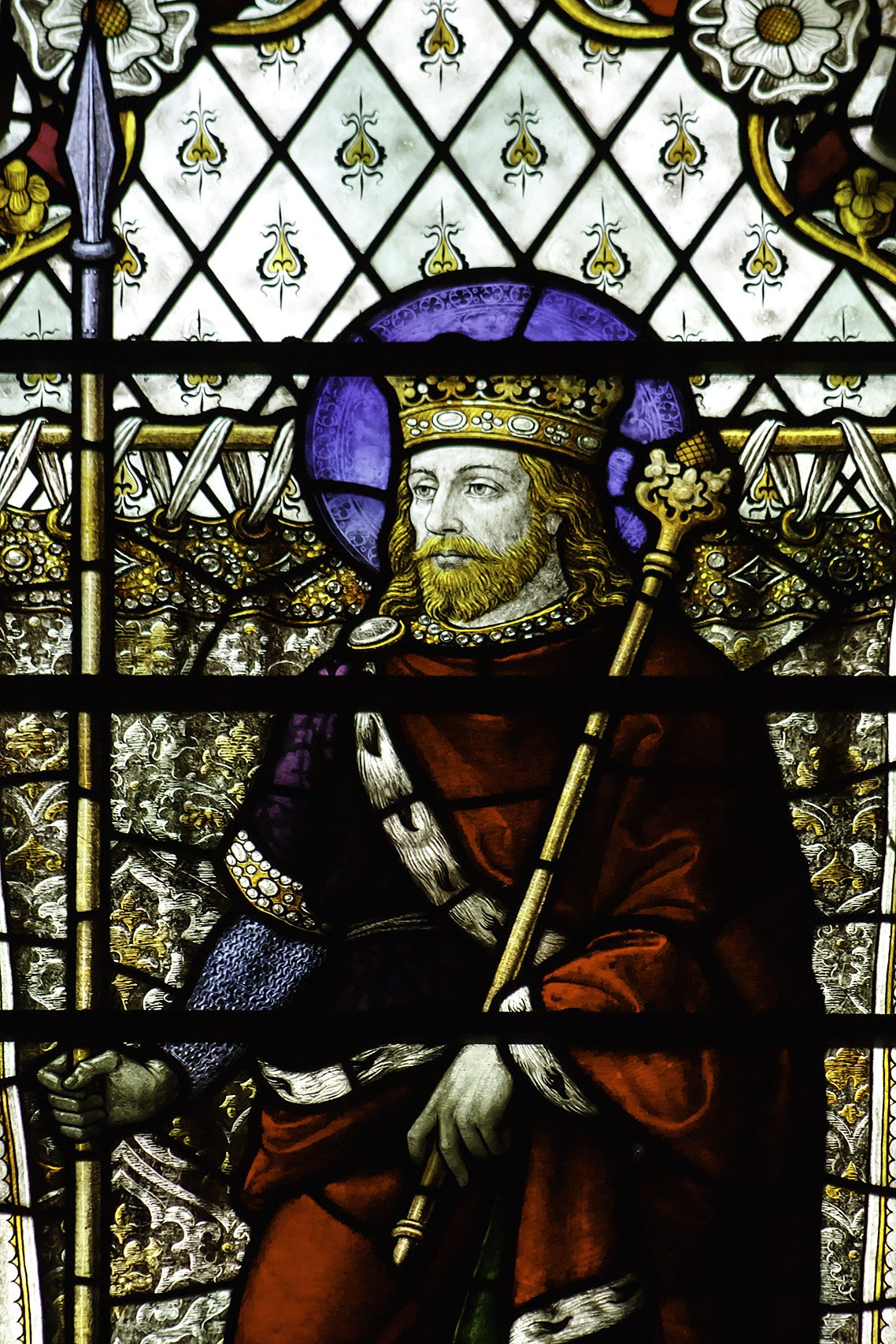
St Anthusa of Seleucia St Antoninus of Rome St Arnulf (9th Century) Hermit of Eynesbury Information regarding this Saint have been lost but he has long been venerated in Arnulphsbury, Cambridgeshire, England. St Athanasius of Tarsus
Blessed Bernard Perani OFM. Cap (1604-1694) Lay Brother
St Dalmau Llebaría Torné St Epictetus of Ostia St Ethelgitha of Northumbria St Fabrician of Toledo St Felix of Ostia
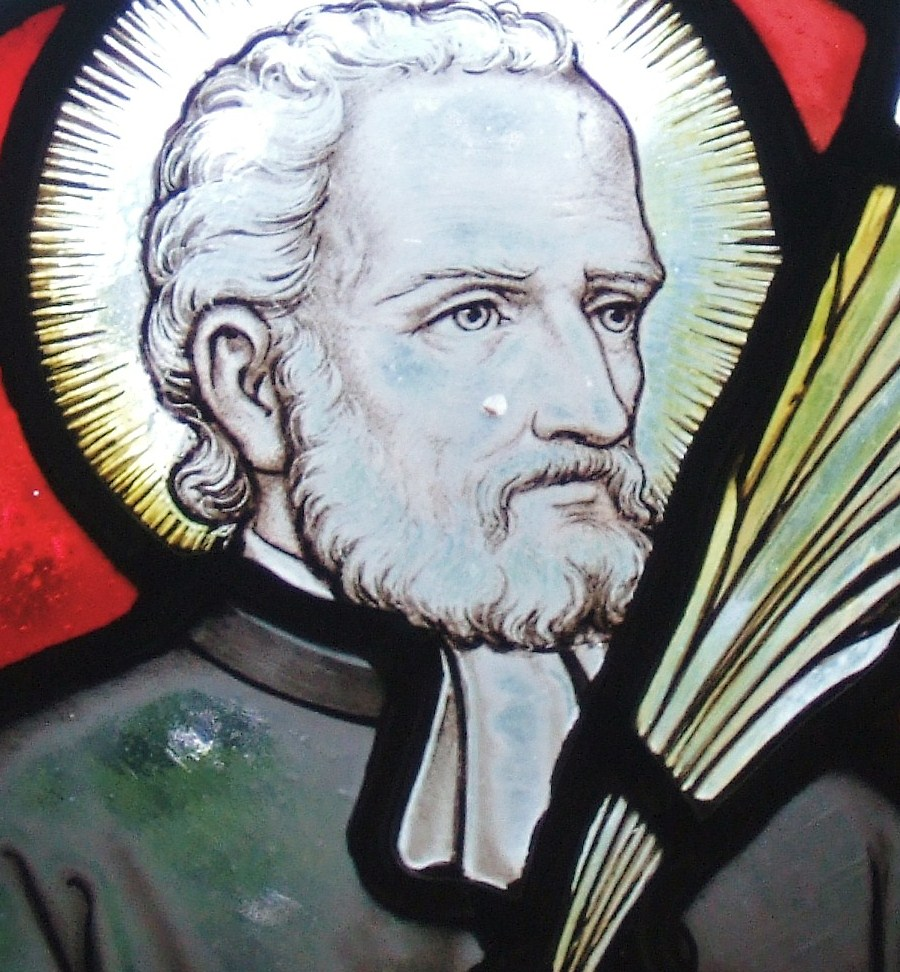
St John Kemble (1599 – 1679) Martyr, Priest. Ordained in 1625, he returned to Monmouthshire and served more than 50 years as an itinerant Priest, winning admirers even among Protestants. After being dragged on a hurdle to Widemarsh Common, Kemble declared on the scaffold that he died for the religion that had made this country Christian and that he forgave all his enemies. He was then obliged to encourage the executioner, who had no stomach for his task. The hanging was horribly botched, so that Kemble took half an hour to die. Subsequently he was beheaded and his left hand cut off, this may still be seen at the church of St Francis Xavier in Hereford. Life and Death: https://anastpaul.com/2018/08/22/saint-of-the-day-22-august-st-john-kemble-1599-1679-martyr/
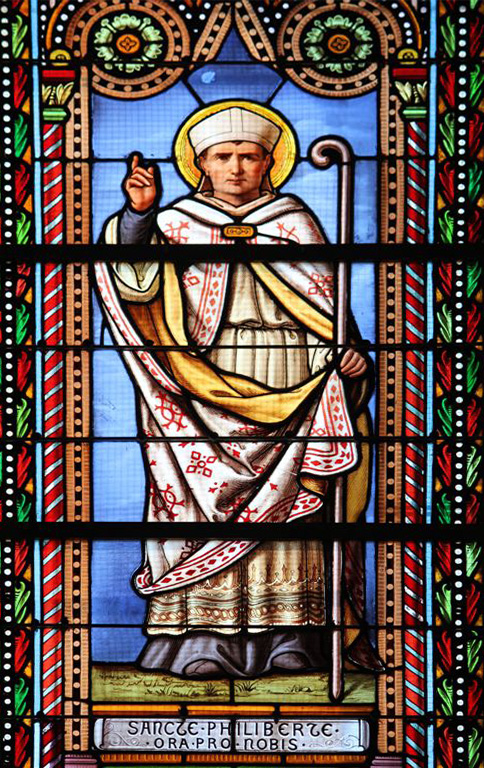
St John Wall St Josep Roselló Sans St Julio Melgar Salgado St Maprilis of Ostia St Martial of Ostia St Maurus of Rheims St Philibert of Toledo Bl Richard Kirkman St Saturninus of Ostia Bl Simeon Lukach St Sigfrid of Wearmouth + St Symphorian of Autun
Thought for the Day – 21 August – Meditations with Antonio Cardinal Bacci (1881-1971)
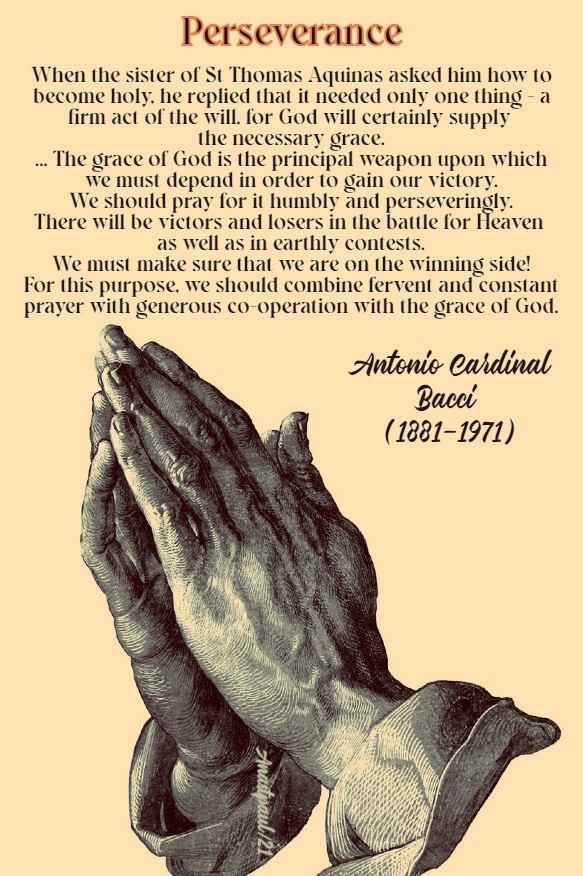
Perseverance
“Perseverance may be a difficult virtue but nothing is really difficult to a person of strong resolution. When the sister of St Thomas Aquinas asked him how to become holy, he replied that it needed only one thing – a firm act of the will, for God will certainly supply the necessary grace.
Think of how much work and sacrifice is required to achieve worldly success. Cicero wrote that it required constant and tireless labour in order to become a great orator (Cf De Oratore, 1:39). St Paul cited the example of athletes who are prepared to make such great sacrifices, in order to train themselves to win. If they are prepared to do so much to gain a perishable crown, he comments, we should be prepared to do much more to gain an imperishable one (Cf 1 Cor 9:25).
The grace of God is the principal weapon upon which we must depend in order to gain our victory. We should pray for it humbly and perseveringly. There will be victors and losers in the battle for Heaven as well as in earthly contests. We must make sure that we are on the winning side! For this purpose, we should combine fervent and constant prayer with generous co-operation with the grace of God.”
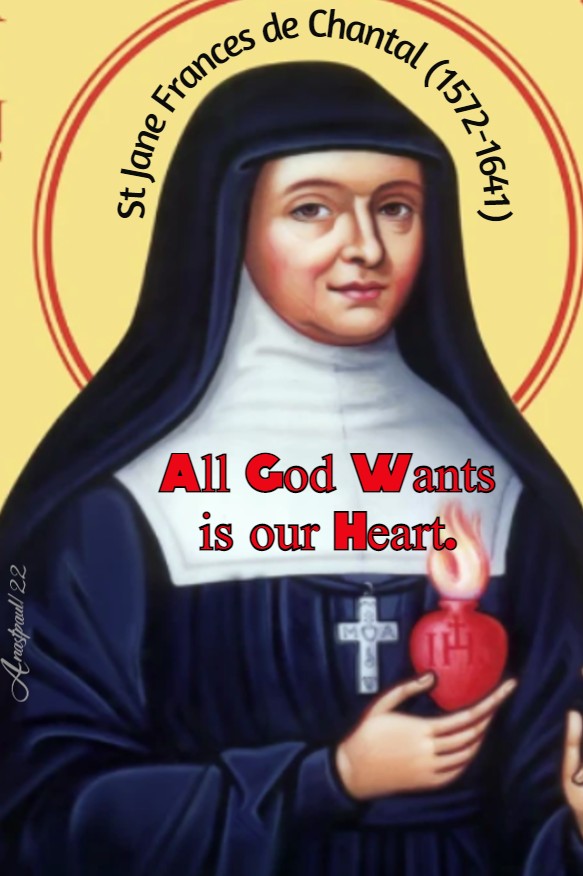
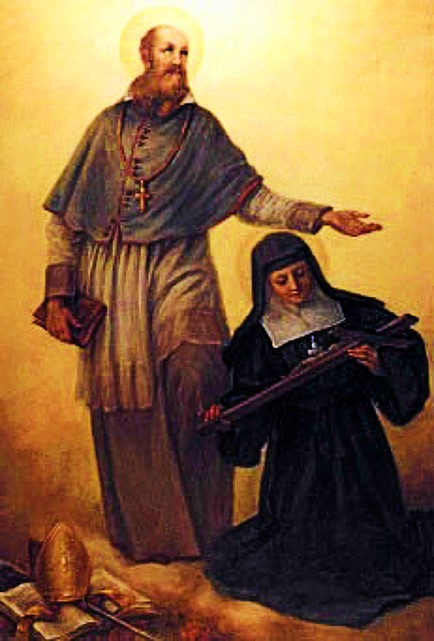
Quote/s of the Day – 21 August – St Jane Frances de Chantal VHM (1572-1641) Widow
“All God wants is our heart.”
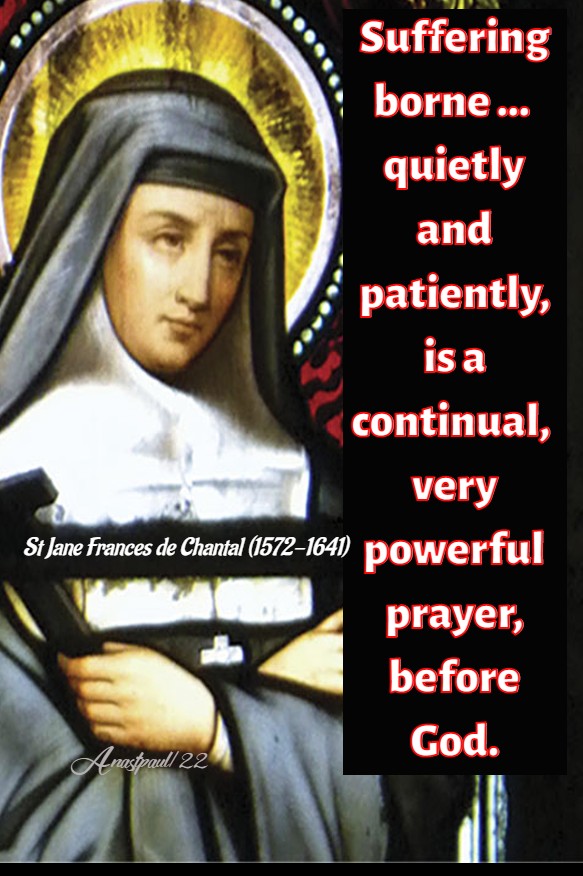
“Suffering borne … quietly and patiently, is a continual, very powerful prayer, before God.”
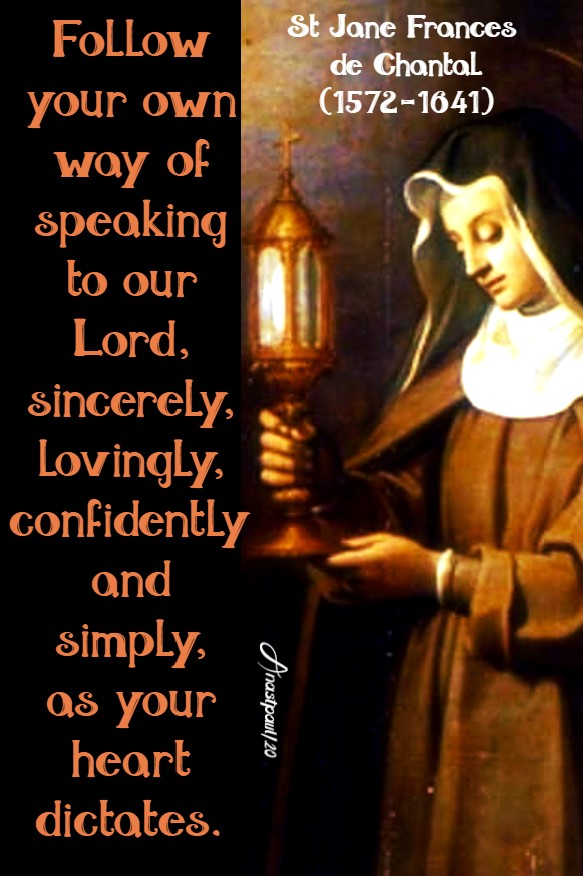
“Follow your own way of speaking to our Lord; sincerely, lovingly, confidently and simply, as your heart dictates.”
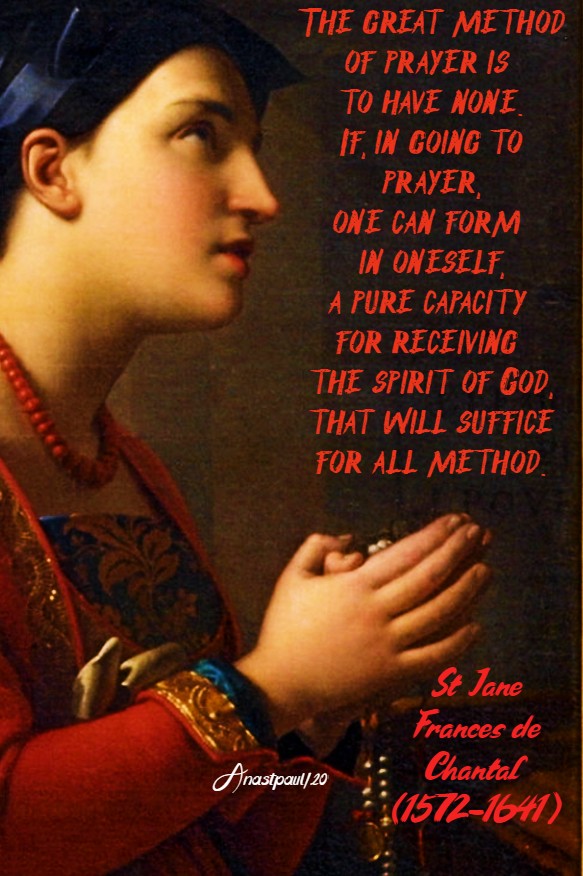
“The great method of prayer is to have none. If, in going to prayer, one can form in oneself, a pure capacity for receiving the spirit of God, that will suffice for all method.”
One Minute Reflection – 21 August – “The Month of the Immaculate Heart of Mary” – St Jane Frances de Chantal VHM (1572-1641) Widow – Within the Assumption Octave – Proverbs 31:10-31 – Matthew 13:44-52 – cripture search here: https://www.drbo.org/
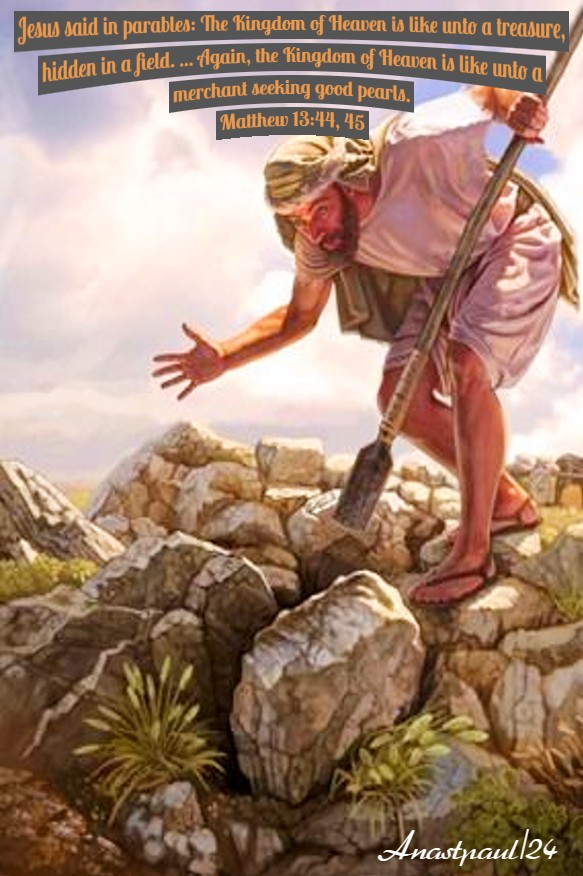
“Jesus said in parables: The Kingdom of Heaven is like unto a treasure, hidden in a field. … Again, the Kingdom of Heaven is like unto a merchant seeking good pearls. ”- Matthew 13:44 and 45
REFLECTION – “The two parables of the treasure and the pearl, both teach us the same thing – we should prefer the Gospel before all earthly treasures. … However, there is something even more praiseworthy than this – we should delight to give it preference, joyfully, unhesitatingly. Let us never forget this, to abandon all else, so as to follow God, is to gain more, than one loses. The preaching of the Gospel is hidden in this world like a hidden treasure, a treasure without price.
To gain this treasure … two conditions are required – the forsaking of this world’s goods and a firm determination. For, it is a question “of a merchant searching for fine pearls, when he finds a pearl of great price, he goes and sells all that he has and buys it.” This one pearl is Truth and Truth is one, it is not divided. Do you possess a pearl? Then you know your wealth, it is clenched in the palm of your hand, no-one is aware of your fortune.
So it is with the Gospel, if you embrace it with faith, if it remains enclosed in your heart, what a treasure you have You alone know it is there. Unbelievers, who know neither what it is nor what value it has, have no idea of your incredible wealth!” – St John Chrysostom (347-407) Bishop of Constantinople, Father and Doctor of the Church (Homilies on Saint Matthew’s Gospel No 47:2).
PRAYER – Almighty and merciful God, Who endowed St Jane Frances, burning with love of Thee, with a wondrous strength of spirit through all the paths of life, in the way of perfection and willed through her, to ennoble Thy Church, by a new religious family, grant by her merits and prayers, that we who are aware of our weakness, may trust firmly in Thy power and, by the assistance of divine grace, overcome all obstacles in our way. Through the same Jesus Christ, Thy Son our Lord, Who lives and reigns with Thee, in the unity of the Holy Ghost, God, world without end. Amen (Collect).
Our Morning Offering – 21 August – “The Month of the Immaculate Heart of Mary” – Feast of St Jane Frances de Chantal (1572-1641)
Prayer of Abandonment By St Jane Frances de Chantal (1572-1641)
O sovereign goodness of the sovereign Providence of my God! I abandon myself forever to Thy arms. Whether gentle or severe, lead me henceforth whither Thou will. I will not regard the way through which Thou will have me pass but keep my eyes fixed upon Thee, my God, who guides me. My soul finds no rest without the arms and the bosom of this heavenly Providence, my true Mother, my strength and my rampart. Therefore I resolve with Thy Divine assistance, 0 my Saviour, to follow Thy desires and Thy ordinances, without regarding or examining why Thou does this rather than that but I will blindly follow Thee, according to Thy Divine will, without seeking my own inclinations. Hence I am determined to leave all to Thee, taking no part therein, save by keeping myself in peace in Thy arms, desiring nothing, except as Thou incites me to desire, to will, to wish. I offer Thee this desire, 0 my God, beseeching Thee to bless it. I undertake all it includes, relying on Thy goodness, liberality and mercy, with entire confidence in Thee, distrust of myself, and knowledge of my infinite misery and infirmity. Amen.
Saint of the Day – 21 August – Saint Euprepius (1st/2nd Century) he 1st Bishop and Confessor of Verona. Died at Verona at the end of the 1st Century or the beginning of the 2nd Century. Also known as – Euprepus, Puprepis.
The Roman Martyrology reads today: “At Verona, St Euprepius, Bishop and Confessor.”
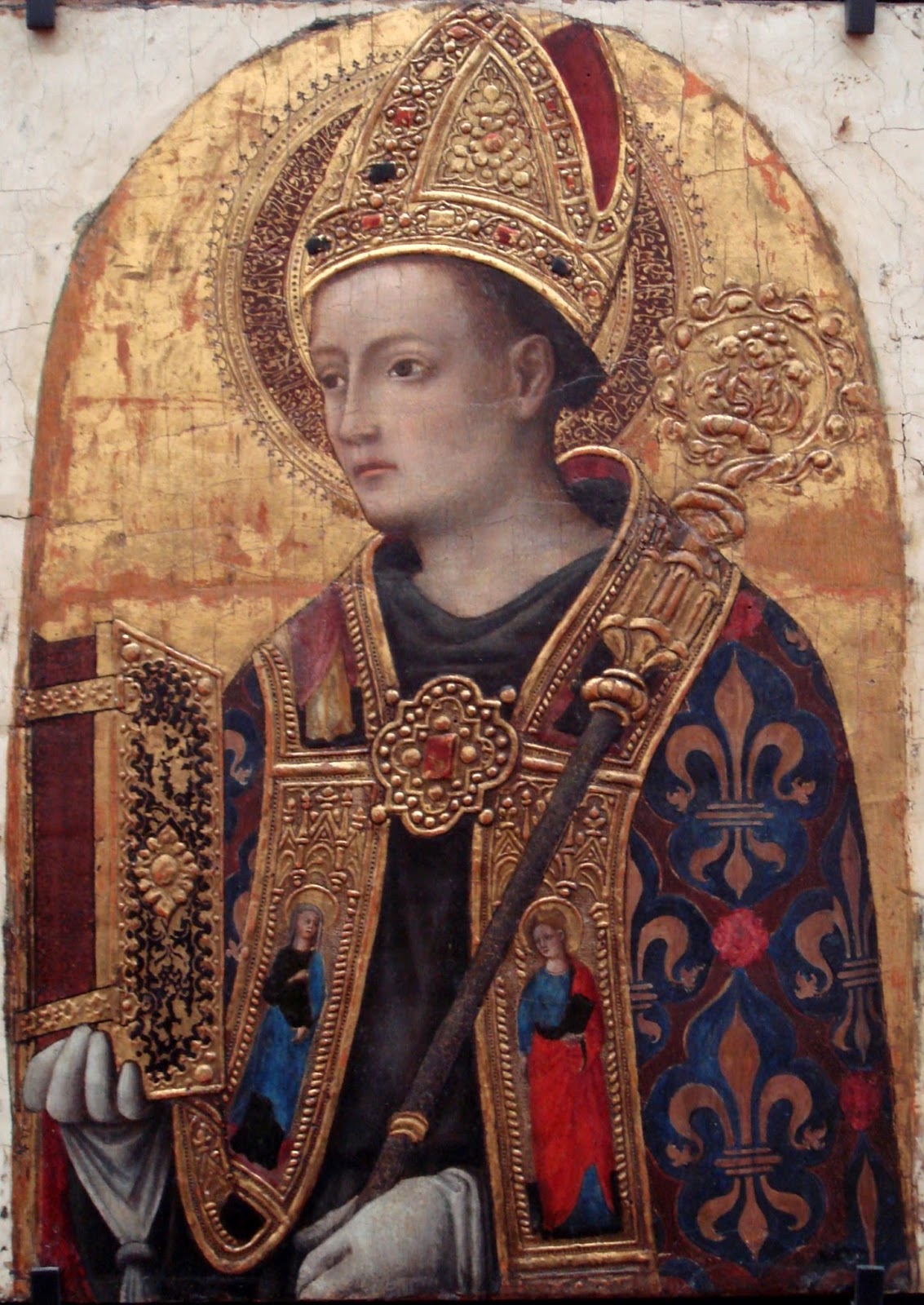
Unknown Bishop Blessing by Vittore Carpaccio
Not much is known of his life beyond the fact that his name was Greek. According to the local tradition of Verona, he was one of the Seventy (two) Disciples mentioned in the Gospel but his name does not appear among them in the 2nd Century list compiled by St Hippolytus of Rome.
Local tradition states that Euprepius was the Bishop of Verona from 60 to 72. The work, known as the ‘Carmen Pipinianum’ includes a description of Verona and its Churches and gives a list of the first eight Bishops: Euprepius, Dimidrianus (Demetrianus), Simplicius, Proculus, Saturninus, Lucilius (Lucillus, Lucius), Gricinus and Zeno.
According to the Catholic Encyclopedia, “the period of St Euprepius and ,therefore, of the erection of the See, must be placed not before the peace given to the Church under Gallienus (260) but rather, under the first period of the reign of Diocletian, when the Church enjoyed peace.
The reconstruction of the Chronology of Bishops known as the ‘Velo di Classe’ (which dates from the end of the 8th Century or beginning of the 9th), places Euprepius first in the list of Bishops of Verona. His Feast day in the Martyrologium Romanum is 21 August.
St Euprepius’ cult did not gain much popularity until the 14th Century. In 1492, his Relics, along with those of other Veronese Bishop Saints, were rediscovered in the Crypt of San Procolo. The Relics were translated to the ancient Basilica of San Zeno in 1806, where an inscription on the Altar reads:
“Euprepio Veronae a Christi ann. LXXII praesuli primo.” “Euprepius, first Bishop of Verona, from the year 72 of Christ. ”
In the 16th Century, Domenico Riccio painted a series of portraits of the Bishops of Verona, ranging from Euprepius to one of Cardinal Agostino Valerio for the Palazzo del Vescovado di Verona.
St Euprepius (1st/2nd Century) Bishop and Confessor of Verona
St Fidelis of Edessa St Theogonius of Edessa St Gracia of Lérida St Hardulph St Joseph Nien Vien St Leontius the Elder St Luxorius of Sardinia St Maria of Lérida St Maximianus the Soldier St Maximilian of Antioch St Natale of Casale Monferrato St Paternus of Fondi St Privatus of Mende St Quadratus of Utica
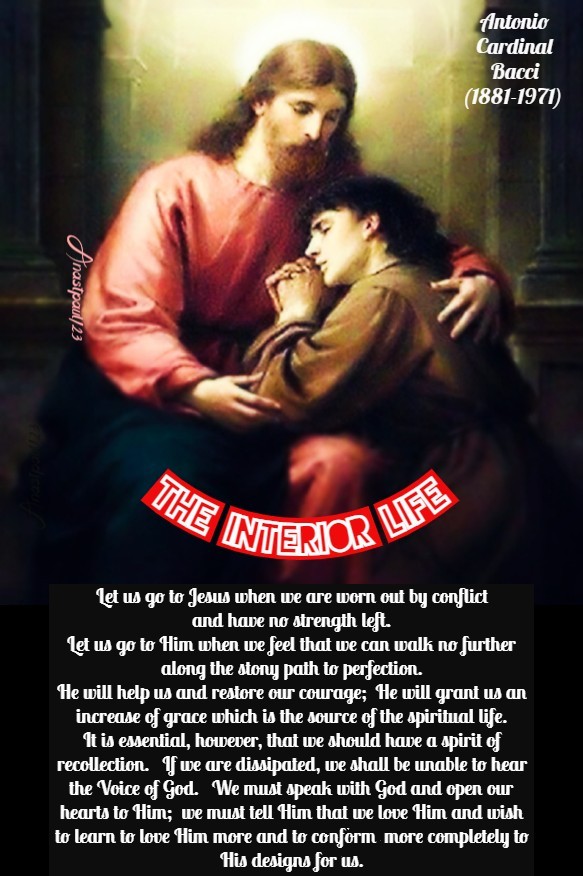
Thought for the Day – 20 August – Meditations with Antonio Cardinal Bacci (1881-1971)
The Interior Life
“Let us go to Jesus when we are worn out by conflict and have no strength left. Let us go to Him when we feel that we can walk no further along the stony path to perfection. He will help us and restore our courage; He will grant us an increase of grace which is the source of the spiritual life.
It is essential, however, that we should have a spirit of recollection. If we are dissipated, we shall be unable to hear the Voice of God. We must speak with God and open our hearts to Him; we must tell Him that we love Him and wish to learn to love Him more and to conform more completely to His designs for us. Then, we shall find peace and contentment in the interior life, such as the world can neither know, nor communicate.”
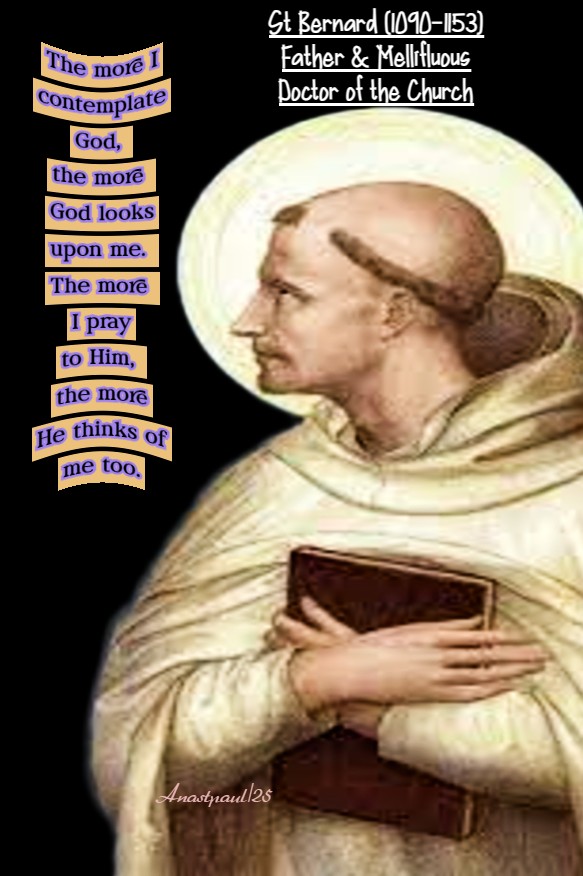
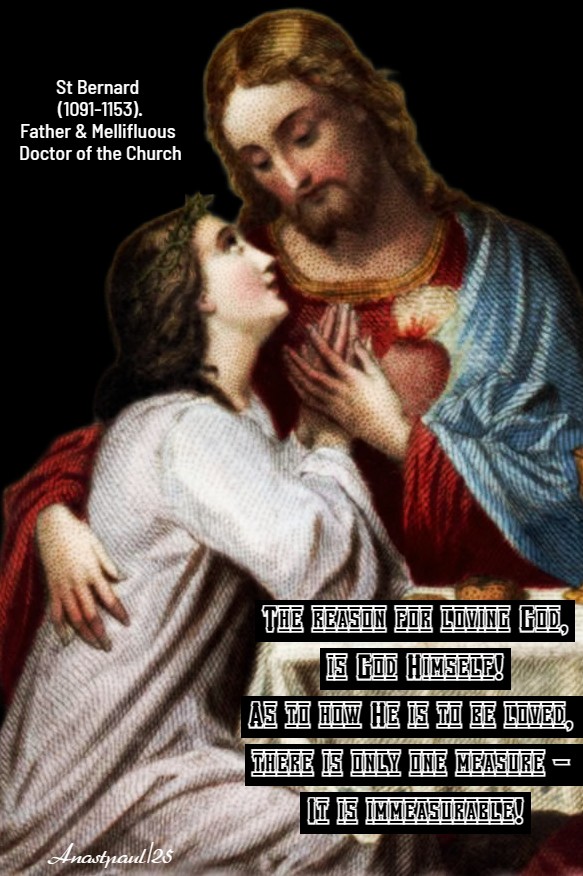
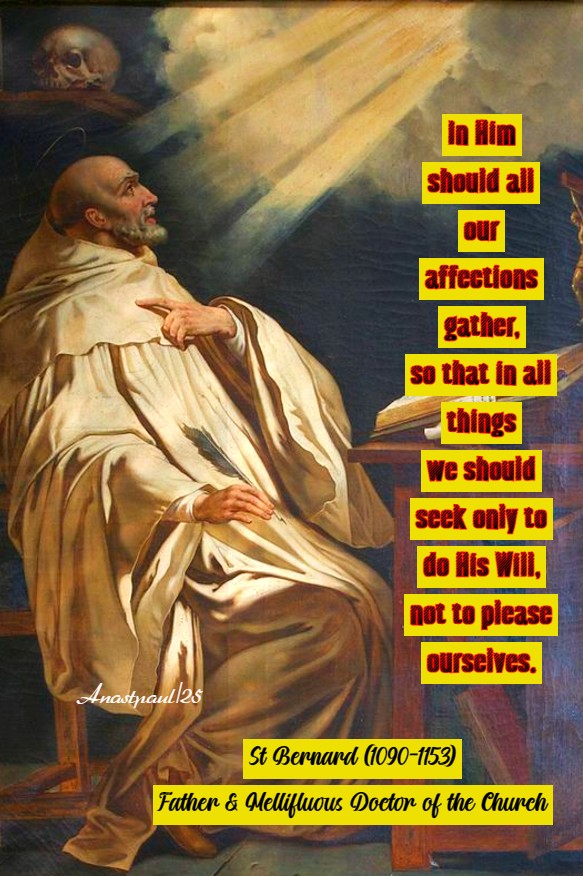
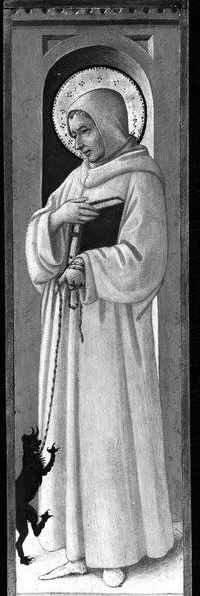
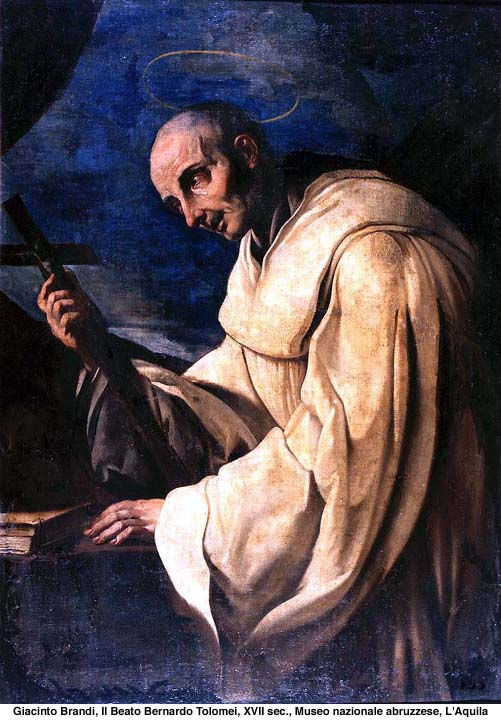
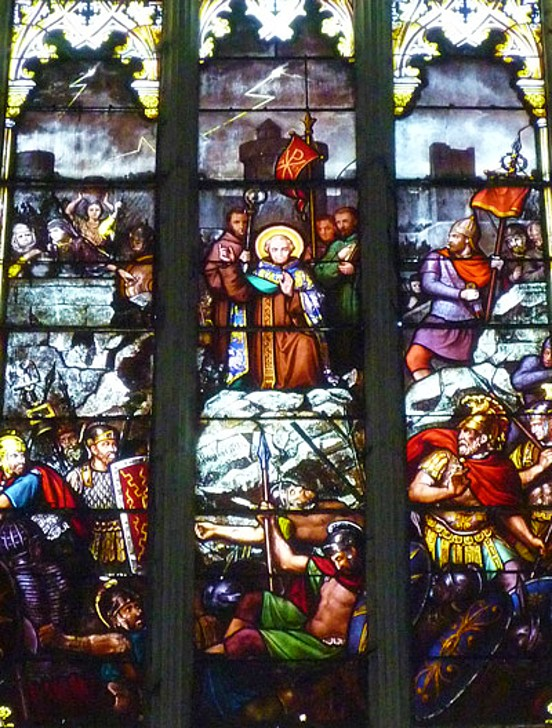
Quote/s of the Day – 20 August – “The Month of the Immaculate Heart of Mary” – The Feast of St Bernard (1090-1153) Confessor, Father and Mellifluous Doctor
“The more I contemplate God, the more God looks upon me. The more I pray to Him, the more He thinks of me too.”
“The reason for loving God, is God Himself! As to how He is to be loved, there is only one measure – It is immeasurable!”
“In Him should all our affections gather, so that in all things we should seek only to do His Will, not to please ourselves.”
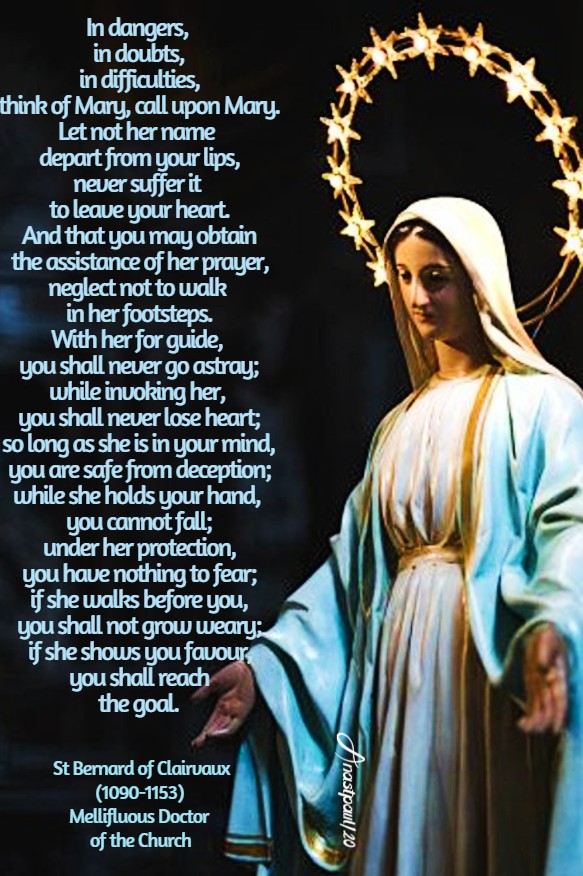
“In dangers, in doubts, in difficulties, think of Mary, call upon Mary. Let not her name depart from your lips, never suffer it to leave your heart. And that you may obtain the assistance of her prayer, neglect not to walk in her footsteps. With her for guide, you shall never go astray; while invoking her, you shall never lose heart; so long as she is in your mind, you are safe from deception; while she holds your hand, you cannot fall; under her protection you have nothing to fear; if she walks before you, you shall not grow weary; if she shows you favour, you shall reach the goal.”
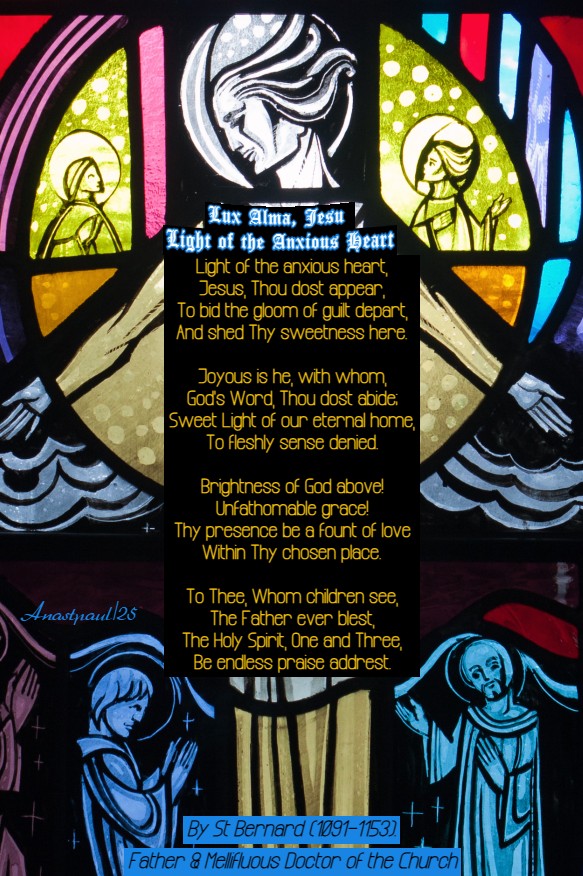
Lux Alma, Jesu Light of the Anxious Heart By St Bernard (1091-1153). Father & Mellifluous Doctor of the Church
Light of the anxious heart, Jesus, Thou dost appear, To bid the gloom of guilt depart, And shed Thy sweetness here.
Joyous is he, with whom, God’s Word, Thou dost abide; Sweet Light of our eternal home, To fleshly sense denied.
Brightness of God above! Unfathomable grace! Thy presence be a fount of love Within Thy chosen place.
To Thee, Whom children see, The Father ever blest, The Holy Spirit, One and Three, Be endless praise addrest.
Translation by Cardinal Newman (1800-1890). There are eight translations. Liturgical Use: Hymn for Lauds on the Feast of the Transfiguration of Our Lord. This Hymn is a cento from St Bernard’s Jesu Dulcis Memoria.
One Minute Reflection – 20 August – “The Month of the Immaculate Heart of Mary” – The Feast of St Bernard (1090-1153) Confessor, Father and Mellifluous Doctor – Ecclesiasticus 39:6-14 – Matthew 5:13-19 – Scripture search here: https://www.drbo.org/
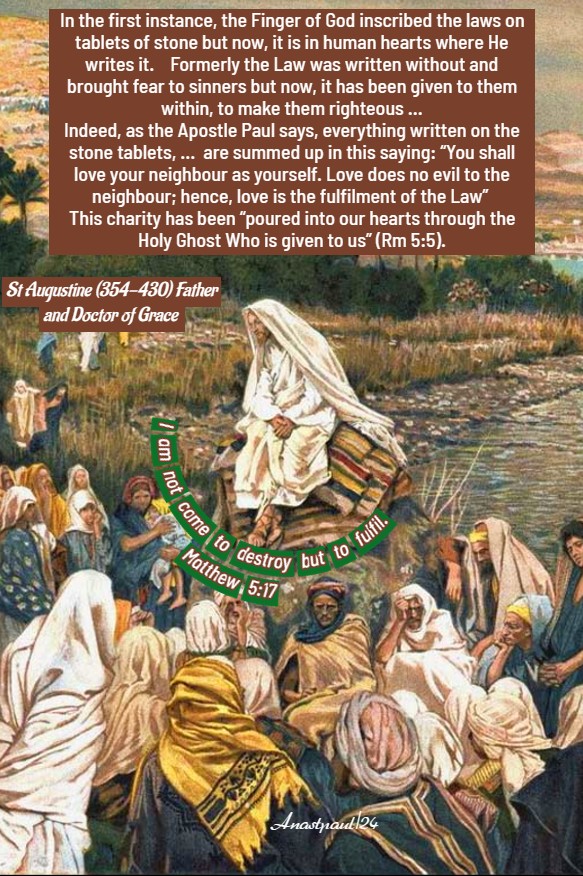
“I am not come to destroy but to fulfil.” – Matthew 5:17
REFLECTION – “Grace which was formerly veiled, so to speak, in the Old Testament, has been fully revealed in the Gospel of Christ by a harmonious disposition of the times, just as God usually disposes of everything with harmony … But within this wonderful harmony, we notice a great difference between the two ages. On Sinai, the people did not dare draw near the place where the Lord was giving His Law; in the Upper Room, the Holy Ghost comes down on all those assembled there, while waiting for the fulfilment of the promise (Ex 19:23; Acts 2:1). In the first instance, the Finger of God inscribed the laws on tablets of stone but now, it is in human hearts where He writes it (Ex 31:18; 2 Cor 3:3). Formerly the Law was written without and brought fear to sinners but now, it has been given to them within, to make them righteous …
Indeed, as the Apostle Paul says, everything written on the stone tablets, “you shall not commit adultery, you shall not kill. .. you shall not covet” and whatever other commandments there may be, are summed up in this saying: “You shall love your neighbour as yourself. Love does no evil to the neighbour; hence, love is the fulfilment of the Law” (Rm 13:9f.; Lv 19:18) … This charity has been “poured into our hearts through the Holy Ghost Who is given to us” (Rm 5:5).” – St Augustine (354-430) Father and Doctor of Grace (On the spirit and the letter, 28-30).
PRAYER – O God, Who gave to Thy people, blessed Bernard, as a minister of salvation, grant, we beseech Thee, that we, who cherished him on earth as a teacher of life, may be found worthy to have him as an intercessor in Heaven. Through Jesus Christ, Thy Son our Lord, Who lives and reigns with Thee, in the unity of the Holy Ghost, God, world without end. Amen (Collect).
Our Morning Offering – 20 August – “The Month of the Immaculate Heart of Mary” – The Feast of St Bernard (1090-1153) Confessor, Father and Mellifluous Doctor
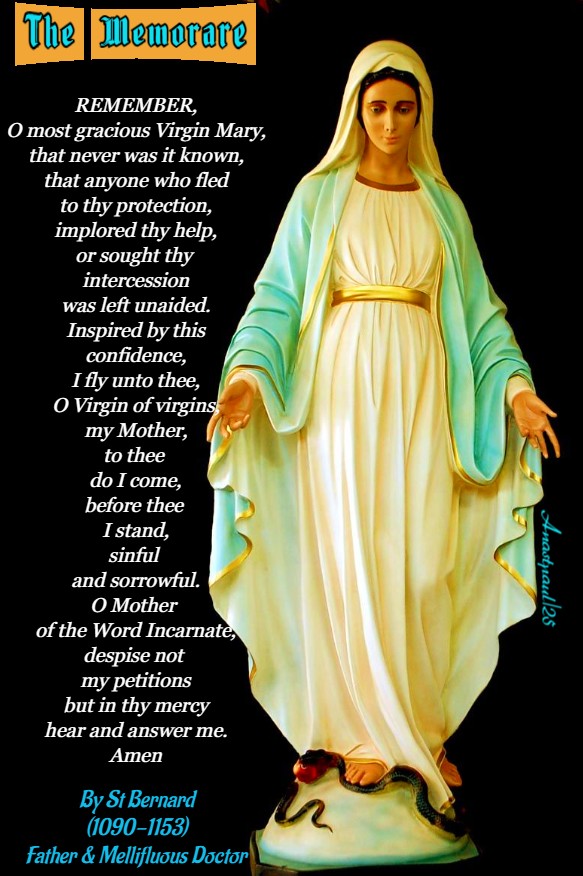
The Memorare By St Bernard (1090-1153) Father and Mellifluous Doctor
REMEMBER, O most gracious Virgin Mary, that never was it known, that anyone who fled to thy protection, implored thy help, or sought thy intercession was left unaided. Inspired by this confidence, I fly unto thee, O Virgin of virgins, my Mother, to thee do I come, before thee I stand, sinful and sorrowful. O Mother of the Word Incarnate, despise not my petitions but in thy mercy hear and answer me. Amen
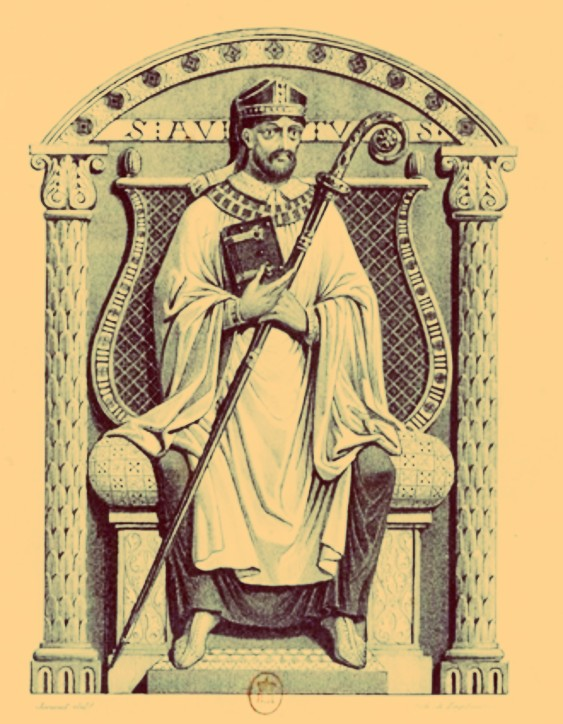
Saint of the Day – 20 August – St Herbert Hoscam (Died c1181) Bishop of Gonza, Italy, Missionary, Scholar. Born in England, in the 12th Century and died in Conza della Campania , Italy, around 1181. Patronage – of the City and Diocese of Gonza. Also known as – Herbert of Conza, Erberto…
Unknown Italian Saint Bust may be St Herbert Hoscam
Herbert is still the highly venerated Patron Saint of the City and Diocese of Conza. He lived in the second half of the 12th Century, as attested by a parchment from 1169 preserved in the Diocesan Archives of Conza. This document states that he granted Robert, the Bishop of Muro Lucano, the right to Consecrate a Church in honour of St Martin.
He was present at the Third Lateran Council in 1179 and was considered a she[herd illustrious for his sanctity and learning.
Herbert died around 1181. On 23 March 1684, the Theatine Archbishop Gaetano Caracciolo, inspected the Relics placed in a side Altar and transferred them to an urn under the High Altar of Conza Cathedral, where they remain today. On this occasion, the Archbishop took the Episcopal ring, which every year, on the eve of the Feast, 20 August is immersed in Holy Water and then devotedly sprinkled over the faithful, while the hymn of the holy confessors is sung.
The venerated shepherd of this Diocese and City, so struck by recurring earthquakes and constanly reborn over the centuries, the last of which was in 1980, always enthusiastically supported the cult of the St Herbert. At the behest of Archbishop Giuseppe Nicolai († 1758), a precious silver Statue was erected in honour of the Patron Saint and at the end of the 19th Century, Archbishop Antonio Buglione named a Rural Bank after him.
St Brogan St Burchard of Worms St Christopher of Cordoba St Cristòfol Baqués Almirall St Gobert of Apremont St Haduin of Le Mans St Heliodorus of Persia St Herbert Hoscam (Died 1188) Bishop St Leovigild of Cordoba St Lucius of Cyprus St Manetius/Benedict dell’ Antella OSM Confessor
Thought for the Day – 19 August – Meditations with Antonio Cardinal Bacci (1881-1971)
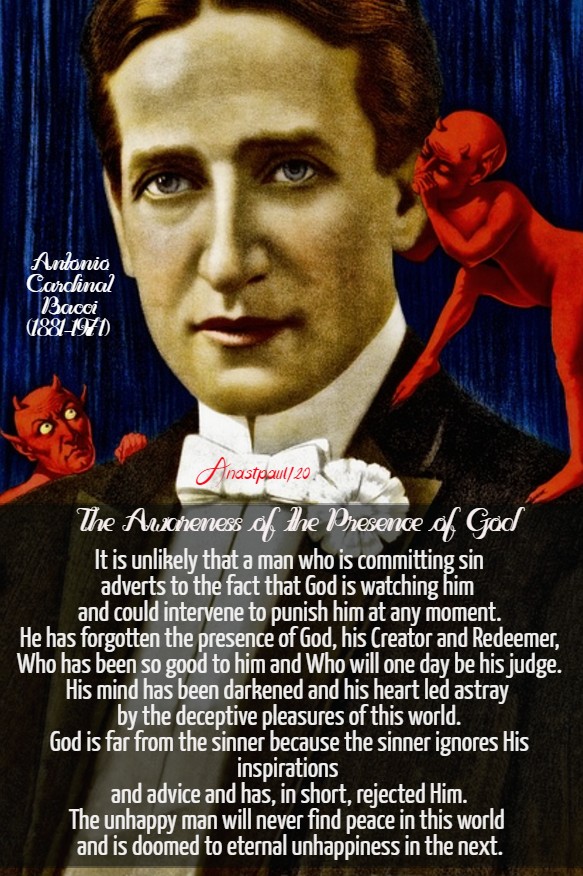
The Awareness of the Presence of God
“The cultivation of a continual awareness of the presence of God is such a useful practice that many writers regard it as the fundamental principle of the spiritual life. As St Alphonsus de’Liguori points out, it obliges us to do three thing: (1) To preserve ourselves completely free from sin; (2) To practise virtue, in every possible way and (3) To seek a closer and more loving contact with God (Al Servizio Divino, III, 1,3).
The realisation of the presence of God is a particularly good way of subduing our passions and conquering temptation. “If we were always aware of God’s presence within us,” writes St Thomas Aquinas, “we should never, or hardly ever, sin” (Opusc 58, c 2).
It is unlikely that a man who is committing sin adverts to the fact that God is watching him and could intervene to punish him at any moment. He has forgotten the presence of God, his Creator and Redeemer, Who has been so good to him and Who will one day be his judge. His mind has been darkened and his heart led astray by the deceptive pleasures of this world.
God is far from the sinner because the sinner ignores His inspirations and advice and has, in short, rejected Him. The unhappy man will never find peace in this world and is doomed to eternal unhappiness in the next.
“If we remained always in the presence of God,” wrote St John Chrysostom, “we should neither conceive, nor do anything evil” (Homil 8, ad, Phil 2).”
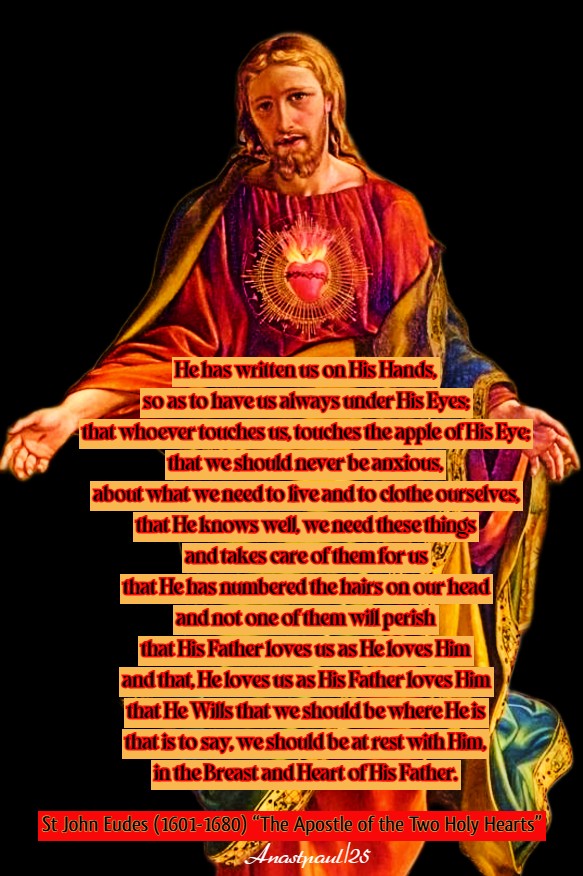
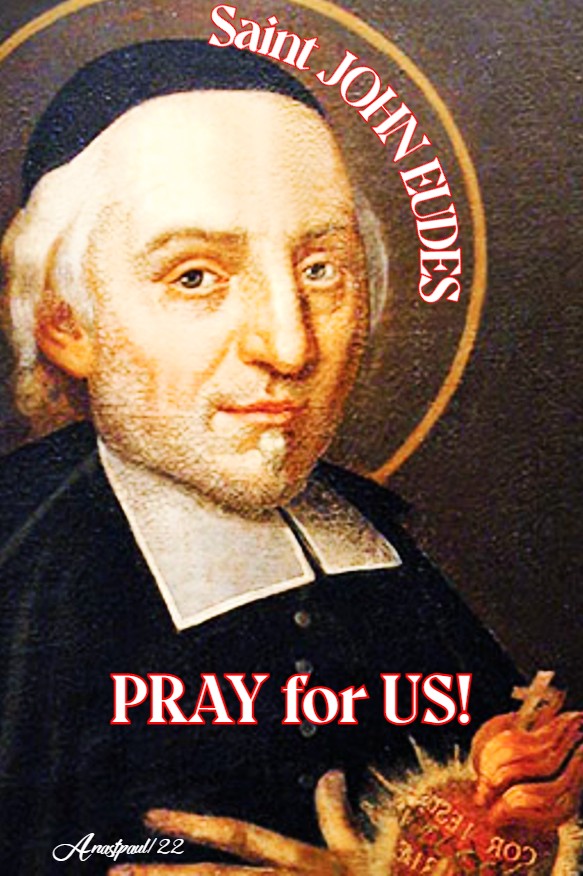
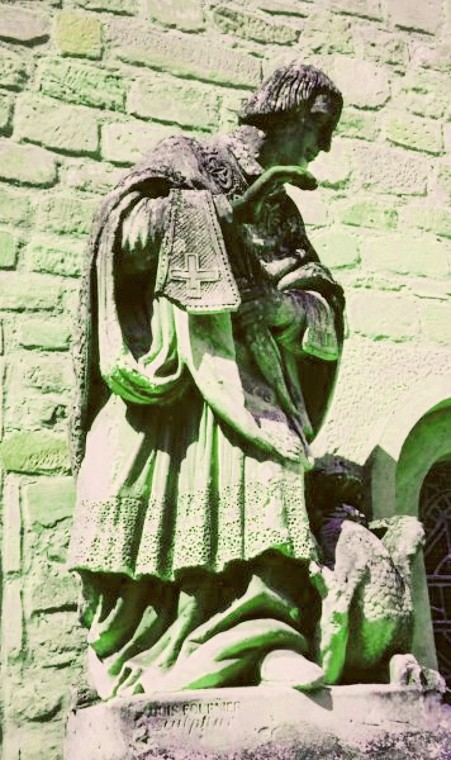
Quote/s of the Day – 19 August – “The Month of the Immaculate Heart of Mary” – The Feast St John Eudes (1601-1680) Confessor, “The Apostle of Two Hearts”
“He has written us on His Hands, so as to have us always under His Eyes; that whoever touches us, touches the apple of His Eye; that we should never be anxious, about what we need to live and to clothe ourselves, that He knows well, we need these things and takes care of them for us that He has numbered the hairs on our head and not one of them will perish that His Father loves us as He loves Him and that, He loves us as His Father loves Him that He Wills that we should be where He is that is to say, we should be at rest with Him, in the Breast and Heart of His Father.”
One Minute Reflection – 19 August – “The Month of the Immaculate Heart of Mary” – St John Eudes (1601-1680) Confessor, “The Apostle of Two Hearts” – Within the Assumption Octave – Sirach 31:8-11 – Luke 12:35-40 – Scripture search here: https://www.drbo.org/
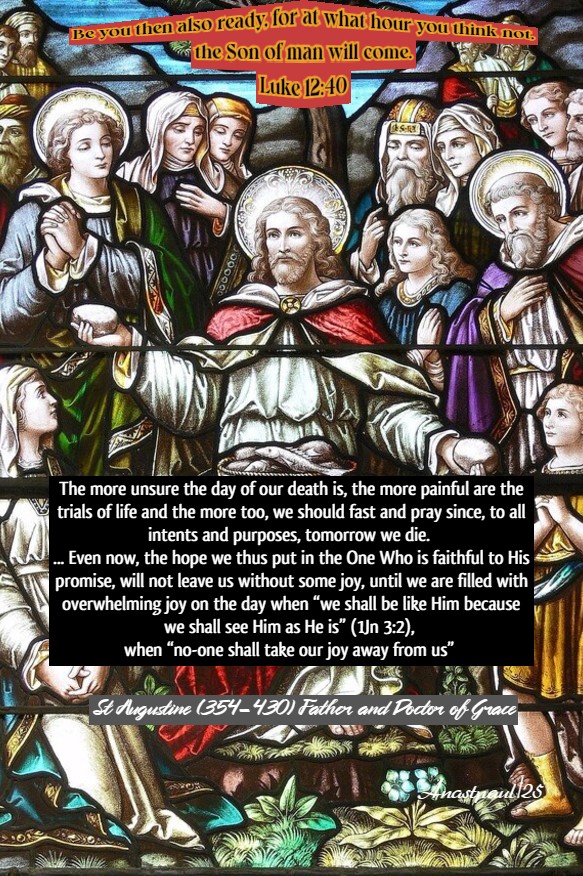
“Be you then also ready, for at what hour you think not, the Son of man will come.” – Luke 12:40
REFLECTION – “Let our “loins be girded and our lamps lit”; let us be like “servants waiting for their master to return from the wedding feast” (Lk 12:35). Do not let us be like those unbelievers who say: “Let us eat and drink, for tomorrow we die” (1 Cor 15:32). The more unsure the day of our death is, the more painful are the trials of life and the more too, we should fast and pray since, to all intents and purposes, tomorrow we die. Our Lord said to His disciples: “Yet a little while and you will no longer see Me and again, a little while and you will see Me” (Jn 16:16). Now is the time of which He said: “You will grieve but the world will rejoice” (v. 20); now is the time in this life of suffering when we journey apart from Him. “But,” He adds, “I shall see you again and your hearts will be full of joy and no-one will take your joy away from you” (v. 22).
Even now, the hope we thus put in the One Who is faithful to His promise, will not leave us without some joy, until we are filled with overwhelming joy on the day when “we shall be like Him because we shall see Him as He is” (1Jn 3:2), when “no-one shall take our joy away from us”… “A woman in labour,” says our Lord, “is in anguish because her hour has arrived. But when she has given birth to a child, she feels immense joy because a child has been born into the world” (Jn 16:21). This is the joy no-one can take away from us and with which we will be filled when we pass from our present understanding of faith into eternal Light. So let us fast and pray now because we are in the days of childbirth.” – St Augustine (354-430) Father and Doctor of Grace [Sermon 210, 5 (7)]
PRAYER – O God, Who wondrously enkindled St John, Thy Confessor, to promote the religious veneration of the Sacred Hearts of Jesus and Mary and through him, willed to found new religious families in the Church, grant, we beseech Thee that we may honour his holy merits and may learn from the example of his virtues. Through Jesus Christ, Thy Son our Lord, Who lives and reigns with Thee, in the unity of the Holy Ghost, God, world without end. Amen (Collect).
Our Morning Offering – 19 August – “The Month of the Immaculate Heart of Mary” – Feast of St John Eudes (1601-1680) Confessor, “The Apostle of Two Hearts”
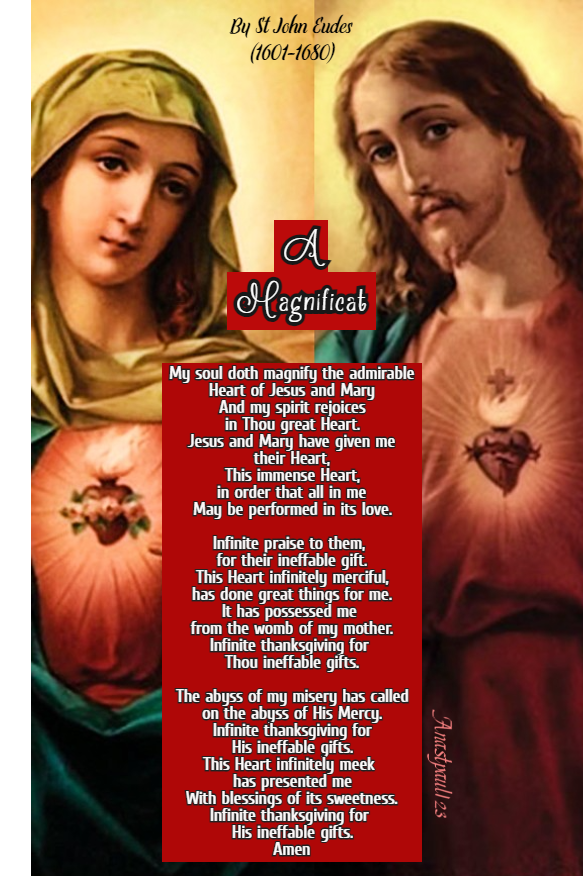
A Magnificat By St John Eudes (1601-1680) A Hymn of Praise and Thanksgiving to the Sacred Heart of Jesus and to the Holy Heart of Mary
My soul doth magnify the admirable Heart of Jesus and Mary And my spirit rejoices in Thou great Heart. Jesus and Mary have given me their Heart, This immense Heart, in order that all in me May be performed in its love.
Infinite praise to them, for their ineffable gift. This Heart infinitely merciful, has done great things for me. It has possessed me from the womb of my mother. Infinite thanksgiving for Thou ineffable gifts.
The abyss of my misery has called on the abyss of His Mercy. Infinite thanksgiving for His ineffable gifts. This Heart infinitely meek has presented me With blessings of its sweetness. Infinite thanksgiving for His ineffable gifts. Amen
Saint of the Day – 19 August – Saint Maginus (Died c306) Hermit Martyr of Brufaganya, Spain. Nobly born in Burgundy modern France and died by being beheaded with a sickle durinmg the persecutions of Diocletian in c3046 in Tarragona, Spain. Patronage of Tarragona. Also known as – Magi, Magin.
Maginus, being orphaned at a young age, and desiring to give himself to God, became a Hermit in a cave on Mount Brufaganya located at 760m above sea level, above the beginning of the Torrent de Sant Magí.
Upon the arrival of the Roman Prefect Dacian in Tarragona, persecuting Christians under the edict of Emperor Maximian, and Diocletian, Maginus tried to convert them to the Faith and was imprisoned.
Being miraculously freed, he left the City by a gate now called Sant Magí, where he dedicated a Chapel and returned to Mount Brufaganya.
Being captured once again in his cave, Maginus was taken to Tarragona, then transferred to Gaià, where he was beheaded.
St Andrew the Tribune St Badulf of Ainay St Bertulf of Luxeuil St Calminius St Credan of Evesham
St Donatus of Sisteron (Died 535) Priest, HermitMiracle-worker. The Roman Martyrology reads: “In the neighbourhood of Sisteron in France, the blessed St Donatus, Priest and Confessor. Being from his very infancy endowed with the grace of God in an extraordinary manner, he lived the life of an Anchorite for many years and after having been renowned for glorious miracles, he went to Christ.” St Donetus’ Life of Grace: https://anastpaul.com/2024/08/19/saint-of-the-day-19-august-st-donatus-of-sisteron-died-535-priest-confessor-hermit/
Blessed Jordan of Pisa OP (c1255–1311) Dominican Friar, Theologian, Professor, renowned Preacher, Founder of the Confraternity of the Holy Redeemer at Pisa, Visionary, Marian devotee, promoter and daring innovator of the vernacular Italian language as a ‘church’ language and a tool for evangelisation. On 23 August 1833, Blessed Jordan’s cultus was confirmed by Pope Gregory XVI and in 1838 he was Beatified by Pope Gregory XVI. His Ardent Life: https://anastpaul.com/2019/08/19/saint-of-the-day-blessed-jordan-of-pisa-op-c-1255-1311/ St Julius of Rome
St Louis OFM (1274-1297) Prince and Bishop of Toulouse, Neapolitan Prince of the Capetian House of Anjou, Franciscan Friar and Priest, Apostle of Prayer, of Penance and of the poor and the sick. He had received the last sacraments on the Feast of the Assumption of Our Lady and on the 19th of August, 1297, while pronouncing the holy name of Mary, he yielded his soul to God. Because of the many miracles that were wrought at his tomb, he was Canonised as early as 1317, during the lifetime of his mother. Lovely St Louis: https://anastpaul.com/2020/08/19/saint-of-the-day-19-august-saint-louis-of-toulouse-ofm-1274-1297-prince-and-bishop/St
St Magnus of Anagni St Magnus of Avignon St Magnus of Cuneo St Marianus (Died c515) Hermit of Entreaigues, a forest in France. St Gregory of Tours wrote his Vita but we have no copy thereof. St Marinus of Besalu St Maginus (Died c306) Hermit Martyr of Tarragona, Spain St Mochta St Namadia of Marsat St Rufinus – Confessor. A Saint venerated for centuries in of Mantua, Italy but sadly all records of his life have been lost. St Sarah the Matriarch St Sebaldus St Thecla of Caesarea St Timothy of Gaza
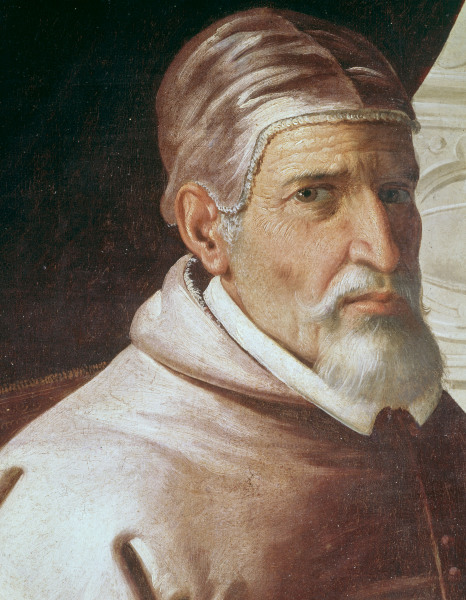
Blessed Pope Urban II (1042–1099) Bishop of Rome, Abbot, Confessor – after 1969 his Feast was moved to 29 July. The Roman Martyrology reads today: “At Rome, Blessed Urban II, Pope, who followed in the footsteps of St Gregory VII, in his zeal for learning and religion and fired the Crusaders with enthusiasm for the recovery of the holy places in Palestine, from the power of the infidels. The veneration paid to him from time immemorial Pope Leo XIII, approved and confirmed.” Biography: https://anastpaul.com/2019/07/29/saint-of-the-day-29-july-blessed-pope-urban-ii-c-1035-1099-bishop/
Martyrs of Nagasaki – 15 Beati: A group of missionaries and their laymen supporters who were executed for spreading Christianity in Japan. They are: Antonius Yamada, Bartholomaeus Mohyoe, Iacobus Matsuo Denji, Ioachim Díaz Hirayama, Ioannes Miyazaki Soemon, Ioannes Nagata Matashichi, Ioannes Yago, Laurentius Ikegami Rokusuke, Leo Sukeemon, Ludovic Frarijn, Marcus , kenoshita Shin’emon, Michaël Díaz Hori, Paulus Sankichi, Pedro de Zúñiga, Thomas Koyanag., They were beheaded on 19 August 1622 at Nagasaki, Japan and Beatified , 7 May 1867 by Pope Pius IX.
Thought for the Day – 18 August – Meditations with Antonio Cardinal Bacci (1881-1971)
The Apostolate of Prayer
“Everybody cannot be an Apostle in the strict sense of the word. Not everyone can dedicate his whole life to the expansion of God’s Kingdom upon earth and to the conversion of pagans, heretics and sinners. Everyone can, however, do a little in this cause. Perhaps you cannot leave your family as the missionaries do and travel to distant lands to extend the Kingdom of God. Perhaps you cannot enter a Convent or dedicate yourself to God as a Priest or a Religious because you have not received this high vocation from God. We know, however, that each one of us has some responsibility for his neighbour and must help him whenever possible. “Go surety for your neighbour according to your means ” (Eccles 29:20).
Now, the ‘Apostleship of Prayer’ offers everybody a simple way of doing exactly this. Its object is to promote the glory of God and the salvation of souls, especially by means of prayer in union with the Sacred Heart of Jesus and the Immaculate Heart of Mary. Besides prayer, we must offer the actions and sufferings of each day. Let us decide to become one, with all the faithful, in offering the prayers and actions and sufferings of each day to the Sacred Heart of Jesus, through the Immaculate Heart of His Mother Mary.
We shall certainly receive showers of graces, both for ourselves and for the salvation of the souls of our neighbours.”
Quote/s of the Day – 18 August – “The Month of the Immaculate Heart of Mary” – 4th Day Within the Octave of the Assumption of the Blessed Virgin – Judith 13:22-25; 13:15; 13:10 – Luke 1:41-50 – Scripture search here: https://www.drbo.org/
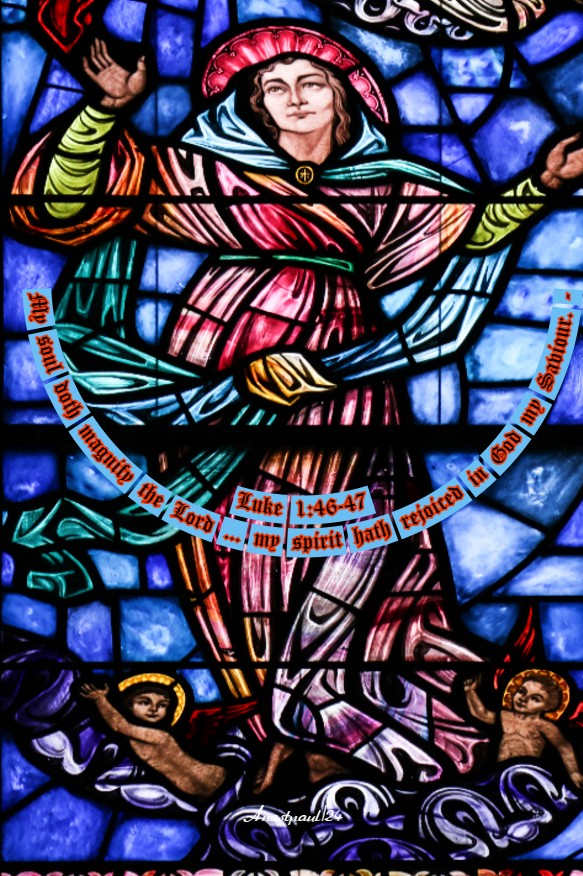
“And Mary said: My soul doth magnify the Lord … … my spirit hath rejoiced in God my Saviour.” Luke 1:46-47
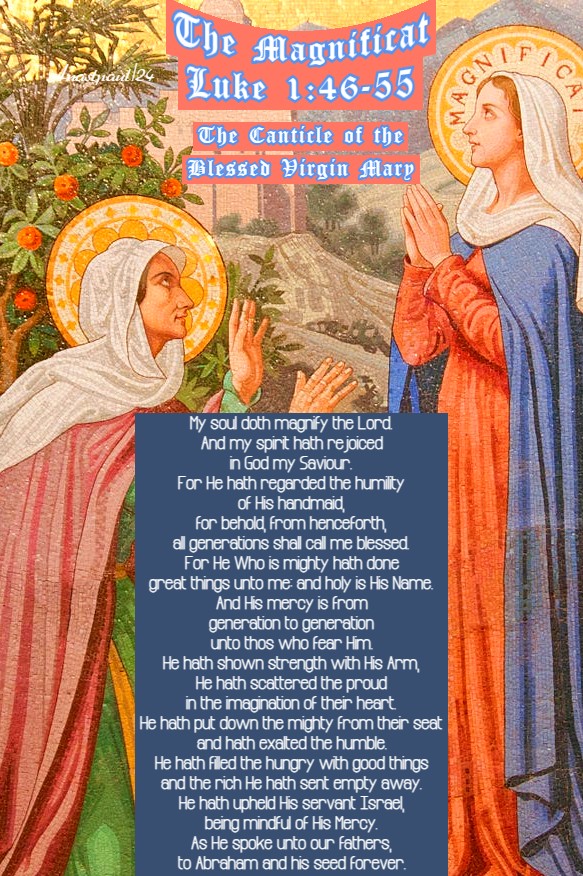
The Magnificat The Canticle of the Blessed Virgin Mary Luke 1:46-55 Indulgence 100 days
My soul doth magnify the Lord. And my spirit hath rejoiced in God my Saviour. For He hath regarded the humility of His handmaid, for behold, from henceforth, all generations shall call me blessed. For He Who is mighty hath done great things unto me: and holy is His Name. And His mercy is from generation to generation unto thos who fear Him. He hath shown strength with His Arm, He hath scattered the proud in the imagination of their heart. He hath put down the mighty from their seat and hath exalted the humble. He hath filled the hungry with good things and the rich He hath sent empty away. He hath upheld His servant Israel, being mindful of His Mercy. As He spoke unto our fathers, to Abraham and his seed forever.
Glory be to the Father and to the Son and to the Holy Ghost as it was in the beginning, is now and ever shall be, world without end! Amen
One Minute Reflection – 18 August – “The Month of the Immaculate Heart of Mary” – 4th Day Within the Octave of the Assumption of the Blessed Virgin – Judith 13:22-25; 13:15; 13:10 – Luke 1:41-50 – Scripture search here: https://www.drbo.org/
“And Mary said: My soul doth magnify the Lord. And my spirit hath rejoiced in God my Saviour. ” – Luke 1:46-47
REFLECTION – “O Virgin! Temple of the Trinity! the God of all Goodness and Mercy … is declared to have been born of thee. The message is brought to thee by the Angel who hails thee full of grace … and thou art told. Thou consent and the King of Glory instantly becomes Incarnate in thy womb. By this joy, we pray, make us pleasing to this great King. …
Thy second Joy is that thou, the Star, gives birth to the Sun … This birth causes neither alteration nor pain in thee; thou remains a Virgin as before. As a flower loses not its beauty by sending forth its fragrance; so neither do thou lose the bloom of virginity by giving birth to thy Creator. O Mary, gracious Mother! be for us the way which leads to thy Son. …
A star tells thee of thy third Joy. Thou sees a star resting over thy Child, the Magi adoring Him and offering their varied gifts …. O Mary, the world’s Star! pray for us, that we may be cleansed from our sins. …
The fourth Joy, O holy Virgin! was given to thee when Jesus rose from the tomb … hope was restored and death was put to flight. And thou, O full of grace (Lk 1:28), had thy share in effecting these wonders. The enemy is conquered … we, who had been made captive are set free and raised up from earth to Heaven. O Mother of our Creator! pray for us earnestly, that by this Paschal Joy we may be joined with the heavenly choirs after this life’s labours are over.
Thou received thy fifth Joy, O Mary!, when thou were present at thy Son’s Ascension into Heaven. Then thou clearly saw that He, Whose Mother thou art, was thy Creator. His Ascension shows us the path whereby we are to ascend to Heaven … We beseech thee, by this Joy, may we also ascend to Heaven, where, with thee, together with thy Son, we may rejoice for all eternity …
The sixth Joy was when the Holy Paraclete descended from Heaven in the form of fiery tongues, strengthening … and inflaming the Apostles to heal those whose tongues had brought them to perdition and to purify their souls from sin. By this holy Joy, intercede for us we pray, O Virgin!, to thy Son that He may pardon us the stain of our sins lest there be found guilt upon us at the great Judgement.
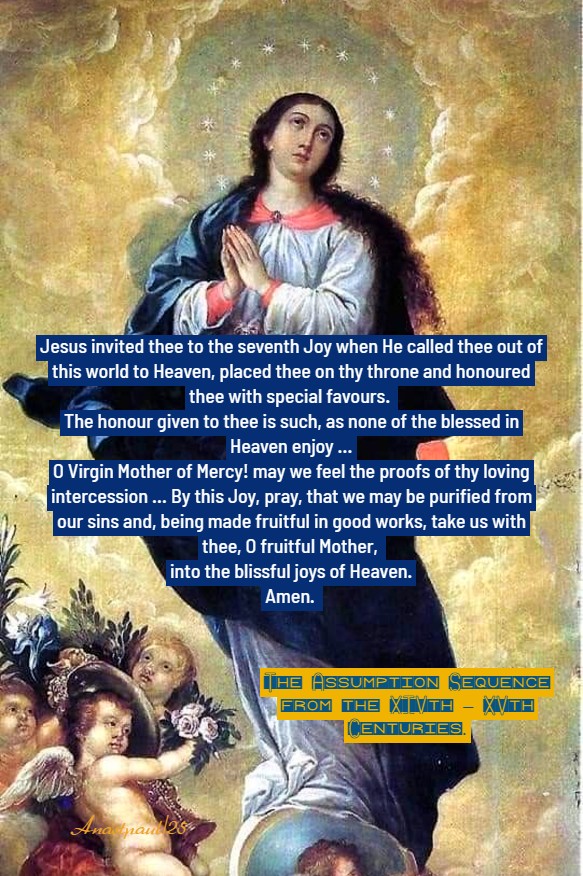
Jesus invited thee to the seventh Joy when He called thee out of this world to Heaven, placed thee on thy throne and honoured thee with special favours. The honour given to thee is such, as none of the blessed in Heaven enjoy … O Virgin Mother of Mercy! may we feel the proofs of thy loving intercession … By this Joy, pray that we may be purified from our sins and, being made fruitful in good works, take us with thee, O fruitful Mother, into the blissful joys of Heaven. Amen. ” – Latin Liturgy – The Assumption Sequence from the XIVth – XVth Centuries.
PRAYER – O Lord, we beseech Thee, forgive the transgressions of Thy servants and, forasmuch as by our own deeds, we cannot please Thee, may we find safety through the prayers of the Mother of Thy Son and our Lord. Through the same Jesus Christ, Thy Son our Lord, Who lives and reigns with Thee, in the unity of the Holy Ghost, God, world without end. Amen (Collect).
Saint of the Day – 18 August – Saint Eonus (Died c502) Bishop of Arles. Of French birth where he died in his Diocese of Arles in c502. Also known as – Eolnius, Aeonius.
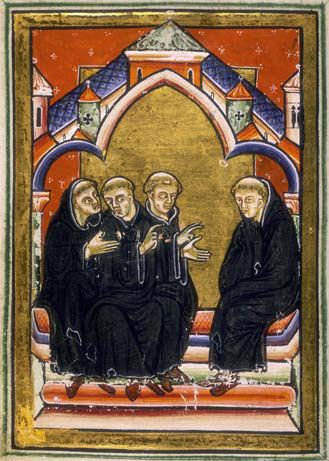
Unknown Bishop
Eonus was related to the renowned Saint Caesarius (470-542) and a fellow citizen of Arles. Eonus succeeded Saint Leontius, as the Bishop of Arles, who was still alive in 475.
Pope Saint Gelasius I addressed a letter to our Saint to be shared with the Eiscopate of Gaul. Pope Anastasius II (496-498) had determined the respective rights of the Provinces of Vienne and Arles, in a way prejudicial to the latter and Eonus asserted his point of view. In 499, Pope Symmachus ordered him to send a representative to Rome, together with that of Vienne. In 500, the outcome of this meeting in Rome was successful for Eonus, as Arles recovered its rights.
Eonus corresponded with Saint Ruricius, the Bishop of Limoges, three of whose letters addressed to him have come down to us.
Eonus involved himself in monastic life and placed St Caesarius, who had left Lérins for health reasons, at the head of one of his Monasteries. He Ordained St Caesarius to the Priesthood and chose him as his successor. This choice Eonus expressed this to his Clergy, to the best of his faithful and to the King of Toulouse, Alaric.
He likely died in 502. The Diocese of Arles and Aix, celebrate the Feast of Saint Eonus with us all today.
St Florus of Illyria Bl Francis of Francavilla Bl Gaspar di Salamanca St Hermas of Rome St John of Rome St Juliana of Myra St Juliana of Stobylum St Laurus of Illyria St Leo of Myra
Massa Candida: Also known as Martyrs of Utica and the White Company: Three hundred 3rd Century Christians at Carthage, who were ordered to burn incense to Jupiter or face death by fire. Martyrs. Saint Augustine of Hippo and the poet Prudentius wrote about them. They were forced to cast themselves into a pit of burning lime c 253 at Carthage, North Africa.
DISCLAIMER: Please note: I cannot control the content of the Advertisements on this Site, or of pop-ups which may appear, The revenue from the Advertisements, however, does provide a little assistance in the support of the Site. I do apologise for any inappropriate content.
Our Morning Offering – 18 August – “The Month of the Immaculate Heart of Mary” – Within the Octave of the Assumption
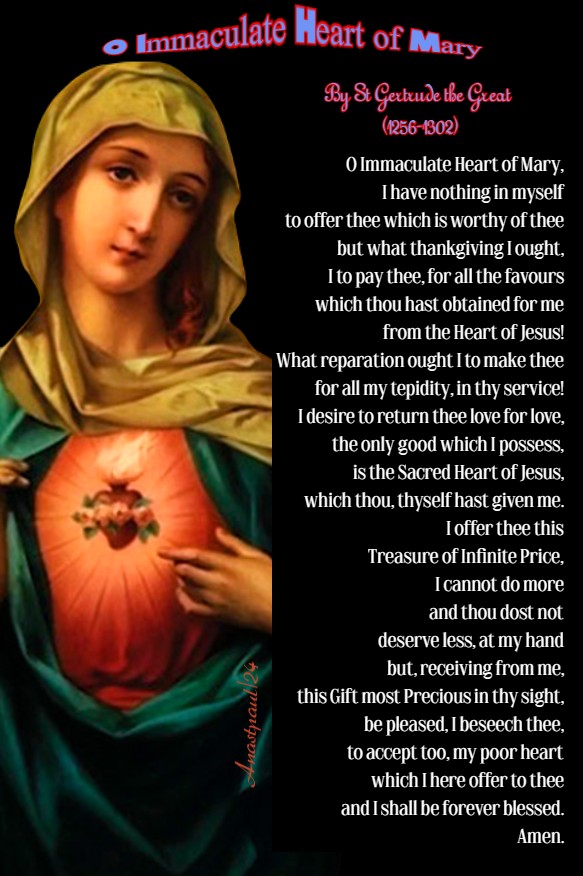
O Immaculate Heart of Mary By St Gertrude the Great (1256-1302)
O Immaculate Heart of Mary, I have nothing in myself to offer thee which is worthy of thee but what thanksgiving I ought I to pay thee, for all the favours which thou hast obtained for me from the Heart of Jesus! What reparation ought I to make thee for all my tepidity, in thy service! I desire to return thee love for love, the only good which I possess, is the Sacred Heart of Jesus, which thou, thyself hast given me. I offer thee this Treasure of Infinite Price, I cannot do more and thou dost not deserve less, at my hand but, receiving from me, this Gift most Precious in thy sight, be pleased, I beseech thee, to accept too, my poor heart which I here offer to thee and I shall be forever blessed. Amen.
Thought for the Day – 17 August – Meditations with Antonio Cardinal Bacci (1881-1971)
Mary, the Source of Holiness
“Since we are Mary’s children, we should try and reproduce her holiness in ourselves. Although, it is higher than that of the Angels, her sanctity is easy to imitate. There is no record that she ever had ecstasies or worked miracles. Her’s was a perfect internal sanctity, consisting of total conformity with the Will of God and an intense love for Him. We must aspire to this kind of holiness and model our lives upon it. There is no point in arguing that it is sufficient to be good Catholics and, that it is not necessary to be holy. A Catholic, to be truly such, MUST be holy!
St Paul referred to the early faithful as saints (Eph 1:1). “You are a chosen race,” said St Peter, “a royal priesthood, a holy nation, a purchased people,” (1 Peter 1:16, Lev 11:44) “You are to be perfect,” Jesus Himself had commanded, “even as your heavenly Father is perfect,” (Mt 5:48), This was the reason, He indicated why He had come into the world – “that they may have life and have it more abundantly” (Jn 10:10). This is the purpose of the Gospel and this must be the purpose of our lives. Some day, we shall either be holy in Heaven, or we shall be damned. We shall either be Saints in Heaven or condemned forever in Hell. This truth merits careful though – everything else is passing but this is something which will never pass away. This command to sanctify ourselves is a reality which is present at every moment of our lives. Let us do our best to obey it, at any cost!”
Quote/s of the Day – 17 August – “The Month of the Immaculate Heart of Mary” – St Hyacinth OP (1185-1257) ) Confessor – 1 Corinthians 12:2-11 – Luke 18:9-14 – Scripture search here: https://www.drbo.org/
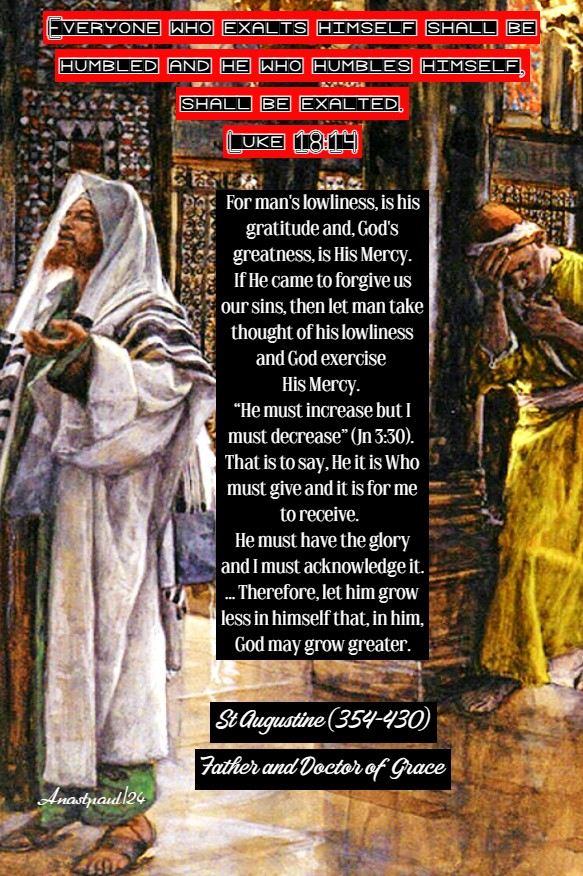
“Everyone who exalts himself shall be humbled and he who humbles himself, shall be exalted.”
Luke 18:14
“The one who requests less than he deserves from God will surely obtain more than he deserves. This is clearly shown by the tax-collector who requested forgiveness but obtained justification. And the thief merely requested to be remembered in His Kingdom but he inherited Paradise!”
St John Climacus (c525-606)
“The most perfect degree of humility is to take pleasure in contempt and humiliations. Contempt suffered patiently, is worth more before God, for love of Him, than a thousand fastings and disciplines.”
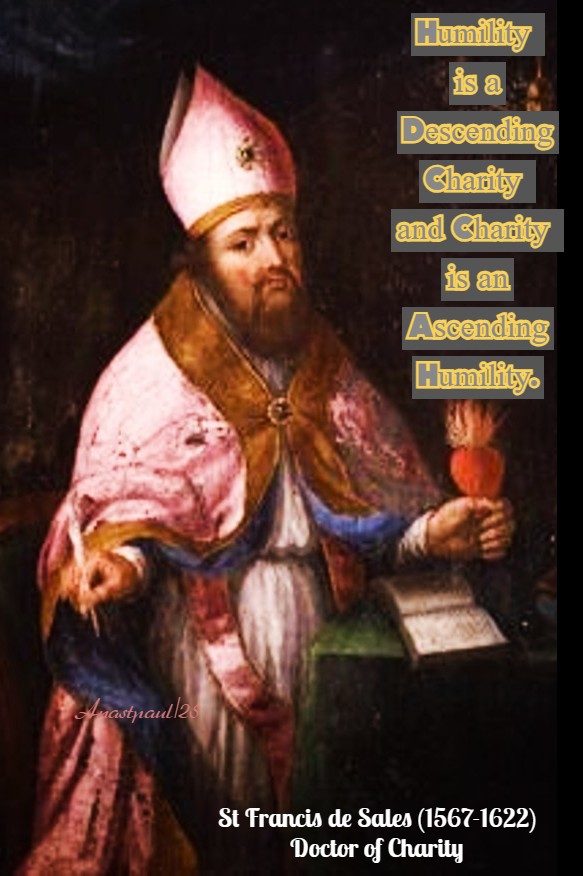
“Humility is a Descending Charity and Charity is an Ascending Humility.”
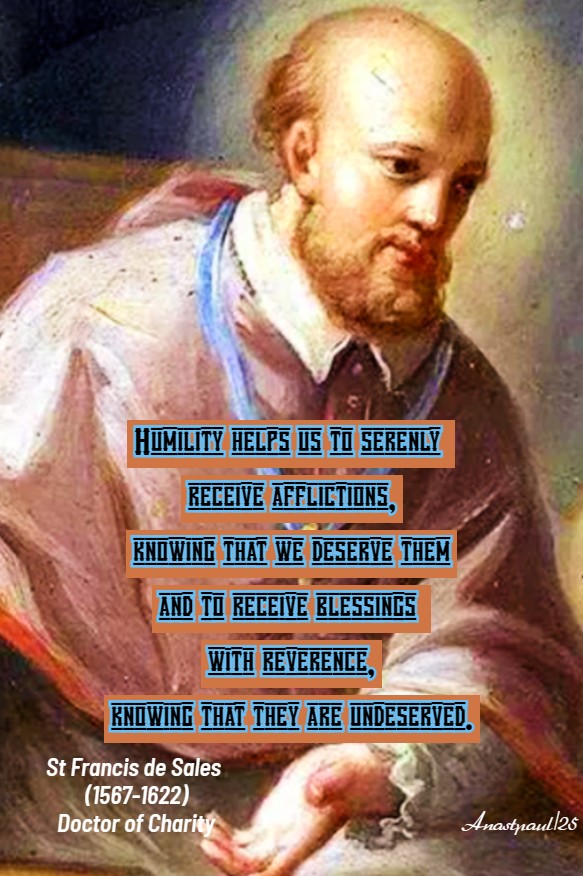
“Humility helps us to serenely receive afflictions, knowing that we deserve them and to receive blessings with reverence, knowing that they are undeserved.”
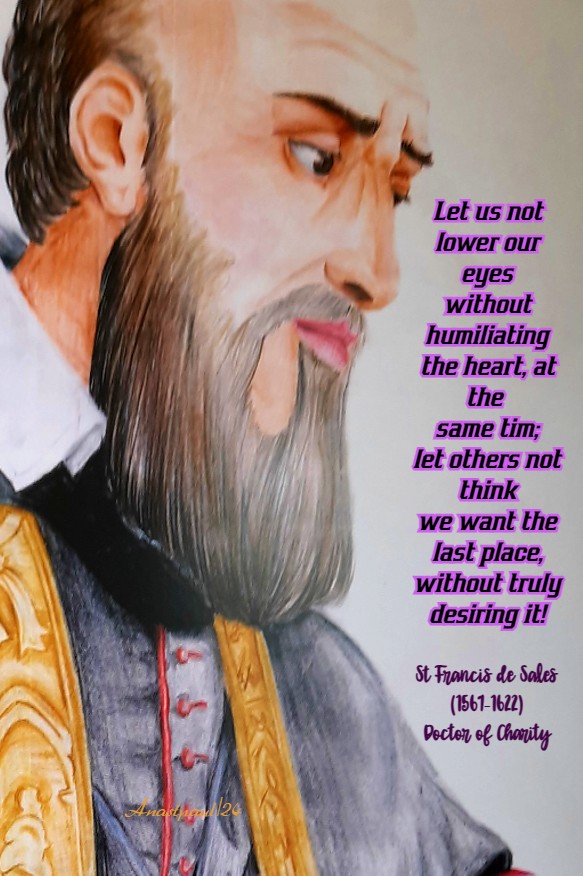
“Let us not lower our eyes without humiliating the heart , at the same time; let others not think we want the last place, without truly desiring it!”
“Humility makes our lives, acceptable to God, meekness, makes us acceptable to men.”
One Minute Reflection – 17 August – “The Month of the Immaculate Heart of Mary” – St Hyacinth OP (1185-1257) ) Confessor – 1 Corinthians 12:2-11 – Luke 18:9-14 – Scripture search here: https://www.drbo.org/
“Everyone who exalts himself shall be humbled and he who humbles himself, shall be exalted.” – Luke 18:14
REFLECTION – “Before the Lord Jesus’ coming, people drew all their glory from themselves. But He came as Man that the glory of man might grow less and the glory of God grow greater. For He came without sin and found us all to be sinners. If He came to lose our sins, it is because God is merciful, so let man take note of it. For man’s lowliness, is his gratitude and, God’s greatness, is His Mercy.
If He came to forgive us our sins, then let man take thought of his lowliness and God exercise His Mercy. “He must increase but I must decrease” (Jn 3:30). That is to say, He it is Who must give and it is for me to receive. He must have the glory and I must acknowledge it. Man should understand his place, let him acknowledge God and hear what the Apostle Paul says to the high-minded and proud man, who claims to be exalted: “What do you possess that you have not received? But if you have received it, why are you boasting as though you have not received it?” (1 Cor 4:7). So, let the man who would call his own that which is not his own, understand that he has received it and make himself small, for it is good for him that God should be glorified in him. Therefore, let him grow less in himself that, in him, God may grow greater.” – St Augustine (354-430) Father and Doctor of Grace (Sermons on Saint John’s Gospel 14:5)
PRAYER – God, Who gladden us with the annual feast of blessed Hyacinth, Thy Confessor, mercifully grant that, while honouring the anniversary of his death, we may also imitate his deeds. Through Jesus Christ, Thy Son our Lord, Who lives and reigns with Thee, in the unity of the Holy Ghost, God, world without end. Amen (Collect).































 AnaStpaul
You must be logged in to post a comment.