Passionate Catholic.
Being a Catholic is a way of life - a love affair "Religion must be like the air we breathe..."- St John Bosco
Prayer is what the world needs combined with the example of our lives which testify to the Light of Christ.
This site, which is now using the Traditional Calendar, will mainly concentrate on Daily Prayers, Novenas and the Memorials and Feast Days of our friends in Heaven, the Saints who went before us and the great blessings the Church provides in our Catholic Monthly Devotions.
This Site is placed under the Patronage of my many favourite Saints and especially, St Paul.
"For the Saints are sent to us by God
as so many sermons.
We do not use them, it is they who move us
and lead us, to where we had not expected to go.”
Charles Cardinal Journet (1891-1975)
This site adheres to the pre-Vatican II Catholic Church and all her teachings. .
PLEASE ADVISE ME OF ANY GLARING TYPOS etc - In June 2021 I lost 100% sight in my left eye and sometimes miss errors. Thank you and I pray all those who visit here will be abundantly blessed. Pax et bonum! 🙏
Our Morning Offering – 28 August – “The Month of the Immaculate Heart of Mary” – The Feast of St Augustine (354-430) – Bishop, Confessor, Father and Doctor of Grace
Blessed Virgin Mary, Holy Mary! By St Augustine (354-430) Father & Doctor of the Church
Blessed Virgin Mary, who can worthily repay thee with praise and thanksgiving for having rescued a fallen world by thy generous consent! Receive our gratitude and by thy prayers, obtain the pardon of our sins. Take our prayers into the sanctuary of Heaven and enable them to make our peace with God. Holy Mary, help the miserable, strengthen the discouraged, comfort the sorrowful, pray for thy people, plead for the clergy, intercede for all women consecrated to God. May all who venerate thee, feel now, thy help and protection. Be ready to help us when we pray and bring back to us, the answers to our prayers. Make it thy continual concern, to pray for the people of God, for thou were blessed by God and were made worthy to bear the Redeemer of the world, Who lives and reigns forever. Amen
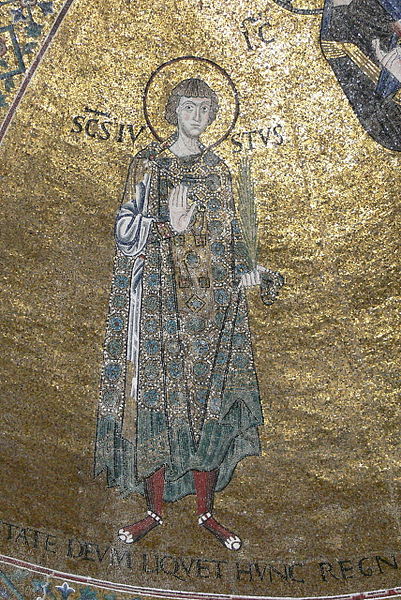
Saint of the Day – 28 August – St Julian of Auvergne (Died c304) Martyr. Born in Vienne, Dauphiny, Gaul (modern France) and died there by being beheaded. Patronages – against headaches, of Canons, Auvergne, Briounde, Baldissero Torinese, Italy and Barbania, Italy. Also known as – Julian of Brionde, Julian of Brioude, Julian of Briounde, Giuliano…
The Roman Martyrology reads today : “At Brioude, in Auvergne, St Julian, Martyr, during the persecution of Diocletian. Being the companion of the blessed tribune, Ferreol and secretly serving Christ under a military garb, he was arrested by the soldiers and killed in a barbarous manner by having his throat cut.”
Julian was a 4th Century Martyr from the Auvergne region of France. Although the main focus of his worship was in the small Village of Brioude, he was originally from the City of Vienne and also associated with Clermont. He was most famous through his association with an aristocratic family of Bishops of the time, his most notable proponents being St. Gallus of Clermont and St Gregory of Tours (the latter best known for his Ten Books of Histories). Gregory wrote a Vita of Julian.
Little is known of the life of St Julian. The persecution in Vienne, under the auspices of the Governor Crispinus (although this is disputed) forced him to leave the Town, as advised by his friend and fellow Saint, the Tribune Ferréol.
He also feared that his parents might prevent the Martyrdom he longed for. He hid in the house of a poor woman within the region of Clermont but upon hearing pagans nearby, he revealed himself and presented himself for execution.
Having decapitated the Saint, his executioners took his head to Vienne, leaving the body to be buried in Brioude by two old men, who received an invigorating miracle which made them feel young again thereafter.
His feast is usually kept on 28 August but in the Towns of his Patronage it is moved to 29 in order to avoid confliction with St Augustine.
Although the main focus of his cultus is in the small Village of Brioude, he was originally from the City of Vienne and also associated with Clermont. He was most famous through his familial association with an aristocratic family of Bishops of the time, His most notable proponents being St Gallus of Clermont and St Gregory of Tours (the latter best known for his Ten Books of Histories). St Gregory wrote a Vita of Julian.
In 543, Bishop Gallus instituted Rogations and the people of Clermont processed to the Church of St Julian at Brioude in order to seek his intercession against the plague which beset their City.
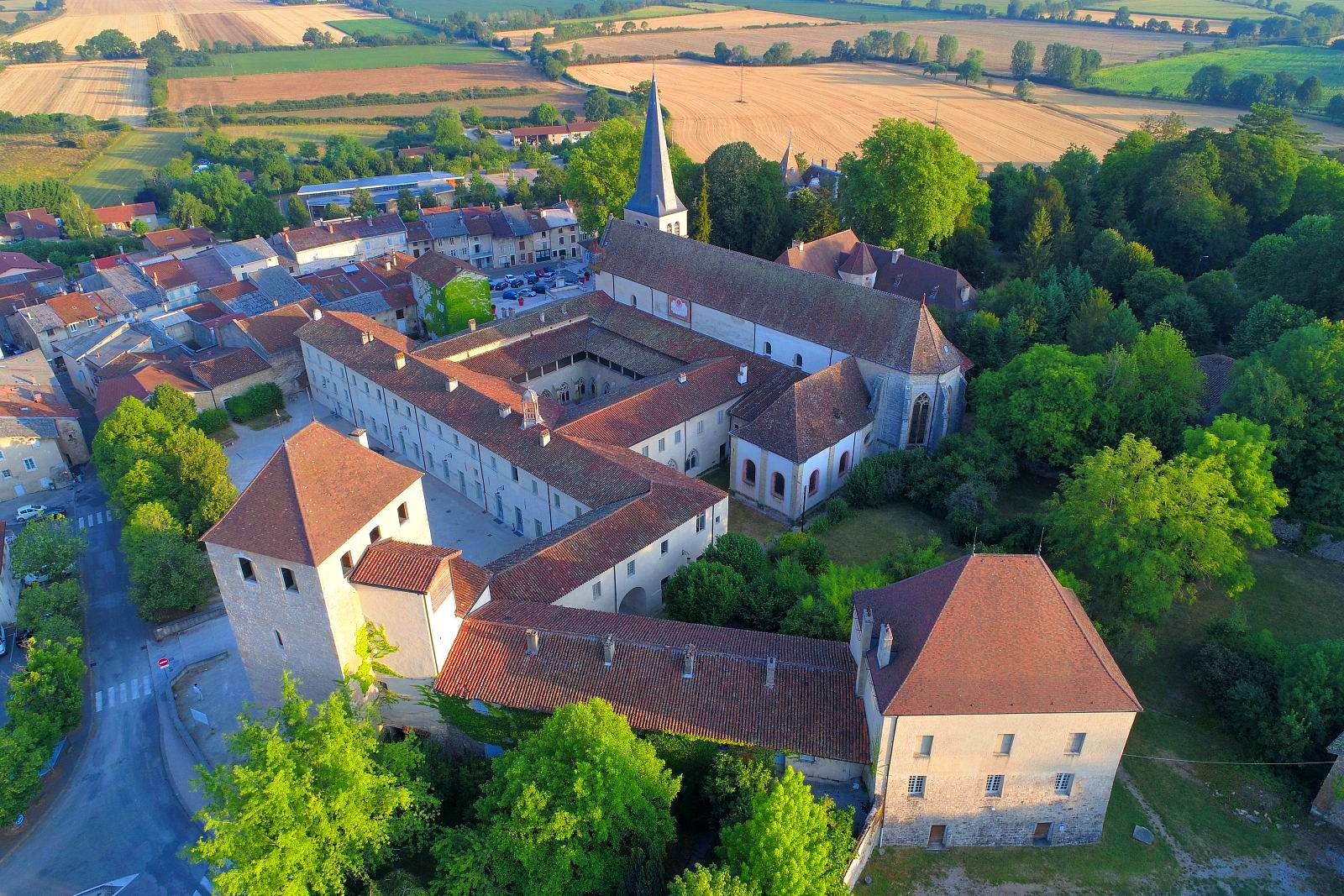
A Church was built over Julian’s Tomb which later became the Basilica of Saint-Julien de Brioude, the largest Romanesque in Auvergne, see below. The Feast of Saint Julian, celebrated in Brioude on 28 August, drew such crowds to the Saint’s Relics that in the mid-11th Century, the Chapter was obliged to build a hostel to care for the indigent pilgrim and the sick.
Very early on the site of Julian’s death also became a place of pilgrimage and a small Shrine was erected over the miraculous Fountain which had sprung up where he had been Martyred. In the Miracles of Julian, St Gregory of Tours tells of numerous instances of people cured by drinking water from the Fountain and there is a particularly large number of miracles attested to the cure of headaches. A Holy Mass is still celebrated near the Spring, on the Feast Fay of the Saint, during the Patronal celebrations of the Town.
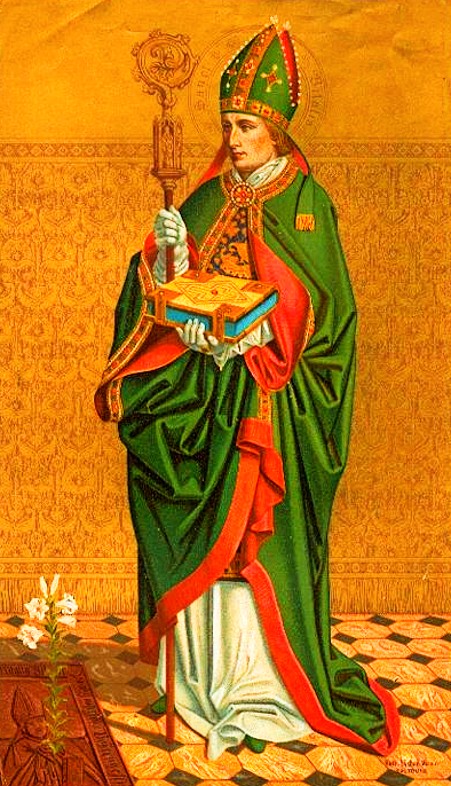
St Augustine (354-430) – Bishop of Hippo, Confessor, Doctor of Grace and one of the original Four Fathers & Doctors of the Latin Church, Theologian, Preacher, Writer a None of these titles, though accurate, would please him, however, as much as the simple one he used to describe himself: ‘Servant of God.’ For, whatever we achieve in life, whatever gifts and talents we have been given, are of little value unless they lead us, as they did Augustine, to know, love and serve God ever more deeply.
Thought for the Day – 27 August – Meditations with Saint Alphonsus Maria de Liguori (1696-1787) Bishop, Confessor, Most Zealous Doctor of the Church
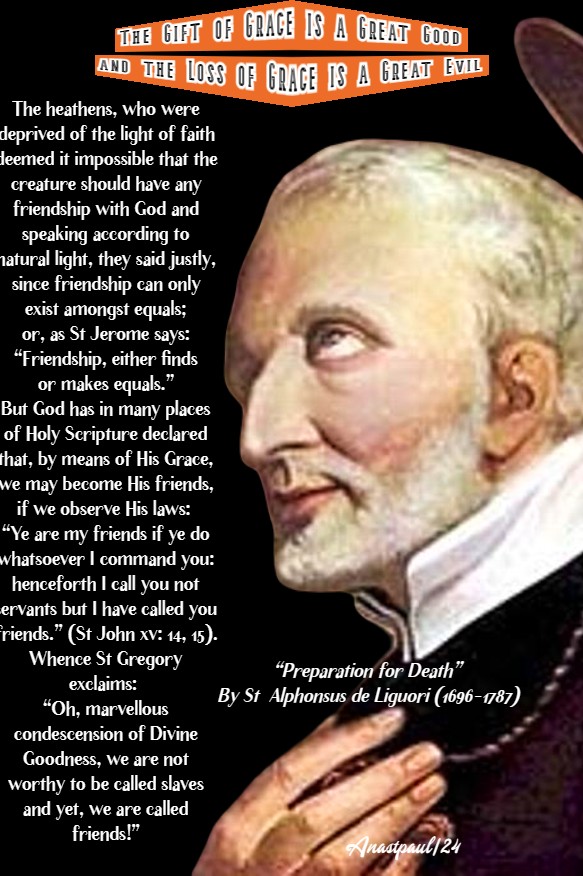
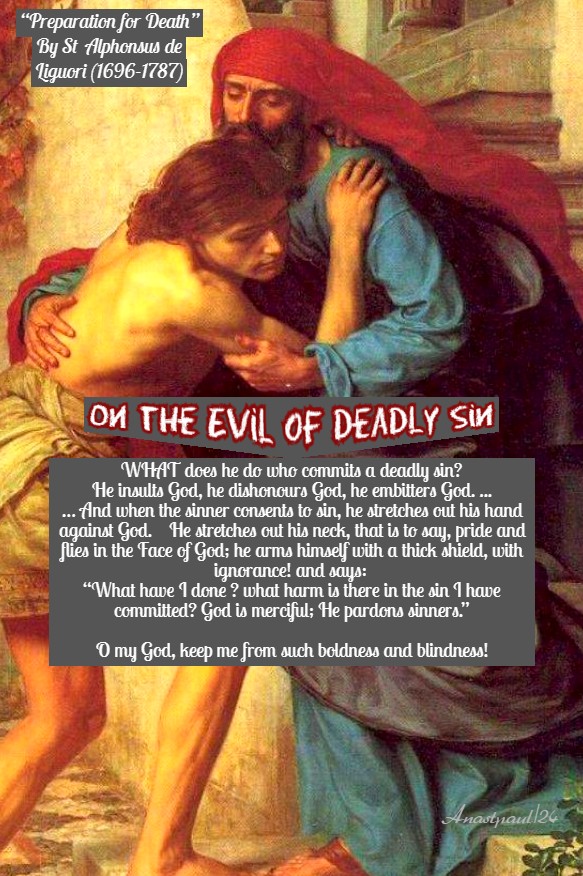
“Preparation for Death” By St Alphonsus Maria de Liguori (1696-1787)
CONSIDERATION I
“Dust thou art and unto dust shalt thou return.” (Gen iii:19)
SECOND POINT: In order more clearly to see what indeed thou art, my Christian soul, St John Chrysostom observes: “Go to a sepulchre, contemplate dust, ashes, worms and sigh.” See how that corpse becomes, at first yellow and then black. Afterwards, there is seen upon the body, a white and unpleasant mould. Then there issues forth a foul and corrupt matter which sinks into the ground. In that corruption many worms are generated which feed upon the flesh. The rats then come to feast upon the body, some on the outside, others entering into the mouth and bowels.
The cheeks, the lips and the hair fall in pieces; the ribs are the first to become bare of flesh, then the arms and the legs. The worms after, having consumed the flesh eat each other, and, in the end, nothing remains of that body but a fetid skeleton which, in course of time, is divided, the bones being separated and the head falling from the body, they “become like the chaff of the summer threshing-floors and the wind carried them away“ ” (Dan ii:35.)
Behold, then, what man is – a little dust upon a threshing-floor which is carried away by the wind! Behold that nobleman, who was considered to be the life and soul of society, where is he? Go into his room, he is not there; if you look into his bed, it belongs to another; his clothes, his arms, others have already taken and divided them. If you wish to see him, you must seek for him in that grave where he is changed into all that is unpleasant and into fleshless bones.
O my God, that that body fed with so many delicacies, clothed with so much pomp, attended by so many servants, should be reduced to this ! O ye Saints, ye, who for the love of that God, Whom ye loved alone, upon this earth, knew how to mortify your bodies and now, your bones are kept and prized as sacred relics in golden shrines and your souls which are beatified, rejoice in the presence of God, waiting for the final Day, when your bodies even, will again become the companions of your souls in glory, as they were once the companions of your souls, in bearing the cross of this world. This is the true love of the body, so to burden it with mortifications here, that it may be happy in eternity and to deny it those pleasures here which would render it unhappy in eternity.
Affections andPrayers
Behold, therefore, O my God, to what my body will become reduced, through which I have so often offended Thee, it will be reduced even to worms and corruption. But this does not grieve me, O my God, nay, it rather cheers me, for this my flesh to become putrid and consumed which made me lose Thee, O my Sovereign Good. But it does grieve me very much, to think that I should have taken so much delight in those wretched pleasures which have so often displeased Thee. But I will not distrust Thy Mercy. Thou hast waited for me to give me pardon. “Therefore will the Lord wait that He may be gracious unto thee.” (Isa xxx: 18) And Thou wilt pardon me if I repent. Yes, Thou wilt, for I do repent with all my heart for having despised Thee, O God of Infinite Goodness. I will repeat to Thee as did St Catherine of Genoa, “No more sins, my Jesus, no more sins.” No, I will no longer abuse Thy patience, neither will I wait to embrace Thee until the hour of death. O my Crucified Love, now will I embrace Thee, now will I commend my soul into Thy keeping. “Into Thy Hands, I commend my spirit.”
My soul has been many years in this world without loving Thee, give me light and strength to love Thee during the life which remains to me. I will not wait until the hour of death to love Thee, from this moment, 1 will love Thee and embrace Thee and unite myself to Thee and, I promise, never more to leave Thee.
Quote/s of the Day – 27 August – St Joseph Calasanz (1557-1648) Confessor, Priest
“If, from the very earliest years, a child is instructed in both religion and letters, it can be reasonably hoped that his life will be happy.”
“Like the saplings of plants, the young are easily influenced, as long as someone works to teach their souls. But if they are allowed to grow hard, we know well that the possibility of one day bending them, diminishes a great deal and is sometimes utterly lost.”
“LOVE is the only way to HEAVEN.”
“Keep, O Lord, my heart at peace, always close to Thee. Thou Who calms the wild waves of the sea.”
One Minute Reflection – 27 August – “The Month of the Immaculate Heart of Mary” – St Joseph Calasanz (1557-1648) Confessor, Priest –Wisdom 10:10-14; Matthew 18:1-5 – Scripture search here: https://www.drbo.org/
“And whoever receives one such little child for My sake, receives Me.” – Matthew 18:5
REFLECTION – “Could God not have made the human person perfect right from the beginning? For God, Who has always been identical with Himself and Who is not created, everything is possible. But because the existence of the created beings began after God’s, they are necessarily inferior to God, Who made them … Thus, since they are created, they are not perfect. When they have just been born, they are small children and as small children, they are neither accustomed to, nor have they had practice in, perfect conduct … Thus, God could give perfection to the human person right from the beginning but, the human person was incapable of receiving this perfection, for he was only a small child.
And that is why, in the last times, when our Lord gathered up all things in Himself (Eph 1:10), He came to us, not in His power but, in such a way, we were able to see Him. For He could have come to us in His inexpressible glory but, we were not yet able to bear the greatness of His glory. … Although the Word of God was perfect, with humankind He became a small Child, not for Himself but because of the state of childhood, in which was humankind.” – St Irenaeus (c130-202) Bishop of Lyons, Martyr, Father of the Church (Against the Heresies IV 38, 1-2).
PRAYER – O God, Who through St Joseph, Thy Confessor, did graciously will to provide Thy Church with a new method for the training of youth, in the spirit of understanding and holiness grant, we beseech Thee, that, following his example and through his intercession, we may live and teach so as to acquire an everlasting reward. Through esus Christ, Thy Son our Lord, Who lives and reigns with Thee, in the unity of the Holy Ghost, God, world without end. Amen (Collect).
Morning Prayer To Be Conformed to the Divine Will Unknown Author Breviary Prayer
Most Holy Trinity, Godhead IndIvisible, Father, Son and Holy Ghost, our first beginning and our last end, Thou hast made us in accord with Thine Own Image and likeness.
Grant that all the thoughts of our minds, all the words of our tongues, all the affections of our hearts and all the actions of our being may always be conformed to Thine Holy Will.
So may we, having seen Thee veiled in appearance here below, by means of faith, come at last to contemplate Thee face-to-face, in the perfect possession of Thee, forever in Heaven. Amen
Saint of the Day – 27 August – Saint Narnus of Bergamo (Died c345) Bishop and Confessor, of Bergamo which is a suffragan of the Archdiocese of Milan. Died in c345 in Bergamo, Italy of natural causes. Additional Memorial – 15 January in Bergamo. Also known as – Narno.
The Roman Martyrology reads today: “At Bergamo, St Narnus, who was Baptised by the blessed Barnabas and Consecrated by him as the first Bishop of that City.”
Narnus is venerated as the 1st Bishop of Bergamo. Christian tradition holds that he was Consecrated during the Apostolic Age by St Barnabas, although Narnus probably lived later than that.
The oldest source which mentions Narnus is from the 13th Century and was written by Brother Branca da Gandino, a Friar. He considers Narnus a Bishop of Bergamo. He probably held the Episcopal Office towards the middle of the 4th Century, according to some scholars in the years 334-345 and they also affirm that it was St Ambrose, who consecrated him as the 3rd Bishop of Bergamo.
The place of his birth is uncertain, some say Castione, some Ogna, some Villa d’Ogna but the consensus is Ogna (Bergamo). It is believed that he built the primitive Alexandrian Basilica, of which St Grata was the promoter.
He died in his seat of Bergamo, towards 345 or around 375 (?) and was buried four metres deep from the choir, in the Crypt of the ancient Alexandrian Church which was the ‘martyrium’ of St Alessandro and, at the same time, a Cathedral and there, he was honoured with an Altar and venerated every year with solemn liturgies.
In 1561, the ancient Basilica of St Alessandro had to be demolished and the Relics of St Narnus, together with those of his successor St Viatore and other Saints, were transferred to the Church of St Vincenzo, today’s Cathedral of ST Alessandro, where they are still venerated. During these works, an ancient Tombstone was found which indicated the place where both St Narnus and St Viatore were buried, in Latin: “episcopus Narnus Christi Confessor” that is, St Narnus has the title of ‘Confessor’ which, in ancient times, also included Martyrs, it is thought that perhaps he had suffered mistreatment in his youth, during the persecution of Diocletian.
Bergamo St Alexander Cathedral – a magnificent art-encrusted interior
In the following centuries there were four other recognitions of the Relics; in a calendar of the 11th Century and in one of the 13th Century, owned by the Monastery of St Grata, the Feast of St Narnus is placed on 27 August, a date which was then passed into other ‘Catalogs’ and also into the Roman Martyrology.
On the figure of the Bishop of Bergamo, there is a vast bibliography, as well as a discrete ancient iconography. In the Diocese of Bergamo, his memory is celebrated on 15 January.
Bergamo Cathedral an astoundingly beautiful Cathedral both inside and out
Feast of the Seven Joys of Our Lady – This Feast is also known as “The Franciscan Crown,” The Seven Joys of the Virgin. Today was kept by the Franciscans as the Feast of the Seven Joys of the Virgin Mary. As an expression of the Seraphic Order’s devotional life, it corresponds to the Feast of the Holy Rosary, which began among the Dominicans and the observance on 15 September of the Seven Sorrows of the Virgin, https://anastpaul.com/2022/08/27/27-august-feast-of-the-seven-joys-of-our-lady-the-franciscan-crown/
St Agilo of Sithin St Angelus of Foligno St Anthusa the Younger St Arontius of Potenza St Baculus of Sorrento St Carpophorus St David Lewis St Decuman St Ebbo of Sens St Etherius of Lyons St Euthalia of Leontini St Fortunatus of Potenza
St Gebhard of Constance St Giovanni of Pavia St Honoratus of Potenza St John of Pavia St Licerius of Couserans St Malrubius of Merns St Narnus of Bergamo (Died c345) Bishopand Confessor St Phanurius St Poemen Bl Roger Cadwallador St Rufus of Capua St Sabinian of Potenza St Syagrius of Autun
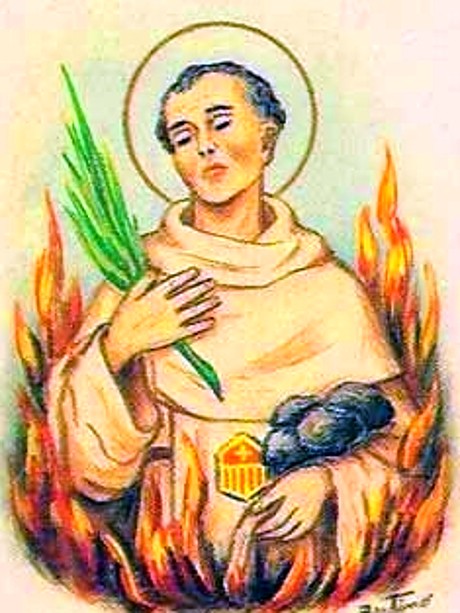
Martyrs of Tomi – 5 Saints: A group of 17 Christians imprisoned and excuted for their faith during the persecutions of Diocletian. They miraculously were unburned by fire and untouched by wild animals. We know the names and a few details on five of them – John, Mannea, Marcellinus, Peter and Serapion. They were tied to stakes and burned alive; they emerged unharmed – thrown to wild animals in the amphitheatre; the animals ignored them; they were beheaded in 304 in Tomi, Mesia (modern Costanza, Romania).
Martyrs of Nagasaki – 14 Beati: A group of fourteen missionaries and Japanese native Christians, who were Martyred together for their faith. They died on 16 August 1627 in Nagasaki, Japan and were Beatified on 7 May 1867 by Pope Pius IX. They are – Blessed Antonius of Saint Francis, Blessed Bartolomé Díaz Laurel, Blessed Caius Akashi Jiemon, Blessed Francisca Pinzokere, Blessed Francisco of Saint Mary, Blessed Franciscus Kuhyoe, Blessed Leo Kurobyoe Nakamura, Blessed Lucas Tsuji Kyuemon, Blessed Ludovicus Matsuo Soyemon, Blessed Magdalena Kiyota, Blessed Maria Shobyoe, Blessed Michaël Koga Kizayemon, Blessed Thomas Sato Shin’emon, Blessed Tsuji Shobyoe.
Thought for the Day – 26 August – Meditations with Saint Alphonsus Maria de Liguori (1696-1787) Bishop, Confessor, Most Zealous Doctor of the Church
“Preparation for Death” By St Alphonsus Maria de Liguori (1696-1787)
CONSIDERATION I
“Dust thou art and unto dust shalt thou return.” (Gen iii:19)
FIRST POINT: CONSIDERthat thou art dust and unto dust thou must return. The day will come when thou must die,and be placed in a grave where “the worms” shall “cover thee” (Isa xiv). The same fate awaits all, both nobles and plebeians, both princes and vassals. Directly the soul shall leave the body, with the last gasp, it will go into eternity and the body will return to its dust. “When Thou takest away their breath, they die and are turned again to their dust.” (Ps civ: 29). Imagine to yourself a person, whose soul has just departed. Behold that pale corpse which is still upon the bed, the head fallen upon the breast; the hair dishevelled and bathed in the sweat of death; the eyes sunken; the cheeks hollow; the face of ashy paleness; the tongue and the lips of a leaden hue; the body cold and heavy. Those who see it grow pale and tremble. How many there are who, upon seeing a relation or friend, in this condition, have changed their life and have left the world!
But still more dreadful, is it when the body begins to decay. A few hours or days will hardly have passed, ere it will become offensive. The windows will have to be opened; incense will have to be burned nay, it must be sent in haste to the Church to be buried, that the whole house be not infected. Behold to what that proud, that voluptuous man is reduced? In life he was the favourite, the one who was sought-after in society; now, he makes all those who look upon him shudder. His relatives hasten to have him removed from the house and men are hired to bear him, shut up in a coffin, to his grave. He was once famous for his great talent, for his great politeness, for his courteous behaviour and for his facetiousness but now that he is dead, his memory will soon pass away: “their memorial is perished with them.” (Ps ix: 6).
Upon hearing the news of his death, some people say he was of great dignity others that he left his family well-provided for; some grieve because he had done them good and others rejoice because they derive some benefit from his death. Within a short time, however, he is spoken of by no-one. And his nearest relatives, even from the hour of his death, will not hear him mentioned, lest their grief should be renewed. When the visits of condolence are made, other things form the subject of conversation and if anyone, by chance, alludes to the departed one, the relatives immediately exclaim: “In kindness, do not mention him to me.” You must consider that what you have done at the death of your friends and relations, others will do at your death too!.
Those who are living, enter upon the stage of life, to occupy the wealth and the position of the dead and little, or no esteem, is paid to the dead and very little mention is ever made of them. Your relatives will, at first, mourn for you for some days but they will soon be consoled with that share of property which will fall to them, so that they will shortly rejoice because of your death and, in the same room in which your soul has gone forth, to be judged by Jesus Christ, they will dance and eat, laugh and play, as they did before and your soul, where will it be then?
Affections and Prayers
Jesus, my Redeemer, I thank Thee that Thou didst not let me die when I was in disgrace with Thee. During how many of the past years have I not deserved to be cast into hell? If I had died on such a day, or on such a night, what would have become of me for all eternity? I thank Thee for this, O my God. I accept my death as a satisfaction for my sins and I accept it in whatever manner it may please Thee to send it to me. But since Thou hast waited for me until now, wait for me yet a little longer. “Let me alone that I may take comfort a little.” (Job x 20). Give me time to weep over the offences which I have committed against Thee, before Thou comest to judge me. 1 will no longer resist Thy sweet Voice which calls me. Perhaps these words which I have just read may be the last call for me. I confess, I do not deserve pity, for Thou hast so often pardoned me and I, ungrateful one who I am, have again offended Thee but “a broken and contrite heart, O God, shalt Thou not despise.” (Ps li: 17). O Lord, since Thou wilt not despise a broken and contrite heart, look upon a traitor, who being repentant, flees unto Thee. “Cast me not away from Thy Presence.” (Ps li: 11). In mercy, do not cast me from Thee, for Thou hast said, “Him that cometh to Me I shall in no wise cast out.” (St John vi: 37). It is true that I have offended Thee more than many others because I have been favoured by Thee with light and grace but, the blood which Thou hast shed for me, gives me courage and gives me pardon, if only I repent. Yes, O my Sovereign Good, I do repent with my whole heart for having despised Thee. Pardon me and give me grace to love Thee for the time to come. I have offended Thee too many times already. I will not spend the life which remains to me, O my Jesus, in giving Thee offence but, I will spend it ever weeping over the displeasure I have caused Thee and in loving Thee with all my heart, Thou, O God, Who art so worthy of infinite love.
Quote/s of the Day – 26 August – “The Month of the Immaculate Heart of Mary” and the Feast of Our Lady of Czestochowa, Queen of Poland
O Pure and Immaculate Blessed Virgin By St Ephrem (306-373) Father and Doctor of the Church
O Pure and Immaculate and likewise Blessed Virgin, who art the sinless Mother of thy Son, the mighty Lord of the universe, thou who art inviolate and altogether holy, the hope of the hopeless and sinful, we sing thy praises. We bless thee, as full of every grace, thou who didst bear the God-Man: we bow low before thee; we invoke thee and implore thine aid. Rescue us, O holy and inviolate Virgin, from every necessity that presses upon us and from all the temptations of the devil. Be our intercessor and advocate at the hour of death and judgement, deliver us from the fire that is not extinguished and from the outer darkness; make us worthy of the glory of thy Son, O dearest and most clement Virgin Mother. Thou indeed art our only hope most sure and sacred in God’s sight, to Whom be honour and glory and majesty and dominion forever and ever, world without end. Amen
St Ephrem (306-373) Father and Doctor of the Church
“You have guarded the integrity of the temple [of your body]; you have kept your tabernacle free from all sin, so that the Father becomes your guest, the Holy Ghost overshadows you and the Only-begotten Son Incarnate is born of you.”
St Hesychius of Jerusalem (Died c450) Priest, Exegete, Father
“O Mother blest! And chosen Shrine wherein the Architect Divine, Whose Hand contains the earth and sky vouchsafed in hidden guise to lie; Blest in the message Gabriel brought; blest in the work, the Spirit wrought; Most blest, to bring to human birth, the long desired of all the earth!”
St Venantius Fortunatus (c530 – c609) Bishop, Poet, Theologian, Father
“It is through the most Blessed Virgin Mary that Jesus Christ came into the world and, it is also through her that He will reign in the world.”
One Minute Reflection – 26 August – “The Month of the Immaculate Heart of Mary” – St Pope Zephyrinus (Died 217) Martyr and Our Lady of Czestochowa, Queen of Poland – 1 Peter 5:1-4; 5:10-11; Matthew 16:13-19 – – Scripture search here: https://www.drbo.org/
“Whatsoever thou shalt bind upon earth, it shall be bound also in Heaven and whatsoever thou shalt loose on earth, it shall be loosed also in Heaven.” – Matthew 16:19
REFLECTION – “Bridegroom and Bride, that is, Christ and the Church, are as one, be it in receiving Confession or in bestowing Absolution. All this makes clear why Christ had to tell each of us: “Go, show yourself to the priest” (Mt 8:4) … It follows that apart from Christ, the Church cannot grant forgiveness and that Christ has no will to forgive, apart from the Church. The Church’s authority to forgive extends only to the repentant, to those, that is, whom Christ has already touched; Christ, on His part, has no intention of regarding, as forgiven, one who despises the Church!
Doubtless, Christ need accept no restraints to His power of Baptising, Consecrating the Eucharist, Ordaining Priests, forgiving sins and the like but, the humble and faithful Bridegroom, prefers to confer such blessings, with the co-operation of His Bride. “What God,” then, “has joined, let no man put asunder” (Mt 19:6). “I say this is a great Mystery and refers to Christ and the Church” (Eph 5:32) … To remove the Head from the Body (Col 1:18) were to ruin the whole Christ, irreparably. Christ, apart from the Church, is no more the whole Christ, than the Church is complete, if separated from Christ. Head and Body go to make the whole and entire Christ.” – Bl Isaac of Stella (c 1100 – c 1170) Cistercian Monk, Abbot, Theologian, Philosopher (Sermon 11, §11-814).
PRAYER – Grant us, Thy servants, O Lord God, we beseech Thee, to enjoy lasting health of mind and body and, by the intercession of the glorious and blessed Mary, ever Virgin, may we be delivered from present sorrow and partake to the full of eternal happiness.ThroughJesus Christ, Thy Son our Lord, Who lives and reigns with Thee, in the unity of the Holy Ghost, God, world without end. Amen (Collect).
Our Morning Offering – 26 August – “The Month of the Immaculate Heart of Mary” and the Feast of Our Lady of Czestochowa, Queen of Poland
Most Holy Virgin, My Consolation By St Germanus of Paris (c490-576)
Most Holy Virgin! Who art the greatest consolation which I receive from God, thou, who art the heavenly dew which assuages all my pains, thou, who art the light of my soul when it is enveloped in darkness, thou, who art my guide in unknown paths, the support of my weakness, my treasure, in poverty, my remedy, in sickness, my consolation, in trouble, my refuge, in misery, and the hope of my salvation, hear my supplications, have pity on me, as becomes the Mother of so good a God and obtain for me a favourable reception of all my petitions at the throne of mercy. Amen
Saint of the Day – 26 August – Saint Bregwin of Canterbury (Died 764) Archbishop of Canterbury, Defender of the rights of the Church against secular powers. Born in Saxony, in modern Germany and died in 764 of natural causes. Also known as – Bregwine, Bregowine.
Bregwin was the 13th Archbishop of Canterbury, holding that See from 759 until his death in 764. Little is known of the history of Bregwin prior to receiving the Pallium and being Consecrated by the hands of Pope St Paul I in 761.
Some traditions hold that he was a German Saxon Lord who was converted by St Theodore of Tarsus. Most of what we know of Bregwin is taken from charters and official documents of the See of Canterbury fduring his reign.
The surviving documents reveal a Church under pressure from the land-hungry petty Kings surrounding Canterbury. A surviving letter written by Bregwin in 760 to the Bishop of Mainz, St Lullius, shows him protesting the confiscating of a Church and its property by King Cynewulf of Wessex. Another charter reveals what appears to be a compulsory “donation” of land from the See of Canterbury to Aethelbert II of Kent. Biographies written after Bregwin’s death suggest that the saint was beholden to Aethelbert II for his position and the King demanded much of him.
The year of Bregwin’s death, the lands around Kent came under the domination of the Mercians and their powerful King Offa, who would split the Diocese of Canterbury in order to weaken its power. In all this, Bregwie comes across as a saintly shepherd who defended the rights of the Church and of course, in particular of his See.
According to Bregwin’s 12th Century chronicler Eadmer, Bregwin convened a Synod during his Episcopacy. Some of his letters to St Lullus (c710-786) the Bishop of Mainz in Germany, (he was an English missionary to Germany) still exist which reference a visit to Rome sometime during his Episcopacy.
The manner of St Bregwin’s death is unknown but he was venerated all over England as a Saint by the mid-12th Century. He was buried in the Chapel of Saint John the Baptist, east end of Canterbury Cathedral.
Our Lady of Czestochowa, Queen of Poland – Our Lady of Czestochowa is a revered icon of the Virgin Mary housed at the Jasna Góra Monastery in Częstochowa, Poland. Several Pontiffs have recognised the venerated icon, beginning with Pope Clement XI who issued a Canonical Coronation to the image on 8 September 1717 via the Vatican Chapter. Patron of Poland. According to tradition, the Icon of Jasna Góra (Bright Mountain) was painted by St Luke the Evangelist on a tabletop built by Jesus Himself and the Icon was discovered by St Helen, mother of Emperor Constantine and collector of Christian Relics, in the Holy Land. Visit our Mother here: https://anastpaul.wordpress.com/2017/08/26/blessed-feast-of-our-lady-of-czestochowa-queen-of-poland-26-august/
St Bregwin of Canterbury (Died 764) Archbishop of Canterbury St Elias of Syracuse St Eleutherius of Auxerre St Felix of Pistoia Bl Herluin Bl Ioachim Watanabe Jirozaemon St Irenaeus of Rome
St Jeanne Elisabeth des Bichier des Anges FC (1773-1838) (commonly referred to as St Elisabeth Bichier) and known as “the Good Sister” – Religious and co-Founder with Saint André Hubert Fournet – [After the approval of 2 miracles, he was Beatified on 16 May 1926 by Pope Pius XI and Canonised on June 1933 by the same Pope, after a further 2 miracles.](whom we celebrate on 13 May –https://anastpaul.com/2020/05/13/saint-of-the-day-13-may-saint-andre-hubert-fournet-1752-1834-the-good-father/) of the Sisters of the Cross, Sisters of St Andrew, a religious congregation which was established for the care of the poor and the instruction of rural children in the Diocese of Poitiers in 1807. She also helped to inspire the founding of a community of Priests dedicated to Missionary service, the St Elisabeth died in 1838, at which time there were about 600 Daughters of the Cross serving in some 100 communities. She was Beatified by Pope Pius XI in 1934 and Canonised by Pope Pius XII in 1947. Biography: https://anastpaul.com/2020/08/26/saint-of-the-day-26-august-saint-jeanne-elisabeth-des-bichier-des-anges-fc-1773-1838/
St Jean Bassano St Jean of Caramola Bl Juan Urgel Bl Margaret of Faenza St Maximilian of Rome St Melchizedek the Patriarch St Orontius of Lecce St Pandwyna St Rufinus of Capua St Secundus the Theban St Victor of Caesarea St Victor the Martyr St Vyevain of York
Martyrs of Celano – 3 Saints: Three Christians, Constantius, Simplicius and Victorinus, Martyred in the same area at roughly the same time. They were Martyred in c 159 in the Marsica region of Italy. At some point their relics were interred under the main Altar of the San Giovanni Vecchio Church in the Collegiata di Celano and were authenticated in 1057 by Pope Stephen IX. The city was depopulated in 1222; when it was re-built, the relics were re-enshrined in the Church.
Thought for the Day – 25 August – Meditations with Saint Alphonsus Maria de Liguori (1696-1787) Bishop, Confessor, Most Zealous Doctor of the Church
“Preparation for Death” By St Alphonsus Maria de Liguori (1696-1787)
PREFACE Part Three (Final)
Perhaps, with its cares and pleasures, the world is occu- pying too large a portion of our time and thoughts. The “Consideration” upon its vanity (Chapter xiii.) will teach us, in the first place, to care chiefly for those things which we can carry away with us after death, to endeavour to gain eternal possessions. In the second place, to weigh the things of time against those of eternity and to mark their lightness. In the third place, to contrast time with eternity and so, to become “Consideration” rich toward God.”
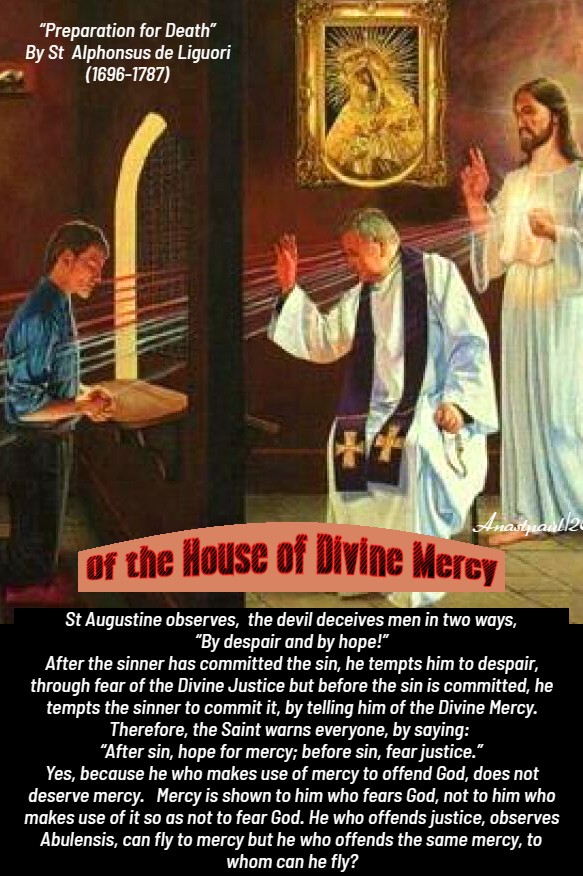
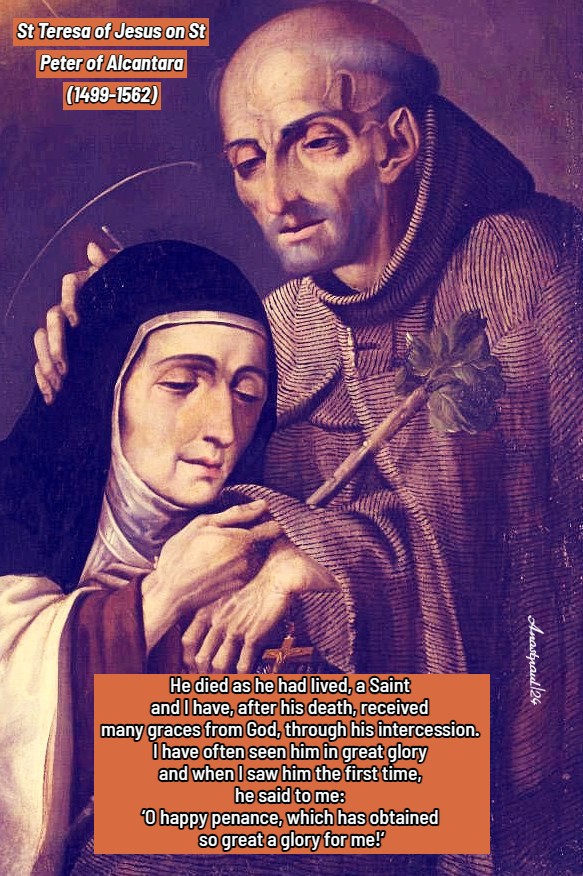
Each “Consideration” opens three points for meditation and to each of these, is added an “Affection” and a “Prayer.”
The “Consideration” employ the mind, the “Affection” excites the heart; they awake in us those emotions by which it seeks to unite itself with God. It is that “affectus orationis” of which St Fulgentius makes mention. The affection is kindled by consideration and the consideration is supplemented by the affection; neither can afford to be separated the one from the other. Whilst the “Consideration” sets forth death as the end of toil, the “Affection” urges the soul to anticipate it, to ask Heaven of Jesus, not that it may enjoy itself the more but that, it may love Him the more. The former bids us look at the consummation of our victory, the latter expresses such love, that it longs quickly to die, if such be the will of Jesus. Better far to die and so to be delivered from the danger of losing grace and from the fear of love ever growing cold! …
… This brief explanation of the plan upon which this book has been written, naturally leads to some suggestions as to its use. And, firstly, it maybe remarked, that only one “Consideration” should be read at the same time. In many cases one point even, with its “Affections and Prayers” will afford sufficient employment both for the head and heart.
It must be remembered that the book is intended to be suggestive merely, not final or ample. It presents a skeleton which the devout reader is to clothe with flesh and blood and animate with the life of his own spirit. – It is an outline, the details of the picture being left to the reader to complete.
Quote/s of the Day – 25 August – St Louis IX (1214-1270) King and Confessor
When the Tartars spread desolation and terror throughout Hungary, Poland and Bohemia, King Louis’ Mother, Queen Blanche expressed her fears but St Louis, calmly viewed the situation:
“Madame, what have we to fear? If these barbarians come to us, we shall either conquer or, shall die Martyrs.”
The instructions which St Louis gave to the heir of his crown and which, he had constantly observed himself, testify to his great devotion and holiness. These were the last admonitions of the Holy King:
Love God, the Almighty, above all else.
Flee sin more quickly than you would a serpent.
Become not fainthearted, in adversity.
Become not elevated, in the days of prosperity.
Show the wounds of your soul frequently, to your spiritual physician and refuse no remedies, however bitter, to heal them.
Pray diligently.
Be compassionate and generous to the poor.
If your mind is harassed with doubt, consult a devout man.
Keep faithful and pious counsellors around you and dismiss those who are wicked.
All that is good hold fast: all that is bad discard.
Lend a willing ear to those who speak of God.
Listen not to calumniators and slanderers.
So long as you reign, leave not unpunished those who blaspheme God and the Saints.
First be grateful to God, then to men.
Love and protect justice and neither neglect nor despise, the complaints of the needy.
In your own affairs, when they are not perfectly clear, speak and act against yourself.
Refund immediately the possessions of others.
Protect the clergy.
Love and honour your parents.
If you are obliged to war against Christians, spare the Churches and the Convents.
Endeavour to terminate all contentions with kindness.
Guard all your officials with a watchful eye.
Ever show due reverence to the Pope.
Overstep not the bounds of moderation in your expenses.
When I have departed, let prayers and Masses be said for the repose of my soul.
O God, We Love Thee Prayer inspired by St Louis’ Last Instructions to his Eldest Son, Philip (Perhaps Philip prayed thus)
O God, we love Thee. We wish to do nothing to displease Thee. If we have troubles, let us thank Thee. If we do not, we also humbly thank Thee. Let us pray diligently and be compassionate and generous to the poor. May we hold fast all that is good and all that is bad, discard. We thank Thee for friends, who help us bear our burdens and help us grow in holiness. Let us turn away from calumniators and slanderers and lend a willing ear to those who speak of God. Let us always do what is right and just for those we serve and promote peace among our neighbours. Let us be quick to defend our Faith. O Holy Lord, all Thy holy Saints, defend us from all evils. Grant us Thy grace to fulfil always, Thy Holy Will, so that Thou may be glorified and honoured and so we may be with Thee forever. Amen
One Minute Reflection – 25 August – “The Month of the Immaculate Heart of Mary” – St Louis IX (1214-1270) King and Confessor – Pemtecost XIV – Galatians l 5:16-24; Matthew 6:24-33 – Scripture search here: https://www.drbo.org/
“No man can serve two masters …” – Matthew 6:24
REFLECTION – “I firmly believe that you know the Kingdom of Heaven is promised and given, by the Lord, only to the poor (cf Mt 5:3) because, she who loves what is temporal, loses the fruit of love.
It is not possible to serve God and mammon, for either the one is loved and the other hated, or the one is served and the other despised; one clothed cannot fight another naked because she who has something to be caught hold of, is more quickly thrown to the ground: someone who lives in the glory of earth, cannot rule with Christ; it is easier for a camel to pass through the eye of a needle, than for a rich person to enter the Kingdom of Heaven (cf Mt 6:24).
Therefore, you have cast aside your garments, that is, earthly riches, so that instead of being overcome, by the one fighting against you, you will be able to enter the Kingdom of Heaven through the straight path and the narrow gate (cf Mt 7:13-14).” – St Clare OSC (1193-1252) Foundress of the Poor Clares (1st Letter to Saint Agnes of Prague 25-29).
PRAYER – O God, Who transported Thy blessed Confessor Louis from an earthly throne to the glory of the heavenly Kingdom, by his merits and intercession we beseech Thee, to make us of the company of the King of kings, Jesus Christ Thy Son. Who lives and reigns with Thee, in the unity of the Holy Ghost, God, world without end. Amen (Collect).
Saint of the Day – 25 August – St Patricia of Naples (7th Century) Virgin, Consecrated as a Religious Sister, Pilgrim. Born in Constantinople (modern Istanbul, Turkey) and died in c665 at Naples, Italy of natural causes. Patronage – of Naples, one of a long list of Patron Saints of Naples. St Patricia is less well known than St Januarius, also a Patron Saint of the City, who attracts crowds to Naples Cathedral three times a year to witness the miracle of a small sample of his blood turning to liquid but St Patricia’s blood liquifies every Tuesday, on her Feast Day and at many other times. Also known as – Patricia of Constantinople, Patritia of… Patrizia of…
Saint Patricia, the niece of Emperor Constantine, was born in Constantinople in the year 30 of the Christian era. Brought up in the Imperial Court and trained in the Christian religion by a pious lady named Aglaia (now Blessed), she took the vow of virginity at an early age and, to remain faithful to her vow, she fled from her paternal home. With the faithful Aglaia as a companion, she sailed to Rome, where Pope Liberius bestowed upon her the veil of Christ’s Bride.
At the death of her father, she returned to Constantinople where she renounced all her worldly possessions, distributing her wealth to the poor. Patricia then embarked with her companion, on a ship bound for the Holy Land in order to visit the places sanctified by Our Lord. During the voyage, they were overtaken by a violent storm which carried the vessel in the opposite direction, as far away as Naples, Italy. There, they landed and took refuge on a rock near the bay, afterward called Castel del’ovo. After a few months of penitential life, she fell ill and died a saintly death at the age of 21.
The Castel del’ovo, legendary site of St Patricia’s shipwreck.
She was buried at the Church dedicated to the Martyr Saints Nicandro and Marciano, thereby remaining with her spiritual daughters, the Patrician Sisters who had formed around her. In 1864 the Sisters brought her remains to the Monastery of St Gregory theArmenian when their convent was suppressed.
Inside the Church of St Gregory the Armenian
St Patricia is today venerated by numerous devout pilgrims who reverently kneel before those sacred remains and frequently witness a wonderful miracle – the liquefying of her blood which flowed from her mouth almost 600 hundred years after her death. It is believed that, in 1214, one of her teeth had been pulled by a zealous knight and blood flowed from the empty socket.
The miracle has been repeated for 12 Centuries. Not only every year on her Feast day, 25 August, every Tuesday but frequently in the presence of pious pilgrims who come to pray and beg St Patricia’s intercession..
Ecclesiastical authorities and scientists have investigated the phenomenon more than once and have come to the conclusion that the liquefaction cannot be explained by science and, therefore, is a real miracle.
In Naples, every Tuesday is dedicated to St Patricia. The Sister Adorers of the Blessed Sacrament of her Order are in charge of her Shrine.
The Shrin of St Patricia inside her Chapel in the Church of St Gregory the Armenian in Naples
St Alessandro Dordi St Andreas Gim Gwang-Ok St Aredius of Limoges St Ebbe the Elder St Eusebius St Genesius of Arles St Genesius of Brescello St Genesius St Gennadius of Constantinople St Geruntius of Italica St Ginés de la Jara
St Gurloes of Sainte Croix St Hermes of Eretum St Hunegund of Homblieres St Julian of Syria St Julius of Eretum St Maginus (Died C304) Martyr, Hermit
St Maria Micaela of the Blessed Sacrament (1809-1865) “Mother Sacramento” was a Spanish professed Religious and the Founder of the Handmaids of the Blessed Sacrament, Apostle and martyr of charity. In 1922, Pope Pius XI, proclaimed Mother Sacramento’s heroic virtues. On 25 July 1925, he Beatified her and on 4 March 1934, he Canonised her. Her Life: https://anastpaul.com/2019/08/25/saint-of-the-day-25-august-saint-maria-micaela-of-the-blessed-sacrament-1809-1865/
St Menas of Constantinople St Nemesius of Rome St Patricia of Naples (7th Century) Virgin St Peregrinus of Rome St Petrus Gim Jeong-Duk St Pontian
Thought for the Day – 24 August – Meditations with Saint Alphonsus Maria de Liguori (1696-1787) Bishop, Confessor, Most Zealous Doctor of the Church
“Preparation for Death” By St Alphonsus Maria de Liguori (1696-1787)
PREFACE Part Two
Regarded as a Manual of Mental Prayer, each of these, “Considerations” has a technical and special significance. They treat of life and death, of the value of time, of the mercy of God, of the habit of sin, of the general and particular judgments, of the love of God, of the Holy Communion and of kindred subjects, equally important.
The “Consideration” as here used, implies far more, than a mere inquiry. Its equivalents, the Italian Considerazione, and the Latin Consideration do not fully express its particular meaning in this Treatise, where it stands for a reflectional meditation. It calls into play the exercise of the memory which puts together all the circumstances of the subject under notice; it excites the imagination which represents, as in a picture, all such circumstances, bringing ~ them vividly before the mind’s eye and, lastly, it urges the will so to. fix and detain these things in the soul that, by its own effort, it may unite itself with the Will of God, so that God’s Will and the will of man, may become one.
St Thomas Aquinas defines “Consideration” to be “an act of the intellect andof the beholding the truth of a proposition,”(Sum. 22E Q liii. 4); to be, “moreover, principally related to the judgement.” As one of the three divisions of prayer, properly so called, these Considerations must also be considered as reflections, as reasonings of the mind upon definite subjects, either for its perfect conviction of some vital truth, or for its persuasion to the formation of some holy resolution. The chief end of all such reflection, must be the bringing the soul into communion with God but, this cannot be effected by the intellect alone. Man is not united to God through the mind only but chiefly through the heart; the “Consideration” must pass onwards into an “Affection” which forms another leading division of mental prayer, where the action of the former ends that of the latter begins.
Let us apply these “Consideration” to one or two of the subjects which are treated of in the present Treatise.
At the first thought of Death, we are all naturally inclined to fear it but, the “Consideration” upon death (Chapter viii.) tends to remove this fear, since it brings death before us: Firstly, as “the end of our labours” of that toil by which we are prepared for our eternal rest. Secondly, as the “consummation of our victory” over sin and weakness; the struggle has been a sore one, the battle has been hardly fought but, it has been won at last! Thirdly, as the “gate of life” therefore, the death of the Saints is called, a birthday, a day in which they are born to that other and blessed life which can never end. These are the three Points in the “Consideration” upon Death which disarms it of its terrors.
Again, are we sorely troubled by our struggles with self-will ? We find a “Consideration” on conformity to the Will of God (Chapter xxxiv, the “First Point” of which, indicates the connection between perfect resignation to God’s Will and perfect love towards His Person. The “Second Point” shows that nothing comes amiss of earthly sorrow and humiliation, not even Martyrdom itself, if all things be submitted to His Divine Will. The “Third Point” explains that peace of soul fills a heart whose every desire is in conformity to God’s Will. Let come what may, I wish for it because God Will’s it.
Quote/s of the Day – 24 August – “The Month of the Immaculate Heart of Mary” – St Bartholomew the Apostle and Martyr
“Here is a true child of Israel. There is no guile in him.”
John 1:47
“The Saints must be honoured as friends of Christ and children and heirs of God. Let us carefully observe the manner of life of all the Apostles, Martyrs, ascetics and just men who announced the coming of the Lord. And let us emulate their faith, charity, hope, zeal, life, patience under suffering and perseverance unto death, so that we may also share their crowns of glory.”
St John Damascene (675-749) Father and Doctor of the Church
Behold the Messengers of Christ By Fr Jean-Baptiste Santeul (1630-1697) Priest, Monk, Hymnist, Poet, Writer
Behold the Messengers of Christ, Who sow in every place, The unveiled Mysteries of God, The Gospel of His Grace.
The things through mists and shadows dim By holy prophets seen, In the full Light of Day, they saw With not a cloud between.
What Christ, true Man, Divinely wrought, What God in Manhood bore, They wrote, as God inspired, in words Which live forevermore.
Although in space and time apart, One Spirit ruled them all And in their Sacred pages still We hear that Spirit’s Call.
To God, the blessèd Three in One, Be glory, praise and might, Who called us from the shades of death To His Own glorious Light. Amen.
Trans. Compilers of Hymns Ancient and Modern, 1861. This Hymn was used for Vespers I & II and Nocturns on the Feasts of St Mark and St Luke in the Paris Breviary (1736). Cardinal Newman’s Hymni Ecclesiae has it listed for the same hours, as the Common of Evangelists in the Paris Breviary (presumably a later edition). Tune: “Tiverton“ J Grigg, c1791.
One Minute Reflection – 24 August – “The Month of the Immaculate Heart of Mary” – St Bartholomew the Apostle and Martyr – 1 Corinthians 12:27-31; Luke 6:12-19 – Scripture search here: https://www.drbo.org/
“At that time, Jesus departed to the mountain to pray and continued all night in prayer to God.” – Luke 6:12
REFLECTION – “Our Lord prays, not to plead on His Own account but to gain something for me. Even though the Father has placed all things at the disposal of the Son, nevertheless, the Son, in order to fulfil His condition as man completely, has thought it fitting to plead with the Father on our account, since He is our Advocate. Do not insidiously prick up your ears, imagining that Christ asks out of weakness, for that which He is unable to carry out Himself, He Who is the Author of all might! Master in obedience, Christ fashions us according to the precepts of virtue, by His Own example. It is said: “We have an Advocate with the Father” – if He is Advocate then, He must intervene for my sins. So it is not through weakness but from goodness that He pleads. Do you want to know to what extent He can do all He wills? He is simultaneously, Advocate and Judge; in the One dwells an obligation of compassion, in the other, the honour of might. “And He spent all the night in prayer to God” – He sets you an example, He outlines a model for you to imitate.
What is it He has to do for you when, for your sake, Christ spends the night in prayer? What is it which it is fitting to do, when you wish to undertake some work of devotion, when Christ, on the point of sending out His Apostles, prayed alone? Besides, at no point, if I am not mistaken, do we find that He prayed with the Apostles. Everywhere He prayed alone. This was because God’s intentions cannot be grasped by human desires and no-one can share in the intimate thoughts of Christ. Do you wish to know, too, how it is indeed on my account and not for Himself that He prayed? “He called His disciples and chose twelve of them” in order to send them out as sowers of the faith, to make known man’s help and salvation throughout the world.” – St Ambrose (340-397) One of the original four Doctors of the Latin Church (Commentary on St Luke’s Gospel 5, 42).
PRAYER – Almighty, eternal God, Who bestowed on us the devout and holy joy of this day to celebrate the Feast of Thy blessed Apostle Bartholomew, grant unto Thy Church, we beseech Thee, both to love what he believed and to preach what he taught. Through the same Jesus Christ, Thy Son our Lord, Who lives and reigns with Thee, in the unity of the Holy Ghost, God, world without end. Amen (Collect).
Our Morning Offering – 24 August – “The Month of the Immaculate Heart of Mary”and Feast of Our Lady Health of the Sick
O Mary, Immaculate Virgin Prayer for Health of Soul and Body
O Mary, Immaculate Virgin, our salvation lies in thy hands. Cleanse our souls, we beseech thee, from the leprosy of sin and assist us in our corporal infirmities. And, if it be the will of God that we must be acquainted with sickness and suffering, obtain for us, at least, perfect patience and resignation, in whatsoever God may dispose. Amen.
Saint of the Day – 24 August – St Sandratus (Died 986) Abbot, Reformer, Official legate of the Emperor, Co-founder of Gladbach Monastery. Died in 986 at his one of his Monasteries. Also known as – Sandradus.
We know little of our St Sandratus except that he became a Monk in the monastery of St Maximinus, in Trier, Germany, where he must have excelled in both devotion and leadership qualiyties, in order to attract the attention of the Emperior.
In 972, Emperor Otto I appointed him to attend at the Monastery of St Gall in modern Switzerland, in order to effect much needed reforms there.
In 974, after the successful completion of his mission at St Gall, Sandratus was requested to assist Archbishop Gero of Cologne to found a Monastery at Gladbach which was named after the Gladbach, a narrow brook which now runs underground. The Abbey and its adjoining Villages grew into the Town of Gladbac, incorporated in the 1360s, the origin of the present City of Mönchengladbach in North Rhine-Westphalia.
gLADBACH aBBEY
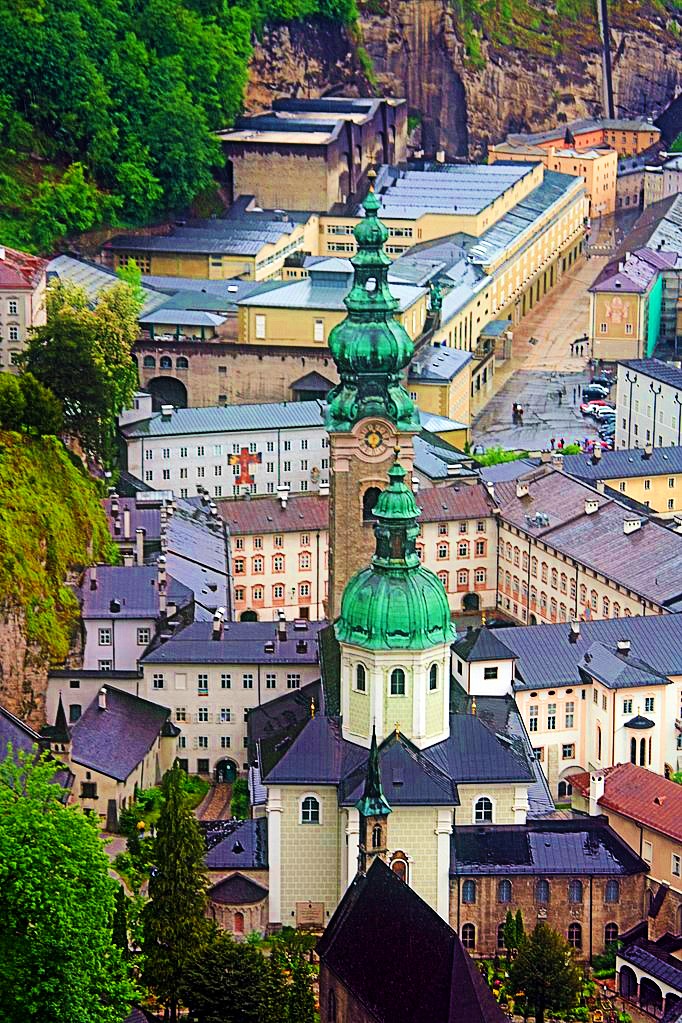
At the same time, in the Alsace region, Sandratus was also appointed to the responsibility of governing the Weissenburg Monastery dedicated to Sts Peter and Paul, below is the Abbey Church today.
St Eutychius of Troas St George Limniotes St Irchard
St Jeanne-Antide Thouret (1765-1826) French Religious and the Founder of the Thouret Sisters – renamed the Sisters of Divine Charity., Apostle of Charity and the Poor and helpless, Teacher. Thouret’s life was one of service to children and the ill across France in schools and hospitals – some of which her order established. This active apostolate did not cease when the French Revolution forced her into exile. She continued her work in both Switzerland and the Kingdom of Prussia. St Jeanne-Antide was Canonised on 14 January 1934 by Pope Pius XI. Her Life: https://anastpaul.com/2019/08/24/saint-of-the-day-24-august-saint-jeanne-antide-thouret-1765-1826/
St Patrick the Elder St Ptolemy of Nepi St Romanus of Nepi St Sandratus (Died 986) Abbot St Taziano of Claudiopolis
Thought for the Day – 23 August – Meditations with Saint Alphonsus Maria de Liguori (1696-1787) Bishop, Confessor, Most Zealous Doctor of the Church Today we begin that which frightens us all but which is very necessary for our salvation. Some of our fellow pilgrims have requested help on this subject and I do not think we can do much better,than calling on St Alphonsus for assistance. “Preparation for Death” was published in English in 1869. Here we will extract and abridge slightly where necessary, always indicating any such abridgements. To mention that there are 2 versions of this great Treatise available online – one is that which we are using taken from the original publication. Be warned, however, there is another which has been published with the inclusion of an Editor’s opinions, thus no longer retaining the truth of the words of St Alphonsus. The Book contains 34 Chapters and we begin below with an Extract from St Alphonsus’ Preface.
“Preparation for Death” By St Alphonsus Maria de Liguori (1696-1787)
PREFACE Part One
The object of the present Treatise is expressed by a passage which is to be met with in one of the Epistles of St Fulgentius (c462 – 533), on the subject of prayer: “Compunction of soul excites an affection for prayer; humble prayer obtains the Divine assistance. Compunction of soul, leads it to regard its wounds but prayer, earnestly demands the medicine for its healing. And who is sufficient for these things? For who can pray as he ought, unless the Divine Physician Himself, pours into the heart the beginning of spiritual desire.”
. It will be seen that the following Manual of Devotion consists of a series of chapters or instructions, upon important points of Christian teaching which are called “Considerations” These Considerations are written for the purpose of pricking or of wounding the conscience, it maybe in many points, that so, it may, be thoroughly aroused and awakened, of exciting, that is, compunction of the soul, real remorse of conscience for past, as well as, for present coldness and dryness. It must be a very hard heart, indeed, which is not moved by these “Considerations” so touchingly simple are they, so plain and so wholly true. They deal with such doctrines and facts, as have an universal application which admit of no dispute and which are always confirmed by some passage from Holy Scripture. It must be allowed, on all hands that it is necessary for the soul to be aroused, to feel its own needs, to regard its own wounds that so it may be directed to a source whence these needscan be supplied and these wounds be healed.
One great aim of this Treatise, is to arouse, as well as to direct the mind, to lead it to consider its own wants and to see, by prayer, to have those wants supplied. The book is essentially a guide to prayer. It represents, from its beginning to its end, the continual outpouring of heart before God –an outpouring which is ofttimes expressed in the very same words which imply, at the same time, a new phase of thought.
Quote/s of the Day – 23 August – “The Month of the Immaculate Heart of Mary” – – 1 Corinthians. 4:9-14; Luke 12:32-34 – Scripture search here: https://www.drbo.org/
“Sell what you possess and give alms. Make for yourselves purses which do not grow old, a treasure unfailing in Heaven, where neither thief draws near, nor moth destroys.”
Luke 12:33
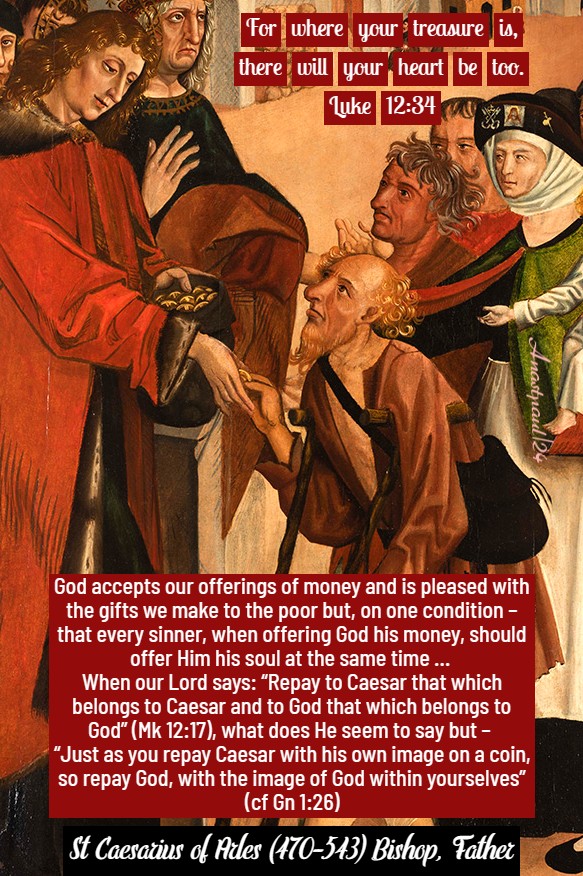
“For where your treasure is, there also will your heart be.”
Lukr 12:34
“Our hearts were made for Thee, O God And restless must they be Until, O God, this grace accord, Until they rest in Thee!”
St Augustine (354-430) Father and Doctor of the Church
“Where is the heart which loves? On the thing it loves. Therefore, where our love is, there our heart is held captive. It cannot leave it; it cannot be lifted higher, it cannot go either to the right or the left; see, it is fixed. Where the miser’s treasure is, there is his heart and where our heart is, there is our treasure. And what is so deplorable is that the things which hold us in servitude, are, for the most part, such unworthy things!”
St Vincent de Paul (1581-1660)
Like St John the Baptist did – “Prepare a path for God so that He can enter your heart.”
St John Baptiste de la Salle (1651-1719)
Almighty God, Open Thou My Heart A Prayer for Guidance By St Bede the Venerable (673-735) Father and Doctor of the Church
ALMIGHTY God, open Thou my heart and enlighten me with the grace of the Holy Spirit, to see those things which are well-pleasing to Thy will. Direct my thoughts and understanding to those things which it is proper to meditate upon and to take in hand; in such fashion, as by fitting character and deeds, I might be found worthy of the eternal joy of heavenly life. Direct my acts to Thy commandments, that I might, by labour so unbrokenly study to bring them to fulfilment, as to attain to an everlasting reward. Amen
One Minute Reflection – 23 August – “The Month of the Immaculate Heart of Mary” – St Philip Benizi OSM (1233-1285) Confessor – 1 Corinthians. 4:9-14; Luke 12:32-34 – Scripture search here: https://www.drbo.org/
“For where your treasure is, there will your heart be too.” – Luke 12:34
REFLECTION – “…If, therefore, you wash, by a good life, the filth which has been glued on your heart like plaster, the Divine Beauty will again shine forth in you. It is the same as happens in the case of iron. If freed from rust by a whetstone that which but a moment ago, was black will shine and glisten brightly in the sun. So it is too with the inner man which the Lord calls “the heart.” When he has scraped off the rustlike dirt which dank decay has caused to appear on his form, he will once more recover the likeness of the Archetype (Gn 1:27) and, be good. For what is like to the Good is certainly itself good.
Hence, if a man who is pure of heart sees himself, he sees in himself what he desires and thus, he becomes blessed because, when he looks at his own purity, he sees the Archetype in the image. To give an example. Although men, who see the sun in a mirror, do not gaze at the sky itself, yet they see the sun in the reflection of the mirror, no less than those who look at its very orb. So, He says, it is also with you. Even though you are too weak to perceive the Light itself, yet if you but return to the grace of the image with which you were informed from the beginning, you will have all you seek in yourselves.
…For the Godhead is purity, freedom from passion and separation from all evil. If, therefore, these things be in you, God is indeed in you. Hence, if your thought is without any alloy of evil, free from passion, arid alien from all stain, you are blessed because you are clear of sight.” – St Gregory of Nyssa (c335-395) Bishop, Father of the Church (Brother of St Basil the Great) (Sermons 6 sur les Béatitudes – on the Beatitudes 6).
PRAYER – O God, Who through St. Philip, Thy Confessor, gave us an outstanding example of humility, grant that Thy household may follow his example by scorning worldly prosperity and, ever seek the things of Heaven. Through Jesus Christ, Thy Son our Lord, Who lives and reigns with Thee, in the unity of the Holy Ghost, God, world without end. Amen (Collect).
You must be logged in to post a comment.