Thought for the Day – 10 August – Meditations with Antonio Cardinal Bacci (1881-1971)
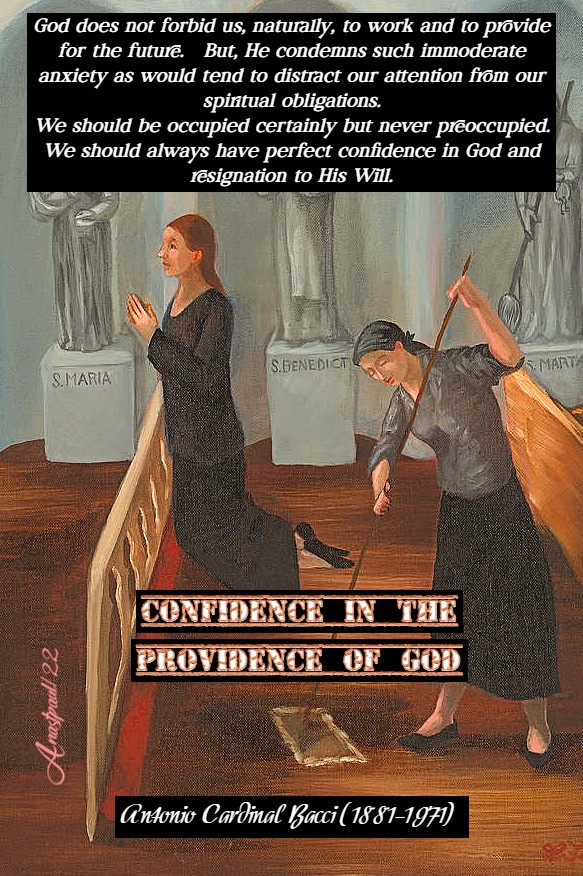
Confidence in the Providence of God
“God does not forbid us, naturally, to work and to provide for the future. But, He condemns such immoderate anxiety as would tend to distract our attention from our spiritual obligations. We should be occupied certainly but never preoccupied. We should always have perfect confidence in God and resignation to His Will.”
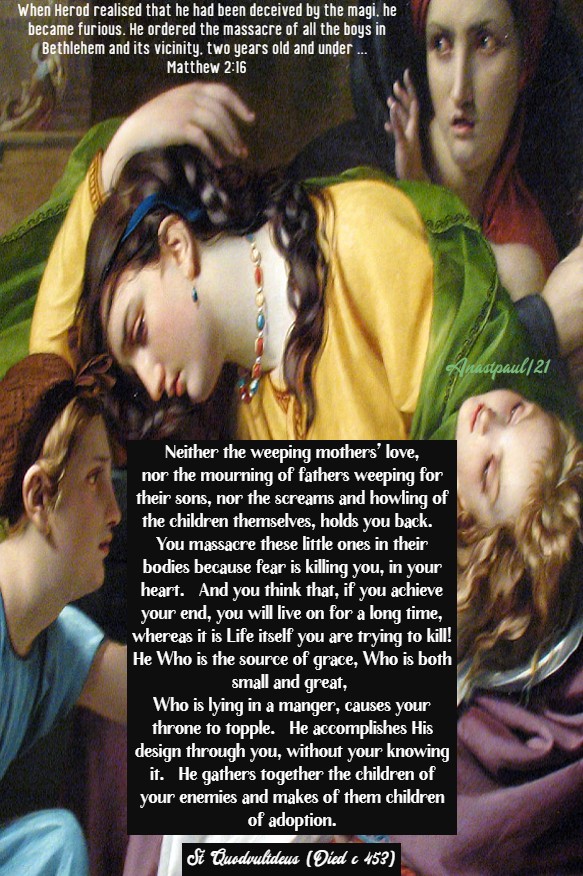
Quote of the Day – 19 February – Saint Quodvultdeus (Died c 453) Father of the Church, Bishop of Carthage,
“Neither the weeping mothers’ love, nor the mourning of fathers weeping for their sons, nor the screams and howling of the children themselves, holds you back. You massacre these little ones in their bodies because fear is killing you, in your heart. And you think that, if you achieve your end, you will live on for a long time, whereas, it is Life itself, you are trying to kill! He Who is the source of grace, Who is both small and great, Who is lying in a manger, causes your throne to topple. He accomplishes His design through you, without your knowing it. He gathers together the children of your enemies and makes of them, children of adoption.”
Saint Quodvultdeus (Died c 453) Father of the Church Bishop of Carthage
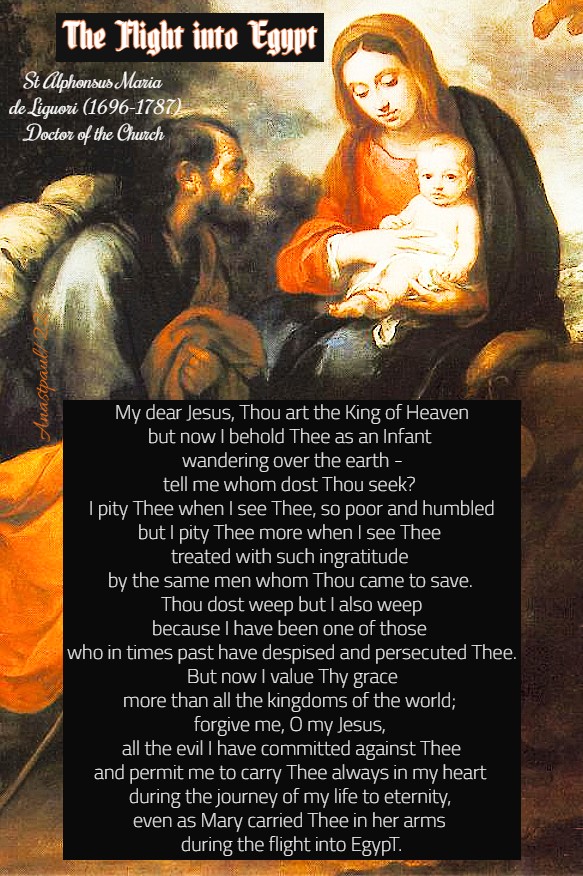
Quote of the Day – 17 February – Feast of the Flight into Egypt
“My dear Jesus, Thou art the King of Heaven but now I behold Thee as an Infant wandering over the earth – tell me whom dost Thou seek? I pity Thee when I see Thee, so poor and humbled but I pity Thee more when I see Thee treated with such ingratitude by the same men whom Thou came to save. Thou dost weep but I also weep because I have been one of those who in times past have despised and persecuted Thee. But now I value Thy grace more than all the kingdoms of the world; forgive me, O my Jesus, all the evil I have committed against Thee and permit me to carry Thee always in my heart during the journey of my life to eternity, even as Mary carried Thee in her arms during the flight into Egypt.”
By St Alphonsus Maria de Liguori (1696-1787) Doctor of the Church
Our Morning Offering – 17 February – Feast of the Flight into Egypt
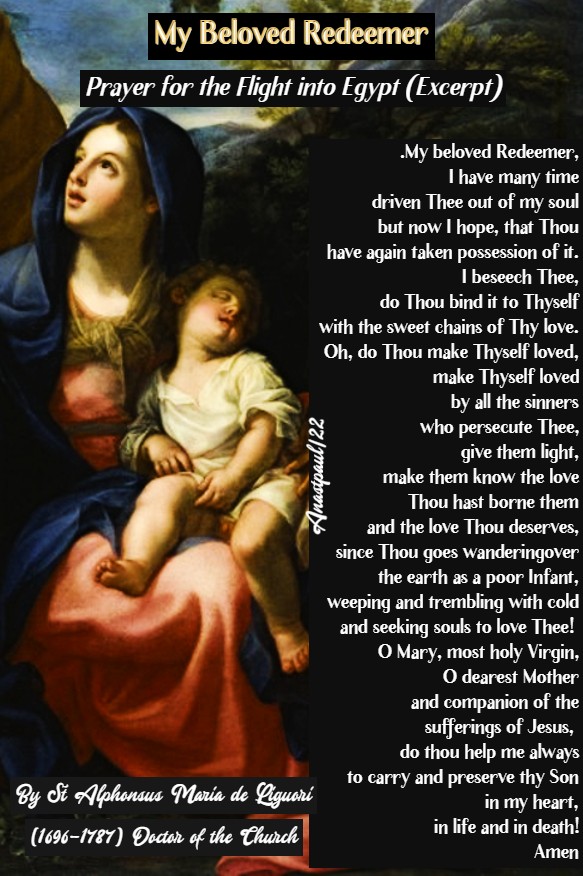
My Beloved Redeemer Prayer for the Flight into Egypt (Excerpt) By St Alphonsus Maria de Liguori (1696-1787) Doctor of the Church
My beloved Redeemer, I have many times driven Thee out of my soul but now I hope, that Thou have again taken possession of it. I beseech Thee, do Thou bind it to Thyself with the sweet chains of Thy love. Oh, do Thou make Thyself loved, make Thyself loved by all the sinners who persecute Thee, give them light, make them know the love Thou hast borne them and the love Thou deserves, since Thou goes wandering over the earth as a poor Infant, weeping and trembling with cold and seeking souls to love Thee! O Mary, most holy Virgin, O dearest Mother and companion of the sufferings of Jesus, do thou help me always to carry and preserve thy Son in my heart, in life and in death! Amen.
Our Morning Offering – 11 January – Sixth Day within the Octave of Epiphany
O Adorable Infant By St Alphonsus de Liguori
O Adorable Infant I should not dare to present myself before Thee, did I not know that Thou, Thyself invitest me to approach Thee. It is I, by my sins, who made Thee shed so many tears in the stable of Bethlehem but since Thou art come upon earth. to pardon penitent sinners, vouchsafe to pardon me. I sincerely repent of having despised Thee, my Lord and my God, Who art so good and hast loved me so much. Thy grace that I ask, is that I may love Thee henceforth, with all my heart. Inflame my soul entirely with Thy Holy Love. I love Thee, O my God, Who hast become an Infant for me. Grant that I may never cease to love Thee O Mary, my Mother! thou art all-powerful by yhy prayers; I ask but one favour of Thee, namely, that Thou wilt pray to Jesus for me. Amen.
Our Morning Offering – 10 January – The Fifth Day within the Octave of Epiphany
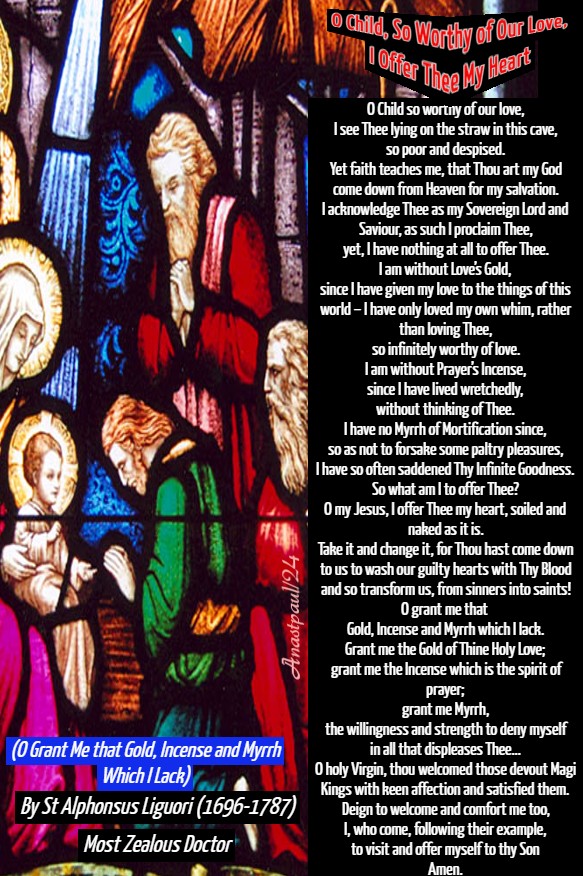
O Child, So Worthy of Our Love, I Offer Thee My Heart (O Grant Me that Gold, Incense and Myrrh Which I Lack) By St Alphonsus Liguori (1696-1787) Most Zealous Doctor
O Child so worthy of our love, I see You lying on the straw in this cave, so poor and despised. Yet faith teaches me, that You are my God come down from heaven for my salvation. I acknowledge You as my Sovereign Lord and Saviour, as such I proclaim You, yet, I have nothing at all to offer You. I am without Love’s Gold, since I have given my love to the things of this world – I have only loved my own whim, rather than loving You, so infinitely worthy of love. I am without Prayer’s Incense, since I have lived wretchedly without thinking of You. I have no Myrrh of Mortification since, so as not to forsake some paltry pleasures, I have so often saddened Your infinite goodness. So what am I to offer You? O my Jesus, I offer You my heart, soiled and naked as it is. Take it and change it, for You have come down to us to wash our guilty hearts with Your Blood and so transform us from sinners into saints. O grant me that Gold, Incense and Myrrh which I lack. Grant me the Gold of Your Holy Love; grant me the Incense which is the spirit of prayer; grant me Myrrh, the willingness and strength to deny myself in all that displeases You… O holy Virgin, you welcomed those devout Magi Kings with keen affection and satisfied them. Deign to welcome and comfort me also, I, who come, following their example, to visit and offer myself to your Son Amen.
Our Morning Offering – 4 January – Christmas Weekday “Month of the Most Holy Name”
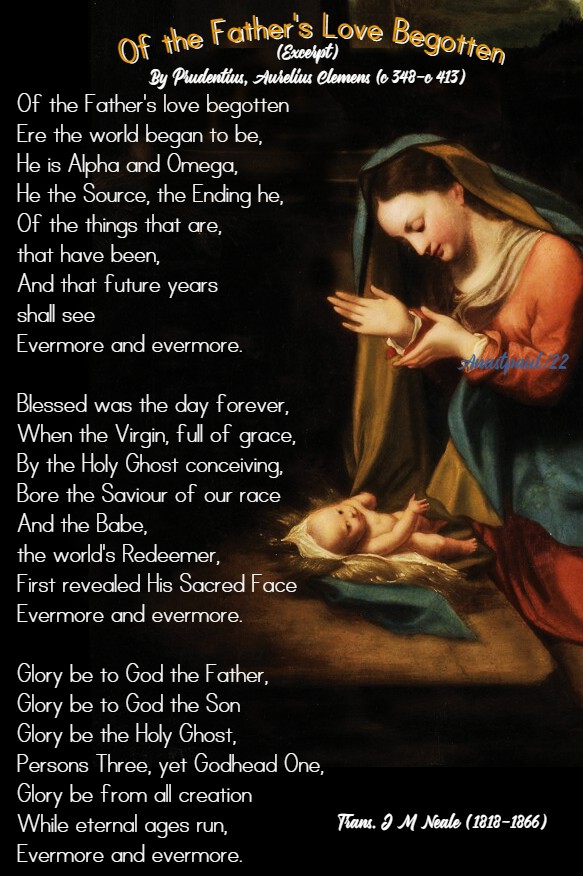
Of the Father’s Love Begotten (Excerpt) By Prudentius, Aurelius Clemens (c 348-c 413) Trans. J M Neale (1818-1866)
Of the Father’s love begotten Ere the world began to be, He is Alpha and Omega, He the Source, the Ending he, Of the things that are, that have been, And that future years shall see Evermore and evermore.
Blessed was the day forever, When the Virgin, full of grace, By the Holy Ghost conceiving, Bore the Saviour of our race And the Babe, the world’s Redeemer, First revealed His Sacred Face Evermore and evermore.
Glory be to God the Father, Glory be to God the Son Glory be the Holy Ghost, Persons Three, yet Godhead One, Glory be from all creation While eternal ages run, Evermore and evermore.
Aurelius Prudentius Clemens was a Roman Christian Poet, born in the Roman Province of Tarraconensis (now Northern Spain) in c 348. He probably died in the Iberian Peninsula some time after 405, possibly around 413. Prudentius practised law with some success and was twice Provincial Governor, perhaps in his native country. Towards the end of his life (possibly around 392) Prudentius retired from public life to become an ascetic, fasting until evening and abstaining entirely from animal food and writing poems, hymns and controversial works in defence of Christianity. Prudentius later collected the Christian poems written during this period and added a preface, which he himself dated 405. The poetry of Prudentius is influenced by early Christian authors, such as Tertullian and St Ambrose, as well as the Sacred Scriptures and the Acts of the Martyrs. His hymn Da, puer, plectrum – “Of the Father’s Love Begotten”) and the hymn for Epiphany O sola magnarum urbium (“Earth Has Many A Noble City”), both from the Cathemerinon, are still frequently in use today, although many others are too but perhaps less frequently..
Quote/s of the Day – 30 December – The Sixth Day in the Christmas Octave, Readings: 1 John 2:12-17, Psalm 96:7-10, Luke 2:36-40
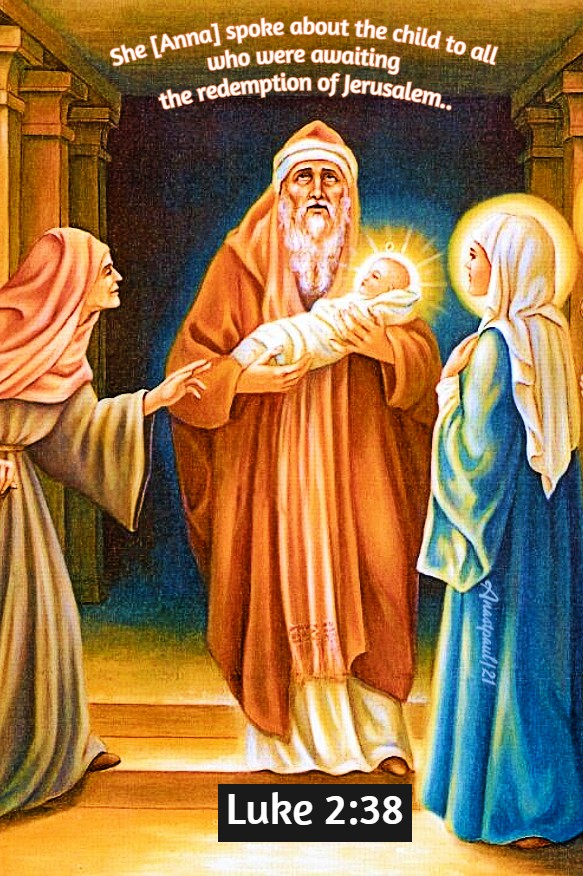
“She [Anna] spoke about the child to all who were awaiting the redemption of Jerusalem…”
Luke 2:38
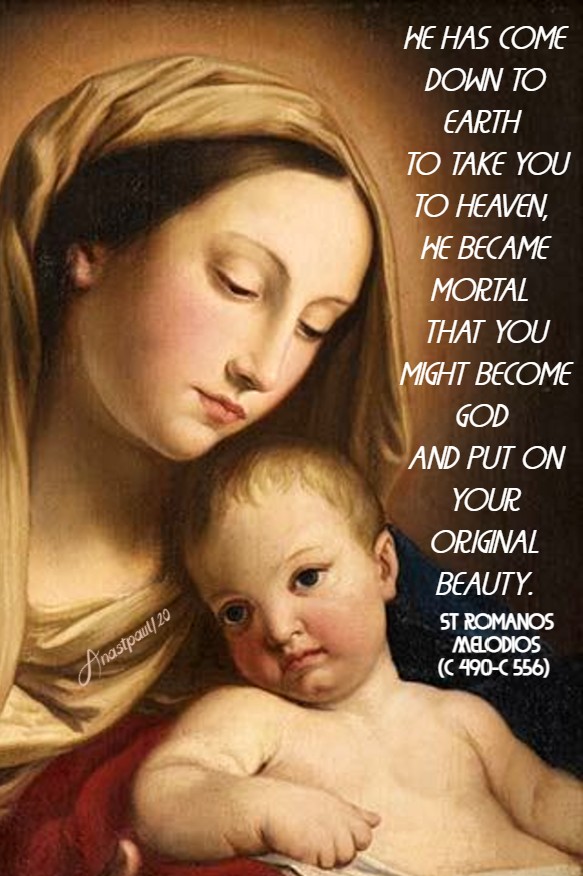
“He has come down to earth to take you to heaven, He became mortal that you might become God and put on your original beauty.”
St Romanos Melodios (c 490-c 556) Monk, Composer of Hymns, Poet
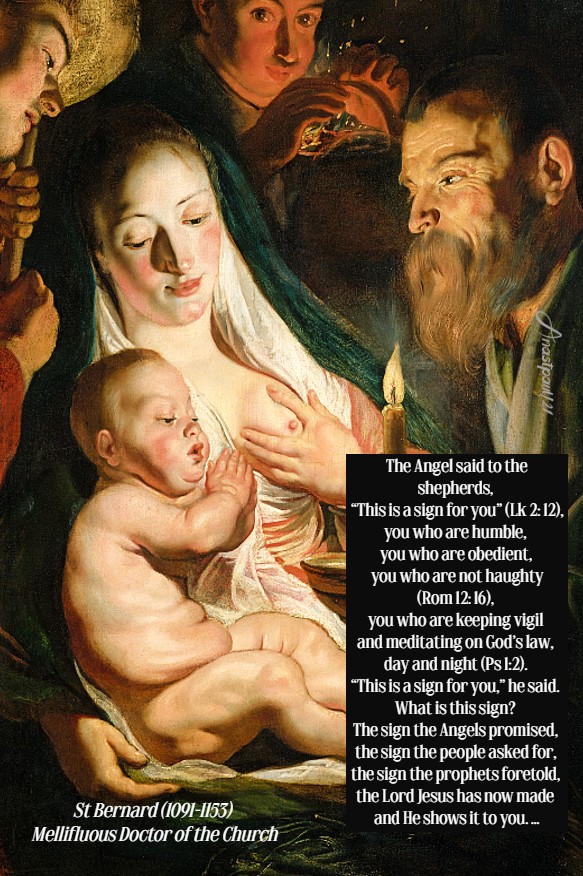
“The Angel said to the shepherds, “This is a sign for you” (Lk 2: 12), you who are humble, you who are obedient, you who are not haughty (Rom 12: 16), you who are keeping vigil and meditating on God’s law, day and night (Ps 1:2). “This is a sign for you,” he said. What is this sign? The sign the Angels promised, the sign the people asked for, the sign the prophets foretold, the Lord Jesus has now made and He shows it to you. …”
St Bernard (1091-1153) Mellifluous Doctor of the Church
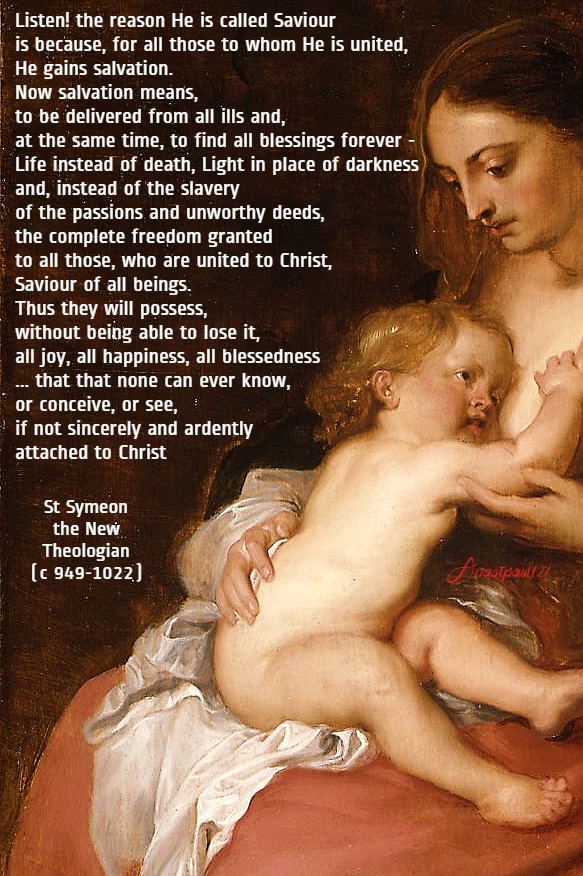
“Listen! the reason He is called Saviour is because, for all those to whom He is united, He gains salvation. Now salvation means, to be delivered from all ills and, at the same time, to find all blessings forever – Life instead of death, Light in place of darkness and, instead of the slavery of the passions and unworthy deeds, the complete freedom granted to all those, who are united to Christ, Saviour of all beings. Thus they will possess, without being able to lose it, all joy, all happiness, all blessedness (…) that that none can ever know, or conceive, or see, if not sincerely and ardently attached to Christ.”
St Symeon the New Theologian (c 949-1022)
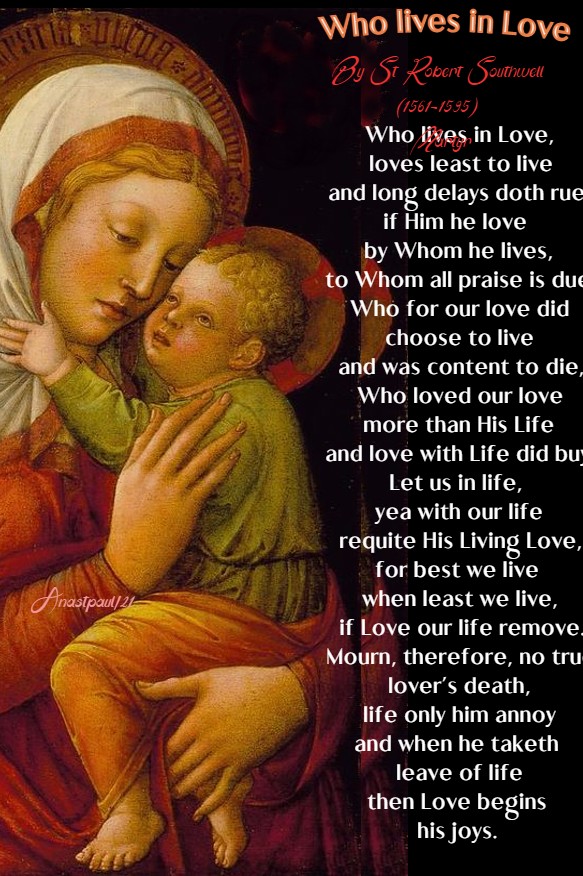
Who lives in Love By St Robert Southwell SJ (1561-1595) Martyr
Who lives in Love, loves least to live and long delays doth rue, if Him he love by Whom he lives, to Whom all praise is due, Who for our love did choose to live and was content to die, Who loved our love more than His life and love with Life did buy. Let us in life, yea with our life requite His Living Love, for best we live when least we live, if Love our life remove. Mourn, therefore, no true lover’s death, life only him annoy and when he taketh leave of life then Love begins his joys.
Our Morning Offering – 30 December – The Sixth Day of the Octave of Christmas
Beloved and Most Holy Word of God By St James of the Marches (1391-1476)
Beloved and most holy Word of God! You enlighten the hearts of the faithful, You satisfy the hungry, console the afflicted. You make the souls of all, productive of good and cause all virtues to blossom. You snatch souls from the devil’s jaw. You make the wretched holy and men of earth, citizens of heaven! Amen
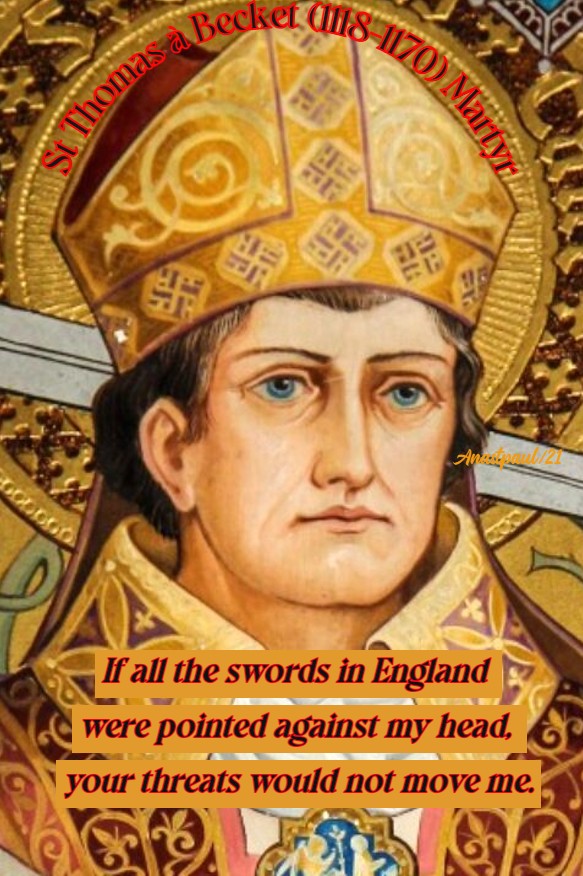
Quote/s of the Day – 29 December – The Fifth Day of the Octave of Christmas and the Memorial of St Thomas à Becket (1118-1170) Martyr, Archbishop of Canterbury
“… No matter who plants or waters, God gives no harvest unless what he plants is the faith of Peter and unless he himself. assents to Peter’s teaching.”
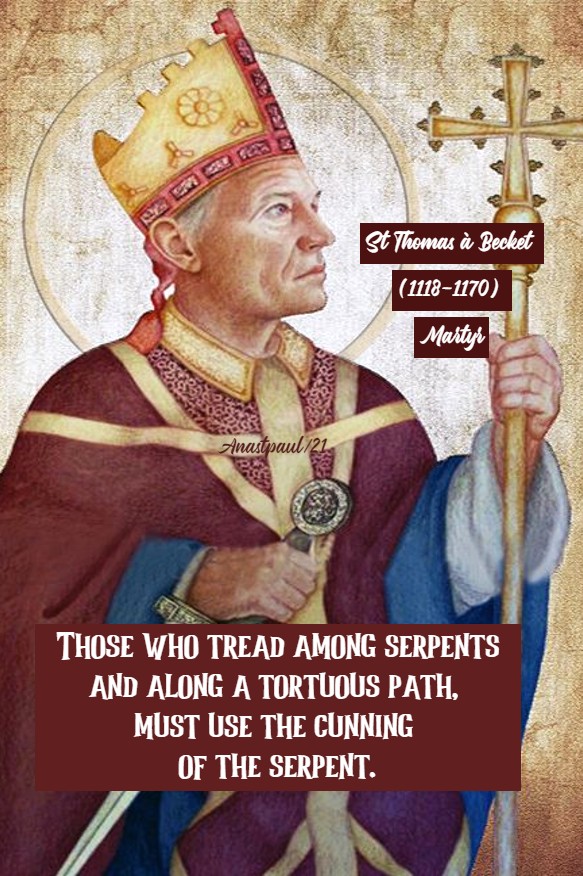
“Those who tread among serpents and along a tortuous path, must use the cunning of the serpent.”
“If all the swords in England were pointed against my head, your threats would not move me.”
St Thomas à Becket (1118-1170) Martyr, Archbishop of Canterbury
Our Morning Offering – 29 December – The Fifth Day of the Christmas Octave
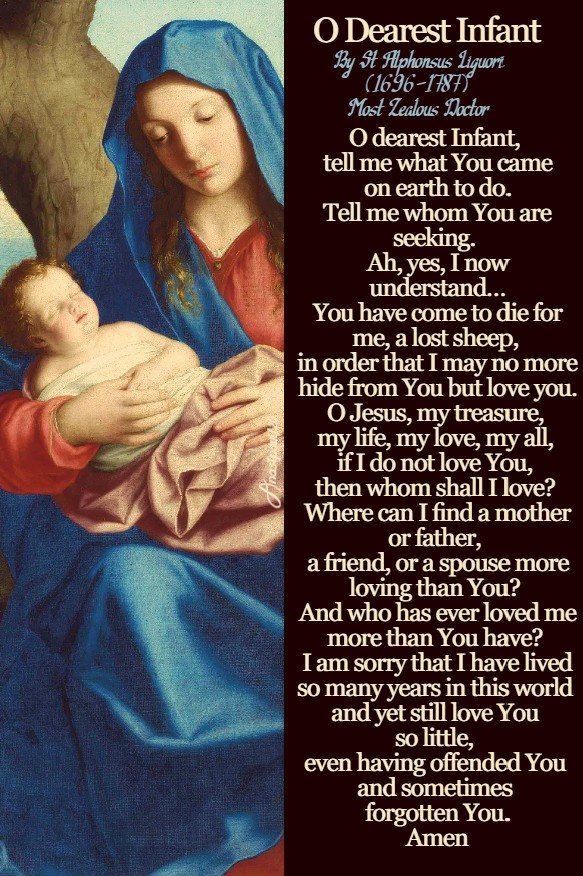
O Dearest Infant By St Alphonsus Liguori (1696-1787) Most Zealous Doctor
O dearest Infant, tell me what You came on earth to do. Tell me whom You are seeking. Ah, yes, I now understand… You have come to die for me, a lost sheep, in order that I may no more hide from You but love You. O Jesus, my treasure, my life, my love, my all, if I do not love You, then whom shall I love? Where can I find a mother or father, a friend, or a spouse more loving than You? And who has ever loved me more than You have? I am sorry that I have lived so many years in this world and yet still love You so little, even having offended You and sometimes forgotten You. Amen
Our Morning Offering – 28 December – The Feast of the Holy Innocents and the Fourth |Day of the Octave of Christmas
O Jesus, Dear Holy Child By St Thérèse of the Child Jesus (1873 – 1897) Doctor of the Church
O Jesus, dear Holy Child, my only treasure, I abandon myself to Thy every whim. I seek no other joy than that of calling forth Thy sweet Smile. Vouchsafe to me, the graces and the virtues of Thy Holy Childhood, so that, on the day of my birth into Heaven, the Angels and Saints may recognise in Thy Spouse, Thérèse of the Child Jesus. Amen
Quote/s of the Day – 26 December – The Second Day in the Christmas Octave
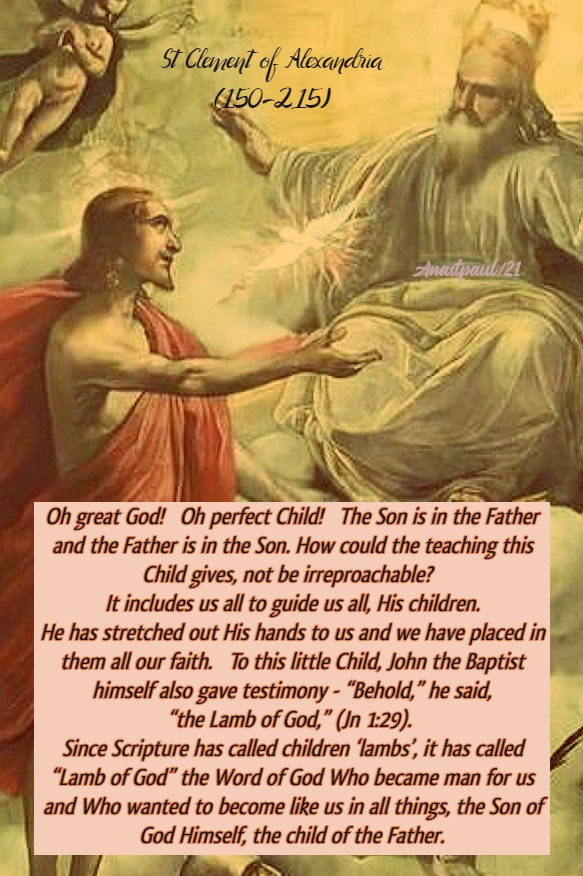
Christ, the Child
“Oh great God! Oh perfect Child! The Son is in the Father and the Father is in the Son. How could the teaching this Child gives, not be irreproachable? It includes us all to guide us all, His children. He has stretched out His hands to us and we have placed in them all our faith. To this little Child, John the Baptist himself also gave testimony – “Behold,” he said, “the Lamb of God,” (Jn 1:29). Since Scripture has called children ‘lambs,’ it has called “Lamb of God” the Word of God Who became man for us and Who wanted to become like us in all things, the Son of God Himself, the child of the Father.”
St Clement of Alexandria (150-215) Theologian, Father
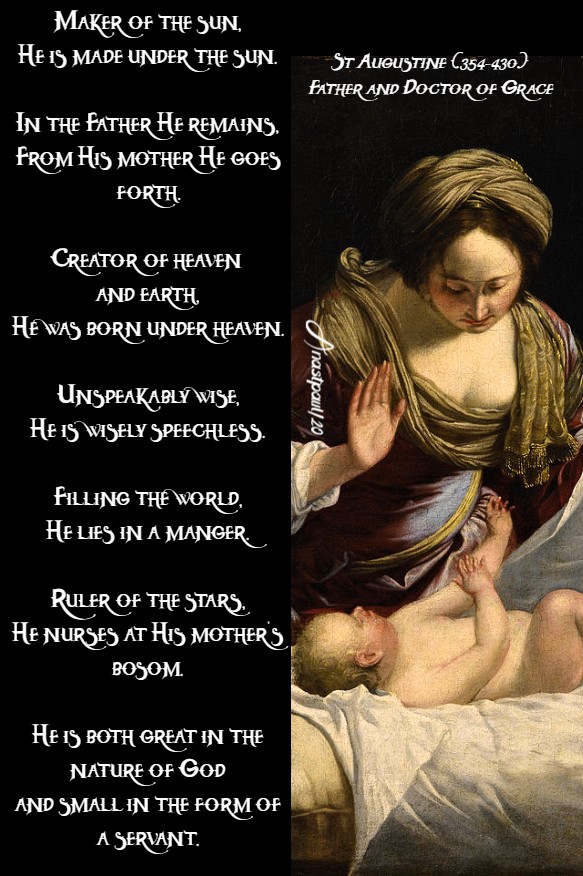
“Maker of the sun, He is made under the sun.
In the Father He remains, From His mother He goes forth.
Creator of heaven and earth, He was born under heaven.
Unspeakably wise, He is wisely speechless.
Filling the world, He lies in a manger.
Ruler of the stars, He nurses at His mother’s bosom.
He is both great in the nature of God and small in the form of a servant.”
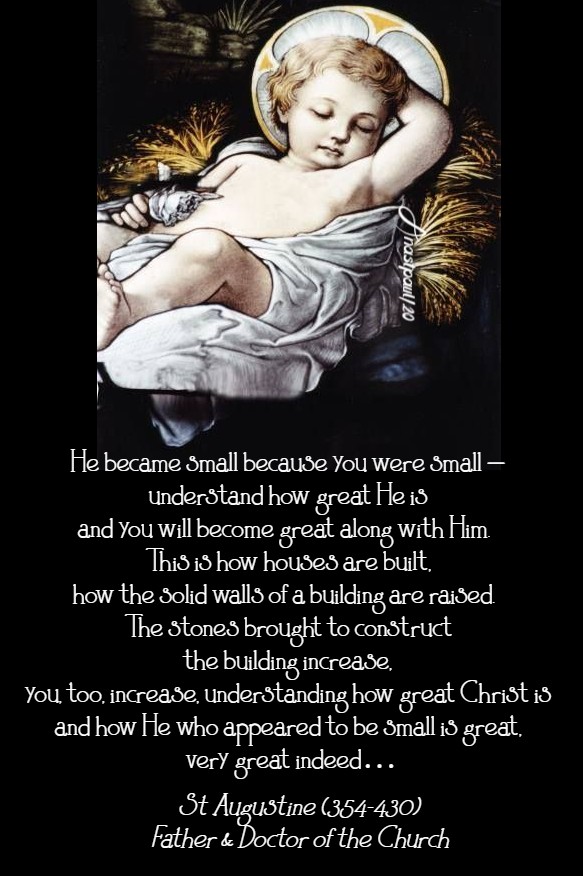
“He became small because you were small – understand how great He is and you will become great along with Him. This is how houses are built, how the solid walls of a building are raised. The stones brought to construct the building increase, you, too, increase, understanding how great Christ is and how He who appeared to be small is great, very great indeed…”
St Augustine (354-430) Father & Doctor of the Church
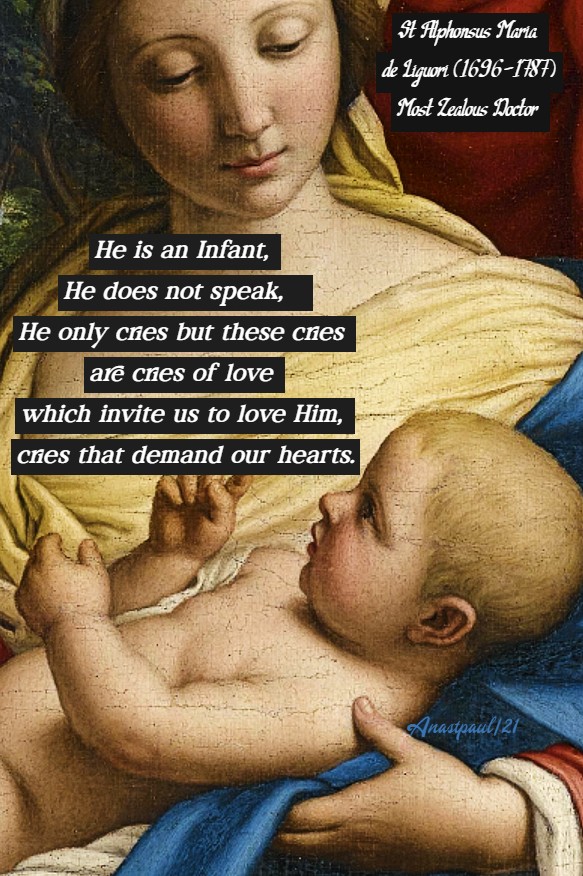
“He is an infant, He does not speak, He only cries but these cries are cries of love which invite us to love Him, cries that demand our hearts.”
St Alphonsus Maria de Liguori (1696-1787) Most Zealous Doctor
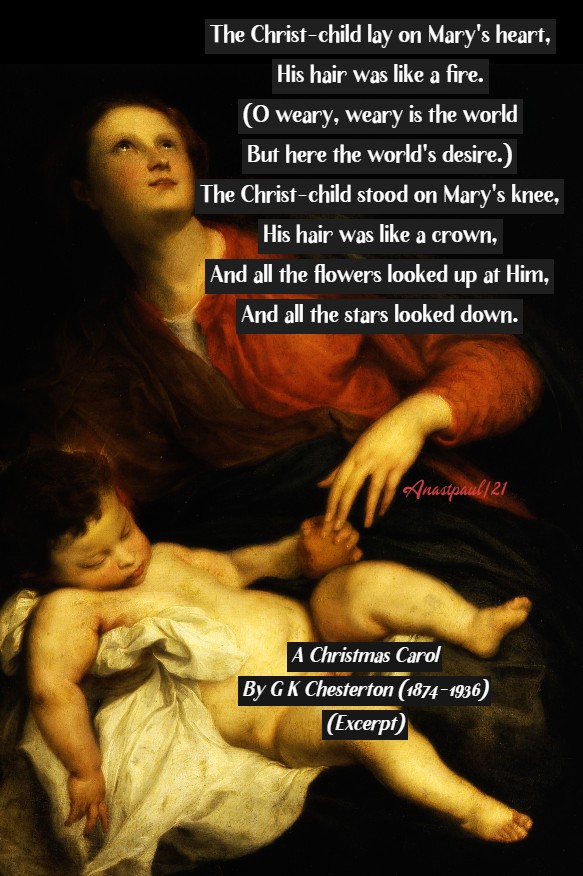
A Christmas Carol By G K Chesterton (1874-1936) English Catholic Convert, Writer, Poet.
The Christ-child lay on Mary’s lap, His hair was like a light. (O weary, weary were the world, But here is all aright.)
The Christ-child lay on Mary’s breast His hair was like a star. (O stern and cunning are the kings But here the true hearts are.)
The Christ-child lay on Mary’s heart, His hair was like a fire. (O weary, weary is the world But here the world’s desire.) The Christ-child stood on Mary’s knee, His hair was like a crown, And all the flowers looked up at Him, And all the stars looked down.
Our Morning Offering – 26 December – Feast of St Stephen the ProtoMartyr and The Second Day in the Christmas Octave
Sleep, Holy Babe By Fr Edward Caswell C.Orat. (1814-1878)
Sleep, holy Babe, Upon Your Mother’s breast! Great Lord of earth and sea and sky, How sweet it is to see You lie In such a place of rest! Sleep, holy Babe, Your angels watch around, All bending low with folded wings Before th’incarnate King of kings In rev’rent awe profound! Sleep, holy Babe, While I with Mary gaze In joy upon that face awhile, Upon the loving Infant smile Which there divinely plays. Sleep, holy Babe, And take Your brief repose; Too quickly will Your slumbers break And You to lengthened pains awake, That death alone shall close. Amen
Quote/s of the Day – 25 December – The Solemnity of the Nativity of Our Lord, Jesus Christ
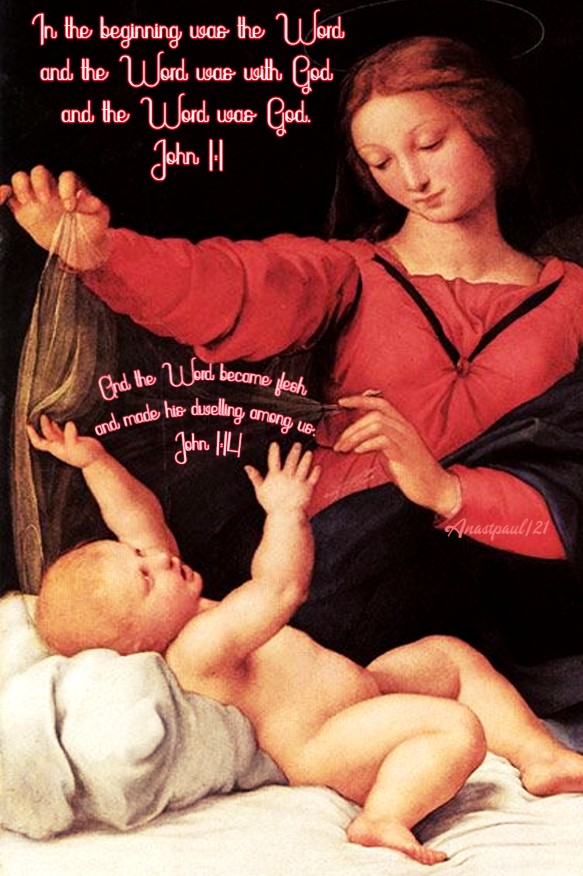
“In the beginning was the Word and the Word was with God and the Word was God.”
John 1:1
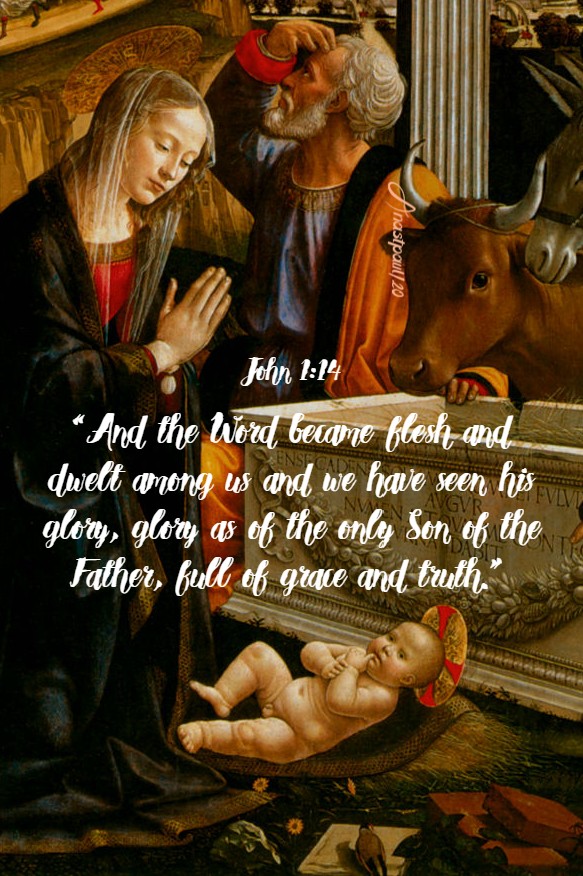
“And the Word became flesh and made his dwelling among us and we saw his glory, the glory as of the Father’s only Son, full of grace and truth.”
John 1:14
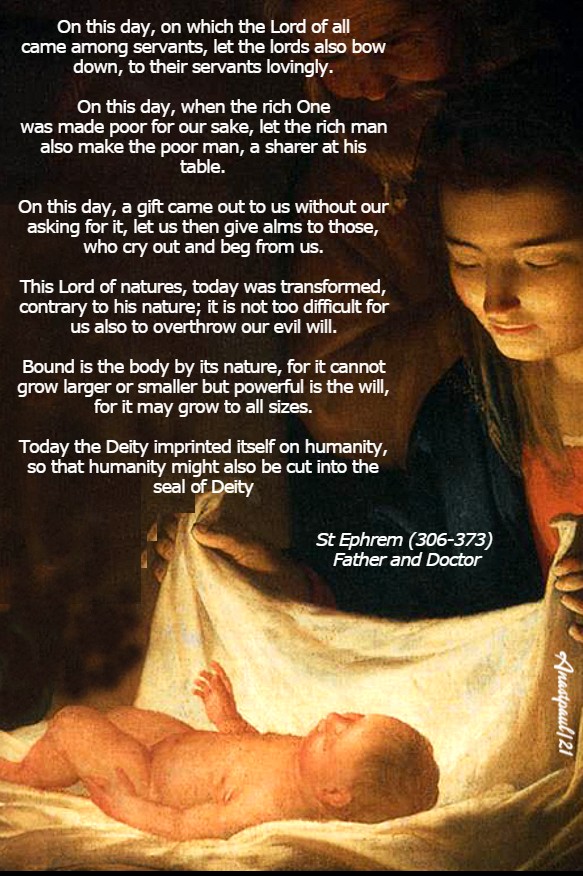
“On this day, on which the Lord of all came among servants, let the lords also bow down, to their servants lovingly.
On this day, when the rich One was made poor for our sake, let the rich man also make the poor man, a sharer at his table.
On this day, a gift came out to us without our asking for it, let us then give alms to those, who cry out and beg from us.
This Lord of natures, today was transformed, contrary to his nature; it is not too difficult for us also to overthrow our evil will.
Bound is the body by its nature, for it cannot grow larger or smaller but powerful is the will, for it may grow to all sizes.
Today the Deity imprinted itself on humanity, so that humanity might also be cut into the seal of Deity.”
St Ephrem (306-373) Father and Doctor
(Homily on Our Lord, 21)
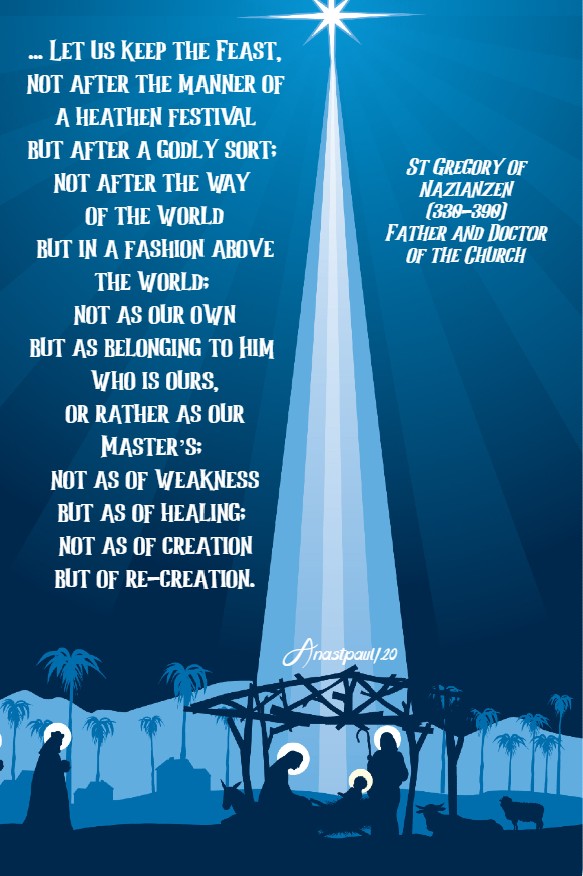
“… Let us keep the Feast, not after the manner of a heathen festival but after a godly sort; not after the way of the world but in a fashion above the world; not as our own but as belonging to Him who is ours, or rather as our Master’s; not as of weakness but as of healing; not as of creation but of re-creation.”
St Gregory of Nazianzen (330-390) Father and Doctor of the Church
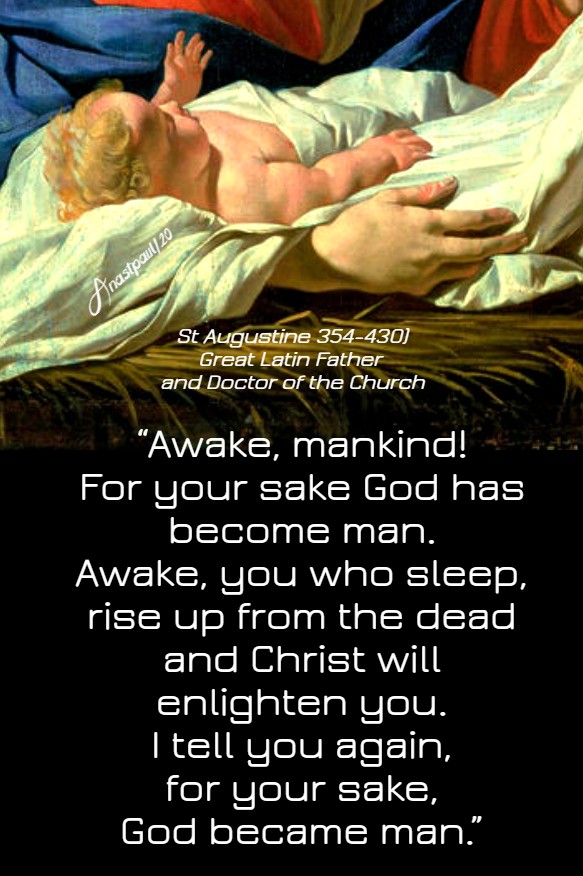
“Awake, mankind! For your sake God has become man. Awake, you who sleep, rise up from the dead and Christ will enlighten you. I tell you again, for your sake, God became man.”
St Augustine 354-430) Great Latin Father and Doctor of the Church
One Minute Reflection – 25 December – The Solemnity of the Nativity of Our Lord, Jesus Christ – Mass during the day – Readings: Isaiah 52:7-10, Psalm 98:1-6, Hebrews 1:1-6, John 1:1-18
Christ has been born for us, come, let us adore Him!
And the Word became flesh and dwelt among us, full of grace and truth; we have beheld his glory, glory as of the only Son from the Father. … John 1:14
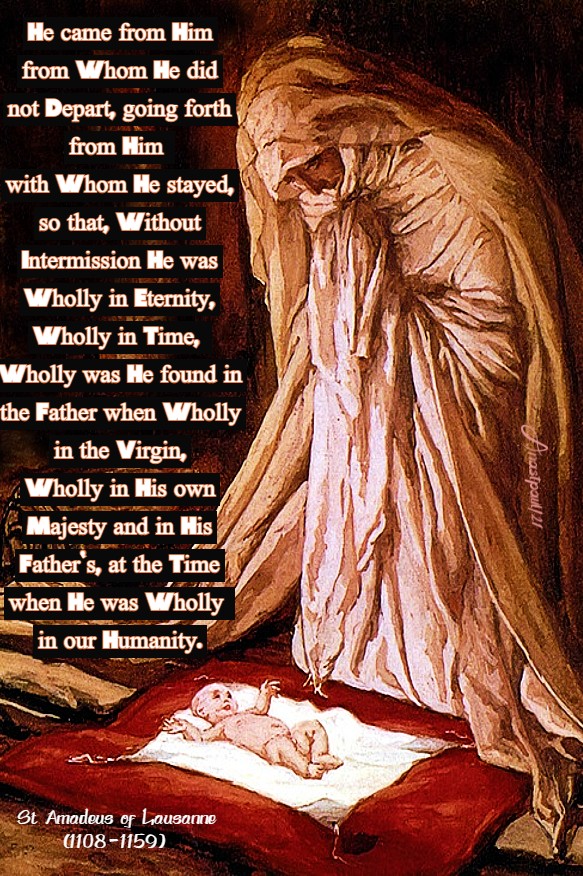
REFLECTION – “Christ has come from the Father, He has come from the Word, He has come from the Holy Spirit, since the whole Trinity accomplished His conception and His incarnation. For to come from the highest Trinity was, no other, than to be conceived and to become, a human being, by the same Trinity. Therefore, it was said: “His going forth is form the highest heaven.” (cf. Ps 18[19]:6) The Only-Begotten … begotten of the Father eternally, begotten in time, He came forth from His Mother, remaining invisibly with the Father and dwelling visibly with us. For to go forth from the Father was this – to enter upon our world, to be seen openly and to become what, from the nature of the Father, He was not. This indeed is wonderful, He came from Him from Whom He did not depart, going forth from Him, with Whom He stayed, so that without intermission, He was wholly in eternity, wholly in time, wholly was He found in the Father, when wholly in the Virgin, wholly in His own Majesty and in His Father’s at the time, when He was wholly in our humanity. If you ask how, gather the truth by means of an illustration. A word conceived in the heart goes forth complete in the voice, so that it comes perfectly to others, yet remains wholly in the heart. So the good Word, spoken forth from the heart of the Father, went forth into the broad plain, yet did not leave the Father.” … St Amadeus of Lausanne (1108-1159) Cistercian Monk and Bishop (On the praises of the Blessed Mary, homily II).
PRAYER – Almighty God, Your incarnate Word fills us with the new light He brought to men. Let the light of faith in our hearts, shine through all that we do and say. We make our prayer through Jesus Christ, our Lord, with the Holy Spirit, God forever, amen.
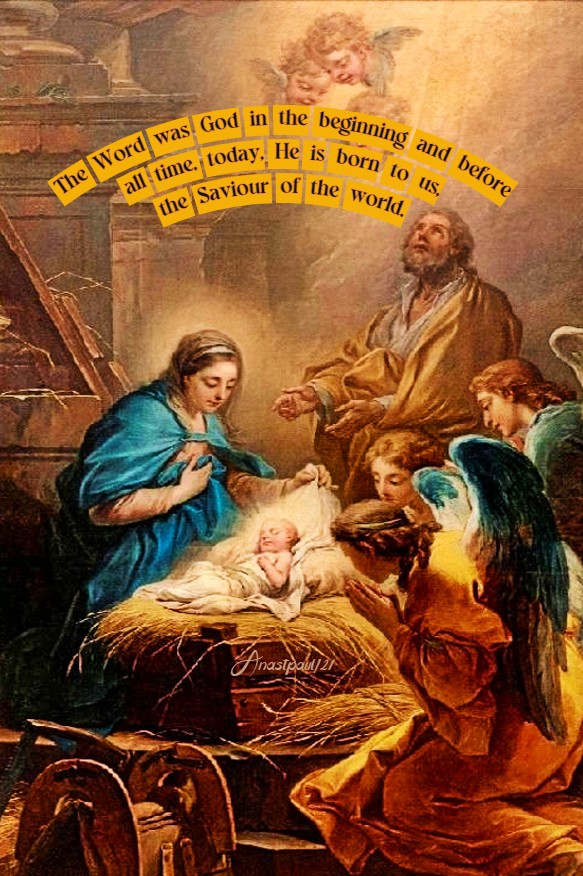
The Word was God in the beginning and before all time, today, He is born to us, the Saviour of the world.
Thought for the Day – 24 December – Meditations with Antonio Cardinal Bacci (1881-1971)
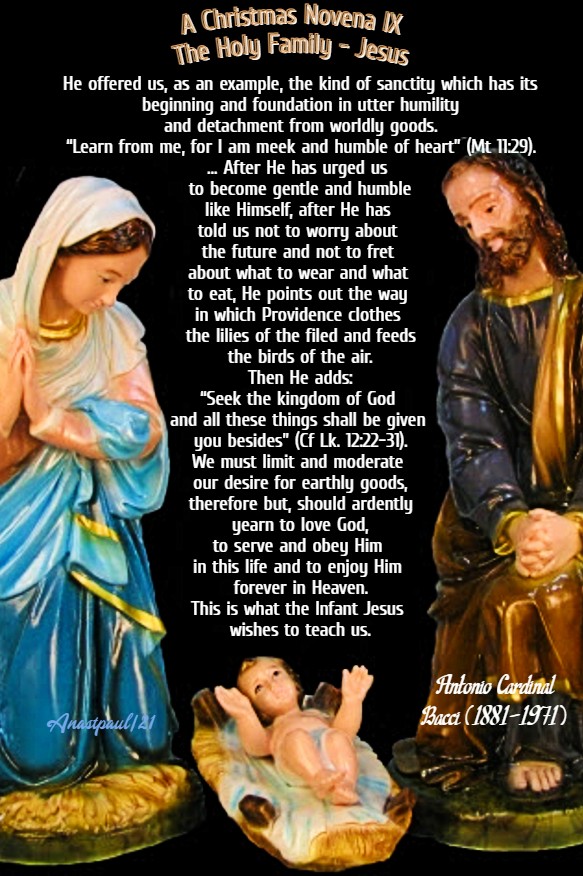
A Christmas Novena IX The Holy Family – Jesus
“We have in the Holy Family, the highest possible models of perfection – Jesus, Mary and Joseph. As God, Jesus is essentially holy. By means of the Hypostatic Union, this sanctity is transmitted also to His human nature. The holiness of Jesus was only gradually revealed as He grew older because He wished to be like us in everything, save in sin. As the Gospel says, He “advanced in wisdom and age and grace before God and men” (Lk 2:52). Jesus gave us an example of holiness which we should find easier to imitate because it was eternally increasing all the time. He offered us, as an example, the kind of sanctity which has its beginning and foundation in utter humility and detachment from worldly goods. “Learn from me, for I am meek and humble of heart” (Mt 11:29).
Socrates advised his followers to have few desires and to desire these as little as possible, in order to remain content, for the man who is full of desires is always uneasy and restless. This human counsel is very true but, it is incomplete. It recommends detachment from earthly things but fails to teach the ardent and practical desire for supernatural things. Jesus Christ teaches us both. After He has urged us to become gentle and humble like Himself, after He has told us not to worry about the future and not to fret about what to wear and what to eat, He points out the way in which Providence clothes the lilies of the filed and feeds the birds of the air. Then He adds: “Seek the kingdom of God and all these things shall be given you besides” (Cf Lk. 12:22-31).
We must limit and moderate our desire for earthly goods, therefore but, should ardently yearn to love God, to serve and obey Him in this life and to enjoy Him forever in Heaven. This is what the Infant Jesus wishes to teach us.”
One Minute Reflection – 24 December – “Month of the Immaculate Conception” – “Rejoice! Rejoice! Emmanuel” – The Nativity of the Lord, Mass at Midnight – Readings: Isaiah 62:1-5, Psalms 89:4-5, 16-17, 27, 29, Acts 13:16-17, 22-25, Luke 2:1-14
Know today that the Lord will come – in the morning you will see His glory.
Rejoice! Rejoice! Emmanuel Shall come to thee, O Israel! May the Lord bless us, protect us from all evil and bring us to everlasting life.
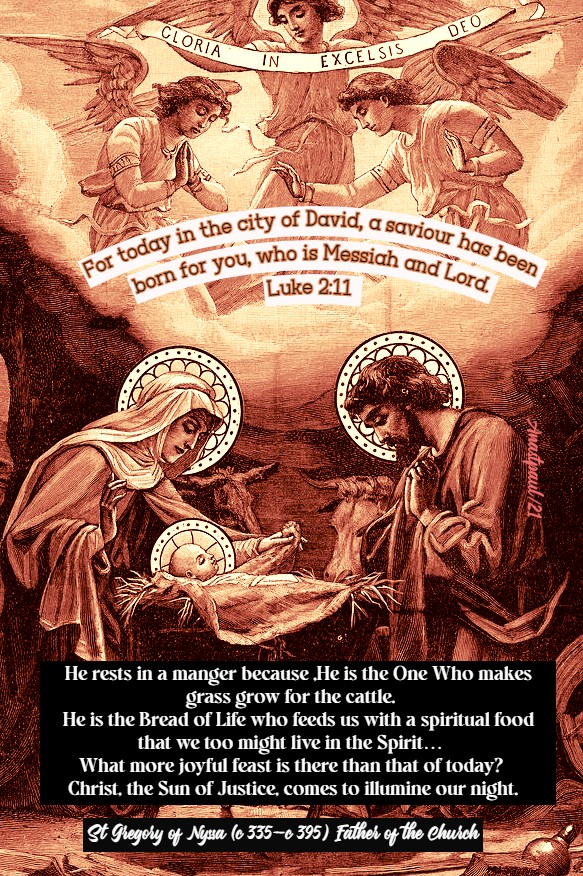
“For today in the city of David, a saviour has been born for you, who is Messiah and Lord.” – Luke 2:11
REFLECTION – “Brethren, now we have been told about the miracle, let us turn aside to see this unusual sight as Moses did (Ex 3:3) – in Mary, the burning bush is not consumed, the Virgin gives birth to the Light, without defilement … Let us then run to Bethlehem, the town of the Good News! If we are real shepherds, staying awake on our watch, then it is to us that the voice of the angels is addressed, announcing a great joy … “Glory to God in the highest for peace is coming down to earth!” There where, only yesterday, there was nothing but misfortune, battlefields and exile, now earth receives peace for today “Truth shall spring out of the earth and justice shall look down from heaven” (Ps 84[85]:12). Behold the fruit earth gives to humankind, in reward for the goodwill reigning among men (Lk 2:14). God is joined to man, to raise man to the stature of God.
At this news, my brethren, let us go to Bethlehem to behold … the mystery of the crib, a child wrapped in swaddling clothes rests in a manger. A Virgin, after giving birth, His undefiled Mother, embraces her Son. Let us repeat the words of the prophet along with the shepherds: “As we have heard, so we have seen in the city of our God.” (Ps 47[48]:9)
But why does our Lord seek shelter in this cave at Bethlehem? Why is He sleeping in a manger? Why does He participate in Israel’s census? My brethren, He who brings liberty to the world, comes to be born into our slavery to death. He is born in this cave to reveal Himself to us, who are immersed in darkness and the shadow of death. He rests in a manger because ,He is the One Who makes grass grow for the cattle (Ps 104[103],14). He is the Bread of Life who feeds us with a spiritual food that we too might live in the Spirit… What more joyful feast is there than that of today? Christ, the Sun of Justice (Mal 3,20), comes to illumine our night. What had fallen, is raised up again, what was overcome, is now set free… what was dead is restored to life… Let us all sing today with one voice over all the earth: “Death came through one man, Adam, today salvation has come through one man (cf Rom 5,17)” … St Gregory of Nyssa (c 335–c 395) Bishop, Father of the Church (Sermon on the Nativity).
PRAYER – Almighty God, Your Incarnate Word fills us with the new Light, He brings to men. Let the light of faith in our hearts shine through all that we do and say. And may the Immaculate Virgin Mother of our Saviour, be ever near to help and protect us. Through Christ, our Lord and Saviour, with the Holy Spirit, one God with You, now and for all time and eternity, amen.
24 December – Vigil of the Nativity of the Lord/Mass at Midnight Midnight Mass is the first liturgy of Christmastide that is celebrated on the night of Christmas Eve, traditionally beginning at midnight when Christmas Eve gives way to Christmas Day. This popular Christmas custom is a jubilant celebration of the Mass in honour of the Nativity of Jesus Christ.
Saint Thomas Aquinas wrote a commentary on these words and explained in his Summa Theologiae, “And from this ,the Mass derives its name … the deacon on festival days ‘dismisses’ the people at the end of the Mass, by saying: ‘Ite, missa est,’ that is, the victim [Jesus] has been sent to God through the angel, so that it may be accepted by God.”
St Adam the Patriarch St Adela of Pfalzel Bl Alberic of Gladbach Bl Brocard of Strasbourg St Bruno of Ottobeuren St Caran of Scotland St Delphinus of Bordeaux
Bl Peter de Solanes Bl Venerandus of Clermont — • Blessed Dionysius Roneo • Blessed Philip Claro • Blessed Giulio Pons • Blessed Peter of Valladolid
Blessed Mercedarian Sisters – (6 beati): Six cloistered Mercedarian nuns at the convent of Vera Cruz in Berriz, Spain. Noted for their devotion to the rules of the Order and for their deep prayer lives. • Blessed Anna Maria Prieto • Blessed Anna de Arrano • Blessed Orsola de Larisgoizia • Blessed Maguna Mary • Blessed Margaret • Blessed Mary of the Assumption Sarria
Martyred Maidens of Antioch – (40 saints): A group of forty virgins martyred in the persecutions of Decius. None of their names have come down to us. They were martyred in 250 in Antioch, Syria.
Martyrs of Tripoli – (6 saints): A group of Christians martyred together, date unknown. The only details that have survived are six of the names – Drusus, Lucian, Metrobius, Paul, Theotimus and Zenobius. They were martyred in Tripoli, Libya.
Thought for the Day – 23 December – Meditations with Antonio Cardinal Bacci (1881-1971)
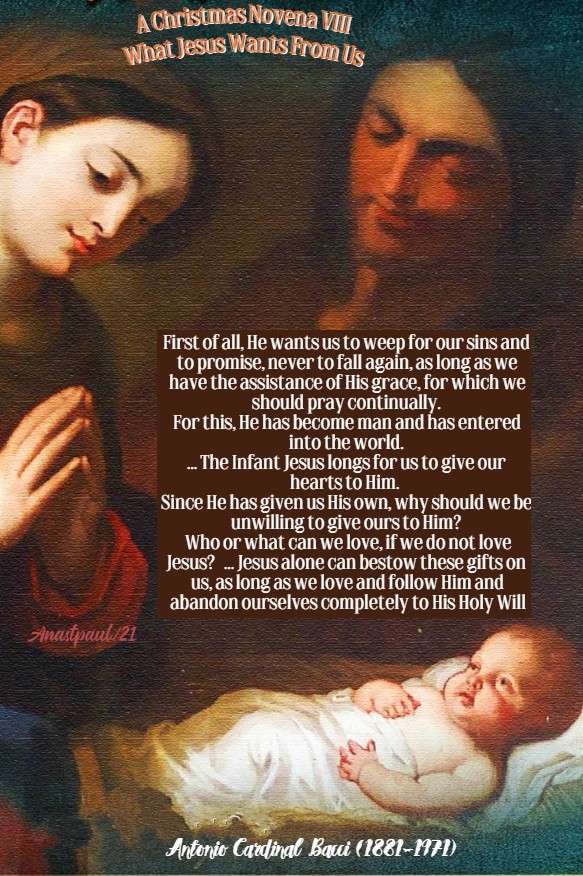
A Christmas Novena VIII What Jesus Wants From Us
“Let us contemplate Jesus lying on a rough pallet of straw in the manger. When we see Him looking at us, let us ask ourselves what it is that He requires of us. In fact, He wants many things from us. First of all, He wants us to weep for our sins and to promise, never to fall again, as long as we have the assistance of His grace, for which we should pray continually. For this, He has become man and has entered into the world. For this He will work miracles, preach His doctrine and shed His Precious Blood on the Cross. All this He will do to redeem us from sin and to win Heaven for us.
If we return to the path of sin, we destroy the divine work of redemption, inasfar as it applies to ourselves. We make Christ’s passion, death and resurrection useless in our case. We brush aside the chain of favours with which His love has girdled us – the Gospel, the Sacraments and the Church, our good mother who is always at our side to instruct and direct us, to rescue us from peril and, to distribute to us, the gifts of her divine Founder. When we sin, we commit an act of base ingratitude to Jesus and accomplish our own eternal ruin.
The Infant Jesus longs for us to give our hearts to Him. Since He has given us His own, why should we be unwilling to give ours to Him? Who or what can we love, if we do not love Jesus? Nothing else is capable of giving us peace of soul and resignation in suffering. Jesus alone can bestow these gifts on us, as long as we love and follow Him and abandon ourselves completely to His Holy Will.”
“And so, when God’s birth is proclaimed to you, keep silent. Let Gabriel’s word be held in your mind for nothing is impossible to this glorious Majesty, who humbled Himself for us and was born of our humanity.”
St Ephrem (306-373) Father & Doctor
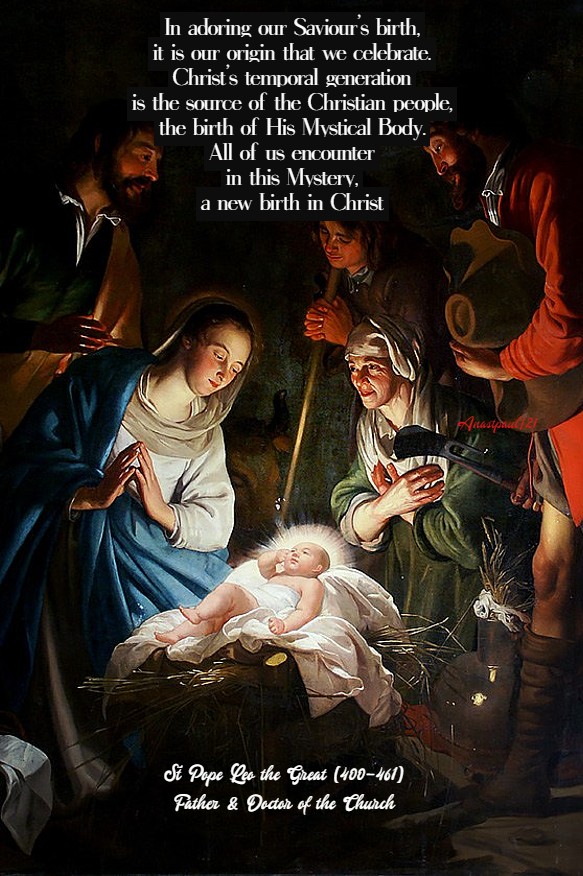
“In adoring our Saviour’s birth, it is our origin that we celebrate. Christ’s temporal generation is the source of the Christian people, the birth of His Mystical Body. All of us encounter in this Mystery, a new birth in Christ.”
St Pope Leo the Great (400-461) Father & Doctor of the Church
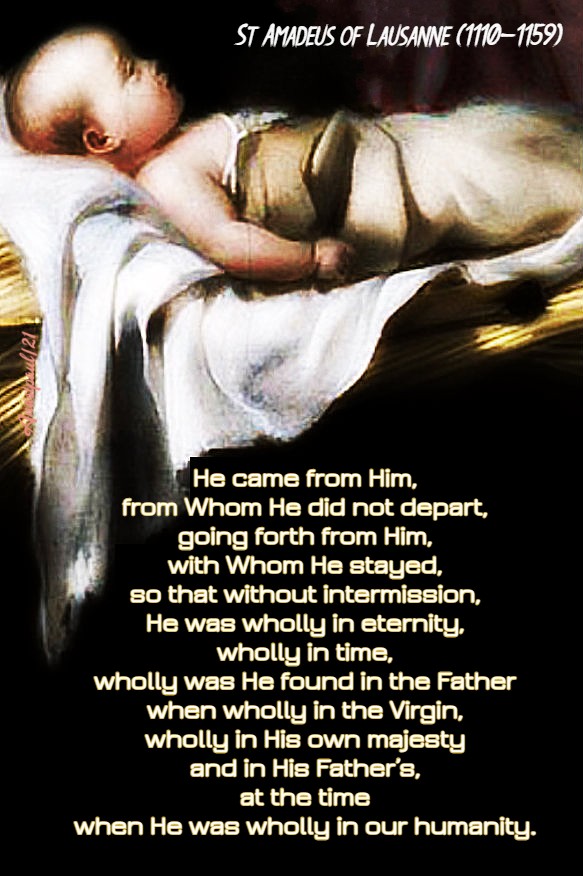
“He came from Him, from Whom He did not depart, going forth from Him, with Whom He stayed, so that without intermission, He was wholly in eternity, wholly in time, wholly was He found in the Father when wholly in the Virgin, wholly in His own Majesty and in His Father’s, at the time when He was wholly in our humanity. ”
One Minute Reflection – 23 December – O Emmanuel – Readings: Malachi 3:1-4, 23-24, Psalms 25:4-5,8-9, 10 and 14, Luke 1:57-66
The Lord is at hand, come, let us adore Him.
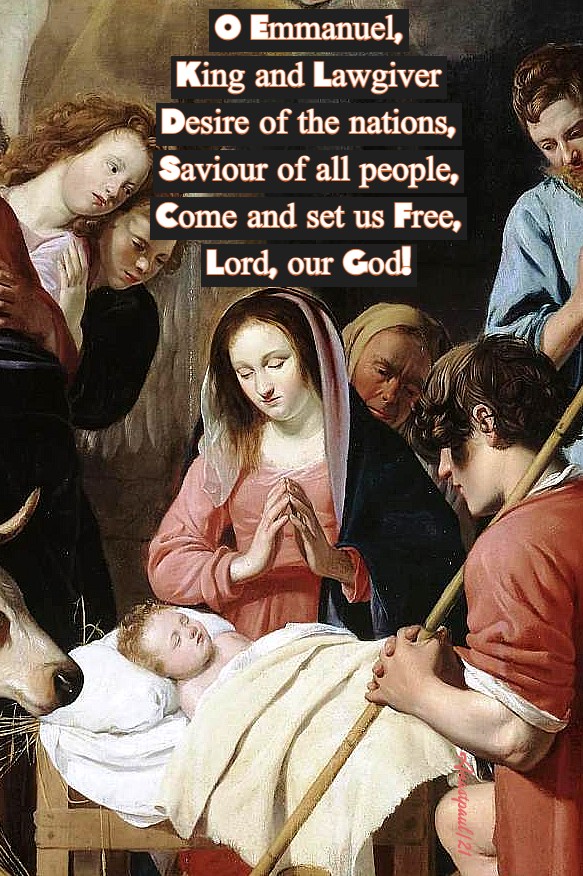
O Emmanuel, King and Lawgiver Desire of the nations, Saviour of all people, Come and set us free, Lord, our God!
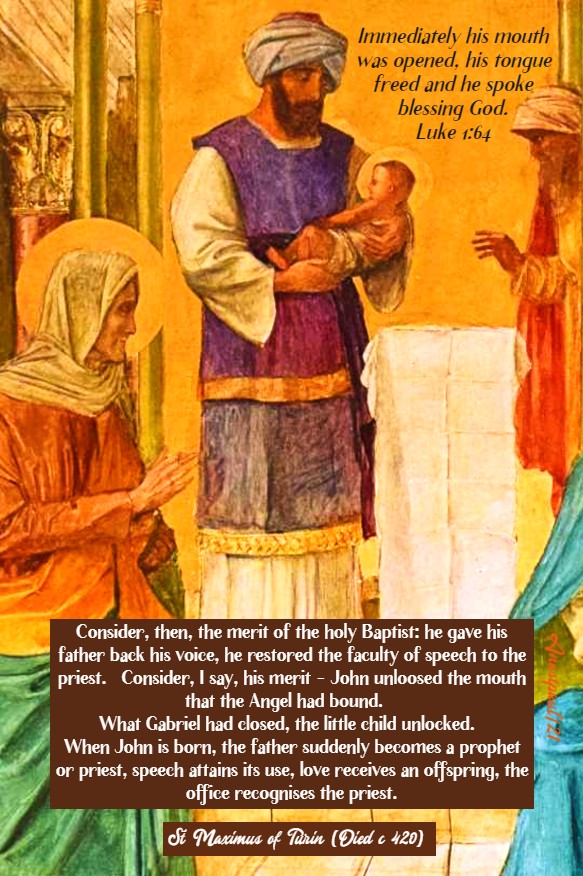
“Immediately his mouth was opened, his tongue freed and he spoke blessing God.” – Luke 1:64
REFLECTION – “When John, his son was born, among his neighbours there was concern about what name he should be given. Writing tablets were offered to his father, so that he himself could put down the name that he had decided upon, so that he might express, in writing, what he could not, in speech. Then, in a wonderful manner, when he had taken the tablets in order to begin writing, his tongue was loosened, the written word gave way to speech and he did not write “John” but spoke it. Consider, then, the merit of the holy Baptist: he gave his father back his voice, he restored the faculty of speech to the priest. Consider, I say, his merit – John unloosed the mouth that the angel had bound. What Gabriel had closed, the little child unlocked. When John is born, the father suddenly becomes a prophet or priest, speech attains its use, love receives an offspring, the office recognises the priest.” – St Maximus of Turin (Died c 420) Bishop of Turin (Sermon 6)
PRAYER – Almighty God, now that the birth of Your Son is drawing near, we pray that Your eternal Word, Who took flesh in the womb of the Virgin Mary and came to dwell amongst men, will show Your unworthy people, the greatness of His love. And by the intercession of His Holy Mother, may we be granted Your grace. Through Emmanuel, our Lord, Who lives and reigns with You and the Holy Spirit, God forever and ever, amen.
O Come, O come, Emmanuel And ransom captive Israel, That mourns in lonely exile here Until the Son of God appear. Refrain: Rejoice! Rejoice! Emmanuel Shall come to thee, O Israel!
O come, Thou Wisdom, from on high And order all things far and nigh, To us the path of knowledge show And teach us in her ways to go. Refrain
O come, o come, Thou Lord of might, Who to thy tribes on Sinai’s height In ancient times did give the law, In cloud, and majesty and awe. Refrain
O come, Thou Rod of Jesse’s stem, From ev’ry foe deliver them That trust Thy mighty power to save And give them vict’ry o’er the grave. Refrain
O come, Thou Key of David, come And open wide our heav’nly home, Make safe the way that leads on high, That we no more have cause to sigh. Refrain
O come, Thou Dayspring from on high And cheer us by thy drawing nigh. Disperse the gloomy clouds of night And death’s dark shadow put to flight. Refrain
O come, Desire of nations, bind In one the hearts of all mankind. Bid every strife and quarrel cease And fill the world with heaven’s peace. Refrain
The favourite O Come, O Come Emmanuel carol was originally written in Latin text in the 12th Century. The author of the words and composer to the music of O Come, O Come Emmanuel is unknown. It is, however, believed that the melody was of French origin and added to the text a hundred years later. The Latin was translated into English by John Mason Neale in 1851.
Thought for the Day – 22 December – Meditations with Antonio Cardinal Bacci (1881-1971)
A Christmas Novena VII Prayer and Dedication
“Let us kneel once more before the crib. Like other newborn infants, Jesus is sometimes asleep and sometimes awake, sometimes crying and sometimes smiling. Often His tiny eyes silently watch Mary and Joseph. Surely, this seems a useless existence for Almighty God. But we know that it is not purposeless. This is the first great lesson which God wishes to give to the proud and corrupt human race. It is the lesson of humility, prayer and total dedication to God.
To outward appearances, Jesus is behaving like any other baby. Internally, however, His soul is hypostatically united to the Eternal Word and dwells in the Presence of the Heavenly Father, Whom He loves with a burning and infinite love. Heart and soul, He offers Himself as a holocaust on behalf of sinful humanity and implores His Heavenly Father, to enlighten minds darkened by error, to strengthen weak human wills and to make all men holy. It may well be said, that already, in the silence and obscurity of the cradle, Jesus has begun to redeem the world, for every one of His human-divine actions has an infinite value. Whether He is awake or asleep, crying or smiling, He offers Himself silently to His Eternal Father as a holocaust of propitiation for our sins.
Let us adore the Divine Infant, therefore and thank Him for the priceless gift of our Redemption, which is already accomplished in the silence and obscurity of the manger. Let us implore the grace to love Him and to imitate Him more closely.
As we kneel before the Infant Jesus, let us beseech Him to enable us to grasp the truth of these reflections. Let us take more care of our soul than we do of our external talents and possessions. May God occupy the foremost place in our minds and may He be the principal object of our thoughts, desires and affections. Let us imitate the humble recollection and ardent love for God of the Holy Infant. Like Him, let us offer ourselves entirely to God. Let us ask Him to make us like Him, in complete acceptance of the Divine Will, especially when we are in trouble or in pain, for in this way, we shall be able to show God how sincerely we love Him.”
Quote of the Day – 22 December – Wednesday of the Fourth Week of Advent, O Rex Gentium/O King of all Nations,
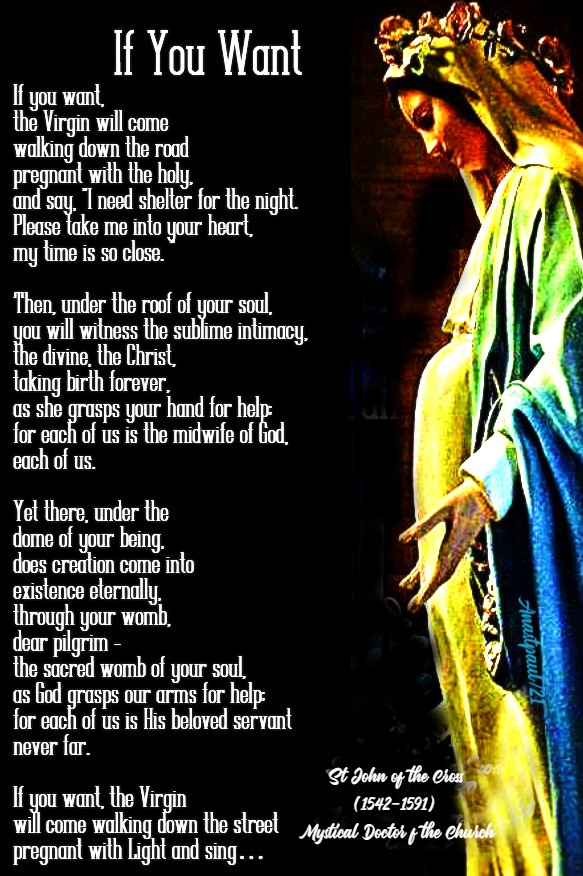
“If you want, the Virgin will come walking down the road pregnant with the Holy and say: “I need shelter for the night. Please take me inside your heart. My time is so close.” Then, under the roof of your soul, you will witness the sublime intimacy, the Divine, the Christ, taking birth forever. As she grasps your hand for help, for each of us is the midwife of God, each of us. Yes, there, under the dome of your being, does creation come into existence eternally– through your womb, dear pilgrim–the sacred womb of your soul! As God grasps our arms for help; for each of us is His beloved servant never far. If you want, the Virgin will come, walking down the street, pregnant with Light and sing!”
St John of the Cross (1542-1591) Mystical Doctor of the Church
One Minute Reflection – 22 December – “Month of the Immaculate Conception” – Wednesday of the Fourth Week of Advent, O Rex Gentium/O King of all Nations, Readings: Samuel 1:24-28; First Samuel 2: 1, 4-8; Luke 1:46-56
The Lord is at hand, come let us adore Him.
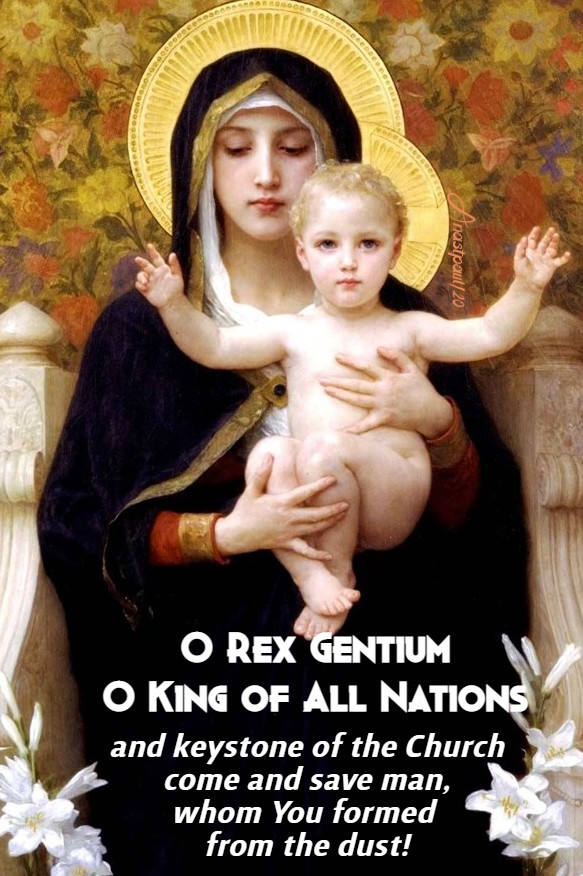
O KING OF ALL NATIONS and keystone of the Church come and save man, whom You formed from the dust!
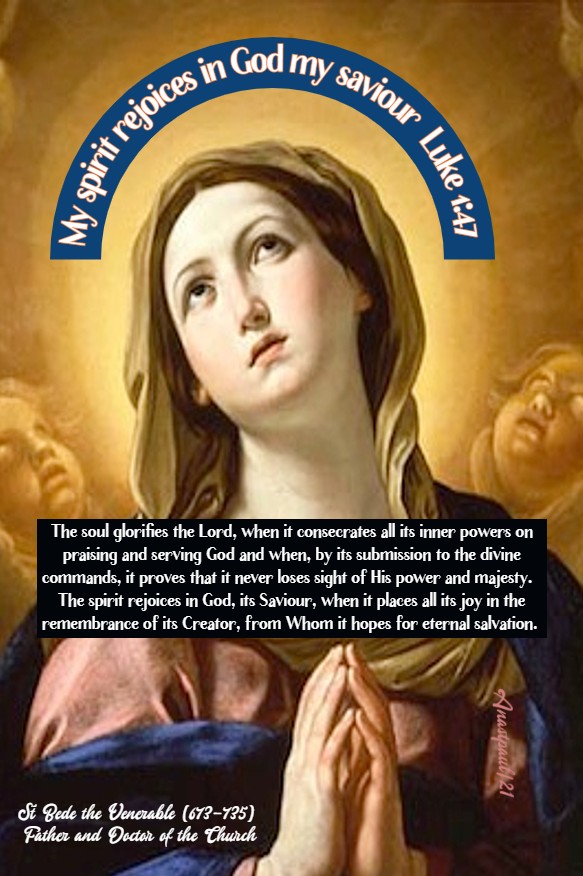
“My spirit rejoices in God my saviour” – Luke 1:47
REFLECTION – “My soul magnifies the Lord, my spirit rejoices in God my Saviour.”. The first interpretation of these words is undoubtedly to acknowledge the gifts granted to her, to Mary in particular, by God. But then she recalls the universal blessing with which God never ceases to surround the human race.
The soul glorifies the Lord, when it consecrates all its inner powers on praising and serving God and when, by its submission to the divine commands, it proves that it never loses sight of His power and majesty. The spirit rejoices in God, its Saviour, when it places all its joy in the remembrance of its Creator, from Whom it hopes for eternal salvation. Without doubt, these words exactly express the thought of all the Saints but it was most especially fitting they should be spoken by the blessed Mother of God, who, filled with a special privilege, burned with a wholly spiritual love for the One she had the joy of conceiving in her flesh. More than any other Saint she had good reason to rejoice in Jesus – that is to say, in her Saviour – because He Whom she acknowledged to be the Eternal Author of our salvation, would in time, as she knew, be born in His own flesh and with such authenticity, that in one and the same Person her Son and her God, would be truly present…
Hence it is a praiseworthy and salutary custom, whose fragrance perfumes Holy Church, when everyday at Vespers, we sing the Canticle of the Virgin. We may well expect from this, that the souls of the faithful, by so often calling to mind the Lord’s Incarnation, will be enflamed with even greater fervour and that, such a frequent reminder of His Holy Mother’s example, will strengthen them in virtue. And Vespers is the best time to come back to this song, since our souls, tired by the day and drawn this way and that by the day’s thoughts, need to come back together again, when the hour of rest draws near, so that they may find, once more, their singleness of focus.” – St Bede the Venerable (673-735) Monk, Father and Doctor of the Church (Homilies on the Gospel, I, 4 ; CCL 122, 25f)
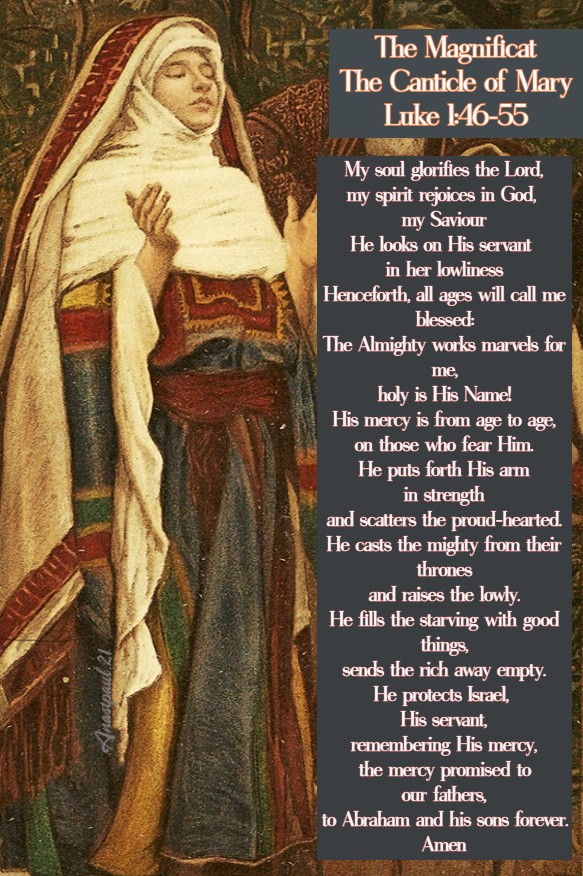
PRAYER –The Magnificat The Canticle of Mary Luke 1:46-55
My soul glorifies the Lord, my spirit rejoices in God, my Saviour He looks on His servant in her lowliness Henceforth, all ages will call me blessed: The Almighty works marvels for me, holy is His Name! His mercy is from age to age, on those who fear Him. He puts forth His arm in strength and scatters the proud-hearted. He casts the mighty from their thrones and raises the lowly. He fills the starving with good things, sends the rich away empty. He protects Israel, His servant, remembering His mercy, the mercy promised to our fathers, to Abraham and his sons forever. Amen.
Thought for the Day – 21 December – Meditations with Antonio Cardinal Bacci (1881-1971)
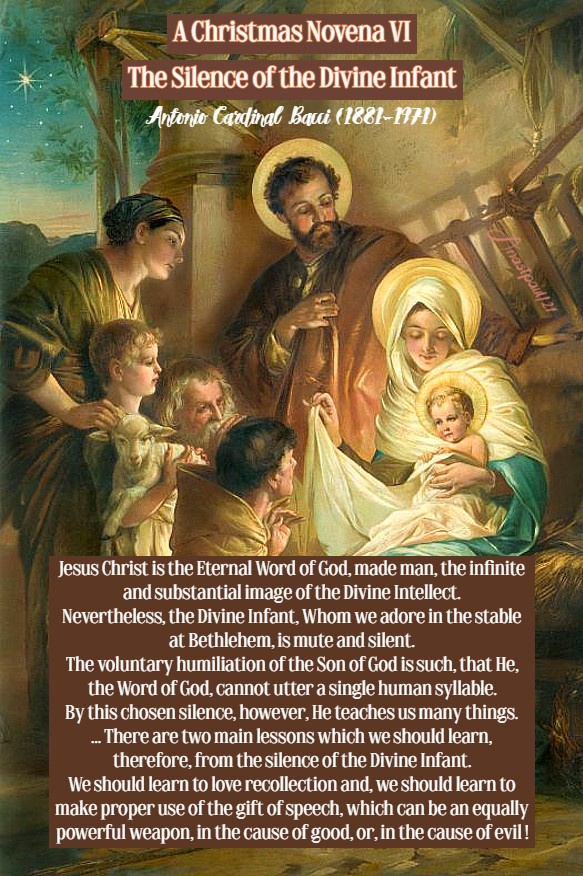
A Christmas Novena VI The Silence of the Divine Infant
“Jesus Christ is the Eternal Word of God, made man, the infinite and substantial image of the Divine Intellect. Nevertheless, the Divine Infant, Whom we adore in the stable at Bethlehem, is mute and silent. The voluntary humiliation of the Son of God is such, that He, the Word of God, cannot utter a single human syllable. By this chosen silence, however, He teaches us many things. In the first place, He teaches us humility and self-denial. He teaches us, moreover, to recollect ourselves in the Presence of God, so that it may be easier for us to speak with Him and for Him, to make known what He requires of us. The silence of prayer brings forth divine consolations and inspirations to holiness,
Do we love to be silent? It is not necessary to become hermits but, it is essential, from time to time, to place ourselves quietly in the Presence of God. God cannot be heard through the noise and confusion of the world, whereas, He speaks clearly to the soul, which seeks the silence of prayer. In any case, if we go about looking for the gossip and idle chatter of the world, it is almost impossible not to offend God. “Avoid profane and empty babblings,” St Paul urges us, “for they contribute much to ungodliness” (2 Tim 2:16). “If anyone does not offend in word,” adds St James, “he is a perfect man” (Js 3:2). “The tongue is a little member,” he continues but, goes onto emphasis that it is capable of doing either a great deal of good or a great deal of harm. “With it, we bless God the Father and, with it, we curse men, who have been made after the likeness of God. Out of the same mouth proceed blessing and cursing. These things, my brethren ought not to be so” (Js 3:5-10).
There are two main lessons which we should learn, therefore, from the silence of the Divine Infant. We should learn to love recollection and, we should learn to make proper use of the gift of speech, which can be an equally powerful weapon, in the cause of good, or, in the cause of evil!”
One Minute Reflection – 21 December – O Oriens/O Radiant Dawn – “Month of the Immaculate Conception” – Tuesday of the Fourth Week of Advent, Readings: Songs 2: 8-14 or Zephaniah 3: 14-18a; Psalm 33: 2-3, 11-12, 20-21; Luke 1: 39-45
The Lord is at hand, come let us adore Him.
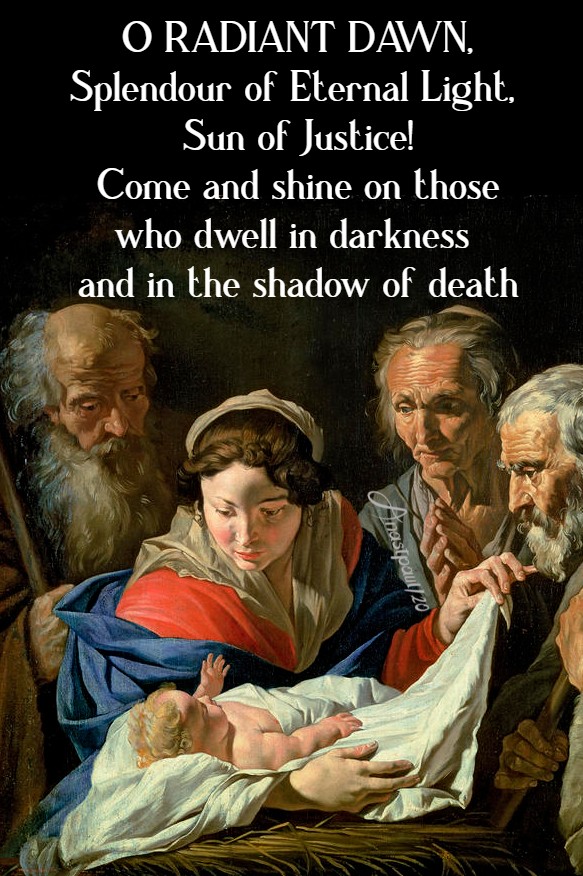
O Radiant Dawn, Splendour of Eternal Light, Sun of Justice! Come and shine on those who dwell in darkness and in the shadow of death.
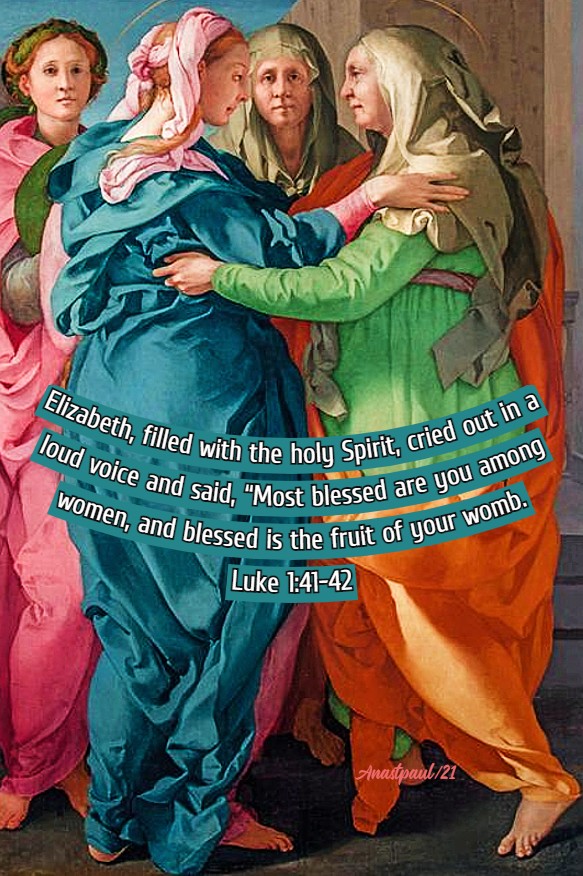
“Elizabeth, filled with the holy Spirit, cried out in a loud voice and said, “Most blessed are you among women, and blessed is the fruit of your womb.” – Luke 1:41-42
REFLECTION – “Everyday we devoutly greet the most Blessed Virgin Mary with the angel’s greeting and we usually add: Blessed is the fruit of thy womb. After she was greeted by the Virgin, Elizabeth added this phrase as if she were echoing the salutation of the Angel – Blessed are you among women and blessed is the fruit of your womb. This is the fruit of which Isaiah spoke – On that day the shoot of the Lord shall be splendid and radiant—the sublime fruit of earth. What is this fruit but the holy one of Israel, the seed of Abraham, the shoot of the Lord, the flower arising from the Root of Jesse, the fruit of life, Whom we have shared?
Blessed surely in seed and blessed in the shoot, blessed in the flower, blessed in the gift, finally blessed in thanksgiving and praise, Christ, the Seed of Abraham, was brought forth from the seed of David into the flesh.
He alone among men is found perfected in every good quality, for the Spirit was given to Him without measure so that He alone could fulfill all justice. For His justice is sufficient for all nations, according to the Scriptures. As the earth brings forth its buds and as the garden germinates its own seed, so the Lord God shall bring forth justice and praise before all the nations. For this is the shoot of justice, which the flower of glory adorns with its blessings when it has grown. But how great is this glory? How can anyone think of anything more glorious, or rather, how can anyone conceive of this at all? For the flower rises from the root of Jesse. you ask: “How far?” Surely it rises even to the highest place because Jesus Christ is in the glory of God the Father. His magnificence is elevated above the heavens, so that He, the issue of the Lord, is splendid and glorious, the sublime fruit of earth.
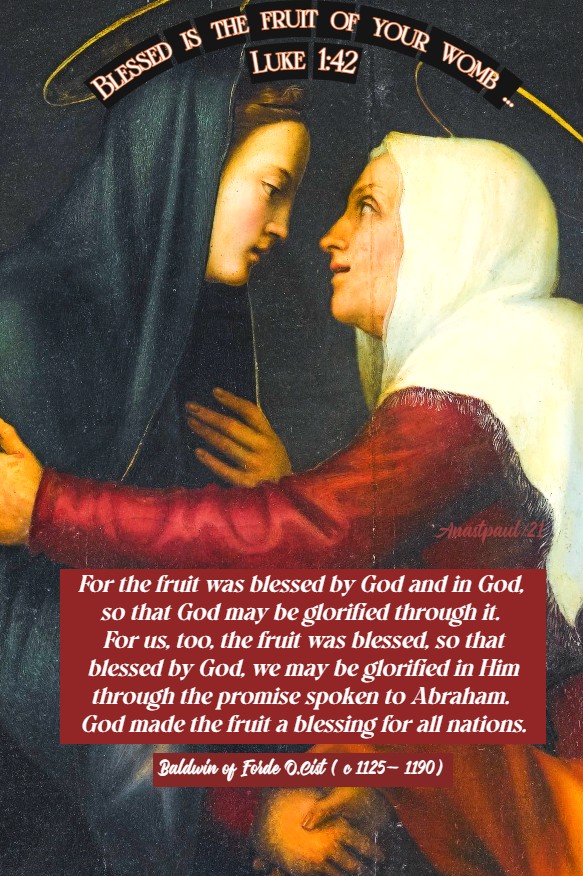
But what is our benefit from this fruit? What other than the fruit of blessing from the blessed fruit? From this seed, this shoot, this flower, surely the fruit of blessing comes forth. It has come even to us; first as a seed it is planted through the grace of pardon, then germinated with the increase of perfection and finally, it flowers in the hope or the attainment of glory. For the fruit was blessed by God and in God, so that God may be glorified through it. For us, too, the fruit was blessed, so that blessed by God, we may be glorified in Him through the promise spoken to Abraham. God made the fruit a blessing for all nations.” – Baldwin of Forde O.Cist ( c 1125– 1190) Cistercian Abbot, Bishop, then Archbishop of Canterbury ( An excerpt from A Sermon on the ‘Hail Mary’).
PRAYER – In Your goodness Lord, as we rejoice at the coming of Your Son in flesh and blood like ours, grant that when He comes again in glory, we may receive the gift of eternal life. And may His Blessed and Immaculate ever Virgin Mother, cast upon us a look of mercy and intercede on our behalf. Through Jesus Christ our Lord, with the Holy Spirit, God now and for all eternity, amen.
Thought for the Day – 20 December – Meditations with Antonio Cardinal Bacci (1881-1971)
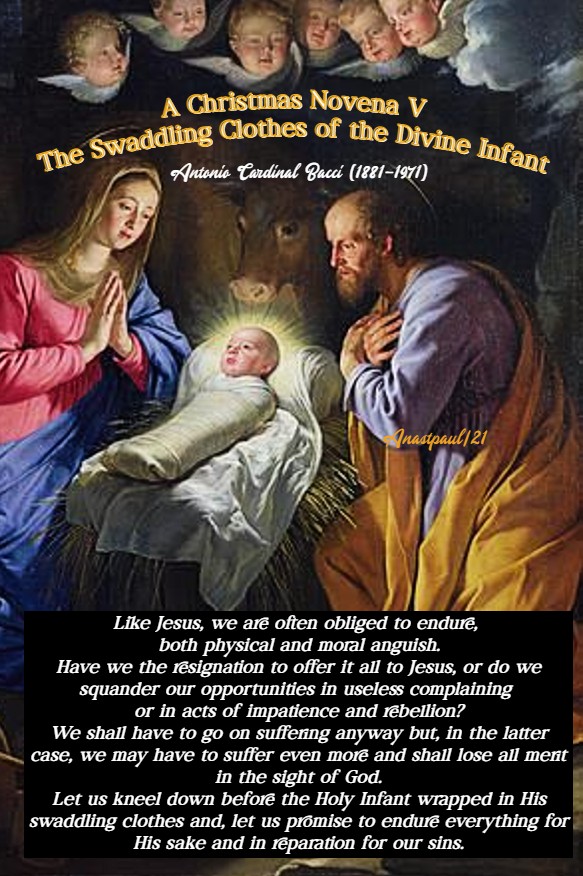
A Christmas Novena V The Swaddling Clothes of the Divine Infant
“Mary, like other mothers in those days, wrapped the Infant Jesus in swaddling clothes. The Divine Child quietly offered this new humiliation to His heavenly Father. He saw prefigured in these bands, the ropes with which He would be bound in the garden of Gethsemane, even after He had given sinful humanity, His celestial teaching, example and miracles and finally, His own Body inthe Sacrament of the Eucharist. He saw in them too, the chains with which He would be secured to the pillar, in order to be scourged in the Praetorium of Pilate among the jeers and insults of the onlookers. He saw in them, finally, the cords with which, after having been condemned to the ignominious death of the Cross, He would be tied, while being led to the place of execution on Mount Calvary. Filled with infinite love for stricken humanity, the Heart of the Divine Infant offered all this, in advance, to His Father in heaven.
Are we making any effort to return such great love? Like Jesus, we are often obliged to endure, both physical and moral anguish. Have we the resignation to offer it all to Jesus, or do we squander our opportunities in useless complaining or in acts of impatience and rebellion? We shall have to go on suffering anyway but, in the latter case, we may have to suffer even more and shall lose all merit in the sight of God.
Let us kneel down before the Holy Infant wrapped in His swaddling clothes and, let us promise to endure everything for His sake and in reparation for our sins.”




























 AnaStpaul
You must be logged in to post a comment.