Posted in ART DEI, SAINT of the DAY, The PASSION

Saint of the Day – 12 July – St John Gualbert (c 985-1073) “The Merciful Knight”

Saint of the Day – 12 July – St John Gualbert (c 985-1073) Abbot, Founder of the Vallumbrosan Order and many monasteries, Apostle of the poor, Reformer – born ‌Giovanni Gualberto in c 985 at Florence, Italy and died in 1073 at Passignano near Florence, Italy of natural causes.   PatronagesForest workers, Foresters, Park rangers, Parks, Badia di Passignano, Vallumbrosan Order, Italian Forest Corps, Brazilian forests.st john gaulbert snip getty image.JPG
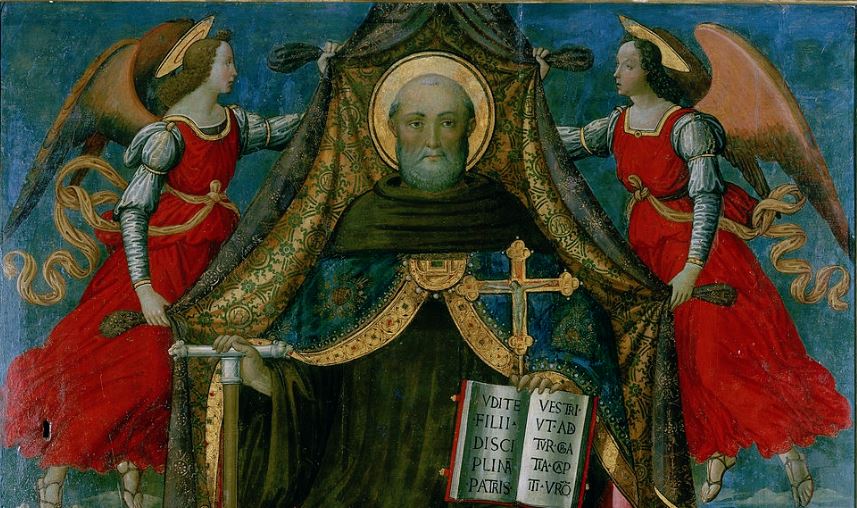
Giovanni Gualberto was born circa 985 to nobles who hailed from the Visdomini House, he was born in the Castle known as Poggio Petroio.   His sole sibling was his older brother Ugo.   He was also related to the Blessed Pietro Igneo.

He was educated and raised a devout Catholic but during his adolescence, cared little for religion.   He was instead focused on frivolous things and was concerned with vain amusements and romantic intrigues.   When his brother Ugo was murdered, Gualbert set out to avenge his death.
stjohn gualbert

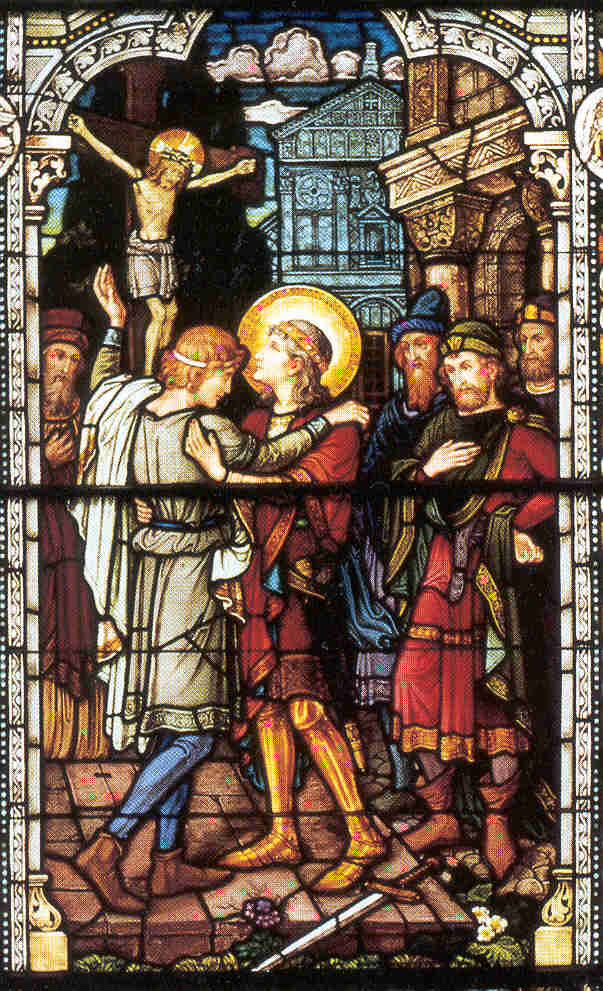
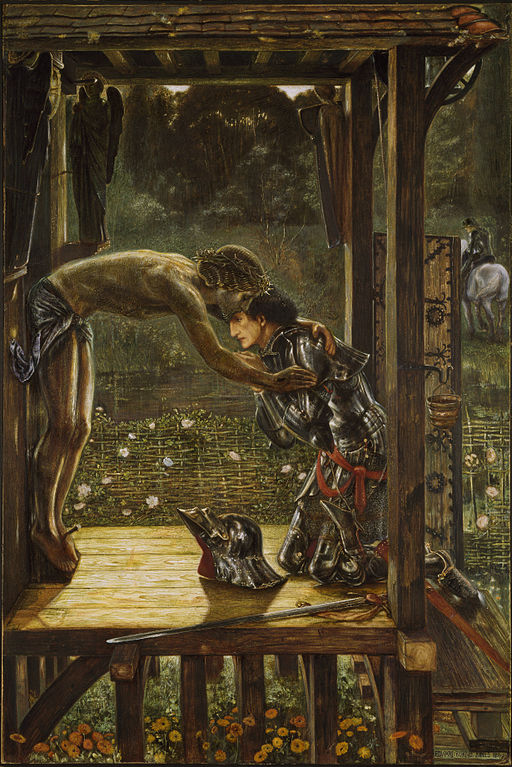
On Good Friday, as he was riding into Florence accompanied by armed men, he encountered his enemy in a place where neither could avoid the other.   John would have slain him but his adversary, who was totally unprepared to fight, fell upon his knees with his arms stretched out in the form of a cross and implored him, for the sake of Our Lord’s holy Passion, to spare his life.   St John said to his enemy, “I cannot refuse what you ask in Christ’s name.   I grant you your life and I give you my friendship.   Pray that God may forgive me my sin.”   Grace triumphed.

Gualbert entered the nearby Benedictine Church at San Miniato al Monte to pray and the figure on the Crucifix bowed His head to him in recognition of his generous and merciful act.   Gualbert begged pardon for his sins and that week cut off his hair and began to wear an old habit that he had borrowed.
sts-michael-and-john-gualbert
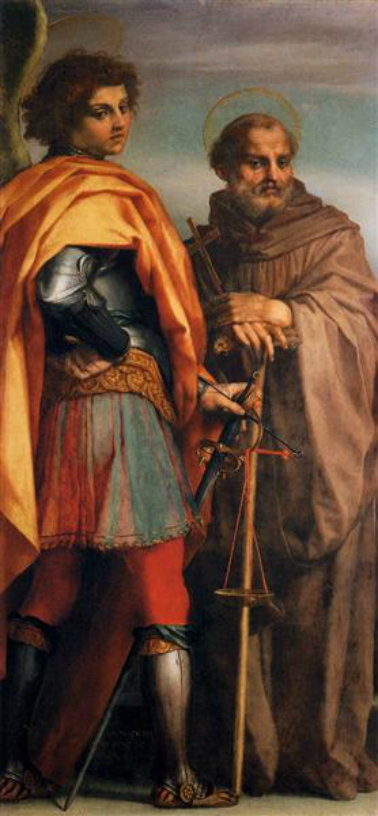
St Michael & St John Gualbert

This holy miracle,  forms the subject of Edward Burne-Jones’s artwork,  “The Merciful Knight” and Joseph Shorthouse, the author,  adapted this in his celebrated novel “John Inglesant”.   The explanatory inscription provided by Burne-Jones tells the viewer of a knight who forgave his enemy when he might have destroyed him and how the image of Christ kissed him in token to show that his acts had pleased God.
512px-Edward_Burne-Jones_-_The_Merciful_Knight. st john gualbert - wow!jpg.jpg
Edward Burne-Jones “The Merciful Knight”

Gualbert became a Benedictine Monk at San Miniato despite his father’s opposition.  His father hastened to find his son but gave him his blessing when he heard his son’s arguments and saw that he was resolute in his decision.   But he counselled his son to do good.   He fought against simoniacal actions of which both his Abbot Oberto and the Bishop of Florence, Pietro Mezzabarba, were accused and their guilt discovered. Unwilling to compromise, he left to find a more solitary and strict life.  st john gaulbertHe often fasted and imposed other strict penances on himself.   His attraction was for the cenobitic and not eremitic life, so after he spent some time with the Monks at Camaldoli he late, in 1036, settled at Vallombrosa where he founded his own convent.   Instead of a traditional garden he wished to have his Monks plant trees (firs and pines for the most part), hence his Patronage of forests and foresters.   He founded additional Monasteries for his Order in locations such as Rozzuolo and San Salvi.
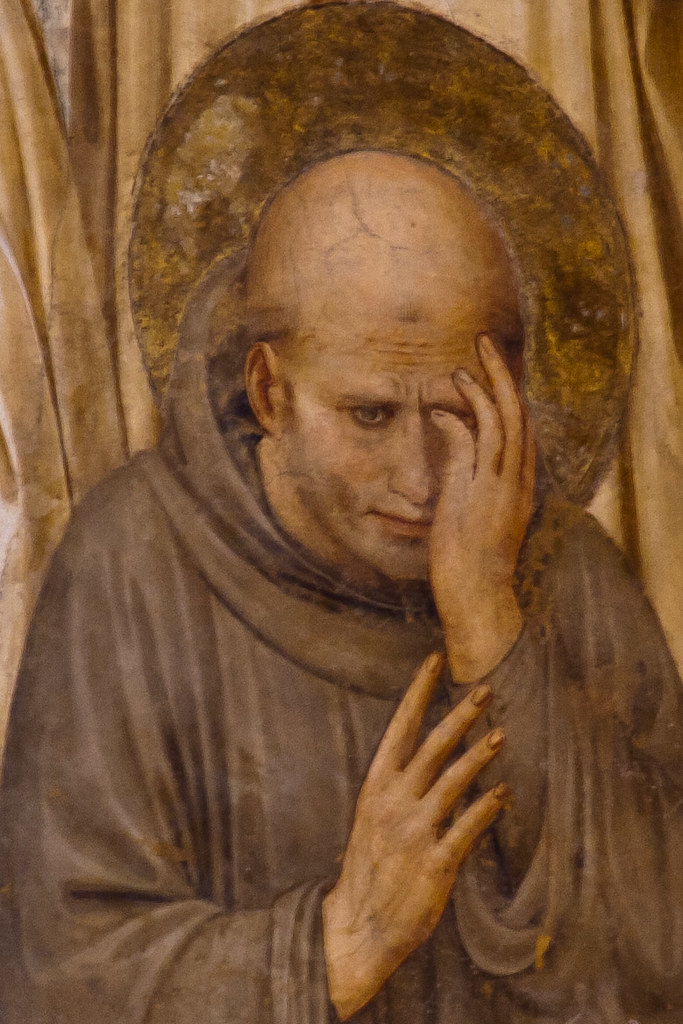
St. John Gualbert

He became a noted figure for his compassion to the poor and the ill.   Pope Leo IX travelled to Vallambrosa to see and talk with St John.    Pope Stephen IX and pOPE Alexander II ,held him in the greatest esteem as did Pope Gregory VII, who praised Gualbert for the pureness and meekness of his faith, as a staunch example of compassion and goodness. Gualbert also admired the teachings of the Church Fathers, in particular Saint Basil and Saint Benedict of Nursia.

He never wished to be Ordained to the Priesthood and nor did he even wish to receive the Minor Orders.  He fought manfully against simony and in many ways promoted the interest of the Faith in Italy.   On 12 July 107, after a life of great austerity, he died whilst the Angels were singing round his bed.

The holy lives of the first Monks at Vallombrosa attracted considerable attention and brought many requests for new foundations but there were few Postulants, since few could endure the extraordinary austerity of the life.   Thus only one other Monastery,, that of San Salvi at Florence, was founded during this period.   But when the Founder had mitigated his Rule somewhat, three more Monasteries were founded and three others reformed and united to the Order during his lifetime.   

In the struggle of the Popes against simony, the early Vallumbrosans took a considerable part, of which the most famous incident is the ordeal by fire undertaken successfully by St Peter Igneus in 1068. Shortly before this, the Monastery of St Salvi had been burned and the Monks ill-treated by the anti-reform party.   These events still further increased the repute of Vallombrosa. A Bull of Pope Urban II in 1090, which takes Vallombrosa under the protection of the Holy See, enumerates fifteen Monasteries besides the Motherhouse.

johngualbert1

St John was Canonised by Pope Celestine III on 24 October 1193.
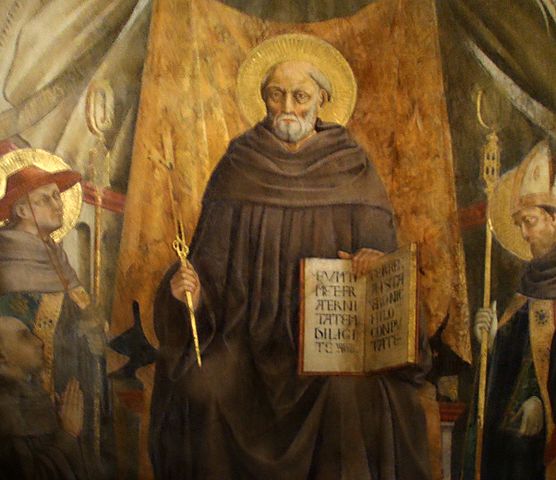
556px-Santa_Trinita,_Neri_di_bicci,_San_giovanni_gualberto_(dettaglio)2

Pope Pius XII, in 1951, named St John the Patron Saint for the Italian Forest Corps while he was named as the Patron for Brazilian forests in 1957.
Posted in ART DEI, SAINT of the DAY, The HOLY ROSARY/ROSARY CRUSADE

Art Dei – 18 June – Paintings in Blessed Osanna Andreasi’s House

Art Dei – 18 June – The Memorial of Blessed Osanna Andreasi OP (1449-1505) – Her House in Mantua, Italy

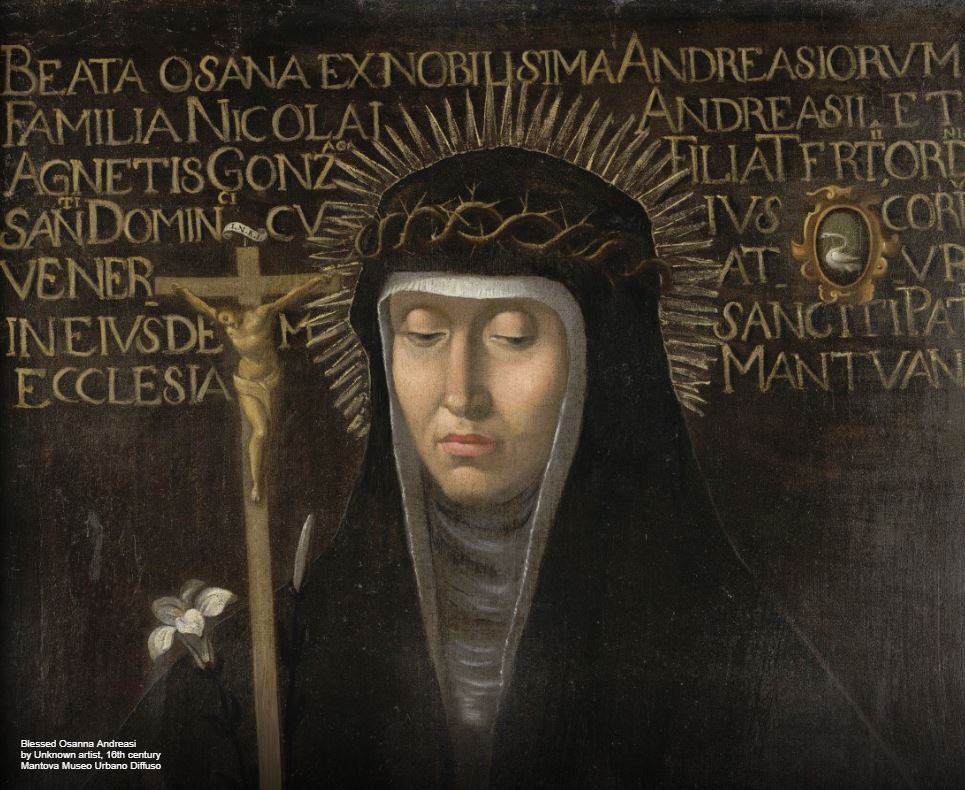
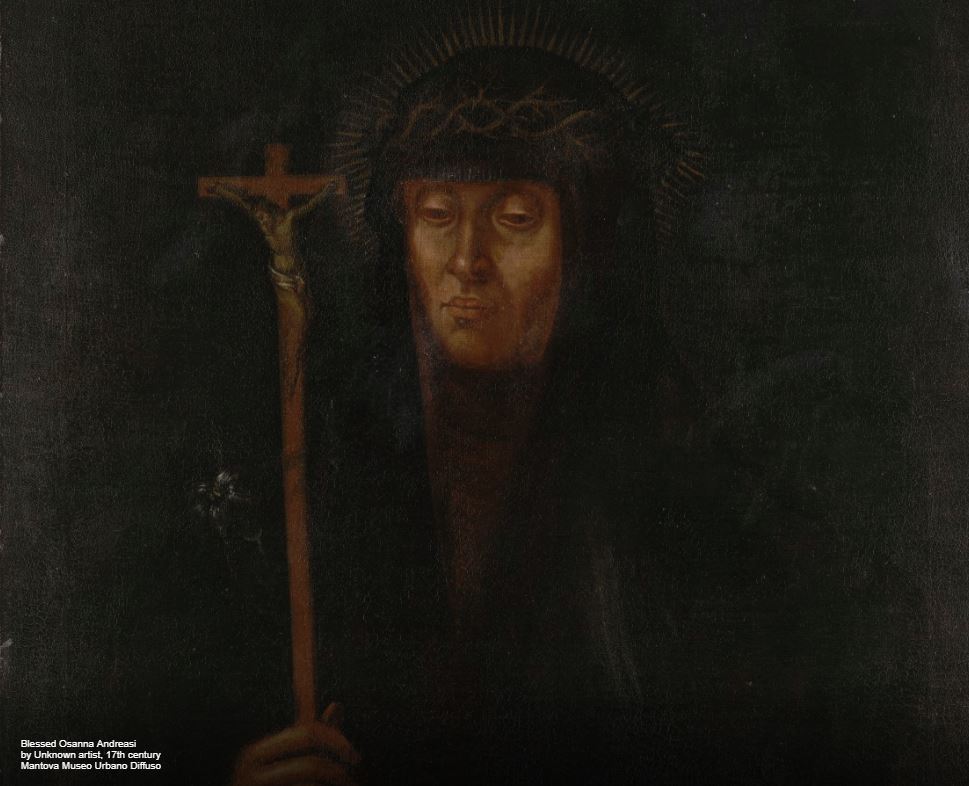
This beautiful painting was donated to the Andreasi House in 2002 by private collectors, it is a replica of a painting made in the late 16th century, the original is also part of a private collection, attributed to Luigi Costa the Elder.   This versions differs from the original in that it lacks the plate at the bottom and also because in the background we can see a large writing in gold letters and the figure of a swan, the symbol of the Andreasi family.   Though the original is more intense, this version also is very interesting, with the large cross and the lily around it, indicating the woman’s condition of virgin.   The crown of thorns she is holding evidently creates a direct relationship with the suffering of Jesus Christ.   In the course of time, a specific physical type representing the Blessed took shape – she is both severe and beautiful, conveying a sense of quiet prayer but also the charisma of a benefactor.bl osanna andreasi - google arts.JPG

This painting below, is another portrait of the Blessed, evidently from a series beginning with the work that is part of the private collection attributed to Costa the Elder.   The low quality of this canvas does not, however, prevent the viewer from recognising her typical features, here particularly severe and lacking many of the usual symbols.   Here, in fact, we see only the cross, long and slender, that the Blessed holds as usual in her right hand, showing it to the worshippers.bl osanna andreasi - lower quality without symbols google arts.JPG

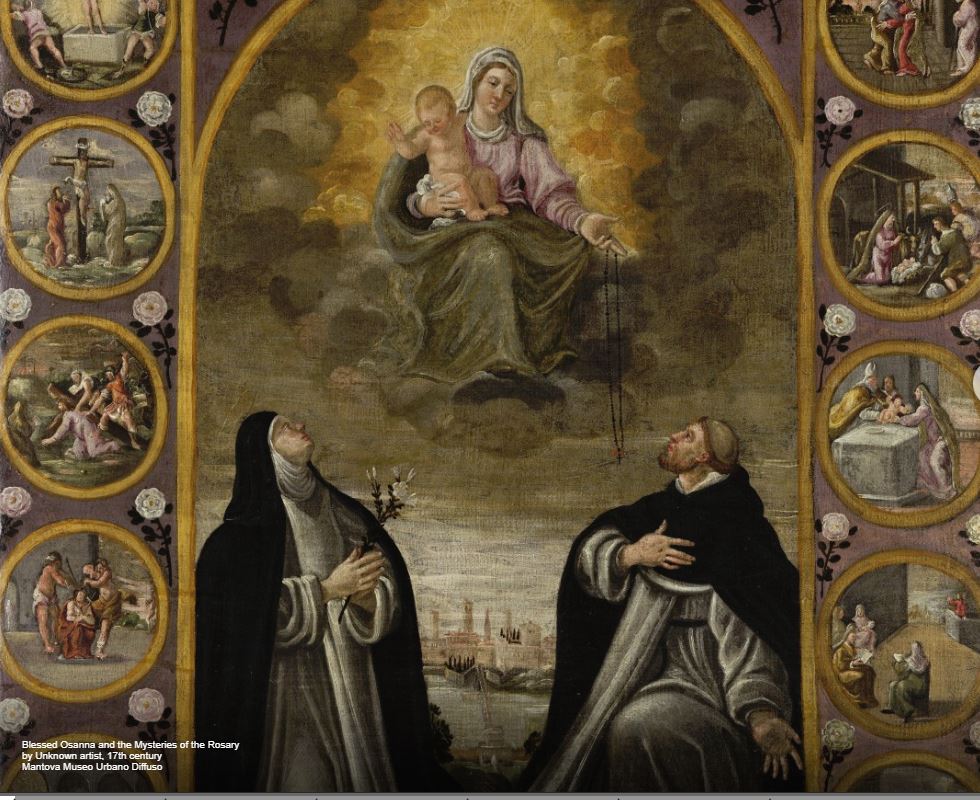
Blessed Osanna and the Mysteries of the Rosarybl asanna and the mysteries of the rosary
In this devotional composition, the Blessed Osanna is painted standing on the left, while invoking the Virgin Mary who appears above, surrounded by clouds, carrying Baby Jesus in her arms.   Next to Osanna we see Saint Dominic, who is in turn admiring the celestial vision.   The peculiarity of this painting is, however, the presence of a total of fifteen tondos on the two sides and in the upper part of the painting, depicting the Mysteries of the Rosary.   On the right we have the Joyful Mysteries – Annunciation, the Visitation of Mary to saint Elizabeth, the Nativity, the Presentation of Jesus at the Temple, the Finding of Jesus in the Temple.   On the left the Sorrowful Mysteries – the Agony in the Garden, the Scourging at the Pillar, the Crowning with Thorns, the Carrying of the Cross and the Crucifixion.   Above the Glorious Mysteries – the Resurrection, the Ascension, the Descent of the Holy Spirit, the Assumption of Mary and the Coronation of the Virgin.   Finally, it must be noted that between the Blessed and Saint Dominic, we can make out the outline of the city of Mantua seen from San Giorgio.   This detail allows to identify with certainty the female figure as being the Blessed Osanna.bl osanna andreasi and the rosary - detail - google arts.JPG

The home of the Blessed Osanna Andreasi
In between two floors is a small consecrated chapel and a study with painted cupboards. On the main floor are four rooms of which one is entirely fresh with trompe l’oeil architecture depicting columns, balustrades and Latin proverbs recorded on scrolls.
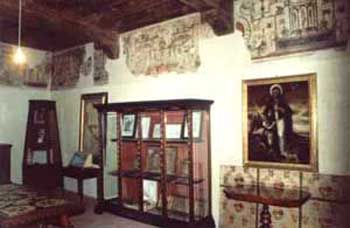
The room of relics of the Blessed Osanna Andreasi (1449-1505) bl osanna's house 243_Castello.jpg Set among hydrangeas, roses and officinal plants in the courtyard is a delightful porch with 15th century pink marble columns bearing the Andreasi coat of arms.  bl osanna'sandreassi's house.jpgThe interior frescoes date from the 15th, 16th and, above a fireplace, 17th centuries – the decoration on the wooden coffered ceilings is still visible in parts, while the floors and stairs are made of terracotta and the doors of wood.   It was purchased by nobleman Niccolò Andreasi in the mid 15th century as his family home.   The house underwent minor changes in the early 16th century when Andreasi’s daughter Osanna was beatified.
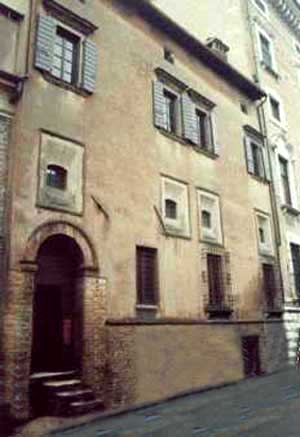
Property of the Andreasi family for centuries, the house passed in 1780 into the hands of the Magnaguti family by marriage.   Conte Alessandro Magnaguti (1887 – 1966) bequeathed it to the Dominican Province Utriusque Lombardiae to perpetuate the memory and cult of Blessed Osanna, who was a Tertiary of the Order and whose home it was.
Since 1935 it has been home to the Dominican Fraternity, who restored it and created a cultural centre for the circulation of Dominican spirituality and for the study of Thomistic philosophy.   They established the Association for Dominican Monuments in 1993.   The house, which still preserves its vocation for philosophy, culture and mysticism, hosts courses on philosophy and art, comparative religion, conferences, book launches and exhibitions and is the home to countless amazing holy artworks, mostly depicting Dominican Saints but not exclusively.

Posted in ART DEI, SAINT of the DAY

Memorials of the Saints – 18 February

St Angilbert of Centula
St Colman of Lindisfarne
St Constance of Vercelli
St Esuperia of Vercelli
St Ethelina
St Flavian (Died 449) Martyr
Bl John of Fiesole/Fra Angelico OP  – The Angelic Friar Giovanni (1387-1455)
The Artist: https://anastpaul.wordpress.com/2018/02/18/saint-of-the-day-18-february-blessed-john-of-fiesole-fra-angelico-o-p-1387-1455/

https://www.youtube.com/watch?v=siSh9StTKWk

St Gertrude Caterina Comensoli
St Helladius of Toledo
St Ioannes Chen Xianheng
St Ioannes Zhang Tianshen
St Jean-François-Régis Clet
St Jean-Pierre Néel
Bl Jerzy Kaszyra
Bl John Pibush – one of the Martyrs of Douai
St Leo of Patera
St Martinus Wu Xuesheng
Bl Matthew Malaventino
St Paregorius of Patara
St Sadoth of Seleucia
St Simeon
St Tarasius of Constantinople
St Theotonius
Bl William Harrington

Martyrs of North Africa – 7 saints: Group of Christians who were martyred together, date unknown. We know nothing else but seven of their names – Classicus, Fructulus, Lucius, Maximus, Rutulus, Secundinus and Silvanus.
They were born and martyred in North Africa.

Martyrs of Rome – 5 saints: A group of Christians martyred together in the persecutions of Diocletian. We know nothing else but their names – Alexander, Claudius, Cutias, Maximus and Praepedigna. They were martyred in 295 in Rome, Italy.

Posted in ART DEI, MORNING Prayers, PAPAL SERMONS, QUOTES - J R R Tolkien and MORE, SAINT of the DAY, The WORD

One Minute Reflection – 19 July – Today’s Gospel: Matthew 11:28-30.

One Minute Reflection – 19 July – Thursday of the Fifteenth week in Ordinary Time, Year B – Today’s Gospel: Matthew 11:28-30.

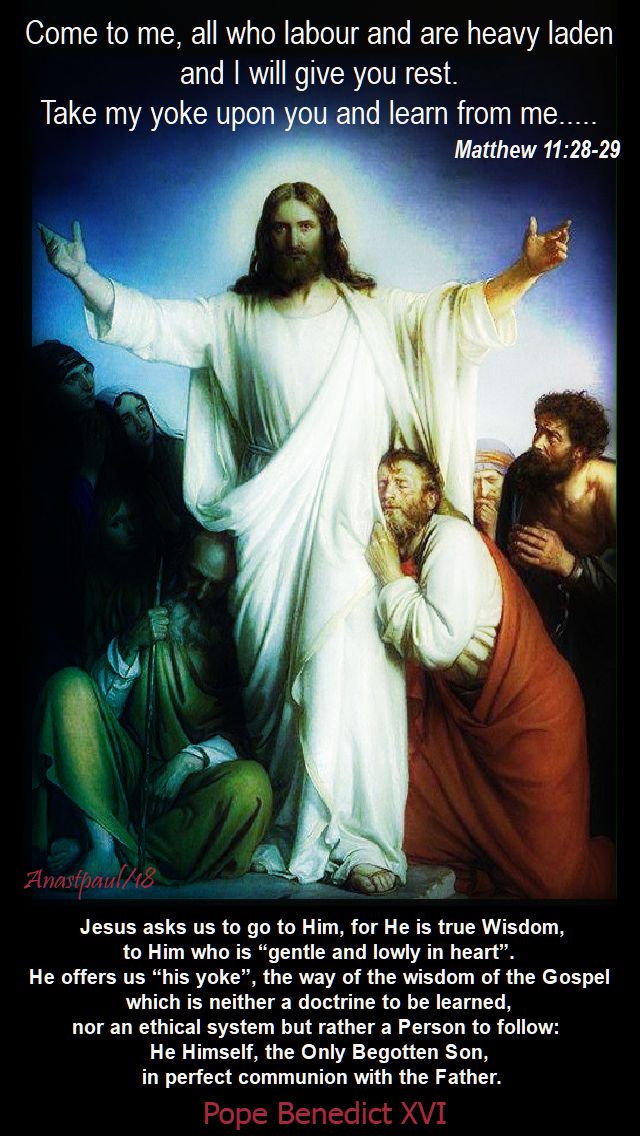
“Come to me, all who labour and are heavy laden and I will give you rest. Take my yoke upon you and learn from me; for I am gentle and lowly in heart and you will find rest for your souls. For my yoke is easy, and my burden is light.”…Matthew 11:28-30

REFLECTION – “Jesus asks us to go to Him, for He is true Wisdom, to Him who is “gentle and lowly in heart”.   He offers us “his yoke”, the way of the wisdom of the Gospel which is neither a doctrine to be learned, nor an ethical system but rather a Person to follow: He Himself, the Only Begotten Son, in perfect communion with the Father.”…Pope Benedict, XVI, General Audience, 7 December 2011come to me all who are burdened - matthew 11 28-29- jesus asks us to go to him - pope benedict - 19 july 2018

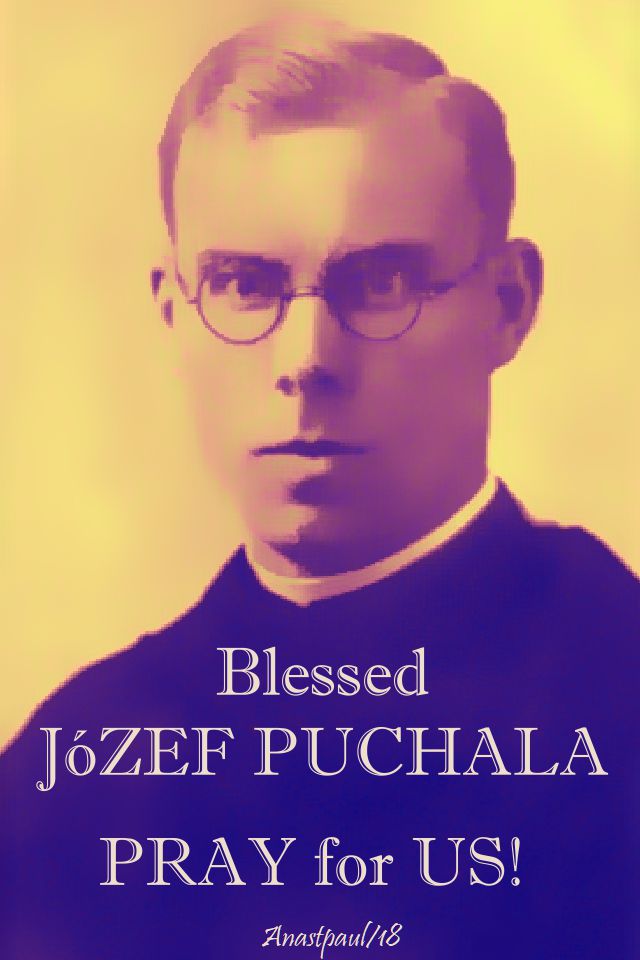
PRAYER – “Holy God, our Father, we turn to You in confidence as children and pray, give us meekness of heart, make us “poor in spirit” that we may recognise that we are not self-sufficient, that we are unable to build our lives on our own but need You, we need to encounter You, to listen to You, to speak to You.   Help us to understand that we need Your gift, Your wisdom, which is Jesus Himself, in order to do the Your will in our lives and thus to find rest in the hardships of our journey.”   Blessed Jozef Puchala, Holy Martyr for Christ, Pray for us, amen.   (Adapted from the same homily above.)bl jozef puchala martyr - 19 july 2018- pray for us

NOTE:   The Image used for the Reflection above is called “Christ the Consolator” by Carl Heinrich Bloch (1834-1890).   You would be mistaken in believing that this great Artist was a Mormon but of course, he was a Danish Artist of a Christian leaning (Mormons are NOT Christians and were begun by Joseph Smith in the 1820s in New York), studied and was inspired and drawn to Catholicism (but did not convert) in Rome and was vastly influenced by Rembrandt (a protestant) in Holland.   The Mormons have used his artworks endlessly – in their temples, advertising and media, he would be highly indignant I believe, without a doubt!

Posted in ART DEI, MORNING Prayers, QUOTES on FAITH, QUOTES on SANCTITY, SAINT of the DAY

Thought for the Day – 18 February – The Memorial of Blessed John of Fiesole/Fra Angelico O.P. (1387-1455)

Thought for the Day – 18 February – The Memorial of Blessed John of Fiesole/Fra Angelico O.P. (1387-1455)

One of the greatest Christian artists is Giovanni Fiesole, better known to the world as Blessed Fra Angelico, the “Angelic Brother.”   Fra Angelico is a patron saint for Catholic artists.   His style of painting beautifully bridges the iconographic and gothic traditions. Giorgio Vasari, author of “Lives of the Artists,” referred to Angelico as a “rare and perfect talent.”

Very little of his writings have survived the centuries but one phrase still resonates, more than 400 years after his death. “He who does Christ’s work, must stay with Christ always.”

Saint Paul, in his letter to the Galatians said something similar.   “I live; yet now, it is not I, but truly Christ, who lives in me. And though I live now in the flesh, I live in the faith of the Son of God, who loved me and who delivered himself for me.” Galatians 2:20

What does it mean when Paul tells us it is no longer he who lives but Christ who lives in him?   What does it mean to stay with Christ always?

In Paul’s time it was believed that the only way to have a right relationship with God was to follow the law, the Ten Commandments and all the thousands of rules that derive from them.   But Paul rejected this idea and preached that the only road to justification, to having that right relationship with God, is through faith in Jesus Christ.

It is not enough to simply “follow the rules” and stay out of trouble.   If that is all we do then we are trying to achieve heaven by our own merits.   God wants more from us than that.   God invites us into a relationship of friends and family, a relationship of love.   This type of relationship is a living, dynamic one.   To love Christ and to want to be near Him is to be crucified with Him.

It means standing up for the Truth even when it is unpopular.   It means finding time to pray.   It means that we stay faithful to the teachings of Jesus.   And it means that when we fail, we humbly confess our sins as we would apologise to a friend we have hurt, so that that relationship can be restored.   It means that we must reflect Christ to the whole world, so that when people look at us they do not see us, they see Christ.

For the Artist this means we must deeply consider our vocation, St John Paul described it as a vocation of beauty.   Do we work to bring beauty to the world?   Do we use our gifts to lift peoples hearts and minds to God?   Does our work reflect His splendour and bring hope and joy to our brothers and sisters?   This does not mean that every artist must confine themselves to religious art but it does mean that we may be called to sacrifice lucrative opportunities. or turn away from work that does not suit our vocation.   But in the end that is what it means to live for Christ and not for ourselves.   (Deacon Lawrence Klimecki – Speaker, Writer, Artist)

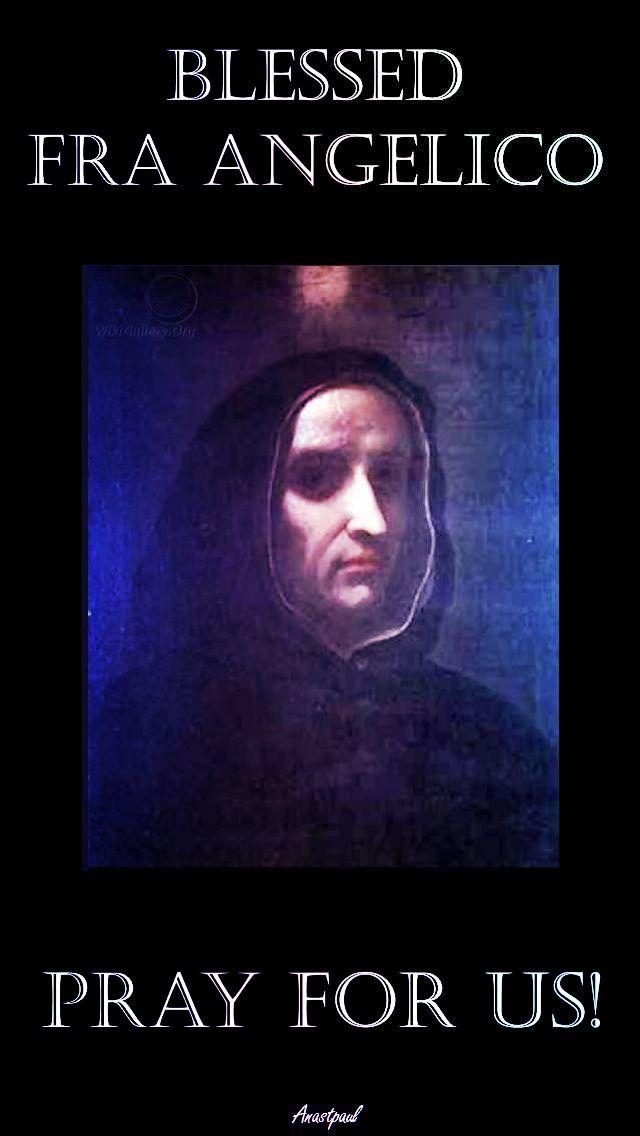
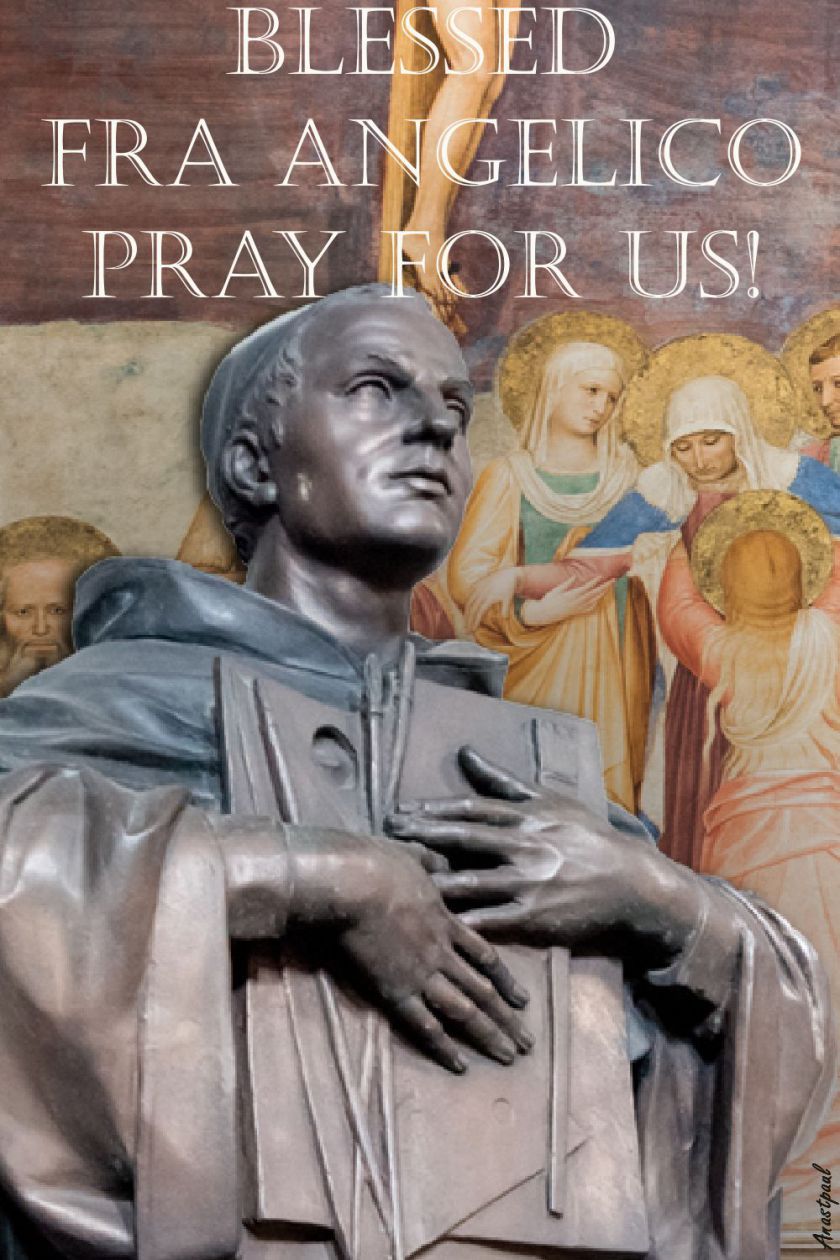
Blessed Fra Angelico, pray for us!

bl-fra-angelco-pray-for-us-18 feb 2017-no 2

Posted in ART DEI, MORNING Prayers, ON the SAINTS, QUOTES - J R R Tolkien and MORE, QUOTES of the SAINTS, SAINT of the DAY

One Minute Reflection – 18 February – The Memorial of Blessed John of Fiesole/Fra Angelico O.P. (1387-1455)

One Minute Reflection – 18 February – The Memorial of Blessed John of Fiesole/Fra Angelico O.P. (1387-1455)

Well done you are an industrious and reliable servant…… Come share your master’s joy…………Matthew 25:21

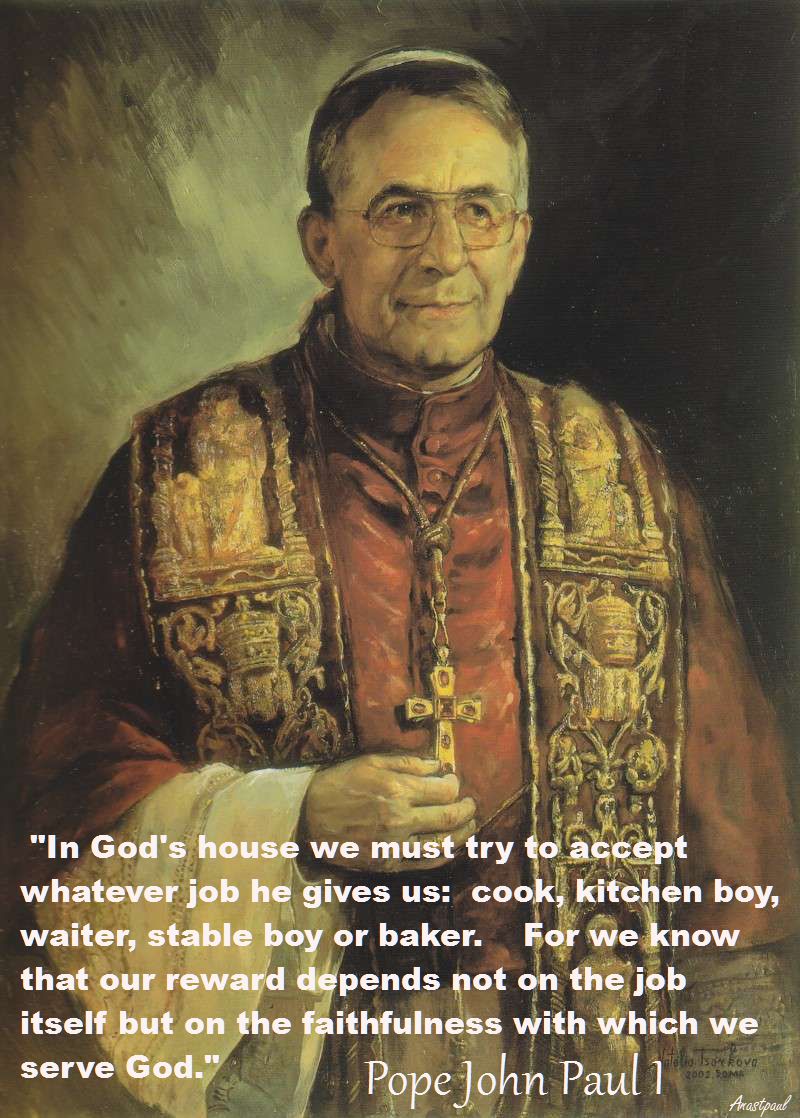
REFLECTION – “In God’s house we must try to accept whatever job he gives us – cook, kitchen boy, waiter, stable boy or baker. For we know that our reward depends not on the job itself but on the faithfulness with which we serve God.”… Pope John Paul I
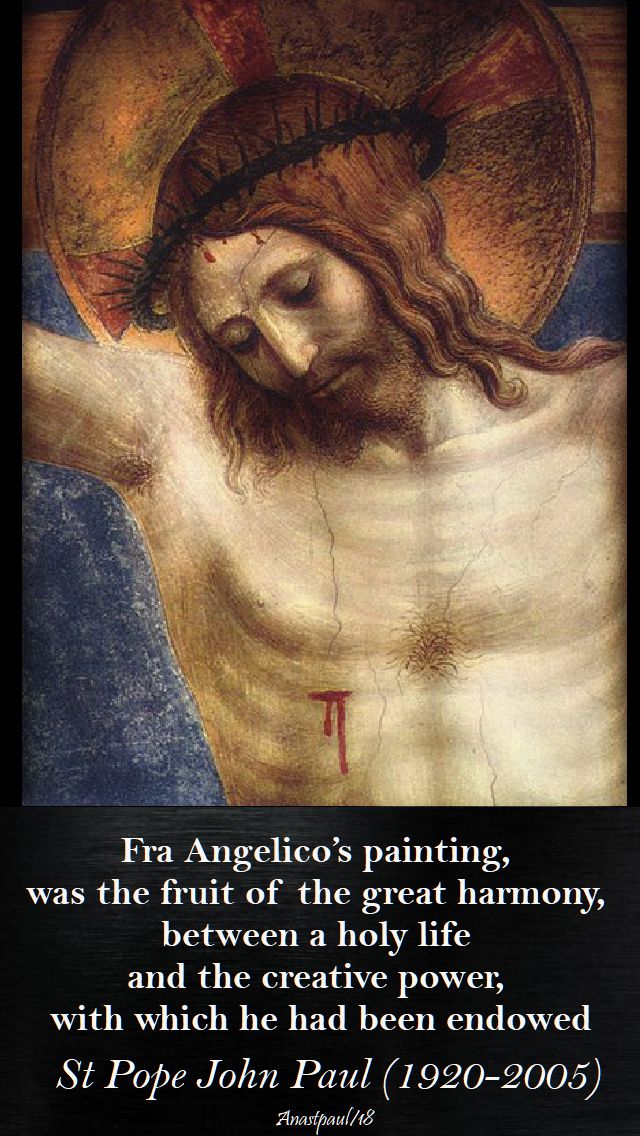
“Fra Angelico’s painting was the fruit of the great harmony between a holy life and the creative power with which he had been endowed.”… St Pope John Paul IIin-gods-house-we-must-try-pope-john-paul-i-18 feb 2018fra angelico's painting was the fruit - st john paul - 18 feb 2018

PRAYER – O God, in Your providence You inspired blessed Fra Angelico to portray the beauty and sweetness of heaven.   By his prayers and the example of his virtues, grant that we may manifest this splendour to our brothers and sisters.   Blessed Angelico, pray for us! Through Christ our Lord, amen.

bl-fra-angelico-pray-for-us-2-18 feb 2018

Posted in ADVENT, ART DEI, CARMELITES, MORNING Prayers, ON the SAINTS, SAINT of the DAY, The HOLY CROSS

Christ of Saint John of the Cross

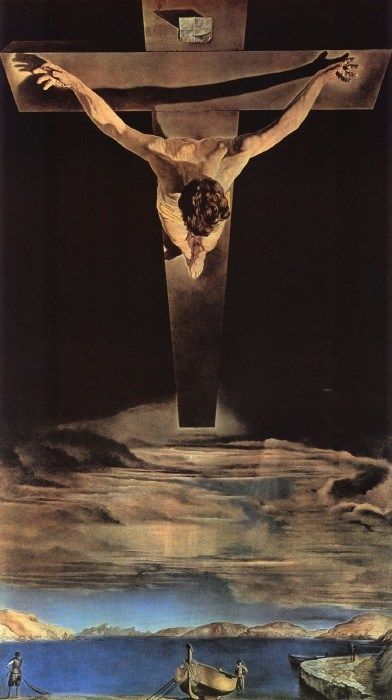
Christ of Saint John of the Cross is a painting by Salvador Dalí made in 1951.   maxresdefault

It depicts Jesus Christ on the cross in a darkened sky floating over a body of water complete with a boat and fishermen.   Although it is a depiction of the Crucifixion, it is devoid of nails, blood and a crown of thorns, because, according to Dalí, he was convinced by a dream that these features would mar his depiction of Christ.   Also in a dream, the importance of depicting Christ in the extreme angle evident in the painting was revealed to him.

70ddc4b4dc7e3d28326a32e29d6c4997--dali-paintings-cross-paintings

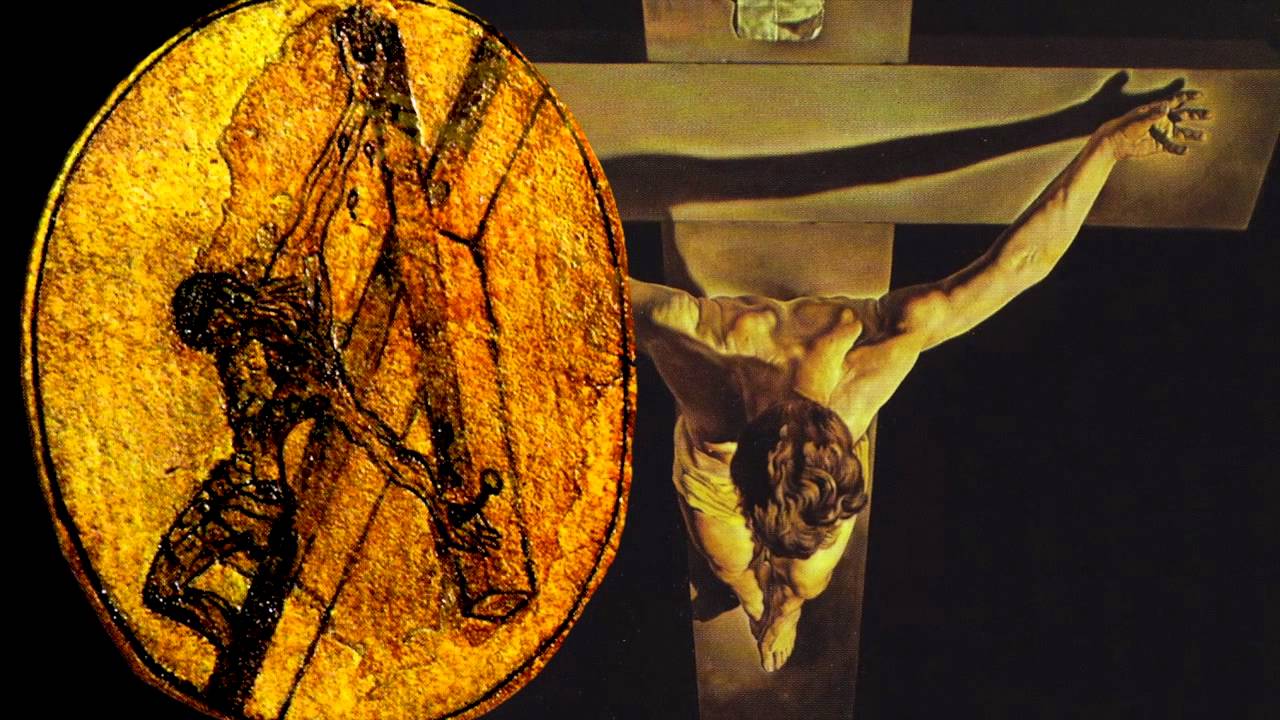
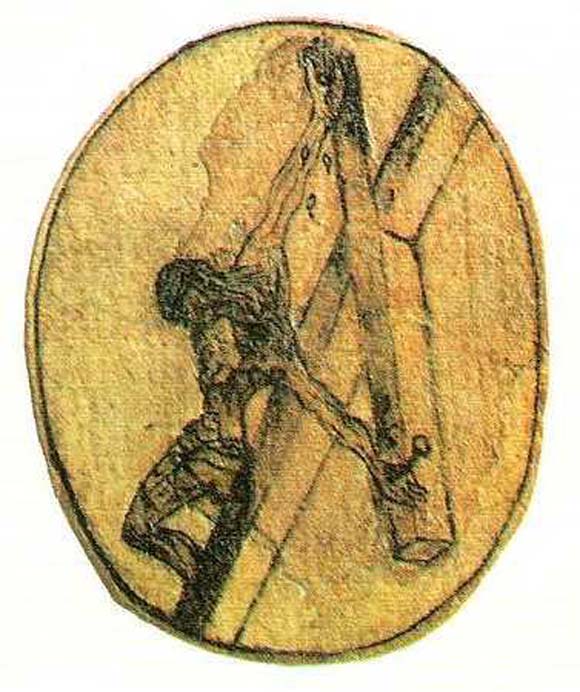
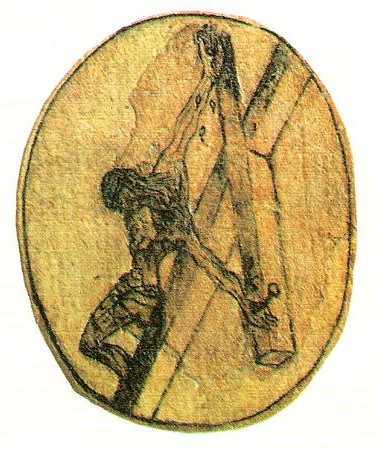
It is known by it’s Title because its design is based on a drawing by the 16th-century Spanish friar, today’s saint and a Doctor of the Church, St Jon of the Cross.   The composition of Christ is also based on a triangle and circle (the triangle is formed by Christ’s arms;  the circle is formed by Christ’s head).  The triangle, since it has three sides, can be seen as a reference to the Trinity and the  circle represents Unity.    Below is the drawing by St John of the Cross.drawing-by-st-john-of-the-cross

On the bottom of his studies for the painting, Dalí explained its inspiration:   “In the first place, in 1950, I had a ‘cosmic dream’ in which I saw this image in colour and which in my dream represented the ‘nucleus of the atom.’   This nucleus later took on a metaphysical sense;  I considered it ‘the very unity of the universe,’  the Christ!”

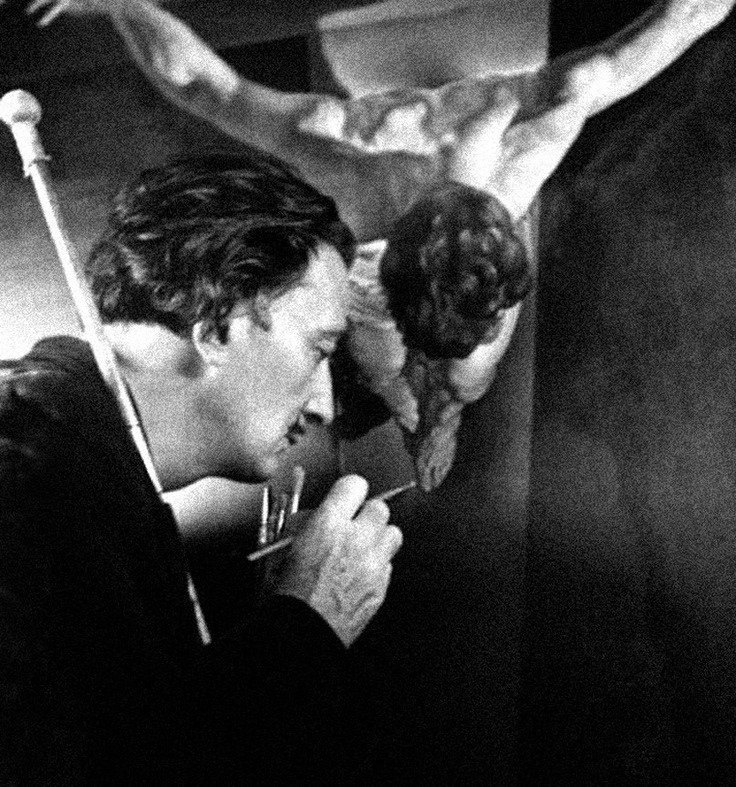
In order to create the figure of Christ, Dalí had Hollywood stuntman Russell Saunders suspended from an overhead gantry, so he could see how the body would appear from the desired angle and also envisage the pull of gravity on the human body.   The depicted body of water is the bay of Port Lligat, Dalí’s residence at the time of the painting.Salvador Dalí painting St. John of the Cross

Posted in ART DEI, SAINT of the DAY, The APOSTLES & EVANGELISTS, The BLESSED VIRGIN MARY

Blessed Feast of Our Lady of Czestochowa, Queen of Poland – 26 August

Blessed Feast of Our Lady of Czestochowa, Queen of Poland – 26 August – Also known as – The Black Madonna of Czestochowa, Czarna Madonna, Hodegetria, Imago thaumaturga Beatae Virginis Mariae Immaculatae Conceptae, Matka Boska Czestochowska, One Who Shows the Way.   Our Lady of Czestochowa is a revered icon of the Virgin Mary housed at the Jasna Góra Monastery in Częstochowa, Poland.   Several Pontiffs have recognised the venerated icon, beginning with Pope Clement XI who issued a Canonical Coronation to the image on 8 September 1717 via the Vatican Chapter.    Patron of Poland.

According to tradition, the icon of Jasna Góra (Bright Mountain) was painted by Luke the Evangelist on a tabletop built by Jesus Himself and the icon was discovered by St Helen, mother of Emperor Constantine and collector of Christian relics in the Holy Land.   The icon was then enshrined in the imperial city of Constantinople, where it remained for the next 500 years.

jasna gora monastery
JASNA GORA MONASTERY

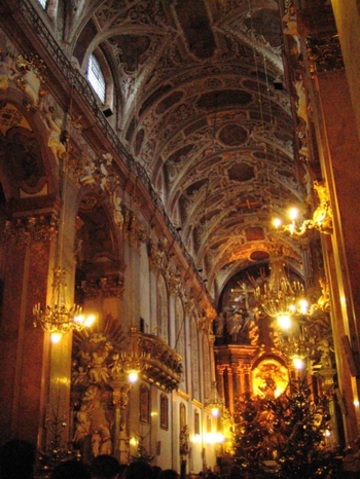
basilica of our lady of czestochowa at jasna gora
BASILICA OF OUR LADY OF CZESTOCHOWA AT JASNA GORA

In 803, the painting is said to have been given as a wedding gift from the Byzantine emperor to a Greek princess, who married a Ruthenian nobleman.   The image was then placed in the royal palace at Belz, where it remained for nearly 600 years.

History first combines with tradition upon the icon’s arrival in Poland in 1382 with a Polish army fleeing the Tartars, who had struck it with an arrow.

Legend has it that during the looting of Belz, a mysterious cloud enveloped the chapel containing the image.   A monastery was founded in Częstochowa to enshrine the icon in 1386 and soon King Jagiello built a cathedral around the chapel containing the icon.

However, the image soon came under attack once again.   In 1430, Hussites (pre-Reformation reformers) attacked the monastery, slashed the Virgin’s face with a sword, and left it desecrated in a puddle of blood and mud.

It is said that when the monks pulled the icon from the mud, a miraculous fountain appeared, which they used to clean the painting.   The icon was repainted in Krakow, but both the arrow mark and the gashes from the sword were left and remain clearly visible today.

The miracle for which the Black Madonna of Częstochowa is most famous occurred in 1655, when Swedish troops were about to invade Częstochowa.   A group of Polish soldiers prayed fervently before the icon for deliverance and the enemy retreated.   In 1656, King John Casimir declared Our Lady of Częstochowa “Queen of Poland” and made the city the spiritual capital of the nation.

The Virgin again came to the aid of her people in 1920, when the Soviet Russian Red Army gathered on the banks of the Vistula River, preparing to attack Warsaw.   The citizens and soldiers fervently prayed to Our Lady of Częstochowa and on September 15, the Feast of Our Lady of Sorrows, she appeared in the clouds above Warsaw.   The Russians were defeated in a series of battles later dubbed the “Miracle at the Vistula.”

During Nazi occupation, Hitler prohibited pilgrimages to Jasna Góra but many still secretly made the journey.   In 1945, after Poland was liberated, half a million pilgrims journeyed to Czestochowa to express their gratitude.   On September 8, 1946, 1.5 million people gathered at the shrine to rededicate the entire nation to the Immaculate Heart of Mary.   During the Cold War, Jasna Góra was a centre of anti-Communist resistance.  Czestochowa is regarded as the most popular shrine in Poland, with many Polish Catholics making a pilgrimage there every year.   A pilgrimage has left Warsaw every August 6 since 1711 for the nine-day, 140-mile trek.  Elderly pilgrims recall stealing through the dark countryside at great personal risk during the German Nazi occupation. Pope John Paul II secretly visited as a student pilgrim during World War II.   He was a fervent devotee of the Virgin Mary and of her icon at Czestochowa.   As pope, he made pilgrimages to pray before the Black Madonna in 1979, 1983, 1991 and 1997.   In 1991, he held his Sixth World Youth Day at Czestochowa, which was attended by 350,000 young people from across Europe.

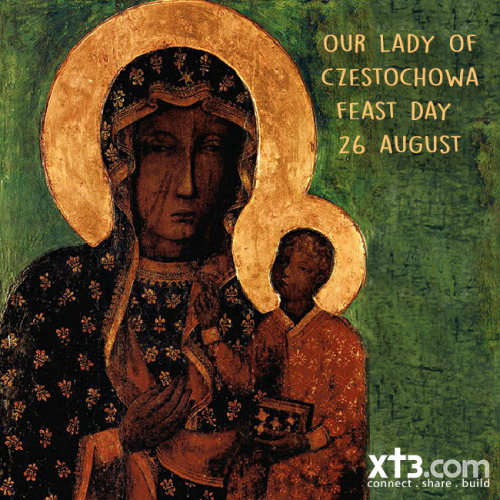
The four-foot-high painting displays a traditional composition well known in the icons of Eastern Christians.   The Virgin Mary is shown as the “Hodegetria” (“One Who Shows the Way”).   In it the Virgin directs attention away from herself, gesturing with her right hand toward Jesus as the source of salvation.   In turn, the child extends his right hand toward the viewer in blessing while holding a book of gospels in his left hand.  The icon shows the Madonna in fleur-de-lis robes.

our lady of czestochowa

dressed in special robes at Jasna Gora Monastery
This image shows Our Lady dressed in special robes at Jasna Gora

Posted in ART DEI, SAINT of the DAY

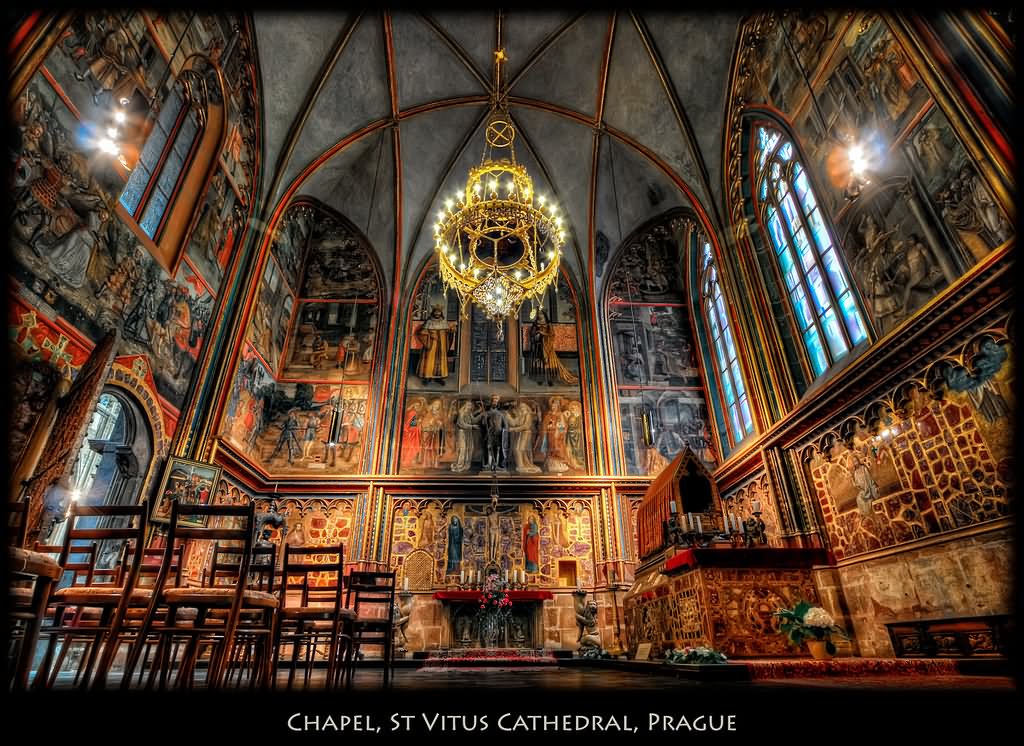
Celebrating St Vitus’ Memorial and the Cathedral in his honour in Prague, Czech Republic, the country for which he is a Patron

Celebrating St Vitus’ Memorial and the Cathedral in his honour in Prague, Czech Republic, the country for which he is a Patron.   The Image below is the Chapel of St Vitus within the Cathedral.

Chapel-St.-Vitus-Cathedral-Prague

To many people, St. Vitus Cathedral is Prague Castle.   While the Prague Castle complex houses many buildings, St. Vitus is the one that dominates the skyline wherever you are in city.   St. Vitus Cathedral (Katedrála svatého Víta) is a Gothic masterpiece and the spiritual symbol of the Czech state.

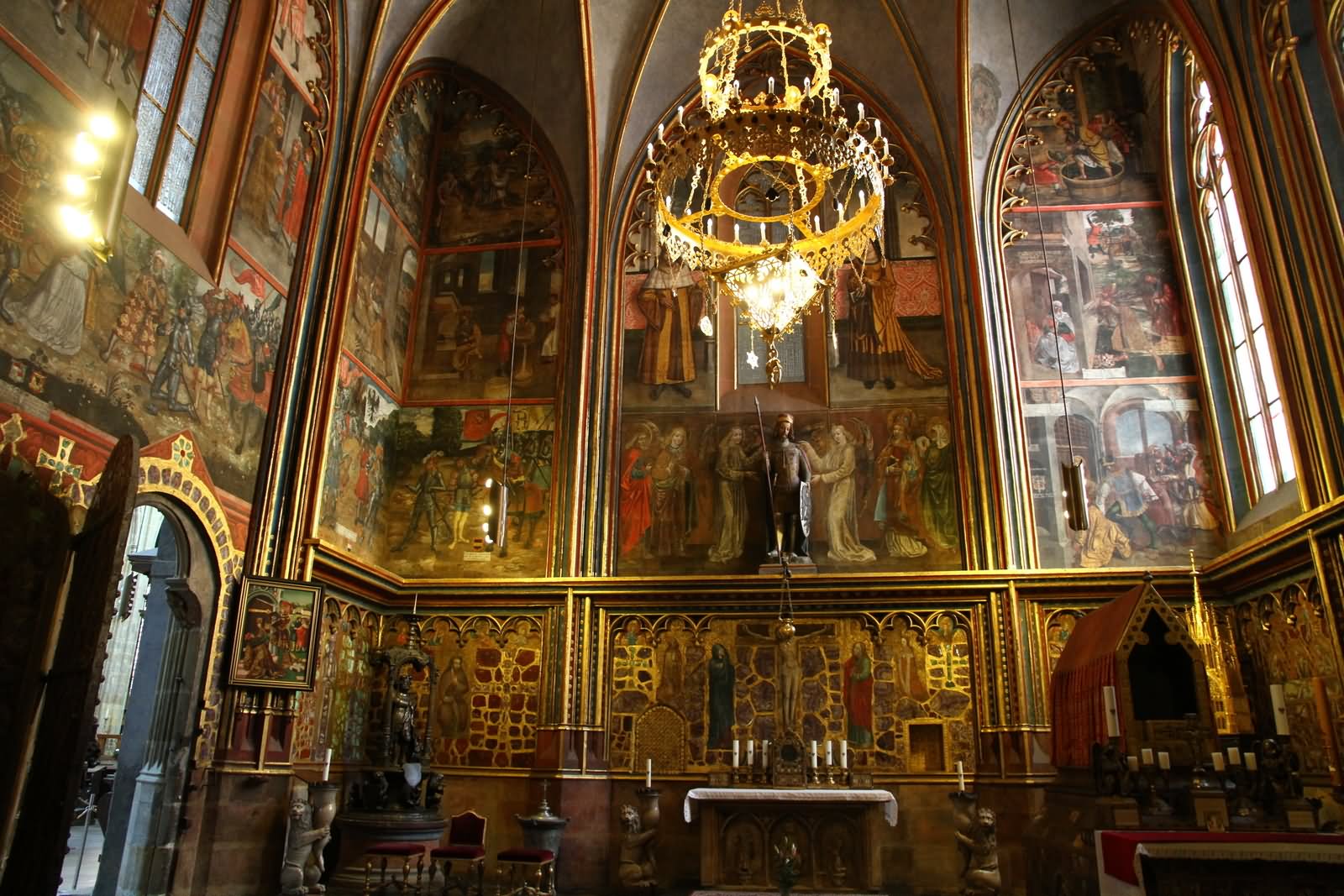
The cathedral was commissioned by Charles IV. Construction began in 1344 on the site of an earlier 10th century rotunda.   Its original builders, Matthias of Arras and later Peter Parler, constructed the chancel with a ring of chapels – St. Wenceslas Chapel, the Golden Portal and the lower section of the main steeple.   However, it took almost six centuries to complete, with the final phase of construction in the period 1873-1929.   Below is St Wenceslas Chapel which is decorated with frescoes and semi-precious stones.   A door in the south-western corner of the chapel leads to the Crown Chamber, in which the Bohemian Coronation Jewels are stored.

St.-Wanceslas-Chapel-Inside-The-St.-Vitus-Cathedral

As well as being the largest and most important Basilica in Prague, St. Vitus Cathedral has also overseen the coronation of Czech kings and queens.   In the chancel of the cathedral, in front of the high altar, is the royal mausoleum.   Below this, in the crypt, there are the royal tombs. Czech kings and queens and patron saints of the country are interred here.

The Great South Tower of the Cathedral was founded in the late 14th century and reconstructed in the 16th and 18th centuries.   The tower holds the largest bell in the Czech Republic, called Zikmund, which dates from the 16th century.   Visitors can climb the Great South Tower, see the bell partway up and enjoy spectacular views over the city from the top.   The tower has 287 narrow, winding steps and is more than 90 metres high.

Posted in ART DEI, EUCHARISTIC Adoration

“Art Dei” Series “The Defenders of the Eucharist” by Peter Paul Rubens, Flemish 1577-1640 Issue 1 – 6 June 2017

Art Dei Series

The Defenders of the Eucharist
by Peter Paul Rubens, Flemish 1577-1640
SN 214 Oil on Canvas c1625

Artist:
Peter Paul Rubens, along with the Italian sculptor Gianlorenzo Bernini, was one of the greatest artists of the 17th century.   His canvases can be said to define the scope and style of high baroque painting through their energy, earthy humanity and inventiveness. A devoutly religious man, a man of learning and a connoisseur of art and antiquities, he was also a man of the world who succeeded not only as an artist but as a respected diplomat in the service of Isabella and Albrecht of the Spanish Netherlands.

Travels to Venice where he studied Titian, Veronese & Tintoretto freed his artistic talent from rigid classicism.   While he did incorporate copies of classical statues in his paintings he always avoided the appearance and coldness of stone.   To the contrary, his nudes, for which he became famous, always depicted an ample female form of vitality and good health as well as of sensuousness.   His mastery of color along with his knowledge of antiquity is seen particularly in his mythological paintings.

As court painter and confidant to the Archduchess Isabella Clara Eugenia, Rubens recognized the role art was to play in the Counter Reformation.   His genius found expression in his designs for the Triumph of the Eucharist tapestries which he and his assistants completed between 1625 and 1628.

Knighted by two monarchs and master of a successful workshop, Rubens became rich and famous in his own time. Having executed over 3,000 paintings, woodcuts and engravings of all types, he died the most respected artist of his time in 1640.

Norbert of Xanten, defender of the Holy Eucharist
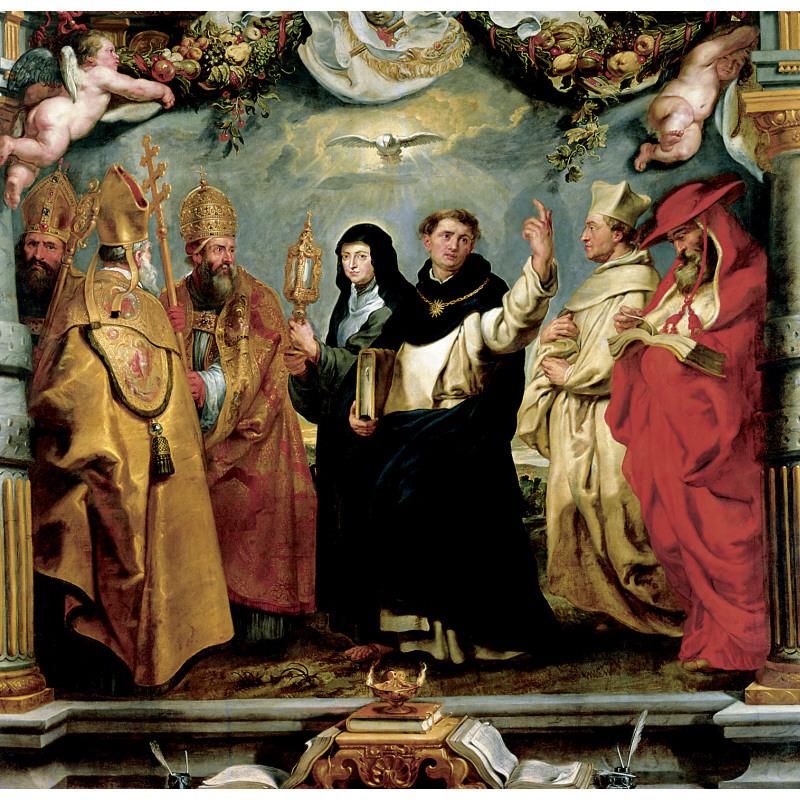
The Defenders of the Eucharist
by Peter Paul Rubens, Flemish 1577-1640 Including Sts Jerome, Norbert, Thomas Aquinas, Clare, Gregory the Great, Ambrose, Augustine

Subject:
This painting shows seven saints, all of whom were considered to be defenders of the doctrine of Transubstantiation an integral tenet of the Catholic Church.   From the right the figures represent –

(1) St Jerome, (Feast Day 3 September) noted for his translation of the bible from Hebrew into Latin;  

(2) St Norbert, (Feast Day 6 June) a German archbishop and saint, who preached against dissenters who attacked the Christian sacraments and official clergy;  

(3) St Thomas Aquinas, (Feast Day 28 January) a medieval theologian of the Dominican order, whose writings became the basis for much of the doctrine of the Catholic Church;  

(4) St Clare, (Feast Day 11 August) the founder of the Poor Clares, was a Franciscan heroine who repulsed the Saracens at Assisi by confronting them holding the Host in her hands;

(5) Gregory the Great, (Feast Day 3 September) who established, as Pope, the form of the Roman liturgy;

(6) St Ambrose, (Feast Day 7 December) renowned as both theologian and statesman of the Church, who in an age of controversy, was instrumental in crushing Arianism, a doctrine concerning the relationship of God the Father to Christ which was considered heresy and in direct opposition to orthodox teaching about the Trinity; and

(7) St Augustine, (Feast Day 28 August) perhaps the Church’s most celebrated and influential theologian.

Painting:
Seven Saints, including the four Latin Doctors of the Church, progress with great dignity from right to left, their heads seen in different views in a fashion similar to the heads of the Four Evangelists.   The Dove of the Holy Ghost hovers protectively over the saints in the very center of the composition emitting golden light that illuminates the procession. Above the dove, a putti holds two trumpets to herald the message of the Church Fathers.

Leading the procession are Sts. Ambrose, Augustine and Gregory the Great, all wearing elaborate gold copes.   The first two are crowned with bishop’s mitres, while the third wears the papal tiara.   In the center of the procession, St. Clare carries a monstrance and looks directly out at the viewer. Rubens has shown his patroness, the Archduchess Isabella as St. Clare garbed in the black and white habit of the Discalced Carmalites, clothes she wore at the Convent of the Discalzas Reales in Madrid when she was a girl and later as a widow after her husband the Archduke Albert had died in 1621.

St. Thomas Aquinas follows, a large book under his arm wearing a gold chain from which is hung a blazing sun.   Behind Aquinas is a monk in a white habit who is St. Norbert.   Last in line is St. Jerome the fourth Doctor of the Church dressed in red as a cardinal, intensely reading from a large book.   In the centre of the bottom of the composition, below the apron of the “stage” is a burning lamp (the lamp of truth), open books and writing supplies of ink pots and quill pens, all in reference to the writings of the Church Fathers.

All seven saints were known as defenders of the Eucharist, particularly the Four Doctors of the Church who developed the doctrine of transubstantiation and defended it against heretics.

Historical Context:
The cycle of eleven paintings of The Triumph of the Eucharist was commissioned by the Archduchess Isabella who was the daughter of Philip II of Spain and the Governor of the Spanish Netherlands.  It was planned as a gift for the convent of the Descalzas Reales in Madrid in 1625 where it still hangs today.   This Franciscan Order of Poor Clares was one with which Isabella was closely associated.

The series is a mixture of allegory and religious evangelisation intended to promote the worship of the Eucharist, the bread and wine consecrated as the body and blood of Christ and distributed at communion which had been strengthened recently by the Council of Trent and which constituted an important element in Counter Reformation Catholicism.

This was a time of great concern on the part of the Catholic church as it attempted to correct not only the abuses of the clergy but also to reaffirm its tenets / dogma in the face.


Posted in ART DEI, MORNING Prayers, SAINT of the DAY

Thought for the Day – 23 April

Thought for the Day – 23 April

The Christian hero is not the slayer of dragons or the knight who wields the sword.
The Christian hero is the saint, although saints like St Joan of Arc, could and did wield the sword too.
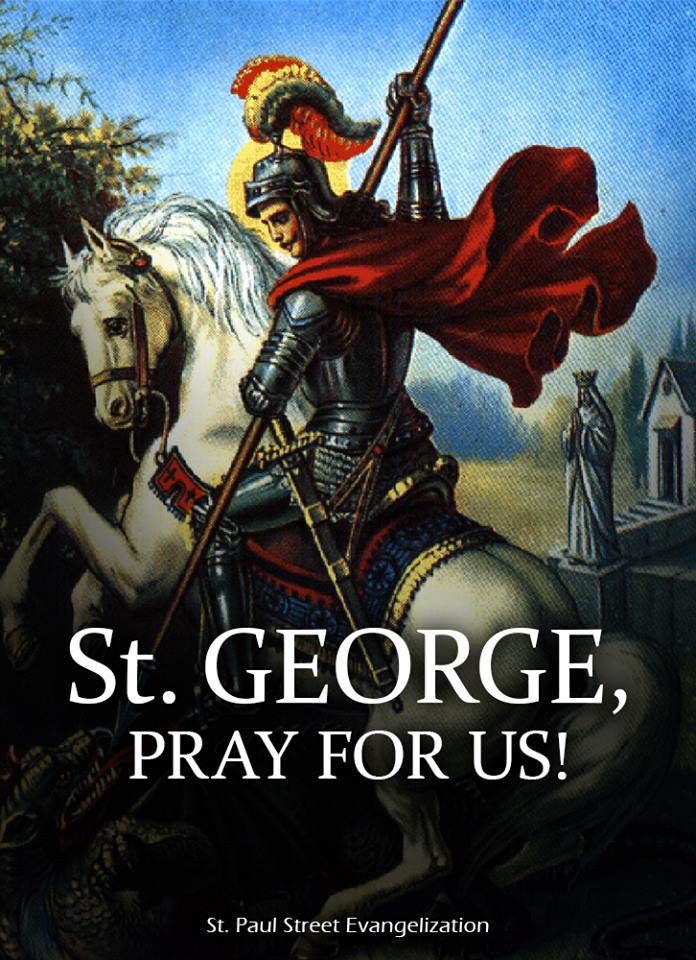
St George, whose Memorial it is today, got lost in legends and folklore but he was a real soldier who gave his life in witness to Christ.   He was a Martyr for Christ – the ultimate act of heroism.   If only we remembered him correctly and with honour, for this martyrdom for the One who saved us!

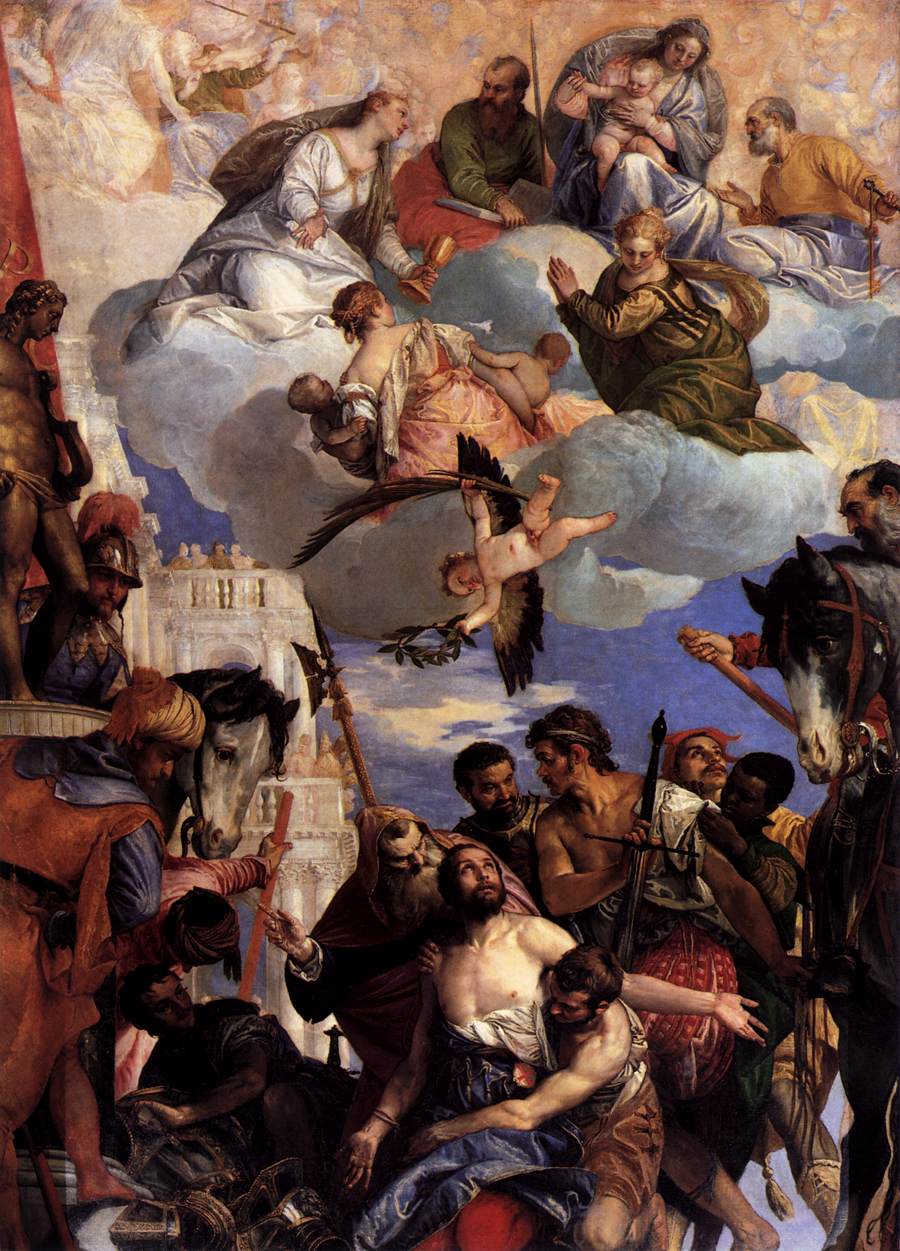
martyrdom-of-saint-george

Martyrdom of Saint George, c.1564 – Paolo Veronese

St George pray for us and we pray that your memory may be restored!

ST GEORGE - APRIL 23

Posted in ART DEI, EASTER, MORNING Prayers, The WORD

One Minute Reflection – 18 April – Easter Tuesday 3rd Day of the Octave

One Minute Reflection – 18 April – Easter Tuesday 3rd Day of the Octave

Daily Meditation: You give us the freedom of the children of God.

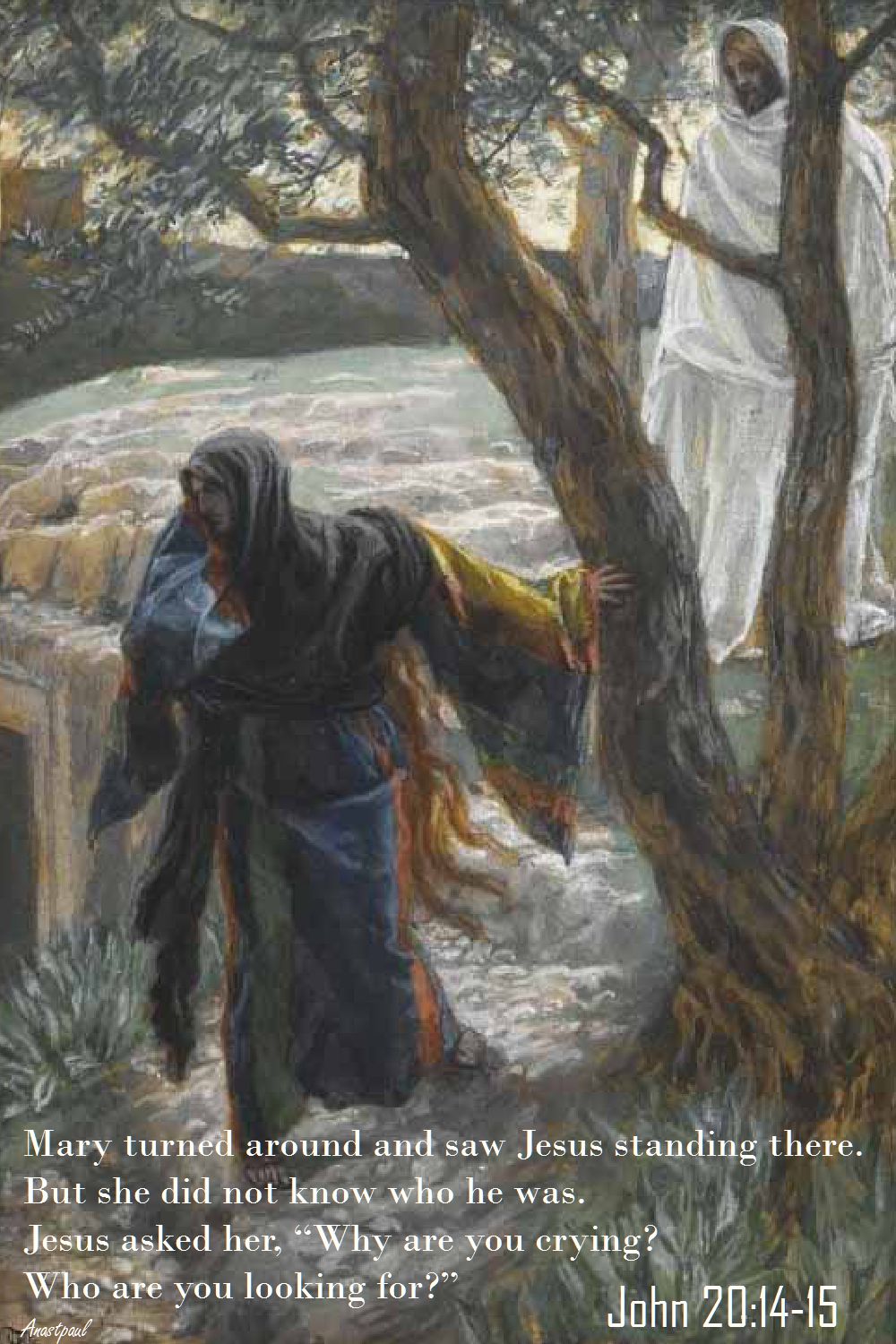
Mary turned around and saw Jesus standing there.
But she did not know who he was.
Jesus asked her, “Why are you crying?
Who are you looking for?” ……………….. John 20:14-15

REFLECTION – “Throughout the history of the living, the origins of anything new have always been small, practically invisible and easily overlooked.   The Lord Himself has told us that “heaven” in this world is like a mustard seed, the smallest of all the seeds (Matthew 13:31-32), yet contained within it are the infinite potentialities of God.   In terms of world history, Jesus’ Resurrection is improbable; it is the smallest mustard seed of history.

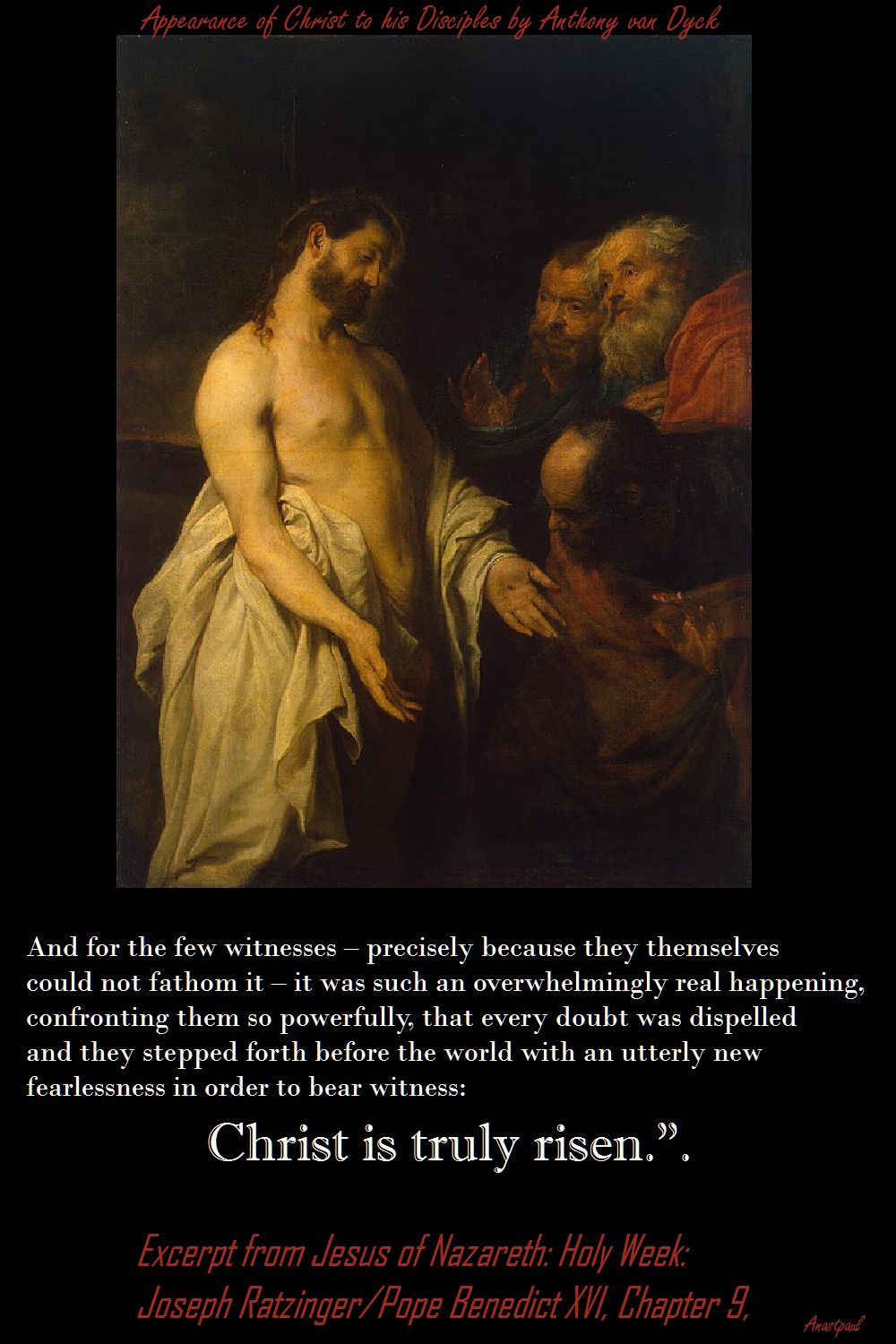
This reversal of proportions is one of God’s mysteries. The great – the mighty – is ultimately the small.   And the tiny mustard seed is something truly great.    So it is that the Resurrection has entered the world only through certain mysterious appearances to the chosen few.   And yet it was truly the new beginning for which the world was silently waiting.   And for the few witnesses – precisely because they themselves could not fathom it – it was such an overwhelmingly real happening, confronting them so powerfully, that every doubt was dispelled and they stepped forth before the world with an utterly new fearlessness in order to bear witness:  Christ is truly risen.……………Excerpt from Jesus of Nazareth: Holy Week: From the Entrance Into Jerusalem To The Resurrection, by Joseph Ratzinger/Pope Benedict XVI, Chapter 9,

PRAYER – Lord God, give me the opportunity to recognise the healing power of love that has been offered me and that it really does fill these days with power.   Teach me to recognise Jesus alive and Jesus with me now.. Grant me freedom from fear, freedom for courageous love and service. Help me to understand the freedom You give us all as Your children. Amen

JOHN 20-14 & 15CHRIST IS TRULY RISEN-PAPA B

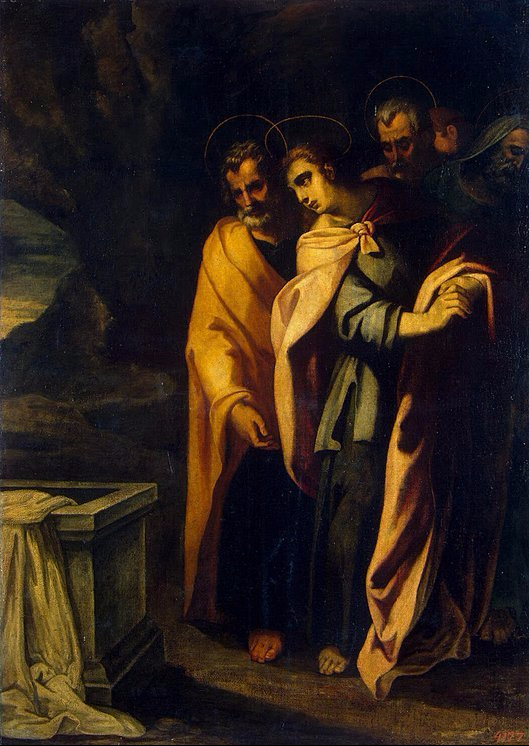
Apostles-at-a-Christ-s-Tomb
Francisco Ribalta (Spain 1590s) Apostles Peter and John at Christ’s Tomb

Posted in ART DEI, MORNING Prayers, SAINT of the DAY

Thought for the Day – 10 April

Thought for the Day – 10 April

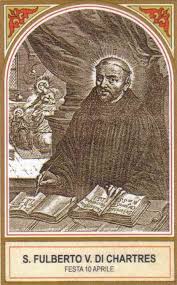
Chartres Cathedral has been called a “sermon in stone and stained glass” and it demonstrates what can happen when faith bursts into culture.   St Fulbert of Chartres recognised that unless faith influences culture, it’s voice remains weak.   It is not enough to believe – we have to make the Christian faith part of our lives and part of the world we live in.   So, as Chartres teaches and impacts our hearts and minds with awe and faith, so our lives too should be a “school of faith” and teach our world with awe and belief!

St Fulbert pray for us!

ST FULBERT PRAY FOR US 2


Posted in ART DEI, SAINT of the DAY, The BLESSED VIRGIN MARY

Saint of the Day – 10 April – St Fulbert of Chartres

Saint of the Day – 10 April – St Fulbert of Chartres (c960 in Italy-1029 in Chartres, France) Bishop, Writer, Poet, Reformer, Marian devotee, Preacher, Teacher, Advisor – Attributes – preaching monk, in his sick bed with the Virgin Mary nearby.

download (2)

Fulbert was born in Italy around the year 960.    He was taught by the famous Gerbert, who became Pope Sylvester II in the year 999.    Fulbert followed Pope Sylvester to Rome. When Pope Sylvester II died in 1003, Fulbert went to France where he started a school at Chartres.    This school was the most famous seat of education in France.    Scholars from all over France, Italy, Germany and England attended school there.    Fulbert became chancellor of the church of Chartres and was the treasurer of St. Hilary’s at Poitiers. Later he was elected bishop of Chartres and he rebuilt the cathedral when it burned down.    He had the assistance of King Canute of England, Duke William of Aquitaine and other European leaders in rebuilding the cathedral in great splendour.

The veneration of the Virgin Mary was already established in the Church and Fulbert use this to teach her importance.    The results were twofold, it helped to ease people’s fears and greatly expanded the Marian Cult and Chartres’s position in it.   Chartres was already involved due to its being the holder of a sacred relic of Mary’s, the “Sancta Camisia”, (Holy Tunic), which has been variously described as being worn by Mary during the Annunciation or during the birth of Christ.   This tunic was already the subject of a miracle because of its use by an earlier bishop of Chartres, Gauscelinus, in 911 to ward off the invading Normans.    Fulbert expanded on the theme of miracles involving Mary, especially those cases where she had interceded between sinners and God.    In this way people could pray for Mary’s intercession with God on their behalf in the perceived coming apocalypse.   Fulbert himself was involved in one of these miracles;   when he was gravely ill Mary had healed him with a drop of milk because of his devotion to her.    This also served to give Mary the image of not only the mother of Christ but for all who believed in her, their mother too.    All of this led to Fulbert’s ultimate goal of promoting a special feast day to celebrate Mary’s Nativity.

To gain popular support for this feast, Fulbert wrote his famous sermon “Approbate Consuetudinis” in which he relates Mary’s miracles.    He also brings in the evidence of Mary’s family lineage, which the Bible traces back to King David.    In his sermon Fulbert used the symbolism of the “Stirps Jesse” (Tree of Jesse) to help explain Mary’s familial relationship to the great men of the past and how it was determined, as described in Scripture, that she would be the one to whom Christ would be born.   This again served to enhance her importance to the world and convince people of the need to celebrate her birth.   This sermon led to a number of liturgical changes throughout the next few centuries in Europe.   The sermon itself, or variations of it and the chants associated with it, became part of the service for the feast day of Mary’s Nativity on 8 September    By promoting the Feast day of Mary’s Nativity, Fulbert was able to advance the importance of Mary and therefore the cult of her veneration grew.    This in turn enhanced the importance of the Cathedral of Chartres as a centre for Marian devotion and also gave people a spiritual symbol to turn to in times of need at the turn of the millennium.

During his time in Chartres Fulbert played an important role in the development and spread of the ideas that led to the Gregorian church reforms of the eleventh century under Pope Gregory VII.    These reforms concerned the division between the powers of church and state, especially in the appointment of new abbots and bishops.    In the eleventh century the secular rulers had a habit of appointing whomever they wanted to fill vacant church positions.    Fulbert and some of his students, such as Abbot Albert of Marmoutier, routinely wrote that it was up to the clergy and the citizens of the diocese involved to elect a replacement, the authority being found in the rulings of the First Council of Nicaea (325) and the Council of Antioch (264-272).    These reforms also stated that the Church, not the state, was responsible for disciplining the clergy.    The issues of simony (the buying of church offices) and immoral clerics were also addressed by Fulbert.    Although the reforms were issued by Gregory VII, some of its ideas came from Fulbert, whose writings were disseminated through his students.

After Chartres Cathedral burned in 1020, Fulbert devoted his energies to raising funds for its rebuilding, which was completed in 1037, nine years after his death.   In 1194 the cathedral was again almost completely destroyed by fire; only the crypt, some of the west facade and two towers remained.    The crypt has been incorporated into all subsequent reconstructions.    The construction of the Gothic-style cathedral that stands to-day began afterward.   It is in this cathedral that we see Fulbert’s influences that resulted from his promotion of the Feast day of Mary’s Nativity and the cult of the Virgin Mary.   The sculptures around the three portals depict the life of Mary, who is the central figure in the Royal Portal.   One of the cathedral’s stained glass windows depicts the Tree of Jesse, which traces Mary’s family and the Holy Family, again a reference to Fulbert’s teachings in regards to the Feast of Mary’s Nativity.

St Fulbert died of natural causes on April 10, 1029.

Prayer

Lord Jesus, we pray that St. Fulbert will intercede for our clergy when they need strengthening to make the right decisions.    May they always stay true to Church teachings and to You, we pray.  Amen.

Posted in ART DEI, LENT, MORNING Prayers

Our Morning Offering – 12 March

Our Morning Offering – 12 March

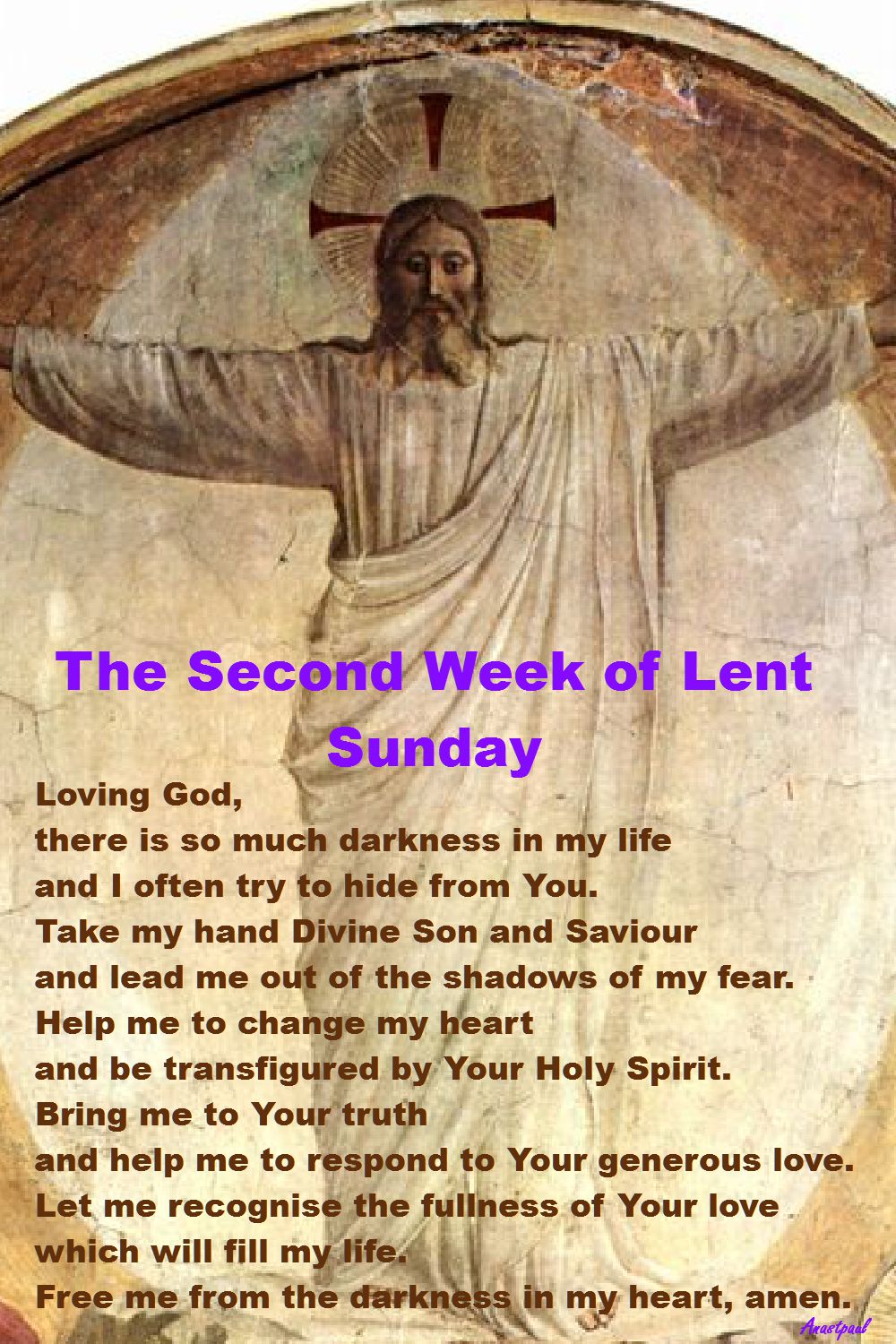
The Second Week of Lent – Sunday

Loving God,
there is so much darkness in my life
and I often try to hide from You.
Take my hand Divine Son and Saviour
and lead me out of the shadows of my fear.
Help me to change my heart
and be transfigured by Your Holy Spirit.
Bring me to Your truth
and help me to respond to Your generous love.
Let me recognise the fullness of Your love
which will fill my life.
Free me from the darkness in my heart. Amen

2nd week of lent - sunday 12 march

Posted in ART DEI, MORNING Prayers, SAINT of the DAY

Quote of the Day – 18 February

Quote/s of the Day – 18 February

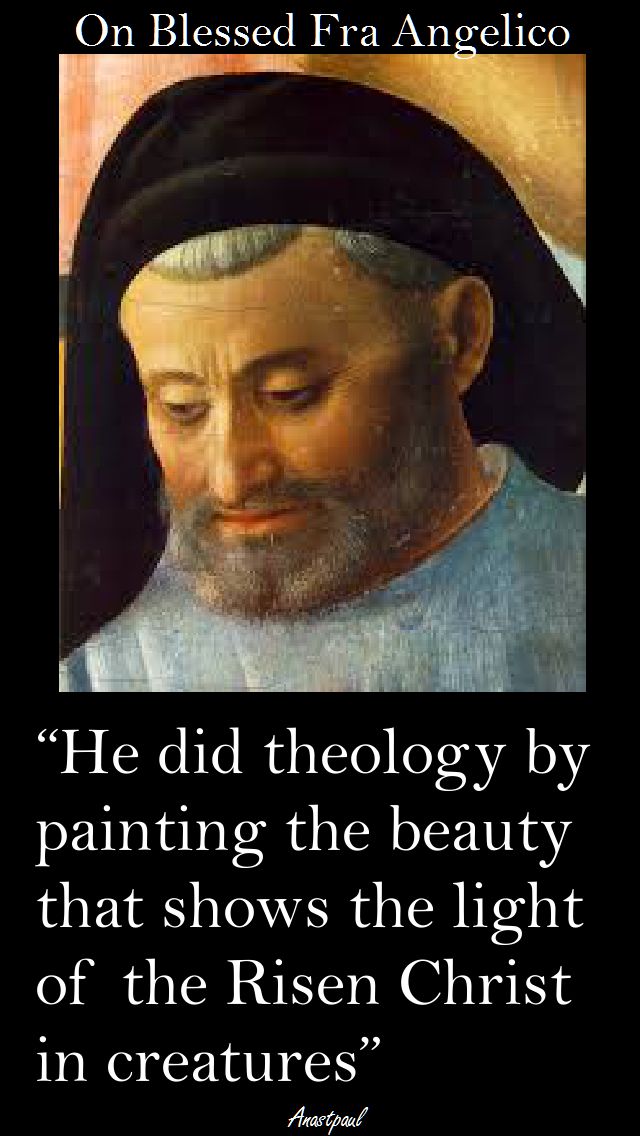
Theologian Hans Urs von Balthasar said Angelico’s art embodies the motto of the Dominican Order contemplata aliis tradere, that is,
“communicating to others the contemplated mysteries”.
Another writer expressed a similar judgment: fece teologia dipingendo la bellezza, che mostrò la luce del Risorto nelle creature da lui redente: “he did theology by painting the beauty that shows the light of the Risen Christ in creatures”.

Author of the Lives of the Artists – Vasari – wrote of Fra Angelico that “it is impossible to bestow too much praise on this holy father, who was so humble and modest in all that he did and said and whose pictures were painted with such facility and piety.”

he-did-theology-bl-fra-angelico

Posted in ART DEI, SAINT of the DAY

Christ of Saint John of the Cross

Christ of Saint John of the Cross – Salvidor Dali (1951)

300px-christ_of_saint_john_of_the_cross

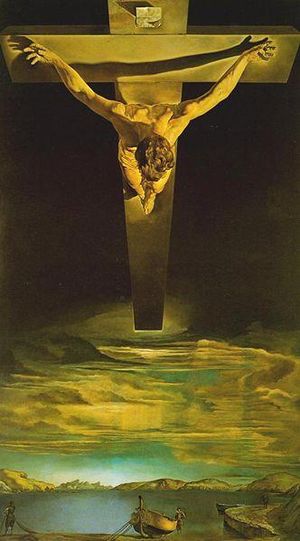
is a painting by Salvador Dalí made in 1951. It depicts Jesus Christ on the cross in a darkened sky floating over a body of water complete with a boat and fishermen. Although it is a depiction of the crucifixion, it is devoid of nails, blood, and a crown of thorns, because, according to Dalí, he was convinced by a dream that these features would mar his depiction of Christ. Also in a dream, the importance of depicting Christ in the extreme angle evident in the painting was revealed to him.

It is known by it’s Title because its design is based on a drawing by the 16th-century Spanish friar John of the Cross. The composition of Christ is also based on a triangle and circle (the triangle is formed by Christ’s arms; the circle is formed by Christ’s head). The triangle, since it has three sides, can be seen as a reference to the Trinity and the  circle represents Unity.  Below is the drawing by St John of the Cross.

john_of_the_cross_crucifixion_sketch

On the bottom of his studies for the painting, Dalí explained its inspiration: “In the first place, in 1950, I had a ‘cosmic dream’ in which I saw this image in colour and which in my dream represented the ‘nucleus of the atom.’ This nucleus later took on a metaphysical sense; I considered it ‘the very unity of the universe,’ the Christ!”
In order to create the figure of Christ, Dalí had Hollywood stuntman Russell Saunders suspended from an overhead gantry, so he could see how the body would appear from the desired angle and also envisage the pull of gravity on the human body. The depicted body of water is the bay of Port Lligat, Dalí’s residence at the time of the painting.