One Minute Reflection – 3 January – Feast of the Most Holy Name of Jesus, Readings: Epistle Acts 4:8-12, Psalm 105:47, Isa 63:16, Ps 144:21, Gospel Luke 2:21-24
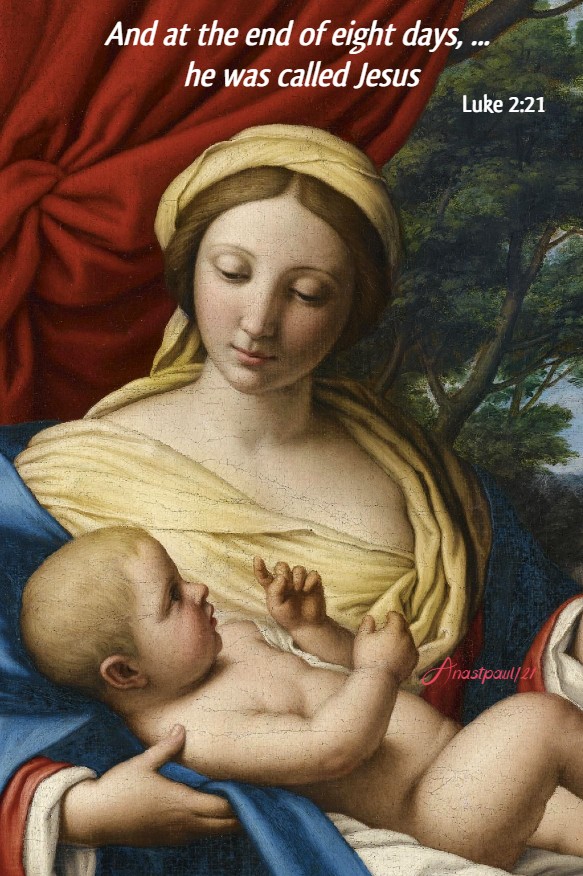
“And at the end of eight days, when he was circumcised, he was called Jesus”…Luke 2:21
REFLECTION – “The Name stands as a complete summary and description of our Lord’s character and office and it is under this aspect that it has been regarded by thousands of Saints, whose hearts have melted at its mere sound. To them Jesus is their God, Jesus is their King, Jesus is their Redeemer, Jesus is their Mediator, Jesus is their Saviour, Jesus is their great Priest, Jesus is their Intercessor, Jesus is the Captain under Whom they fight, Jesus is the Leader Whom they follow, Jesus is their Teacher, Jesus is the Giver of their law, Jesus is the Spouse and Shepherd of their souls, Jesus is their Light, Jesus is their Life, Jesus is the Judge before Whom they rejoice to think, that they must one day stand, Jesus is their final and eternal Reward, for which alone they live.
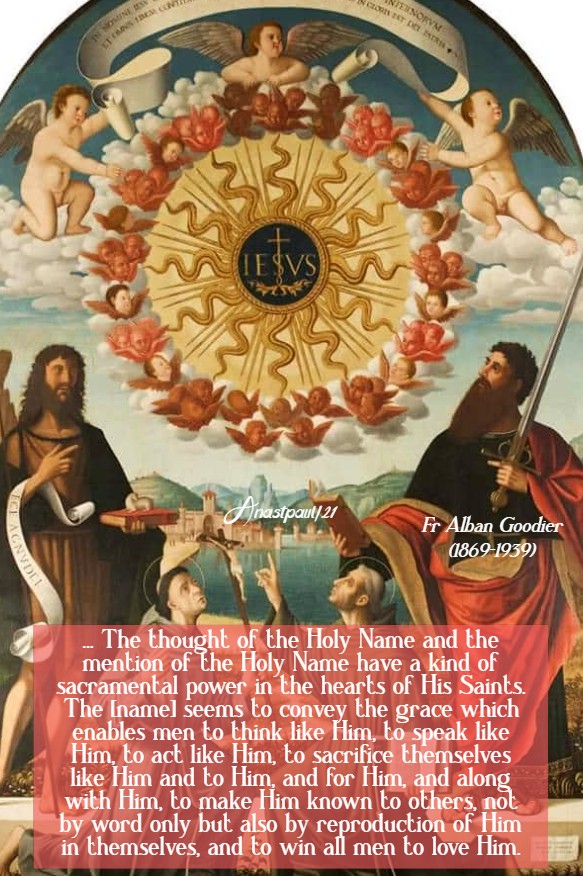
But He is also to them the Mirror of all the most glorious and winning virtues. He is, and His Name tells them that He is, unbounded Charity, infinite Mercy, extremest Kindness, deepest Humility, most devoted Piety, transparent Simplicity, uttermost Poverty, Chastity without a stain. It is the prerogative of love to transform those who love into the likeness of Him Whom they love and as the mere name of one who is loved cannot sound in the ear or be thought of in the mind, without adding to the love which is already there, so the thought of the Holy Name and the mention of the Holy Name have a kind of sacramental power in the hearts of His Saints. The [name] seems to convey the grace which enables men to think like Him, to speak like Him, to act like Him, to sacrifice themselves like Him and to Him, and for Him, and along with Him, to make Him known to others, not by word only but also by reproduction of Him in themselves, and to win all men to love Him.” – Fr Alban Goodier SJ (1869-1939) Archbishop – Excerpted from The Prince of Peace
PRAYER – O God, who founded the salvation of the human race on the Incarnation of Your Word, give Your people the mercy they implore, so that all may know there is no other Name to be invoked but the Name of Your Only Begotten Son. Who lives and reigns with You in the unity of the Holy Spirit, one God, forever and ever. Amen
Thought for the Day – 2 January – Meditations with Antonio Cardinal Bacci (1881-1971)
The Necessity of Meditation in Silence
“With desolation all the land made desolate because, there is none that considereth in the heart” (Jer 12:11).
Very often the world is plunged in the desolation of evil because, there is nobody who will speak with God, in the silence of his heart and try to regulate his life according to His holy commandments. It is in a particularly outstanding way today, that the heresies of actionism and externalism, dominate the great mass of mankind. To act, to rush, to arrive … above all, to arrive! But to arrive where? In this frantic, frenzied and tumultuous race, which good people are often found competing, two very sure things are forgotten, namely, that we shall finally arrive at death and, that from death, we shall pass onto eternity. The whole course of our lives, therefore, should be directed towards this end. But, if we are to keep this end in view, prudent reflection is essential, especially meditation, made with the assistance of the Divine light, on the eternal truths.
Absorbed in the deafening din of the world around us, it is difficult to hear the Voice of God. At least, for a little while each day, we must create within ourselves, a zone of silence, in order to listen to His Voice. Since God speaks readily in the silence of the heart, let us recollect ourselves before Him, in this quiet oasis. At least a quarter of an hour of daily meditation is essential for the life of a Catholic. This should be the diving-board for all the actions of day, if we wish these to be correct and productive of good.
It is very useful, moreover, to recall to mind frequently during the day, the resolutions which have been formed and to accompany these reflections, with short prayers, aspirations and acts of love for God.”
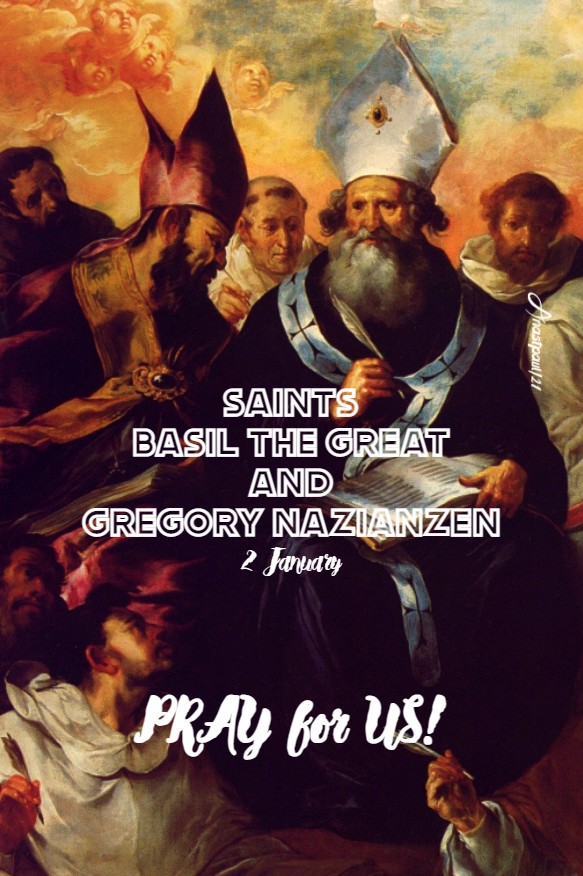
Quote/s of the Day – 2 January – Christmas Weekday and The Memorial of St Basil the Great (329-379) and St Gregory of Nazianzen (330-390)
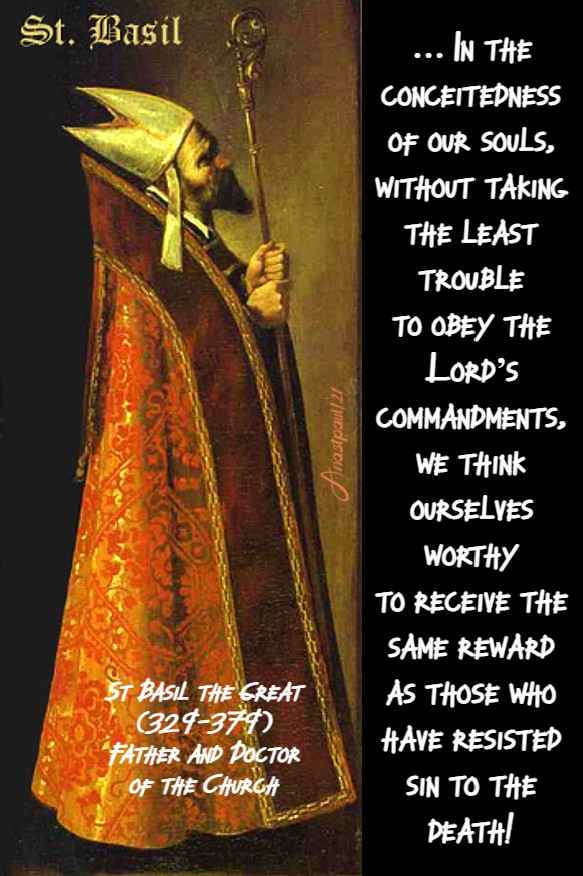
“… In the conceitedness of our souls, without taking the least trouble to obey the Lord’s commandments, we think ourselves worthy to receive the same reward as those who have resisted sin to the death!”
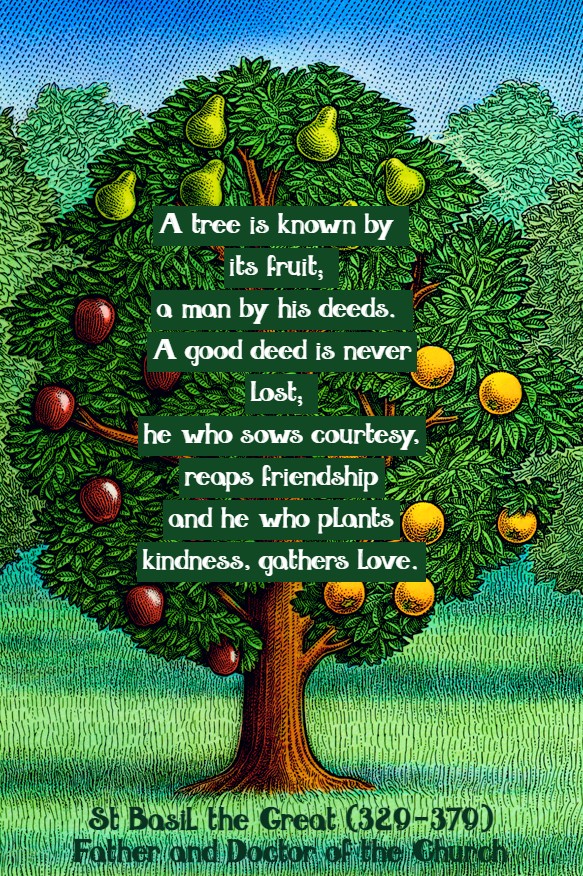
“A tree is known by its fruit, a man by his deeds. A good deed is never lost, he who sows courtesy, reaps friendship and he who plants kindness, gathers love.”
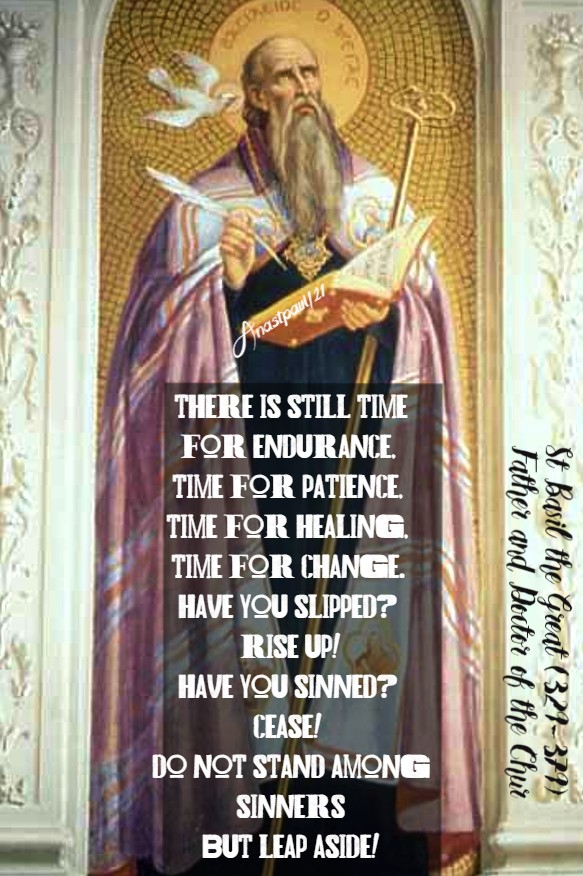
“There is still time for endurance, time for patience, time for healing, time for change. Have you slipped? Rise up! Have you sinned? Cease! Do not stand among sinners but leap aside!”
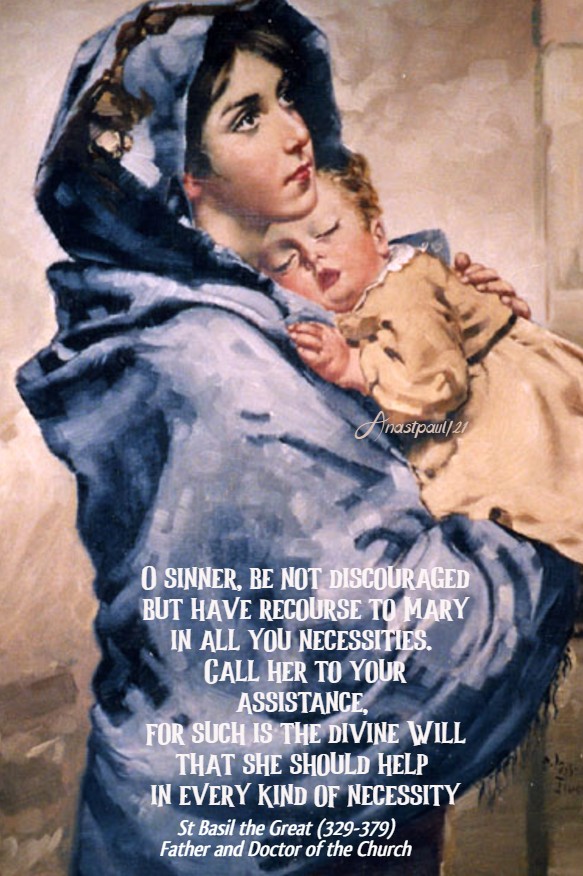
“O sinner, be not discouraged but have recourse to Mary in all you necessities. Call her to your assistance, for such is the divine Will that she should help in every kind of necessity.”
St Basil the Great (329-379) Father and Doctor of the Church
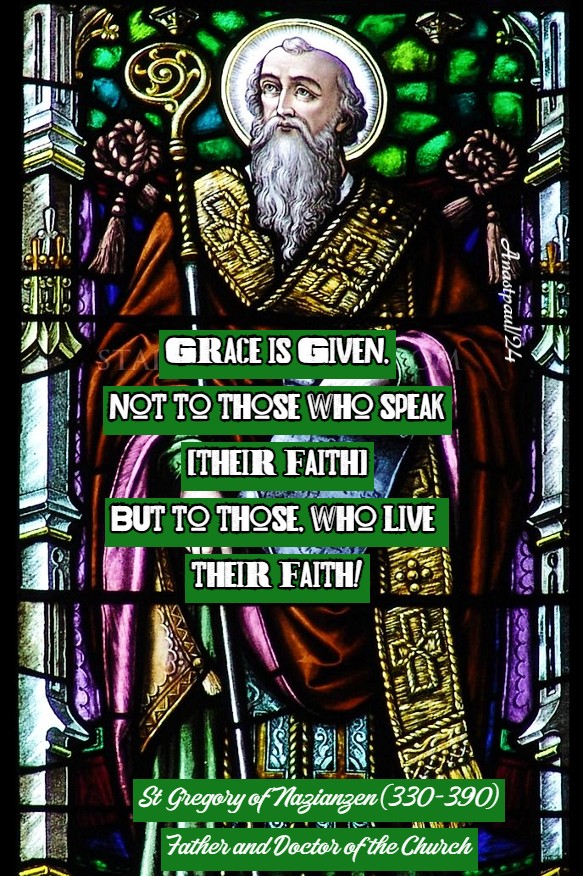
“Grace is given, not to those who speak [their faith] but to those, who live their faith.”
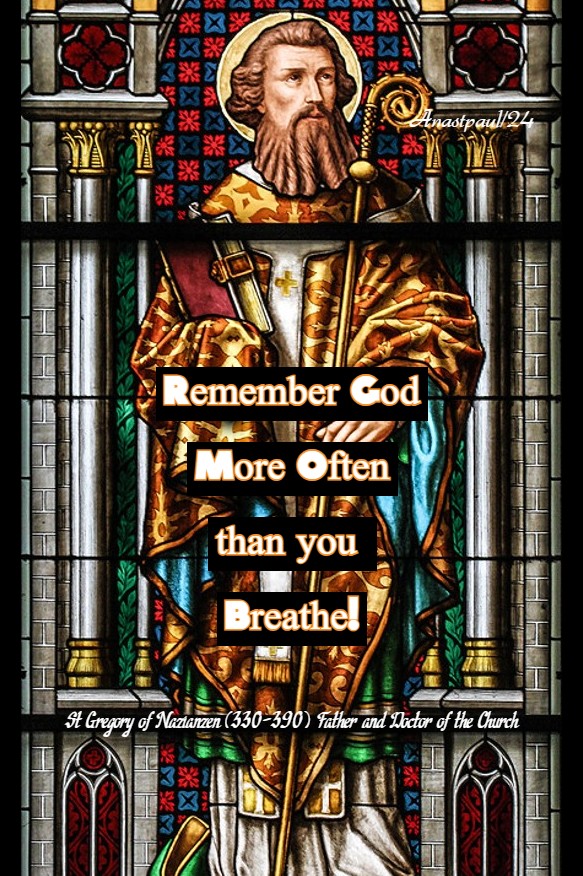
“Remember God more often than you breathe!”
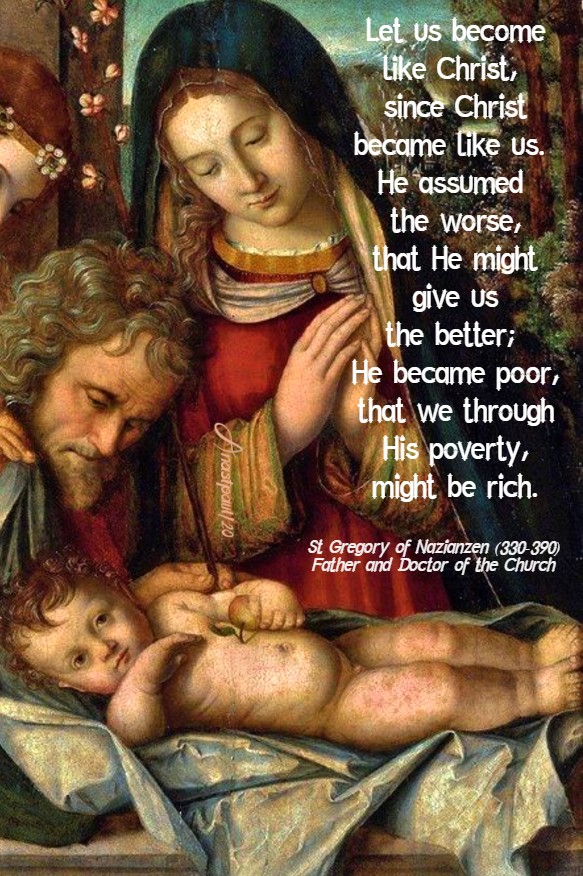
“Let us become like Christ, since Christ became like us. He assumed the worse, that He might give us the better; He became poor, that we through His poverty, might be rich.”
St Gregory of Nazianzen (330-390) Father and Doctor of the Church
One Minute Reflection – 2 January – Christmas Weekday and The Memorial of St Basil the Great (329-379) and St Gregory of Nazianzen (330-390), Readings: 1 John 2:22-28, Psalms 98:1, 2-3,3-4, John 1:19-28
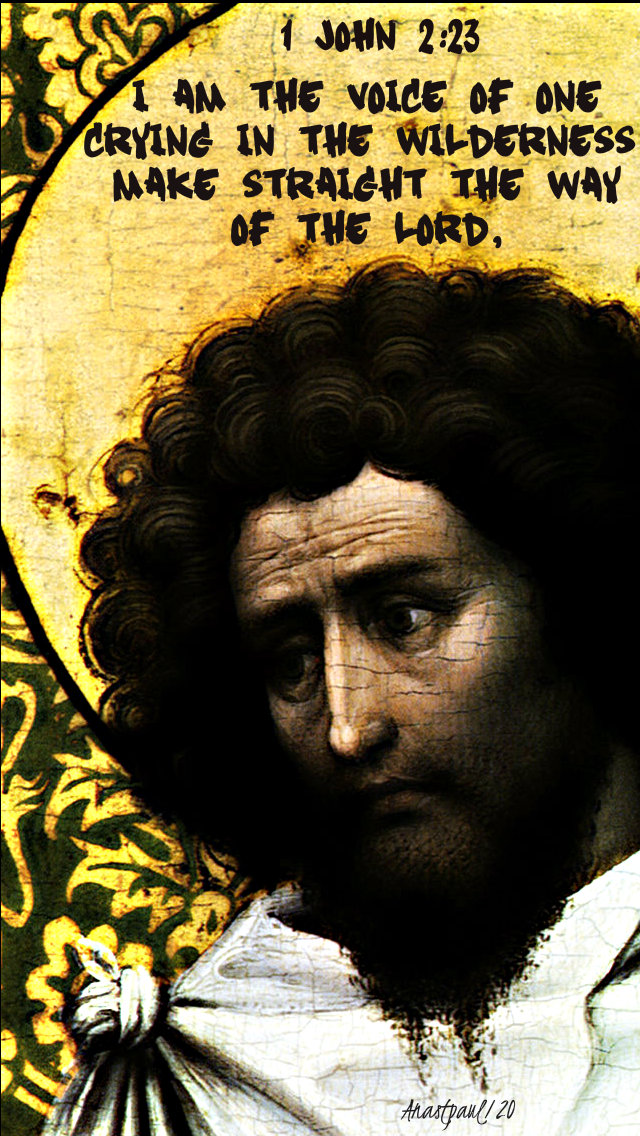
He said, “I am the voice of one crying in the wilderness, ‘Make straight the way of the Lord,’ as the prophet Isaiah said.” … 1 John 2:23
REFLECTION – “Prepare a way for the Lord.” Brethren, however far you journey along it… from the very nature of goodness, there is no limit to the way along which you travel. And so… the wise and indefatigable traveller… can say to himself each day: “Now I begin”… And how many “go astray in the wilderness”… None of them can yet say: “Now I begin.”
For “the beginning of wisdom is the fear of the Lord.” If the beginning of wisdom, then surely it is also the beginning of the way of goodness… It is this that encourages praise…, it also moves the proud to penance, so that they hear the voice of him crying in the wilderness, ordering the preparation of the way and thus showing how to begin it: “Do penance for the kingdom of heaven is close at hand”…
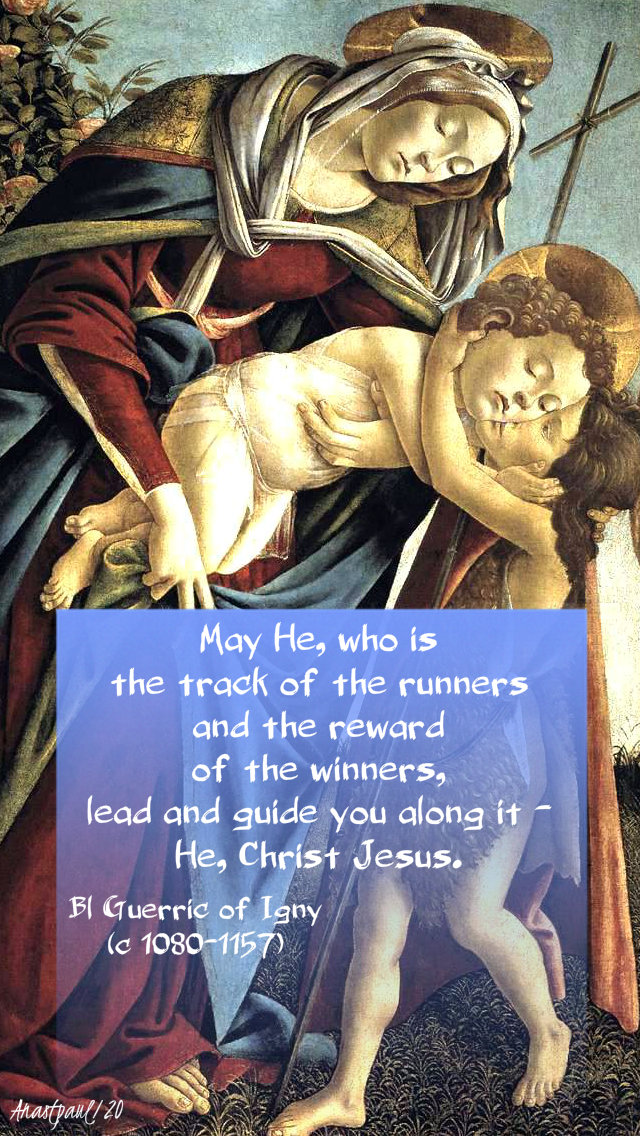
If you are on the way, then fear only one thing, lest you leave it, lest you offend the Lord who leads you along it, so that He would abandon you to “wander in the way of your own heart”… If you feel that the way is too narrow look forward to the end to which it leads you. If you were to see how everything is to be attained, then you would say without hesitation: “Broad indeed is your command!” If you cannot see so far, believe Isaiah who could… “Behold,” he says, “the redeemed shall walk by this way and the ransomed of the Lord shall return and come to Sion with singing, everlasting joy shall be upon their heads . They shall obtain also joy and gladness and sorrow and sighing shall flee away.” Those who dwell sufficiently on this end, I think, will not only make the way easier for himself but also grow wings, so that he no longer walks but flies… May He, who is the track of the runners and the reward of the winners, lead and guide you along it – He, Christ Jesus!” … Blessed Guerric of Igny (c 1080-1157) Cistercian Abbot – 5th sermon of Advent, SC 166
PRAYER – Look with favour on our morning prayer, Lord and in Your saving love, let Your light penetrate the wilderness in our hearts. May no sordid desires darken our minds, renewed and enlightened as we are, by Your heavenly grace. God our Father, You enriched Your Church and gave examples for us to follow in the life and teachings of Sts Basil and Gregory. Grant that, learning Your truth with humility, we may practise it in faith and love. Sts Basil and Gregory, pray for our beloved Church, pray for all Catholic Christians, through Jesus Christ with the Holy Spirit, God forever, amen.
My Wishes to You All for a Blessed and Grace-filled 2021
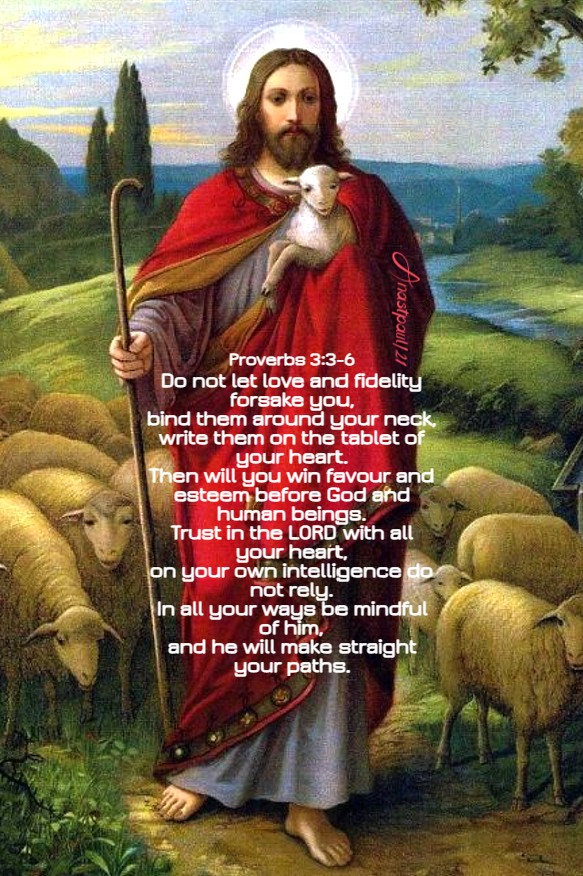
Do not let love and fidelity forsake you, bind them around your neck, write them on the tablet of your heart. Then will you win favour and esteem before God and human beings. Trust in the LORD with all your heart, on your own intelligence do not rely. In all your ways be mindful of him, and he will make straight your paths.
Proverbs 3:3-6
“We implore You, O All-Holy, Long-Suffering Life and Restoration, Source of goodness, look down from heaven and visit all those who ever trust in You; rescue our life, Lord, from all constraint and affliction, and, in the faith of truth, guide us all. At the prayers of the Immaculate Mother of God and Virgin, Save your world and those in the world and spare us all, You who, for us, became man without change, only Lover of mankind.”
Thought for the Day – 1 January – Meditations with Antonio Cardinal Bacci (1881-1971)
Mary, Mother of God
“The near-infinite greatness of Mary, flows from the fact, that she is the Mother of God. The Eternal Word of the Father, consubstantial with Him in nature and equal to Him in majesty, willed to become man in order to set us free from the slavery of sin and to regain Heaven for us. He became man in the chaste womb of the Virgin Mary. He took a human body and soul and was born of her, as the God-Man. For this reason, there is attributed to His Divine Person, the title of Son of Mary and to Mary, the title of Mother of God.
There is a relationship between Mary and each of the three Divine Persons, for she is the daughter of God the Father, the spouse of the Holy Spirit by whose power the Word became incarnate in her and the mother of the Word made Man. She is, moreover, in the words of Dante, the “termine fisso di eterno consiglio” (Paradiso 33:1-3). In other words, she is the centre of the eternal plan which God established for the redemption of the human race. It was God’s eternal design to reunite creation to the Uncreated, by means of Mary. She became the mother of the Eternal Word, in whom the divine and human natures were indissolubly united. He redeemed us by His infinite merits but, in this work of redemption, He employed the co-operation of His holy Mother. All the graces, privileges and virtues of Mary, flow from this great mystery of her divine Motherhood. As befitted the future Mother of God, she was conceived free from the stain of original sin and full of grace. Her mortal life was a continuous ascent towards the highest peak of sanctity. When she died, she was assumed body and soul into Heaven, where she was crowned in glory, as Queen of Angels and Queen of Saints. When we consider the sublime nobility of Our Lady, we should be moved to love and venerate her. This love and veneration does not subtract in the slightest from God’s glory, because, she is the Mother of God. In fact, it is a great advantage to us, to imitate her and to call on her to intercede for us.”
Quote/s of the Day – 1 January – The Solemnity of Mary, Mother of God and the Octave Day of the Nativity of the Lord
“If anyone does not believe that Holy Mary is the Mother of God, such a one is a stranger to the Godhead.”
St Gregory of Nazianzen (330-390) Father & Doctor of the Church
“That anyone could doubt, the right of the holy Virgin to be called the Mother of God, fills me with astonishment. Surely, she must be the Mother of God, if our Lord Jesus Christ is God and she gave birth to Him!”
St Cyril of Alexandria (376-444) Father and Doctor
“Having confidence in you, O Mother of God, I shall be saved. Being under you protection, I shall fear nothing. With your help, I shall give battle to my enemies and put them to flight, for devotion to you, is an arm of Salvation.”
St John Damascene (676-749) Father and Doctor of the Church
“What shall we say, brethren? Is she not our mother? Certainly, brethren, she is in truth our mother. Through her we are born, not to the world but to God.”
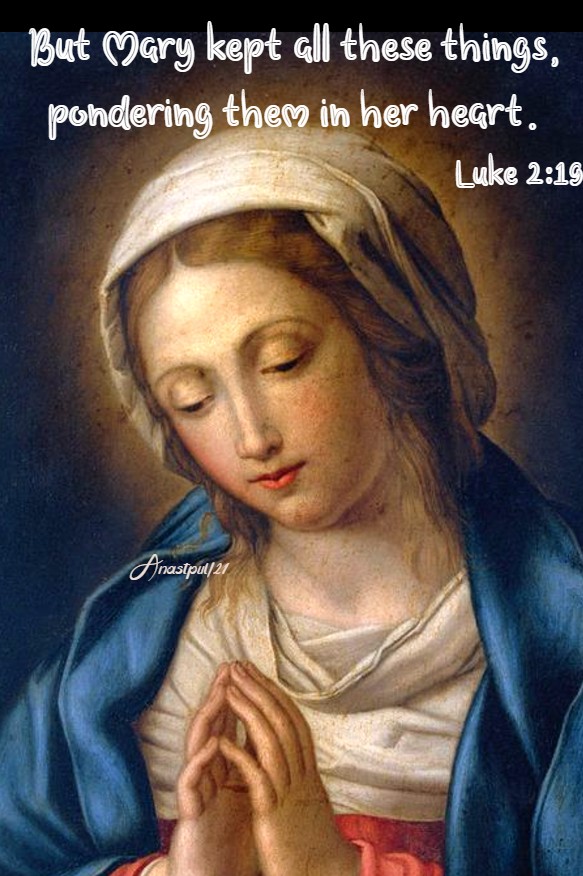
But Mary kept all these things, pondering them in her heart. … Luke 2:19
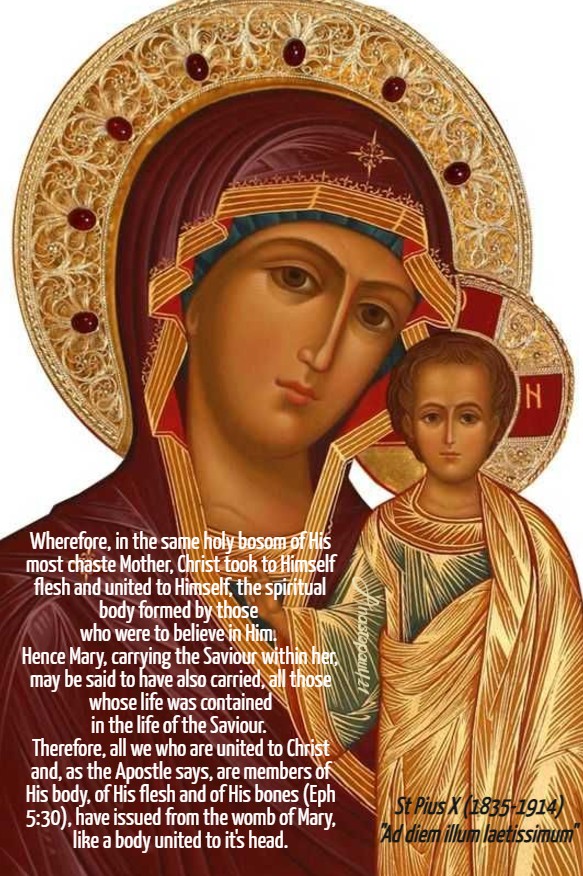
REFLECTION – “Is not Mary the Mother of Christ? Then she is our Mother also. And we must in truth hold that Christ, the Word made Flesh, is also the Saviour of mankind. He had a physical body like that of any other man and again, as Saviour of the human family, He had a spiritual and mystical body, the society, namely, of those who believe in Christ. “We are many, but one sole body in Christ” (Rom. xii., 5). Now the Blessed Virgin did not conceive the Eternal Son of God, merely in order, that He might be made man taking His human nature from her but, also in order, that by means of the nature assumed from her, He might be the Redeemer of men. For which reason, the Angel said to the Shepherds: “To-day there is born to you a Saviour who is Christ the Lord” (Luke 2:11). Wherefore, in the same holy bosom of His most chaste Mother, Christ took to Himself flesh and united to Himself, the spiritual body formed by those who were to believe in Him. Hence Mary, carrying the Saviour within her, may be said to have also carried, all those whose life was contained in the life of the Saviour. Therefore, all we who are united to Christ and, as the Apostle says, are members of His body, of His flesh and of His bones (Eph 5:30), have issued from the womb of Mary, like a body united to it’s head. Hence, though in a spiritual and mystical fashion, we are all children of Mary and she is Mother of us all. … If then, the most Blessed Virgin is the Mother at once of God and men, who can doubt that she will work with all diligence to procure that Christ, Head of the Body of the Church (Col 1:18), may transfuse His gifts into us, His members and above all, that of knowing Him and living through Him (I John 4:9)?” – Saint Pius X (1835-1914) – Pope from 1903 to 1914 – Encyclical “Ad diem illum laetissimum” §10-11
PRAYER – God, our Father, since You gave mankind a Saviour through the blessed Mary, virgin and mother and a heavenly mother through our Saviour, grant that we may feel the power of her intercession, when she pleads for us with Jesus Christ, Your Son, the author of life, who lives and reigns with You and the Holy Spirit, God, forever and ever, amen.
Thought for the Day – 31 December – Meditations with Antonio Cardinal Bacci (1881-1971)
The Last Day of the Year
“The last day of the year has come. It should be a day of reckoning and of resolution. Think of the many benefits which God has conferred on you throughout your life but, especially in the year which is now drawing to a close.
Count the temporal favours which you have received. Many of your friends and acquaintances have died during the year but, you are still alive! God has rescued you from innumerable perils and illnesses. He has allowed you more time in which to perfect your spiritual life and to perform pastoral work on your neighbour’s behalf. Try not to be like the barren tree in the gospel because, this could be your final year of trial.
Count the spiritual blessings which you have received. Think of the graces and good inspirations which God has given you during the past twelve months. How often have you received forgiveness for your sins, been restored to the friendship of God and, experienced anew, the joy and peace of being in the state of grace? How often has Jesus come into your heart under the guise of the Blessed Eucharist? How often have you been enlightened ad ecouraged by hearing or reading the word of God? Think, too, of the good example which you have received in private and in public and recall the many occasions, on which the helping hand of God has reached out to save you from falling into sin.
You could never show sufficient gratitude for all these favours. Spend this day, at least, in acts of repentance and thanksgiving and, promise God, to be faithful to Him in the coming year.”
Quote/s of the Day – 31 December – The Seventh Day in the Octave of Christmas
Are we Ready? Will this be another year from hell?
“Brothers, . . . I can only say, that forgetting all that lies behind me and straining forward to what lies in front of me, I am racing towards the finishing-point, to win the prize of God’s heavenly call in Christ Jesus.”
Philippians 3:13
“My brothers, Christ made love the stairway that would enable all Christians to climb to heaven. Hold fast to it, therefore, in all sincerity, give one another practical proof of it and by your progress in it, make your ascent together.”
St Fulgentius of Ruspe (c 462 – 533)
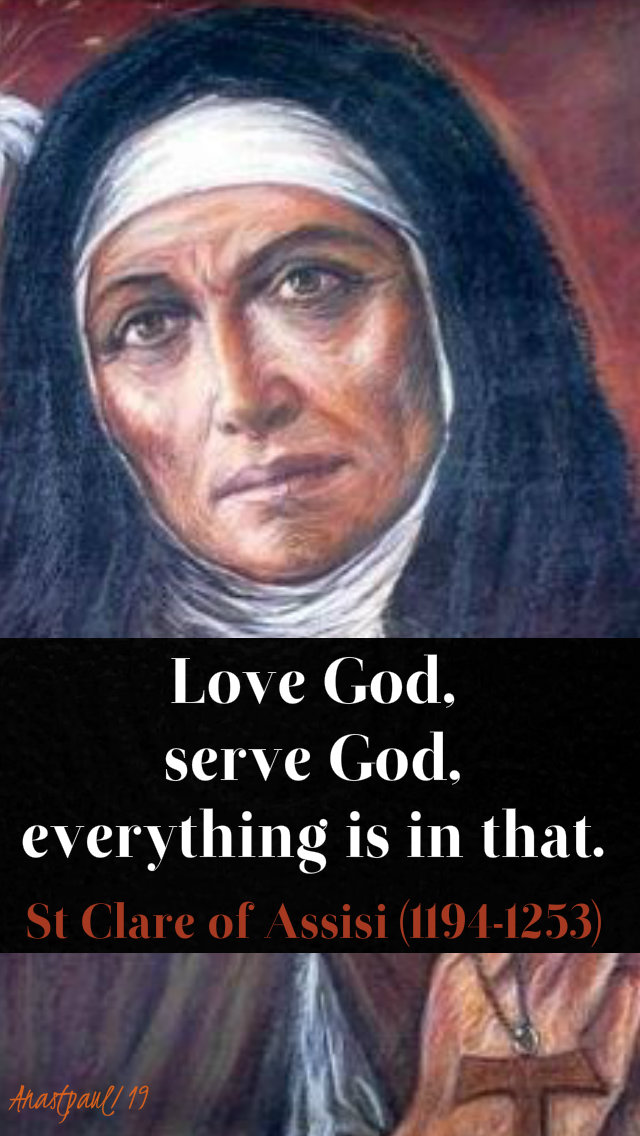
“Love God, serve God, everything is in that.”
St Clare of Assisi (1194-1253)
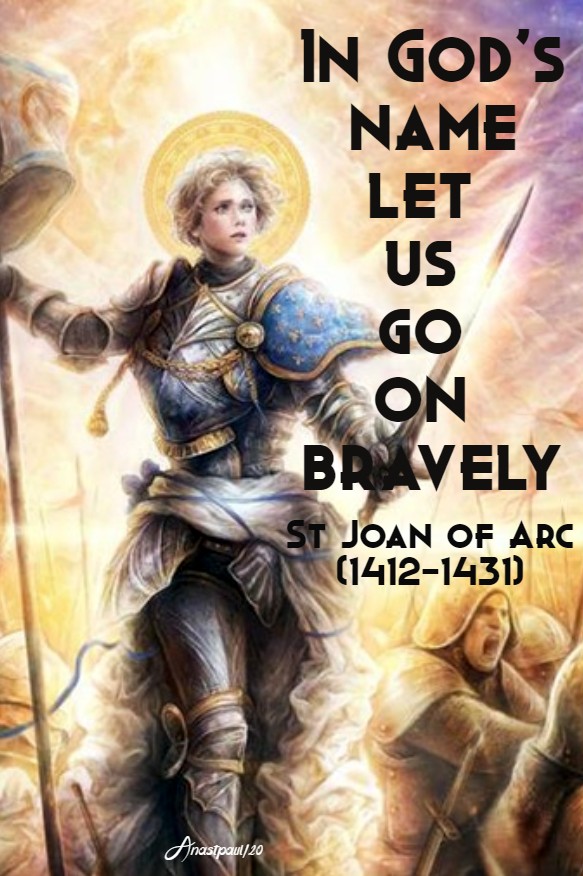
“In God’s Name, let us go on bravely”
St Joan of Arc (1412-1431)
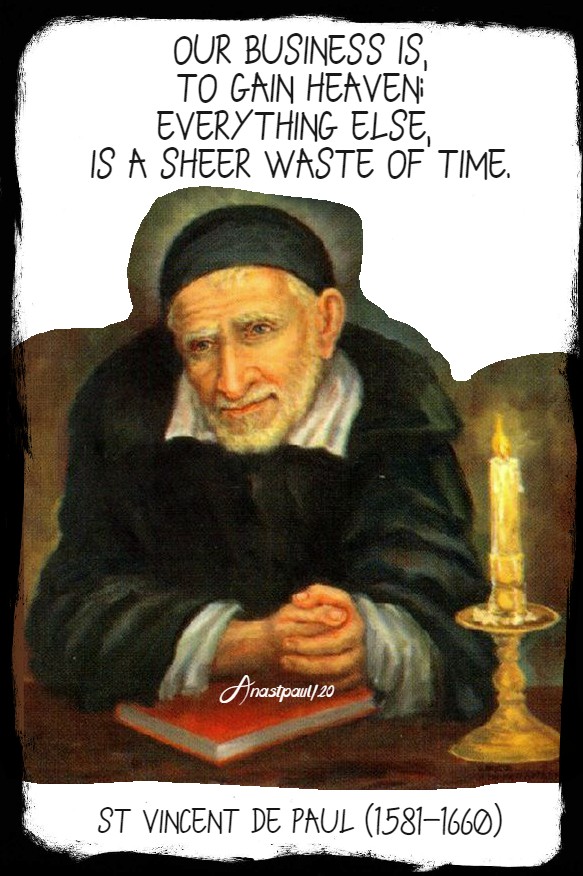
“Our business is, to gain heaven; everything else, is a sheer waste of time.”
St Vincent de Paul (1581-1660)
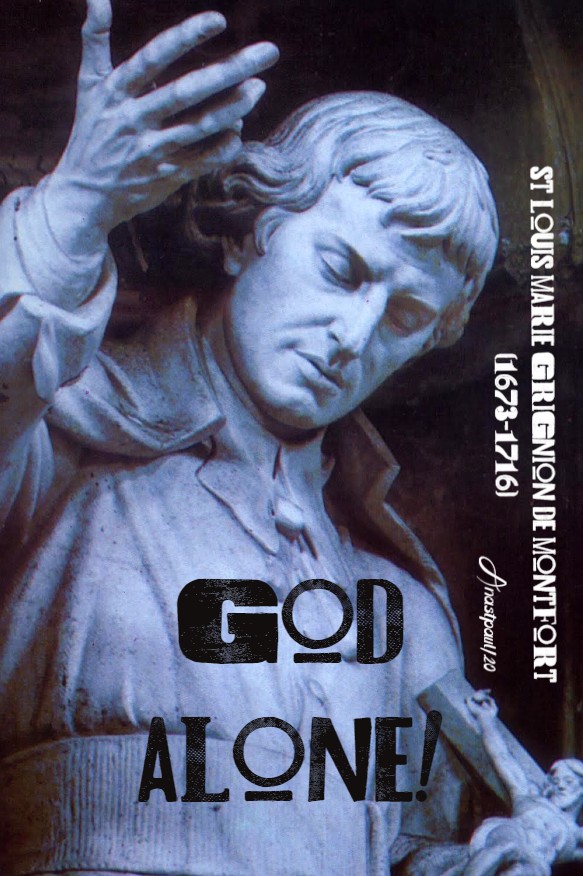
“God Alone”
St Louis Marie Grignion de Montfort (1673-1716)
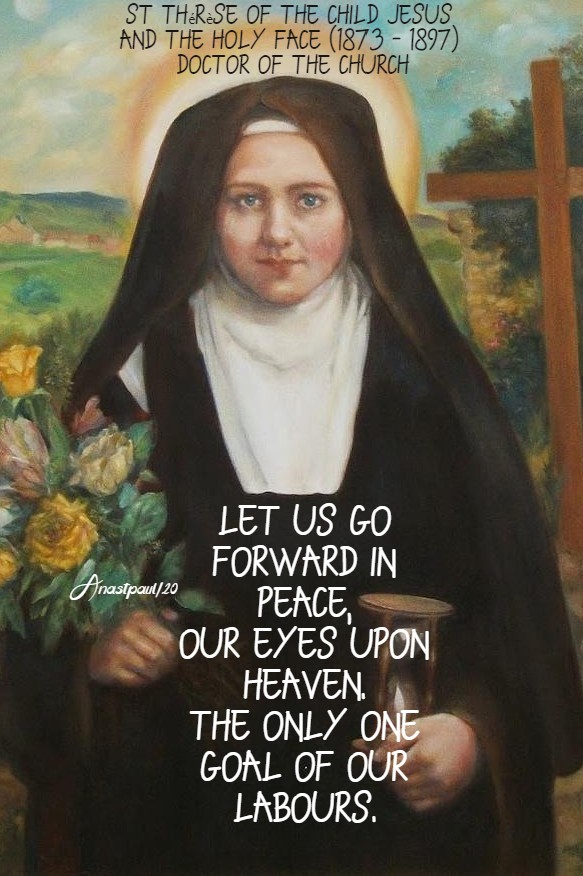
“Let us go forward in peace, our eyes upon heaven, the only one goal of our labours.”
St Thérèse of the Child Jesus (1873-1897) Doctor of the Church
Christ has been born for us, come, let us adore Him.
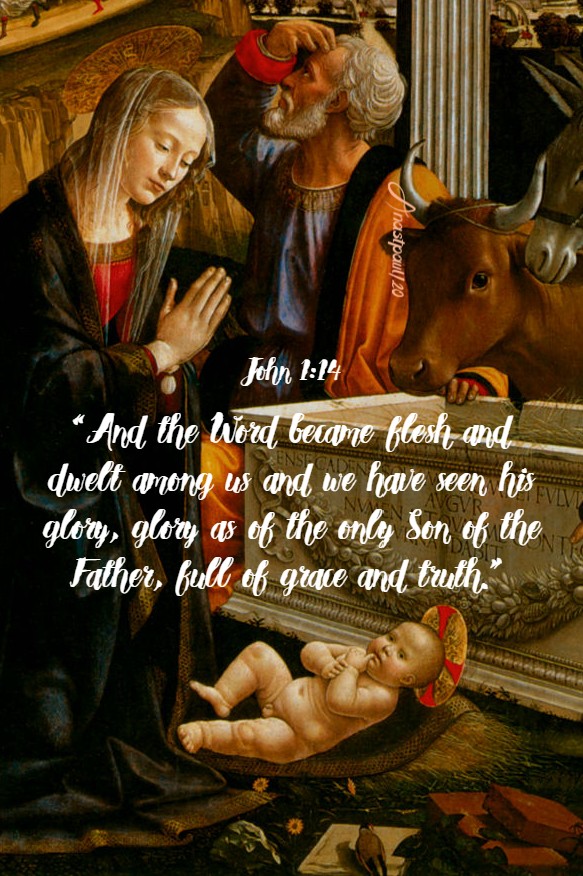
“And the Word became flesh and dwelt among us and we have seen his glory, glory as of the only Son of the Father, full of grace and truth.” – John 1:14
REFLECTION – “God, who gave being to all that is, at the same time united all things together in His providence.
Being master, He became a servant (cf, Phil 2:6-7) and so revealed to the world, the depth of His providence.
God the Word, in becoming incarnate while remaining unchanged, was united through His flesh with the whole of creation.
There is a new wonder in heaven and on earth – God is on earth and man is in heaven.
He united men and angels, so as to bestow deification on all creation.
The knowledge of the holy and co-essential Trinity is the sanctification and deification of men and angels. …
When, in His compassion for man, the Word became flesh (cf. Jn 1:14), He changed, neither what He was, nor what He became.” – Thalassios the Syrian (5th Century) Priest, Hermit and Abbot in Syria – Centuries on Love I
PRAYER – All-powerful, ever-living God, we thank You for the human birth of Your Son, which is the source and perfection of our Christian life and worship. Number us among His people, for the salvation of all mankind is found in Him, for the Word became flesh who lives and reigns with You and the Holy Spirit, God, forever and ever, amen.
Thalassius of Syria undertook the call of God to life as a hermit in the fifth century. Thalassius is recorded to have entered into solitude at a young age near a village named Targala in Byzantine Syria. He is said to have dwelt there, living the ascetic life with no shelter for nearly forty years. Thalassius’ was a soul filled with humbleness, simplicity and a gentle nature. God manifested in him, the gifts of powerful intercession and healing for which he gained considerable renown. In time, many came to join Thalassius in the eremitic life and he welcomed them as he would welcome Christ, building them cells with his own hands. BlessedThalassius, Hermit of Syria is said to have died peacefully.
Thought for the Day – 30 December – Meditations with Antonio Cardinal Bacci (1881-1971)
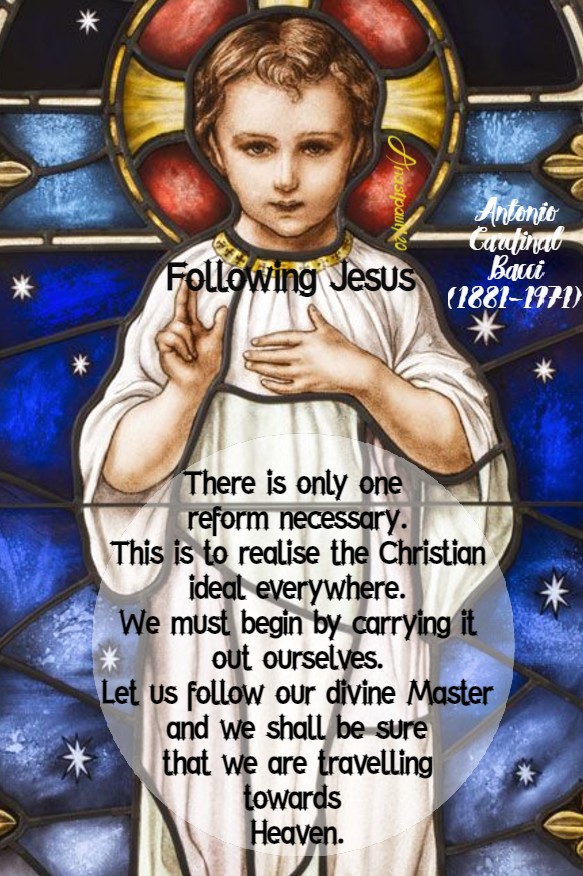
Following Jesus
“When we have renounced ourselves and have embraced our cross with resignation and love, we must follow Jesus. We must follow Him in a special way as the infallible Teacher of truth. The teachings of men cannot satisfy our intellects. Still less, can they satisfy our hearts. What they teach is either incomplete or false. This is proved by the fact that the doctrines of mean have succeeded and replaced one another, down through the centuries while “the word of the Lord endures forever” (1 Peter 1:25).
The teaching of Christ produces an extraordinary renovation in the individual, in the family and in society. It is this renewal which we call Christianity and Christian civilisation. There is a wide chasm between paganism and Christianity. This gulf would be even wider, only for the fact that Christianity has not yet been fully put into practice throughout the universe. There is only one reform necessary. This is to realise the Christian ideal everywhere. We must begin by carrying it out ourselves. Let us follow Jesus, Who is saying to us: “I am the way and the truth and the life” (Jn 14:6). “He who follows Me does not walk in darkness” (Jn 8:12).
Let us follow our divine Master and we shall be sure that we are travelling towards Heaven!”
Quote/s of the Day – 30 December – The Sixth Day in the Christmas Octave
“Christmas”
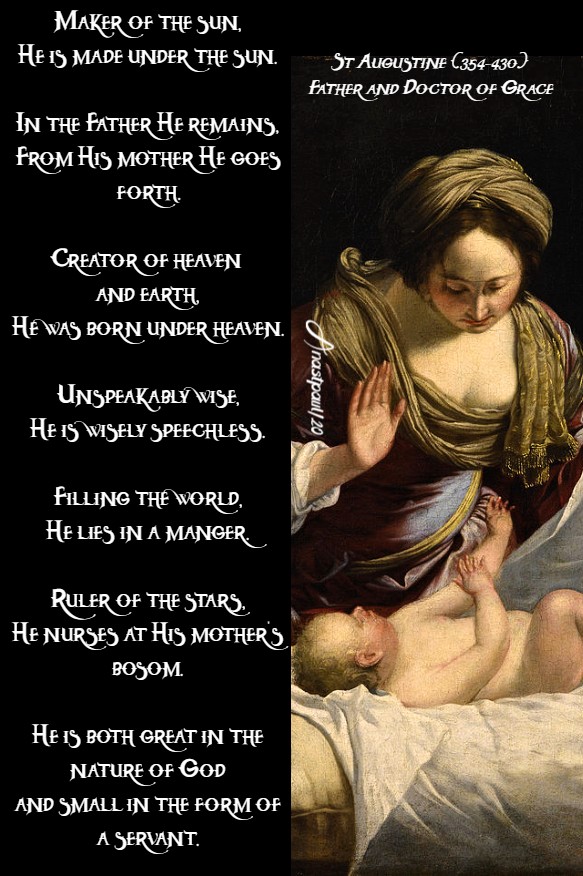
“Maker of the sun, He is made under the sun.
In the Father He remains, From His mother He goes forth.
Creator of heaven and earth, He was born under heaven.
Unspeakably wise, He is wisely speechless.
Filling the world, He lies in a manger.
Ruler of the stars, He nurses at His mother’s bosom.
He is both great in the nature of God and small in the form of a servant.”
St Augustine (354-430) Father and Doctor of Grace
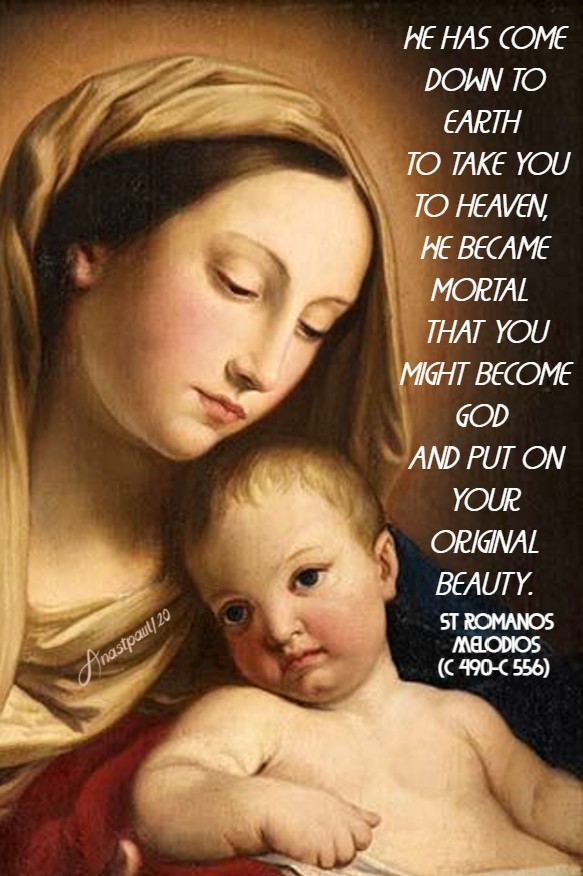
“He has come down to earth to take you to heaven, He became mortal that you might become God and put on your original beauty.”
St Romanos Melodios (c 490-c 556) Monk, Composer of Hymns, Poet
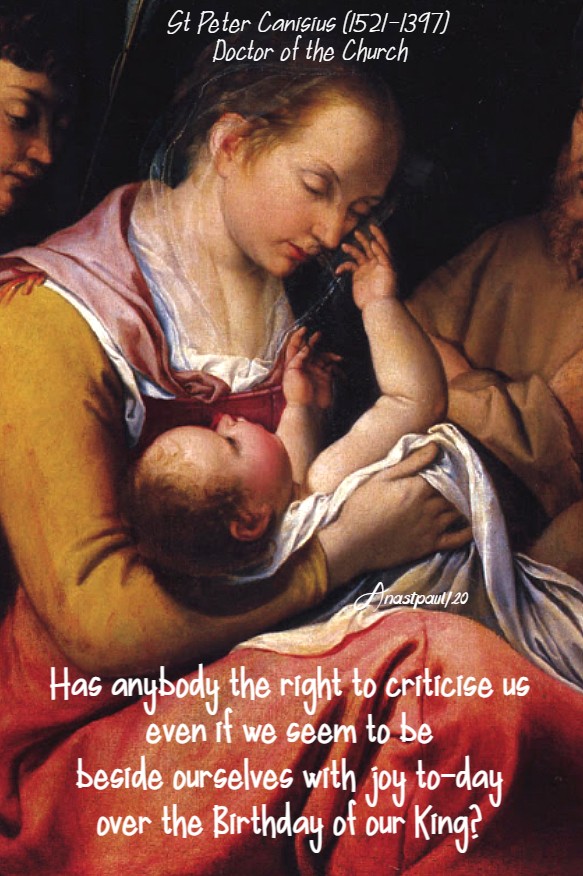
“Has anybody the right to criticise us even if we seem to be beside ourselves with joy to-day over the Birthday of our King?”
St Peter Canisius (1521-1397) Doctor of the Church
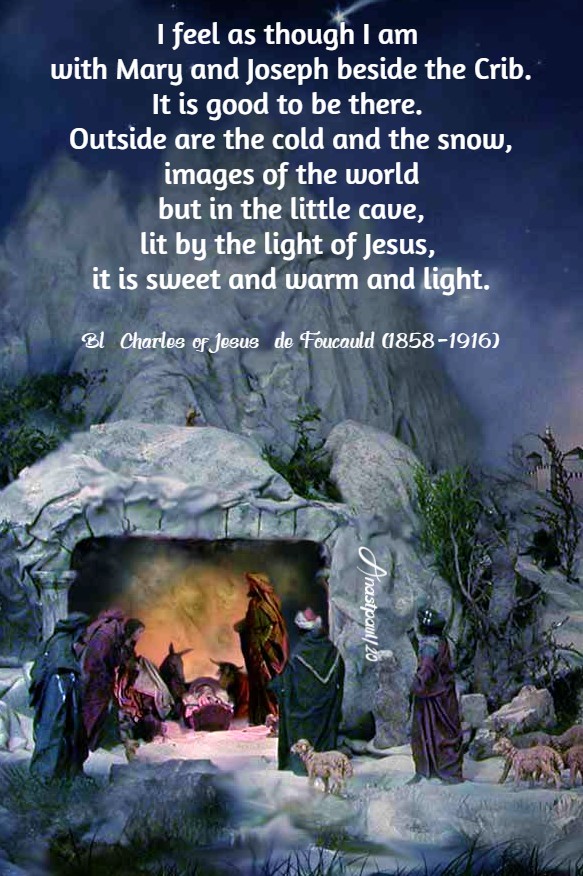
“I feel as though I am with Mary and Joseph beside the Crib. It is good to be there. Outside are the cold and the snow, images of the world but in the little cave, lit by the light of Jesus, it is sweet and warm and light.”
One Minute Reflection – 30 December – The Sixth Day in the Christmas Octave, Readings: 1 John 2:12-17, Psalm 96:7-10, Luke 2:36-40
“She spoke about the child to all who were awaiting the redemption of Jerusalem” … Luke 2:38
REFLECTION – “O Root of Jesse, who stand as a sign to the peoples” (Is 11: 10), “how many kings and prophets wanted to see you and did not” (Lk 10:24)? Simeon is the happiest of them all because by God’s mercy he was still bearing fruit in old age. For he rejoiced to think that he would see the sign so long desired. He saw it and was glad (Lk 8:56). When he had received the kiss of peace, he departed in peace but first, he proclaimed aloud that Jesus was born, a sign that would be rejected (Lk 2:25-34). And so it was. The sign of peace arose and was rejected, by those who hate peace (Ps 119:7). For what is peace to men of goodwill (Lk 2:14) is a stone to make men stumble, a rock for the wicked to fall over (l Pt 2:8). “Herod was troubled and all Jerusalem with him” (Mt 2:3). He came to His own and His own did not receive Him (Jn 1:11). Happy those shepherds keeping watch at night who were found worthy to be shown the sign of this vision! (Lk 23:8)
For even at that time He was hiding Himself from the wise and prudent and revealing Himself to the simple (Mt 11:25; Lk 10:21). … The angel said to the shepherds, “This is a sign for you” (Lk 2: 12), you who are humble, you who are obedient, you who are not haughty (Rom 12: 16), you who are keeping vigil and meditating on God’s law day and night (Ps 1:2). “This is a sign for you,” he said. What is this sign? The sign the angels promised, the sign the people asked for, the sign the prophets foretold, the Lord Jesus has now made and He shows it to you. …
This is your sign. What is it a sign of? Indulgence, grace, peace, “the peace which will have no end” (Is 9:7). It is this sign: “You will find a baby wrapped in swaddling clothes and lying in a manger” (Lk 2: 12). But this baby is God Himself, reconciling the world to Himself in Him (2 Cor 5: 19). … He is the Kiss of God, the Mediator between God and men, the man Christ Jesus (1Tm 2:5), who with the Father and the Holy Spirit lives and reigns world without end.” … St Bernard (1091-1153) Doctor of the Church
PRAYER – Almighty God and Father, the human birth of Your Only-begotten Son, was the beginning of new life. May He set us free from the tyranny of sin. We make our prayer through Christ, our Lord with the Holy Spirit, God forever and ever, amen.
Thought for the Day – 29 December – Meditations with Antonio Cardinal Bacci (1881-1971)
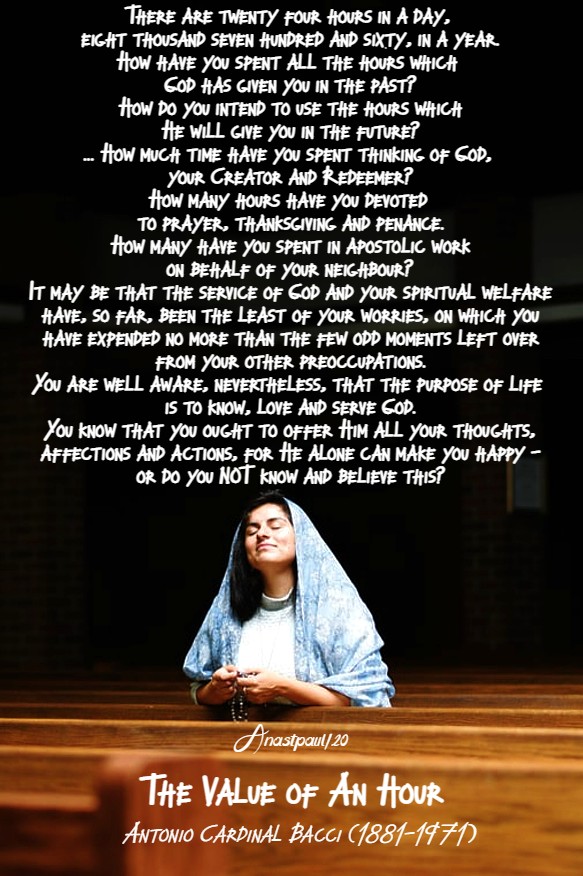
The Value of An Hour
“There are twenty four hours in a day, eight thousand seven hundred and sixty, in a year. How have you spent all the hours which God has given you in the past? How do you intend to use the hours which He will give you in the future?
When you examine the past, you will find much to regret. Perhaps you have spent many hours in sin, in idle gossp, in useless or dangerous pastimes, or in innumerable business transactions, all of which will contribute NOTHING towards your eternal salvation, which should be our main concern in this life.
How much time have you spent thinking of God, your Creator and Redeemer? How many hours have you devoted to prayer, thanksgiving and penance. How many have you spent in apostolic work on behalf of your neighbour? It may be that the service of God and your spiritual welfare have, so far, been the least of your worries, on which you have expended no more than the few odd moments left over from your other preoccupations. You are well aware, nevertheless, that the purpose of life is to know, love and serve God. You know that you ought to offer Him all your thoughts, affections and actions, for He alone can make your happy – or do you NOT know and believe this?”
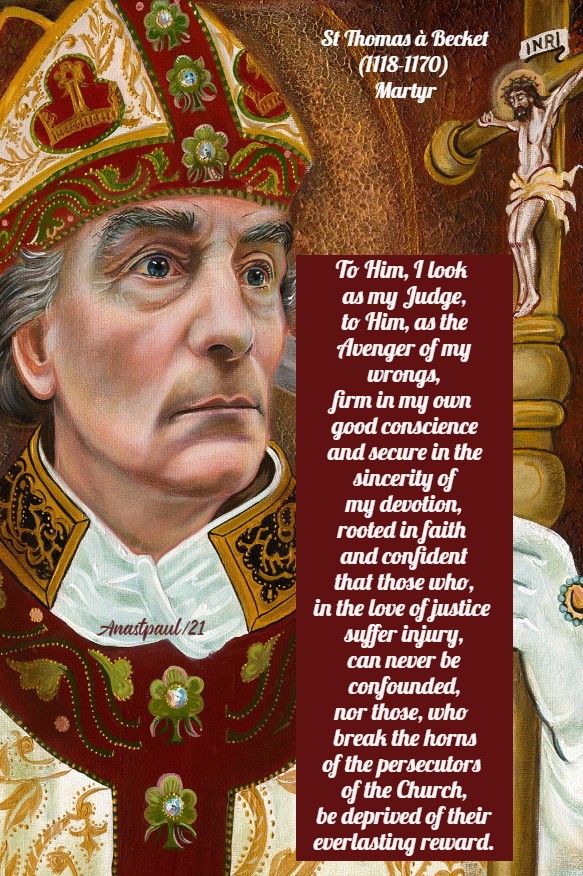
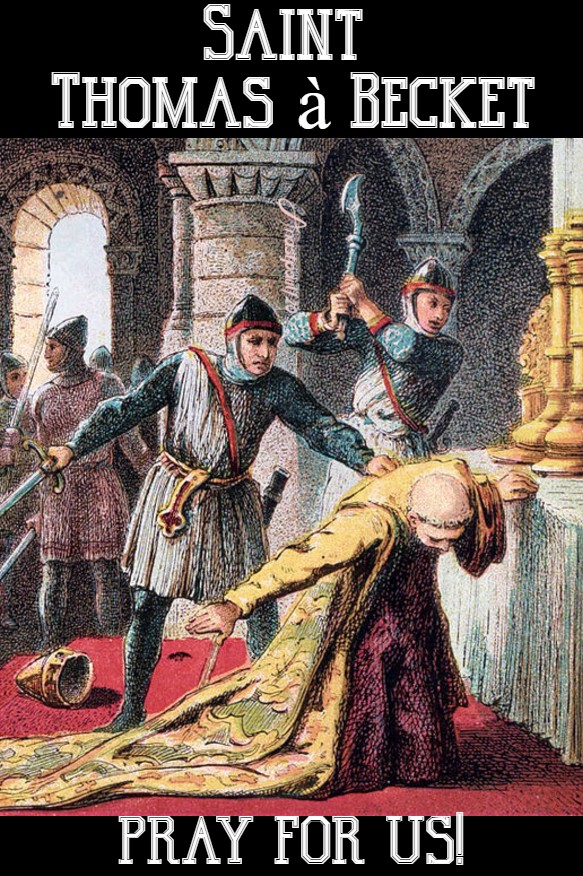
Quote/s of the Day – 29 December – The Fifth Day of the Octave of Christmas and the Memorial of St Thomas à Becket (1118-1170) Martyr, Archbishop of Canterbury
“To Him, I look as my judge, to Him, as the avenger of my wrongs, firm in my own good conscience and secure in the sincerity of my devotion, rooted in faith and confident that those who, in the love of justice suffer injury, can never be confounded, nor those, who break the horns of the persecutors of the Church, be deprived of their everlasting reward.”
“Let it be your consolation, then, that God’s enemies, however honourable and exalted they may have been, shall, nevertheless, fade away like the smoke.”
One Minute Reflection – 29 December – The Fifth Day of the Octave of Christmas, Readings: 1 John 2:3-11, Psalms 96:1-2, 2b-3, 5-6, Luke 2:22-35 and the Memorial of St Thomas à Becket (1118-1170) Martyr, Archbishop of Canterbury
“Now, Master, you may let your servant go in peace ”- Luke 2:29
REFLECTION – “The kingdom of God is at hand” (Lk 21:31). The kingdom of God, beloved brethren, has begun to be at hand; the reward of life and the joy of eternal salvation and perpetual happiness and the possession of paradise once lost, are now coming with the passing of the world; now the things of heaven are succeeding those of earth; great things, small and eternal things, transitory. What place is there here for anxiety and worry? …
It is written that “the just man lives by faith” (Rm 1:17). If you are just and live by faith, if you truly believe in Jesus Christ, why do you, who are destined to be with Christ and secure in the promise of the Lord, not rejoice that you are called to Christ …? Take the example of Simeon, the just man who was truly just, who with full faith kept the commandments of God – when the answer had been given him from heaven that he would not die before he had seen Christ and when Christ as an infant had come into the temple with His mother, he knew in spirit that Christ was now born, concerning whom it had been foretold to him before and on seeing Him he knew, that he himself would quickly die.
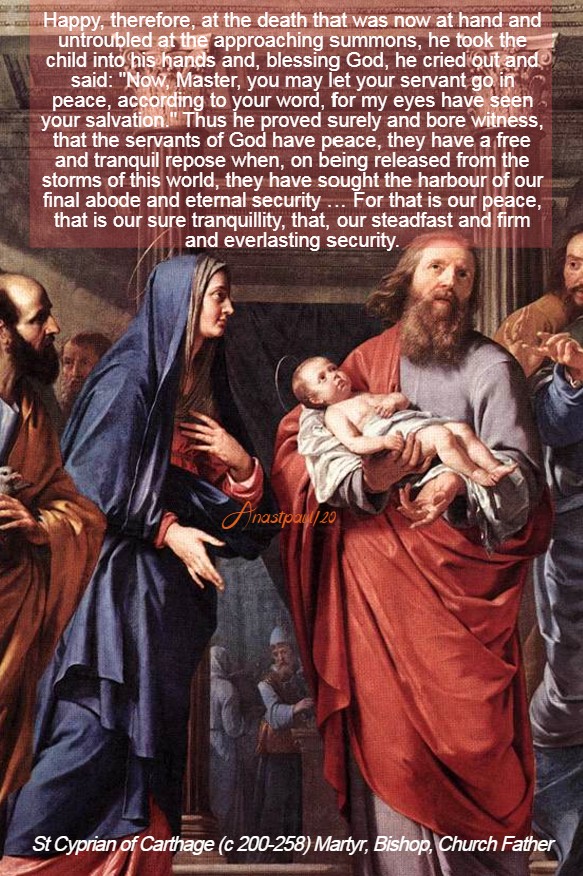
Happy, therefore, at the death that was now at hand and untroubled at the approaching summons, he took the child into his hands and, blessing God, he cried out and said: “Now, Master, you may let your servant go in peace, according to your word, for my eyes have seen your salvation.” Thus he proved surely and bore witness, that the servants of God have peace, they have a free and tranquil repose when, on being released from the storms of this world, they have sought the harbour of our final abode and eternal security … For that is our peace, that is our sure tranquillity, that, our steadfast and firm and everlasting security.” – St Cyprian of Carthage (c 200-258) Martyr, Bishop, Church Father – On mortality, 2-3
PRAYER – God our Father, our human nature is the wonderful work of Your hands. Your Son took to Himself our manhood, grant us a share in His Sonship, that as co-heirs with Him, we may strive evermore obediently to gain our final home with the Blessed Virgin and all Your saints. Through Christ, our Lord, with the Holy Spirit, one God with You now and for evermore, amen.
Thought for the Day – 28 December – Meditations with Antonio Cardinal Bacci (1881-1971)
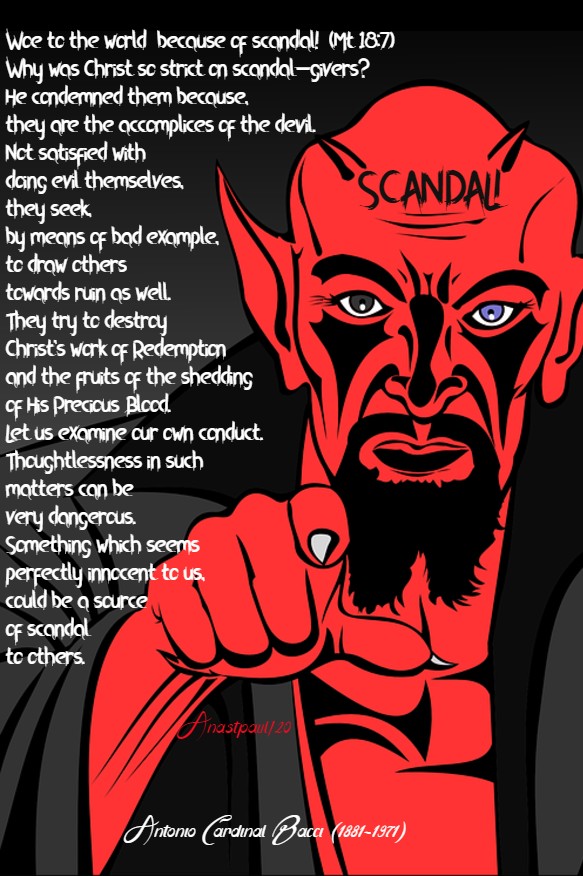
SCANDAL!
The Gospel contains a frightening condemnation of those who give scandal. “Whoever causes one of these little ones who believe in me to sin, it were better for him to have a great millstone hung around his neck and to be drowned in the depths of the sea. Woe to the world because of scandal! … If thy hand or thy foot is an occasion of sin to thee, cut it off and cast it from thee! It is better for thee to enter life, mained or lame, than, having two hands or two feet, to be cast into the everlasting fire …” (Cf Mt 18:6-9). Why was Christ so strict on scandal-givers? He condemned them because they are the accomplices of the devil. Not satisfied with doing evil themselves, they seek by means of bad example, to draw others towards ruin as well. They try to destroy Christ’s work of Redemption and the fruits of the shedding of His Precious Blood. Let us examine our own conduct. If we discover anything which could provide an occasion of sin for others, let us remedy it immediately. Thoughtlessness in such matters can be very dangerous. Something which seems perfectly innocent to us, could be a source of scandal to others. Prudence and delicacy are necessary in our relations with our fellow-men.
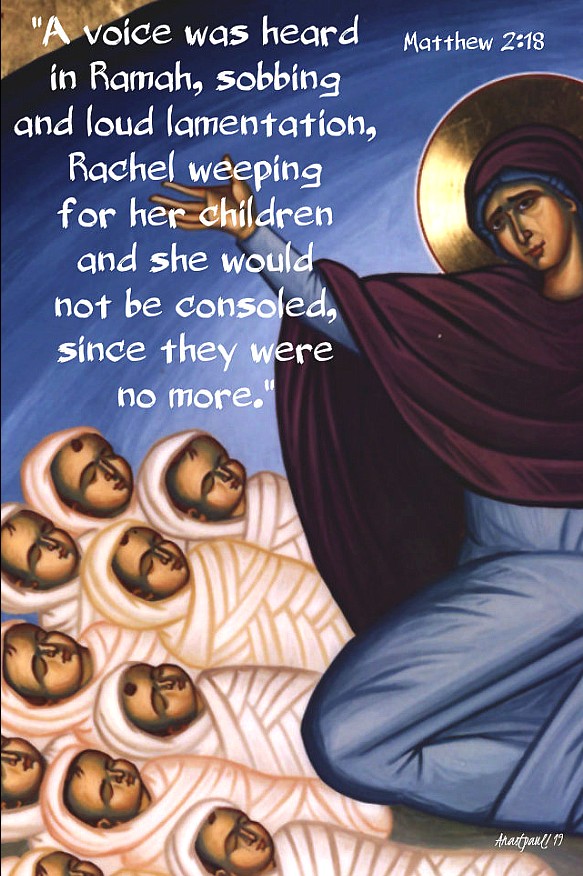
Quote/s of the Day – 28 December – The Feast of the Holy Innocents – The Fourth Day of the Christmas Octave, Readings: 1 John 1:5-2:2, Psalm 124:2-5, 7-8, Matthew 2:13-18
“A voice was heard in Ramah, sobbing and loud lamentation; Rachel weeping for her children and she would not be consoled, since they were no more.”
Matthew 2:18
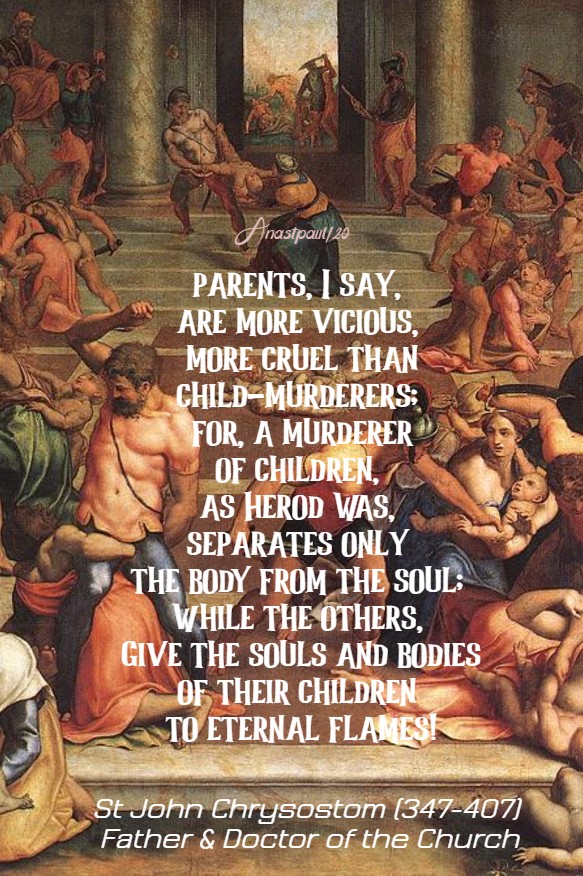
“Thus, parents, I say, are more vicious, more cruel than child-murderers; for, a murderer of children, as Herod was, separates only the body from the soul; while the others, give the souls and bodies of their children to eternal flames! Further, those who are killed would have died in the course of time, though they had not been murdered; while children, neglected by their parents, might have avoided eternal death, had not the wickedness of their parents prepared it for them. Besides this, the general resurrection would have compensated for the bodily death, while the death and destruction of the soul, nothing can restore. A child, condemned by the parent’s fault, has no hope of salvation but has to suffer eternal pains. Hence I am right in saying, that such parents are worse than child-murderers.”
One Minute Reflection – 28 December – The Feast of the Holy Innocents – The Fourth Day of the Christmas Octave, Readings: 1 John 1:5-2:2, Psalm 124:2-5, 7-8, Matthew 2:13-18
When Herod realised that he had been deceived by the magi, he became furious. He ordered the massacre of all the boys in Bethlehem and its vicinity, two years old and under, in accordance with the time he had ascertained from the magi. – Matthew 2:16
REFLECTION – “The Apostle John said: “Whoever says he abides in Christ, ought to walk even as Christ walked” (1 Jn 2:6). Moreover, the blessed Apostle Paul exhorts and teaches us, saying: “We are God’s children but if children, then heirs of God and joint-heirs with Christ; if so be that we suffer with him that we may also be glorified together” (Rm 8:16f.) … Let us, beloved brethren, imitate righteous Abel, who initiated martyrdom, he being the first to be slain for righteousness’s sake (Gn 4:8) …; let us imitate the three children Ananias, Azarias and Misael, who … overcame the king by the power of faith (Dn 3) … What of the prophets whom the Holy Spirit quickened to a foreknowledge of future events? What of the Apostles whom the Lord chose? Since these righteous men were slain for righteousness’ sake, have they not taught us also to die?
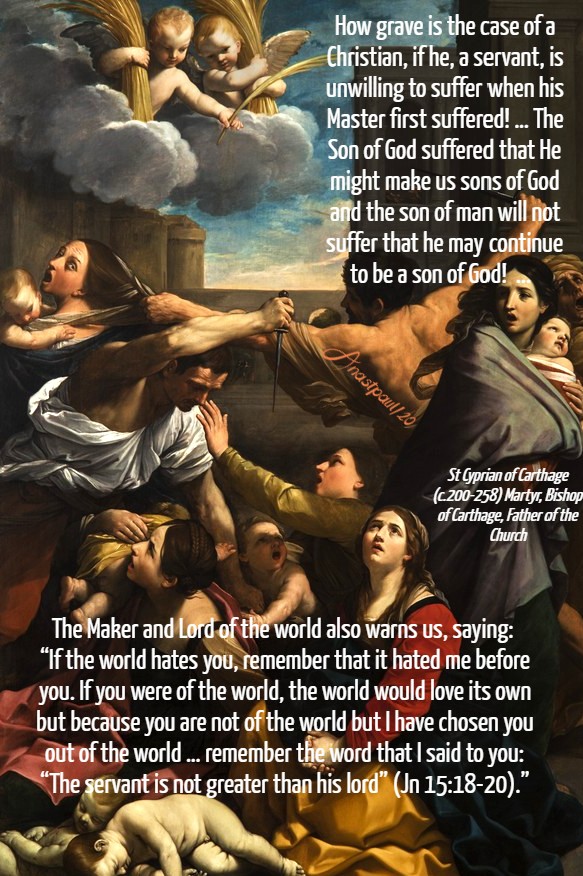
The nativity of Christ at once witnessed the martyrdom of infants, so that they who were two years old and under were slain for His name’s sake. An age, not yet fitted for the battle, appeared fit for the crown. That it might be manifest that they who are slain for Christ’s sake are innocent, innocent infancy was put to death for His name’s sake … How grave is the case of a Christian, if he, a servant, is unwilling to suffer when his Master first suffered! … The Son of God suffered that He might make us sons of God and the son of man will not suffer that he may continue to be a son of God! … The Maker and Lord of the world also warns us, saying: “If the world hates you, remember that it hated me before you. If you were of the world, the world would love its own but because you are not of the world but I have chosen you out of the world … remember the word that I said to you: “The servant is not greater than his lord” (Jn 15:18-20).” – St Cyprian of Carthage (c.200-258) Martyr, Bishop of Carthage, Father of the Church – Letter 55
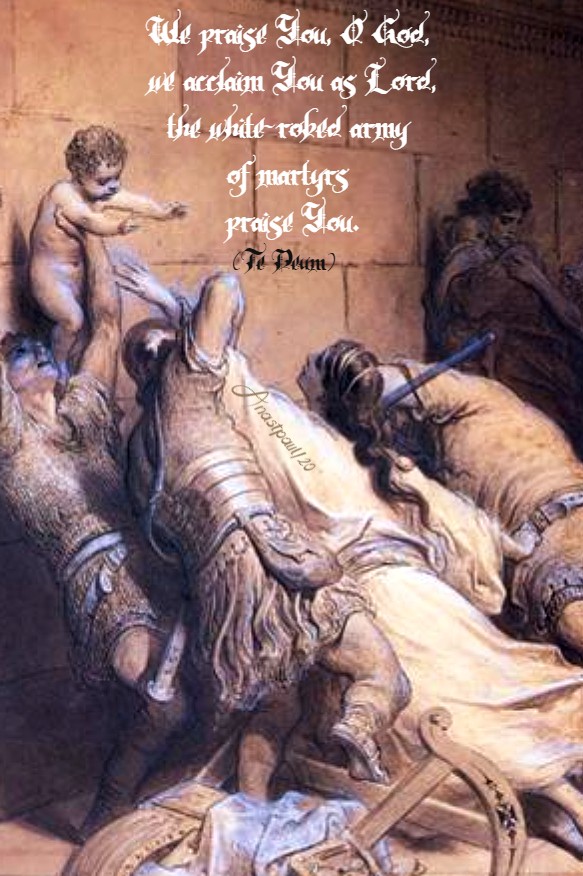
PRAYER – We praise You, O God, we acclaim You as Lord, the white-robed army of martyrs praise You. (from the Te Deum).
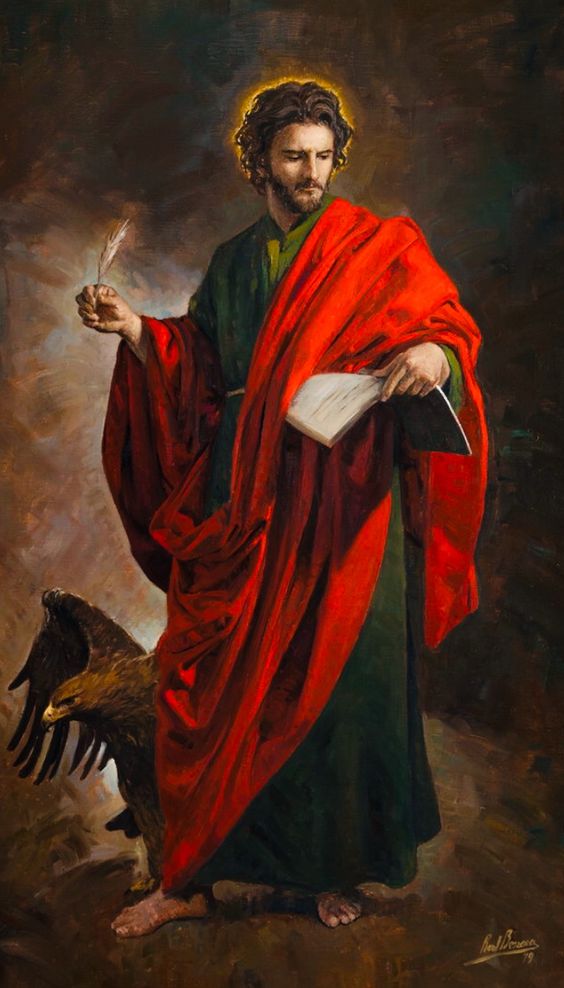
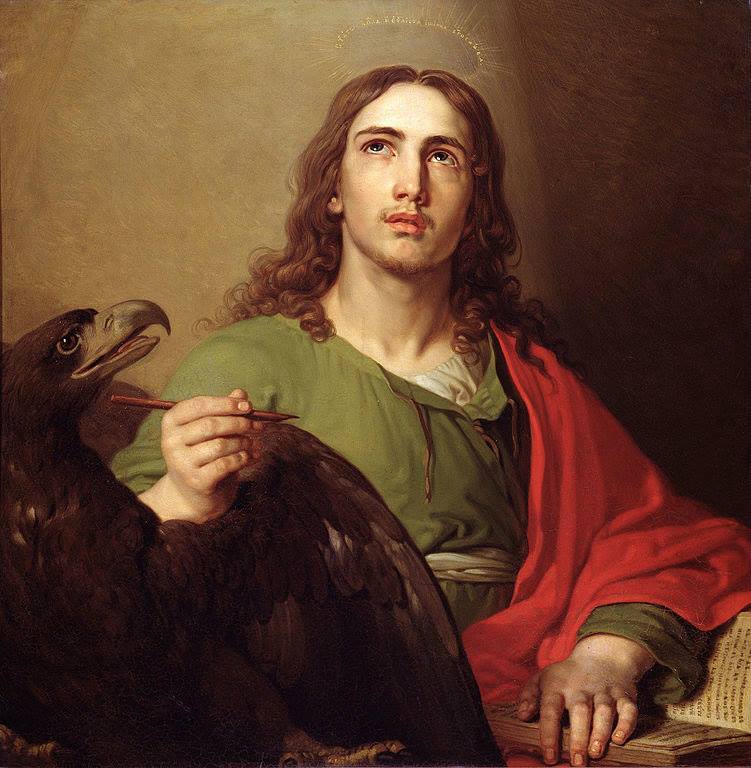
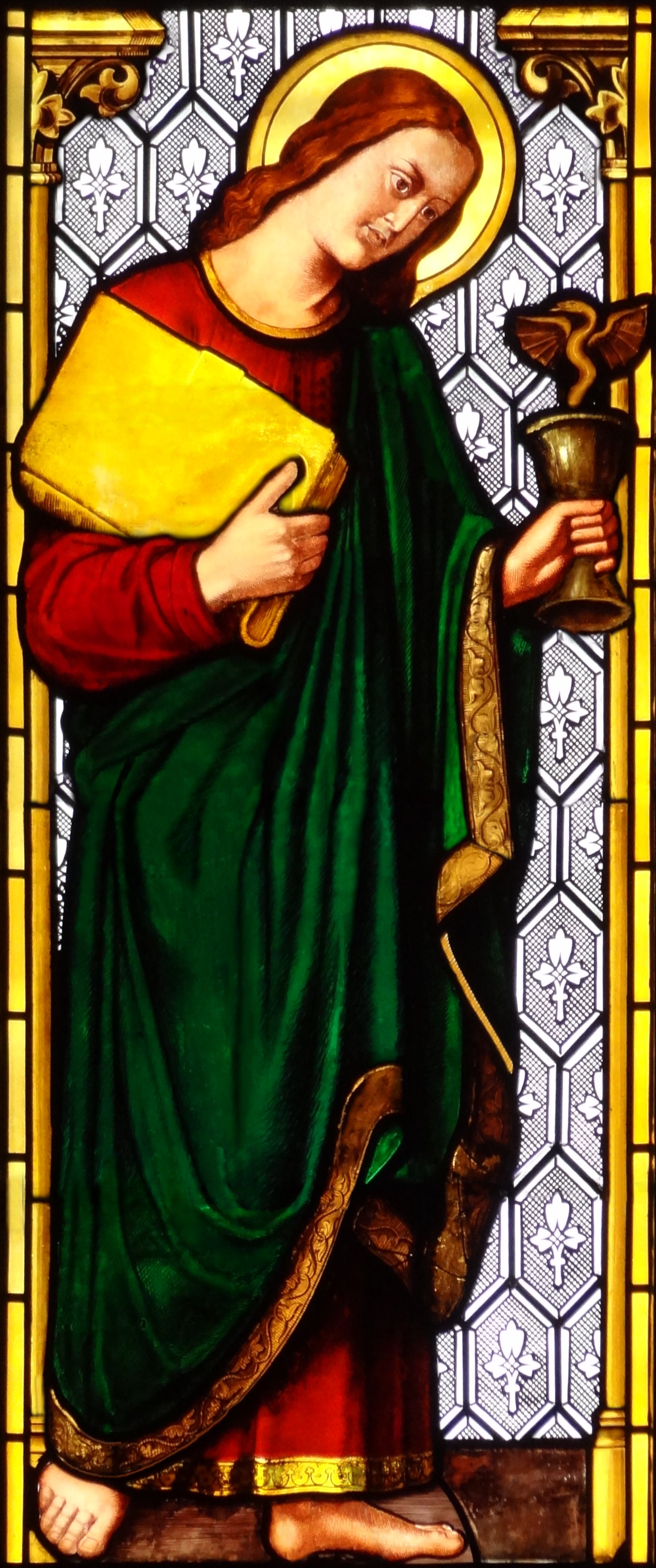
Thought for the Day – 26 December – Meditations with Antonio Cardinal Bacci (1881-1971) – Feast of St John the Apostle and Evangelist, the Beloved
St John the Apostle and Evangelist
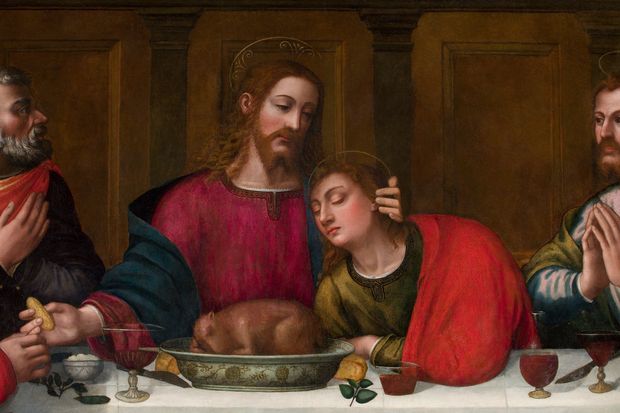
“St John was the beloved disciple of Jesus Christ. He was allowed, along with St Peter and St James, to enjoy the glory of the Transfiguration and, he was invited with them into the Garden of Gethsemane to witness the agonu ofour divine Redeemer. In the Cenacle, moreover, after he had received the Blessed Eucharist, he was the only one of the Apostles privileged to rest his head on the breast of Jesus. He stood at the foot of the Cross on Mount Calvary and heard his Master entrust to him, with His dying breath, the most precious treasure which still remained to Him on earth, the Blessed Virgin Mary. “Son, behold thy Mother.”
It is true, that Jesus loved all His Apostles, to all of whom He granted the happiness of enjoying His company, listening to His teaching and witnessing, His miracles. Even so, He had a special affection for St John. This was because John was a virgin when Jesus called him and remained so, all his life. The state of virginity is especially pleasing to God. It makes us like the Angels and, in a sense, superior to them, since these pure spirits are naturally chaste and, we can only succeed in being so, by means of great self-control. “Blessed are the pure of heart,” says Jesaus in the Gospel, “for they shall see God” (Mt 5:8).
The privilege of the vision of God is attributed, in a special way, to the pure of heart. Therefore, St John, the virgin Apostle, begins his Gospel with a descriptio of the intimate life of the eternal God. “In the beginning was the Word and the Word was with God and the Word, was God” (Jn 1:1). He soars above the earth like an eagle, as St Jerome observes and penetrates into the presence of God Himself.
We know that we shall never be called to scale such heights. We may not even have a vocation to live as virgins. But, we are all required to be clean of heart. Purity is a virtue which all Christians should possess in whatever manner is appropriate to their position in life. Let us examine ourselves strictly on this matter and make suitable resolutions for the future.”
Quote/s of the Day – 27 December – Feast of the Holy Family of Jesus, Mary and Joseph – On the Family by Pope Pius XII
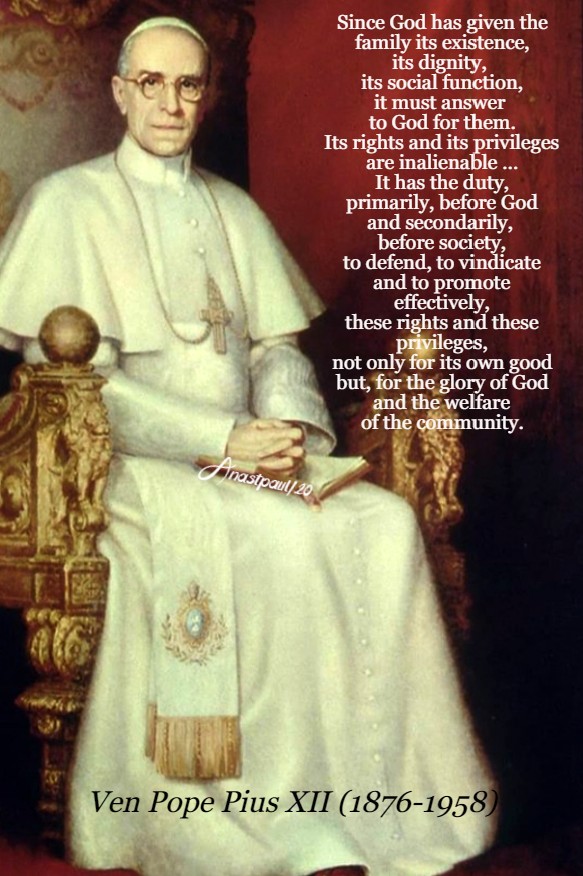
“Since God has given the family its existence, its dignity, its social function, it must answer to God for them. Its rights and its privileges are inalienable … It has the duty, primarily, before God and secondarily, before society, to defend, to vindicate and to promote effectively, these rights and these privileges, not only for its own good but, for the glory of God and the welfare of the community.”
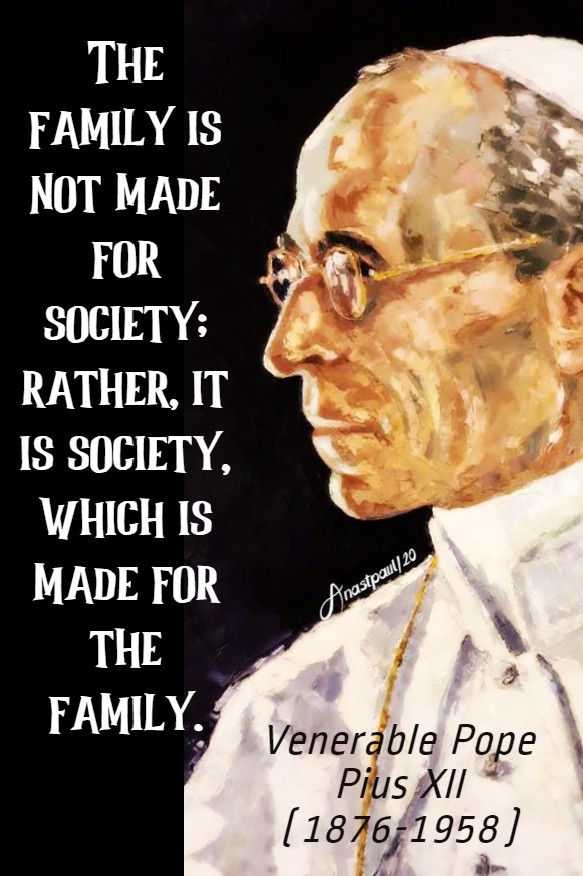
“ … The family is not made for society; rather, it is society, which is made for the family.”
“God did not create a human family made up of segregated, dissociated, mutually independent members. No; He would have them all united by the bond of total love of Him and consequent self-dedication to assisting each other to maintain that bond intact.”
“Christian mothers, if only you knew the future of distress and peril, of shame ill-restrained, that you prepare for your sons and daughters in imprudently accustoming them, to live hardly clothed and in making them lose the sense of modesty, you should be ashamed of yourselves! and of the harm done the little ones whom heaven entrusted to your care, to be reared in Christian dignity and culture.”
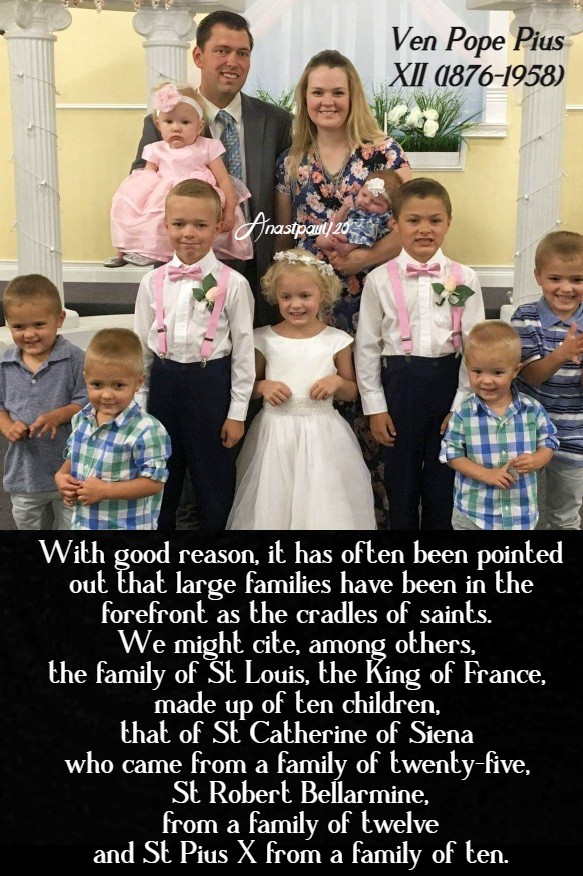
“With good reason, it has often been pointed out that large families have been in the forefront as the cradles of saints. We might cite, among others, the family of St Louis, the King of France, made up of ten children, that of St Catherine of Siena who came from a family of twenty-five, St Robert Bellarmine, from a family of twelve and St Pius X from a family of ten.”
Saint of the Day – 27 December – St John the Apostle and Evangelist. Patronages – • against burns; burn victims• against epilepsy• against foot problems• against hailstorms• against poisoning• art dealers• authors, writers• basket makers• bookbinders• booksellers• butchers• compositors• editors• engravers• friendships• glaziers• government officials• harvests• lithographers• notaries• painters• papermakers• publishers• saddle makers• scholars• sculptors• tanners• theologians• typesetters• vintners• Asia Minor (proclaimed on 26 October 1914 by Pope Benedict XV)• 6 Diocese• 7 Cities.
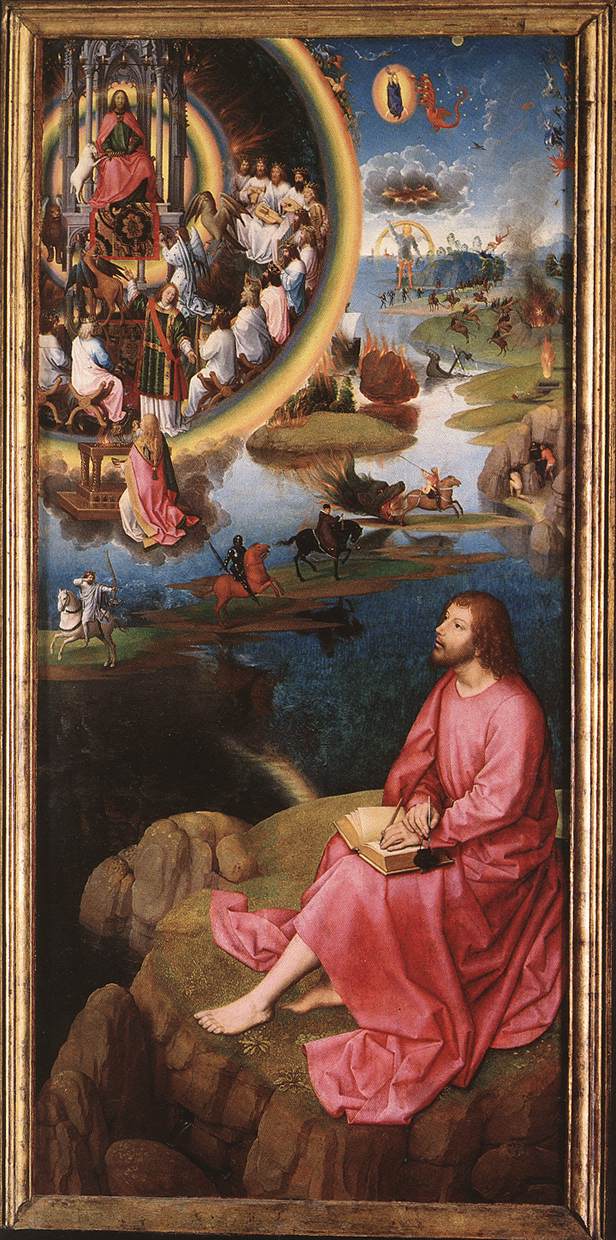
The days following Christmas are full of symbolic meaning, as on 26 December we honour the first Martyr, St Stephen, who shed his blood for Jesus. 27 December, honours St John the Evangelist, the Disciple of Jesus who wrote the Gospel of John and the book of Revelation. Interestingly enough, he is the only Gospel writer to omit a narrative of Jesus’ birth. Based on this fact alone, it seems strange to include him during the Octave of Christmas. What is the Church’s reason behind this choice? Servant of God, Dom Prosper Guéranger in his Liturgical Year, points to St John’s pure chastity and his focus on the Divinity of Christ, as the reasons why he is honoured now at the Crib of Christ.
Dom Prosper Guéranger OSB (1805-1875)
The Disciple Whom Jesus Loved, the Eagle
“Nearest to Jesus’ Crib, after Stephen, stands John, the Apostle and Evangelist. It was only right, that the first place should be assigned to him, who so loved his God, that he shed his blood in his service; for, as this God Himself declares, greater love than this hath no man, that he lay down his life for his friends [1 John, 15:13] and Martyrdom has ever been counted, by the Church, as the greatest act of love and as having, consequently, the power of remitting sins, like a second Baptism. But, next to the sacrifice of Blood, the noblest, the bravest and, which most wins the heart of Him, who is the Spouse of souls, is the sacrifice of Virginity. Now, just as St Stephen is looked upon as the type of Martyrs, St John is honoured as the Prince of Virgins. Martyrdom won for Stephen the Crown and palm; Virginity merited for John most singular prerogatives, which, while they show how dear to God, is holy Chastity, put this Disciple among those, who, by their dignity and influence, are above the rest of men.
St. John was of the family of David, as was our Blessed Lady. He was, consequently, a relation of Jesus. This same honour belonged to St James the Greater, his Brother; as also to St James the Less and St Jude, both Sons of Alpheus. When our Saint was in the prime of his youth, he left, not only his boat and nets, not only has lather Zebedee but, even his betrothed, when everything was prepared for the marriage. He followed Jesus and never once looked back. Hence, the special love which our Lord bore him. Others were Disciples or Apostles, John was the Friend, of Jesus. The cause of this our Lord’s partiality, was, as the Church tells us in the Liturgy, that John had offered his Virginity to the Man-God. Let us, on this his Feast, enumerate the graces and privileges that came to St John from his being The Disciple whom Jesus loved.
This very expression of the Gospel, which the Evangelist repeats several times — The Disciple whom Jesus loved [John, 13:23, 19:26, 21:7, 21:20] — says more than any commentary could do. St Peter, it is true, was chosen by our Divine Lord, to be the Head of the Apostolic College and the Rock whereon the Church was to be built – he, then, was honoured most but St John was loved most. Peter was bid to love more than the rest loved and he was able to say, in answer to Jesus’ thrice repeated question, that he did love Him in this highest way and yet, notwithstanding, John was more loved by Jesus than was Peter himself, because his Virginity deserved this special mark of honour.
Chastity of soul and body brings him, who possesses i,t into a sacred nearness and intimacy with God. Hence it was, that at the Last Supper – that Supper, which was to be renewed on our Altars, to the end of the world, in order to cure our spiritual infirmities and give life to our souls – John was placed near to Jesus, nay, was permitted, as the tenderly loved Disciple, to lean his head upon the Breast of the Man-God. Then it was, that he was filled and from their very Fountain, with Light and Love, it was both a recompense and a favour and became the source of two signal graces, which make St John an object of special reverence to the whole Church.
Divine wisdom, wishing to make known to the world, the Mystery of the Word and commit to Scripture, those profound secrets, which, so far, no pen of mortal had been permitted to write — the task was put upon John. Peter had been crucified, Paul had been beheaded and the rest of the Apostles had laid down their lives in testimony of the Truths they had been sent to preach to the world; John was the only one left in the Church. Heresy had already begun its blasphemies against the Apostolic Teachings; it refused to admit the Incarnate Word as the Son of God, Consubstantial to the Father. John was asked by the Churches to speak and he did so in language heavenly above measure. His Divine Master had reserved to this, his Virgin-Disciple, the honour of writing those sublime Mysteries, which the other Apostles had been commissioned only to teach — THE WORD WAS GOD, and this WORD WAS MADE FLESH for the salvation of mankind.
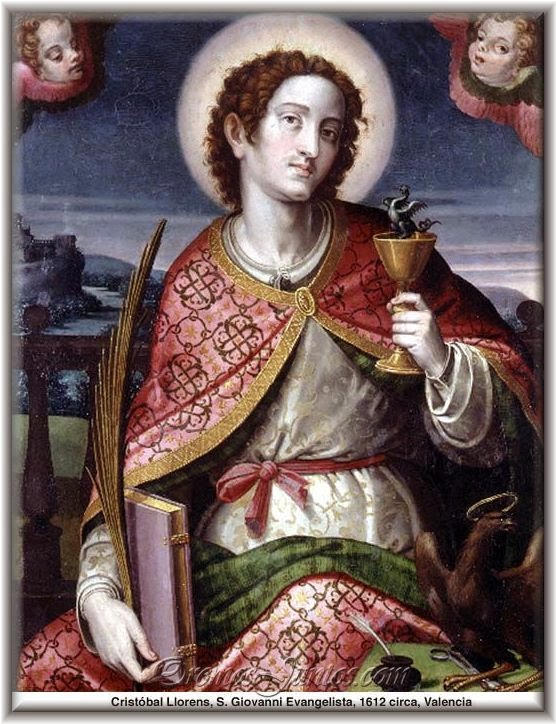
Thus did our Evangelist soar, like the Eagle, up to the Divine Sun and gaze upon Him with undazzled eye, because his heart and senses were pure and, therefore, fitted for such vision of the uncreated Light. If Moses, after having conversed with God in the cloud, came from the divine interview with rays of miraculous light encircling his head – how radiant must have been the face of St John, which had rested on the very Heart of Jesus, in whom are hid all the treasures of wisdom and knowledge! [Col. 2:3] how sublime his writings! how divine his teaching! Hence, the symbol of the Eagle, shown to the Prophet Ezechiel, [Ezechiel 1:10, 10:14] and to St John himself in his Revelations, [Apoc. 4:7] has been assigned to him by the Church and, to this title of The Eagle has been added, by universal tradition, the other beautiful name of Theologian. This was the first recompense given by Jesus to his Beloved John, a profound penetration into divine Mysteries. The second was the imparting to him a most ardent charity, which was equally a grace consequent upon his angelic purity, for purity unburdens the soul from grovelling egotistic affections and raises it to a chaste and generous love. John had treasured up in his heart the Discourses of his Master, he made them known to the Church and, especially, that divine one of the Last Supper, wherein Jesus had poured forth His whole Soul to His own, whom he had always tenderly loved but most so, at the end [John, 13:1]. He wrote his Epistles and Charity is his subject – God is Charity — he that loveth not, knoweth not God — perfect Charity casteth out fear — and so on throughout, always on Love. During the rest of his life, even when so enfeebled by old age as not to be able to walk, he was forever insisting upon all men loving each other, after the example of God, who had loved them and so loved them! Thus, he that had announced more clearly than the rest of the Apostles the divinity of the Incarnate Word, was by excellence, the Apostle of that divine Charity, which Jesus came to enkindle upon the earth.
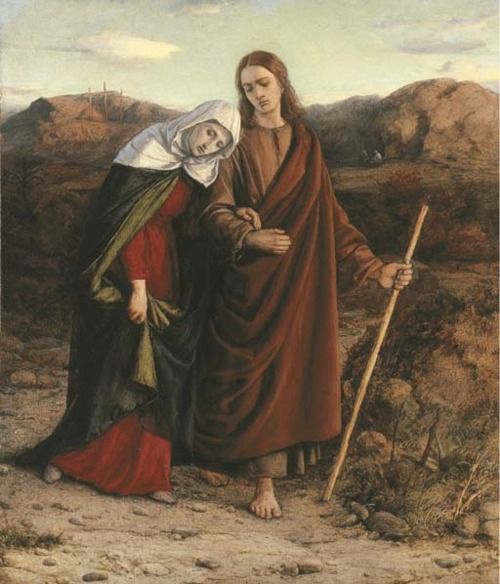
But, our Lord had a further gift to bestow and it was sweetly appropriate to the Virgin-Disciple. When dying on His cross, Jesus left Mary upon this earth. Joseph had been dead now some years. Who, then, shall watch over His Mother? who is there worthy of the charge? Will Jesus send His Angels to protect and console her? — for, surely, what man could ever merit to be to her as a second Joseph? Looking down, he sees the Virgin-Disciple standing at the foot of the Cross – we know the rest, John is to be Mary’s Son — Mary is to be John’s Mother. Oh! wonderful Chastity, that wins from Jesus such an inheritance as this! Peter, says St Peter Damian, shall have left to him the Church, the Mother of men; but John, shall receive Mary, the Mother of God, whom he will love as his own dearest Treasure and to whom, he will stand in Jesus’ stead; whilst Mary will tenderly love John, her Jesus’ Friend, as her Son.
The Blessed Virgin in the House of St John by Dante Gabriel Rossetti, 1859
Can we be surprised after this, that St John is looked upon by the Church as one of her greatest glories? He is a Relative of Jesus in the flesh; he is an Apostle, a Virgin, the Friend of the Divine Spouse, the Eagle, the Theologian, the Son of Mary; he is an Evangelist, by the history he has given of the Life of his Divine Master and Friend; he is a Sacred Writer, by the three Epistles he wrote under the inspiration of the Holy Ghost; he is a Prophet, by his mysterious Apocalypse, wherein are treasured the secrets of time and eternity. But, is he a Martyr? Yes, for if he did not complete his sacrifice, he drank the Chalice of Jesus [Matt. 20:22], when, after being cruelly scourged, he was thrown into a caldron of boiling oil, before the Latin Gate, at Rome. He was, therefore, a Martyr in desire and intention, though not in fact. If our Lord, wishing to prolong a life so dear to the Church, as well as to show how he loves and honours Virginity, — miraculously stayed the effects of the frightful punishment, St John had, on his part, unreservedly accepted Martyrdom.
Such is the companion of Stephen at the Crib, wherein lies our Infant Jesus. If the Protomartyr dazzles us with the robes he wears of the bright scarlet of his own blood — is not the virginal whiteness of John’s vestment fairer than the untrod snow? The spotless beauty of the Lilies of Mary’s adopted Son and the bright vermilion of Stephen’s Roses — what is there more lovely than their union? Glory, then, be to our New-Born King, whose court is tapestried with such heaven-made colours as these! Yes, Bethlehem’s Stable is a very heaven on earth and we have seen its transformation. First, we saw Mary and Joseph alone there — they were adoring Jesus in his Crib; then, immediately, there descended a heavenly host of Angels singing the wonderful Hymn; the Shepherds soon followed, the humble simple-hearted Shepherds; after these, entered Stephen the Crowned and John the Beloved Disciple; and, even before there enters the pageant of the devout Magi, we shall have others coming in and there will be, each day, grander glory in the Cave and gladder joy in our hearts. Oh! this Birth of our Jesus! Humble as it seems, yet, how divine! What King or Emperor ever received, in his gilded cradle, honours like these shown to the Babe of Bethlehem? Let us unite our homage with that given him by these the favoured inmates of his court. Yesterday, the sight of the Palm in Stephen’s hand animated us and we offered to our Jesus the promise of a stronger Faith: to-day, the Wreath, that decks the brow of the Beloved Disciple, breathes upon the Church the heavenly fragrance of Virginity — an intenser love of Purity must be our resolution and our tribute to the Lamb.
Thought for the Day – 26 December – Meditations with Antonio Cardinal Bacci (1881-1971)
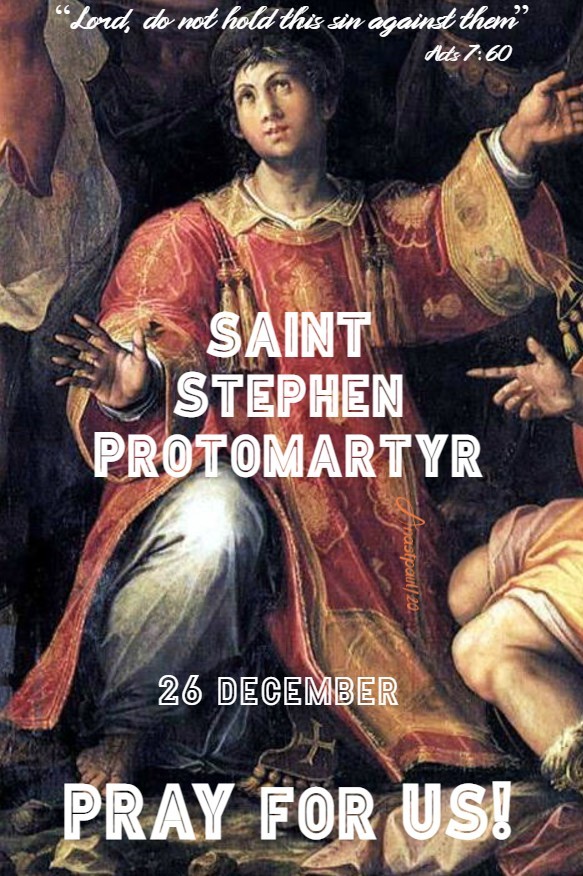
St Stephen, the First Martyr
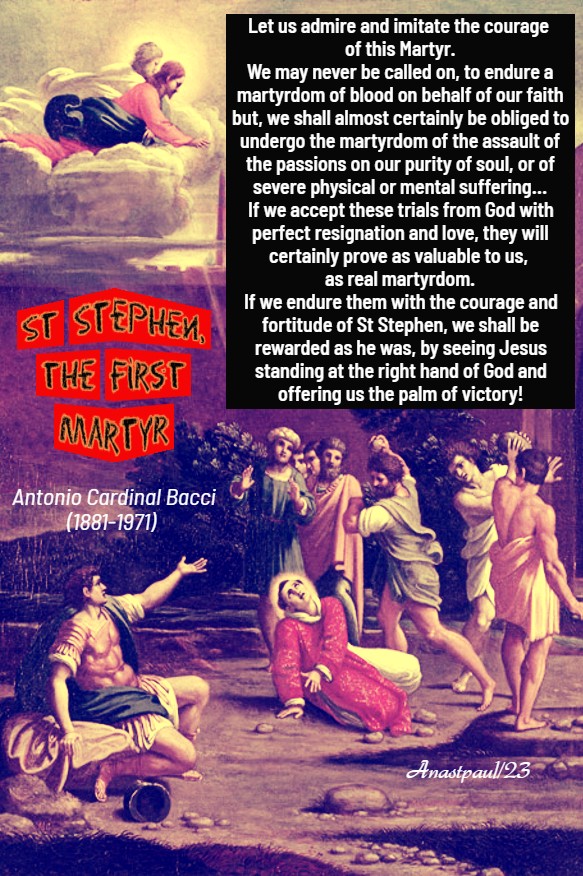
“Among the original seven Deacons nominated by the Apostles, there was one name Stephen, who was outstanding for his sanctity and extraordinary spiritual gifts. Being enlightened by God, this young man dared to rebuke the Jews in public for their hardness of heart and openly defended the doctrine of Christ, Whom he proclaimed to be the Saviour and Redeemer of the world. One day when he was threatened by his foes, Stephen raised his eyes trustfully towards Heaven and said: “Behold, I see the heavens opened and the Son of Man standing at the right hand of God.” The Jews could no longer restrain their fury and proceeded to drag the young man outside the city. There they left their garments in the care of a youth named Saul, while they savagely stoned Stephen to death. Stricken to his knees by the force of the missiles, the saintly young disciple continued to look towards Heaven. “Lord Jesus,” he cried, “receive my spirit.” Before he breathed his last, he forgave his enemies in the manner of his divine Master. “Lord,” he prayed, “do not lay this sin against them.” And with these words he fell asleep (Cf Acts 7:51-60; 8:1-2).
Let us admire and imitate the courage of this Martyr. We may never be called on, to endure a martyrdom of blood on behalf of our faith but, we shall almost certainly be obliged to undergo the martyrdom of the assault of the passions on our purity of soul, or of severe physical or mental suffering… If we accept these trials from God with perfect resignation and love, they will certainly prove as valuable to us, as real martyrdom. If we endure them with the courage and fortitude of St Stephen, we shall be rewarded as he was, by seeing Jesus standing at the right hand of God and offering us the palm of victory!”
Quote/s of the Day – 26 December – Feast of St Stephen the ProtoMartyr and The Second Day in the Christmas Octave
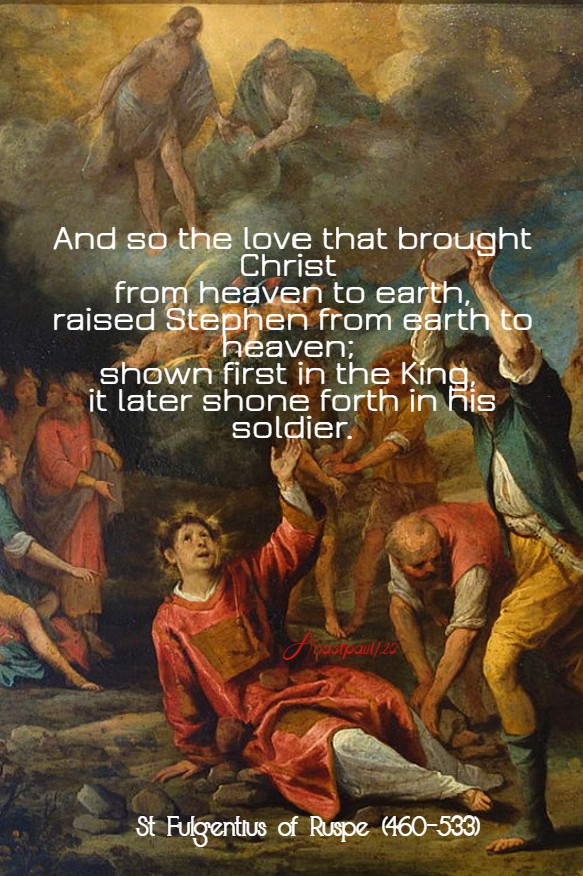
“And so the love that brought Christ from heaven to earth, raised Stephen from earth to heaven; shown first in the King, it later shone forth in his soldier.”
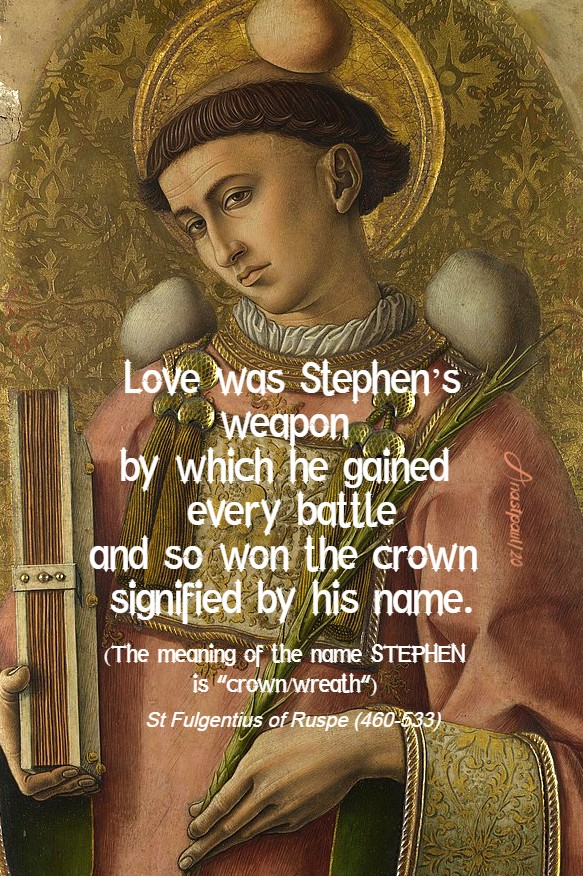
“Love was Stephen’s weapon by which he gained every battle and so won the crown signified by his name.” (The meaning of the anme STEPHEN is “crown/wreath”)
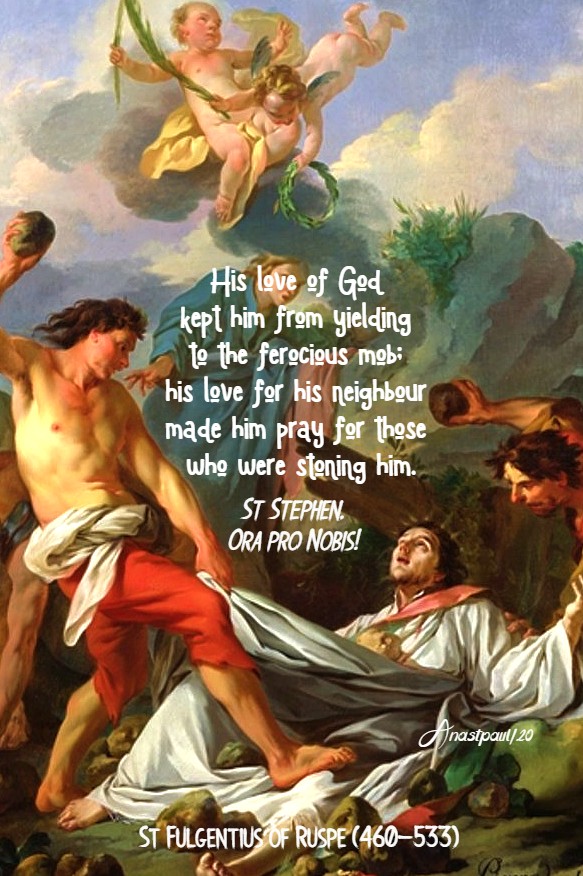
“His love of God kept him from yielding to the ferocious mob; his love for his neighbour made him pray for those who were stoning him.”
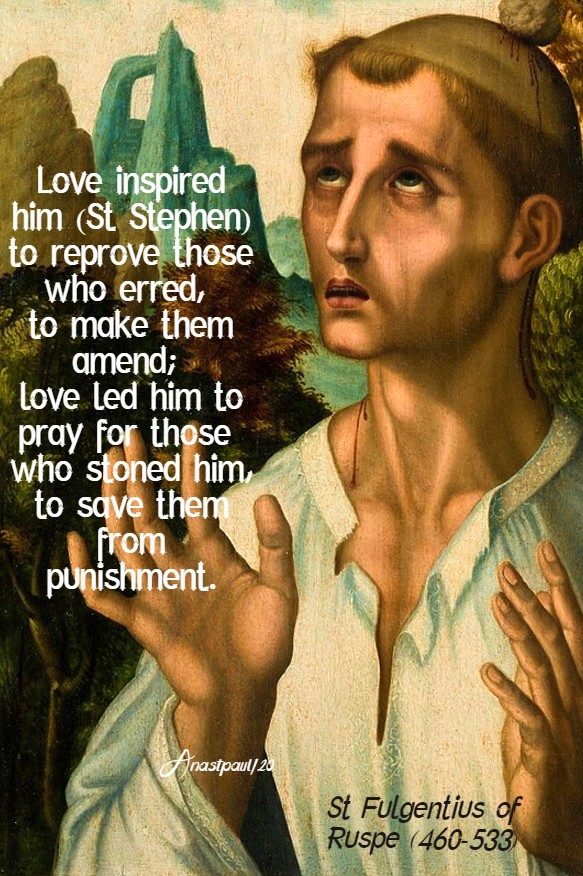
“Love inspired him to reprove those who erred, to make them amend; love led him to pray for those who stoned him, to save them from punishment.”
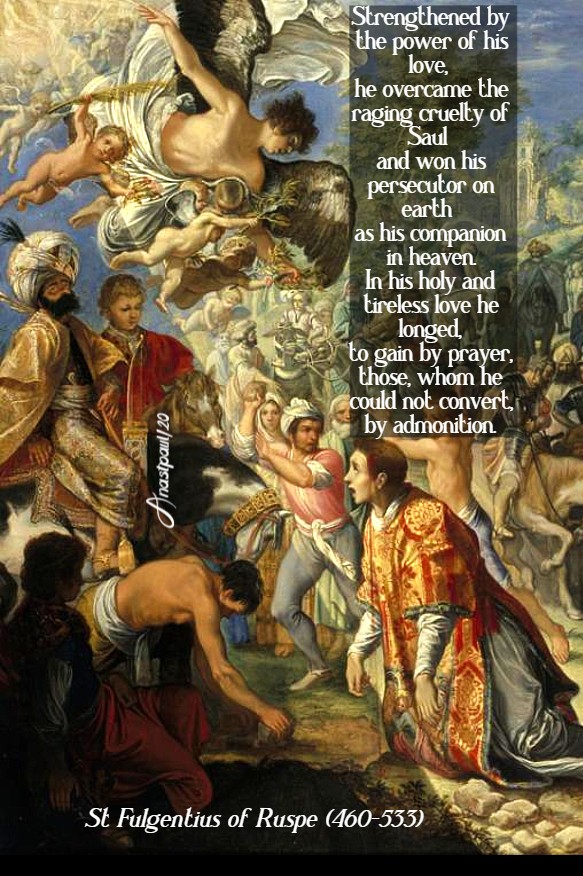
“Strengthened by the power of his love, he overcame the raging cruelty of Saul and won his persecutor on earth as his companion in heaven. In his holy and tireless love he longed, to gain by prayer, those, whom he could not convert, by admonition.”
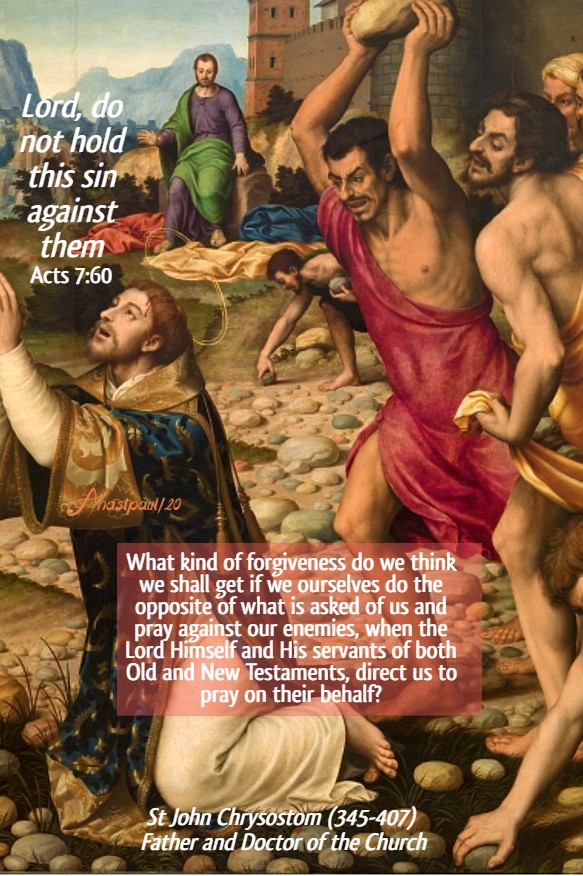
“Lord, do not hold this sin against them” – Acts 7:60
REFLECTION – “Let us imitate our Lord and pray for our enemies … He was crucified yet, at the same time, prayed to His Father for the sake of those who were crucifying Him. But how could I possibly imitate our Lord, one might ask? If you want to, you can. If you weren’t able to do it how could He have said: “Learn from me for I am meek and humble of heart”? (Mt 11:29) …
If you have difficulty in imitating our Lord, at least imitate him who is also His servant, his deacon. I would speak of Stephen. Just as Christ, in the midst of those crucifying Him, without considering the cross, without considering His own predicament, pleaded with the Father on behalf of His tormentors (Lk 23:34), so His servant, surrounded by those who were stoning him, attacked by all, crushed beneath a hail of stones and without taking any account of the suffering they were causing him, said: “Lord, do not hold this sin against them” (Acts 7:60). Do you see how the Son spoke and how His servant prayed? The former said: “Father, forgive them for they know not what they do,” and the latter said: “Lord, do not hold this sin against them.” Moreover, to make us realise better the fervour with which he was praying, he did not just pray as he stood beneath the blows of the stones but he spoke on his knees with sincerity and compassion …
Christ said: “Father, forgive them for they know not what they do.” Stephen cried out: “Lord, do not hold this sin against them.” Paul, in his turn, said: “I offer up this sacrifice for my brethren, my kin according to race” (cf. Rm 9:3). Moses said: “If you would only forgive their sin! And if you will not, then strike me out of the book that you have written!” (Ex 32:32). David said: “May your hand fall on me and my kindred,” (2 Sam 24:17). … What kind of forgiveness do we think we shall get if we ourselves do the opposite of what is asked of us and pray against our enemies, when the Lord Himself and His servants of both Old and New Testaments, direct us to pray on their behalf?” – St John Chrysostom (345-407) Father and Doctor of the Church – Sermon for Good Friday “The Cross and the bandit”
PRAYER – Grant us Your Grace, Lord God Almighty, to practise what we worship. Teach us to love our enemies and to pray for those who persecute us. As we keep the feast of Saint Stephen, may we learn from him, who learned from You and prayed, even for the men who stoned him to death. Through Christ our Lord, with the Holy Spirit, God now and forever, amen.
Thought for the Day – 25 December – Meditations with Antonio Cardinal Bacci (1881-1971)
The Feast of the Nativity
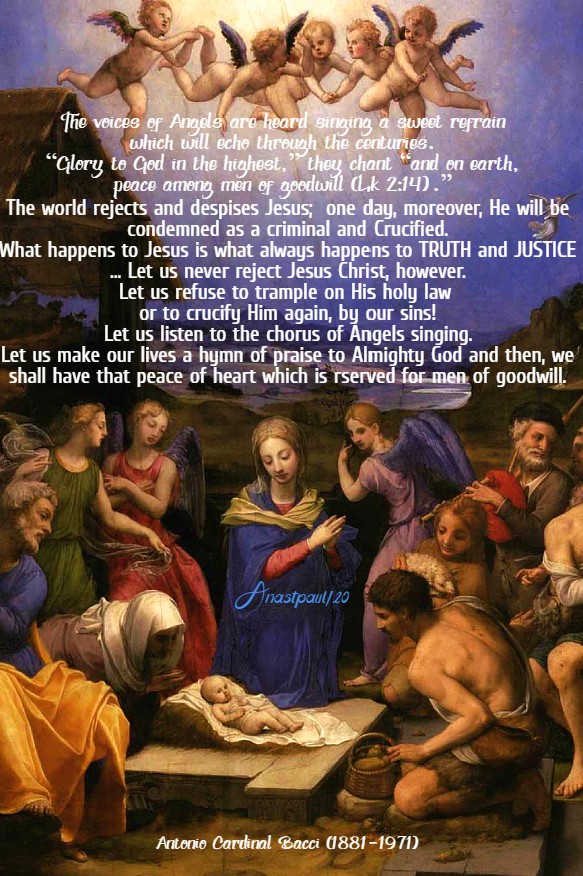
“While the earth, plunged in darkness, ignores the birth of Jesus, the sky brightens above the lowly barn in which the Infant is lying. The voices of Angels are heard singing a sweet refrain which will echo through the centuries. “Glory to God in the highest,” they chant “and on earth, peace among men of goodwill (Lk 2:14).”
The world rejects and despises Jesus; one day, moreover, He will be condemned as a criminal and Crucified. What happens to Jesus is what always happens to TRUTH and JUSTICE, which are often spurned by men but are always victorious in the end. For a time, truth and justice may seem to have been defeated once and for all but then, they triumph in an extraordinary manner. The example of Christ is enough to convince us of this.
Let us never reject Jesus Christ, however. Let us refuse to trample on His holy law or to crucify Him again, by our sins! Let us listen to the chorus of Angels singing. Let us make our lives a hymn of praise to Almighty God and then, we shall have that peace of heart which is rserved for men of goodwill.”
Quote/s of the Day – 25 December – The Solemnity of the Nativity of Our Lord, Jesus Christ and remembering Blessed Jacopone da Todi OFM (1230-1306)
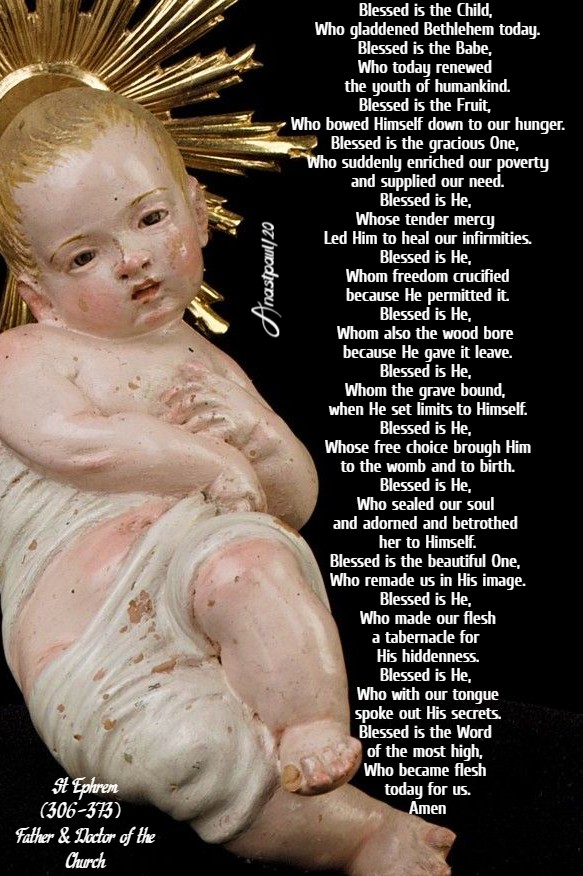
“Blessed is the Child, Who gladdened Bethlehem today. Blessed is the Babe, Who today renewed the youth of humankind. Blessed is the Fruit, Who bowed Himself down to our hunger. Blessed is the gracious One, Who suddenly enriched our poverty and supplied our need. Blessed is He, Whose tender mercy Led Him to heal our infirmities. Blessed is He, Whom freedom crucified because He permitted it. Blessed is He, Whom also the wood bore because He gave it leave. Blessed is He, Whom the grave bound, when He set limits to Himself. Blessed is He, Whose free choice brough Him to the womb and to birth. Blessed is He, Who sealed our soul and adorned and betrothed her to Himself. Blessed is the beautiful One, Who remade us in His image. Blessed is He, Who made our flesh a tabernacle for His hiddenness. Blessed is He, Who with our tongue spoke out His secrets. Blessed is the Word of the most high, Who became flesh today for us. Amen”
St Ephrem (306-373) Father & Doctor of the Church
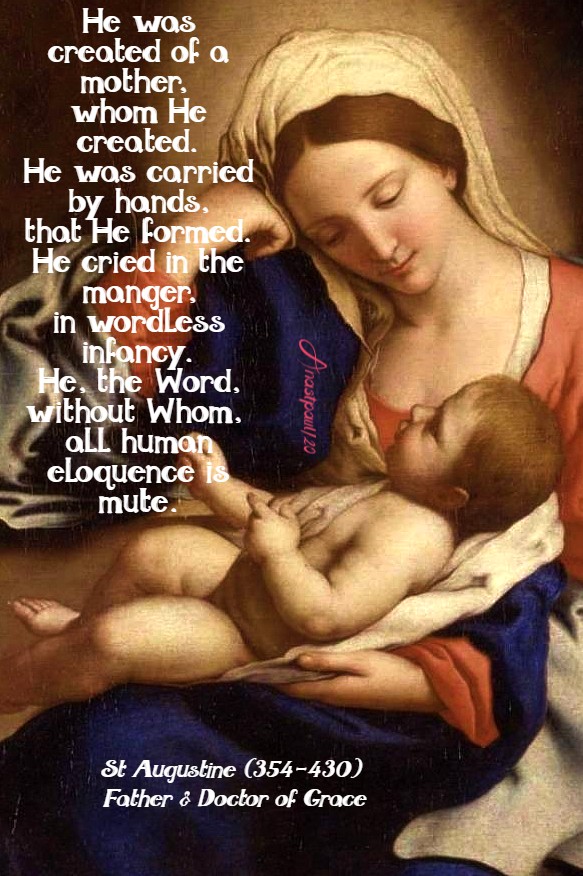
“He was created of a mother, whom He created. He was carried by hands, that He formed. He cried in the manger, in wordless infancy. He, the Word, without Whom, all human eloquence is mute.”
St Augustine (354-430) Father & Doctor of Grace
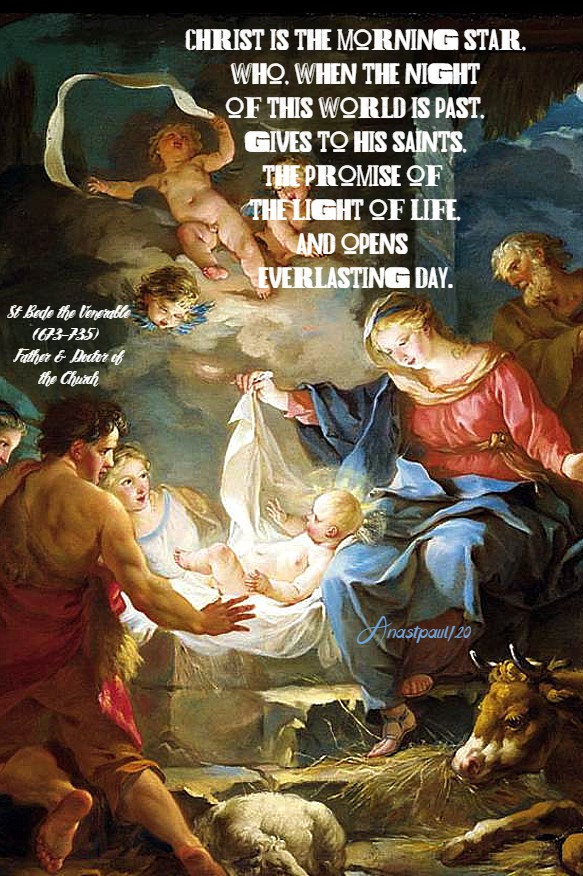
“Christ is the Morning Star, Who, when the night of this world is past, gives to His saints, the promise of the light of life, and opens everlasting day.”
St Bede the Venerable (673-735) Father & Doctor of the Church
“He came from His royal throne, the stern Conqueror of error and the gentle Apostle of love.”
William of Saint Thierry (c 1075-1148)
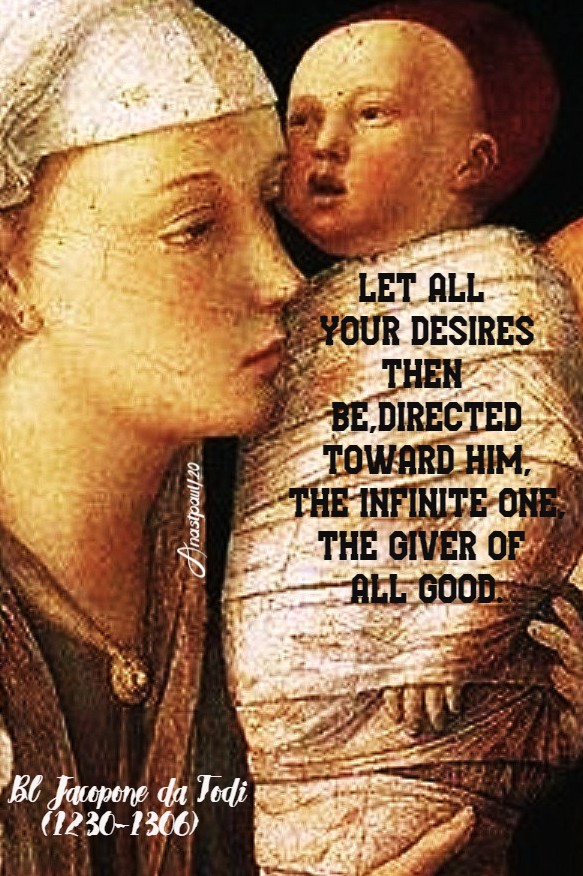
“Let all your desires then be, directed toward Him, the Infinite One, the Giver of all Good.”
Bl Jacopone da Todi (1230-1306)
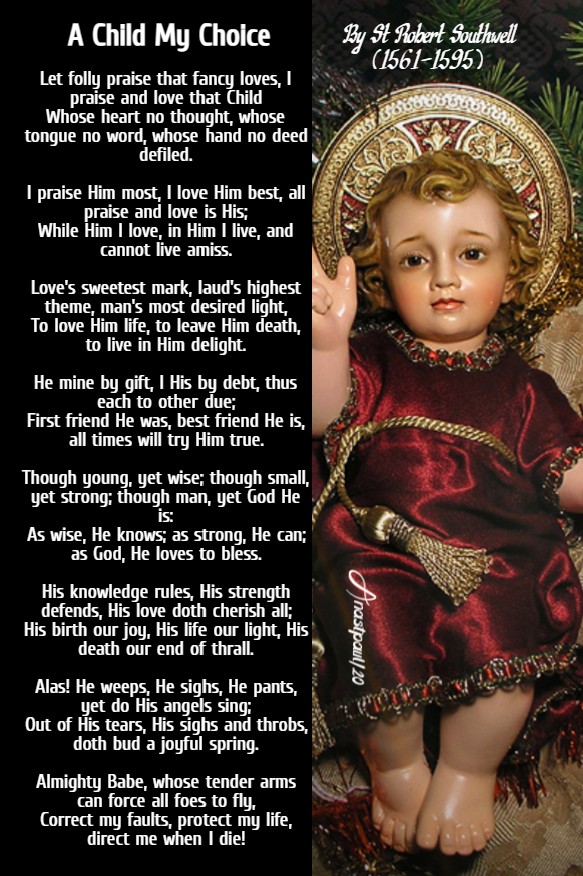
A Child My Choice By St Robert Southwell (1561-1595) Martyr
Let folly praise that fancy loves, I praise and love that Child Whose heart no thought, whose tongue no word, whose hand no deed defiled.
I praise Him most, I love Him best, all praise and love is His; While Him I love, in Him I live, and cannot live amiss.
Love’s sweetest mark, laud’s highest theme, man’s most desired light, To love Him life, to leave Him death, to live in Him delight.
He mine by gift, I His by debt, thus each to other due; First friend He was, best friend He is, all times will try Him true.
Though young, yet wise; though small, yet strong; though man, yet God He is: As wise, He knows; as strong, He can; as God, He loves to bless.
His knowledge rules, His strength defends, His love doth cherish all; His birth our joy, His life our light, His death our end of thrall.
Alas! He weeps, He sighs, He pants, yet do His angels sing; Out of His tears, His sighs and throbs, doth bud a joyful spring.
Almighty Babe, whose tender arms can force all foes to fly, Correct my faults, protect my life, direct me when I die!
Christ has been born for us, come, let us adore Him!
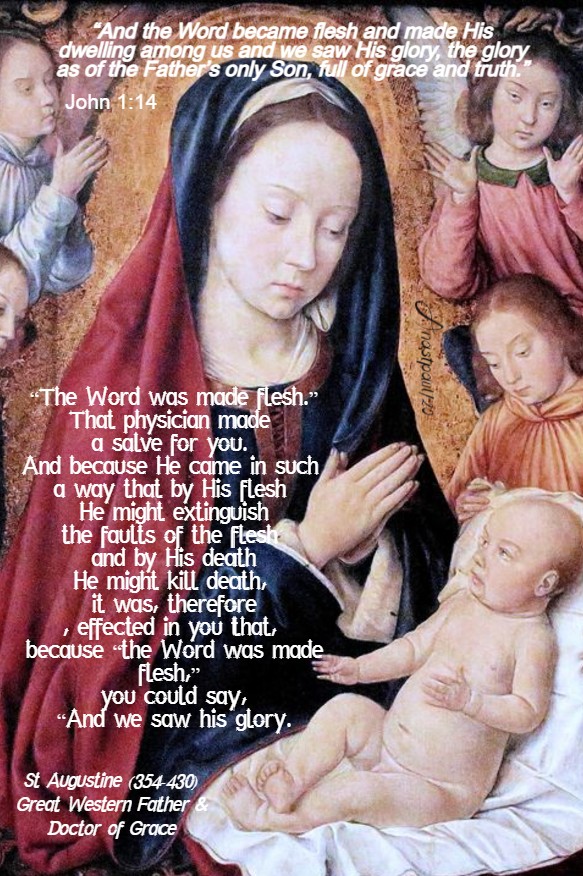
“And the Word became flesh and made His dwelling among us and we saw His glory, the glory as of the Father’s only Son, full of grace and truth.” – John 1:14
REFLECTION – “His glory no-one could see unless he was healed by the lowliness of His flesh. Why could we not see? Concentrate, my beloved people and see what I am saying. Dust, so to speak, had forcibly entered humanity’s eye; earth had entered it, had injured the eye and it could not see the light. That injured eye is anointed; it was injured by earth and earth is put there that it may be healed. For all salves and medicines are nothing but [compounds] of the earth. You have been blinded by dust, you are healed by dust; thus the flesh has blinded you, flesh heals you. For the soul had become carnal by assenting to carnal passions; from that the eye of the heart had been blinded. “The Word was made flesh.” That physician made a salve for you. And because He came in such a way that by His flesh He might extinguish the faults of the flesh and by His death He might kill death, it was, therefore, effected in you that, because “the Word was made flesh,” you could say, “And we saw his glory.” – St Augustine (354-430) Great Western Father & Doctor of Grace –Tractates on the Gospel of John, 2
PRAYER – Almighty God, Your incarnate Word fills us with the new light He brought to men. Let the light of faith in our hearts, shine through all that we do and say. We make our prayer through Jesus Christ, our Lord, with the Holy Spirit, God forever, amen.
The Word was God in the beginning and before all time, today, He is born to us, the Saviour of the world.
Our Morning Offering – 25 December – The Solemnity of the Nativity of Our Lord, Jesus Christ
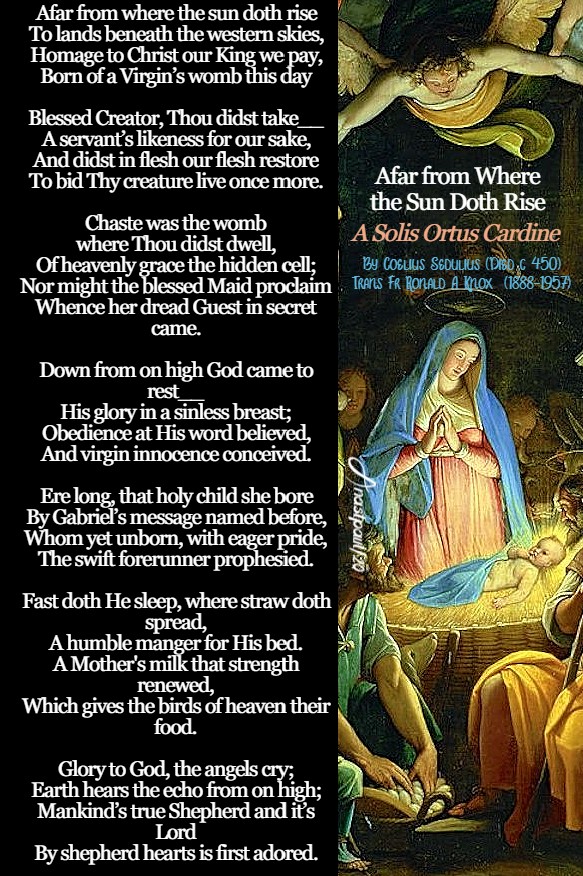
Afar from Where the Sun Doth Rise A Solis Ortus Cardine By Coelius Sedulius (Died c 450) Trans Fr Ronald A Knox (1888-1957)
Afar from where the sun doth rise To lands beneath the western skies, Homage to Christ our King we pay, Born of a Virgin’s womb this day
Blessed Creator, Thou didst take__ A servant’s likeness for our sake, And didst in flesh our flesh restore To bid Thy creature live once more.
Chaste was the womb where Thou didst dwell, Of heavenly grace the hidden cell; Nor might the blessed Maid proclaim Whence her dread Guest in secret came.
Down from on high God came to rest__ His glory in a sinless breast; Obedience at His word believed, And virgin innocence conceived.
Ere long, that holy child she bore By Gabriel’s message named before, Whom yet unborn, with eager pride, The swift forerunner prophesied.
Fast doth He sleep, where straw doth spread, A humble manger for His bed. A Mother’s milk that strength renewed, Which gives the birds of heaven their food.
Glory to God, the angels cry; Earth hears the echo from on high; Mankind’s true Shepherd and it’s Lord By shepherd hearts is first adored.
“A Solis Ortus Cardine…” (Latin for “From the Pivot of the Sun’s Rising”) is a poem by Christian Poet, Coelius Sedulius (Died c 450), recounting Christ’s life from His birth to His resurrection. Its 23 verses each begin with a consecutive letter of the Latin alphabet, making the poem an abecedarius. It is one of the oldest parts of the Roman Catholic liturgy, with two hymns formed from the first seven and four later verses. There have been monastic translations into Anglo-Saxon and later translations into other languages..


















 AnaStpaul
You must be logged in to post a comment.